




Disclosure: some links in this article are affiliate links. If you sign up through one, HeroHunt may earn a commission at no extra cost to you.
The recruiting industry has been one of the industries with the most developments in recent years. When covid hit, hiring was hit hardest. When we recovered, hiring jumped up. Current economic turbulence makes things even more exciting.
But one thing is for sure. Companies need talent. Without the right people, no business.
An exciting industry for sure. And especially if you’re starting your own recruiting business.
This guide will walk you through all the necessary steps for you to set up your recruiting agency.
- Get registered
- Choose your niche
- Build your brand
- Decide on a business model
- Find customers
- Go recruit!
1. Get registered
In most countries you need to be a registered business to legally do business with customers.
Every country has its own legal structures, options for starting a business and rules so you have to figure out what those are within your country.
Not the most exciting part of setting up a business, but for you to receive money from customers and to operate legally you need to have your business registered.
Take into account that when you want to do business internationally (cross-border) you might need a different legal set up than when you do business only locally.
Also financially there are a lot of things to consider, like tax.
Best is to involve an accountant or financial advisor with the experience needed for your specific set up. If you don’t have that money to spend yet, start with a simple structure. You usually can change your legal entity later, although it might require some work.
Here are the basic steps to go through to get registered:
Step 1. Research possible legal structures
Find out which entity you can set up within the country where you want to register your agency. Is it going to be your home country? Then you might already be familiar with some of the rules and options for registering your business entity.
Google the regulations in your region, which governmental organizations processes business registration and seek advice from people who you know who set up a business before in your region.
Step 2. Get registered
File your request to register your business. Depending on the country’s efficiency of setting businesses this can take anywhere between a couple days to a couple of months.
This doesn’t mean you cannot already start on building your business. There is a lot of work you can already do without being registered (building a website, setting up your recruitment process, starting networking etc.).
Step 3. Keep your documents safe!
Keep all the legal documentation that you build up somewhere in a safe and organized place. Bad administration can cost a lot of money and cause problems in the future. Take your time to develop a disciplined way of working and keep your administrative hygiene in order. Use software that can manage your finances like Freshbooks, file storage like Google Drive and an applicant tracking system (ATS) like Manatal to keep your candidate and client records organized.
Manatal
Most new agencies run their first placements out of a spreadsheet and an inbox. It holds up until roughly the third live role, at which point candidate history starts going missing and you cannot remember which client saw which CV. That is the moment clients stop trusting you, so it is worth solving early rather than migrating a year of mess later. Manatal is the cheapest credible starting point at $15/user/month billed annually ($19 if you pay month to month), with a 14-day trial that does not ask for a card. It is built for agencies rather than internal HR teams, so it tracks clients and placements alongside candidates, which is the half an HR-oriented or free ATS leaves out. The honest catch: the $15 tier caps at 15 active jobs and 10,000 candidates. Once you are running more than 15 live roles you are really pricing the $35/user/month tier, and at that point you should genuinely compare it against Bullhorn and JobAdder rather than assume the entry price still applies.
2. Choose your niche
A niche is a particular part of the industry that you focus on. An example of a niche of a recruitment business could be ‘Permanent tech talent for startups’.
It’s important to pick a niche because when you focus on a particular part of the market it’s a lot easier to build up knowledge and network quickly instead of going after all kinds of different recruitment projects.
You don’t have to know exactly what you want to focus on initially because developing your specialism and brand around a niche is an iterative process and takes time. Also, you can always expand your services across market segments later.
It does help however to quickly gain experience and a name in a segment where customers don’t have that focus on a particular candidate market. This will be part of your added value as a recruitment agency.
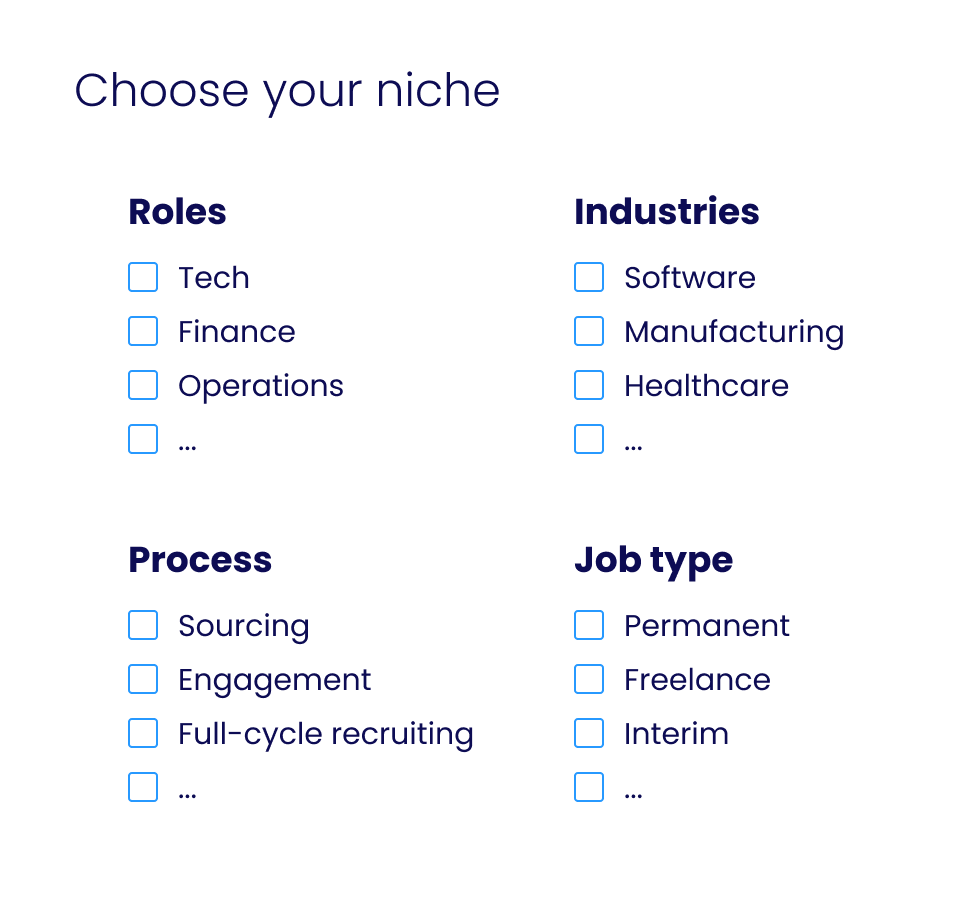
You can look at niches from a couple different angles:
- Roles
- Industries
- Process
- Job type
Roles
Are you going to focus on finding tech talent only or is it financial professionals you’re going to help customers find? The candidate market you focus on can bring a lot of value to the customer since you will have built up knowledge of how to source these candidates and also a network of candidates within that niche.
Industries
Are you going to focus on the corporate market or on startups? A startup company will have fundamentally different requirements to talent than corporations. So you might want to establish your recruitment agency as one that can help with the specific needs of certain growth stages of a company. Also the industry angle can be a relevant one to choose your niche in, is it going to be healthcare organizations, financial institutions, governments or software companies you’re going to help?
Process
Are you going to focus on the sourcing part of recruitment or are you going to be a full-cycle recruitment agency? Based on the companies you like to help you probably also have a certain focus in terms of process. Bigger companies might need your help specifically for the sourcing part of recruitment (finding talent and reaching out) and smaller companies might be looking for more of a full-cycle approach since they don’t have the resources and experience to do recruitment themselves.
Job type
Are you going to focus on permanent or contract jobs? Recruiting for contract roles fulfills a different need than permanent roles and requires a different expertise and is more reliant on the network that you will build up yourself. Whereas recruitment for permanent positions is much more focussed on long term commitment and the right fit with company culture.
3. Build your brand
You’re not the only recruitment agency. Competition in the recruitment industry is very real and you have to differentiate yourself from others to win deals. The good news is that most recruitment agencies don’t invest a lot in building a brand.
The biggest part of agencies, especially the smaller ones, have unfinished and very basic websites, monstrous logos and zero content.
This is an opportunity for you to stand out with a beautiful brand that clearly communicates your focus (niche) and possibly also educates potential customers on where to find good recruitment services (that’s you!).
Website
A great website lets you stand out and get the attention from a customer. It also is the gateway for information about your recruitment services for potential customers. Your website should make clear what services you offer, which niche your serving and what your approach is.
Your website can also be the place where you create and share content like videos and blogs. If you do this right potential customers are even able to find you in search engines like Google so you can create a steady stream of organic traffic and eventually leads for your business.
Here’s some inspiration from great recruitment agency websites:
Your options for building a website:
- Hire a website developer: through for example Fiverr, UpWork, or someone in your own network
- Build it yourself: with website builders like Squarespace, Web.com or Wix.
Content
Content can be a true growth engine for your recruitment business. Many potential customers start their search for recruitment agency services online. If you have good content, you might be one of the agencies ending on top of their search results and probably the one they click on.
Next to appearing in search results, content also helps you to establish your recruitment brand in other ways. You can share content on social media, in events and in newsletters.
The more interesting content you create, the more engaged potential customers will find you and contact you to learn more.
Content can be anything like blogs, how to guides, videos, email newsletters and even full courses on recruiting.
Why give your knowledge away for free? Because in the end you’ll gain customers by creating content because website visitors end up in leads and leads will end up in paying customers.
Here are some examples of strong blog pages of recruitment agencies:
To find out what the most interesting topics are to create your own content about, you can use a SEO tool like Mangools to do your keyword research.
Social
When you have interesting ideas and content to share with the world, share it! Get active on social media like LinkedIn, Instagram, Twitter, wherever your potential customers and potential candidates are active.
Create a company account on social media so people can find your brand and start following your agency for updates.
But also engage with posts and updates from your potential customers so they will see that care about their companies and their professional goals.
4. Decide on a business model
Your business model is the single decision on this list that determines whether you survive year one. It sets how much you earn per deal, how long you wait for the money, and how much cash you need in the bank before the first invoice clears.
There are four models that actually matter for a new agency, plus one that most founders should ignore at the start.
| Model | Typical fee | When you get paid | Good for a new agency? |
|---|---|---|---|
| Contingency | 15-25% of first-year salary (20% is the common benchmark) | Only if your candidate is hired, usually invoiced after they start | Yes, easiest to sell, hardest to get paid on |
| Retained | 25-33% of first-year package | In thirds: on engagement, on shortlist, on placement | Only once you have a reputation |
| Container (hybrid) | Small upfront fee plus balance on placement | Part upfront, rest on placement | Yes, the realistic bridge |
| Contract / temp | 30-75% markup on the contractor's pay rate | Weekly or monthly, ongoing while the contractor works | Great revenue, brutal cash flow |
| Embedded / RPO | Monthly fee or day rate | Monthly, like a retainer | Yes, if you like predictability |
Contingency: easy to sell, easy to lose
Contingency is where nearly everyone starts. You only invoice when your candidate is hired, so the client takes no risk and saying yes to you costs them nothing. That is exactly why it is easy to win work and painful to run: you are usually competing against two or three other agencies plus the client's own team, and you can do four weeks of excellent work and earn nothing.
On a $100,000 salary at a 20% fee, a placement is worth $20,000. That is real money. Just be honest with yourself about the hit rate: if you are working three contingency roles against competing agencies, one paying out is a normal outcome, not a bad one.
Retained: better business, harder to win
In a retained search the client pays you to run the search whether or not it ends in a hire, and the role is exclusively yours. The fee is normally split into thirds: one third when the client signs, one third when you deliver the shortlist, one third when the candidate accepts.
It is a far better business than contingency (paid work, no race, real commitment from the client), and it is very hard to sell as an unknown agency. Clients pay retainers to firms they trust. Plan to earn your way into it rather than launching with it.
Container: the bridge most founders miss
A container deal is the compromise: a modest upfront engagement fee (often a few thousand) with the balance due on placement. The client is committed enough that you are not working for free, but their exposure is small enough that a new agency can realistically close it. If you cannot yet sell a full retainer, sell a container before you default to contingency.
Contract staffing: watch the cash, not the margin
Contract placement looks wonderful on paper. You bill the client an hourly rate, you pay the contractor a lower one, and you keep the difference every week the contractor works. Markups commonly run 30% to 75% on top of pay.
Read that markup carefully, because markup is not margin. Out of the gap come employer taxes, insurance, workers' compensation and payroll admin. After that burden, gross margins on contract work often land in the low-to-mid 20% range.
The real trap is cash flow, and it is what kills new staffing firms. You pay your contractor weekly. Your client pays you in 30 to 60 days. Every contractor you place therefore makes your bank balance worse before it makes it better, and growth makes the hole deeper. If you go down this route, understand payroll funding or invoice factoring before your first contractor starts, not after.
Also decide your guarantee
Whatever model you pick, clients will ask what happens if the hire quits. The common answer is a rebate or free-replacement period, often 30 to 90 days, sometimes on a sliding scale (a full refund in month one, partial after that). Decide this deliberately and write it into your terms of business before you negotiate your first deal, because agreeing it under pressure mid-deal always costs you more.
5. Find customers
This is the step that decides whether you have a business or a hobby. Most new agency founders are good recruiters and reluctant salespeople, and they discover in month two that nobody is going to hand them a job to work on.
Start with the people who already know you
Your first two or three clients almost certainly come from your existing network, not from cold outreach. Former colleagues, former clients, former hiring managers, people who already know you deliver. Before you buy a single tool, write down every person you have worked with who now hires people, and talk to all of them. It is unglamorous and it is the highest-converting business development you will ever do.
Then chase the hiring signal
Once the network is exhausted, stop cold-calling at random and start following buying signals. A company that has just posted three roles in your niche, or just raised a funding round, or just lost a recruiter, is a company with a hiring problem right now.
Signals worth tracking:
- Live job ads in your niche: a role that has been open 30+ days is a role the internal team is struggling with
- Funding announcements: new money usually means a hiring plan
- Reposted or repeatedly refreshed ads: a strong sign the current approach is not working
- Companies with no internal recruiter: nobody in-house owns the problem
The reason job ads are such a good prospecting list is that they tell you what the company needs and prove they are willing to spend money on it. Your outreach then writes itself, because you are not pitching your services in the abstract, you are talking about a specific role they cannot fill.
Get to the person who signs the invoice
The gap between a list of companies and a list of clients is contact data. The person who posted the ad is rarely the person who can sign a terms of business agreement, and that is where most self-built prospecting lists stall.
You have three realistic options, and the right one depends on how much time you have versus how much cash:
- Do it by hand: find the decision maker on LinkedIn, guess or verify the email, log it yourself. Free, accurate, and slow. Perfectly sensible for your first 20 prospects
- LinkedIn Sales Navigator: the best filtering for finding the right person, but it deliberately does not give you email addresses, so you are limited to InMail unless you pair it with something else
- A contact database like Apollo.io or Lusha: company filters, decision-maker contact details and outreach sequencing in one place. This is the pragmatic default once manual research stops scaling
For a bootstrapping agency, Apollo is usually the one to start with, mostly because it combines the database and the sequencing tool, so you are paying for one subscription instead of two while you are still proving the model works. Treat the data as a starting point rather than gospel: verify a sample before you send, and never mistake a big list for a good one.
Apollo.io
Job ads tell you which companies are hiring. They almost never tell you the name and email of the founder, Head of Talent or hiring manager who can actually agree your fee. Apollo.io is the standard low-cost fix for that gap: filter its company database by industry, headcount and location to match the niche you chose in step 2, pull the decision maker's contact details, and run the follow-up sequence in the same tool instead of stitching three subscriptions together. Two honest warnings before you rely on it. Its free plan is free forever but includes only 10 export credits a month, and every contact you push out to a CSV or CRM burns one, so it is enough to test the data quality and nothing more: a real BD campaign needs a paid seat. And its coverage is noticeably stronger on US tech companies than on smaller European employers, so verify a sample by hand before you trust a list of 500 and torch your sending domain on bad addresses.
Expect to follow up more than feels comfortable
One email is not outreach. Most agency founders send a single message, hear nothing, and quietly conclude that cold outreach does not work. A sequence of a few genuinely useful, specific touches over two or three weeks is the minimum, and personalisation beats volume every time in a niche small enough that people talk to each other. Sending 500 identical emails to your target market is not a growth tactic, it is a reputation problem.
And when a placement goes well, ask. Referrals and repeat business from happy clients are cheaper than any prospecting tool, and a good agency's second year should be mostly repeat clients.
6. Go recruit!
Everything up to here is setup. The business only exists once you are filling roles.
Run a real intake
The most common reason a first placement fails is a lazy intake. Before you source a single candidate, get the hiring manager to tell you what the role actually is: what the person will do in the first six months, what a genuinely good CV looks like, what the salary range really is, who else is interviewing, and how fast they can move. Vague briefs produce vague shortlists, and a rejected shortlist costs you weeks you are not being paid for.
Then deliver
- Source: find candidates, using your network plus sourcing and outreach for the ones who are not looking, by hand or with an AI sourcing tool like HeroHunt.ai
- Screen: qualify against the brief, not against the job ad
- Shortlist: a small, well-argued shortlist beats a pile of CVs, and it is what clients pay for
- Manage the process: chase feedback, prep candidates, keep both sides warm
- Close: handle the offer, the counter-offer and the notice period, because deals die here
HeroHunt.ai
The first roles you win will be in the niche you picked in step 2, which almost always means the good candidates are employed and not reading job ads. As a one-person agency you are doing the searching, the screening and the outreach yourself, on top of selling, and that is where new founders quietly run out of hours. HeroHunt.ai is built for exactly that job: it searches a billion public profiles, screens them with language models against your brief rather than against keyword matches, and writes personalized outreach, so a single recruiter can work a shortlist that would otherwise need a research assistant. Be clear about what it is not. It is a sourcing tool, not an ATS, so it does not track your clients, fees or placements and it does not replace the system above. And on your first two or three roles your own network will usually beat any database, so use it when the warm list runs dry, not before.
Track a few numbers from day one
You do not need a dashboard, but you do need to know your submission-to-interview ratio, your interview-to-placement ratio, your average time to fill and your average fee. Those four tell you whether the problem is your sourcing, your screening or your clients, and without them you are guessing about your own business.
Keep it all in one place from the first role rather than migrating a year of messy history later.
Start your candidate and client records in one system before the first placement, not after the third.
Final thoughts
Starting a recruitment agency is genuinely one of the more accessible businesses to launch: low capital, no inventory, and you can win your first client with a laptop and a network. The hard parts are not the parts founders worry about. Registration is admin. The niche is a decision you can refine. What actually separates the agencies still trading in year three is a business model that pays them for the work they do, and a habit of business development that does not stop the moment they get busy delivering.
Pick a niche narrow enough to be known for, sell a container before you settle for contingency, understand your cash flow before you place a contractor, and keep talking to prospects even in the weeks you are fully booked.