



The world has moved beyond scepticism for the remote working trend.
In the course of just two years, companies embraced remote and its benefits.
Remote working provides companies with efficiency gains, a more productive workforce and scaling opportunities like never before.
Employees are also happy with remote options, because they can finally work from anywhere they want, are better able to focus and can enjoy a flexible lifestyle dominated by their own needs, instead of schedules.
97.6% of the workforce said they would like to work remotely, at least some of the time, for the rest of their life (1).
And of the people who have started working remotely, 41% never want to return to the office (2).
The remote force is strong. And many people and organizations have made up their mind. But plenty still remain undecided or are looking for the right ways to implement a remote working model.
Getting to a remote model means you’re hiring a global workforce that should get the full support to make their remote work, work.
This guide will help you understand remote working models, its requirements and how you can adopt a new remote hiring strategy.
- The amazing things that remote made possible
- Remote flavours
- Time zones
- Other challenges that remote brings
- What remote work requires from employees
- Examples of successful remote working and hiring companies
- What successful remote companies do when it comes to hiring
- Tools that help you hire remotely
1. The amazing things that remote made possible
Remote is one of the fastest global transformations of businesses that ever occurred.
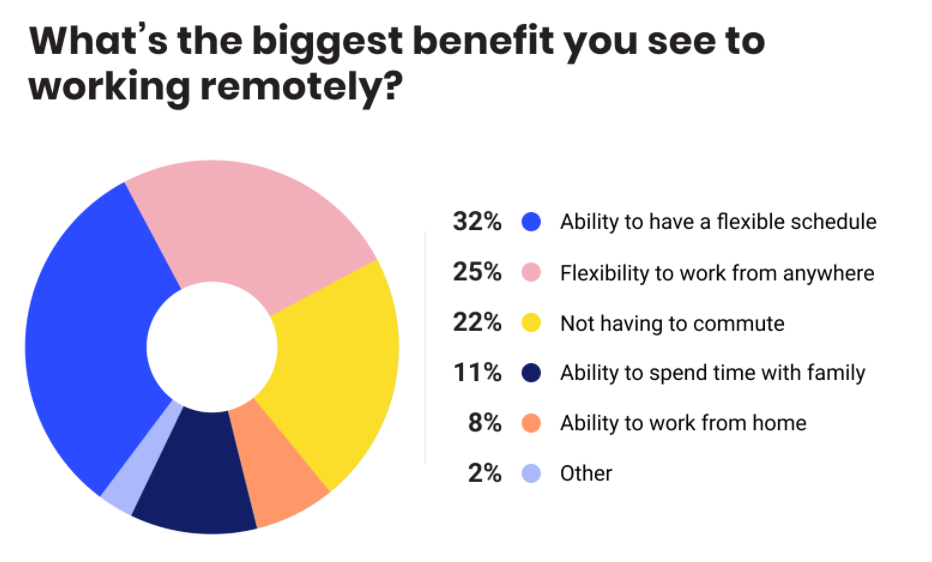
Remote workers are reaping the benefits of remote with flexibility, work from anywhere, no travel time and family time mentioned as the biggest benefits.
People can work from anywhere
Dreams literally come true of people that always wanted to work from remote places but could never do so because they were constraint to a local office.
Now they can choose to stay close to their family, work from exotic places or travel the world and live in a new country every three months.
We’ve only started to imagine what possibilities this brings, entire categories of talent will reinvent their lifestyle.
These are some real stories from people working remotely:
"Working remotely has allowed our family to create memories that will outlive any accomplishment. We've been able to spend a month in Iceland, extended time in Costa Rica, Florida, and Washington state" -Brian Rhea, product manager GitLab
"I’m traveling to the seaside to join a couple of my friends who also work remotely and live in a small town by the sea every summer from June to September" -Silvina Furnadzhieva, Productivity Consultant.
"Working in 15 countries over 7 years, remote work has afforded me to build work around my lifestyle goals. It’s the movement of choice" -Jordan Carroll, Job Coach.
Unless you’re a paranoid micromanaging manager, you have to love the fact that your employees have more chill and fun time instead of sitting in the bus commuting to physical meetings.
The world has become your talent pool
Think about this for a second. Embracing remote means that the full 8 billion people around the world become your potential next hires.
If you compare that to being limited to local talent, that talent pool increases with crazy multitudes, even if you live in a big country.
Imagine going from sourcing locally to globally in these countries:
Germany 84 million people > 8 billion x95 talent pool
Netherlands 17 million people > 8 billion x470 talent pool
United States 330 million people > 8 billion x24 talent pool
Australia 26 million people > 8 billion x308 talent pool
You could say that all talent is to be found in your own region, but that’s probably just you being comfortable with your current way of working.
Hiring for remote roles allows you to find the top 20 talents out of a talent pool of 8.000.000.000 that match the exact job description and are best in what they do.
While some remote companies still rely on legacy sourcing tools that are not fit for a global strategy, others are responding to this trend with search engines that search the entire global web and can find any candidate regardless of the country they are in.
Sustainable collaboration
We need each other to get things done. But thanks to remote, we do not have to travel to meet our colleagues and clients.
In some businesses it’s very normal to drive for hours to meet people or even take a flight for a single meeting. Something that I believe for most professions will very soon be unimaginable.
Now remote has been given a boost, you can’t really make the case anymore for travelling five hours for a one hour meeting.
In office models have workers spend the equivalent of 28 days a year commuting (1), that’s a whole month worth of just travelling to work.
Remote working has allowed saving that travel, with the impactful side effect of reducing greenhouse gas emissions equivalent to an amount of 600,000 cars (7).
Naturally diverse teams
Diversity has been buzzing around the business world for a while now, but beyond the buzz, remote offers a true and natural way of attracting diverse talent.
Especially cultural diversity is driven by remote models because talent can come from anywhere in the world.
This gives people the opportunity to learn about different cultures and from people with different beliefs, preferences and behaviour.
In local teams an effort has to be made to reduce proximity and networking bias, in remote teams cultural diversity becomes a natural part of the hiring cycle.
More focussed work
Remote workers consistently indicate they are more focussed when they work remotely as opposed to working in the office.
77% of remote workers say they’re more productive when they’re working from home (5).
For 75% of people, the fewer distractions they have with remote work are an important reason to work remotely (6).
Remote workers said they gained 35 working minutes a day on average due to fewer interruptions at their home as opposed to constant interruptions at an office (4).
"The ability to eat meals, make coffee, take breaks on your own time is lovely" -Collin Waldoch, Bootstrapped Startup Founder.
2. Remote flavours
Remote comes in lots of different flavours.
Some people work in teams with people they have never met in person and might never meet each other. I have experienced this myself with our own full remote team, half of our own team I never met in person.
Other companies choose a hybrid approach, reaping the benefits of remote but embracing the power of building relationships in person.
Different situations ask for different types of remote models.
You probably have heard of hybrid and full remote models.
Hybrid is a broad term to describe a model in which employees work partly remote and partly in the office.
Full remote (or all remote), is when employees work entirely remotely, all the time, with the exception of company gatherings like parties, company trips or for example quarterly events.
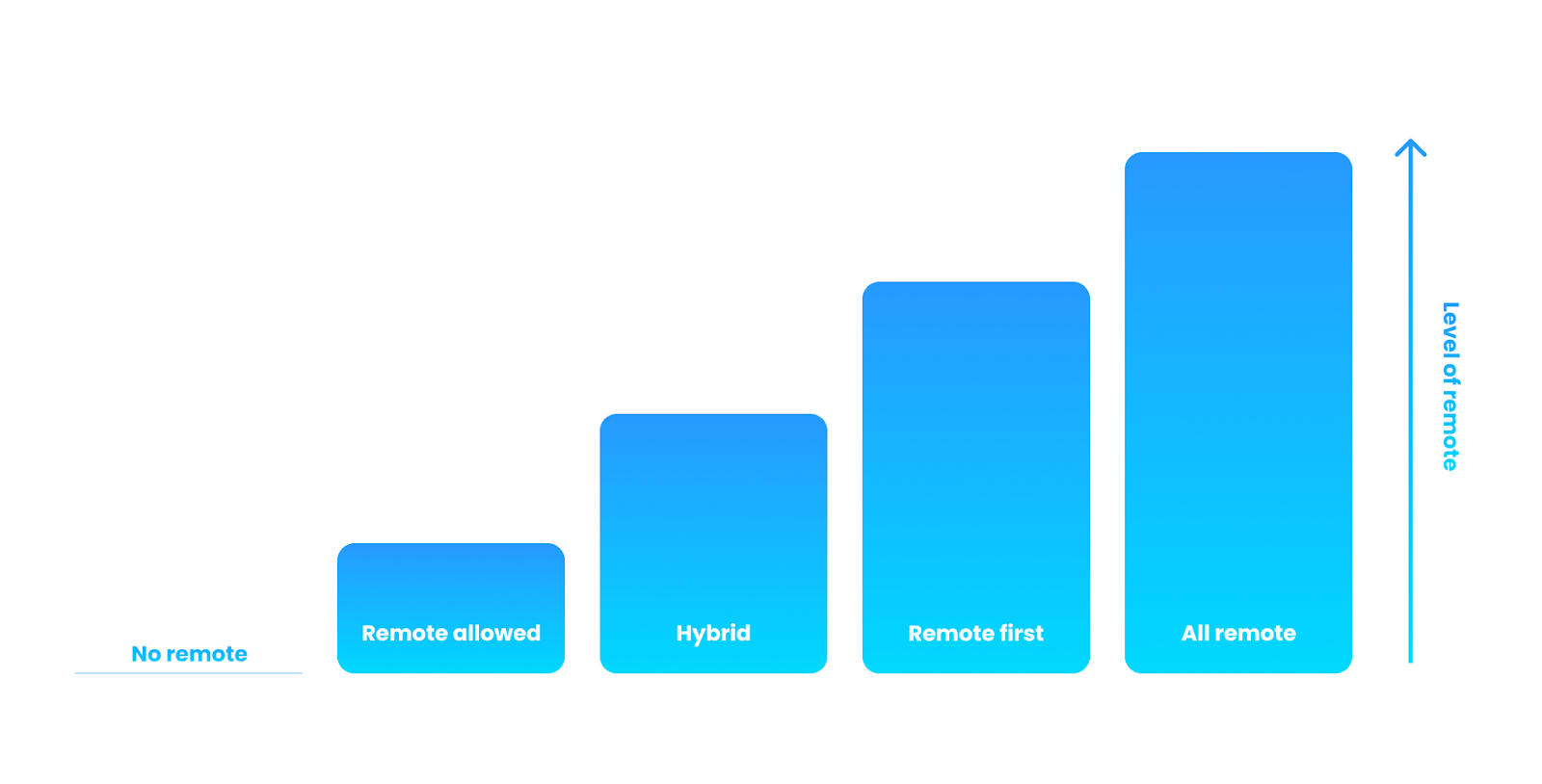
Then there are all kinds of different names we can give remote different remote styles like Remote Ok, Work From Anywhere, Synchronous Remote, Asynchronous Remote, Remote-first, Office-first.
Some companies like HubSpot provide options where the employee can opt-in for certain remote, hybrid or in office setups.
HubSpot offers three options to employees (3):
@Office: You come into a HubSpot office 3 or more days per week. You have a dedicated desk for your laptop, monitor, family photos, plants, and anything else that makes your workspace truly yours. Beyond taking your HubSpot laptop home if you’d like to, employees who are @office won’t get an at-home desk set-up.
@Flex: You come into a HubSpot office 2 or fewer days per week. When you come to the office, you’ll be allocated a “hotel desk”, which will be organized by team when possible. Because you opted-out of dedicated desk space in an office, HubSpot will help support your work-from-home (WFH) set-up.
@Home: You work the majority of your time from home in a HubSpot-approved entity. HubSpot makes sure your WFH set-up is safe, sound, and sets you up for success.
3. Time zones
About 74% of employees work with colleagues who are in different time zones (1).
Time zones have a big effect on the way you work together with colleagues.
If you work in France, and part of your colleagues work in Australia (East), you have to bridge a 9 hour time difference, meaning that if you start your day at 08:30 in the morning, your colleagues in Australia, at 17:30, most likely already finished for the day.
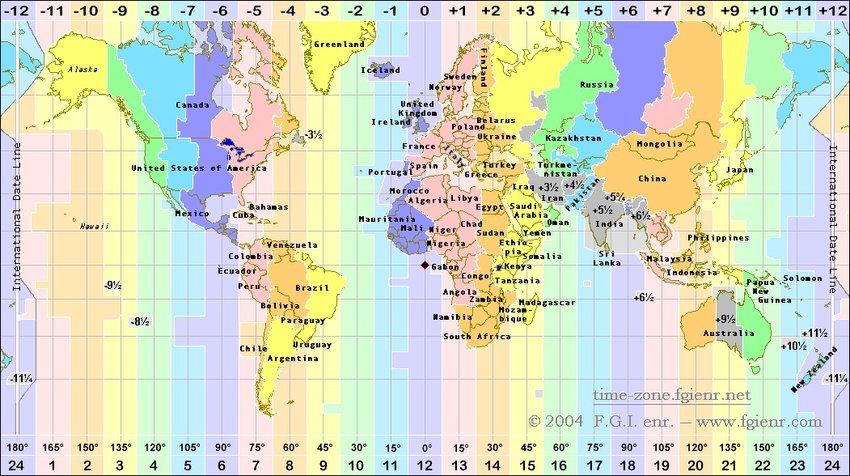
Most remote teams work with 2 to 5 different time zones (1).
To manage the time difference, a further sophistication of ways of working with each other has to be developed.
One way to talk about managing time zones in work is to talk about synchronous working and asynchronous working.
Synchronous working
Synchronous working is what most people are used to. This basically means working when your colleagues (or customers) are working.
You could say, from a collaboration perspective, this is the most convenient form because the people that you need to collaborate with to do your job are wide awake when you are.
Asynchronous working
Working asynchronously means you and your colleagues or clients work at different times, at least partly.
Example, we worked with a team member who was in India, meaning it was 18:30 his time, when it was 11:30 my time (Netherlands), which gave us about two hours synchronous time since I started my work around 08:30.
Working asynchronously means you cannot always expect a direct response from colleagues when you message them with a question or a proposal.
You probably have to wait a few hours or a day before you get a response from them so you can move on with that particular task.
This requires some advanced work planning since you have to keep delays into account and you might not be able to finish things right away.
The adequate asynchronous worker plans and schedules the part of their work that is dependent on others carefully, taking into account the time frames in which they can collaborate with others.
Asynchronous working is typically driven by text messages (through for example Slack), because phone calls are not always possible with times that do not overlap.
4. Other challenges that remote brings
Even though remote is already embraced at scale by companies and employees, and the transition to remote is going smoothly in 82% of the cases (1), remote work also brings new challenges.
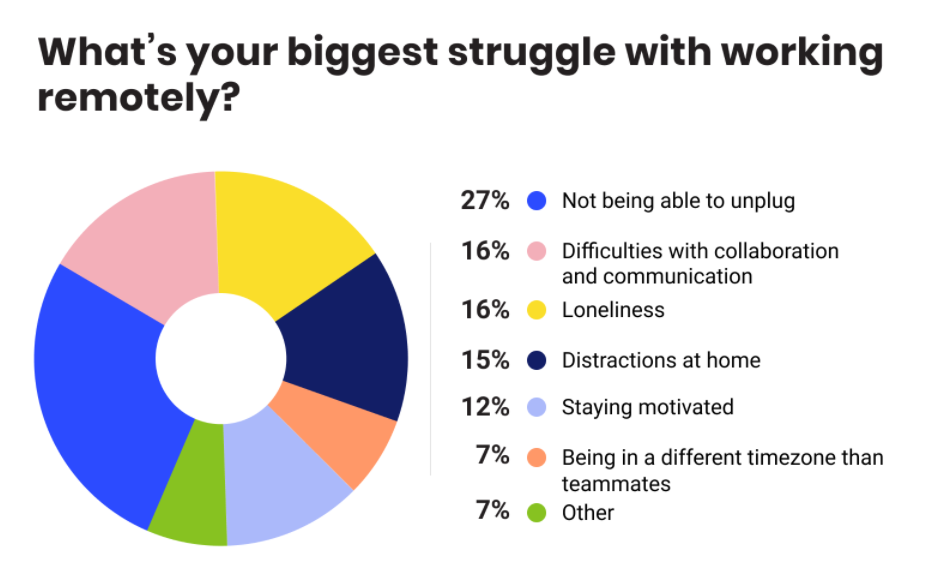
The top three challenges for remote workers are:
- Not being able to unplug, an issue commonly referred to as ‘always on’, because work is always accessible (online)
- Difficulties with collaboration and communication, due to many factors under which lack of body language and spontaneous encounters
- Loneliness, a side effect of remote working that for some people can lead to feelings of depression
In blended remote working forms, like hybrid, all kinds of additional challenges can arise. Not only at an individual level, but also at an organization level.
Companies like HP, IBM and Yahoo report the challenge that in a hybrid model, the in-person culture comes to dominate, disenfranchising those who are working remotely.
Despite these new challenges that employees are coping with, a staggering 99% of remote workers would like to keep working remotely, at least part of the time (1).
It seems for now, the advantages or remote outweigh the challenges it brings.
5. What working remotely requires from workers
The challenges and opportunities that remote brings, ask for a different way of working than an in-office model.
To start hiring remotely, there are some basics to consider.
Practical considerations for hiring remote talent
Being a hybrid or full remote company means that you are selecting for certain individuals who can and want to work remotely.
Qualities to look for in remote employees:
- Manager of one: They can self manage their planning, tasks and deliverables, set priorities and are not dependent on someone watching over their shoulder.
- Digitally savvy: Needless to say, working remotely is powered by digital interaction and tooling, candidates have to feel really comfortable doing their work with digital means.
- Communicative: Remote employees have to communicate regularly and document their communication clearly so colleagues can understand what they are doing and what they need without necessarily talking one-on-one.
Also collaboration from a hiring perspective requires some adaptation to fit the remote situation:
- Digital first communication: Almost all communication, especially in full remote companies, is done through digital means (Slack, Zoom, Notion).
- Asynchronous planning: The remote hiring team needs to plan further and more carefully so different time zones can be taken into account.
- Automated processes: In a non remote setup you can rely for a big part on interpersonal relationships to get things done. In remote setups, more is dependent from automation, like data collection and ATS integrations, to support a data driven way of working facilitated by technology instead of manual processes.
- Documentation: Since in a remote setup you don’t just walk to someone's desk to ask something, it becomes more important to document processes, ways of working and for example touch points with candidates, so colleagues can make use of your work and follow up on tasks.
What to communicate in job posts and in interviews when you’re hiring for a remote role:
- Describe the remote working model in some detail: full remote, hybrid, office-first or any of the other flavours mentioned earlier.
- Communicate time zones that the future employee will most likely be working in (synchronous vs asynchronous communication).
- Include a link to additional information on how you work remote as a company.
- Indicate if prior remote working experience is required, optional or not important for the role.
- Include the remote perks you’re offering, for example: work from anywhere, diverse teams, sustainable collaboration, remote desk budget.
- Optionally provide some employee references on how they experience working remotely with your company.
Legal considerations for hiring remote talent:
- If you have a legal team within your company, check with them to see what the legal requirements are of hiring processes and candidates. If you don't have a legal department, research any legal boundaries yourself.
- Before you set your mind to sourcing globally, be aware of your company’s or policies or (inter)national law that might restrict certain areas of (re)locating talent, for example danger zones.
- Check the resident permits (typically for permanent roles) and work VISAs (typically for contracted/temporary roles) that your company requires from the candidate. Even if they work fully remote, a permit can be required.
Last but not least, check with the candidate what they need to do their job remotely