.png)
Data annotation in 2026 isn’t labeling data — it’s engineering human judgment at scale to shape how AI actually thinks.
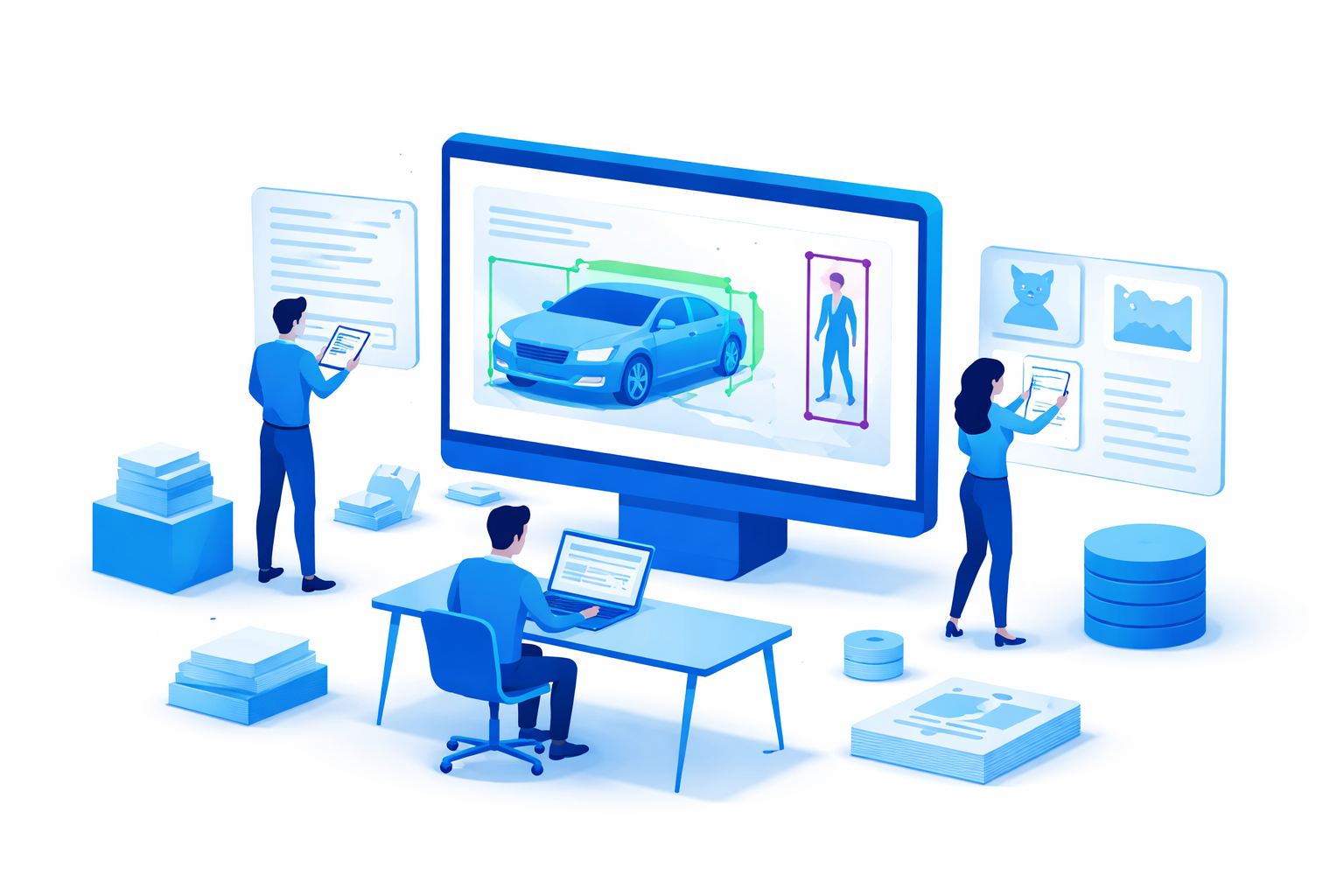

In the era of advanced AI, high-quality human-annotated data has become the lifeblood of model training. From self-driving cars to large language models like ChatGPT, virtually every cutting-edge AI system is fueled by armies of human data annotators (sometimes called “AI tutors”). These are the people labeling images, transcribing audio, and providing feedback on AI outputs to teach models how to behave. As we enter 2026, the data annotation industry is evolving at breakneck speed – new players are rising, old ones are consolidating, and AI-assisted tools are changing how humans label data. This in-depth guide offers a practical, up-to-date review of the landscape, including the top data annotation companies (grouped by domain), key trends driving change, evaluation criteria, and what the future might hold.
Who is this guide for? If you’re an AI project manager or product leader looking to outsource data labeling or scale up human feedback for model training, this guide will help you understand the leading providers in late 2025/early 2026 and how to choose the right partner. We start with a high-level overview of why human annotation matters and how the market is shifting, then dive into specific top providers in different domains (text vs. vision vs. others), and conclude with emerging trends and a future outlook.
At its core, data annotation is the process of adding human-provided labels or feedback to raw data so that AI systems can learn from it. This can mean humans drawing boxes around objects in images, transcribing and translating audio clips, annotating video frames, or ranking the quality of AI-generated text. For example, a self-driving car’s vision model needs people to label thousands of images of pedestrians, stop signs, and other objects, so the car can recognize those in the real world. A large language model (LLM) like ChatGPT is refined through humans (often called AI tutors or labelers) who rate AI responses and provide corrections in a process known as reinforcement learning from human feedback (RLHF). In short, behind every impressive AI, there’s usually a small army of humans teaching it what’s what.
Why do these human labelers matter so much? Because an AI model is only as good as the data it learns from. Poorly labeled or biased data will lead even the most sophisticated neural network astray. In fact, industry surveys show that data quality issues are a major hurdle for AI projects – data sourcing and labeling bottlenecks increased over 10% year-on-year recently, reflecting how crucial and challenging this step has become. Simply having big data isn’t enough; it needs to be the right data. As one AI strategy lead noted, companies are finding that to fine-tune modern models, the training data must be extremely high-quality – accurate, diverse, properly labeled, and tailored to the specific use case. This is why specialized data annotation providers exist: they bring the human expertise and quality control needed to transform raw data into AI-ready datasets at scale.
Another reason human annotators remain indispensable is the rise of complex AI behaviors that require human judgment to evaluate. For instance, today’s LLMs are trained not just on factual correctness but on nuanced preferences (what tone is most helpful, which content might be inappropriate, etc.). Through RLHF, people have to rank and fine-tune AI outputs so models learn human values and preferences. A recent industry report found that over 80% of companies deploying AI emphasize keeping a “human-in-the-loop” – that is, having humans involved to guide and improve the model’s learning. Whether it’s filtering toxic content, teaching an AI to follow ethical guidelines, or handling corner cases that algorithms struggle with, humans provide the common sense and domain knowledge that machines lack. In summary, data annotators are the silent teachers behind AI, ensuring that the next generation of models are accurate, safe, and aligned with human needs.
The data annotation industry has exploded in size and importance heading into 2026, driven by the AI revolution across sectors. In 2024 the global market for data collection and labeling services was estimated at around $3.7 billion, and it’s forecast to grow to over $17 billion by 2030, with annual growth rates above 25%. This rapid expansion is fueled by the ubiquity of AI: from healthcare to finance to retail, organizations are gathering massive troves of raw data but need human help to label it for training machine learning models. Every new AI application – whether it’s an autonomous drone or a medical diagnosis algorithm – creates demand for labeled data, and many companies don’t have the capacity or expertise to do it all in-house. As AI adoption widens, we’ve essentially hit a “data bottleneck”: plenty of raw data, but a shortage of labeled, usable data. This has made data annotation a critical service, with AI model builders scrambling to secure reliable pipelines of human-labeled data.
Quality over Quantity: A key shift in late 2025 is that AI teams are no longer just chasing more data – they want better data. In the early days of AI, success often came from sheer volume (e.g. tagging millions of images cheaply to improve a vision model). But now, leading AI labs realize that curation and accuracy matter more than brute force. Models learn best from thoughtfully chosen, well-labeled examples, especially for complex tasks. For instance, to improve an AI coding assistant, you’d benefit more from a thousand code review examples labeled by senior software engineers than from a million lines of code labeled by non-experts. Industry insiders note that companies “need high-quality data labeling from domain experts – such as doctors, lawyers, or senior engineers – to improve their models,” and the hard part is finding and recruiting those expert labelers. We’re seeing a pivot from crowdsourced “low-skill” labeling to specialized annotation by people with real subject-matter knowledge. The goal is “smart data”: smaller batches of highly informative, error-free annotations can boost model performance more than vast noisy datasets. This trend has pushed providers to focus on annotator training, domain expertise, and rigorous quality control more than ever before.
New Players and a Stratified Landscape: With the higher bar for quality, a new wave of specialized data annotation companies has emerged in the past couple of years. These startups act as extensions of AI labs’ teams, offering expert-heavy labeling services on tight turnarounds. Notable examples include Surge AI, Mercor, and Micro1 – young companies that recruit skilled contractors (often with advanced degrees or industry backgrounds) and position themselves as premium human data providers. They cater to AI labs needing nuanced work like fine-tuning large language models or labeling edge-case scenarios, and they pride themselves on agility and expertise. Meanwhile, the traditional giants of data labeling from the 2010s – firms like Appen, Lionbridge AI (TELUS International), iMerit, and Sama – are still very much in the game, handling huge projects for big tech. These older providers built massive global workforces (sometimes hundreds of thousands of annotators) and robust delivery processes. However, some have struggled to adapt to the new demand for ultra-specialized, fast-turnaround tasks; their strength was scaling up big, long-term projects rather than boutique work. The result in late 2025 is a two-tiered market: on one side, large vendors known for scale, multilingual reach, and compliance – on the other side, newer boutique firms known for expert talent and flexibility. Both types have their place, and many AI organizations now maintain a roster of multiple partners to cover different needs (e.g. a big provider for routine labeling and a specialist firm for complex R&D data).
AI Agents and Automation in Labeling: Another major change shaking up this industry is the introduction of AI assistance into the labeling workflow. Leading platforms are no longer just passively recording human inputs – they now often include AI “co-pilots” that help speed up the work. For example, modern annotation tools might use a computer vision model to pre-label images (drawing rough bounding boxes around objects), and then human annotators simply correct or refine those labels. This auto-labeling or pre-labeling approach can drastically improve efficiency. By 2025, many labeling software systems have features like smart suggestions, one-click object detection, and real-time error flagging. A single human labeler today can be far more productive than one five years ago, thanks to these AI helpers. One industry report noted that integrating AI agents into the data labeling pipeline can cut manual effort by roughly 50% and reduce annotation costs by 4× while still maintaining high accuracy. In practice, this means companies might not need as large a human labeling team as before for the same volume of data – but they do need a more skilled team that can work effectively with AI-assisted tools. Annotators are becoming more like supervisors or editors, handling the tricky cases and verifying the AI’s work. For straightforward tasks (e.g. labeling common objects in images), algorithms like Meta’s Segment Anything Model can handle much of the grunt work, allowing humans to focus on edge cases. The net effect: labeling projects that once took months can sometimes be completed in weeks, with significant cost savings.
Synthetic Data as a Complement: Alongside human labeling, there’s also a surge of interest in synthetic data – data that’s generated artificially (by simulations or generative models) rather than collected from the real world. Think of simulated driving scenes to train self-driving cars, or AI-generated text dialogues to pre-train an LLM. By late 2025, synthetic data is not replacing human-labeled data, but it’s certainly supplementing it in many projects. Synthetic data is especially useful when real data is scarce, expensive, or sensitive due to privacy. For example, a robotics company might use a simulator to create thousands of variations of a warehouse scene to pre-train its vision model, then use human labelers to fine-tune on a smaller set of real camera footage. The synthetic data market itself is growing rapidly – one analysis projects it will jump from about $0.5 billion in 2025 to $2.7 billion by 2030. Some providers claim that, in certain domains, synthetic datasets coupled with minimal human curation can reduce the need for manual labels by as much as 70%. Many data labeling firms have taken note and begun integrating synthetic data offerings or partnerships. The bottom line is that AI teams are becoming more creative in how they get training data: blend human and machine-generated data, use AI to label data, and so on. However, even when synthetic data is used, humans are often needed to validate it or label the tricky real-world edge cases that simulations miss. So human annotators aren’t going away – their role is just shifting to higher-value parts of the process.
Major Shake-Ups and Big Money Moves: Perhaps the most headline-grabbing development in 2025 was the strategic shake-up among the top data labeling platforms. In mid-2025, Meta (Facebook’s parent company) made a huge investment in Scale AI – one of the industry’s leading platforms – buying a 49% stake and even bringing Scale’s CEO (Alexandr Wang) on as Meta’s Chief AI Officer. This deal, reportedly valuing Scale at around $30 billion, underscored how vital data annotation has become to Big Tech’s AI plans. But it also caused waves: rival AI labs (like Google and OpenAI) had been customers of Scale and suddenly grew wary that their sensitive training data might be visible to a competitor (Meta). In the wake of Meta’s move, Google – which was Scale’s largest customer – and OpenAI both announced they would shift their data labeling work away from Scale. This opened the door for those new independent players to swoop in. Indeed, Surge AI, a startup founded in 2020, was a big winner. Surge positioned itself as a neutral, high-quality alternative and reportedly saw a surge in demand from top labs. By late 2024, Surge had raked in over $1 billion in revenue, surpassing even Scale’s revenue (~$870 million over the same period). In other words, a three-year-old upstart outpaced the incumbent after that incumbent’s partial acquisition by Meta. Around the same time, Mercor – another newcomer – raised funding at a hefty $10 billion valuation and grew its annual revenue to roughly $500 million by recruiting subject-matter experts as labelers. And Micro1, yet another young firm, raised a round at a $500 million valuation and is rapidly scaling up its contractor network. We’re seeing big VC bets and billion-dollar valuations in a field that, a decade ago, was considered a low-margin outsourcing business. Data labeling is now viewed as strategic infrastructure for AI – akin to cloud computing or semiconductor chips. There’s intense competition to be the go-to provider for AI labs, and as the Meta/Scale saga showed, issues like data privacy and neutrality can make or break those relationships.
In summary, the late-2025 data annotation landscape is characterized by rapid growth, a push for higher-quality specialized data, the integration of AI and automation in the labeling process, and a diverse set of providers ranging from huge crowdsourcing platforms to niche expert networks. For anyone seeking a data labeling partner now, it’s important to grasp these trends. They explain why some providers emphasize PhD-level annotators, why others tout their AI-driven tools, and why big tech firms are making multi-billion-dollar moves in this space. Next, we’ll discuss how to evaluate these providers – what factors matter most when choosing – and then we’ll dive into our curated top lists of the best annotation companies for various needs.
Not all data annotation services are equal – they differ widely in focus, scale, quality, and cost. Choosing the right partner (or combination of partners) requires understanding your project’s needs and how each provider stacks up on key criteria. Here are the most important factors to consider when evaluating data annotation companies:
Keep these factors in mind as we delve into the top providers. In fact, we used the above criteria (quality, scale, specialization, cost, etc.) to evaluate dozens of companies in late 2025. Nearly 90% of businesses building AI rely on some form of external data labeling support, so making an informed choice is important. Next, we’ll present our Top 5 lists in three categories: providers for text/LLM data, for autonomous vehicles & computer vision, and for robotics, speech & other specialized domains. Each list is based on our research and scoring across the key factors, with an emphasis on the most up-to-date capabilities and track records as of 2025–2026.
Training and fine-tuning large language models (and other NLP systems) require a lot of human feedback and textual annotation. This can range from classic text labeling (e.g. categorizing documents, tagging entities) to more complex tasks like conversation annotation, content moderation, and RLHF where labelers judge AI-written responses. The providers below are particularly strong in text data annotation and have proven methods for tasks like chatbot training, search relevance evaluation, translation, and content review. Many have specialized workflows for reinforcement learning feedback and employ annotators with strong language skills or specific domain knowledge. We ranked these companies based on their quality, experience with language data, capacity, and recent performance with LLM projects.
Overview: Surge AI is a Silicon Valley upstart (founded 2020) that has quickly become a go-to for large language model training, especially reinforcement learning from human feedback. Surge focuses on providing highly skilled annotators – think domain experts, writers, and linguists – to tackle the most nuanced text annotation tasks. In 2023–2025 it gained notoriety for helping top AI labs like Anthropic, OpenAI, and Google with RLHF and alignment data. In fact, after some labs parted ways with Scale AI, Surge stepped in to supply the large volumes of preference rankings and prompt feedback needed to fine-tune models like Anthropic’s Claude and OpenAI’s GPT. Surge’s philosophy is to prioritize quality over quantity: they recruit contractors with specific domain expertise (law, medicine, coding, etc.) so that annotations are not just correct but insightful. For example, Surge labelers were involved in constructing OpenAI’s GSM8K dataset (grade-school math problems) to improve GPT’s math reasoning, and they provided expert review for safety and bias tuning.
Strengths: Surge AI is widely regarded as the premium choice for LLM-related data. Their platform and workflows are built for RLHF: they offer custom task formats for ranking AI responses, writing demonstration dialogues, red-teaming model outputs for flaws, and so forth. Annotators go through vetting and training specifically on how to evaluate AI-generated text. Surge is also known for responsive project management – they work closely with AI research teams to iterate on guidelines and rubrics (which is crucial in subjective tasks like “Which response is better?”). Thanks to its high-end positioning, Surge has managed to stay profitable and growing purely on revenue. By 2025 it reportedly exceeded $1.2 billion in annual revenue, outpacing older rivals. This reflects how much top labs are willing to pay for quality: Surge is not cheap, but it delivers results needed for state-of-the-art models. If your project requires fine-grained human feedback for an AI model – say, rating a chatbot’s answers on clarity and empathy, or reviewing a model’s code suggestions for correctness – Surge AI has the expertise to handle it.
Potential Drawbacks: The obvious one is cost. Surge typically works on a custom quote basis, and their rates per annotation or per hour can be significantly higher than using a general crowd. They’re best suited for when quality is paramount and budget is less of an issue. Also, Surge’s focus is mainly on language tasks (they themselves note they are less oriented toward generic image labeling unless it’s part of a multimodal project). So if you needed something like millions of simple image tags, Surge might be overkill. Lastly, because Surge works closely with a relatively smaller pool of expert annotators, their throughput on extremely large-scale jobs might be constrained (though they have scaled impressively so far for even the biggest labs). In summary, Surge AI is ideal when you need top-notch human feedback for language AI, such as dialogue tuning, content safety analysis, or any NLP task requiring judgement and subtlety. It’s used heavily by cutting-edge AI labs and comes with that pedigree – along with a premium price tag.
Overview: Mercor is another rising star, notable for its innovative approach to sourcing human intelligence. Founded in 2022, Mercor built a marketplace of industry experts who provide data labeling and consulting to AI companies. Instead of drawing from gig workers, Mercor taps former professionals – for example, ex-investment bankers, lawyers, doctors – and pays them handsomely to share their knowledge in structured ways to train AI. By late 2025 Mercor was paying out over $1.5 million per day to its contractors (who can earn up to $200/hour on certain tasks) and reached about $500 million in annual revenue. It attracted customers like OpenAI, Anthropic, and Meta, especially for projects where corporate or specialized knowledge was needed. Mercor essentially helps AI labs get data that regular labeling crowds can’t provide – often because that data is proprietary or requires insider understanding. For instance, rather than trying to get a banking dataset from Goldman Sachs (who won’t share it), an AI lab can hire ex-Goldman employees through Mercor to simulate and annotate the needed scenarios.
Strengths: The biggest selling point of Mercor is deep domain expertise on demand. It’s like an expert network tailored to AI data. Need a hundred accounting statements analyzed by CPAs to train a finance model? Mercor can find CPAs to label them. Want realistic legal questions answered by attorneys for a legal QA system? Mercor brings in the attorneys. This model unlocks data that was previously hard to get – the knowledge in people’s heads and experiences. Mercor’s contractors produce data like detailed summaries, analyses, and labeled examples that reflect real-world workflows. The quality tends to be high because these aren’t random gig workers; they’re folks who truly understand the content. Mercor’s marketplace approach is also scalable in terms of talent – tens of thousands of experts are on the platform globally, and the company claims to be profitable even while paying high rates, because AI labs value the data so much. For AI projects in domains like finance, law, medicine, engineering, or any specialized field, Mercor can be a game-changer. They essentially free AI developers from having to strike data partnerships with incumbent companies (which can be slow or impossible); instead, they channel human expertise directly. Mercor’s rapid growth and hefty $10B valuation reflect how needed this service has become as AI expands into knowledge-heavy industries.
Potential Drawbacks: Mercor’s approach is also relatively expensive – you are paying for seasoned professionals. The upside is high-quality, proprietary data; the downside is cost and possibly speed. Coordinating many experts on a marketplace can be complex, so Mercor’s turnaround times might be longer than a straightforward labeling farm for equivalent volume. The data Mercor provides is often more like knowledge generation (creating new labeled content from experts) rather than just labeling existing data, so you should have a clear idea of what you want those experts to produce. Also, Mercor is young and still building out its platform features; it may not have the same polished project management tools or API integration as some traditional providers. It’s best suited for cases where normal crowdsourcing falls short – when you truly need experts with insider knowledge, or when data is sensitive and you prefer experienced professionals under strong NDAs. In summary, Mercor fills a unique niche: it brings white-collar gig workers into AI data labeling. If your AI model needs the kind of data only an industry insider could label correctly, Mercor is likely the top choice.
Overview: Micro1 is a newer entrant (founded around 2022) that blends elements of recruiting and data annotation into one service. The company started by building an AI-driven recruitment platform, but quickly pivoted into providing managed labeling teams for AI labs – essentially helping companies find and manage human contractors for data work. Micro1’s claim is that it can vet and curate top talent for AI projects extremely quickly, acting almost like a hiring service combined with an outsourcing firm. By 2025, Micro1 was working with clients like Microsoft and several Fortune 100 companies, and it had grown its annual recurring revenue from just $7M at the start of 2025 to about $50M by late 2025. It raised a Series A funding that valued it at $500M, indicating investor belief in its model. Micro1 positions itself as one of the startups filling the gap left when some AI labs stopped using Scale AI – they aim to “pick up the slack” and provide an alternative pipeline of skilled human labelers.
Strengths: The key strength of Micro1 is speed and flexibility in building teams. If you need, say, 20 dedicated labelers to work on your project full-time for the next 3 months, Micro1 can recruit and deploy that team for you on short notice. They pride themselves on moving at the pace of a startup – their founder (a 24-year-old entrepreneur profiled in Forbes) emphasizes that they operate with agility that perhaps larger outsourcing firms lack. Micro1 uses automation to source candidates but then a human curation to ensure they get qualified annotators. In practice, they provide a managed service where you have a team (often remote contractors) who are effectively your team but sourced and administered by Micro1. This can be very attractive to AI startups who don’t want to spend months recruiting their own labelers or overseeing a crowd on a task-by-task basis. Micro1 also touts a strong growth trajectory – though smaller than players like Surge or Mercor, it’s scaling rapidly and adopting best practices from them. They have reportedly handled projects involving both language and vision data, and they emphasize “net new human data” – meaning they help generate the fresh data that models need as opposed to just re-labeling existing datasets. With backing from notable investors and advisors (like ex-Twitter execs), Micro1 is carving a spot as an up-and-coming competitor to the incumbents.
Potential Drawbacks: As a younger company, Micro1 may not have the extensive track record or specialized tools that older providers have. Its focus is on assembling human talent, which means the onus of designing the labeling process might still lie with the client or Micro1’s project leads (versus a fully productized platform that others offer). If your needs are highly specialized (e.g. requiring domain experts), Micro1 might or might not have those in network yet – though they can try to recruit them. Their current scale (revenue ~$50M) is an order of magnitude smaller than giants like Appen or even Mercor, so for extremely large projects they are still ramping up. Essentially, Micro1 is a fast follower in this space: it may offer more hands-on service and hustle, but perhaps lacks some features or global reach of bigger players (for now). Companies that value the startup mentality and personalized approach might love Micro1; those who prefer a very established vendor might wait to see Micro1 grow further. All that said, given their growth and the fact they already work with big-name AI labs, Micro1 is definitely a provider to watch (and consider for projects needing quick team formation). They exemplify the new generation of data labeling firms that are hungry, tech-enabled, and bridging the gap between recruiting and annotation services.
Overview: TELUS International AI Data Solutions is the entity that includes what used to be Lionbridge AI – a veteran in the data annotation field. Lionbridge was a pioneer in crowdsourced language data (famous for running search engine rating programs and translation projects) and was acquired by TELUS International (a Canadian telecom and IT firm) in 2020. Now under TELUS, it operates one of the largest globally dispersed crowds for AI data, with a particularly strong presence in multilingual and enterprise projects. For decades, Lionbridge (and competitor Appen) have been the primary providers of human raters for companies like Google, Microsoft, and Facebook to evaluate search results, ads, and speech recognition. As of 2025, TELUS International AI still offers that breadth: they cover 300+ languages and dialects, with hundreds of thousands of contributors worldwide. They handle everything from search relevance (think: people judging if Bing’s results for a query are good), to content moderation, to e-commerce tagging, to voice dataset collection. In essence, TELUS (Lionbridge) is an industrial-scale labeling operation geared toward big tech’s needs and any enterprise needing a reliable, large-volume partner.
Strengths: The global reach and experience here are unparalleled. TELUS International’s annotator network spans North America, Europe, Asia, Africa – you name it – allowing them to tackle projects that need input from diverse locales or in rare languages. If you need 1,000 hours of audio transcribed across 10 African languages, or a sentiment analysis dataset in 20 languages, they can deliver. They also have robust process infrastructure: decades of know-how in managing large crowds, ensuring security (they have secure facilities in many countries for sensitive data tasks), and scaling up/down as needed. TELUS inherited Lionbridge’s long-term contracts with major companies, which speaks to quality and trust at scale. They excel in search and ad evaluation projects – for example, Google’s search quality rating program (those human raters that evaluate algorithm changes) has long been serviced by Lionbridge and Appen. TELUS can provide highly detailed guidelines and trained raters for such complex judgment tasks. They also often serve as a one-stop shop for enterprises, bundling data collection, annotation, even some model testing services. In the context of LLMs and text, TELUS has been involved in things like training chatbots (providing conversation data) and moderation – for instance, they can supply teams to rank AI-generated content on whether it’s toxic or not, similar to RLHF. Their pricing is generally middle-of-the-road: not cheapest, but you get reliability and compliance (which big companies value).
Potential Drawbacks: Being a large enterprise-oriented provider, TELUS (Lionbridge) may sometimes feel less agile or innovative than the startups. They have a big machine of a company, so customizing a workflow or handling a very R&D-ish request might be slower or more rigid in process. In recent years some clients have noted that the fastest improvements in tooling and AI-assistance came from newer firms, whereas the big incumbents were a bit slower to adopt cutting-edge annotation tools (though they are catching up). Also, while TELUS can muster huge numbers, the flip side of any crowd that large is that individual annotator skill can vary. For highly specialized tasks requiring deep expertise or creativity, a massive crowd might not achieve the same quality without heavy training – so boutique firms or expert marketplaces (like Mercor, Surge) could have an edge there. Essentially, TELUS is fantastic for tried-and-true high-volume projects: need 500 people to label data across 50 countries in a secure, managed way? They do that in their sleep. But if you need a handful of PhDs to do very tricky labeling, you’d likely look elsewhere. Another consideration is that TELUS’s size and enterprise focus might come with higher minimum project sizes or longer onboarding; small startups with only a few thousand data points might find it easier to use a self-serve platform. In conclusion, TELUS International (Lionbridge AI) remains a top choice for multilingual and enterprise-scale text data annotation, especially for evaluation tasks and large-scale content operations. It’s a “big gun” provider – extremely reliable for big jobs, though perhaps not the most nimble for experimental or highly specialized needs.
Overview: TaskUs is a slightly different animal on this list. It’s originally a BPO (Business Process Outsourcing) company – known for things like content moderation, customer support, and back-office services – that has in recent years moved aggressively into the AI data annotation space. TaskUs is a U.S.-based firm (with global operations) that went public in 2021, and it employs tens of thousands of staff in delivery centers across 20+ countries. Their foray into AI services means they offer managed teams of annotators for hire, similar to how a BPO offers a team of call center agents. TaskUs leverages its experience handling sensitive content for social media companies to position its data labeling services as secure, scalable, and enterprise-friendly. They have dedicated AI Services divisions now, doing image, video, audio, and text annotation for some of the world’s largest tech companies. For example, TaskUs has worked on projects like labeling images for autonomous vehicle research, transcribing/regarding voice assistant data, and providing human feedback for generative AI models – all under strict quality and privacy standards.
Strengths: The hallmark of TaskUs is enterprise-scale operation with a focus on quality and security. Because of their background in content moderation, they are used to dealing with highly sensitive or regulated data (they literally have handled the most sensitive social media content under NDAs and with rigorous wellness and security protocols for their staff). This means if you have a project that requires 100 full-time annotators working in a secure facility (no cell phones, controlled access) for a year, TaskUs can spin that up. They recruit educated, full-time staff in many regions (Philippines, India, Eastern Europe, etc.) and provide a lot of training and oversight. So compared to a gig platform, TaskUs gives more stability and consistency – you effectively get a dedicated team that can develop domain knowledge over time. They also have strong project management – you’ll typically have an account manager and team leads ensuring KPIs are met. For large companies that might require their vendors to comply with things like SOC2 or ISO certifications, TaskUs checks those boxes. In terms of capabilities, TaskUs can handle a wide range: image bounding boxes, 3D LiDAR annotation, text classification, chatbot feedback, you name it. They often compete with the likes of Appen or TELUS for big contracts, highlighting their ability to deliver at scale. Another strength is TaskUs’s flexibility in staffing – need to surge from 50 to 150 annotators for three months? They can recruit and train additional staff relatively quickly, given their operational depth.
Potential Drawbacks: As a large BPO-type provider, TaskUs may not be the cheapest option – their annotators are often full-time employees with benefits, and the company layers on project management (which is great for quality, but it means higher overhead). If you have only a small labeling task, TaskUs likely isn’t appropriate. They tend to engage on sizable contracts where the economics make sense. Also, while TaskUs is strong in execution, they historically are not a specialized AI data company from the start – they’ve learned and built that capability. They may lack some of the slick custom annotation software that others have, although they do use a mix of in-house and third-party tools. In some cases, TaskUs will actually work on your chosen platform (some clients have TaskUs labelers use the client’s labeling tool or a licensed platform like Labelbox). This can be fine, but it’s a different model than an all-in-one tech + workforce solution. Essentially, TaskUs sells people and process, not a unique labeling technology. This means you should be prepared to integrate or provide guidelines clearly, as with any managed service. To summarize, TaskUs is an excellent choice when you need reliability at scale, especially under strict security. Many AI product teams in large enterprises or tech firms use TaskUs when they need a big team quickly that they can trust with sensitive data. It’s like having an outsourced in-house team. However, if you’re a small startup or need just a handful of expert labelers, TaskUs might be more firepower (and cost) than necessary.
(Honorable Mentions: There are a few other notable providers in the text/NLP space worth briefly mentioning. Appen – which we will cover in a later section – also does a ton of text data work and historically provided search engine evaluators and translators to big companies. Toloka (a platform originally by Yandex) is an affordable crowdsourcing option for text tasks, especially if you need responses from many people quickly (it’s been used for things like collecting RLHF ratings at scale). And some newer startups like Open AI’s outsourced teams via BPOs (Accenture) or specialist firms like Scale AI’s own managed labeling for text are out there – but the list above represents the leaders heading into 2026 for language data annotation.)*
One of the earliest and biggest drivers of the data labeling industry was the need to annotate images and videos for computer vision – particularly for autonomous vehicles (self-driving cars) and other vision-centric AI systems (drones, security cameras, retail AI, etc.). These tasks often involve drawing bounding boxes around pedestrians, segmenting road scenes, labeling lane lines, annotating LiDAR point clouds, and so on. The following are top providers that excel in visual data annotation, with a strong track record in automotive and similar domains. We ranked them based on their tool sophistication for vision data, quality control on complex annotations, capacity to handle huge volumes (autonomous vehicle projects can entail millions of frames), and experience in the CV/autonomy sector.
Overview: Scale AI is nearly synonymous with autonomous vehicle data labeling. Founded in 2016, Scale made its name by tackling the massive data bottlenecks of self-driving car development. They built advanced tooling and combined it with a scalable workforce (both in-house and crowd) to label images, LiDAR scans, and videos with incredible throughput. Scale’s core mission has been to deliver “labeling at scale without sacrificing quality.” They were an early innovator in using pre-labeling models and automated checks to assist human annotators, thereby speeding up the process while maintaining accuracy. Over the years, Scale expanded beyond AV (autonomous vehicles) to other areas – like mapping, e-commerce (product image tagging), document processing, and even text (they had an RLHF offering for LLMs) – but their crown jewel remains computer vision. By mid-2025, Scale had grown into one of the largest players, valued at billions, and was serving clients ranging from major self-driving car companies to the Air Force (for satellite image analysis). They even caught Meta’s eye, leading to the significant partnership/investment we discussed earlier. Despite some recent shifts (Meta’s stake and the departure of some customers), Scale AI is still a powerhouse in CV annotation technology.
Strengths: Scale’s technology platform for vision tasks is arguably the most advanced in the industry. They have purpose-built interfaces for drawing 3D bounding boxes in point clouds, for tracking objects across video frames, for semantic segmentation of images, and more. They famously integrated models like CNNs and Transformers to auto-suggest labels – for example, their system might automatically outline a car in an image, and the human annotator just approves or corrects it. This yields high consistency and speed. Scale also emphasizes enterprise features and precision: annotation guidelines are enforced through the tool (with validations), they have real-time analytics on annotator performance, and multiple stages of QA (including ML models that flag likely errors). For an autonomous driving client, Scale might label a billion pixels of road imagery with 99+% accuracy, under tight ISO-certified processes. Another strength is experience at extreme scale – they’ve handled projects where entire fleets of test vehicles’ worth of sensor data (images, LiDAR, radar) were labeled continuously. Scale essentially grew up with the self-driving industry; their workflows are tuned to those needs (like aligning multi-sensor data, synchronizing frames, etc.). They also support integration via API – many AI teams plug directly into Scale’s API to send raw data and receive labels back automatically in their pipeline. Scale’s reputation for quality is such that many considered them the gold standard for difficult CV tasks (like identifying edge-case objects in driving scenes). They remain a top choice where accuracy and speed are mission-critical, and the budget exists for a premium solution.
Potential Drawbacks: The elephant in the room recently has been concerns about data confidentiality due to the Meta relationship. If you’re a company that competes or overlaps with Meta, you might hesitate to use Scale now (worried, rightly or wrongly, that Meta’s involvement could pose a risk). Scale has publicly stated they keep a strict firewall to protect customer data, but the optics caused some clients to explore alternatives. Aside from that, Scale is known to be one of the more expensive options. You’re paying for top-notch tech and service, so smaller firms might find it out of reach. Also, because Scale automates a lot, in rare cases clients felt a bit less human touch – e.g. if your project is unusual, Scale’s system might need adjustments, and some have found more boutique firms to be more flexible in custom setups. However, Scale does offer custom solutions; they have project managers and solution architects who can work with you. It’s just that very niche tasks might not fit into their standard platform as neatly. Another consideration: after losing some big customers in 2025, there’s a question of how Scale will pivot – but the company has begun focusing on government contracts and other sectors to diversify. For now, if your priority is cutting-edge computer vision annotation with robust tools and you need large volumes done right, Scale AI is either at the top of the list or very close to it. Many companies still trust Scale for their most demanding CV data needs, given the proven track record.
Overview: Sama (formerly Samasource) is a provider that combines data annotation services with a strong social impact mission. Founded in 2008 by Leila Janah, Samasource’s goal was to “lift people out of poverty through digital work.” They set up delivery centers in regions like East Africa (Kenya, Uganda) and Asia, hiring and training people from low-income communities to become professional data annotators. Over the years, Sama became a trusted vendor for many Silicon Valley companies, known not only for reliable service but also for their ethical model. They have labeled data for the likes of Microsoft, Google, and Nvidia, contributing to projects in computer vision (e.g. millions of images for autonomous driving and facial recognition) while simultaneously creating job opportunities in underserved areas. Sama’s services cover image tagging, bounding boxes, segmentation, video annotation, and more, much of it related to autonomous vehicles, mapping, and content moderation. In 2021, Samasource rebranded to Sama and positioned itself squarely as an AI data solutions company. As of 2025, Sama operates globally (with hubs in North America as well) but continues its commitment to “impact sourcing”, ensuring fair wages and development programs for its workforce.
Strengths: Sama’s dual focus on quality and ethical practices has won it many fans. On the quality front, Sama has over a decade of experience in complex vision tasks. They were one of the early contractors to tag images for self-driving car startups and have a deep bench of expertise in dense image annotation (they even have R&D efforts to incorporate automation where possible). They’ve developed solid QA processes and can handle large volumes – for instance, one case study mentions Sama improving multi-class object detection for an OEM by providing high-quality labels at speed. They also launched a new data annotation platform that automates simpler labels so humans can focus on the tricky parts, showing they keep up with tech trends. On the ethical side, Sama sets itself apart: they pride themselves on paying their workers well, providing training and benefits, and auditing working conditions. This resonates with companies that care about the ESG aspect of their supply chain. In fact, Sama often highlights that their clients get both top-notch data and a positive social impact story. The workforce stability can also improve quality – many Sama annotators stay for years and become highly skilled (reducing turnover issues that pure gig platforms face). Sama is also strong in multilingual data to an extent (given their global workforce, they can handle various languages especially for voice or text tasks that accompany vision). For companies aiming to do good while getting the job done, Sama is a compelling choice. It’s essentially “mission-driven” data labeling proven at scale.
Potential Drawbacks: Sama’s pricing isn’t the cheapest; while they operate in low-cost regions, their emphasis on fair wages means they might not undercut competitors on price (and rightly so, to maintain their model). If cost is your absolute priority and you’re comfortable with other vendors, you might find cheaper options. Another factor: earlier in 2023, Sama faced some controversy when it was reported that contractors in Kenya working on content moderation for OpenAI suffered mental distress from reviewing graphic content (this was outside normal AV labeling and related to filtering harmful text/images for AI) – Sama subsequently exited that specific line of work (toxic content moderation) due to the backlash. This incident highlighted the challenges of ethical standards in labeling. While it didn’t directly relate to, say, drawing boxes on road images, it’s something clients might have taken note of. On regular vision tasks, that’s less of an issue, but it shows the complexity in managing worker well-being. Additionally, Sama is very much about managed service; if you want a slick platform to do it yourself, they’re not a self-serve tool (though they do have internal tools they use). Communication across time zones (if you’re in the US and the team is partly in Africa/Asia) is usually fine, but sometimes asynchronous. Overall, Sama is best for organizations that value a trusted, socially responsible partner and have substantial vision labeling needs. They combine a “feel-good” factor with solid delivery. If you’re building an autonomous vehicle model and need tons of annotated driving footage – and you’d like it done in a way that also does social good – Sama would be near the top of the list.
Overview: iMerit is an India-headquartered data annotation company (founded in 2012) that has carved a strong niche in handling complex, high-accuracy annotation tasks, particularly in domains like medical imaging, autonomous vehicles, geospatial imagery, and robotics. iMerit’s model blends automated tools with a trained in-house workforce to deliver quality at scale. They have over 5,000 employees and multiple delivery centers in India as well as in the U.S. and Europe. iMerit emphasizes having subject-matter experts involved: for example, they employ radiology technicians for labeling medical scans, or GIS specialists for annotating satellite images. They have also been active in annotating data for agriculture tech (e.g. identifying pests on crops in images) and manufacturing (defect detection in product images). In the autonomous driving field, iMerit has handled tasks like semantic segmentation of street scenes and LiDAR point cloud labeling. By 2025, iMerit is often regarded as the go-to for enterprise-scale annotation in regulated or high-stakes environments. They’ve also made strategic acquisitions (like an annotation platform called Bitkemy, now Ango Hub) to bolster their technology stack for automation and QA.
Strengths: The standout strength of iMerit is quality through domain focus. They tend to take on projects where accuracy requirements are high and domain knowledge helps – and they deliver. For instance, in medical AI, iMerit can provide annotators who actually understand anatomy, so labeling of, say, CT scans for tumors is done with care and consistency. In autonomous vehicles, they have experienced teams for labeling sensor fusion data (camera + LiDAR together), which is more complex than just 2D bounding boxes. iMerit also heavily touts their secure workforce: much of their staff are full-time, working in secure centers with NDAs, which appeals to clients with sensitive data (government, healthcare, etc.). They have obtained certifications and compliance measures (SOC 2, ISO 27001, etc.) to assure data security. On the tech side, iMerit’s Ango Hub platform (and other internal tools) enables them to do things like workflow automation, pre-annotation (like OCR or object proposals before human review), and multi-stage QA efficiently. They support an extremely broad set of data types – images, video, LiDAR, audio, text, multi-modal – basically if it needs labeling, they can handle it. Another strength is partnership mentality: iMerit often works closely with clients to iterate on guidelines and even to develop new use-case-specific taxonomies. They present themselves as an extension of the client’s team, with solution architects and project managers deeply involved. This is valuable when the labeling task isn’t straightforward and may evolve (common in R&D-heavy fields like robotics or when training data requirements change).
Potential Drawbacks: iMerit is not the cheapest solution out there; they compete on quality, not rock-bottom pricing. If a project could be done by a general crowd with sufficient accuracy, iMerit’s premium might not be necessary. They shine when you can’t compromise on correctness. Additionally, because they emphasize domain expertise, sometimes scaling very rapidly in a new area might be constrained by how fast they can train or onboard experts. For example, if you suddenly need 500 medical annotators, iMerit can ramp up but maybe not overnight; they will want to properly train the teams. This is usually fine for planned projects, but if you needed a burst capacity of generic labeling, a crowd platform might activate faster (with potentially lower quality). Also, being based largely in India (though global now), some clients in, say, defense or government might have concerns about offshore data work (though iMerit does have U.S. offices and can set up onshore teams if needed). It’s worth noting that iMerit has a background similar to Sama in that it started with an impact sourcing flavor (training youth in India for digital work), but nowadays it’s very much an established commercial provider. In summary, iMerit is a top pick when your computer vision project requires meticulous, expert-informed annotation. They are often recommended for autonomous vehicle companies (to handle the really hard perception edge cases), for aerial imagery analysis (like identifying features on maps), and for any scenario where the cost of an error is high. Their combination of human expertise and workflow tech yields enterprise-grade annotations, which is why they boast clients in the Fortune 500 and collaborations with tech majors.
Overview: Cogito (Cogito Tech LLC) is a mid-sized data annotation company that has gained recognition for its focus on data security, confidentiality, and bespoke annotation solutions. Based in India (with U.S. presence), Cogito has been around for over a decade, providing services in image/video annotation, text and NLP tagging, and audio transcription. They have a broad portfolio but are especially known for handling projects that require keeping data in a controlled environment – for instance, projects for financial institutions, government agencies, or any client dealing with sensitive personal data. Cogito offers what they call “onsite labeling” options, where their teams can work on the client’s premises or on air-gapped systems if needed. They also have experience in diverse domains: from annotating medical X-rays, to labeling images for retail AI, to preparing training data for satellite imagery analysis. Cogito often flies a bit under the radar (they’re not as large or heavily marketed as Appen or Scale), but among insider circles they are appreciated for being reliable and flexible with custom requirements.
Strengths: The top strength of Cogito is secure and customized service. They understand that some clients can’t or won’t send data to a generic cloud labeling platform. Cogito can deploy dedicated teams that work in secure facilities – whether in their own offices with strict access control or even at the client’s location. This makes them stand out for projects involving confidential documents (like legal or financial data annotation) or proprietary research data. They sign strong NDAs and have protocols to ensure data doesn’t leak. Alongside security, Cogito has a quality-focused approach. They often implement multi-layer QC (like two-pass annotation with a reviewer checking everything) when needed. Their workforce is a mix of in-house and contracted specialists. They also tout multimodal expertise – being able to combine text, image, and audio annotations for things like video with sound or image plus metadata tasks. In computer vision specifically, Cogito has done a lot of work in retail and e-commerce vision (like product tagging, fashion image annotation), as well as medical imaging and autonomous vehicle support (though on AV, they might not be as famous as Scale or iMerit, they have done tasks for automotive OEMs). One more strength is cost-effectiveness for the quality – they tend to be more affordable than the biggest Western vendors, since most operations are in India, yet they aim to deliver quality on par with more expensive firms. This value proposition (high security + good quality + moderate pricing) makes Cogito attractive to many medium to large enterprises that have to mind both budget and compliance.
Potential Drawbacks: Cogito is not a massive company, so if you need to scale to, say, 1000 annotators in a week, they may not have that bench immediately (they could recruit, but it takes time). They are better suited for small to medium scale projects or larger ones that ramp gradually. Another consideration is that their tooling, while competent, may not be as cutting-edge as those of tech-first companies. They do use industry-standard annotation tools and can adopt whatever platform the client prefers, but they aren’t known for proprietary AI-assisted software (though they have some automation capabilities). Essentially, Cogito competes more on service than on unique technology. That means if you’re looking for an all-in-one platform with an API, Cogito might not be the first choice (instead, you might have Cogito label on your chosen platform). Also, because they will do custom setups, the onboarding might be a bit more involved – but that’s often worth it for the security benefits. In summary, Cogito Tech is a trusted partner for secure, high-quality annotations. Clients who use them often stick with them for sensitive work. If your computer vision data is confidential or you require an NDA-bound team working exclusively on your project with oversight, Cogito is excellent. They might not have the flashiest profile in the industry, but sometimes that discretion is exactly what clients (especially in defense, finance, or healthcare) are looking for.
Overview: Alegion is a U.S.-based data labeling company that has been around since the early 2010s. They offer an enterprise-grade annotation platform along with managed services, and they specialize in handling complex video and image annotation projects that may not fit neatly into out-of-the-box tools. Alegion is known for its consultative approach – working closely with clients to design custom workflows, integrate with machine learning pipelines, and even do things like iterative model-assisted labeling (where the model and humans are in a loop improving each other). They’ve served Fortune 500 companies and government agencies, often for use cases where the requirements are unique. For example, Alegion has been involved in defense-related imagery analysis, agritech (labeling crops and livestock in drone footage), and advanced video analytics (like tracking multiple objects and events across long video sequences). They emphasize quality, customization, and integration – basically aiming to be the team you call when your labeling needs are too complicated for a self-serve SaaS tool, but you still want efficiency and maybe some automation.
Strengths: The key strength of Alegion is tailored solutions for difficult tasks. They often come in when a client says “We tried using platform X or crowdsourcing Y, but the results weren’t good enough” – Alegion will then craft a more refined process. They have an annotation platform that supports complex workflows (e.g., multi-step tasks, where one group of annotators does an initial label, then another group validates or adds metadata, etc.). They support hierarchical taxonomies and custom interfaces – if you need a special UI to label a certain kind of data, they can build that. Alegion also integrates machine learning in the loop: for instance, they allow you to plug in your model to pre-label data, and their platform will route easier cases vs. harder cases differently, etc. This can save time and focus human effort where it’s most needed. Their project management is very hands-on – they often assign project managers with domain knowledge to oversee annotators (who might be a mix of their in-house team and contractors). Alegion has also been praised for being able to handle 3D and geospatial data where some generic tools fall short. Need to label a 3D point cloud of a factory floor? Need to annotate satellite images for tiny objects? Alegion will figure out a way. Security-wise, being U.S.-based, they can accommodate ITAR (for defense) or other regulatory needs more easily onshore. They also have experience integrating with clients’ ML and data platforms – so if you have an AWS stack or Azure ML setup, they can connect workflows so that data flows in and out of labeling smoothly. Essentially, Alegion is a partner for complex enterprise AI data prep, not just an outsourcing shop.
Potential Drawbacks: Given their high-touch approach, Alegion is not the cheapest. They’re best for when the value of getting it right is high. If you have a fairly standard task that could be done on a less expensive platform with minimal fuss, Alegion might be overkill. They often shine in scenarios where other methods failed or where accuracy needs to be extremely high. Also, Alegion might have longer lead times to set up a project – because they spend time understanding requirements and possibly configuring the platform. It’s not a quick log-in and start labeling solution; it’s more like a mini-consulting engagement followed by execution. For smaller companies or straightforward tasks, this might not be necessary. Additionally, Alegion’s name recognition isn’t as high as some rivals, but those who have used them often become repeat customers for challenging projects. Finally, as a company that’s been around a while but is not huge, they may juggle resources – they’re not going to have a bench of 1,000 idle annotators ready, but they will build the team as needed (often with a stable core team). In summary, Alegion is ideal when you have an unusual or very intricate vision AI project where generic solutions haven’t worked. They will give you white-glove service, design the annotation process almost like an extension of your engineering team, and focus on getting you high-quality data that fits your model’s needs. They’re a top pick for those “hard labeling problems” that others might shy away from.
(Honorable Mentions: CloudFactory – which we’ll cover in the next section – also does a lot of vision data labeling and is especially known for consistent quality with dedicated teams, making them a favorite of many robotics and drone vision startups. Hive AI – an AI-driven platform – provides super fast image/video labeling via a combination of models and crowd, and is popular for things like social media content tagging, though it’s more of a “black box” solution with less transparency. Playment (now part of TELUS) and Clickworker (now part of LXT) were specialized in automotive image annotation and crowd microtasks respectively, and their capabilities live on in those parent companies. For sheer crowd volume on vision tasks, Amazon Mechanical Turk and Toloka remain options, but require more DIY management to ensure quality. The five listed above, however, represent the leaders in delivering high-quality, large-scale computer vision annotation services as we enter 2026.)*
Our final category covers a mix of specialized areas – including annotation for robotics (which often involves multi-sensor data and sequential decision data), for audio/speech and multilingual AI, and other niche domains like edge-case data collection or hybrid human-in-the-loop setups. These providers are more generalist in their service range or have unique models. We also include here some major platforms that enable access to a massive crowd for diverse tasks, as well as companies excelling in speech and language data (since training AI tutors and voice assistants requires lots of labeled speech/text). Essentially, this category is a grab-bag of top providers that didn’t squarely fit in the previous two lists but are leaders in their own right, especially for language-heavy annotation, crowdsourcing at scale, and managed workforce solutions for various AI tasks.
Overview: Appen is one of the longest-standing and best-known data annotation companies in the world. Founded in 1996 in Australia, Appen started with speech and language data (building lexicons and speech corpora for voice recognition systems) and later expanded massively through acquisitions (like buying Figure Eight/CrowdFlower in 2019). Today, Appen manages a crowd of over a million contributors in 170+ countries, covering over 200 languages and dialects. If you’ve ever done a weird microtask online or heard of “search engine evaluators” or “social media feed judges,” chances are Appen (or Lionbridge) was behind it. Appen’s sweet spot has always been text and audio data: it’s the go-to for anything multilingual, from transcribing and translating speech, to annotating sentiment or intent in text, to rating search engine results and training voice assistants (Siri, Alexa, etc.). They also do computer vision now (bounding boxes, etc.), but their differentiation is strongest in language. Appen works with all the tech giants (Microsoft, Google, Facebook, etc.) and many enterprises – often under long-term contracts – to supply the human judgments that make AI systems robust worldwide. Appen even produces an influential yearly “State of AI” report from the perspective of data readiness (which earlier we cited for stats on bottlenecks). Although Appen hit some growing pains in 2020–2021 (with stock fluctuations and competition rising), they remain a top player heading into 2026.
Strengths: The scale and diversity of Appen’s crowd is unmatched. Need 1,000 hours of Burmese speech transcribed? Appen can likely mobilize native speakers. Want to collect images of store shelves from 50 countries? They have people on the ground. This breadth is crucial for global AI products that need training data reflective of many languages and cultures. Appen also has deep expertise in speech technology data – they’ve been doing phonetic annotations, pronunciation lexicons, wake-word collection, etc., for decades. For any company building ASR (Automatic Speech Recognition) or TTS (Text-to-Speech), Appen is often the first name recommended for gathering and labeling audio. Quality-wise, Appen has honed methods like gold set insertion (where known answers are inserted to check annotator accuracy), consensus mechanisms, and layered reviews, especially for subjective tasks like search relevance. They also have well-established crowd management tools (inherited from Figure Eight) that allow clients to funnel tasks to the crowd, manage quality filters, and integrate via APIs. Another strength is experience working at enterprise scale – they understand how to meet strict guidelines set by big customers, how to handle PII in datasets (often by anonymization or special procedures), and how to deliver consistently even as guidelines evolve. Appen’s longevity means they’ve “seen it all” in terms of annotation pitfalls, so they typically have a solution or at least a warning for various projects. Additionally, Appen has a huge bench of project managers and linguists who can advise on how to design an annotation schema for optimal results. If your AI project needs lots of human judgments across many locales/languages, Appen is hard to beat.
Potential Drawbacks: Appen’s biggest challenge in recent years has been agility and cost. Being a large publicly-traded company, they have overhead – so smaller companies might find Appen’s services pricey or the onboarding bureaucratic if they don’t represent a multi-million dollar account. Some AI startups in 2024–2025 turned to newer providers (like Surge or others) when they wanted faster turnaround or more specialized attention, complaining that Appen could be slow or inflexible for novel tasks. Appen also relies heavily on a gig workforce, which has occasionally led to quality variability and workforce grievances (some crowd workers express concerns about pay rates or task availability – though Appen maintains they pay fairly by regional standards). From a client perspective, ensuring top quality with a huge crowd might require more iterative feedback than with a smaller managed team. That said, Appen is aware of these issues and works to mitigate them with monitoring and training. Another note: the integration of Figure Eight’s technology wasn’t perfectly smooth initially, but by 2025 Appen offers both self-serve platforms (Appen Connect) and fully managed service options. If you prefer a high-touch partner, you’d use their managed service; if you want to DIY with their crowd, you can via their platform. Finally, Appen’s focus on volume means if you only need a handful of domain experts, Appen might not be the right fit (that’s where a Mercor or iMerit might be better). In summary, Appen is the giant of the industry for multilingual and large-scale crowd annotation – an extremely reliable choice when you need breadth and depth in language data or have high-volume, multi-country projects. Just be prepared that you’re working with a big outfit – tremendous capabilities, but not a boutique.
Overview: LXT is a provider that might not have instant name recognition, but it has rapidly grown by combining with a very well-known platform: Clickworker. LXT originated as a data annotation and AI training data provider (with strengths in NLP, speech, and search relevance), and in late 2023 it acquired Clickworker, one of Europe’s largest freelance microtask marketplaces. The result is a provider that offers the best of both worlds: the technology and project management expertise of LXT in delivering custom AI datasets, and the enormous global crowd of Clickworker for scalability. Clickworker has long been known as a platform similar to Amazon Mechanical Turk, with millions of registered workers worldwide doing tasks like data labeling, surveys, etc.. Now under LXT’s umbrella, this workforce can be harnessed for AI projects with more structure and quality controls. LXT/Clickworker collectively boast a presence across 六 continents and over 150 countries (the Clickworker platform itself had 4.5 million workers). This makes LXT a formidable player for high-volume data collection and labeling, especially for multilingual speech, text, and simple image tasks.
Strengths: The combination of LXT and Clickworker brings extreme scalability and reach. If you need data from a specific demographic or locale (say, Arabic speakers in UAE or French speakers in Canada), chances are Clickworker’s crowd has people there. This is great for projects like speech data collection (e.g. record 2-minute voice samples from 10,000 people across 20 countries – LXT can manage that via the crowd) or search engine evaluation (assign hundreds of raters across different regions). LXT also provides a layer of enterprise management on top of the raw crowd: they implement quality assurance processes (like qualifier tests for workers, ongoing gold standard checks, and even hierarchical review for complex tasks). This helps mitigate the common pitfalls of an open crowd (like inconsistent quality or lack of specialist knowledge) by filtering and training the contributors. Additionally, LXT can manage multi-step workflows on the platform – for example, one worker transcribes audio, another reviews the transcript, a third may annotate entities in the text, etc., all tracked through their system. Thanks to the Clickworker acquisition, LXT has a very cost-effective solution for large jobs – using a crowd marketplace often lowers cost per label compared to fully managed in-house teams, and now that it’s under LXT, clients who might have been wary of using an unmanaged platform can get managed-service benefits. Use cases where LXT/Clickworker shine include: massive image tagging or content moderation projects (if you have a huge content library to tag “does this image contain a person? violence? etc.”, the crowd can handle that quickly), voice data collection (they’ve done projects with tens of thousands of people recording phrases, ideal for training voice assistants or speech-to-text models), search relevance and ad evaluation (historically, Clickworker was involved in projects similar to what Appen and Lionbridge did for search engines), and any scenario requiring quick responses from many humans. The geographic and linguistic reach is excellent, as mentioned – needing Latvian speakers at scale? They’re there. Speed is another plus: a well-designed microtask on Clickworker can get thousands of judgments in hours. With LXT’s oversight, clients get results fast but also checked for accuracy.
Potential Drawbacks: The flip side of a huge crowd platform is often less transparency and potential variability in individual worker expertise. If your task is highly specialized or requires deep understanding, a general crowd might struggle unless heavily guided. LXT/Clickworker is not the best for, say, highly technical annotations (e.g., identifying cancer cells in microscope images) without significant extra quality controls and expert oversight. Managing quality at scale can be tricky – LXT must carefully design tasks and gold standards to ensure the crowd is doing it right. Also, crowd workers tend to churn in and out; you may not get the same people throughout a long project, though large numbers smooth this out statistically. From a client perspective, using LXT means you might not have as much direct contact with individual annotators or insight into who is doing the work (compared to, say, a provider like CloudFactory where you could even meet your team virtually). But LXT likely provides aggregated reports and can accommodate preferences like only using workers from certain countries if needed. In short, there’s a bit of a trade-off between ultimate scale/cost and granular control. LXT tries to bridge that by adding project management. Another consideration: for very time-sensitive or realtime needs, an open crowd can sometimes deliver faster than managed teams, but quality must be monitored – LXT’s platform does that but it’s something to be aware of. Summing up, LXT (with Clickworker) is a top choice for large-scale, relatively straightforward data collection and labeling tasks. It offers quick ramp-up, broad coverage, and good cost efficiency. It’s particularly strong in multilingual projects and high-volume microtasks. If you have a million images to categorize or need to gather voices from around the world, LXT is built for that. Just ensure the task can be well-defined for a crowd and that appropriate quality checks are in place, which LXT will help configure.
Overview: Toloka is a global crowdsourcing platform that originated at Yandex (the Russian tech company) and later spun off into its own entity. It’s often likened to Amazon Mechanical Turk, but with more modern features and a strong foothold in Eastern Europe and beyond. Toloka boasts a community of millions of contributors worldwide, accessible through their platform for various microtasks. They have become particularly notable in the AI field for providing scalable human input for things like RLHF (Reinforcement Learning from Human Feedback), search engine evaluation, and large-scale annotation projects. In late 2025, Toloka is frequently used by AI labs to get quick judgments on AI model outputs or to label big datasets, and it’s known for having robust tools for task design and quality control. One reason people turn to Toloka is its cost-effectiveness and speed for certain tasks – it can be significantly cheaper than hiring a managed service, and if properly set up, can yield solid quality. Toloka has an international user base, but is especially strong in Europe, Russia/CIS, and emerging markets (they expanded globally after spinning off from Yandex).
Strengths: The primary strength of Toloka is the combination of scale, flexibility, and tooling. You can recruit thousands of independent workers quickly through Toloka’s interface or API. This is ideal for tasks like: getting a massive number of preference ratings for RLHF (imagine fine-tuning a chatbot – you can have Toloka workers rank which response is better in a dialogue, and collect vast amounts of such feedback), running benchmark evaluations (like have people answer questions with a model vs. a competitor and compare results), or classic labeling tasks split into tiny chunks. Toloka’s platform provides good task configuration options – you can set up custom templates for multi-choice, drawing on images (they support simple bounding boxes, classification, segmentation masks, etc.), audio transcription, you name it. They also have built-in quality mechanisms: you can require workers to pass a quiz to qualify for your task, insert honeypot questions, do peer review workflows, and even use skill scores to route tasks only to high-performing workers. Another advantage is fast iteration – need to tweak instructions or add examples? You can do that on the fly. Toloka also supports paying in a simpler way than MTurk for international usage and has a support team to help with project setup if needed. Notably, Toloka is widely used for RLHF and alignment data because of its massive crowd and quick turnaround. For example, if an AI lab wants a thousand people to each do 50 comparisons of AI-generated summaries, Toloka can deliver that within hours to days, and importantly, with diversity of viewpoints since the crowd is global. Cost-wise, Toloka tasks often run at a few cents each for simple judgments, making it very economical for large volumes. It also draws a lot of participants from countries where hourly wages are lower (though Toloka does try to ensure fair pay per task), which keeps costs down. Additionally, since it’s a platform, it’s highly scalable on-demand – you pay only for what you use, with no long-term contracts needed (though enterprise plans exist). Finally, Toloka’s origin with Yandex means it was battle-tested on real-world search and AI problems before being offered to the public, lending credibility that it can handle complex setups.
Potential Drawbacks: As a pure crowd platform, using Toloka effectively requires good project design and management from the client side. If you just throw a complex task up without clear instructions or quality checks, you might get garbage back. It’s not a managed service, so the responsibility is on you (or your team) to define the task well, set proper gold standards, monitor results, and iterate. Some companies with limited experience in crowdsourcing hit a learning curve here. That’s not a Toloka-specific drawback – it’s true for any open crowd platform – but it’s worth emphasizing. Another factor is data/privacy considerations: if your data is highly sensitive, you might not want to distribute it to thousands of unknown individuals. Toloka, like MTurk, generally isn’t used for extremely confidential data unless you cleverly mask it or break it into harmless pieces. Also, while Toloka’s crowd is global, some have observed that it’s particularly strong in Eastern Europe, Central Asia, and similar regions (due to its Yandex roots). That can be a plus or minus depending on the task – e.g., if you need a lot of Russian or Turkish speakers, great; if you specifically need a broad U.S. demographic, MTurk or a Prolific might have more of certain segments. However, Toloka has been actively growing in the U.S. and worldwide, so this gap is closing. In terms of UI, Toloka’s interface is reasonably developer-friendly, but people unused to crowd platforms might find it a bit technical (though they do have a console and templates to guide you). Lastly, payment processing and compliance (for things like GDPR) is largely handled by Toloka, but as a client you should ensure your task doesn’t inadvertently collect personal data without proper handling – basically, you have to think of ethics and fairness to crowdworkers too. Summing up, Toloka is extremely powerful for those who know how to wield it: it offers speed, cost efficiency, and scale for a range of AI data needs, especially in evaluation and simple annotation tasks. It’s like having a huge on-demand workforce at your fingertips. But with great power comes the need for careful management – if you invest time in setting up tasks right, Toloka can be a game-changer for your data pipeline.
Overview: CloudFactory is a U.K./U.S.-based company that provides a managed workforce for data labeling, combining a tech platform with distributed teams of workers primarily in developing countries (they have big operations in Nepal and Kenya, among others). CloudFactory’s model is to recruit and train teams that work on clients’ tasks long-term, offering more consistency than a random crowd, while still being highly scalable and cost-effective compared to hiring in-house in Western countries. They also have a social mission akin to Sama’s – aiming to create digital livelihoods in underserved communities. CloudFactory is a popular choice for robotics companies, drone imagery analytics, agritech, and other startups that need reliable annotation but maybe aren’t ready to build large internal labeling teams. They cover image, video, text, and audio tasks, and are known for their focus on quality control and client collaboration. Essentially, when you sign up with CloudFactory, you get a dedicated team (or teams) of cloud workers for your account, and you can even build rapport, give feedback directly to them, etc. This makes it a bit more personal than an anonymous crowd. By 2025, CloudFactory has served hundreds of tech companies and is often cited for its work on things like agriculture robotics (e.g., labeling weeds vs crops in images), medical image annotation, and general ML dataset preparation.
Strengths: The core strength of CloudFactory is consistent, high-quality output through dedicated teams. Instead of crowdsourcing where you might have different people every day, CloudFactory assigns a managed team to your project. Those people can develop domain understanding and grow with your project. For example, if you’re a drone imagery startup training an AI to detect roof damage, CloudFactory might give you a team of 5-10 workers who will label your data day in, day out. They become familiar with your guidelines deeply, and you can refine instructions with their feedback. This typically leads to higher accuracy and less rework compared to a totally fluid crowd. CloudFactory also provides a Team Lead or project manager who is your point of contact and who ensures quality on their side (by doing audits, coaching the team, etc.). They often set up a Slack channel or regular calls with clients – so communication is strong. Another strength is that they invest in worker training and well-being (they even incorporate leadership development and community service for their workers as part of their model), which tends to produce motivated, attentive annotators. Technologically, CloudFactory isn’t tied to one tool – they can work on their own platform or use whatever labeling software you need. This flexibility is great: if you already use, say, CVAT or Labelbox or any custom tool, they’ll likely adapt to it. If not, they have their in-house tools to assign tasks and monitor quality. CloudFactory is also known for scaling up with clients – you can start with one small team and then, as your needs grow, they can add more teams in parallel. They maintain a talent pool to draw on. And the social impact angle (creating jobs in Nepal/Kenya) resonates with many clients – similar to Sama, it means your investment is also helping communities. Additionally, CloudFactory’s locations mean they can do tasks that require English fluency (Kenya has a large English-speaking population, Nepal too among educated folks) and also some foreign language support (though for very broad language needs, Appen or LXT might have larger pools). Many robotics and AI companies have lauded CloudFactory for helping them get from prototype to production by reliably handling the ongoing data labeling.
Potential Drawbacks: Because CloudFactory uses smaller dedicated teams, if you need massive scale very quickly, there might be a limit to how fast they can recruit and train new teams. They’re far more scalable than an in-house approach, but they’re not as instantly massive as a crowd platform. For instance, if you suddenly needed 500 people for a one-week project, CloudFactory wouldn’t be the typical choice (Toloka or MTurk would). CloudFactory is optimized for ongoing work and iterative improvement, not one-off surges (though they can do some of that too). Another consideration is cost: while still cost-effective (given workers are in lower-cost countries), it’s typically pricier per label than an unmanaged crowd because you’re paying for the project management and training overhead. But you get what you pay for in quality and convenience. CloudFactory might also not have as many specialized domain experts as, say, iMerit or Mercor; their workers are smart and trained but generally not MDs or PhDs – they are more generalists (though over time they become domain experts on your project by experience). For extremely specialized annotation, you might still lean to an iMerit or hire actual domain consultants. However, CloudFactory has done things like radiology annotation by collaborating with medical advisors. Tooling-wise, since they can use any tool, that’s flexible, but if you don’t have a tool and their default doesn’t have a fancy feature you want, you might need to discuss options – they’re pretty accommodating though. In terms of location, some clients in Asia or Americas might prefer workers in their own time zone for real-time collaboration; CloudFactory’s teams are mostly in GMT+ time zones (Nepal ~GMT+5:45, Kenya ~GMT+3). They do adjust shifts for clients, but it’s something to align on. Overall, the ideal scenario for CloudFactory is when you want a reliable extension of your team to handle data labeling with minimal micromanagement from you, and you expect to keep them busy for an extended period. Many AI companies use CloudFactory so that their engineers can focus on model development while CloudFactory handles the data grunt work with care. It’s a partnership model, and in 2025, CloudFactory is highly regarded as a result.
Overview: Hive AI (simply known as Hive) is a bit unique on this list – it’s an AI company that offers a suite of solutions, one of which is a data labeling service powered by a mix of human crowd and proprietary AI models. Hive operates as an API-first service: clients often submit data (images, videos, audio) and get back labels via API quickly. Behind the scenes, Hive uses a combination of its trained machine learning models to pre-label content and a private crowd of Hive workers to validate and correct as needed. Hive built its name in the late 2010s by offering extremely fast labeling for things like content moderation (e.g., identifying nudity or hate symbols in images) and has expanded into many other categories. Hive claims to deliver annotations often within hours – essentially as a real-time or on-demand labeling service. They also productized some pre-trained models (like for OCR, face recognition, object detection), but in context of human annotation, Hive’s model is somewhat a “black box”: you send data, you get results, you don’t necessarily interact with individual annotators. By 2025, Hive has been used by social media companies, media & entertainment firms, and even in retail and security contexts where speedy tagging is needed.
Strengths: The biggest strength of Hive is speed at scale. Because they heavily leverage automation, a large portion of straightforward cases can be labeled almost instantly by AI, with humans focusing only on the ambiguous or complex cases. This means if you have a stream of data coming in continuously (like moderation of live content, or classifying new e-commerce images daily), Hive can integrate and handle it with low latency. They have a bunch of pre-built annotation “models” – for example, models to detect objects, to do speech-to-text for certain languages, etc., which they use to assist the human labelers on their platform. Hive’s crowd (which is internal or tightly managed, not an open marketplace) then ensures quality. The result is that you might get something like 95% of your labels very quickly and only the tricky 5% take a bit longer with human attention. For use cases like social media content tagging, advertising analytics (e.g., tagging logos or scenes in commercials), or basic image classification, Hive is very handy. Another strong point is simplicity for the client: you don’t need to manage a crowd or even think about annotation interfaces – Hive provides an API or a dashboard, and you just consume results. It’s almost like calling an AI service, except humans are in the loop to ensure accuracy above what an AI alone could do. Hive also offers custom model training – meaning if you use their service for a while, the data and feedback can fine-tune their models to get even faster/cheaper over time for your specific task. Hive’s pricing can be attractive for large volumes, since automation offsets human labor costs (they might charge per image or per minute of video at a rate that undercuts pure human services). Their system is also built to handle video efficiently – for instance, doing frame-by-frame labeling with AI tracking objects, etc., which is useful for video moderation or video scene recognition tasks. Hive has documented case studies of processing very large volumes (millions of pieces of content) per day. Essentially, if you want a turnkey solution to “label my data with minimal hassle and as fast as possible,” Hive is a top choice.
Potential Drawbacks: The downside of Hive’s approach is the lack of transparency and control. Because it’s somewhat of a “black box”, you don’t see the labeling process or have much say in annotation guidelines beyond the initial setup. For highly sensitive or nuanced tasks, this could be a concern. For example, if you have proprietary data or need very specific labeling instructions followed, Hive might not give you the fine-grained control you’d get by managing your own labelers or using a platform like Toloka. Also, Hive’s quality is generally good for the domains it has experience in (like generic objects, common content filters), but if your task is outside their typical scope, it might require some custom setup and you’d need to validate output carefully at first. Another consideration: if you need to cite or trace back who labeled what (for auditing, etc.), Hive doesn’t provide that level of detail – with a service like CloudFactory or Appen, you might ask for auditing of certain tasks, whereas with Hive you just trust their pipeline. It’s also been noted by some that Hive’s own pre-trained models focus a lot on visual data – so their advantage is largest in vision tasks (less so in, say, pure text NLP labeling). They do offer human text categorization too, but their automation might not help as much there beyond maybe some NLP. For speech, they have models for certain languages but maybe not all, so humans do more of the heavy lifting. So, Hive is really shining when you have a well-defined, repetitive task on visual or AV data where partial automation is feasible. In niche cases like highly specialized medical imaging, Hive wouldn’t be appropriate because their models won’t know how to label an MRI and their crowd won’t be doctors, and you can’t instruct them case-by-case easily. One more drawback: Hive’s closed model means if something goes wrong or quality dips, you have to rely on their support to fix it, rather than being able to directly intervene. Companies that want a lot of insight or custom control might find that frustrating. In summary, Hive is like the “fast food” of data annotation – quick, convenient, and often hits the spot, but not a gourmet or bespoke solution. For many applications, that trade-off is worth it. If you need thousands of images moderated for explicit content every minute, Hive’s your tool. If you need careful, thoughtful annotations with complex criteria, you might lean towards a more hands-on provider. Many organizations actually use Hive for the broad-strokes high-volume stuff, and a service like iMerit or CloudFactory for the tricky stuff, in complementary fashion.
(Honorable Mentions: Defined.ai (formerly DefinedCrowd) – historically specialized in speech and NLP data (with a crowd plus tools focused on voice assistants), though its prominence has waned a bit after some legal issues; Labelbox, SuperAnnotate, Kili Technology – these are primarily software platforms for data annotation that often partner with human labeling services rather than providing them directly, but they’re part of the ecosystem for those wanting in-house plus occasional outsourced help; Wipro, Infosys, and other IT services giants – they have data annotation offerings bundled in larger AI service contracts, useful for some enterprises but not usually a first pick for stand-alone labeling needs; and finally heroHunt.ai – rather than a labeling provider, it’s an AI-powered talent platform that can help companies directly recruit their own annotators or “AI tutors” when they choose to build in-house teams. For example, some organizations opt to hire experienced annotators or domain experts themselves (instead of fully outsourcing); in such cases, platforms like HeroHunt.ai can assist in finding qualified candidates globally to serve as internal labelers or contractors. It’s an alternative approach to fulfilling the human capital needs for AI training – effectively complementing or substituting traditional providers by empowering companies to source talent directly. The trade-off is more managerial overhead on the company’s part, but it can grant more control. It’s worth noting as the landscape evolves that not every solution is purely outsourcing vs. crowdsourcing; some are enabling you to create your own micro labeler workforce with the right recruiting tools.)
As we look beyond 2025 into 2026 and beyond, the data annotation industry is poised for further rapid evolution. Several trends are on the horizon:
AI-Assisted Labeling Will Become the Norm: We’ve already seen how providers are integrating AI “co-pilots” to help human labelers (from auto-drawing bounding boxes to flagging likely errors). This will only increase. Advances in foundation models mean that AI agents will get better at doing first-pass labeling. We can expect annotation workflows where an AI does, say, 70–80% of the work and humans handle the tricky 20–30%. This could dramatically speed up project timelines and lower costs. One study noted that such AI agents can cut manual effort by half and quadruple throughput without losing accuracy. In the near future, every major labeling platform will likely have built-in ML assistance (if they don’t already), and labelers will need to be skilled in working with these tools (more like editors than raw annotators). The role of a human labeler might shift to verification, correction, and edge case handling. For companies, this means you might not need as large a labeling team for a given project as you would have in 2020 – but the team you have will be interacting with AI systems closely. Providers are also likely to offer “AI agent oversight” services, where they set up custom AI models to pre-label your data and manage the humans who fine-tune the results.
More Emphasis on Quality, Domain Expertise and Alignment: As models get more powerful, the focus is shifting from quantity of data to quality and correctness of data. Future annotation efforts will involve more complex judgment calls – like ensuring an AI’s outputs are unbiased, factual, or aligned with ethical guidelines. This requires labelers who are not just clicking buttons, but understanding context. We may see the rise of the “AI auditor” or “AI tutor” as a formal job role – people who have domain expertise and can provide high-level feedback to AI systems. In other words, the baseline labeling of “cat vs. dog” will be fully automated, while humans will tackle things like “Is this AI’s medical advice accurate and appropriate?” or “Does this AI-generated image subtly violate content policy?”. This will likely drive providers to invest in training their workforce in specialized areas (just as some now have medical annotation teams, tomorrow they might have climate science annotation teams, etc.). It also means companies might collaborate more with domain experts and even end-users to label what’s important. The industry might adopt practices from software QA, like “red team” testing – having labelers actively try to break an AI or find its blind spots (some alignment researchers already do this). All of this points to a future where human feedback is crucial not for basic model training, but for fine-tuning and governing AI behavior.
Continuous Labeling and Human-in-the-Loop Systems: The old paradigm of one-and-done dataset labeling is giving way to continuous data pipelines. AI models in production will be constantly encountering novel scenarios, and there will be systems to catch when the model is uncertain or likely wrong and route those cases for human review. This is the idea of online learning with human in the loop. For example, a self-driving car’s perception system might automatically flag weird objects or near-misses and send those clips to a human panel (maybe via a provider or an in-house team) for urgent labeling, which then gets fed back as a training example to improve the model. We’ll see more real-time or on-demand labeling needs, which some providers (like Hive or crowd platforms) are well positioned for. It also means the line between development data labeling and product operations blurs: some companies may integrate external labelers into their ops (e.g., a social media company might have contract labelers constantly reviewing a random sample of posts to monitor an AI content filter’s performance). Multi-modal and contextual labeling will also rise – where labelers need to consider not just one data point, but a series, or multi-source information (like reviewing an AI chatbot conversation rather than a single response). Providers will adapt by training workers for more context and offering tooling that displays more than one item at a time.
Consolidation and New Entrants: The data annotation sector may see further M&A and partnerships. We’ve already witnessed consolidation (TELUS with Lionbridge, Appen with Figure Eight, LXT with Clickworker, etc.). As AI becomes even more central to business, big tech or other large companies might acquire stakes in or outright buy reliable data providers (as Meta did with Scale). This could continue – perhaps we’ll see partnerships like cloud platforms integrating labeling services deeply, or consulting firms buying data labeling startups to bolster their AI implementation offerings. At the same time, new startups will keep emerging, especially focusing on niches like synthetic data augmentation, or labeler productivity tools (for instance, startups that build better interfaces for 3D labeling or that crowdsource highly specialized knowledge). Interestingly, one potential “competitor” to traditional providers are platforms that enable companies to build their own private crowd or community for labeling (such as hiring experts or power users to label data directly via a marketplace). We mentioned how HeroHunt.ai and similar platforms might let an AI lab recruit skilled annotators or domain experts directly. If more companies take that route (essentially creating mini in-house labeling teams through recruiters), providers may respond by offering more flexible staffing solutions or expert networks.
Ethical and Regulatory Factors: There’s growing awareness of the working conditions and pay for annotators – the “ghost workers” powering AI. In the future, we might see industry standards or certifications for fair data labor. Clients might prefer providers who can demonstrate good labor practices (fair wages, mental health support for content moderators, etc.). Also, with regulations like GDPR, handling of personal data in annotation (e.g., photos of people, medical records) must be compliant; providers will double down on compliance offerings (some already have GDPR-compliant workflows, onshore options, etc.). On the AI side, if regulators require more transparency in AI decision-making, that could drive demand for traceable annotations and audit trails – meaning companies will want to know which data and which annotators influenced a model’s training. This could lead to interesting features like cryptographic signing of annotations or blockchain-like logging of annotation provenance, ensuring data integrity and accountability.
Synthetic Data and AI-Only Training Loops: A looming question is – will we ever get to a point where models train models, reducing the need for human labels drastically? Synthetic data generation is growing (expected to reach a multi-billion market by 2030), and indeed some domains (like self-driving simulation or game environments for reinforcement learning) use tons of simulated data. It’s likely that synthetic data will handle more routine scenarios, while human labelers focus on edge cases and validation. Some optimistic takes suggest models might even start to evaluate other models (there’s research on using AI feedback instead of human feedback – e.g., “RLAIF” – Reinforcement Learning from AI Feedback). However, most experts believe human oversight remains crucial: to inject real-world judgment, handle unpredictable events, and ensure alignment with human values. So rather than replace human annotators, the AI-generated data will shift their focus to supervising the AI’s outputs. For instance, an AI might generate 100,000 synthetic medical reports to augment training, and human experts might review a sample to verify realism and correctness. The providers of the future may offer integrated solutions – combining simulation tools, automatic labeling, and human review into one package.
In conclusion, the future of data annotation is one of closer collaboration between humans and AI. The market is moving towards faster, smarter workflows where AI does the heavy lifting and humans provide direction, expertise, and final approval. The demand for human input is not disappearing – it’s evolving. We’re likely to see the role of “labeler” become more skilled (almost like an AI teacher or auditor), and the industry will continue to be a linchpin of the AI development process. As long as AI systems need to align with human reality and values, people will remain in the loop. Providers that innovate with automation while championing human insight and quality are set to thrive in this new landscape. It’s an exciting era, where the humble task of labeling is transforming into the sophisticated art/science of teaching AI – at scale.
Fetch real-time profiles from 1B Profiles today.