




The hardest decision here is not which CRM, it is which kind of CRM. Half the platforms recruiters get recommended (Salesforce, Freshsales, HubSpot) are sales CRMs that track companies and deals. The other half (JobAdder, Bullhorn, Recruitly, Zoho Recruit) are purpose-built recruitment CRMs that also act as an applicant tracking system. Both can be the right answer, but only if you know which problem you are actually solving: winning and keeping clients, or running candidates through a pipeline.
Start with the candidate database. A recruitment CRM should store candidate records, parse resumes into searchable fields, and let you find people again six months later. A sales CRM will store a contact, but it will not parse a CV, deduplicate applicants, or track someone across three jobs. If you plan to bolt candidate management onto a sales CRM, budget for the bolt-on.
Then look at workflows and job board integration. You want a process that runs from vacancy to placement without anything falling through the cracks, and you want to post a job to the boards (and to LinkedIn) without retyping it seven times. Purpose-built recruitment tools ship this. General CRMs do not.
Reporting matters, but read the pricing page first. Every vendor on this list claims strong analytics. Far fewer publish what they charge. The gap between the sticker price and the real bill is where most agencies get caught: onboarding fees, per-seat jumps, add-ons for API access and single sign-on, and annual contracts you cannot exit.
These are the 7 best CRM platforms for recruitment businesses:
- Salesforce
- Freshsales
- Zoho Recruit
- HubSpot
- JobAdder
- Bullhorn
- Recruitly
Before the detail, here is the whole field on the two axes that actually decide it: what the entry tier costs, and what the entry tier stops you from doing. Prices below are the vendors' own published figures, checked in July 2026.
| Platform | Type | Entry price | What the entry tier caps | Best for |
|---|---|---|---|---|
| Salesforce | Sales CRM | $25/user/mo (Starter Suite) | No candidate database, resume parsing or job board posting | Agencies already standardised on Salesforce |
| Freshsales | Sales CRM | $9/user/mo annual (Growth) | No free plan, 21-day trial only | Client-side business development |
| Zoho Recruit | Recruitment CRM + ATS | Free plan, then per recruiter/mo | Free tier: 1 active job. Standard: 100 active jobs | Small agencies already in the Zoho stack |
| HubSpot | Sales CRM | Free (2 users), Starter $7/seat/mo annual | Professional is $90/seat/mo annual plus a one-time $1,500 onboarding fee | Marketing-led client acquisition |
| JobAdder | Recruitment CRM + ATS | Quote only, no published price | API, SSO and Broadbean are paid add-ons | Agencies that want a tailored proposal |
| Bullhorn | Recruitment CRM + ATS | Quote only, annual contract | Demo only, no free trial | Mid to large agencies, contract and temp staffing |
| Recruitly | Recruitment CRM + ATS | Free plan, Solo $25/user/mo | Solo is 1 user. A second recruiter means Professional at $80/user/mo | Solo recruiters and very small agencies |
| Manatal | Recruitment CRM + ATS | $15/user/mo annual ($19 monthly) | $15 tier caps at 15 active jobs and 10,000 candidates | Small agencies where cost per seat is the binding constraint |
Two things jump out of that table. First, the two most established recruitment CRMs on the list (JobAdder and Bullhorn) publish no price at all, so you cannot compare them without a sales call. Second, the cheap sticker prices belong either to sales CRMs that do not do the recruiting job, or to tiers that stop working the moment you add a second recruiter or a sixteenth open role. Read every row's cap column before you read its price column.
1. Salesforce
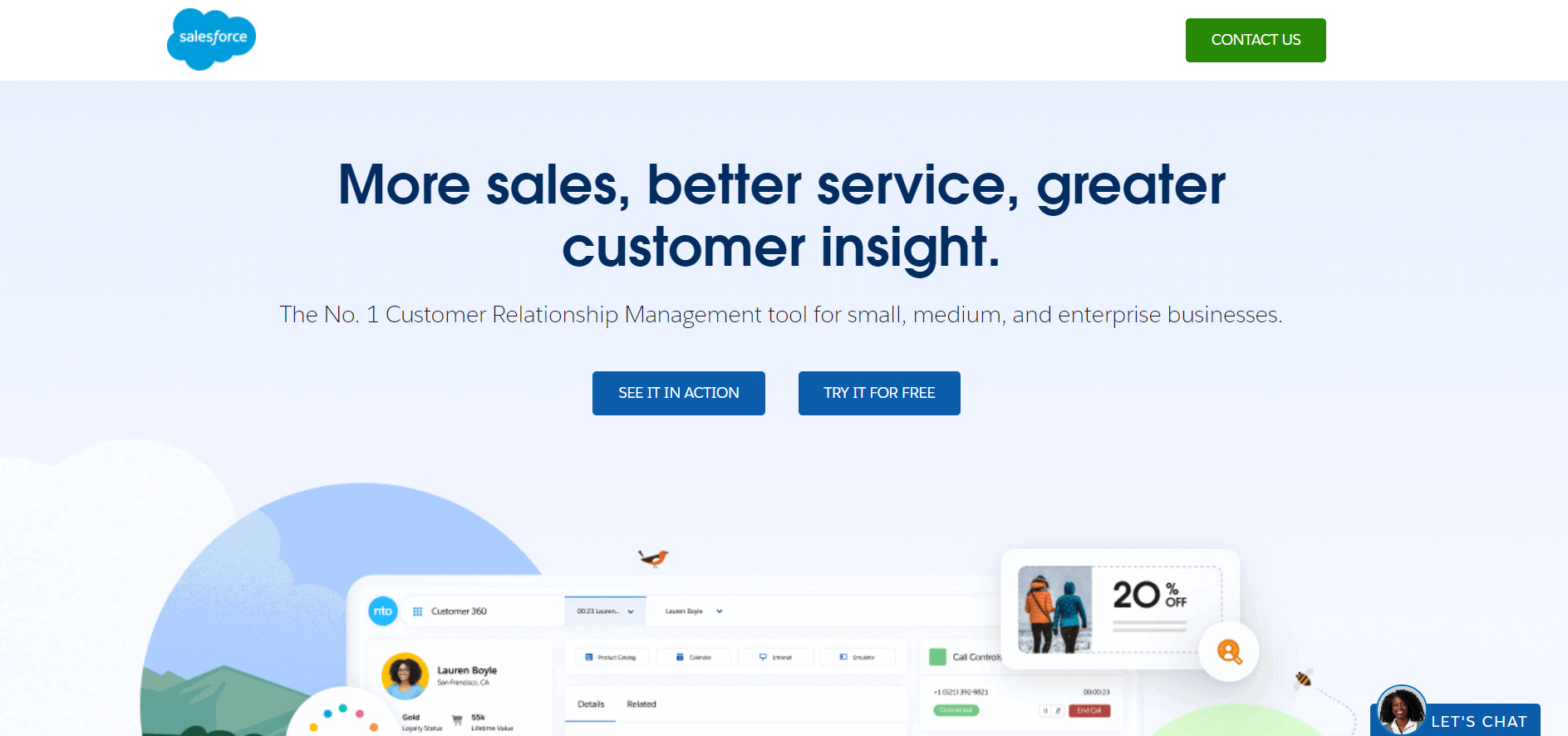
Salesforce is the default enterprise CRM: contact management, sales forecasting, workflow automation, and a customisation surface deep enough to build almost anything. That last part is the point for recruiters. Salesforce does not ship recruitment functionality, it ships the platform that recruitment functionality gets built on. Bullhorn even sells a version that runs on it.
Price: Starter Suite is $25 per user per month, billed monthly or annually, with no user maximum - Salesforce. Sales Cloud editions above Starter climb steeply from there and are billed annually.
Free trial: Yes.
Key Feature: Customisable dashboards and reporting. If your KPIs are unusual, Salesforce is the one platform on this list that will definitely model them.
Best for: Mid-market and enterprise firms with an admin, or a budget for one. The catch: out of the box there is no candidate database, no resume parsing and no job board posting, so a pure recruitment agency is buying a foundation, not a solution.
2. Freshsales
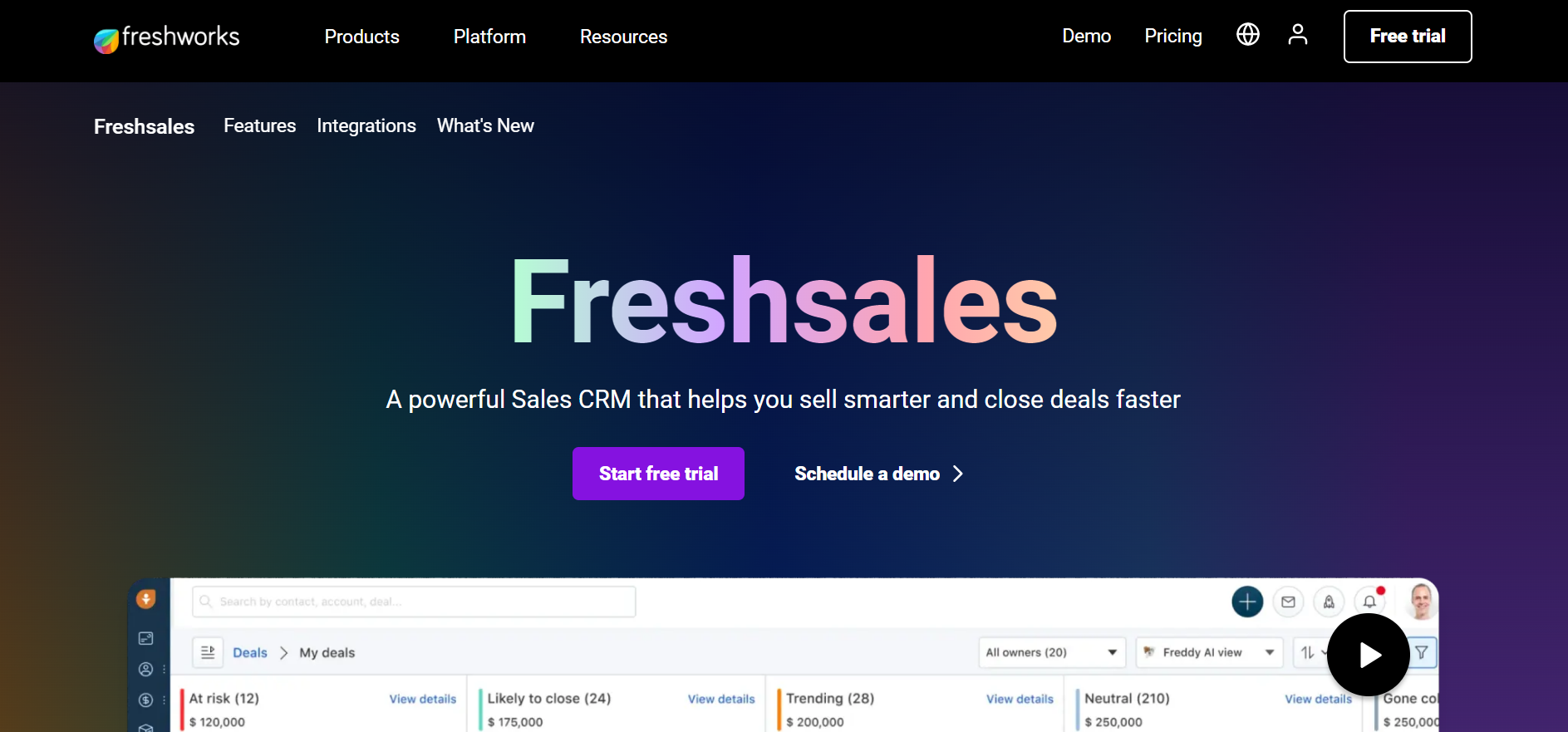
Freshsales is Freshworks' sales CRM: lead management, pipelines, sales automation, and integrations with Google Workspace, Zapier and Freshdesk. For a recruitment business it is a client-side tool, useful for tracking the agency's own business development rather than its candidates.
Price: Growth $9, Pro $39 and Enterprise $59 per user per month billed annually - Freshworks. The Freddy AI agent is a separate add-on priced per session.
Free trial: Yes, 21 days, fully loaded. Note that there is no free plan: the trial is the only free entry point.
Key Feature: Lead scoring, which prioritises inbound client enquiries by likelihood to convert.
Best for: Small agencies whose bottleneck is winning clients, not managing candidates. The catch: it will not parse a CV or post a job, so it rarely stands alone in an agency.
3. Zoho Recruit
Zoho Recruit is the recruitment product in the Zoho suite, and the name is worth being precise about: Zoho CRM is the sales product, Zoho Recruit is the one with the candidate database, resume parsing and job board posting. It comes in two editions, a Corporate HR edition for in-house teams and a Staffing Agency edition for agencies.
Price: Zoho publishes per-recruiter, per-month pricing on its pricing page, and the tiers are gated on active jobs: the forever-free plan allows 1 active job, Standard 100, Professional 250 and Enterprise 750. Annual billing saves roughly 16%, and video interviewing and client portals are separately priced add-ons.
Free trial: Yes, 15 days, with a 45-day money-back guarantee on paid plans.
Key Feature: A forever-free tier that a freelance recruiter working one role at a time can genuinely use, which nothing else on this list offers.
Best for: Small agencies already using Zoho for mail, books or CRM. The catch: the 1-job free cap makes that tier a demo rather than a plan, and the add-ons add up faster than the sticker suggests.
4. HubSpot
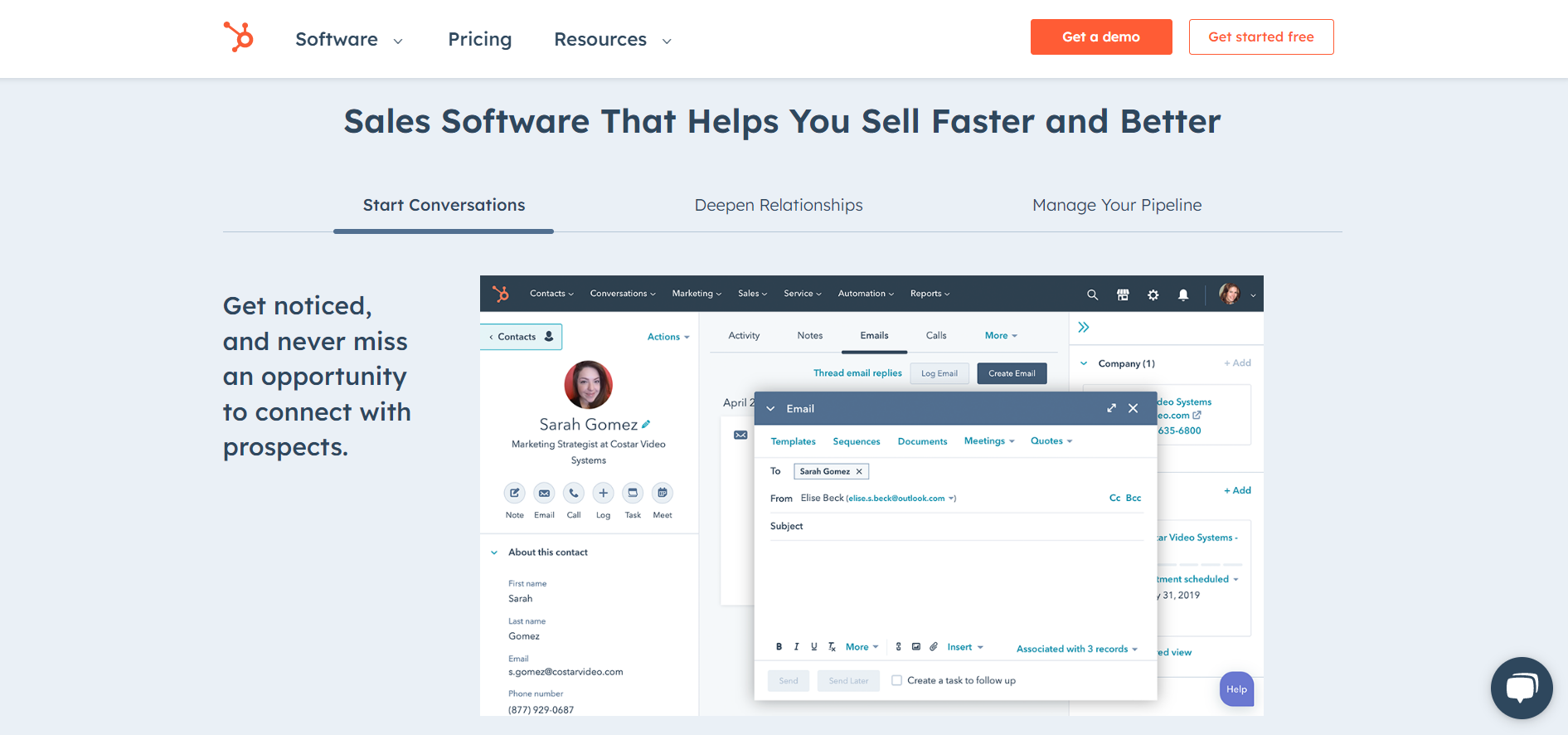
HubSpot gets recommended to recruiters as "the free CRM", which is true only at the very bottom. It is an excellent contact, email and marketing platform, and agencies with a content-led client acquisition motion get real value from it. As a candidate system it is a sales CRM, with the same gaps as the rest.
Price: The Sales Hub free plan is $0 for up to 2 users. Starter is $7 per seat per month billed annually ($20 month to month). Professional is $90 per seat per month billed annually and carries a one-time $1,500 onboarding fee. Enterprise starts at $150 per seat per month with a $3,500 onboarding fee - HubSpot.
Free trial: The free plan is the trial. No credit card required.
Key Feature: Email tracking and sequences, which tell you when a client or candidate opened your message and clicked a link.
Best for: Agencies that market to clients. The catch: "free" ends at 2 users, and the automation most agencies actually want lives in Professional, where the mandatory onboarding fee alone is $1,500 before you have paid for a single seat.
5. JobAdder
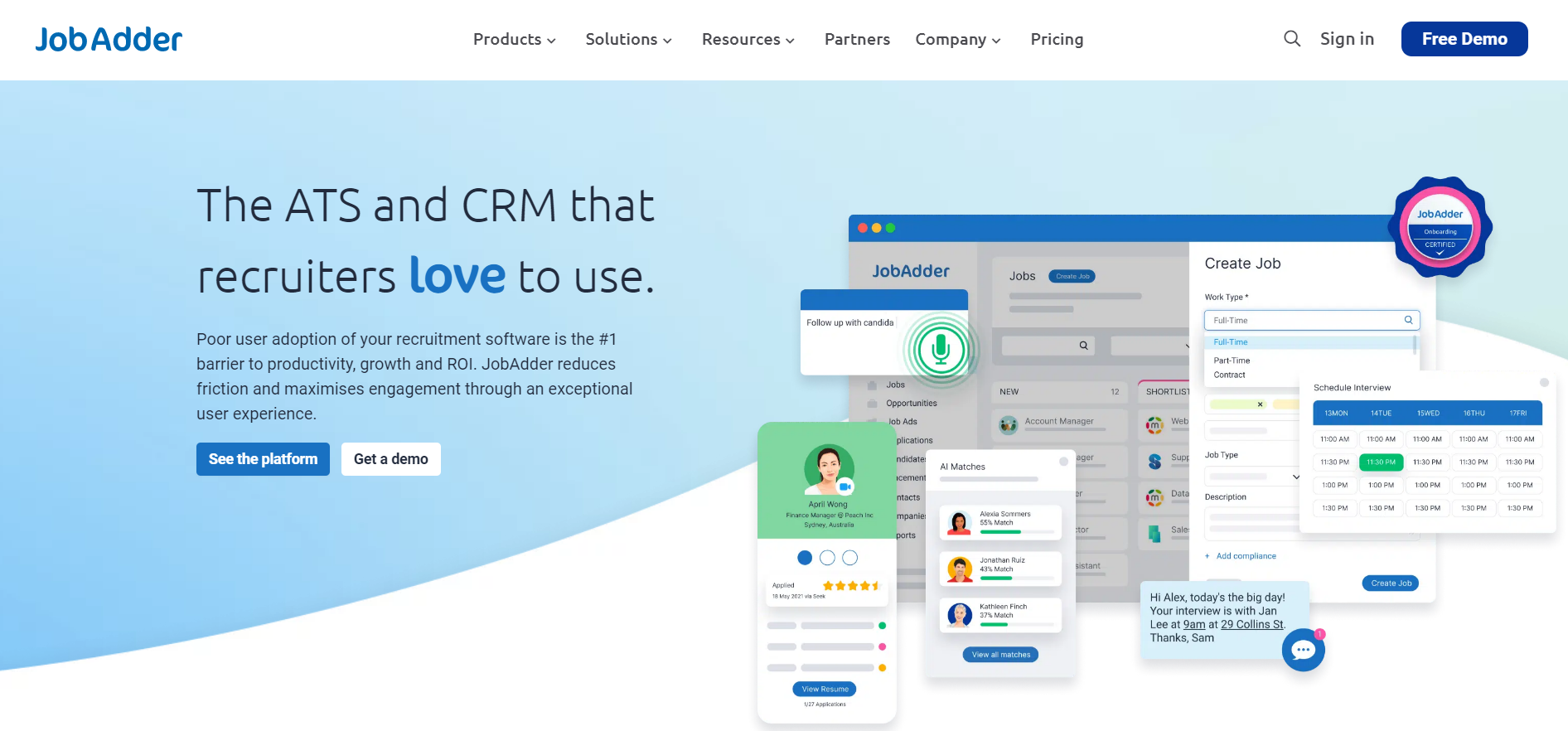
JobAdder is a purpose-built recruitment platform for agencies: candidate sourcing, applicant tracking, and client and candidate management in one system, with strong job board distribution. It is a genuine end-to-end agency tool rather than a CRM you have to adapt into one.
Price: No published price. JobAdder offers four plans, Lite (1-5 users), Essential (6-20 users), Pro (21+ users) and Business (in-house talent teams), and quotes each agency individually - JobAdder. The 2023-era "$99 per month" figure still circulating online is not on their pricing page.
Free Trial: Not advertised. The entry point is a demo or a pricing request.
Key Feature: Job board integration. Post a role to many boards at once, plus advanced search across your candidate database.
Best for: Small to large agencies that want one system for everything. The catch: the add-on list is where the budget goes. Dedicated IP, API and sandbox access, single sign-on, Broadbean, smart forms and the hiring manager portal are all priced separately, so ask what your quote actually includes.
6. Bullhorn
Bullhorn is the incumbent in agency recruitment software, and the only platform here built around the thing that separates a staffing business from a search business: contract and temp placement, with timesheets, pay-and-bill and back-office. If you place contractors, this is the end of the market you belong in.
Price: No list price. Bullhorn quotes per seat, per agency, on an annual contract, and implementation is a project with its own cost rather than a signup.
Free Trial: No. Demo only.
Key Feature: Depth of integration: job boards, LinkedIn and a large partner marketplace, plus analytics built around staffing metrics rather than generic sales pipelines.
Best for: Mid-sized to large agencies, especially in contract and temp staffing. The catch: it is the heaviest and most expensive option on this list, and a two-person perm desk will not use a fraction of it.
7. Recruitly
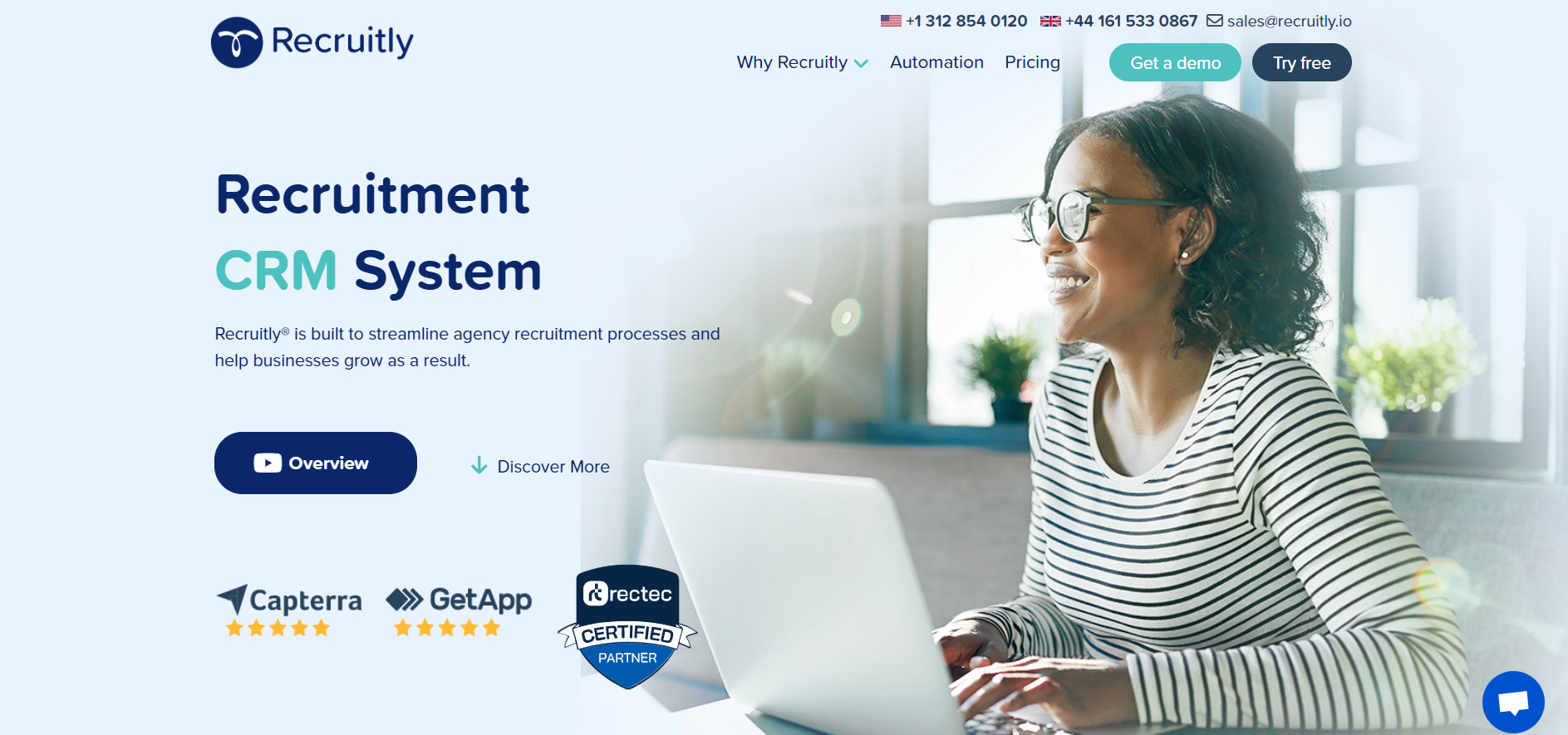
Recruitly is a recruitment CRM that manages candidates, clients, job orders and placements, with applicant tracking, resume parsing, job posting, email marketing and analytics. Its pricing model has changed since this article first ran: it is now charged per user rather than as a flat monthly fee, and there is a free plan.
Price: Free ($0), Solo $25, Professional $80 and Enterprise $120 per user per month, with a discount for annual billing - Recruitly. Each tier is capped on data: Free allows 1,000 candidates and 5 jobs, Solo 10,000 candidates and 25 jobs, Professional 50,000 candidates and 100 jobs. Eligible new agencies can get 75% off Pro and Enterprise for three years under Recruitly's startup initiative.
Free Trial: Yes, 14 days on the paid plans.
Key Feature: Email and outreach automation for candidate and client campaigns, job alerts and scheduling, plus posting to 50+ job boards.
Best for: Freelance recruiters and very small agencies. The catch, and it is a big one: Solo is capped at 1 user. The moment you hire a second recruiter you are on Professional at $80 per user per month, a 3.2x jump per seat.
Also worth comparing: Manatal
Recruitly's seat cliff is worth sitting with, because it exposes the gap in this list. If you want a purpose-built recruitment CRM, the options above either refuse to publish a price (JobAdder, Bullhorn) or get expensive as soon as there are two of you. Manatal is the obvious thing to weigh against them: an agency-focused ATS and recruitment CRM that does publish its price, and publishes the lowest one here.
It covers what the top of this article asks for: a searchable candidate database with resume parsing, pipeline management with custom stages, job posting to boards and to a career page, plus client and placement tracking for agency work. On the two axes that matter most to a small agency, the published price and the cost of the next seat, it is the cheapest purpose-built option in this comparison. That is the whole case for it, and it is a narrow one: it wins on price and transparency, not on depth.
Manatal
Every purpose-built recruitment CRM above either hides its price (JobAdder, Bullhorn) or jumps to $80 per user per month the moment a second recruiter joins (Recruitly). Manatal publishes $15 per user per month billed annually ($19 month to month), and the 14-day trial takes no credit card. The honest catch: that tier stops at 15 active jobs and 10,000 candidates, so a busy agency desk is really comparing the $35 tier for unlimited jobs, and API access plus SSO only appear at $55. It is also not a Bullhorn-class system: no pay-and-bill and no back-office, so if you run timesheets for contractors, stay at the quote-only end of this list.
How to choose
Work backwards from what your desk actually does, not from the feature list. If you place contractors, the decision is close to made for you: you need timesheets, pay-and-bill and back-office, which means Bullhorn or a comparable staffing platform, quote and implementation project included. If you run a perm desk and the real problem is that candidates and clients live in a spreadsheet, any of the purpose-built recruitment CRMs will fix it, so choose on price per seat and on the caps, and make JobAdder and Bullhorn quote you before you assume they are out of reach.
If your problem is winning clients rather than tracking candidates, a sales CRM is the honest answer, and HubSpot's free tier is a reasonable place to start as long as you know it ends at 2 users. And if cost per seat is the binding constraint, the published numbers point one way: $15 per user per month with a 15-job cap, against $80 per user per month for Recruitly's multi-user tier and a sales call for everything else.
The cheapest published price of any purpose-built recruitment CRM here at $15 per user per month billed annually, if the 15-job cap on that tier fits your desk.
One thing no CRM on this list does, whatever it costs: find you candidates. A CRM organises the people you already know about. Sourcing is a separate job, handled by tools like HeroHunt.ai, and it is worth keeping the two budgets separate in your head so you do not buy a database and expect a pipeline.
Take the time to evaluate each platform against your own desk before committing, and pay particular attention to the annual contract terms on the quote-only vendors. Pick the right CRM and you save time, run a tighter process, and stop losing candidates you already paid to find.
Pricing checked against each vendor's own pricing page in July 2026. Recruitment software pricing changes often, so verify current figures before you buy.