




What the 10 leading candidate engagement tools really cost in 2026, which candidates each one is built to engage, and how to choose without overpaying
Recruiting emails are getting harder to land: across 6.2 million outreach sequences sent in 2025, the average reply rate was 16.9%. That figure comes from Gem's 2026 email outreach benchmarks, and it fell from 22.6% in 2024, while the share of sequences that produced an interested reply dropped from 12.1% to 9.4% - Gem. At the same time, engagement is where hires come from: Gem's separate 2026 recruiting benchmarks found that sourced candidates are nearly eight times more likely to be hired than inbound applicants. The step that matters most is also the step that is getting harder, which is exactly why candidate engagement software has become one of the most crowded categories in recruiting technology.
The problem is that "candidate engagement software" now describes four different products priced in four different ways. Some tools find passive candidates and run outreach sequences for $99 to $549 a month per recruiter. Others are enterprise talent CRMs and conversational AI platforms that never publish a price and close deals at a median of tens of thousands of dollars a year. Comparing them on a feature checklist hides the two things that decide whether a tool pays off: which candidates it is built to engage, and which unit you pay for.
This guide does the comparison properly. It explains the four types of engagement software and where each fits in the candidate journey, how each is metered, and then reviews the 10 best candidate engagement tools in 2026 with their real prices: published plans read from each vendor's own pricing page in October 2026, and for the enterprise platforms that quote every deal, the median contract value buyers actually paid. It closes with a side-by-side comparison, the benchmarks that tell you whether your engagement is working, a decision framework, the ways these tools fail, and where AI agents are taking the category next.
Written by Yuma Heymans (@yumahey), who has been building AI recruitment tools since 2021 as the founder of HeroHunt.ai, an AI Recruiter that sources candidates from 1B+ profiles and engages them on autopilot. Competing in this category every day is why this guide prices each tool in the unit buyers actually pay for, not the one on the banner.
HeroHunt.ai
If the engagement problem you are solving is outbound, getting qualified passive candidates to reply, HeroHunt.ai covers both halves of it: it finds and screens candidates from up to 1B profiles, then runs personalised sequences by email from your own Gmail or Outlook and by LinkedIn connection request or InMail from your connected account. Plans start at $99 a month with unlimited positions, metered on matched profiles and emails found (2,000 profiles and 500 emails a month on Starter), after an 8-day free trial (card required). The honest caveat: it is not a talent CRM or a texting bot, so if your problem is nurturing a large existing database or answering thousands of hourly applicants, start with Paradox, Sense, Phenom or Avature in section 4 instead.
Contents
- The Short Answer: Best Candidate Engagement Software by Use Case
- What Candidate Engagement Software Actually Does in 2026
- How Candidate Engagement Software Is Priced
- The 10 Best Candidate Engagement Tools in 2026, Priced
- Side by Side: Price, Pricing Unit and Channels
- Engagement Benchmarks: What Good Looks Like in 2026
- How to Choose: A Decision Framework
- Where Candidate Engagement Software Fails
- How AI Agents Are Changing Candidate Engagement
- The Bottom Line
1. The Short Answer: Best Candidate Engagement Software by Use Case
There is no single best candidate engagement tool, but there is a clear best choice for each kind of team. Outbound tools with published self-serve plans (HeroHunt.ai, Pin, Juicebox, SeekOut) win for solo recruiters, agencies and small teams. Gem and hireEZ win for in-house teams that want outbound plus rediscovery. Paradox wins for high-volume hourly hiring, Sense for staffing agencies re-engaging a contractor bench, and Phenom and Avature for large enterprises that want a full CRM-led engagement suite.
Price follows the same split. The outbound tools start between roughly $1,000 and $6,600 a year per recruiter on published plans, while the enterprise and conversational platforms are quoted individually and land in the tens or hundreds of thousands of dollars a year. The table below gives the quick version; every number is explained, with its source, in section 4.
| Tool | Best for | Starting price (verified October 2026) | Priced by |
|---|---|---|---|
| Gem | In-house CRM, sequences and rediscovery | $99/user/mo (staffing), startups from $300/mo; in-house custom | Users or company headcount |
| hireEZ | Outbound plus ATS rediscovery with AI agents | $494/seat/mo billed annually ($5,929 a year) | Seat plus credits |
| SeekOut | Precise search for hard-to-find profiles | $149/mo billed annually, $179 monthly | Plan plus credits |
| Juicebox | Natural-language search and sequences | $99/mo billed yearly, $119 monthly | Seat plus credits |
| Pin | Lowest-cost automated outreach | $100/mo, annual only | Seat plus credits |
| Paradox (Workday) | High-volume hourly hiring by text | £18-£65 per employee a year (Workday rate card) | Company headcount |
| Sense | Staffing redeployment and texting | $2,000/mo platform, $500/mo texting only | Package |
| Phenom | Enterprise talent experience suite | $98,313 a year Vendr median | Enterprise licence |
| Avature | Configurable enterprise CRM | Quote only; one federal contract at about $1.2M a year | Enterprise licence |
| HeroHunt.ai | Autonomous sourcing plus multichannel outreach | $99/mo, monthly or yearly | Plan with profile and email allowances |
The most common mistake this table helps avoid is buying across categories. A 15-person agency does not need Phenom, and a 30,000-employee retailer will not fix its hourly hiring with an outbound sourcing seat. Start from the row that matches your main engagement problem, then read that tool's full review and the decision framework in section 7.
2. What Candidate Engagement Software Actually Does in 2026
Candidate engagement software is any tool that starts or sustains a conversation with a candidate on your behalf: the first outreach email, the follow-up nobody remembers to send, the text that confirms an interview, the update that keeps last year's runner-up warm. The category name hides the fact that four very different products compete under it, and the most expensive buying mistake is comparing a $99-a-month outbound tool with a six-figure enterprise CRM as if they did the same job.
The split matters because each type is built around a different candidate. Outbound tools engage people who have never heard of you. Talent CRMs engage people who already know you: past applicants, silver medalists, alumni and event sign-ups. Conversational AI engages people who are applying right now, often for hourly roles, and must answer within minutes. Staffing engagement automation engages a contractor bench an agency wants to place again. One product can stretch across two of these jobs, but none of the ten tools in this guide is best at all four.
- Outbound engagement: find passive candidates and run personalised multi-step sequences by email and LinkedIn.
- Nurture and rediscovery: a talent CRM that segments past candidates and re-engages them when a fitting role opens.
- Conversational engagement at volume: a chat or text assistant that answers questions, screens and books interviews around the clock.
- Staffing engagement automation: texting, surveys and redeployment campaigns for agencies and their contractor pools.
The second job is the most underrated. Gem's 2026 benchmarks report, built from more than 165 million applications and 1.2 million hires between June 2021 and May 2025, found that nearly half (46%) of sourced hires now come from rediscovered candidates - Gem. In other words, almost half of the "sourcing" wins at Gem customers came from re-engaging people the company already knew. If your team only buys an outbound tool, it is paying to find strangers while ignoring the warmest pool it owns. If it only buys a CRM, it never adds new people to that pool.
The trend is what makes this hard to ignore. Gem's own chart shows the rediscovered share of sourced hires climbing every year of its dataset, from about a quarter to nearly half, as more companies built up candidate databases worth mining.
Share of Sourced Hires That Were Rediscovered Candidates
Each bar is a June-to-May year in Gem's 2026 Recruiting Benchmarks. The practical reading is that a company's own database is now its single largest source of sourced hires, and it compounds: every outbound campaign this year becomes next year's rediscovery pool, but only if the engagement tool keeps those candidates organised, tagged and reachable.
The diagram below maps the four jobs onto the candidate journey. Read it from left to right: outbound and inbound candidates enter, conversational tools move them through screening and scheduling, and the CRM loop catches everyone who did not get the job this time.
The loops are the point. The outbound box on the left is where most of the 2026 AI-agent investment has gone, because it is the easiest to sell on a demo: type a job description, watch candidates appear, watch messages go out. The loops on the right, rediscovery and redeployment, are where the cheapest hires come from, because those people already know and trust you. A balanced engagement stack covers both, even if one tool does most of the work.
How to apply this: before you look at any vendor, write down which of the four jobs causes your team the most pain today and which candidate pool you are under-using. A startup hiring engineers usually needs outbound first. A retailer hiring 2,000 store staff a year needs conversational AI first. An agency with 5,000 past contractors needs redeployment automation first. An enterprise with 400,000 candidates sitting in its ATS needs a CRM with real rediscovery. The ten tools in section 4 are grouped so you can jump straight to your job.
3. How Candidate Engagement Software Is Priced
Engagement software uses at least five different metering units, and the unit predicts your real cost better than the headline price. A tool priced per seat gets more expensive as your team grows. A tool priced per company headcount gets more expensive as your company grows, even if recruiting does not. A tool priced on credits gets more expensive as you engage more candidates. Two products with the same list price can differ by a factor of five once you apply your own volumes, which is why this guide reports the unit next to every price.
The second split is between published and negotiated prices. Six of the ten tools here publish a price on their own website: HeroHunt.ai, Pin, Juicebox, SeekOut, hireEZ and Sense, plus Gem for startups and staffing firms. The enterprise platforms (Phenom, Avature and Paradox) quote every deal individually. For those, the most reliable public evidence is what buyers actually paid, which procurement marketplace Vendr aggregates from real contracts into a median, a range and a sample size. Neither number is "the price": a published plan is what a small team pays, and a Vendr median is what a typical mid-sized buyer negotiated.
The five metering units below cover every tool in this guide. Most products combine two of them, usually a base unit plus a credit meter, and the combination is what you need to model, because the base price is fixed while the credit cost rises with exactly the activity you bought the tool to increase.
- Per seat or per user: hireEZ, SeekOut, Juicebox, Pin and Gem's staffing plans charge per recruiter per month.
- Per plan with usage allowances: HeroHunt.ai sells plans with monthly allowances of matched profiles and emails rather than per-seat pricing.
- Per company headcount (FTE band): Gem prices its in-house plans by the number of employees at your company, not recruiters.
- Per package or enterprise licence: Sense publishes monthly starting prices per package, while Phenom, Avature and Paradox sell annual licences scoped to company size, modules and volume.
- Credits on top: most tools add a second meter for contact reveals, exports, AI actions or text messages.
The practical consequence is that you cannot compare these tools from their pricing pages alone. A ten-person recruiting team at a 3,000-person company might pay less with a per-seat outbound tool than with an FTE-banded platform, while a two-person team at a 50-person startup might find Gem's FTE pricing far cheaper than any per-seat tool. Credits flip the comparison again for heavy users: a plan that looks cheap at 300 contact credits a month becomes expensive if your recruiters need 1,000. Build a simple model with your own seat count, company size and monthly candidate volume before you compare quotes.
A worked example shows how fast the ranking changes. Take a three-recruiter agency team. On Pin's Solo plan that is $3,600 a year, on Juicebox Starter (yearly) about $3,564, on SeekOut's Sourcing Core somewhere between $1,788 and $5,364 depending on how its seat contradiction resolves, and on hireEZ $17,787 paid upfront. Add ATS integration and the cheaper options either need an upgrade or an add-on. Now take a 25-person startup with one recruiter: Gem's startup grid lists $400 a month on monthly billing for 11-30 employees, which buys the whole platform for that company, not one seat. The same tool can be the cheapest or the most expensive option depending entirely on which unit you are in.
The chart below shows the entry price of each published plan in this guide, converted to a yearly figure so that monthly-billed and annually-billed plans sit on the same axis.
Entry Plan Cost per Year, Published Prices (USD)
Read the chart as a floor, not a budget. Every one of these entry plans has a cap (one user, a credit allowance, a limited database or no ATS integration) that a growing team hits quickly, and the step up to the next tier is often larger than the entry price itself. hireEZ stands out because its only published plan already includes ATS rediscovery and AI-review credits, which the cheaper tools charge extra for or leave out.
The enterprise platforms cannot go on that chart because none of them publishes a price. Vendr's marketplace data fills part of the gap: it records the median annual contract value that real buyers negotiated, and the chart below shows it for the tools in this guide that have one, plus two strong alternatives from section 4.11.
Median Annual Contract Value on Vendr (USD)
Two cautions apply to these medians. Sample sizes differ enormously: Gem's figure comes from 234 purchases and SeekOut's from 65, while Phenom's rests on a handful of contracts, so treat the Phenom and Beamery bars as indicative rather than precise. And a median contract covers a whole team, not one seat. Even so, the scale is clear: a typical Phenom contract costs about as much as sixteen hireEZ seats paid upfront, because it covers far more, including careers sites, CRM, chatbots, scheduling and analytics across an entire company. The real question is never "which tool is cheapest" but "which unit of value am I buying": a recruiter seat, an outbound conversation, or a company-wide engagement platform.
How to apply this: for each tool on your shortlist, write down the metering unit, your own number of that unit, and the price per unit at the tier you would actually need. Then add the credit meter at your expected monthly volume. That two-line model will tell you more than any vendor's ROI calculator.
4. The 10 Best Candidate Engagement Tools in 2026, Priced
The ten tools below were chosen for what they do best in 2026, not for how loudly they market. Each one leads at least one of the four engagement jobs from section 2, has shipped meaningful product in the last year, and has price evidence a buyer can check. The first five (Gem, hireEZ, SeekOut, Juicebox and Pin) are outbound engagement tools for finding and contacting candidates. Paradox and Sense cover conversational and staffing engagement. Phenom and Avature are enterprise CRM-led suites. HeroHunt.ai closes the list as an autonomous sourcing and outreach option with published monthly plans.
Every price was read in October 2026, either from the vendor's own pricing page, rendered in a real browser because most of these pages load prices with JavaScript, or, where a vendor publishes nothing, from a public procurement source: Workday's UK government rate card, AWS Marketplace, US federal spending records or Vendr's contract data. Each review says which, because a published plan, a government rate card and a negotiated median are different kinds of evidence and should not be compared as if they were the same number. Section 4.11 then notes five more tools that just missed the list and why.
4.1 Gem: The Recruiting CRM That Grew Into a Platform
Gem is the default answer for in-house teams that want outbound sequences, a talent CRM and rediscovery in one product, and it now sells an all-in-one plan that replaces the ATS as well. Recruiters build multi-step email sequences that send from their own Gmail or Outlook mailbox, nurture past candidates in segmented pipelines, and use AI sourcing to search Gem's profile database and the company's own ATS at the same time - Gem. In March 2026 Gem said every recruiter with a license gets unlimited AI sourcing, and in August it launched an MCP server so AI assistants can work with Gem data directly.
Gem's engagement strength is the loop between outbound and rediscovery. The same analytics that tell you which sequence step earns replies also tell you which past candidates resurface for a new role, and its own benchmark data argues that this loop is where almost half of sourced hires now come from. The trade-off is that Gem is a platform you configure, not an agent you hand a job description to: teams that never build sequences or curate their pipelines get far less from it than teams with a recruiting-operations owner.
Gem's outreach composer shows how the CRM and the sequence meet in practice. The candidate card carries a "Silver Medalist" tag from an earlier process, and the AI-drafted message references a specific, recent career event rather than a generic compliment.
Gem: AI-personalised outreach to a rediscovered candidate
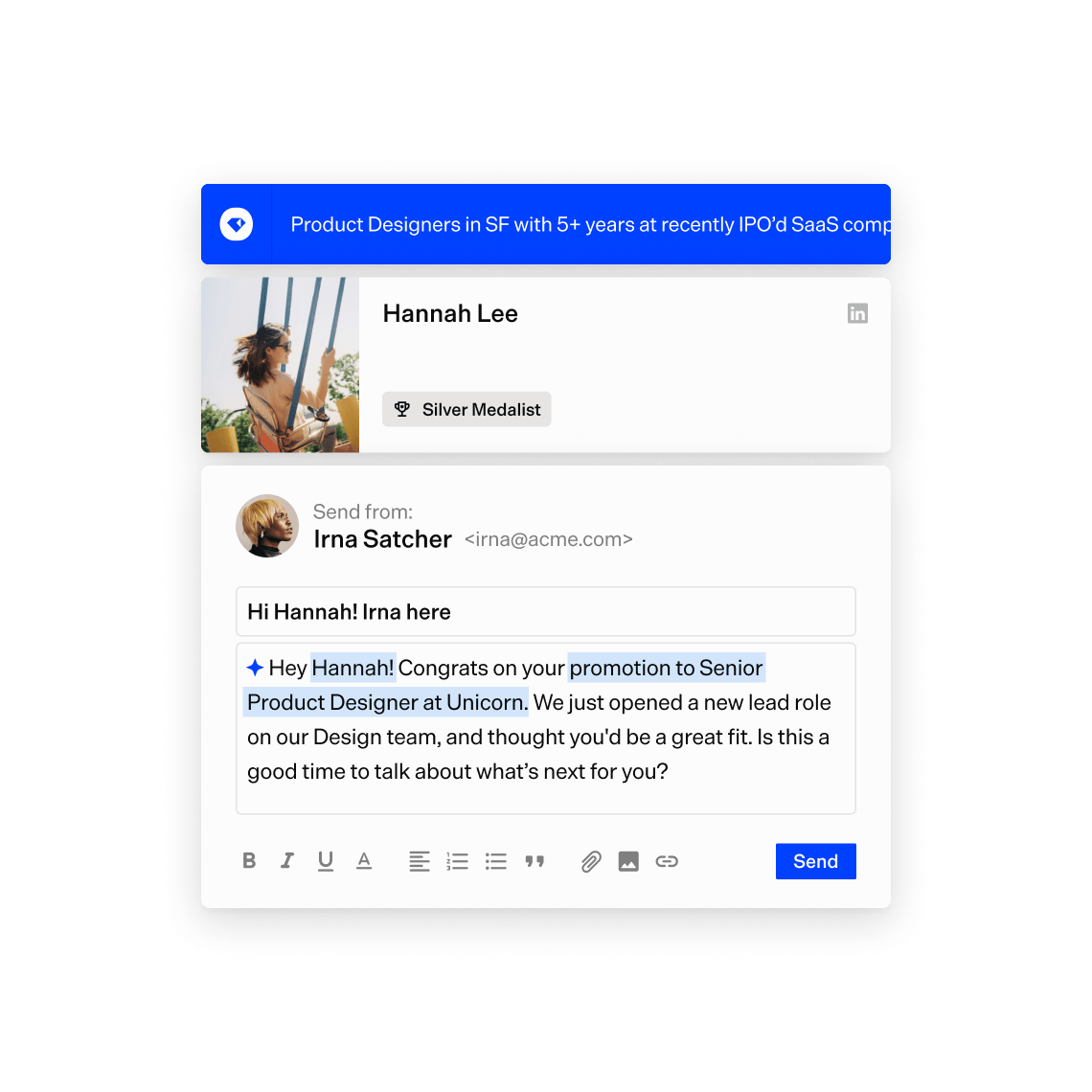
The highlighted phrases are the personalisation the AI inserted, and the "Send from" line shows the message going out from a named colleague's own mailbox. That combination, a rediscovered candidate plus a specific reason to talk now plus a real sender, is the pattern the benchmark data in section 6 rewards.
| Plan | Price | What is included |
|---|---|---|
| Startup (1-10 employees) | $300/mo monthly, or $130/mo billed yearly in year one | Self-serve checkout |
| Startup (11-30 employees) | $400/mo monthly, or $180/mo yearly in year one | Self-serve checkout |
| Staffing Essentials | $99/user/mo yearly, $139 monthly | 150 email credits per user per month, max 3 users |
| Staffing Professional | $149/user/mo yearly, $199 monthly | 750 email credits per user per month, max 10 users |
| In-house (Gem + Your ATS, All-in-One) | Custom, by company headcount | Vendr median $25,699 a year |
The in-house price is quoted by your company's employee count rather than by recruiter, which makes Gem unusually cheap for small recruiting teams at small companies and progressively more expensive as headcount grows. Gem's startup pricing shows the full ladder: $300 a month for 1-10 employees up to $900 for 76-100, with the yearly price shown at roughly half of list for the first paid year. For the in-house plans, Vendr records a median of $25,699 across 234 purchases, ranging from $7,000 to $73,076 - Vendr. Our Gem pricing breakdown covers the AI seat types and contract terms in detail.
The honest limitations: Gem's help center lists some AI capabilities, such as AI app review, as paid add-ons arranged through an account manager, so confirm what your quote includes. The staffing plans cap users at 3 and 10 and reserve the AI suite and Bullhorn-style ATS connectors for Enterprise. And because pricing follows company size, a fast-growing company can see its Gem bill rise at renewal without hiring a single extra recruiter.
Best for: In-house recruiting teams at startups and mid-market companies that want sequences, CRM nurture and rediscovery in one system, and have someone to own the configuration.
4.2 hireEZ: Agent-Native Outbound on Top of Your ATS
hireEZ (formerly Hiretual) is an outbound sourcing and engagement platform that searches a large external profile database alongside your ATS, then runs automated email campaigns from the recruiter's own mailbox - hireEZ. In August 2026 it relaunched as "the new hireEZ", rebuilt around an AI agent, EZ Agent, that sources, screens and engages candidates with the recruiter approving at checkpoints - PR Newswire via Webull. Its rediscovery feature, which resurfaces past applicants from your ATS for new roles, is one of the strongest in the outbound group.
hireEZ also publishes one of the few large, recent outreach benchmarks. Its 2025 report, based on 2.7 million recruiting emails sent in the first half of 2025, found an average reply rate of 15.2% - hireEZ. That number is a useful reality check for any vendor promising dramatically higher replies, and it matches Gem's much larger 2025 dataset closely.
| Plan | Price | What is included |
|---|---|---|
| Growth, annual plan paid upfront | $494/seat/mo ($5,929 a year) | Per seat per month: 300 contact, 300 rediscovery and 300 export credits, plus 1,000 AI-review credits |
| Growth, annual plan paid monthly | $549/seat/mo ($6,588 a year) | Same allowances, still an annual commitment |
| Enterprise | Custom | Vendr median $13,000 a year |
The headline "solo recruiters start at $494/mo" on hireEZ's pricing page is the annual plan paid upfront, so the real commitment is $5,929 a year - hireEZ pricing. The $549 option is labelled at checkout as the annual plan's monthly payment option, so it spreads the same year-long commitment rather than offering a month-to-month plan. That makes hireEZ the most expensive published seat in this guide, roughly three to five times the entry plans of Pin, Juicebox or SeekOut. What you buy for that premium is ATS rediscovery, AI review credits and a deeper agent workflow; if you only need outbound sequences to new candidates, cheaper tools do that job. Our hireEZ pricing guide explains why the old $169 and $199 figures still quoted online are years out of date.
The limitations are mostly about fit. The allowance of 300 contact credits per seat per month is modest for a high-volume sourcer, there is a 7-day trial but no true monthly plan, and enterprise pricing is configured to "the stack hireEZ replaces", which makes comparison shopping slow.
Best for: In-house teams with a large ATS database who want outbound sourcing and AI rediscovery in one agent-driven workflow, and can commit to an annual seat.
4.3 SeekOut: Deep Search With Built-In Outreach
SeekOut made its name with deep candidate search, especially for technical, cleared and diverse talent, and its self-serve Sourcing Core plan now brings that search plus contact data and outreach to individual recruiters - SeekOut. Sourcing Core includes email integration with sending on the recruiter's behalf and AI-written multi-step campaigns, and in September 2026 SeekOut added a Talent Intelligence Agent that drafts outreach as part of its research - SeekOut.
For engagement, SeekOut's value is precision before contact: richer filters and profile data mean fewer, better-targeted messages, which matters in a year when reply rates are falling. Its sequence tooling is capable rather than distinctive (messaging analytics only start on the higher Sourcing + Integration tier), so teams that live in sequences all day may prefer a CRM-first tool, while teams that struggle to find the right people in the first place get the most from it.
The Outreach tab below shows how SeekOut organises engagement inside a project: separate sequences for public-profile, ATS and alumni candidates, each with its own funnel from started to opened, replied and exported to the ATS.
SeekOut: outreach sequences inside a sourcing project
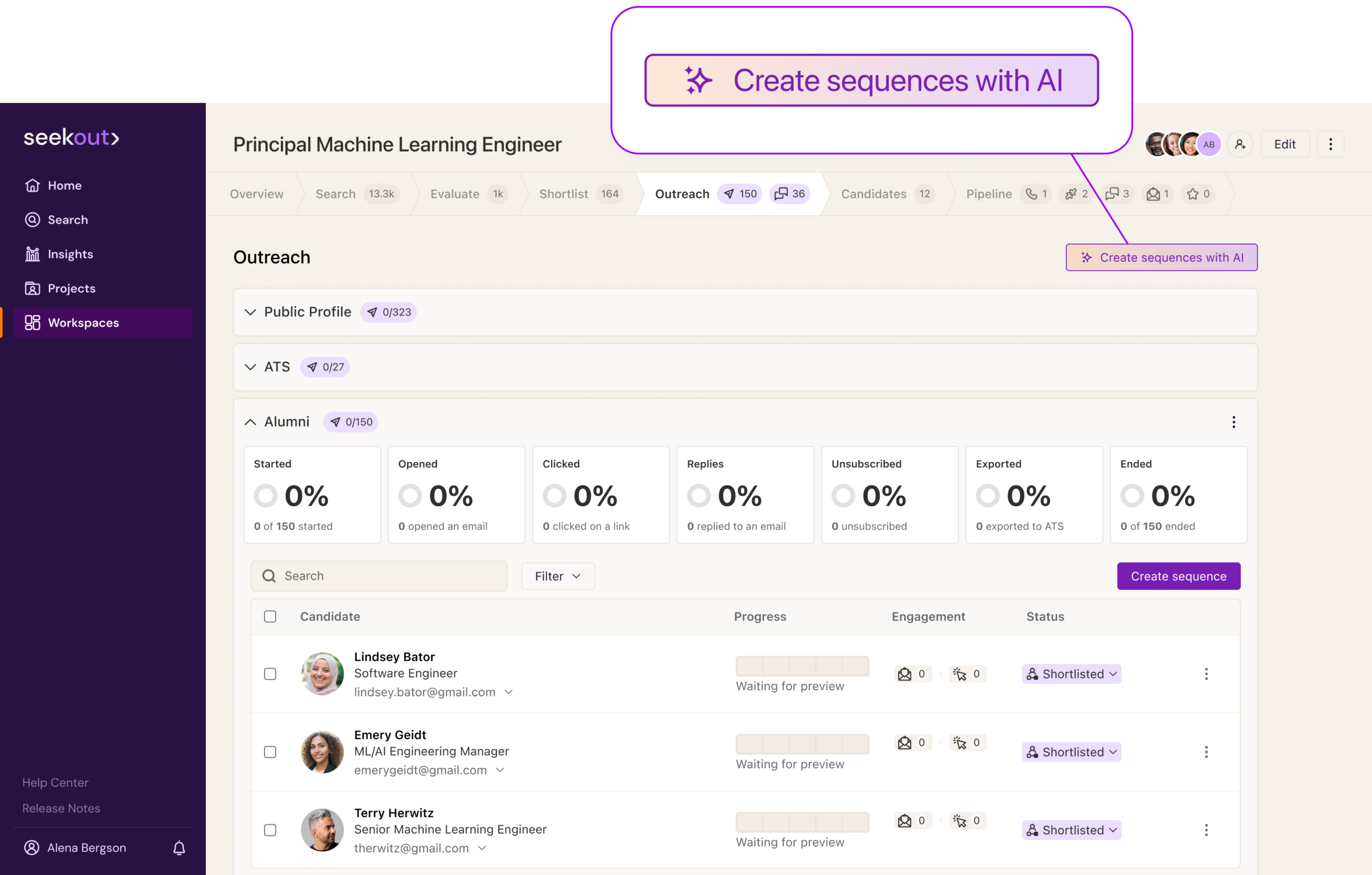
Splitting outreach by source is a small design choice with a big effect on results, because alumni and past applicants respond to a different message than strangers do. The "Create sequences with AI" button drafts those variants for you, which makes the split practical even for a single recruiter.
| Plan | Price | What is included |
|---|---|---|
| Sourcing Core, annual | $149/mo ($1,788 a year) | 500 contact credits and 1,000 exports a month, email send-on-behalf, AI multi-step campaigns |
| Sourcing Core, monthly | $179/mo | Same allowances, 14-day free trial |
| Sourcing / Sourcing + Integration | Custom, annual | 750 contacts and 5,000 exports per seat, ATS integration, messaging analytics |
| Enterprise median | Vendr median $20,000 a year | 65 purchases, $5,820 to $54,920 |
There is one contradiction buyers should resolve in writing: SeekOut's pricing card describes Sourcing Core as being for individual recruiters, while its feature comparison table lists "Seats included: 3" - SeekOut pricing. Credits do not roll over, and the self-serve plan excludes SSO, ATS integration and the healthcare and clearance search that SeekOut is known for. Our SeekOut pricing guide traces how the plan names and prices changed through 2026.
Best for: Recruiters and in-house teams hiring hard-to-find technical or specialist profiles, where finding the right person matters more than sequence automation.
4.4 Juicebox: Natural-Language Search Plus Sequences
Juicebox grew quickly on a simple promise: describe the candidate in plain English, get a ranked list, and send personalised email sequences from the same screen - Juicebox. Its PeopleGPT search and AI agents made it a favourite with startup founders and agency recruiters. In October 2026 it announced it was acquiring the intellectual property and other assets of Fetcher, which was shutting down - Business Wire via Morningstar. A week later it shipped "Smarter Sequences" with a new composer, more sending controls and clearer reporting - Juicebox.
Juicebox sits between a pure search tool and an autonomous agent. Recruiters run searches and sequences themselves on Starter and Growth, or pay per agent for autonomous sourcing that can email candidates automatically. Email steps send on their own from a connected Gmail or Outlook mailbox, while LinkedIn and call steps become tasks for the recruiter to complete, which is worth knowing if your candidates live on LinkedIn.
| Plan | Monthly billing | Yearly billing | Engagement allowances |
|---|---|---|---|
| Starter | $119/mo | $99/mo | 500 contact and 500 export credits, 1 sending mailbox |
| Growth | $199/mo | $179/mo | 1,500 credits per seat, 3 mailboxes per seat, up to 5 seats, phone numbers at 3 credits |
| Agents | $199 per agent/mo | Unlimited contact and email credits, automatic emailing | |
| Business | Custom, annual | 6 mailboxes per seat, ATS and CRM integration |
The catch for an engagement buyer is integration. ATS and CRM sync, the thing that keeps replies and interested candidates flowing into your system of record, is only on the custom Business plan - Juicebox pricing. Sending volume is capped per mailbox rather than per plan (100 emails a day by default and 200 at most on self-serve plans), so the mailbox count in the table is effectively your outreach ceiling. One inconsistency to check: the Starter card mentions phone contacts, while the comparison table shows phone numbers only from Growth. Our Juicebox pricing guide breaks down credit usage in detail.
Best for: Founders, solo recruiters and small agencies who want fast natural-language search and email sequences on a low monthly price, and can live without ATS sync.
4.5 Pin: Low-Cost Autopilot Outreach
Pin is an AI recruiting tool that pairs candidate search with automated outreach, aimed squarely at small teams that want sourcing and engagement on autopilot at a low published price - Pin. In late October 2026 it launched Autopilot, which answers candidate replies and books interviews on the recruiter's behalf - Pin.
Pin's appeal is price and simplicity. It is one of the cheapest published paths to automated outbound engagement, and its sequences are multichannel from the Solo plan up: email sends automatically from Gmail or Outlook, LinkedIn steps appear as tasks, and text messages are drafted for you to send. The trade-off is depth: its analytics and integrations are lighter than Gem, hireEZ or SeekOut, and ATS integration is an add-on below the Enterprise plan.
| Plan | Price | Engagement allowances |
|---|---|---|
| Free | $0 | Email-only sequences |
| Solo | $100/mo, annual only | 500 credits, multichannel sequences, 1 mailbox |
| Professional | $135/mo yearly, $179 monthly | 1,000 credits per user, 5 mailboxes per user, shared inbox |
| Enterprise | Custom | Unlimited mailboxes, ATS integration included |
Pin's Solo price moved from $99 to $100 in October 2026 and its top tier was renamed from Business to Enterprise, so check the current page before relying on older comparisons - Pin pricing. There is also a platform risk worth weighing: in September 2026 Pin's CEO wrote that LinkedIn had removed Pin's company page and his own profile, which matters for a product whose sequences include LinkedIn steps - Pin. Our Pin pricing guide covers the plan history.
Best for: Solo recruiters and small teams that want the lowest-cost route to automated sourcing and multichannel outreach and do not need deep ATS sync on day one.
4.6 Paradox (Workday): Conversational AI for High-Volume Hiring
Paradox is the category leader in conversational engagement: an AI assistant, usually named Olivia, that answers applicants by text, chat and messaging apps, screens them with a few questions and books interviews without a recruiter touching the conversation - Paradox. Workday announced it would acquire Paradox in August 2025, saying the platform had already powered more than 189 million AI-assisted candidate conversations, and completed the deal on October 1, 2025 - Workday. Paradox is still sold to companies that do not run Workday, and its conversational ATS can replace a traditional ATS for frontline hiring.
Its engagement strength is speed for high-volume, hourly roles, where the employer who replies first often wins the candidate. In Workday's acquisition announcement, Chipotle's chief people officer credited Paradox with cutting time-to-hire by 75%, from 12 days to four. For professional or executive hiring the model fits less well: those candidates expect a human conversation, and Paradox is not an outbound sourcing tool.
The texting flow below is the core of the product: the assistant offers interview slots, the candidate replies in plain language, and the interview is booked and confirmed in the same thread.
Paradox: interview scheduling by text

Notice what is missing from the exchange: no login, no portal, no recruiter. For a candidate applying to a store or warehouse job from a phone, that is the whole experience, and it is why conversational tools dominate frontline hiring while barely registering in professional recruiting.
| Workday rate card (UK G-Cloud 15) | 500-1,500 employees | 3,501-10,000 | 50,001+ |
|---|---|---|---|
| Candidate Experience (CEXP) | £49.55 per employee/yr | £35.45 | £18.02 |
| Conversational ATS (CATS) | £64.77 per employee/yr | £46.34 | £23.55 |
Paradox does not publish prices, but Workday's UK government rate card for "Paradox for Workday", dated January 2026, does: the Candidate Experience product is priced per employee per year on a sliding scale, and the conversational ATS costs more per employee - G-Cloud pricing document. The same document warns that minimum deal values apply and that Workday agent capabilities may require separate Flex Credits. At the published rate, a 1,000-employee organisation would pay about £49,550 a year for Candidate Experience before any minimum, and a 5,000-employee one about £177,000.
Two cautions. Pricing on company headcount means a retailer with 20,000 employees pays for all of them, even if only stores hire through Paradox. And in July 2025 Paradox disclosed that security researchers had accessed a test account through a legacy password, viewing information for five candidates, a reminder to ask any conversational vendor for its security attestations - Paradox.
Best for: Employers hiring hundreds or thousands of hourly and frontline workers a year, especially Workday customers, who need applicants answered and scheduled in minutes.
Workday's own two-minute demo shows the scheduling flow from the candidate's and recruiter's side, including how a candidate books an interview within seconds of applying.
Scheduling Interviews in 9 Seconds with Workday Paradox
4.7 Sense: Texting, Journeys and AI Agents for Staffing Firms
Sense is the engagement platform built for staffing agencies, and it is one of very few in the category that still publishes a starting price. It sits on top of the agency's ATS and runs automated "journeys" across SMS, WhatsApp, email, chatbot and voice: re-engaging past contractors when a matching job opens, surveying placed workers, collecting referrals and scheduling interviews - Sense. In 2026 it repackaged these capabilities as AI agents, including a messaging agent that works across email, SMS, WhatsApp, chatbot and voice, and a scheduling agent.
Sense's strength is redeployment. An agency's cheapest placement is a contractor it has already vetted and placed, and Sense is designed to find those people the moment an assignment ends or a new order arrives, then reach them on the channel they actually answer. For in-house corporate teams the fit is weaker: its outbound sourcing is light compared with the tools in sections 4.1 to 4.5, and its talent acquisition plan is priced well above most outbound tools.
The journey builder below shows how its automation works in practice: a trigger (a new member added to a segment), followed by an email survey, a timed delay and an SMS follow-up, with nodes for chatbots, job matching and branching conditions on the right.
Sense Journeys: multichannel engagement automation

The "Add a node" panel on the right is the useful detail for a buyer: every touchpoint exists in both an SMS and an email version, so the same journey can reach a contractor who never opens email and one who never answers texts. Branch and split nodes let an agency route people by their answers, for example sending available workers straight to job matching and unavailable ones to a later check-in.
| Package | Published starting price | What it covers |
|---|---|---|
| Sense Platform for Staffing Teams | $2,000/mo | Workflows, 1:1 and bulk SMS/WhatsApp, chatbot and voice screening, scheduling, matching, campaigns |
| Enterprise Staffing | $2,000/mo, quoted | Same platform for larger agencies |
| AI Recruiter | $3,000/mo | Sense's AI agent offering |
| Talent Acquisition (in-house) | $7,000/mo | Corporate recruiting version |
| SMS/WhatsApp Messaging only | $500/mo | Texting without the full platform |
| Interview Scheduling only | $500/mo | Scheduling without the full platform |
These starting prices are published on Sense's own pricing page and have not changed since at least July 2025, according to archived copies - Sense pricing. The page does not say whether they assume annual billing, how many users or messages are included, or how they scale with agency size, so treat them as floors and ask for the message volume and seat assumptions behind your quote. At $24,000 a year for the staffing platform, Sense is priced for agencies with a meaningful contractor database, not a two-person search firm.
Best for: Staffing agencies that want to redeploy and re-engage a large contractor pool by text, WhatsApp and email, with automation running on top of their existing ATS.
Sense's 93-second overview of its 2026 AI agents shows the idea behind the repackaging: a set of coordinated agents that source, match, engage, screen and schedule on the recruiter's behalf, with the recruiter setting the strategy.
Sense AI Agents
4.8 Phenom: The Enterprise Talent Experience Suite
Phenom sells an enterprise talent experience platform: AI-powered careers sites, a talent CRM with nurture campaigns, chatbots, automated scheduling, and a growing set of AI agents for screening and fraud detection - Phenom. It has been one of the most acquisitive vendors in the category, buying Included AI, Be Applied and Plum in the first half of 2026, and Gartner named it a Visionary in its 2026 Magic Quadrant for talent acquisition suites.
For engagement, Phenom's advantage is breadth inside a large organisation. The same platform that personalises the careers site for a visitor captures them as a lead, nurtures them by email and text, rediscovers them for a new role, and screens them with a voice or chat agent. At Phenom's 2026 HR awards, home-health provider Elara Caring reported application-to-offer times of 2.3 days, and a 50% conversion rate for candidates screened by the voice agent against 35% without it - Phenom.
The AI discovery view below shows Phenom's rediscovery workflow: the platform surfaces matching candidates for a requisition from its CRM and applicant history, each with a fit grade, and the recruiter adds or dismisses them.
Phenom: AI discovery inside the talent CRM
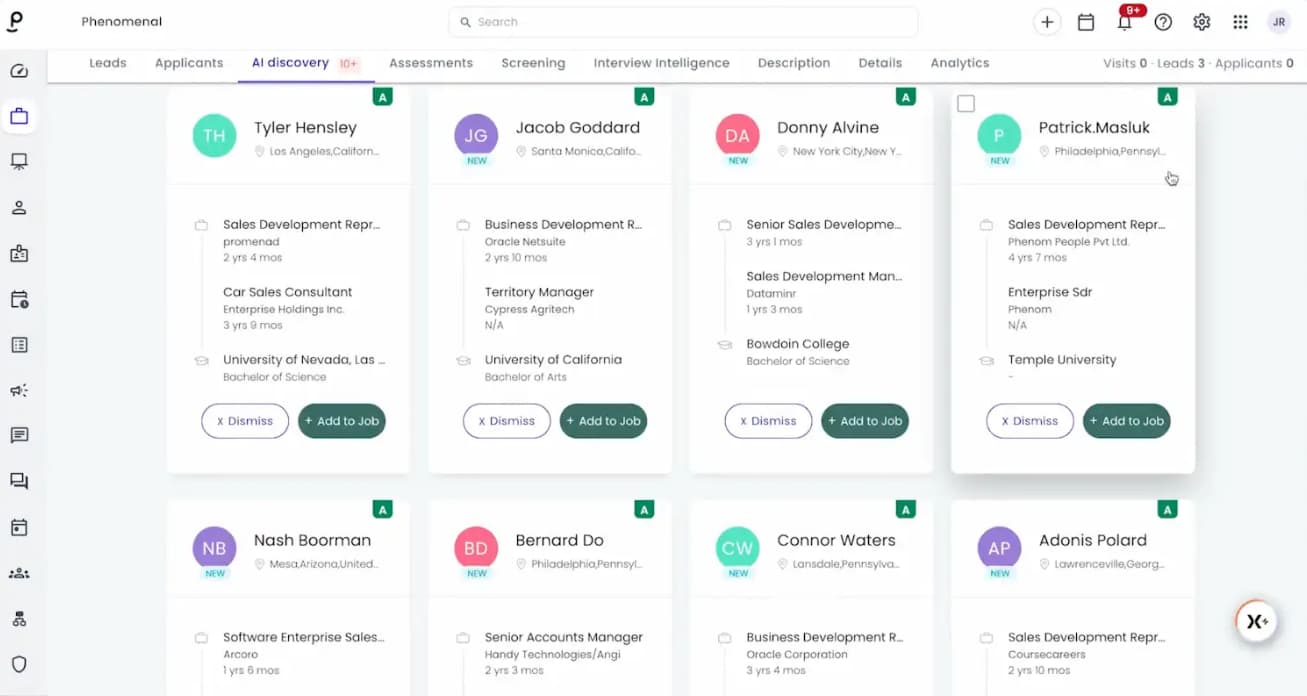
The design choice worth noticing is that rediscovery is a tab inside the requisition, not a separate search. That is exactly the workflow the Gem data in section 2 rewards: the warmest candidates appear where recruiters already work, so they actually get contacted.
| Price evidence | Figure | Source detail |
|---|---|---|
| AWS Marketplace, "Intelligent Talent Experience" | $750,000 for a 36-month contract | A representative customer, about $250,000 a year |
| Vendr median contract | $98,313 a year | Range $37,500 to $112,278, small sample |
Phenom publishes no price list, but its AWS Marketplace listing shows a 36-month contract for a representative customer at $750,000, roughly $250,000 a year - AWS Marketplace. Vendr's median of $98,313 a year comes from only a handful of contracts, so treat it as a rough floor for mid-sized enterprises rather than a benchmark - Vendr. Either way, Phenom is the most expensive tool in this guide, and it only makes sense when you will use most of the suite.
Best for: Large enterprises with high application volumes and a big candidate database that want careers site, CRM, chatbot and agents on one platform, and have the budget and team to implement it.
4.9 Avature: The Configurable CRM for Global Enterprises
Avature is the enterprise CRM-first choice: a highly configurable platform for sourcing, candidate relationship management, events, campus recruiting and engagement workflows, used heavily by global companies with complex hiring programmes - Avature. It remains private and founder-led, and Gartner named it a Leader in the 2026 Magic Quadrant for talent acquisition suites for the second consecutive year, as it introduced a new generation of AI agents and an agent builder - Avature.
Avature's engagement story is about building your own direct-sourcing engine rather than renting reach. In a 2026 case study, Bupa described cutting applications per hire from 50-60 to between two and eight by engaging pre-qualified talent pools, while its job-board spend fell 73% since 2023 - Avature. The trade-off is that configurability takes work: Avature implementations are projects, often with partners, and smaller teams rarely use enough of it to justify the effort.
| Price evidence | Figure | Source detail |
|---|---|---|
| US Department of State contract (via reseller) | $2.74 million obligated, 2023-2026 | Option years of about $1.17-$1.2 million each |
| UK G-Cloud 15 partner services | £1,500-£1,850 per day | Implementation partner rates; licences sold separately |
Avature publishes nothing, and its public price evidence comes from one very large buyer: the US State Department's Avature contract, bought through reseller Copper River Technologies, has obligated $2,738,818.52 since 2023 - USAspending. That is not a typical price, but it shows the scale Avature is built for and why mid-market teams should look elsewhere first.
Best for: Global enterprises that want a deeply configurable CRM and direct-sourcing engine, with the budget for implementation partners and the internal team to run it.
4.10 HeroHunt.ai: Autonomous Sourcing and Outreach on Monthly Plans
HeroHunt.ai is an AI Recruiter that combines the two halves of outbound engagement that most tools sell separately: finding the right candidates and contacting them. You describe the role, it searches up to 1 billion profiles across platforms, screens each candidate against your requirements with current GPT and Claude models, and runs personalised outreach sequences automatically - HeroHunt.ai. Its RecruitGPT turns a single prompt into a candidate shortlist, and more than 15,000 recruiters have used the platform.
On engagement specifically, its sequences mix channels and react to what happens. A sequence can find a candidate's email, send a message from the recruiter's own Gmail or Outlook mailbox, send an AI-written message tailored to that candidate, send a LinkedIn connection request or InMail from the recruiter's connected LinkedIn account, and save interested candidates to the ATS, with each step set to run always, only if the previous step succeeded, or only if it failed. Because messages come from your own mailbox and LinkedIn account, replies land where you already work.
| Plan | Monthly | Annual | Included each month |
|---|---|---|---|
| Starter | $99 | $990 | 1 user, 2,000 matched profiles, 500 emails found |
| Pro | $199 | $1,990 | 1 user, 5,000 matched profiles, 1,000 emails found, analytics and integrations |
| Team | $399 | $3,990 | 3 users sharing 25,000 matched profiles and 4,000 emails found |
The pricing model is the clearest in this guide: plans are published on the HeroHunt.ai plans page, billed monthly or yearly (2 months free on annual), with unlimited positions and searches, metered on AI-screened and matched profiles delivered and candidate emails found. There is an 8-day free trial (card required) that includes 150 profiles and 75 emails, which is enough to run one real role end to end before you pay.
The honest limitations matter for an engagement buyer. HeroHunt.ai is an outbound tool, not a talent CRM: it does not run newsletter-style nurture campaigns for a 100,000-person database, and it has no text-message or chatbot channel for high-volume applicants. Integrations sit on Pro and Team rather than Starter, allowances reset monthly without rollover, and you still review the shortlist yourself rather than handing it to a human sourcing team. For the outbound job it is built for, though, it removes the most expensive step, the hours spent searching before anyone sends a message.
Best for: Solo recruiters, small agencies and small in-house teams who want autonomous sourcing and multichannel outreach on a published monthly plan, without a sales cycle or an annual contract.
4.11 Also Considered: Five Tools That Just Missed the List
Several well-known engagement tools did not make the ten, either because their 2026 momentum or pricing evidence was weaker or because they are primarily another kind of product with engagement features attached. They are still worth a look if your situation matches their niche, and naming them explains how the list was drawn.
The bar for the main list was the same for every vendor: a clear lead in at least one engagement job, real product progress in the last twelve months, and a price a buyer can verify. Each tool below misses on one of those three counts, but may still be the right answer for a specific team, particularly agencies already running one of these ATS platforms, where switching costs favour the built-in option.
- Beamery: long a leading enterprise talent CRM, but its UK accounts for the year to January 2025 show revenue falling from £38.0 million to £34.9 million, a cost optimisation programme, and its founders leaving the board in September 2025 - Companies House. Vendr's median is $76,797 a year.
- Fountain: strong for hourly and frontline hiring, launched its agentic Cue product in April 2026, with a Vendr median of $40,200 a year across 14 purchases - Vendr.
- Recruit CRM: an agency ATS and CRM with published prices of $95, $135 and $215 per user a month billed annually, adding multichannel email, LinkedIn and WhatsApp sequences on its Business plan - Recruit CRM.
- Bullhorn Automation: the former Herefish, the default engagement add-on for agencies on Bullhorn's ATS, but quote-only - Bullhorn.
- Loxo: an agency platform whose Core plan starts at $149 per user a month billed annually, but which excludes the Loxo Source database that its sourcing and outreach depend on - Loxo.
The pattern across these five is instructive. Beamery shows that a strong product can become a riskier purchase when the company behind it is shrinking, which is why vendor stability belongs on every enterprise shortlist next to features and price. Recruit CRM, Bullhorn Automation and Loxo show the opposite trend: agency ATS vendors are absorbing engagement features, so an agency already on one of them should test its built-in sequences before buying a separate tool. Fountain is the closest alternative to Paradox for frontline hiring if you want a vendor independent of the big HR suites.
5. Side by Side: Price, Pricing Unit and Channels
The comparison that matters is not features but how each tool engages and how it charges. Every tool in this guide can send an email; far fewer can text, run a chatbot, send LinkedIn steps automatically or sync replies into your ATS on their entry plan. The table below sets the ten side by side on the dimensions that decide total cost and day-to-day fit, using only details read from each vendor's own pages or the price sources cited in section 4.
Two columns deserve a note before you read it. "Channels" lists what the product engages through, and where a channel is manual (Juicebox and Pin turn LinkedIn steps into tasks for the recruiter rather than sending them) the table says so. "ATS sync on entry plan" matters because engagement that never reaches your system of record has to be copied by hand, which is where most tools quietly lose their time savings.
| Tool | Type | Entry price | Pricing unit | Channels | ATS sync on entry plan |
|---|---|---|---|---|---|
| Gem | CRM, sequences, optional ATS | $99/user/mo staffing; in-house custom | Users or company FTE | Email sequences, multichannel | In-house yes; staffing on Enterprise only |
| hireEZ | Outbound and rediscovery agents | $494/seat/mo annual | Seat plus credits | Email campaigns, AI agent | Rediscovery credits included |
| SeekOut | Search plus outreach | $149/mo annual | Plan plus credits | Email, AI multi-step campaigns | No |
| Juicebox | Search plus sequences | $99/mo yearly | Seat plus credits | Email automatic; LinkedIn and calls as tasks | No (Business only) |
| Pin | Search plus autopilot outreach | $100/mo annual | Seat plus credits | Email automatic; LinkedIn as tasks, texts drafted for you to send | Add-on |
| Paradox | Conversational AI | £18-£65 per employee/yr | Company headcount | Text, chat, messaging apps | Yes |
| Sense | Staffing engagement | $2,000/mo | Package | SMS, WhatsApp, email, chatbot, voice | Yes |
| Phenom | Enterprise suite | ~$98,000/yr median | Enterprise licence | Email, text, chatbot, voice agent | Yes |
| Avature | Enterprise CRM | Quote only | Enterprise licence | Email, events, workflows | Yes |
| HeroHunt.ai | Autonomous sourcing and outreach | $99/mo | Plan with allowances | Email from your mailbox, LinkedIn InMail and connections | Pro and Team, not Starter |
Three conclusions stand out. First, only the conversational, staffing and enterprise platforms (Paradox, Sense and Phenom) send texts at scale; if SMS or WhatsApp is central to your engagement, the outbound tools are the wrong category. Second, LinkedIn automation varies: Juicebox and Pin turn LinkedIn steps into manual tasks, while others send them from a connected account, so if a large share of your candidates only answer on LinkedIn, check exactly what each tool automates. Third, ATS sync is often a paid upgrade on the cheaper tools, which can double the effective entry price for a team that needs it.
How to apply this: shade the columns that are non-negotiable for you (usually channels and ATS sync), cross out every tool that fails them, and only then compare price. Most teams end up with two or three candidates, which is the right number to take into live demos.
6. Engagement Benchmarks: What Good Looks Like in 2026
A healthy outbound sequence in 2026 earns a reply from roughly one candidate in six, and most of those replies come after the first email, not from it. That is the single most useful benchmark for judging any engagement tool, because it tells you whether a vendor's promised results are plausible and whether your own team is underperforming. Gem's 2026 email outreach report, built from 6.2 million sequences and 15.5 million messages sent through Gem in 2025, puts the average reply rate at 16.9% and the interested-reply rate at 9.4% - Gem. hireEZ's own 2025 dataset of 2.7 million emails landed in the same place, at 15.2%.
Those numbers matter because vendors routinely quote reply rates of 30%, 40% or higher from hand-picked customers. They are not impossible for a well-targeted niche search, but they are not the norm, and a tool that promises them as a baseline is selling hope. Use the published benchmarks as your yardstick, then measure your own team against them for a month before and after any new tool.
Follow-ups and sequence design
Follow-ups roughly double the reply rate, but only up to a point. In Gem's 2025 data, sequences earned an 8.8% reply rate after the first email, 13.7% after the second and 16.3% by the third, with Gem concluding that "the optimal sequence length is 3-4 emails, with diminishing returns beyond that". The median gap between emails also tightened, to four days between the first and second message and five days between the second and third, down from six days in 2024. In practice that means a complete three-step sequence now runs about nine or ten days from first touch to final follow-up.
The rest of the report is just as practical for anyone configuring sequences in an engagement tool. These are the findings with the clearest effect sizes:
- Short emails win: 51-100 words earned the best reply rate across company sizes, 9.2%, against 6.1% at 401-450 words.
- Personalised subject lines: using company, first-name and title tokens lifted open rates to 71.5%, against 61.1% with no tokens.
- Hiring manager as sender: switching an unanswered follow-up to send on behalf of the hiring manager lifted one stage's reply rate from 6.04% to 9.74%, a gain Gem itself calls modest in absolute terms.
- Timing: Wednesday was the best day and 3 pm local time the best hour, and 54% of opens happened within the first hour.
The common thread is that small configuration choices move results more than tool choice does. A team that switches tools but keeps sending 400-word, five-step sequences from a recruiter nobody knows will see the same results in the new tool. A team that keeps its tool but cuts emails to 100 words, sends the second follow-up from the hiring manager and stops at three or four steps should, on Gem's numbers, see a clear lift without changing anything else. When you evaluate vendors, check that the product makes these defaults easy: short templates, sender switching, step limits and send-time scheduling.
Gem walked through these findings in a webinar when the report came out, including how its own customers configure sequences around them. The section on follow-up timing and hiring-manager senders is the most practical part for anyone setting up a new engagement tool.
Outreach that works: 2026 benchmarks, best practices, and tools in action
The webinar reinforces the main point of the data: most of the gain comes from sequence design, not from switching tools, so ask every vendor to show you how its defaults handle length, sender and timing.
The candidate side: ghosting and slow responses
Candidates now experience silence as the norm, which makes fast, clear communication a competitive advantage. Greenhouse's 2026 candidate research, covering more than 2,800 job seekers in five countries, found that 81% of US candidates had been rejected from a job in the past year without ever speaking to anyone at the company, and that being ghosted by the employer was the most common complaint, at 45% - Greenhouse. The Survale CandE benchmark, built from more than 66,000 candidate surveys in 2025, found that 31% of North American candidates had heard nothing back one to two months or more after applying.
That silence has a cost you can measure. Gartner reported in June 2026 that only 48% of candidates accepted their most recent job offer in late 2025, down from 54% a year earlier and 85% two years earlier, and its analysts told CHROs to build "higher-touch candidate engagement strategies for critical roles" - Gartner. Engagement software exists to close exactly this gap: automated status updates, fast scheduling and timely rejections cost almost nothing once configured, and they are where conversational tools like Paradox and the status-update features of enterprise CRMs earn their keep.
Texting and chat: what the evidence really says
Text and chat engagement works, but most of the statistics used to sell it have no traceable source. The figures that appear on almost every texting vendor's site, a "98% open rate" and a "45% response rate", trace back to a 2016 Gartner marketing article that only said "various sources report" rates that high, with no dataset and nothing to do with recruiting - Gartner. Treat any vendor that still leads with those numbers with caution.
The better evidence is smaller but real. In the Survale CandE 2025 research, candidates who started an application from a text message rated the application experience with a net promoter score of 59, against 45 otherwise, and candidates who applied through a chatbot rated it 71 - Survale. The same research found employer chatbot use rising from 19% to 23%. For high-volume and hourly hiring, where speed decides whether a candidate shows up at all, that experience gap is the business case for conversational engagement.
How to apply this: pick three metrics and track them monthly: reply rate and interested-reply rate on outbound sequences (target the mid-teens and high single digits), time from application to first human or automated response for inbound candidates (target same day), and the share of hires that came from your existing database. If a new engagement tool does not move at least one of those three within a quarter, it is not working, whatever its dashboard says.
7. How to Choose: A Decision Framework
Choose by the candidate you most need to engage, then by how you want to pay, and only then by features. Feature lists in this category have converged: almost every tool now claims AI matching, AI-written outreach, multichannel sequences and analytics. What still separates them is which candidate pool they were built for and which pricing model they use, and both are decisions you can make in an afternoon if you know your own numbers.
Start with three numbers from your own team: how many hires you make a year, what share of them come from outbound sourcing versus inbound applicants versus your existing database, and how many people will actually use the tool every day. Those three numbers eliminate most of the market before you book a single demo, because they tell you whether you need a per-seat outbound tool, an enterprise platform priced per employee, or a conversational system priced on volume.
Why this order matters: teams that start from features almost always over-buy, because every enterprise demo shows capabilities a small team will never configure. Teams that start from the candidate pool and the pricing unit buy the tool they will actually use, and usually spend less. The framework below applies that order, first by buyer profile and then through the questions to put to every vendor.
Five common buyer profiles
Most teams fit one of five profiles. The match is not absolute, and larger organisations often run two tools side by side (an outbound agent for hard-to-fill roles plus a CRM or conversational platform for everything else), but these profiles are where each product is strongest.
The profiles are defined by the engagement problem rather than company size alone. A 200-person company hiring 40 engineers a year has an outbound problem; a 200-person staffing agency placing 2,000 contractors has a redeployment problem; a 200-store retailer has a speed problem. Find the sentence that describes your hardest hires, not your average ones, because that is where the tool will earn or lose its cost, and where its weaknesses will show first.
- Solo recruiter or small agency: HeroHunt.ai, Pin or Juicebox, because published monthly plans and autonomous outreach matter more than CRM depth.
- Startup or scale-up hiring engineers: Gem if you want CRM, sequences and possibly an ATS in one, or HeroHunt.ai or hireEZ if outbound volume is the bottleneck.
- Mid-market in-house team: Gem or SeekOut for sourcing and nurture, paired with your ATS.
- Enterprise with a large candidate database: Phenom or Avature for CRM-led rediscovery and nurture at scale.
- High-volume hourly hiring: Paradox for conversational screening and scheduling, with Phenom as the suite alternative and Sense for staffing agencies.
The pattern behind the list is cost per conversation. A solo recruiter cannot justify a five-figure annual contract, so published plans win even if the database is smaller. An enterprise with a million past candidates cannot justify paying per seat to re-find people it already has, so a CRM with strong rediscovery wins even at six figures. A retailer hiring thousands of hourly workers needs replies in minutes, which only a conversational system delivers. Agencies sit in between: they need outbound for new searches and redeployment automation for their bench. Map yourself to the closest profile, then shortlist two tools, not five.
Two profiles deserve extra care. Mid-market in-house teams sit exactly where the pricing models cross over, so they should model both a per-seat outbound tool and Gem's headcount-based plan before deciding; the cheaper one depends on how many recruiters you have relative to company size. Staffing agencies should separate the two engagement jobs they have: finding new candidates for new orders, where an outbound tool fits, and re-engaging their own contractor database, where Sense or their ATS vendor's automation fits. Buying one tool and expecting it to do both well is the most common agency mistake.
Questions to ask in every demo
Demos are designed to show the best case, so steer them toward your worst case. Bring one real, hard role and one real segment of past candidates, and ask the vendor to run both live. The goal is not to catch the vendor out but to see the product do your job rather than a rehearsed one, and to get the usage numbers you will need to estimate the real annual cost.
Ask how many credits or allowance units that run consumed, what happens at the monthly cap, whether replies sync to your ATS automatically, whether messages send from your own mailbox, how unsubscribes are honoured across users, and what the contract looks like at renewal. Write the answers down for every vendor in the same format. Two weeks later, when the sales follow-ups arrive, that sheet is what keeps the decision about your team's needs rather than the most persuasive account executive.
Where a vendor offers a trial, use it on a live requisition rather than a sandbox. SeekOut offers 14 days, hireEZ seven, HeroHunt.ai a short card-required trial, and Pin a free plan, while the enterprise platforms usually offer a paid pilot instead. A two-week pilot that measures replies, interested replies and hours saved on one real role is worth more than any reference call, because it tests the tool against your candidates, your employer brand and your recruiters' habits at the same time.
8. Where Candidate Engagement Software Fails
Most engagement tools fail for the same reason: they automate sending faster than they automate judgement. A sequence that reaches 400 people a week with a mediocre message does more damage than one that reaches 40 with a good one, because every ignored email trains mailbox filters against your domain and every irrelevant message trains candidates to ignore your brand. The software is rarely the root cause. The failure is a buying decision that measured messages sent instead of conversations started, and a rollout that never decided who owns the message, the list and the follow-through.
This matters more in 2026 than it did three years ago because the margin for error has shrunk. Reply rates are falling, mailbox providers enforce sender rules, candidates receive more automated outreach than ever, and regulators have started treating recruiting AI as a high-risk use. The five failure modes below account for nearly every disappointed engagement-software buyer we have seen, and each one has a fix that costs less than switching vendors.
Deliverability: the silent failure
Deliverability problems are invisible until they are severe. Your sequence dashboard shows "sent", the candidate never sees the email, and the reply rate quietly drops. Gmail's sender guidelines require every sender to authenticate with SPF or DKIM, require DMARC for anyone sending more than 5,000 messages a day to Gmail accounts, and ask senders to keep the spam rate reported in Postmaster Tools below 0.30%, with 0.10% as the recommended ceiling - Google Workspace Admin Help. A recruiting team that spins up a new domain, imports 3,000 contacts and starts a five-step sequence on day one can cross those lines in a week.
The tools handle this differently, and it is worth asking about before you sign. Most outbound engagement platforms (HeroHunt.ai, Gem, hireEZ, Juicebox, Pin) send from each recruiter's own Google or Microsoft mailbox, which keeps volume per sender low and replies in the recruiter's inbox, but also means one careless user can hurt the shared company domain. The practical fix is boring and effective: authenticate the domain, cap daily sends per mailbox, warm up new mailboxes gradually, verify emails before sending, and stop sequences the moment someone replies anywhere.
Over-automation and sequence fatigue
The second failure is sending more steps because the tool makes it free. Every additional follow-up costs nothing to configure, so many teams default to five or six. The data says the returns stop much earlier. Ashby's analysis of more than 500,000 sourcing sequences sent between 2022 and 2024 found that one email earned a 7% reply rate, three emails earned 23%, and a fourth email added almost nothing - Ashby Talent Trends. Gem's 2025 data reached the same conclusion, putting the optimal sequence at three to four emails. Past that point you are mostly generating unsubscribes and spam complaints.
Over-automation also shows up in AI-written messages that are personalised in form but not in substance: a line about the candidate's university or a recent post, followed by a generic pitch. Candidates have learned to spot this. The fix is to let AI do the research and the first draft, then hold a human standard for the opening line and the reason this role fits this person. Tools that show you the reasoning behind a match make that review fast.
Data decay and the CRM graveyard
A talent CRM that nobody curates becomes a graveyard within a year. People change jobs, emails bounce, and the "silver medalist" tag from a 2024 search means little in 2026. Enterprise buyers of CRM platforms such as Phenom and Avature often discover that the hard part was never the software but the content and ownership: who writes the nurture emails, who segments the pool, who decides when a past candidate is worth contacting again. Without that owner, the CRM collects records and engages nobody.
The fix is to treat rediscovery as a workflow, not a database. Re-run matching against the existing pool every time a requisition opens, refresh contact data before you send, and retire segments that have not produced a reply in twelve months. The vendors that now run AI matching across your own ATS and CRM (Gem, hireEZ and Phenom all market this) make the rediscovery step cheap, but only if the underlying records are current.
Compliance: texting, GDPR and the EU AI Act
Engagement is the part of recruiting where privacy law actually bites, because it is the moment you contact a person who did not ask to hear from you. Three rules matter most for engagement software buyers in 2026. They do not replace legal advice, but they should shape which tool you choose and how you configure it.
Why this matters for tool choice: compliance is mostly a product feature, not a policy document. A tool that records consent, honours unsubscribes across every recruiter and sequence, and logs who approved an AI-selected candidate makes compliance the default. A tool that does none of this leaves it to each recruiter's memory, which is how most engagement-related complaints and fines start, usually with a candidate who unsubscribed once and was emailed again by a colleague.
- US texting (TCPA): automated texts to mobile numbers need the candidate's prior express consent. The FCC's stricter one-to-one consent rule never took effect: the Eleventh Circuit vacated it on January 24, 2025 - Morrison Foerster.
- GDPR sourcing notices: when you collect a candidate's data from a third-party source and use it to contact them, you must give the privacy notice at the latest at the time of the first communication - GDPR Article 14.
- EU AI Act: AI systems used in recruitment are high-risk, and the Digital Omnibus published on July 24, 2026 moved those obligations to December 2, 2027 - Garrigues.
In practice this means three configuration choices. For texting, collect opt-in at application and keep an audit trail, which conversational platforms like Paradox and staffing tools like Sense build in. For European outreach, make sure your first message carries a short privacy notice and an opt-out, and that unsubscribes are honoured across every sequence and every recruiter. For AI matching and AI-written outreach, keep a human approval step and records of how candidates were selected, because those are the controls the AI Act will expect from December 2027. The delay is a planning window, not an exemption.
Contract traps: credits, minimums and auto-renewal
The price on the pricing page is rarely the price you pay over a year. Engagement tools meter usage in units that are easy to underestimate: contact credits that expire monthly, AI credits that pause features when they run out, seat minimums, and annual contracts that renew automatically. SeekOut's credits do not roll over, Ashby pauses AI features when its credit balance hits zero, and Findem's enterprise agreement auto-renews for 12 months with renewal price changes by notice, as our Findem pricing guide details. None of this is hidden, but it is rarely on the first page a buyer reads.
Before you sign, ask four questions in writing: what happens when we hit the monthly limit, do unused credits roll over, what is the renewal notice period and price cap, and can we reduce seats at renewal. A tool that answers all four clearly is usually a tool that intends to keep you by being useful rather than by being hard to leave.
9. How AI Agents Are Changing Candidate Engagement
The defining shift of 2026 is that engagement software stopped being a tool a recruiter operates and became an agent a recruiter supervises. In 2024 a sequence tool sent the messages you wrote to the list you built. In 2026 the leading products search for candidates, decide who fits, write a personalised first message, send it, follow up, answer the first reply and book the call, with the recruiter approving at a few checkpoints. Every vendor in this guide now markets some version of that loop, and the differences between them are increasingly about how much they let the agent do unsupervised and how they charge for it.
The change matters for buyers because it moves the cost from seats to outcomes and usage. When a human sends every message, a seat price is a reasonable proxy for value. When an agent does the work, vendors meter what the agent consumes: profiles screened, contacts revealed, messages sent, candidates delivered. That is why so many 2026 price lists now carry credits, allowances and caps, and why comparing them on the headline monthly price alone is misleading.
What the agents actually do today
Three agent patterns have become standard across the market. They overlap, and the best tools combine them, but separating them makes it easier to see what you are paying for and where a human still needs to stay in the loop.
The distinction matters at the contract stage, because each pattern is metered differently. Sourcing agents usually consume profile, contact or AI-review credits. Rediscovery agents often come bundled with the CRM or ATS licence but may draw on a separate AI allowance. Conversational agents are typically priced into an enterprise licence by hiring volume. Knowing which pattern you actually need prevents paying for an agent suite when one capability would do, and it tells you which credit meter to model before you sign.
- Sourcing-and-outreach agents take a job description, search a large profile database, screen each match against the requirements and send a personalised sequence.
- Rediscovery agents run the same matching against your own ATS and CRM, so past applicants and silver medalists resurface when a new role opens.
- Conversational agents answer applicants by text, chat or WhatsApp, run screening questions and schedule interviews without a recruiter in the loop.
LinkedIn's own agent shows how far the pattern has spread, and how usage gets metered. Its Hiring Assistant sources candidates and sends outreach from inside LinkedIn Recruiter, and according to LinkedIn's help center each message it sends counts toward both your InMail credits and your Hiring Assistant credit limits, with instant outreach switched off for projects located in the EU - LinkedIn Help. Our breakdown of the second version of Hiring Assistant covers its capacity tiers and price in detail. The lesson for any agent: autonomy is capped by credits, and the cap is where the real price lives.
Where agents still fall short
Agents are better at volume than at judgement. They find more candidates than a human sourcer and write more personalised first messages than a tired recruiter on a Friday afternoon. They are still weak at the two moments that decide whether a candidate engages: deciding whether this person is genuinely worth interrupting, and handling a nuanced reply ("interested, but only if the role is remote and the equity is real"). Most vendors keep a human approval step for exactly this reason, and buyers should be suspicious of any product that removes it entirely for senior or specialised roles.
There is also a new arms race on the candidate side. Applicants now use AI to apply to dozens of roles a day, and fake or misrepresented candidates have become a real cost, which is why Gem, Findem and others shipped fraud and authenticity checks in 2026. An engagement agent that cannot tell a real, interested person from a bot-assisted mass applicant simply automates noise faster.
The outlook for 2027
Three trends look durable. First, outcome-based pricing will spread: Findem already sells candidate slates priced per unlocked candidate, and agent tools increasingly meter delivered candidates rather than seats. Second, engagement will converge with the ATS: Workday owning Paradox, Gem selling an all-in-one ATS, and Ashby adding texting all point to fewer, broader platforms for enterprises, while focused agents serve smaller teams. Third, regulation will formalise the human checkpoint: with EU AI Act obligations for recruiting AI due in December 2027, the products that log why a candidate was selected and who approved the outreach will be easier to buy.
How to apply this: when you evaluate an agent, ask the vendor to run it live on one of your real open roles, then judge three things: how many of the candidates it found you would actually contact, how many of its messages you would send unedited, and what the run consumed in credits. Those three numbers tell you more than any feature list.
10. The Bottom Line
The best candidate engagement software in 2026 is the one built for the candidate pool you are under-using, priced in a unit that grows with your value rather than your headcount. For most small teams and agencies that means an outbound tool with a published monthly plan. For enterprises sitting on hundreds of thousands of past applicants, it means a CRM with real rediscovery. For high-volume hourly hiring, it means a conversational assistant that answers in minutes. Very few organisations need all three on day one.
If you want a short version of this guide, it is this. Solo recruiters and small agencies should start with HeroHunt.ai, Pin or Juicebox, because a published monthly price and autonomous outreach beat database depth at that scale. Startups and mid-market in-house teams should look first at Gem, then at hireEZ or SeekOut if outbound volume is the bottleneck. Enterprises should run a structured comparison of Phenom and Avature for CRM-led engagement, and high-volume employers should put Paradox on the shortlist. Staffing firms should add Sense for redeployment and texting at scale.
Whatever you choose, measure it on conversations started and hires made, not messages sent. Run a real role through the tool before you sign, write down the credits it consumed, and negotiate the renewal terms while you still have leverage. The tools are better than ever; the teams that get the most from them are the ones that stay clear about what they are buying.
Autonomous sourcing, AI screening and email plus LinkedIn outreach from $99 a month, unlimited positions, 8-day free trial (card required).
This guide reflects candidate engagement software pricing and features as of October 2026. Vendors in this category change plans, credits and packaging frequently, so verify current details on each vendor's pricing page before you buy.