


What outsourced recruiting really costs per hire in 2026, read from filings and public contracts, and when an AI recruiter is the cheaper capacity
Korn Ferry paid about £850 million (roughly $1.1 billion) for AMS, one of the largest recruitment process outsourcing (RPO) providers, and closed the deal on September 1, 2026 - Korn Ferry. AMS came with about $650 million of annual fee revenue, $100 million of adjusted EBITDA and more than $1.5 billion of estimated fees still to be earned under existing client contracts - Korn Ferry. That is a large bet that employers will keep handing their hiring to an outside firm for years at a time, on contracts whose prices nobody publishes.
That is the problem for anyone buying RPO in 2026. No major provider publishes a rate card. The trade body for the industry says providers "report little AI-specific pricing change so far" while buyers "increasingly expect efficiency gains to reach the commercials" - RPO Association. Meanwhile, AI recruiters that source, screen and contact candidates list their prices openly, at roughly $99 to $599 per seat a month. Buyers are comparing a quote they cannot benchmark with a price they can read on a web page, and most never work out what each option costs per hire.
The short answer is that RPO is priced as recruiting capacity, not as placements. Providers charge a monthly management fee, a fee per hire, or a blend of both with a minimum "true-up". Company filings show that about 76 cents of every RPO dollar pays for the people doing the work, which means an RPO program costs roughly what the same team would cost you in-house, plus about a third. On the bottom-up model in this guide, a median-paid recruiter delivered through an RPO works out to about $12,000 a month, or about $4,900 per hire at the 2026 average recruiter productivity, rising to roughly $7,200 to $9,400 at the lower hire rates reported for business and technical roles. The average case is close to the $4,800 average that recruiting marketplace Dover publishes for its freelance recruiters, and about a quarter of a 22% agency fee on a $90,000 role. An AI recruiter seat costs about 1-7% of one loaded recruiter. It replaces sourcing, screening and outreach, not the whole program.
This guide breaks down the three RPO fee models and the true-up clause hidden in most contracts, the real numbers from SEC filings, UK and Australian government contracts and the few published prices, a bottom-up cost model you can rebuild with your own salaries, the contract terms that move your bill more than the headline rate, and who leads the market after the Korn Ferry and AMS deal. It then prices AI recruiters (Juicebox, hireEZ, Findem, SeekOut, LinkedIn's Hiring Assistant, HeroHunt.ai and others) on the same per-hire basis, so you can decide which mix of RPO, in-house recruiters and AI agents fits your hiring plan.
HeroHunt.ai
If the part of an RPO you actually need is sourcing capacity (finding, screening and contacting candidates for roles your own team will interview and close), price that slice on its own before you sign a management fee for the whole program. HeroHunt.ai's AI Recruiter searches and screens profiles against your brief and runs outreach, on published plans from $99 a month with unlimited positions and searches. Pro includes 5,000 AI-screened profiles and 1,000 candidate emails a month, and there is no fee when you hire. The honest caveat: it does not run interviews, coach hiring managers or close offers, which is most of what an RPO team bills for at volume. The 8-day trial requires a card.
Contents
- RPO Pricing in 2026: The Short Answer
- What You Are Actually Paying For: The Anatomy of an RPO Fee
- The Three RPO Fee Models, and the True-Up Hidden in Most Contracts
- The Real Numbers: What Filings, Contracts and Marketplaces Show
- Build Your Own RPO Price: A Bottom-Up Cost Model
- The Contract Terms That Change What You Pay
- The RPO Market in 2026: Who Is Biggest and Who Is Coming Up
- How AI Recruiters Are Priced, and What They Actually Replace
- RPO vs AI Recruiter vs Agency vs In-House: Cost per Hire Side by Side
- Where RPO Still Wins, Where AI Wins, and How Each Fails
- How to Negotiate an RPO Deal in 2026
- The Future: AI Agents and the Repricing of Outsourced Recruiting
- The Bottom Line: A Decision Framework
1. RPO Pricing in 2026: The Short Answer
RPO pricing is a capacity price wearing different clothes. Whether a provider quotes you a monthly management fee, a fee per hire or a blend, the number underneath is the same: the cost of the recruiters, sourcers, coordinators and account managers assigned to your program, plus the provider's technology, overhead and margin. The billing model decides who carries the risk when hiring volume moves. It does not change what the work costs. That is why the most useful question about any RPO quote is not "is this a good per-hire fee?" but "how many recruiter-months am I buying, and what happens to my bill if my hiring plan changes by half?"
This matters in 2026 because the gap between what buyers can see and what they pay has never been wider. RPO quotes are private, multi-year and negotiated, and the public evidence is thin: a handful of SEC filings, some government contract notices, one trade-body paper and a few vendors willing to print a number. At the same time, the cheapest layer of recruiting work (finding and contacting candidates) is being repriced by AI recruiters at a few hundred dollars a month. A buyer who cannot translate an RPO quote into a cost per hire cannot tell whether the program is fairly priced, or whether a smaller in-house team with AI tools would do the same job for less.
The table below summarises the evidence this guide works through. Every figure is sourced in the sections that follow; the derived rows are our arithmetic, shown step by step in section 5.
| What | Figure | Type of evidence |
|---|---|---|
| Korn Ferry RPO fee revenue, FY2026 | $367.1M, up 4% | SEC 10-K |
| Share of Korn Ferry RPO fees spent on people | 75.6% | Derived from 10-K |
| Korn Ferry RPO adjusted EBITDA margin | 15.7% | SEC 10-K |
| AMS run-rate margin at acquisition | about 15% | Derived from deal release |
| Most common RPO model (fixed monthly plus per hire) | about half of contracts | SIA, 2021 data |
| Dover marketplace average cost per hire | $4,800 | Published, Oct 2026 |
| 4 Corner Resources fixed-fee RPO | from $2,500, no per-hire fee | Published, Oct 2026 |
| Contract recruiter ceiling rate, US GSA schedule | $91.44/hour median | Government price list |
| RPO cost per hire, median-paid recruiter, 2026 average productivity | about $4,900 (up to about $9,400 for technical roles) | Derived model |
| AI recruiter seat, as share of one loaded recruiter | about 1-7% | Derived from list prices |
Read the table from top to bottom and a pattern appears. The filings say RPO is a people business with mid-teens margins, so its price tracks recruiter salaries closely. The one public per-hire dataset (Dover's) averages $4,800 per hire, and the bottom-up model lands in the same place at average recruiter productivity, rising towards $9,400 for technical roles. The one number that sits in a different order of magnitude is the AI seat, which is why the comparison between RPO and AI recruiters is less about which is cheaper and more about which parts of the recruiting process each can actually take over.
How to apply this: before you look at any RPO proposal in detail, convert it into two numbers. The first is cost per hire at your realistic hiring volume, not the provider's forecast. The second is cost per recruiter-month, which tells you whether you are paying a fair premium over an in-house hire. The rest of this guide gives you the benchmarks for both, starting with what an RPO fee actually buys.
2. What You Are Actually Paying For: The Anatomy of an RPO Fee
About three quarters of an RPO fee is payroll, and roughly a sixth is profit. The clearest public view comes from Korn Ferry, whose fiscal 2026 annual report is the only filing among the listed providers reviewed for this guide that shows RPO as a separate segment with its own margin. In the fiscal year to April 30, 2026, Korn Ferry's RPO unit booked $367.1 million of fee revenue, up 4% from $354.1 million, served more than 250 enterprise clients, and produced $57.7 million of adjusted EBITDA, a 15.7% margin - Korn Ferry 10-K. The same filing shows $277.4 million of compensation and benefits in the RPO segment, which is 75.6% of its fee revenue on our arithmetic.
Those two ratios explain nearly everything about RPO pricing. If people costs are three quarters of the fee, an RPO cannot be dramatically cheaper than an equivalent in-house team: it pays recruiters roughly market salaries, then adds its own management layer, systems and profit. Dividing 1 by 0.756 gives about $1.32 of fees for every $1 of payroll. That 32% premium is what you pay for flexibility, ramp speed, process discipline and someone else's balance sheet carrying the recruiters when your hiring slows. Whether it is worth it depends on how much those things are worth to you, which is a real question rather than a rhetorical one.
What $100 of Korn Ferry RPO Fee Revenue Paid For (FY2026)
The chart makes the economics concrete. Of every $100 a client paid Korn Ferry's RPO business, $75.60 went to compensation and benefits, $15.70 survived as adjusted EBITDA, and the remaining $8.70 covered everything else: offices, technology, general overhead. The margin is not unusual. When Korn Ferry agreed to buy AMS, it disclosed that AMS was generating about $650 million of fee revenue and $100 million of adjusted EBITDA on a run-rate basis, a margin of about 15.4% on our arithmetic. That figure covers all of AMS's service lines (RPO, early careers, contingent workforce and consulting), so it is not a pure RPO margin, but it lands within half a point of Korn Ferry's RPO segment. Two independent measurements in the same range are a strong signal that mid-teens is what this kind of business earns.
Where the fee comes from: implementation and delivery
Most RPO contracts bill in two phases, and the first one is easy to miss in a proposal. Korn Ferry describes its RPO revenue as generated through "1) the implementation phase and 2) the post-implementation recruitment phase", with "both fixed and variable fees" recognized over the period the recruiting services are performed - Korn Ferry 10-K. The implementation phase covers process design, technology setup, employer branding, recruiter hiring and training, and the transition of open requisitions. It is billed whether or not a single hire follows, and providers rarely publish its size.
The delivery phase is where the three fee models in section 3 apply. Here the filings of other providers add useful detail. Hudson Talent Solutions (the former Hudson RPO, now owned by Star Equity Holdings) says its transaction prices "contain both fixed fees and variable consideration", and that the variable part "is constrained by candidates accepting offers of permanent employment" - Star Equity 10-Q. In plain language, the provider only books the per-hire part of its fee once an offer is accepted.
PeopleScout, the RPO business of TrueBlue, describes its pricing as "typically composed of a fee for each hire and/or talent consulting fees", recognized as "the number of hires made during each month multiplied by the agreed-upon rate per hire" - TrueBlue 10-K.
The filings also name the factors that move the price. PeopleScout lists them directly:
- Geography, because recruiter salaries and labour law differ by market
- Volume, because fixed costs spread over more hires
- Job type, because a nurse or engineer takes more recruiter hours than a warehouse role
- Recruiting difficulty, which is the same thing measured by time to fill
Every one of these is a proxy for recruiter hours. A per-hire fee is simply the provider's estimate of the hours a hire will take, multiplied by its loaded hourly cost, plus margin. That is useful to know in a negotiation: if you can show a provider that your roles are easier to fill than they assumed (a strong employer brand, a high inbound application rate, fast hiring managers), you are giving them a reason to lower the per-hire rate without touching their margin. The reverse also holds, and it is why specialist and professional roles always carry higher per-hire fees than high-volume hourly ones.
Why technology does not make RPO cheaper (yet)
A reasonable buyer would expect AI to have cut RPO prices by now. It has not, and the industry's own trade body has devoted a paper to the question. The RPO Association's August 2026 paper on pricing and AI lists "why providers report little AI-specific pricing change so far", a "technology-provider counterpoint" on "why platform costs are rising rather than falling", and the warning that "the market has not converged on a new model" - RPO Association. The paper calls the near-term signals "mixed". Read together, its topics suggest that providers are paying for AI platforms on top of their recruiters, and that whatever efficiency gains exist have not yet shown up as lower prices.
That is the opening for buyers. If 75% of the fee is people and AI tools take over a share of the sourcing and screening hours, the provider's cost base falls, but your price only falls if your contract says it must. Section 11 covers how to write that into a deal. For now, the point is that the RPO price you are quoted in 2026 is unlikely to include AI savings unless you negotiate for them.
3. The Three RPO Fee Models, and the True-Up Hidden in Most Contracts
There are three RPO pricing models in common use, and they differ mainly in who carries the risk when hiring volume changes. The RPO Association names them as the management fee, pay-for-performance and the hybrid or blended model - RPO Association. Its August 2026 paper uses the same three categories, which is a useful reminder that despite years of talk about outcome pricing and AI, the commercial structure of RPO has barely changed. What has changed is the size of the gap between how the work gets done and how it gets billed.
The single most repeated statistic about these models is that about half of all RPO contracts use a blend of a fixed monthly fee and a cost per hire. It traces to Staffing Industry Analysts, which wrote that the combination represents "half of all reported contracts" - SIA. Almost nobody quoting it mentions the date: the article was published on September 1, 2021, and drew on SIA's RPO landscape research from that year. Newer SIA data exists but sits behind a membership wall. The figure is directionally plausible and widely repeated, but treat it as a five-year-old survey of providers, not a 2026 market fact.
The diagram below shows when money moves under each model, which is where most of the confusion sits.
Follow the paths and the risk transfer becomes visible. On the left, the management fee is owed every month regardless of results, so the buyer carries volume risk: if hiring freezes, you keep paying for a team with nothing to do until you renegotiate or terminate. In the middle, pay-for-performance splits the fee between an "open" fee when a requisition is assigned and a "close" fee on hire, which moves part of the risk to the provider. On the right, the hybrid lowers both components, and the true-up variant sets a floor under the provider's revenue. Each subsection below looks at one model in detail.
The management fee model
A management fee buys a dedicated team for a fixed monthly price. The provider assigns recruiters, sourcers and coordinators to your program, often on your site or embedded in your systems, and bills a set amount per month or per week. There is no per-hire charge, so the provider earns the same whether it makes ten hires or forty in a month. This is the model closest to simply renting recruiters, and it is the easiest to benchmark against an in-house team, because the fee is a direct function of headcount.
The appeal is predictability. Finance teams can budget the cost a year ahead, recruiters are not incentivised to push weak candidates through to hit a per-hire target, and the provider can be asked to work on anything (employer branding, workforce planning, internal mobility) without arguing about which activity earns a fee. 4 Corner Resources, one of the few providers that prints a number, lists its own fixed-fee RPO as starting at $2,500 with no per-hire fee, quoted by scope; the page does not say whether that figure is weekly or monthly - 4 Corner Resources. The model has three weaknesses that buyers should price in:
- Volume risk sits with you, so a hiring freeze turns the fee into pure cost
- Productivity is invisible unless you measure hires per recruiter yourself
- Scope creep runs both ways, as the team absorbs work that was never priced
- Ramp-down is slow if notice periods are long
The second weakness is the one that hurts quietly. Under a management fee, the provider's profit rises when the same team delivers fewer hires with less effort, and nothing in the invoice will tell you. A management-fee RPO without a hires-per-recruiter target and a monthly report against it is a blank cheque. The model works best for steady, predictable hiring at volume, where a fixed team can be kept busy and its output tracked against a clear baseline. If you choose it, make the monthly report a contract deliverable, not a courtesy.
The pay-for-performance (per-hire) model
Pay-for-performance charges per hire, usually split between requisition and hire. The RPO Association describes an "open fee" charged when a requisition is opened and a "close fee" charged on hire. SIA wrote in 2021 that the cost per hire is "commonly split, for example 50% on requisition and 50% on hire". The split matters more than buyers expect: if a role is cancelled after the provider has started work, you may still owe the open fee. That is fair compensation for sourcing effort, but it means a per-hire contract is not truly pay-on-success.
This model is how the publicly reported per-hire businesses describe themselves. PeopleScout books revenue as hires per month multiplied by an agreed rate per hire. Hudson only recognizes its variable consideration once candidates accept offers. For buyers, the attraction is obvious: costs scale with hiring, and a quiet quarter costs little. The provider prices that risk in, though. A per-hire rate has to cover the provider's fixed costs at its forecast volume, so if your hiring comes in below forecast, the provider either loses money or comes back to renegotiate. Expect the per-hire rate on a pay-for-performance deal to be noticeably higher than the effective per-hire cost of a well-utilised management-fee team.
In practice, per-hire RPO suits buyers with uncertain or seasonal hiring, buyers who want to test a provider before committing to a dedicated team, and programs where the hire itself is a clean, countable event (for example a high-volume hourly role with a short process). It suits roles with long, complex processes less well, because the provider carries months of sourcing and interviewing cost before the close fee arrives, and will price accordingly.
The hybrid model and the true-up
The hybrid model combines a smaller monthly fee with a reduced per-hire fee, and it is the structure most enterprise programs end up with. The fixed part covers the provider's dedicated team and technology; the variable part ties some of the fee to output. The most important variant is the true-up. The RPO Association describes it this way: "Employers pay a minimum monthly management fee", the provider tallies the per-hire fees, and "the employer only pays for the higher of the two amounts".
The true-up looks like a minor detail. It is the clause that decides what you pay in a bad year. If your hiring runs at forecast, the per-hire fees exceed the minimum and the minimum never bites. If hiring halves, you pay the minimum, which is effectively a management fee for a team you no longer need. The questions to ask about any true-up are simple:
- How is the minimum set? It should follow your forecast, not the provider's cost base
- Monthly or annual? Annual true-ups smooth seasonal hiring
- Does it step down if you reduce the forecast with notice?
- What counts as a hire: accepted offer, start date or completed probation?
The fourth question is easy to overlook and can be worth more than the rate itself. Hudson's filing ties its variable fee to accepted offers, which is standard. But an offer accepted and then reneged, or a hire who leaves in week three, should not cost the same as one who stays a year. Agencies routinely offer rebates or free replacements when a hire leaves early (Hays's UK terms, for example, refund 50% of the fee if a hire leaves within 8 weeks and 25% between 8 and 13 weeks - Hays), and an RPO close fee should carry at least a similar guarantee. If it does not, ask for one before you negotiate the rate.
Project RPO and on-demand recruiting
Project RPO applies the same models to a defined burst of hiring, such as a new site, a product launch or a graduate intake, and it is where most small and mid-sized companies meet RPO. The pricing logic does not change, but the term does: weeks or months instead of years, and usually a fixed fee for the project or a per-hire rate with a minimum. UK public bodies buy this regularly. Leeds Trinity University, for example, tendered project RPO for "high volume, short-term and/or specialist recruitment projects", with the stated aim to "stem spiralling recruitment costs through over-reliance on expensive recruitment agencies" - Contracts Finder.
Below project RPO sits a newer category that blurs the line between RPO and freelance recruiting: marketplaces where companies hire individual recruiters by the hour, on retainer or per hire. Dover's marketplace is the most transparent example, because it publishes a table of individual hires and what each cost (covered in section 4). These models are the closest substitute for RPO at small volumes, and they matter for this guide because they are also the market AI recruiters are pricing against most directly. A startup choosing between a fractional recruiter at about $5,000 a hire and an AI recruiter at a few hundred dollars a month is making the same decision an enterprise makes about its RPO contract, at a smaller scale.
4. The Real Numbers: What Filings, Contracts and Marketplaces Show
There is no public RPO rate card, but there are four kinds of hard evidence, and together they bracket the price well. The first is company filings, which show revenue, margins and how fees are structured, but never a per-hire rate. The second is government contract notices, which show what public bodies committed to spend, usually as a total contract value. The third is the small number of providers and marketplaces that publish their own prices. The fourth is the market for individual contract recruiters, where US government schedules publish ceiling rates. Each is incomplete on its own; read together, they agree more than you might expect.
It is worth being explicit about what is missing. None of the public filers (Korn Ferry, Star Equity, TrueBlue, ManpowerGroup, Randstad) discloses an RPO hire count or a per-hire fee, so no one can derive an actual revenue per hire from public data. The widely quoted ranges of "$3,000 to $10,000 per hire" or "$8,000 to $15,000 per recruiter per month" appear across dozens of vendor blogs without a primary source behind them. They may be roughly right, but they are folklore, and this guide does not use them. Where a number below is derived rather than read directly, it says so.
What company filings reveal
Korn Ferry's RPO business grew 4% in fiscal 2026, and the AMS deal adds a provider with about 1.8 times its fee revenue across all service lines. Beyond the margin figures in section 2, Korn Ferry's 10-K reports that 66% of its RPO fee revenue was referred from the firm's other services, which says a lot about how RPO is sold: through existing relationships, not open tenders. AMS brings roughly $650 million of run-rate fee revenue (across RPO, early careers, contingent workforce and consulting) next to Korn Ferry's $367.1 million, plus more than $1.5 billion of estimated remaining contract fees. Dividing the backlog by the annual run rate gives about 2.3 years of AMS revenue already under contract (our arithmetic), which is the clearest public measure of how long RPO commitments run.
Star Equity's filings give the most granular view of a mid-sized provider. In the second quarter of 2026, Hudson's RPO revenue was $17.1 million, down 2% year on year, while its contracting revenue rose 7% to $19.3 million. RPO grew 14% in the Americas but fell 10% in Asia Pacific and 13% in EMEA - Star Equity 10-Q.
For full-year 2025, Hudson's RPO revenue was $68.4 million, and the company says it holds "multi-year (three to five year) contracts with most of our key partners", and Star Equity as a whole (Hudson plus its other businesses) drew about 73% of 2025 revenue from its top 25 clients - Star Equity S-4.
The other large providers disclose growth rather than prices. ManpowerGroup said its Talent Solutions organic constant-currency revenue "improved to 1% growth year over year" in the third quarter of 2026, "driven by RPO and MSP" - ManpowerGroup.
Randstad's management told analysts in October 2026 that its Enterprise unit "benefited from 4% - globally 4% RPO growth" - Randstad. TrueBlue, by contrast, reported that PeopleScout revenue declined in 2025 as clients were "reducing hiring volumes, sourcing candidates with internal resources". That last phrase is worth noting: in-sourcing is already taking business from at least one major RPO.
What government contracts reveal
Public contracts show the scale and duration of RPO commitments, and one of them shows how badly they can go wrong. In the UK, Contracts Finder and Find a Tender publish award values for public RPO deals. The largest is military recruiting. The Ministry of Defence awarded Serco the Armed Forces Recruiting Service contract, worth £1,326,089,815 from April 1, 2025 to March 31, 2034 - Contracts Finder.
It replaces the Army's long-running contract with Capita, which began in 2012 with "an original advertised contract value of £500m" and whose total value the MoD put at £1,151,042,801 in a 2025 modification notice - Find a Tender. The two contracts differ in scope (Serco's covers the Armed Forces Recruiting Service, Capita's the Army), so they are not directly comparable, but both show that public RPO is bought in decades and billions, not months.
Smaller notices are more typical of what a mid-sized employer would buy. The Australian Securities and Investments Commission awarded Chandler Macleod a recruitment process outsourcing contract for 2019 to 2022 now valued at AUD 4.52 million, up from an original AUD 4.16 million after four amendments - AusTender. Contract values that grow through amendments are common in RPO, because the scope (number of roles, new locations, added services) tends to expand once the provider is embedded. These are historical contracts, but they illustrate a durable point: the award value is a starting figure, not a ceiling.
Even public procurement frameworks rarely print an RPO rate. On the UK's G-Cloud 15 marketplace, where suppliers must publish pricing documents, the one supplier our search found naming RPO among its services prices it "POA" (price on application), alongside published fees for its workforce platform: an implementation fee of £15,000 to £60,000, then either an annual management fee of £25,000 to £100,000 plus a transitional fee of 2% of total pay bill, or no management fee and 3.5% - G-Cloud 15. The structure (implementation, management fee, variable fee) is exactly the RPO pattern. The missing number is the RPO price itself.
What published prices reveal
The few published prices cluster around $4,000 to $5,000 per professional hire. The most useful dataset comes from Dover, a recruiting software company that runs a marketplace of freelance recruiters. Dover states that "the average cost per hire on Dover is $4.8k" and publishes a table of individual hires, computing each hire's cost as recruiter hours multiplied by the recruiter's hourly rate - Dover. We read the 50 hires shown on the page on November 4, 2026: 36 carried a cost, with a median of $4,100 and a range from $200 (a therapist role) to $16,400. Engineering roles among them had a median of about $5,000.
Dover is not an RPO, and its recruiters work for early-stage companies on mostly professional roles, so its numbers describe one segment of the market. But it is the only source that publishes real per-hire costs at the level of individual hires, and its average sits in the same range as the derived RPO cost in section 5. The other published price, 4 Corner Resources' fixed fee from $2,500, is a starting point rather than a typical contract, and should be read as the floor of what a small, single-recruiter engagement costs.
What contract recruiters cost
Hiring recruiters by the hour costs about $91 an hour at the US government ceiling. The General Services Administration's CALC tool publishes the maximum hourly rates that schedule holders may charge federal agencies. On November 4, 2026, the API returned 82 labour categories with "recruit" in the title across 28 vendors; excluding coordinator, assistant, volunteer and manager titles left 75 categories from 26 vendors, with a median ceiling of $91.44 per hour and a middle half from about $72 to $117 - GSA. Contract recruiters are the most direct alternative to a management-fee RPO, because both are ways to rent recruiting capacity.
The arithmetic is worth doing. At 2,080 hours a year, a contract recruiter billed at the GSA median costs about $190,000 a year, which is more than a management-fee RPO would charge for the equivalent capacity on the model in section 5. Ceiling rates are maxima rather than averages, and commercial rates vary, so treat this as an upper benchmark. It does explain why companies with steady hiring move from contract recruiters to RPO: at full utilisation, a dedicated RPO team is usually cheaper than the same hours bought freelance, and it comes with process and technology attached.
5. Build Your Own RPO Price: A Bottom-Up Cost Model
An RPO quote can be rebuilt from three public numbers: what a recruiter earns, what it costs to employ them, and how many hires they make. Because about three quarters of an RPO fee is payroll, you can estimate a fair price from the bottom up, then compare it with the proposal on your desk. The model below uses US national figures so that every input is traceable. It is a benchmark, not a quote: your roles, locations and provider will differ, and the point is to show you which inputs matter so you can replace them with your own.
This matters because the alternative, comparing one opaque quote with another, gives a provider every advantage in a negotiation. A bottom-up number tells you two things a competing quote cannot. It shows whether the premium over an in-house team is in the expected range (about a third, on the filings), and it shows how sensitive your cost per hire is to recruiter productivity, which is the variable that management-fee contracts quietly shift onto you.
Step 1: the recruiter's salary and loaded cost
The US Bureau of Labor Statistics counts recruiters within the human resources specialists occupation and puts the median annual wage at $75,940 (May 2025 data) - BLS. This is a national median across all HR specialists, so it understates what technical recruiters in large US cities earn. It is a conservative starting point, and you should replace it with the salary your provider actually pays its recruiters on your account, which you are entitled to ask about.
Employers pay more than salary. In June 2026, wages and salaries made up 70.0% of private-industry employer compensation costs, with benefits accounting for the remaining 30.0% - BLS. Dividing the median wage by 0.70 gives a loaded cost of about $108,500 a year for a median-paid recruiter. That figure is what an in-house recruiter costs you before software, advertising and management time, and it is the baseline any RPO price should be compared against.
Step 2: the provider's markup
At Korn Ferry's cost structure, an RPO needs about $1.32 of fees for every $1 of payroll. Applying that ratio to the loaded recruiter gives roughly $143,500 a year, or about $11,960 a month, as the fee an RPO would need to charge to keep its people costs at 75.6% of revenue. That is not a quote from Korn Ferry, and it does not mean every provider charges it. It is the fee implied by one large provider's actual cost ratio, applied to a median recruiter, and it gives you a reasonable benchmark for a monthly management fee per dedicated recruiter.
Two caveats keep this honest. First, an RPO's compensation line includes more than recruiters: delivery managers, sourcers, coordinators and account leads all sit in it, so the "per recruiter" fee really means "per recruiter-equivalent of payroll" on your account. Second, providers with lower salary bases (offshore sourcing centres, for example) can deliver at lower fees, while specialist providers with expensive recruiters charge more. The ratio is the stable part; the salary is where your own numbers belong.
Step 3: recruiter productivity, the input that decides everything
The average recruiter made 7.3 hires per quarter in early 2026, up from a low of 4.5 in early 2023. Ashby, the applicant tracking system, measures hires per recruiter across its customers and published the series in its April 2026 recruiter productivity report - Ashby. The same chart shows applications per hire rising from 121 in early 2021 to a peak of 319 in late 2024 (Ashby describes it as tripling from the 2021 lows), which is why recruiters spend so much more time screening than they used to.
Applications per hire tripled while hires per recruiter recovered
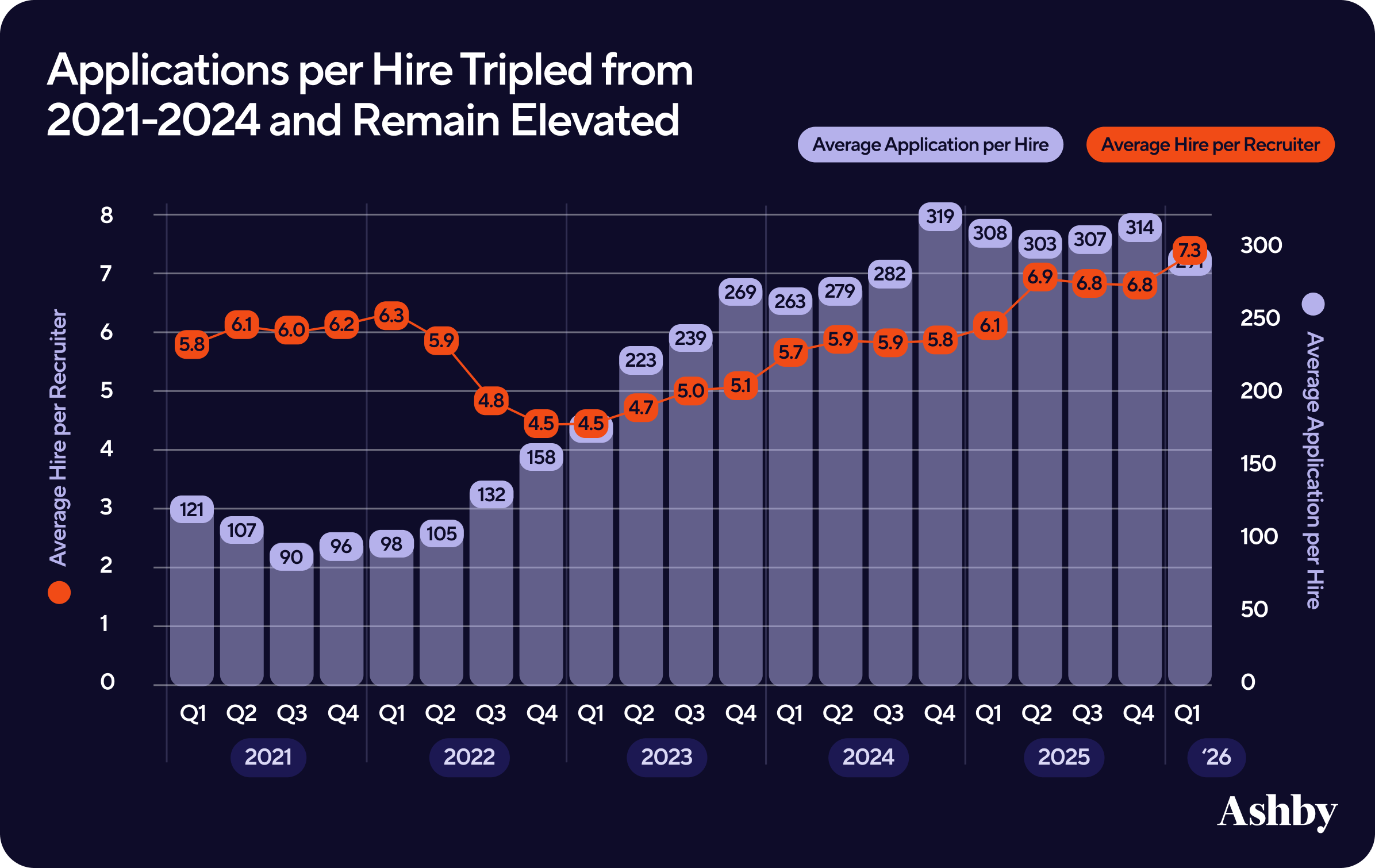
The hires-per-recruiter line in the chart is the one that matters for RPO pricing. At 7.3 hires a quarter, a recruiter makes about 29 hires a year; at the 2023 low of 4.5, about 18. The report also breaks the figure down by role type, and the per-type numbers are lower: in Q1 2026, 5.0 hires a quarter for business roles and 3.8 for technical roles. Treat 7.3 as the optimistic end for a recruiter dedicated to one kind of role, and the technical figure as the realistic one for engineering-heavy hiring. Ashby's customer base leans towards technology and fast-growing companies, and high-volume hourly programs will run far higher numbers, so again, use your own data where you have it. But the swing itself is the lesson: the same recruiter, at the same cost, produced 60% more hires in early 2026 than in early 2023, purely because of market conditions and process.
Step 4: cost per hire under each model
Dividing the annual costs by annual hires gives the cost per hire. At the 2026 all-recruiter average, the implied RPO management fee works out to about $4,900 per hire, against about $3,700 per hire for the same recruiter employed in-house. At Ashby's business-role rate the figures are about $7,200 and $5,400; at its technical-role rate, about $9,400 and $7,100. The chart below shows how both move with productivity.
Cost per Hire vs Recruiter Productivity (Derived)
Two conclusions follow from the chart. First, the gap between RPO and in-house stays at about a third at every productivity level, because it comes from the provider's cost ratio, not from the market. Second, productivity moves cost per hire more than the markup does: moving from 7.3 to 3.8 hires a quarter nearly doubles the cost per hire, a far bigger swing than the entire RPO premium. Under a management fee, that productivity risk is yours. Under a per-hire fee, the provider carries it and prices it in. Either way, the hires-per-recruiter number is the one to put in the contract.
To use the model with your own numbers, replace the three inputs. A technical recruiter on $120,000 costs about $171,000 loaded and implies an RPO fee of about $227,000 a year: about $7,800 per hire at the all-recruiter average of 29 hires a year, but about $14,900 per hire at the 3.8 hires a quarter Ashby reports for technical roles. At the other extreme, if recruiters on a high-volume hourly program made 150 hires a year each, the same model gives about $960 per hire at the median salary, and about $1,500 even at $120,000. If a provider's per-hire quote is far above what your inputs produce, ask what assumption about volume or productivity sits behind it (our recruiting budget template shows where these lines sit in a full plan). If it is far below, ask what the minimum commitment is, because the gap is usually being recovered there.
6. The Contract Terms That Change What You Pay
In RPO, the clauses around the rate usually move the total bill more than the rate itself. A per-hire fee that is 10% cheaper than a competitor's is worth less than a true-up minimum set 30% too high, an implementation fee nobody modelled, or a notice period that keeps you paying for a team for six months after hiring stops. Because RPO deals run for years and expand in scope, small terms compound. This section covers the clauses that most often decide what a program actually costs.
The public record shows how sticky these contracts are in practice, even when they look flexible on paper. Hudson's own filing says "the majority of our contracts are short-term in nature as they include termination clauses that allow either party to cancel within a short termination period, without cause", while the same company describes "multi-year (three to five year) contracts with most of our key partners". Both are true at once: the legal exit is short, the commercial relationship is long, because replacing an embedded RPO means rebuilding a recruiting function.
The terms worth negotiating hardest are these:
- The true-up minimum, tied to your forecast and stepping down with notice
- Implementation and exit fees, both capped and stated in the contract
- The definition of a hire, with a refund or free replacement for early leavers
- Data and technology ownership, so candidates and workflows stay yours
Each of these protects a different moment in the program's life. The true-up protects you in a downturn. Implementation and exit fees protect you at the start and end, when costs are easiest to hide. The hire definition protects quality. Data ownership protects your ability to leave: if the candidate database, assessment results and job templates live in the provider's systems, switching provider means starting again from zero, and the incumbent knows it at every renewal. None of these clauses is exotic, and providers expect to negotiate them; the buyers who lose on them are usually the ones who never asked.
Two smaller clauses deserve a line in the contract as well. The first is conversion fees: the best outcome of a good RPO is often hiring its recruiters onto your own team, so check whether your RPO contract charges a fee when you hire the provider's staff and, if it does, cap it in advance. The second is pass-through costs, such as job advertising, background checks and assessment tools, which are often billed on top of the fee. Ask for them to be listed, capped or bundled, because a per-hire rate that excludes them is not comparable with one that includes them.
Service levels and penalties: what failure actually costs the provider
Service credits in RPO contracts are usually small next to the cost of failure. The best-documented example is the British Army's recruiting partnership with Capita. The National Audit Office found that the Army "committed £1.36 billion over ten years", including "a 10-year, £495 million contract with Capita", whose cost rose "by 37% to £677 million". Capita "missed the targets by between 21% and 45% each year since 2013-14", and the regular soldier intake was "4,300 below target in 2017-18 (42% below)" - National Audit Office.
The penalty side is the instructive part. Over the contract, Capita incurred penalties "totalling £26 million over the contract period (6% of payments)". Six percent of fees is a meaningful sum for a provider, but trivial against the operational cost of an army thousands of soldiers short. The report is from 2018 and describes a very large public contract, so the specific figures are historical. The lesson is not. When you negotiate service levels, ask what the penalty would be in your worst realistic year, and compare it with what that year would cost your business. If the ratio looks like Capita's, the service levels are a reporting tool, not a risk transfer.
Service levels themselves are worth writing carefully. Time to fill, offer acceptance rate, hiring-manager satisfaction and quality of hire are the usual measures, but each can be gamed: time to fill falls if the provider pushes weaker candidates, and acceptance rates rise if offers are pitched high. Pair every speed measure with a quality measure, and agree in advance how disputed hires are counted.
How to apply this: build a one-page model of your RPO contract under three scenarios (forecast volume, half volume, and a hiring freeze), including implementation, minimums, notice periods and exit. The scenario that looks worst on that page is the one to negotiate. Most buyers only model the forecast, which is the scenario the provider has already priced most carefully.
7. The RPO Market in 2026: Who Is Biggest and Who Is Coming Up
The RPO market is consolidating at the top while AI-first entrants attack the bottom. The Everest Group's 2026 assessment of RPO providers places eight firms in its Leaders group: Randstad Sourceright, ManpowerGroup's Talent Solutions RPO, AMS, Korn Ferry, Cielo, KellyOCG, Wilson and PeopleScout. Two of those eight are now one company. Everest's own footnote notes that the assessment "does not account for the latest acquisition of AMS made by Korn Ferry in 2026", which is the single biggest structural change in the market this year.
Everest Group RPO PEAK Matrix 2026: the global leaderboard
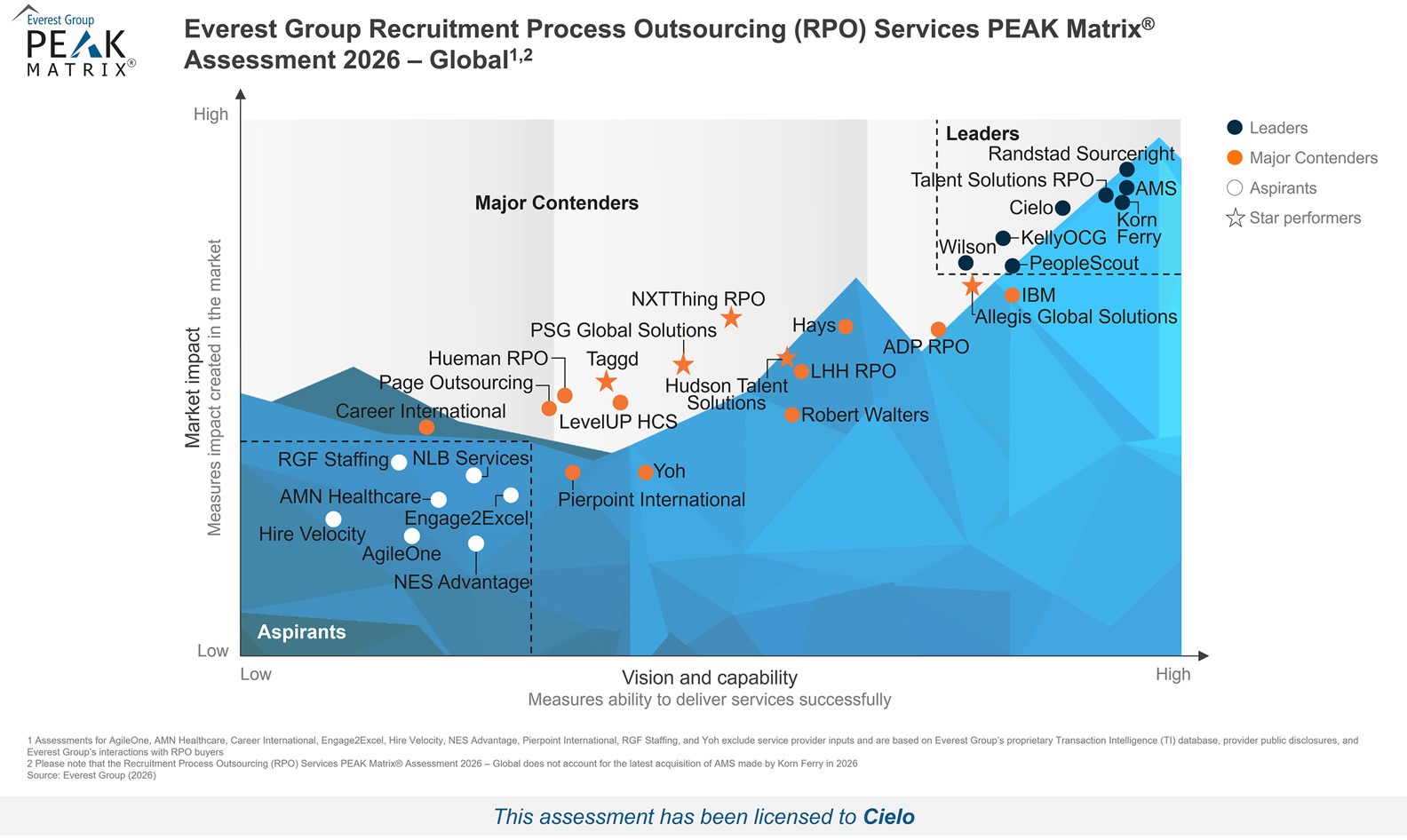
The matrix shows the market's shape clearly. The Leaders in the top right are large, global providers that sell multi-year enterprise programs. A crowded middle of Major Contenders includes IBM, Allegis Global Solutions, ADP RPO, Hays, LHH RPO and Robert Walters, plus Hudson Talent Solutions. Everest marks five providers as Star Performers: Hudson, Allegis Global Solutions, NXTThing RPO, PSG Global Solutions and Taggd. The Aspirants in the bottom left are smaller or specialist providers. Price does not appear anywhere on the chart, which is typical: analyst rankings measure capability and market impact, and leave pricing to private negotiation.
The leaders, and what each sells
Korn Ferry made the biggest move of the year. Its own RPO business reported $367.1 million in fiscal 2026, and AMS brings about $650 million of run-rate fee revenue across RPO, early careers, contingent workforce and consulting, with operations in more than 120 countries and about 8,000 staff - Korn Ferry.
After closing, Korn Ferry described the combined firm as having nearly 17,000 colleagues in more than 130 offices - Korn Ferry.
Korn Ferry also announced in September 2026 that it ranked first overall in HRO Today's Baker's Dozen customer satisfaction list for RPO, a customer-satisfaction ranking that HRO Today bases on a survey of RPO buyers - Korn Ferry.
Randstad Sourceright sits inside Randstad's Enterprise business, which reported 4% global RPO growth in the third quarter of 2026. Randstad is also the most explicit of the large providers about AI changing its delivery model: its CEO told analysts that Enterprise client teams "use a conversational interface with 5 collaborating agents to plan, match, advertise and deliver insights", and that the group is "moving away from the traditional event-based recruiting model to a model that's platform-centric". At ManpowerGroup, RPO and MSP growth lifted Talent Solutions to 1% organic constant-currency growth in the same quarter. Cielo has been a Leader for the 14th consecutive year, and Everest credits its position partly to its "continued investments in AI-enabled recruitment"; Cielo now sells its technology under the name Cosm by Cielo - Cielo. PeopleScout remains a Leader, but its parent's filings show revenue declining as clients reduce volumes and in-source.
The challengers and the AI-first entrants
Mid-sized providers are buying AI rather than building it. Hudson Talent Solutions, one of five Star Performers in Everest's matrix, announced on April 1, 2026 that it would embed Maki People's AI hiring platform across its global RPO delivery, giving clients AI-driven assessment from application to final selection - Maki People. The pattern is common: RPO providers license AI screening, interviewing and sourcing tools and wrap them in their service, which is exactly why their platform costs are rising, as the RPO Association paper notes.
At the other end, a new layer of companies sells recruiting outcomes without an RPO contract at all. Dover's marketplace of freelance recruiters publishes its per-hire costs. Jack & Jill's agent "Jill" charges UK and EU employers 10% of first-year salary on hire, while US employers pay a per-role subscription instead - Jack & Jill. And AI sourcing platforms such as Juicebox, hireEZ, Findem and HeroHunt.ai sell the sourcing and outreach layer of the RPO bundle as software, priced per seat or per agent. None of these replaces a 500-hire enterprise program today. All of them are taking the work at the edges, which is where RPO providers earn their easiest margin.
Randstad Enterprise, the parent of Randstad Sourceright, explains the incumbent's pitch in its own words in a short March 2026 video. It is worth watching with the cost model from section 5 in mind, because the value it describes (scale, process, employer brand, analytics) is the part of the fee that AI tools do not yet replace.
Recruitment process outsourcing (RPO) in 2 minutes
The video makes a fair case for RPO at scale: a single provider running consistent process, technology and reporting across countries and business units. What it does not discuss is price, and that silence is the market norm. The buyer's job is to separate the parts of that pitch that genuinely require an outsourced team (multi-country compliance, high-volume coordination, flexible capacity) from the parts that are now available as software at a fraction of the cost.
8. How AI Recruiters Are Priced, and What They Actually Replace
AI recruiters are priced per seat, per agent, per role or per hire, and almost all of them publish their prices. That alone separates them from RPO. A buyer can read the price of most AI sourcing and outreach tools on a public pricing page, compare them in an afternoon, and start a trial the same day. The trade-off is scope: these tools take over the search, screening and first contact that make up much of a recruiter's week, but none of them yet runs a full hiring process on its own from intake meeting to signed offer.
This matters for RPO buyers because sourcing and screening are exactly the hours that inflate an RPO team's size. Ashby's data shows applications per hire more than doubling since early 2021, and LinkedIn now sells an agent that evaluates thousands of applicants per licence each month. If software absorbs the screening and sourcing load, the number of recruiter-months you need falls, and with it the size of any capacity-priced contract. The table below lists published prices for the main AI recruiting tools as of late October and early November 2026.
| Tool | Published price | Pricing unit |
|---|---|---|
| Juicebox | $99/seat/mo yearly ($119 monthly); agents $199/agent/mo | Seat plus agent |
| Pin | Solo $100/mo (annual); Pro $135 annual or $179 monthly | Seat |
| SeekOut Sourcing Core | $149/mo annual or $179 monthly | Plan |
| hireEZ | $494/mo (annual, paid upfront) | Seat |
| Findem Studio | $249/seat/mo; with Platform $599 | Seat plus credits |
| Jack & Jill (US) | $199/role slot/mo annual or $249 monthly | Role slot |
| Jack & Jill (UK/EU) | 10% of first-year salary | Per hire |
| LinkedIn Hiring Assistant | Quote only, add-on per Recruiter licence | Capacity tier |
| HeroHunt.ai | From $99/mo; Pro $199/mo | Plan, unlimited positions |
Each price comes from the vendor's own pricing page (linked in the table), read between late October and early November 2026. Read the units carefully, because they are not interchangeable (our recruiting software pricing hub compares 40 tools by metering unit). A Juicebox seat and a Juicebox agent are different products. SeekOut's Sourcing Core card says it is for individual recruiters while its feature table lists three seats included, so check what you are buying. Findem's seat price comes with a monthly credit allowance that agents consume. HeroHunt.ai's plans include unlimited positions and are metered on AI-screened profiles and candidate emails rather than seats or hires. Jack & Jill charges differently by region: a success fee in the UK and EU, a per-role subscription in the US.
LinkedIn's Hiring Assistant: the agent sold to RPOs as well as employers
LinkedIn's Hiring Assistant is the most important AI recruiter for RPO buyers to understand, because RPOs can buy it too. LinkedIn describes it as an add-on for both LinkedIn Recruiter and Recruiter Professional Services Plus (RPS+), the version sold to staffing and outsourcing firms. Each licence comes with a monthly capacity tier: for Recruiter customers, Tier 1 covers 200 sourced candidates and 3,500 evaluated applicants, rising to 1,500 sourced and 25,000 evaluated at Tier 3, and the number of licences cannot exceed the number of Recruiter Searcher licences on the contract - LinkedIn.
LinkedIn does not publish the price; our Hiring Assistant 2 guide covers what public procurement records show.
LinkedIn Hiring Assistant runs the hiring-manager feedback loop
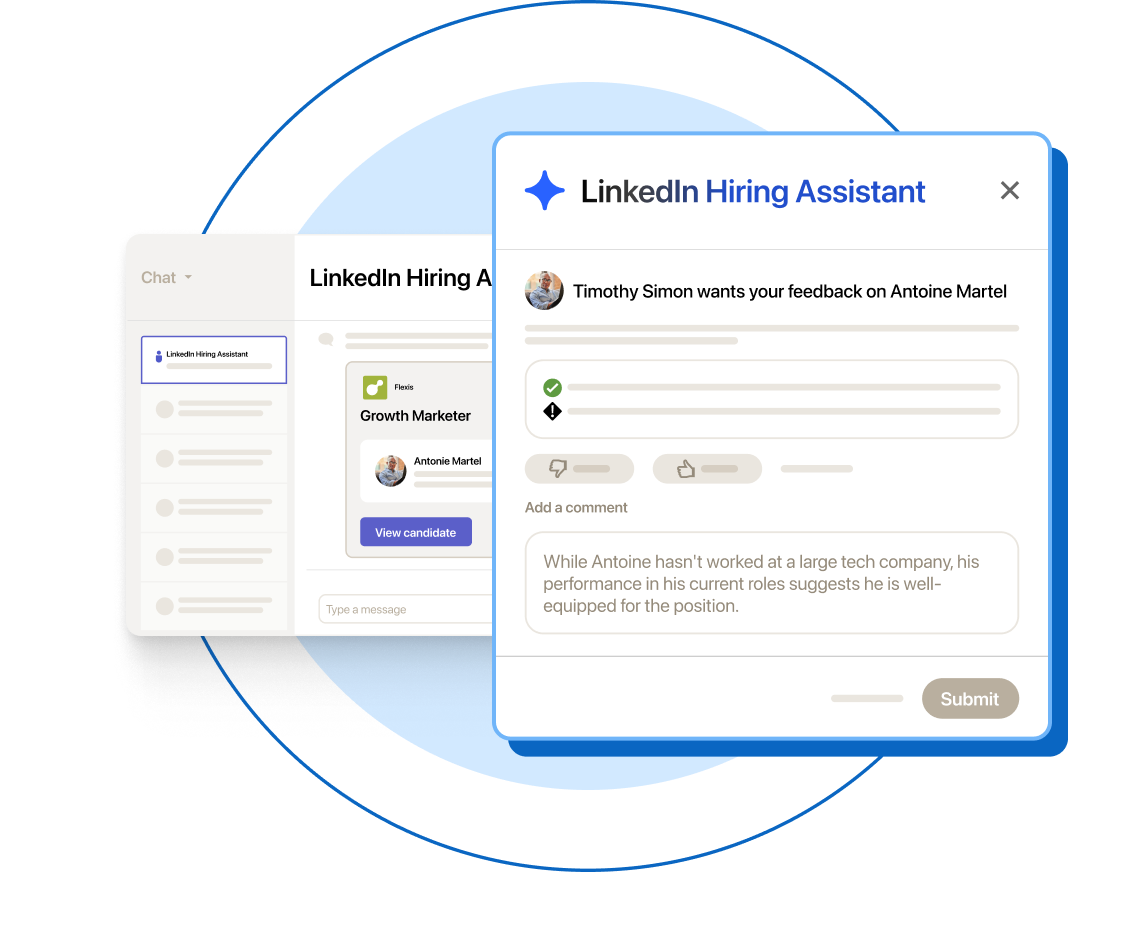
The illustration shows the agent doing something RPO teams have always billed for: chasing a hiring manager for feedback on a candidate and feeding it back into the search. That is a small task, but it is one of hundreds of coordination tasks that fill an RPO recruiter's day. The evaluated-applicants allowance is the bigger story. An agent that screens 3,500 to 25,000 applicants per licence a month on Recruiter, and up to 50,000 on RPS+, absorbs the inbound volume that Ashby's data shows has more than doubled, which is precisely the work that made RPO teams grow.
LinkedIn's own two-minute walkthrough of Hiring Assistant 2, published in October 2026, shows the agent sourcing, evaluating and reporting inside Recruiter. Watch it as a buyer: the question is not whether the agent is impressive, but which of the hours in your RPO statement of work it would remove.
What is LinkedIn Hiring Assistant 2? Features and Benefits Explained
What AI recruiters replace, and what they do not
AI recruiters replace the top of the funnel; RPO teams still own the middle and the close. Mapping the two against each other is the most useful exercise a buyer can do, because it turns a vague "AI versus outsourcing" debate into a list of tasks with prices. On the AI side, the published tools now cover search across large profile databases, screening of inbound applicants against criteria, personalised outreach and follow-up sequences, rediscovery of past candidates in your ATS, and basic scheduling. Some add AI interviewing or assessment.
The human side of an RPO contract covers the work where judgement, relationships and accountability matter most. These are the tasks where a hiring manager needs to trust the person on the other side of the table, where a mistake has legal or reputational consequences, or where the work is mostly persuasion. That split is not permanent, but in late 2026 it looks like this:
- Intake and calibration: agreeing what good looks like with hiring managers
- Interview management: running panels, debriefs and decision meetings
- Offer and close: compensation, negotiation and counter-offers
- Compliance and audit: right-to-work, records, regulated sectors
- Program design: workforce planning, employer brand, reporting
Each of those tasks is a reason RPO still exists, and each is also a place where an RPO team's time can be measured. If your hiring is dominated by sourcing (hard-to-find professional roles, outbound-heavy searches), an AI recruiter can remove a large share of the hours you are paying for, and the remaining work may fit inside a smaller in-house team. If your hiring is dominated by coordination (thousands of hourly hires across sites, complex compliance), the AI layer helps the RPO team rather than replacing it, and the commercial question becomes whether the provider passes the savings through.
9. RPO vs AI Recruiter vs Agency vs In-House: Cost per Hire Side by Side
On a $90,000 professional role, a contingency agency costs about four times as much per hire as an RPO, and an RPO costs about a third more than an in-house recruiter. The chart below puts every model in this guide on the same basis: cost per hire for a mid-level professional role. Each bar is either a published figure or derived from public inputs, and the derived bars use the 2026 productivity of 29 hires per recruiter per year from section 5.
The comparison is deliberately simple, because the point is the order of magnitude rather than the exact figure. A contingency agency charging 22%, mid-range when Hays's published UK bands run from 20% to 28% of salary, costs $19,800 on a $90,000 salary (our agency fees guide covers the full range of published rates).
A contract recruiter at the GSA median ceiling costs about $6,500 per hire at full utilisation. SHRM's average cost per hire for non-executive roles, which includes all recruiting costs, is $5,475 - SHRM. The derived RPO fee is about $4,900 at average recruiter productivity (about $9,400 at the technical-role rate), Dover's marketplace average $4,800, and an in-house recruiter about $3,700.
Cost per Hire by Recruiting Model, $90,000 Professional Role
The last bar needs careful reading. A Juicebox agent at $199 a month costs $2,388 a year, or about $82 per hire if it supports a recruiter making 29 hires a year. That is not a cost per hire in the same sense as the others, because the agent does not make hires on its own; it is an add-on to a recruiter. The right way to read it is as a share of a recruiter: about 2.2% of a loaded recruiter's cost. A hireEZ seat at $5,929 a year or Findem's Studio plus Platform at $5,999 a year is about 5.5%. An AI recruiter pays for itself if it frees up that share of a recruiter's time, which is roughly one to two and a half hours of a 40-hour week.
Three scenarios, three different answers
The cheapest model depends on volume, role type and whether you can hire and keep recruiters. The three worked examples below use the same public inputs and show why there is no single answer. They are illustrations, not quotes: replace the inputs with your own salaries, fees and productivity data before you rely on them.
The first scenario is a startup making 12 engineering hires a year at $150,000 base salary. A contingency agency at 22% would cost $33,000 per hire, or $396,000 a year. A full-time in-house recruiter on $120,000 costs about $171,000 loaded but would be under-used at 12 hires, giving about $14,300 per hire. A fractional recruiter at Dover's average would cost about $57,600. A founder or hiring manager running searches with an AI recruiter seat costs a few thousand dollars a year in software plus their own time, which is the scarce resource. For most startups, the answer is a mix: AI tools for sourcing, a fractional recruiter or agency for the one or two roles that are truly hard, and no RPO at all, because the minimums of a dedicated program would exceed the work.
The second scenario is a scale-up making 60 professional hires a year at $90,000. The table shows the annual cost of each model on the inputs from section 5, at the all-recruiter average of 29 hires per recruiter a year; for a technical-heavy plan, scale the recruiter-based rows up accordingly.
| Model, 60 hires a year | Annual cost | Notes |
|---|---|---|
| Contingency agency at 22% | $1,188,000 | Before rebates or volume discounts |
| Contract recruiters at GSA median | about $391,000 | 2.05 FTE at $91.44/hour, ceiling rate |
| RPO, derived management fee | about $295,000 | Plus an unpublished implementation fee |
| In-house, 2.05 recruiter FTE | about $223,000 | Before software and advertising |
| In-house plus AI agent seats | about $228,000 | Same team, plus 2 Juicebox agents |
This is where the RPO decision is genuinely close. The RPO premium of about $72,000 a year over in-house buys flexibility (the provider absorbs a hiring freeze, subject to the true-up), speed (no months spent hiring recruiters), and usually technology and reporting. Whether that is worth it depends on how confident you are in your hiring forecast and how quickly you could build a team. What the table also shows is that AI seats barely move the in-house cost, so the real question is whether they move the productivity: if recruiters with AI tools make more hires each, the same 60 hires need fewer recruiter-months, and the in-house option pulls further ahead.
The third scenario is an enterprise making several hundred hourly hires a year across sites. Here, RPO is at its strongest. Volume programs run much higher hires per recruiter than the professional-role averages above, per-hire fees fall accordingly, and the coordination work (scheduling, onboarding, compliance at scale) is exactly what RPO teams are built for. AI tools still matter, but mostly inside the RPO, as screening and scheduling agents. The commercial question for an enterprise is not "RPO or AI" but which provider will pass AI efficiency through to the price, which is covered in section 11.
The hidden variable: recruiter workload
In-house recruiters are carrying more open roles than ever, which is one reason companies outsource. Gem's 2026 benchmarks report shows job openings per recruiter rising from 9.6 to 13.4 between mid-2021 and mid-2025 - Gem. Recruiting teams were cut after 2022 while hiring did not fall as far, so each recruiter now carries about 40% more requisitions.
Job openings per recruiter rose about 40% since 2021-22
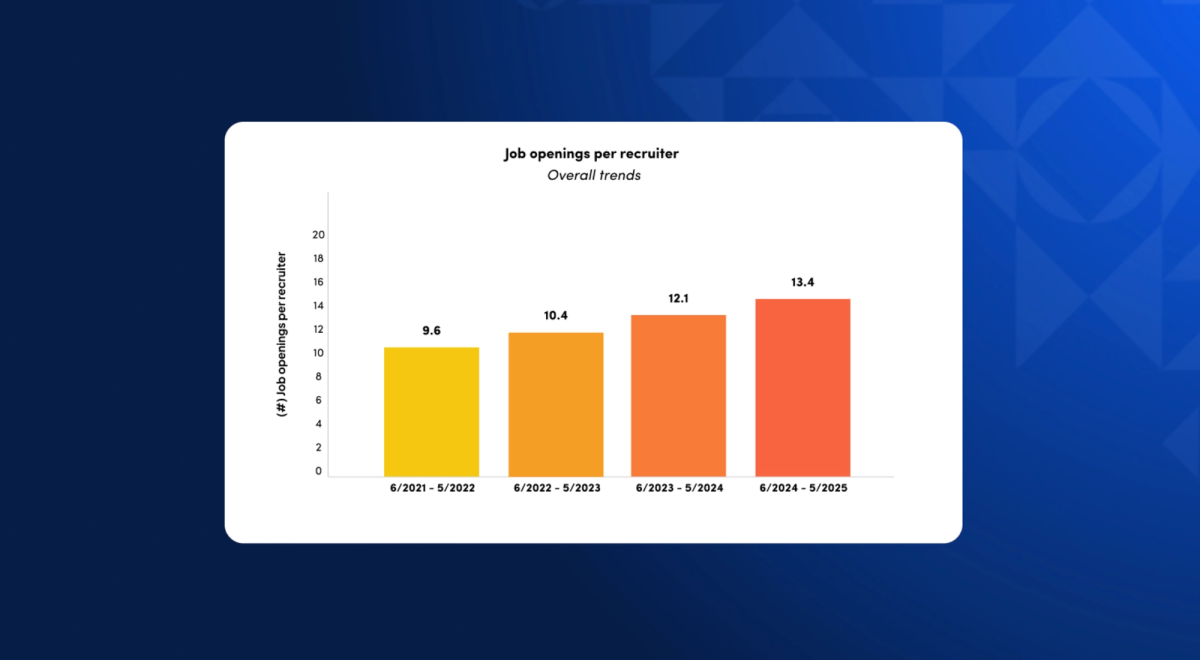
The chart explains a decision many talent leaders face in 2026. When each recruiter carries 13 or more open roles, something has to give: time to hire stretches, quality slips, or the company buys capacity from outside. RPO is one way to buy it. Hiring more recruiters is another. AI recruiters are a third, and the cheapest per unit of capacity, but they only help if the bottleneck is sourcing and screening rather than interviewing and closing. Diagnosing which bottleneck you have is the first step before buying any of them; our time-to-hire benchmarks show where the days usually go.
10. Where RPO Still Wins, Where AI Wins, and How Each Fails
RPO wins on scale, coordination and accountability; AI recruiters win on sourcing cost and speed; both fail in predictable ways. Most of the arguments for and against RPO are really arguments about which of these matters most for a particular hiring plan. A buyer who understands where each model breaks can design around the failure modes rather than discovering them a year into a contract.
The strongest case for RPO is a large, repeatable hiring program across locations or countries, where consistency and compliance matter as much as speed. Public bodies buy it for similar reasons: the Australian securities regulator, UK universities and housing associations have all contracted RPO providers, and at least one stated its aim plainly, to stem the cost of over-reliance on agencies. RPO also wins when you need capacity faster than you can hire it, for a new site, an acquisition or a seasonal peak, and when you want someone else to own the outcome contractually. The strongest case for AI recruiters is professional hiring where sourcing is the bottleneck, which describes most technology, specialist and leadership hiring below the executive level.
How RPO fails
RPO failures tend to come from the contract structure rather than from the provider's recruiters. A provider's team can be skilled and committed and still deliver a bad outcome for the buyer, because the contract rewards the wrong thing, protects the provider against the wrong risk, or makes it too expensive to change course when the program underperforms.
This is why post-mortems of failed RPO programs so often focus on targets, penalties and exit terms rather than on recruiting quality. The recruiters on the account change, but the contract stays the same for years, so a structural flaw keeps costing money long after the people who negotiated it have moved on. Four patterns recur in the public record and in the mechanics described earlier:
- Missed volume targets with penalties too small to matter, as with Capita
- Paying minimums in a downturn, when the true-up becomes a management fee
- Productivity drift under a fixed fee, invisible without measurement
- Lock-in through data and process, which makes switching expensive
The Capita case shows the first pattern at its most extreme, with targets missed every year and penalties of 6% of payments. The second is the one most private employers meet: TrueBlue's filings describe RPO clients "reducing hiring volumes", and under a contract with a minimum, those clients keep paying for capacity. The third and fourth are slower. A management-fee team with no productivity target can drift for months before anyone notices, and a provider that owns your candidate data and workflows can make switching so costly that renewal becomes the default. Each of these can be contracted around. None of them is fixed by negotiating a lower rate.
How AI recruiters fail
AI recruiters fail where the work needs relationships or judgement. The most common failure is buying an AI sourcing tool and expecting hires, when the bottleneck was hiring-manager availability, interview scheduling or offer approval. A tool that triples the number of qualified candidates in your pipeline does nothing if your hiring managers can only interview four people a week. The second failure is outreach quality: automated messages that read as automated get ignored, and a poorly configured agent can damage your employer brand faster than a human recruiter could.
The third failure mode is compliance, and it is growing. AI that screens or ranks candidates falls under specific rules in several jurisdictions: New York City requires bias audits of automated employment decision tools, Colorado's replacement AI law takes effect on January 1, 2027, and under the EU's Digital Omnibus, the high-risk obligations for AI used in hiring now apply from December 2, 2027. Our shortlisting guide covers what these rules require. An RPO provider takes on part of this compliance burden contractually, which is a real part of what its fee buys. If you replace RPO with AI tools, that burden comes back in-house.
How to apply this: list the failure modes that would hurt you most, then choose the model whose failures you can contain. A company that cannot afford a missed hiring target in a peak season should not rely solely on AI tools and a thin in-house team. A company whose hiring volume is genuinely uncertain should not sign a management-fee RPO with a high minimum. Most companies end up with a hybrid: AI tools for sourcing and screening, an in-house core team, and RPO or agencies for the peaks and the hardest roles.
11. How to Negotiate an RPO Deal in 2026
The strongest negotiating position in 2026 is a credible alternative: your own bottom-up cost model and a priced AI option. RPO providers price against what they believe you would otherwise do. If your fallback is "keep hiring through agencies", a 30% premium over in-house looks cheap. If your fallback is "build a small team with AI recruiters, at a cost we have already modelled", the provider has to justify every recruiter-month. Bring both numbers to the first meeting, not the last.
The second principle is to negotiate the structure before the rate. The rate is the number providers expect to discuss, and it is where they have the most room. The structure (minimums, productivity targets, AI pass-through, exit terms) is where the long-term cost sits, and where a buyer who has done the modelling has the advantage. Three structural moves matter most in 2026:
- Unbundle sourcing and price it separately from screening, coordination and closing
- Tie the fee to productivity, with a hires-per-recruiter floor and an AI pass-through
- Protect the downside with a capped true-up, owned data and a clean exit
The first move is the newest and the most valuable. Many RPO statements of work still price sourcing as recruiter hours, even when the provider is using AI tools to do it. If you already own or plan to buy an AI recruiter, carve sourcing out of the scope and price the RPO on the work that remains. Even if you keep sourcing with the provider, asking for it to be priced as a separate line forces the provider to show what it costs, which is the number you need to compare against software.
The second move works in two directions. A productivity floor (hires per recruiter per quarter, reported monthly) protects you if output falls under a management fee. An AI pass-through clause (an annual efficiency review that resets the fee when the provider's tools raise output) ensures that some of the gain reaches your invoice rather than the provider's margin. The RPO Association's paper is explicit that buyers "increasingly expect efficiency gains to reach the commercials", so this is a request providers have heard before, and a provider that refuses it is telling you how it plans to use its AI investment.
The third move is about the bad year, not the average one. Cap the true-up so minimums follow your forecast and step down with notice; keep candidate data, assessments and workflows in your own systems so you can leave; and agree exit and transition fees up front, when you have the most leverage. Run a competitive process even if you expect to renew, and consider a paid pilot on one business unit before committing the whole organisation. A pilot gives you a measured hires-per-recruiter number to negotiate with, which is worth more than any benchmark in this guide.
A worked negotiation: the 60-hire scale-up
Consider the scale-up from section 9, receiving an RPO proposal at $6,500 per hire with a monthly minimum equal to 80% of its forecast. On the bottom-up model, a fair management-fee equivalent is about $4,900 per hire at average productivity for a mostly business-role plan, so the quote sits roughly a third above a fair price that already includes the provider's margin, and the minimum exposes the company to most of that even if hiring falls. Those inputs are illustrative, but the pattern is common: a headline per-hire rate set for a cautious volume forecast, protected by a high floor.
A buyer with the model in hand has three good moves. First, ask the provider to show its assumed hires per recruiter; if it is well below the rates Ashby reports for comparable roles (7.3 a quarter on average, 5.0 for business roles), the quote is padding productivity risk. Second, offer to carve out sourcing, which the company can run with AI recruiters at a few thousand dollars a year, in exchange for a lower per-hire rate on the remaining scope. Third, accept a minimum, but at 50% of forecast with a quarterly step-down. Even if the provider only moves halfway on each point, the expected annual cost falls substantially, and the worst-case cost in a hiring freeze falls by far more. That worst case is the number to optimise, because it is the one the provider's pricing is built to protect.
12. The Future: AI Agents and the Repricing of Outsourced Recruiting
RPO pricing has not changed yet, but its cost base has, and the gap will not last. The industry's own trade body says "the market has not converged on a new model" and that providers "report little AI-specific pricing change so far". The same paper names the emerging models it says are worth watching over the next 12 to 18 months: "technology-enabled capacity pricing, talent intelligence subscriptions" and "outcome-based performance pricing". It also flags "how a shift in foundation-model pricing could reshape RPO cost structures", which is a polite way of saying that the cost of the AI layer is falling fast enough to matter.
The direction was visible long before generative AI. In 2021, Staffing Industry Analysts noted that "a number of RPO providers are investing in automation for volume hires, making it more financially viable to charge project fees rather than transactional fees". Five years later, Randstad describes moving "away from the traditional event-based recruiting model to a model that's platform-centric", Cielo sells its technology as a separate brand, and Korn Ferry agreed to pay about $1.1 billion for AMS, combining two of the eight RPO Leaders in Everest's 2026 assessment. Each of these is a provider preparing to sell something other than recruiter hours.
Outcome pricing is no longer theoretical, either. It already exists at the small end of the market: Jack & Jill charges UK and EU employers a percentage of salary only when a hire is made, and Dover's freelance recruiters can be paid per hire. None of these is an RPO, but each shows buyers what an AI-assisted recruiting service looks like when it is priced on results rather than hours, and enterprise buyers will increasingly ask their RPO providers why they cannot do the same.
The counter-pressure is real. RPO providers are paying for AI platforms, model usage and integration work on top of their recruiters, and the RPO Association's paper gives a technology provider's view that platform costs are rising, not falling. Providers will argue, with some justice, that the efficiency gains must first pay for the tools. The reasonable buyer position is not to demand the full saving immediately, but to insist on transparency: which tools are used, what they cost, and how output per recruiter has changed since they were introduced.
Three changes look likely as agents take over more of the recruiting workflow:
- Sourcing-heavy per-hire fees fall, as agents do the search work
- Programs shrink in headcount, with fewer, more senior recruiters per account
- Technology gets priced separately, as subscriptions alongside the service
The first change is already under way at the edges, where marketplaces and AI-first companies sell sourcing and introductions at prices far below RPO's implied cost. The second follows from the arithmetic in section 5: if an agent handles the screening load, each recruiter can carry more hires, and a capacity-priced contract needs fewer recruiter-months. The third is the one buyers should watch most closely. A provider that charges for its AI platform as a separate line, on top of a service fee priced for the old staffing levels, is charging twice for the same work. Insist that the two are reconciled.
For buyers, the practical implication is timing. A five-year RPO contract signed in late 2026 at today's capacity prices will look expensive by 2028 if agents keep improving at their current pace. Shorter terms, annual efficiency reviews and the right to carve out scope are worth more now than they were in any previous cycle. Much of the sourcing layer of recruiting is already available as software, and the open question is how quickly the coordination layer follows.
13. The Bottom Line: A Decision Framework
Buy RPO for scale, coordination and accountability; buy AI recruiters for sourcing capacity; and never buy either without converting it to cost per hire first. RPO in 2026 is a people business with mid-teens margins, priced as recruiter capacity through management fees, per-hire fees or a blend with a true-up minimum. On public data, a fair RPO price for a median-paid recruiter is about $12,000 a month, or about $4,900 per professional hire at average 2026 productivity (and up to about $9,400 for technical roles), roughly a third above the in-house equivalent and about a quarter of a 22% agency fee. AI recruiters cost about 1-7% of a loaded recruiter per seat and take over the top of the funnel, but not the interviews, offers and compliance that RPO teams still carry.
The diagram below turns the guide into a decision path. The volume thresholds are rules of thumb rather than hard lines, and the right answer for any company depends on its roles, markets and how well it can hire and keep recruiters.
Read the paths with the earlier sections in mind. Small hiring plans rarely justify RPO minimums, so the left branch relies on AI tools and targeted agency use. Mid-sized plans turn on one question, whether you can build a recruiting team, and the answer decides between in-house with AI and a per-hire RPO. Large volume programs are where RPO earns its fee, and the only open questions are the fee model and whether the contract forces AI savings through to your invoice.
If your hiring is sourcing-heavy and you want to see what the top-of-funnel slice costs as software before you price an RPO, try an AI recruiter on one live role first. HeroHunt.ai is one option among those in section 8, priced on a published plan rather than a placement fee.
AI sourcing, screening and outreach on a flat monthly plan with unlimited positions, and no fee when you hire.
Written by Yuma Heymans (@yumahey), who built HeroHunt.ai, the world's first AI Recruiter, and has been building AI recruitment tools since 2021. With a background in management consulting at Bain and KPMG, he writes about what recruiting capacity really costs, whether it comes from people or from software.
This guide reflects RPO company filings, public contract notices and vendor pricing published as of November 2026. RPO fees are negotiated privately and change with volume and scope, and AI recruiter prices change frequently, so verify current terms and prices with each provider before you sign.