


The 2026 buyer's guide to the three applicant tracking systems betting their future on AI agents.
Job applications have surged 412% since 2023 while the number of open roles barely moved - Greenhouse. That single ratio explains why the boring, dependable applicant tracking system (ATS) became the most contested piece of recruiting software in 2026. When a job posting can draw thousands of AI-polished, sometimes AI-generated applications overnight, a database that just stores them is a liability. The winners are becoming something new: an agentic ATS, a system where AI agents actively source, screen, schedule, and communicate on the recruiter's behalf, while the ATS itself becomes the governed record beneath them.
Three platforms dominate the conversation, and they are pulling in three different directions. Greenhouse is bolting governed, deliberately assistive AI onto its structured-hiring backbone. Ashby is the AI-native challenger shipping the most aggressive autonomous agents in the category. Workday is turning its enterprise suite into an "agent system of record" and bought two of the best recruiting agents on the market to fill it. Same category, three philosophies, wildly different price tags.
Here is the problem for buyers: the marketing decks have converged on identical language ("agentic," "AI teammates," "autonomous"), so the words no longer tell you what you are actually buying. The differences that matter, autonomy depth, data ownership, ecosystem, and true cost, are buried under the pitch.
This guide breaks down what agentic actually means for an ATS in 2026, profiles Greenhouse, Ashby, and Workday in depth with real 2025 and 2026 releases and pricing, compares them head to head, and gives you a decision framework grounded in company size and hiring model rather than feature checklists. It also covers the sourcing agents that now sit in front of any ATS and the adjacent players worth a shortlist.
Contents
- What an agentic ATS actually is
- The 2025 reset: how the ATS became the system of record for agents
- Greenhouse: governed AI on a structured-hiring backbone
- Ashby: the AI-native hiring OS
- Workday: the enterprise agent system of record
- Head-to-head: autonomy, data, and ecosystem
- Pricing and total cost of ownership
- The sourcing layer: agents that feed any ATS
- The wider field: adjacent and emerging players
- How to choose: a decision framework
- The outlook: multi-agent hiring in 2027
- The bottom line: matching platform to team
1. What an agentic ATS actually is
An agentic ATS is an applicant tracking system where AI does not just suggest, it acts: agents run multi-step recruiting work end to end (finding candidates, screening applications, scheduling interviews, drafting and sending messages, and building reports) while the ATS holds the permissions, the audit trail, and the final human decision. The clearest way to understand the shift is a ladder that the analyst firm Aptitude Research uses to describe the whole market: talent acquisition is moving from recruiter-driven to agent-augmented to agent-operated - Aptitude Research. The 2022 generation of "AI recruiting" tools lived on the first two rungs. The 2026 generation is climbing to the third.
That distinction is not marketing hair-splitting, because it changes what a recruiter's day looks like. An assistive feature waits for you to ask ("summarize this resume," "draft this email"). An agent is given an objective and a boundary, then works on its own schedule and pings you when a decision is needed. It is the difference between a calculator and a bookkeeper. The same underlying language models power both, but the product decisions around autonomy, memory, and permissions are what separate a copilot from a colleague, and they are exactly where Greenhouse, Ashby, and Workday have made different bets.
A concrete example makes the ladder tangible. Consider interview scheduling, the most-hated coordination chore in recruiting. On the assist rung, the tool drafts an email you still send and books the room after you pick the time. On the augment rung, it proposes three slots that fit every interviewer's calendar and waits for your nod. On the operate rung, a scheduling agent negotiates directly with the candidate, resolves conflicts across five interviewers in two time zones, sends the invites, and reschedules automatically when someone drops, surfacing to you only when it genuinely cannot proceed. All three exist in 2026, sometimes inside the same product, and the rung a vendor ships by default tells you more about its philosophy than any feature list. Ashby's autonomous Scheduling Agents live on the third rung, Greenhouse's Notetaker sits comfortably on the first two, and Workday's Paradox integration runs the third rung at frontline scale. Knowing which rung you actually want, and for which tasks, is the real buying decision.
Underneath the agents, something subtler happened to the ATS itself: it got reframed as the system of record for AI activity. Instead of every vendor building a walled garden, the leaders adopted the Model Context Protocol (MCP), an open standard that lets external agents (ChatGPT, Claude, Copilot) query and update ATS data through defined, permission-aware tools. Both Greenhouse and Ashby shipped MCP servers in May 2026, and Workday built an entire governance layer, the Agent System of Record, around the same idea. The result is a layered stack: sourcing agents at the top feeding candidates in, task agents in the middle acting on the pipeline, a governance layer enforcing who can do what, and a human making the call.
The practical takeaway from this architecture is that you are no longer buying a database, you are buying a control plane. The questions that decide value in 2026 are not "does it have AI" (they all do) but "how much will it do without me," "can I see and undo what it did," and "can I plug my own agents into it." Read the three profiles that follow through that lens: each platform answers those three questions differently, and each answer maps cleanly onto the kind of company it was built for. Section 6 turns those answers into a side-by-side comparison, but the mental model above is what makes the comparison legible.
2. The 2025 reset: how the ATS became the system of record for agents
The category reset in 2025 was driven by acquisitions, not features, and that tells you the capability is real. The defining event was Workday completing its acquisition of Paradox on October 1, 2025, folding a conversational AI recruiter into its suite alongside the HiredScore talent-matching engine it had bought in early 2024 - Workday. Weeks earlier, SAP completed its acquisition of SmartRecruiters on September 11, 2025, buying itself a modern recruiting front-end to replace the aging SuccessFactors module - SAP. When two of the three biggest enterprise HR suites buy their agentic recruiting capability within a month of each other, the window to build it internally has closed.
One number deserves a correction up front, because it circulates constantly and it is wrong. The widely repeated "$1.1 billion" price is not what Workday paid for Paradox. Paradox's terms were officially undisclosed and reported at roughly $1 billion in cash; the $1.1 billion figure belongs to Workday's separate agreement to buy the Swedish AI company Sana, announced September 16, 2025 - Tech.eu. It is a small thing, but it is the kind of detail that separates a real buyer's guide from a rewrite of press releases, and it matters if you are benchmarking what agentic recruiting capability actually costs at the acquisition level.
The two headline deals were the visible tip of a broader consolidation wave that reshaped the vendor map in a single year. Aptitude Research's year-end review catalogued the same three themes running through nearly every transaction: consolidation, agentic AI, and embedded AI, with deals spanning Radancy buying myInterview, iCIMS buying Apli, Zoom buying BrightHire, and Findem buying Getro - Aptitude Research. The pattern matters to a buyer for a practical reason: the tool you shortlist today may belong to a much larger suite by the time you renew, which changes its roadmap, its pricing leverage, and its integration priorities. When you evaluate an agentic ATS in 2026, you are also implicitly betting on who owns it in 2028, and the independents (Ashby and Greenhouse among them) look different on that axis than the modules now absorbed into SAP, Workday, or Zoom.
Two structural forces made these deals inevitable, and both point back to the same crisis. The first is the application flood. LinkedIn now sees roughly 11,000 job applications submitted every minute, a 45% year-over-year jump driven by generative AI and one-click auto-apply tools - eWeek. Greenhouse, drawing on its own platform data, reports applications per recruiter up 412% since 2023 against roughly flat open roles. When volume explodes but headcount does not, automation stops being a nice-to-have and becomes the only way to keep the funnel moving.
The second force is a trust and authenticity crisis that turns raw volume into an adversarial problem. Gartner found that just 26% of job applicants trust AI to evaluate them fairly, even as candidates increasingly weaponize AI on their side of the table - Gartner. The fraud is not hypothetical: security firm Pindrop received 827 applications for a single senior developer role and found roughly 12% used fake or deepfake identities - StaffingHub. Gartner projects that by 2028, one in four candidate profiles globally will be fake - Personnel Today. Screening humans out of an ocean of synthetic applicants is exactly the kind of tireless, pattern-matching work that agents do well and people do miserably, which is why fraud detection became a headline feature across all three platforms in 2026.
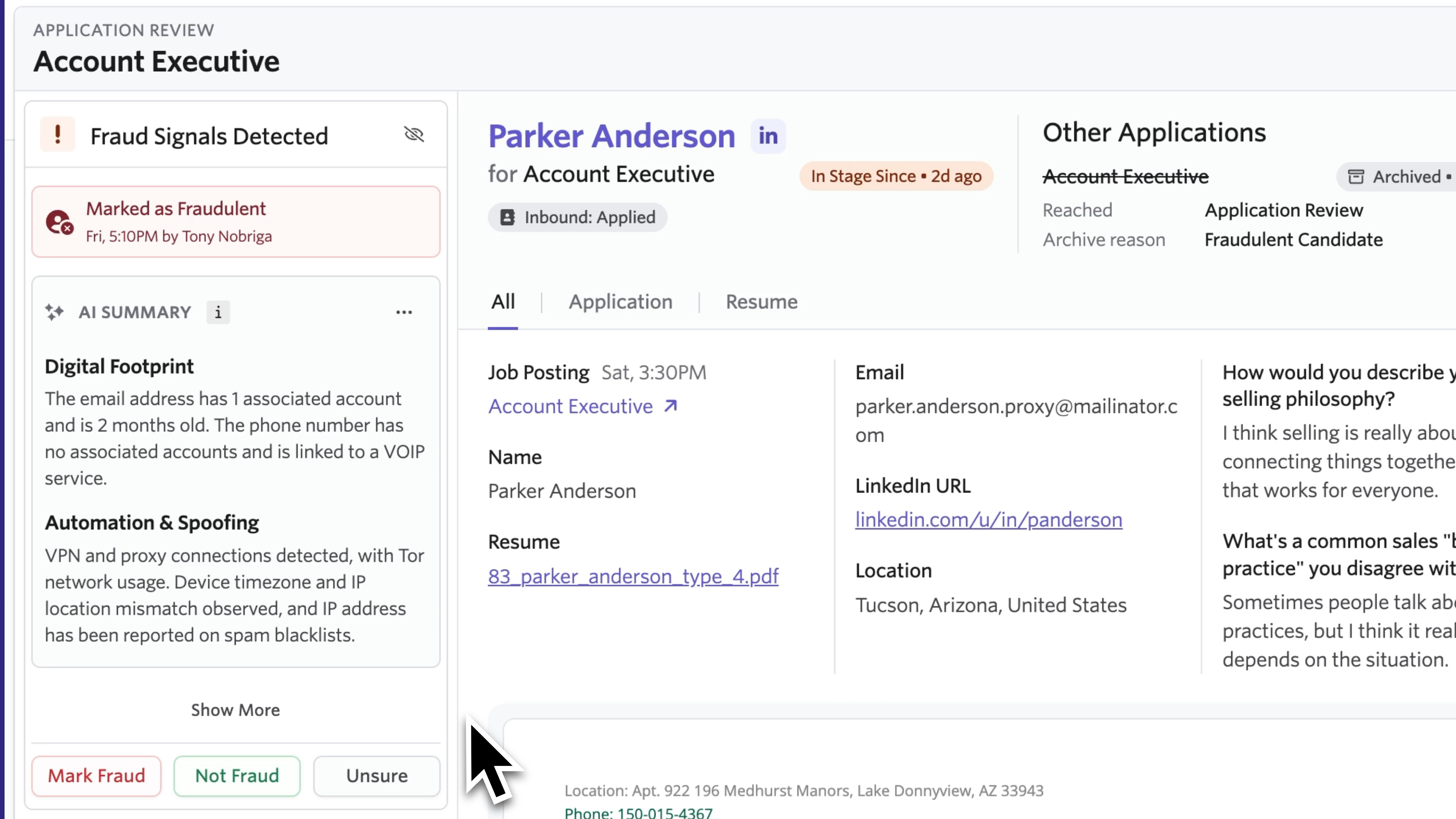
Ashby's response is a good illustration of how this crisis became product. Its Fraudulent Candidate Detection, shipped September 16, 2025, analyzes device, IP, email, and phone signals to flag suspicious applications automatically, and it is included on every plan rather than sold as an upsell - Ashby. The screenshot below shows how the flags surface right inside application review, so a recruiter sees the fraud signal next to the candidate's materials rather than discovering it later.
The trust crisis, turned into a product feature
Buyer intent caught up fast, which is the third leg of the reset. KPMG measured enterprise AI-agent deployment nearly quadrupling, from 11% to 42% of organizations in about six months through Q3 2025 - KPMG. In talent acquisition specifically, Korn Ferry's 2026 research found 84% of talent leaders plan to use AI in 2026 and 52% plan to add autonomous AI agents to their teams - Korn Ferry. The chart below shows how sharply intent has tilted toward genuine autonomy rather than assistance.
What talent leaders plan to do with AI in 2026
Intent, though, runs well ahead of depth, and that gap is the real state of the market. Bullhorn's GRID 2026 survey of around 2,300 recruitment professionals found that while 30% of staffing firms have moved to agentic AI, only 10% run it across their full workflow - Bullhorn. The performance spread is what should focus a buyer's attention: Bullhorn found top-performing firms are 4x more likely to use AI, and iCIMS and Aptitude found that 46% of companies are using or planning agentic AI yet 45% still have no formal AI governance framework - iCIMS. Both things are true at once. The median deployment is shallow and ungoverned, and the well-run deployments are pulling away. This wider adoption wave sits on top of a market that had already crossed the tipping point.
Agents arrived after AI adoption was already normal
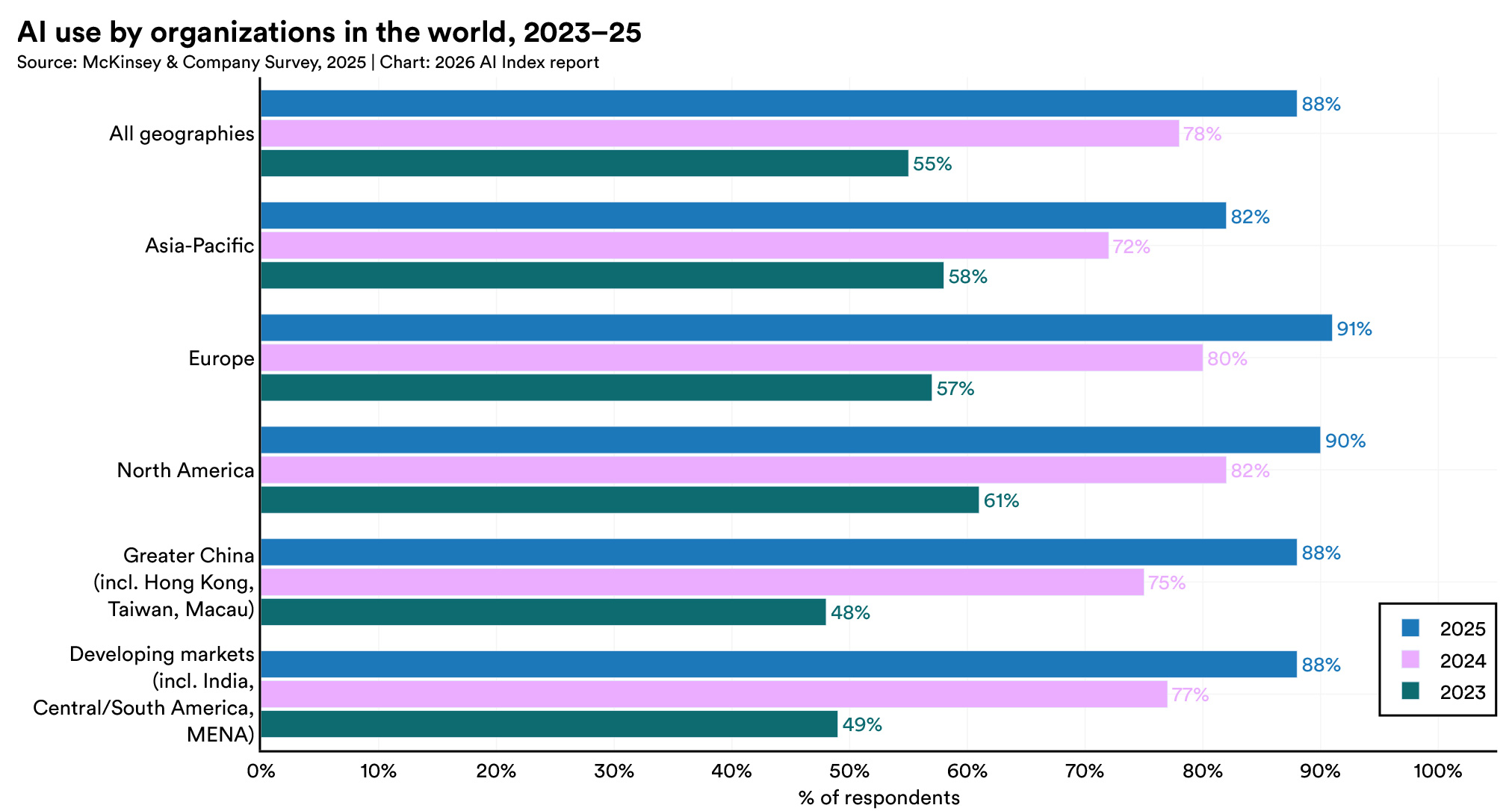
For a buyer, the reset means the decision has changed shape. You are not choosing whether to adopt agents, you are choosing whose governance model and whose agents you trust with your funnel, and the underlying ATS market (roughly $2.7 to $3.0 billion in 2026, growing 7 to 9% a year) is reorganizing around exactly that question - IMARC Group. The next three sections profile the three platforms that most enterprise and scale-up buyers will shortlist, in order of how differently they answer it.
3. Greenhouse: governed AI on a structured-hiring backbone
Greenhouse's bet is that in an era of black-box automation, the winning move is restraint plus governance. Its 2026 strategy is branded, almost defiantly, as AI "built to strengthen structured hiring, not shortcut it," and the company has been explicit that its agents inform decisions rather than make them - Greenhouse. Chief Product Officer Meredith Johnson frames it bluntly: AI can surface insights, "but the hiring decision is always yours." For a mid-market or enterprise buyer worried about bias liability, candidate backlash, and the 45% of companies operating agents with no governance, that positioning is a feature, not a hedge.
That restraint is easier to trust because it comes from a company with a decade of structured-hiring credibility rather than an AI startup improvising a governance story. Greenhouse has been majority-owned by TPG's Rise Fund since a roughly $500 million deal in early 2021, and it built its reputation on scorecards, kits, and interview plans long before agents were a category - Forbes. Its earlier acquisition of Interseller in 2021 added outbound sourcing, and in 2025 it shipped Real Talent, a fraud-and-spam layer aimed squarely at the deepfake and bot problem section 2 described - StaffingHub. The scale behind the product is substantial: Greenhouse says it has analyzed data from more than 6,000 companies and 640 million applications between 2022 and 2025, and that its customers now hire at more than twice the rate they did in 2022 despite far higher application volume - Recruiting News Network. That data advantage is what makes its agents' recommendations more than generic model output.
The substance behind the positioning is a genuine 2026 product wave. On June 10, 2026, Greenhouse launched six AI capabilities landing through the third quarter: a Job Kickoff Agent that turns intake notes into a structured job setup, a source-linked Candidate Insights Agent that answers questions about a candidate strictly from scorecards and recorded activity, a Notetaker that maps interview transcripts to scorecard questions, an Analytics Chart Agent, and AI Report Insights - Greenhouse. The design thread running through all six is traceability: every AI answer links back to a source in the record, which is what makes the output defensible to a hiring manager or, increasingly, an auditor.
The way these agents are scoped is as telling as what they do. The Job Kickoff Agent attacks the intake stage, where most bad hires are actually born, by turning a messy kickoff conversation into a structured job with defined attributes and interview stages, so the rigor is front-loaded rather than bolted on later. The Candidate Insights Agent deliberately refuses to opine beyond the evidence: it answers a hiring manager's questions strictly from scorecards, notes, and recorded activity, with each answer citing its source, which prevents the confident hallucination that undermines trust in lesser tools. That scoping is the whole Greenhouse thesis in miniature: an agent that knows the boundary of what it may claim is more valuable in hiring than one that will answer anything. It is a quieter kind of AI than Ashby's or Workday's, and for regulated industries, public companies, and anyone who expects to defend a hiring decision later, the quietness is precisely the selling point.
Two acquisitions and a governance framework round out the picture, and they show where Greenhouse is willing to be aggressive. In May 2026 it acquired Ezra AI Labs, a voice-AI interviewer that runs structured, on-demand conversational interviews scored against a predefined rubric, completing the deal on May 27 - Greenhouse. Around the same time it shipped Greenhouse MCP, a permission-aware layer that lets approved external tools like Claude or Copilot query hiring data with an audit trail. And it published an AI Principles Framework whose fourth pillar states plainly that "AI informs but never decides." Greenhouse also commissions monthly third-party bias audits from Warden AI across ten protected classes, a level of published assurance no competitor matches. HR-tech analyst George LaRocque walked through the reasoning with Greenhouse's CPO in a useful 2026 interview on the Ezra acquisition and governed MCP - WorkTech.
Greenhouse also earned the right to talk about the trust crisis, because it did the research that defined it. Its 2025 AI in Hiring Report, published November 19, 2025 and surveying 4,136 respondents, produced the year's most-cited statistic: 70% of hiring managers trust AI to make faster and better decisions, but only 8% of job seekers call AI-driven hiring fair - Greenhouse. The same report found 91% of recruiters had spotted candidate deception and 34% spend up to half their week filtering spam. A follow-up in May 2026 found 63% of job seekers had already faced an AI interview and most had a poor experience. That editorial credibility is part of the product: it is why Greenhouse's "governed, humane AI" pitch lands rather than reads as spin.
Greenhouse's research defined the year's trust debate

The trade-offs are real and worth naming. Greenhouse's deliberate assistiveness means it will do less on its own than Ashby or Workday, which is exactly the point for some buyers and a dealbreaker for others chasing autonomous, high-volume throughput. Its native analytics are thinner than Ashby's, and it charges separately for sourcing automation that competitors bundle. What you get in return is the deepest ecosystem in the category (500-plus integrations and roughly 7,500 customers) plus the strongest structured-hiring and fairness controls on the market - BestRecruitingTools. For a company where hiring rigor, auditability, and a wide plug-in ecosystem matter more than maximum automation, Greenhouse is the safe, credible default, and its "governed system of record" framing is the most future-proof of the three if you expect to run your own agents against your ATS. Pricing, covered in section 7, sits in the mid-market band: real, negotiable, and far below Workday.
4. Ashby: the AI-native hiring OS
Ashby is the platform betting hardest on autonomy, and its customer list suggests the bet is working. It is used by nearly 70% of the Forbes AI 50, up from around half a year earlier, including OpenAI, Cursor, Notion, Ramp, Linear, and Harvey - Ashby. When the companies building frontier AI overwhelmingly choose one ATS to hire with, that is a meaningful signal about which product feels native to the agentic era rather than retrofitted into it. Founded by CEO Benji Encz and Abhik Pramanik, Ashby positions itself not as an ATS but as an all-in-one "hiring OS" that unifies applicant tracking, CRM, sourcing, scheduling, and BI-grade analytics in one system priced on total company headcount rather than per recruiter seat.
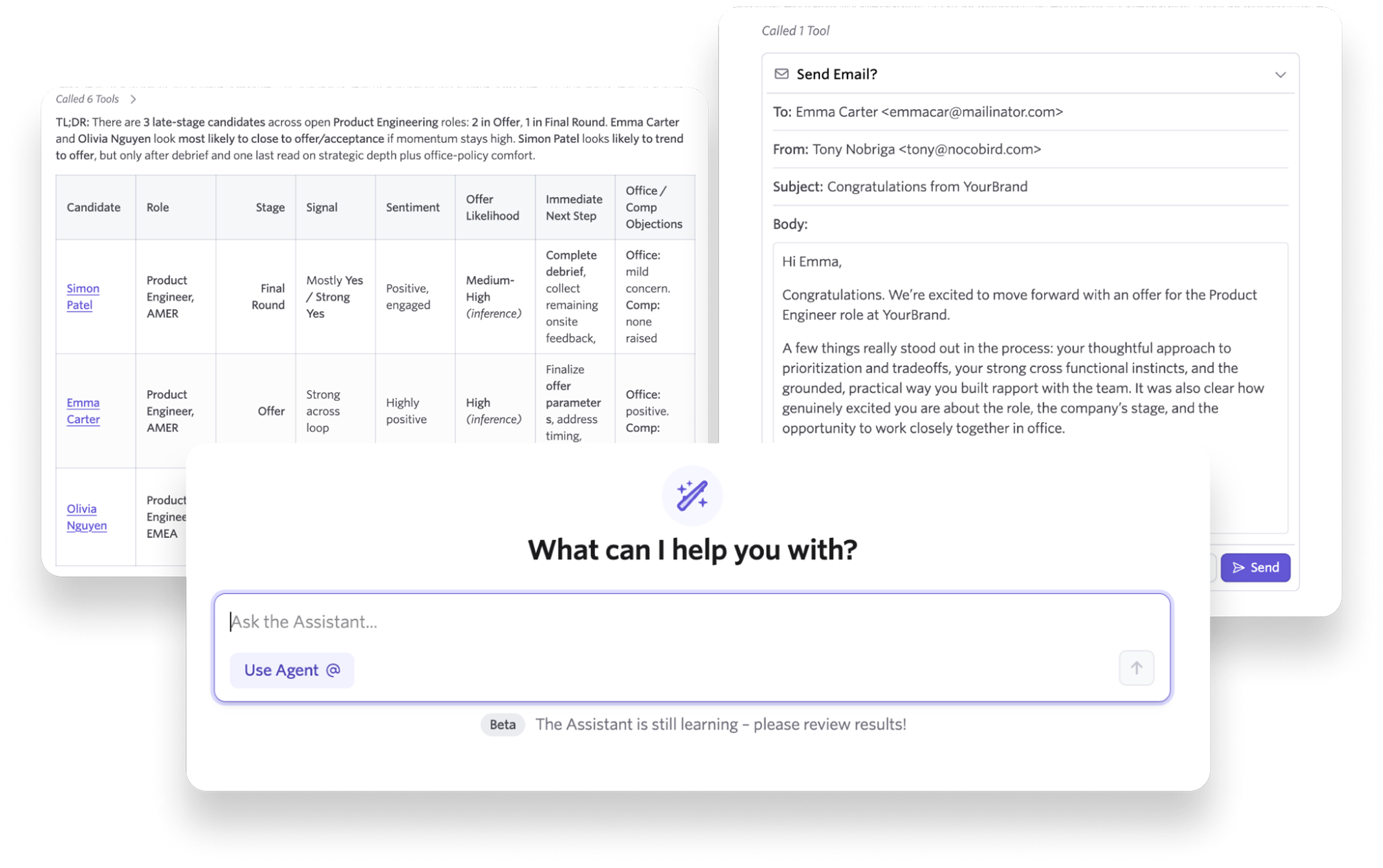
The autonomy showed up in force at Ashby's Ashby One conference on May 7, 2026. The headline releases were Ashby Assistant (a chat agent that can query and act across candidates, jobs, and interviews), Custom Agents (reusable, permission-controlled workflows a team can build once and share), autonomous Scheduling Agents that manage full interview coordination end to end, and MCP server support so external tools like ChatGPT and Claude can read and update Ashby data - Ashby. Notably, even Ashby's most autonomous features keep a human gate: the Assistant "prompts you for review before it runs," so autonomy is opt-in per action rather than fire-and-forget - Ashby. The screenshot below shows the Assistant returning a pipeline update with citations back to the underlying data, which is the same traceability discipline Greenhouse emphasizes, applied to a more autonomous product.
An agent that acts across the whole pipeline
Ashby also moved into AI interviewing by acquisition. Its new AI Interviewer, which runs structured conversational screens natively inside a hiring plan, was rebuilt on the technology and team from Talent Llama, a deal that closed in late 2025 and was announced alongside the Ashby One releases - Ashby. Combined with earlier 2025 launches (Fraudulent Candidate Detection, an AI Notetaker, and AI Talent Rediscovery that surfaces strong past applicants), Ashby now covers the full loop from sourcing to scheduling to interviewing with its own agents rather than a patchwork of point tools. The product keynote from the co-founders is the best single primary source on how they think about it.
Product Keynote | Ashby One 2026, San Francisco
The company's momentum is more than a marquee logo wall. When Ashby raised a $50 million Series D on July 22, 2025, led by Alkeon Capital and co-led by existing investor Lachy Groom at roughly twice its Series C valuation, it disclosed the operating metrics behind the round: ARR up 135% year over year, customers more than doubling from 1,300 to over 2,700, and interviews scheduled on the platform up 170%, all at a burn multiple under 1x - Ashby. Those are the numbers of a company taking real share in the mid-market, not a niche darling. Its genuine technical differentiator, and the reason data-obsessed teams choose it, is the Advanced Analytics Builder: BI-grade funnel, capacity, and quality-of-hire reporting that at most competitors requires exporting to a separate data tool.
In practice, that analytics depth is what makes Ashby's agents more useful than the average, because an agent is only as good as the data it can reason over. The report builder produces granular funnel, velocity, and source-of-hire breakdowns that at Greenhouse or Workday would mean a data-engineering ticket or a Tableau connection - Improvado. When the same system holds the analytics and runs the agents, an Assistant can answer "which sourcing channel produced our best engineering hires last quarter" directly from the record rather than guessing, which is exactly the kind of question a scale-up's head of talent lives on. The funding trajectory reinforces the momentum story: Ashby's $50 million Series D came just over a year after a $30 million Series C in June 2024, and it now employs around 220 people across more than 20 countries - PR Newswire. Its customer roster stretches well beyond AI labs to include Shopify, Snowflake, Vanta, Reddit, and Deliveroo, evidence that the platform scales past the startup segment into genuine enterprise territory - Ashby.
Ashby's limits are the mirror image of its strengths. It is priced and built for teams with at least one dedicated recruiter, so a five-person startup making occasional hires will find it heavier and pricier than it needs; there is no free tier and no permanent low end, and the sub-100-employee Foundations plan caps email lookups at 200 a month. Its ecosystem, while growing, is not as deep as Greenhouse's 500-plus integrations, and its all-in-one philosophy means you are betting on Ashby's native modules rather than best-of-breed plug-ins. For a fast-scaling company between roughly 50 and 2,000 employees that wants modern UX, the best native analytics in the category, and genuinely autonomous agents in one system, Ashby is the strongest pick in this guide. It is the platform most clearly built for the agent-operated rung of the ladder rather than retrofitted onto it.
5. Workday: the enterprise agent system of record
Workday's play is the most ambitious and expensive: don't just add agents, build the operating system that governs an entire workforce of them. In February 2025 it unveiled the Agent System of Record (ASOR), a central place to register, permission, budget, and monitor every AI agent an organization runs, whether built by Workday, the customer, or a third party - Workday. The framing from chair Aneel Bhusri is that the future workforce will include humans and agents together, and that companies which cannot manage that mix "will fall quickly behind." For a Fortune 500 buyer who already runs finance, HR, and payroll on Workday, ASOR reframes agentic AI from a scattering of point tools into a governed, metered, auditable fleet, and that governance story is Workday's real product.
For recruiting specifically, Workday assembled a three-layer stack by acquisition and integration. HiredScore (bought in early 2024) provides explainable, bias-audited candidate matching and rediscovery; Workday Recruiting is the core ATS; and Paradox, whose conversational agent "Olivia" closed into Workday on October 1, 2025, handles high-volume apply, screen, and schedule workflows - Workday. The named agent that ties HiredScore into recruiting, the Recruiter Agent, proactively sources passive candidates, drafts job descriptions, and recommends talent, with Workday citing a 54% boost in recruiter capacity and a 55% average reduction in screening time - Workday. This is the deepest autonomous, end-to-end frontline hiring capability of the three platforms, because Workday bought the two best agents in the market rather than building lighter versions.
The Paradox results are what make the frontline case, and they are on a different scale from anything a pure ATS reports. At acquisition, Paradox had powered more than 189 million AI-assisted candidate conversations and cut time-to-hire to as low as 3.5 days for hourly roles - Workday. General Motors, using Olivia under the name "Ev-e," auto-scheduled more than 74,000 interviews and cut time-to-schedule from over five days to 29 minutes, saving a reported $2 million a year - Paradox. For a retailer, restaurant chain, or logistics company hiring tens of thousands of frontline workers a year, that throughput is the entire business case, and no mid-market ATS comes close to it. Workday's Rising 2025 keynote lays out the broader agentic vision, including the Microsoft partnership on agent identity.
Workday Rising Innovation Keynote: Transforming Work with Agentic AI
Governance is where Workday genuinely leads, and it is deliberately not maximal autonomy. The Agent Gateway uses open protocols (MCP and agent-to-agent) to connect third-party agents into ASOR, an Agent Partner Network launched with fifteen partners including Microsoft, Google Cloud, and AWS, and ASOR integrates with Microsoft Entra Agent ID so every agent carries a verified identity and enforced permissions - Workday. CEO Carl Eschenbach's framing, that "humans and agents should peacefully coexist in a way that amplifies human performance," is not a slogan so much as a product constraint: metering, identity, and ROI tracking rather than uncontrolled autonomy. Workday was named a Leader in the 2025 Gartner Magic Quadrant for Talent Acquisition suites, and its scale is the moat: 11,000-plus organizations, over 65% of the Fortune 500, and more than a trillion transactions a year training its Illuminate AI - Futurum Group.
The recruiting agents sit inside a much larger Illuminate rollout, which is both the appeal and the complexity. Workday expanded Illuminate with a wave of agents across HR and finance through late 2025 and into 2026, from a Talent Mobility Agent to a Payroll Agent, all deployed and metered through the same Agent System of Record - TechTarget. For recruiting, the HiredScore-powered Recruiter Agent reports reducing candidate screening time by roughly 57% and filling around 70% of requisitions from existing talent pools, a rediscovery advantage only a company sitting on years of HCM data can offer - Workday Marketplace. Alongside the agents, Workday introduced Flex Credits, a consumption model that lets customers spend a shared, annually refreshing budget across agents and features, plus a Workday Data Cloud with zero-copy sharing into Databricks and Snowflake. Flex Credits are a notable bet given that buyer appetite for consumption pricing actually cooled in 2025, and they are worth scrutinizing in any Workday negotiation because they shift cost risk onto the customer's usage.
The trade-offs are severe enough to disqualify Workday for most companies, and honesty about them matters. You cannot buy Workday Recruiting standalone; it requires a Workday HCM subscription, so the entry point is an enterprise platform decision, not a recruiting one. Implementation typically runs 100% to 200% of the first-year subscription over six to nine months, and the recruiter and candidate UX is widely considered weaker than best-of-breed tools. There is also real data lock-in: Workday's requisition-centric HCM schema means a standard export cannot reconstruct the candidate-to-application-to-scorecard chain that a Greenhouse or Ashby record preserves - ClonePartner. Workday is the right answer for large, high-volume enterprises already committed to the Workday ecosystem, and close to the wrong answer for almost everyone else. The economics, which improve sharply with scale, explain exactly who it fits.
Workday core HCM cost per employee falls with scale
The per-employee curve above, drawn from procurement benchmarks, is the whole Workday argument in one line - WorkdayNegotiations. At 500 to 2,500 employees the platform is punishingly expensive per head; at 50,000-plus it is cheap per head and the bundled recruiting agents come nearly for free against a cost base you were already paying. That curve is why Workday wins the giant enterprise and loses the scale-up, and it sets up the head-to-head that follows.
6. Head-to-head: autonomy, data, and ecosystem
The three platforms are not competing for the same buyer, and recognizing that is the single most useful thing in this guide. They cluster by segment first and philosophy second: Workday for the large, high-volume enterprise already on its suite; Greenhouse for the mid-market and enterprise that prize structured-hiring rigor and ecosystem; Ashby for the fast-scaling, recruiter-led, analytics-obsessed company. Almost every "which is better" argument dissolves once you place a company on that map, because the honest answer is that the best platform for a 300-person AI startup is a poor fit for a 40,000-person retailer, and vice versa. The comparison below is therefore organized around the three questions from section 1 (how autonomous, who owns the data, how open the ecosystem) rather than a raw feature checklist.
On autonomy, the ranking is clear and it inverts the usual assumption that the enterprise incumbent is the most conservative. Workday is the most autonomous for high-volume frontline hiring because Paradox and HiredScore run genuinely end-to-end workflows; Ashby is the most autonomous for professional and technical hiring, shipping the broadest set of true agents with per-action human gates; and Greenhouse is the most deliberately restrained, keeping AI in an advisory role by design. On data ownership, the order reverses: Ashby and Greenhouse keep a clean, portable, candidate-centric record, while Workday's requisition-centric schema creates the deepest lock-in. On ecosystem, Greenhouse's 500-plus integrations lead, Ashby's all-in-one approach means fewer plug-ins but more native coverage, and Workday's strength is its own suite rather than third-party breadth.
| Dimension | Greenhouse | Ashby | Workday |
|---|---|---|---|
| Best-fit segment | Mid-market to enterprise | Scale-ups (~50-2,000 staff) | Large enterprise (3,000+) |
| Agentic posture | Assistive by design | Autonomous, human-gated | Autonomous, governed |
| Flagship agents | Job Kickoff, Candidate Insights, Ezra Voice AI | Assistant, Custom + Scheduling Agents, AI Interviewer | Recruiter Agent (HiredScore), Olivia (Paradox) |
| Data model | Candidate-centric, portable | Candidate-centric, portable | Requisition-centric, locked-in |
| Ecosystem | 500+ integrations | All-in-one, fewer plug-ins | Own suite, Agent Gateway |
| Open agents (MCP) | Greenhouse MCP (2026) | MCP server (2026) | Agent Gateway (MCP + A2A) |
| Standalone purchase | Yes | Yes | No (requires Workday HCM) |
The table makes the philosophies concrete, but the practical reading is what matters. If you expect to run your own agents against your ATS (an internal sourcing bot, a Claude workflow that drafts outreach, a custom analytics agent), all three now expose an MCP-style interface, but Greenhouse and Ashby give you a cleaner, more portable data foundation to build on, while Workday gives you the most governance if you are managing dozens of agents across the whole company. If data portability is a board-level concern (because you have switched ATS before and felt the pain), Workday's lock-in is a genuine strategic cost that does not show up on the price sheet. And if ecosystem breadth is the priority because your stack already includes specific assessment, background-check, or video tools, Greenhouse's marketplace is the surest bet.
Switching costs deserve their own line in the analysis, because they are the hidden tax that makes the wrong first choice so expensive. Moving off Greenhouse or Ashby is unpleasant but tractable, since both keep a clean candidate-centric record you can export. Moving off Workday is a different order of difficulty: its requisition-centric schema means a standard export flattens the relational structure, dropping scorecards, collapsing multi-application candidate histories, and stripping attachments, so the candidate-to-application-to-job chain cannot be faithfully rebuilt elsewhere - ClonePartner. That asymmetry should weight a genuinely undecided enterprise buyer toward the more portable options, because in the agent era the value of your historical hiring data (the fuel every rediscovery and matching agent runs on) only rises, and losing it in a migration is a strategic cost that never appears on the quote.
One structural shift cuts across all three and reframes the whole comparison: sourcing is separating from the ATS. Because the agentic ATS manages candidates you already have rather than finding new ones, a distinct layer of sourcing agents now sits in front of whichever platform you choose, and tools like Gem, Juicebox, and HeroHunt.ai plug into all three. That means the "Greenhouse vs Ashby vs Workday" decision is increasingly about the record and workflow layer, with the top-of-funnel decided separately, a point section 8 develops in full. Before that, the other number that separates these platforms is price, and it separates them by an order of magnitude.
7. Pricing and total cost of ownership
None of the three publishes a real rate card for its main tiers, so every serious number here comes from procurement benchmarks, and the honest headline is that these platforms span a 10x price range. Greenhouse renamed its tiers in 2025 from Essential, Advanced, and Expert to Core, Plus, and Pro, all quote-only - Greenhouse. Ashby is the only one with a published entry price. Workday cannot be priced as recruiting alone. Because list prices are hidden, the most reliable signal is aggregated deal data, and the Vendr marketplace medians below are the cleanest apples-to-apples comparison available: Ashby around $22,048 a year, Greenhouse around $26,610, and Workday around $50,865 - Vendr.
Median annual contract value by ATS (Vendr, 2026)
Those medians hide enormous ranges tied to headcount, and the ranges are where the real decision lives. Greenhouse benchmarks run from roughly $5,100 a year for a sub-50-person team on Core to $36,000 to $70,000-plus at enterprise scale, with implementation of $10,000 to $30,000 and renewal escalators of 8 to 15% baked into most contracts - Pin. Ashby starts at a published $400 a month for Foundations (up to about 100 employees), then moves to custom, headcount-based Plus and Enterprise tiers commonly landing at $30,000 to $120,000 a year for larger companies - Ashby. Workday is a different universe: because Recruiting rides on HCM, first-year cost for a 500-person company typically runs $150,000 to $300,000, and implementation alone can equal or double the subscription - Pin. The table gathers the bands in one place.
| Cost element | Greenhouse | Ashby | Workday |
|---|---|---|---|
| Entry / small team | ~$5,100/yr (Core, <50 staff) | $400/mo (Foundations, <100 staff) | Not sold standalone |
| Mid-market | ~$10k-$36k/yr | ~$30k-$70k/yr | Requires HCM |
| Enterprise | ~$36k-$70k+/yr | ~$60k-$120k+/yr | $150k-$300k+/yr (500 staff, all-in) |
| Implementation | $10k-$30k | $5k-$20k | $50k-$1M+ (6-9 months) |
| Pricing basis | Headcount, quote-only | Total headcount, not seats | Per employee (HCM), 3-yr term |
| Vendr median ACV | $26,610 | $22,048 | $50,865 |
The most important pricing nuance is the basis, not the number, and it trips up buyers constantly. Ashby and Workday meter on total company headcount, not recruiter seats, so a 250-person company with three recruiters pays on 250 employees. That model punishes large companies that hire infrequently and rewards small companies that hire constantly, which is the opposite of the per-seat intuition most buyers bring. Greenhouse is also headcount-influenced but negotiated per deal. Layer in the hidden costs (Greenhouse's separate sourcing add-on at roughly $24,970 for ten seats, Ashby's add-ons pushing spend 20 to 40% over base, Workday's escalators and integration fees) and the true total cost of ownership commonly runs 30 to 50% above the base subscription across all three. Budget for the loaded number, not the quote.
Because none of the three publishes list prices, the numbers are unusually negotiable, and the Vendr data quantifies the room. Buyers in that dataset saved on average around 16% on Greenhouse, roughly 21% on Ashby, and about 15% on Workday off initial quotes, which means the sticker you are shown is a starting position, not a rate - Vendr. The single most useful negotiation lever is the headcount basis itself: since Ashby and Workday meter on total employees, a company that expects to hire in bursts should push for terms tied to hiring activity or negotiate the true-up mechanics up front, rather than accepting a price that scales with every new hire whether or not the recruiting team touched it. It is also worth timing a purchase to the vendor's quarter-end and asking explicitly about the multi-year escalator, because an 8 to 15% annual bump compounds into the largest hidden line item over a typical three-year term.
For a fast-growing startup or a lean SMB, this is where the three enterprise platforms can be genuine overkill: their agentic depth and their pricing basis are both built for teams running many roles at once. If you want AI-native applicant tracking without an enterprise contract, it is worth knowing that at least one credible ATS publishes a real list price where these three publish none.
Manatal
If the numbers above are out of reach, the affordable AI-native option in this category is Manatal, and unlike Greenhouse, Ashby, or Workday it publishes a real price: $15 per user per month billed annually, with AI candidate scoring and enrichment built in and a 14-day trial that needs no card. The honest caveat worth knowing before you compare: that Professional tier caps at 15 active jobs and 10,000 candidates, so any team consistently running more than 15 requisitions is really comparing against the $35 Enterprise tier for unlimited jobs, not the headline $15.
The strategic point beneath the price sheet is that you are increasingly paying for two different things: the record-and-workflow layer (the ATS) and the top-of-funnel sourcing layer, which used to be bundled and is now separating. That split changes the math, because a mid-priced ATS plus a dedicated sourcing agent can outperform a single expensive suite for a company whose real bottleneck is finding candidates, not tracking them. That is the subject of the next section.
8. The sourcing layer: agents that feed any ATS
An agentic ATS is very good at managing candidates you already have, and by design it does almost nothing to find new ones. This is the most important architectural fact in the 2026 stack and the one buyers most often miss. Greenhouse, Ashby, and Workday optimize the pipeline from application onward: screening, scheduling, interviewing, deciding. But when the bottleneck is the top of the funnel (not enough qualified people applying, or the best people never applying at all), no amount of pipeline automation helps. Bullhorn's data makes the point starkly: a sourced candidate is far more likely to convert than an inbound applicant, and outbound is exactly the work that agents do tirelessly and humans do slowly. So a distinct layer of sourcing agents now sits in front of the ATS.
These tools are ATS-agnostic on purpose, which is what makes them a genuine complement rather than a competitor to the three platforms above. Gem runs an AI-first recruiting platform that can also overlay an existing ATS like Greenhouse or Workday - Gem. Juicebox (PeopleGPT) does natural-language search over 800 million profiles with 41 ATS integrations, so it bolts onto your system of record rather than replacing it - Juicebox. The common pattern is: the sourcing agent finds and qualifies people across the open web, then pushes them into whichever ATS holds your pipeline. That is why the sourcing decision is now made separately from the ATS decision, and why a buyer should evaluate both layers rather than assuming one vendor does both well.
HeroHunt.ai is one option in this layer, and it illustrates the model cleanly. It is an autonomous AI Recruiter that searches over 1 billion public profiles across sources like LinkedIn, GitHub, and Stack Overflow, screens them with language models, and runs personalized outreach, then feeds the people it finds directly into your ATS. Its integrations list names Greenhouse, Ashby, and Workday explicitly, and Greenhouse's own support documentation describes it as a sourcing front-end that pushes candidate data (including contact details) straight into the Greenhouse pipeline - HeroHunt.ai. The point is not that it replaces your ATS; it is that it solves the problem your ATS structurally cannot.
HeroHunt.ai
If your real bottleneck is finding candidates rather than tracking them, a sourcing agent in front of your ATS is worth more than another pipeline feature. HeroHunt.ai is an autonomous AI Recruiter that searches over 1 billion profiles, screens with language models, and runs outreach on autopilot, then pushes matches into Greenhouse, Ashby, or Workday. The honest caveat: it is a sourcing layer, not an ATS, so it complements one of the three above rather than replacing it, and it is a flat plan with unlimited positions, metered on monthly allowances of AI-screened and matched profiles and candidate emails rather than per seat, so heavy sourcing volume calls for a larger plan.
The practical way to apply this is to diagnose your bottleneck before you spend, because the two layers solve opposite problems. If you have strong inbound volume and your pain is throughput, triage, and candidate experience, invest in the ATS and its native agents (Greenhouse, Ashby, or Workday depending on segment). If you have weak inbound or you compete for passive, hard-to-reach talent (senior engineers, specialists, anyone who never checks a job board), the higher-leverage spend is a sourcing agent on top of a mid-priced ATS. Many teams over-buy the ATS and under-buy sourcing, then wonder why a more expensive system did not fix a funnel that was empty at the top. The stack works best when each layer is matched to the actual constraint, and the beauty of the ATS-agnostic sourcing layer is that you can change one without ripping out the other.
A quick worked example makes the two-layer math concrete. Imagine a 250-person software company hiring for a dozen technical roles, most of them requiring passive candidates who never apply. On a single-suite approach it might pay $60,000 a year for an enterprise-tier ATS and still struggle to fill the funnel, because the ATS is optimized for candidates who arrive, not for going out to find them. On a two-layer approach it might pay for a mid-tier ATS plus a dedicated sourcing agent, spend less in total, and actually solve the constraint that was blocking hires. The lesson is not that any one product is cheaper; it is that matching spend to bottleneck beats buying the biggest suite, and that the sourcing decision has enough leverage to deserve its own evaluation rather than being treated as a checkbox inside the ATS purchase.
9. The wider field: adjacent and emerging players
The three-way race is the main event, but a serious 2026 shortlist should know the adjacent platforms that will fit specific buyers better than any of the big three. The category consolidated hard in 2025, so several of these are now backed by much larger companies, which changes their trajectory. The most important is SmartRecruiters, an SAP company since September 2025, which in April 2026 launched its "Winston" agent family (interview, chat, match, and companion agents) plus an agentic CRM, all designed to work natively with SAP SuccessFactors - SmartRecruiters. For any company standardizing on SAP, SmartRecruiters is now the natural recruiting front-end and a direct Workday alternative at the enterprise tier.
The SAP integration is worth understanding because it mirrors the Workday playbook move for move. From 2026, SmartRecruiters' Winston agents and SAP's Joule AI companion are designed to work as connected agents for scheduling, candidate matching, interview feedback, and fraud detection inside SuccessFactors - SAP. The strategic read for a buyer is that the two dominant enterprise HCM suites have each now paired their system of record with a modern agentic recruiting front-end (Workday with Paradox and HiredScore, SAP with SmartRecruiters and Winston), so the enterprise ATS decision increasingly rides on which HCM you already run. That is good news and bad news at once: good, because the recruiting experience on both suites improved dramatically; bad, because it deepens the same lock-in that makes leaving either ecosystem so costly. If you are an SAP shop, SmartRecruiters deserves the shortlist slot you might otherwise have reserved for Workday.
For companies that want recruiting inside a broader HR platform rather than a specialist ATS, two names lead. Rippling added a recruiting module inside its all-in-one HR, IT, and payroll platform, with AI application review, fraud detection, and the ability to move from approved headcount to onboarding without leaving the system - Rippling. It is a strong fit for SMBs already running Rippling for payroll and devices, because the recruiting data lives next to the employee data automatically. Pinpoint targets the mid-market with a flexible in-house ATS and AI candidate filters, priced from roughly $345 a month, and suits teams that want more configurability than an all-in-one but less complexity than Workday - Pinpoint.
Two more specialists matter at the extremes of the market. Eightfold remains the talent-intelligence pioneer, with an AI candidate agent that handles thousands of candidates across web, mobile, and Slack and is pushing into high-volume frontline hiring - Eightfold. Paradox, now inside Workday but still sold to some customers standalone, is the frontline conversational specialist whose Olivia agent runs autonomous apply-screen-schedule workflows in over 100 languages, and it is the benchmark for hourly and high-volume hiring. The pattern across all of these is that the ATS market is fragmenting by hiring model (frontline vs professional vs technical) even as it consolidates by ownership, so the right adjacent pick depends less on brand and more on what kind of hiring you actually do.
The analyst read on where this is heading is worth taking seriously. Josh Bersin, writing in mid-2026, observes that multi-agent AI for talent acquisition has genuinely arrived across Eightfold, Paradox, SmartRecruiters, Phenom, and others, that agentic recruiting can cut time-to-hire from around two weeks to three days, and, crucially, that fewer than 5% of the more than one million frontline employers currently use agentic recruitment tools - Josh Bersin. That last figure is the whole opportunity in one number: the technology is real and proven, and adoption has barely begun. For a buyer, it means you are early enough that platform choice still confers real advantage, and late enough that the leading products actually work. The practical move is to shortlist by segment first, then pressure-test the two or three finalists against your real hiring model, which is what the decision framework in the next section is built to do.
10. How to choose: a decision framework
Start with two facts about your company (how many employees you have and what kind of hiring you do) and the field narrows to one or two finalists before you look at a single feature. This inverts how most buyers shop, which is to collect feature lists and score them, a process that reliably produces analysis paralysis because all three leaders now check every box. The better method is to let segment and hiring model do the elimination first, then use features only to break ties between the survivors. The tree below encodes the logic, and the paragraphs after it explain the reasoning at each branch.
At the small end (under 100 employees, hiring occasionally), the enterprise three are usually the wrong spend, because you will pay a headcount-based price for agentic depth you cannot yet use. A budget AI-native ATS like Manatal or, if you already run Rippling for payroll, Rippling Recruiting, gives you modern applicant tracking with AI scoring at a fraction of the cost, and you can graduate later. The mistake to avoid here is buying Workday or Ashby "to grow into," which front-loads cost and complexity you will not recoup until you are hiring at real volume.
In the scale-up band (roughly 100 to 2,000 employees with at least one full-time recruiter) the decision is genuinely between Ashby and Greenhouse, and it turns on temperament. Choose Ashby if your team is analytics-obsessed, wants the most autonomous agents, and values a single all-in-one system with best-in-class reporting; it is the platform built for the agent-operated future and favored by fast-moving tech companies. Choose Greenhouse if you prize structured-hiring rigor, published fairness controls, the deepest integration ecosystem, and deliberately governed AI over maximum automation; it is the safer institutional choice and the more future-proof "system of record" if you plan to run your own agents against it. Neither is wrong, and the tie-breaker is whether your culture leans toward autonomy or governance.
At the enterprise end (over 3,000 employees, especially high-volume or frontline hiring) the question is really about your existing stack. If you already run Workday HCM, Workday recruiting with its Illuminate, HiredScore, and Paradox agents is the path of least resistance and the deepest autonomy for frontline throughput, and the per-employee economics finally work in your favor at scale. If you are not committed to Workday, a best-of-breed frontline specialist like Paradox or an SAP-native SmartRecruiters may outperform it on candidate experience and cost. Across every branch, remember the cross-cutting rule from section 8: whatever ATS you choose, decide your sourcing layer separately, because the ATS will not fill an empty funnel. Match each layer to its real constraint and you will out-hire a competitor who bought a bigger suite and left the top of the funnel empty.
One tactical note applies no matter which branch you land on: pilot the agents before you trust them, and pilot on a real, unglamorous requisition rather than a demo. The right test is not whether an agent can screen a resume (they all can) but whether its judgment matches your best recruiter's on roles you know well, and whether the audit trail is good enough to explain a rejection to a hiring manager or a candidate. Run a single high-volume role through the autonomous path, keep a human reviewing every decision for the first few weeks, and measure the disagreement rate. If the agent and your recruiter agree most of the time and the disagreements are defensible, you can widen its autonomy with confidence. If they diverge in ways you cannot explain, you have learned something cheap now that would have been expensive at scale. Governance is not a document you sign at purchase, it is a habit you build in the first month.
11. The outlook: multi-agent hiring in 2027
The near future is not a single super-recruiter agent but a coordinated team of agents, and the platform that governs that team best will win the next cycle. The direction of travel is already visible in the 2026 releases: Workday's Agent System of Record exists precisely to manage many agents at once, Ashby's Custom Agents let teams compose reusable specialists, and Greenhouse's MCP lets outside agents join the workflow under permission. Josh Bersin's research points the same way, cataloguing more than 100 potential HR agents grouped into "superagent families" and forecasting the largest HR transformation in decades - The Josh Bersin Company. The recruiter's job shifts from doing the work to directing and auditing a fleet of agents that do it, which is why governance, not raw capability, is becoming the competitive frontier.
Three concrete shifts are worth planning for, because they will change how you buy within a year or two. First, interoperability becomes table stakes: with MCP and agent-to-agent protocols now shipping across all three leaders, the walled-garden ATS is ending, and your ability to bring your own agents will matter as much as the vendor's native ones. Second, verification and provenance move to the center: as the fake-profile rate climbs toward Gartner's projected one-in-four by 2028, the ATS that best proves a candidate is real (and best documents why an agent made a call) will command a premium. Third, pricing models will churn: Workday is already experimenting with consumption-based Flex Credits even as buyer appetite for consumption pricing has cooled, so expect several years of instability in how agentic capability is metered.
The role of the recruiter changes alongside the tools, and that shift should inform hiring plans as much as software budgets. As agents absorb the mechanical work (sourcing sweeps, first-pass screening, scheduling, reference chasing), the scarce skill becomes agent management: writing clear objectives, setting the right autonomy level per task, reading the audit trail critically, and catching the failure modes a model will not flag itself. This is closer to managing a junior team than operating software, and the recruiters who thrive will be the ones who treat an agent's output as a draft to be edited rather than an answer to be trusted. Teams that redefine the job description now, rewarding judgment and oversight over raw activity, will adapt faster than those that simply bolt agents onto the old workflow and hope for productivity.
The AI Revolution in Talent Acquisition, and Perspectives on Tech and M&A
What should a buyer actually do with a forecast? Two things, both defensive and both cheap now. Protect your data portability, because the agent era will only raise the cost of being locked into a schema you cannot export cleanly; this is the strongest argument for weighting Ashby or Greenhouse over Workday if segment does not force your hand. And treat AI governance as a purchase criterion, not an afterthought, since 45% of companies currently run agents with no framework at all and that will not survive the first wave of bias litigation or a high-profile deepfake hire. The teams that win the 2027 hiring market will be the ones who learned, in 2026, to manage agents as a workforce: giving them clear objectives, tight permissions, and honest audits, exactly as they would a team of people. Author and HeroHunt.ai founder Yuma Heymans has argued this shift plainly, that the leverage moves to whoever can direct autonomous recruiting agents well, and the platform choices in this guide are the first real test of that skill.
12. The bottom line: matching platform to team
There is no single best agentic ATS in 2026, only the best fit for your size, your hiring model, and your appetite for autonomy versus governance. The three leaders have deliberately diverged, and that is good news for buyers: it means the decision is legible once you stop comparing feature lists and start comparing philosophies against your own situation. Workday is the governed, deep-autonomy choice for large enterprises already on its suite, unmatched for frontline volume and unjustifiable for almost anyone smaller. Greenhouse is the structured, humane, ecosystem-rich choice for the mid-market and enterprise that value rigor and auditability over maximum automation. Ashby is the AI-native, analytics-first choice for the scale-up that wants genuine agents and the best reporting in one modern system.
The decision framework compresses to a few sentences. Under 100 employees, start affordable and grow into depth later. Between 100 and 2,000 with a real recruiting function, choose Ashby for autonomy and analytics or Greenhouse for governance and ecosystem. Over 3,000, especially in high-volume or frontline hiring, choose Workday if you are already on it or a frontline specialist if you are not. And regardless of which ATS you pick, decide your sourcing layer separately, because the most common and expensive mistake in this market is buying a powerful system to manage a funnel that is empty at the top. The right stack is a matched pair: the ATS that fits your record-keeping and workflow, and the sourcing agent that fits your top-of-funnel problem.
The deeper truth behind all of this is that the ATS stopped being a passive database and became a control plane for a workforce of agents. That is a bigger change than any single feature, and it rewards buyers who think in layers, protect their data, and treat governance as a first-class requirement. Get those three habits right and the specific logo on the contract matters far less than the discipline with which you run it. The platforms have done their part by making genuine autonomy real in 2026; the advantage now goes to the teams that learn to direct it.
Written by Yuma Heymans (@yumahey), founder of HeroHunt.ai, the world's first AI Recruiter. He has spent years building autonomous sourcing and outreach agents that feed talent into every major ATS, and writes from hands-on experience competing in the agentic recruiting market this guide describes.
This guide reflects the agentic ATS landscape as of August 2026. Pricing, product names, and features in this category change frequently, so verify current details with each vendor before purchasing.