



What Jack & Jill Really Costs in 2026: Jill's 10% Fee, the New US Plans, and the Best Alternatives
Jack & Jill charges 10% of first-year salary in the UK and Europe, and nothing at all on a hire in the US. That is the single most important fact about Jill's pricing, and most reviews, comparison pages and AI answers you will find get only half of it. In Britain and Europe, Jill is a success-fee recruiter: companies pay 10% of first-year salary, only when Jill makes a hire, with a full refund if the hire leaves in the first three months - Jack & Jill Pricing. In the United States, since late summer 2026, Jill is a subscription: a free Meet Jill tier, then Hire Jill at $199 per role per month on annual billing or $249 month to month, with no success fee however many people you hire - Jack & Jill US Pricing.
That split changes the buying decision completely. A 10% fee on a $150,000 engineer is $15,000. The same money buys sixty months of a monthly Hire Jill slot. One model makes Jill cheaper than an agency; the other prices it like sourcing software, provided its candidate network actually covers the role you are filling. Which one applies to you depends on where the role is, which terms you accepted, and even on whether a role was already live when your account changed models.
This guide breaks down both Jack & Jill price lists, the clauses in its Platform Terms that change what you actually pay, worked cost examples for a UK and a US hire, where Jill wins and where it falls short, and the seven strongest alternatives with verified 2026 prices, from contingency agencies to pay-on-hire agents and flat-rate AI sourcing tools. Every current price was checked on 8 October 2026 on the vendor's own page or terms, and each figure links to its source.
Yuma Heymans (@yumahey) wrote this guide. He founded HeroHunt.ai, an AI Recruiter used by more than 15,000 recruiters that competes with Jill for the same hiring budgets, so he has read Jack & Jill's terms with a competitor's eye. Treat it that way, and check every linked figure yourself.
Contents
- What Jack & Jill Is in 2026
- Jack & Jill Pricing in 2026: Two Price Lists
- The Fine Print: What the Platform Terms Add
- What One Hire Really Costs: UK and US Examples
- Where Jill Wins and Where It Falls Short
- The 7 Best Jack & Jill Alternatives in 2026
- Full Comparison: Every Pricing Model Side by Side
- How to Choose Between Jill and the Alternatives
- The Bottom Line
1. What Jack & Jill Is in 2026
Jack & Jill is a two-sided AI hiring marketplace, and its price only makes sense once you see which side is paying. Jack is a voice agent that works for job seekers: candidates talk to him for roughly twenty minutes about their experience, preferences and salary, then receive matched roles, interview practice and coaching for free. Jill is the agent that works for companies: she takes a hiring brief, searches Jack's network, and introduces candidates who have already said they want roles like yours. When both agents agree there is a match, the candidate and the hiring manager meet directly, without a job application - Jack & Jill. Candidates never pay, so every dollar of revenue comes from the hiring side, either as a success fee or, in the US, as a subscription.
The company has grown fast enough that its pricing is still moving. Jack & Jill raised a $20 million seed led by Creandum in October 2025, when roughly 49,000 candidates had used Jack, mostly in London - Tech.eu. On 15 September 2026 it announced a $40 million Series A led by Air Street Capital, with 380,000 people talking to Jack and more than 5,000 companies hiring with Jill across San Francisco, New York and London - Jack & Jill Series A. Coverage of the round puts total funding at $60 million, reports about 25,000 interviews arranged so far at a pace of roughly 5,000 a month, and says revenue grew about 40-fold after the seed, with San Francisco opening in January 2026 and New York in June - Pulse 2.0.
The candidate side is what Jill is really selling, so it is worth seeing. The screenshot below, from Jack & Jill's own homepage, shows Jack presenting a candidate with matched roles, salaries, locations and a "Request intro" action, along with a short explanation of why each role fits what the candidate said they wanted.
Jack, the candidate-side agent
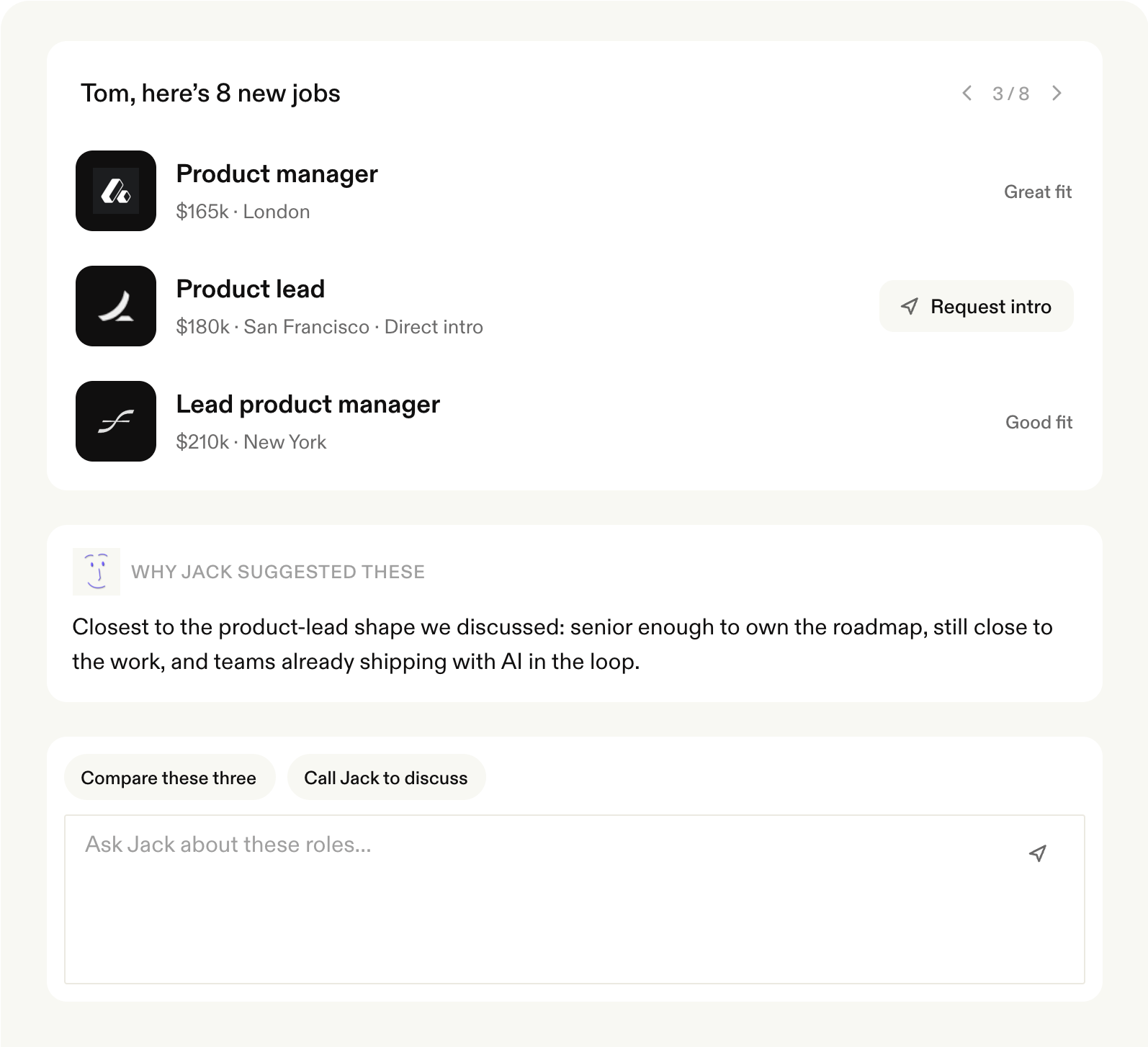
Notice that every role carries a salary and a fit label, and that the explanation refers back to a conversation ("the product-lead shape we discussed"). That is the proprietary data Air Street Capital cited when it led the Series A: preferences and intent that candidates volunteer to Jack and that no scraped profile database contains. It is also the limit of the product. Jill's warm introductions come from people who have talked to Jack, so the network's size and location decide how well Jill can serve any given role.
As of 8 October 2026, Jack & Jill's homepage counter shows 404,759 professionals using Jack and 5,816 companies using Jill - Jack & Jill. Those numbers are self-reported, but they are large enough to matter, and they are concentrated in exactly the three cities where the company operates offices. Why this matters: Jill is not a database you search, it is a network you rent access to, and its pricing is a bet that warm, opted-in introductions are worth more than cold outreach. How to apply this: before you compare prices, check whether your roles sit inside that network (tech, product and go-to-market roles in London, San Francisco or New York are the sweet spot) because the cheapest price is worthless if no introductions arrive.
For a sense of how the founders frame the business, and why they see agents on both sides of the market as the end state, CEO Matt Wilson walked through the model and the Series A in a long interview with Antler, one of the new investors in the round.
Matthew Wilson: Inside Jack & Jill's $40M Series A
The interview is useful context for the pricing changes covered next: the company is spending its new capital on the US, and the US is exactly where it has abandoned the success fee. The next section lays out both price lists side by side.
2. Jack & Jill Pricing in 2026: Two Price Lists
Jack & Jill now runs two pricing models, and the one you see depends on where you are hiring. Its default pricing page, which European visitors see, still says "No subscriptions, no retainers, no upfront fees" and prices Jill at 10% of first-year salary. Its US pricing page says "Start free, and pay for more searches" and sells Jill by the slot. Both pages are live at the same time, and the US page tells visitors "You're seeing US pricing" with a link back to European pricing - Jack & Jill US Pricing. The Platform Terms make the split formal: hirers on a Plan pay a Subscription Fee and owe no Success Fee, while hirers not on a Plan pay a Success Fee when they engage a candidate Jill introduced - Jack & Jill US Platform Terms.
This is a recent change. In December 2025 the pricing page showed a single offer: 10% of base salary, a full refund if the hire left in the first three months, and a "Golden Ticket" promotion that made the first hire free, worth up to £25,000 or $32,000, for VC-backed companies whose investor had unlocked the offer, on candidates introduced before 31 December 2025 - Internet Archive. The US Platform Terms that introduce subscription Plans carry an effective date of 24 August 2026, and a third-party capture dated 28 September 2026 recorded the same US tiers that are live today - TestGorilla.
2.1 UK and Europe: the 10% success fee
In the UK and Europe, Jill costs nothing until you hire, then 10% of first-year salary. The pricing page and its FAQ set out the full offer, and it is simple by recruitment standards: companies pay only after a successful hire signs, there is no exclusivity, no lock-in and no minimum number of hires, and Jack & Jill pitches it against agencies charging 20 to 30% - Jack & Jill Pricing. The Platform Terms specify that the 10% is calculated on first-year base salary, not total compensation, which is a meaningful difference from many agency contracts that charge on salary plus bonus and benefits.
Contractors and pre-existing candidates get their own rules, and both work in the buyer's favour on the face of it. The published terms below come straight from the pricing page; the next section covers the conditions attached to each of them.
- Permanent hires: 10% of first-year salary, charged only when Jill makes a hire
- Contractors and freelancers: 10% of total compensation over 12 months
- Refund guarantee: full refund if the hire leaves or is dismissed in the first 3 months
- Existing conversations: no fee if Jill introduces someone you were already talking to
- Commitment: none, from one role to a hundred
Read together, this is a classic contingency model at roughly half the agency rate. The buyer carries almost no risk before a hire, and the three-month refund is more generous than many agency guarantees, which often refund only part of the fee after the first few weeks (Reed's published terms, covered in section 4, are a typical example). The trade-off is that the fee scales with salary: the more senior the hire, the bigger the cheque, even though Jill's work on a senior role may not be any harder than on a junior one. A team hiring ten people a year at £80,000 pays £80,000 in fees, which is where the subscription logic of the US plan starts to look attractive.
2.2 United States: Meet Jill, Hire Jill and Scale Jill
In the US, Jill is a subscription priced per open role, with no success fee at all. The pricing page offers three tiers. Meet Jill is free: unlimited roles, 20 intro requests a month shared across those roles, Slack integration, and no card details required. Hire Jill costs $199 per slot per month billed annually, or $249 billed monthly, where each slot holds one role at a time and includes Slack and Ashby integrations, public profile search and 50 intro requests a month. Scale Jill is a custom annual agreement with volume pricing on slots and intro requests, invoiced, with dedicated onboarding - Jack & Jill US Pricing.
The unit that matters on the US plans is the intro request, and Jack & Jill defines it precisely: it is asking a candidate whether they want to meet you, the candidate accepts or declines, and only an accepted intro puts you in touch. Strong-fit candidates can also ask to meet you first. The page's FAQ is explicit on the points buyers usually worry about, summarised in the table below.
| US plan question | Jack & Jill's published answer |
|---|---|
| Fee when you hire | None: "Hire as many candidates as you like, the price stays the same" |
| Contractors | Same price for contractor, part-time and fractional hires |
| Cancelling | One click; you keep the paid month and it does not renew |
| Unused intro requests | Do not roll over; the allowance resets monthly |
| Running out | Add a slot or more intro requests in one click |
The page's own agency comparison makes the pitch in one line: an agency charging 20 to 30% would take $24,000 to $36,000 on a $120,000 hire, while one Jill slot costs $249 a month. That framing is fair on price and silent on outcome. A subscription is paid whether or not anyone is hired, so the risk that sat with Jack & Jill under the success fee now sits with you. The candidate card below shows what an intro request looks like from the hiring side.
Jill's candidate card, where intro requests are spent
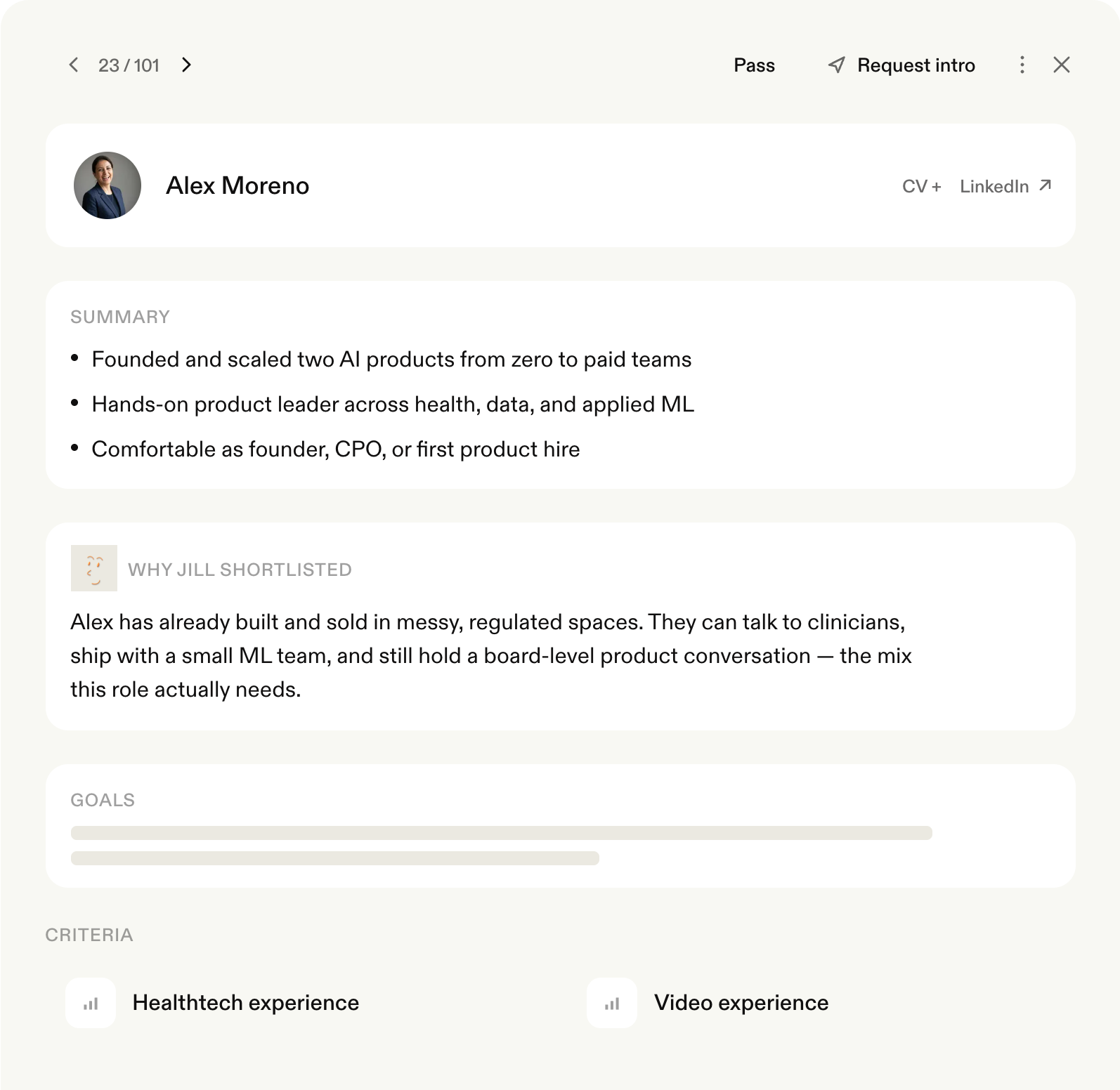
Each "Request intro" click on a card like this spends one unit of your monthly allowance when you send it, and the terms make clear that spent allowance is not restored; the counter at the top of this mock-up ("23 / 101") hints at how many matches Jill surfaces for a role. Why this matters: on the US plan you are buying a monthly budget of asks, not hires, so your cost per hire depends on how selective you are and how often candidates say yes. How to apply this: start on Meet Jill's 20 free requests, track how many accepted intros and interviews they produce for one real role, and only then decide how many paid slots that conversion rate justifies.
3. The Fine Print: What the Platform Terms Add
The headline prices are honest, but the Platform Terms add conditions that change the real cost in specific situations. Jack & Jill publishes separate terms for the two regions: UK and European hirers are governed by Platform Terms effective 1 July 2026, and US hirers by terms effective 24 August 2026 that add Plans on top of the success-fee model - Jack & Jill Platform Terms. Few buyers read them before signing up, because the sign-up flow is self-serve and the pricing page fits on one screen.
That is a mistake, because several clauses matter more than the percentage itself. Some are standard for any contingency recruiter, such as the twelve-month window during which an introduced candidate still triggers a fee. Others are specific to Jill, such as the flat fee for co-founders and equity-only hires, or the rule that lets Jack & Jill move your account between pricing models. The two subsections below cover the clauses that most affect what you pay.
3.1 Success-fee terms (UK, Europe and legacy US accounts)
The success fee reaches further than "10% when you hire" suggests. A fee is owed if you or an affiliate engage an introduced candidate within 12 months of the introduction, even for a different role than the one discussed, and even if you previously rejected that candidate. The refund guarantee covers a hire who resigns, or is dismissed for performance or conduct, within the first three months of their start date. It does not cover dismissals unrelated to performance, such as a redundancy, and you must notify Jack & Jill in writing within 14 days of the departure, with the refund then paid within 30 days - Jack & Jill Platform Terms.
Payment and disclosure terms are strict by startup-tool standards. The terms set out these obligations for hirers on success-fee pricing, and they are the ones most likely to surprise a first-time buyer:
- Invoice timing: issued when the employment contract is signed, payable within 14 days
- Late payment: interest at 8% a year above the Bank of England base rate
- Non-standard hires: a flat £2,500 fee for co-founder, equity-only, unpaid or intern engagements, with no refund
- Pre-existing candidates: exempt only with written evidence within 10 business days of the introduction
Two further obligations apply only on success-fee pricing. You must tell Jack & Jill promptly about any offer you make to an introduced candidate within twelve months, whether or not it is accepted, and disclose their first-year base salary; if you do not, the terms let Jack & Jill invoice you on its own reasonable estimate, which binds unless it is manifestly wrong. That disclosure duty is standard for contingency recruiters, but it is easy to forget when the tool feels like self-serve software rather than an agency.
The pre-existing candidate rule deserves the most attention. The exemption only applies if the candidate applied to you directly, or had substantive two-way communication with you about a role, within the six months before Jill's introduction, and internal notes, database records or unanswered outreach do not count. If you miss the ten-business-day window, the terms deem Jill's introduction the effective cause of the hire. In practice, that means any team running its own sourcing alongside Jill needs to check every introduction against its ATS the day it arrives. The £2,500 flat fee is also worth knowing for early-stage founders, because it applies to exactly the co-founder and equity-heavy hires a pre-seed company is most likely to make through a network like Jack's.
3.2 US plan terms: subscriptions, overage and model changes
On a US Plan, you owe no success fee, but you take on the obligations of a SaaS subscription. Plans renew automatically, are paid in advance in US dollars, and an annual plan is paid for twelve months up front with no refund for unused months. Usage allowances for intro requests and profile views are pooled across your account, reset monthly and never roll over. If you exceed them, Jack & Jill may decline the request or supply it and invoice you in arrears at an Overage Rate that the terms describe as higher than the included rate, though it shows the rate in the product before you pass the allowance - Jack & Jill US Platform Terms.
Three further clauses shape the real risk of a US subscription. First, the terms state that a Plan does not guarantee any number of introductions, interviews or hires, and there is no service level agreement. Second, closing or pausing a role cancels every pending intro request for it, and the spent allowance is not restored. Third, Jack & Jill can move an account between the subscription and success-fee models on 30 days' notice, for example when your hiring moves between regions.
The model-change clause has a practical consequence that is easy to miss. A move onto a Plan applies only to roles opened after the move: roles already live stay on success-fee pricing until you close them, and any candidate introduced under the success fee still carries a fee if you hire them within twelve months. Accounts that accepted an earlier version of the terms also keep their old pricing until they buy a Plan. Why this matters: a US company that signed up for Jill in early 2026 may still be on the 10% model without realising it. How to apply this: check the pricing model shown on your account page (the terms make it the binding record), and if you want subscription pricing, buy a Plan before opening new roles rather than after.
4. What One Hire Really Costs: UK and US Examples
For a single hire, Jill is half the price or less of an agency in Europe and a small fraction of it in the US. Percentages are hard to compare in the abstract, because agencies calculate fees on different salary definitions and offer different guarantees. The two worked examples below use real, published rate cards rather than industry averages, and they show that the gap between Jill and an agency is often larger than the headline "10% versus 20%" suggests.
The salaries in these examples are illustrative, chosen to represent a mid-level engineering or product hire, so substitute your own numbers. The fee rules, rates and guarantees are taken directly from each provider's published terms as of October 2026. Both examples assume the hire stays past every guarantee period, which is the outcome you are planning for.
4.1 A UK hire at £70,000 base salary
On a £70,000 hire with a £7,000 bonus, Jill's fee is £7,000, while a large UK agency's published rate card puts the fee between £16,940 and £20,790. Jill charges 10% of first-year base salary, so the bonus is excluded and the fee is £7,000 plus VAT. Reed, one of the UK's largest agencies, publishes its Employment Agency Terms of Business: a permanent introduction fee of 22% on its Standard service, 25% on Advanced and 27% on Premium, calculated on total first-year gross remuneration including commission, bonuses and benefits, with a minimum fee of £2,000 - Reed Terms of Business.
On the same hire, Reed's Standard fee is 22% of £77,000, or £16,940, and its Premium fee is 27% of £77,000, or £20,790. The salary definition alone adds £1,540 to the Standard fee, because Reed counts the bonus in the fee base. The guarantees diverge just as sharply, which matters because a refund is the only protection against a bad hire.
| Provider and tier | Fee on £70,000 base + £7,000 bonus | Guarantee |
|---|---|---|
| Jill (UK/EU) | £7,000 (10% of base) | Full refund for 3 months |
| Reed Standard | £16,940 (22% of total) | 100% for 2 weeks, 50% to 8 weeks |
| Reed Advanced | £19,250 (25% of total) | 100% for 4 weeks, 50% to 12 weeks |
| Reed Premium | £20,790 (27% of total) | 100% for 6 weeks, 50% to 26 weeks |
The table understates Jill's advantage on risk. Its full refund runs for roughly thirteen weeks, while Reed's Standard tier refunds the whole fee only if the hire leaves in the first two weeks, and only half after that. The honest counterweight is service: an agency recruiter screens, sells the role and manages the offer, while Jill introduces opted-in candidates and leaves the interviewing and closing to you. If you have no one to run that process, the comparison is not like for like.
4.2 A US hire at $150,000 base salary
In the US, the same hire costs between a few hundred dollars and $37,500 depending on the model. If Jill fills a $150,000 role from a monthly Hire Jill slot within three months, the total cost is three months at $249, or $747. Under the success-fee model Jill uses in Europe, the same hire would cost $15,000. Paraform's recruiter marketplace typically charges 20 to 25% of first-year salary, or $30,000 to $37,500 on this role - Jack & Jill vs Paraform. Reval, the pay-on-hire recruiter whose site now points customers to Metaview's fillmore agent, charges from $50 to start a search plus 10% of base salary on hire, or $15,050 - Reval.
The chart below puts these models on one axis for a single $150,000 hire. The agency bar uses 25%, the middle of the 20 to 30% range Jack & Jill itself quotes; the Dover bar uses the top of the $2,000 to $8,000 per-hire range Dover publishes for its fractional recruiters - Dover.
What One $150,000 Hire Costs Under Each Pricing Model
The bars make the strategic point obvious: Jill's US subscription prices the role, not the hire, and that collapses the cost of a successful search by an order of magnitude. A single 10% fee on this hire would pay for sixty months of a monthly Hire Jill slot. The catch is that the $747 bar assumes the search succeeds. If Jill's network produces no hire after six months, you have spent $1,494 and still have an open role, whereas the success-fee models would have cost nothing. Why this matters: the subscription is a bet on Jill's hit rate for your specific roles, and the success fee is insurance against a miss, priced at about $14,000 on this role. How to apply this: use the subscription for roles squarely inside Jack's network, and keep a success-fee or agency option for hard-to-fill roles where the risk of a long, empty search is real.
HeroHunt.ai
If Jill's per-role subscription appeals but you are hiring for several roles at once, or for roles outside Jack's network, HeroHunt.ai prices differently: plans start at $99 a month with unlimited positions and searches, metered on AI-screened and matched profiles delivered and candidate emails found (2,000 profiles and 500 emails a month on Starter), with no fee when you hire. Hire Jill, by comparison, charges $199 to $249 for every role you keep open. The honest caveat: HeroHunt.ai sources and contacts candidates on your behalf with automated, personalised outreach, so you get cold outreach at scale rather than Jill's warm introductions to people who have already asked for roles like yours, and the 8-day trial requires a card.
5. Where Jill Wins and Where It Falls Short
Jill wins on price and candidate intent, and falls short on coverage, transparency and evidence. The pricing makes Jill an easy product to try, especially in the US where Meet Jill costs nothing. What the price cannot tell you is whether Jill will produce hires for your roles, and on that question the public evidence is thinner than the company's growth numbers suggest.
This section weighs both sides, because a cheap tool that does not fill your roles is more expensive than an agency that does. The strengths are structural and hard for competitors to copy. The weaknesses are mostly a function of the company's age and focus, and several of them can be tested cheaply before you commit.
5.1 Where Jill wins
Jill's biggest advantage is that its candidates have already opted in. Every candidate Jill introduces has talked to Jack about what they want, including salary expectations, and an intro only goes through when the candidate accepts it. That double opt-in is the opposite of cold outreach, which Jack & Jill's own docs contrast with the single-digit response rates of LinkedIn InMail - Jack & Jill Docs. It also explains how the company can arrange thousands of interviews a month. Customers named in the Series A announcement include Ramp, Attio, Multiverse, Maze and Corgi.
The commercial terms are also buyer-friendly in ways that matter, and they compare well with both of the models Jill competes against. Agencies usually want exclusivity on a search and charge on total compensation, while sourcing software usually wants an annual contract before you see results. Four advantages stand out:
- Half the agency rate in Europe, calculated on base salary only
- A full three-month refund, longer than most agency guarantees
- No exclusivity or minimums, so Jill can run alongside other channels
- A free US tier with 20 intro requests a month and no card required
Taken together, these make Jill close to risk-free to test. A European company pays nothing unless a hire happens and gets its money back if that hire leaves early, and a US company can run a real role through Meet Jill without entering a card. That combination is rare in recruiting, where agencies want exclusivity and software vendors want annual contracts. For startups hiring product, engineering and go-to-market roles in the three cities Jack & Jill covers, it is a strong default to add to the mix.
5.2 Where Jill falls short
The main weakness is coverage: Jill can only introduce people who are in Jack's network, and that network is concentrated. The company's traction is centred on London, San Francisco and New York, and its own docs explain that candidates found through public profile search come without a warm introduction, which means you contact them yourself like any sourcing tool - Jack & Jill Docs. A specialist role in a smaller market, or a senior role where the right people are not job hunting, may see few introductions.
Independent evidence is also limited. Jack & Jill does not publish placement or hire rates, and a competitor's review in October 2026 found no G2 or Capterra reviews of the product at all - TestGorilla. On Trustpilot the company scores 3.8 out of 5 from about 223 reviews, almost all from job seekers, with 20% one-star ratings and one candidate writing in October 2026 that in ten months they had never been offered a Jill job - Trustpilot. The Platform Terms add their own caveats: Jill "may occasionally hallucinate", and Jack & Jill does no background, reference or right-to-work checks on the candidates it introduces.
None of this means Jill does not work; the growth figures suggest it works well for many companies. It means the burden of proof sits with your own pilot. Why this matters: on a US subscription, a weak hit rate turns a cheap tool into wasted spend, and in Europe a fee still lands on any hire within twelve months of an introduction. How to apply this: run one representative role for a month, count accepted intros and first interviews, and compare that against what your current channels produce for the same role before adding slots or relying on Jill for critical hires.
6. The 7 Best Jack & Jill Alternatives in 2026
The right alternative depends on which of Jill's two models you are comparing against. If you like the European success fee, the closest alternatives are other pay-on-hire options, from agencies to marketplaces to fillmore. If you like the US subscription, the closest alternatives are AI sourcing tools that charge a flat monthly price. The seven below cover both camps, ranked by how closely they match what a Jill buyer is actually trying to do, with HeroHunt.ai listed last as our own product.
Every price below was checked on the vendor's own pricing page or published terms on 8 October 2026, except where a vendor publishes no price, in which case the source of the estimate is named. For a wider view of the market, including tools outside this shortlist, our recruiting software pricing index covers 40 tools and the metering unit behind each bill. Why this matters: comparing Jill's 10% against a $99 seat is meaningless unless you compare the same unit, cost per hire, under the same assumptions. How to apply this: for each option below, estimate how many hires it would produce for you in a year and divide its annual cost by that number before you compare.
6.1 Traditional contingency agencies: the baseline Jill undercuts
Agencies remain the most expensive option per hire, and the most complete service. A contingency agency sources, screens, sells the role to candidates, manages interviews and negotiates the offer, and is paid only on a hire. In the UK, published rate cards such as Reed's sit between 22% and 27% of total first-year remuneration with sliding guarantees, as shown in the worked example above. In the US, Jack & Jill's own pricing page puts agency fees at 20 to 30% of first-year salary, and fractional-recruiting provider Dover cites a similar contingency band of 15 to 30% - Dover.
The case for an agency over Jill is labour. Jill introduces candidates who have opted in; an agency recruiter also persuades passive candidates who never would have, and handles the parts of hiring a busy founder hates. The case against is cost and alignment: at 25% of a $150,000 salary, one hire costs $37,500, and agencies are paid for speed of placement rather than for retention. Best for: senior, confidential or genuinely hard-to-fill roles where you need a human to run the whole search and the fee is small next to the cost of the seat staying empty.
6.2 Paraform: the recruiter marketplace
Paraform is the marketplace version of an agency: many independent recruiters compete on your role, and you pay mostly on a hire. It describes itself as an agentic hiring platform where expert recruiters and AI systems collaborate, and announced a Series B led by Scale Venture Partners in March 2026 that brought total funding to $65 million - Paraform. Its homepage claims more than 10,000 expert recruiters and 1,000 client companies, and quotes customers including Palantir and Hightouch.
Paraform publishes no price list. Reported fees are typically 20 to 25% of first-year salary, with an alternative fixed-bounty model and an upfront listing fee whose amount is not public, as covered in detail in our Paraform pricing guide. That makes Paraform roughly twice Jill's European fee and dozens of times the cost of a Hire Jill slot for a single hire. The upside is reach: a specialist recruiter with a network in your niche can fill roles that are nowhere near Jack's network. A close rival, Contrario, runs a similar recruiters-plus-AI-agents model priced as a subscription plus roughly 25% of first-year salary per hire - Contrario. Best for: US startups filling a handful of critical technical roles where speed matters more than the fee.
6.3 Metaview fillmore: the closest like-for-like to Jill's 10%
fillmore is the alternative most similar to Jill's European model: an autonomous agent sold on "only pay when you hire". Metaview's fillmore sources candidates, writes every outreach message from scratch across email, LinkedIn and WhatsApp, follows up and books screening calls, all from a Slack brief - Metaview fillmore. Metaview publishes no fillmore price, but in August 2026 it acquired Reval, an AI-native recruiting firm, to accelerate fillmore - Metaview. Reval charged from $50 to kick off a search plus 10% of base salary on hire, with a 90-day money-back guarantee if the hire leaves or is terminated with cause - Reval.
The difference from Jill is where candidates come from. fillmore runs cold outbound to people who may not be looking, while Jill introduces people who have already told Jack they want a move. That makes fillmore better for passive, senior or niche talent, and Jill better for responsive candidates in its core cities. If you prefer a subscription, Metaview also sells a Sourcing agent at $100 or $300 per user per month - Metaview Pricing. We cover fillmore's likely cost in our Metaview pricing guide. Best for: teams that want Jill's pay-on-hire economics but need to reach passive candidates outside Jack's network.
6.4 Dover: the fractional recruiter middle ground
Dover sits between Jill and an agency: a human recruiter who bills by the hour, plus a free ATS. Its pricing page offers a free ATS with unlimited users and jobs, a Premium ATS at $199 a month, and a marketplace of startup recruiters who set their own hourly rates - Dover Pricing. Dover publishes a table of real hires and their total cost to the company, with examples ranging from about $1,400 to $8,600 per hire, and positions the model at $2,000 to $8,000 per hire against 15 to 30% contingency fees.
That makes Dover more expensive per hire than a Hire Jill slot and far cheaper than Jill's 10% fee on most salaries, with the difference that you get a person running the search. The risk profile is different too: hourly billing means you pay for time even if a search fails, which is closer to Jill's US subscription than to its European success fee. Best for: seed and Series A startups that need recruiting labour, not just introductions, and want to see the cost of every hire before they commit.
6.5 Juicebox Agents: the per-role sourcing agent
Juicebox is the closest software analogue to a Hire Jill slot: an autonomous agent you assign to one role for a flat monthly fee. Its pricing page lists Starter at $99 per seat per month on yearly billing ($119 monthly), Growth at $179 yearly ($199 monthly), a custom Business plan, and Juicebox Agents at $199 per agent per month as an add-on to any paid plan - Juicebox Pricing. Each agent runs continuously against a role, sources and ranks candidates and can auto-email or auto-shortlist them, with unlimited contact and email credits for agent work.
On sticker price, one Juicebox Starter seat plus one agent costs about half as much again per role as a Hire Jill slot: $298 a month on yearly billing against Jill's $199. The difference is the candidate pool and the channel. Juicebox searches public professional data and runs cold outreach, so it can reach anyone, while Jill introduces opted-in candidates but only from its own network. Our Juicebox pricing guide covers the credit limits behind each tier. Best for: in-house recruiters who want an agent per role across any market and are comfortable running outreach themselves.
6.6 Pin: the low-cost AI recruiter with a free plan
Pin is a self-serve AI recruiter whose entry price undercuts a Jill slot, with a free plan to test on. Its pricing page lists a Free plan with one position, one AI agent and five contact lookups a week; Solo at $99 per user per month, billed annually only, with unlimited positions, two agents and 500 contact credits; Professional at $135 annually or $179 monthly per user with 1,000 credits per seat; and a custom Business plan - Pin Pricing. Pin also offers automated outreach, interview scheduling and an MCP server for driving it from Claude or ChatGPT.
Because Pin prices per user with unlimited positions, a recruiter working five roles pays the same as one working one, which is where it beats Jill's per-slot model for multi-role hiring. As with Juicebox, the trade-off is cold outreach rather than warm introductions, and Pin is a young company whose traction figures are largely self-reported, as our Pin pricing guide details. Best for: solo recruiters and small teams hiring across several roles who want a published price and a free plan to start.
6.7 HeroHunt.ai: flat-rate AI sourcing with unlimited positions
HeroHunt.ai is an AI Recruiter that sources, screens and contacts candidates for a flat monthly price, with no fee per hire and no charge per open role. It searches up to 1 billion profiles across platforms, screens candidates with current GPT and Claude models, and runs personalised outreach automatically, alongside RecruitGPT, which builds a candidate shortlist from a single prompt. Plans start at $99 a month with unlimited positions and searches, metered on AI-screened and matched profiles delivered and candidate emails found, and the Team plan shares one pool across 3 users - HeroHunt.ai Plans.
Against Jill, the difference is the same as for the other sourcing tools: HeroHunt.ai reaches candidates wherever they are, including people who have never heard of Jack, but it reaches them with outreach rather than an opted-in introduction, so response rates depend on your message and your role. Against Jill's US pricing, the unlimited-positions model matters most for teams with several open roles, since adding a role costs nothing extra. It is our own product, so weigh this entry accordingly and test it on the 8-day trial (card required) at uwi.herohunt.ai. Best for: teams hiring for many roles or outside Jack's core cities who want to own their pipeline at a predictable monthly cost.
7. Full Comparison: Every Pricing Model Side by Side
The market splits into two pricing worlds, and Jill now has a foot in each. On one side are pay-on-hire models (agencies, Paraform, fillmore and Jill's European fee) that cost nothing until a hire and then charge a percentage of salary. On the other are subscriptions (Jill's US plans, Juicebox, Pin, HeroHunt.ai, LinkedIn) that charge a fixed monthly price whether or not anyone is hired. Dover's hourly model sits in between.
The table below summarises every option covered in this guide, including LinkedIn's Hiring Assistant, the incumbent most enterprise teams compare against. LinkedIn publishes no US price for it, but its UK government G-Cloud price list sets a Recruiter seat at £8,925 a year for one or two licences, and listed the Hiring Assistant add-on from £2,079 per licence a year under a launch promotion that ran to June 2026 - UK Digital Marketplace.
| Option | Pricing model | Published price (October 2026) | You pay if no one is hired? |
|---|---|---|---|
| Jill, UK/EU | Success fee | 10% of first-year base salary | No |
| Jill, US | Per-role subscription | $0 Meet Jill; $199 to $249 per slot a month | Yes (paid plans) |
| Contingency agency | Success fee | 20 to 30% of first-year salary | No |
| Paraform | Success fee or bounty | 20 to 25% reported; no price list | No (listing fee aside) |
| fillmore (Reval terms) | Kickoff + success fee | $50 + 10% of base salary | Only the kickoff |
| Dover | Hourly recruiter + ATS | $2,000 to $8,000 per hire published | Yes (hours worked) |
| Juicebox | Seat + agent subscription | $99 to $199 a seat, agents $199 each | Yes |
| Pin | Per-user subscription | $0, $99, $135 to $179 a user | Yes (paid plans) |
| HeroHunt.ai | Per-plan subscription | From $99 a month, unlimited positions | Yes |
| LinkedIn Hiring Assistant | Seat + add-on, annual | £8,925 seat + from £2,079 add-on a year (UK list, launch promo) | Yes |
Why this matters: the final column is the one that should drive your decision, because it tells you who carries the risk of a failed search. Pay-on-hire models are expensive when they work and free when they do not; subscriptions are cheap when they work and wasted when they do not. The chart below compares the entry monthly price of the subscription options for working one role on monthly billing, which is the fairest like-for-like view of Jill's US plan.
Entry Monthly Price to Work One Role (Monthly Billing)
Read the chart with two caveats. First, the tools on it do different jobs: Hire Jill delivers opted-in introductions from its network, while the others source and contact candidates from public data, so a lower price buys a different kind of pipeline rather than the same one for less. Second, the per-role cost of the per-user and per-plan tools falls as you add roles, because Pin, Metaview and HeroHunt.ai charge the same whether you work one role or ten, while a second Jill role is a second slot. For a team with five open roles, Jill's US plan costs $1,245 a month on monthly billing; the per-user tools stay at their single price. How to apply this: multiply each tool's price by the number of roles or users you will actually run at once before comparing. Our deeper breakdown of seat versus per-hire pricing models walks through when each model wins at different hiring volumes.
8. How to Choose Between Jill and the Alternatives
Choose by two questions: who will do the work, and how much risk you want to carry on each search. This matters because the most common mistake with cheap AI recruiting tools is buying introductions without the capacity to act on them. If nobody in-house has time to run interviews and close candidates, a product that only introduces candidates will stall, however cheap it is, and you need a service that includes labour. If you have that capacity, the question becomes whether you want to pay per hire (low risk, high cost) or per month (high risk, low cost), and whether your roles sit inside Jack's network.
The decision tree below turns those questions into a recommendation. It starts from the labour question, because that is the one buyers most often skip, then splits by region and risk appetite.
Follow the branch that matches your situation and the choice is usually clear. The left side of the tree is where Jill is weakest, because Jill does not run your interview loop or sell the role; teams without recruiting capacity get more from an agency, Paraform or a Dover recruiter despite the higher price. The right side is where Jill is strongest, provided the roles sit inside its network: a European team pays 10% only on success, and a US team can test for free before buying slots. For the bottom-right branch (many roles, niche roles or markets outside London, San Francisco and New York) a flat-rate sourcing tool or fillmore's outbound agent reaches candidates Jill's network cannot.
How to apply this in practice: most teams should not pick one option. A sensible stack for a growing startup is Jill for roles in its sweet spot, a flat-rate sourcing tool for everything else, and an agency held in reserve for the one or two searches a year that justify its fee. Whatever you choose, record the source of every hire in your ATS, so that after a quarter you can compare cost per hire across channels with real numbers rather than vendor claims. For a broader ranking of agent-based options, see our guide to the best autonomous AI recruiters.
9. The Bottom Line
Jack & Jill's pricing is genuinely cheap, but "10%" is only true in the UK and Europe. There, Jill charges 10% of first-year base salary on success with a full three-month refund, less than half of what a published UK agency rate card charges once bonuses are counted. In the US, Jill has replaced the fee with a subscription: Meet Jill is free with 20 intro requests a month, and Hire Jill costs $199 to $249 per role per month with no fee on hires. For a single successful US hire, that makes Jill one of the cheapest options on the market by a wide margin.
Why this matters: the decision framework follows from the risk each model puts on you, not from the headline price. How to apply this: if you hire in Europe and Jack's network covers your roles, Jill's success fee is close to risk-free and should be in your mix. If you hire in the US, start on Meet Jill, measure accepted intros for a real role, and only buy slots once you have seen the conversion. If your roles fall outside Jack's network, or you have many roles open at once, compare a flat-rate sourcing tool such as HeroHunt.ai, Juicebox or Pin, where adding a role costs nothing extra. And if no one on your team can run the process, pay for an agency, Paraform or a Dover recruiter, because the cheapest introduction is worthless without someone to turn it into a hire.
Finally, read the terms that apply to your account before you hire anyone. The twelve-month fee window, the ten-day deadline for claiming pre-existing candidates, the £2,500 flat fee for co-founder hires and the rule that keeps live roles on success-fee pricing after a move to a Plan can each change your bill by thousands, and none of them appear on the pricing page.
AI sourcing, screening and outreach for a flat monthly price with unlimited positions, and no fee when you hire.
This guide reflects Jack & Jill's published pricing pages and Platform Terms as checked on 8 October 2026 (US terms effective 24 August 2026, UK and European terms effective 1 July 2026), and each alternative's published prices on the same date. Jack & Jill changed its pricing model in 2026 and its terms allow further changes on 30 days' notice, so verify current terms with each vendor before purchasing.