



The 2026 buyer's guide to the AI that reads applications, runs first-round screens and decides who a recruiter actually sees
Applications per recruiter rose 411.8% between 2022 and 2025, from 146 to 746 a year. That is the finding of Greenhouse's March 2026 benchmark across more than 6,000 organizations and 640 million applications, and it is the single best explanation of why AI candidate screening software went from optional to unavoidable in under three years - Greenhouse Benchmark Report. Over the same period the number of recruiters per organization fell by 55.6%. No team reads five times the volume with half the people.
But here is the problem: screening is where AI stops assisting and starts deciding. A sourcing tool that misses someone costs you a candidate. A screening tool that misjudges someone rejects a real person, often without a human ever looking, and that is exactly the conduct now being litigated in Mobley v. Workday and a 2026 consumer-reporting class action against Eightfold AI. Candidates have noticed too: only 8% of job seekers believe AI makes hiring fairer - Greenhouse.
The short answer to "which tool is best" is that there is no single best, because "AI candidate screening" now covers five different products. If you run Workday, HiredScore is the default for grading applicants. If you are a mid-market team on a modern ATS, the screening built into Greenhouse, Ashby or Workable will beat any bolt-on. For frontline volume, Paradox and Sapia.ai lead. For defensible structured interviews at enterprise scale, HireVue. For skills evidence with a published price, TestGorilla. And if your problem is that the right people never apply at all, you need screening on the outbound side, which is where tools like HeroHunt.ai sit.
This guide compares the 10 strongest AI screening tools of 2026 with real pricing (and an honest "not published" where there is none), shows how each one actually scores a candidate, reviews the evidence on whether AI screening works, maps the failure modes and the 2026 legal landscape, and ends with a decision framework and a pilot plan you can run in six weeks.
Contents
- What AI Candidate Screening Software Actually Does in 2026
- Why Screening Became the Bottleneck
- How These 10 Were Chosen
- The 10 Best AI Candidate Screening Tools in 2026
- Side-by-Side Comparison
- What AI Screening Actually Costs
- Does AI Screening Work? The Evidence
- Where AI Screening Fails
- The 2026 Legal Map for Automated Screening
- How AI Agents Are Rewiring Screening
- How to Choose, Pilot and Deploy
- The Bottom Line
1. What AI Candidate Screening Software Actually Does in 2026
AI candidate screening software is any system that evaluates a candidate against a job before a human does, and in 2026 it comes in five distinct layers. Buyers who treat it as one category end up comparing a resume grader with a voice interviewer and wondering why the prices differ by a factor of fifty. The useful question is not "which AI screener" but "which decision in my funnel do I want a machine to make, and how much of it".
The five layers map onto the stages a candidate passes through. Application ranking reads resumes and application answers and grades or sorts them against the job. Conversational screening asks knockout and qualification questions by chat or text. AI interviews run a structured spoken or written interview and score the answers against a rubric. Skills assessments test what someone can actually do. And outbound profile screening evaluates people who never applied, typically profiles found by a sourcing search, before anyone contacts them. Each layer produces a different artefact, carries a different legal risk and is priced on a different unit.
The diagram below shows where each layer sits. Note the two entry points: most screening software only ever sees inbound applicants, while outbound screening judges a pool you chose to search.
The most important distinction inside every layer is whether the software ranks or decides. A ranking tool sorts candidates and leaves every advance or reject to a human. A deciding tool auto-advances or auto-rejects on its own output. The difference matters commercially and legally. In a 2024 survey of 948 US business leaders, 82% of companies using AI in hiring used it to review resumes, and 21% let it reject candidates at any stage with no human review - Resume Builder. The data is from October 2024, but it is still the best published measure of how often the "decide" switch is flipped.
The second distinction is how the output is expressed, because that decides how explainable a rejection is. In 2026 the major products have converged on five formats:
- Letter grades such as the A and B grades HiredScore shows in Workday
- Per-criterion verdicts such as Ashby's "Meets" or "Does not meet" against each requirement
- Match tiers such as Greenhouse's Strong, Good, Partial and Limited match
- Numeric scores such as Workable's 0 to 100 against an ideal candidate profile
- Rubric scorecards from interviews, such as HireVue's 1 to 5 skill ratings
These formats are not cosmetic. A per-criterion verdict tells a rejected candidate, an auditor and a hiring manager exactly which requirement was missed, while a single number or grade compresses the reasoning into something that is easy to sort and hard to defend. Why this matters: the output format decides whether you can defend a decision later. If you expect to be asked "why was this person rejected", which under the new California, Colorado and EU rules you increasingly will be, favour tools whose output is a list of reasons rather than a score. How to apply this: before any demo, write down which layer you are buying for, whether you want it to rank or decide, and what explanation you need to be able to give a rejected candidate. Those three answers eliminate most of the market before you spend an hour on a sales call.
2. Why Screening Became the Bottleneck
Screening broke because application volume grew several times faster than recruiting capacity, and AI on the candidate side made each application less informative. Both halves of that sentence matter. Volume alone could be handled by hiring more recruiters. Volume combined with applications that all look polished, keyword-matched and increasingly machine-written is a different problem, because it destroys the signal that human screeners relied on.
The volume data is now consistent across every large dataset. Greenhouse's platform shows applications per job rising from roughly 115 to 244 between 2022 and 2025, applications per hire up 157.7%, and recruiters per organization down 55.6% - Greenhouse Benchmark Report. LinkedIn's January 2026 research found US applicants per open role have doubled since spring 2022 - HR Dive. The chart below plots the Greenhouse changes side by side.
How the Screening Load Changed, 2022 to 2025
The shape of that chart is the business case for every product in this guide. The per-recruiter bar is so much taller than the per-job bar because two forces compound: more applications per role and fewer people to read them. Interestingly, Greenhouse also found monthly hires per recruiter rose 122.3% over the same period, which suggests recruiters adapted by triaging harder rather than reading more, and triage is precisely what AI screening automates.
Ashby's 2026 Talent Trends data, covering more than 109 million applications on its platform, shows the same pressure from a different angle. Applications per hire climbed from 121 in Q1 2021 to a peak of 319 in Q4 2024 and stood at 291 in Q1 2026 - Ashby. The consequence for candidates is visible in the share of applications that get an interview at all.
Candidates are roughly 50% less likely to receive an interview today
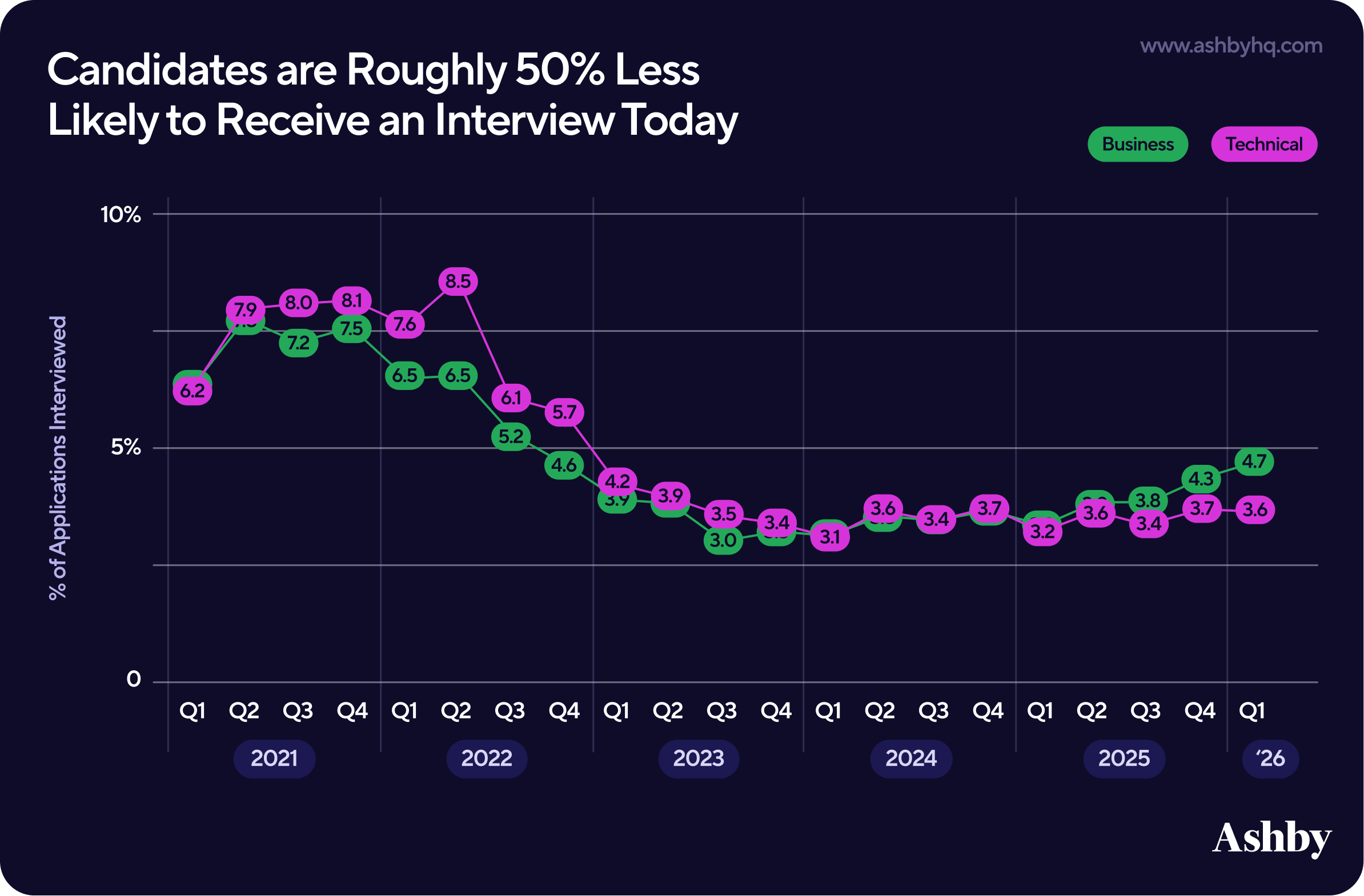
The interview rate fell from 7% to 8% of applications in 2021 to 3.6% for technical roles and 4.7% for business roles by early 2026. Put plainly, more than 95 of every 100 applicants are now screened out before speaking to anyone, which means the screening decision, not the interview, is where most hiring outcomes are actually determined. That is why the quality of the screen deserves at least as much scrutiny as the quality of your interview process.
The second force is AI on the candidate side. Greenhouse's November 2025 survey of 4,136 job seekers and hiring professionals across the US, UK, Ireland and Germany found that 41% of US job seekers admit to using prompt injections, meaning hidden text designed to manipulate AI filters, and 65% of hiring managers have caught applicants using AI deceptively - Greenhouse. Measured rates are lower than admitted ones: ManpowerGroup detects hidden text in around 10% of resumes it scans with AI, while Greenhouse estimates about 1% - Built In. Gartner goes further and predicts that by 2028 one in four candidate profiles will be fake - HR Dive.
Three practical consequences follow from these numbers, and they shape what good screening software must do in 2026:
- Keyword matching is dead because AI-written resumes match every keyword by default
- Fraud detection is now table stakes inside the screening step, not a separate tool
- Evidence beats documents, so interviews and work samples move earlier in the funnel
- Explainability is mandatory because rejection volumes make challenges inevitable
Each of those points shows up in the product roadmaps below. Greenhouse and Ashby both bundled fraud detection into their screening layers in 2025, HireVue, Eightfold and Greenhouse all moved structured AI interviews to the very top of the funnel, and the strongest application-ranking tools now show per-criterion reasoning instead of a bare score. Why this matters: a tool built in 2022 around parsing and keyword scoring is solving a problem that no longer exists. How to apply this: ask every vendor what their screen does with an AI-written resume that matches every requirement on paper, and how they detect hidden text, fabricated experience and proxy interviewees. Vague answers are disqualifying. If the volume problem is the part that hurts most in your own funnel, our guide to the best AI candidate interviewers goes deeper on the interview layer specifically.
3. How These 10 Were Chosen
The ten tools below were selected on five criteria, and a tool had to clear at least four to make the list. The criteria were chosen to reflect what actually separates a defensible screening deployment from an expensive liability, rather than feature counts or analyst-quadrant position, which mostly measure marketing budgets.
The first criterion was 2025-2026 product currency: each tool had to ship a material screening capability between mid-2025 and October 2026, because anything older predates the AI-written application problem described above. The second was how the decision is made: we favoured tools that show reasoning and keep a human in control of rejections by default. The third was price transparency, either a published price or reliable transaction data. The fourth was evidence, meaning validation studies, independent bias audits or named customer outcomes. The fifth was market weight: whether the tool is used at enough scale that its behaviour actually shapes how candidates are screened.
The list is ordered by funnel layer, starting with application ranking and ending with outbound screening, not by an overall score. A ranking across layers would be meaningless: HireVue and TestGorilla are not competing for the same budget line, and a frontline retailer and a 60-person software company should not be reading the same "number one". Several strong products were cut, mostly because they are either covered better in a dedicated guide or not current enough; section 4.11 explains each cut so you can judge whether our reasoning applies to you.
Why this matters: these criteria are the same ones a regulator, a plaintiff's lawyer or a sceptical hiring manager will apply to your deployment, so a tool that fails them is a liability however good its demo looks. How to apply this: score your own shortlist against the same five criteria before any vendor call, and drop anything that cannot show its reasoning or its evidence.
One disclosure belongs here rather than in a footnote. HeroHunt.ai is on this list, in the outbound screening layer, and it is our own product. It is included because outbound profile screening is a genuine layer with few alternatives, and it is assessed with the same caveats as everything else. Where it is the wrong choice, the guide says so.
4. The 10 Best AI Candidate Screening Tools in 2026
The ten tools below cover every layer of the screening funnel, and the right pick depends far more on your ATS, your hiring volume and your role mix than on any feature list. Each profile explains what the tool actually does at the screening step, what changed in 2025-2026, what it costs (or what the best available evidence suggests it costs), where it is strong, where it fails, and who should buy it.
Why this matters: the same tool can be the best choice for one team and a waste of money for another, so the profiles are written to help you rule tools out quickly. How to apply this: read the sections for the layers you identified in section 1 and skip the rest. If you run Workday, start with 4.1 and 4.6. If you are on Greenhouse, Ashby or Workable, start with your own ATS in 4.3 to 4.5 before evaluating anything standalone, because native screening has quietly become good enough that a bolt-on rarely earns its integration cost.
4.1 Workday HiredScore (Recruiting Agent)
HiredScore is the most widely deployed application grader in the enterprise, because it ships inside Workday Recruiting. Workday acquired HiredScore in 2024 and now sells it as "HiredScore AI for Recruiting", which grades every applicant against the requisition with what Workday calls "unbiased, AI-driven candidate grading" and surfaces the top-graded candidates in a "Spotlight" inbox for recruiters - Workday. In practice that means the first thing a recruiter sees on a busy requisition is no longer the newest application but the highest-graded one, which changes daily behaviour more than any dashboard does.
The screenshot below, from Workday's own product page, shows what a recruiter actually sees: an applicant list for a single requisition, graded by letter in the "HS" column, with the pipeline stages across the top.
HiredScore grading inside Workday Recruiting
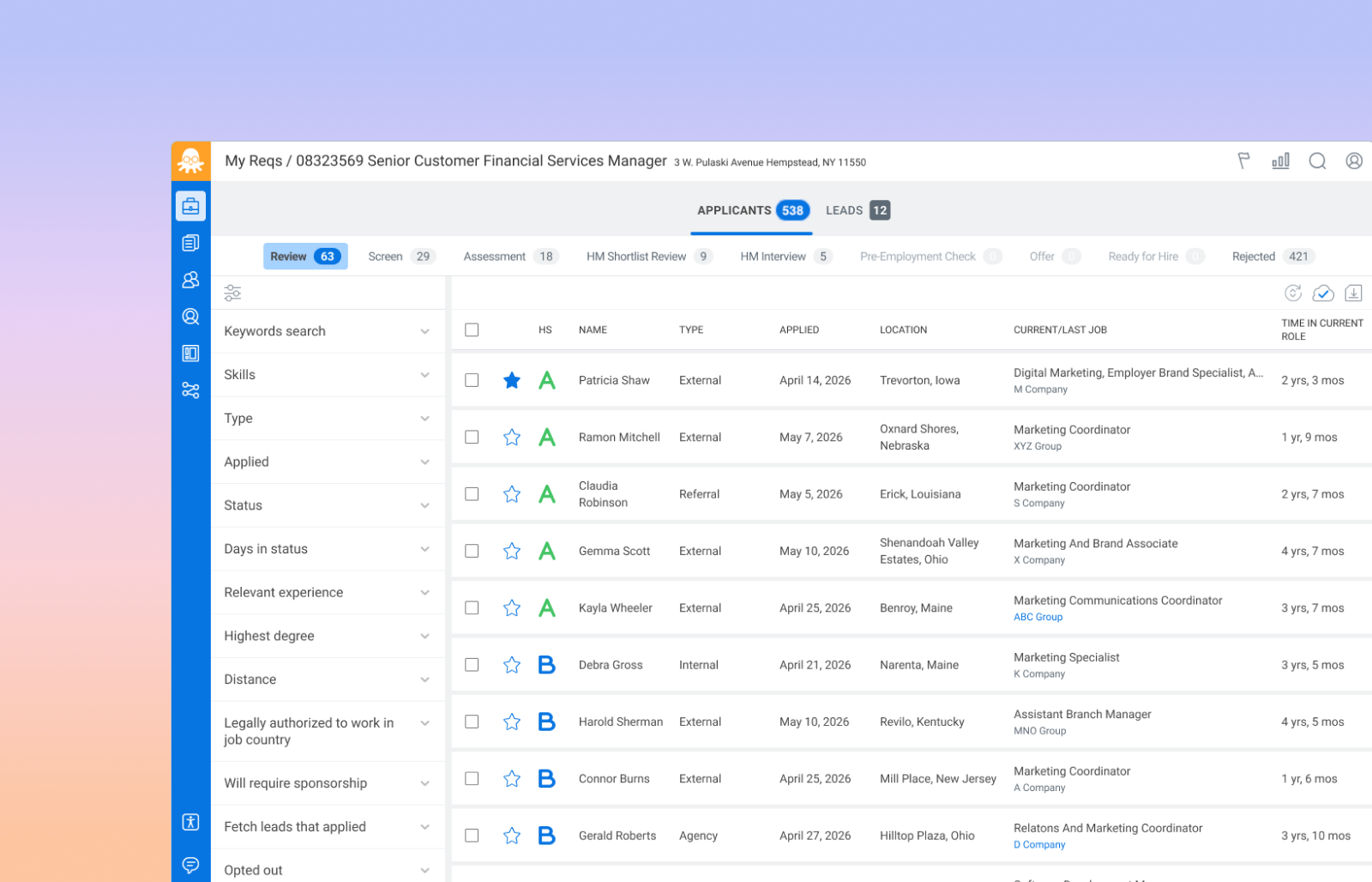
Look at the numbers in the tab bar: 538 applicants, 63 in review and 421 already rejected. That ratio is the reality of enterprise inbound screening, and it is why grading matters. On the same product page Workday claims a 54% increase in recruiter capacity within 10 months of launch and 35% faster hiring manager reviews. Those are vendor figures with no named customer attached, so treat them as directional.
Pricing is not published anywhere, because HiredScore is sold as part of a Workday contract rather than as a standalone line. For context only, Vendr's transaction data puts the median Workday buyer at $51,600 a year across 373 purchases, a figure for Workday overall rather than for HiredScore - Vendr. Our HiredScore pricing breakdown covers the standalone history.
The strength is integration: grades sit where recruiters already work, there is no second system to reconcile, and the Spotlight inbox changes daily behaviour without training. The weakness is legal exposure. On 29 July 2025 the court in Mobley v. Workday ruled that the age-discrimination collective includes applicants "scored, sorted, ranked, or screened" by HiredScore's AI features, and directed Workday to produce a list of customers who enabled them - court order. That does not mean the tool discriminates, a question the case has not decided, but it does mean any HiredScore deployment should run with documented adverse-impact monitoring.
Best for: enterprises already on Workday Recruiting that want grading in the system of record and have the compliance function to monitor it.
4.2 Eightfold AI
Eightfold is a talent intelligence platform first and a screener second, and its screening is strongest when you want one model across external applicants, internal mobility and rediscovery of past candidates. Its match scoring compares candidates to roles using a model trained on career trajectories, and its April 2026 release claimed 1.6 billion career trajectories behind that model, with one third of customers in the Fortune 500 - Eightfold.
The bigger 2025-2026 change is that Eightfold now interviews. Its AI Interviewer, launched on 8 October 2025, runs structured interviews in parallel, produces transcripts and summaries for recruiter review, supports 22+ languages and, notably, "does not use facial recognition, tone of voice, or any biometric analysis" - Eightfold. Eightfold claims up to 90% faster time to first interview. The short official explainer below shows the candidate-facing flow.
What is Eightfold AI Interviewer?
Note what the video emphasises: consistency and defined job criteria, not speed. That is the right framing for an AI interview, because consistency is the one property a machine reliably beats a tired human on. An AI Interview Companion for human-led interviews followed in April 2026, and a Candidate Agent that answers applicant questions about pay, benefits and credentials arrived in July 2026, which Josh Bersin described as part of the shift to multi-agent recruiting - Josh Bersin.
Eightfold publishes no price and has no pricing page, and Vendr's marketplace shows no transaction sample for it, so any figure you read is an estimate. The main risk is again legal. In January 2026 applicants filed Kistler v. Eightfold AI in California, alleging that Eightfold's hidden 0-to-5 match scores amount to consumer reports under the Fair Credit Reporting Act, compiled without the disclosure and dispute rights that law requires - Jones Walker. Eightfold disputes the claims and says it does not scrape social media. The case is unresolved, but it raises a question every buyer should ask any vendor: what data beyond the application is feeding the score?
Best for: large enterprises that want a single talent-intelligence layer across hiring, mobility and rediscovery, and are prepared to audit what data feeds the match score.
4.3 Greenhouse Real Talent (Talent Matching)
Greenhouse's screening is the clearest example of an ATS building the right guardrails in by design: it sorts, explains and flags, but it never rejects. Real Talent launched on 3 June 2025 as a bundle of AI talent matching, spam protection, fraud detection and CLEAR identity verification, explicitly stating that "the responsibility for reviewing and selecting applicants will always rest in the hands of the hiring team" - Greenhouse. It became broadly available on the new Core, Plus and Pro tiers in early 2026.
Talent Matching is calibration-based. Recruiters set criteria (skills, experience, job titles and optionally industry) with importance weights, and candidates are sorted into Strong, Good, Partial, Limited or "Needs manual review" - Greenhouse Support. The support documentation is unusually direct: Talent Matching "does not automatically disposition any candidates nor does it make any hiring decisions". The interface below shows the result, including a fraud-status filter applied to the same list.
Greenhouse Talent Matching with fraud filtering
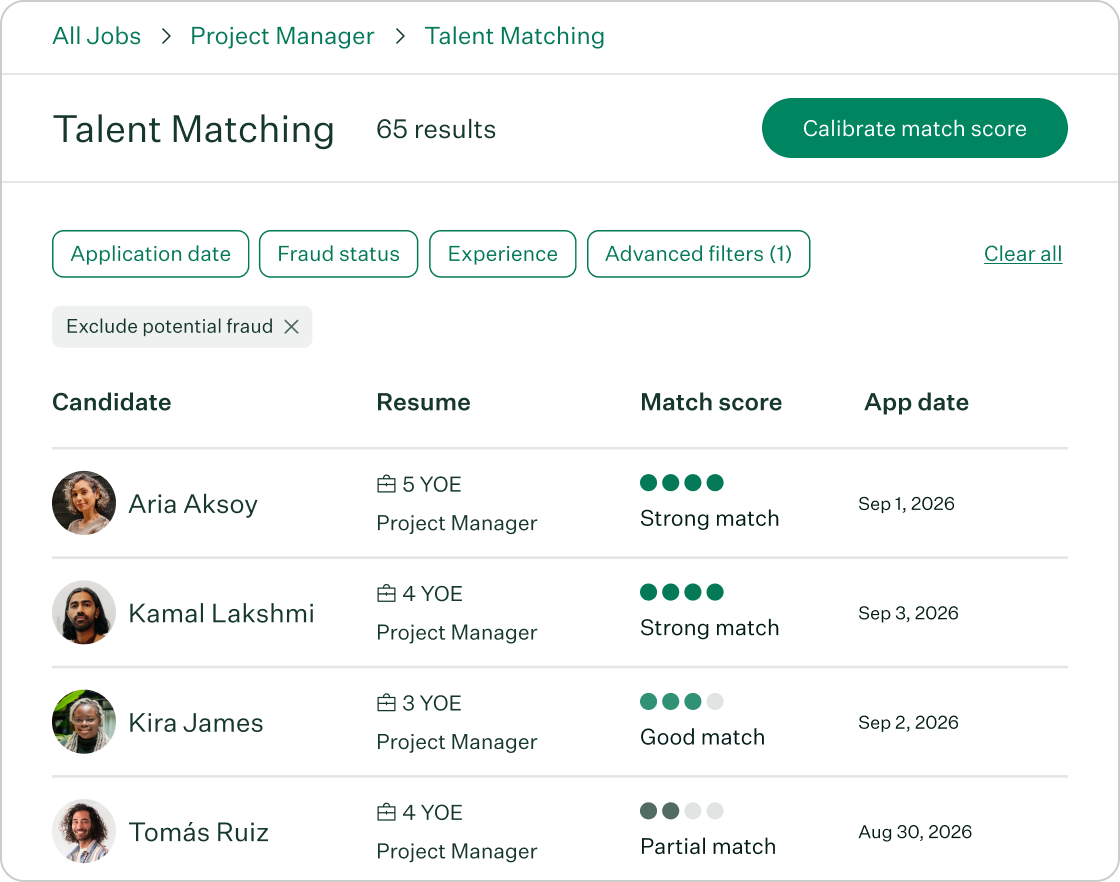
Two details in that screenshot are worth copying as requirements for any vendor. The "Calibrate match score" button means recruiters tune the criteria per job instead of trusting a generic model, and the "Exclude potential fraud" chip shows that fraud screening runs in the same view as fit screening. Candidates whose resumes cannot be analysed, who are in restricted AI locations, or who opted out of AI review go to manual review rather than to the bottom of the list, which is the correct failure mode.
Greenhouse also completed its acquisition of Ezra AI Labs on 27 May 2026 to bring structured voice AI interviews in-house, so the AI interview layer is becoming native too - Greenhouse. Pricing is not published: the tiers carry no figures. Vendr's data puts the median Greenhouse buyer at $26,611 a year across 882 purchases, with a range from roughly $10,200 to $74,700 - Vendr. Our full Greenhouse pricing guide works through the tiers.
Best for: mid-market and enterprise teams on Greenhouse that want explainable sorting with fraud screening built in, and a vendor that has committed in writing to never auto-rejecting.
4.4 Ashby AI-Assisted Application Review
Ashby takes the most conservative and arguably the most defensible approach of any tool here: it gives no score and no ranking at all, only a verdict per criterion with a citation. Recruiters define must-have, should-have and nice-to-have criteria per job, and the AI reads each application and marks every criterion "Meets" or "Does not meet", with "unknown" when the resume does not say and "skipped" when it cannot be read - Ashby. The final decision is explicitly left to humans.
The design choices around the model matter as much as the output. Ashby redacts personal information before resumes reach the model, commissioned an independent bias audit, supports applicant opt-out of AI processing and warns recruiters in-app when they write criteria that look biased. The screenshot below shows the result in the review queue.
Per-criterion evaluations in Ashby's application review

The "Does not meet 3 of 4" tooltip is the whole philosophy in one line. A recruiter, a hiring manager or an auditor can see exactly which requirement each applicant missed, which makes it easy to spot a badly written criterion (a frequent cause of silent mass rejection) and easy to explain an outcome. The limitation is the flip side: there is no ranking, so on a 900-applicant role you still filter by criteria combinations rather than reading a sorted list, and Ashby's own documentation notes that criteria applied to application-form answers only check whether a question was answered, not the quality of the answer - Ashby Docs.
The feature launched in September 2024 and has been extended since with fraudulent-candidate detection (September 2025) and AI talent rediscovery (May 2026) - Ashby. It runs on AI credits included in each plan: 1,500 credits a month on Foundations, 2,500 per seat per year on Plus. The published Foundations plan for companies up to 100 employees shows $400 a month at its default setting, with 10% off for an annual commitment; above 100 employees pricing is quote-only - Ashby. Vendr's data puts the median Ashby buyer at $22,896 a year across 161 purchases, which tells you how steep the step from Foundations to Plus is - Vendr.
Best for: tech and scale-up teams that want the most explainable screening output available and are comfortable filtering by criteria instead of trusting a rank.
4.5 Workable Agent
Workable's agent is the most aggressive ATS-native screener on this list and the best value for small companies, as long as you keep its automation switches under control. Announced on 13 March 2026, the Workable Agent sources passive candidates, screens everyone who applies, scores each person out of 100 against an Ideal Candidate Profile with written reasoning, and can chat with candidates to fill gaps - Workable. Each criterion is marked met, partially met, not met or unknown.
The help documentation spells out the control model. Sourcing, outreach, screening, auto-advance and auto-disqualify are separate toggles at account, job or candidate level, and auto-disqualify is off by default - Workable Help. That default is correct, and the most important configuration decision you will make with Workable is whether to keep it. The seven-minute official demo below walks through the scoring and the rules for moving candidates.
Workable Agent Demo: AI-Powered Recruiting for Sourcing, Screening and Candidate Engagement
Watch how the Ideal Candidate Profile is built before the job goes live: that step is where Workable succeeds or fails, because ICP criteria cannot be added after a job is published. Pricing is unusually transparent. The Standard plan for companies with 1 to 20 employees is $299 a month or $3,588 a year, with Premier at $599 and nine larger headcount bands that carry no published figure - Workable. The agent runs on AI credits: one credit per candidate evaluated, two per sourced profile and ten per candidate chat, with 3,000 free credits granted to paid accounts.
Those credits are worth translating. At Greenhouse's 2025 average of 244 applications per job, 3,000 free credits screen the applicants of roughly a dozen roles, after which every evaluation is a metered cost. Workable's launch announcement described pricing as "flat by company size, not usage-based", which contradicts its own credit documentation, so get the credit pack price in writing before signing. Our comparison of LinkedIn, Indeed and Workable's AI recruiters covers the agent's sourcing side.
Best for: companies under a few hundred employees that want scoring, reasoning and candidate chat in one affordable ATS, with a recruiter who will own the automation settings.
4.6 Paradox (Workday Paradox)
Paradox is the largest conversational screening engine in the world, and since October 2025 it is a Workday product. Workday agreed to acquire it on 21 August 2025 for approximately $1 billion in cash and completed the deal on 1 October 2025, relaunching its assistant as the Workday Paradox Candidate Experience Agent - Workday. At announcement, Paradox cited more than 189 million AI-assisted candidate conversations - PR Newswire.
Paradox screens differently from everything above it. It does not grade a resume; it holds a text conversation with the applicant, checks minimum qualifications such as availability, location, age requirements and certifications, answers questions and books the interview straight into a manager's calendar. For frontline hiring, where the best candidate is often simply the first qualified person who can start on Monday, speed of response is the screen. Workday's Hamra Enterprises case, a franchisee running 208 restaurants across 12 states and making around 10,000 hires a year, reports time to hire cut by 70%, from 13 days to 4 - Workday.
The limitation is depth. Paradox is excellent at knockout screening and logistics and is not designed to evaluate a software engineer or a finance manager, so it is the wrong tool for professional hiring and should not be compared with Ashby or HireVue on capability. It also publishes no pricing, and since the acquisition the commercial relationship increasingly runs through Workday, which means buyers outside the Workday ecosystem should ask hard questions about roadmap priority and how long standalone integrations with other ATSs will remain first-class. Workday published its own example of what the agent handles end to end at Hamra: the assistant, named Sam there, screens for minimum qualifications by text, schedules and reschedules interviews with no human involvement, and manages onboarding on the candidate's phone. That scope is the product's real value and its real boundary.
Best for: high-volume frontline employers (restaurants, retail, logistics, healthcare support) where speed to conversation decides who you hire, especially those already on Workday.
4.7 Sapia.ai
Sapia.ai is the strongest specialist for structured chat interviews at volume, and the only vendor here that charges per hire rather than per seat, interview or employee. Candidates answer a small set of open questions by text on their phone, in their own time, and Sapia's models score the answers for behavioural competencies and communication, producing a ranked shortlist for recruiters. Sapia claims more than 10 million candidates interviewed and an independent bias audit on its homepage - Sapia.ai.
The pricing model is the most buyer-friendly in the category. Sapia states that you can "interview and assess as many people as you want, without limits, and you'll only pay for the people you end up hiring", with a tailored cost-per-hire rate, and says the model is designed for organisations hiring more than 500 people a year - Sapia.ai. No rate is published on the page, and figures circulating on directory sites (including a "$1 per interview" plan) do not exist; our Sapia.ai pricing analysis covers what is actually known.
The 2026 product direction is aimed squarely at the problem in section 2. In September 2026 Sapia launched an experience-scoring tool explicitly pitched as a replacement for CV screening - Workplace Journal. In August 2026 PageUp embedded Sapia's interviewing directly into its enterprise hiring workflows - PR Newswire. The logic is sound: if resumes have become unreliable, replace the resume read with a structured, scored conversation that every applicant gets.
The honest limitations are scope and method. Sapia measures soft skills and communication, not hard technical ability, so it pairs with an assessment rather than replacing one. Text-based inference of personality traits is also the most contested part of this whole market scientifically, and buyers should read Sapia's published validation material critically rather than relying on summary claims. Its customer base is strongest in Australia, New Zealand and the UK.
Best for: high-volume employers hiring 500+ people a year into customer-facing roles who want a consistent first interview for every applicant and a price tied to outcomes.
4.8 HireVue
HireVue is the enterprise standard for structured AI interviews and assessments, and its 2026 AI Interviewer is the most validation-heavy product in the category. Launched on 18 June 2026, it runs two-way voice interviews around the clock, scores qualification questions as "Meets" or "Does not meet" and skill questions on a 1 to 5 rubric built by industrial-organisational psychologists, and ranks candidates before any recruiter phone screen - HireVue. HireVue cites more than 1,300 validation studies behind its scoring, which no competitor comes close to.
The scale backs that up. When HireVue acquired the Hireguide technology and team in March 2026 to accelerate its agentic roadmap, it reported more than 1,150 customers, including over 60% of the Fortune 100, 180 million assessments and 80 million video interviews - HireVue. In January 2026 it also joined Workday's AI agent partner network, a telling decision to plug into the dominant enterprise HR platform rather than compete with it - HireVue. Its product page claims candidates get a consent step and an opt-out, which matters under the transparency rules discussed in section 9.
Pricing is not published: HireVue names packages but lists no figures. Vendr's marketplace shows a median of $20,900 a year, but that figure rests on only three recorded purchases with a range from roughly $9,800 to $41,100, so it is a weak anchor - Vendr. Realistically, budget for an enterprise contract negotiated on applicant volume.
The cautionary case is worth knowing. In March 2025 the ACLU of Colorado filed complaints alleging that an AI video interview used by Intuit relied on speech recognition that performs worse for deaf and Indigenous applicants, after a deaf Indigenous employee was denied a promotion and her request for human captioning - HR Dive. HireVue called the complaint "entirely without merit" and said Intuit did not use a HireVue AI-based assessment. Whatever the outcome, the lesson for any interview-layer purchase is that accommodation workflows (captions, extra time, a human alternative) must be designed in before launch, not handled ad hoc. Our guide to why candidates quit AI interviews covers the candidate-experience side.
Best for: large, regulated enterprises that need validated, audit-ready structured interviews at volume and have the procurement capacity to negotiate an opaque contract.
4.9 TestGorilla
TestGorilla is the best screening tool for teams that want skills evidence and a published price they can read on a web page. Its library of more than 350 skills tests, resume scoring and qualifying questions has been joined since 7 October 2025 by AI video interviews in two formats: one-way recorded answers scored against rubrics, and conversational interviews of 6 to 20 minutes in which an AI persona asks follow-up questions within set guardrails - TestGorilla. Scores are explainable, and recruiters can edit or override any of them.
The pricing is the clearest in this guide. The assessments product has a Free plan at $0 with 10 credits a month, Core from $215 a month per account billed annually and Plus from $520 a month billed annually - TestGorilla. An AI interview costs two credits per candidate, so the Free plan covers about five AI interviews a month, which is enough to test the format on a real role before paying anything. ATS and API integrations, custom AI interviews and job simulations are Plus-only, which is the gating to watch: a team that needs results written back into its ATS is really evaluating the $520 tier, not the $215 one.
The strategic case for TestGorilla is that it attacks the AI-written-resume problem directly. A test result or a scored work sample is much harder to fake with a chatbot than a cover letter, and moving a short assessment to the top of the funnel replaces an unreliable signal with a reliable one. In March 2026 TestGorilla added seven AI readiness and AI fluency assessments - IT Brief, reflecting the fact that many employers now want to know how well candidates work with AI, not whether they used it.
The limitations are candidate friction and depth. Every assessment placed before a human conversation increases drop-off, especially among in-demand candidates with other options, so keep top-of-funnel tests short and role-relevant. And while TestGorilla covers coding, specialised engineering hiring is better served by dedicated platforms such as CodeSignal, covered in section 4.11. Our guide to screening for real AI skills shows how to design assessments that measure genuine ability.
Best for: SMB and mid-market teams that want evidence-based screening, a self-serve trial and a published price, and are willing to put a short test in front of candidates.
4.10 HeroHunt.ai
HeroHunt.ai is the outbound screening option on this list: it screens people who never applied, before anyone contacts them. That is a different job from everything above. Inbound screeners can only rank the applicants who showed up; when the right people are not applying, which for senior, technical and specialist roles is the normal case, the screening problem moves upstream to deciding which of thousands of sourced profiles deserve outreach at all.
HeroHunt.ai's AI Recruiter searches across platforms (up to a billion profiles on its larger plans), then screens each profile against the recruiter's written brief using recent GPT and Claude models, returning a score and a written conclusion explaining the match. Recruiters approve or reject candidates individually or in bulk, and approved candidates move into automated, personalised email outreach after the platform finds their email addresses. Plans are metered on AI-screened and matched profiles delivered and candidate emails found, with unlimited positions and searches; the entry plan includes 2,000 AI-screened profiles a month.
The comparison with inbound screening tools cuts both ways, and it is worth being precise about it. HeroHunt.ai does not screen your inbound applicants, does not run interviews or assessments, and is not an applicant tracking system, so it sits beside your ATS rather than replacing any tool above. Its screening is only as good as the brief: a vague brief produces vague scores. Where it earns its place is the step that inbound tools structurally cannot reach, evaluating candidates you went looking for, with the reasoning written out so a recruiter can audit it in seconds.
HeroHunt.ai
If your screening problem is not too many applicants but too few qualified ones, an inbound screener cannot fix it: it can only rank the people who applied. HeroHunt.ai's AI Recruiter screens profiles you never received, scoring each one against your written brief with large language models and writing out why it matches, then finds emails and runs personalised outreach for the candidates you approve. The checkable difference is access: an 8-day free trial (card required), then plans from $99 a month with unlimited positions, metered on AI-screened profiles. The honest caveat: it does not screen inbound applicants or run interviews, it is not an ATS, and its reach is thinnest for people who publish little about their work online.
Best for: recruiters and small teams hiring specialist or senior roles where the best candidates are not applying, who want sourcing, screening and outreach in one workflow.
4.11 Six More Worth Knowing, and Why They Were Cut
Several excellent products missed the ten because they serve a narrower slice of screening, overlap with a tool already listed, or are covered better in a dedicated guide. None of these are weak products, and for the right buyer several of them are the better choice. The common thread is specialisation: each one does one screening job extremely well rather than spanning the funnel.
Technical hiring is the biggest omission by design. CodeSignal publishes a self-serve price for skills assessments and its AI Interviewer: Build at $79 a month billed annually for 60 credits a year, Grow at $479 a month for 420 credits, and $20 per extra credit - CodeSignal. HackerRank launched its Chakra AI Interviewer in early 2026, running rubric-based voice and video screens with integrity scoring. Both are stronger than any generalist for engineering roles, because their results views pair a skills score with an integrity signal and leave the pass or fail decision to a human.
That integrity signal is the detail that matters. CodeSignal reported in February 2026 that assessment fraud and cheating attempts more than doubled in 2025, with entry-level hiring the most exposed - CodeSignal. Any technical screen without proctoring or integrity signals now measures access to an AI copilot as much as skill. Our guide to detecting AI interview cheating covers the defences in depth.
The remaining four each fill a specific gap. Short summaries, with the reason each was cut:
- Manatal: budget ATS whose AI recommendations give a match percentage with a gap analysis; cut because the feature was still in public beta in January 2026
- Phenom: launched a conversational voice screening agent in November 2025; cut because it is sold as part of a large platform contract
- LinkedIn Hiring Assistant: evaluates LinkedIn and ATS applicants as a Recruiter add-on; cut because it is a sourcing agent first
- Classet and Alex: AI phone screens for hourly roles, with Classet publishing a price; covered in our AI interviewer guide
Two of those are worth a closer look depending on your stack. Manatal publishes a price that suits small agencies: $15 per user per month billed annually, though that Professional tier caps at 15 active jobs and 10,000 candidates - Manatal. Phenom is the opposite end of the market, with Vendr reporting a median buyer at $98,313 a year - Vendr. LinkedIn's agent is covered in our analysis of LinkedIn Hiring Assistant 2. The AI phone-screen specialists, Classet and Alex included, are compared in our AI candidate interviewers guide.
5. Side-by-Side Comparison
The table below compresses the ten profiles into the six facts that decide most purchases: which layer the tool screens, what it outputs, whether it rejects on its own, what it publicly costs, and who it fits. It is a summary, not a substitute for the profiles above, and every price cell should be read alongside the caveats in section 6.
The single most useful column is "Auto-reject". Every tool in this list can be configured to keep a human in control, and most do so by default, but the defaults differ and the defaults are what actually ships in most deployments. Read that column together with the output column: a tool that outputs per-criterion reasons and never auto-rejects is the lowest-risk configuration available in 2026.
| Tool | Screening layer | Output | Auto-reject by default | Published price | Best for |
|---|---|---|---|---|---|
| Workday HiredScore | Application ranking | Letter grades, Spotlight inbox | Ranks; decisions by recruiter | Not published | Workday enterprises |
| Eightfold AI | Ranking + AI interview | Match score, interview summaries | Recruiter oversight | Not published | Talent intelligence at scale |
| Greenhouse | Application ranking | Strong / Good / Partial / Limited | Never auto-dispositions | Not published | Greenhouse customers |
| Ashby | Application ranking | Meets / Does not meet per criterion | No score, no auto-reject | $400/mo (up to 100 employees) | Tech scale-ups |
| Workable Agent | Ranking + chat | 0-100 score with reasoning | Auto-disqualify off by default | $299/mo (1-20 employees) + credits | Small companies |
| Paradox | Conversational screen | Knockouts, scheduling | Qualification rules | Not published | Frontline volume |
| Sapia.ai | Chat interview | Competency scores, shortlist | Ranks for recruiters | Per hire, no rate published | 500+ hires a year |
| HireVue | AI interview + assessment | Meets / 1-5 rubric scores | Ranks before recruiter screen | Not published | Regulated enterprises |
| TestGorilla | Skills assessment + AI interview | Test and rubric scores | Recruiter can override | Free; Core from $215/mo | Evidence on a budget |
| HeroHunt.ai | Outbound profile screening | Score + written conclusion | Recruiter approves or rejects | From $99/mo | Roles where the best people do not apply |
Why this matters: once the facts sit side by side, the market's structure becomes visible, and three patterns stand out. First, price transparency correlates inversely with company size: the four tools that publish a usable number all target small and mid-sized buyers, while every enterprise tool hides behind a sales process. Second, the ATS-native tools (Greenhouse, Ashby, Workable, HiredScore inside Workday) have converged on explainable ranking and conservative defaults, partly because their legal teams can see the litigation in section 9. Third, no single tool covers every layer, so most mature stacks in 2026 combine an ATS-native ranker with one interview or assessment tool.
How to apply this: shortlist at most two tools per layer you actually need, and start from the tool your ATS already includes. The cheapest screening software in 2026 is usually the feature you are already paying for and have not switched on.
6. What AI Screening Actually Costs
AI screening is priced on at least five different units, and comparing headline prices across units produces conclusions that are not just imprecise but backwards. A per-hire price, a per-credit price and a per-employee contract can describe the same annual spend, and the cheapest-looking sticker is frequently the most expensive at your volume. The table below sets out the unit each tool actually meters and the best available price evidence.
The two columns that matter most are the pricing unit and the evidence column. "Not published" does not mean expensive, it means you have no anchor, which costs you negotiating leverage. Where Vendr transaction data exists it is shown, because a median of real contracts is a better guide to your invoice than any list price.
| Tool | Pricing unit | Published entry price | Real-world evidence |
|---|---|---|---|
| Workday HiredScore | Inside a Workday contract | Not published | Workday overall: median $51,600/yr, 373 purchases (Vendr) |
| Eightfold AI | Enterprise contract | Not published | No public transaction sample |
| Greenhouse | Subscription by company size | Not published | Median $26,611/yr, 882 purchases (Vendr) |
| Ashby | Subscription by company size + AI credits | $400/mo up to 100 employees | Median $22,896/yr, 161 purchases (Vendr) |
| Workable | Headcount band + AI credits | $299/mo for 1-20 employees | 3,000 free credits; 1 credit per screened applicant |
| Paradox | Enterprise contract, now via Workday | Not published | No public transaction sample |
| Sapia.ai | Per hire, unlimited interviews | No rate published | Designed for 500+ hires a year |
| HireVue | Enterprise contract | Not published | Median $20,900/yr on only 3 purchases (Vendr) |
| TestGorilla | Per account + credits | Free; Core from $215/mo (annual) | AI interview = 2 credits per candidate |
| HeroHunt.ai | Monthly plan, metered on AI-screened profiles | From $99/mo | 8-day free trial, card required |
Why this matters: the table hides the most important cost driver, which is that metered units scale with applicant volume, not with your team. Workable's one credit per screened applicant is the cleanest example. Using Greenhouse's 2025 average of 244 applications per job, a company with 20 open roles a quarter would consume roughly 4,900 evaluation credits a quarter on screening alone, before any sourcing or candidate chat at two and ten credits respectively. The 3,000 free credits are a trial allowance, not a steady state. The point is not that Workable is expensive, since credit costs on a few thousand screens are modest next to an enterprise contract, but that the cost line moves with application volume, which is the one variable this whole category exists because of.
The same arithmetic applies to interviews and assessments. CodeSignal's Build plan costs $948 a year for 60 credits, which is about $15.80 per assessment before overage at $20. TestGorilla's two-credit AI interview means the Free plan's 10 monthly credits cover five interviews. And at the enterprise end, a subscription priced on company size has the opposite problem: it does not shrink in a hiring freeze, so a quiet year can produce a higher cost per screened candidate than a busy one.
A simple comparison shows how the units change the answer. A 60-person software company hiring 25 people a year sits inside Ashby's published Foundations band and inside Workable's lower headcount bands, so either native screener costs a few thousand dollars a year on top of an ATS it needs anyway, and a standalone enterprise tool would cost several times more for the same screening job. A 5,000-person retailer hiring 3,000 frontline workers a year faces the opposite arithmetic: per-seat or per-credit tools become expensive at that applicant volume, and a per-hire model like Sapia's or a platform contract like Paradox's starts to look cheap per hire. Neither answer is visible from the headline prices alone.
Four hidden costs recur across almost every vendor and rarely appear in a quote:
- ATS integration tiers, such as TestGorilla's Plus-only integrations, which change the real entry price
- Credit overage and pack pricing, which is often missing from the main pricing page
- Compliance work: bias audits, notices and record-keeping that the law assigns to you, not the vendor
- Size-band cliffs, such as Ashby's jump from a published plan to quote-only above 100 employees
The compliance line deserves the most attention because it is the one buyers forget. A NYC bias audit, California's four-year record retention for automated-decision data and Colorado's notice duties from 2027 are all employer obligations, and they cost money whether or not the vendor helps. How to apply this: before comparing vendors, estimate your annual volume at each layer (applications screened, interviews run, assessments sent), multiply by each vendor's unit, add integration and compliance, and only then compare. For a deeper treatment of metering models across the whole recruiting stack, see our AI recruiting pricing models guide. Vendor-by-vendor list prices for 40 recruiting tools are in the recruiting software pricing index.
7. Does AI Screening Work? The Evidence
The honest summary of the evidence is that structured AI interviews have one strong field experiment behind them, while AI resume screening with general-purpose language models has mostly laboratory evidence, and much of it is unflattering. These are different claims, and vendors routinely blur them by citing interview results to sell resume screening. Keep them separate when you read any sales deck.
The strongest evidence comes from a randomised field experiment by Brian Jabarian and Luca Henkel covering 70,884 applications to customer-service roles at a recruitment process outsourcer in the Philippines, in which applicants were randomly assigned to a human interviewer or an AI voice agent, and human recruiters made every hiring decision in both arms. The paper, revised in September 2026, reports that AI-interviewed applicants were 12% more likely to receive job offers, with gains carrying through to job starts and retention and no decline in the productivity of hires - arXiv. The chart below shows the three headline outcomes.
Human vs AI Voice Interviews in a 70,884-Application Field Experiment
The retention result is the one that should change minds, because it is the hardest to explain away. If AI interviews simply pushed more people through, offers would rise and quality would fall; instead one-month retention rose by about 18% alongside offers. The authors attribute the effect to what they call controlled variance: the AI asks the full structured guide every time, while human interviewers drift. When applicants were offered a free choice, about 78% chose the AI interviewer. Jabarian presented the study in the talk below, recorded before the September 2026 revision.
Voice AI in Firms: A Natural Field Experiment on Automated Job Interviews
The limits of that study matter as much as the result. It covers one firm, one country and entry-level customer-service roles, it tests an interview rather than a resume screen, and humans still made the decisions. It supports the claim that a well-designed AI interview can collect better information than a rushed human screen. It says nothing about letting a model reject applicants from their documents.
The resume-screening evidence is weaker and more worrying. A University of Washington study of three open-source models found they favoured white-associated names 85% of the time and female-associated names only 11% of the time when screening otherwise identical resumes - University of Washington. A February 2026 study testing frontier models found many "unable to consistently select the resumes describing more qualified candidates", and that selection rates by demographic group varied by model and by job, sometimes in the opposite direction to older findings - arXiv. The figure from that paper below makes the point visually.
Selection rates by model, job and race for equally qualified candidates

Read the figure against the dashed parity line at 0.5. For equally qualified candidates, one model selected Black candidates for the software engineering role at roughly 0.6 and White candidates at roughly 0.4, while another model sat close to parity, and the gaps shrank or reversed for the German-speaking business development role. The lesson is not that AI favours one group; it is that bias is model-specific and job-specific, so a vendor's audit on one model and one job tells you little about yours.
Two 2025-2026 findings add new risks. A study of AI self-preference found that language models favour resumes written by the same model, with simulations showing candidates who used the screener's own model were 23% to 60% more likely to be shortlisted than equally qualified candidates who wrote their own - arXiv. And a September 2026 paper found that purely cosmetic, competence-preserving formatting changes flipped 29.6% of pairwise decisions for its best-performing open model - arXiv. Purpose-built models can do better: one vendor's research team reported its proprietary match model reaching an AUC of 0.85 against 0.77 for the best general LLM, with a better race impact ratio, though that is vendor-authored evidence - arXiv.
Why this matters: the evidence supports AI that structures and documents an evaluation, and it does not support handing reject decisions to a general-purpose model reading resumes. How to apply this: prefer purpose-built screening with per-criterion reasoning over "send the resume to a chatbot" workflows, demand job-specific adverse-impact data rather than a generic audit certificate, and keep a human on every rejection until your own data shows the tool agrees with your best recruiters.
8. Where AI Screening Fails
AI screening fails in predictable ways, and almost every failure is a configuration or governance failure rather than a model failure. Why this matters: that is good news, because it means most of them can be prevented by the buyer. The bad news is that they are invisible by default: a screener that silently rejects the wrong 10% of a 900-person applicant pool produces no error message, only a slightly worse shortlist that nobody can compare against the one they never saw.
The first and most common failure is the badly written criterion. A single over-specific requirement ("5+ years in Salesforce CPQ" for a role where 3 years is fine) can eliminate most of a pool, and a per-criterion tool like Ashby makes this visible while a score-only tool hides it. The second is proxy discrimination: requirements like continuous employment, specific universities or commuting distance correlate with protected characteristics and reproduce bias without any model "intending" to. Illinois now explicitly bans using zip codes as a proxy for protected classes - Thompson Hine.
The clearest real-world example of a configuration failure predates today's language models, which is exactly why it is instructive. In 2023 the tutoring company iTutorGroup paid $365,000 to settle the EEOC's first case involving hiring software, after its application system was set to automatically reject women aged 55 or older and men aged 60 or older - Duane Morris. More than 200 qualified applicants were rejected, and the rule was discovered only because one applicant submitted two identical applications with different birth dates. No model was involved: a knockout rule did the damage, silently, at scale. Every modern screener has knockout rules, and they deserve the same review as the AI.
Data quality is the quiet second cause. Screeners read what parsers extract, and parsers still struggle with multi-column resumes, scanned PDFs, non-English documents and unconventional career paths. Greenhouse's design of routing unreadable resumes to "Needs manual review", and Ashby's "skipped" label, exist precisely because the alternative (scoring a badly parsed resume as a weak candidate) penalises people for their formatting rather than their experience. Ask every vendor what happens to a resume its parser cannot read, and treat "it gets a low score" as a failing answer.
The failure modes that have grown fastest in 2025-2026 are the adversarial ones, where candidates or fraudsters actively work against the screen:
- Prompt injection in resumes, where hidden text instructs the model to rate the candidate highly
- AI-written applications that match every keyword and erase the signal a screen depends on
- Fraudulent candidates, from fabricated histories to proxy interviewees and deepfakes
Two subtler model-level effects from section 7 sit alongside them: self-preference, where a model rewards text written by a model like itself, and formatting sensitivity, where layout alone changes the verdict on identical qualifications. Each of these has a practical defence. Prompt injection is neutralised by tools that strip formatting and screen plain text, which is why recruiters say the hidden-text trick rarely works on modern systems, though general-purpose "paste the resume into a chatbot" workflows remain exposed. AI-written applications are best countered by moving evidence earlier: a short structured interview or work sample reveals more than a polished document. Fraud requires identity verification and integrity signals in the same flow, as Greenhouse and Ashby now provide; our guide to candidate identity verification compares the specialist options.
The third family of failures is human. Automation bias sets in within weeks: recruiters stop reading the reasoning and start trusting the grade, and a tool designed to assist becomes a tool that decides in all but name. Candidate drop-off is the mirror image. Greenhouse's April 2026 survey of 2,950 job seekers found 38% of US candidates have already withdrawn from a hiring process because it included an AI interview - Greenhouse. Every automated step added before a human conversation costs some candidates, and the strongest candidates, who have the most options, are the most likely to leave. A screen that improves average quality while losing the top 5% of applicants is a net loss that no dashboard will show you.
How to apply this: audit a random sample of AI rejections every month, not just the shortlist; review every criterion for proxies before a job goes live; measure completion rates at each automated step; and keep at least one fast human touchpoint for candidates who stall. These four habits catch most failures before they become either a bad hire or a lawsuit.
9. The 2026 Legal Map for Automated Screening
The legal risk of AI screening rose sharply in 2025-2026 through litigation rather than new federal law, while the big statutory deadlines moved later. For buyers, that combination is dangerous: the deadlines that drove compliance projects have slipped, but the lawsuits that test whether screening tools discriminate or act as unregulated consumer reporting agencies are already in discovery. Here is where things stood in October 2026.
The two cases every buyer should follow both target vendors, which matters because they test whether liability attaches to the software as well as the employer. In Mobley v. Workday, a federal court conditionally certified a nationwide age-discrimination collective in May 2025 - Proskauer. In May 2026 the court held that Workday's own bias testing was privileged, and in June 2026 it allowed the plaintiffs' California discrimination claims to proceed because Workday designs and operates its screening tools from California - Duane Morris. In Kistler v. Eightfold AI, filed on 20 January 2026, applicants argue that undisclosed match scores are consumer reports under the Fair Credit Reporting Act - Epstein Becker Green.
The statutory picture is a patchwork, summarised below for the jurisdictions most HeroHunt readers hire in.
| Jurisdiction | Rule | Status in October 2026 | What it means for screening |
|---|---|---|---|
| European Union | AI Act, Annex III high-risk | Delayed to 2 December 2027 by Regulation (EU) 2026/1744 | Recruitment AI needs risk management, logging and human oversight |
| California | Civil Rights Council ADS regulations | In force since 1 October 2025 | Vendors can be liable as agents; keep ADS records for four years |
| Colorado | SB 26-189 (replaced the 2024 AI Act) | Takes effect 1 January 2027 | Notice before use, explanation after adverse decisions |
| Illinois | HB 3773 | In force since 1 January 2026 | Notice to applicants; no discriminatory effect; no zip-code proxies |
| New York City | Local Law 144 | In force; enforcement criticised | Annual bias audit and candidate notice for automated tools |
The EU delay is the change most likely to be misread. Regulation (EU) 2026/1744, the AI Omnibus, was published on 24 July 2026 and moved the application date for stand-alone high-risk systems, including recruitment and candidate evaluation, from 2 August 2026 to 2 December 2027 - National Law Review. The obligations themselves did not go away. Colorado went further and replaced its 2024 law entirely: SB 26-189, signed on 14 May 2026, drops annual impact assessments and leaves enforcement solely to the attorney general, but requires notice before automated technology materially influences a decision and a plain-language explanation and route to human review afterwards - Holland & Knight.
California is already live and is the strictest in practice, because its regulations treat screening vendors as potential agents of the employer and require four years of record retention for automated-decision data - Mayer Brown. New York City's bias-audit law, by contrast, shows how weak enforcement can be: a December 2025 state audit found the city's consumer protection agency flagged one compliance issue across 32 posted audits, where auditors found at least 17 - DLA Piper. At federal level, a December 2025 executive order created a Justice Department task force to challenge state AI laws, but state rules remain enforceable unless a court or Congress says otherwise - Paul Hastings.
Why this matters: every one of these rules converges on the same three duties: tell candidates when automation is used, be able to explain an adverse outcome, and keep a human able to review it. How to apply this: choose tools whose output is a list of reasons (section 1), switch off auto-reject unless you can defend it, keep screening records for at least four years, and ask every vendor for its own adverse-impact testing by job family. For hiring across borders, our international recruiting compliance guide covers the wider picture. None of this is legal advice; involve counsel before deploying any tool that can reject candidates automatically.
10. How AI Agents Are Rewiring Screening
The defining shift of 2025-2026 is that screening stopped being a feature and became an agent: software that reads the requisition, screens applicants, talks to candidates and schedules the next step without a recruiter starting each task. Almost every vendor in this guide launched an agent in the past eighteen months: Workable's agent, Eightfold's AI Interviewer and Candidate Agent, HireVue's AI Interviewer and Talent Engagement Agent, Phenom's voice screening agent, Sapia's Tia and LinkedIn's Hiring Assistant 2.
Why this matters: agents act without being asked, so the configuration choices in section 8 now run continuously rather than once per job. The second shift is consolidation. Workday bought both HiredScore and Paradox, Greenhouse bought Ezra AI Labs for voice interviews, and HireVue absorbed Hireguide's technology. The direction is clear: the system of record wants to own screening, because whoever owns the screen owns the most valuable data in recruiting, which is the record of who was rejected and why. For buyers, this changes contract strategy. Signing a three-year deal with a standalone screener at the moment your ATS is building the same capability is the most avoidable procurement mistake in this category.
Adoption is earlier than the announcements suggest. Josh Bersin estimates that fewer than 5% of the more than one million employers with frontline workforces use agentic recruitment tools today - Josh Bersin. Intent is high, though: LinkedIn's January 2026 research found 93% of talent acquisition professionals planned to increase their AI use and 66% planned more AI for pre-screening interviews - HR Dive. The gap between plans and production is where most buyers sit right now.
The upcoming players are worth watching for what they do differently. A wave of venture-backed AI recruiters, including Alex, which raised $17 million in a Series A in September 2025 - TechCrunch, as well as Tenzo, Humanly and Classet, run live screening calls by phone, video or messaging and write scorecards straight into the ATS. Their bet is that the first conversation, not the resume, becomes the primary screening artefact. Outbound tools such as HeroHunt.ai make the parallel bet on the sourcing side: that screening should happen before outreach, on profiles nobody has applied with yet.
The likely end state by 2028 has three parts. Documents will matter less, because AI-written resumes and applications carry little signal. Structured conversations and work samples will move to the top of the funnel, run by agents and scored against rubrics. And regulation will force every automated reject to carry a reason and a route to human review. How to apply this: buy screening that produces evidence (transcripts, rubric scores, per-criterion reasons) rather than opaque scores, because evidence survives both the technology shift and the regulatory one.
11. How to Choose, Pilot and Deploy
The fastest way to choose AI screening software is to start from your bottleneck and your ATS, not from a vendor list. Most teams have one dominant problem (too many unqualified applicants, too few qualified ones, slow time to first contact, or unreliable signal in applications), and each problem points to a different layer. The decision tree below encodes the logic used throughout this guide.
Why this matters: the tree deliberately starts with the bottleneck question because the most common mistake in this market is buying an inbound screener for a problem that is really a sourcing problem. If nobody good applies, ranking the people who did apply faster will not help, and the money belongs upstream.
How to apply this: follow the left branch if inbound volume is your problem and the right branch if quality of supply is. Note that the professional-roles path ends in an assessment: for most professional hiring, the best 2026 stack pairs a ranker or interviewer with one source of hard evidence, because neither a resume score nor a conversation alone reliably proves skill.
Once you have a shortlist, run a shadow pilot before switching anything on. For four to six weeks, run the AI screen alongside your normal human process on two or three real roles, without letting it affect any candidate. Then compare: how often does the AI agree with your best recruiters, which candidates did it rank low that humans advanced (and vice versa), and do selection rates differ across groups? The standard first check is the four-fifths rule from the US Uniform Guidelines on Employee Selection Procedures, under which a group's selection rate below 80% of the highest group's rate is generally regarded as evidence of potential adverse impact - eCFR.
Five questions separate serious vendors from the rest in that evaluation:
- What exactly is scored, and which data beyond the application feeds the score?
- Can we see per-candidate reasons that a rejected applicant could be given?
- What is the default for auto-reject, and who can change it?
- Show adverse-impact results by job family, not a single audit certificate
- How are fraud and hidden text detected inside the screening step?
A vendor that answers all five clearly, with documentation, is ready for a regulated deployment; one that answers with a brochure is not. After the pilot, roll out in stages: one job family at a time, auto-reject off, monthly audits of a random sample of AI rejections, and candidate notices written before launch rather than after the first complaint. Measure four things from day one: time to first human contact, recruiter hours per hire, candidate completion rate at each automated step, and selection rates by group. If any of those moves the wrong way, you will see it in weeks rather than in a lawsuit two years later.
At the 90-day mark, hold a formal review with the same rigour you would apply to a new recruiter. Compare quality of hire signals for AI-advanced and human-advanced candidates (hiring manager ratings, offer acceptance, early attrition), re-run the adverse-impact check on the larger sample, and read twenty randomly chosen AI rejections end to end. Only if all three look healthy should you consider expanding to more job families or loosening any human-review step. Teams that skip this review tend to discover problems through a candidate complaint or an audit request, which is the most expensive way to learn.
12. The Bottom Line
The best AI candidate screening software in 2026 is the one that matches your bottleneck, lives inside your ATS where possible, and shows its reasoning for every candidate it ranks low. Application volume has outgrown human screening permanently, so the question is no longer whether to automate the first pass but how to do it without losing good candidates or creating legal exposure.
Why this matters: the cost of a bad screen is invisible, because you never meet the candidates it rejected. How to apply this: the decision framework is short. On Workday, start with HiredScore and add Paradox for frontline roles. On Greenhouse, Ashby or Workable, switch on the native screening before buying anything, because it is good, explainable and already paid for. For frontline volume on any stack, compare Paradox and Sapia.ai. For audit-ready structured interviews in a large enterprise, HireVue, or Eightfold if you also want talent intelligence across internal mobility. For skills evidence on a budget, TestGorilla, and for engineering roles, CodeSignal. And where the people you need are not applying at all, screen on the outbound side with HeroHunt.ai, which scores sourced profiles against your brief before any outreach goes out.
Whatever you choose, three rules hold across every tool. Keep a human on rejections until your own pilot data justifies anything else. Prefer per-criterion reasons over scores. And audit what the screen rejects, not just what it recommends, because the candidates you never see are the ones a bad screen costs you.
Written by Yuma Heymans (@yumahey), who built HeroHunt.ai's AI Recruiter, which screens every sourced profile against a recruiter's brief with large language models, and has been building AI recruitment tools since 2021, long enough to know that a screening score is only as trustworthy as the reasons written next to it.
This guide reflects the AI candidate screening market as of October 2026. Products, prices, court rulings and regulatory deadlines in this category change quickly; verify current details with each vendor and with legal counsel before purchasing or deploying any tool that evaluates candidates.