



The Practical Guide to Contrario Pricing, Real Costs, and the Best Alternatives in 2026
Contrario went from a standing start to $6 million in annualized revenue and paid out more than $1 million to recruiters in under six months, then launched publicly on May 20, 2026 with a $2.3 million seed led by Nexus Venture Partners. That is one of the fastest starts any recruiting marketplace has posted, and it is backed by a Y Combinator W25 pedigree and angels from OpenAI, DoorDash and Stanford - Morningstar / PR Newswire. But if you go looking for what Contrario actually costs, you hit a wall immediately: contrario.ai/pricing returns a 404, and the homepage routes every visitor to "Get a demo" - Contrario.
That opacity is the reason this guide exists. Contrario is an AI plus expert-recruiter marketplace priced on a hybrid contingency model, which means you do not pay a seat license, you pay a percentage of each hire's first-year salary. On its own alternatives page the company discloses the model as "generally 25% of first-year salary," varying by role difficulty, and a July 2026 independent review confirmed there is no visible rate card to model against before you talk to sales - theaiway. For a startup filling a hard senior role, a done-for-you agent that delivers vetted candidates fast can be worth every point of that fee. For a company doing steady, lower-stakes hiring, paying 25% per head adds up quickly.
This guide breaks down exactly what Contrario costs, how its contingency and recruiter-split model works, where it genuinely wins, and the five strongest alternatives in 2026 ranging from rival recruiter marketplaces to free autonomous sourcing tools you run yourself. Every fee is sourced, every claim is linked, and the alternatives are grouped honestly into done-for-you versus do-it-yourself so you can find your lane fast.
Written by Yuma Heymans (@yumahey), who built HeroHunt.ai and has spent since 2021 building autonomous sourcing on the DIY side of exactly this build-versus-buy decision. He writes about the marketplace-versus-software trade-off from inside the software half of it.
Contents
- What Contrario Actually Is
- Contrario Pricing: What It Really Costs in 2026
- Where Contrario Wins and Where It Falls Short
- The 5 Best Contrario Alternatives in 2026
- Full Comparison: Pricing and Models
- How to Choose the Right Alternative
- The Bottom Line
1. What Contrario Actually Is
Contrario is a done-for-you hiring service, not a piece of software you operate. It runs a curated network of vetted expert recruiters, each supercharged by vertical AI agents that handle candidate scoring, outreach drafting, scheduling and follow-ups, with the whole workflow living inside your Slack and syncing to your ATS. The pitch is that pairing human recruiter judgment with AI execution beats both a pure agency and a pure software tool: the AI removes the grunt work, the human keeps the hiring bar. Contrario positions this explicitly as "the case for pairing AI agents with human recruiters instead of replacing them" - VentureBeat.
The company was founded in 2025 by two Stanford dropouts, Arya Marwaha (ex-BCG) and Aditya Sood (NLP research at NASA and Stanford AI Lab), who met in a first-year dorm - Y Combinator. It sits inside YC's Winter 2025 batch, employs around 15 people out of San Francisco, and raised its $2.3 million seed from Nexus Venture Partners with Inventum Ventures and Goodwater Capital participating - citybiz. Its self-reported traction is genuinely strong for the age: 150+ candidates placed, roughly 30% of recent hires involving AI agents, and a top recruiter earning $100k+ per month on the platform - Contrario blog. Every one of those numbers is company-reported and unaudited, which is worth holding in mind throughout.
The core capability that separates Contrario from a classic contingency agency is the AI agent layer sitting under each recruiter. Instead of a human sourcer manually screening resumes and typing outreach, the agents score candidates against the role, draft the messages, and coordinate interviews, so a single recruiter can carry far more roles at a higher submission quality. Contrario markets that 80% of submitted candidates advance to a first-round interview (framed as "four of five meet the hiring bar") and that candidates arrive roughly 3x faster than a traditional agency - Yahoo Finance. Those are marketing claims, not independently verified benchmarks, but they describe the intended value clearly: fewer, better candidates, delivered faster, with the recruiter as quality control rather than manual laborer.
To see what the buyer actually experiences, it helps to look at the product surface, because Contrario is unusually recruiter-facing for a service sold to employers. Its main dashboard is a job board where recruiters browse open roles with the hire reward attached, which is how the marketplace routes talent to reqs.
Contrario's recruiter-facing Browse Jobs dashboard
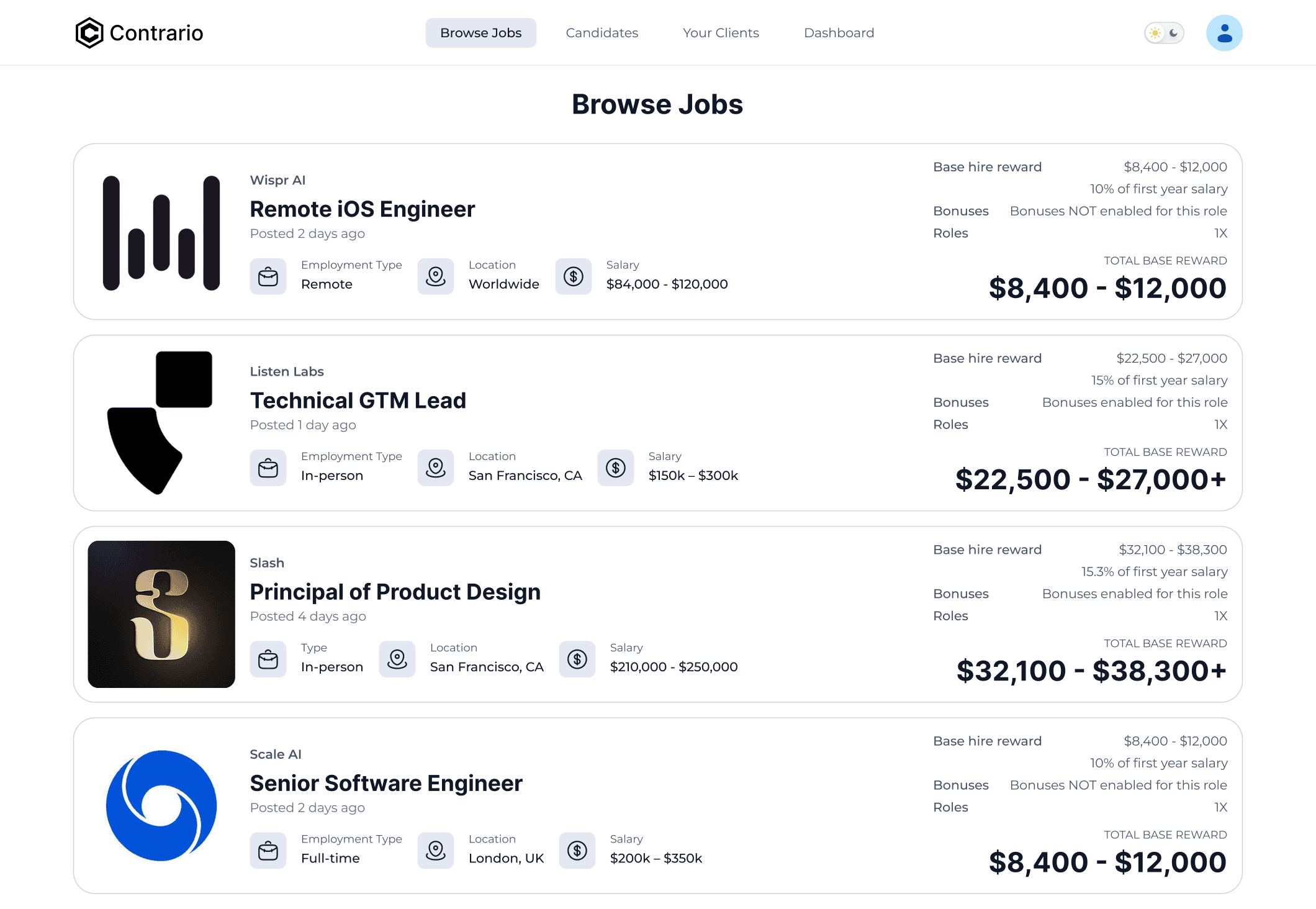
What the screenshot reveals is the real shape of the business: named roles from companies like Wispr Flow, Listen Labs, Slash and Scale AI, each carrying a salary band and a payout, sitting in a marketplace that recruiters work rather than an interface an employer operates. That is the tell that Contrario is a managed, contingency-priced service and not a sourcing tool. The employer's job is to brief the role and review shortlists in Slack; the sourcing labor happens inside the network. This is a fundamentally different purchase than buying seats in a search product, and it drives everything about how the pricing works.
2. Contrario Pricing: What It Really Costs in 2026
Contrario does not publish a rate card. Based on its own alternatives page, the fee is a hybrid subscription-plus-contingency model generally set at 25% of a hire's first-year salary, varying by role difficulty, seniority and urgency - Contrario alternatives. That single fact is the most important input for anyone evaluating the service, and it is the one the company makes hardest to find, since the pricing URL 404s and every path leads to a sales call. Third-party synthesis puts the effective band at roughly 20% to 25% of first-year salary, which on a $150,000 engineering role means a fee between $30,000 and $37,500 per hire.
The structure underneath that headline is a marketplace split, and it matters because it shapes candidate quality. Recruiters on Contrario's network keep a 50% to 70% split on every successful placement, with Contrario retaining the remainder to fund the AI agents and platform - Contrario alternatives. That split is notably lower than the closest competitor, Paraform, which markets an 80% recruiter split to attract independent recruiters - Paraform for recruiters. A lower recruiter cut is not automatically worse for the employer, since Contrario invests the difference in the AI layer, but it is a real structural difference in how the two marketplaces motivate their talent. The service also references a replacement guarantee if a hire does not work out within a guarantee window, though the exact duration is not published on any Contrario-owned page, so treat the widely-quoted "90-day" figure as unverified.
Because the fee is a percentage of salary rather than a flat number, the real cost scales with seniority, and this is where a percentage model bites. The table below models Contrario's disclosed band against a range of typical salaries so you can see the actual dollar commitment before a demo, since the company will not show it to you up front.
| First-year salary | Contrario at 20% | Contrario at 25% | Recruiter keeps (50-70%) |
|---|---|---|---|
| $120,000 | $24,000 | $30,000 | $15,000 - $21,000 |
| $150,000 | $30,000 | $37,500 | $18,750 - $26,250 |
| $180,000 | $36,000 | $45,000 | $22,500 - $31,500 |
| $220,000 | $44,000 | $55,000 | $27,500 - $38,500 |
The pattern the table exposes is that Contrario is priced like a premium agency, not like software, and the two are not comparable on a per-seat basis. A traditional contingency agency charges 15% to 25% and a retained search runs 25% to 35% of first-year salary, a benchmark Contrario itself cites on its comparison page - Contrario alternatives. Contrario's "generally 25%" therefore sits at the top of the contingency band and undercuts retained search, which is exactly the position a fast, AI-accelerated service wants: cheaper than the white-glove incumbent, pricier than a self-serve tool, justified by speed and submission quality. For a company hiring in bursts of a few critical roles, that math often works. For steady-volume hiring, paying 25% per head is where teams start looking at building an in-house pipeline instead.
This is the exact point where price sensitivity peaks, so it is worth naming the honest low-cost path before the alternatives. The moment you decide 25% per hire is too much for your volume, the alternative is to bring sourcing in-house, which means owning the search yourself with software rather than outsourcing it to a marketplace. Section 4 prices that route out in full.
The reason the contingency model deserves scrutiny is that it changes the math depending on how you hire. A team filling two or three genuinely hard senior roles a year, where a bad hire costs months, may find 25% a bargain against the fully-loaded cost of an in-house recruiter, which SHRM data cited by Contrario puts at a $200,000 to $250,000 annual salary plus a cost-per-hire near $5,475 for non-executive roles - Contrario alternatives. A team hiring fifteen engineers a year at $37,500 each is spending $562,500 on Contrario fees alone, which pays for a small in-house team with budget to spare. Before signing, model your annual hiring volume against the per-hire fee, because that total, not the "25%" headline, decides whether a marketplace or an in-house build is cheaper for you.
3. Where Contrario Wins and Where It Falls Short
Contrario's strongest card is speed with a human quality gate, and its weakest is opacity across both price and vetting. For a startup that needs to fill a hard role now and does not have a recruiting function, a service that delivers pre-vetted, interview-ready candidates in days, with a real recruiter accountable for the bar, is genuinely valuable. The Slack-native workflow means there is nothing to deploy and no software to learn, and the pay-on-hire contingency structure means you carry no cost until a placement actually lands. Early reviewers praise exactly this: a responsive founding team, strong candidate quality, and an all-in-Slack workflow that fits how startups already operate - Product Hunt.
The limitations cluster around transparency and fit, and they are real. The demo-gated, no-rate-card pricing is the first friction point, because a percentage-of-salary fee is hard to compare against alternatives without a sales conversation. The recruiter vetting happens behind the scenes with no public transparency into how the network is screened, which the independent review flagged directly - theaiway. And the done-for-you model is genuinely overkill for companies with occasional or low-volume hiring: paying a managed service to run a search you could handle with a job post and a cheap ATS is a poor fit. The Slack dependency also means teams that want a dedicated ATS or full sourcing autonomy will find the model constraining rather than liberating.
It is also worth being honest about how thin the independent evidence is, because Contrario is under a year old. There is no G2, Capterra or TrustRadius profile for the product, and only two reviews exist on Product Hunt, both from recruiter-side early supporters rather than arms-length buyers - Product Hunt. Nearly every traction number traces back to a single May 2026 launch press release and the company's own blog, with no third-party ARR estimate from Sacra, Latka or Growjo to corroborate the $6 million figure. There is also an unreconciled discrepancy in the customer count: the launch PR claims 200+ companies while the YC profile lists 15+ actively using alongside 2,500+ engineers on the platform - Y Combinator. None of this means the numbers are wrong, but it means you are buying on the company's word, and the signal to trust most is your own pilot: run one real role and judge the shortlist yourself.
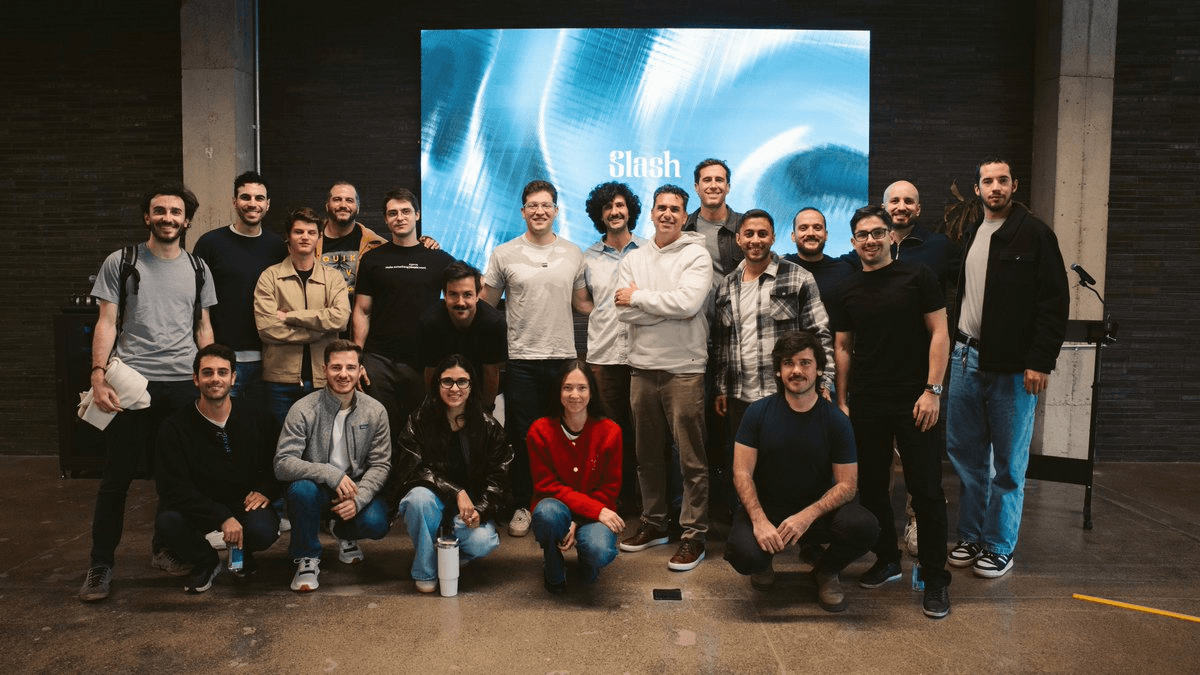
There is also a category question worth confronting directly, because Contrario is not the only way to solve the underlying problem. A company that needs hires can buy a done-for-you marketplace like Contrario, hire a traditional agency, embed a fractional recruiter, or run sourcing itself with AI software. Those are genuinely different products at genuinely different price points, and the right answer depends far more on your hiring volume and whether you have any in-house recruiting capacity than on which vendor markets best. The team photo below, from Contrario's own launch, captures the human half of its pitch, and it is a useful reminder that you are buying a service staffed by people, not a self-serve tool.
The Contrario team at its 2026 launch
The five alternatives that follow cover that entire spectrum, from the closest done-for-you marketplace rival to the cheapest DIY software you run yourself. Each one beats Contrario on at least one axis that might decide it for your team, whether that is a higher recruiter split, radically lower cost, a free tier, or an established review footprint that a one-year-old startup simply cannot offer yet.
4. The 5 Best Contrario Alternatives in 2026
The alternatives below split cleanly into two categories, and keeping them separate is the single most useful thing you can do when comparing. Done-for-you options (Paraform, Dover, traditional agencies) are like-for-like with Contrario: someone else does the recruiting and you pay per hire or per hour. Do-it-yourself options (HeroHunt.ai, Juicebox) are AI software you run yourself for a fixed monthly fee, which is dramatically cheaper per hire but requires you to own the process. They are ordered to move from closest-comp to furthest, so you can stop reading once you reach your lane.
Before the individual write-ups, it helps to see the cost gulf between the two categories on a single hire. The chart below models the effective cost to fill one $150,000 engineering role, using each option's disclosed fee structure. The done-for-you services cost tens of thousands per hire; the DIY software costs a monthly subscription.
Cost to Fill One $150k Engineering Role (2026)
The chart makes the strategic picture unmissable. The market splits into two worlds separated by two orders of magnitude: done-for-you services (traditional agencies, Contrario, Paraform) clustered between roughly $30,000 and $45,000 per hire, and DIY software (Dover's embedded model as a middle ground, then Juicebox and HeroHunt.ai) where the cost is a monthly subscription that would fill many roles for the price of one agency placement. This is not an apples-to-apples comparison and it is not meant to be, because the two worlds sell different things: the expensive options sell you the labor and the outcome, the cheap options sell you the tool and make you supply the labor. Which side you belong on is the real decision, and it turns almost entirely on whether you have anyone in-house to run sourcing.
4.1 Paraform: The Closest Done-For-You Rival
Paraform is the most direct comparison to Contrario: a recruiter marketplace that connects companies, especially startups from seed to Series B, with a network of independent expert recruiters on a contingency basis, paying only on a successful hire. The fee model is nearly identical, running roughly 20% to 25% of first-year salary, which on a $150k role lands between $30,000 and $37,500 - Paraform for companies. Like Contrario, Paraform layers software on top of the human network to manage the workflow, and it has raised $65 million to build out the marketplace, giving it more scale and a longer track record than Contrario's one year.
The single sharpest difference is the recruiter split, and it cuts in the recruiter's favor. Paraform pays its recruiters an 80% split on each placement versus Contrario's 50% to 70%, a differentiator Paraform markets aggressively to attract top independent recruiters to its side of the marketplace - Paraform for recruiters. For an employer, a more generous split can mean access to stronger recruiters, though Contrario counters that its lower split funds a deeper AI layer. The honest trade-off is maturity versus AI-native design: Paraform is the more established marketplace with a longer proof record, while Contrario is the newer, more aggressively AI-integrated challenger. Paraform is best for a company that wants the done-for-you contingency model from a marketplace with more scale and a recruiter network incentivized by an industry-leading split.
4.2 Dover: The Cheaper Embedded and Free-ATS Option
Dover is the strongest option for a team that wants human recruiting help without paying a full contingency fee, because it prices on hours rather than a percentage of salary. Its recruiter marketplace lets recruiters set their own hourly rates with no placement fees, so your total cost is simply hours worked times rate, which Dover reports ranges from roughly $300 to $30,000 per hire depending on role complexity, and starts with an $800 fully refundable deposit where you pay only for hours actually used - Dover pricing. Dover's own comparison content pegs the effective embedded-recruiting cost per hire in the $4,000 to $7,000 range for typical roles - Dover fractional recruiter costs.
On top of the marketplace, Dover offers a genuinely free ATS with unlimited jobs and users, 100+ job-board integrations, and AI applicant scoring, with paid tiers adding premium sourcing and AI features. That combination makes Dover a hybrid: you can run your own pipeline free and pull in fractional recruiter hours only when you need them, which is a fundamentally more cost-controlled model than a percentage-of-salary contingency fee. The trade-off is that Dover's hourly model gives you less of a guaranteed outcome than Contrario's pay-on-hire contingency, since you pay for hours whether or not they produce a hire. Dover is best for cost-conscious startups that want optional human help layered on a free ATS, and that would rather pay for hours than surrender 25% of a salary per placement.
4.3 HeroHunt.ai: The Autonomous DIY Recruiter
HeroHunt.ai is the do-it-yourself alternative for teams that would rather own sourcing than outsource it, and it inverts Contrario's economics entirely. Instead of paying a percentage of each hire, you pay a fixed monthly subscription from $99 per month with an 8-day free trial, and its AI Recruiter autonomously sources candidates from over 1 billion profiles, screens them, writes personalized outreach, and runs multi-channel follow-ups across LinkedIn, email and WhatsApp - HeroHunt.ai plans. The companion RecruitGPT generates a candidate shortlist from a single plain-language prompt, which is the closest thing to describing a role and getting engaged candidates back without a human in the loop.
The structural advantage over Contrario is cost per hire, and it is enormous. Where Contrario charges tens of thousands per placement, HeroHunt's subscription gives you unlimited positions and searches for a fixed monthly fee, so a team hiring at any real volume pays a fraction per hire. Tiers scale by two monthly allowances, AI-screened and matched profiles delivered and candidate emails found, from Starter (2,000 profiles and 500 emails) through Pro (5,000 and 1,000) and Team (3 users sharing 25,000 and 4,000), with allowances resetting each month - HeroHunt.ai plans. With 15,000+ recruiters using it globally, it also has an adoption base a one-year-old marketplace cannot match. The honest trade-off is that HeroHunt is software, not a service: you own the process, review the AI's output, and make the hiring decisions yourself, where Contrario hands you a managed outcome. It is best for teams with any in-house recruiting capacity that want to automate sourcing and outreach at a fixed cost rather than pay per head.
HeroHunt.ai
The comparison that decides this article is not feature lists, it is who supplies the labor. Contrario's roughly 25% contingency fee buys you a recruiter and a managed outcome; the AI Recruiter is the do-it-yourself side of the same job, searching over 1 billion profiles, screening them against the role, and running personalized multi-channel follow-ups across LinkedIn, email and WhatsApp for a fixed monthly fee instead of a percentage of every salary. The honest caveat: plans meter AI-screened and matched profiles and candidate emails per month, with allowances resetting each month, so a burst of reqs in one week can use up the month's allowance, and no one vets the shortlist or manages the search on your behalf the way a Contrario recruiter does. If your real bottleneck is that nobody on the team has time to recruit at all, the done-for-you fee is still buying something this does not.
4.4 Juicebox (PeopleGPT): The Proven DIY Search Engine
Juicebox, marketed as PeopleGPT, is the other strong DIY software alternative, and it is the tool that popularized natural-language candidate search. You describe your ideal candidate in plain English and its AI returns matches from a database of 800 million+ profiles, replacing the Boolean-search grind with a conversational one - Juicebox pricing. It crossed $10 million in ARR with more than 2,500 customers and raised a $30 million Series A from Sequoia in September 2025, so unlike Contrario it has substantial third-party-verified traction and staying power - Juicebox pricing.
On price, Juicebox is transparent where Contrario is not: a free tier with limited searches, a Starter plan at $139 per seat per month (roughly $119 annually) with 250 monthly credits, a Growth plan at $199 per seat, and autonomous sourcing agents as a $199 per agent per month add-on, so a single seat plus an agent runs around $338 per month - Juicebox pricing. That is a rounding error next to a $37,500 contingency fee, but the comparison is not fair in either direction: Juicebox finds and contacts candidates, it does not vet them or manage the search for you the way Contrario's human recruiters do. Its outreach is also email-centric and its deeper ATS integrations sit behind custom Business contracts. Juicebox is best for a team that wants the most proven natural-language sourcing engine and has the in-house capacity to run the pipeline itself.
4.5 Traditional Agencies: The Incumbent Benchmark
Traditional and boutique contingency agencies remain the default that Contrario is built to displace, and they are worth understanding precisely because Contrario prices against them. A standard contingency agency charges 15% to 25% of first-year salary, paid only on a successful hire, while retained search for senior and executive roles runs 25% to 35% - Leonar. On a $150k role, that is roughly $22,500 to $37,500 for contingency and up to $52,500 for retained search, which is why Contrario's "generally 25%" is positioned as the top of contingency but below retained.
What a traditional agency gives you that the newer marketplaces claim to improve on is a dedicated, relationship-driven recruiter who knows your industry deeply, often with decades of network in a specific vertical. What it lacks is the AI acceleration and the speed: Contrario claims candidates 3x faster than a traditional agency, and whether or not that exact multiple holds, the structural point is that a human-only agency has no AI layer to compress sourcing and coordination - Yahoo Finance. The other consideration is variance: agency quality ranges enormously, from elite boutiques to churn-and-burn shops, where a curated marketplace at least applies a consistent vetting layer. Traditional agencies are best for specialized senior or executive roles in a specific vertical where a deep, human relationship and industry network matter more than speed or AI-driven cost efficiency.
5. Full Comparison: Pricing and Models
The table below distills Contrario and the five alternatives into the dimensions that actually drive the decision: the pricing model, the effective cost to fill one $150k role, whether pricing is public, and who each option is best for. Read it as a lane-finder: the top rows are done-for-you services priced per hire, the bottom rows are DIY software priced per month, and Manatal sits between them as the affordable tooling floor if you decide to run hiring in-house. Confirm current numbers before committing, since fees change and several of these are demo-gated.
| Option | Model | Cost per $150k hire | Pricing public? | Best for |
|---|---|---|---|---|
| Contrario | Contingency ~25% | ~$37,500 | No (demo-gated) | Fast AI-assisted done-for-you hiring |
| Paraform | Contingency ~20-25% | ~$30,000-37,500 | Partial | Marketplace with 80% recruiter split |
| Traditional agency | Contingency/retained 15-35% | $22,500-52,500 | Varies | Specialized senior/exec roles |
| Dover | Hourly + free ATS | ~$4,000-7,000 | Yes | Cost-controlled embedded help |
| Manatal | ATS subscription | $15/user/mo | Yes | Affordable in-house tooling floor |
| Juicebox | SaaS ~$99-378/mo | ~$378/mo | Yes | Proven DIY natural-language search |
| HeroHunt.ai | SaaS from $99/mo | from $99/mo | Yes | Autonomous DIY sourcing at scale |
The pattern in the table is the whole decision compressed into one view. The three done-for-you options at the top cost roughly a hundred times more per hire than the DIY software at the bottom, and that gap is not a pricing error, it is the price of labor. Contrario, Paraform and traditional agencies charge tens of thousands because a human runs the search and you buy the outcome; Dover splits the difference by selling hours instead of outcomes; and HeroHunt.ai, Juicebox and the Manatal tooling floor charge a monthly fee because you run the search and buy only the tool. On transparency, Contrario is the outlier at the top: it is the only done-for-you option that will not disclose its model without a demo, where even Paraform and traditional agencies publish or readily quote their percentage bands.
One thing the table cannot capture is total annual cost, and it is where the per-hire number can mislead in both directions. A team hiring two hard roles a year pays Contrario roughly $75,000 total, which is cheaper than a $200,000+ in-house recruiter plus software. A team hiring fifteen roles pays Contrario over $560,000, where a $99-per-month DIY tool plus one in-house recruiter would cost a fraction. The contingency model is cheapest at low volume and brutally expensive at high volume; the subscription model is the reverse, carrying a fixed cost that only pays off once you hire enough to amortize it. Build a twelve-month total at your actual hiring volume before choosing, because volume, not the per-hire sticker, is what flips the answer.
6. How to Choose the Right Alternative
Choosing among these options comes down to three questions in order: do you have any in-house recruiting capacity, how many roles do you hire per year, and how specialized or urgent are those roles. Answering them in sequence eliminates most of the list fast, because the options are genuinely differentiated by hiring model rather than interchangeable. The decision tree below maps the most common paths a team takes through those questions.
The tree encodes the logic most teams actually follow. If you have no in-house recruiting capacity and need the work done for you, the split is between specialization (Paraform or a traditional agency for hard senior roles delivered as a managed outcome) and cost control (Dover, where you buy recruiter hours on a free ATS rather than surrender a percentage of salary). If you do have capacity and can run sourcing yourself, the question becomes budget: HeroHunt.ai or Juicebox to automate the sourcing at a fixed monthly fee, or Manatal as the cheapest transparent ATS to organize an in-house pipeline you run manually. Contrario itself is the right answer specifically when you have no capacity, hire in bursts of a few important roles, and value AI-accelerated speed enough to pay the top of the contingency band for it.
The one factor the tree cannot decide for you is how much you value a managed outcome versus owning the process, because that is the real fork. Contrario and its done-for-you rivals sell you an outcome: candidates arrive vetted and interview-ready, and you pay for that convenience with a five-figure fee per hire. The DIY tools sell you leverage: they make one recruiter as productive as several, but someone on your side still has to point them at the right roles and make the calls. If your bottleneck is that no one on your team has time to recruit, the done-for-you fee buys back that time and may be worth it. If your bottleneck is simply that manual sourcing is slow, DIY software solves it for a fraction of the cost, and the honest move is to try both a done-for-you demo and a free DIY trial in parallel.
Whatever the tree points you toward, run the same structured pilot across your top two choices rather than committing on a pitch alone. Pick one live role that represents your typical hiring, then measure three things: how many qualified candidates each option surfaced, how many advanced to a real interview, and the true cost per qualified hire once you include your own time. Because the DIY options are free or cheap to trial, you can run a HeroHunt.ai or Juicebox pilot alongside a Contrario or Paraform demo and let the results break the tie. This is also the only reliable way to test a marketplace's real quality, since a curated network's value lives entirely in whether its recruiters and AI actually deliver better candidates than you could source yourself, and no self-reported "80% advance to interview" stat will tell you how it performs on your specific reqs.
7. The Bottom Line
Contrario is a genuinely promising service wrapped in genuine uncertainty. Its AI-plus-human model, Slack-native workflow, pay-on-hire structure and blistering early growth are real advantages, and for a startup with no recruiting function that needs a hard role filled fast, its roughly 25% contingency fee can be worth every point. The problems are that you cannot confirm that fee without a demo, the company is under a year old with almost no independent review footprint, and every headline number is self-reported. In a category this new, buying on the company's word alone is an avoidable risk.
For most teams evaluating Contrario in 2026, the smarter path is to first decide which side of the line you are on. If you need the work done for you and value AI speed, Contrario and Paraform are the direct comparison, with Paraform offering a more established marketplace and a higher recruiter split, while a traditional agency still wins for deeply specialized senior roles. If you want cost control with optional human help, Dover's hourly model on a free ATS is the most economical done-for-you option. And if you have any in-house capacity at all, the DIY route is dramatically cheaper: HeroHunt.ai automates sourcing and outreach from a fixed monthly fee, and Juicebox delivers proven natural-language search for a fraction of a single contingency placement.
If your decision is to bring hiring in-house and stop paying per head, the practical way to start is a sourcing tool you can trial on one live role, without a demo wall or a five-figure commitment.
Autonomous sourcing, screening and outreach on a fixed monthly plan, with no percentage-of-salary fee per hire.
Whichever way you go, insist on two numbers before signing anything with a done-for-you service: the exact contingency percentage in writing, and the replacement-guarantee window with its precise duration. Those two figures, not the launch-day traction stats, determine what a recruiting marketplace actually costs you and what protection you get when a hire does not work out.
This guide reflects the AI recruiting and marketplace landscape as of July 2026. Pricing, fees and features in this category change frequently, so verify current details on each vendor's own site before purchasing.