



The 2026 playbook for hiring global talent without paying a six-figure visa tax.
In twelve months the $100,000 H-1B fee was signed, walked back, upheld in one court, struck down in another, and reborn as a proposed $103,265 rule. That whiplash is the whole story. The single largest cost shock ever attached to a US work visa arrived by presidential proclamation on September 19, 2025, then spent the next year bouncing between agencies and appeals courts - White House. As of the moment this guide went out, the fee is not being collected because a federal court vacated it, yet the government is appealing and has already proposed a permanent replacement.
Here is the problem for anyone who actually has a role to fill: the fee is unpredictable, but the routes around it are stable. You cannot plan a hire around a number that changes every quarter in a courtroom. You can plan around the fact that treaty visas, cap-exempt petitions, in-country transfers, and hiring people in their own country were never covered by the fee in the first place and never will be. Betting on the litigation is gambling. Building fee-proof hiring paths is strategy.
This guide treats the fee as a routing problem, not a wall. It breaks down exactly what the charge is and is not, where it stands legally right now, what a new H-1B hire truly costs today, and then walks through five concrete routes that legally sidestep the six-figure charge: keeping people already here, cap-exempt sponsors, the treaty and specialty visa alphabet, the recent-graduate and green-card path, and hiring abroad without relocating at all. It closes with a decision framework that maps a real hire to the cheapest legal path. For the broader policy backdrop, our companion piece on the $100K fee's implications and workarounds goes deeper on the politics; this one is the operator's manual.
A note on who this is for. If you are a recruiter, a founder, a hiring manager, or a people-operations lead who has been told that hiring a foreign national now means a six-figure bill, this guide is written to give you back the options that panic took away. It assumes no immigration-law background and translates the categories into plain hiring decisions. It is not legal advice, and every serious hire should involve immigration counsel, but it will let you walk into that conversation already knowing which path fits your candidate, which is where most of the wasted time and cost hides.
Contents
- The fee is a routing problem, not a wall
- What the $100K fee actually is (and what it is not)
- Where the fee stands in the courts right now
- The real cost math of a new H-1B hire
- Route 1: Keep the people already in the US
- Route 2: Cap-exempt H-1B, the quiet loophole
- Route 3: The fee-immune visa alphabet
- Route 4: Hire the new grad, start the green card early
- Route 5: Do not relocate, hire abroad
- What the giants are actually doing
- Your 2026 decision framework
1. The fee is a routing problem, not a wall
The most important thing to understand about the $100,000 fee is how narrow it is. It never applied to every H-1B worker, every petition, or every employer. By its own terms it attaches only to new petitions for people who are outside the United States and have to enter on a fresh H-1B visa - Yale OISS. Everything else, and there is a lot of everything else, sits outside the charge. That single design choice is why a fee that looks like a wall is really a fork in the road: the same hire can often be re-routed onto a path the fee cannot touch.
Think of a candidate as a packet that needs to reach a US payroll. There are many ways to route that packet, and only one of them, the classic cap-subject H-1B for a worker abroad, runs through the tollbooth. A worker already inside the country on a valid status takes a different road entirely. A Canadian, an Australian, a Chilean, or a Singaporean has a treaty lane. A genuinely exceptional researcher or executive has the O-1 and L-1 lanes. A recent US graduate has an OPT lane that costs the employer nothing. And a role that does not truly need a US desk can be filled in the worker's own country, where no US visa is involved at all. The fee only wins when you insist on the one road it guards.
This reframing has a practical payoff that shows up immediately in a sourcing pipeline. When immigration is treated as a wall, a recruiter filters out every candidate who would need sponsorship, quietly shrinking the funnel by a third or more in technical fields. When it is treated as a routing problem, those same candidates come back into play, each tagged with the path that fits them, and the only ones who remain genuinely hard are a narrow band of mid-career workers abroad in non-treaty countries. The size of that reframing is the difference between competing for talent in a picked-over domestic pool and competing in the global one, which is where most of the scarce AI and engineering skill actually lives.
The diagram below is the mental model for the rest of this guide. Start with the hire you actually have, then follow the branches to the path that skips the six-figure charge.
Why this matters: most employers reacted to the fee emotionally, with a hiring freeze on anyone who was not a US citizen. That is an overcorrection that hands your competitors the talent. The fee removed exactly one option from a menu of eight or nine. How to apply it: before you reject a candidate over immigration cost, run them down the tree. In practice the majority of skilled hires land on a branch that never touches the fee, and the ones who do not can usually be employed in their home country while you decide whether US relocation is even necessary. The rest of this guide is that tree, expanded.
2. What the $100K fee actually is (and what it is not)
The charge is a one-time payment of $100,000 tied to a single new H-1B petition, paid by the employer, for a worker who is abroad and needs to enter on a new visa. It is not annual, not per year, and not a renewal cost. That distinction sounds pedantic until you remember that for a full day after the proclamation, the market believed the opposite. On September 19, 2025, Commerce Secretary Howard Lutnick described it publicly as a charge companies would pay every year, and that it would hit renewals, which triggered a genuine panic across the tech sector - Business Today. Within roughly a day the White House corrected the record, with Press Secretary Karoline Leavitt stating plainly that it is not an annual fee and applies only to the petition for a new visa - Al Jazeera.
The proclamation rests on the president's authority under INA sections 212(f) and 215(a) to restrict the entry of foreign nationals, the same suspend-entry power used for travel bans - White House. That legal foundation is precisely what later got it into trouble, because a payment tied to entry looks a lot like a tax, and the power to tax belongs to Congress. The restriction took effect at 12:01 a.m. Eastern on September 21, 2025 and was written to last twelve months unless extended, which puts its nominal sunset right around the time this guide published - AILA. The payment itself runs through the Treasury's Pay.gov system, and proof of payment has to accompany the petition.
The phrase that does the heavy lifting is outside the United States. The fee keys off whether the beneficiary needs to be admitted from abroad on a new H-1B visa, which is why the same person can be fee-subject or fee-exempt depending only on where they are standing when the petition is filed. A worker in Bangalore who needs consular processing is exposed; the identical worker who happens to already be in the US on an F-1 or L-1 and requests a change of status is not. That is not a drafting accident, it flows directly from the 212(f) entry-restriction theory the proclamation is built on, and it is the seam that every route in this guide widens into a door.
The short official explainer below captures the mechanics cleanly, and those mechanics are still accurate about the proclamation even though its legal status has since moved.
How the new $100,000 H-1B visa fee works
What the fee explicitly does not touch is the entire installed base of the program. Anyone holding an H-1B visa issued before the effective date can travel and re-enter freely. Petitions filed before September 21, 2025, and petitions requesting a change of status, amendment, or extension for someone already inside the country are all outside the charge - American Immigration Council. There is a national-interest waiver written into the proclamation, but officials signaled it would be extraordinarily rare and requires the Homeland Security Secretary to personally find the hire is in the national interest, so no serious hiring plan should depend on it - White House.
The scale of the exempt zone is the punchline. In FY2024 the program produced close to 400,000 approvals, but only about 141,000 of those were new employment; the remaining roughly 258,000 were renewals and continuations for people already working in the US - Pew Research Center. In other words, the large majority of all H-1B activity in a normal year is exactly the extension-and-continuation traffic the fee never touched. The charge was aimed at the minority of the program that brings new workers in from abroad, which is why so much of a company's existing and prospective H-1B workforce sits safely outside it.
It also helps to know who the fee was aiming at, because that tells you who is safe. The H-1B program is heavily concentrated: India-born workers received roughly 73% of H-1B visas in 2023, with China a distant second, and about two thirds of recipients work in computer-related jobs at a median salary near $123,600 - Pew Research Center. A charge on new petitions for workers abroad is, in effect, a charge aimed squarely at that population.

Why this matters and how to apply it: the exemptions are not fine print, they are the first and cheapest workaround. If your candidate is already in the US in any valid status, or already holds an H-1B, the fee is a non-issue and you are simply doing normal paperwork. The people who genuinely trigger the charge are new entrants from abroad, and for them you route to a different visa, which is the rest of this guide.
3. Where the fee stands in the courts right now
As of early September 2026, the $100,000 fee is not enforceable, but treating that as permanent would be a mistake. The status is genuinely unsettled, with two federal district courts having reached opposite conclusions and appeals live in two different circuits. Any hiring plan built on the assumption that the fee is dead could be wrong within a single news cycle, which is exactly why the durable move is to build paths that do not care how the litigation ends.
The timeline is worth knowing because it explains the volatility. The first major challenge came from the US Chamber of Commerce, which sued in the District of Columbia on October 16, 2025, later joined by the Association of American Universities - US Chamber of Commerce. A separate coalition of healthcare groups, unions, and religious orders filed Global Nurse Force v. Trump in Northern California - Justice Action Center. Then twenty states led by California brought a third suit in Massachusetts - Fragomen. On December 23, 2025, the DC district court handed the administration a win, ruling the fee fell within the president's 212(f) power to restrict entry - Fragomen.
The Massachusetts case went the other way, and decisively. On June 8, 2026, Judge Leo Sorokin vacated the fee in full, holding that a $100,000 charge functions as an unauthorized tax rather than a cost-recovery fee, and that Congress, not the executive, holds the power to impose it - Ogletree Deakins. The government appealed to the First Circuit and briefly won a stay that reinstated the fee for a few days - Klasko Immigration Law Partners. That reprieve ended on July 24, 2026, when the First Circuit refused to keep the fee alive during the appeal, meaning USCIS and the State Department cannot currently assess the $100,000 payment - Littler. With one court upholding the fee and another striking it down, commentators widely expect the fight to reach the Supreme Court - Bloomberg Law.
The legal fault line is simple to state. A fee may only recover the government's actual cost of adjudication, while a tax raises revenue, and only Congress can levy a tax. The Massachusetts court held that a $100,000 charge that the government itself admitted does not fund processing is a tax wearing a fee's clothing, and it leaned on the Supreme Court's recent skepticism of the president imposing charges without clear congressional authorization. The administration's answer is to stop calling it an entry restriction and instead run a formal rule through DHS framed as genuine interagency cost recovery, which is exactly what the August 2026 proposal attempts.
The image below lays out the two competing charges side by side, because the second one is the reason you cannot relax.
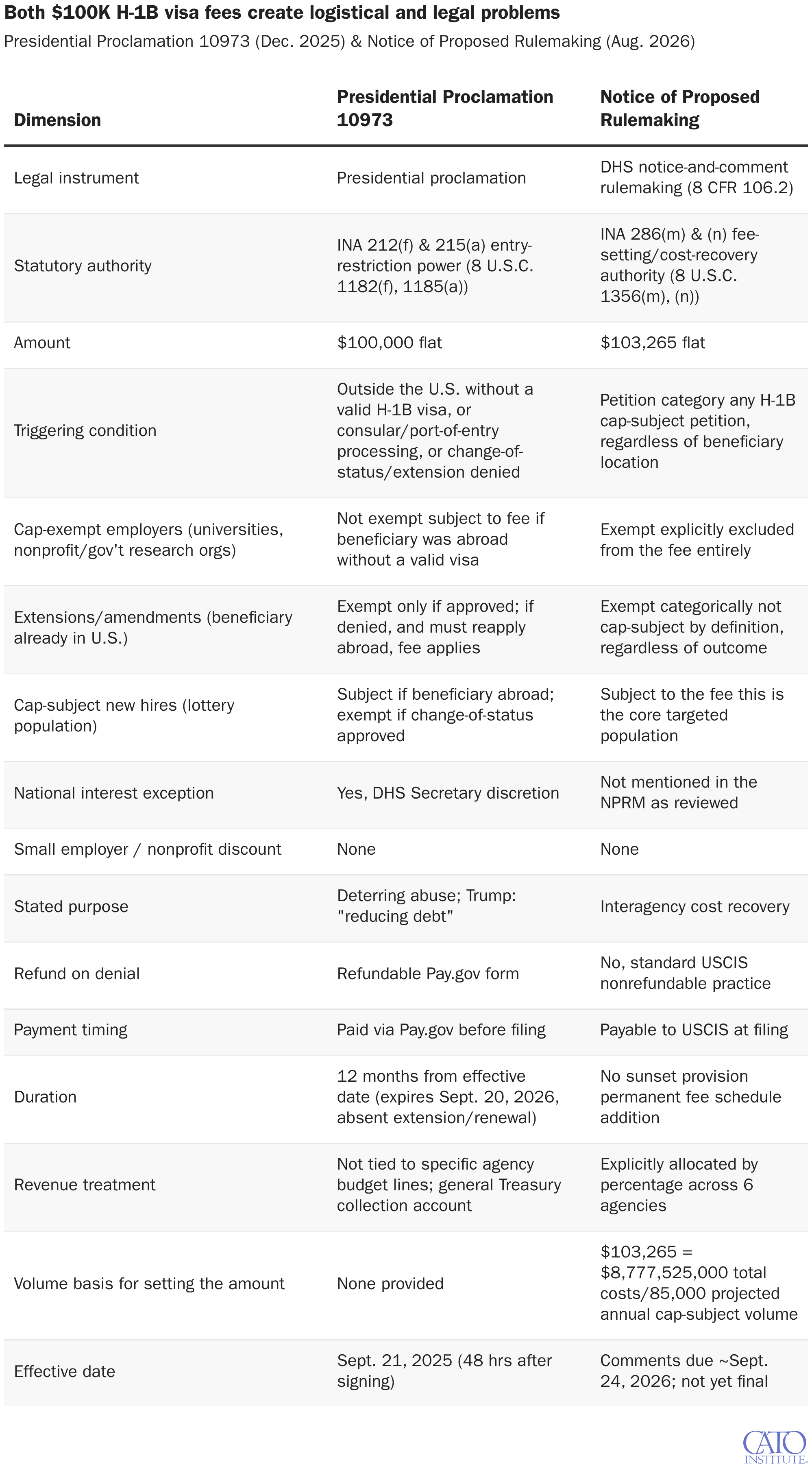
The administration is not waiting for the courts. On August 25, 2026, DHS published a proposed rule for a new fee of $103,265 on every cap-subject H-1B petition, framed as interagency cost recovery and running through the normal notice-and-comment process rather than a proclamation - National Law Review. If finalized, it could reach cap-selected petitions as early as the following spring, and because it is a rule rather than an entry restriction, it is designed to survive the exact legal argument that killed the proclamation.
Two features of that proposed rule matter for planning. First, it would hit all cap-subject petitions, including some for workers already in the US, a broader sweep than the proclamation's abroad-only trigger, which means several of the fee-avoidance routes that work against the proclamation would need re-examination if the rule is finalized. Second, it runs on a public comment period, so its timing is measured in months of rulemaking and near-certain litigation rather than the overnight shock of a proclamation. The practical read is that the six-figure fee, in one form or another, is likely to keep reappearing, which is the strongest possible argument for building hiring paths that do not depend on its absence. There has also been bipartisan pushback, including a House bill introduced in March 2026 to exempt healthcare workers from the charge, which tells you the policy is contested from both directions - Newsweek.
One more change rides alongside the fee and matters even if the fee itself disappears. DHS finalized a wage-weighted selection rule on December 29, 2025, effective February 27, 2026, that replaces the pure random lottery with a system giving higher-paid roles more entries into the pool - Federal Register.
The mechanic is worth understanding because it changes who wins. Under the weighted rule, each registration is entered into the pool a number of times equal to its wage level, so a Level IV role gets four entries, Level III three, Level II two, and an entry-level Level I role only one - Greenberg Traurig. A recent graduate at an entry wage now competes at a structural disadvantage against a senior engineer for the same cap, on top of any fee. For the roles many companies actually struggle to fill through H-1B, junior and mid-level talent, the lottery is no longer a coin flip, it is a weighted draw stacked against them, which is another reason the non-H-1B routes in this guide are often the only viable path rather than merely the cheaper one. The FY2027 cap season, with registration running March 4 to 19, 2026, was the first to operate under the new selection math - USCIS. Why this matters and how to apply it: even a cap-subject H-1B is now tilted against entry-level and lower-wage roles, so for junior hires the alternatives in this guide are not just cheaper, they are often the only realistic path.
4. The real cost math of a new H-1B hire
Before the fee, sponsoring a new H-1B was a four-figure exercise, and that baseline is what makes the six-figure charge so distorting. The standard government filing fees for a new cap petition run about $3,595 for larger employers and roughly $2,225 for those with 25 or fewer workers, built from the $215 registration fee, the base I-129 fee, the ACWIA training fee, the fraud prevention fee, and the asylum program fee - Lighthouse. Add optional premium processing, which rose to $2,965 on March 1, 2026, plus a few thousand in legal fees, and a typical all-in new H-1B lands somewhere between $5,000 and $15,000 - Ogletree Deakins. That is a real cost, but it is a rounding error against a single engineer's salary.
The $100,000 charge changes the category of decision. A cost that used to be an afterthought becomes larger than many workers' entire first-year salary, and the Cato Institute has estimated that stacking every charge across a petition's lifecycle could push the cumulative cost of one H-1B hire past $214,000 in a worst case - Cato Institute. The chart below shows the jump in scale. Notice that the fee does not make sponsorship more expensive, it makes it a fundamentally different kind of financial commitment, one that most companies will not make for an unproven hire with no guarantee the petition is even approved.
Cost of One New Cap-Subject H-1B Hire (USD)
The market reacted exactly as the math predicts. The government itself conceded in court that the fee was arguably prohibitive and does not raise revenue, and Cato's analysis found the charge drove a roughly 87% collapse in fee-subject petitions and a 77% drop in visa issuances to workers abroad while it was in force - Cato Institute. JPMorgan economists modeled the fee cutting around 5,500 work authorizations per month, close to 66,000 a year, concentrated on Indian talent - Bloomberg. This is not a fee that companies grumble about and pay. It is a fee that companies route around, which is the entire premise of this guide.
Put concrete numbers on it. Imagine hiring a data engineer abroad at a $130,000 salary. On the traditional cap H-1B route with the fee live, the employer faces roughly $12,000 in normal costs plus the $100,000 charge, close to $112,000 in year-one immigration cost before the person writes a line of code, and even then only a one-in-four chance of selection, since USCIS received 470,342 eligible registrations for FY2025 and selected just 120,603 - WSM Immigration Attorneys. Route the same engineer onto an O-1, if they qualify, and the government cost falls back under $5,000 with no lottery at all. Employ them in their home country through an Employer of Record instead, and the immigration cost disappears entirely, replaced by a service fee near $600 a month that buys a fully compliant local employee. The fee does not change who you want to hire, it changes which of these three doors you walk them through.
There is a second-order effect worth pricing in. The Penn Wharton Budget Model projected that the fee and wage weighting together shift selections toward higher-paid workers, lifting the mean compensation of selected H-1B workers by roughly $7,551 to $18,799 and cutting the share going to workers with no prior US visa - Penn Wharton Budget Model. Why this matters and how to apply it: the surviving H-1B path is increasingly reserved for senior, expensive roles. If your hire is early-career, a new graduate, or simply not a market-topping salary, the traditional cap H-1B is now a bad bet on cost and on selection odds, and one of the following routes will almost always serve you better.
5. Route 1: Keep the people already in the US
The cheapest way around the fee is to hire someone the fee already exempts, and the largest such pool is the people already working in the United States. Every petition that requests a change of status, an extension, an amendment, or a change of employer for a worker who is physically in the country and in valid status sits entirely outside the $100,000 charge - American Immigration Council. You pay the ordinary I-129 fees and nothing more. This is not a loophole so much as the plain design of the proclamation, which only ever targeted entry from abroad.
For recruiters, this reframes the entire candidate market. An H-1B worker at another company is now dramatically more valuable to you than an identical candidate sitting overseas, because transferring an existing H-1B is a routine, fee-free filing while importing a new one is a six-figure gamble. The same logic applies to the enormous population of people already in the country on other statuses: F-1 students on Optional Practical Training, L-1 transferees, TN and E-3 holders, and dependents with work authorization can often change to H-1B or another status from inside the US without ever triggering the entry-based fee. The moment a worker is on US soil in valid status, the expensive road is closed to them and the cheap roads open.
Two mechanics make this route more powerful than it looks. The first is H-1B portability under the American Competitiveness in the Twenty-First Century Act, which lets a worker who already holds H-1B status begin working for a new employer the moment a non-frivolous transfer petition is filed, without waiting for approval and without any entry-based fee. The second is cap-gap for F-1 students, which automatically extends work authorization for a graduate whose H-1B change-of-status petition is pending, bridging the window between OPT expiring and the H-1B start date. Neither mechanism involves a consular entry, so neither triggers the $100,000 charge. Together they mean that a huge amount of skilled-worker movement inside the US, job changes, promotions, and student-to-professional transitions, happens entirely in the fee-free zone.
There is one edge to respect. The exemption is tied to the worker staying inside the country through the process. If a change-of-status request is denied and the petition can only be approved through consular processing abroad, the fee can re-attach, and a worker who leaves before their new status is approved can complicate the picture. The practical guidance the largest employers gave their own staff in September 2025 was blunt: stay in the US and avoid international travel until the dust settled - Yahoo News. Amazon, Microsoft, Google, JPMorgan, and Goldman Sachs all sent versions of that memo within 48 hours of the proclamation.
For recruiting teams this creates a concrete tactic: prioritize candidates who already hold H-1B status at other employers. A worker three years into an H-1B at a large firm can move to you on a transfer that starts the day you file, with only standard fees, no lottery, and no exposure to the proclamation, which makes them functionally easier to hire than a US citizen who needs to give notice. In a market where the fee froze many employers into inaction, the pool of transfer-ready H-1B workers is both large and underpursued, and the companies that actively recruit into it are picking up senior talent their competitors have written off as too expensive to touch.
Why this matters: retention and internal mobility are now immigration strategy. Every H-1B worker you keep, and every status change you handle in-country, is a hire you did not have to route through a fee or a lottery. How to apply it: audit your existing workforce for anyone whose status is up for renewal or who could transfer in from a competitor, and prioritize those moves. For a structured view of the compliance mechanics involved in sponsoring and transferring international staff, our guide to international recruiting compliance covers the paperwork discipline this route depends on. The people already here are the first place to look, not the last.
6. Route 2: Cap-exempt H-1B, the quiet loophole
A specific class of employer can file H-1B petitions with no lottery, no annual cap, and no fee, at any time of year, and most recruiters never think about them. These are the cap-exempt employers: institutions of higher education, nonprofit organizations affiliated with a university, nonprofit research organizations, and governmental research organizations - RN Law Group. Petitions filed by these employers were expressly excluded from the $100,000 proclamation and are also excluded from the proposed $103,265 rule, because both carve out cap-exempt filings. For the right role, this is the single cleanest way to put a foreign national on a US payroll on an H-1B without touching the machinery the fee lives in.
The power of this route is that it removes two constraints at once. There is no lottery, so you are not praying for a 25% selection rate, and there is no October start-date wait, so you can file and onboard year-round. A university can hire a researcher in March and have them working weeks later.
The practical scope is wider than the word university suggests. Nonprofit research organizations, from independent institutes to many teaching hospitals, and governmental research organizations at the state or federal level all file cap-exempt, and a nonprofit that is affiliated with or related to a higher-education institution can qualify even if it is not itself a school. The caution is that USCIS scrutinizes the affiliation and the research purpose, so the qualification has to be genuine and documented, not asserted. Where it holds, though, the employer gains something no private company can buy at any price: an H-1B pipeline with no lottery, no annual cap, and no six-figure fee, available every month of the year. The eligibility is broader than people assume: nonprofits with the right IRS status that are genuinely affiliated with a university or that conduct qualifying research can qualify, which pulls in hospitals attached to medical schools, research institutes, museums, and similar organizations well beyond obvious campuses.
A concrete version makes the concurrent strategy legible. Suppose a machine-learning researcher is blocked from a startup by the lottery and the fee. A university lab hires them cap-exempt into a genuine part-time research role, which puts them in valid H-1B status year-round with no lottery and no charge. The startup then files a concurrent H-1B for the same person, and because they already hold cap-exempt status, that concurrent petition is not subject to the annual cap either. The arrangement only works if the cap-exempt job is real, paid, and performed, and it demands coordinated counsel on both sides, but for research-adjacent talent it turns a closed door into two open ones. The eligibility test to remember is that it is the petitioning employer's nature, not the worker's, that grants the exemption, so the entire strategy is about finding or partnering with a qualifying institution.
There is even a strategy for companies that are not themselves cap-exempt, called concurrent or cap-exempt bridge employment. Because H-1B allows multiple employers, a worker can hold a cap-exempt H-1B with a university or research nonprofit as their primary employer while working part-time for a private company on a concurrent H-1B, or use the cap-exempt position to maintain status while pursuing other options. It requires genuine, bona fide employment at the cap-exempt institution, not a paper arrangement, and it demands careful legal structuring, so it is not a casual tactic. But for research-heavy startups, university-adjacent labs, and healthcare systems, it is a legitimate and underused path.
Why this matters and how to apply it: if the role could plausibly live at or alongside a university, a teaching hospital, or a research nonprofit, you may have access to an H-1B lane with none of the fee or lottery risk that dominates the rest of this guide. The catch is that the employer identity, not the worker, determines eligibility, so this route only exists if you are, or can partner with, a qualifying institution. Where that fits, it is often the best answer on the entire tree.
7. Route 3: The fee-immune visa alphabet
For workers who are neither already in the US nor eligible for a cap-exempt sponsor, the next stop is the set of visas that were never covered by the proclamation at all. Treaty-based and specialty categories sit outside the H-1B entirely, so the $100,000 charge simply does not apply to them - RN Law Group. Each one fits a specific candidate profile, and between them they cover a surprising share of skilled hires. The trick is knowing which letter matches which person, so this section walks the alphabet from the most common to the most specialized.
Nationality unlocks the easiest lanes. A citizen of Canada or Mexico can use TN status under the USMCA, which has no cap and no lottery. A Canadian can request TN right at a US port of entry, often approved the same day, for a filing cost around $56, while a Mexican applies at a consulate with a roughly $185 visa fee, and TN is granted in three-year increments that renew indefinitely - ImmigrationQuestion. The main constraint is that the job must match one of the professions on the USMCA list. For an eligible North American professional, TN is faster, cheaper, and simpler than an H-1B ever was, fee or no fee.
Each treaty visa carries quirks worth knowing before you promise a start date. TN is adjudicated on the spot at the border for Canadians, which is fast but unforgiving: a thin job-to-degree match can draw a refusal from a single officer, so the paperwork must map the role precisely to a listed profession, and TN does not permit self-employment. E-3 requires a certified Labor Condition Application attesting to the prevailing wage, the same wage protection as H-1B, and renews in two-year blocks. H-1B1 also needs an LCA, is not eligible for premium processing, and pointedly does not allow dual intent, so a worker who wants to pursue a green card should treat it as a bridge rather than a destination. None of these frictions come close to a $100,000 charge, but they are the difference between a smooth hire and a bounced one.
Two more treaty categories cover specific nationalities cleanly. E-3 is reserved for Australian nationals in specialty occupations, capped at 10,500 visas a year that are essentially never exhausted, so it functions without a lottery, and E-3 spouses can work without even filing for a separate work permit - USCIS. H-1B1 covers citizens of Chile and Singapore under a separate annual quota of 6,800 that also never fills, making it effectively lottery-free, though it is granted in one-year increments and does not allow dual intent toward a green card - BAL. For candidates from these four countries, the answer to the H-1B fee is simply to not use an H-1B.
When nationality does not open a lane, achievement and corporate structure often do. Two categories carry no cap and no lottery and fit the strongest candidates.
- O-1 is for individuals of extraordinary ability in science, business, education, athletics, or the arts, proven by a major award or by meeting at least three of eight regulatory criteria, with government fees near $1,055 on the base petition plus the asylum program fee and optional premium processing - DavidsonMorris.
- L-1 is the intracompany transfer visa for a worker who has spent at least one continuous year in the prior three at a related foreign entity, with base fees around $1,385 plus fraud and asylum fees, and it splits into L-1A for managers, valid up to seven years, and L-1B for specialized knowledge, up to five - NNU Immigration.
These two deserve emphasis because they change how you should think about global talent. O-1 is not only for Nobel laureates; a strong engineer or researcher with a real record of publications, patents, press, or judging can often qualify, and immigration counsel increasingly treats it as the default premium alternative to H-1B. L-1 rewards companies that already have a foreign office, because a worker you cannot bring in directly can be hired abroad, seasoned for a year at your overseas entity, and then transferred in on L-1 with no cap exposure. That path takes planning, but it converts a blocked hire into a fee-free transfer, and it pairs naturally with the hire-abroad strategy in Route 5. One caveat to price in for large, visa-heavy employers: a new 9-11 Response and Biometric Entry-Exit fee now layers onto H-1B and L-1 petitions from covered employers with 50 or more US staff who are majority H-1B or L-1, effective for petitions filed on or after September 9, 2026 - USCIS.
It helps to know what the O-1 evidence actually looks like, because employers routinely underestimate who qualifies. The eight criteria include published material about the person, membership in associations that demand outstanding achievement, an original contribution of major significance, authorship of scholarly articles, employment in a critical capacity for a distinguished organization, a high salary, judging the work of others, and receipt of lesser nationally or internationally recognized awards. A mid-career engineer with patents, conference talks, open-source projects that have real adoption, and a senior title at a known company can often assemble three of these without being a household name. When more than one category fits a candidate, choose on speed and permanence: TN and E-3 are fastest for eligible nationals, O-1 is the strongest nonimmigrant option for the exceptional, L-1 is best when a foreign entity already exists, and if the person is clearly green-card material, the self-petition routes in the next section can leapfrog the temporary visa entirely.
Why this matters and how to apply it: the alphabet visas are not exotic fallbacks, they are the mainstream answer for a large fraction of skilled foreign hires, and none of them ever cost six figures. Screen every candidate for nationality first, because a Canadian, Australian, Chilean, or Singaporean is a same-week, low-cost hire, then screen for extraordinary ability or an existing foreign-office relationship. Our overview of sponsoring visa-eligible international talent goes deeper on matching candidates to categories. The H-1B is one letter in a long alphabet, and it is the only expensive one.
8. Route 4: Hire the new grad, start the green card early
Recent graduates from US universities are the most fee-proof hires in the country, because they arrive with work authorization the employer does not pay for. A foreign student on an F-1 visa gets twelve months of Optional Practical Training after graduation, and a graduate in a STEM field gets an additional 24 months, for 36 months of work authorization with no cap, no lottery, and no employer petition fee - DHS Study in the States. The student files the paperwork and pays the modest government fee themselves, currently $470 to file the I-765 online, so the direct cost to the hiring company is essentially zero - Lighthouse. For a company willing to recruit on campus, this is three years of a skilled employee with none of the immigration cost that dominates the rest of this guide.
The reason STEM OPT is a strategy and not just a stopgap is what you do with the three years. During that window the worker is fully productive, and the employer has time to pursue a durable status without the pressure of a status cliff. The obvious next step used to be entering the H-1B lottery, but with the fee and the wage-weighted selection now stacked against junior roles, the smarter play for a genuinely strong graduate is often to skip straight to a green card. Two employment-based categories allow the worker to self-petition, meaning no labor certification and, in the strongest cases, no dependence on the employer at all.
The green-card routes matter here because they are permanent and, for the right candidate, faster than people expect. EB-1A, for individuals of extraordinary ability, allows a self-petition with no employer sponsor and no labor certification, at an I-140 filing fee of $715 plus optional premium processing, and as a first-preference category it often carries current or near-current priority dates - Manifest Law. EB-2 NIW, the National Interest Waiver, similarly permits a self-petition with no job offer and no PERM labor certification for a worker with an advanced degree or exceptional ability who can satisfy the three-part Dhanasar test, at the same $715 I-140 fee - Boundless. For a researcher, founder, or specialist with a real record, starting an NIW during the OPT window can produce a green card before the OPT clock even runs out.
The route does carry real employer obligations, and getting them right is what keeps it clean. STEM OPT requires the employer to be enrolled in E-Verify and to complete a formal training plan on Form I-983 that describes the learning objectives and supervision, and the government can audit that the role is genuine and paid comparably to US peers. Those are administrative steps, not costs, but they are non-negotiable. On the green-card side, the timing math rewards early filing: because EB-1A and EB-2 NIW allow self-petition, you can begin the I-140 in the first months of employment, and for candidates chargeable to most countries the priority dates are current or nearly so, meaning the limiting factor is how fast you assemble the evidence rather than a decade-long queue. The two big exceptions are workers born in India and China, where EB-2 backlogs remain long enough that EB-1A, when the candidate qualifies, is worth the extra evidentiary effort.
A simple timeline shows how forgiving this route is. Hire a STEM graduate in June on the standard twelve-month OPT. During that year, file the 24-month STEM extension well before OPT expires, which alone carries the worker into a third year of authorized work. In parallel, if the graduate is strong, begin an EB-2 NIW self-petition in the first quarter of employment; for many candidates the I-140 is approvable and, where the priority date is current, adjustment of status can follow without the person ever needing an H-1B. The entire arc, from campus offer to pending green card, can run without a lottery entry or a proclamation fee, which is why the patient graduate route quietly out-competes the frantic lottery route for building a durable team.
Why this matters and how to apply it: campus recruiting and early green-card sponsorship together form a pipeline that never touches the H-1B fee. Hire the STEM graduate on OPT at near-zero immigration cost, identify within the first year which hires are strong enough for EB-1A or EB-2 NIW, and file those self-petitions early. You convert a temporary work permit into permanent residence without ever entering the lottery, and you lock in talent that competitors relying on H-1B cannot secure. This is the patient route, and for building a durable technical team it is often the best one on the board.
9. Route 5: Do not relocate, hire abroad
The most direct way around a US visa fee is to not need a US visa, by employing the worker in their own country. For a large and growing share of roles, especially in engineering, data, design, and operations, physical presence in a US office is a habit rather than a requirement. When that is true, you can hire the exact person you wanted and simply employ them where they already live, through an Employer of Record. An EOR is a company that becomes the legal employer in the worker's country: it runs local payroll, withholds and remits taxes, pays the employer's share of social contributions, provides compliant benefits and contracts, and carries the employment liability, while you keep full day-to-day control of the work - Symmetry. You get the talent without opening a foreign entity and without a single immigration filing.
The economics are what make this compelling next to a six-figure fee. EOR platforms charge a flat monthly service fee per employee on top of salary, and the market has become genuinely competitive. Deel lists EOR at $599 per employee per month - Deel. Remote lists $699 per month on monthly billing, dropping toward $599 on annual terms - Remote. Oyster also lists $699 - Oyster HR. Multiplier is among the cheapest full-featured options, publishing EOR from $400 - eorHQ. Velocity Global, now rebranded as Pebl, has run a $399 promotional rate reverting to $599 - Gloroots. Even at the top of that range, a year of EOR service costs a fraction of a single $100,000 petition fee, and unlike the fee it buys you a fully employed, compliant worker rather than a lottery ticket.
EOR Platform List Price (per employee, per month, 2026)
A few practical notes separate the platforms in real use. The published fee always excludes salary, employer payroll taxes, statutory benefits, and currency conversion, which together typically add 20% to 50% on top, so model the loaded cost, not the sticker. Quote-only incumbents like Papaya Global and the original EOR, Globalization Partners, sit at the premium end, often $700 or more per employee once negotiated - eorHQ. Budget-focused providers such as Skuad advertise entry pricing well below the leaders, though real quotes tend to land in the mid-hundreds once a specific country is priced. For a fuller comparison, our roundup of the best platforms for global hiring breaks down the vendors by use case.
Model the loaded cost before you compare it to a visa. Take that same $130,000 engineer, hired in Poland through an EOR at a $599 monthly platform fee. The platform fee is about $7,200 a year; local employer taxes and mandatory benefits might add 20% to 25% on top of salary; and currency conversion adds a small spread. The all-in premium over base salary lands in the low tens of thousands, most of which is statutory cost you would pay employing anyone locally, with the EOR's own margin being the $7,200. Against a $100,000 fee with a one-in-four chance of selection, the comparison is not close.
There is a cheaper cousin to EOR that is tempting and often wrong. Engaging the worker as an independent contractor costs a fraction of EOR, with platforms billing $29 to $49 a month rather than several hundred, but contractor status shifts compliance risk onto both sides and invites misclassification penalties if the person functions like an employee, which core long-term hires almost always do. The EOR exists precisely to convert that person into a compliant local employee with statutory benefits, proper tax withholding, and, critically, enforceable intellectual-property assignment written into a local employment contract, which a loose contractor agreement may not secure. For a genuine team member you intend to keep, EOR is the honest structure and contractor status is a liability dressed as a saving.
One operational detail trips up teams new to global employment: security and access. An EOR employee is still your team member day to day, so they need the same laptop provisioning, single-sign-on access, and security training as a domestic hire, and the local employment contract should carry the same confidentiality and IP terms your US offers do. Reputable platforms handle equipment shipping and device management as add-ons, but the responsibility for granting the right systems access, and revoking it cleanly on departure, stays with you. Treating an in-country employee as a full member of the team, not an outsourced contractor, is what makes the arrangement work in practice as well as on paper.
Where you hire matters as much as how. India and much of Asia offer the deepest and most affordable engineering talent but sit eight to twelve hours off US time, which suits asynchronous and follow-the-sun work more than real-time collaboration. Latin America, from Mexico to Brazil and Argentina, overlaps US hours almost entirely and has become the default nearshore hub for product and engineering teams that need daily standups. Eastern Europe, led by Poland, splits the difference with strong technical depth and a workday that overlaps the US morning. And Canada, through the Global Talent Stream, is the one option that keeps a worker in North American time with a path to eventual US mobility, at the cost of a real relocation.
Operationally, standing up an EOR hire is fast. Once you select a candidate and a platform, onboarding a compliant local employee typically takes days to a couple of weeks, versus the months a visa petition consumes, because the EOR already holds the in-country entity, the benefits contracts, and the payroll registration. The rule of thumb finance teams use is that EOR is the right structure up to roughly a handful of employees per country; past that, the per-head fee starts to rival the cost of incorporating your own local entity, at which point companies often graduate from an EOR to a subsidiary. For the fee-avoidance use case, though, most employers are hiring one or a few people per market, which is squarely the range where EOR wins on both speed and cost.
Deciding to hire abroad changes the bottleneck. The visa stops being the constraint and sourcing becomes it, because the person you want may sit well outside your usual LinkedIn radius, in Bangalore, Warsaw, Lagos, or São Paulo. This is where an AI recruiter earns its place in the workflow.
HeroHunt.ai
Once you commit to hiring in the worker's home country, the hard part is no longer the paperwork, it is finding the right person in a market you do not recruit in every day. HeroHunt.ai searches over 1 billion profiles worldwide and runs personalized outreach on autopilot, and it starts with an 8-day free trial and published plans from $99 a month, which makes it a natural front end for a global-hiring plan. The honest caveat: it finds and engages candidates, it does not run in-country payroll or compliance, so pair it with an EOR like Deel or Remote to actually employ whoever it surfaces.
For teams that want the talent close to US time zones rather than twelve hours away, there is a nearshoring version of this route. Canada's Global Talent Stream targets a two-week turnaround, with the government aiming to process the employer labor market assessment within 10 business days and the work permit within another 10 for approved applicants, and it has a direct-apply category for in-demand tech occupations - Government of Canada. A worker the US fee blocked can often be in a Toronto or Vancouver office within weeks, in a time zone that overlaps the entire US workday.
The permanent-establishment risk is manageable but real, and worth a sentence of detail because it is the trap most first-time global employers miss. A single engineer writing code rarely creates a taxable corporate presence, but a worker who signs contracts, closes deals, or manages a local team can be treated as a dependent agent that gives your company a taxable footprint in that country, which cascades into corporate filings and withholding. The mitigation is to keep client-facing, contract-signing, and management authority in a jurisdiction where you already have an entity, and to structure those authorities carefully when hiring senior commercial roles abroad. A good EOR will flag the risk, but it is your exposure, not theirs, so the org-design decision sits with you.
Why this matters and how to apply it: hiring abroad is not a consolation prize, it is frequently the better deal, and it is completely immune to any US visa fee, current or proposed. The honest trade-offs are real: an EOR does not eliminate corporate permanent establishment risk, which tax authorities assess based on what the worker actually does, not who signs the paycheck, and it does not put the person in a US office if the role genuinely needs one - Thomson Reuters. Treat EOR as a bridge for roles that can be remote and as a permanent solution for roles that never needed US soil - Slasify. For most modern knowledge work, that covers more of your hiring than you would guess. Our guide to the best EORs in the US and our global AI talent map help you decide where to hire and through whom.
10. What the giants are actually doing
The companies with the most to lose from the fee did not fight it and wait, they rerouted their hiring at scale, and their moves are a template. The clearest signal is where the largest US tech employers are actually adding people. The six biggest, Meta, Amazon, Apple, Microsoft, Netflix, and Google, added roughly 33,000 workers in India in 2025, an 18% jump, with nearly half of open India roles in AI, machine learning, cloud, and security, and Alphabet alone leasing enough new Bengaluru office space for about 20,000 people - Rest of World. Amazon committed $35 billion and Microsoft $17.5 billion to India through the end of the decade. When the people you would have sponsored on H-1B are expensive to import, the giants simply employ them where they are, and India now hosts roughly half of the world's global capability center workforce.
At the same time, the composition of who wins the shrinking H-1B pool has shifted in a way that confirms the wage tilt. For FY2025, US tech giants held the top four spots for new H-1B approvals for the first time, with Amazon at 4,644, Meta at 1,555, Microsoft at 1,394, and Google at 1,050, while the top seven Indian IT outsourcing firms saw new approvals fall 37% year over year - Storyboard18.
The analysts who study the program most closely read the shift the same way. Immigration researcher Stuart Anderson has argued for years that H-1B restrictions do not protect American jobs, they simply result in more hiring abroad, and the 2025-2026 data is the clearest confirmation yet - Forbes. The work did not disappear when the fee made US sponsorship expensive, it relocated to the engineers rather than moving the engineers to the work, which is the same conclusion the giants reached with their capital-expenditure budgets and the same one a two-person startup can reach with an EOR login. The program is consolidating toward a handful of deep-pocketed employers hiring senior, high-wage roles, and away from the volume, entry-level staffing model that defined it for two decades. The image below shows how concentrated the employer base already was even before the fee accelerated the trend.

The independent analysts read the same tea leaves. Forrester projected that the fee's lasting effect would be higher IT-services prices and more offshoring, as staffing-heavy and mid-market firms move work to lower-cost hubs rather than pay six figures per US hire - Forrester. The through-line is that restricting the visa did not keep the work in the US, it moved the work to the worker. That is precisely the logic of Route 5, executed by the largest employers on earth with tens of billions of dollars behind it.
Scale the same move down and it still works. A 40-person software company that would have sponsored two H-1B engineers a year can instead hire those engineers in Krakow and Guadalajara through an EOR for a combined platform cost under $15,000 annually, keep one time zone aligned with the US and one within a few hours, and skip the lottery and the fee entirely. The difference between the giant and the startup is not access to the strategy, it is only headcount. The same vendors, the same visas, and the same nearshoring logic are available to a company hiring its first international employee, which is why the fee has accelerated global hiring across the whole market rather than concentrating it at the top.
There is a quieter response layered under the offshoring, and it is about productivity rather than location. The same companies redirecting hiring to India are also leaning harder on AI to get more output from the workers they already have, which softens the number of new hires they need to sponsor at all. For recruiting teams the parallel is direct: AI now does much of the sourcing and first-pass outreach that used to require headcount, so the effort of running a multi-country, multi-visa hiring pipeline is far lighter than it would have been even two years ago. The fee raised the cost of one hiring path at the same moment the tools for pursuing every other path got dramatically cheaper.
Why this matters and how to apply it: you do not need Amazon's budget to copy Amazon's playbook. The same EOR platforms and nearshoring paths that let a giant staff a Bengaluru campus let a 50-person company hire one engineer in India, Poland, or Brazil. The giants are voting with their hiring that global, in-country employment is the durable answer to US visa cost, and the tooling that makes it accessible to everyone else already exists. The competitive risk is not that you cannot access this talent, it is that your competitors already are while you wait for the courts.
11. Your 2026 decision framework
The right path depends on the specific hire, so the closing move is to make the decision mechanical rather than emotional. Do not start from "can we afford an H-1B," start from the candidate's situation and let it route you. The order below reflects cost and certainty, cheapest and safest first, and it collapses the entire guide into a sequence you can run in a screening call. The goal is to reach a fee-proof answer for the largest possible share of your hires, which in practice is most of them.
Run each candidate through this order and stop at the first match.
- Already in the US in valid status? Do an in-country change or extension. No fee, routine filing.
- Citizen of Canada, Mexico, Australia, Chile, or Singapore? Use TN, E-3, or H-1B1. Low cost, no lottery.
- Extraordinary record, or a year at your foreign office? File O-1 or L-1. No cap, no fee.
- Recent US STEM graduate? Hire on OPT now, start EB-1A or EB-2 NIW early. Near-zero cost.
- Role can be remote, or you have a cap-exempt sponsor? Employ abroad via EOR, or file cap-exempt. Fee never applies.
That sequence answers the fee for the overwhelming majority of skilled hires without ever paying it. The residual case, a mid-career worker abroad, from a non-treaty country, whose role genuinely requires US presence, and who is not extraordinary enough for O-1, is the narrow slice where a cap-subject H-1B is still the only fit. For that slice, the honest guidance is to watch the litigation and the $103,265 rulemaking closely, file when the fee is enjoined if you can, and price the risk that it returns. Even then, the fallback is to employ the person in their home country for a year and revisit US relocation once their value is proven, which converts the hardest case into a Route 5 case.
Build a small amount of monitoring into your hiring operations so timing does not catch you flat. The enforceability of the fee has flipped several times in a single year, the proclamation has a sunset, and the DHS rule has a comment deadline and a likely court fight, so the calendar itself is a variable. A recruiter who knows, in any given month, whether the fee is currently enjoined can time a genuinely fee-subject filing into a window when it is not being collected, and can advise a candidate honestly about risk. That is not a substitute for the fee-proof routes, it is a hedge for the narrow cases where none of them fit, and it costs nothing but attention.
The larger point is a mindset shift. Immigration cost used to be a paperwork detail handled after the decision to hire; in 2026 it is a routing decision made during sourcing, and the recruiters who internalize that will out-hire the ones still treating a foreign candidate as a $100,000 problem. Building a fee-proof pipeline is partly a legal exercise and partly a sourcing one, since the whole strategy depends on being able to find the right person wherever they happen to live. Tools that automate global candidate discovery, from AI recruiters like HeroHunt.ai to the EOR platforms that employ whoever they surface, turn a policy shock into an operational advantage. For the wider talent-market context these decisions sit inside, our analysis of how to win the AI talent war connects the immigration tactics here to the broader fight for scarce skills.
Turn the framework into a habit and the fee stops being a threat. Add the routing question to your intake template so every role captures the candidate's location and nationality up front; keep a one-line note on the fee's current legal status; and build relationships with one immigration firm and one EOR before you need them, so a promising candidate never stalls while you scramble for a process. The companies that did this treated the entire 2025-2026 upheaval as a sourcing advantage, hiring the global talent their slower competitors flinched away from. The fee will keep changing. A hiring operation designed around routes rather than around one visa does not much care.
This guide was written by Yuma Heymans (@yumahey), who built HeroHunt.ai, the AI recruiter that sources from over 1 billion profiles worldwide and runs outreach on autopilot. He writes about the hard edges of modern hiring, and few edges are harder right now than moving skilled talent across a border that keeps changing its price.
This guide reflects the H-1B landscape as of September 2026. The $100,000 fee is under active litigation, its enforceability has changed multiple times, and DHS has proposed a separate $103,265 rule, so verify the current legal status and any government fees before acting on a specific hire.