


The insider's guide to telling genuine AI competence from the resume keyword: what "AI skills" mean now, why old screening broke, and the working sessions, questions, and tools that expose the real thing.
"AI skills" is now the single fastest-growing skill on LinkedIn, and it is also the single most exaggerated. In the twelve months to mid-2025, the number of LinkedIn members adding an AI skill to their profile rose 20x, while AI job postings on the platform grew sixfold - The Decoder. At the same time, 45% of recent job seekers admitted to exaggerating their skills with AI tools during hiring, including a third who specifically lied about AI skills on their resume - Computerworld. The keyword has never been more common, or less informative.
Here is the problem underneath the hype: the signals recruiters relied on for a decade all broke at once. A resume line saying "prompt engineering" costs nothing to write and nothing to fake. A take-home coding test is solved by a hidden overlay in under five minutes. A LeetCode round is answered by a model reading the screen. And a growing share of candidates are not even who they say they are. Screening for real AI skills in 2026 is not about finding a new keyword to search for. It is about rebuilding the evaluation itself around things that are hard to fake: watching someone work, probing how they think, and grading judgment rather than output.
This guide breaks down what "real AI skills" actually mean in 2026 (they are not what your job ad says), why traditional screening collapsed, the one principle that separates processes that work from those that do not, the evidence for what predicts performance, a step-by-step screening playbook, the assessment platforms with real pricing, how to screen differently by role type, where AI agents are taking recruiter-side screening, and the future outlook. Everything here is grounded in late 2025 and 2026 data, because in this field a benchmark from two years ago describes a different world. The goal throughout is practical: not to admire the problem, but to hand you a screening process you can run on Monday.
Written by Yuma Heymans (@yumahey), who built HeroHunt.ai and has spent five years building autonomous systems that source, screen, and reach out to candidates, which is a very good way to learn how easily "AI skills" can be claimed and how hard they are to verify.
Contents
- The 2026 Problem: The Most Claimed, Least Verified Credential
- What "Real AI Skills" Actually Mean Now
- Why Traditional Screening Broke
- The Principle: Stop Banning AI, Grade How They Use It
- The Evidence: What Actually Predicts Performance
- The 2026 Screening Playbook
- Depth Questions That Expose Real Understanding
- The Tools: Assessment and AI-Fluency Platforms
- Screening by Role Type
- The Recruiter Side: AI Agents and Their Limits
- Future Outlook and a Decision Framework
1. The 2026 Problem: The Most Claimed, Least Verified Credential
The starting point for any screening decision in 2026 is accepting that AI-skill demand and AI-skill fraud have exploded together, which means self-reported AI ability now carries almost no signal. Demand is real and enormous. The World Economic Forum found that 86% of employers expect AI to transform their business by 2030, with AI and big data the single fastest-growing skill category of the decade. That demand is well paid: jobs requiring AI skills command a 56% wage premium over comparable roles, according to PwC's analysis of close to a billion job ads - PwC. The premium is not confined to engineering, either. Analyzing 1.3 billion postings, Lightcast found AI-skill roles pay 28% more (roughly $18,000 a year), and that 51% of them now sit outside IT and computer science entirely.
The trouble is that the same forces inflating demand have inflated the claims. When a skill carries a five-figure premium and a hiring manager who cannot fully evaluate it, people add it. Economists have now measured the effect directly. An NBER working paper analyzing 29.4 million US LinkedIn profiles found that nearly one in five members retroactively edited already-completed jobs, and that additions of terms like "AI," "GPT," and "LLM" rose more than sixfold after ChatGPT's release, a phenomenon the researchers called "resume time-travel" that makes any snapshot overstate real 2022 AI experience by about 30% - The Next Web. The keyword is being backdated onto careers that never touched it.
The breadth of that demand is what turned this from a tech-sector concern into an everyone problem, and the adoption data explains why the screening burden landed on so many desks at once. Microsoft's 2025 Work Trend Index found that 78% of leaders are considering hiring for AI-specific roles, and roughly a third plan to bring in AI agent specialists within 12 to 18 months - Microsoft. Indeed's analysis of 53.5 million US postings found that 46% of the skills in a typical job now face generative-AI transformation, which is why AI competence is being written into roles that never mentioned it a year ago - Indeed Hiring Lab. When demand outruns the ability to assess it this badly, exaggeration is not merely tempting; it is nearly risk-free, because the person across the table frequently cannot tell the difference.
The demand side is now genuinely global, which is why it cannot be treated as a niche specialism. The chart below, from the Stanford HAI AI Index via Lightcast, shows the share of all job postings that require AI skills by country at the end of 2025, and the leaders are not where most recruiters would guess.
AI-skill demand is now a mainstream global hiring requirement
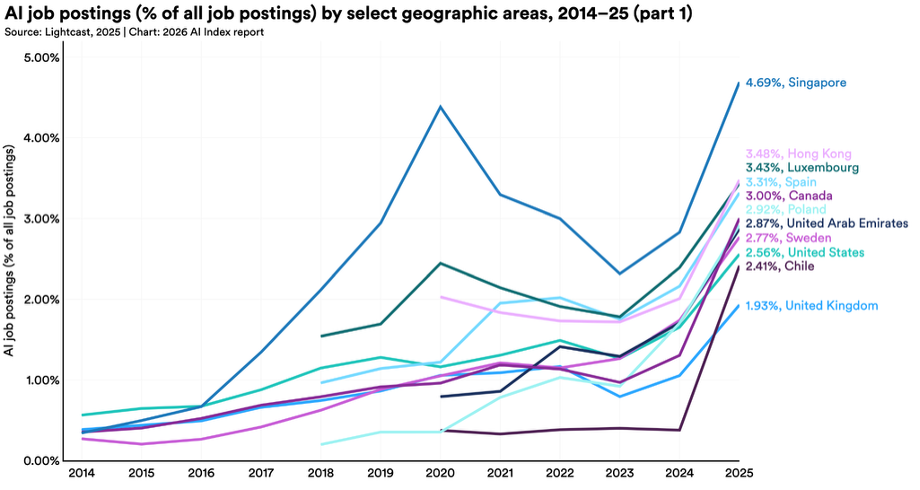
As the country lines show, AI-skill demand reached 4.69% of all postings in Singapore and 2.56% in the United States by 2025, with double-digit multiples of growth since 2018. When a skill appears in one in twenty job ads in a leading market, employers can no longer treat "can you use AI" as a specialist bonus question. It is a baseline competency to be screened deliberately, the way literacy and numeracy are assumed and yet still tested.
The fraud problem goes well beyond honest exaggeration, and this is what makes 2026 different from 2024. Two-thirds of AI-related resume claims might be soft inflation, but a hard core is outright deception. A survey of 874 HR professionals found 72% of recruiters had already encountered AI-generated fake applications - Skillfuel. Gartner projects that by 2028, one in four candidate profiles worldwide could be fake, and in one survey 6% of candidates admitted to interview fraud by posing as someone else or using a proxy - HR Dive. The category has expanded from "candidate who oversells" to "candidate who may be a synthetic identity," and no keyword search will separate the two.
The behavior is not confined to the resume, either; it now reaches into the live interview. Resume Genius's 2026 survey of active US job seekers found that 22% use AI during live interviews and more than a third admitted exaggerating their AI-tool proficiency, with a similar share listing skills they did not yet possess - Newsweek. That detail changes how you should weight an interview: a candidate can now generate confident, correct-sounding answers in real time, so a smooth verbal performance on AI questions is no longer evidence of underlying skill. The only interview signals that survive are the ones a real-time assistant cannot produce for the candidate, which again points to observed work and probing follow-ups over polished self-description.
Why this matters is straightforward and a little uncomfortable: the cheapest, most scalable screening signals are now the least trustworthy. Resume keywords, self-rated skill sliders, and unproctored take-homes were never strong predictors, but they were cheap, and in a low-fraud world cheap-and-weak was an acceptable first filter. In a world where a third of candidates will exaggerate and a quarter of profiles may be fake, cheap-and-weak becomes actively misleading, letting confident fabricators through while filtering out quieter, more honest talent. How to apply this is the theme of the entire guide: move your real evaluation later and make it observational, because the front of the funnel can no longer be trusted to tell you anything about AI ability.
2. What "Real AI Skills" Actually Mean Now
You cannot screen for a skill you have not defined, and most job ads in 2026 are still screening for the 2023 version of "AI skills." The most important shift to internalize is that prompt engineering as a standalone craft has faded, absorbed into broader competencies, even as the underlying ability to work with models has become table stakes. The dedicated "Prompt Engineer" title peaked and receded quickly, partly because newer models understand messy, informal instructions well enough that expert phrasing rarely changes the outcome - Salesforce Ben. The skill did not vanish; it stopped being a job. Defining what replaced it is the necessary first step of screening, because if your rubric still rewards clever prompt wording you are testing the wrong thing.
What replaced it is a cluster of durable, harder-to-fake competencies. The most cited reframing came from Andrej Karpathy, who argued for "context engineering" over prompt engineering: the real work in any serious AI application is filling the model's limited context window with exactly the right information, tools, and history for the next step, not wording a single question well - Andrej Karpathy. Around this sit the other genuine skills of 2026: writing evals (tests that tell you whether an AI system is actually getting better), designing agentic workflows where a model uses tools and takes multi-step actions, and above all judgment, knowing when to trust a fluent answer and when to verify it. That last one is the crux, because the defining failure of low-skill AI users is mistaking confident output for correct output - Security Journey.
Two of these competencies deserve special weight because they are the hardest to fake and the most predictive of production success: writing evals and agentic judgment. Writing a good eval is the AI equivalent of writing a good test suite. It means defining in advance what "better" means for a fuzzy, probabilistic system and building a repeatable way to measure it, a discipline that mostly belongs to people who have shipped something and watched it regress. Agentic judgment is knowing how to hand a model tools and multi-step autonomy without letting it wander into expensive mistakes, and when to keep a human in the loop. Neither shows up as a tidy resume keyword, and neither survives a supervised working session if it is not real, which is exactly why they belong at the center of a 2026 scorecard rather than the tool names that crowd job ads.
It helps to see which specific skills employers actually name in their postings, because the mix is broader and more concrete than "AI" suggests. The chart below breaks out named generative-AI skills in US job ads and how fast each grew.
The specific AI skills employers actually ask for
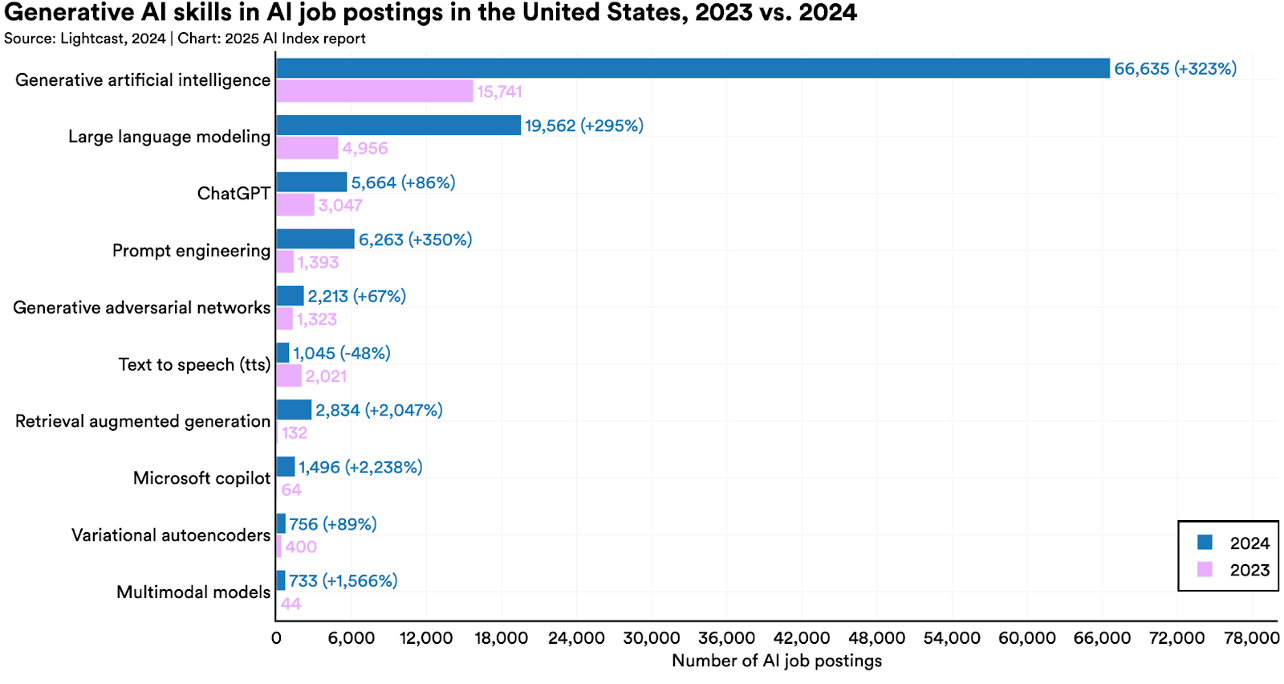
The breakdown is revealing: general generative AI and large language modeling dominate the volume, while faster-growing but smaller categories like retrieval-augmented generation (up more than twentyfold) point to where sophistication is heading. For a screener, the practical takeaway is that "AI skills" is not one competency but a stack, and the level you need to verify depends entirely on the role. A marketing hire needs fluent, verified use of tools; a machine-learning engineer needs the retrieval and model-training depth underneath. Screening starts by writing down which layer of that stack the role actually requires.
The cleanest way to structure this is with a tier model, because the same interview cannot evaluate a research scientist and a fluent sales operator. The industry has converged on a small number of archetypes. When Andela acquired the assessment company Woven in early 2026, it organized AI engineering talent into Builders (who create LLM and agentic components), Integrators (who connect models into working products), and Scalers (who run AI systems reliably in production) - Andela. Workera, meanwhile, benchmarks a wider population across five personas from Literate through Practitioner, Engineer, Scientist, and Steward - Workera. You do not need to adopt either taxonomy wholesale, but you do need a version of it.
For non-technical hiring, a practical four-tier model covers almost every role and keeps expectations honest:
- AI-fluent generalists who use tools daily in marketing, ops, sales, or support and must verify outputs
- AI integrators (software engineers) who ship products with copilots and agents woven in
- AI builders (ML and applied-AI engineers) who train, fine-tune, and evaluate models directly
- AI product leaders who scope, prioritize, and de-risk AI features without necessarily coding them
The reason this tiering matters so much for screening is that it sets the bar for what "real" means before anyone is interviewed. A generalist who can prompt well, catch a hallucination, and judge when a task is too consequential to delegate is genuinely skilled for that role, and it would be a mistake to grill them on RAG architecture. A builder who cannot explain their evaluation strategy is under-skilled for theirs, no matter how fluent they sound. How to apply this: write the tier and the two or three specific competencies into the scorecard first, then design every downstream step to produce evidence for exactly those competencies and nothing else.
3. Why Traditional Screening Broke
The blunt reality of 2026 is that the three pillars of technical screening (the resume filter, the take-home assignment, and the live algorithm interview) have all lost most of their signal, and pretending otherwise is the single most common hiring mistake. Start with the take-home, which was already on borrowed time and is now effectively dead as an integrity signal. Fabric, which runs AI-conducted interviews at scale, found that AI tools complete most coding assignments in under five minutes, and that async take-home completion has become almost meaningless as a differentiator - Fabric. When the artifact you are grading can be generated flawlessly by any candidate in minutes, the artifact tells you nothing about the person.
The live coding interview held out longer, but it broke too, and the story of how is worth knowing because it changed the industry's posture. In 2025 two Columbia students built Interview Coder, a hidden overlay that fed AI-generated answers to coding problems invisibly during interviews; one of them said he used it in an Amazon interview, was found out, and had the offer rescinded before being suspended from Columbia - Interview Coder. They rebranded it into Cluely, a startup whose original tagline was "cheat on everything," and which raised a $15 million Series A from Andreessen Horowitz, with the founder openly stating that undetectability was not even the point - TechCrunch. The lesson recruiters took was not that one tool existed, but that assuming an unobserved candidate is not using AI is now naive.
The scale of that behavior is the part most hiring teams underestimate. It is not a fringe of bad actors; it is closer to the norm on unobserved assessments. The data is stark enough that it belongs in every screening conversation, so the chart below shows how AI-cheating flags vary by role type across nearly twenty thousand interviews.
Share of Candidates Flagged for AI-Cheating, by Role Type
Across 19,368 AI-run interviews, Fabric flagged 38.5% of candidates for AI-cheating behavior overall, rising to 48% in technical roles, and, most damningly, 61% of flagged cheaters still scored above the pass threshold and would have advanced undetected in a normal process - Fabric. Karat, which runs human-led technical interviews for large employers, reports the ceiling is even higher on unproctored code tests, estimating that 80% of candidates use large language models even when explicitly prohibited - Karat. Prohibition, in other words, does not work; it just selects for candidates willing to break a rule quietly.
Detection tooling has not kept pace, and the interviewers running the process know it. A survey of 67 interviewers at large technology firms found that 81% suspect candidates of using AI during interviews while only a third have ever actually caught someone, which captures the core asymmetry cleanly: the cheating is far more common than the catching - SoftwareSeni. Modern overlay tools hook into the graphics layer to stay invisible even to screen sharing, so a detection arms race is one the assessment side is structurally positioned to lose. This is the practical reason the industry abandoned prohibition. Not because banning AI is wrong in principle, but because it is unenforceable, and an unenforceable rule mostly selects for the candidates comfortable breaking it quietly while punishing the honest ones who complied.
The final crack in the old model is that the resume filter itself has become an attack surface rather than a defense, which few screening playbooks account for. Candidates have learned to hide white-text instructions in resumes to manipulate AI screeners, a form of prompt injection that Greenhouse observed in a measurable share of submissions - The Interview Guys. More seriously, identity fraud has gone synthetic: a security vendor documented a live-interview candidate whose face was a real-time deepfake with a cloned voice, exposed only because the facial movements lagged the speech by a fraction of a second - Pindrop. Why this matters is that a screening process built to catch weak answers is not built to catch a fabricated person, and in 2026 you must design for both. How to apply this runs through the rest of the guide: stop trusting artifacts produced out of your sight, and move the real evaluation into a setting you can observe.
4. The Principle: Stop Banning AI, Grade How They Use It
The single most important shift in screening for AI skills is philosophical, and every effective 2026 process is built on it: stop trying to detect and ban AI, and instead let candidates use it while you grade how well they use it. This sounds like surrender, but it is the opposite. Banning AI is unenforceable, as the 80% cheating figure shows, and it also tests for the wrong thing, because the actual job now involves working with these tools, not without them. When you allow AI openly, the cheating tool becomes the instrument of the exam. You are no longer asking "did they use AI," a question you cannot answer honestly; you are asking "are they good with AI," which is exactly what you wanted to know.
The vendors closest to the problem all pivoted to this model in 2025 and 2026, which is the strongest evidence that it works. CodeSignal launched AI-Assisted Coding Assessments with an embedded assistant called Cosmo, giving hiring teams a full transcript of every candidate-AI interaction plus a session replay, so the evaluation is of the process rather than the final answer - CodeSignal. HackerRank went further and made AI collaboration an explicit, weighted scoring dimension, logging which AI suggestions a candidate accepts and which they reject - HackerRank. The whole apparatus of detection is being repurposed into an apparatus of observation.
This pivot tracks the reality of how people now work, which is the deeper justification for it. A large majority of engineers already use AI copilots daily, so an assessment that forbids them tests an artificial condition the job never imposes. Grading how someone works with AI is therefore not a concession to cheating; it is a more valid test, because it measures performance under the conditions of the actual role. The same logic extends well beyond engineering: a marketer, an analyst, or a support lead who will use AI every day should be evaluated doing exactly that, with the tools switched on, so the score reflects the real work rather than a sanitized approximation of it that no one will ever reproduce on the job.
The most instructive example is not a testing vendor but an AI company hiring for itself. Sierra replaced its algorithm and whiteboard rounds with an AI-native onsite: a candidate-led planning session, a two-hour build phase in which the candidate uses any AI tools and frameworks they like to ship a working prototype, and then a demo, graded on technical judgment, code quality, production-readiness, and explicitly on how they used AI along the way - Sierra. Notice what this format makes visible that a take-home hides: not whether the candidate can produce correct code, which the AI guarantees, but whether they can steer, verify, discard bad suggestions, and make sound product decisions under time pressure. That is the skill, and you can only see it by watching.
The observation can be automated, human, or both, and the mechanics are what turn it into a signal. An AI-native assessment does not simply record a final answer. It captures the full transcript of prompts, which suggestions the candidate accepted or rejected, and a replay of how the solution evolved, converting an opaque artifact into a readable record of judgment. The human version raises the ceiling further: Karat runs a NextGen format in which a live interview engineer watches a candidate work in a real multi-file project with an AI assistant available, probing their reasoning in the moment and grading how they validate AI-generated code and weigh tradeoffs - Karat. Both approaches rest on the same insight: the signal lives in the process, so the process has to be made visible rather than guessed at from a result.
For a practical grounding in the mindset behind this shift, the recorded talk below from CoderPad, an official technical-interviewing platform, walks through hands-on strategies for hiring AI talent past the buzzwords. It is a 2025 strategy session rather than a product demo, so the substance (evaluate real, demonstrable competence rather than claimed keywords) remains the working consensus in 2026.
Beyond the Buzzwords: Practical Strategies for Hiring AI Talent
The talk reinforces the central move recruiters keep relearning: the point of an AI-era assessment is to observe judgment, not to police tool use. Why this matters is that it resolves the cheating crisis and the skills-verification problem in one stroke, because a candidate who can openly wield AI to a strong result under observation is demonstrating precisely the competence the role requires, and a candidate who cannot steer the tool is exposed no matter how polished their resume. How to apply this: make your core screening step a supervised working session with AI explicitly allowed, and build your rubric around the decisions the candidate makes, not the code they produce.
5. The Evidence: What Actually Predicts Performance
Before designing the working session, it is worth grounding the process in the decades of validity research on hiring methods, because AI has not repealed it; it has made it more relevant. The most important update is that a 2022 re-analysis by Sackett and colleagues corrected a long-standing statistical error and re-ranked the predictors of job performance, and the new order puts structured interviews and work-sample tests at the top, above general cognitive ability - SIOP. This matters enormously for AI screening, because a supervised build-with-AI session is essentially a work-sample test, and the depth interview around it is a structured interview. The 2026 best practice and the strongest evidence point the same way.
The magnitude of the difference between methods is large enough to change how you spend interviewing time, so the chart below shows the updated validity coefficients (higher means more predictive of performance).
Validity of Hiring Methods (Sackett et al. 2022 re-analysis)
The practical reading is that a structured interview (the same questions, the same rubric, calibrated interviewers) at r = 0.42 and a work-sample test at r = 0.33 are the workhorses to build around, and that unstructured conversation, which sits far lower, is where most interviewing time is still wasted. Google's own hiring research reached the same conclusion years earlier and productized it: its structured-interviewing guidance uses vetted questions asked of every candidate, standardized rubrics defining what a poor, borderline, solid, or outstanding answer looks like, and interviewer calibration to keep scoring consistent - Google re:Work. The structure is what makes the signal comparable across candidates, which is the entire point when you are trying to rank real ability.
The structure pays off in ways that also ease adoption, which matters because a heavier process only helps if people will actually run it. A rubric-scored interview makes rejections feel fairer, saves interviewers real preparation time through reusable questions and answer keys, and produces something an unstructured chat never does: comparable scores you can defend to a hiring committee months later. The broader shift toward demonstrated skill over credentials is accelerating in step with it, as a growing majority of employers drop degree requirements from at least some roles once they see that a direct test of ability beats a proxy. For AI roles in particular, where formal credentials barely exist and the field reinvents itself every year, demonstrated ability is not just the stronger signal. It is frequently the only meaningful one available.
The market has already voted for skills-based evaluation over credentials, which is useful context for getting buy-in on a heavier screening process. TestGorilla's 2025 research found that 85% of employers now use skills-based hiring, 76% use skills tests to validate candidates, and two in three say those tests reduced their mis-hires - TestGorilla. The direction of travel is unmistakable: away from proxies like degrees and self-reported skills, toward direct demonstration of ability. Why this matters is that it gives you both the evidence and the organizational cover to invest in observation-heavy screening. How to apply this: treat the structured, rubric-scored working session as the spine of your process, and treat everything before it (resume, portfolio, keyword) as a cheap, fallible pre-filter rather than a decision.
6. The 2026 Screening Playbook
The playbook that follows assembles the principle and the evidence into a concrete, repeatable sequence, and its logic is a funnel that gets progressively harder to fake at every stage. The guiding idea is to spend cheap effort early to verify claims, then concentrate expensive human attention on a single observed working session and a structured depth conversation, and finally to confirm identity and integrity before an offer. Nothing in the funnel relies on a signal that a confident faker can cheaply produce out of your sight. The diagram below shows the full sequence and where each stage's signal comes from.
As the funnel shows, each stage has a distinct job, and the two rejection paths that catch the most fakers are "cannot steer the tool" in the working session and "fluent but shallow" in the depth interview. The rest of this section walks through the stages in order, with enough detail to run each one.
6.1 Define the tier and the competencies
Every wasted interview traces back to a vague scorecard, so the first stage is to write down the role's tier (generalist, integrator, builder, or product leader) and the two or three specific AI competencies it truly requires. A content marketer's competencies might be "verifies AI outputs against sources" and "judges when a task is too consequential to delegate." A machine-learning engineer's might be "designs an evaluation harness" and "reasons about retrieval versus fine-tuning." This step is not bureaucracy; it is what makes the later stages scorable, because a rubric can only rate a candidate against a competency you have named. Skipping it is why so many AI interviews collapse into an unstructured chat about which tools someone has "played with," which is exactly the low-validity method to avoid.
6.2 Verify the cheap claims first
Before spending anyone's live time, verify what can be verified cheaply, because portfolios and public work are harder to fabricate than resume lines and often expose the gap immediately. For builders and integrators, a linked GitHub profile is a legitimate signal, and roughly 60-80% of technical recruiters already glance at one for mid-to-senior roles, looking past star counts to tests, CI, and real evaluation pipelines - Fonzi. The important caveat, and a common source of false negatives, is that a sparse public profile is not a red flag: around 90% of senior engineers have fewer than ten public repositories, because their best work lives in private company code. The signal is in the quality of what exists, not the volume.
Public work needs to be read for authenticity, not just presence, and there are reliable tells. The strongest positive signals and the most common fabrication patterns are worth committing to memory:
- Green flag: repositories with tests, CI, and honest commit history showing iteration
- Green flag: a written post-mortem or eval readme describing what failed and why
- Red flag: tutorial-cloned projects with the original author's fingerprints intact
- Red flag: large blocks of AI-generated code with no tests and no evidence of understanding
Reading a portfolio this way takes ten minutes and filters a meaningful share of candidates before any live time is spent, which is the entire economic argument for doing it first. The point is not to reject on a thin profile, which would discard good senior engineers, but to promote candidates whose public work shows genuine iteration and judgment, and to enter the working session with specific, evidence-based questions rather than a blank slate. For non-technical roles, the equivalent cheap check is a short, specific work artifact request tied to the competencies from 6.1, reviewed for the same authenticity tells.
It is worth extending this cheap check to the places AI practitioners actually leave evidence, because the right one depends on the tier. For builders, a Hugging Face profile with published models or datasets and a Kaggle history with real competition results are strong, hard-to-fake signals of applied work, and a technical blog that reasons through a genuine problem is often more revealing than any single repository. For generalists, the equivalent is a short, specific artifact request tied to the competencies from stage 6.1, such as an analysis they produced with AI, read not for polish but for whether they caught the model's errors. The unifying rule is to judge public work by authenticity and iteration rather than volume or prestige, and to use what you find to sharpen the working session rather than to decide the outcome on its own.
6.3 Run the supervised build-with-AI session
The centerpiece of the whole process is a live, time-boxed working session in which the candidate solves a realistic problem with AI tools explicitly allowed, while you watch. This is the work-sample test that the validity research endorses and the observed setting that defeats cheating, and it should carry the most weight in your decision. Model it on Sierra's format: give a realistic task, let the candidate use any tools they choose, and grade the decisions, not the deliverable. For an integrator, that might be building a small feature with a coding agent; for a generalist, drafting and fact-checking a customer-facing analysis with a chatbot; for a builder, sketching and defending an evaluation approach for a flaky model.
What you are scoring is judgment made visible, and it is genuinely hard to fake because it happens in real time under questions. Watch for how the candidate frames the problem before prompting, how they react when the model produces something plausible but wrong, whether they verify outputs against a source or accept them, and how they decide what to keep and what to discard. A strong candidate treats the AI as a fast, unreliable collaborator to be directed and checked; a weak one pastes the first fluent answer and moves on. HackerRank's rubric formalizes this by weighting AI collaboration as its own graded dimension alongside technical skill and problem-solving, which is a useful template even if you run the session yourself - HackerRank. The session is where "real AI skills" stop being a claim and become an observation.
A concrete task makes this real, and the best ones mirror a slice of the actual job. For an integrator, hand them a small, slightly broken codebase and ask them to add a feature and fix the bug using whatever AI tools they like, then watch whether they read the diff the agent proposes or accept it blind. For a generalist, give a messy customer email thread and a small data snippet and ask for a summary and a recommendation, then check whether they trace the model's claims back to the source. For a builder, ask them to design an evaluation for a described model and defend the choice. In every case the deliverable barely matters; what you score is the sequence of decisions, the moments of visible doubt, and the checks they run before calling it done.
6.4 Structured depth interview
Immediately around the working session, run a structured depth interview that probes the reasoning underneath the work, because fluency with tools and understanding of fundamentals are different things and only the second predicts durable performance. Use the same core questions for every candidate at a given tier, score them against a written rubric, and calibrate your interviewers, exactly as the structured-interview evidence prescribes. The questions themselves are the subject of section 7, because getting them right is what separates a depth interview that exposes shallow knowledge from one that merely rewards confident talkers.
6.5 Verify identity and integrity
The final stage before a decision is confirming that the person you evaluated is the person you are hiring, which was a formality in 2023 and is a genuine risk control in 2026. With Gartner projecting that a quarter of profiles may be fake and deepfake interviews already documented, a light identity check at offer stage is now proportionate rather than paranoid - HR Dive. This does not require heavy biometric tooling for most roles; it requires that at least one substantive evaluation happened live with a human who can attest to consistency between the candidate's claimed background and their demonstrated ability, plus standard reference and right-to-work checks. The observed working session doubles as your best integrity control, because a proxy or synthetic candidate cannot easily sustain real-time problem-solving under questions.
For most roles this identity control can stay light. A single live, interactive round with a human who can later attest that the person's demonstrated ability matched their claimed background covers the majority of the risk, supplemented by standard reference and right-to-work checks. Higher-stakes or fully remote roles may justify more, such as confirming that the face and voice on later calls match the earlier interview, which is a proportionate response to documented deepfake cases rather than paranoia. The key design principle is that integrity is not a separate gate bolted on at the end. It is a property that emerges naturally when at least one substantive evaluation happens live and observed, which is why a process built around a supervised working session gets most of its fraud resistance for free.
Pulling the stages together, the funnel works because it inverts the old economics of screening: it spends the least effort where fraud is cheapest (the resume) and the most effort where fraud is hardest (observed, real-time judgment). Why this matters is that it is robust to exactly the failure modes that broke traditional screening, from AI-completed take-homes to keyword inflation to synthetic identities. How to apply this: adopt the sequence wholesale for senior or high-volume-of-fraud roles, and a lightweight version (cheap claim check plus one supervised session) for everything else, but never let a hire rest on unobserved artifacts alone.
7. Depth Questions That Expose Real Understanding
The depth interview is only as good as its questions, and the goal of a good AI-skills question is to create a gap that fluency alone cannot cross, so the shallow candidate reveals themselves precisely where the deep one shines. The technique is to ask about tradeoffs and failures rather than definitions, because definitions are memorized and now generated on demand, while the reasoning behind a real decision is not. A question like "what is RAG" is answered perfectly by anyone with a browser; a question like "walk me through a time you chose retrieval over fine-tuning, and what you gave up" cannot be faked without the underlying experience. Every question below is designed around that principle, and each has a recognizable strong answer and a recognizable weak one.
Consider a core architecture question that separates builders from resume-holders: when would you use retrieval-augmented generation instead of fine-tuning, and vice versa? A strong answer explains that fine-tuning updates the model's weights to change style, format, or domain behavior, while RAG retrieves current information at query time without touching the weights, and therefore that you reach for RAG when facts change often and fine-tuning when you need consistent behavior or format - DataCamp. The weak answer treats them as interchangeable magic or, tellingly, proposes fine-tuning for a problem that is obviously about fresh information. The follow-up ("how would you cut this model's hallucination rate") should elicit grounding via retrieval, lower temperature, chain-of-thought, and human verification, not "switch to a newer model," which is the giveaway of someone who has read headlines but never shipped.
A handful of questions reliably do the heavy lifting across technical AI roles, each targeting a different competency:
- Model selection: "What would you reach for on tabular data, and why?" (Strong: default to gradient-boosted trees; weak: unjustified deep learning)
- Cost and latency: "How would you take a model from 200ms to 80ms at P99?" (Strong: profile first, then quantize, distill, batch; weak: "add more servers")
- Evaluation: "How do you know your AI feature is actually improving?" (Strong: a real eval set and metric; weak: "it looks better")
- Failure analysis: "Tell me about an AI system that failed in production and why." (Strong: a specific post-mortem naming a real cause; weak: cannot recall one)
The reason these four work is that each targets a decision that only hands-on practitioners have actually made, and the failure-analysis question in particular is nearly impossible to fake convincingly because a genuine war story has texture (a named cause like train-serving skew or distribution shift, a specific fix, a lesson) that invented ones lack - Second Talent. For non-technical roles the same philosophy applies with different content: ask a marketer to describe a time an AI draft was confidently wrong and how they caught it, which tests the verification judgment that defines real AI fluency rather than tool familiarity.
It helps to script one worked scenario so every interviewer runs it identically. Present the candidate with a realistic situation: the model has produced a confident, well-formatted answer to a question that carries real consequences, say a compliance summary or a pricing recommendation, and ask what they would do before acting on it. A strong candidate immediately separates the format from the facts, names the specific things they would verify and how, and explains why this case earns scrutiny that a throwaway brainstorm would not. A weak candidate either accepts the answer because it looks authoritative or, at the opposite extreme, distrusts everything without being able to say what would change their mind. The distance between those two responses is the most reliable tell of real versus performed AI skill, and it surfaces in about five minutes.
The deeper point, and the reason judgment beats knowledge here, is that the fundamental red flag of a weak AI hire at any tier is the same: mistaking fluent, confident output for accurate output, and failing to calibrate scrutiny to the stakes - Security Journey. A strong candidate naturally distinguishes a low-stakes brainstorm, where they let the model run, from a high-stakes financial or medical conclusion, where they verify every claim against a trusted source. Why this matters is that this calibration is exactly the skill that keeps AI useful rather than dangerous in production, and it is invisible on a resume. How to apply this: end the depth interview with a stakes-calibration question, because a candidate who cannot articulate when they would slow down and verify is a candidate who will ship the model's confident mistakes straight to your customers.
8. The Tools: Assessment and AI-Fluency Platforms
You do not have to build all of this from scratch, because the assessment market split into two useful categories in 2025 and 2026, and picking the right one starts with knowing which category your roles need. The first category is AI-native coding platforms, which embed a real AI assistant in the coding environment, log every prompt, and score how the candidate collaborates with and overrides the model. The second is AI-fluency assessors, which benchmark the much larger non-engineering population on prompting, judgment, and verification using rubric-scored tasks rather than self-report. Confusing the two is a common and expensive mistake: a coding platform will not tell you whether your marketing team can use AI safely, and a fluency assessor will not screen a senior ML engineer.
On the coding side, the leaders have all shipped AI-native formats, and their pricing is public enough to plan around. The table below summarizes the main options and their entry pricing, drawn from each vendor's own pages.
| Platform | AI-era approach | Entry pricing (verified) |
|---|---|---|
| CodeSignal | Embedded "Cosmo" assistant, full AI transcript, session replay | Build $79/mo billed annually ($948/yr, 60 credits) |
| HackerRank | AI collaboration as a weighted score; 93%-accurate plagiarism detection | Starter $199/mo ($165/mo billed annually) |
| CoderPad | AI Assist in-IDE on all tiers; AI reviewer on higher plans | Starter $80/mo billed annually ($960/yr) |
| Karat | Human-led "NextGen" interviews grading AI collaboration live | Custom (interviewing-as-a-service) |
| Woven / Andela | Scenario-based tests across Builder, Integrator, Scaler archetypes | Custom (enterprise) |
The pricing tells a story worth reading before you buy: these are credit or seat based, and the meaningful cost is per-candidate throughput, not the headline number. CodeSignal consumes a credit whenever a candidate starts an assessment or interview and charges roughly $20 per overage credit, so a team screening hundreds of candidates should model volume carefully - CodeSignal. The human-led options like Karat cost more per interview but shift the anti-cheating burden onto trained interviewers, which is the right trade when a role is senior enough that a bad hire is far more expensive than the assessment. For most teams the practical move is a cheaper automated screen early and a human-led session for finalists, which mirrors the funnel in section 6.
For the far larger population of non-engineers, the AI-fluency assessors are the relevant tools, and they exist because the proficiency gap is enormous and self-report cannot measure it. Section's testing of over five thousand US knowledge workers found that only 5.5% meet a real bar for AI proficiency, with a similarly small share able to write a genuinely effective prompt - Section. The chart below shows how thin the top of that distribution is, which is the single best argument for testing fluency rather than assuming it.
AI Proficiency of the US Workforce (Section, 5,026 tested)
With nearly three-quarters of workers stuck at "experimenter" and only a sliver genuinely proficient, the implication for screening is that AI fluency is a real differentiator you can select for, not a box everyone can honestly tick. The fluency assessors quantify it with methods designed to resist gaming. Workera scores against subject-matter-expert rubrics with an auditable trail rather than course completions, and reports having verified millions of skills - Workera. Correlation One's engine has assessed over half a million professionals across domains like generative-AI fluency, applied LLM workflows, and AI judgment, with multi-version content and paste protection to resist copying - Correlation One. For teams wanting a lighter option, general skills-testing suites now include AI modules: TestGorilla's Core plan runs $142/mo billed annually and bundles hundreds of tests including AI-specific ones - TestGorilla, while CFTE's standalone AIQ proficiency assessment is available from £99 for individuals - CFTE.
The category keeps consolidating and hardening, which itself signals that verifiable skill evidence is becoming infrastructure rather than a nice-to-have. On the integrity side, Codility added a device-integrity companion that scans for known hidden cheating tools alongside a timeline of paste, tab, and focus events, aggregating them into a single graded signal rather than a blunt pass-or-fail flag - Codility. For non-technical populations, suites like iMocha now ship dedicated generative-AI readiness tests covering AI literacy, prompting, and responsible use. And the market is merging: Handshake's acquisition of the AI-native learning platform Uplimit is an explicit bet on pairing hands-on projects with verified credentials at the scale of a large job-seeker network - Handshake. The direction of travel is toward portable, auditable proof of capability, which is precisely what a polluted resume can never provide.
For most teams the practical question is not which platform is best in the abstract but whether to buy one at all versus running the working session themselves, and the answer turns on volume and tier. High-volume screening for integrators and generalists genuinely benefits from an AI-native platform that scales the observed test and captures the transcript automatically, and the per-candidate cost is easy to justify against a single avoided mis-hire. Low-volume senior and specialist hiring often does better with a human-run session and a light structured rubric, because the value there is the depth of a real practitioner's probing, which no automated scorer yet matches. Many teams end up with both: a platform for the top of the funnel and a human-led final round for the people who will actually receive an offer.
The reason to treat these tools as instruments rather than answers is that every one of them measures a slice, and none replaces the observed working session at the center of your funnel. A fluency score is a good pre-filter and a good post-hire development signal; it is not proof that a specific candidate will make sound judgment calls on your specific problems. Why this matters is that buying a platform can create false confidence, letting a high score substitute for the observation that actually predicts performance. How to apply this: use an AI-native coding platform or a fluency assessor as the cheap, scalable early filter, choose the category that matches the role's tier, and still put finalists through a supervised session you run and score yourself.
9. Screening by Role Type
The playbook is universal but its calibration is not, and applying the same bar to every role is how teams simultaneously reject good generalists and hire shallow builders. The most useful adjustment is to change what "good" looks like at each tier defined in section 2, because the competency that matters shifts as you move from using AI to building it. For an AI-fluent generalist in marketing, ops, or sales, the bar is verification and calibration: can they get real value from tools while catching the confident errors and knowing which tasks are too consequential to delegate. The working session for this tier is a realistic content or analysis task, and the failure mode to screen out is the candidate who trusts fluent output uncritically, which the stakes-calibration question from section 7 exposes directly.
High-volume generalist hiring deserves a specific warning, because that is where AI-generated applications flood the funnel and where a thin automated screen does the most damage. When hundreds of applicants can each generate a polished, keyword-perfect application in seconds, the resume filter stops separating anyone, and the only thing that recovers signal is a short, standardized work sample that every candidate completes under the same conditions. The reassuring part is that generalist working sessions are cheap to run at scale and quick to score against a tight rubric, so volume is an argument for more observation, not less. The failure mode to avoid is answering application volume by leaning harder on the automated keyword screen, which simply rewards whoever generated the most convincing text rather than whoever can actually do the work.
For an AI integrator, typically a software engineer, the bar rises to shipping working software with AI woven in, and the screening has to reflect that the job itself changed. Recent data shows the shift is nearly complete: CodeSignal found that 91% of engineers already use agentic AI coding tools and three-quarters had shipped partially or primarily AI-generated production code in the prior six months - CodeSignal. The integrator's working session should therefore look like real work: building a feature with a coding agent, where you grade how they decompose the problem, verify the agent's output, and catch the subtle bugs that AI-generated code hides. Stack Overflow's finding that 46% of developers now actively distrust AI accuracy and that debugging AI code is a top time sink is the competency you are screening for: productive skepticism, not blind acceleration - Stack Overflow.
The two deeper tiers demand the most specialized evaluation, and this is where generic assessments fail hardest. The distinctions that matter when screening builders and product leaders come down to a few concrete competencies:
- AI builders must demonstrate real evaluation design, model-selection reasoning, and a genuine production failure story
- AI builders should be probed on retrieval versus fine-tuning and cost/latency tradeoffs, not tool familiarity
- AI product leaders must show they can scope an AI feature, define its eval and guardrails, and de-risk hallucination without necessarily coding
- AI product leaders are best screened on judgment about what not to build, since over-eager AI features are a common failure
For builders and product leaders, the specialized platforms in section 8 earn their cost, because a scenario-based test built for AI engineers surfaces depth that a generic coding round misses entirely. The broader lesson across all four tiers is that the same funnel runs each time, but the working-session task and the depth questions are swapped to match the competencies you wrote down in stage 6.1. Why this matters is that mis-calibrated bars are quietly expensive: they pass confident generalists into builder roles and reject careful builders for lacking generalist polish. How to apply this: maintain one funnel and four scorecards, and never reuse a builder's rubric on a generalist or vice versa.
10. The Recruiter Side: AI Agents and Their Limits
While hiring teams rebuild how they screen candidates, AI is also reshaping the screening that recruiters themselves do, and understanding both sides is necessary because the recruiter-side tools have the same fake-signal weakness as the candidate-side ones. The adoption is real and fast. Korn Ferry's survey of 1,674 talent leaders found that 84% plan to use AI in recruiting in 2026 and 52% plan to add autonomous AI agents, yet the same leaders rank critical thinking as their number-one hiring criterion and AI skills only fifth, a healthy reminder that AI ability is one competency among many, not the whole evaluation - Korn Ferry. The direction is toward agents that source, screen, and reach out end to end, compressing the top of the funnel.
The category of autonomous sourcing and screening tools has grown crowded, and it is worth knowing the landscape because these systems increasingly perform the first-pass screen that used to be a recruiter's job. Tools such as Juicebox, hireEZ, SeekOut, Fetcher, and Paradox's Olivia now run natural-language search across hundreds of millions of profiles and automate outreach and initial qualification - Recruiterflow. Purpose-built AI recruiters go further: HeroHunt.ai positions itself as an AI Recruiter that finds, screens, and reaches out to candidates autonomously across a billion-plus profiles, one of several platforms trying to turn sourcing and first-pass screening into a single automated loop. These tools are genuinely useful for coverage and speed, and they are the right way to widen the top of the funnel that section 6 then narrows with human observation.
The critical caveat, and the reason recruiter-side AI cannot be trusted to do the whole job, is that an AI screener reading resumes inherits every weakness of the resume as a signal. If a keyword is faked, a model ranking on keywords will rank the faker highly; if a resume hides white-text prompt injection, an LLM screener may obey it. This is why the reality checks matter. Gartner found that 88% of HR leaders say their teams have not yet realized significant value from AI tools, and predicts that more than 40% of agentic AI projects will be canceled by 2027 - Pin. The gap between the adoption headline and the value headline is the whole story: deploying an agent is easy, and getting trustworthy screening signal out of it is not.
The usage data beneath the headlines shows recruiters already lean on AI most for exactly the tasks where fake signals hurt most. AI now assists a majority of teams with candidate screening and a large share with sourcing and assessments, yet the overwhelming majority of recruiters insist on keeping final decision authority over any AI recommendation - Recruiterflow. That instinct is correct and worth encoding as policy. A model that ranks candidates on resume text will faithfully reproduce the resume's lies, so its output is a triage aid, never a verdict. The safe pattern is to let AI widen and prioritize the funnel while a human, armed with the observed evaluation from section 6, owns the judgment about who can genuinely do the work.
The synthesis of both sides is that AI belongs at the top of the funnel and human judgment belongs at the bottom, and confusing the two is the mistake that produces both fake-positive hires and canceled AI projects. Use autonomous tools to source broadly and to handle the volume that no human could, then run every serious candidate through the observed, structured evaluation that no current agent can fake its way past. Why this matters is that the same principle governs both sides of the desk: automation is superb at coverage and terrible at verifying genuine ability under adversarial conditions. How to apply this: let agents widen and accelerate sourcing, keep the final skills verification human and observational, and treat any tool that claims to fully automate the screening decision with the skepticism the value data warrants.
11. Future Outlook and a Decision Framework
Looking ahead, the direction of both candidate skills and screening methods is clear enough to plan around, and the teams that adapt first will have a real advantage while the keyword remains polluted. On the candidate side, the frontier skill is moving from using AI to directing fleets of agents, and the assessment vendors are already following: CodeSignal launched agentic coding assessments in April 2026 to measure how engineers work with autonomous tools like coding agents, not just chat assistants - CodeSignal. Expect "real AI skills" to keep climbing this ladder, from prompting, to context engineering, to orchestrating and verifying multi-agent systems, which means your rubric will need refreshing every year rather than every three.
The screening side is heading toward continuous, verifiable skill evidence and stronger identity infrastructure, both driven by the fraud problem. As synthetic candidates and AI-washing normalize, expect verified skill credentials (rubric-scored, auditable, and portable) to gain ground over self-reported profiles, and expect a live, observed human interaction to become a non-negotiable integrity control rather than an optional final round. The consolidation is already visible in the market, with learning and assessment platforms merging to build exactly this kind of proof-of-capability infrastructure. None of this removes the human judgment layer; it hardens the parts of the process that fraud attacks and frees human attention for the judgment that machines cannot yet replicate.
Two concrete shifts are worth preparing for. The first is continuous, portable skill verification replacing the one-time resume claim, where a rubric-scored, auditable credential travels with a candidate and can be re-checked rather than taken on faith, which the wave of learning-and-assessment consolidation is quietly building toward. The second is identity infrastructure becoming a standard layer of hiring, as the normalization of synthetic candidates forces employers to confirm cheaply and early that the person evaluated is the person hired. Neither shift removes human judgment. Both harden the parts of the process that fraud attacks, so that scarce human attention goes to evaluating genuine ability instead of policing authenticity, and the teams that build these two capabilities now will hire from a cleaner signal for the rest of the decade.
For teams that need to act now, the decision framework compresses the whole guide into a short sequence. It is deliberately simple, because the failure mode is over-engineering the tooling and under-investing in observation:
- Define the tier and two or three competencies before writing the job ad, not after
- Treat resumes and keywords as fallible pre-filters, never as evidence of AI ability
- Center the process on one supervised build-with-AI session, graded on judgment
- Ask tradeoff and failure questions, not definitions, in a structured, rubric-scored interview
- Verify identity and integrity live before any offer, because a quarter of profiles may be fake
The reason this framework holds up as the landscape shifts is that it is built on things that do not change: observed work beats claimed work, structured evaluation beats unstructured conversation, and judgment under stakes is the durable core of any AI skill. The specific tools, models, and even the vocabulary will keep moving, but a process that watches a candidate steer AI to a real result under real questions will keep telling you the truth. Why this matters, finally, is that the cost of getting it wrong has risen sharply: in a market where the most confident claims are the least reliable, the teams that verify ability directly will out-hire the teams that keep searching for a better keyword.
The AI recruiting field is where this tension gets resolved at scale, because the same technology that lets a candidate fake AI skills is the technology that, pointed the other way, helps a recruiter find and verify the real thing. The winners in 2026 will be the teams that use AI to widen the funnel and reserve human judgment to close it, screening for demonstrated ability rather than the confident claim of it.
This guide reflects the AI hiring landscape as of September 2026. Pricing, tools, and even the definition of "AI skills" change quickly, so verify current details before making decisions.