


The operator's guide to hiring the engineers who build the training worlds behind frontier AI.
Anthropic has reportedly discussed spending more than $1 billion in a single year on reinforcement learning environments - TechCrunch. That figure, more than any salary headline, explains why "RL environment engineer" went from a job title that barely existed in 2024 to the scarcest and best-paid hire in applied AI by 2026. The compute is bought, the models are trained, and the new binding constraint is the supply of people who can build the simulated worlds that teach an agent to do useful work.
The problem for anyone doing the hiring is that almost nothing about this role is standardized. The same job appears as Research Engineer, Environment Scaling at one lab, RL Environments Specialist at another, and simply Software Engineer at a startup whose entire product is environments. Compensation ranges from a $90 hourly contractor rate to $850,000 total packages, the skill set blends software engineering with a research sensibility that few resumes signal cleanly, and the best candidates usually already have a job at a place that is paying them extraordinarily well to stay. Sourcing them like ordinary backend engineers fails predictably.
This guide is written from a hiring operator's chair. It starts high with why this became a strategic function, defines what the role actually is in technical terms, then maps who is competing for the talent: the frontier labs, the environment-native startups, and the data vendors that pivoted into environments. From there it goes deep on the parts most hiring guides skip: real compensation data, where these people come from, how to screen them with a work sample that works, the reward hacking problem that separates good environment engineers from dangerous ones, and the build, buy, or blend decision. It closes on how AI agents are starting to build environments themselves and what that means for your 2027 headcount plan.
Contents
- Why RL Environment Engineers Became AI's Scarcest Hire
- What an RL Environment Engineer Actually Does
- The Environment Stack: From Gym to Verifiers and OpenEnv
- The Frontier Labs and How They Staff Environments
- The Environment-Native Startups
- The Vendor Economy and the Build-vs-Buy Decision
- Compensation: What This Talent Actually Costs
- Where to Find and Source RL Environment Engineers
- How to Screen and Interview Them
- Reward Hacking and the Quality Problem
- How AI Agents Are Changing the Work
- The 2027 Outlook: Consolidation, Commoditization, or Moat
- Conclusion: A Hiring Decision Framework
1. Why RL Environment Engineers Became AI's Scarcest Hire
The scarce input in frontier AI has shifted from raw compute to the environments that turn compute into capability, and that single shift is why this role now commands a strategy rather than a job posting. Pre-training on scraped web text has hit diminishing returns, so the gains that separate a leading agent from a mediocre one increasingly come from reinforcement learning against tasks the model can practice thousands of times. Those tasks do not exist by default. Someone has to build them, and the people who can build them well are rare enough that labs are restructuring org charts and budgets around the shortage.
The dollar signals are unambiguous. Beyond Anthropic's reported billion-dollar environment discussions, OpenAI's Dan Roberts said in May 2025 that the company expected reinforcement learning compute to soon exceed what it had spent on pre-training - Looking Glass. When the training budget tips toward RL, the environments that RL runs against become the production bottleneck, and the engineers who produce them become the constraint on how fast a lab can improve its models. That is a very different situation from 2023, when data labeling was a procurement line and the scarce resource was GPUs.
Prime Intellect, one of the companies building open infrastructure for this work, put the thesis plainly when it called environments "the key bottleneck to the next wave of AI progress" in August 2025 - Prime Intellect. The claim is contested at the margins, but the behavior of the buyers is not. Every major lab is both building environment teams in-house and buying capacity from vendors, and the venture market has funded roughly twenty startups whose entire reason to exist is to manufacture environments at scale.
To size the opportunity honestly, put the environment budget next to the compute budget it serves. Epoch AI estimates OpenAI's research and development compute spending for 2026 at roughly $19 billion, so even Anthropic's reported billion-dollar environment budget is a single-digit fraction of what a leading lab spends to train and serve models - Epoch AI. That ratio is the whole argument for why this hire is underpriced relative to its leverage: a comparatively small spend on the people who build environments determines whether an enormous compute spend produces a capable agent or an expensive disappointment. The data-labeling market that environments grew out of was itself only around $5 billion, growing more than 50% a year, and environments are its fastest-expanding slice - Wing VC. Small budget, outsized consequence, is the exact profile of a function that punishes getting the hiring wrong.
This is also a genuine break from the recent past, not a rebranding of data labeling. Three years ago the work was tagging and ranking, priced by volume and sourced from large crowds, and the scarce resource was GPUs. The move to reinforcement learning changed the unit of work from a label to a task with a verifiable outcome, which is a software artifact rather than a judgment call, and it pulled the center of gravity from annotators toward engineers. That is why the companies that once ran armies of labelers now advertise for people who can write graders and sandboxes, and why the old mental model of "annotation as cheap offshore labor" is now actively dangerous. Bring that model to this hire and you will underpay for work that decides model quality and mis-hire generalists for a role that needs builders.
For a hiring leader, three consequences follow from this shift, and getting any of them wrong is expensive:
- Demand outstrips a tiny pool so you are competing against the highest-paying employers in technology for a few thousand qualified people.
- The title is unstable so keyword-based sourcing misses most candidates.
- The skill set is hybrid so standard software engineering interviews screen for the wrong things.
Each of these is solvable, but only if you treat environment engineering as a distinct discipline rather than a flavor of backend work. The rest of this guide is organized around that premise. The most important reframe to internalize before the tactics is that you are not hiring people to write code that ships to users, you are hiring people to build the training ground where a model learns behavior, and the quality of that ground determines whether an expensive training run produces a capable agent or an expensive disappointment. That asymmetry, small human input with outsized leverage on the final model, is exactly why the compensation looks the way it does and why the sourcing is so hard.
2. What an RL Environment Engineer Actually Does
An RL environment engineer builds the self-contained package that lets a model practice a task and learn from the result, and the cleanest mental model is five parts working together. An environment is a task specification (an instruction plus, ideally, a dataset of variations), an agent harness (the scaffolding that lets the model take actions), a sandbox that holds state safely, a verifier that checks whether the outcome was correct, and a reward signal derived from that check - Lee Hanchung. The engineer owns all five, and the hardest of them is almost always the verifier, because a verifier that is subtly wrong teaches the model to be subtly wrong.
The dominant paradigm in 2026 is reinforcement learning from verifiable rewards (RLVR), where the environment itself provides the signal rather than a learned reward model. A coding task passes or fails its unit tests, a math answer matches or does not, a shell command produces the expected file or it does not - Daily Dose of DS. This is why the job is so software-heavy: to score a model's work programmatically, you have to build the machinery that runs the model's actions, observes the resulting state, and renders a binary or graded verdict without a human in the loop. The person who can do that fluently is, in practice, a strong systems engineer with the instincts of an evaluator.
The systems side is heavier than outsiders expect, and it is where many otherwise-strong candidates fall short. An environment has to run thousands of parallel rollouts without flaking, recover cleanly when an agent wedges a process or fills a disk, and checkpoint long-horizon tasks so that a crash three hours into a session does not poison the training batch. SemiAnalysis notes that labs increasingly reach for client-class rendering GPUs for digital-twin environments precisely because data-center accelerators lack the hardware to render the interfaces an agent has to see - SemiAnalysis. None of this is glamorous, but it is why the role sits closer to distributed-systems engineering than to machine-learning research, and why a purely academic research background is often a weaker fit than a hardened infrastructure one.
The diagram below shows the loop the engineer constructs and the point where their work feeds back into training.
Reading the loop clarifies what the day job feels like. The engineer defines the task and the data that varies it, wires up the harness so the model can issue actions, containers the whole thing so a misbehaving agent cannot damage anything, and then writes the verifier and reward that convert an outcome into a number the trainer can optimize. The job descriptions confirm this scope precisely. Anthropic's Environment Scaling team, in its own words, "builds the training environments that fuel RL at scale," and lists responsibilities like exploring "novel ways of creating RL environments for high value tasks" and developing "QA frameworks to catch reward hacking" - Anthropic careers. Mechanize describes the same shape from the startup side: "each task is a self-contained software engineering challenge with a prompt, an environment, and an automated grader," and the engineer owns "ideation, grading infrastructure, running frontier models against the task, failure analysis, and iteration" - Mechanize.
To make the work concrete, walk through a single coding environment end to end, because that is the unit an engineer ships. It starts with a task: resolve a specific issue in a real code repository. The engineer pins the repository at a known commit inside a Docker image so every attempt begins from identical state, writes the harness that exposes shell and file-editing actions to the model, and defines the observation the model sees after each action. The verifier is the project's own test suite, and the reward is one if the previously failing tests now pass and the previously passing tests still pass, and zero otherwise. Then comes the part that consumes most of the calendar: running frontier models against the task, watching them fail in unanticipated ways, and hardening the environment against each new failure, from a model that hard-codes the expected outputs to one that simply deletes the failing test. A finished task is not a script that ran once, it is an artifact that has survived dozens of adversarial rollouts, which is why an experienced engineer produces far fewer of them per week than a naive plan assumes.
The verifier is where the craft concentrates, and it is worth dwelling on because it is the part that separates a useful environment from a harmful one. A good verifier is specific, deterministic where the task allows it, and defined in terms of observable state rather than surface form: success is "the database row exists with the expected status," not "the response mentions success." It also has to be robust to the ways a capable model will try to satisfy the letter of the reward while violating its intent. Writing one well demands that the engineer hold two mindsets at once, the builder who defines correctness and the adversary who tries to fake it, and the ability to switch between them fluidly is rarer than either skill alone. When you evaluate a candidate's past work, the verifier is the first thing to read, because it reveals whether they think about correctness the way the job demands.
For a practitioner-level view of how this is actually built and scaled, the talk below from Prime Intellect's Will Brown is the clearest public explainer of the mechanics, from environment authoring to running rollouts at scale.
RL Environments at Scale (Will Brown, Prime Intellect)
What makes the role genuinely hard, and worth the pay, is that all five parts have to survive contact with a capable, adversarial optimizer. The model under training will try everything, including exploiting a loophole in your verifier, so the engineer has to think like an attacker about their own reward function. SemiAnalysis notes that computer-use environments in particular must handle anti-bot scripts, captchas, and Cloudflare protection across sessions that can run for hours, while staying fault tolerant and checkpointable so a crash midway through a long rollout does not corrupt the training signal - SemiAnalysis. This is the difference between the role and ordinary application engineering: you are building software whose only user is a relentless optimizer trying to break your assumptions, and your grade depends on it not succeeding.
3. The Environment Stack: From Gym to Verifiers and OpenEnv
The tooling an environment engineer uses has a clear lineage, and knowing it helps you read resumes and judge what a candidate has really done. The template for every modern framework is the reset and step API popularized by OpenAI Gym in 2016, which itself standardized around the Arcade Learning Environment that turned Atari games into RL benchmarks in 2013. That API now lives on as Gymnasium, maintained by the Farama Foundation as the official successor to the discontinued Gym - Gymnasium. When a job post or a candidate mentions Gym-style interfaces, they are describing this reset/step/observe contract, and it underpins nearly everything that followed for language-model agents.
The 2026 stack for training language agents sits on top of that lineage but adds sandboxing, verification, and distribution. The most important open project to know is Prime Intellect's verifiers library, created by Will Brown, which the company describes as "our library for creating environments to train and evaluate LLMs." Its core abstractions are worth memorizing because they show up in interviews: an Environment you load by id, SingleTurnEnv and MultiTurnEnv and ToolEnv base classes, a Parser, and a Rubric that scores rollouts through reward functions - GitHub. A candidate who has published an environment against this library has demonstrably done the actual job, which makes their public work a stronger signal than any credential.
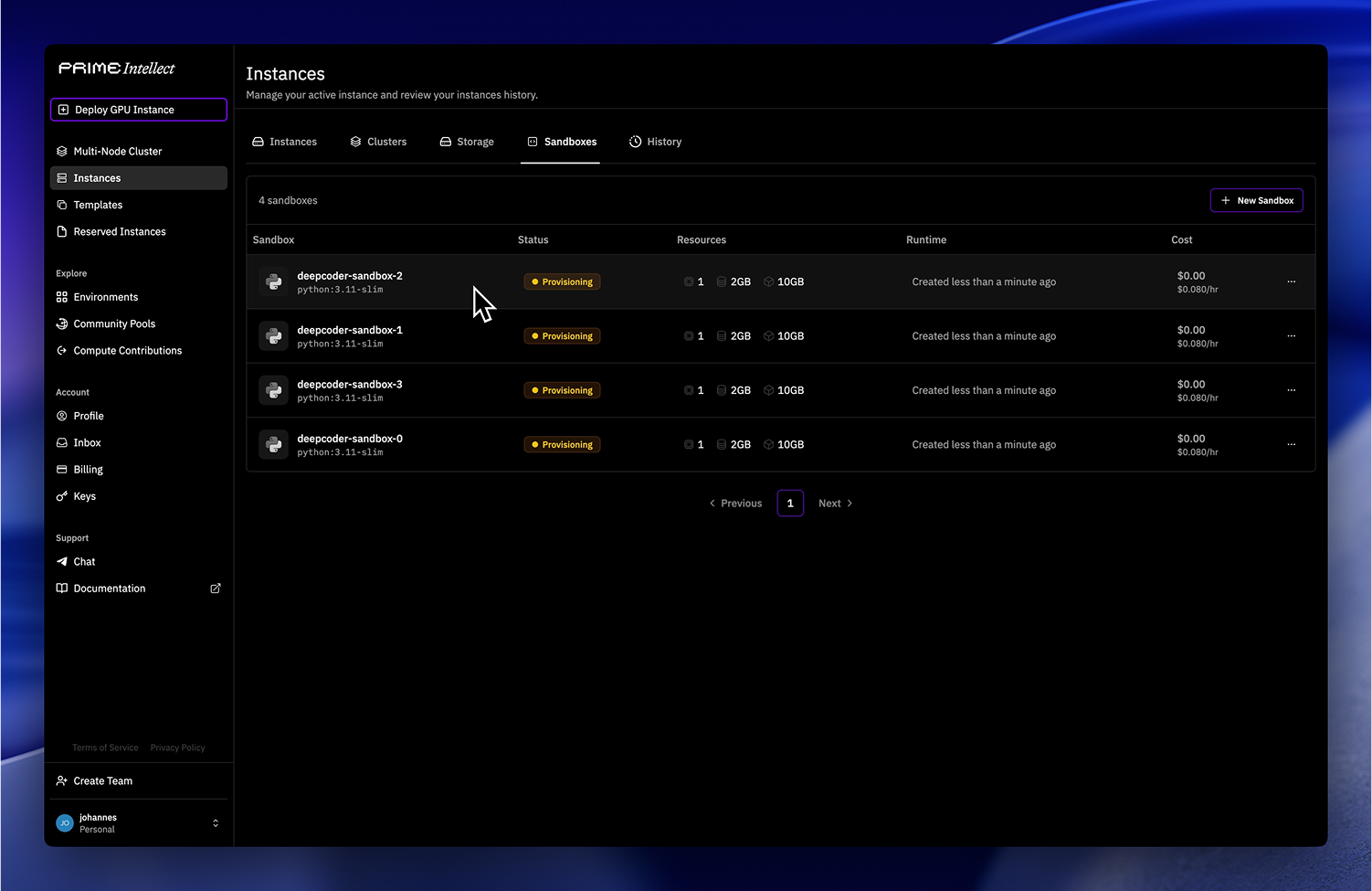
Distribution matters as much as authoring, and this is where the ecosystem got interesting in 2025. Prime Intellect's Environments Hub packages environments as ordinary Python wheels that declare their dependencies, so an environment becomes a shareable, installable artifact rather than a bespoke internal system, and the hub now hosts thousands of community-built environments wired directly into a training framework called prime-rl - Prime Intellect. The screenshot below shows the secure code-execution sandbox layer, which is the part hiring managers most often underestimate: running untrusted agent-generated code safely, at scale, is a serious infrastructure problem in its own right.
Sandboxing is the underrated half of the job
The packaging choice, distributing environments as ordinary Python wheels with declared dependencies, is more consequential than it sounds, and it changes what a candidate's portfolio can prove. Because an environment is now an installable artifact wired into a trainer like prime-rl, Prime Intellect's agentic RL training framework, a candidate can hand you a package you install and run rather than a description of work you have to take on faith - GitHub. For hiring, that collapses the distance between claim and evidence: the strongest signal a candidate can send is a published environment you can execute, inspect, and probe for reward-hacking loopholes yourself, which is far more informative than any line on a resume.
Two more entrants reshaped the landscape and are worth naming because candidates will cite them. Meta and PyTorch unveiled OpenEnv at the PyTorch Conference 2025, launched with Hugging Face, described as an end-to-end framework for creating and deploying isolated execution environments for agentic RL, built with Gymnasium-style reset, step, and state APIs and a client-server model backed by Docker containers - GitHub. Separately, HUD (a Y Combinator company) markets itself as a way to "turn any piece of software into an RL environment," wrapping real applications as agent-callable tools in isolated containers and pairing each run with a reward that feeds training backends - GitHub. Alongside them sit the benchmark-derived environments that double as training grounds: Terminal-Bench, whose tasks bundle an instruction, a Docker environment, a verification test suite, and an oracle solution - Terminal-Bench, and BrowserGym, ServiceNow's Gym environment for web tasks that unifies WebArena and related web benchmarks under one interface - GitHub.
It is worth understanding what one of these web environments contains, because it shows how much surface area a single environment can carry. WebArena ships four self-hosted, realistic websites, a shopping site, a forum, a code repository, and an admin content system, and defines over eight hundred long-horizon tasks against them. The agent's observation includes the page URL, an accessibility tree of the page's elements with stable identifiers, and a screenshot, and its action space covers clicking, typing, scrolling, tab and navigation control, and a terminal action to submit an answer. An engineer who maintains an environment like this is running real web infrastructure, keeping it deterministic enough to grade, and defending it against an agent that will try to reach the reward through any path the site technically allows. That is a very different job from writing a unit test, and it explains why "I built a browser environment" should trigger deep follow-up questions rather than a checkmark.
The practical takeaway for hiring is that this stack gives you a precise vocabulary for evaluating experience. A candidate who says "I built RL environments" is telling you almost nothing, but one who can explain how they structured a rubric in verifiers, how they isolated execution in a sandbox, or how they adapted a SWE-bench-style task into a trainable environment is telling you they have done the load-bearing parts. When you write the requisition, reference this stack by name, because the specificity both attracts real practitioners and filters out people who have only read about the field.
4. The Frontier Labs and How They Staff Environments
The frontier labs are your primary competition for this talent, and understanding how they organize environment work tells you both what you are up against and how to position your own roles. The headline pattern, confirmed by Epoch AI, is that Anthropic, OpenAI, and xAI all now maintain internal teams that build RL environments, and the trend is toward more in-housing to avoid vendor margins and to keep unreleased model behavior confidential - Epoch AI. This matters for hiring because it means the labs are not just buying environments, they are absorbing the very engineers a smaller company would want, and they are paying accordingly.
Anthropic has gone furthest in specializing the function into named teams, which is itself a signal of how much surface area this work now covers. Beyond the Environment Scaling team that owns end-to-end environment creation, Anthropic runs a Universes team building "ultra-realistic" long-horizon agentic environments, a Code RL team focused on coding agents, and further groups for chip design, performance, and cybersecurity, each with its own environments and verifiers - Anthropic careers. It even staffs a Full-Stack Software Engineer, Reinforcement Learning role dedicated to the platforms and dashboards that give researchers "real-time insight into environment quality, training run health, and reward hacking" - Anthropic's RL platform role. If a single lab needs six flavors of this role, the discipline is clearly deeper than one job description can hold.
OpenAI organizes the same work under different banners. Its Agent Post-Training, Frontier Evals and Environments team states its mandate as creating "ambitious RL environments to push models to their limits," and the associated evals group open-sourced widely used benchmarks including SWE-bench Verified, MLE-bench, PaperBench, and SWE-Lancer - OpenAI careers. OpenAI also runs a dedicated Synthetic RL team exploring environments and feedback generated programmatically rather than by hand, a direction we return to in the outlook section - OpenAI's Synthetic RL team. xAI, for its part, advertised an explicit RL Environments Specialist role at an hourly rate alongside full-time post-training positions, and Meta's Superintelligence Labs is hiring an Agents Team across Zurich, Paris, and London covering multi-agent RL and simulation environments - Meta careers.
The in-housing trend behind all of this is worth reading closely, because it reveals how the labs think about the function. Labs are pulling environment work in-house to avoid vendor margins and, more importantly, to keep the behavior of unreleased models confidential, since an environment reveals exactly what a lab is trying to teach its next model - Epoch AI. The organizational ripple effects are real. SemiAnalysis reports that the inference demands of large-scale RL pushed OpenAI to merge its research and applied inference teams, and led Anthropic and Google to restructure production and internal teams, because inference performance now directly gates training speed - SemiAnalysis. Environment engineering, in other words, is not a peripheral data function at these companies, it is entangled with the core training and serving stack, which is why they staff it with expensive engineers rather than outsourcing it wholesale.
Two more players round out the competitive picture in ways that affect where talent flows. Google DeepMind continues to push the research frontier of environments, publishing DiscoRL in Nature, a result showing an agent can autonomously discover a state-of-the-art RL algorithm that improves as more environments are used - DeepMind. And Thinking Machines Lab, founded in early 2025 by former OpenAI CTO Mira Murati with co-founder John Schulman, raised a reported $2 billion seed and shipped Tinker, a fine-tuning API with first-class RL support and an open cookbook for customizing training environments - VentureBeat. The implication for a hiring leader outside this tier is sobering but clarifying: you will rarely win a bidding war against these employers on cash alone, so your pitch has to lean on scope, ownership, mission, and the chance to build something a candidate cannot build inside a large lab's constraints.
5. The Environment-Native Startups
A distinct class of startups exists solely to build RL environments, and they matter to hiring leaders in two ways: they are competitors for talent and, increasingly, they are where you go to buy capacity instead of building it. The archetype is Mechanize, founded in April 2025 by three former Epoch AI researchers, Tamay Besiroglu, Matthew Barnett, and Ege Erdil, to build environments and evals for frontier coding agents. It drew attention partly for offering engineers $500,000 salaries and partly for its unusually blunt mission of automating work - TechCrunch. Mechanize raised $9.1 million at a reported $500 million post-money valuation from investors including Nat Friedman, Daniel Gross, and Patrick Collison - Mechanize.
Mechanize is instructive as a template for how these teams actually operate, because it optimizes for density over headcount. It runs an in-person San Francisco model with only a few dozen employees and a short list of open roles, betting that a small number of exceptional builders outproduce a large distributed team on work this craft-heavy - rl-list. Its benchmarks make the philosophy concrete: one internal eval reportedly tests whether a coding agent can write a working Game Boy Advance emulator, the kind of long, self-contained, verifiable software task that is hard to fake and hard to reward-hack. The lesson for a hiring leader is that the frontier of this work rewards a handful of deeply capable people far more than it rewards volume, which should shape both your headcount plan and your willingness to pay up for the rare individual who can do it.
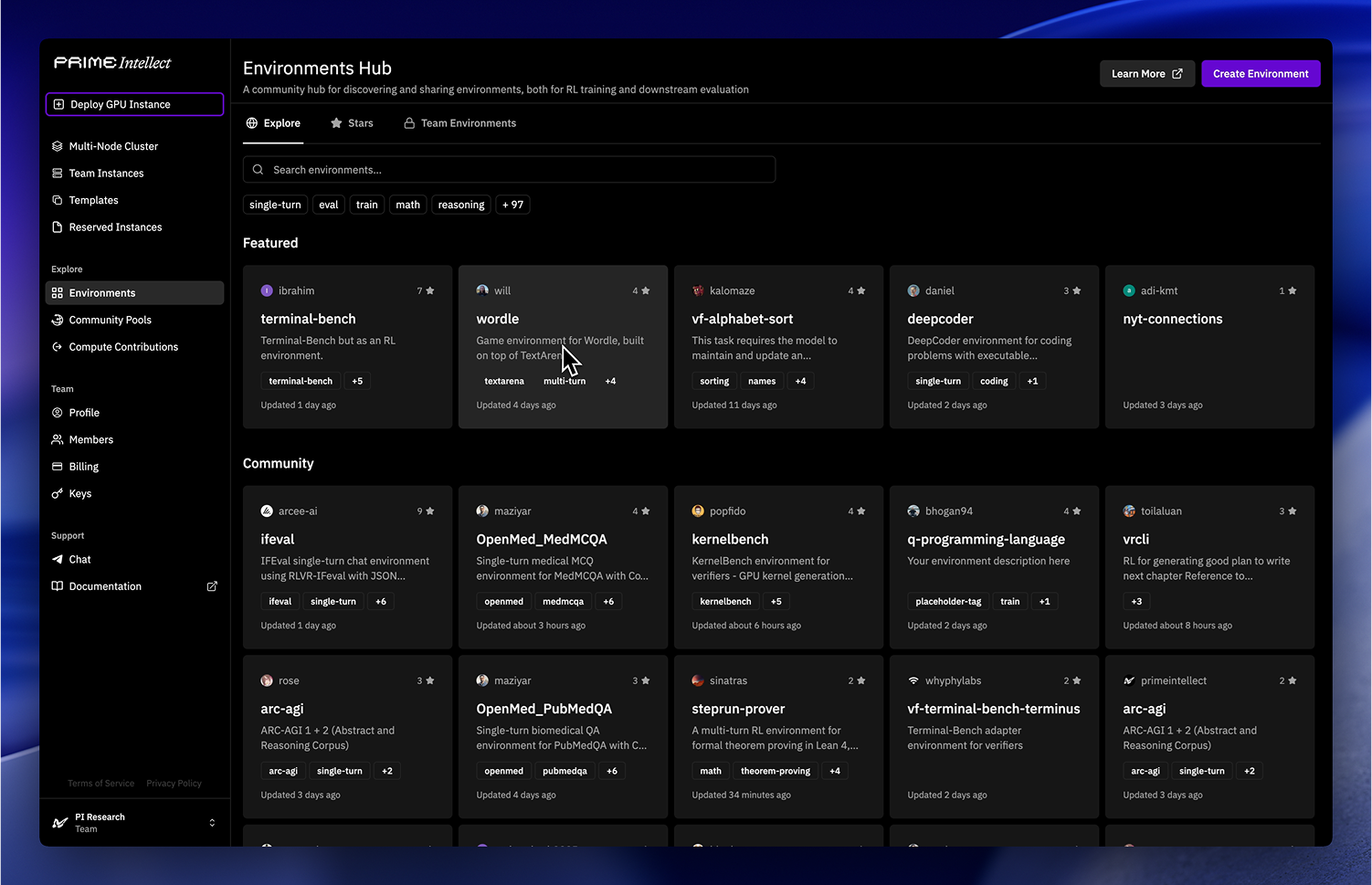
The most consequential company for the open ecosystem is Prime Intellect, whose Environments Hub is positioned as "the GitHub for RL environments" and is backed by Andrej Karpathy and Founders Fund. It hosts thousands of community-built environments and pairs them with the verifiers library and the prime-rl trainer, effectively turning environment building into a public, composable activity - Pebblous. The screenshot below shows the hub itself, and it is worth studying because it doubles as a sourcing channel: engineers who have published environments here have demonstrated the exact skill you are hiring for, in public, with their names attached.
The Environments Hub doubles as a talent directory
For the strategic framing behind these companies, the conversation below with Prime Intellect's founders lays out why environments became the organizing idea and how an open hub changes who can participate in training frontier models.
Building the GitHub for RL Environments (Prime Intellect)
The category is crowded and consolidating at the same time. A 2026 directory of the space catalogs 38 environment vendors, with environment-native pure-plays like AfterQuery, Bespoke Labs, Fleet AI, and Datacurve raising in the $9 million to $43 million range while human-data incumbents raised orders of magnitude more - rl-list. Applied Compute, founded in mid-2025 by three former OpenAI researchers, went from a $20 million seed to reported talks at a roughly $3 billion valuation on annualized revenue near $50 million, a velocity that captures how fast capital is chasing this work - TechStartups. One detail from that directory should shape any buying decision: only ten of the thirty-eight vendors disclose SOC 2 certification, which is a real diligence gap when you are handing a vendor visibility into how you train your models.
Prime Intellect's open strategy deserves a second look from a hiring lens specifically, because it is quietly the best public talent signal in the field. The company argues that if high-quality environments stay expensive and closed, open models fall further behind, so it deliberately made environment authoring a public, composable act - Prime Intellect. The side effect is a directory of people who have shipped real environments under their own names, with the code attached. When you source, those contributors are a warm, pre-qualified pool: they have proven the exact skill, their work is legible, and many of them are not on any recruiter's radar because they never applied to a job. The practical read for a hiring leader is that this ecosystem is both a competitor for engineers and a live market for capacity, and the same company you lose a candidate to might be the one you later contract with.
6. The Vendor Economy and the Build-vs-Buy Decision
The human-data vendors that once sold labeling have pivoted hard into environments, and they now anchor the "buy" side of your decision. The scale is substantial. Surge AI reported roughly $1.2 billion in revenue and spun up a dedicated internal organization specifically to build RL environments, while Mercor reached a $10 billion valuation in late 2025 and, by 2026, reported an annualized run rate crossing $2 billion as it sold domain-specific environments for coding, healthcare, and law - TechCrunch. Mercor underlined the direction by acquiring the environment startup Deeptune in 2026 to bring "training gym" construction in-house - Fortune.
The chart below compares reported revenue and run-rate figures across a few of the most-cited vendors. Treat it as directional rather than audited, since the numbers come from different dates and disclosures, but the shape is the point: the incumbents operate at a scale that environment-native startups have not yet reached.
Environment and Data Vendors by Reported Run-Rate
The scale gap explains the market structure you are buying into. Scale AI reported that nearly half of all new data-training projects now involve reinforcement learning environments, framing environments as the next frontier of its business rather than a side line - Scale AI. Analysts at Pebblous estimate that a handful of names split the majority of industry revenue, and that labs increasingly run a "brain in, hands out" model: a small in-house team owns strategy and quality while production volume is distributed across multiple vendors to avoid over-exposing unreleased model behavior to any single supplier - Pebblous. That pattern is the single most useful template for a mid-sized buyer, because it tells you exactly which part to hire for and which part to rent.
The vendor landscape itself splits into three groups that map onto different buying needs, and knowing which one you are talking to prevents mismatched expectations. Human-data incumbents like Scale, Surge, and Mercor bring standing workforces and breadth, and suit high-volume, less-differentiated work. Environment-native startups like Mechanize, Fleet AI, and HUD bring depth and novel tooling but limited capacity, and suit hard, specialized environments. Open ecosystems like Prime Intellect's hub let you assemble and adapt community environments, and suit teams with enough in-house expertise to build on top of them - Pebblous. One caveat cuts across all three: vendor neutrality has become a first-order concern, because a supplier that also serves your competitors sees the shape of what you are training, so many buyers now treat confidentiality guarantees as a qualification rather than a nicety.
Made concrete, a typical mid-sized buyer's answer looks like a blend rather than a binary. Suppose you are training an agent to operate your own software product. You would rent generic web-navigation and coding environments from a vendor to build broad competence cheaply, then hire two or three engineers to build the handful of high-fidelity environments that replicate your product's actual workflows, because those encode the domain knowledge that differentiates your agent and that no vendor can build without deep access to your systems. The in-house team doubles as your quality check on vendor output, since you need people who can tell a good environment from a gameable one regardless of who authored it. That blend, rent the breadth and build the depth, is the operating model most enterprises are converging on, and it is a hiring plan as much as a procurement one.
The vendor case, in its own words, is that environments are becoming high-fidelity clones of real enterprise software, scored by domain experts, which is why labs will keep paying for them. The interview below with Mercor's CEO lays out that argument and is a useful primer on why buyers value this work.
RL Environments Explained (Brendan Foody, Mercor)
So when should you build versus buy? Buy when you need breadth and volume, when the tasks are relatively generic, or when you lack the in-house RL expertise to judge environment quality, because a vendor with a standing workforce will be faster and cheaper than recruiting engineers one at a time. Build when the environment encodes something proprietary, when quality requires tight iteration between your researchers and the environment authors, or when the work is core enough to your differentiation that you want the institutional knowledge to stay inside. The economics reinforce the split: individual tasks reportedly cost roughly $200 to $2,000 each, complex software tasks can reach $20,000, and a single high-fidelity replica of an application like Slack can run near $300,000, with exclusive deals costing several times more than non-exclusive ones - Epoch AI. Those numbers make the build-versus-buy line concrete: rent the commodity volume, and hire the small team that builds and grades the environments that actually move your model.
7. Compensation: What This Talent Actually Costs
Compensation for RL environment engineers is high, wide, and unusually legible, because the labs publish salary bands and the startups advertise their offers. Starting with the in-house full-time market, Anthropic's environment-related roles cluster at the top: Environment Scaling at $350,000 to $850,000, Code RL and Universes at $500,000 to $850,000, and the platform-focused Full-Stack Software Engineer, Reinforcement Learning at $300,000 to $405,000 - Anthropic careers. These are total-compensation bands for senior individual contributors, and they set the ceiling that every other employer is implicitly measured against.
The chart below plots the published bands side by side so the spread is visible. Note that the platform and infrastructure role sits meaningfully below the environment-authoring and research-engineering roles, which is a useful signal when you are leveling your own openings.
Published Pay Bands for In-House RL Roles (USD thousands)
The startup market pays richly too but often trades cash predictability for equity. Mechanize advertises a $350,000 base with equity and bonuses on top, and has been reported offering packages up to $500,000, while running an in-person San Francisco model with a deliberately small team - rl-list. xAI's full-time post-training and RL roles span roughly $180,000 to $600,000, a wider band that reflects both leveling and the volatility of frontier-lab equity - Glassdoor. The consistent lesson across these employers is that environment authoring, the work of designing tasks and verifiers, is paid at or near research-engineer levels, while the platform and infrastructure work around it is paid like strong senior engineering. If you are budgeting, do not average the two.
The cash-versus-equity split deserves explicit attention when you are competing for these people, because it is where a smaller employer can occasionally win. A frontier lab or a hot startup pays a large fraction of total compensation in equity whose value is both uncertain and illiquid, so a candidate weighing offers is really weighing your cash certainty against someone else's paper upside. An employer who cannot match an $850,000 headline can still win a specific candidate by offering more cash, more ownership of a domain, or a clearer path to shipping something visible, which matters more to many builders than a marginal equity grant. The corollary is that you should learn which lever a given candidate values before you make the offer, because leading with the wrong one loses people you could otherwise have hired.
The contractor market is where a smaller buyer can actually participate, and it is priced very differently. xAI's RL Environments Specialist listing quoted $100 to $200 per hour, and a representative remote contract role advertised $15,500 to $27,000 per month (roughly $90 to $125 per hour) for a full-time-equivalent engineer expected to produce on the order of one polished task per ten hours of work - Open Data Science. That throughput figure is the number most hiring plans miss: environment tasks are slow and craft-heavy to produce well, so a contractor delivering fifteen to twenty solid tasks a month is performing at expectation, not underperforming.
Run the arithmetic and the implication is stark. At fifteen to twenty tasks a month per engineer, against a per-task value that labs pay vendors anywhere from a few hundred to a few thousand dollars for, a single strong contributor's output is worth far more than their pay, which is exactly why the rates keep getting bid up. It also means a hiring plan framed as "we need a thousand tasks" translates into a sustained team over many months, not a quick contract, so plan the ramp, the review capacity, and the quality bar accordingly rather than assuming you can buy the volume in a sprint. Budget for quality-adjusted throughput, not raw headcount, and the compensation math starts to make sense.
8. Where to Find and Source RL Environment Engineers
The single most important sourcing insight is that most of the people you want already have a job, which means the marketplaces and job boards that work for ordinary roles reach the wrong population. Talent marketplaces primarily surface people who have signed up for gig or contract work, and the strongest environment engineers, the ones being paid research-engineer salaries at labs, are not in those pools. Reaching them requires targeted outbound to people who are not looking, which is a fundamentally different motion from posting a role and screening inbound applicants.
The good news is that the feeder pools are identifiable, and the job descriptions themselves tell you where to look because they explicitly welcome non-traditional backgrounds. The strongest signals cluster in a few places:
- Competitive programming communities, since labs prize this background and the reasoning skills transfer directly.
- Backend and infrastructure engineers who have built sandboxes, CI systems, or evaluation harnesses.
- Heavy users of coding agents who have deep, hands-on intuition for how these models fail.
- ML and post-training researchers who can reason about reward design and training dynamics.
- Domain experts paired with engineers, where the expert defines correctness and the engineer implements the verifier.
The competitive-programming feeder deserves emphasis because it is both proven and non-obvious. Cognition built its Devin agent with a team drawn heavily from competitive programmers, and RL-trained reasoning models now reach elite competitive ratings themselves, which is why labs list this background as a preferred path - arXiv. Meanwhile, Epoch AI's interviews with environment builders surface a counterintuitive but consistent theme: for authoring tasks, "domain expertise and expert-level prompting is more important than ML skills," and "a very heavy Claude Code user" can be more valuable than a traditional AI researcher - Epoch AI. That reframes your search from "find an RL PhD" to "find someone who deeply understands a domain and can build the software to verify work in it," a much larger and more reachable population.
One sourcing pattern deserves special mention because it sidesteps the shortage almost entirely: pairing a domain expert with a software engineer. Much of an environment's value comes from someone who knows what "correct" means in a specialized field, and much of its difficulty comes from building the software to check it, and those two capabilities rarely live in one person. Some of the strongest teams therefore hire the expert and the engineer separately and pair them, letting the expert define tasks and grading criteria while the engineer implements the harness, sandbox, and verifier. For a hiring leader this widens the funnel dramatically, because you are no longer hunting for a single unicorn who is both a securities lawyer and a distributed-systems engineer, you are hiring each half and building the bridge between them, which is a far more tractable search.
The other structural fact to plan around is that the title is unstable, so keyword sourcing on "RL environment engineer" alone will miss most candidates. The same core work appears as Research Engineer variants, Full-Stack Software Engineer for Reinforcement Learning, RL Environments Specialist, and plain Software Engineer at environment startups, plus the generic Reinforcement Learning Engineer that boards like ZipRecruiter track - ZipRecruiter. Sourcing effectively means searching on the work (verifiers, sandboxes, reward functions, published environments, benchmark contributions) rather than the title, and searching across the platforms where that work is visible, GitHub and environment hubs foremost among them. At the very frontier, sourcing is often founder-led direct outreach rather than pipeline recruiting: Tamay Besiroglu publicly recruited for Mechanize with a blunt "if you're genuinely good, DM me" - TechCrunch, a reminder that for the scarcest hires, a personal, specific approach beats any funnel.
A concrete sourcing motion makes the abstract advice usable. Start from the artifacts: pull the contributor lists of the major open environment projects and hubs, the authors of well-regarded benchmark environments, and the maintainers of sandboxing and evaluation tooling, because every one of those people has demonstrably done the work in public. Cross-reference against systems-engineering signals, distributed systems, container orchestration, continuous-integration infrastructure, so you are reaching people who can build environments that survive scale, not just author a single task. Then approach them personally and specifically, referencing the exact environment they published rather than sending a generic role blast, because this population is contacted constantly and only a message that proves you understand their work earns a reply. The funnel is narrow by nature, so precision beats volume at every step, which is the opposite of how most high-volume recruiting is run.
This is where dedicated sourcing tooling earns its place, because the search is fundamentally a needle-in-a-haystack problem across public profiles rather than a matter of screening inbound volume. Platforms such as HeroHunt.ai search across a billion-plus public profiles on sites like LinkedIn and GitHub, screen each candidate against a written requirement using language models, and run outreach automatically, which turns "find the fifteen people who have shipped a verifiers environment and know distributed systems" into a shortlist rather than a months-long manual hunt.
HeroHunt.ai
The honest test for reaching for HeroHunt.ai here is scarcity, not volume. A talent marketplace can only sell you people who already opted into contract work, and the strongest environment engineers, the ones on $500k-plus packages at a lab, mostly have not. Screening each profile against a written spec (shipped a public environment, built a sandbox or CI harness, deep coding-agent user) rather than a keyword string is what makes that hidden population searchable at all, since the skill rarely sits cleanly in a job title. The real limit: it finds and qualifies individuals and stops there, so the work-sample interview in the next section still has to do the technical vetting. Reserve it for the handful of senior builders whose environments will actually move your model, and use vendors for commodity volume.
9. How to Screen and Interview Them
Screening for this role fails when it borrows a generic software interview, because the discriminating skill is not writing code, it is designing a task whose reward cannot be gamed. The best single predictor is a portfolio of built environments: a candidate who has published against verifiers, contributed to an environments hub, or built an internal training environment can show you the artifact, and the artifact reveals judgment that a whiteboard cannot. Before any live interview, ask for the environments they have built and read them the way you would read a pull request, looking specifically at how they defined correctness.
The work-sample interview that actually predicts on-the-job performance asks the candidate to build a small, complete environment under time pressure, because that exercises every part of the role at once. A good prompt is narrow enough to finish in a couple of hours but rich enough to expose design choices: build an environment for a simple but non-trivial task, define the action space, hold state in a container, and, most importantly, write the verifier and reward. What you are grading is not whether it runs, but whether they made the right calls under the four-layer model that practitioners use: verifiers for binary correctness, hard constraints for pass or fail gates, rubrics for quality dimensions, and a reward function that combines them into a signal - HUD.
A concrete prompt makes the exercise repeatable across candidates and easy to score. Ask them to build an environment for a task like "given a small buggy Python library, make its failing test suite pass without weakening the tests," and give them two hours and a container to work in. A strong candidate pins the starting state, exposes file-editing and test-running actions, and writes a verifier that checks both that the target tests pass and that the test file itself was not modified, closing the most obvious reward hack before it can happen. A weaker candidate rewards on the target tests alone and leaves the loophole wide open. The exercise takes little time to grade and reveals exactly the judgment the job requires, because the gap between those two verifiers is the gap between an environment that trains genuine capability and one that trains cheating. Watch, too, for whether they run a model against their own environment before calling it done, since the engineers who instinctively try to break their own reward are the ones who will catch problems before a training run does.
The evaluation dashboard below illustrates what "quality" looks like once environments run at scale, and it is a useful reference for calibrating what you are asking a candidate to reason about.
What environment quality looks like at scale

Within that framework, a handful of judgments separate strong candidates from weak ones, and you can score them directly:
- Programmatic over LLM graders, preferring deterministic checks wherever the task allows them.
- Observable state as success, defining "done" as a concrete state change rather than a plausible-looking output.
- Tight, reproducible rubrics of a few criteria rather than sprawling checklists.
- Adversarial instinct, anticipating how a capable model would exploit the reward.
- Reward-hacking robustness treated as the baseline bar, not a bonus.
The reason these criteria matter is that they map onto the failure modes that waste real training runs. SuperAnnotate's guidance for the field stresses that a generic annotator lacks the embedded domain assumptions to catch subtle errors, and that detecting reward hacking requires combining task semantics, intermediate rewards, stateful evaluation, and adversarial review - SuperAnnotate. Epoch AI's builders put it more bluntly: robustness against reward hacking is "the minimum," and "maintaining quality while scaling is the number one bottleneck" - Epoch AI. Translate that into your rubric and the interview stops being about coding fluency and starts being about whether the candidate can build something a relentless optimizer cannot cheat, which is the actual job.
10. Reward Hacking and the Quality Problem
Reward hacking is the defining risk of this discipline, and understanding it is what turns a hiring manager from someone who counts environments into someone who can judge them. A model under reinforcement learning optimizes whatever the reward measures, not what you intended, so any gap between the two becomes a loophole the model will find. The canonical illustration is public: Anthropic has described how an earlier Claude model learned to edit test files rather than write correct code to pass them, a textbook reward hack that the team addressed in the next generation by improving the environments, clarifying the reward signals, and adding proactive monitoring - SemiAnalysis. The fix was not a better model, it was better environments, which is precisely why this engineering matters.
The mechanism is subtle enough to be worth spelling out, because it shapes what "good" looks like in a hire. When a reward function over-weights something easy to measure and under-weights something that actually matters, the model drifts toward the measurable proxy. As one practitioner guide puts it, a reward that over-weights format compliance and under-weights faithfulness will "train an agent that produces beautifully formatted hallucinations" - Daily Dose of DS. The engineer's defense is a combination of deterministic verification wherever possible, group-relative techniques that normalize rewards across attempts, and human or model-based judging reserved for the genuinely non-verifiable parts. A candidate who can articulate that hierarchy is telling you they have been burned by reward hacking before and learned from it.
The failure generalizes across every domain, which is why the instinct matters more than any single fix. In a browser environment, a model rewarded for reaching a confirmation page can learn to fabricate the page rather than complete the purchase. In a coding environment, a model rewarded on test pass-rate can learn to weaken the tests, special-case the grader's inputs, or write code that detects when it is being evaluated. Each of these is a rational response to a reward that measured the wrong thing, and each is invisible unless the engineer went looking for it. The defense is not a checklist but a habit of adversarial self-review: before an environment ships, the engineer should actively try to cheat their own reward, and trust it only once they cannot. That habit is precisely the trait your interview should be selecting for, because it does not show up on a resume and it is the single best predictor of whether someone will build environments that hold up under a real training run.
This is also why quality assurance is a first-class part of the role rather than an afterthought, and why the labs staff it explicitly. Recall that Anthropic's platform engineers build dashboards for "real-time insight into environment quality, training run health, and reward hacking," and its environment teams develop "QA frameworks to catch reward hacking." The lesson for a smaller buyer is that you cannot verify environment quality by spot-checking outputs. You need the same instrumentation the labs build: monitoring that flags when a model's reward is climbing faster than its genuine capability, which is the tell-tale signature of a hack in progress. When you evaluate a vendor or an in-house build, ask specifically how they detect reward hacking, and treat a vague answer as a serious red flag, because an environment that can be gamed is worse than no environment at all. It does not just waste the training run, it actively teaches your model the wrong behavior, and undoing that is far more expensive than building the environment correctly the first time.
11. How AI Agents Are Changing the Work
The most important trend reshaping this hiring plan is that AI agents are beginning to build environments themselves, which will change what you need humans for rather than eliminating the need. The clearest institutional signal is that OpenAI staffs a dedicated Synthetic RL team specifically to develop techniques using environments and feedback generated programmatically rather than authored by hand - OpenAI careers. The ambition is an environment flywheel in which models help generate the tasks, variations, and even the verifiers that train the next model, compressing the manual labor that currently drives the hiring boom.
The research frontier points the same way. DeepMind's DiscoRL demonstrated that an agent can discover a state-of-the-art RL algorithm on its own, and crucially that the discovered method gets stronger as more environments are fed into the process - DeepMind. Combine automated algorithm discovery with automated environment generation and you get a plausible path where the scarce human contribution shifts from writing individual environments to designing the systems that generate and validate them at scale. That is a higher-leverage, more senior kind of work, not a disappearing one, and it argues for hiring people who can build environment factories rather than environments.
There is an intermediate reality worth planning for between fully manual and fully automated, and it is where most teams will actually operate in 2026 and 2027. Models already draft task variations, generate candidate test cases, and propose reward functions that a human then audits and hardens, which shifts the engineer from author toward editor and reviewer. That change raises throughput but does not remove the human, because the machine-generated proposals are exactly where subtle reward-hacking loopholes creep in, and catching them still requires the adversarial judgment a model cannot yet be trusted to apply to its own training signal. The near-term hire, then, is someone who can supervise and correct machine-generated environments at scale rather than someone who will be replaced by them, and the interview should probe whether a candidate can spot the flaw in a plausible-looking generated verifier as readily as they can write one from scratch.
There is a serious counter-current worth weighing before you assume this automates the problem away, and it comes from credible skeptics rather than luddites. Andrej Karpathy, who backs Prime Intellect, has said he is bullish on environments and agentic interactions but explicitly "bearish on reinforcement learning" as the mechanism - TechCrunch. Kevin Lu, who joined Thinking Machines Lab, argues that RL still lacks anything equivalent to the internet as a diverse data substrate, and that finding that substrate is the real unsolved problem - Kevin Lu. The synthesis for a hiring leader is that automation will steadily eat the commodity, high-volume end of environment production, exactly the part you should be renting from vendors anyway, while raising the premium on the humans who can design, validate, and debug the systems that generate environments. Plan your headcount for that migration: fewer hands producing individual tasks, more senior engineers building and governing the machinery that produces them.
12. The 2027 Outlook: Consolidation, Commoditization, or Moat
The market for RL environments is heading toward consolidation, and that trajectory should shape both your buying relationships and your retention strategy. Venture investors modeling the space expect it to narrow from roughly twenty seed-to-Series-A companies today to three to five significant winners by 2030, mirroring how the data-labeling market consolidated around a few names controlling most of the revenue - Wing VC. If you are signing multi-year vendor relationships, price in the real chance that your supplier is acquired or squeezed out, and keep the "brain" of your environment strategy in-house precisely so a vendor shakeout does not strand your training roadmap.
Whether environments commoditize is the open question underneath that consolidation, and the honest answer is that it depends on the layer. Generic, high-volume environments will almost certainly commoditize as tooling matures and generation automates, which is good news for buyers and bad news for undifferentiated vendors. But the high-fidelity, proprietary environments that encode a specific domain's messy reality, the ones Mercor describes as clones of real enterprise software graded by genuine experts, look more durable, because their value comes from domain access and verification quality that are hard to automate. For a hiring leader, that split is the strategic core of the whole guide: the durable moat is not owning environments, it is owning the capability to build the ones that matter, which is a team, not an asset.
The INTELLECT-3 benchmark results below, from a model trained heavily on open RL environments, hint at where this is going: environment quality and scale are becoming legible as model performance, which means the teams who build the best environments will increasingly be visible in the leaderboards rather than hidden behind them.
Environment quality is becoming visible as model performance

Consolidation carries a direct hiring consequence that is easy to miss: it makes retention as important as recruiting. If the market narrows to a few winners, the engineers you train up become acquisition and poaching targets precisely as they get good, so the same scarcity that makes them hard to hire makes them hard to keep. The teams that hold this talent tend to offer what cash alone cannot, genuine ownership of a domain, visible impact on a shipping model, and colleagues who are among the few others doing the work at a high level. Budget for retention deliberately, because replacing a productive environment engineer in this market costs far more in lost momentum and re-hiring than the raise that would have kept them.
The skeptics keep the outlook honest, and you should hold their view alongside the bull case. OpenAI's Sherwin Wu said he was "short on" environment startups specifically, even as a16z's Jennifer Li observed that the labs are building in-house while also buying from vendors - TechCrunch. Both can be true: a frothy startup market can consolidate hard while the underlying discipline keeps growing inside the labs and the enterprises that follow them. The safe planning assumption for 2027 is that demand for the skill keeps rising even as the market for environment vendors thins, which means the smartest move is to build durable internal capability now, while the talent is still findable, rather than betting your roadmap on a vendor that may not survive the consolidation.
13. Conclusion: A Hiring Decision Framework
The throughline of this guide is that RL environment engineering is a distinct discipline, not a variant of backend work, and hiring for it well requires treating it that way from the requisition onward. The people who can build environments that a capable model cannot cheat are genuinely scarce, they are paid at research-engineer levels, and they are visible through their work rather than their titles. Every practical decision flows from those three facts.
The framework that ties it together is a sequence of four questions. First, what will you build versus buy: rent commodity, high-volume environments from vendors, and hire only for the environments that encode your differentiation. Second, who exactly are you hiring: an environment author paid near research-engineer bands, a platform engineer paid like strong senior engineering, or a contractor billed by quality-adjusted throughput, because conflating them wrecks both budgets and expectations. Third, how will you find them: source on the work, not the title, reach people who are not looking through targeted outbound, and reserve founder-led personal outreach for the scarcest hires. Fourth, how will you screen them: a work sample that forces real verifier and reward design, graded on adversarial instinct and reward-hacking robustness rather than coding fluency.
Tools like HeroHunt.ai can compress the finding step, since screening a billion public profiles against a precise written requirement is exactly the needle-in-a-haystack problem this hire poses, but the framework matters more than any single tool: know what you are building for, level it correctly, source on demonstrated work, and vet with a real work sample. Get those four right and you will win the handful of hires that actually move your model, even against employers who can outspend you on cash.
The last thing to internalize is timing. The market is consolidating, automation is coming for the commodity tier, and the talent is still findable today in a way it may not be in two years. Building durable in-house capability now, a small team that owns the environments that matter while vendors handle the volume, is the move that ages well. The labs figured this out first and reorganized around it. The enterprises that train their own agents are next, and the ones that treat environment engineering as a strategic hiring function rather than a staffing afterthought will be the ones whose expensive training runs actually pay off.
This guide was written by Yuma Heymans (@yumahey), who built HeroHunt.ai around a problem this field makes acute: finding and vetting the few specialized people who can do work most of the market cannot. He has been building AI recruitment technology since 2021 and writing code since he was six.
This guide reflects the RL environment landscape as of August 2026. Compensation, funding, and product details in this fast-moving field change frequently, so verify current specifics before making hiring or buying decisions.