



Disclosure: some links in this article are affiliate links. If you sign up through one, HeroHunt may earn a commission at no extra cost to you.
Passive candidates are the biggest group of available talent out there. As a recruiter, you can focus on recruiting by a ‘post and pray’ approach where you advertise your job ads and wait for active candidates to come in. Or… you can spearfish the highest quality candidates in the market; passive candidates.
Why is that a good idea?
Because 70% of the entire available global talent pool are passive candidates. Just 30% are active candidates who are actively looking for a job on job boards.
85% of all candidates are open to new job opportunities.
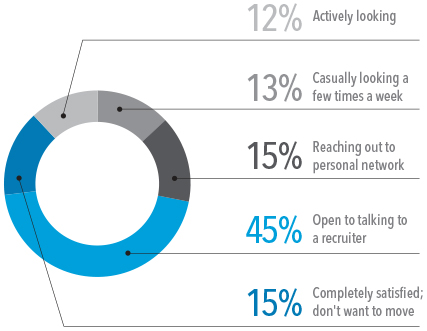
When you rethink your approach to passive candidates an entire pool of candidates opens up. In addition, passive candidates on average are of a better quality than active candidates.
Where most recruiters focus on inbound candidates who have applied to job posts, there are recruiters that choose to focus on passive candidate sourcing.
This is why passive candidates are increasingly interesting for recruiters:
- Passive candidates make up the biggest talent pool: 70% of the workforce is passive talent
- Matches are more accurate: with active candidate recruitment you will on average invite just 2% of candidates that applied for an interview, with passive candidate sourcing you can spearfish for the exact talent you think would be best
- Quality of passive candidates is higher: 73% of recruiters find higher quality candidates when focusing on passive candidates.
- There is less competition for passive candidates: because the majority of recruiters still rely on active candidate recruitment the competition for passive candidates is less.
The proven approach to reach passive candidates is not job boards, but rather proactive outreach (outbound recruiting).
But once you find passive candidates, how do you engage them in your employer brand and open jobs?
Enough reason to write this guide on how to engage passive candidates.
These are the topics we’ll discuss in this blog:
- Why engagement is important for passive candidates
- How to engage passive candidates
- Tools to use for passive candidate engagement
1. Why engagement is important for passive candidates
Because passive candidates are not actively searching for a job yet, engaging them (proactively) is even more important than with active candidates.
Passive candidates are not invested in your employer brand yet, they’re probably not even aware of the existence of your company let alone your job positions.
Aso, candidates have more opportunities and higher expectations than ever before so it’s harder to get them to consider your employer brand.
You have to engage them over a series of interactions, or touch points, to get them caring about your company as a potential employer.
Imagine being approached on the street by an absolute stranger. Shortly after introducing themselves they ask you to come with them to have a look at something they’re offering. Would you go with them? Probably not, but this is what most recruiters do in approaching candidates: one shot direct messages that focus on the need of the company, instead of focussing on the candidate’s need for the longer term.
To get passive candidates acquainted, comfortable and excited about your employer brand and job offering you need several touch points over time where you provide the right information at the right time and be available to the candidate.
That’s what engagement is all about.
2. How to engage passive candidates
The whole game with passive candidates is patience and relevance: you win them over one small, well-timed interaction at a time, not with a single perfectly-worded message. A passive candidate has no reason to reply to a stranger about a job they were not looking for, so your first job is not to sell the role, it is to earn a second touchpoint. Everything below is built around that idea.
The recruiters who are good at this treat it like building a relationship rather than closing a deal. They lead with the candidate, they spread contact out over time, they give something useful at each step, and they keep nurturing the people who say not right now. Here is how to actually do it.
Lead with the person, not the vacancy
Your opening message should prove you looked at them, not that you have a job to fill. Reference a specific project, a talk they gave, a repo they shipped or a post they wrote, and connect it to why you thought of them. Generic outreach is exactly what the best passive candidates ignore, because they get a dozen mismatched messages a week from recruiters who never opened their profile.
This is why passive candidate sourcing and engagement are two halves of the same job. If you sourced the person carefully, you already have the raw material for a relevant first touch. If you scraped a list and blasted it, you have nothing to say that they have not heard before.
Space your touchpoints out over time
One message is not outreach, it is a coin flip. Plan a sequence of three to five touches spread over two to three weeks, across more than one channel: an email, a LinkedIn note, a comment on something they published, a follow-up that adds a new angle. Each touch should stand on its own and give a reason to keep the conversation going, never just circling back on the same ask.
The point of spacing is that a passive candidate's situation changes. Someone who is happy today may be frustrated in three weeks after a reorg or a passed-over promotion. Staying gently present, without nagging, means you are the recruiter they remember when that shift happens.
Give value at every touch
Because passive candidates are not invested in your brand yet, each interaction has to leave them slightly better off whether or not they ever apply. Share a salary benchmark for their role, a useful article, a heads-up about your team's roadmap, an introduction. This is how you build the employer brand familiarity the intro talked about: by being useful before you are needful.
This is also the difference between engagement and spam. If every message asks for something (a call, a reply, a referral) you are draining the relationship. If most messages give something, the occasional ask feels fair.
Nurture the ones who say “not now”
Most passive candidates you reach will not be ready when you first reach them, and that is fine. The mistake is dropping them the moment they decline. A polite not right now is a future hire if you keep the relationship warm: check in every couple of months, remember what they cared about, and be the first call when a better-fit role opens.
Doing this by memory does not scale past a handful of people, which is exactly why the next section is about the tooling that lets you run a warm pipeline of dozens or hundreds of passive candidates without letting anyone fall through the cracks. For a deeper walkthrough of the nurture mechanics, our candidate engagement guide goes further.
3. Tools to use for passive candidate engagement
Engagement is a system, not a talent, and the tooling question is really one question: where do you remember every passive candidate, what you last said to them, and when the next touch is due? Your inbox cannot do that past about ten people. Once you are nurturing dozens, you need something that stores the relationship, not just the message.
There are three tool categories that actually matter here, and they map cleanly onto the workflow above: a recruitment CRM to hold and automate the relationship, a contact-data tool to reach people who never applied, and AI sourcing and outreach to keep the top of the pipeline full. You rarely need all three from day one, but you will end up wanting at least the first.
A recruitment CRM to run the pipeline
A recruitment CRM (candidate relationship management) is the backbone of passive engagement: it is where each candidate sits in a pipeline stage, where their history lives, and where you can trigger the next personalized touch automatically instead of relying on your memory. Applicant tracking systems track people who applied to you; a CRM tracks people you are pursuing, which is the entire passive-candidate problem. Affordable recruitment CRMs like Manatal are built around exactly this pattern, which is why it is worth a closer look here.
Manatal
Engaging passive candidates means running a relationship across weeks and many touchpoints, which is exactly what a recruitment CRM is for, and it is why Manatal fits this article's reader better than a bare ATS. It is a recruitment CRM that fires personalized emails automatically as a candidate moves between pipeline stages, so your nurture sequence keeps running while you work other reqs, and it publishes a real price instead of hiding behind a demo: $15 per user per month billed annually ($19 month to month), with a 14-day trial that needs no card. The honest caveat: that entry tier caps at 15 active jobs and 10,000 candidates, and its sequencing is deliberately basic (no email-campaign scheduling), so a high-volume outbound team running large multi-step drips will outgrow it and should look at the $35 unlimited tier or pair it with a dedicated sequencer.
Contact data to reach people who never applied
The catch with passive candidates is that they did not hand you their email, so before you can engage anyone you have to find a way to reach them. A contact-data tool solves the first-touch problem: it turns a name and a company into a work email or a direct dial. Tools like Apollo.io include a free tier that is enough to test hit rates on your own shortlist before you pay, which is the sensible way to find out whether the data quality holds up for your market. Reserve the paid credits for the roles where email actually lands, and lean on LinkedIn for the rest.
AI sourcing and outreach to keep the pipeline full
Everything above assumes you have passive candidates to engage in the first place, and keeping that top-of-funnel full by hand is slow. This is where AI sourcing tools come in. HeroHunt.ai and its AI Recruiter take a different approach from a manual CRM workflow: they source matching candidates from over a billion profiles and start personalized outreach automatically, so the nurture pipeline is fed without you running searches all day. It is one option among several, but it fits the same principle this whole guide runs on: relevance and consistency at a scale humans cannot sustain manually.
HeroHunt.ai
Every tactic in this guide assumes there are passive candidates in front of you to engage, and that top-of-funnel work is the part that quietly eats the week. HeroHunt.ai is built for exactly that half of the job: its AI Recruiter searches over a billion public profiles, screens them against your role brief rather than a keyword string, and writes the personalized first touch itself, so the nurture pipeline described above never runs dry. Full disclosure, this is our own product, so here is the honest limit. It is a sourcing and outreach engine, not a CRM: it finds people who were not looking and opens the conversation, but the multi-month nurture of a candidate who said not right now still belongs in the pipeline tool from the CRM section above. Use it for the top of the funnel, not as your system of record.
4. Bringing it together
Engaging passive candidates comes down to a simple loop: reach people who were not looking, lead with something relevant to them, give value across several well-spaced touches, and keep the ones who are not ready yet warm until they are. The tactics are not complicated. What is hard is doing them consistently across a real pipeline, which is why the tooling matters as much as the technique.
If you are picking one thing to start with, start with the system that stops candidates falling through the cracks. A recruitment CRM turns a scattered set of good intentions into a repeatable pipeline, and it is the cheapest place to buy back the consistency that passive engagement lives or dies on.
Manatal's 14-day trial needs no card, so you can load a real passive-candidate pipeline and watch the stage-triggered nurture emails fire before you pay anything.
Written by Yuma Heymans (@yumahey), who built HeroHunt.ai, the world's first AI Recruiter, now used by 15,000+ recruiters to source and engage passive talent on autopilot.