



Disclosure: some links in this article are affiliate links. If you sign up through one, HeroHunt may earn a commission at no extra cost to you.
Finding blockchain developers is hard because there are a lot more companies currently looking for blockchain developers than there are blockchain developers who are offering themselves to companies.
And the pool has been shrinking, not growing. Weekly crypto commits fell from roughly 850,000 to 210,000 since the start of 2025, and the number of active crypto developers dropped 56% to around 4,600, based on Artemis data reported in March 2026 - CoinDesk. Ethereum, still the biggest ecosystem, was down to 2,811 weekly active developers.
Those people did not stop being engineers. They went to AI, which is where the entire industry's growth went: GitHub added 36 million new developers in a single year - Octoverse 2025.
This changes the shape of the problem. The people you want still exist, but they are a small, senior, often pseudonymous group sitting inside a much noisier market of people who put "blockchain" on a profile once. Precision matters more than reach.
That's why you have to be creative in your search. And definitely not wait until blockchain developers come to you as a company.
You have to proactively search and chase them and reach out to them to be able to convert them eventually to your successful hire.
I'm going to show you in which sources you can find blockchain developers because most people and most recruiters think that LinkedIn is the only source where they can find their next blockchain developer. That is definitely not the case. Alternative sources to LinkedIn offer a great source of valuable candidates and valuable candidate information.
A couple of examples of platforms other than LinkedIn that you can search are GitHub and Stack Overflow.
GitHub now has over 180 million developers on it - Octoverse 2025. It has a lot of valuable information because code repositories are shared with each other publicly. That information, using the right tool, can be available to you so you can analyse that skills related information and answer the question of whether someone is actually the right fit from a skills perspective for your job.
The second source is Stack Overflow, which we'll also be sourcing today. Similarly to GitHub it has a lot of valuable information from a skills validation perspective, because a lot of technical questions are asked and answered there.
One honest warning on Stack Overflow, because this is the part that has changed most since we first recorded this: it is no longer a live signal. Monthly question volume has fallen back to the level it was at in 2009, the year the site launched, as developers moved their questions to AI assistants - The Pragmatic Engineer. So use the archive to validate someone you already found, because a good answer from 2021 still proves they knew the topic. Do not read silence as a negative signal, and do not expect to build a 2026 shortlist out of recent Stack Overflow activity. There barely is any.
The challenge here is: how are we going to source these platforms? Because Stack Overflow and GitHub are not built for recruiters looking for developers. LinkedIn is, but ideally, we would want to have one solution, which can find all those different profiles from all those different platforms in one place.
In this blog, we are going to show how to use HeroHunt.ai to find your next blockchain developer, which will source all those different platforms in one solution.
Create a search based on your job description
In HeroHunt.ai, we start with the job description, basically the only thing that we need to create a search.
The first thing we do is including the job title in HeroHunt.ai: blockchain developer.
In this case, we have our job description, which can also be a list of specs or requirements. In this case, we have the full job description, which is great because there's a lot of valuable information about tangibles and intangibles, which eventually translates to a search.
Include the job description
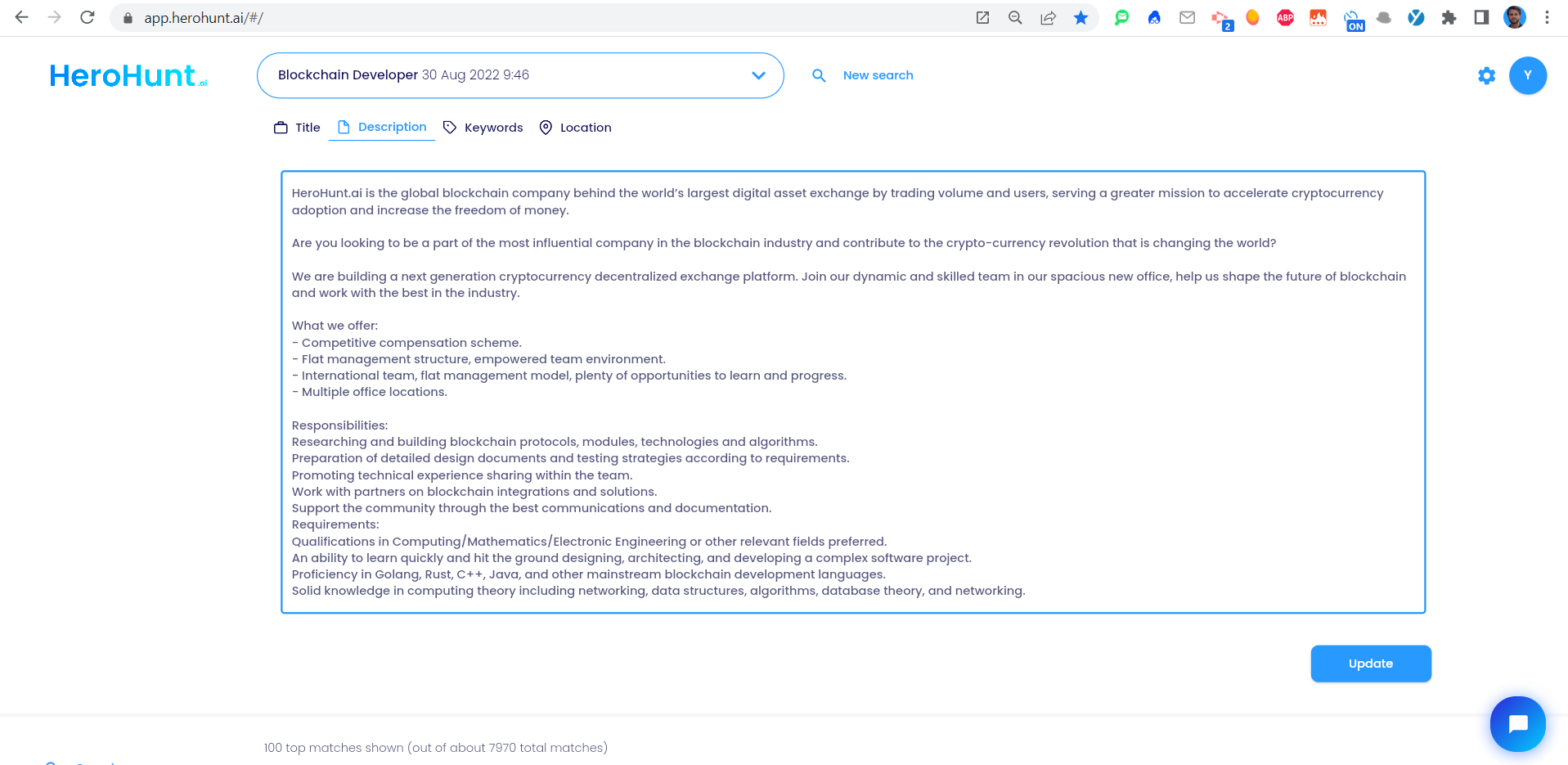
After copying and pasting the job description, you see that HeroHunt.ai extracts the keywords automatically prioritize them for you, so you can eventually do the last tweaks to the search and optionally add keywords that you want to add to your search.
From your job description the search is built
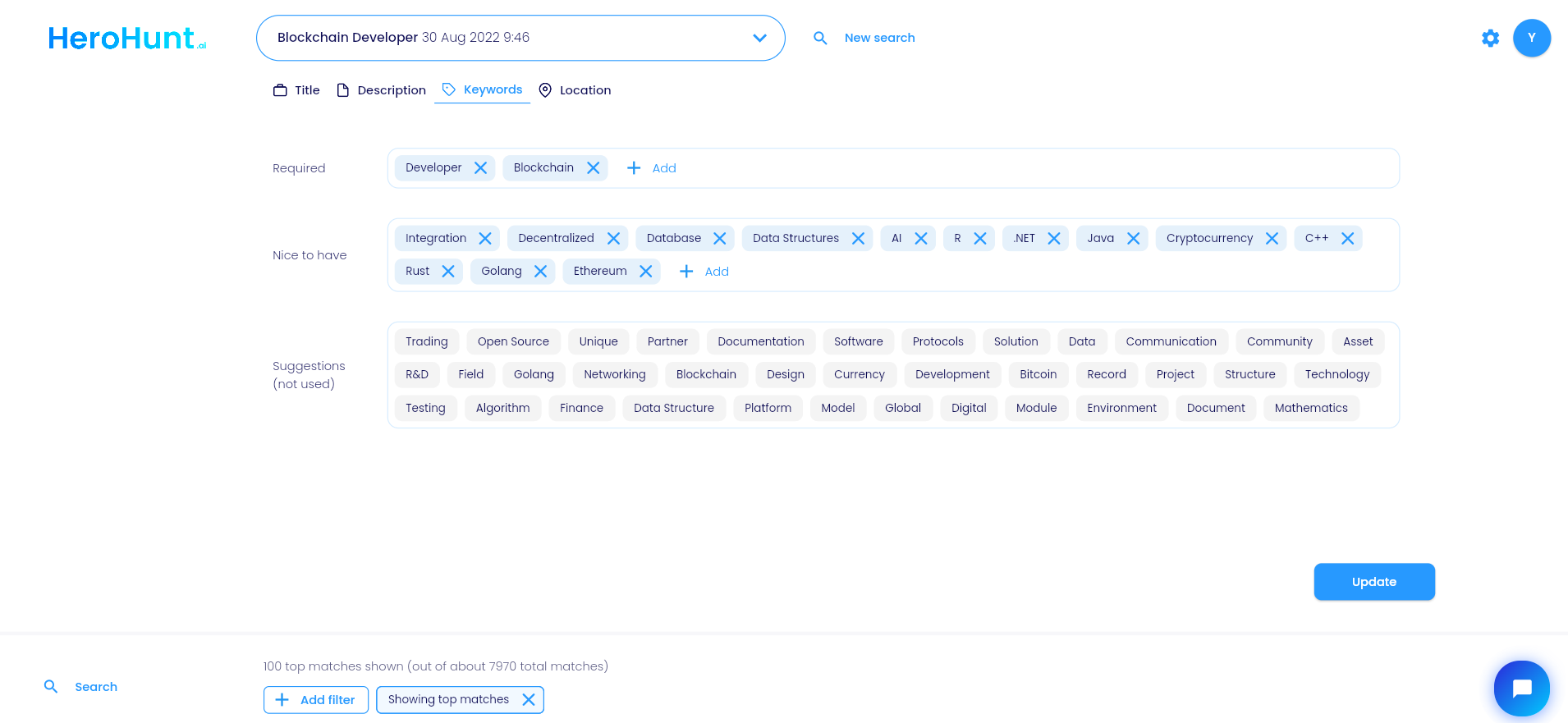
Now we have a search with the required and nice tot have keywords. The required keywords have to be on the profile for the profile to appear in your search results.
HeroHunt.ai automatically takes into account all the different underlying synonyms or similar words. So blockchain can be ledger, distributed ledger, etc. and it does so for all the different keywords that you include.
If you use a different tool than HeroHunt.ai, make sure the solution is taking into account the different underlying synonyms because there are so many different words used for the same thing. You want to include those different ways of writing so you can find all relevant candidates.
Now we have built the search, we only have to include a location, for this example that's the United States, but it can be any location worldwide.
From there you run the search and work down the results, which are pulled from GitHub, Stack Overflow and the other sources in one list rather than three tabs. The profiles that come back are the shortlist you actually review, and the ones you keep are the ones you take into outreach.
HeroHunt.ai
The reason to run one search instead of three tabs is that a blockchain shortlist has to be assembled from evidence rather than from job titles. HeroHunt.ai searches GitHub, Stack Overflow and LinkedIn profiles in a single query and expands your keywords into their synonyms, so people who wrote "distributed ledger" or "smart contract" instead of "blockchain" still surface, which matters a lot when the genuinely active population is only a few thousand engineers. The honest limit: it works from profiles that exist and are linkable across platforms, so a fully pseudonymous protocol contributor with a cat avatar and no connected identity will not show up in it. For that half of the market you still need the Electric Capital repository lists and the public channels covered below.
That covers the tooling. The rest of this piece is the part no tool does for you: knowing where blockchain developers specifically congregate, and what to do once you have found one.
Where the blockchain developers actually are
LinkedIn and a generic GitHub keyword search fail here for the same reason: they surface people who describe themselves as blockchain developers, not people who ship blockchain code. When the genuinely active population is only a few thousand engineers worldwide, that gap is the entire job. You need sources where the evidence is the code itself.
The best free resource that almost no recruiter uses is Open Dev Data, Electric Capital's open-source taxonomy mapping crypto ecosystems to the actual repositories that constitute them. It ships as JSONL and parquet files (code under MIT, data under CC BY 4.0), so you can pull the repository list for Ethereum, Solana, or Bitcoin's Lightning branch, then take the contributor list of each repo. What you end up with is a sourcing pool defined by committed code instead of by self-description. It is the closest thing this industry has to a verified list of real blockchain developers, and it costs nothing.
Hackathons are the second pool. ETHGlobal's project showcase archives the projects built at its events, and each project page carries the team and the repository behind it. These are people who shipped something working, under time pressure, with their names attached to it. For junior and mid-level talent especially, that is a far better filter than any CV keyword.
Then there is the social layer, where crypto is genuinely different from other engineering niches. Farcaster is still where a meaningful share of Ethereum builders talk to each other, though it is well past its peak (around 250,000 monthly actives in December 2025, with daily activity down roughly 40% - Yahoo Finance). Protocol Discords, governance forums and grant pages are all public and all full of people provably doing the work.
Job boards like CryptoJobsList and Web3.career are worth knowing, but be clear about what they are: inbound. They are where you post a role and wait. In a pool this small, waiting is how you lose the hire.
How to get a contact detail once you have found someone
Finding the person is not the hard part anymore. Reaching them is. A GitHub profile is not a contact detail, and this is where most recruiters stall out, because the crypto norm is pseudonymity: a cat avatar, an ENS name, and no surname anywhere.
Start with the free route, which works more often than people expect. Every git commit carries the author's email address, so cloning a repository and reading the log gives you the addresses behind the contributions. The catch is that GitHub lets any user switch on email privacy, and once they do, their commits are attributed to an @users.noreply.github.com address that goes nowhere - GitHub docs. Privacy-minded crypto developers turn this on more often than the average engineer, so treat the commit log as a cheap first attempt rather than a plan.
Next, mine the profile itself. Blockchain developers leave more public breadcrumbs than most engineers do: an X handle, a Farcaster account, a Telegram in a README, a personal site in the GitHub bio, an ENS name that resolves to a public identity. For someone genuinely embedded in a protocol community, a reply in the right public channel outperforms a cold email, because the culture is public by default and a cold InMail reads as an outsider move.
Only then reach for a contact database. Tools like Apollo.io resolve a name plus an employer into a work email, which is exactly the right instrument for one half of this market and exactly the wrong one for the other half.
Apollo.io
Contact databases are built on employment records, which is why they split this market cleanly in two. When your target's GitHub or LinkedIn names an employer (Coinbase, Chainalysis, a funded L2 team), Apollo.io will usually return the work email. When your target is a pseudonymous protocol contributor with no listed company, it returns nothing, and no amount of credits changes that. So measure your real hit rate before you pay: the free plan is 900 credits per seat per year, released monthly, and check which credit type your lookups actually draw on before you plan around that number, because exports and emails are metered separately. It is enough to test a blockchain shortlist and see how much of it is actually enrichable, and nowhere near enough to run sourcing on. Paid starts at $49 per seat per month billed annually, or $65 month to month.
The practical rule: run the pseudonymous half of your list through public channels and the employed half through a database. Recruiters who try to force every blockchain candidate through one method are the ones who conclude the talent does not exist.
The takeaway
Blockchain sourcing in 2026 rewards precision over volume, because the population is small and the noise is loud. Search across GitHub and the code-based sources rather than LinkedIn alone, use Electric Capital's ecosystem taxonomy to work from committed code instead of claimed skills, and accept that a good share of your best targets will only ever be reachable through a public channel and not an inbox.
The supply is thinner than it was in 2022, but so is the competition for it. Most companies gave up on this hiring problem when the market turned. That is precisely what makes it winnable.
Written by Yuma Heymans (@yumahey), who built HeroHunt.ai, the world's first AI Recruiter, used by 15,000+ recruiters to source across GitHub and 1B+ profiles rather than LinkedIn alone.