



Disclosure: some links in this article are affiliate links. If you sign up through one, HeroHunt may earn a commission at no extra cost to you.
Recruiting talent on Kaggle
Kaggle is an online community for data scientists and machine learning experts and enthusiasts. Kagglers share datasets, collaborate on code and join competitions to solve data science challenges and possibly win prize money. Organizations can set up challenges in which Kagglers can compete.
Two things have changed since this guide first ran, and both matter if you are sourcing. Kaggle is much bigger: its own homepage now invites you to "join 32M+ builders, researchers, and labs", up from 5 million a few years ago. And it has repositioned itself around AI evaluation, calling itself "The World's AI Proving Ground" and adding Benchmarks and Game Arena alongside the classic competitions. Kaggle is owned by Google and pitches "source top AI talent" to organizations on its own front page, so nobody is going to be surprised that you are there.
Key facts
- Data science, machine learning and AI engineering profiles
- 32M+ registered members
- Talent competes in public projects and can win money
- Ranked tiers make skill directly comparable
The pool is far smaller than 32 million
The headline number is the least useful number on the page. Kaggle only ranks people who reach Expert tier or above, and when you look at the actual leaderboards the pool collapses to something a single recruiter can work through by hand.
As of July 2026, the Competition rankings list 402 Grandmasters, 2,290 Masters and 11,799 Experts. The Datasets track is smaller still at 113 Grandmasters, 210 Masters and 1,604 Experts, and the Code track has 103 Grandmasters, 586 Masters and 6,181 Experts. Those are global counts, not counts per country.
This is the single most important reframe for a recruiter. Sourcing on LinkedIn means filtering millions of self-reported claims down to a shortlist. Sourcing the Kaggle Grandmaster tier means starting from a finite, ranked, publicly verified list of a few hundred people and deciding which of them you can plausibly reach. It also sets your expectations: if your brief is "hire a Competitions Grandmaster", you are recruiting from a pool of 402 humans on Earth, most of whom already work somewhere excellent and are not looking.
Information
Kaggler profiles are rich in relevant information from a skills perspective. Especially the discussions and public work provide an accurate view on the candidate's capabilities based on actual data science projects they did.
Profile overview
The profile is rich in information and provides a clear overview on the candidate's activity.
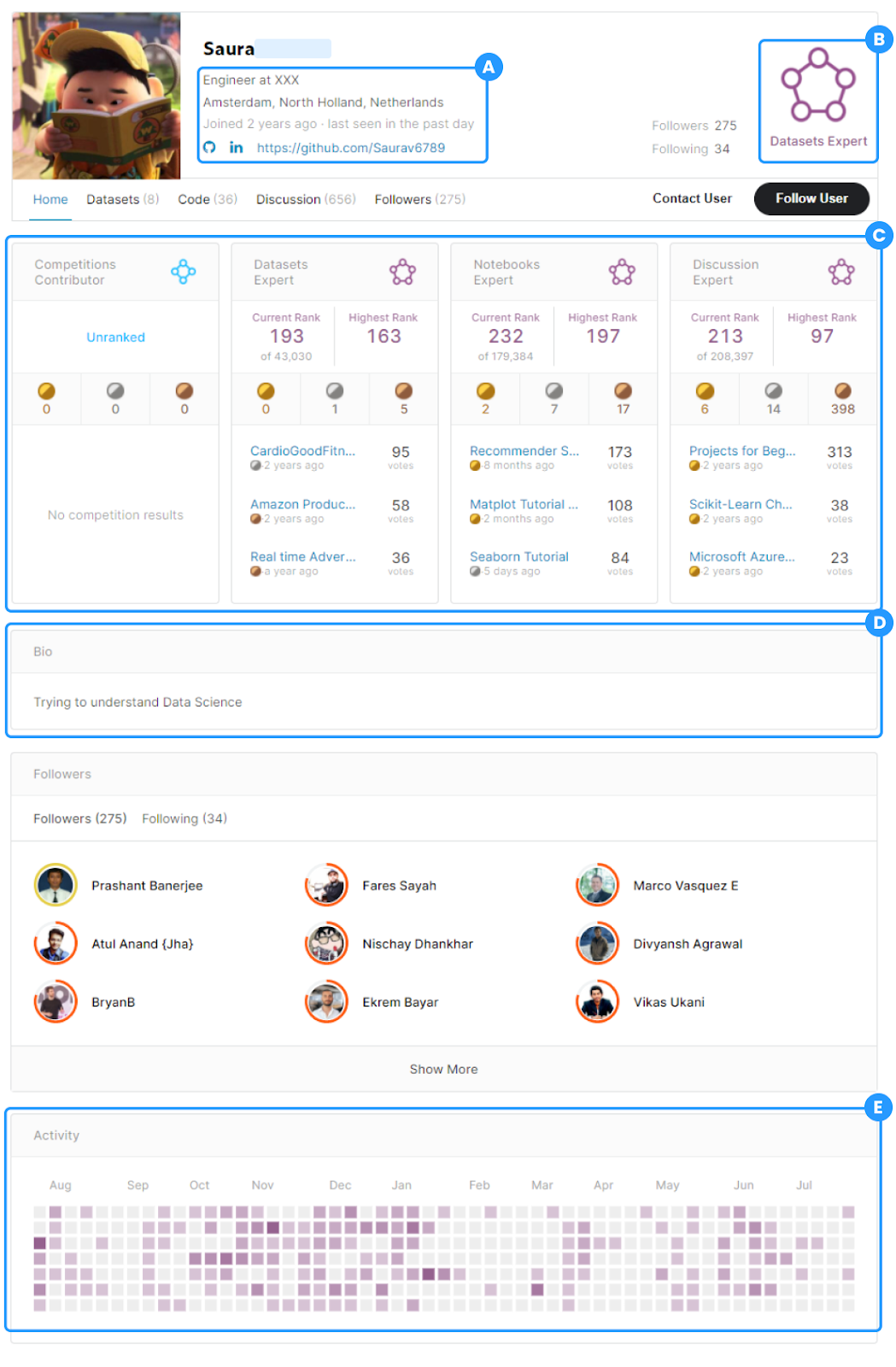
B: Category of expertise based on the Kaggle Progression System that ranks users based on performance on the platform
C: Rank based on points and awards
D: Bio (free text)
E: Activity over time
The layout has been refreshed since this screenshot, but the anatomy is the same and the sourcing-relevant fields are now better, not worse. Take Chris Deotte's profile, a 7x Grandmaster, as a live example. It states his employer and title (Data Scientist & Researcher at NVIDIA), his city (San Diego), that he joined 8 years ago, that he was last seen in the past day, his rank in each track (41 of 209,861 in Competitions, 3 of 62,114 in Notebooks), and a link out to a personal or company page. That is a job title, a location, a recency signal and a skill proof, all on one public page, with no InMail credit spent.
One detail worth correcting if you learned the old system: the Progression System now ranks three tracks only, Competitions, Datasets and Code. Discussion is no longer a ranked track. People who earned a Discussion tier keep it as a "Legacy" title, which is why you will still see "Discussions Legacy Grandmaster" on veteran profiles. Do not read a legacy badge as a current ranking.
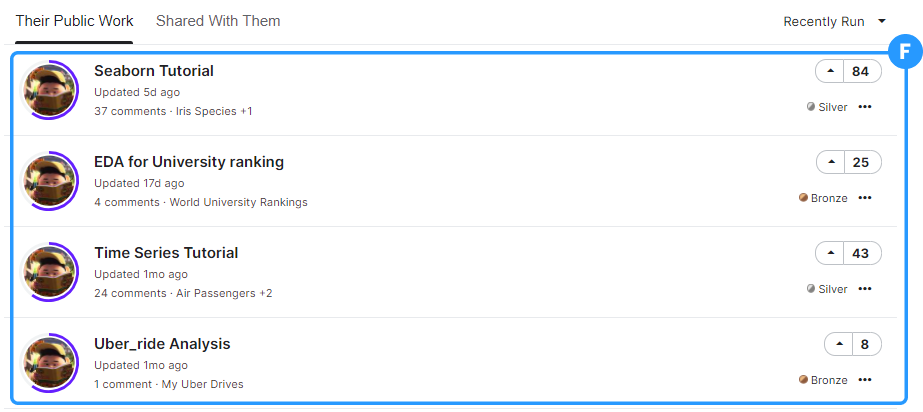
Code
The code the candidate has been working on gives a realistic view of the candidate's skills and interests.
Discussions
The discussion the candidate participated in indicate the candidate's involvement in the community and their willingness to help.
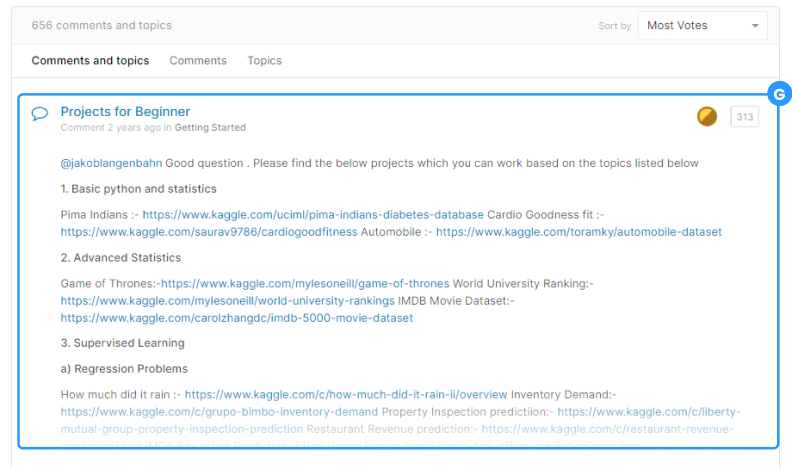
Discussions no longer earn a rank, but they are still the best free read on how someone behaves in a team. A candidate who patiently explains their solution to a beginner reads very differently from one who only posts to claim a leaderboard spot, and you get that read before you have spoken to them once.
Search
You can easily search Kaggle with a free account. But there are also other options like Google search with operators to find data talent.
Search Kaggle
Kagglers earn points by placing in competitions, publishing datasets and notebooks, and adding value in discussions. Based on the points that users earn a ranking is assigned. You can search in the Kaggle user rankings to find the best data scientists:
The rankings page is the most underused sourcing tool on Kaggle, because most recruiters never notice the two filters sitting above the leaderboard: City and Organization. Those turn a global vanity leaderboard into a sourcing list. Filter the Competition rankings by your city and you get the ranked, verified data scientists who are already commutable. Filter by Organization and you get the map of who your competitors have already hired, which tells you both who to approach and what your offer has to beat. Switch tracks with the tab (Competitions, Datasets, Code) or straight from the URL, for example the Code rankings.
Ranking points decay over time, which is a feature for you and not a bug. Points reflect recent achievement, so a high-ranked Kaggler is someone who is active now, while tiers and medals are permanent and reflect a career. Someone with a Grandmaster tier but a collapsed rank has moved on to a demanding day job, which is a very different outreach conversation than a currently-ranked competitor.
You can also search competitions based on the keywords you're looking for to find interesting candidates who score high on the leader board of that competition:
You can do the same for:
Code and for Discussions
The newest surface is Benchmarks, where labs, researchers and the community publish open evaluations, and it has a Creators filter. It is a small, high-signal pond: writing a benchmark that other people take seriously is a harder credential than placing in a competition, because it requires defining what "good" even means in a domain. Ignore the Game Arena tab for sourcing purposes. That leaderboard ranks models playing chess and Go against each other, not people, so there is no candidate at the other end of it.
Search Google
Kaggle profiles are indexed by Google, and the tier sits in the page title, which makes X-ray search unusually precise here. Search for Kagglers within a certain region and with certain skills mentioned:
site:kaggle.com "joined * * ago" amsterdam python
Because every profile page is titled with the tier, you can filter by seniority directly in the title, which the rankings page cannot do across cities in one query:
site:kaggle.com intitle:"Competitions Master" netherlands
Sub-pages are indexed separately (/competitions, /code, /discussion), so a query returning kaggle.com/username/code is telling you that person's notebooks are the strongest thing about them. Swap the tier string for "Notebooks Grandmaster", "Datasets Expert" or any other combination of track and tier, and swap the location for the city, country or employer you are hunting in.
From a Kaggle profile to a conversation
Kaggle gives you the name, the proof and usually the employer. It never gives you an email address, and this is where most Kaggle sourcing attempts quietly die. There are three routes out, in order of how well they actually work.
Start with the profile itself, because it is free and it converts best. Many Kagglers link their GitHub, personal site, LinkedIn or X directly from the profile header, and a personal site very often carries a public email. Second, use the Contact button that sits next to Follow on every profile. It is the lowest-friction option, it costs nothing, and a message that references the specific notebook you read is one of the few pieces of recruiter outreach this audience does not resent.
Only when neither works do you need a contact database, and only for the subset of profiles that name an employer. This is a genuinely different job: you have a name, a company and a title, and you need the work email. Apollo.io is the pragmatic pick for it because a Kaggle sourcing project is small and bursty, which is exactly the shape its free tier fits.
Apollo.io
The whole Competitions Grandmaster tier is 402 people worldwide, so the "database" you need is tiny. Apollo's free plan is 900 credits per seat per year, which covers enriching every Grandmaster on Earth twice over without ever reaching the $49 per seat per month Basic tier (or $65 if you go month to month). Two honest catches. Those 900 credits are released monthly, roughly 75 at a time, not handed over on day one, so a full leaderboard sweep is a project you run over months rather than an afternoon. And Apollo is a B2B database keyed on companies: it will find the NVIDIA researcher and completely whiff on the student, the freelancer and the pseudonymous handle with no employer listed, and those are a large share of the top ranks. Use the profile links first, and treat Apollo as the fallback for the employed half of your list.
What a Kaggle rank does not tell you
A Grandmaster tier is real evidence of one thing: modelling skill under competitive pressure, on a clean problem with a defined metric. It is not evidence of the things that make up most data science jobs. Competitions hand you the dataset, the target and the scoring function, so they say nothing about whether someone can find the problem worth solving, negotiate with a product manager, or keep a pipeline alive at 3am.
Kaggle also rewards behaviour that production engineering punishes. Winning solutions are routinely enormous ensembles tuned to squeeze a fractional gain out of a leaderboard, which is close to the opposite of a maintainable model. Treat the tier as a very strong screen for raw modelling ability and for genuine self-motivation, then interview for everything else exactly as you normally would.
Used that way, it works, and at scale. NVIDIA runs a team it calls the Kaggle Grandmasters of NVIDIA, currently 18 Grandmasters hired essentially on this signal. It is the clearest proof available that a public leaderboard rank converts into hires, and it is also a warning: the people at the top of these lists are already being courted by companies that built recruiting programmes around them.
Where this fits in a sourcing stack
Kaggle is a precision instrument, not a volume channel. It is the right tool when you need verified, ranked ML ability and you are willing to work a list of hundreds by hand. It is the wrong tool when you need fifty data analysts this quarter, because the ranked pool simply is not that big and most of it is not in your city. Run it alongside your broader sourcing, whether that is LinkedIn, GitHub or an AI sourcing tool like HeroHunt.ai that searches across platforms at once, and use Kaggle for the roles where proof of skill is the thing you cannot fake.
The practical sequence is short. Filter the rankings by city and by the organizations you can out-offer, read the profile and one notebook properly, then contact them through their own links or Kaggle's Contact button, and fall back to enrichment only for the names that are still cold.
HeroHunt.ai
The arithmetic above is why Kaggle cannot be your only channel: 402 Competitions Grandmasters and 2,290 Masters worldwide, before you filter for a city, a visa or a willingness to move. HeroHunt.ai is the other half of that stack, an AI recruiter that searches across the open web and social platforms rather than one leaderboard, screens the results with language models against your actual brief, and runs the outreach. The honest caveat: it does not read Kaggle tier as a filter, so it will not hand you "every Notebooks Grandmaster in Berlin". That query belongs on the rankings page, filtered by City, and worked by hand. Use Kaggle for verified proof of modelling skill on a few hundred people, and an AI sourcing tool for the volume the leaderboard was never going to give you.
Kaggle member count, tier counts, rankings filters and progression tracks checked against Kaggle's own pages in July 2026. Leaderboard counts are live and will drift. Apollo pricing checked against Apollo's pricing page in July 2026.