



The practical 2026 playbook for defining, pricing, sourcing, and screening the role that is rewriting the revenue org chart.
GTM engineer job postings grew 205% year over year, and Clay now shows up in 69% of them - GTME Pulse. Three years ago the title barely existed. In September 2026 it is one of the hardest roles in B2B SaaS to hire correctly, not because candidates are scarce, but because almost nobody agrees on what the job actually is, what it should pay, or where a real one is hiding.
But here's the problem: most hiring managers write a sales ops job description, ask sales ops interview questions, and then wonder why the person they hired can't build anything. A GTM engineer is closer to a software engineer who happens to sit inside revenue than a revenue operations analyst who happens to know some Python. Hire against the wrong mental model and you either overpay for a technical generalist doing admin work, or underpay a builder who leaves in four months for a company that gets it.
This guide breaks down exactly what a GTM engineer does, what the role actually pays in 2026 across seniority and geography, where to find candidates who are not passively browsing job boards, and how to run an interview process that filters out tool operators from systems builders. It also covers where companies most often get the hire wrong, and when a fractional or agency GTM engineer beats a full-time one.
Contents
- What a GTM Engineer Actually Is
- Why Demand Exploded in 2026
- The Job in Practice: What They Build
- GTM Engineer vs RevOps vs Sales Engineer vs Growth Marketer
- Compensation in 2026: What to Actually Pay
- Reading a Real Offer: Base, Variable, and Equity
- Where to Source Candidates
- Writing a Job Description That Attracts Builders
- Screening and Interviewing: Filtering Operators From Architects
- The Backgrounds That Convert Best
- Where Hiring Managers Get This Wrong
- Build, Buy, or Fractional: Choosing the Right Structure
- The Future: AI Agents and the Next Rung of the Role
- Conclusion: The Decision Framework
1. What a GTM Engineer Actually Is
The title itself is young enough to be worth dating before defining it further: GTM engineering did not exist as a recognized job category before 2022, and job-board volume did not become meaningful until Clay's rapid growth through 2024 and 2025 gave hiring managers a concrete product to point to when describing what the role builds. That recency is not a footnote. It explains why almost no candidate has a multi-year resume in the exact title, why the backgrounds covered in Section 10 are so varied, and why screening for prior "GTM engineer" experience specifically, rather than for the underlying skill, eliminates most of the strongest people who could actually do the job well.
A GTM engineer is a technical builder who sits inside revenue and treats go-to-market the way a software team treats a product: as a system with inputs, logic, failure modes, and a codebase, rather than a set of manual tasks executed by reps. The title describes someone who connects sales and marketing tools through APIs, writes the enrichment and routing logic that decides which lead goes where, and ships automations that used to require a headcount request - Apollo.
The clearest way to understand the role is by what it replaces. Before 2023, a company that wanted better lead routing hired a RevOps analyst who configured a tool. A company that wanted personalized outbound at scale hired more SDRs and gave them templates. A GTM engineer replaces both of those instincts with code: instead of configuring an existing tool's settings, they write the logic themselves, often across five or six tools stitched together with Clay, n8n, or Python scripts that no off-the-shelf product offers - Clay.
Three things define the job in practice. First, connecting systems: making sure a signal captured in one tool (a website visit, a call transcript, a support ticket) actually reaches the tool that needs it, in the right shape, without a human copying and pasting. Second, automating the manual work that slows a revenue team down, whether that is qualifying inbound leads, building account lists, or writing first-draft outreach. Third, owning the tooling decisions: which platform is the source of truth for a given data type, when a new tool earns its subscription versus adding pointless complexity, and when to build something custom instead of buying another SaaS seat - ZoomInfo.
This is why the role reads as unusually technical for a function that reports into sales or marketing. A working GTM engineer is comfortable in SQL, often Python or TypeScript, understands a CRM's data model (Salesforce or HubSpot) at the schema level, and can build a multi-step enrichment waterfall without being handed step-by-step instructions - Clay. That technical bar is exactly what makes the role hard to source through conventional sales-ops channels, and it is the reason this guide spends as much time on where to look as on what to pay.
"Waterfall enrichment" is worth understanding concretely, because it is the single most-cited skill in GTM engineering job postings and a good proxy for the job's actual difficulty. Given a list of prospects with only a name and a company domain, a waterfall is a sequence of data providers tried in order until one returns a valid match: a free "infer" step constructs a likely email address from the name and domain pattern first, and only if that fails does the pipeline pay for a first paid provider, then a second, then a third, stopping the moment a valid result appears and refunding credits for providers that returned nothing - Clay. Built well, this pattern lifts email match rates from the 50-60% typical of a single-source tool to 80-95% coverage, while built carelessly (wrong provider order, no de-duplication, no cost cap) it silently burns budget on expensive providers that a cheaper source further down the list would have covered. Whether a candidate can explain that ordering trade-off unprompted, cheapest and most reliable provider first, expensive long-shot last, is one of the more reliable signals covered in the screening framework in Section 9.
How Clay's own team frames the GTM engineering function
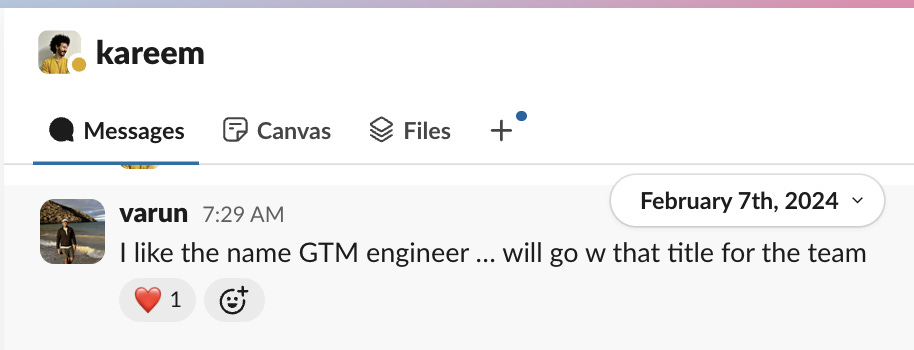
The image above, from Clay's own breakdown of the discipline, shows why the role resists a simple job description: it spans data infrastructure, workflow automation, and revenue strategy at once, which is also why generalist recruiters routinely misjudge how senior a "GTM engineer" candidate needs to be for a given problem.
2. Why Demand Exploded in 2026
Job postings for GTM engineering roles grew from roughly 1,400 in mid-2025 to over 3,000 by January 2026, a 205% year-over-year increase, according to an analysis of more than 3,300 job postings - GTME Pulse. That is not a niche trend confined to Silicon Valley outbound shops. The same analysis found the role listed at companies ranging from three-person seed startups to public software companies, with a median advertised base salary of $127,500 as of the most recent data pull.
The proximate cause is AI-assisted automation finally becoming reliable enough to trust with revenue-critical logic, combined with sales and marketing tool sprawl reaching a breaking point. A typical mid-market SaaS company now runs a CRM, an enrichment tool, an outbound sequencer, an intent data provider, a website visitor identification tool, and an AI research layer, none of which talk to each other out of the box. Someone has to own the plumbing, and increasingly that person is not a RevOps generalist configuring dashboards but an engineer writing the connective logic - Cleanlist.
There is a second, less obvious driver behind the 2026 spike, and it explains why the role's importance keeps rising even as AI agents get better at the execution work they are theoretically replacing humans for. An AI agent that drafts outreach or scores a lead is only as good as the data it is given: a lead-scoring model fed duplicate records, stale firmographic data, or inconsistent field mappings will confidently produce wrong answers at machine speed, which is a worse outcome than a human doing the same task slowly and catching the error. That failure mode, invisible until it has already damaged a quarter's worth of pipeline data, is why companies that adopted AI sales tools aggressively in 2024 and 2025 are now the same companies posting the most senior, best-paid GTM engineering roles in 2026: they learned the expensive way that automation without a data-quality owner scales mistakes, not results. Section 13 returns to this dynamic in more depth, because it is also the clearest signal for where the role's compensation ceiling is heading next.
GTM Engineer Job Postings, 2025-2026
The chart shows a market that more than doubled in roughly eight months and has kept climbing since. What it does not show, and what matters more for a hiring manager, is that supply has not kept pace in the same way. The 2026 State of GTM Engineering Report, based on 228 practitioner survey responses across 32 countries, found a median respondent age of 25 and that 53% of practitioners are self-taught - GTME Pulse. In other words, the candidate pool skews young, largely trained outside formal channels, and concentrated in communities rather than resume databases. That single fact should shape almost every sourcing decision covered later in this guide.
It is also worth being honest about how much of this growth is genuine new demand versus retitling. A meaningful share of "GTM engineer" postings are RevOps or sales ops roles that got a rebrand to attract more technical applicants in a hot labor market. That inflation is real, and it is one reason the compensation section below breaks salary down by what the role actually requires rather than by title alone.
3. The Job in Practice: What They Build
Talking about a GTM engineer in the abstract undersells how concrete the daily output is. On a normal week, a GTM engineer at a mid-market B2B company might rebuild the lead routing logic so that inbound demo requests are enriched, scored, and assigned to the right rep within seconds instead of the following business day; write a script that pulls call transcripts into the CRM and auto-tags objections mentioned by prospects; and stand up a Clay table that finds, verifies, and personalizes outreach to a list of 5,000 target accounts overnight - Apollo.
Four named examples from real companies illustrate the range, and the differences between them matter more than the similarities. At Notion, the GTM engineering function reports through RevOps and strategy and is charged with building new go-to-market plays and the workflows that support them, which puts the role closer to a strategy function that happens to ship code than a pure infrastructure job. At Intercom, the team's mandate is narrower and more experimental: pilot new plays, such as automated TAM (total addressable market) enrichment, on a small scale before those plays get proven and scaled company-wide, which means the Intercom version of the role rewards someone comfortable throwing away work that does not pan out. At Canva, GTM AI work includes automating transcript summarization so reps spend less time on note-taking and more on selling, a narrower, deeper automation mandate focused on one high-friction workflow rather than the whole funnel. At Verkada, the growth-focused GTM engineering charter centers on demand generation systems built for the broader revenue organization, which leans the role toward marketing-adjacent infrastructure rather than sales-adjacent infrastructure - Clay.
The practical takeaway for a hiring manager is that "GTM engineer" at four different companies can mean four genuinely different jobs, even though every one of them would look identical on a job board. None of these are "run this software" jobs; each is "design and ship the system." But whether that system is a company-wide strategic play (Notion), a contained experiment (Intercom), a single deep automation (Canva), or a demand-generation engine (Verkada) changes what a strong candidate profile looks like far more than the shared title suggests, which is the dividing line covered in more detail in Section 4.
The 2026 tool stack that GTM engineers actually build on has consolidated around a recognizable set. Clay functions as the data orchestration and enrichment layer, appearing in 69% of GTM engineering job postings analyzed in 2026 - GTME Pulse. Outbound execution runs through Smartlead or Instantly for email and HeyReach for LinkedIn. Prospecting data comes from Apollo or ZoomInfo, website visitor identification from tools like RB2B, and AI-native research from Claude, GPT, or Clay's own "Claygent" agent feature. Workflow automation and glue code lean on n8n, Zapier, and increasingly Python for anything the no-code tools cannot express - Clay.
The distinction between the no-code and code layers of that stack is worth being specific about, because it is a common point of confusion for non-technical hiring managers writing a job description. A tool like Clay or n8n handles the majority of straightforward cases: enrich this record, send this webhook, wait for this condition, branch on this value. Python enters the picture at the edges those tools cannot reach cleanly, custom scoring logic that weighs a dozen signals with company-specific rules, a one-off migration between two systems with incompatible data models, or a performance bottleneck where a no-code tool's per-record pricing makes processing tens of thousands of leads prohibitively expensive compared to a script that does the same work for the cost of compute time. A candidate who reaches for Python by default, even for problems Clay would solve in ten minutes, is over-engineering; a candidate who cannot reach for it when a no-code tool genuinely cannot express the logic is under-equipped. Gauging where a candidate draws that line is a better technical signal than asking them to recite Python syntax from memory.
Where GTM engineering sits in the org chart
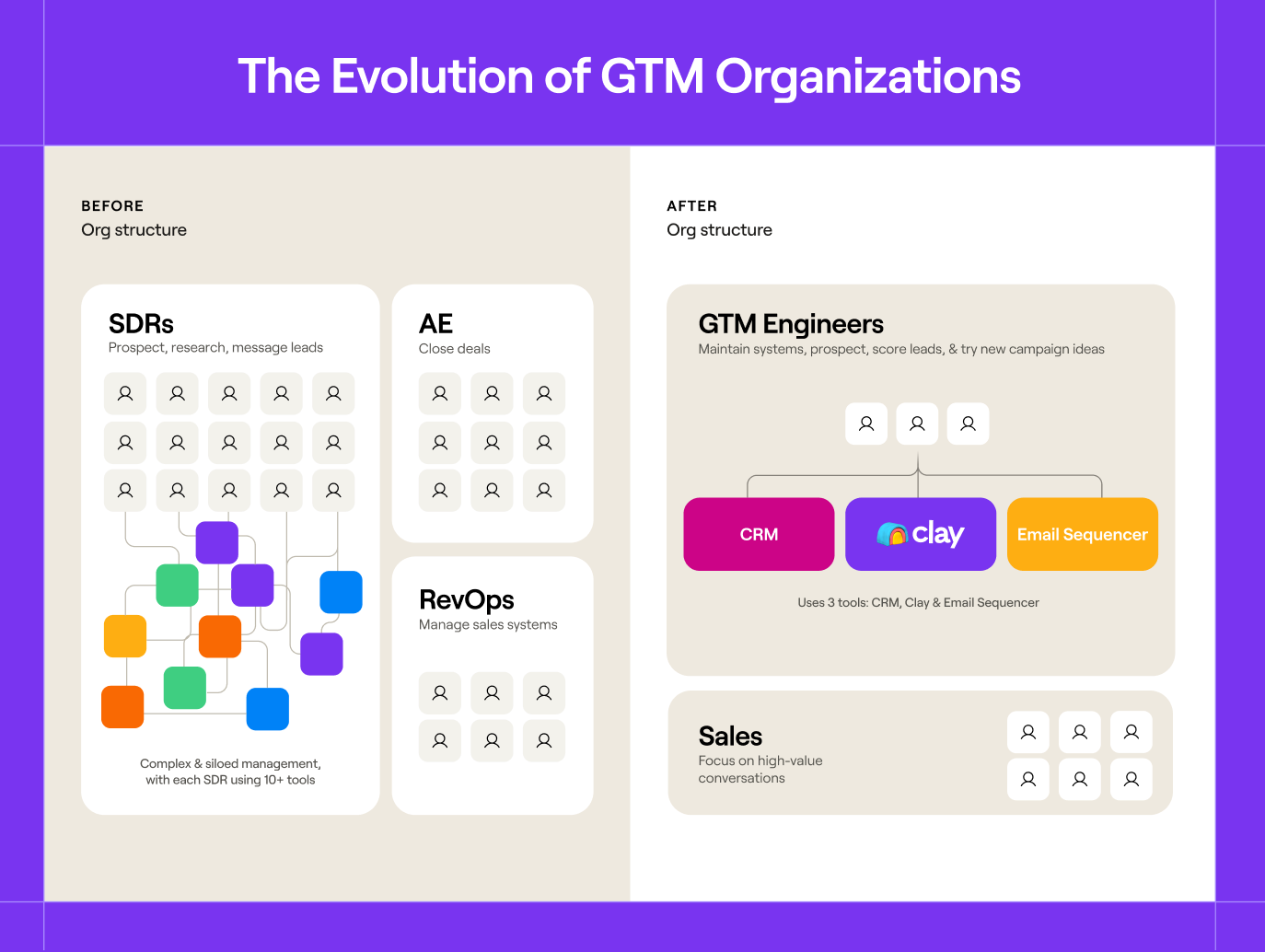
A GTM engineer typically reports to a head of RevOps, a VP of Sales, or, at smaller companies, directly to the CRO or CEO - Clay. Where the role sits on your org chart is not a formality: it determines whether the person spends their time on strategic build work or gets pulled into ticket-style requests from individual reps, which is one of the fastest ways to burn out a good hire. A GTM engineer buried three layers under a sales manager, fielding one-off Salesforce field requests, is not doing the job you paid for, and will leave within a year for a role that lets them build.
4. GTM Engineer vs RevOps vs Sales Engineer vs Growth Marketer
Getting the title right matters because it determines who applies, what you screen for, and what you pay. The clearest framing splits the revenue org into a builder, a conductor, and a translator. The GTM engineer is the builder: someone who writes SQL and Python, connects tools through APIs, and ships entirely new systems using LLMs, agents, and data pipelines that did not exist before they arrived - Factors.ai. RevOps is the conductor: the function that brings order, governance, and predictability to the revenue engine by defining funnel stages, enforcing SLAs, and owning forecasting. RevOps optimizes what already exists; the GTM engineer builds what does not exist yet - RevPartners.
The sales engineer is a different role entirely, and confusing the two is a common and expensive hiring mistake. A sales engineer sits with account executives during live deals, de-risking technical objections and demonstrating the product to a specific prospect. Their unit of work is a single deal. A GTM engineer's unit of work is a system that touches every deal, every rep, and every campaign at once - Apollo. A growth marketer, meanwhile, focuses on channel strategy, creative testing, and campaign performance rather than the underlying data infrastructure, though the two roles increasingly collaborate on the same automations: a growth marketer decides which audience segment and message to test, while a GTM engineer builds the pipeline that actually targets that segment correctly across ad platforms and enrichment sources without manual list uploads.
All four of these role boundaries blur hardest at the earliest company stage, and that is worth naming directly rather than pretending the table above is universal. At a five-person seed-stage startup, one person is frequently doing all four jobs at once: configuring the CRM, writing the outbound automation, jumping on a call to answer a technical objection, and running the paid acquisition test, simply because there is no headcount to split the work. The distinctions in the table matter most once a company is large enough to hire more than one of these roles, at which point misassigning a builder's job to a conductor's hire, or vice versa, becomes an expensive and slow-to-diagnose mistake rather than a moot point.
| Role | Primary unit of work | Core tools | Reports to |
|---|---|---|---|
| GTM Engineer | Systems and pipelines (net-new) | Clay, SQL, Python, APIs | RevOps lead, VP Sales, or CRO |
| RevOps | Process, governance, forecasting | CRM admin, BI dashboards | VP Sales or CFO |
| Sales Engineer | Individual deals | Product demo environment | VP Sales |
| Growth Marketer | Channels and campaigns | Ad platforms, CMS, analytics | CMO |
This table is a starting point, not a hard boundary. In practice, the strongest GTM engineers absorb pieces of all four roles depending on company size, and the smaller the company, the more the titles blur. What should not blur is the compensation logic: a builder who ships net-new infrastructure should be paid and screened differently than an administrator who configures existing tools well, even if both currently hold a "GTM engineer" title on LinkedIn.
The trade-off worth naming explicitly is that RevOps and GTM engineering need each other and will fail without each other, which is a different statement than saying they are interchangeable. RevOps without a GTM engineer is stuck manually configuring the same tools every competitor already owns, unable to build the custom logic that creates a durable advantage. A GTM engineer without RevOps has no governance layer: nobody defining what "qualified" means, what the source of truth is when two systems disagree, or which automations are safe to ship into a live pipeline versus which need a staging environment first. Companies that hire a GTM engineer to replace RevOps, rather than to complement it, routinely end up with technically impressive systems that nobody trusts, because there is no governance function validating that what got built actually matches how the business defines its own funnel. The next section quantifies exactly how large the compensation gap is between these adjacent roles in practice.
5. Compensation in 2026: What to Actually Pay
Published GTM engineer compensation ranges from $132,000 to $241,000 industry-wide, with a median base salary of roughly $132,000 and senior or staff roles at AI-native companies reaching $250,000 to $350,000-plus - GTME Pulse; Apollo. That is an unusually wide band for a single job title, and the width itself is the first thing a hiring manager needs to internalize: "GTM engineer" spans everything from a junior Clay table builder earning barely above SDR pay to a staff-level revenue systems architect commanding senior-engineer compensation.
Breaking the range down by experience level makes the spread easier to plan against. Junior GTM engineers, roughly zero to two years into the discipline, typically land between $100,000 and $130,000 base. Mid-level GTM engineers, two to five years in, sit in the $130,000 to $180,000 band. Senior practitioners with five-plus years command $180,000 to $250,000-plus, and principal or staff-level GTM engineers, usually at well-funded AI-native companies, reach $250,000 to $350,000-plus in total compensation - Apollo.
GTM Engineer Base Salary by Level, 2026 (Midpoint of Published Range)
GTM engineer compensation, broken down by level and region
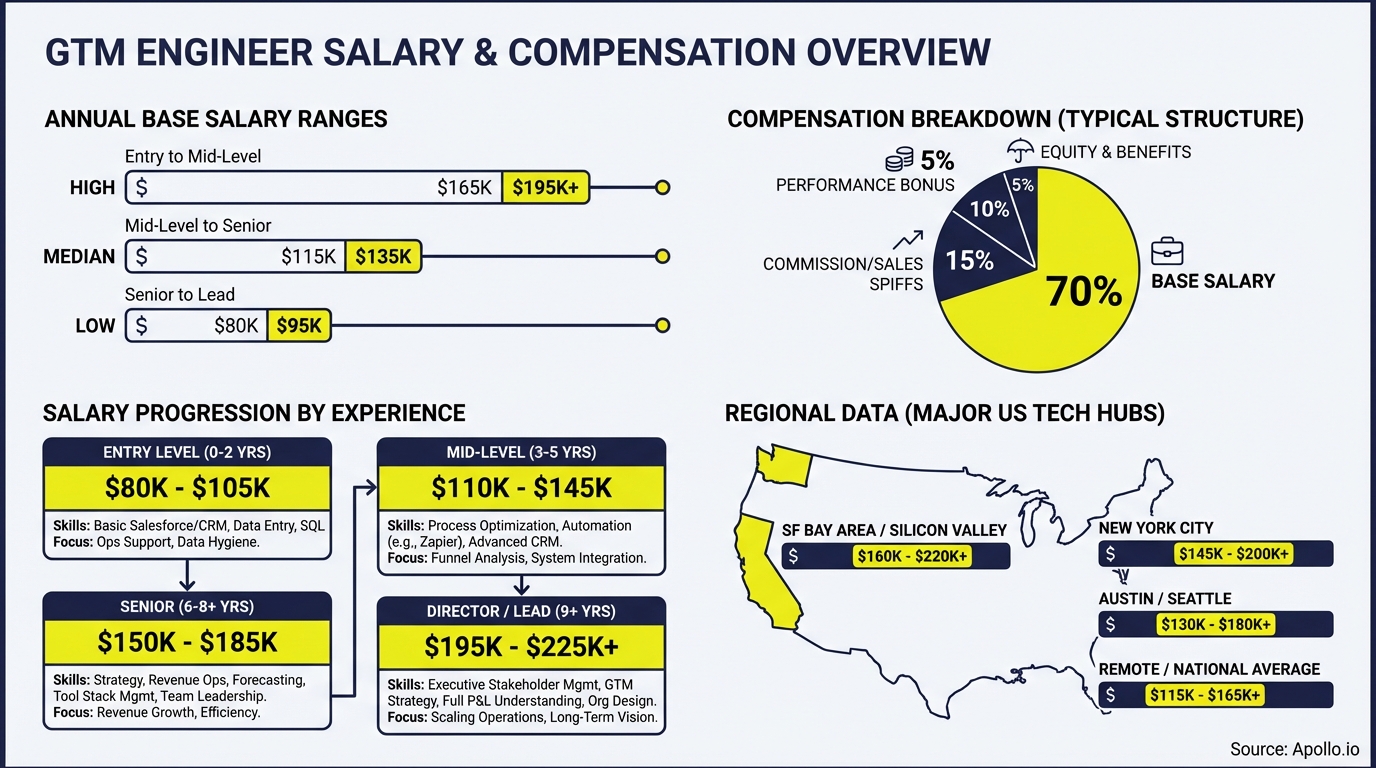
The infographic above adds a dimension the bar chart cannot: geography. US and UK compensation for senior GTM engineers runs $150,000 to $220,000-plus, while Western Europe sits meaningfully lower at €100,000 to €140,000. LATAM-based senior GTM engineers command $96,000 to $144,000, and senior practitioners based in Africa or Southeast Asia typically see $84,000 to $120,000 - HeyReach. For a fully remote function like this one, that geographic spread is not a footnote, it is one of the biggest levers a hiring budget has, and it is a large part of why the sourcing section below spends real time on where non-US talent congregates.
A specific, useful data point for benchmarking against adjacent engineering roles: the U.S. Bureau of Labor Statistics category closest to this work, sales engineers, reports a median salary of $121,520, rising to $137,650 at software publishers specifically - Apollo, citing BLS OEWS data. GTM engineer pay running above that baseline reflects the coding and systems-design component of the job. That premium is measurable: candidates who can write Python or TypeScript, rather than only operate no-code tools, command roughly $45,000 more in base salary than non-technical GTM hires performing similar functions - GTME Pulse. If your budget only supports the lower end of a range, hiring a strong no-code operator and treating the coding skill as a stretch goal is more realistic than advertising for a "full-stack GTM engineer" and getting nobody qualified to apply.
At the top of the market, individual company data points are informative. Vercel pays GTM engineers $252,000 in total compensation, OpenAI pays $250,000, and Ramp pays $184,000 - Apollo. These are not typical offers; they are what AI-native, well-funded companies pay to win a small pool of proven builders, and citing them to a Series A candidate as your benchmark will only signal that you have not done your homework on your own stage's market rate.
Company stage explains a meaningful share of that spread on its own, independent of seniority level. Early-stage startups typically offer lower base salaries, in the $110,000 to $140,000 range, offset by a meaningfully larger equity package, while public companies and well-funded growth-stage firms pay higher cash compensation, $150,000 to $200,000 base, with proportionally smaller equity grants - Apollo. A candidate comparing a seed-stage offer against a Series D offer is not just comparing two numbers on a page; they are choosing between two entirely different risk-and-reward structures, and a hiring manager who can name that trade-off explicitly, rather than simply defending their own number, negotiates from a position of credibility rather than one of pressure.
The width of the overall range, $132,000 to $241,000-plus for a single job title, is itself informative about how to structure a search. It means the first internal conversation before writing a job description should not be "what does a GTM engineer cost" but "which of the four levels in the chart above does our actual problem require." A company that needs someone to fix one broken lead-routing workflow and maintain it does not need, and should not pay for, a staff-level systems architect capable of designing a company-wide revenue data platform. Conversely, a company trying to hire a junior builder to design infrastructure that the entire sales org will depend on for years is setting up a mismatch that shows up within the first quarter, when the junior hire correctly identifies that the problem is bigger than their experience can safely handle. Matching the level in Section 5's chart to the scope in Section 3's job description is the single highest-leverage compensation decision in this entire process, more consequential than negotiating a few thousand dollars off any individual offer.
6. Reading a Real Offer: Base, Variable, and Equity
Compensation structure varies almost as much as the headline number, and getting this wrong is a common source of candidate distrust during negotiation. At SaaS and tech companies, base salary typically makes up 70 to 85% of total compensation, with 10 to 20% in variable pay or bonus and 15 to 25% in equity. Traditional enterprise employers structure this differently: base salary drops to 60 to 75% of total comp, variable rises to 15 to 25%, and equity shrinks to 5 to 10% - Apollo.
This distinction matters most at the offer stage. A candidate comparing two offers of similar headline total compensation, one from a Series B SaaS company and one from a public enterprise software company, is often comparing very different risk profiles. The startup offer likely carries meaningfully more equity upside and less certainty; the enterprise offer carries a heavier bonus component tied to company-wide performance metrics the candidate has less individual control over. Neither structure is wrong, but a hiring manager who cannot explain the split clearly, or who quietly shifts more of an offer into unvested equity to hit a lower cash number, will lose credibility with a candidate pool that talks to each other constantly in the Slack communities covered in the next section.
It is also worth negotiating from an accurate read of leverage. Given the 205% year-over-year growth in open roles documented in Section 2 against a candidate pool that is still small and largely community-based, a genuinely strong GTM engineer candidate in September 2026 is very likely fielding more than one active offer, and will know the market ranges from Section 5 as well as, or better than, the hiring manager does. Treating the negotiation as adversarial, holding back on structure details until the candidate pushes, tends to backfire specifically with this candidate pool, because the same communities that provide the best sourcing channel in Section 7 also function as a real-time compensation-transparency network. A hiring manager who leads with a clear, well-reasoned offer, explaining why a specific level and structure was chosen rather than simply stating a number, converts noticeably better than one who negotiates defensively.
Whether variable pay applies at all depends on how directly the role touches pipeline or revenue outcomes. A GTM engineer building outbound infrastructure that directly drives booked meetings sometimes carries a modest bonus tied to pipeline generated, similar to a sales role. A GTM engineer focused purely on internal data infrastructure and reporting more closely resembles a software engineer and is usually paid on a straight base-plus-equity structure with no variable component at all. Neither approach is more "correct," but the job description should say explicitly which model applies, because ambiguity on this point is one of the fastest ways to lose a strong candidate mid-process.
Equity deserves a specific caveat that a straight percentage figure obscures: the same "15-25% of total comp" equity grant is worth very different things depending on company stage, and GTM engineer candidates, who by Section 10's data skew young and self-taught rather than having been through a prior startup exit, are disproportionately likely to overweight a large-sounding option grant at a seed-stage company relative to its realistic value. A transparent hiring manager states the strike price, the current 409A valuation if one exists, and the vesting schedule during the offer conversation rather than leaving the candidate to infer value from a headline option count. This is not generosity, it is self-interest: a candidate who feels misled about equity value during negotiation is the same candidate who posts about it in the Clay Community Slack described in Section 7, and that community remembers which companies negotiate in good faith.
7. Where to Source Candidates
The single highest-signal sourcing channel for GTM engineers in 2026 is the Clay Community Slack, which has more than 20,000 members and an active #jobs channel - thegtme.com. GTM engineers, as a rule, are not passively browsing job boards. They are active in communities, building automations in public, and posting about their own workflows, which means the channels that work for sourcing a traditional RevOps hire will mostly fail here.
Beyond the Clay community, three other communities consistently surface qualified candidates. RevOps Co-op (revopscoop.com) runs a dedicated #job-board channel inside a Slack of more than 20,000 RevOps practitioners, many of whom are actively cross-training into GTM engineering. Pavilion, a revenue leadership community, has an active #jobs channel that skews toward more senior candidates already operating at a leadership level. HubSpot User Groups are worth checking specifically when the role leans HubSpot-heavy rather than Salesforce-heavy, since HubSpot-native GTM engineers tend to specialize and are easier to find inside the HubSpot ecosystem than on general job boards.
LinkedIn still has a role to play, but not through posting a job and waiting. A working boolean search pattern is to search for "Clay" AND ("GTM" OR "revenue operations" OR "growth engineering"), then filter to profiles that are open to work or that recently changed roles. This surfaces people who list the tool by name in their headline or experience, which correlates strongly with hands-on GTM engineering experience rather than an adjacent title with the buzzword added for visibility. This is also where HeroHunt.ai fits into the workflow: rather than running that boolean search manually across LinkedIn and cross-referencing candidates by hand, an AI Recruiter can be briefed with the exact qualifying signal (hands-on Clay experience, a specific enrichment or outbound stack, a systems-builder track record rather than a tool-operator one) and source and screen against it autonomously across public profiles.
HeroHunt.ai
A GTM engineer search is exactly the kind of role that breaks keyword-based sourcing: the strongest signal (has this person actually built a Clay enrichment waterfall, not just listed Clay as a skill) does not live in a job title. HeroHunt.ai takes a written brief and screens each candidate against it with a language model across public sources, rather than matching on title alone, which is the same "systems builder vs. tool operator" distinction this guide draws in Section 9. There is an 8-day free trial, so testing it against one open GTM engineer requisition costs nothing but the time to write a real brief. The honest caveat: it is a sourcing and screening layer, not an ATS, and it will only be as good as the brief you write, so vague requirements produce vague shortlists.
Two further channels round out a sourcing strategy that goes beyond Slack and LinkedIn. Newsletters written for practitioners, such as The GTM Engineering Newsletter (written by one of the first GTM engineers hired at Clay) and GTME HQ, publish weekly to an audience of exactly the people a job posting is trying to reach, and many accept sponsored job listings that reach a more qualified, already-self-selected readership than a generic job board post. X (formerly Twitter) is where a meaningful share of practitioners "build in public," posting the automations and Clay tables they ship in real time; searching for recent posts that reference Clay, n8n, or specific enrichment workflows surfaces active builders who are demonstrably shipping, not just claiming the skill on a resume.
A candidate's public build history is also, in this specific field, a better predictor than a resume, which makes portfolio review worth treating as a formal sourcing step rather than an afterthought during screening. Because GTM engineering skews young and self-taught (Section 10 covers this in depth), many strong candidates have a public GitHub, a Loom walkthrough of a Clay table they built, or a "build in public" X thread documenting a specific automation end to end. Reviewing that evidence before a first call, rather than after, filters out candidates who talk fluently about the discipline without having shipped anything, and it surfaces quieter candidates whose resume undersells work that is genuinely strong.
For companies unwilling to run a slow full-time search, several specialized marketplaces have emerged specifically for this role. Uplers (uplers.com) and Cargo (getcargo.ai) both run curated GTM engineer talent pools aimed at founders who need a vetted profile faster than an open search allows. These marketplaces trade a placement fee for speed and pre-vetting, which is a reasonable trade for an early-stage company hiring its first GTM engineer without in-house technical evaluation capability.
What backgrounds GTM engineers come from before the title

The background breakdown above is directly useful for sourcing strategy: if a meaningful share of practitioners come from product design, data analytics, and sales engineering rather than traditional sales ops, a job posting that only targets "revenue operations" candidates is filtering out a large share of qualified applicants before they ever see it. Section 10 goes deeper on exactly which backgrounds tend to convert best and why.
8. Writing a Job Description That Attracts Builders
A job description that lists tool names instead of problems to solve will attract tool operators instead of systems builders. This is the single most common and most fixable mistake in GTM engineer job postings. Listing "Clay, Apollo, Instantly, HubSpot" as required skills filters for people who have clicked around those specific interfaces, not for people who can design a data pipeline in a tool they have never touched before, which is the actual skill that predicts success in the role.
A stronger job description leads with the business problems the person will own: "own lead routing so a demo request reaches the right rep within 60 seconds," "build the enrichment pipeline that turns a target account list into verified, personalized outreach overnight," "reduce the manual work our RevOps team spends on CRM hygiene by building automated data-quality checks." Naming specific tools becomes a "nice to have" section rather than the headline, and technical requirements are stated as competencies (SQL fluency, comfort reading and writing Python, experience with a CRM's underlying data model) rather than brand names - DevCommX.
Concretely, the difference looks like this. A weak posting opens with: "Required skills: Clay, Apollo, Instantly, HubSpot, Zapier, 3+ years RevOps experience." A stronger posting opens with: "In your first 90 days, you will rebuild our inbound lead routing so a demo request is enriched, scored, and assigned within 60 seconds instead of the next business day, and you will design the enrichment pipeline behind it. You will report directly to our Head of RevOps, not into an individual sales pod, and you will own the architecture decisions for how our GTM tools connect to each other." The second version filters for someone who can picture themselves solving that specific problem and self-selects out candidates who are only comfortable operating tools they have used before, which is exactly the operator-versus-architect distinction the rest of this guide keeps returning to.
The posting should also state compensation and structure explicitly rather than defaulting to "competitive salary." Given how public salary benchmarking has become in the communities where these candidates congregate (a Clay Community Slack post asking "is $140K fair for a senior GTM engineer" gets answered within the hour), a vague compensation line reads as either inexperience with the market or an attempt to lowball, and either read costs you strong applicants before a conversation even starts.
Three elements consistently separate job descriptions that convert from ones that do not. First, a real example of a system the person would build in their first 90 days, not a generic responsibilities list. Second, explicit reporting structure: who they report to, and whether the role is protected from being pulled into ad-hoc ticket work by individual reps (see Section 3 on why this matters for retention). Third, an honest description of the current tech stack's maturity: candidates evaluating a role want to know whether they are inheriting a clean system to extend or a tangle of broken Zapier automations to rebuild from scratch, and both are legitimate jobs, but they require different candidates.
9. Screening and Interviewing: Filtering Operators From Architects
Traditional interviews fail to reveal a GTM engineer candidate's real capability. Technical questions assess coding knowledge in isolation; behavioral questions reveal communication skills. Neither demonstrates how a candidate approaches an actual go-to-market problem end to end, which is the only thing that predicts on-the-job performance - Yardstick. The fix used by the strongest hiring teams is a structured work sample: give the candidate a real, scoped business problem (build a lead-scoring logic given a sample dataset, or design an enrichment waterfall for a target account list) and evaluate not just the output but how they reasoned through edge cases, failure modes, and trade-offs along the way.
A concrete version of this exercise looks like the following: give the candidate a sample CSV of 200 inbound leads with realistic messiness (some missing company names, some personal Gmail addresses, some obvious duplicates) and ask them to design, on paper or in a shared document, the logic that would route each lead to the right rep within an hour, over a 60 to 90 minute session. A weak answer jumps straight to "I would use Clay to enrich this," treating the tool as the whole solution. A strong answer starts by asking what data is actually trustworthy in that sample, proposes a specific de-duplication and enrichment order (echoing the waterfall logic from Section 1), names what happens to a lead that cannot be matched to any company at all, and only then names which tool would implement each step, and why. The tool name is almost incidental to a strong answer; the reasoning about messy, real-world data is the entire signal the exercise is designed to surface.
Five specific red flags reliably separate operators from architects during a screen. A candidate who responds to a data problem by suggesting buying another tool rather than understanding the underlying protocol or API is showing a shopping instinct, not an engineering one. A candidate who describes handling data by exporting CSVs and manually re-uploading them is not automating anything, regardless of how many tools appear on their resume. A candidate who is unconcerned with domain reputation and CRM data health will quietly damage email deliverability and pipeline data quality in ways that surface months later. A candidate who cannot explain what happens when a step in their pipeline fails, whether an API times out or an enrichment source returns no data, has not actually built anything that has run in production. And a candidate who leans on AI tools to generate outreach or data without first normalizing the underlying data will ship broken, generic output at scale - HeyReach.
That last point connects to a broader mistake worth naming directly: do not mistake three months of Clay experience for seniority. The tool is genuinely accessible, which means a motivated junior candidate can build something that looks impressive in a portfolio within weeks. Distinguishing that from someone who has actually operated a production system under real failure conditions, at scale, over a full sales cycle, requires probing for exactly the failure-mode and edge-case reasoning described above, not just asking to see a finished Clay table - HeyReach.
A well-structured hiring process for this role typically includes a clear candidate profile defining the competencies that actually matter for your specific problem, a scorecard mapped to those competencies before interviews begin (not written retroactively to justify a gut decision), a work-sample exercise scoped to roughly the same problem the person will face in their first month, and a technical conversation focused on trade-offs and failure modes rather than syntax trivia - Clay. Skipping the scorecard step is the most common process failure: without one, interview panels default to "did I like this person" as the deciding factor, which correlates poorly with whether they can actually ship a working pipeline.
Sequencing the loop matters as much as the content of any single stage. A workable structure runs a 30-minute screening call first, focused only on verifying the public build history described earlier in this section and confirming compensation expectations against the bands in Section 5, before either side invests more time. That is followed by the 60 to 90 minute work-sample exercise described above, reviewed by whoever will actually manage the person day to day, not a generalist recruiter unable to evaluate the reasoning. A technical deep-dive on the candidate's own past work comes third, deliberately probing the failure-mode and edge-case questions from the red-flag list above. A reference check closes the loop, and given how new this title is, that reference conversation should focus less on "would you rehire them" and more on a direct question this guide returns to in Section 11: is the system this candidate built still running today.
10. The Backgrounds That Convert Best
Because the title is new, almost nobody has five years of "GTM engineer" experience on a resume, which means screening by prior title is close to useless. The 2026 practitioner survey data shows the strongest performers arrive from a handful of recognizable backgrounds rather than a single career path: product design, RevOps, sales engineering, and data analytics - Clay. Each background maps to a different strength and a different gap worth probing for in an interview.
Candidates coming from product design tend to be strong on workflow logic and user empathy (understanding what a rep or a prospect actually experiences at each step of an automated sequence) but may need coaching on SQL and data-pipeline reliability under scale. Candidates from RevOps already understand the CRM data model and funnel mechanics deeply but sometimes default to configuring existing tools rather than building genuinely new systems, which is the exact operator-versus-architect distinction covered in Section 9. Candidates from sales engineering bring strong technical communication and a real feel for what a prospect needs to see, but their prior work was scoped to individual deals rather than systems that scale across an entire pipeline. Candidates from data analytics bring the strongest raw technical skills (SQL, Python, sometimes real data-engineering experience) but may need the most ramp-up on go-to-market context: what a qualified lead actually looks like, how a sales cycle unfolds, and what "good" outbound looks like from a buyer's perspective.
A striking demographic fact from the same survey: the median GTM engineering practitioner is 25 years old, and 53% are self-taught rather than credentialed through a bootcamp or degree program specific to the field - GTME Pulse. That skews sourcing strategy meaningfully younger and more community-based than a typical RevOps search, and it explains why the Slack and Clay-community channels in Section 7 consistently outperform LinkedIn job postings and traditional recruiter databases for this specific role. A candidate pool this young and this self-taught also means credential-gating (requiring a specific degree, or years of experience in a formal "GTM engineering" role that has only existed for two to three years) will eliminate most of the strongest available talent before you ever see a resume.
The self-taught path deserves specific attention because it is unusually visible compared to most technical fields. A candidate who is self-taught in GTM engineering almost always has a public trail: a Clay community post explaining a waterfall they built, a Loom recording walking through a workflow, a "before and after" thread showing a manual process they automated and the hours it saved. That visibility is a gift to a hiring manager willing to look for it, because it means competence in this field can be verified before a first interview rather than inferred from a resume's job titles, which is precisely the sourcing behavior described for HeroHunt.ai and portfolio review in Section 7. It also means a candidate transitioning from an unrelated background, say, a customer support role who started automating their own ticket triage on the side, can present a stronger case than a credentialed RevOps analyst who has never built anything unprompted, provided the hiring process is actually designed to look for that evidence instead of filtering it out by title or years of experience.
11. Where Hiring Managers Get This Wrong
Companies hiring their first GTM engineer tend to make the same handful of mistakes regardless of industry or size, largely because the role is new enough that almost nobody has internal precedent to hire against. Beyond the interview and sourcing mistakes already covered, five structural errors show up repeatedly across companies hiring this role for the first time. The first is confusing operators with architects at the offer stage, not just during screening: a company will correctly identify a strong systems builder during interviews, then extend an offer priced at the operator end of the range covered in Section 5, and lose the candidate to a competing offer that priced the role correctly.
The second is prioritizing speed of hire over sustainability of the hire, which shows up specifically when companies recruit from agency backgrounds accustomed to high-volume, disposable-domain outbound tactics. Those instincts, tuned for short client engagements where deliverability damage is somebody else's future problem, actively hurt a company that needs its sending domains and CRM data to stay healthy over years, not weeks - HeyReach.
The third mistake is organizational, not a hiring-process error at all: burying the role too deep in the org chart, under a sales manager rather than RevOps leadership or the CRO, and then letting individual reps treat the GTM engineer as a personal ticket queue for one-off Salesforce field changes. This was already flagged in Section 3, but it is worth restating here because it is a retention problem disguised as a hiring problem: teams that lose GTM engineers within a year almost always trace the departure back to this structural issue rather than to compensation.
The fourth is treating the title as interchangeable with RevOps or sales ops on the requisition itself, which pollutes the applicant pool from the start. A posting titled "RevOps / GTM Engineer" attracts RevOps candidates who see the second title as a stretch opportunity, not builders who filter job boards specifically for "GTM engineer" or "GTM engineering." Given how title-sensitive the Boolean sourcing patterns in Section 7 are, a blended or vague title actively shrinks the pool of qualified applicants who ever find the posting in the first place.
The fifth is skipping the reference check that actually matters: verifying a system the candidate claims to have built still exists and still runs. Because portfolios in this field are easy to demo in a controlled interview setting but harder to verify as durable, production infrastructure, the single highest-value reference question is not "how would you describe working with this person" but "is the system they built for you still in use today, and has it needed rework since they left." A system that quietly got dismantled within a month of the candidate's departure is a different signal than one still running unmodified a year later, and almost no hiring process asks the question directly enough to get an honest answer.
12. Build, Buy, or Fractional: Choosing the Right Structure
Not every company needs a full-time GTM engineer on day one, and treating this as a binary hire-or-don't decision leaves a real middle option on the table. A fractional GTM engineer, typically engaged for 10 to 20 hours a week, makes sense for companies validating whether the function earns a full-time seat before committing to the salary bands in Section 5. This is functionally similar to how many companies first tested a fractional RevOps hire before building an in-house team, and the same logic applies here: prove the ROI on a contained scope before scaling the investment.
Agencies and specialized marketplaces are the second alternative, and they solve a different problem than a fractional hire. Where a fractional GTM engineer is one person building your specific systems part-time, an agency brings a team that has already built similar systems for other clients and can move faster on a well-scoped, time-boxed project (standing up an initial Clay-based enrichment pipeline, for example) before handing it off to an in-house owner. The trade-off is context: an agency team will not carry the same long-term institutional knowledge of your specific CRM quirks and sales process that a full-time hire accumulates.
Pricing across these three structures varies enough to change the decision on its own. Independent fractional GTM engineers typically bill $150 to $300 an hour, with the market middle closer to $125 to $200, and senior solo consultants running $1,000-plus per day. Agencies more commonly sell monthly retainers rather than hourly time, ranging from roughly $3,000 a month at the productized, template-driven end up to $28,000 a month for an expert-tier engagement, with $8,000 to $14,000 a month for around 20 hours a week the most common shape in the market - GTME Pulse. Set against the full-time base salaries in Section 5, a mid-market retainer at $10,000 a month is roughly equivalent to a $120,000 annual salary before benefits, equity, or payroll overhead, which makes the fractional or agency route genuinely cheaper for a contained, provable scope, but noticeably more expensive per hour of actual work than a full-time senior hire once a company needs more than roughly half a person's time on an ongoing basis.
The decision between these three structures should follow directly from how central the function is to your revenue motion, not from budget alone. A company whose entire outbound motion depends on custom-built infrastructure needs a full-time, in-house architect who owns that system for years, priced at the senior or staff bands from Section 5. A company testing whether automation can meaningfully improve one specific workflow, lead routing or account enrichment, can validate that hypothesis with a fractional hire or a scoped agency engagement for a fraction of the full-time cost, and make the full-time hiring decision once the ROI is proven rather than assumed.
The diagram above traces the decision from an identified bottleneck through to a sourcing structure. The path back from "fractional" to the original decision point is intentional: the entire point of a fractional or agency engagement is to generate the evidence needed to make a confident full-time hiring decision later, not to permanently avoid making one.
13. The Future: AI Agents and the Next Rung of the Role
The 2026 shift practitioners are already naming is a move toward "revenue data engineering": building reliable, governed data pipelines specifically because AI-driven automation fails silently when its inputs are dirty - Corridor Careers. As AI agents take on more of the execution work (drafting outreach, qualifying leads, summarizing calls), the leverage point shifts upstream to whoever controls the data those agents run on. A GTM engineer who can guarantee clean, deduplicated, correctly-modeled data becomes more valuable precisely because the agents downstream amplify errors in that data at scale, instead of catching them the way a careful human operator once did.
This is visible in how the highest-paying roles are already framed. Forward Deployed Engineer postings, a title borrowed from Palantir's playbook and increasingly applied to GTM-adjacent roles at AI-native companies, pay $176,000 to $220,000, and staff-level positions at AI companies reach $180,000 to $290,000 base - Apollo. These roles look less like classic GTM engineering and more like customer-facing software engineering, embedded directly with a company's largest accounts to build custom integrations, which suggests the ceiling of this career path is converging with software engineering compensation rather than staying anchored to sales-adjacent pay bands.
The tooling itself is already moving in this direction. Clay's own AI research feature, internally called Claygent, lets a GTM engineer describe a research task in plain language (find this company's recent funding round, identify their current CRM from job postings, check whether they use a competitor's product) and have an agent execute it across the open web inside the same enrichment table, rather than the engineer writing bespoke scraping logic for each new data point - Clay. That shifts the GTM engineer's job further away from "writes every rule by hand" and further toward "designs the guardrails an agent operates inside of": what sources the agent is allowed to check, what confidence threshold triggers a human review, and what happens when the agent returns something that does not fit the expected schema. Hiring for that guardrail-design skill, rather than for hands-on familiarity with any single agent product, is the practical version of the future-proofing advice below.
For hiring managers, the practical implication is to future-proof the job description rather than the current tool list. A GTM engineer hired in 2026 to build Clay-based enrichment pipelines will, within two years, likely be managing a small fleet of AI agents that execute parts of that pipeline autonomously, which means the underlying skill that matters most is not fluency with any single tool but the ability to design a system with clear guardrails, error handling, and data governance, regardless of which specific products sit inside it. Hiring for that underlying skill, rather than for today's specific stack, is the single best hedge against the role changing shape again in eighteen months, which, given the pace of change already documented in Section 2, is closer to a certainty than a risk.
Ultimate Guide to GTM Engineering for 2026
The video above, from outbound platform Salesforge, is a useful primer to share directly with a hiring panel that has never worked alongside a GTM engineer before. It covers the same builder-versus-operator distinction this guide draws in Sections 4 and 9, from the perspective of a company that hires and works with GTM engineers as customers rather than as a recruiting resource, which makes it a useful sanity check against the hiring advice above.
14. Conclusion: The Decision Framework
Hiring a GTM engineer correctly in 2026 comes down to getting four decisions right, in order. First, define the role by the systems it needs to build, not by a list of tool names, so the job description attracts architects instead of operators. Second, price the offer against the level the work actually requires: roughly $100K-$130K for a junior builder handling one workflow, $130K-$180K for a mid-level hire who can own a full enrichment or routing system, and $180K-$250K-plus for a senior or staff hire architecting infrastructure that the whole revenue org depends on, adjusted down meaningfully for candidates based outside the US, UK, and Western Europe.
Third, source where the candidates actually are: the Clay Community Slack, RevOps Co-op, and Pavilion before a generic job board, supplemented by a targeted LinkedIn Boolean search or an AI Recruiter briefed on the specific signal that predicts success in your context, since resume keyword matching alone will not distinguish a builder from an operator. Fourth, screen with a real work sample and a scorecard, not a resume review, because the title is too new and too inconsistently applied across companies for prior experience alone to be a reliable filter.
Set realistic expectations on timeline as well. A search run through the community channels in Section 7, with a properly scoped work sample and a reference check that actually verifies the candidate's past systems still run, typically takes six to ten weeks from job description to signed offer for a full-time hire, longer for a staff-level search and shorter for a fractional engagement. Companies trying to compress that timeline by skipping the work sample or the community-based sourcing almost always pay for it later, either in a mis-hire that leaves within the first two quarters, or in an offer that loses a strong candidate to a competitor who moved with equal speed but a clearer process.
Get those four decisions right, and a GTM engineer hired in 2026 will likely still be one of the highest-leverage people on your revenue team in 2028, because the underlying skill (designing governed, reliable systems that other people and, increasingly, other AI agents depend on) only becomes more valuable as automation spreads further into go-to-market. Get them wrong, and the far more common outcome is a $150,000 hire spending their days manually exporting CSVs, which is the exact failure mode this entire guide was written to help you avoid.
This guide was written by Yuma Heymans (@yumahey), who built HeroHunt.ai, the world's first AI Recruiter, after years of watching companies misdefine hard-to-title technical roles and then wonder why sourcing for them fails. HeroHunt.ai now helps 15,000+ recruiters source and screen candidates for exactly this kind of role, where the qualifying signal sits in what someone has built rather than in a job title.
This guide reflects the GTM engineering hiring market as of September 2026. Compensation bands, community sizes, and the tool stack referenced above change quickly in this category, verify current figures against the sources linked throughout before finalizing an offer or a job description.