




The 2026 field guide to finding, evaluating, and hiring the engineers who make AI models fast, cheap, and reliable enough to ship
NVIDIA just paid roughly $20 billion to license the inference technology of a company most recruiters have never heard of.
The company is Groq, a chip startup that spent nine years building hardware specifically to make AI models respond faster. The deal, announced December 24, 2025, is structured as a non-exclusive licensing agreement rather than a full acquisition, and it pulled Groq founder Jonathan Ross and roughly 90% of the company's staff onto NVIDIA's payroll to help scale the technology - CNBC. Groq itself called it a "non-exclusive inference technology licensing agreement to accelerate AI inference at global scale," and confirmed GroqCloud would keep operating independently - Groq Newsroom. By NVIDIA's own account, it is the largest transaction the company has ever made, eclipsing its roughly $7 billion Mellanox acquisition in 2019.
Here is the problem that creates for you as a recruiter: the skill that just got bought for $20 billion is not "AI" in the generic sense your job postings probably describe. It is inference, the specific discipline of taking a trained model and serving it to real users fast enough, cheaply enough, and reliably enough that a product built on it actually works. Training a model happens once, in a research lab, on a schedule. Serving it happens billions of times a day, in production, under load, and every one of those requests costs money, takes time, and can break. The people who solve that problem are AI inference engineers, and in 2026 they are among the hardest technical hires in the industry: not because the role has no name (it does, and it appears verbatim in job postings at OpenAI, Google DeepMind, and a dozen other companies), but because almost nobody outside the field knows what to actually look for.
This guide breaks down exactly what an inference engineer does, the specific companies competing to hire them, the real compensation data you need to build a competitive offer, and the sourcing tactics that actually reach this talent pool, most of which never touches a traditional job board. Every figure in this guide is sourced and current to 2026, because the inference market moves in months, not years.
This guide is written by Yuma Heymans (@yumahey), who built HeroHunt.ai's AI Recruiter after watching technical recruiters repeatedly struggle to tell a genuine GPU-systems specialist from a generalist machine learning engineer with a well-formatted resume. He approaches inference hiring the way he approaches sourcing in general: find the signal that actually predicts skill, not the keyword that just sounds impressive.
HeroHunt.ai
Inference engineers rarely apply to job postings, because they rarely need to: the market described in section 3 means most of them field inbound recruiter messages every week. Finding them means searching where the real signal lives (GitHub commits, contributor graphs, conference speaker lists) instead of waiting for a resume to land. That is the exact problem HeroHunt.ai is built to solve. It searches across more than 1 billion profiles and screens candidates with a language model against the role as you actually describe it, not by keyword match, which matters here because "inference engineer" experience is often buried in a GitHub bio or a side-project description rather than a job title. The honest caveat: it finds and ranks candidates, it does not replace the technical screen covered in section 9, and it works best when you feed it the specific stack (vLLM, TensorRT-LLM, SGLang) instead of a generic "AI engineer" search.
Contents
- What an AI Inference Engineer Actually Does
- The 2026 Market: Why Inference Hiring Got This Hot, This Fast
- Who Is Hiring: The Companies Racing to Staff Inference Teams
- What It Costs: Compensation Benchmarks by Company
- The Skills Taxonomy: What to Actually Screen For
- The Naming Trap: Two Tritons and a Company Not Named Grok
- Where Inference Engineers Actually Are
- Writing a Job Description That Doesn't Get Ignored
- The Interview Process: What Good Loops Actually Test
- Real Hires, Real Results: What a Great Inference Engineer Changes
- The Tool Stack: Sourcing, Outreach, and Where HeroHunt.ai Fits
- The 2026-2027 Outlook and Your Hiring Playbook
1. What an AI Inference Engineer Actually Does
The single most important distinction in this entire guide is the one most job descriptions get wrong: training a model and serving a model are different jobs, done by different specialists, tested with different interview questions. A research scientist or ML engineer who trains models spends their time on data, architecture, and optimization loss curves, largely offline, on a timeline measured in weeks. An inference engineer inherits the finished model and has to answer a completely different question: how do you serve this to 50,000 concurrent users, at an acceptable latency, without the compute bill eating the entire product margin. If you are staffing an "AI team" with one undifferentiated job description, you are very likely trying to hire two different people with one posting, and both candidate pools will read it as a mismatch and pass.
The good news is that this distinction is no longer a recruiter's guess. It shows up explicitly in live job titles at the companies setting the market. OpenAI's open posting is literally titled "Software Engineer, Model Inference", based in San Francisco, tasked with optimizing the company's models "for use in a high-volume, low-latency, and high-availability production environment" - OpenAI Careers. Google DeepMind runs the identical naming convention: "Software Engineer, Model Inference, DeepMind" - Google Careers. Anthropic does not run one inference posting, it runs an entire job family: at least a dozen simultaneously open roles including Performance Engineer (Inference Systems), Staff Engineer (Cloud Inference Launch Engineering), and Engineering Manager (Inference Infrastructure) - Anthropic Careers. NVIDIA's own postings go further and name the exact tools: a "Senior Deep Learning Software Engineer, Inference" role states the team "contributes features and code to NVIDIA's inference libraries, vLLM and SGLang, FlashInfer," while a companion posting for a "Principal Software Engineer - AI Inference" lists "request scheduling, batching policies, KV-cache management" as the actual day-to-day work - NVIDIA Careers.
Reading those postings side by side tells you what the job actually is before you ever open a resume. Perplexity's version, titled simply "AI Inference Engineer", spells out the stack candidates need: Python, Rust, C++, PyTorch, the Triton language, and CUDA, deploying "dozens of model architectures at scale with tight latency and cost budgets" - Perplexity. Databricks lists a "Staff Software Engineer, Foundation Model Inference" role under its Mosaic AI platform team - Databricks. CoreWeave, the GPU cloud provider, hires "Staff Software Engineer, Inference" specifically to build and operate its inference product line - Built In SF. Across every one of these, the pattern holds: the job is not "knows AI," it is systems engineering under a latency and cost budget, applied to a model someone else already trained.
The diagram below traces what actually happens, in engineering terms, when a user sends a single prompt to a production AI product. Understanding this flow, even at a high level, is the fastest way to read a candidate's resume with real judgment instead of pattern-matching on buzzwords, because every stage in this loop maps to a specific skill you will need to screen for later in this guide.
Two of those steps, the scheduler queue and the continuous batching loop, are where nearly all of the engineering difficulty and nearly all of the cost savings live, and the diagram below (pulled directly from the open-source vLLM project's own engineering writeup) shows the actual internal loop that implements them. vLLM is one of the two or three serving engines that dominate this field, covered in full in section 5.
Inside the vLLM Engine Loop
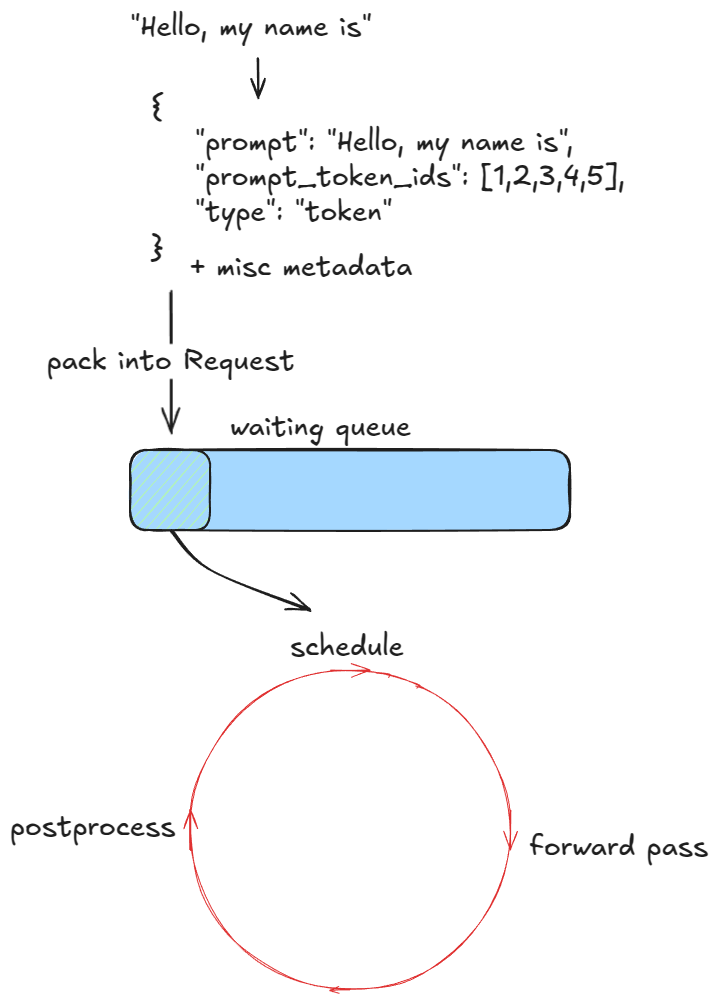
The engine loop in that diagram runs continuously, deciding on every single iteration which requests get GPU time, how much memory each one is allowed to hold, and when a finished request should be swapped out for a new one. An inference engineer's job, stripped of jargon, is building and tuning exactly this kind of loop so that it stays close to 100% GPU utilization instead of the 60-80% memory waste that older, naive serving approaches produced - vLLM Blog. That single efficiency gain, multiplied across a company serving billions of requests a day, is the entire reason this role now commands the compensation and funding attention documented in the rest of this guide.
The economics behind that statement are worth spelling out plainly, because they explain why companies pay a premium for this skill rather than treating it as a cost center to minimize. GPUs are billed continuously whether they are doing useful work or not, so an inference stack running at 40% utilization is paying for 100% of the hardware while extracting less than half the value from it, and that gap shows up directly on a company's cloud bill every single month. An engineer who can push utilization from 40% toward 90%, through the batching, caching, and quantization techniques covered later in this guide, is not delivering a one-time engineering improvement, they are permanently lowering the marginal cost of every future request the product serves. That is a fundamentally different value proposition than most software engineering work, where the benefit of a good implementation is largely fixed at ship time, and it is the underlying reason a great inference hire can pay for their own compensation many times over within a single fiscal year.
2. The 2026 Market: Why Inference Hiring Got This Hot, This Fast
Inference hiring did not become difficult in isolation. It is the sharpest edge of a much broader shift in how AI skills are priced across the entire labor market, and understanding the scale of that shift is what lets you set realistic timelines and budgets before you write a single job posting. The headline number comes from Stanford's 2026 AI Index: AI skills now appear in 2.5% of all US job postings, up 55% year over year and roughly 297% higher than a decade ago - Stanford HAI AI Index 2026. That is not steady growth, it is a market repricing itself in real time.
The same repricing shows up independently in Indeed's own data, which tracks live postings rather than survey responses. AI-mentioning job postings hit 4.2% of all US postings in December 2025, the highest level on record, and are now 134% above their February 2020 baseline while total postings sit just 6% above that same baseline - Indeed Hiring Lab. Inside tech specifically, AI-mentioning postings are 45% above their 2020 baseline even as overall tech postings sit 34% below it, meaning the growth is not a rising tide, it is concentrated almost entirely in AI-specific roles while the rest of tech hiring has actually contracted.
PwC's 2026 Global AI Jobs Barometer, built on an analysis of more than 1 billion job postings across 27 countries, adds the compensation dimension: roles requiring AI skills carry a 62% wage premium over comparable roles without them, up from 57% the year before and just 25% two years earlier - PwC. PwC also finds that companies most exposed to AI are growing headcount 52% faster and wages 24% faster than the least AI-exposed companies, a gap that has only widened. ManpowerGroup's 2026 Global Talent Shortage Survey, which polled roughly 39,000 employers across 41 countries, found AI skills claimed the number one spot globally for hiring difficulty for the first time in the survey's history, ahead of every traditional engineering and IT discipline, with 72% of employers overall reporting difficulty filling roles - ManpowerGroup.
What makes inference specifically, rather than AI broadly, the tightest part of this market is where the capital is actually flowing. NVIDIA's own numbers make the shift concrete: data center revenue hit $62.3 billion in the company's fiscal Q4 2026, and NVIDIA doubled its cumulative demand guidance from the $500 billion figure announced at GTC 2025 to more than $1 trillion through 2027 - GlobalDataCenterHub. At that same GTC 2026 keynote, CEO Jensen Huang described the moment plainly: "the inference inflection has arrived," framing tokens generated per watt of power as the metric that now determines an AI company's actual profitability, not raw model capability. That is a direct statement that the industry's spending priority has shifted from training frontier models to serving them efficiently, and staffing follows spending.
The industry's own benchmarking body backs this up with submission data rather than marketing language. MLPerf Inference v6.0, released in April 2026, drew submissions from 24 organizations including AMD, CoreWeave, Google, Dell, HPE, Oracle, and Nebius, and the largest submitted system scaled to 72 nodes and 288 accelerators, four times the size of the largest system in the prior round, with multi-node submissions up 30% overall - MLCommons. Every one of those submissions represents an engineering team that had to be staffed, tuned, and benchmarked, and that scale of investment is exactly what is now bidding up compensation for the people who can do the work, covered next in section 3 and section 4.
That bidding war is landing on a labor market that is simultaneously contracting for less specialized roles, which is the detail most general hiring commentary misses. Stanford's 2026 AI Index found that employment for software developers aged 22 to 25 has fallen roughly 20% since 2024, even as demand concentrates hard into specialized AI and ML infrastructure roles - IEEE Spectrum. Read next to the postings data earlier in this section, the picture is not "AI is creating jobs" or "AI is destroying jobs," it is both at once, sorted by specificity: broad, junior, generalist software roles are shrinking, while narrow, senior, infrastructure-specific roles like inference engineering are growing fast enough to outpace the talent supply. For a recruiter, that means the old assumption that a slower tech job market makes any technical req easier to fill no longer holds for this particular role, and budgeting extra time and a wider search radius is the safer default.
3. Who Is Hiring: The Companies Racing to Staff Inference Teams
If you want a leading indicator of where inference hiring is about to accelerate, follow the funding rounds rather than the job boards, because in this market a funding announcement is usually followed within weeks by a wave of infrastructure job postings. Four companies illustrate the pattern with unusual clarity, and their valuation trajectories over the past twelve months tell the story better than any single statistic could.
Fireworks AI, which lets companies fine-tune and deploy open-source models fast, raised a $250 million Series C at a $4 billion valuation in October 2025, then closed a $1.505 billion Series D at a $17.5 billion valuation in July 2026 as its annualized revenue passed $1 billion and the platform began processing more than 40 trillion tokens a day - Fireworks AI. That is a more than fourfold jump in valuation in under nine months, and it happened specifically because Fireworks sells the optimization layer, not the underlying model, meaning its growth is a direct proxy for how much of the market has decided that serving efficiently matters more than which base model a product runs.
Baseten, a managed inference platform, moved even faster on the same logic: a $150 million Series D at $2.15 billion in September 2025, a $300 million Series E at $5 billion in January 2026 with NVIDIA participating directly in the round, and a $1.5 billion Series F at a $13 billion valuation in June 2026, its fourth fundraise in eighteen months, alongside reported 20x revenue growth and 40x inference-volume growth year over year - Baseten. NVIDIA's willingness to invest directly in a customer rather than just sell it GPUs is itself a signal worth reading: the chip vendor is betting that the software and optimization layer sitting on top of its hardware is where a meaningful share of the AI infrastructure market's value will actually accrue, which is the same bet implicit in every compensation figure in section 4.
Modal Labs, a serverless GPU compute platform, raised $87 million at $1.1 billion in September 2025 and $355 million at a $4.65 billion valuation in May 2026, with annualized revenue jumping from roughly $60 million to $300 million over that same window, driven heavily by demand from AI coding tools that need to spin up and tear down GPU capacity in seconds rather than provisioning it in advance - SiliconANGLE. Together AI, a GPU-cluster "neocloud" founded by Stanford's Percy Liang and ETH Zurich's Ce Zhang alongside Vipul Ved Prakash, raised $305 million at $3.3 billion in February 2025 and $800 million at an $8.3 billion valuation in July 2026, led by Aramco Ventures with NVIDIA again participating, on the back of quarterly bookings exceeding $1.15 billion - TechCrunch. What ties all four of these companies together, beyond the raw valuation growth, is that none of them train frontier models themselves: their entire business is serving other people's models faster and cheaper than the alternative, and investors are pricing that specialization as being worth tens of billions of dollars in aggregate within a single year.
Inference Platform Valuations, Late 2025 vs Mid-2026
Every one of those four companies has been hiring inference and ML infrastructure engineers aggressively in direct proportion to that valuation growth, and the pattern extends to the two companies that took the public-market route instead. Cerebras Systems, which builds wafer-scale chips for training and inference, completed the largest US tech IPO since Uber's 2019 debut: it priced at $185 a share on May 14, 2026, raised $5.55 billion, and closed its first day up 68% at roughly $311, implying a valuation near $56 billion on a base basis and closer to $86 billion fully diluted - TechCrunch. That IPO followed a compute agreement with OpenAI that has since grown to more than $20 billion, covering 750 megawatts of inference capacity through 2028 - CNBC. CoreWeave, the GPU cloud provider that IPO'd in March 2025 at a roughly $23 billion valuation, has grown its backlog to $104 billion, including a $21 billion incremental commitment from Meta, a multi-year Anthropic deal, and a five-year, $22.4 billion commitment from OpenAI - CNBC.
It would be easy to read all of this against the backdrop of 2026's tech layoffs and assume the two trends contradict each other, but they do not, they describe the same reallocation from two different angles. Roughly 170,500 tech jobs were cut across 2026, even as the four largest tech companies committed a combined $725 billion to AI infrastructure, and Meta's CFO told investors directly that "AI productivity is allowing engineering teams to ship more product with fewer people" around the company's own cuts - TechCrunch. Microsoft's 9,000-person cut in May 2026 was framed the same way: fewer generalist engineering roles, explicitly to fund faster AI infrastructure investment. Read alongside the funding numbers above, the labor market is not shrinking, it is bifurcating: broad software engineering headcount is flat to down, while inference and ML infrastructure headcount at exactly these companies is scaling as fast as the capital allows.
That bifurcation is precisely why a generic "we're hiring AI engineers" posting increasingly reaches the wrong pool. The companies above are not competing for AI talent in general, they are competing for a much narrower group who can be productive on day one against a specific stack, at a specific scale, and that narrowness is what drives the compensation numbers in the next section.
4. What It Costs: Compensation Benchmarks by Company
Budgeting for an inference hire without current data is the single most common way recruiters lose a candidate late in process, because the range they proposed internally was set against generic "software engineer" comp rather than the inference-specific market. The good news is that this role now has real, disclosed numbers to anchor against, thanks largely to pay-transparency laws forcing companies to publish ranges directly on job postings.
Two live postings give the clearest floor for the role. Perplexity's "AI Inference Engineer" posting discloses cash compensation of $190,000 to $250,000 for its San Francisco office - Perplexity. A mirror of OpenAI's "Software Engineer, Model Inference" posting lists compensation around $290,000 a year - PromptHero. Those two data points alone tell you the entry point for this role at a frontier lab starts well above typical senior software engineer bands, and they should anchor your floor even if your company cannot compete at the frontier-lab ceiling.
Broader company-level data from levels.fyi, which aggregates self-reported offers, fills in the picture across the infrastructure ecosystem. The table below reports median total compensation for machine learning engineer and software engineer roles at companies with heavy inference workloads, current as of the September 2026 snapshot.
| Company | Role Sampled | Reported Range | Median |
|---|---|---|---|
| NVIDIA | Machine Learning Engineer | $205K - $331K | $261K |
| Machine Learning Engineer | $199K - $743K | $288K | |
| Groq | Software Engineer (company-wide) | n/a | $305K |
| CoreWeave | Software Engineer | up to $481K | $320K |
| Databricks | Software Engineer | $245K - $1.92M | $468K |
| Meta | Machine Learning Engineer | $187K - $1.45M | $476K |
| Perplexity | Software Engineer | n/a | $593K |
Every row above is a company-specific page on the same aggregator - Levels.fyi, current as of the September 2026 snapshot cited earlier in this section.
Median Reported Total Compensation by Company
Reading that chart, the spread between the lowest and highest medians is more than 2.2x, and the difference is not really about company prestige, it tracks how directly each company's revenue depends on inference efficiency. Perplexity and Meta run consumer products at enormous query volume, where a percentage point of inference cost savings is worth millions of dollars a year, and their comp reflects that directly. NVIDIA's own median sits lower not because the work is less skilled, but because NVIDIA employs inference engineers at much greater scale across many teams, pulling the median down even as top performers are paid well above it.
It is worth grounding these numbers against the broader, less specialized market so you know exactly how much of a premium this specific skill commands. Glassdoor's aggregated, self-reported averages put a generic "AI/ML Engineer" at $178,969 a year, a "Machine Learning Engineer" at $164,714, and a plain "AI Engineer" at $145,471 - Glassdoor. Every inference-specific figure in the table above sits meaningfully above those generalist averages, which is the clearest proof available that inference is priced as a distinct, scarcer specialization rather than a subset of general ML engineering, and your budget should reflect that distinction rather than your company's standard engineering bands.
Geography still moves these numbers meaningfully, even though the underlying skill is identical wherever it is applied. Every disclosed range referenced in this section, from Perplexity's posting to the levels.fyi medians, is anchored to San Francisco Bay Area compensation, which remains the highest-paying market for this specific role because it is where the highest concentration of the companies in section 3 are headquartered. A remote or non-Bay-Area offer that lands meaningfully below those figures is not automatically uncompetitive, but it should be positioned deliberately, either against a lower cost of living or against a genuinely compelling non-cash lever, rather than presented as if it were a Bay Area-equivalent number when a candidate who has done five minutes of research will know otherwise. Being upfront about that gap early in a process wastes less of everyone's time than discovering it at the offer stage, after a candidate has already mentally committed to a number.
5. The Skills Taxonomy: What to Actually Screen For
A resume that says "experience with AI inference" tells you almost nothing. A resume that says "optimized vLLM continuous batching to cut p99 latency 40%" tells you the candidate has actually done the job. The gap between those two sentences is the entire purpose of this section: a working vocabulary of the specific tools, techniques, and concepts that separate a real inference engineer from someone who has adjacent experience and a good vocabulary.
Three open-source serving engines dominate production inference in 2026, and nearly every serious candidate will have hands-on experience with at least one. vLLM, originated at UC Berkeley around its PagedAttention algorithm, is the most widely adopted, with 91,330 GitHub stars - vLLM GitHub. As of May 2025 it also has formal governance under the PyTorch Foundation, a detail covered in more depth later in this section - PyTorch Blog. SGLang, maintained by the LMSYS organization behind Chatbot Arena, has 35,688 stars and is the engine of choice for some of the largest multi-node deployments in the industry, reporting 3.8x prefill and 4.8x decode throughput gains when moving from NVIDIA's H100 to its newer GB200 hardware - LMSYS Blog. TensorRT-LLM, NVIDIA's own compiled runtime, trades hardware flexibility for maximum performance specifically on NVIDIA chips, and a March 2026 NVIDIA benchmark shows it taking DeepSeek-R1 from a 67 tokens-per-second baseline to 368 tokens per second, a 5.5x improvement, on 8 B200 GPUs - NVIDIA. Independent technical comparisons consistently name these three engines as the dominant production choices in 2025 and 2026 - MarkTechPost.
GitHub Stars Across Major Inference Engines
Underneath all three engines sits the same core algorithm, and understanding it is the single highest-leverage thing you can learn from this guide. PagedAttention, introduced in vLLM's original 2023 paper, manages GPU memory the way an operating system manages RAM: instead of reserving one large, wasteful contiguous block per request, it allocates memory in small, non-contiguous pages, which is why the original vLLM benchmark showed up to 24x higher throughput than the standard Hugging Face Transformers library, with memory waste cut from 60-80% down to under 4% - vLLM Blog. The animated diagram below is the field's own preferred way of explaining the idea, and it is worth understanding at a glance even if you never touch the underlying code.
PagedAttention: Memory Management Borrowed From Operating Systems
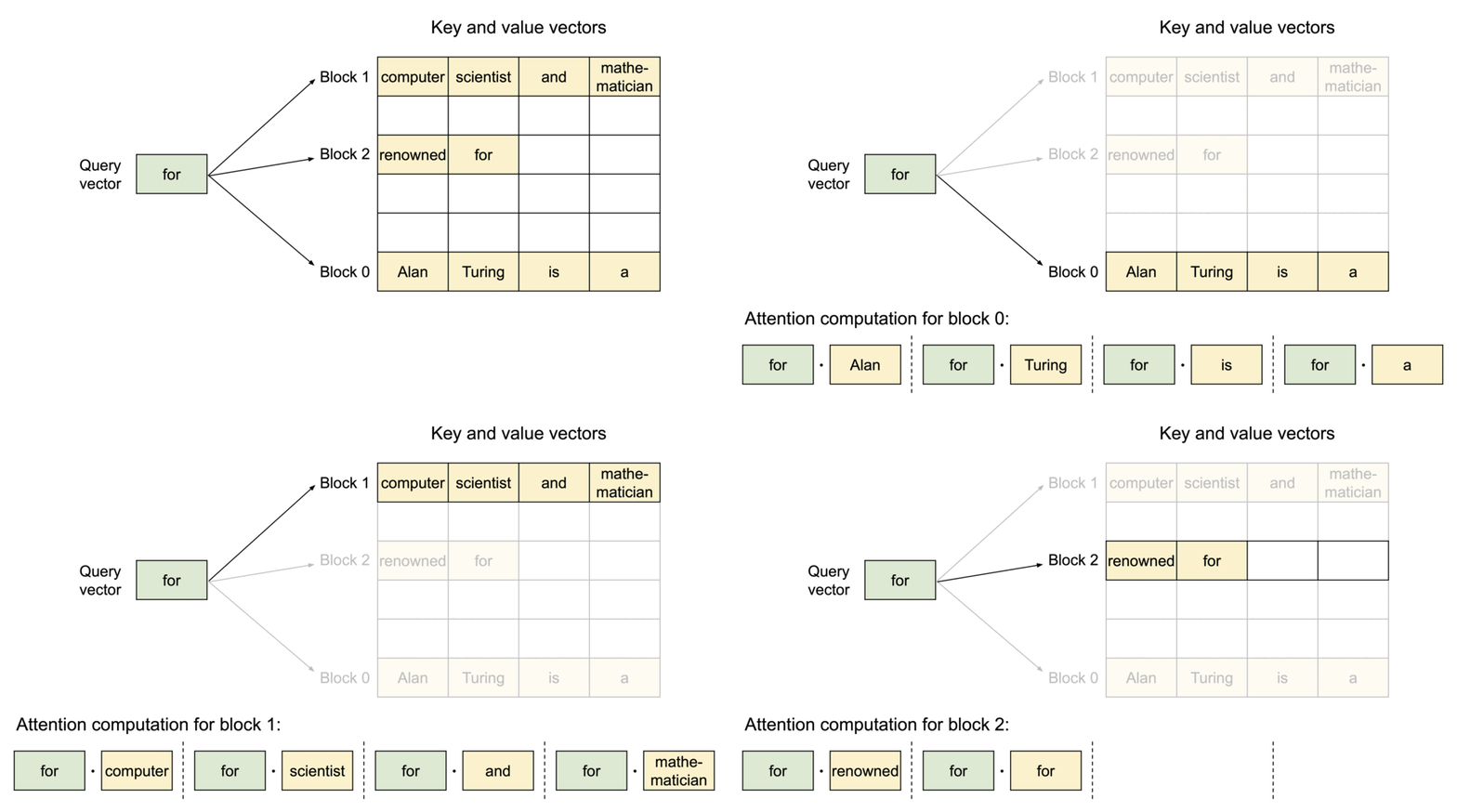
PagedAttention solves the memory problem, but a serving engine still has to decide which requests get GPU time on every single cycle, and that is what continuous batching does: rather than waiting for a fixed group of requests to arrive and finish together, the scheduler replaces a completed request with a new one the instant GPU capacity frees up, keeping the hardware close to fully utilized at all times - RunPod. A related technique, speculative decoding, uses a small, fast "draft" model to guess several tokens ahead, which the larger model then verifies in a single pass rather than generating one token at a time. Fireworks AI's own engineering blog reports that domain-tuned draft models hit a 76% acceptance rate versus 29% for a generic draft model in one production case, translating to roughly a 2x speed improvement, with adaptive speculative decoding generally claiming up to 3x latency gains over naive approaches - Fireworks AI.
Beyond the scheduler, the largest lever an inference engineer has over cost is quantization: compressing a model's weights from 16-bit precision down to 8-bit or 4-bit representations to cut memory footprint and increase throughput, at some cost to accuracy that has to be carefully managed. The two dominant published techniques are GPTQ, a one-shot, second-order weight quantization method from a 2023 ICLR paper - arXiv - and AWQ, which protects the specific weight channels that see the highest activation values from aggressive compression, making it particularly effective for 4-bit on-device deployment. FP8 has emerged as a popular middle ground on newer hardware like NVIDIA's Blackwell generation, offering accuracy much closer to full precision than INT4 while still getting meaningful hardware speedups - VRLA Tech. A candidate who can explain the accuracy-versus-speed tradeoff between these three approaches, in plain language, is demonstrating real production experience rather than surface familiarity.
The last concept worth knowing before you screen a resume is the KV cache, the memory structure that stores every previous token's context so the model does not have to recompute it on every new token. It is the dominant memory bottleneck in any serving system, scaling directly with prompt length, output length, model size, and numeric precision, which means it has to be treated as a first-class capacity-planning constraint rather than an afterthought - Prachub. At the largest scale, teams split the compute-heavy "prefill" phase (processing the initial prompt) from the memory-bandwidth-heavy "decode" phase (generating tokens one at a time) onto entirely separate hardware pools, an architecture pattern called disaggregated prefill-decode serving that shows up explicitly as a core responsibility in real job postings, and that SambaNova's own engineering blog explains in detail - SambaNova. The diagram below, sourced from Hugging Face's own benchmarking documentation, illustrates exactly this split.
Prefill vs. Decode: The Two Phases Every Serving Engine Manages

That image comes from Hugging Face's own documentation, and it is worth pausing on the company that produced it, because the state of that specific project is itself a hiring signal you should know. Hugging Face's Text Generation Inference (TGI), once a major production serving engine, entered maintenance mode on December 11, 2025, and its GitHub repository was fully archived on March 21, 2026. Hugging Face engineer Lysandre Debut confirmed the shift directly, stating the project would only accept "minor bug fixes" going forward, and that Hugging Face now points new deployments toward vLLM or SGLang instead - Hugging Face TGI GitHub. A candidate whose most recent hands-on experience is exclusively TGI is not necessarily weaker, but they likely need a short bridge onto the tools that now dominate the field, and you should ask about it directly rather than assume continuity.
That consolidation is also visible in where the money and governance have moved. vLLM's move under the PyTorch Foundation in May 2025 formalized it as neutral, vendor-independent infrastructure rather than a single company's side project - PyTorch Blog - and the commercial appetite around it is just as strong: in January 2026, several of vLLM's own founding engineers spun out a new startup, Inferact, raising a $150 million seed round at an $800 million valuation co-led by a16z and Lightspeed, with UC Berkeley's Ion Stoica among the backers, specifically to commercialize the project they built - SiliconANGLE. An $800 million seed valuation for a company whose product is largely already free and open source is a striking data point on its own: investors are betting that the enterprise support, hosting, and tuning layer built around vLLM is worth a premium independent of the underlying code, which mirrors exactly the dynamic already playing out at Baseten, Fireworks, and Together AI in section 3. The banner below is the PyTorch Foundation's own announcement graphic for that governance shift.
vLLM Joins the PyTorch Foundation

If you want a sense of how fast this ecosystem actually moves, watch the vLLM maintainers discuss it themselves rather than reading a static summary. The session below, hosted by Red Hat (which acquired core vLLM contributor Neural Magic), is the project's own year-in-review and roadmap discussion, recorded in December 2025.
vLLM 2025 Retrospective & 2026 Roadmap
One layer up from the serving engines themselves sits orchestration, the software that decides which of potentially thousands of GPUs handles a given request, and candidates with this experience are worth a specific line item on your skills checklist because it is a distinct specialization from writing the engine itself. Ray Serve, the model-serving layer built on top of the open-source Ray distributed-compute framework, has 43,757 GitHub stars and was built at UC Berkeley's RISELab by the same research lineage that produced vLLM - Ray GitHub. KServe solves an adjacent problem on Kubernetes specifically, offering a framework-agnostic way to deploy models built in PyTorch, TensorFlow, ONNX, or XGBoost behind a standard interface - KServe Docs. Google Cloud's own tuning documentation for running Ray Serve on its Kubernetes offering is a useful signal in itself: when a hyperscaler writes a dedicated performance guide for a piece of open-source infrastructure, it is because enough of its own customers are already running it in production to justify the investment - Google Cloud. A candidate who has operated one of these orchestration layers, rather than just a single-node serving engine, has demonstrably worked at the cluster scale most of the compensation data in section 4 assumes.
One more credential is worth knowing how to read on a resume: MLPerf Inference, the industry-standard benchmark suite run by MLCommons. Because submitting a result requires a working, tuned, competitively-benchmarked deployment, a candidate listed as a contributor to an organization's MLPerf submission has effectively already passed a real-world performance bar that no interview question can fully replicate. The most recent round, MLPerf Inference v6.0 in April 2026, added new benchmark categories for text generation and text-to-video workloads specifically because the industry's own definition of "state of the art" inference kept moving too fast for the prior benchmark suite to stay relevant - MLCommons. If a candidate's resume or LinkedIn mentions an MLPerf submission by name, it is worth asking about directly in the interview, because it is one of the few credentials in this field that is externally verifiable rather than self-reported.
Finally, do not overweight CUDA fluency as a filter on its own. Nearly every serious candidate has some CUDA exposure, since it remains NVIDIA's foundational GPU programming platform, but the more differentiating and increasingly common skill is comfort with Triton, a Python-embedded language that lets engineers write custom GPU kernels without hand-written CUDA C++, covered in full in the next section alongside a naming collision that trips up nearly every recruiter who has not seen it before.
6. The Naming Trap: Two Tritons and a Company Not Named Grok
Two separate naming collisions run through this entire field, and getting them wrong on a job posting or in a phone screen is one of the fastest ways to lose credibility with a technical candidate. Both are avoidable once you know they exist, so this section exists purely to make sure you never confuse them.
The first collision is Triton, and it refers to two completely unrelated products that happen to share a name. NVIDIA Triton Inference Server is a general-purpose model-serving platform: software that sits in front of a trained model, in any framework, and handles the routing, batching, and scaling of production requests. It has 10,975 GitHub stars, is used in production by companies like Amazon (which reports sub-50 millisecond latency and a 5x throughput gain on one internal model) - NVIDIA Case Study - and is currently being folded into a broader platform under the name "NVIDIA Dynamo-Triton" - NVIDIA. Separately, and with zero relation, Triton the language (often called OpenAI Triton, though the project now lives under an independent triton-lang GitHub organization) is a Python-embedded compiler for writing low-level GPU kernels, the close-to-the-metal code that implements the actual math operations. It has 20,101 GitHub stars, sits underneath PyTorch's torch.compile feature by default, and is the language vLLM's own attention kernels are written in - NVIDIA Developer Blog.
The practical difference matters enormously for hiring: an engineer with deep NVIDIA Triton Inference Server experience is a deployment and DevOps-adjacent specialist, comfortable with model routing, autoscaling, and multi-framework serving infrastructure. An engineer with deep Triton-the-language experience is a much rarer, more compiler-and-kernel-focused specialist, closer to a low-level systems programmer than a deployment engineer. If a resume or job description just says "Triton" with no further context, do not assume which one it means, ask directly, because conflating the two in a screening call is an immediate signal to a serious candidate that the recruiter has not done their homework.
The second collision is simpler but no less common: Groq, spelled with a "q," is the nine-year-old AI chip company behind the $20 billion NVIDIA licensing deal that opened this guide. Grok, spelled with a "k," is Elon Musk's xAI chatbot, an entirely unrelated consumer product. The confusion is old enough that Groq itself has publicly complained about it, posting in November 2023: "Your chatbot is called Grok and our company is called Groq" - Deploybase. Getting this wrong in a job posting, an outreach message, or a candidate-facing conversation is a small but real credibility cost, and it is worth a second glance on anything you write before it goes out.
Neither of these naming traps is difficult once flagged, but both show up constantly in real recruiting workflows: in boolean search strings, in resume keyword scans, and in casual conversation with hiring managers who assume the recruiter already knows the difference. Building the habit of asking "which one do you mean" costs nothing and prevents a genuinely embarrassing mistake in front of the exact audience you are trying to earn credibility with.
There is a broader lesson underneath both examples that applies well beyond these two specific name collisions: this field reuses common English words and short acronyms constantly, because the people naming these projects are systems engineers, not marketers, and precision has never been the goal. A hiring manager casually mentioning "we need someone who knows Ray" could mean the distributed-compute framework covered in section 5, and a mention of "Dynamo" almost certainly means NVIDIA's inference orchestration platform rather than any of the dozens of unrelated products and companies that also use the word. The safest habit for any recruiter working this space is to treat every project or company name as ambiguous by default until confirmed, and to ask the hiring manager or candidate to spell out the full name and, where relevant, the maintaining organization, before it goes into a job posting or an outreach message that a technical audience will read closely.
7. Where Inference Engineers Actually Are
The companies and compensation data in the previous sections describe a talent pool that is small, expensive, and almost never actively job-hunting. That means traditional job-board posting, the default recruiting motion for most roles, is close to useless here: you need to go to where these engineers already spend their time, which is overwhelmingly open source, not LinkedIn.
The single highest-signal sourcing pool is the contributor base of the serving engines covered in section 5. NVIDIA's own job postings state directly that its inference team "contributes features and code to NVIDIA's inference libraries, vLLM and SGLang," meaning the company is actively paying engineers to build public, browsable contribution histories on exactly the projects you should be searching - NVIDIA Careers. The contributor graphs on github.com/vllm-project/vllm/graphs/contributors and github.com/sgl-project/sglang/graphs/contributors are public, searchable, and represent engineers who have already demonstrated real, verifiable production skill rather than a resume claim. Because vLLM, SGLang's related infrastructure, DeepSpeed, and Ray are all now hosted under the PyTorch Foundation, the conference and speaker lists for PyTorch-affiliated events effectively double as a pre-vetted, high-signal candidate pool - PyTorch Foundation.
Conferences remain one of the most efficient ways to find this talent in concentrated form, because speaker and session lists are public and filterable by exact technical topic before you ever make contact. The 2026 calendar gives you a full year of confirmed opportunities: NVIDIA GTC runs March 16-19 in San Jose and again November 30 to December 3 in Washington, D.C., MLSys 2026 runs May 19-21 in Bellevue, Washington, Hot Chips 2026 runs August 23-25 at Stanford, Ray Summit 2026 runs August 24-26 in San Francisco, the PyTorch Conference runs October 20-21 in San Jose, and NeurIPS 2026 runs December 6-12, based in Sydney with satellite venues in Atlanta and Paris. Pulling the accepted-paper and session lists directly from each event's own site (mlsys.org, hotchips.org, nvidia.com/gtc/session-catalog) gives you presenter names who are, by definition, doing exactly the work you are hiring for.
AWS + vLLM: Building the Future of Open, Fast LLM Serving
Outside of formal conferences, three online communities carry an outsized share of the field's real discussion, and each rewards a slightly different sourcing approach. r/LocalLLaMA, with roughly 819,000 members as of a September 2026 snapshot, skews toward hands-on testing of self-hosted models, quantization, and serving frameworks, making it a strong source for engineers who like working close to the hardware. The MLOps Community Slack, reported at somewhere between 20,000 and 28,000 members depending on the source, is more production-and-monitoring focused, closer to the day-to-day reality of running inference at a company rather than experimenting at home. Latent Space, the applied-AI newsletter and podcast run by swyx and Alessio, has grown past 197,000 subscribers and frequently covers inference economics and serving architecture in enough technical depth that its audience skews toward practitioners rather than casual followers.
Once you know where to look, the actual search syntax matters less than most recruiters assume, because the pool is small enough that broad, permissive boolean strings work better than narrow ones. A LinkedIn search combining role-family terms with named tools, such as ("inference engineer" OR "ML infrastructure engineer" OR "model serving") AND (vLLM OR SGLang OR "TensorRT-LLM" OR "continuous batching" OR "KV cache"), will surface far more real candidates than a title-only search, precisely because so many of these engineers carry a generic "Software Engineer" title internally and only reveal their actual specialization in the skills or summary section of their profile.
The same logic applies to GitHub itself, which is a better primary sourcing surface than LinkedIn for this specific role because contribution history cannot be exaggerated the way a resume bullet can. Searching commit history and code for named projects, then cross-referencing the contributor's public profile against a company domain in their commit email or bio, routinely surfaces engineers who are two or three years away from having a public LinkedIn presence that reflects their real seniority, because promotions and title changes lag skill growth badly in a field moving this fast. Conference session catalogs add a third layer: pulling accepted-paper and speaker lists directly from mlsys.org, hotchips.org, and nvidia.com/gtc/session-catalog gives you names who have already been through an independent peer-review or selection process, which is a stronger pre-filter than almost any resume screen a recruiting team could run internally.
Combine those three channels, engine contributor graphs, GitHub commit search, and conference speaker lists, with the LinkedIn boolean string above, and you have a sourcing funnel that reaches people who will never see a traditional job posting at all. That is the practical answer to the market described in sections 2 and 3: if demand for this skill is growing faster than the visible supply, the visible supply (people actively applying to jobs) is the wrong pool to compete over in the first place.
8. Writing a Job Description That Doesn't Get Ignored
A job description that lists "experience with AI/ML" as a requirement will be read, correctly, by a real inference engineer as a signal that the hiring team does not understand the role well enough to write a specific one, and it will be skipped. The postings that actually convert interest from this narrow talent pool share a specific pattern, visible directly in the real listings referenced throughout this guide, and it is worth breaking down explicitly.
The first pattern is naming the exact stack rather than describing it abstractly. Compare a generic line like "experience with machine learning infrastructure" against NVIDIA's actual posting language: the team "contributes features and code to NVIDIA's inference libraries, vLLM and SGLang, FlashInfer" - NVIDIA Careers. The second version tells a candidate exactly what they will work on before they even apply, and it self-selects for people who already have that specific experience rather than adjacent experience they will have to relearn on the job. The second pattern is stating real scale, not aspirational scale. Perplexity's posting does not say "work at scale," it says the team deploys "dozens of model architectures at scale with tight latency and cost budgets" - Perplexity, giving a candidate a concrete sense of the operating environment before the first interview.
The third pattern, and increasingly the most consequential one, is compensation transparency. Because Perplexity, OpenAI, and other frontier employers now disclose real ranges directly on the posting (documented in full in section 4), any company that omits a range is competing at a structural disadvantage: a candidate comparing two nearly identical postings will default to the one that tells them what the job actually pays, and in a market this tight, that candidate will not bother applying to find out the number from the one that hides it. If your internal policy allows it, publishing a range anchored to the data in this guide, rather than to your company's generic engineering bands, is one of the highest-leverage single changes you can make to a job posting.
A fourth pattern is worth naming even though it is less visible in the postings themselves: brevity. Every real posting quoted in this guide gets to the actual work within the first two or three sentences, without a paragraph of mission-statement language first. That is not a stylistic accident, it reflects how this specific audience reads a job posting: an engineer who is not actively looking, but who opens a message or a link out of curiosity, decides within seconds whether the role is worth a second look, and a posting that spends its opening lines on company vision rather than the actual engineering problem has usually already lost that reader before they reach the part that would have convinced them.
None of this requires guesswork, because the market has already told you what a good posting looks like: it names real tools, states real scale, and discloses a real number, and every frontier company hiring for this role right now is already doing exactly that. Writing your own posting to match that pattern is not a stylistic choice, it is table stakes for reaching a talent pool that has learned to filter out anything less specific within the first two sentences.
9. The Interview Process: What Good Loops Actually Test
Screening an inference engineer with a standard software engineering loop, algorithms and data structures on a whiteboard, will filter out exactly the candidates you are trying to hire, because the skill this role requires is systems judgment under real-world constraints, not abstract algorithmic cleverness. The companies that hire this role well have converged on a noticeably different interview format, and understanding it will make your own loop far more predictive.
Anthropic is reported by candidates and interview-preparation sites, though not confirmed in an official company blog post, to run a system-design interview built around a prompt like "design a scalable, GPU-backed inference API," evaluating request lifecycle design, independent CPU and GPU scaling, dynamic batching strategy, KV-cache memory management, and diagnostics under load - Prachub. The same sources describe Anthropic's broader engineering interviews as avoiding LeetCode-style questions almost entirely in favor of open-ended, "progressive system building" problems with no single correct answer, which matches the reality that inference work rarely has one right answer, only better and worse tradeoffs given a specific cost and latency budget.
Baseten's own hiring process, described by candidates on Glassdoor, follows a similarly practical shape: a recruiter screen, a hands-on coding round grounded in real engineering work rather than algorithmic puzzles, a systems and domain discussion focused specifically on GPU serving and latency, and a founder conversation, running roughly a month end to end - Glassdoor. Baseten's own developer relations lead, Philip Kiely, described the underlying bar directly in a public podcast interview: a strong hire needs "deep understanding of runtime optimization, distributed infrastructure, and performance engineering," with specific fluency in post-training quantization, speculative decoding, and KV-cache reuse, evaluated against production targets of time-to-first-token in the hundreds of milliseconds at a scale of trillions of tokens a month, across multiple regions and clouds - Open Source CEO Podcast.
Distilling those real-world loops into a repeatable structure, five concepts should anchor any inference-engineer technical screen regardless of company size: GPU memory hierarchy and how it constrains batch size, the mechanics of continuous batching and why it beats static batching, the accuracy-versus-speed tradeoff across quantization methods, KV cache as a hard capacity constraint rather than a detail, and the general principle that right-sizing a model, its precision, and its batch configuration should happen before chasing kernel-level micro-optimizations. A candidate who can walk through those five areas with specific, concrete tradeoffs, rather than textbook definitions, has almost certainly done the job before, and that fluency is a far better predictor of on-the-job performance than any algorithmic coding exercise could be.
The practical takeaway for a recruiter running a screen, even without deep technical background, is to listen for specificity rather than vocabulary. A candidate who says "we moved from static to continuous batching and cut p99 latency by 40%" is describing a real, lived tradeoff. A candidate who lists "continuous batching" as a skill on a slide with no story attached is much more likely repeating a term they researched before the call, and that distinction, more than any single technical question, is what separates a genuine hire from a well-prepared miss.
A short set of follow-up questions, asked in plain language, does most of the work of a full technical screen without requiring the recruiter to have an engineering background. Ask what happens to GPU memory when a request finishes early relative to others in its batch, and listen for an answer that references paging or block-level allocation rather than a vague "it frees up." Ask how the candidate decided between a smaller, faster model and a larger, more capable one for a specific production use case, and listen for a real cost-per-token or latency-budget tradeoff rather than "the bigger model performed better." Ask what broke the last time they scaled a serving deployment past its tested load, since production incidents are where the gap between textbook knowledge and hands-on experience shows up most clearly, and a candidate with real experience will have a specific, sometimes embarrassing story ready. None of these questions require you to evaluate code, and all three are difficult to fake convincingly without having actually done the work.
10. Real Hires, Real Results: What a Great Inference Engineer Changes
Every statistic in this guide about market size and compensation exists because inference engineering produces measurable, dollar-denominated results, and the clearest way to make the business case for investing in this hire internally is to show exactly what great inference engineering has already delivered at real companies.
Baseten's own published customer results are the most concentrated set of examples available. Speechify, a text-to-speech company, achieved 44% lower cost per million characters processed alongside 30-50% lower p99 latency and 4.5x faster cold starts. Parallel Web Systems saw 3x higher throughput and a 2x latency improvement. Notion's AI meeting notes feature achieved 2-3x lower latency, Gamma cut image generation time by 5x, and Zed Industries made code completions 2x faster - Baseten. Running the same workloads on NVIDIA's newest Blackwell chips added a further layer of gains: Baseten reports more than 225% better cost-performance for high-throughput inference and 25% better cost-performance for latency-sensitive workloads on that hardware generation - NVIDIA Case Study.
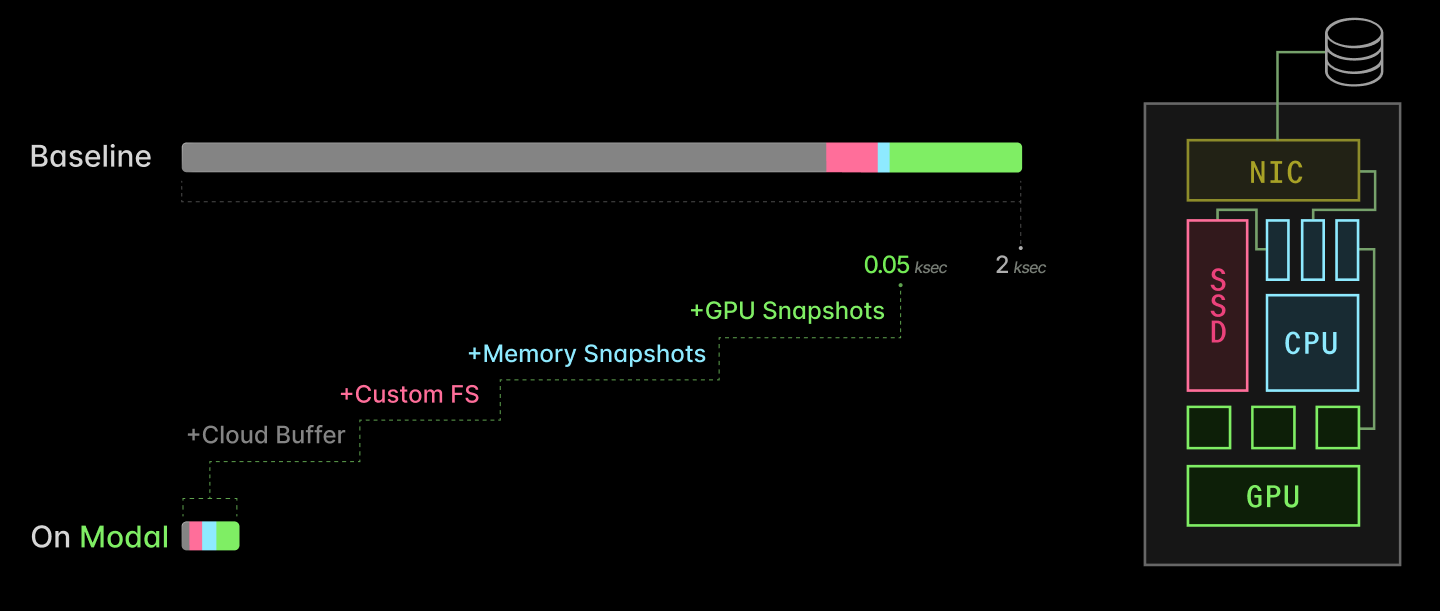
Together AI's own Blackwell benchmarks tell a similar story from a different platform: serving the open-weight Qwen3-235B model up to 2.75x faster than the next-fastest provider, more than 65% faster on Kimi-K2, and roughly 2x faster on gpt-oss-20B, while hitting 314 tokens per second on DeepSeek-R1 - Together AI. Modal's own engineering blog documents a different kind of win entirely, focused on the cold-start problem that plagues serverless GPU deployments: GPU memory snapshotting cut a Parakeet audio-transcription cold start from roughly 20 seconds to 2 seconds, and dropped a vLLM deployment's startup time from 45 seconds to 5 seconds - Modal.
Cutting Cold-Start Latency With GPU Memory Snapshots
Hardware vendors report gains at a different order of magnitude, because they control the full stack rather than optimizing an existing deployment. Cerebras reports serving Llama 3.1-70B at 2,100 tokens per second, a 3x improvement over its own prior figure, and Llama 4 Scout at more than 2,600 tokens per second, which independent benchmarking firm Artificial Analysis measured as roughly 19x faster than the fastest comparable GPU-based solution - Cerebras. Model providers are chasing the same efficiency from the other direction: Mistral's Large 3 model, released in December 2025, is priced at $0.50 and $1.50 per million tokens, a 75% price cut from its predecessor, made possible by a sparse mixture-of-experts architecture with 675 billion total parameters but only 41 billion active per token, keeping inference cost close to a much smaller dense model while retaining frontier-level capability - CloudZero.
Every one of these results, across five different companies with five different products, traces back to the same underlying discipline: an engineer or team that understood the specific tradeoffs covered in section 5 well enough to apply them against a real production workload. What separates them is not that one company has smarter engineers than another, it is that each result targeted a different point in the same tradeoff space described in section 5, whether that meant compressing cold-start time, raising raw tokens-per-second, or cutting the price paid for each token generated. A hiring team evaluating a candidate should ask which of these levers the candidate has actually pulled before, because "I improved inference performance" without a specific lever named is a much weaker signal than a candidate who can say precisely whether their win came from batching, caching, quantization, or hardware choice.
That is the concrete, dollar-and-latency return on the compensation and sourcing effort documented throughout this guide, and it is the argument to bring into any internal conversation about why this hire deserves a premium budget and a faster process than a typical engineering req. A finance or product stakeholder who is skeptical of paying inference-tier compensation for what looks, on paper, like "a backend engineer" only needs to see one of the figures above translated into their own product's numbers: a 44% cost reduction or a 3x throughput gain, applied against a company's actual GPU bill, typically dwarfs the incremental cost of paying market rate for the person who delivers it.
11. The Tool Stack: Sourcing, Outreach, and Where HeroHunt.ai Fits
Everything in sections 5 through 10 tells you what to look for and where the candidates are. This section is about the practical mechanics of actually reaching them, because the sourcing channels described in section 7 (GitHub contributor graphs, conference speaker lists, niche communities) are exactly the kind of unstructured, high-effort search that traditional applicant-tracking workflows were never built to handle.
Most recruiting tech stacks were designed around a fundamentally different assumption: that candidates apply, and the software's job is to sort and rank inbound applications. Inference engineers, as established throughout this guide, mostly do not apply anywhere, because they are already employed, well compensated, and fielding inbound interest without lifting a finger. That inverts the entire workflow: the tool that matters most is not the one that ranks applicants, it is the one that finds people who were never going to apply in the first place, then reaches them with a message specific enough to earn a reply.
This is the exact gap HeroHunt.ai was built to close. Rather than matching keywords against a resume database, it searches across more than 1 billion profiles and uses a language model to screen candidates against the actual role description you provide, which matters directly for this role because, as covered in section 7, the strongest signal for an inference engineer often sits in a GitHub bio, a contributor history, or a conference talk description rather than a formal job title. Paired with the outreach automation that finds and contacts qualified candidates without manual searching, it is built for exactly the kind of passive, technically narrow search this guide has described, rather than the inbound-application model most ATS software still assumes.
None of that replaces the judgment covered in sections 5 and 9: a sourcing tool can surface a strong-looking GitHub profile, but only a recruiter or hiring manager who understands the difference between PagedAttention and prefill-decode disaggregation can tell a genuine specialist from someone who starred the right repositories. Used together, though, an AI-driven sourcing layer and the technical vocabulary this guide has built give a recruiting team the ability to compete for a talent pool that, as section 4 showed, is being bid up by companies with venture funding and public-market valuations most internal teams cannot match on compensation alone. Speed and precision in the sourcing motion become the lever that is actually available to you.
The search-GitHub-screen-outreach loop described in this section is exactly what HeroHunt.ai automates end to end, so it is worth testing against one open inference req before rebuilding your sourcing process around it.
12. The 2026-2027 Outlook and Your Hiring Playbook
Every trend documented in this guide points in the same direction for the next twelve to eighteen months: inference hiring gets harder before it gets easier. NVIDIA's own guidance, doubling its cumulative demand forecast to more than a trillion dollars through 2027, is a direct signal that infrastructure spending, and the staffing that follows it, is still accelerating rather than plateauing. The MLPerf submission growth documented in section 2, four times the largest system size in a single benchmarking cycle, tells the same story from the engineering side: the scale of what a competitive inference deployment looks like is still climbing fast, and the talent required to build one is not growing at the same pace.
The layoff and reallocation pattern from section 3 is unlikely to reverse either. Companies that cut broad engineering headcount to fund AI infrastructure investment are not going to reverse that trade once the infrastructure is built, because the entire premise, stated directly by Meta's own CFO, is that AI productivity lets a smaller team ship more. That means the inference specialists inside those smaller teams become more valuable, not less, as the ratio of infrastructure spend to headcount continues to rise. If your company is competing for this talent against organizations with the funding trajectories described in section 3, the honest expectation is that pure compensation matching will rarely be possible, which makes the sourcing precision and job-description specificity from sections 7 and 8 disproportionately more important than they would be in a less competitive hiring market.
Putting the full guide into a practical sequence, five moves matter more than any others when you are staffing this role. Start by writing the job description around the exact stack (vLLM, SGLang, TensorRT-LLM, or whichever your team actually uses) rather than generic AI language, since section 8 showed that specificity is what earns a serious candidate's attention in the first two sentences. Anchor your compensation range against the levels.fyi and live-posting data in section 4 rather than your company's standard engineering bands, because a range set against generalist comp will lose every close against a frontier-lab competitor. Source directly from the GitHub contributor graphs and conference speaker lists in section 7 instead of waiting for inbound applications, since the strongest candidates are demonstrably not job-hunting. Build your technical screen around the system-design and tradeoff-based format in section 9, not a standard algorithms loop, because it is a far better predictor of real production skill. And treat AI-driven sourcing tools like HeroHunt.ai as the mechanism that makes the other four steps executable at the speed this market demands, rather than as an optional add-on.
It is also worth being honest about where this playbook can still fail. Matching the exact compensation numbers in section 4 will simply not be possible for most companies outside the handful of frontier labs and well-funded infrastructure startups profiled in section 3, and pretending otherwise wastes both your time and the candidate's. The more realistic goal is competing on the dimensions those larger organizations are structurally worse at: a faster process, a more specific and technically credible job description, a hiring manager who can speak the vocabulary in this guide fluently in the first call, and a mission or problem space narrow enough to be genuinely interesting to an engineer who has already solved the generic version of the problem elsewhere. Inference engineers, like most senior technical talent, are not purely comp-maximizing, and a smaller company that is honest about its budget while offering a sharper, faster, more respectful process can and does win searches against much larger compensation packages.
None of this requires becoming a technical expert yourself. It requires knowing enough of the vocabulary in this guide, PagedAttention, continuous batching, the prefill-decode split, the KV cache as a capacity constraint, to ask a better question, read a resume with real judgment, and recognize a genuine answer when a candidate gives one. That is a learnable skill, and it is now the single highest-leverage skill a technical recruiter working in AI can build for 2026 and beyond.
This guide reflects the AI inference hiring market as of September 2026. Compensation figures, funding valuations, and company headcount plans in this field change quickly, verify current details before extending an offer or setting a budget.