


The Practical Guide to What Indeed Charges Employers in 2026, Where the Money Actually Goes, and the Alternatives Worth a Budget Line
Indeed's parent company raised its 2026 revenue forecast for the Indeed and Glassdoor business by roughly $750 million in the space of three months, while the number of jobs posted on Indeed sits 2.9% below a year ago. That combination, fewer jobs and much more revenue, is the single most important fact for any employer trying to understand Indeed pricing in 2026. Recruit Holdings now expects its HR Technology segment to bring in $11.49 billion this fiscal year at a 45.8% profit margin, up from the $10.74 billion and 41% it guided to in May - HR Tech Feed. The extra money is not coming from more jobs. It is coming from employers paying more per job.
But here is the problem: Indeed's price is not a number, it is a meter, and the meter has changed three times in three years. Pay-per-application arrived, blew up small employers' bills and was withdrawn on December 18, 2023. Free posts were capped at three per month in December 2025. On March 31, 2026, organic visibility ended for jobs arriving through single-source feeds. An employer who last checked the rules in 2024 is now budgeting against a product that no longer exists, and most of the "Indeed pricing 2026" pages ranking on Google still quote the dead one.
This guide breaks down exactly what Indeed charges in 2026 (Sponsored Jobs minimums, click versus started-application billing, Premium, and the $520 per month Smart Sourcing subscription), what employers actually pay according to contract data and Indeed's own funnel numbers, where Indeed genuinely wins and where it quietly fails, and the six strongest alternatives, from free distribution to autonomous AI sourcing platforms like HeroHunt.ai. Every price is sourced from Indeed's own pages, regulatory filings or audited contract data. Nothing here is quoted from memory.
Written by Yuma Heymans (@yumahey), who built HeroHunt.ai after watching too many recruiting budgets disappear into job-board clicks that never became hires. He has been building AI sourcing and outreach tools since 2021, so this guide reads Indeed's meters the way a competitor has to.
Contents
- What Indeed Is in 2026, and Why the Price Keeps Moving
- Indeed Pricing in 2026: Sponsored Jobs, Line by Line
- Smart Sourcing, Sourcing Assistant and Talent Scout: The AI Upsell
- What Indeed Really Costs: Contract Data and Funnel Math
- Where Indeed Wins and Where It Falls Short
- The 6 Best Indeed Alternatives in 2026
- Full Comparison and How to Choose
- The Bottom Line
1. What Indeed Is in 2026, and Why the Price Keeps Moving
Indeed is still the largest hiring marketplace on earth, and that scale is the reason employers tolerate its pricing. The site holds 685 million job seeker profiles, is used by 3.5 million employers, operates in over 60 countries and, by its own count, produces 31 hires per minute as of March 2026 - Indeed. No other single channel puts an hourly, frontline or entry-level job in front of that many active applicants within hours of posting. When a restaurant, a clinic or a warehouse needs twelve people by Monday, Indeed is where the applications come from, and every price decision Indeed makes is built on that fact.
The money behind the site tells you where the pricing pressure comes from. Recruit Holdings, Indeed's Tokyo-listed parent, reported $9.67 billion of HR Technology revenue for the fiscal year ended March 2026, up 7.6% in dollar terms, with the United States contributing $5.31 billion and the segment hitting a record 37.7% EBITDA margin - Recruit Holdings. The same report discloses the number that matters most to an employer: US average revenue per job grew 17% year over year. Indeed did not sell 17% more jobs. It charged 17% more for each one, largely through Premium Sponsored Jobs and stricter free-post rules.
Then the first quarter of the new fiscal year (April to June 2026) landed, and the trend accelerated. HR Technology revenue jumped 33.4% year over year to ¥454.6 billion, EBITDA rose 80.6%, and Recruit told investors that "monetization development and operational efficiency in HR Technology progressed faster than initially expected" - Recruit Holdings. Management raised the full-year HR Technology forecast to $11.49 billion with US revenue now expected to grow 25.1%. The chart below shows how far expectations moved in a single quarter, and it is worth reading as a statement about your future invoices rather than Recruit's share price.
Recruit HR Technology (Indeed + Glassdoor) revenue, USD billions
What the chart shows is a company that expects to extract roughly $1.8 billion more from employers this year than last, in a labor market where employers are posting fewer jobs. The Indeed Job Postings Index stood at 101.8 on August 14, 2026, just 1.8% above its February 2020 baseline and 2.9% below a year earlier, with software development postings still at 74.4 - Indeed Hiring Lab. Revenue up double digits while postings fall can only mean one thing: a higher price per posting, achieved by making free visibility scarcer and paid visibility more necessary.
The corporate reshaping behind this is real and recent. In July 2025 Recruit cut 1,300 jobs, about 6% of the HR Technology division, folded Glassdoor's operations into Indeed and framed the whole move around AI, with CEO Hisayuki Idekoba writing that "AI is changing the world, and we must adapt" - TechCrunch.
Glassdoor then legally merged into Indeed, Inc. on July 1, 2026, after existing Glassdoor users were given until April 20, 2026 to link an Indeed account or lose full access - Reworked. For a buyer, the practical consequence is simple: Glassdoor is not an alternative to Indeed any more. A job on Glassdoor is an Indeed job wearing a different logo, priced by the same system.
2. Indeed Pricing in 2026: Sponsored Jobs, Line by Line
The short version: direct free posts are capped at three a month and fade fast, Sponsored Jobs start at $5 per day or $150 per month per job, Indeed bills per click on daily budgets and per started application on monthly budgets, and a Premium tier is priced above Standard on a per-job quote - Indeed. There is no flat listing fee anywhere in the product. Everything you pay for a job ad is a function of a budget you set and job seeker behaviour you do not control, which is why two employers posting the same title in the same city can receive very different invoices.
Start with what is free, because the free tier defines the paid one. Employers posting directly on Indeed can publish up to three free jobs per calendar month, each live for up to 30 days in the US, Canada, UK, Germany and the Netherlands, and Indeed states plainly that a free post "falls back in job seeker search results as new jobs are posted" - Indeed. Some jobs cannot be free at all. Indeed's list of sponsored-only postings covers identical multi-location posts, confidential or generic company names, commission-only roles, hard-to-fill positions, staffing agency postings and jobs from recruitment outsourcers. A staffing firm, in other words, is a paying customer by definition.
Sponsored Jobs are where the meter starts running. The minimum budget is $5 per day or $150 per month, and Indeed's own page adds the caveat that "prices may be higher based on role, title, and location" - Indeed. The billing trigger depends on which budget type you pick: with a daily budget you are charged when job seekers click to view your post, and with a monthly budget you are charged when they click to apply. Invoices arrive on the first day of the month or whenever your account balance reaches $500, whichever comes first. Indeed's own interface presents this as a cadence choice, which is exactly why so many employers do not realise they are choosing what they pay for.
Indeed's Sponsored Jobs budget control, as shown on its employer pricing page
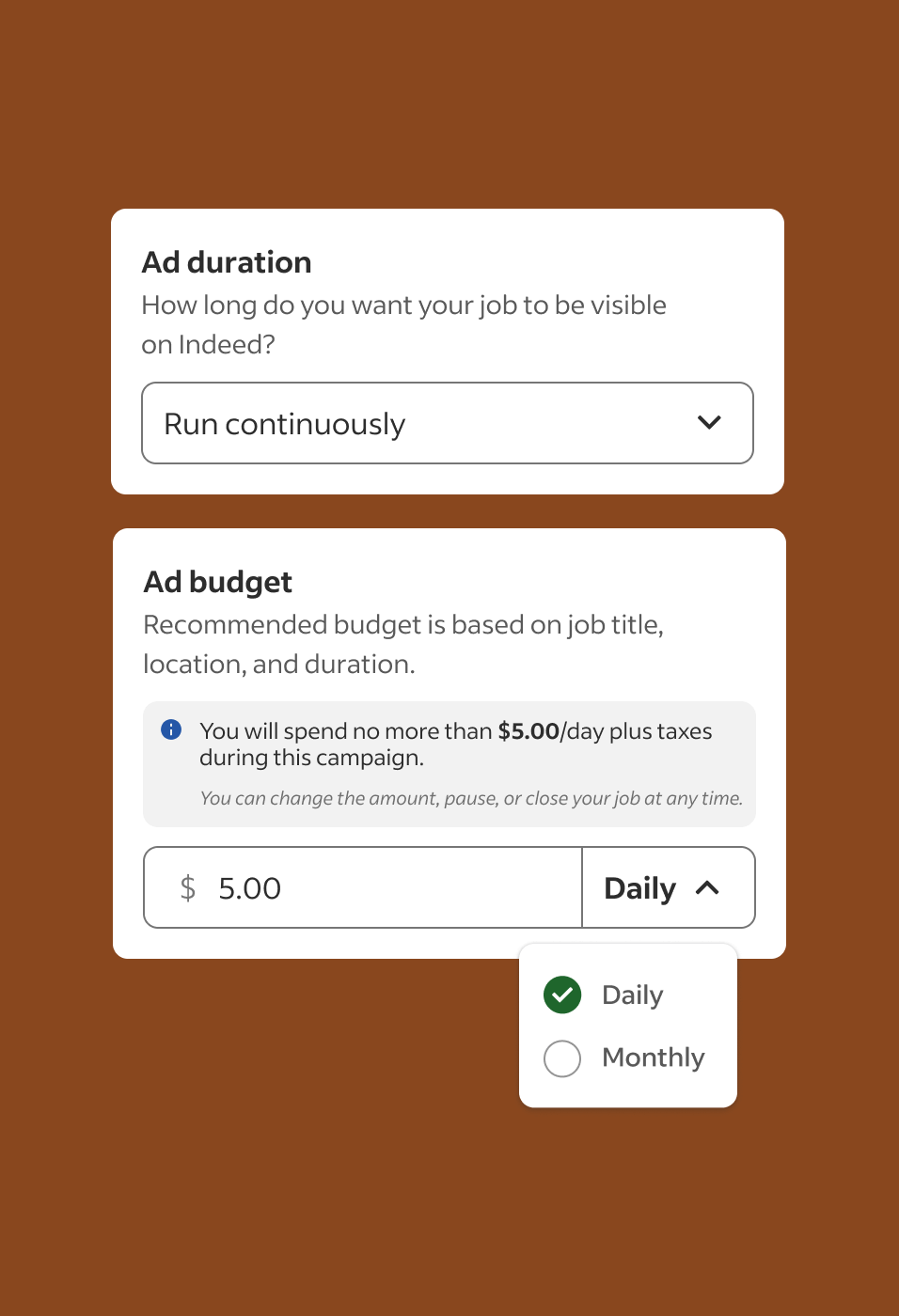
The screenshot is Indeed's own, and three details deserve attention. The default ad duration is "Run continuously," so a sponsored job keeps spending until you close it. The budget line promises you will spend "no more than $5.00/day plus taxes," which is the floor rather than a recommendation, because the page also says the recommended budget is "based on job title, location, and duration." And the small Daily or Monthly dropdown is the pricing model selector: Daily means pay per click, Monthly means pay per started application. An employer who wants to pay only when someone actually begins an application has to pick Monthly, and Indeed does not label it that way anywhere on the screen.
Premium Sponsored Jobs sit on top of Standard, and their price is set relative to it: Indeed says "the Premium price is set above the Standard price to help ensure more applications from quality candidates quickly" - Indeed.
What the higher price buys is advanced matching, location targeting, a stream of Matched Candidates with a daily contact limit, time-saving AI features, the Urgently hiring label, branded jobs, access to a tech network and SMS messaging. Indeed's performance claims for the tier are specific: Premium jobs appear in the top three results up to 2.0X more often than Standard and receive 95% more quality applications than non-Premium jobs - Indeed. Those are vendor figures, but they are at least published, dated and attributed, which is more than most of the category offers.
What the Premium tier adds: labels, targeted applications and AI-written outreach
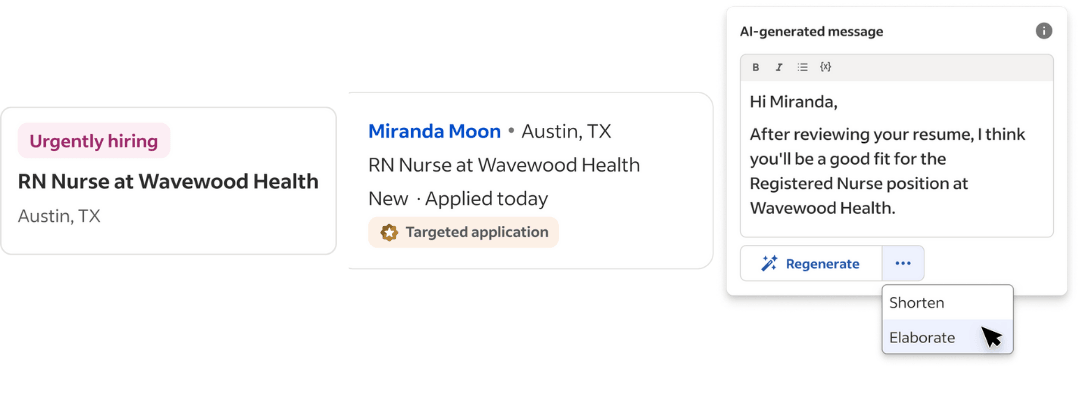
The three panels above are Indeed's own illustration of Premium: the Urgently hiring badge on the listing, a Targeted application marker on an applicant who matched the skills criteria, and an AI-generated message that a recruiter can shorten or elaborate before sending. Nothing in the image is a price, which is the point. Premium is sold on outcomes per job, and the per-job quote appears only once you are inside the sponsorship flow for a specific title in a specific city. Budget for it as a multiple of the Standard quote rather than as a fixed add-on.
It helps to know how Indeed arrived here, because the history explains today's structure. Indeed rolled out pay-per-application pricing in 2022 and 2023, then confirmed it would stop offering it from December 18, 2023, saying the model "required additional effort from employers and was not easy enough to support the different needs of employers" - SHRM.
The real reason was the bills. Employers used to spending hundreds of dollars received invoices in the thousands after missing the 72-hour window to reject unwanted applicants, and single-person HR teams could not police an inbox around the clock - HR Dive. The survivor of that experiment is the monthly-budget option, which bills per started application with no rejection window at all.
Above the self-serve products sits a sales-quoted layer. Indeed introduced Indeed Connect in September 2025 as a subscription bundling advanced screening, advanced sourcing, branding advantages and "preferential product pricing," with no published number - Indeed. Featured Employer placement likewise requires a minimum monthly spend tied to how many jobs you have on Indeed. Section 4 covers what those negotiated contracts actually come to, because the public pages will not tell you.
| Indeed product | Published price (US, 2026) | What the meter counts |
|---|---|---|
| Free job post | $0, up to 3 per calendar month, 30 days live | Nothing, but visibility decays |
| Standard Sponsored Job | From $5/day or $150/month per job | Clicks (daily budget) or started applications (monthly budget) |
| Premium Sponsored Job | Quoted per job, "set above the Standard price" | Same meters, plus daily Matched Candidate contacts |
| Smart Sourcing Professional | $520/month or $4,992/year per user | 100 contacts per month, extra contacts $5.20 each |
| Smart Sourcing Standard | Shown in-account only | Up to 70 additional contacts per month |
| Indeed Connect / Featured Employer | Sales quote, minimum monthly spend | Subscription plus sponsored budgets |
This is the point in the evaluation where price sensitivity peaks, so it is worth naming the honest budget alternative before going further.
Manatal
Indeed's floor is $150 per month per sponsored job, and the three free posts you get each month fall out of search within 30 days. If most of your roles are ordinary enough to attract applicants on their own, Manatal attacks the problem from the other side: for $15 per user per month billed annually (or $19 monthly) its ATS pushes every job to 35+ free job boards including Indeed, Google for Jobs and LinkedIn in one click, and tracks the applicants that come back. The honest caveats: free-board distribution only switches on after your first payment (not during the 14-day trial), free boards never guarantee to publish an organic job, and the $15 tier caps at 15 active jobs and 10,000 candidates, so a high-volume desk is really comparing against the $35 tier.
The reason that comparison is fair rather than a gimmick is that Indeed itself still accepts organic jobs from integrated systems. Indeed's single-source feed policy explicitly leaves alone "feeds from ATSs without an Indeed integration" and requires employers whose ATS is integrated to post through that integration - Indeed. Routing jobs through an ATS is the last remaining way to get repeatable free visibility on Indeed at all, which turns a cheap ATS from an administrative convenience into a pricing strategy.
3. Smart Sourcing, Sourcing Assistant and Talent Scout: The AI Upsell
The second half of Indeed's employer revenue is not advertising at all. It is the subscription that lets you search Indeed's profile database and contact people who never applied, and in 2026 its headline price is $520 per month or $4,992 per year for the Professional plan, which includes 100 contacts per month with a six-month rollover and unlimited additional contacts at $5.20 each - Indeed. A 14-day free trial is available to eligible employers. That is the only Smart Sourcing price Indeed publishes on its US pages in 2026, and it is the number to budget against.
A cheaper Standard tier still exists, but you will see its price for the first time inside your employer account. Indeed's help documentation confirms the tier's shape rather than its cost: Standard subscribers can buy up to 70 extra contacts per month, Professional subscribers can buy unlimited extras and shared contact pools, and all contacts expire six months after they are granted - Indeed.
Subscriptions are assigned per user, so a team of three recruiters who all need to message candidates is looking at three subscriptions, not one. Indeed's Canadian FAQ page still lists Standard at 30 contacts for $125 and Professional at 100 contacts for $250 in local currency with a 20% annual discount - Indeed Canada. Read those two pages side by side and you can see how far the US Professional list price has travelled.
What justifies the higher price, in Indeed's telling, is automation. On June 15, 2026 Indeed launched Sourcing Assistant, an AI feature inside Smart Sourcing that searches Indeed's 370 million sourceable profiles for related skills and recent activity, engages candidates and routes completed applications into your pipeline. Indeed reports that applicants it sourced were 2.9 times more likely to be hired, were hired six days faster on average and saved employers seven hours per week, based on US test data from 225 jobs and 17 beta employers between November 2025 and January 2026 - Indeed. It is available only on Professional and Enterprise subscriptions, US only for now.
Sourcing Assistant: three jobs at a time, on the Professional plan
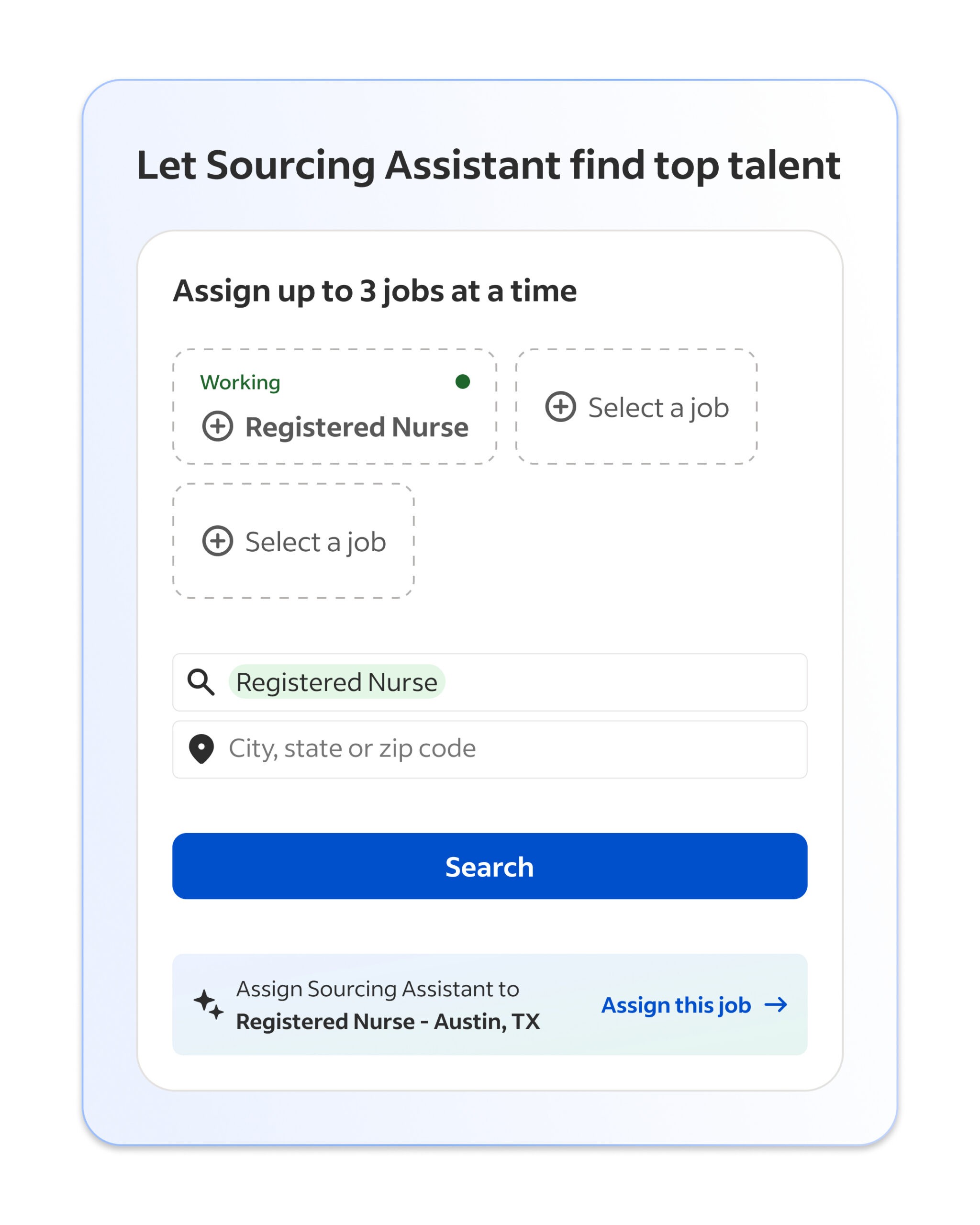
The constraint visible in the screenshot is the one that matters for cost: up to three jobs can be assigned to Sourcing Assistant at a time. A recruiter running fifteen open requisitions is not automating fifteen searches for $520, they are automating three and rotating. Combine that with the 100-contact monthly allowance and the product shapes itself around a specific buyer: a small team with a handful of hard-to-fill roles who wants Indeed's database worked continuously. For an agency desk that needs hundreds of contacts a month, the $5.20 overage is the real price, and it adds up faster than the subscription.
The layer above Sourcing Assistant is Talent Scout, launched at Indeed's FutureWorks event on September 10, 2025 as a conversational agent that reports on how a job is performing, benchmarks salary, surfaces matched candidates and drafts outreach, and plugs into isolved, Workable and Workday through a Chrome extension - Indeed. The same announcement claimed Premium Sponsored Jobs deliver 3x more applicants and 58% faster hiring than free postings, and that employers using multiple Indeed products together see reduced time-to-hire 75% of the time. Indeed's official session from that event is the clearest walkthrough of how the agent is meant to sit inside a recruiter's day.
Smart Recruiting Just Got Smarter with Indeed's Talent Scout (FutureWorks 2025)
The session is useful precisely because it is a product demonstration rather than a pricing page: you can watch what "insights" means in practice (impression and click comparisons against similar jobs, salary nudges, suggested title changes) and decide whether that is worth a Professional subscription for your team. What none of Indeed's AI announcements include is a price. Talent Scout, Indeed Connect and Advanced Screening are all sold through subscriptions and sales conversations, and the only firm number an employer can plan around is the $520 Professional seat. For a head-to-head view of how Indeed's agent compares with LinkedIn Hiring Assistant and Workable's agent, the LinkedIn vs Indeed vs Workable AI recruiter comparison goes deeper on autonomy and reach.
4. What Indeed Really Costs: Contract Data and Funnel Math
Published minimums tell you the floor. Contract data tells you the room. Vendr, which negotiates software purchases on behalf of buyers, puts the median Indeed contract at $15,000 per year across 72 deals, with a range of $9,000 to $46,620 and average savings of 18% off the initial quote, as of February 2026 - Vendr.
SpendHound's contributed contracts run higher: an average of $30,869 per year for companies with 50 to 1,000 employees and $104,546 for enterprises, with SMB spend up 35% year over year in data updated July 2026 - SpendHound. The two datasets sample different buyers, but they agree on the direction, and that 35% SMB increase lines up with Recruit's own 17% revenue-per-job disclosure.
For scale, compare the one job board that publishes an audited average. ZipRecruiter reported $1,669 of revenue per paid employer in the second quarter of 2026 across 70,721 paying employers, which works out to about $556 per month for its typical customer - ZipRecruiter. A $15,000 median Indeed contract is roughly $1,250 per month, so a mid-sized employer's Indeed relationship is about twice a typical ZipRecruiter bill, and enterprise buyers in SpendHound's sample are spending around $8,700 per month. Those are not small business numbers, and they are the numbers Indeed's minimums are designed to grow into.
To understand why a $150 minimum becomes a $15,000 contract, you have to look at the funnel Indeed bills against, and Indeed has helpfully drawn it. The Talent Scout illustration in its own launch materials shows a Registered Nurse job in San Jose with 5,911 impressions, 266 clicks, 39 started applications and 35 completed applications. It is a marketing image, not a benchmark, but it is Indeed's own picture of a normal job.
Indeed's own funnel: impressions to clicks to started applications
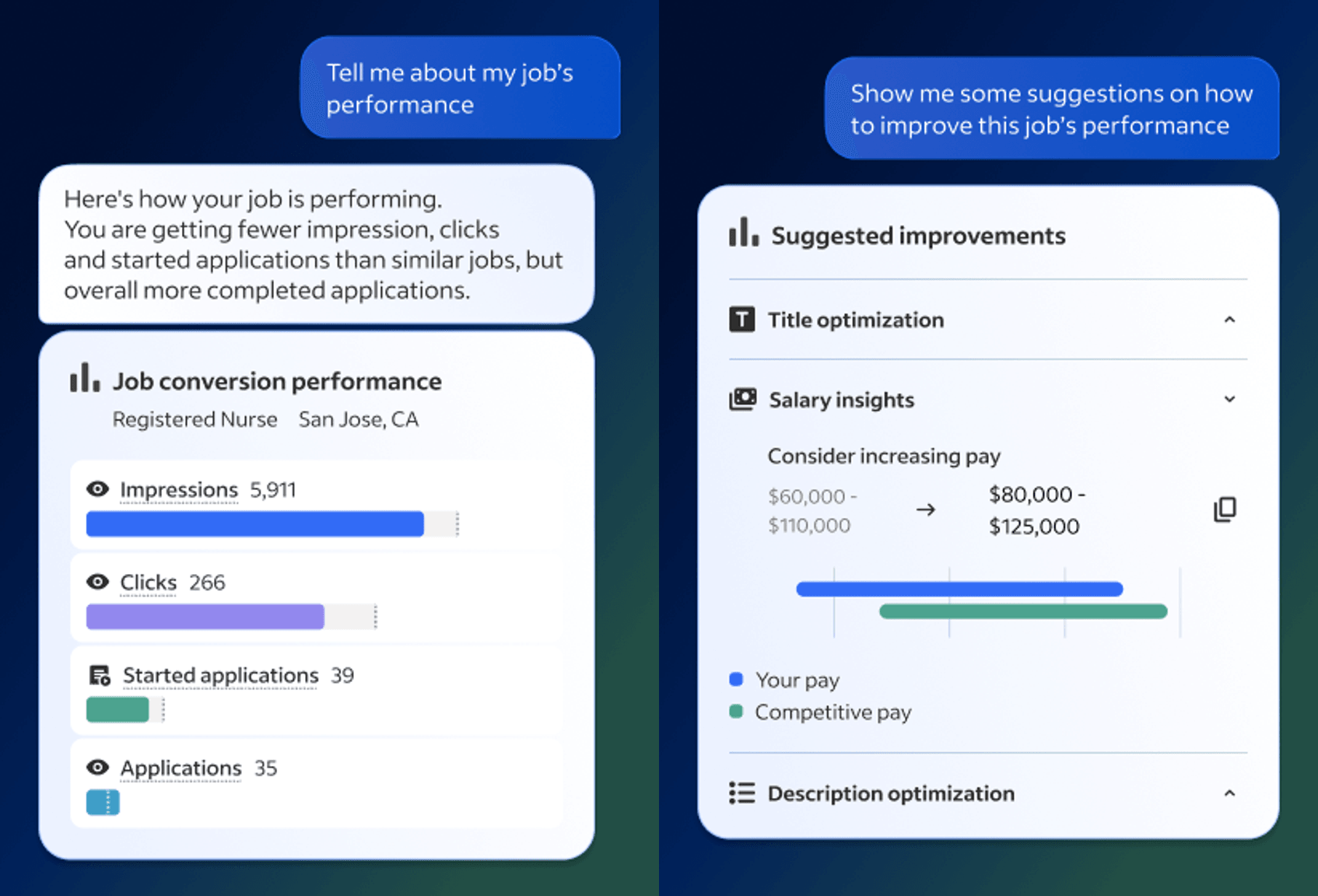
Read the numbers as billing events. Under a daily budget, Indeed charges for clicks, so that job generated 266 billable events. Under a monthly budget, Indeed charges for started applications, so the same job generated 39. Roughly one click in seven became a started application in Indeed's own example, which means the two meters are measuring very different things at very different rates, and the budget you set caps total spend either way. The toggle does not change how much you pay in a month; it changes what you are buying with it, and therefore how many actual candidates a given budget produces. Employers with a low click-to-apply rate (vague titles, no salary, long external application forms) are the ones who lose most under per-click billing.
Indeed also publishes the cheapest lever for improving that ratio, and it costs nothing. Jobs that include pay, address and Indeed Apply receive 42% more impressions and 57% more clicks than jobs without them - Indeed. Indeed Apply matters twice over: it lifts clicks, and because the application completes on Indeed, it lifts the share of clicks that become started applications, which is the event the monthly meter counts. Salary transparency and a native apply flow are worth more than an extra dollar a day of budget, and unlike the budget, they improve the free posts too.
The subscription side has its own multiplication. Because Smart Sourcing is assigned per user, a three-recruiter team on Professional is $1,560 per month at list, or $14,976 per year on annual billing. If that team burns through its 300 pooled contacts and buys 200 more, that is another $1,040 in a month at $5.20 each. Add two Premium Sponsored Jobs running continuously and a small team is at the Vendr median without ever speaking to sales. That arithmetic, not the $150 floor, is Indeed's real price for a company that hires every month, and it is the number to hold in mind when reading the alternatives in Section 6.
5. Where Indeed Wins and Where It Falls Short
Indeed wins wherever candidates come to you, and it wins convincingly. For hourly, frontline, healthcare support, logistics and retail roles, the combination of 685 million profiles, a native Indeed Apply flow and mobile-first search produces applicant volume that no other channel matches at the same speed - Indeed. Three free posts a month is a genuine gift for a small business with occasional hiring, Premium's targeting across 300+ occupations does help a clinic find licensed nurses rather than everyone who typed "nurse," and the ATS integrations mean a mid-market employer can keep organic visibility without touching Indeed's interface at all. When the Hiring Lab's August 2026 data shows loading and stocking postings up 11% and manufacturing up 8% in a year, those employers are Indeed's core, and they are well served.
The failure modes cluster around the same feature: Indeed controls visibility, and it has spent the last nine months making free visibility scarce. On December 11 and 17, 2025, Indeed capped free hosted jobs at three per employer per month and cut their organic window from 120 days to 30, with little advance notice to the small businesses affected - Job Board Doctor.
On March 31, 2026, jobs arriving through single-source XML feeds became "visible only when sponsored," with sponsored-only agency feeds due to disappear on June 30, 2026 and ATS feeds routed through ad-agency multisource feeds losing visibility on December 31, 2026 - Indeed.
Indeed's spokesperson framed the migration to ATS integrations as being "because they provide improved reliability, data quality, and consistency" - HR Dive. The reliability argument is not wrong, but it is incomplete. An ATS integration also gives Indeed a native Indeed Apply flow, which keeps the applicant on Indeed, feeds its matching data and makes the started-application meter countable. For the employer, the same change converts a feed they controlled into an integration Indeed controls, and it removes the one distribution method that let a careers site or an ad agency push jobs to Indeed for free without touching an ATS at all.
Even employers who post directly and keep to three free jobs are on notice. Asked about organic reach in June 2026, an Indeed spokesperson said: "Organic visibility will not be completely removed, but organic visibility for free jobs is not guaranteed nor will it be consistent over time, particularly in competitive roles or locations" - ERE. That is as clear as a marketplace ever gets about its intentions. Free is a trial, sponsored is the product, and the roles where free stops working first are exactly the competitive roles where you most need it to.
The second structural weakness is the incentive built into the meter. Under per-click billing Indeed is paid when someone looks, not when someone suitable applies, and under per-started-application billing it is paid when someone begins a form, not when they finish it or turn out to be qualified. Julie Sowash's critique of the December changes argues that Indeed is managing its average revenue per job, a figure it reports to investors, by restricting free content rather than fixing moderation of the roughly 1.5 million free hosted jobs she says are posted daily - Job Board Doctor. Whether or not you accept the motive, the pay-per-application collapse of 2023 already demonstrated what happens when Indeed's meter and an employer's inbox disagree: the employer paid.
The third gap is the one Indeed's own Sourcing Assistant announcement concedes. Its survey found 71% of hiring managers say higher application volume has made finding qualified candidates harder and 93% say they have lost top talent because hiring took too long - Indeed. Volume is Indeed's product, and volume is the problem for professional, senior and niche roles where the right person is employed, not searching, and never registers a profile. Smart Sourcing reaches the 370 million people who did. For the engineer, controller or regional sales lead who did not, employers turn to LinkedIn, to referrals, or to outbound AI sourcing platforms such as HeroHunt.ai that search across the open web rather than one site's registered users.
Before moving to the alternatives, it is worth being precise about who should not leave Indeed. The signals that Indeed is the right primary channel are consistent:
- High-volume hourly hiring where applicant flow, not quality screening, is the bottleneck
- Local, licensed roles (nursing, trades, drivers) where Premium's occupation targeting pays for itself
- Occasional hiring that fits inside three free posts a month
- An integrated ATS already routing jobs organically, which keeps free visibility alive
If most of those describe you, the sections above are a guide to paying Indeed less, not to leaving, and the cheapest improvements are the ones Indeed itself documents: public pay, a real address and a native apply flow, which convert clicks into started applications at a rate no extra budget can buy. If few of them describe you, the money you are spending on clicks is being spent on the wrong population. The alternatives below are ranked on how well they fix that specific mismatch, not on whether they happen to cost less than $150 a month, because a cheap channel that reaches the wrong people is still the most expensive way to hire.
One more distinction matters before comparing vendors. Indeed's weaknesses are almost all about who it reaches rather than what it charges, so an employer whose candidates genuinely live on Indeed should treat the alternatives as cost controls and supplements, while an employer whose candidates do not should treat them as replacements. The same $15,000 contract is a bargain for a regional home-care provider filling forty aide roles a year and a waste for a software company filling four senior engineering roles, and no amount of budget tuning changes which of those two you are.
6. The 6 Best Indeed Alternatives in 2026
The field of alternatives shrank in 2025 and the survivors are more different from each other than they used to be. Monster and CareerBuilder, which merged in 2024, filed for Chapter 11 bankruptcy in June 2025 and put their job boards up for sale, having "fallen out of favor" with job hunters against Indeed, Glassdoor and LinkedIn - CNN. Glassdoor, as Section 1 covered, is now legally part of Indeed. What remains is a set of channels with genuinely different meters: pay per click on a professional network, a reusable slot, free structured-data distribution, a cheap ATS that multiposts, a startup marketplace and autonomous outbound sourcing.
That diversity is the reason to read the list by meter rather than by brand. Indeed's problem for most employers is not that it is expensive in absolute terms; a $150 sponsored job is cheap next to a recruiter's day rate. The problem is that its meter charges for attention from a population that may not contain the person you need. Each alternative below is included because it changes either the population or the meter, and each entry says which.
6.1 LinkedIn Jobs: Pay Per Click on a Professional Network
LinkedIn's job posting product is the closest structural match to Indeed's, and its rules are published in more detail. You can run one free job post at a time, promoted posts use a daily or total budget billed per click, and LinkedIn's own worked example is that a $10 daily budget over 30 days "will be $300 or less," with your card charged within 48 hours of closing the job, at the 30-day mark, or when the balance reaches $500 - LinkedIn. The cost per click "comes from an algorithm that determines where your job is located and how many competing, similarly titled posts have been created," which is the same auction logic Indeed uses, applied to a population of professionals rather than active job seekers.
The population is the difference and the reason to pay. A promoted LinkedIn post reaches people who are employed and not searching but who see the post in their feed, which is exactly the group Indeed's model under-serves. The trade-off is volume: for hourly and frontline roles LinkedIn produces a fraction of Indeed's applicant flow at a similar per-click cost, and for consistent hirers the Job Slots contract is a negotiated annual commitment rather than a self-serve price. The LinkedIn job posting cost guide covers the slot model and the charge timing in detail.
Best for: professional and knowledge roles where the candidate is employed, and employers who already run LinkedIn Recruiter and want jobs in the same system.
6.2 ZipRecruiter: The Slot Model With an Audited Average
ZipRecruiter is the one job-advertising vendor whose typical bill is a matter of public record. Its second-quarter 2026 shareholder letter reports $1,669 of revenue per paid employer for the quarter across 70,721 paying employers, and a new search and matching engine that lifted qualified application volume 34% quarter over quarter - ZipRecruiter.
That is about $556 per month for the average customer. Reported plan quotes put a Standard slot between $299 and $399 a month, Premium at roughly $419 to $519 and Pro at $719 to $999, with the TrafficBoost add-on charged separately on lower tiers - ZipRecruiter pricing guide.
The meter is what makes ZipRecruiter different from Indeed. A slot is a reusable container: you can swap roles through it and it bills whether or not anyone applies, which means costs are predictable but never zero. For an employer running two or three roles continuously that predictability is worth something; for an employer who hires twice a year it is a subscription for nothing. ZipRecruiter also distributes each posting across a network of partner boards, so the reach per slot is broader than a single-site sponsored job, though the applicants skew to the same active-searcher population as Indeed.
Best for: small and mid-sized employers with a steady stream of two to five open roles who prefer a fixed monthly bill to an auction.
6.3 Google for Jobs and Free Structured-Data Distribution
The cheapest alternative to paying Indeed for visibility is to publish the job where Google can index it directly. Google's job search experience pulls listings from any careers page that marks up its postings with the JobPosting structured-data schema, at no cost, and the requirements are documented publicly for any web developer to implement - Google. Most modern ATS career pages emit that markup automatically, which is why an employer with an ATS often finds their roles in Google's job panel without doing anything.
The limitation is that free distribution is passive. Google for Jobs surfaces a listing to someone who searches for it, and it cannot push a posting into a feed or an email alert the way a sponsored job can. It also does not solve applicant tracking on its own. That is why the practical version of this alternative is an ATS with free multiposting: Manatal's support documentation lists 35+ free boards it publishes to, including Google for Jobs, Indeed, LinkedIn, Adzuna, Jooble and Talent.com, while warning that free boards "do not have the obligation to post organic jobs" and typically take 24 to 48 hours - Manatal. Free reach is real, but it is best-effort by design.
Best for: employers with a careers page and ordinary roles, as the zero-cost baseline every paid channel should be measured against.
6.4 Manatal: The $15 ATS That Multiposts
Manatal earns a place on this list because it is the cheapest published way to keep jobs flowing to Indeed organically after the 2026 feed changes. Its entry plan is $15 per user per month billed annually (or $19 monthly), capped at 15 active jobs and 10,000 candidates, with a $35 tier removing those caps and a $55 tier adding API access and SSO, all on a 14-day trial with no card required - Manatal. Because Indeed's single-source feed policy still honours integrated ATS postings, routing jobs through an ATS is now one of the few ways to earn organic Indeed visibility repeatably rather than three posts at a time.
The honest limits are the same ones its own documentation states. Free job-board distribution activates only after the first payment, not during the trial, and free boards can decline to publish an organic listing. Manatal is also an ATS with AI candidate recommendations, not a sourcing engine: it tracks the people who apply and helps you search LinkedIn profiles through an extension, but it will not find the passive engineer who never applied anywhere. For a company whose problem is cost per applicant on ordinary roles, that is the right tool. For a company whose problem is that nobody suitable applies, it is not.
Best for: small teams and agencies that want applicant tracking plus free distribution to Indeed, Google for Jobs and LinkedIn for less than the price of one sponsored job.
6.5 Wellfound: Free Posts for Startups, Paid Reach on Top
Wellfound (the former AngelList Talent) publishes a full price list, which is rare in this category. Job posts are free forever with unlimited jobs and applicant management, boosted Job Ads start at $200 per ad for top-of-search placement, and its Wellfound Reach sourcing product runs Free, $135 and $199 per seat per month with 20, 250 and 1,000 contact reveals respectively, while the Autopilot service charges $500 per month per role plus a 10% placement fee on a hire - Wellfound. Every listing also broadcasts across Wellfound's search, candidate email alerts and weekly newsletter.
The population is the constraint and the attraction. Wellfound's candidates are people who opted into startup work, heavily weighted to engineering, product, design and go-to-market roles at early-stage companies, and its marketplace is small next to Indeed's 685 million profiles. A hospital or a logistics operator has no business here. A seed-stage software company hiring its first five engineers, on the other hand, will find Wellfound's free tier delivers more relevant applicants than a sponsored Indeed post, and its $200 Job Ad is a fixed fee rather than an auction.
Best for: startups hiring technical and product talent, particularly those who want a published fixed price instead of a click meter.
6.6 HeroHunt.ai: Outbound AI Sourcing Instead of Waiting for Applicants
HeroHunt.ai belongs on this list for the roles where Indeed's model breaks: the ones where the right candidate is employed, not searching, and never registers on a job site. Instead of advertising a job and billing per click, its AI Recruiter searches across 750 million to 1 billion profiles on the open web, screens candidates against the role automatically and runs personalised outreach on autopilot, so the meter is a monthly allowance of AI-screened and matched profiles delivered and candidate emails found, with unlimited positions, rather than clicks or applications. Published pricing is $99 per month for Starter (1 user, 2,000 AI-screened and matched profiles and 500 candidate emails a month, searching 750 million profiles), $199 for Pro (5,000 AI-screened and matched profiles and 1,000 emails, searching 1 billion profiles, premium screening models, integrations) and $399 for Team (3 users sharing 25,000 profiles and 4,000 emails), each with unlimited positions and an 8-day free trial - HeroHunt.ai pricing.
The comparison with Indeed Smart Sourcing is the instructive one. Both are subscriptions for finding people who did not apply; Indeed's Professional seat is $520 for 100 contacts inside Indeed's own registered database, while HeroHunt.ai's Starter is $99 for 2,000 AI-screened and matched profiles and 500 candidate emails a month, across unlimited positions and profiles that were never inside any job board. The trade-offs run the other way for volume roles: HeroHunt.ai will not generate 35 applications for a San Jose nurse job by Friday, because outbound sourcing is built for scarce talent, not applicant flow. Teams that want to test it can start on HeroHunt.ai without talking to sales.
Best for: recruiters filling professional, technical and senior roles where applicants do not arrive on their own, and who want sourcing plus outreach automated for a flat monthly price.
7. Full Comparison and How to Choose
The most useful way to compare these channels is by their meter, because the meter determines whether a quiet month costs you nothing or a full subscription. Indeed's Sponsored Jobs and LinkedIn's promoted posts are auctions that spend what you allow. ZipRecruiter, Smart Sourcing, Wellfound Reach, Manatal and HeroHunt.ai are subscriptions that cost the same whether you hire or not, but each counts a different unit: a slot, a contact, a reveal, a user, an AI-screened and matched profile. Free distribution costs nothing and promises nothing.
The table below puts every published or audited figure from this guide side by side. Where a vendor publishes no number, the cell says so rather than guessing, which is the only honest way to compare a category where two of the largest players quote per job or per contract.
| Platform | Entry price | Meter | Price public? | Population reached |
|---|---|---|---|---|
| Indeed Sponsored Jobs | From $5/day or $150/month per job | Clicks or started applications | Minimums only | 685M active job seeker profiles |
| Indeed Smart Sourcing | $520/month per user (Professional) | 100 contacts per month | Professional only | 370M sourceable profiles |
| LinkedIn promoted post | Set your budget (e.g. $10/day) | Clicks | Mechanics only | Employed professionals |
| ZipRecruiter | Avg $1,669 per quarter per paid employer | Reusable job slot | Audited average | Active seekers plus partner boards |
| Google for Jobs | $0 | None | Free | Google searchers |
| Manatal | $15/user/month annual | Users, 15 active jobs on entry tier | Yes | Applicants via 35+ free boards |
| Wellfound | Free posts, Job Ads from $200 | Ads, reveals or roles | Yes | Startup talent |
| HeroHunt.ai | $99/month Starter | AI-screened and matched profiles + emails per month | Yes | 750M to 1B open-web profiles |
The chart that follows plots the monthly entry cost of each option using only the figures above: Indeed's published minimum, its Professional seat, LinkedIn's own $10-a-day example, ZipRecruiter's audited quarterly average divided by three, Wellfound's Job Ad fee, Manatal's annual rate and HeroHunt.ai's Starter plan.
Monthly entry cost by platform, published or audited figures (USD)
Two things stand out. First, Indeed's $150 minimum is genuinely competitive as an entry point; the expense comes from running several sponsored jobs continuously and stacking a $520 seat on top, which is how the Vendr median reaches $15,000. Second, the three cheapest bars are not job boards at all. An ATS with free distribution, an outbound sourcing platform and free structured data attack the cost from different directions, and the right combination for most employers is one of those plus Indeed for the roles where Indeed's volume is unbeatable, rather than any single channel.
Which combination depends on what you are hiring for, and the decision tree below is the version of this guide that fits on one screen.
Follow the left branch and the answer is to stay on Indeed but pay less: publish pay and an address, use Indeed Apply, route jobs through an integrated ATS so the free visibility survives, and sponsor only the roles that stall. Follow the middle branch and LinkedIn's per-click meter on an employed population usually beats Indeed's on an active one, with free structured data underneath. Follow the right branch and the question is no longer which board to advertise on, because the candidate is not reading boards; it is whether Indeed's 370 million registered profiles or the open web is the better place to search, and at $520 against $99 the answer depends on whether your candidates ever built an Indeed profile at all.
8. The Bottom Line
Indeed pricing in 2026 comes down to four facts. Sponsored Jobs start at $5 per day or $150 per month and bill per click on daily budgets or per started application on monthly budgets. Free posts are capped at three a month, live 30 days, and Indeed itself says their visibility is "not guaranteed." Smart Sourcing Professional is $520 per month per user for 100 contacts. And the typical negotiated contract is around $15,000 a year, with SMB spend rising about a third year over year as Indeed converts free visibility into paid. Everything else on the pricing page is a mechanism for turning the first number into the last one.
The decision framework is short. If your roles attract applicants on their own, Indeed is the right channel and your job is to make it cheaper: publish pay, use Indeed Apply, post through an integrated ATS, choose the monthly budget so you pay for started applications rather than looks, and sponsor selectively. If your roles attract the wrong applicants, move the same budget to a population that fits, which usually means LinkedIn for professionals and Wellfound for startup roles. If your roles attract nobody suitable because the right people are employed, stop buying attention altogether and buy search: Indeed Smart Sourcing if your candidates live on Indeed, or an outbound AI recruiter like HeroHunt.ai if they live on the open web.
For the many employers whose real problem is simply that three free posts and a $150 minimum per job add up, the cheapest fix is the least glamorous one.
Indeed still gives organic visibility to jobs posted through an integrated ATS, which is why a $15 per user per month Manatal plan that multiposts to 35+ free boards including Indeed can cost less than a single sponsored job. Just remember that free distribution starts after your first payment, not on the trial, and that the entry tier stops at 15 active jobs.
Whatever you choose, re-read Indeed's own pricing page before you renew. The meter moved in December 2023, December 2025 and March 2026, Recruit has told investors that monetization is progressing faster than it expected, and the next change will not be announced in a blog post you are likely to read.
This guide reflects Indeed's published employer pricing, Recruit Holdings' disclosures and vendor price lists as of September 2026. Job advertising prices are set by auction and change by role and location, and subscription prices change frequently, so verify current figures on each vendor's own site before purchasing.