


The recruiter's field guide to sourcing, screening, and closing the engineers who build autonomous AI agents.
By early 2026, "AI Engineer" had become the single fastest-growing job title in the United States, with four of the five fastest-rising roles all tied to AI - LinkedIn News. Inside that surge sits a narrower, hotter specialty that most job descriptions still fumble to name: the AI Agent Engineer, the person who builds software that runs in a loop, calls tools, and takes real actions with little human supervision. Gartner projects that 40% of enterprise applications will ship task-specific AI agents by the end of 2026, up from less than 5% a year earlier - Gartner. Every one of those agents needs someone to build it, and that someone is in brutally short supply.
Here is the problem for a recruiter: this is not a generic machine-learning hire, and the standard sourcing playbook misfires on them. The best agent builders often do not carry a tidy "AI Agent Engineer" title, do not maintain a polished LinkedIn, and cannot be found by Boolean-matching a job title that barely existed eighteen months ago. Their real work lives in a GitHub repository, a published MCP server, or a weekend hackathon submission, not in a resume keyword. Meanwhile the loudest candidates, the ones who list every framework and describe every project as "cutting-edge," are frequently the weakest, because the skills that matter here (evaluation, observability, cost control, guardrails) are invisible to a keyword scan and easy to fake in an interview.
This guide is written for the recruiter or talent leader who has to fill these roles without being an engineer. It starts from first principles, explaining precisely what an AI Agent Engineer is and how the role differs from the adjacent titles people confuse it with. Then it moves through the market and the money, the technical stack you need to recognize (not master), the signals that separate a real builder from a keyword faker, where these people actually gather online, how to reach them, how to screen them when you cannot read code, and which tools (from Juicebox to CodeSignal to AI recruiters like HeroHunt.ai) genuinely help. The goal is that a reader who stops after any single section still walks away able to run a better process than most teams competing for the same people.
Contents
- What an AI Agent Engineer Actually Is (and Is Not)
- Why This Is the Hardest Hire of 2026
- What They Actually Build: The Agentic Stack You Need to Recognize
- Reading the Resume: Real Builder vs Keyword Faker
- What It Costs: Compensation Benchmarks for 2026
- Where to Find Them: Sourcing Channels That Actually Work
- Outreach That Lands With Engineers Who Have Options
- Screening Without Being Technical
- Designing the Interview Loop (and the Failure Modes to Avoid)
- The Tooling: Sourcing Platforms, Assessments, and AI Recruiters
- How AI Agents Are Changing Recruiting Itself
- The Future Outlook and Your Hiring Playbook
1. What an AI Agent Engineer Actually Is (and Is Not)
An AI Agent Engineer builds autonomous software systems that use a large language model as a reasoning core, then wrap it in the machinery that lets it act: tools, memory, orchestration, evaluation, and guardrails. The single most useful mental model for a non-technical recruiter is this: they do not build the model, and they usually do not train it either. They build the system around the model. A regular chatbot answers a question in one shot. An agent takes a goal, breaks it into steps, calls external tools to get things done, checks its own progress, and keeps looping until the task is finished or a stopping condition is hit. That loop, and everything that makes it reliable, is the job.
This matters because the market is drowning in adjacent titles that sound identical and are not. The cleanest way to hold the distinctions is by what each role ships. A Machine Learning Engineer trains and deploys custom models on a company's own data, owning data pipelines, feature engineering, and model lifecycle; the work is math-heavy and rarely involves building agents at all. An AI Engineer builds products on top of existing foundation models from providers like Anthropic, OpenAI, or Google, and the 2026 consensus is that this discipline is now "more software engineering than data science." An AI Agent Engineer is a specialization inside AI engineering, focused specifically on agentic systems: multi-step autonomous loops, tool use, multi-agent orchestration, and, critically, the evals, observability, and guardrails that make a non-deterministic system safe to ship. The old Prompt Engineer title, meanwhile, is fading into a sub-skill, because writing one clever prompt has been subsumed by the broader discipline Anthropic now calls context engineering - Anthropic.
The distinction that will save you the most wasted interview hours is deterministic versus non-deterministic. A traditional software engineer builds systems where the same input always produces the same output; you can test them with fixed assertions. An agent engineer works with systems where the same input can produce different outputs, because a language model sits in the middle. That single fact reorganizes the entire job. Evaluation stops being an afterthought and becomes a first-class discipline. Observability (the ability to trace exactly what an agent did and why) becomes mandatory rather than nice-to-have. A strong software engineer who has genuinely learned this agentic stack is one of the most common and valid paths into the role, so do not screen out someone just because their last title said "Backend Engineer."
The following diagram shows the atomic unit these engineers work with, taken from Anthropic's widely-cited engineering guide on the subject. It illustrates why "takes actions in a loop" is the defining property, and why a static workflow is not the same thing as a true agent.
The agent loop: reason, act, observe, repeat
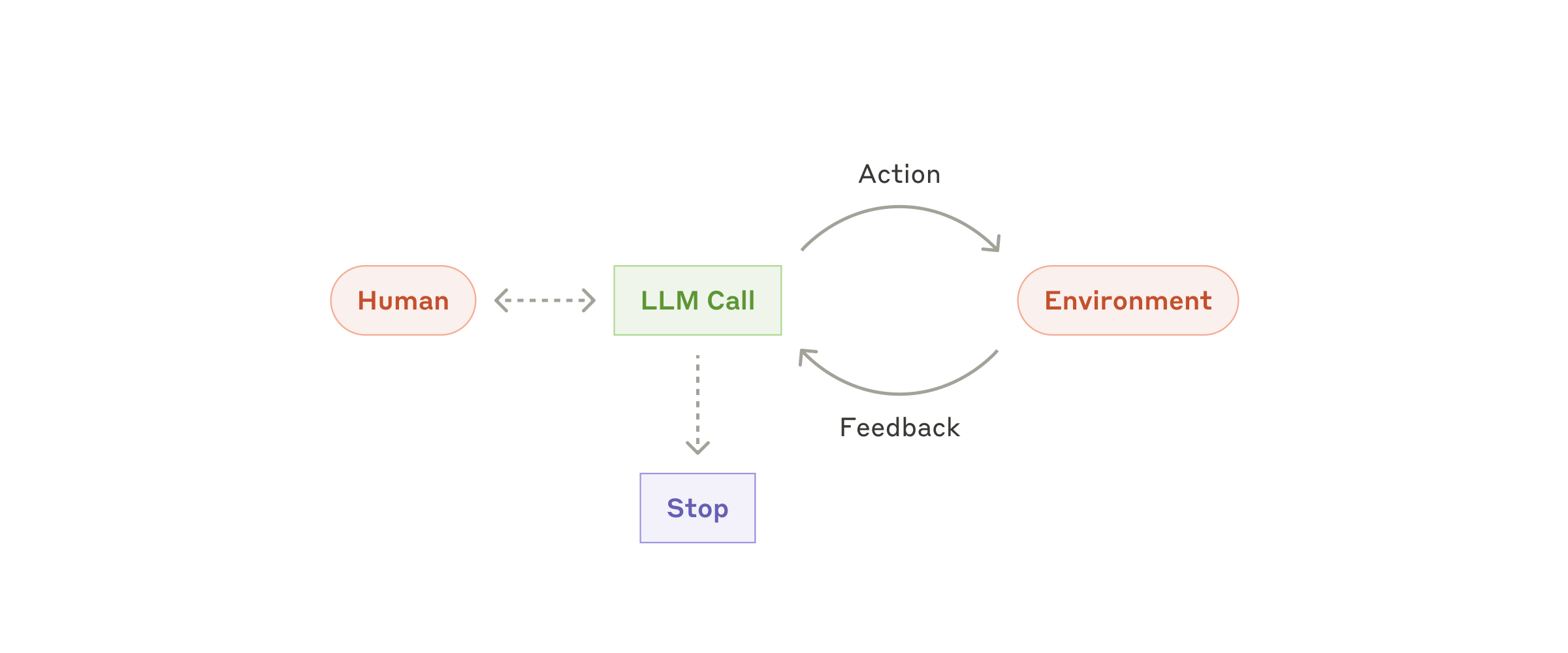
Notice what the diagram foregrounds: the agent does not run once, it runs in a feedback loop, taking an action, reading the result from its environment, and deciding what to do next until it decides the job is done. That loop is exactly what a candidate must be able to build, debug, and make reliable. When you are interviewing, the fastest way to separate a real agent engineer from someone who has only made single API calls is to ask what happens when a tool call fails on step four of a ten-step task. A builder will talk about retries, state, budgets, and stopping conditions. A pretender will talk about prompts.
It helps to picture the day-to-day work, because it is unlike what most people imagine an "AI job" to be. A typical loop looks like this: the engineer defines the tools and their input schemas, builds the agent's control flow, runs it against a set of evaluation cases, then reads the resulting traces in a tool like LangSmith or Langfuse to see exactly where the agent went wrong. They tune the context, the prompts, or the tool definitions, add a guardrail where the agent did something unsafe, optimize cost and latency by routing cheaper subtasks to cheaper models, and only then ship behind an evaluation gate before monitoring it in production. The word that shows up on nearly every serious job description for this reason is iteration, because the work is a tight, repeated cycle of build, measure, and refine rather than a single grand design. A candidate who describes their process in these terms, tracing failures and gating releases on evals, is describing the actual job; one who describes it as "writing prompts until it works" is not.
The practical takeaway for how you apply this: before you write a single sourcing query, get your hiring manager to tell you which of these roles they actually need, because "we need an AI person" is where most of these searches go wrong. If the team wants to fine-tune a proprietary model on internal data, you want an ML engineer. If they want to wire a language model into an existing product, an AI engineer will do. If they want a system that autonomously books meetings, resolves support tickets, or runs research end to end, you want an agent engineer, and the rest of this guide is about finding that specific person.
2. Why This Is the Hardest Hire of 2026
The headline reason this hire is so hard is that demand exploded faster than any talent pool could grow. AI Engineer ranked number one on LinkedIn's 2026 Jobs on the Rise list for the United States, and the roles that fill out the top of that list (AI consultant, data annotator, AI researcher) are all downstream of the same agent boom - Forbes. Deloitte's technology predictions estimated that a quarter of enterprises already using generative AI would deploy agents in 2025, rising to half of them by 2027 - Deloitte Global. When adoption doubles in two years and the supply of people who can actually build production agents grows slowly, the market tightens into exactly the kind of seller's market recruiters dread.
The supply side is genuinely thin, and it is being drained from two directions at once. McKinsey's research found that the number of workers in occupations requiring real AI fluency jumped from roughly one million in 2023 to about seven million by 2025, which sounds like abundance until you realize how few of those people have shipped an autonomous agent to production as opposed to prompting a chatbot - Iternal AI. At the same time, the frontier labs and a wave of well-funded startups are hoovering up the most capable builders, and a parallel gig economy (covered later in this guide) is paying elite engineers to do evaluation and reinforcement-learning work for the model makers themselves. The result is that recruiters consistently describe AI-engineering roles as drawing far fewer qualified applicants per posting than an equivalent senior software role, with senior specialist searches stretching to 60 to 120 days while top candidates accept competing offers within two to three weeks - Syndesus.
Geography concentrates the pain further. The San Francisco Bay Area is overwhelmingly dominant, and a 2026 talent map found that the Bay Area, Seattle, Boston, and Austin together account for 52% of United States AI and ML job openings, with Silicon Valley running at more than six times the national average for AI-role density - KORE1. Commercial real estate analysts at CBRE describe the Bay Area's AI-skilled talent as fueling the next tech growth cycle, which is good for the region and painful for everyone trying to hire out of it - CBRE. New York, Seattle, Austin, and Dallas form a second tier, and London leads the non-United States hubs, though at materially lower pay, which turns relocation and remote-from-the-States offers into a real competitive lever for European talent.
There is also a structural shift under the market that changes who you are even looking for. Stanford's 2026 AI Index reported that employment for early-career software developers aged 22 to 25 has fallen by roughly a fifth since 2024, even as demand for specialized AI builders climbs - Stanford HAI. The chart below captures that decline, and it should reframe how you think about the pipeline.
Early-career developer employment is shrinking
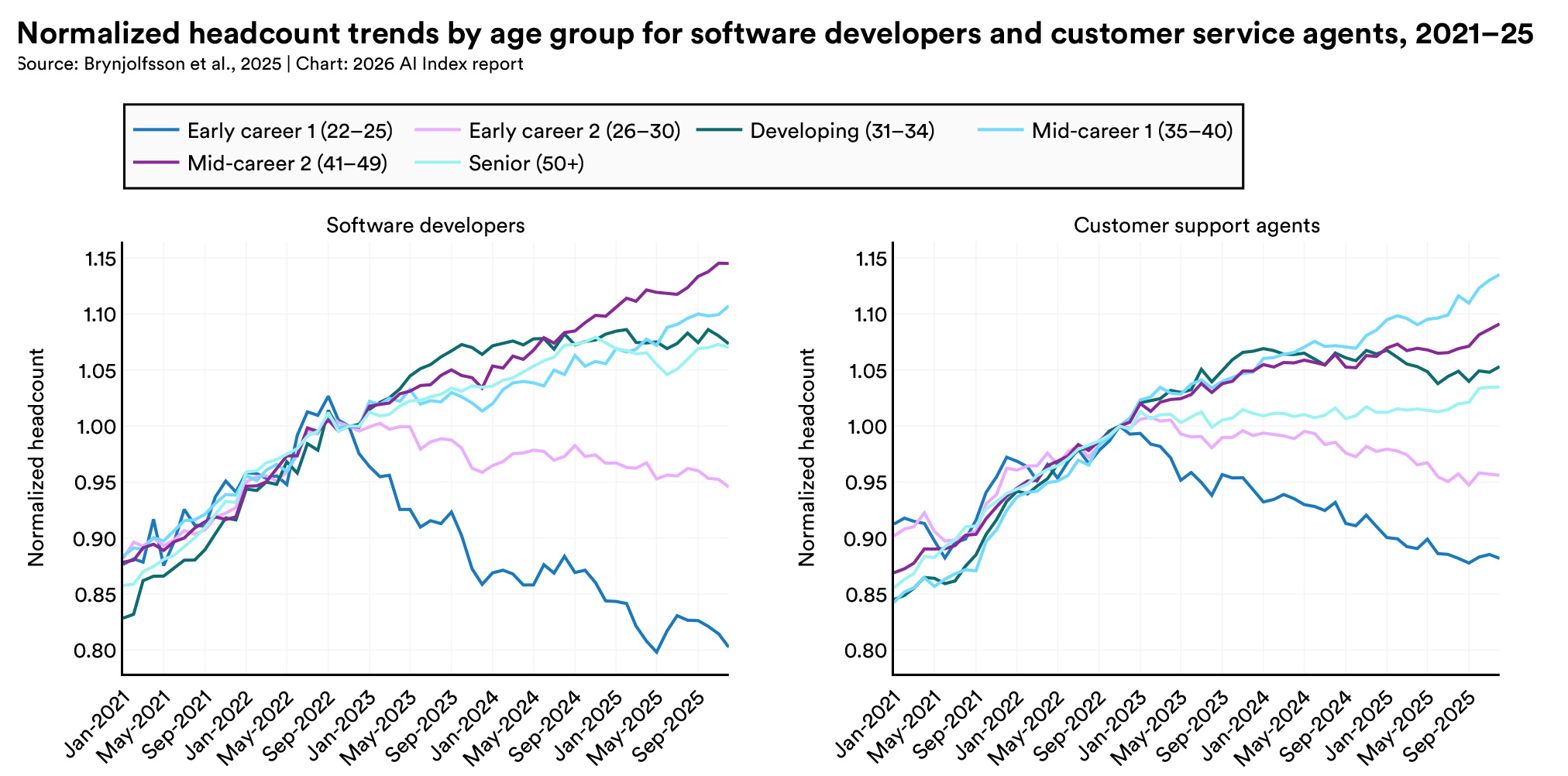
The message in that decline is not that engineering is dying; it is that the generalist entry-level tier is contracting while the specialized, agent-building tier commands a premium. For a recruiter, that means the old strategy of hiring cheap junior developers and training them up is weakening at exactly the moment the specialized role you need is scarcest and most expensive. The strategic response, developed across the rest of this guide, is to get much sharper at identifying genuine agent-building signal early, to move faster than competitors who still run three-week scheduling gaps, and to widen your search beyond the LinkedIn-tidy candidates into the open-source communities where the real builders congregate.
3. What They Actually Build: The Agentic Stack You Need to Recognize
You do not need to write code to hire an agent engineer, but you do need to recognize the vocabulary of what they build, because that vocabulary is your best filter. The good news is that the modern agentic stack has consolidated into a recognizable set of layers, and a candidate who has genuinely shipped agents will reference the specific tools in each layer with real detail. The diagram below is a map of the moving parts behind a single autonomous agent, and it doubles as a checklist you can hold a job description against.
The first layer to recognize is orchestration, the framework that runs the agent's loop and manages its state. The market has settled around a handful of names, and knowing them lets you read a resume at a glance. LangGraph, from the team behind LangChain, is the 2026 default for stateful production agents, favored in enterprise and regulated settings for its checkpointing, human-in-the-loop controls, and audit trails; the broader LangChain library sits at roughly 134,000 GitHub stars and is where most people prototype - LangChain. CrewAI is the fastest route from idea to a multi-agent prototype, OpenAI's Agents SDK is the production-grade choice for teams built around GPT models, Google's Agent Development Kit targets teams on Google Cloud, and Microsoft consolidated its AutoGen and Semantic Kernel efforts into a single Agent Framework that reached general availability in April 2026. Anthropic's Claude Agent SDK, launched in September 2025, ships the same agent loop that powers Claude Code, with built-in tools, subagents, and persistent sessions - Anthropic.
The chart below shows the relative popularity of the leading frameworks by GitHub stars in mid-2026. Treat it as directional rather than precise, since star counts drift weekly, but the ordering tells you which names should feel familiar when they appear on a resume.
Agent Framework Popularity (GitHub stars, mid-2026)
A subtle but important point hides in that chart: stars measure attention, not usage. LangGraph, the production workhorse, actually carries fewer stars than some flashier projects while reportedly serving tens of millions of monthly downloads, far more than higher-starred rivals. So when a candidate says they used LangGraph or the Claude Agent SDK to ship something that real users depend on, weight the production claim over any star-count trivia. The framework name is a starting signal; what they built with it, and whether it survived contact with real traffic, is the real one.
The second layer worth knowing is the Model Context Protocol, or MCP, which is the single most important protocol to recognize in 2026. Think of it as USB-C for AI tools: instead of building a bespoke integration for every data source an agent needs, MCP gives one standard connector. Anthropic introduced it in late 2024 and donated it to a newly formed, Linux-Foundation-backed Agentic AI Foundation in December 2025, by which point it had reached more than 97 million monthly SDK downloads and over 10,000 active servers - Model Context Protocol. The reason this matters for hiring is blunt: the top blocker for enterprise AI has been integration complexity, not model quality, so a candidate fluent in MCP can wire an agent into a company's existing systems fast. A sibling standard, Google's Agent2Agent (A2A) protocol, handles agent-to-agent communication and passed 150 supporting organizations in its first year - Linux Foundation. Recognize MCP as agent-to-tool and A2A as agent-to-agent, and you already speak more of the language than most recruiters in this market.
The augmented language model at the center of all this is worth seeing directly, because it visually defines the core competencies you are screening for. The diagram below, again from Anthropic's engineering team, shows the model enhanced with retrieval, tools, and memory: the three capabilities that turn a chatbot into the building block of an agent.
The augmented LLM: retrieval, tools, and memory
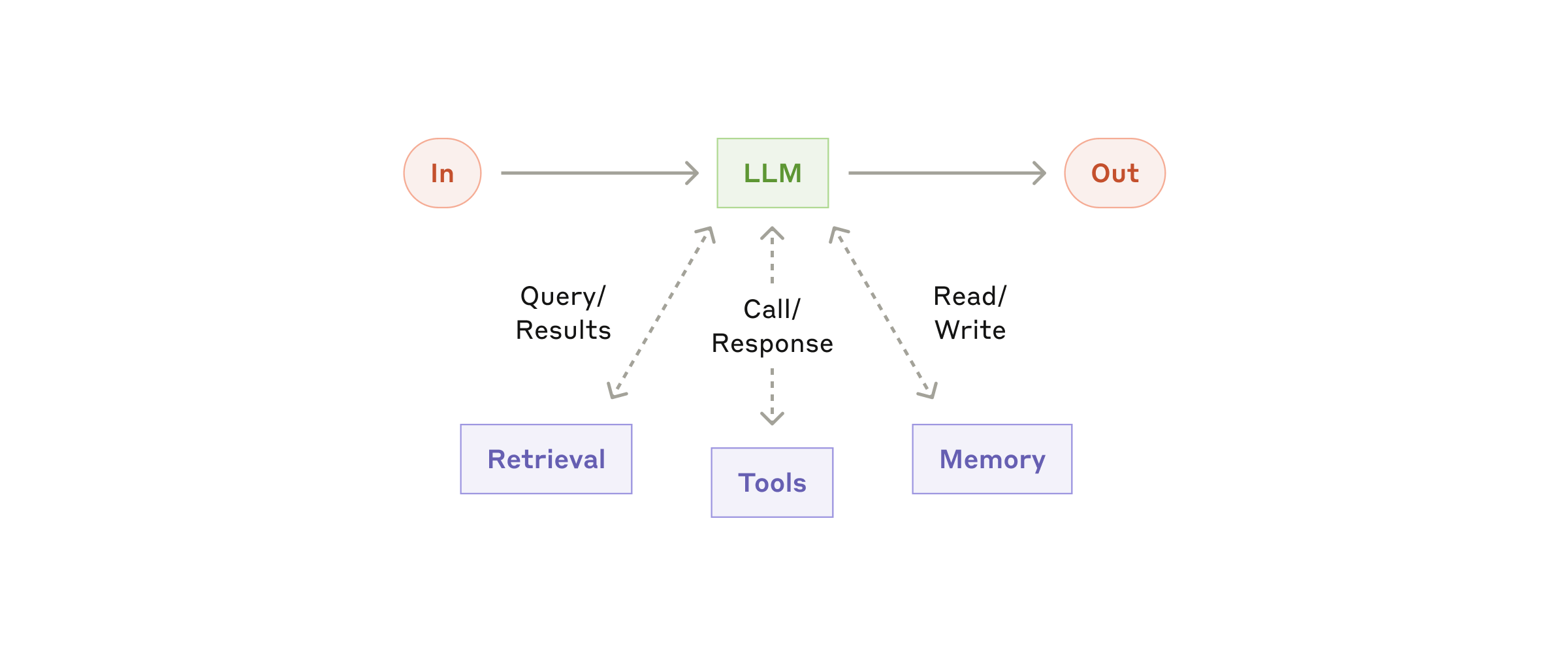
The remaining layers are where seniority reveals itself. Retrieval-augmented generation (RAG) is still the most-deployed pattern in production, and the hard part is not the demo but surviving messy data and ambiguous queries, which is why senior candidates talk about hybrid retrieval and reranking rather than just "vector search." The memory layer sits on vector databases like Pinecone, Qdrant, Weaviate, and Chroma, often with a dedicated agent-memory library such as Mem0 or Letta on top - Tacnode. The evaluation and observability layer is the one that most separates real practitioners from demo-builders: names to listen for include LangSmith, Langfuse, Braintrust, and Arize Phoenix, along with the vocabulary of "LLM-as-a-judge" and "golden datasets" - Latitude. Finally, the guardrails layer defends against prompt injection and tool abuse, using tools like NVIDIA's open-source NeMo Guardrails - NVIDIA.
Retrieval deserves a closer look, because it is the layer where junior and senior candidates diverge most visibly. Building a demo that answers questions from a handful of clean documents is a weekend project; building retrieval that survives a real corpus is not. Production RAG has to cope with messy, contradictory source data, ambiguous queries where the user's words do not match the document's words, and a corpus that drifts as content is added and removed. Senior engineers talk about hybrid retrieval that blends keyword and semantic matching, about reranking the first pass of results, and about choosing the right embedding model for their domain, because they have felt the pain of a naive approach returning confident nonsense. When a candidate describes how they diagnosed and fixed a retrieval failure, with specifics about which chunks were coming back wrong and how they measured the improvement, that story is worth more than any framework name on their resume.
Two of those layers deserve extra weight in your mental model, because they are the ones fakers skip. Evaluation is how an engineer knows their agent got better after a change rather than just feeling different, and guardrails are how they stop a jailbroken agent from firing a destructive tool call. A candidate who cannot describe how they measure agent quality, or how they prevent an unauthorized action, has almost certainly not shipped a real agent, no matter how many frameworks they list. If you internalize nothing else from this section, internalize that evals and guardrails are the load-bearing skills, and the rest of the stack is supporting cast.
For a recruiter who wants to hear how practitioners actually talk about this, the short talk below from a member of Anthropic's applied team is the single best primer on what "good" looks like, and it teaches the vocabulary you will want to listen for in interviews.
How We Build Effective Agents (Anthropic)
The through-line of that talk, and the practical lesson for your screening, is that the best engineers keep agent designs as simple as the task allows and obsess over reliability rather than cleverness. When a candidate volunteers that they deliberately did not use an agent for a problem a simple script could solve, or that they cut a multi-agent design down to a single loop because it was more reliable, that restraint is a strong positive signal. Complexity for its own sake is a red flag; hard-won simplicity is what production experience teaches.
4. Reading the Resume: Real Builder vs Keyword Faker
The core skill in this section is distinguishing depth from decoration, and the fastest way to do it is to look for specificity. A real builder's resume is full of concrete numbers, named tools they clearly used, and production outcomes they owned. A keyword faker's resume lists every framework in the ecosystem with no depth on any of them, describes projects in adjectives rather than metrics, and never mentions how anything was measured. This is not a minor filtering problem: hiring data cited across the industry suggests roughly a third of failed AI hires came from impressive-looking resumes attached to outdated hands-on skills - Dover. Recency and specificity of real work matter more than title or pedigree.
The strongest green flag is a shipped agent in production with owned metrics attached. Look for language like "reduced per-invocation cost from eleven cents to four cents," or "the eval that gates each release caught a regression before it hit production traffic." Precise cost and latency numbers are hard to fake because they come from having actually operated the thing. Named evaluation tooling is the next signal: a candidate who says they used Langfuse to trace failures or built LLM-as-judge evals with a ground-truth dataset is describing work a demo-builder never does. Concrete MCP or tool-use work is a third: "built an MCP server exposing fourteen internal tools" beats "integrated LLMs with backend services" every time, because the former is specific and the latter is filler.
Here is a compact list of the signals that reliably indicate real production experience, drawn from how specialist recruiters in this market actually screen. Keep it to the ones that are hard to fabricate.
- Owned production metrics - cost, latency, or a regression the eval caught
- Named eval and observability tools - LangSmith, Braintrust, Arize Phoenix, Langfuse
- A published MCP server or merged pull requests into a major agent framework
- State and memory depth - talks about retries, human-in-the-loop, and stopping conditions
- A genuine open-source footprint rather than starred tutorial forks
The reason this specific list works is that every item on it is a proof-of-work artifact that survives scrutiny. Anyone can write "expert in LangGraph" on a resume, but a merged pull request into the LangGraph repository is a public, timestamped, reviewable fact. A published MCP server sitting in the official registry is self-selecting proof that the person builds real tool-use plumbing. Cost and latency numbers imply the candidate ran something in production long enough to optimize it. When you screen against artifacts rather than adjectives, the fakers fall away quickly, and you are left with a shortlist whose claims you can independently verify before you ever schedule a call.
A quick composite example makes the difference concrete. Picture two candidates for the same production role. The first lists LangGraph, CrewAI, AutoGen, LlamaIndex, and Semantic Kernel across a dense skills section, with project descriptions like "built cutting-edge agentic AI solutions." The second lists one framework, links a GitHub repository containing an agent they actually built, and describes a single project in plain terms: cut the agent's average cost per run from nine cents to three by routing simple steps to a smaller model, added an eval suite that caught a regression before a release, and wrote an MCP server so the agent could reach the company's ticketing system. On a keyword scan, the first candidate looks stronger. On any serious screen, the second is the obvious hire, because every claim they make is specific, measured, and independently checkable. Training yourself to prefer that second profile over the first is most of what good screening for this role actually is.
It also helps to sort candidates into sub-archetypes rather than treating "agent engineer" as one undifferentiated blob, because the role has genuinely specialized. Some builders are core agent architects who live in planning patterns and state design; others are multi-agent orchestrators focused on how agents hand work to each other; others are tooling and integration engineers who make tool calls robust; and others are infrastructure engineers who own the runtime, sandboxed execution, and observability. Matching the archetype to the actual role before you screen prevents the common miss of rejecting a brilliant infrastructure engineer for a role that needed one, simply because they were quieter on prompt design. Ask your hiring manager which archetype the team is missing, and screen for that shape specifically.
The clearest red flags deserve naming so you can spot them fast: a resume that lists five frameworks with no production depth on any, a portfolio that is entirely Jupyter notebooks and stateless single API calls, and an inability to name a single observability tool or describe how agent quality was measured. Vague phrases like "optimized costs" with no numbers, or "leveraged cutting-edge AI," are tells that the candidate is decorating rather than describing. None of these is disqualifying on its own, but a resume that trips several of them, especially the missing-evals signal, almost never survives a serious technical screen, so it is not worth your hiring manager's time.
5. What It Costs: Compensation Benchmarks for 2026
The honest starting point is that "AI Agent Engineer" is not yet a standardized title with its own salary survey, so you have to triangulate from the nearest tracked roles: AI Engineer, Applied AI Engineer, Forward Deployed Engineer, and Research Engineer. Say that openly to your hiring manager, because a budget built on a made-up "agent engineer salary" figure will either lose candidates or overpay. The most reliable broad-market anchor is Built In's United States AI Engineer data, which puts average total compensation at roughly $210,000 in 2026, up about 15% year over year - Built In. That is the number most companies outside the frontier labs will actually hire against, and it is the right baseline for a startup or enterprise role.
The market is sharply bimodal, though, and the top end distorts everyone's expectations. At the frontier labs, compensation is dominated by equity, not base salary. Levels.fyi data for OpenAI software engineers, updated in mid-2026, shows a median total compensation of $860,000, with individual levels ranging from about $253,000 at entry to well over a million dollars at senior levels; the eye-opener is the jump from the L3 to L4 band, where total compensation roughly doubles because equity, not base, drives the increase - Levels.fyi. Aggregated self-reported bands put Google DeepMind's senior L5 engineers in the mid-hundreds of thousands and its staff and principal levels well past a million in total compensation, with Anthropic clustering at a similar altitude - CTAIO. These numbers are equity-heavy and stock-price-dependent, so treat them as directional rather than guaranteed cash.
The table below lays out the practical benchmarks a recruiter can plan against, separating the broad market you will usually hire in from the frontier-lab tier that sets candidate expectations. Base ranges are the useful negotiating anchor because equity varies so wildly.
| Segment | Typical role | 2026 total comp (illustrative) |
|---|---|---|
| Broad-market average | AI Engineer (US) | ~$210K |
| Prototype / internal tier | Junior agent engineer | $130K-$165K base |
| Production single-agent tier | Mid to senior | $175K-$235K base |
| Multi-agent / platform tier | Senior to staff | $240K-$325K+ base |
| Frontier lab (OpenAI L5) | Senior, equity-heavy | ~$1.1M median total |
Those middle three tiers come from a specialist recruiting firm's 2026 agent-engineer bands, which also note that hands-on production experience with LangGraph or CrewAI carries a 15% to 25% premium on top - KORE1. The chart below visualizes just how far apart the segments sit, which is the single most useful thing to show a hiring manager who anchored their budget on a headline frontier-lab number they saw in the news.
2026 Total Compensation by Market Segment (illustrative)
The comparative lesson in that spread is that you are almost never competing directly with OpenAI for the same person, so you should stop pricing as if you were. A Series B startup that offers a senior agent engineer $230,000 in base plus meaningful equity is not losing to a frontier lab's million-dollar package, because the two offers appeal to different people at different moments. The lab package is equity-heavy, stock-price-dependent, and attached to a research pipeline where an individual's work may be one small input; the startup offer is more cash-certain, gives the engineer visible ownership of a shipping product, and often a faster path to staff level. Framed honestly, that trade is genuinely attractive to a large share of strong builders, especially those who want to see an agent they built serving real users rather than sitting behind a lab's internal gate. The mistake most teams make is apologizing for not matching a headline number instead of selling the trade they can actually offer.
The numbers that make headlines belong to the extreme tail, and you should know them mostly so you can calibrate expectations back down to reality. When Meta launched its Superintelligence Labs hiring spree in mid-2025, it reportedly offered multi-year packages worth tens of millions to poach researchers from rival labs, and TechCrunch had to clarify that these were large multi-year equity packages rather than literal hundred-million-dollar signing bonuses - TechCrunch. One reported offer to a single researcher was framed as worth up to $1.5 billion over six years, a figure Meta itself called inaccurate and dependent on stock performance - NewsNation. These stories are real, but they describe a handful of world-class researchers, not the agent engineer you are hiring to build a support-automation system, so use them to explain why the market feels frothy, not to set your band.
The practical guidance that follows from all this is to lead with base and mission for most roles, and to be honest with candidates about where equity upside is real versus theoretical. A well-funded startup cannot match a frontier lab's cash, but it can offer meaningful ownership, a clearer path to shipping something visible, and a faster promotion track, all of which matter to builders who want to see their work in production rather than buried in a research pipeline. Because the closest tracked proxy to your role, the Forward Deployed Engineer, has seen explosive posting growth as labs race to put agents into customer environments, framing your opening around that "build agents that ship to real users" identity often resonates more than a pure compensation pitch - Paraform.
6. Where to Find Them: Sourcing Channels That Actually Work
The governing principle for sourcing agent engineers is that proof of work beats profile polish, so you should spend most of your energy where builders leave public artifacts rather than where they maintain tidy titles. That means GitHub first, because a merged pull request or a maintained repository is a timestamped, reviewable fact that no resume keyword can fake. There are two motions on GitHub. The repo-first motion searches for agent-framework topics and then mines the contributor and stargazer lists; a working query pattern is topic:langchain language:Python stars:>50 pushed:>2026-09-01, which you then repeat across topics like langgraph, crewai, autogen, and the MCP organizations - Saral AI. The user-first motion switches to GitHub's Users tab and filters by language, location, and follower ranges to surface active builders directly.
The critical framing for a non-technical recruiter is that stars and follower counts are supporting signals only, never the whole story. What actually matters is ownership and collaboration: original repositories, maintainership, release history, and substantive merged pull requests into large projects, along with real participation in issue threads and code reviews - Nexus IT Group. Someone with merged pull requests into LangGraph or a popular MCP server is a far stronger lead than someone who forked a tutorial and collected a few stars. This is why GitHub outranks LinkedIn for this specific role: the platform surfaces what people build, not what they claim, and building is the entire job.
The sharpest single filter in 2026 is the Model Context Protocol registry. The official community registry lets you browse and filter published MCP servers, and the associated servers repository exposes a direct list of the people who build tool-use plumbing for a living - GitHub. A candidate who has published an MCP server to that registry has self-selected as someone who does the exact work most enterprises are struggling to staff. Beyond GitHub, three other venues concentrate genuine agent builders, and each rewards a slightly different approach.
- Hackathons on Devpost - agentic AI events run by framework vendors and cloud providers expose team members and their exact builds
- Hugging Face Spaces - live agent demos and the profiles of the people who ship them
- Discord and Reddit communities - the LangChain, Hugging Face, and Latent Space Discords, plus subreddits like r/LLMDevs and r/LocalLLaMA
- arXiv and paper authors - people writing about agents, evals, and tool use, with contact details in the PDF
- "Build in public" on X - engineers posting agents with real cost and latency numbers in the thread
Hackathons deserve special mention because they are a concentrated, time-boxed proof of building under pressure, and they hand you a perfect outreach hook. Live 2026 events like the Forum Ventures and Anthropic Agentic AI Hackathon, an MCP-focused hackathon with fifty thousand dollars in prizes, and Google Cloud's rapid agent event all publish project pages that name the builders and describe exactly what they shipped - Devpost. Referencing a candidate's specific submission ("I saw your agent that did X at the MCP hackathon") is dramatically more effective than a generic message, a point the next section quantifies.
Communities reward patience and observation rather than blasting messages. The productive tactic is to map the people who contribute regularly, the ones posting a thoughtful answer or a project update roughly once a week, because active contributors are far better leads than passive lurkers - daily.dev. Match the community to the sub-archetype you need: application builders cluster in r/LLMDevs and Hugging Face, while infrastructure and self-hosting engineers gather in r/LocalLLaMA and the Ollama Discord. LinkedIn still has a role as a coverage layer, but for this role it should be the cross-check, not the primary channel, because the best agent builders are frequently the ones with the thinnest LinkedIn presence. Tools like HeroHunt.ai exist precisely to search across these open-web sources and LinkedIn at once, which is useful when the person you want is describable by what they built but not by any single job title.
7. Outreach That Lands With Engineers Who Have Options
The uncomfortable truth about outreach to agent engineers is that they are flooded, and generic messages are not just ineffective, they are actively counterproductive because they signal you did not do your homework. Baseline cold-reply rates for this audience sit in the range of roughly 9% to 14%, and messages that reference a candidate's specific framework work convert at about triple the rate of generic pitches - KORE1. The gap between a lazy message and a specific one is enormous: generic "I came across your profile" openers get single-digit reply rates from engineers, while specific, technical, time-bounded outreach can reach 30% to 45% - Jobs by Culture. That difference is the whole game, and it is entirely within your control.
The chart below shows how sharply reply rates climb as messages get more specific and better timed. It is worth internalizing because it reframes outreach from a volume exercise into a craft one: five carefully-researched messages will beat fifty templated blasts, and they will not burn goodwill in a small, gossipy community.
Cold Outreach Reply Rate by Message Type
The formula that produces those higher numbers is consistent and learnable. Start with a subject line of eight words or fewer that names something the candidate actually shipped. Open with a first sentence that proves you read their work, referencing their specific pull request, benchmark, repository, or a post they wrote about a production trade-off. Make the body a single concrete technical problem your team is solving, not a culture deck or a list of perks. Then ask for a fifteen-minute conversation rather than an application, and keep the whole thing under about 120 words, because engineers read these on their phones between meetings. The entire message should feel like it could only have been written to this one person.
Timing multiplies everything. Reaching out around a real event (a new release they shipped, a hackathon win, a public "I'm exploring what's next" post) lands far better than a cold approach with no trigger, because it is both relevant and well-timed. This is where being genuinely plugged into the communities from the previous section pays off: if you noticed that a maintainer just merged a significant feature or that someone's agent won a prize last weekend, that is your opening, and it will read as attentive rather than intrusive. Signal-based outreach of this kind consistently outperforms untriggered messages, and it compounds your credibility in a community where reputations travel.
One caution worth stating plainly: do not let automation erode the specificity that makes outreach work. AI-assisted personalization can genuinely help you research and draft faster, and well-personalized AI-assisted messages do lift reply rates, but the moment a message feels templated or mass-sent, most candidates ignore it, and senior agent engineers are especially allergic to it because they receive so much of it. The right use of automation here is to help you find the specific artifact worth referencing and to draft a first version you then sharpen by hand, not to spray the same "personalized" template across a hundred people. The half of this job that a tool can accelerate is research and drafting; the half it cannot replace is the judgment about what actually makes this particular person worth a fifteen-minute call.
8. Screening Without Being Technical
The screening challenge is real but solvable: you cannot read code, yet you have to filter out people who cannot build. The answer is not to fake technical judgment, it is to structure the evaluation so that non-technical judgment is enough, backed by one technical grader at the right moment. The foundation is a competency checklist rather than gut feel. Work down a fixed set of areas (LLM application development, retrieval and RAG, agents and tool use, evaluation and guardrails, deployment) and for each one, confirm the candidate can tell a concrete story with real numbers attached. You are not judging whether the code is elegant; you are confirming that each competency is backed by something specific rather than a buzzword. A candidate who cannot produce a concrete story for the evaluation box, in particular, has almost certainly not shipped a real agent.
The single most effective screening instrument for a non-technical team is the seeded-bug take-home. You give the candidate a small, already-working agent that secretly contains a few intentional defects, and you ask them to find and fix them. A well-designed version seeds three specific, realistic bugs: a retry loop that hammers a service on transient errors, a missing budget or spend cap that would let costs run away, and stale state reads caused by writing to memory too early - KORE1. The beauty of this format for a non-technical reviewer is that you can score it against an answer key. You tier candidates by which defects they catch and fix, and you do not need to read the code yourself to know whether they found the missing spend cap, because your key tells you what a strong answer looks like.
There are a few work-sample designs worth having in your toolkit, each testing a slightly different thing. Keep the list short and pick the one that matches the role.
- Seeded-bug take-home - a working agent with three planted defects, about 90 minutes, scored against a key
- Calendar-assistant build - agent must ask clarifying questions, read state before acting, and persist across a crash
- Framework-free loop - build a clean agent loop that calls the model and tools directly, without a framework
The calendar-assistant and framework-free designs are worth understanding because of what they reveal. The calendar-assistant task asks the candidate to build an agent against a mock calendar API that must confirm before booking, recover from a simulated crash, and self-correct on API errors, with the deliverable including a written trace of the agent's reasoning that a non-technical reviewer can actually read. The framework-free approach, used by the agent company Sierra, deliberately asks candidates to build a clean loop that calls the model and invokes tools directly without leaning on LangChain, which tests whether they understand the mechanics or have only wired together someone else's abstractions - Exponent. Across the market, roughly a third of AI-engineering processes with disclosed steps include a take-home, typically with a two-to-seven-day deadline, so candidates expect this and strong ones welcome it - AI Engineering Field Guide.
There is a specific failure mode to screen for that did not exist a few years ago, often called the vibe coding trap: candidates who prompt an AI, paste the output without understanding it, and hope the tests pass. The output looks clean and complete, which is exactly what makes it dangerous, because it hides accumulating technical debt the candidate cannot maintain - GoodFirms. You screen for it in two ways. First, a short paid work trial on a real codebase with edge cases seeded in, where you watch whether the candidate iterates, tests, and cleans up, or simply accepts the first suggestion. Second, a simple question: "tell me about a time you caught a bug or a security issue in AI-generated code." The specificity of the answer is the signal. The goal is not to ban AI assistance, which every real engineer now uses, but to confirm the candidate reviews and steers it rather than trusting it blindly.
A handful of questions separate signal from noise well enough that you can ask them verbatim and grade on whether the answer gets concrete. Ask how the candidate knows their agent got better after a change; a credible answer names an evaluation dataset, a judge or rubric, and a regression check, while a weak one says "it looked better." Ask how they would architect an agent that has a powerful, destructive tool so that a jailbroken call cannot fire it; you want to hear least-privilege, human confirmation, and sandboxing. The primer below, an official Anthropic roundtable, is a useful way for a non-technical screener to calibrate what a good answer to these sounds like before running the interviews.
Tips for Building AI Agents (Anthropic)
The most advanced signal of all, and the one that marks a genuinely senior hire, is a candidate who evaluates their evaluations. Weak engineers test the agent; strong ones ask whether their eval itself is trustworthy, checking that their judge agrees with human reviewers and guarding against the agent gaming the metric. If you ask "how do you know your eval is trustworthy?" and get a thoughtful answer about ground-truth datasets and judge calibration, you are almost certainly talking to someone who has shipped real, reliable agents. That question alone, delivered near the end of a screen, is one of the highest-yield filters in this entire guide.
9. Designing the Interview Loop (and the Failure Modes to Avoid)
A good interview loop for this role is short, fast, and built around the work rather than around algorithm puzzles. A strong reference model comes from Sierra, whose process runs a recruiter screen, a technical screen that in 2026 shifted toward system design rather than pure coding, a take-home agent build, a debugging round, and a presentation round where the candidate walks through their build and then explains a technical topic to a non-technical audience - Exponent. That last round is quietly brilliant for this role, because agent engineers work cross-functionally with product and operations teams, and the ability to explain a non-deterministic system to a non-engineer is a genuine job skill, not a nicety. You can borrow that round directly, and a non-technical panelist is exactly the right person to grade it.
For a hiring team without deep in-house engineering to spare, the practical loop is a five-step sequence that keeps non-technical judgment in charge while putting one technical grader at the single point where code must be read. Keep it tight, because speed is itself a screening advantage in this market.
- Recruiter screen against the competency checklist, 20 to 30 minutes
- Take-home using the seeded-bug or calendar-assistant design, capped near 90 minutes
- Take-home walkthrough where the candidate explains their trade-offs and you grade clarity
- Technical grading of the actual code by one engineer or trusted contractor
- Behavioral and collaboration round focused on how they work with non-engineers
The logic of that sequence is that it concentrates the scarce technical judgment where it is genuinely required (step four) and lets a non-technical recruiter own everything else with confidence. The take-home walkthrough in step three is especially valuable, because a candidate explaining why they chose one approach over another, with concrete numbers, reveals depth that a non-technical interviewer can absolutely assess: you are grading whether the reasoning is specific and honest about trade-offs, not whether the syntax is correct. When the walkthrough answers get vague or hand-wavy, that is a signal you can trust even without reading a line of code.
The failure modes in this market are consistent and expensive, so it is worth naming them so you can design around them. The most common is over-indexing on generic algorithm puzzles that have nothing to do with agent reliability, which filters for the wrong skill entirely. The second is running a loop with no evaluation or observability question at all, which reliably produces a hire who can build an impressive demo but cannot ship something that stays reliable in production. As one hiring lead put it, the person you actually want is someone "obsessed with making non-deterministic systems reliable," and a loop that never probes reliability will never surface them. The third is letting a non-technical panel try to grade code they cannot read, instead of using answer keys, written traces, and one dedicated technical grader.
The fourth failure mode is simply being too slow, and it deserves its own emphasis because it silently kills more of these searches than any other. With demand outstripping supply by a wide margin, candidates expect a first conversation within days and a full process wrapped in two to three weeks; a slower process loses your top choices to competitors who moved faster, no matter how good your role is - Syndesus. Specialist recruiters report meaningfully shorter time-to-hire when feedback after each stage closes within 48 hours, so the single highest-leverage process change you can make is to compress your feedback loops. Book the next round before the candidate leaves the current one, and get decisions out fast, because in this market the fastest good process wins as often as the best-paid one.
10. The Tooling: Sourcing Platforms, Assessments, and AI Recruiters
The tooling landscape for hiring agent engineers has split into two motions, and matching the tool to the motion saves both money and frustration. The first motion is sourcing, finding people who are not applying, and here the category has itself divided into AI recruiters that autonomously source, screen, and reach out, versus traditional databases that bolted AI onto Boolean search. For this specific role, the decisive feature is search across the open web (GitHub, Hugging Face, personal sites, communities) rather than LinkedIn alone, because the best agent builders are often open-source contributors without tidy LinkedIn titles, and because the role's title is so unstable that Boolean-on-title simply fails. Natural-language and semantic search win here, which is why a query like "engineers who shipped multi-agent LLM systems with LangGraph" matters more than any keyword filter.
Among sourcing platforms, a few names anchor the market. LinkedIn Recruiter remains the default coverage layer, reportedly running around $10,800 to $12,960 per seat per year in 2026 with a typical three-seat minimum, and its Hiring Assistant, LinkedIn's first true AI recruiting agent, became generally available in late 2025 and now claims to cut profile-review time substantially - LinkedIn News. hireEZ repositioned itself as an agentic recruiting platform strong on open-web sourcing, priced by quote at an estimated median around thirteen thousand dollars a year - Vendr. SeekOut offers a self-serve tier at $149 per month billed annually with strong technical and publication filters useful for AI talent - SeekOut. Juicebox, often called PeopleGPT, searches more than 800 million profiles in plain English and prices from about $119 per seat per month, with autonomous sourcing agents at $199 each - TrustRadius. Gem bundles sourcing with a CRM and ATS for teams that want pipeline analytics, listing from around $99 per user per month - Pin.
The table below compares the sourcing options a recruiter is most likely to weigh, with the metering model called out because it is where the real cost differences hide.
| Platform | Entry price | Metering model | Best for |
|---|---|---|---|
| LinkedIn Recruiter | ~$10.8K/seat/yr | Per seat | Broad coverage layer |
| Juicebox | $119/seat/mo | Per seat + credits | Natural-language search |
| SeekOut | $149/mo annual | Per seat | Technical + diversity filters |
| Gem | $99/user/mo | Per seat | Teams wanting analytics |
| HeroHunt.ai | Free trial | Per open position | Lean teams, open-web search |
That last row points at the option most worth a look for a solo or lean recruiting function, precisely because its cost model is different from everyone else's. Almost every tool above is seat-priced, which punishes small teams; the outlier meters on the work itself.
HeroHunt.ai
For the exact problem this guide is about, the title chaos matters more than the raw database size. The person you want may call themselves an "AI Engineer", a "Forward Deployed Engineer", or nothing at all on LinkedIn, while their real work sits in a GitHub repo and a published MCP server. HeroHunt.ai is built for that kind of search: it works across roughly a billion public profiles spanning LinkedIn, GitHub and other open sources, screens each candidate with a language model against the brief you actually wrote rather than a keyword string, and drafts a first outreach per person. It is our own product, so weigh this the way you would weigh any vendor writing about its own category. Two facts that actually change the maths: it meters on open positions per month rather than per seat, so a solo recruiter running three roles pays far less than a seat-priced tool, and it is free to try for 8 days with no permanent free tier. The honest caveat: sourcing is the half of this hire that software can genuinely accelerate, and screening is the half it cannot. No search product can tell you whether a candidate can actually build a reliable looping agent with real evals, so pair it with the seeded-bug work sample from section 8 rather than trusting any match score on its own.
The second motion is assessment, and here the whole category pivoted hard in 2025 and 2026 around a single realization: testing coding in a vacuum is pointless because candidates use AI anyway, so the question became how well they work with an AI agent. CodeSignal embedded its Cosmo AI co-pilot directly into the assessment IDE and built agentic assessments around real tools like Claude Code and Cursor, where the candidate builds with an agent and then explains their decisions to a human reviewer, giving the hiring team a full transcript of the interaction - CodeSignal. HackerRank rebuilt its platform for what it calls the agentic era, generating role-specific tests from a job description in under twenty minutes - HackerRank. For teams with no engineers to spare, Karat offers technical-interview-as-a-service and launched an AI-enabled format in late 2025 that assesses how candidates work with AI under pressure - BusinessWire.
There is a third category that a recruiter in this market must understand even if they never buy from it: the talent marketplaces that are draining the very supply you are competing for. Companies like Mercor pay elite engineers to do evaluation and reinforcement-learning work for the frontier labs, and Mercor's scale is staggering, reportedly reaching roughly two billion dollars in annualized revenue by mid-2026 while paying contractors well over two million dollars a day - Sacra. Turing pivoted from staffing to supplying labs with training data and evaluations through a network of millions of vetted engineers - Pulse 2.0, and Micro1 runs an AI recruiter named Zara that conducts proctored async video interviews - Software Advice. The reason this matters to your search is competitive: the same scarce engineers you want to hire full-time can now earn premium hourly rates moonlighting for the labs, which tightens supply and raises the bar on what your offer has to beat.
The practical synthesis for a lean 2026 stack is to combine semantic open-web sourcing (an AI recruiter or Juicebox) with LinkedIn for coverage, a hands-on portfolio and GitHub review, and an AI-open technical evaluation (a CodeSignal agentic assessment, or Karat if you have no engineers to run screens). Do not try to buy your way out of the judgment steps; the tools accelerate sourcing and standardize assessment, but the decision about whether a candidate can really build reliable agents still rests on the work sample and the walkthrough. Spend on the tools that widen your funnel and standardize your evaluation, and keep your own attention on the two or three signals (production metrics, real evals, a genuine open-source footprint) that no platform can judge for you.
11. How AI Agents Are Changing Recruiting Itself
There is a neat symmetry worth pausing on: the same technology these engineers build is now reshaping how you hire them. The framing has shifted from "AI helps recruiters" to "AI agents do recruiting," with autonomous systems that scan internal and external sources, score fit, initiate multichannel outreach, adapt follow-ups based on engagement, and book screens, all without a human triggering each step. The concrete 2026 examples are already in market: LinkedIn's Hiring Assistant, hireEZ's agentic mode, Juicebox's autonomous agents, SeekOut's managed Spot service, and AI recruiters that run the search-screen-outreach loop end to end. Understanding this shift is not optional, because your competitors are using these agents to move faster on the same candidates, and because the same tools carry real risks you are accountable for.
Where these systems fail is instructive, and the failures cluster in predictable places. The most common mistake teams make is turning on automated outreach at scale before their data and matching foundations are solid, which produces exactly the mass-personalized spam that senior agent engineers ignore and resent. Personalization matters most precisely where automation is weakest, so the sequencing lesson is to automate outreach last, after sourcing and matching are dialed in, not first. The second failure is hallucination: agents confidently surface candidates who do not exist or do not fit, and a human still has to decide what is real, a problem made worse by the title chaos in this very role, which throws off automated scoring. Neither failure is a reason to avoid the tools; both are reasons to keep a human firmly in the loop.
The most serious risk is legal, and it is not hypothetical. The defining cautionary tale of 2026 is the Mobley v. Workday case, in which a federal court allowed an age-discrimination collective action to proceed against an AI hiring tool, with Workday's own filings acknowledging that roughly 1.1 billion applications were rejected through its systems in the relevant period - Forbes. The lesson for any recruiter deploying automated screening is that rejecting candidates at scale through an opaque model creates real disparate-impact liability, which is why regulators are moving: the European Union's AI Act classifies hiring AI as high-risk, and jurisdictions like New York City already mandate bias audits. Keeping a human decision-maker in the loop and auditing your tools is not just good practice, it is increasingly a legal requirement.
There is also an assessment-integrity arms race worth understanding, because it shapes which evaluation approach you should trust. As candidates use AI to assist or cheat on live coding tests, platforms have escalated with object detection, proctoring, and session recording. The smarter response, and the one the best platforms are converging on, is not to wage a detection war but to redesign the task to be AI-open and to judge the candidate's process and reasoning rather than a final answer, which is exactly what CodeSignal's transcript approach and the seeded-bug walkthrough from section 8 do. In a world where every real engineer works with AI, the assessment that bans AI is testing for the wrong thing, and the assessment that watches how a candidate collaborates with AI is testing for the actual job.
The balanced takeaway is that AI agents are a genuine force multiplier for recruiting when used for the parts they are good at, and a liability when trusted with the parts they are not. Use them to widen your funnel, to draft and personalize research faster, and to standardize the mechanical steps, while keeping human judgment on the final decision, the sensitive outreach, and the legal exposure. That is, incidentally, the same balance the engineers you are hiring strike in their own work: automate the mechanical, supervise the consequential, and never ship a non-deterministic system without a human able to see what it did and why.
12. The Future Outlook and Your Hiring Playbook
Looking ahead, the role is going to get both bigger and more specialized, which has direct implications for how you hire. Gartner's analysts describe a progression from the task-specific agents dominating 2026 toward multi-agent ecosystems by the end of the decade, and if that holds, the premium will shift further toward engineers who can design how many agents coordinate rather than how one agent loops - Gartner. The protocols underpinning that future, MCP for agent-to-tool connections and A2A for agent-to-agent communication, are consolidating under neutral foundations, which means fluency in them will only become more valuable, not less - Linux Foundation. The safe bet is that evaluation, observability, and guardrails, the reliability skills, will remain the durable core of the role even as frameworks come and go, so screen for those first and treat any specific framework as a detail.
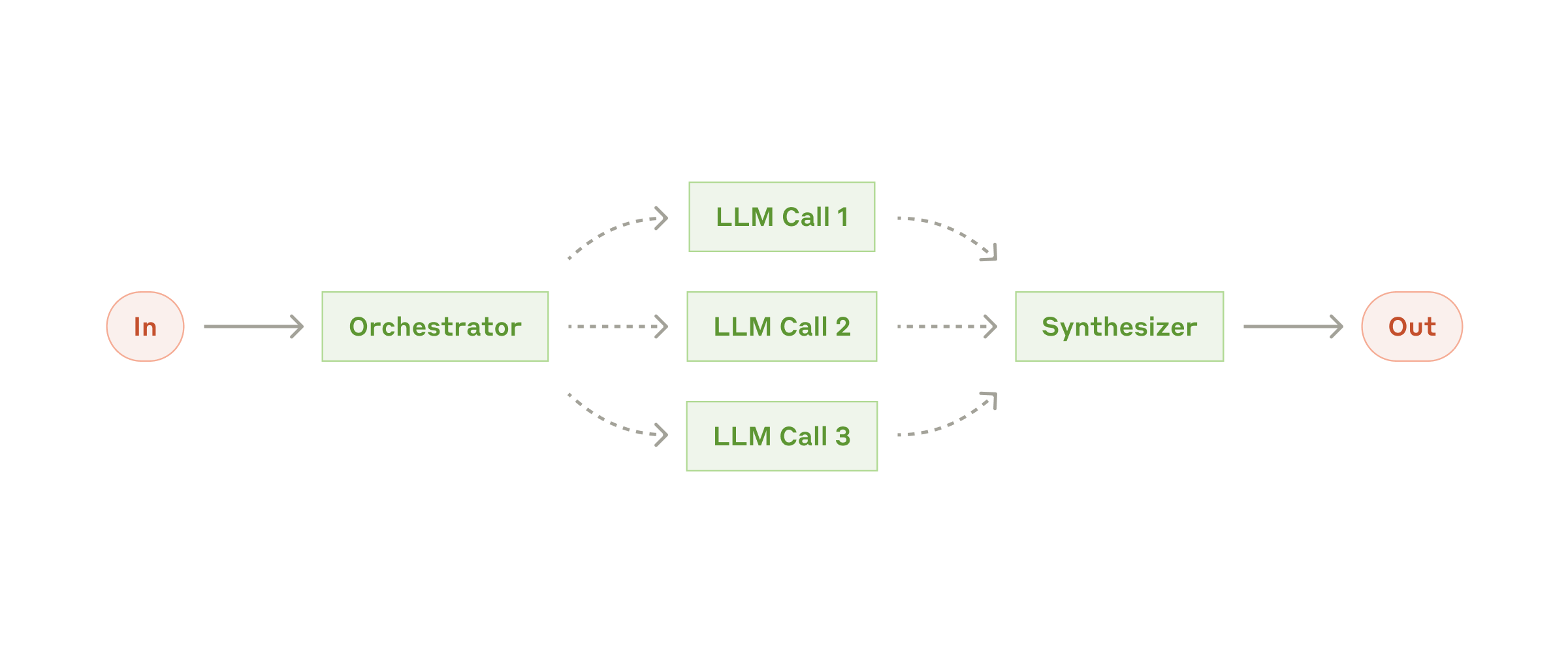
The diagram below, one more time from Anthropic's engineering team, shows the orchestrator-workers pattern that increasingly defines senior work: a central agent breaks a task down, delegates to worker agents, and synthesizes the results. It is worth recognizing because a candidate who can speak fluently about coordinating multiple agents is demonstrating exactly the skill the next phase of this market will reward.
The orchestrator-workers pattern
Pulling the whole guide together, the playbook for hiring an AI Agent Engineer in 2026 comes down to a decision framework you can run on repeat. First, get precise about which role you actually need, because "AI person" is where these searches fail. Second, calibrate your budget against the right proxy roles and be honest about where you sit on the bimodal market. Third, source against proof of work (GitHub, MCP registry, hackathons, communities) rather than title keywords, and treat LinkedIn as a cross-check. Fourth, make every outreach message specific and well-timed, because generic messages do worse than nothing. Fifth, screen with a seeded-bug work sample and a walkthrough that a non-technical reviewer can grade, backed by one technical grader and an unmissable evaluation question.
The final principle, and the one that quietly decides most of these searches, is speed. In a market where qualified candidates are scarce and accept offers within weeks, the fastest good process beats the best-paid slow one more often than recruiters expect, so compress your feedback loops, book the next round before the candidate leaves the current one, and get decisions out within days. If you get the sourcing and screening structure right, the leverage a modern AI recruiter gives you on the sourcing half lets a lean team run several of these reqs at once without drowning.
If the sourcing half is where you want the leverage, HeroHunt.ai runs the search, screen and draft loop across roughly a billion public profiles and prices per open role rather than per seat, so a lean team can work several agent-engineer reqs at once. Start free with the 8-day trial, then keep the human work sample from section 8 for the part no tool can judge.
This guide was written by Yuma Heymans (@yumahey), who built HeroHunt.ai, the world's first AI Recruiter, and has spent years sourcing hard-to-find technical talent from over a billion profiles on autopilot. He writes about AI in recruiting from the position of someone building agents and hiring the people who build them.
This guide reflects the AI agent hiring landscape as of August 2026. The market, the tools, and especially the compensation numbers move quickly, so verify current pricing and salary data before making decisions.