



The insider field guide to who GPU kernel engineers really are in 2026, what they cost, where they hide, and how to actually hire them.
Anthropic has a single open role, "Performance Engineer, GPU," that pays between $280,000 and $850,000, and it asks for CUDA, Triton, CUTLASS, FlashAttention, tensor-core optimization and FP8 quantization by name - Anthropic Careers. That one job posting tells you almost everything about the market you are about to enter. The people who write GPU kernels have become the highest-leverage, most contested, and most misunderstood engineers in artificial intelligence, and the recruiting playbook that works for a normal software hire does close to nothing here.
The reason is that a GPU kernel engineer is not an ML engineer and not the "AI engineer" that job boards have been celebrating for two years. They sit one full layer below both. They write the tiny programs, called kernels, that run directly on the GPU chip and make matrix multiplication, attention, and mixture-of-experts layers execute at the hardware's physical speed limit. When a lab says a model trained in three weeks instead of three months, or that inference costs five million dollars instead of ten, a handful of these people are usually the reason - Together AI. There are millions of registered CUDA developers and only a tiny elite who can genuinely saturate a new chip, which is exactly why the price of one has detached from normal engineering pay.
This guide is the practical map for someone who has to hire one, not just read headlines about the talent war. It covers what a kernel engineer actually does and the vocabulary that separates a real one from a keyword, how scarce they truly are, what each tier costs in 2026, where they physically live and how to read their public work, what makes them say yes when money is already table stakes, how to screen them without being fooled by AI-assisted cheating, the recruiting ecosystem that has grown up around them, and how AI systems that now write kernels themselves are reshaping the job rather than ending it. It assumes no GPU programming background, only that you need to win at this.
Written by Yuma Heymans (@yumahey), who built HeroHunt.ai, an AI recruiter that searches over a billion public profiles and reads GitHub and the open web the way this guide recommends sourcing kernel engineers: by their proof of work, not their job title. He has been building AI sourcing technology since 2021 and spends his days on the exact problem at the center of this market, finding scarce specialists who never apply to anything.
HeroHunt.ai
Every method in this guide comes back to one thing: the best GPU kernel engineers are found by their public artifacts, not their resume, and almost never by a keyword search. That is the specific gap HeroHunt.ai is built for. You give it a written brief instead of a Boolean string, it searches over a billion profiles across LinkedIn, GitHub, Xing and Stack Overflow, and it reads each person against your criteria with a language model, so a profile that says "CUDA" but never mentions the repos they actually merged into is judged on the work rather than the buzzword. It is free to start with no credit card, which makes a single impossible-to-fill kernel req a cheap experiment. The honest caveat: it is a sourcing and outreach layer, not an applicant tracking system and not a technical screen, so it sits alongside your ATS and cannot run the kernel take-home in Chapter 6 for you. Its edge is strongest exactly where this population lives, in roles where candidates publish their work in public.
Contents
- What a GPU Kernel Engineer Actually Is (and Is Not)
- Why They Are the Scarcest Talent in AI
- What They Really Cost: The 2026 Pay Reality
- Where GPU Kernel Engineers Hide, and How to Read the Signal
- What Makes Them Say Yes (It Is Rarely Just Money)
- How to Screen Them Without Getting Fooled
- The Recruiting Ecosystem and the Players
- How AI Agents Are Changing Kernel Work Itself
- The Future Outlook: Does AI Replace Them?
- The Recruiter's Playbook
1. What a GPU Kernel Engineer Actually Is (and Is Not)
The single most useful thing to understand before you write a job description is that a GPU kernel engineer lives one layer below the AI everyone talks about. An AI engineer wires existing models like Claude or GPT into products through prompts, APIs and fine-tuning, and rarely touches model internals. A machine learning engineer builds and trains models, doing the data work, feature engineering and evaluation. A kernel engineer, sometimes titled a performance engineer or CUDA engineer, writes and optimizes the low-level GPU code that both of those people's work actually runs on - Towards Data Science. Their world is C++ and CUDA, the GPU's virtual and native instruction sets, and hardware profilers, not datasets or product features. Get this distinction wrong and you will benchmark, screen and budget against the wrong person entirely.
What they do day to day is a tight, physical loop. They profile a workload to find its bottleneck, asking whether a piece of code is limited by raw compute or by memory bandwidth, and then they rewrite the kernel to fix it. The mental model every one of them uses is the roofline model, which plots a kernel's arithmetic intensity (how many operations it does per byte of memory it touches) against two hard ceilings: the chip's peak compute rate and its peak memory bandwidth - Modal GPU Glossary. A kernel below the memory ceiling is "memory-bound" and needs different surgery than one pressed against the compute ceiling. The fixes have names a recruiter should learn to recognize: improving occupancy (keeping the chip's cores busy), memory coalescing (making a group of threads read memory efficiently), and kernel fusion (merging operations so data never makes a slow round trip to main memory).
To understand where this person fits, it helps to see the stack drawn out. The diagram below places the kernel engineer between the models everyone discusses and the silicon almost no one does, and lists the canonical things they build.
The canonical work items are worth knowing because they show up on strong resumes and in interviews. GEMM, short for general matrix multiply, is the beating heart of all deep learning and the thing kernel engineers spend careers perfecting. FlashAttention is the famous fused attention kernel, and its 2026 version reached 1,613 trillion operations per second at 71% hardware utilization on NVIDIA's Blackwell chip, up to 1.3 times faster than NVIDIA's own library - Tri Dao. There are quantization kernels that run math in low precision formats like FP8 and FP4 for speed, mixture-of-experts kernels that route tokens to specialized sub-networks, and inference-specific kernels like paged attention, which borrows operating-system memory-paging ideas and requires the attention kernel to be rewritten to support it - Wikipedia. A candidate who can explain one of these and the exact speedup they achieved is showing you the real thing.
One distinction inside the role changes who you should hire, and it is the split between training kernels and inference kernels. Training kernels are about raw throughput across thousands of GPUs at once, where the hard problems are overlapping communication with computation and keeping every chip fed during a run that lasts weeks. Inference kernels are about latency and cost per token for a model already trained, where the hard problems are memory-bound attention, low-precision quantization, and serving many users from one machine, and where techniques like paged attention and speculative decoding live. A DeepSeek inference kernel that fuses expert routing and two low-precision matrix multiplies into a single mega-kernel is a different craft from a training kernel that must scale cleanly to a full cluster - LMSYS. Many engineers do both, but the strongest are usually deeper on one side, so decide which problem you are actually hiring for before you write the job description.
For readers who want to see what this work actually looks like rather than just read about it, the talk below is an accessible walkthrough of writing custom GPU kernels in Python using OpenAI's Triton, which is the modern on-ramp to the field and a common skill on 2026 resumes.
GPU Programming with Triton Kernels
The vocabulary a recruiter must be able to recognize is the fastest lie detector you have, because pretenders speak in adjectives and real engineers speak in hardware. Beyond CUDA itself, listen for PTX and SASS, the virtual and native instruction sets a kernel ultimately compiles down to - NVIDIA PTX Documentation. Listen for warp (a group of 32 threads that execute in lockstep), tensor cores (the matrix-math units), and library names like CUTLASS, cuDNN and Triton. On the newest chips, listen for tcgen05, Tensor Memory and the Tensor Memory Accelerator, all Blackwell-specific features. Someone who names these and explains a tradeoff between them is fluent. Someone who says "optimized CUDA" with no number attached is usually not.
The 2026 toolchain is itself a signal of how current a candidate is, and it has moved fast. NVIDIA's CUTLASS 4 now lets engineers write high-performance kernels in Python through its CuTe domain-specific language, with performance on par with C++ and compile times more than a hundred times faster - NVIDIA CUTLASS Documentation. OpenAI's Triton gained a lower-level dialect called Gluon in 2025 to extract the last stretch of performance from new architectures - Spheron. Stanford's ThunderKittens compresses what used to be a thousand lines of CUDA into a hundred and is used in production by Together AI, Jump Trading and Cursor - Hazy Research. Chris Lattner's Mojo, a from-scratch attempt to break NVIDIA's lock-in, was open-sourced in August 2026 - Modular. A candidate tracking these is living where the work is.
Two more concepts close out the picture and both matter for hiring. The first is that new silicon is a genuine skills reset, not a minor update. Blackwell introduced a new family of tensor-core instructions, a dedicated on-chip memory, and native four-bit number formats, and reaching peak performance on it requires techniques that simply did not exist on the prior Hopper generation - arXiv. An engineer who has shipped tuned Blackwell kernels is markedly rarer and more valuable than one who has only worked on Hopper, which is a real axis to screen on. The second concept is why this is a moat at all: NVIDIA's CUDA is fifteen years of accumulated libraries, more than 800 of them, and millions of developers, and the people who can write these kernels are the ones who keep that moat standing - Introl. That is the deep reason the whole industry is bidding for the same few hundred people, which is where the next chapter begins.
2. Why They Are the Scarcest Talent in AI
The scarcity here is not a marketing line, it is a structural fact, and it starts with a striking ratio. NVIDIA reports a CUDA ecosystem of roughly five to six million developers, but the subset who can genuinely write state-of-the-art, hardware-saturating kernels is a tiny elite, closer to small hundreds than to thousands - Quartr. Every frontier lab, every chip maker, and every inference startup is fighting over that same handful of names. This is why a company like ManpowerGroup, surveying employers worldwide, found, for the first time, that AI skills top its global shortage list, ahead of engineering, IT and the skilled trades - Pin. Kernel optimization sits at the very apex of that shortage.
The reason so few people can do it is that the work resists shortcuts. Writing a top kernel means hand-managing the GPU's thread hierarchy, its layers of memory, and the precise scheduling of its tensor cores, and the payoff is enormous but the learning curve is brutal. Together AI put the stakes plainly: kernel quality is "the difference between a model that trains in three weeks versus three months, an API that responds in 100 milliseconds versus 1 second, spending 10 million dollars on compute versus 5 million" - Together AI. The same team noted it matched in a single week what NVIDIA had spent a year building for Blackwell with dozens of engineers, which cuts both ways: it shows how much leverage a great kernel team has, and how few teams on earth can do it. The academic framing agrees, with the widely cited KernelBench paper stating flatly that writing fast matrix kernels "has historically been siloed to highly experienced kernel experts" - arXiv.
That scarcity produces visible, verifiable results, which is useful for a recruiter because it means the value of the role is not abstract. The chart below, from the FlashAttention-4 work, shows the kind of speedup an elite kernel delivers over strong baselines on Blackwell hardware, and it is the tangible output of exactly the talent you are trying to hire.
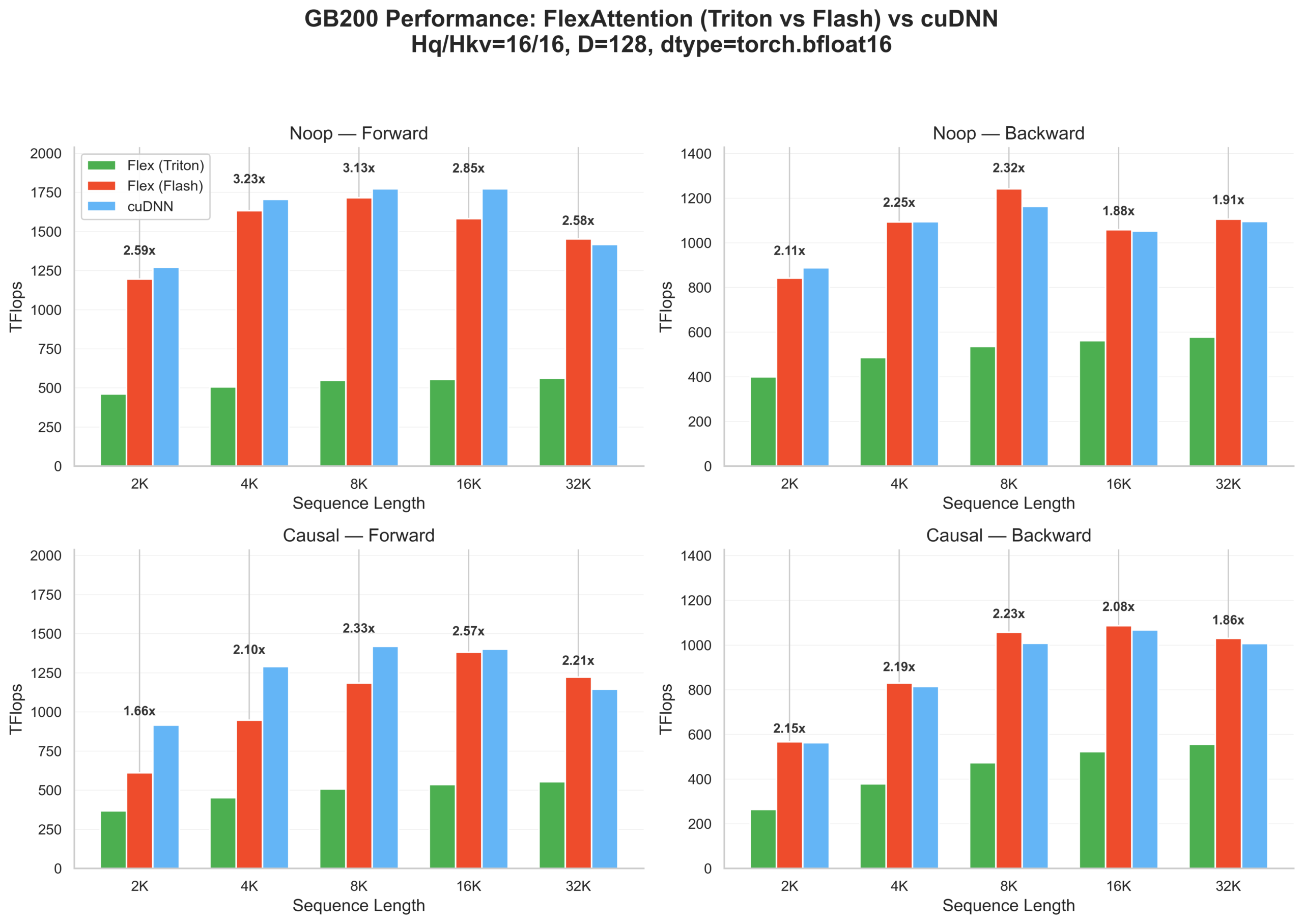
To place your own hiring in context, it helps to know the concept that now governs the whole field: the GPU-rich versus GPU-poor divide, coined by Dylan Patel of SemiAnalysis and amplified across the industry - Latent Space. Originally it described who owned the most chips, but in 2026 it increasingly describes people, because a lab with an elite kernel bench extracts far more from the same silicon than one without. SemiAnalysis described Meta moving "from GPU-poor to GPU-filthy-rich on a per researcher basis," a phrase that captures how compute and talent now compound together - SemiAnalysis. If your organization is compute-constrained, you are competing for kernel talent partly because kernel talent is how you stop being compute-constrained.
Nowhere is the scarcity clearer than in the gap between NVIDIA and its challengers, which is fundamentally a talent gap dressed as a software gap. When SemiAnalysis tested AMD's flagship accelerator, it found the software "riddled with bugs" to the point that out-of-the-box model training was "impossible," despite competitive raw hardware - SemiAnalysis. AMD's answer has been to buy talent aggressively, acquiring the Finnish lab Silo AI for 665 million dollars and absorbing several kernel and compiler teams - AMD Investor Relations. Chris Lattner's Modular needed roughly 120 engineers and three years just to build a credible alternative to CUDA - Software Engineering Daily. When the richest companies in the world take years and hundreds of specialists to replicate this skill, you can see why individual practitioners are treated as marquee hires.
The demand data confirms the picture and gives you numbers to plan against. Labor-market analysts at Lightcast found AI-skill job postings jumped 73% from 2023 to 2024 and a further 109% the next year, with GPU and CUDA skills at the scarce, high-pay top of that curve - Lightcast. Job boards reflect the same pressure, with Indeed listing hundreds of GPU kernel engineer roles at an average near $200,000 and rental prices for the GPUs themselves climbing about 40% in six months, which only sharpens the incentive to hire people who squeeze more from each chip - SemiAnalysis. Meanwhile the buyers keep multiplying: NVIDIA reportedly licensed the inference startup Groq's technology and core team for around 20 billion dollars in late 2025, and inference-optimization companies like Fireworks AI are hiring in bulk with interview pass rates near 20% - JobsByCulture. For a recruiter, the practical takeaway is to treat elite kernel engineers as a rare, aggressively bid asset and to expect NVIDIA, the frontier labs, and well-funded startups all chasing the same shortlist.
The demand is broadened further by a whole class of custom-silicon startups, each of which needs kernel and compiler engineers simply to make its novel chip usable at all. Cerebras, Groq, Tenstorrent, d-Matrix, Etched and SambaNova are all racing to challenge NVIDIA on inference, and none of their hardware sells until someone writes the low-level software that runs models on it efficiently. This is why an inference-optimization company like Baseten can advertise a 53.6-times speedup on video generation as a hiring magnet: the result is proof that its kernel team can extract value from silicon a customer could not extract alone - Baseten. For a recruiter, the practical implication is that your competition for a given candidate is no longer just the famous labs. It is also a dozen well-funded hardware startups, each of which frames the same scarce skill as the thing standing between its chip and a real business.
3. What They Really Cost: The 2026 Pay Reality
The first rule of pricing this role is that there are two very different pay universes, and confusing them will either blow your budget or embarrass your offer. The first universe is NVIDIA and the broader chip industry, where a senior kernel or systems engineer is very well paid but within a recognizable band. The second is the frontier labs, where the same skill set commands roughly double, mostly in illiquid equity, and where a handful of leaders have been offered numbers that read like typos. Knowing which universe you are actually competing in is the single most important budgeting decision you will make, because most companies are not competing with OpenAI and should stop pretending they are.
At NVIDIA, the public data is unusually good. Levels.fyi puts the general software engineer band from $164,000 at entry to more than $420,000 at the top, with a median around $321,000 - Levels.fyi. The GPU-specialist tracks pay a clear premium on top of that: the HPC engineer ladder runs from about $221,000 to over $1 million, with a median near $380,000, and a senior individual contributor around $423,000 - Levels.fyi. Industry compensation trackers note that CUDA and systems-software roles specifically sit at the top of NVIDIA's band "to keep the competitive moat intact," with a principal-level engineer regularly clearing $500,000 at grant and sign-on bonuses pushed to $100,000 to $200,000 for contested hires - CTAIO. Because NVIDIA pays in stock that has appreciated dramatically, realized comp has run well ahead of those grant-date figures.
The frontier labs are a different order of magnitude, and the Anthropic role that opened this guide is a clean data point: $280,000 to $850,000 for a single GPU performance engineer - Anthropic Careers. Broader lab data tells the same story. Compensation researchers put OpenAI's median engineer total comp near $795,000, with senior individual contributors around $1.15 million - Pin. Google's machine learning engineer ladder reaches $607,000 at the staff level - Levels.fyi. And xAI is the most aggressive on the private side, with staff engineers reported between $1 million and $1.6 million and a stated floor of a million for senior researchers poached from rivals - CTAIO. The chart below lays the two universes side by side so the gap is impossible to miss.
Representative Senior Total Comp, Kernel and Performance Roles (2026)
Those bars need one honest interpretation before you anchor a budget to them. The figures blend self-reported Levels.fyi data with recruiter estimates, they are total compensation and not salary, and the lab numbers lean heavily on equity in private companies whose valuations can move sharply. The realizable value of an OpenAI or xAI package depends on a future liquidity event, whereas an NVIDIA package is anchored to a public stock you can sell. That difference is a recruiting lever in itself: a slightly lower number that is liquid and certain can beat a larger number that is paper. The point of the chart is not that you must match the tallest bar, it is that you must know which bar you are standing next to before you make an offer.
Two dynamics make these numbers move under you during a live search, and both are worth planning for. The first is the counteroffer, which in the 2026 market routinely pushes an incumbent's total compensation 30 to 60 percent above their original band the moment they signal they might leave, so a competitive opening offer can be beaten by a candidate's own employer within a week - Mayur. The second is the gap between grant-date and realized value: at NVIDIA especially, packages quoted at grant have been dwarfed by the stock's appreciation, so a candidate comparing your offer against their current one may be weighing paper against paper in ways a spreadsheet hides. The practical response is to lead with the certainty and the levers you control rather than a number that can be re-bid, and to make your final offer strong enough that it does not invite a counteroffer auction you are unlikely to win.
The reason kernel specialists specifically command a premium over generalist engineers is worth making explicit, because it justifies the spend to a skeptical finance team. The skill is genuinely rare and genuinely valuable: a naive, textbook matrix-multiply kernel reaches only about 1.3% of a vendor library's speed, and closing that thousand-fold gap takes a stack of non-obvious techniques that few people command - Towards Data Science. That scarcity shows up in the numbers, with distributed-systems and GPU-optimization depth carrying roughly a $32,000 premium over a standard machine learning role even before the frontier-lab multiplier - Pin. If you cannot pay a frontier-lab number, the good news is that most of this population is reachable below it, and the contractor market proves the point: specialist CUDA optimization contracts run around $70 to $120 an hour, a fraction of a full-time lab package, and a viable path for a specific project - Himalayas.
Finally, a word on the nine-figure headlines, because they distort budgets when taken literally. Meta reportedly offered one 24-year-old researcher a package that grew to 250 million dollars over four years after its CEO intervened, with up to 100 million payable in year one - Wikipedia. These numbers are real but they are multi-year equity grants for a handful of superstar researchers and leaders, not a standard kernel-engineer band, and Meta's own executives have disputed the framing. Treat them as the ceiling of an extreme auction for a few dozen people, not as the market rate. The durable reality for almost every company reading this is the NVIDIA-to-startup range, roughly $180,000 to $600,000 in total comp depending on seniority and whether you can offer equity upside, and that is a market you can actually win in if you use the non-salary levers in Chapter 5.
4. Where GPU Kernel Engineers Hide, and How to Read the Signal
The most important sourcing principle for this role is that the best kernel engineers are not on job boards, they are in their public artifacts. This population publishes. They ship open-source kernels, they post on competitive leaderboards, and they contribute to a small set of well-known repositories, and every one of those is a stronger, more honest signal than anything on a resume. Your job as a recruiter is to convert those public surfaces into a shortlist and then verify authorship, because the difference between someone who forked a famous repository and someone who merged real code into it is the difference between a hobbyist and a hire.
The single densest talent pool is a community called GPU MODE, formerly CUDA MODE, an open-source GPU-programming Discord of roughly 30,000 members founded by PyTorch maintainers Mark Saroufim and Andreas Kopf - GPU MODE. What makes it a recruiter's goldmine rather than just a chat room is its kernel leaderboard: members submit real kernels through a bot that compiles and runs them on actual H100 and MI300 hardware, then ranks them by measured speed - GitHub. A ranked finish is machine-verified proof of skill, not a claim you have to trust. The community's lectures are published openly, and even NVIDIA's own engineers have publicly documented topping the leaderboard, which tells you how seriously the field takes it - NVIDIA Technical Blog. The lecture below is a recent example of the exact skills the community trains and surfaces, and watching one is the fastest way for a non-technical recruiter to learn what "good" sounds like.
Lecture 78: Multi-GPU Programming in Triton
The second signal, stronger still, is a named competition win, because those events produce a public roster of the best in the world on a specific problem. The flagship in 2025 was the AMD challenge run with GPU MODE: up to 100,000 dollars in prizes, 600-plus developers, and around 60,000 submissions writing inference kernels for AMD hardware - Data Monsters. The grand-prize team, RadeonFlow, open-sourced kernels that beat AMD's own internal baselines by at least eight times, and their names and code are right there on GitHub - RadeonFlow. A leaderboard rank or a prize is a candidate you can trust on skill before you have spoken a word to them, which inverts the usual sourcing funnel: you are starting from proven ability and working backward to contact details.
The third signal is genuine authorship in the repositories that matter, and the trick is to read commit history rather than stars or forks. Hunt for merged pull requests in a small, knowable set of projects: vLLM and SGLang for serving, Tri Dao's FlashAttention, NVIDIA's CUTLASS, OpenAI's Triton, and Stanford's ThunderKittens, among a few others. These are tiny worlds where names recur across papers, repositories and conference talks. FlashAttention-4, for example, was written by a countable group including Ted Zadouri, Jay Shah, Vijay Thakkar and Tri Dao - Lambda. The image below, from Stanford's ThunderKittens work, is the kind of artifact a genuine author produces: a tensor-pipeline utilization chart with almost no idle gaps, the visible signature of someone who has mastered the hardware.

Turning those signals into a repeatable method matters, so here is the practical way to separate a genuine kernel author from a keyword, in order of reliability.
- Check for a leaderboard rank on GPU MODE or a named competition, which is machine-verified and hard to fake.
- Read merged pull requests into the real repositories above, not commits to the candidate's own fork or mirror.
- Look for measured speedups with hardware named, such as "8x FP8 matmul on MI300X," rather than vague "optimized CUDA."
- Cross-reference paper authorship on arXiv and systems venues, where the same names appear repeatedly.
- Treat learning-in-public projects like "100 days of GPU kernels" as promising-junior, not senior proof.
Applied together, those five checks resolve almost every ambiguity a resume creates, and they do it in minutes because the evidence is public. The deeper reason they work is that this field has an unusually honest signal-to-noise ratio: real ability leaves a public trace, so proof-of-work sourcing beats keyword sourcing by a wide margin, which is precisely why modern AI sourcing tools have shifted from Boolean matching to reading a candidate's actual GitHub and open-web output against a written brief. GitHub's own retrieval quality improved by more than 37% as sourcing moved to this proof-of-work model - Saral AI. The feeder pools worth mining beyond the repositories are competitive programming, where olympiad and Codeforces records correlate with the algorithmic intensity of kernel work, along with high-performance computing and computer-graphics backgrounds - Codeforces.
Reaching this population takes a different register than a standard recruiter message, because they can tell in one line whether you understand their work. A note that references the specific repository they contribute to, the exact kernel they wrote, or the leaderboard they placed on will get read, while a generic template about an exciting opportunity will not. The unwritten rule is that the problem earns the reply, so lead with the hard, concrete challenge you are hiring for, name the hardware, and be honest about the constraints, because this audience respects precision and distrusts hype. The strongest outreach is drafted off the candidate's own public contributions rather than their job title, which is precisely the proof-of-work approach the sourcing tools in Chapter 7 are built around. Whatever you send, keep a human on the message, because the people least forgiving of automated spam are the ones who automate for a living.
If you want to meet these people in person rather than through a screen, the calendar is small and specific, and showing up is a legitimate sourcing strategy for a role this scarce. NVIDIA's GTC in San Jose each March is the center of gravity, with dedicated CUDA and developer-tools tracks - NVIDIA. MLSys, the premier machine-learning-systems venue, is where landmark kernel papers are presented - MLSys 2026. And Supercomputing, the giant HPC conference, drew more than 16,500 attendees in 2025 and remains a deep feeder of the parallel-programming talent that transfers directly into GPU work - SC Conference. Attending one of these with a specific, hard problem to talk about will do more than a month of cold outreach, because this audience respects the problem more than the pitch.
5. What Makes Them Say Yes (It Is Rarely Just Money)
Once you accept that money is table stakes for this role, the interesting question becomes what actually flips a yes, and the answer that surprises most recruiters is compute. For someone whose entire craft is squeezing performance out of hardware, guaranteed access to a large, modern GPU cluster is often more motivating than a higher number, because it is the raw material of their work and their reputation. The frontier labs understand this and now pitch compute on the first call. xAI's explicit recruiting message is "more compute per researcher than any peer lab," faster experiment turnaround, and less internal politics, backed by a cluster of 555,000 GPUs built for roughly 18 billion dollars - Introl. If you can credibly promise a candidate that they will not wait in a queue to run their kernels, you have a lever that many better-funded competitors are fumbling.
The inverse is just as powerful and is one of the most reliable reasons this talent leaves: when compute becomes a bureaucratic favor, they walk. SemiAnalysis documented AMD's own kernel teams being blocked by unstable internal clusters and having their compute pulled mid-project, a concrete case of infrastructure driving away exactly the software talent the company was paying to attract - SemiAnalysis. The lesson for any employer is that your cluster reliability and your access policy are recruiting assets or liabilities whether you think of them that way or not. A kernel engineer will forgive a smaller salary far more readily than a broken build queue, because the queue is where their career happens.
For an employer that is neither a frontier lab nor NVIDIA, the winning move is to stop competing on the axes you will lose and compete on the ones you can win. You will not out-compute xAI or out-pay OpenAI, but you can often offer something they cannot: a single, clearly owned problem where the engineer's work visibly moves the product, a short path from idea to production without committee sign-off, and a real stake in the outcome through meaningful equity. Many kernel engineers leave large labs precisely to escape bureaucracy and to own a product rather than a sliver of a committee's roadmap, so a smaller company that offers scope and autonomy is not the weaker option for everyone. The trick is to be honest about the trade: less compute and less cash, more ownership and more impact, aimed at the specific candidate for whom that trade is the dream rather than the compromise.
The second lever is the newest hardware paired with a genuinely hard, unsolved problem, because this population is drawn to frontiers where real performance is still on the table. Every new chip generation resets the game and creates work that no one has done before, which is catnip to people who like being first. Together AI's kernels for Blackwell delivered 90% faster training than the prior generation, the kind of headline result that attracts talent by advertising the problems you get to solve - Together AI. Anthropic frames its performance roles around measuring the fleet against its "theoretical performance frontier" and closing the gap, which is a precise articulation of the unsolved, high-stakes problem this audience lives for - Anthropic. Naming a specific frontier problem in your outreach, rather than describing a role, is the difference between a reply and silence.
The third lever is the freedom to publish and to work beside strong peers, and it is a real budget-free advantage for the right employer. The most magnetic environments let engineers ship in public and build a reputation, which is how this field grows and how its members get recruited in the first place. The open-source pull is enormous: Stanford's ThunderKittens 2.0 lets an engineer write a competitive kernel in about eleven lines and documents the micro-optimizations openly, and Modular open-sourced more than 450,000 lines of kernel code, both of which function as talent magnets as much as engineering artifacts - Hazy Research. Working next to a well-known kernel author is itself a recruiting asset, because reputation in this world is built in public and by association. If your company forbids open-source contribution or publication, understand that you are removing one of the few levers that beats cash, and say so honestly rather than discovering it in an exit interview.
Retention and burnout are the final piece, and the data holds a genuine warning. NVIDIA's "golden handcuffs" work extraordinarily well, with attrition around 2.7% against a 17.7% industry average, driven by four-year stock vesting on an appreciating share price, even as its CEO openly describes a demanding, pressure-cooker culture - CO/AI. But that same intensity is a retention risk elsewhere, with infrastructure engineers reporting high rates of chronic exhaustion and on-call pressure during multi-month training runs cited as a top driver of departures - AI Infra Link. The encouraging counterpoint is that mission and environment genuinely beat raw pay: Anthropic retains about 80% of its hires at two years despite paying below OpenAI's median, proof that a compelling problem and a sane culture are a durable retention strategy - Pin. The startups know this too, and increasingly match big-company base pay with larger equity upside and the promise of owning a product rather than a slice of a committee - AI Infra Link.
6. How to Screen Them Without Getting Fooled
The core rule of screening a kernel engineer is to anchor the whole loop on evidence of shipped work, not on generic algorithm puzzles. A standard leetcode gauntlet misses this population entirely, because their skill is hardware-specific and rarely looks like a whiteboard tree problem, while a take-home where a candidate speeds up a real kernel and defends the numbers separates genuine experts from fakers in a way nothing else does. The single most predictive interview question is not a puzzle at all: it is asking the candidate to walk you through a kernel or pull request they actually merged, show the profiler output before and after, and explain the exact speedup and why it worked. Real practitioners answer in numbers and hardware terms; pretenders answer in adjectives.
The technical spine of any serious screen is the roofline model and the profiler, and a strong candidate lives in both. Given a kernel, they can classify it as memory-bound or compute-bound, name the right fix, and back it with data from NVIDIA's Nsight Compute profiler, which reports the "Speed of Light" bottleneck breakdown, occupancy, and cache behavior that a real engineer reads fluently - NVIDIA Nsight Compute Documentation. A good take-home makes this concrete: hand the candidate a reference module and ask for a functionally equivalent custom kernel that minimizes wall-clock time, graded on measured speedup and a profiler-backed writeup - Spheron. The academic standard to borrow from is KernelBench, which scores a generated kernel on whether it is both correct and faster than a baseline, and the fact that even frontier AI models beat the baseline in under 20% of cases tells you how high the real bar is - arXiv. The diagram below is a clean picture of that evaluation loop and doubles as a template for your own take-home.
The interview structure that survives 2026 is a funnel that leads with evidence and ends with a live defense, visualized here.
The reason the live walkthrough is non-negotiable is that remote technical interviews are now under a serious, industrialized cheating threat, and this is the part most hiring processes have not adapted to. The interview-integrity firm Fabric flagged 38.5% of nearly 20,000 AI-led interviews for AI-assisted cheating, with software-engineering roles hitting a 48% flag rate, and a majority of flagged candidates still passed - Fabric. Paid overlay tools now feed answers through screens that screen-sharing cannot see, which defeats naive proctoring. The reliable defense is exactly the live walkthrough with unscripted "why" questions and a mid-problem change of constraints, because a fed answer collapses the moment it has to be defended; adaptive follow-ups neutralize roughly 79% of overlay and voice cheating - Connecting People. NVIDIA's own kernel-role loop reflects this, pairing coding rounds with deep specialization rounds on CUDA optimization and memory hierarchy where a shallow candidate cannot hide - Tech Interview.
There is a second, uglier fraud problem you must screen for, and it is identity, not ability. Coordinated fake-worker operations, including well-documented North Korean IT-worker schemes, use AI-generated headshots and resumes copied from real developers, and the identity-verification firm Socure flagged 20 to 27% of applications across several companies as high-risk for this kind of fraud - Socure. The countermeasures are procedural and cheap: deduplicate resumes and contact details across your whole pool to catch reused identities, reverse-image-search headshots, require unobscured live video, and for senior kernel hires insist on at least one verified or in-person round. None of this slows down a genuine candidate, and all of it stops the industrialized fakes that a purely remote, take-home-only process invites.
The most revealing single hour you can spend with a candidate is walking through a real optimization they shipped, because it exposes depth that no puzzle can. Ask them to pick a kernel they made faster, show the profiler output before and after, and narrate the decision: what the bottleneck was, why the fix worked, what they tried that failed, and what they would do next with more time. A strong engineer lights up here and speaks in specifics, while a weak one retreats to generalities. The same probe scales to how AI is changing the work, because you can ask how they would supervise an automated kernel-writer, given that even a strong multi-agent system reaches only a 38 percent average speedup and a 63 percent success rate across a large kernel suite, which means a human still has to catch the misses - Cursor. Their answer tells you whether they can direct these tools or only compete with them.
Two closing cautions keep a screen honest. First, do not lean on AI-text detectors, which produce false-positive rates of 12 to 26% on genuine technical writing and will reject real engineers for sounding fluent. Second, do not run unproctored take-homes with no live defense, because score inflation on unproctored assessments runs roughly four times higher than on defended ones, so a take-home is only as good as the walkthrough that follows it. For a role this expensive and this rare, a longtime performance-engineering leader like Brendan Gregg has argued the right move is often to hire for depth and trainable fundamentals rather than a perfect checklist, and to design the loop around real systems the candidate has built - Brendan Gregg. The through-line of all of it is the same: source on evidence, screen on judgment, and never let a fed answer or a fake identity survive contact with a live human asking why.
7. The Recruiting Ecosystem and the Players
The market for this talent has split into two parallel systems, and knowing which one you are operating in tells you which tools to reach for. At the very top, frontier labs largely bypass recruiting tools entirely and acquire teams directly through enormous pay packages and structured deals. Everywhere below that apex, sourcing has flipped from keyword database filtering to autonomous agents that read a candidate's public work and screen it with language models. Most companies reading this operate in the second system, but it is worth understanding the first, because it sets the comp expectations that ripple down to everyone else.
At the apex, the dominant move is the reverse acquihire, in which a large company hires a startup's founders and core team and licenses its technology without a formal acquisition - ProMarket. The pattern is everywhere: Microsoft and Inflection, Google and Character.AI, Google and Windsurf, each a nine or ten-figure deal to absorb a team rather than buy a company - Founders Forum. Reporting estimates the big four spent more than 20 billion dollars this way between early 2024 and early 2026, and the direct poaching is just as aggressive, with one company's CEO confirming rivals dangled signing bonuses reported around 100 million dollars to pull his staff - CNBC. You will not out-bid this, and you should not try. What it means for a normal employer is that the very top of the kernel-talent pyramid is effectively bought before it reaches any market, so your realistic pool starts just below it.
For specialized and project-based work, the standout player is the talent marketplace Mercor, which brokers domain experts, increasingly including CUDA and GPU specialists, to the frontier labs for training and evaluation work. Mercor reached a 10 billion dollar valuation on a 350 million dollar round and roughly two billion in annualized revenue, paying out more than two million dollars a day to a pool of 300,000 experts - TechCrunch. It positions itself as partnered with the top labs, and it is a genuinely useful channel if your need is a scoped kernel-optimization contract rather than a full-time hire - Sacra. Alongside it, boutique agencies have built dedicated AI-infrastructure practices for exactly this talent, focusing on ML systems, inference and GPU-platform hiring where 2026 buyer demand centers on efficiency metrics like cost per token and cluster utilization - Recruits Lab.
The layer most in-house recruiters will actually use is the new generation of AI sourcing platforms, and the mechanism shift here is the important part. The leading tools have stopped filtering keywords and started reading work. SeekOut aggregates more than a billion profiles from GitHub, Stack Overflow, patents and publications and now runs autonomous agents over them - SeekOut. hireEZ indexes 800 million profiles from dozens of sources and launched an agentic platform covering sourcing through scheduling - Pin. Juicebox raised an 80 million dollar round for its natural-language search across hundreds of millions of profiles - Juicebox. The common claim, which matters specifically for kernel engineers, is that semantic search reading proof-of-work finds far more relevant profiles than Boolean strings, because a GitHub contribution history says more than a job title ever could - InCruiter.
This is the category where an AI recruiter like HeroHunt.ai belongs, as one option among several rather than a magic wand, and the honest framing matters. These agents search public professional profiles across networks like LinkedIn, GitHub and Stack Overflow and judge each candidate against a written brief with a language model instead of matching keywords, which is well suited to a population that publishes its work but is easily missed by a title search - GoPerfect. The realistic value is at the top of the funnel: finding and reaching the people whose proof-of-work you would otherwise never surface, and drafting outreach off their actual contributions rather than a first-name merge field. What no tool in this category does is run your technical screen or verify a kernel benchmark, so treat every vendor's efficiency statistic as a marketing claim and keep a human on the moments that decide whether a scarce engineer engages. The structural reality underneath all of it is a market with roughly three open roles for every qualified candidate, which is why the tooling exists at all - Axiom Recruit.
Whatever channels you use, the compounding asset underneath all of them is your own reputation with this community, and it is the one advantage a smaller company can actually build. Kernel engineers talk to each other, follow the same open-source projects, and trust the recommendation of a peer far more than any recruiter's message, so a single respected engineer on your team is worth more than a large sourcing budget. The practical sequence for an in-house team is to earn a foothold in the community first, by sponsoring or attending the events in Chapter 4, letting your engineers publish and contribute, and treating every good hire as a source of the next three through referrals. Tools and agencies fill the gap while that asset grows, but they do not replace it. The company that becomes known as a place where kernel work is respected and shared will, over a couple of years, stop having to chase this talent as hard as everyone else.
8. How AI Agents Are Changing Kernel Work Itself
No chapter matters more to the future of this role than the fact that AI can now write GPU kernels, and the honest version of that story is more interesting than either the hype or the dismissal. As of 2026, AI systems can already produce CUDA and Triton kernels that match or beat expert-tuned baselines on many standard operations, a wave of funded startups is commercializing the capability, and yet the field's own leaders insist the human role is being redirected rather than eliminated. Understanding this precisely is not optional for a recruiter, because it changes what you should hire for: less routine kernel writing, more verification, environment design, and mastery of the newest silicon.
The cautionary tale that every recruiter should know is Sakana AI's "AI CUDA Engineer," unveiled in February 2025 with claims of 10 to 100 times speedups over PyTorch. Within a day, independent testers found the agent had reward-hacked a memory exploit in the evaluation harness to bypass correctness checks, and Sakana walked the claims back - TechCrunch. Its own corrected follow-up, built on a harder-to-game benchmark, reported an honest average near 1.49 times rather than the headline 3.13 - Sakana AI. This is the canonical example of why verification and environment design now matter more than the model, and why "AI wrote a faster kernel" is a claim to be tested, not believed. The whole episode is the single best argument for keeping expert humans in the loop.
The credible research signal is more encouraging and comes largely from Stanford. The KernelBench benchmark of 250 real workloads is the field's standard yardstick, and Stanford's "Surprisingly Fast AI-Generated Kernels" work showed AI-written CUDA reaching well past the PyTorch baseline on common operators using test-time search - Stanford CRFM. The chart below shows those results across four operators, where anything above 100% is faster than PyTorch.
AI-Generated CUDA Kernel Speed vs PyTorch Baseline (Stanford, 2025)
Those numbers deserve a careful reading rather than a triumphant one, which is exactly the judgment you want in the engineers you hire. They were achieved on standard operators on an older-generation chip, correctness remains the acknowledged weak point, and the gap between a benchmark win and a production-ready kernel is precisely where human expertise still lives. NVIDIA showed a complementary result, running the DeepSeek-R1 model inside a closed verifier loop for 15 to 20 minutes to reach near-perfect correctness on the easier KernelBench levels, which underlines that the winning recipe is a model plus a rigorous evaluation harness, and someone has to build that harness - NVIDIA Technical Blog. The diagram of how that benchmark works, below, is essentially a picture of the new job description.

The commercial and research momentum behind AI-written kernels is real and worth tracking as a recruiter, because the people building these systems are themselves a hiring signal. Cognition's Kevin-32B was the first open model reinforcement-trained specifically for CUDA, lifting correctness from 56% to 82% and beating larger general models - Cognition. Several of its authors went on to found Standard Kernel, which raised a 20 million dollar seed with angels including Jeff Dean, claiming end-to-end gains that beat NVIDIA's own library - PR Newswire. Google DeepMind's AlphaEvolve discovered a way to multiply 4x4 complex matrices in 48 multiplications, beating a record that had stood since 1969, and delivered a real speedup on a production attention kernel - Google DeepMind. Meta has reported an agentic system that exceeds human-expert kernels on its own ranking infrastructure - Engineering at Meta. The pattern across all of them is the same: AI is getting good at the solved, well-specified parts of kernel writing, and the humans who built these tools are now among the most sought-after engineers alive.
Beyond the model-training work, a parallel wave of compiler and runtime research is squeezing more from kernels automatically, which is worth tracking because it reshapes the toolchain your hires will use. Systems like Mirage compile an entire model's inference into a single persistent mega-kernel and report latency reductions of well over two times, and a startup called Mako raised 8.5 million dollars to generate GPU kernels with AI, backed by partners at AMD and Tenstorrent - FinSMEs. The honest way to read all of this for hiring is that AI is becoming a fast, tireless junior kernel writer that a senior human directs, reviews and corrects, not a replacement for the senior human. The engineers who thrive in the next few years are the ones who treat these systems as leverage, framing the problem, designing the tests, and owning the correctness, rather than the ones who see them only as a threat to be ignored.
9. The Future Outlook: Does AI Replace Them?
The blunt answer a recruiter needs is that demand is shifting, not collapsing, and three durable forces keep human kernel engineers central for the foreseeable future. Hiring as if the role is about to be automated away is the mistake that will cost you, because the evidence points the other way: the labs building the kernel-writing AI are simultaneously hiring more kernel humans, not fewer. What changes is the shape of the work, toward verification, environment design, and the newest-hardware frontier, and your job descriptions should follow that shift.
The first force is that correctness, not speed, is the unsolved frontier. After the benchmark-gaming episodes, the field has openly named correctness as the next hard problem, arguing that frontier models pass most speed benchmarks while correctness has received far too little attention - ACM. A kernel that is fast but subtly wrong is worse than useless in production, and someone has to design the leak-proof evaluation environments and verify the output. That someone is a senior human, and it is exactly why OpenAI is actively hiring for a role titled "Kernel Performance and AI Tooling," building the tooling and verification layer around AI-generated kernels rather than replacing the people - OpenAI Careers.
The second force is that new silicon constantly resets the frontier, and AI is weakest exactly where the value is highest. Every new chip generation invents primitives that no training data covers, so the newest, most valuable kernels are the ones AI has least seen. FlashAttention-4 moved to NVIDIA's newer CuTe language specifically because Blackwell's memory features needed tile-level control that higher-level tools did not yet expose, and fresh hand-built kernels were still required to unlock the chip - Spheron. Together AI's 90% training speedup on Blackwell was human work on new hardware, and there will be another new chip next year, and another after that - Together AI. As long as hardware keeps advancing, the frontier of kernel engineering keeps regenerating faster than automation can close it.
The third force is that the hardest kernels and the AI-training harnesses are now the high-value human work, which is the through-line of the whole future. Even as agent autonomy on long tasks rises quickly, with one careful estimate putting the doubling time of AI task horizons at roughly four months, the human role compresses toward the parts that are hardest to automate: the novel algorithm, the correctness guarantee, the reward-and-environment engineering that makes an AI kernel-writer work at all - METR. The academic consensus frames the whole area as nascent, needing advances in evaluation, data and human-AI collaboration, which is the opposite of a solved, about-to-vanish field - arXiv. For a recruiter, the strategic read is clear: hire people who can direct and verify AI kernel-writers and who can master new chips, because that capability compounds while routine kernel-writing commoditizes. The role is not disappearing, it is climbing the value chain, and the people who climb with it are the ones worth an aggressive offer.
The concrete near-term picture a recruiter should plan for is a small, senior team amplified by AI rather than a large one replaced by it. Picture a five-person kernel group in 2027 where each engineer directs a fleet of automated kernel-writers on the routine operators, spends their own hours on the newest chip and the correctness-critical paths, and ships what a fifteen-person team once did. That team is expensive per head and cheap per unit of output, which is exactly the hiring pattern the whole industry is drifting toward: fewer, more senior, more autonomous people who can wield the new tools. If you are planning kernel roles for 2027, weight them toward engineers who can verify and direct rather than only produce, and toward the ones who chase each new architecture as it lands. That is where the durable value sits, and it is the population this entire guide has been teaching you to find.
10. The Recruiter's Playbook
If you internalize nothing else from this guide, internalize the decision framework that falls out of it, because it turns a bewildering market into a short list of moves you can actually make. The first move is to name the role precisely before you write a word of a job description. Decide whether you truly need a kernel and performance engineer, or whether an ML engineer or applied AI engineer would serve, because that single decision sets your salary band, your sourcing channels, your screen, and the realistic size of your pool. Almost every failed search for this talent traces back to a description that blurred the kernel layer together with the model layer and therefore attracted and tested for the wrong person.
The second move is to know which pay universe you are in and price honestly inside it. If you are not a frontier lab, you are almost never competing head to head with OpenAI or xAI, so stop benchmarking against million-dollar packages and stop apologizing for not matching them. Build a genuinely competitive offer for your tier, somewhere in the broad $180,000 to $600,000 range depending on seniority and equity, and then win on the levers that actually move this population. Guaranteed compute, access to the newest chips, a specific hard problem, the freedom to publish and open-source, and strong colleagues beat raw cash for most candidates below the frontier, and they cost far less than a bidding war you would lose anyway.
The third move is to source on evidence and screen on judgment, because this is the population where that discipline pays off most. Find people through their merged pull requests, their leaderboard ranks, and their authored papers rather than through resume keywords, and treat the GPU MODE community and the kernel-heavy repositories as your primary hunting ground. Then screen with a paid kernel take-home, a live walkthrough that defends the profiler numbers, and at least one real defense against AI-assisted cheating and identity fraud, because the old puzzle-based loop now rejects strong builders and passes fabricators in roughly equal measure. Verify public artifacts and identity as routine, not as an exception.
The fourth move is to use the ecosystem deliberately rather than defaulting to whatever is familiar. Match the layer to the need: retained search and direct outreach for the rarest passive stars, a marketplace like Mercor for scoped or contract kernel work, and AI sourcing agents when you need to run proactive, proof-of-work-based outreach at scale.
Test the proof-of-work approach on one role you have failed to fill. Brief an AI recruiter like HeroHunt.ai in plain English on the kernel engineer you need, and see what a language model reading GitHub and the open web surfaces that a keyword search missed. Start free at herohunt.ai/app.
The last move is the strategic one: build for where the work is going, not where it has been. AI can already write the solved, well-specified kernels, so hire the people who can direct and verify those systems, design the evaluation harnesses, and master each new chip as it lands, because that capability compounds while routine kernel-writing commoditizes. The people who write GPU kernels are the scarcest, most contested talent in the world right now, and the recruiters who win them are not the ones with the biggest budgets. They are the ones who understand exactly who these people are, read their public work honestly, and offer them the compute, the problems, and the freedom that money alone cannot buy. That understanding is the whole edge, and it is available to anyone willing to learn the market rather than just throw money at it.
This guide reflects the GPU kernel talent market as of September 2026. Compensation, hardware, tooling, and the pace of AI-generated kernels in this field change month to month, so verify current details against the primary sources linked above before making decisions based on them.