


Disclosure: some links in this article are affiliate links. If you sign up through one, HeroHunt may earn a commission at no extra cost to you.
Recruiting talent on Xing
XING is the professional network of the German-speaking market. If you hire in Germany, Austria or Switzerland, and especially if the role genuinely needs German as a working language, it still deserves a search. If you hire anywhere else, it does not.
Get one thing straight before you start, because most sourcing guides on Xing (including the earlier version of this one) still describe a platform that no longer exists. On 11 January 2023 Xing shut down its Groups and its events marketplace and repositioned itself as a pure "Jobs-Netzwerk". The community layer that sourcers used to mine for niche talent, the forums and the event attendee lists, is gone and the content was deleted. What is left is a job board, a profile database and a recruiter product. The owner, New Work SE, was also taken private: Burda Digital bought out the remaining minority shareholders at EUR 105.65 per share, approved by the shareholder meeting in June 2025.
Key facts
- More than 21 million members, per Xing's own recruiter brand onlyfy
- Concentrated in Germany, Austria and Switzerland
- Strongest for German-native, non-tech and Mittelstand roles
- Groups, forums and events: discontinued January 2023
- Recruiter product is now called onlyfy TalentManager, not Xing TalentManager
Is Xing still worth your time in 2026?
Honest answer: it is a second network now, not a first one. Xing has lost its own home market. Its membership has been roughly flat for years (New Work SE's own site says "über 20 Millionen Mitglieder im deutschsprachigen Raum", onlyfy says more than 21 million), while LinkedIn has kept compounding in DACH and has passed it. If you only have time to work one network in Germany, work LinkedIn.
Xing still earns a search in a few specific cases:
- German-native, non-English-speaking candidates. Mittelstand engineering, accounting and finance, administration, skilled trades, healthcare. These people frequently have a Xing profile and no LinkedIn profile.
- Roles outside the Berlin, Munich and Hamburg tech bubble. Coverage in smaller cities and rural Mittelstand employers holds up better than you would expect.
- Older cohorts. A lot of Xing profiles belong to people who joined in 2010, never migrated, and are still reachable there.
- Less competition per profile. Everyone is spamming the same LinkedIn inbox. A well-written German message to a Xing profile lands in a much quieter place, and response rates reflect that.
It does not earn a search for software engineering, data, product or design (those people are on LinkedIn and GitHub), for English-speaking or international candidates, or for anything outside DACH.
Which raises the question this guide should answer before it teaches you the searches: if Xing covers only part of your DACH pipeline, the rest of it still has to come from somewhere, and that is a different tool from the ones discussed below. It is the problem HeroHunt.ai was built for.
HeroHunt.ai
Treat the list above as a scoping exercise. Xing earns a search for German-native Mittelstand, finance, administration and healthcare profiles, and loses one for software, data, product and design, because those people are on LinkedIn and GitHub. HeroHunt.ai covers that second half: one query across more than a billion profiles from LinkedIn, GitHub and the open web, screened with language models, with the first outreach message drafted for you. The honest caveat is that it does not remove either of the two problems this guide spends most of its time on. The formal German message, "Sie" and not "du", is still yours to write, and the section 7 UWG restriction on unsolicited commercial email binds an automated sequence exactly as it binds one you typed by hand. Use it for coverage, and keep the DACH-specific judgement manual.
Information
A set up of a XING profile is very much similar to a LinkedIn profile.
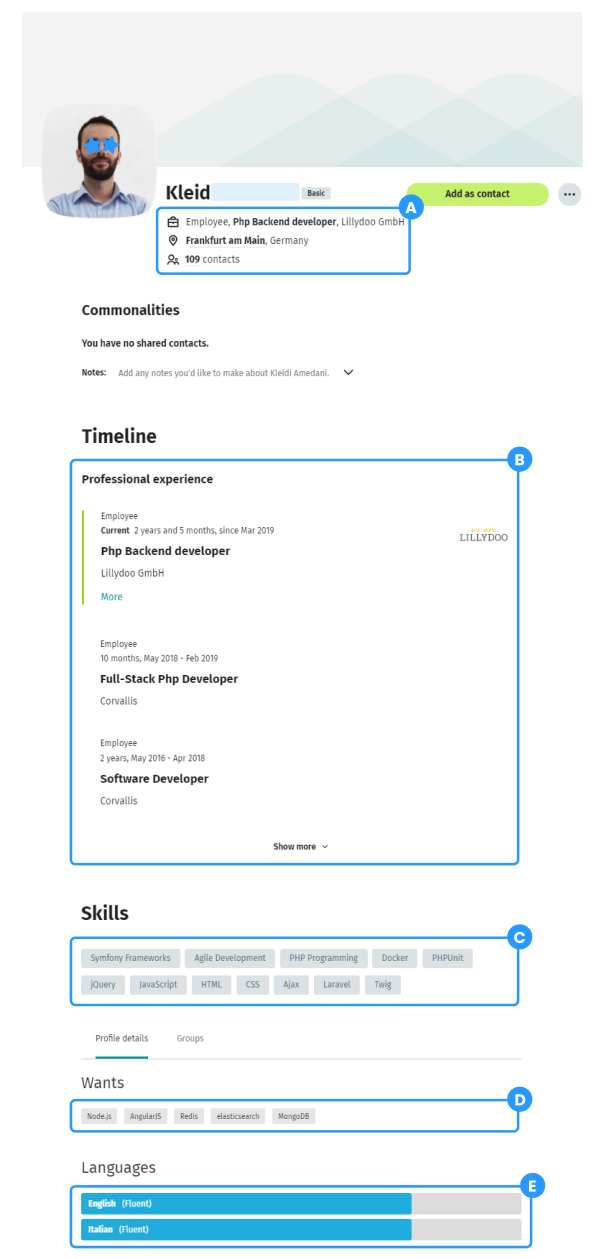
B: Working experience
C: Current skills
D: Desired skills to work with
E: Language proficiency
How to search in Xing
There are three routes in: free, a consumer subscription, and the recruiter product. Work them in that order and only pay when the cheaper route runs out.
1. Search in XING (free and Premium)
You can search for candidates in Xing for free using keywords and contact level, and free search is enough to confirm whether a talent pool exists at all before you spend anything. Premium adds the advanced filter set (company, location, industry, field of activity) and lets you see who viewed your profile. It is a consumer-priced subscription rather than a recruiting cost, but check the number yourself: Xing puts its purchase pages behind a login wall, so every price you will find quoted for it (including the ones in older versions of this guide) is second-hand. The only one that counts is the one in your own checkout.
The real limit on the free and Premium tiers is not search, it is contact. Messaging people who are not already your contacts is what Xing gates, and that gate is what the recruiter product exists to sell.
2. Search in Google (X-ray)
Xing profiles are still publicly indexed, so you can build a shortlist without an account. This still works in July 2026 and we checked why rather than assuming: xing.com/robots.txt disallows /search/, /people/search/ and /publicsearch/, but it does not disallow /profile/, and a public profile fetched while logged out still ships a robots: index, follow tag.
So aim at the profile path, not the site root, or you will drown in job ads:
site:xing.com inurl:profile intext:backend engineer php
Two practical notes. First, the useful data is in the meta description Google indexes: a public Xing profile exposes name, city, current role and employer there, which is exactly the match key you need. Second, do not expect a 100% hit rate. Profile visibility is a member setting, and a fair share of profiles bounce a logged-out visitor to a login screen. X-ray gives you names and employers reliably; it gives you full work histories only sometimes.
3. What to do with the profiles you find
This is the step every Xing guide skips. X-ray hands you thirty browser tabs, and Xing has no export. If you do not file the profiles somewhere as you go, you will re-run the same search next month and re-read the same profiles.
The specific thing to look for is a sourcing extension that actually reads Xing. Most recruiter extensions only speak LinkedIn, which is why this is a shorter list than you would guess.
Manatal
Manatal is worth a look here for one narrow reason: its People-Match AI browser extension is one of the few that parses a Xing profile into a candidate record at all, so the shortlist you just X-rayed goes somewhere instead of into tabs. Read its own docs before you buy, though, because they are blunt about the limit: Xing sits on the beta list, and on beta platforms "only the 'Create Candidate' functionality is supported for now". The profile enrichment and sourcing insights are LinkedIn-only. On Xing you are getting profile capture, nothing clever. Pricing is $15 per user per month billed annually ($19 month to month), but that tier caps at 15 active jobs and 10,000 candidates, so an agency desk running more reqs than that is really pricing the $35 tier ($39 monthly). One more thing a DACH buyer should weigh before anyone else does: Manatal's own GDPR page states "our servers are located in the US and we are currently hosted on AWS", and it leans on the EU-US Data Privacy Framework rather than EU data residency. If your works council will not sign that off, take the EU-hosted option below instead. The trial is 14 days and takes no card.
That EU-hosted option is Recruitee, whose sourcing extension also lists Xing among the sites it reads (with GitHub, Stack Overflow, Stack Exchange and Dribbble). Its help centre states it hosts strictly in the EU, on Google's Frankfurt and Berlin data centres (europe-west3) and AWS Frankfurt (eu-central-1), under an ISO 27001 certificate that names the ATS. For a German buyer that answers the data-protection question in one line instead of three. The trade-off is the meter: Recruitee prices on active job posts, five on the entry tier, which is a job-posting model rather than a sourcing one. A lone sourcer with two open roles and a thousand Xing profiles to file is paying on the wrong axis.
Xing's recruiter product: onlyfy TalentManager
If you are sourcing on Xing seriously, this is what you actually buy, and the name is the first thing that trips people up. In September 2022 New Work SE folded Xing E-Recruiting and Prescreen into a new B2B brand called onlyfy by XING. Xing TalentManager became onlyfy TalentManager. Search for the old name and you will find old prices and old screenshots.
TalentManager is the seat that gives you the full filter set, saved searches, talent pools and, critically, the ability to message members who are not your contacts. It is quote-based and sold on annual contracts, so there is no honest public per-seat number to quote you.
What is worth knowing before the sales call is how onlyfy meters its adjacent products, because the pattern carries. Its applicant manager is priced per job slot (the published "from" price is for a package of five), the minimum contract term is 12 months, notice is three months before the term ends, and it renews for another 12 months if you miss that window. All of that is on onlyfy's own pricing page in the footnotes. Budget for a year, not a month, and put the cancellation date in your calendar the day you sign.
How to approach candidates on Xing
Finding the profile is the easy half. Two things about the German-speaking market will decide whether you get a reply.
Write in German, and write formally. An English message to a Xing profile reads as a mistake, because the entire reason that person is on Xing rather than LinkedIn is often that they work in German. Default to "Sie", not "du". Some tech and startup employers have moved to "du", but getting it wrong in that direction is a real cost and getting it wrong in the other direction is free. Be concrete and unhyperbolic: role, company, location, salary band, why them specifically. German candidates tend to read recruiter enthusiasm as noise.
Prefer in-platform messages to cold email. This is the part that catches out recruiters used to the US playbook. Unsolicited commercial email to someone who has not consented is restricted in Germany under section 7 UWG, and recruiters and staffing agencies do get Abmahnungen (formal cease-and-desist warnings, with costs) for cold approaches. The generally drawn line is that a plain contact request is usually fine, while an unsolicited message offering a service starts to look like advertising. This is one reason messaging inside Xing, where the member joined a jobs network and expects to hear about jobs, is not just the higher-response route but the lower-risk one. It is also the real argument for the paid seat: the free X-ray route gets you the name, and then leaves you holding the riskier way of using it. If you plan to cold-email German candidates at scale, take actual legal advice first. This is not it.
One more DACH-specific lever: New Work SE also owns kununu, the dominant employer-review site in the region. Your kununu rating is visible next to you in this market whether you engage with it or not, and candidates check it. If your score is bad, sourcing harder will not fix your reply rate.
Platform facts, robots rules and vendor pricing checked July 2026 against Xing's, onlyfy's, New Work SE's, Manatal's and Recruitee's own pages. Xing puts its consumer pricing behind a login wall, so no Premium price is quoted here as fact.