




The 2026 field guide to finding, qualifying, and reaching AI engineers and researchers where they actually spend their time: X.
Half of the machine-learning papers shared by AI's most-followed accounts are posted within 24 hours of hitting arXiv, and the papers those accounts endorse earn two to three times the median citations of comparable work - ICML 2024. That single finding tells you why X (the platform formerly called Twitter) is the closest thing recruiting has to a live feed of who is building what in artificial intelligence. Blogs, journals, and LinkedIn posts lag the conversation by days. On X, a researcher announces a model on launch day, an engineer posts the latency numbers they just shaved off an inference server, and a founder quietly writes "leaving the lab, building something new." Each of those is a sourcing signal, and most recruiters never see them.
The reason this matters now is money and scarcity. The best AI people are the most fought-over labor category of the decade: Meta confirmed four-year packages that total roughly $100 million for a handful of senior leaders - TechCrunch, and even a rank-and-file frontier-lab engineer clears half a million dollars a year. When the prize is that large, the winners are not sitting in your applicant tracking system waiting to be found. They are heads-down, employed, and passive, and they broadcast their thinking on X while ignoring their LinkedIn inbox.
But X was never built for recruiters, and in 2026 it actively got harder to use. There is no recruiter product, no reliable way to search bios, and no saved-search alerts. The developer API stopped being a flat subscription and became metered pay-per-use. The multi-column dashboard most sourcers relied on moved behind a $40-per-month tier. Communities, the feature every older "source talent on Twitter" guide told you to join, was shut down in May 2026. And most painfully, a cold message from an unpaid account to someone who does not follow you can vanish silently, with no error and no notification.
This guide is the practical way through all of that. It covers why AI talent concentrates on X, what changed on the platform in 2026, how to build a sourcing stack, the exact search operators and recipes that surface builders, how to qualify a real engineer from a loud commentator, how to write direct messages that actually get replies, the tools and AI agents that turn a handle into a hire, and the legal and ethical lines you cannot cross. It assumes no technical background. Every tactic here can be done in the X app without writing a line of code.
This guide is written by Yuma Heymans (@yumahey), who built HeroHunt.ai's AI Recruiter and has spent years turning scattered public signals, a merged pull request here, an arXiv thread there, a half-finished bio, into a contactable shortlist. He writes from the same identifier-matching problem this guide is about.
HeroHunt.ai
X is where you spot the signal, but the slow part of sourcing is turning a handle into a real person you can contact and screening dozens of them against a live brief. That is the job HeroHunt.ai is built for: its AI Recruiter searches over 1.2 billion public profiles across LinkedIn, GitHub, and the open web, screens each one with a language model instead of keyword filters, and runs the outreach, with a free tier and no credit card. The honest caveat: it is a sourcing and outreach layer, not an ATS, and it does not natively crawl X, so the smart pattern is to use X for discovery and let a tool like this resolve and reach the people you surface.
Contents
- Why AI Talent Lives on X in 2026
- What Changed on X (and What Broke)
- Build Your X Sourcing Stack
- Find Them: Advanced Search Operators and Recipes
- Find Them: Lists, Grok, the Follower Graph, and Spaces
- Qualify Them: Builder vs Commentator
- Reach Them: DMs That Actually Get Replies
- Tools and AI Agents for Sourcing on X
- Automation, Bans, and the Rules of the Game
- The Legal and Compliance Map
- Where X Fails: Bots, Bias, and Blind Spots
- The Future: Agentic Sourcing and Grok-as-Recruiter
- Putting It Together: A Repeatable Weekly Workflow
1. Why AI Talent Lives on X in 2026
Start with the conclusion: X is the discovery layer for AI talent, not a database. LinkedIn is where people who are actively looking go to be found. X is where the people who are not looking go to argue about attention mechanisms, ship weekend projects, and react to model launches in real time. For a category of worker who is overwhelmingly employed and passive, that distinction decides whether you ever reach them at all. The best way to internalize it is a mental model you will use throughout this guide: X reveals how a builder thinks, GitHub and Hugging Face prove what they shipped, and LinkedIn is just a contact address. Effective sourcing chains all three, and it almost always starts with the thinking.
The scarcity behind this is real and getting worse. AI engineer is the fastest-growing job title for young workers two years running, and between 2023 and 2025 LinkedIn added 639,000 US AI-related postings while the pace of AI job growth jumped from 14% to 156% year over year - BigGo Finance. Demand is exploding into a fixed, elite supply. Stanford's index counts 220,520 top AI authors and inventors in the US, more than the next four countries combined, yet the country's ability to attract new AI talent has fallen sharply since 2017 - Stanford HAI. When the pool is that small and that contested, waiting for inbound applications is not a strategy.
The compensation numbers explain the behavior of the people you are trying to hire. A generic software developer earns a median around $133,080, an AI or machine-learning engineer sits near $170,750, and by the time you reach a frontier lab the medians run to $600,000 at Anthropic and $795,000 at OpenAI - Pin. The chart below shows that escalation. The takeaway is not the exact figure at any tier; it is the slope. Someone earning three-quarters of a million dollars is not browsing job boards, and no InMail template is going to dislodge them. They can, however, be reached by someone who clearly understands the specific problem they are working on, and X is where that problem is visible.
AI Compensation Ladder (Median Total Comp, USD thousands)
There is also a hard behavioral fact that makes cold, LinkedIn-first sourcing fail for this group: the best engineers are not job hunting. Stack Overflow's 2025 survey found that 45.6% of developers are not actively looking and another 28.8% are only "somewhat open," which puts roughly three-quarters of the field outside the active pool - Pin. Those same people are extremely active where their work is discussed. That is why "go where the builders congregate" beats "search a resume database harder," and it is why a recruiter who learns X gains access to candidates their competitors never see.
The most valuable signals of all are career moves, and they break on X before anywhere else. When Yann LeCun announced in late 2025 that he would leave Meta to build a world-models startup - CNBC, the news and the wave of people reacting to it played out on X first, publicly and reachably. The same pattern repeats at every level: "excited to share I'm joining," "wrapping up my time at," and "we're hiring for our new team" are posted on X hours or days before they surface on LinkedIn. For a recruiter, a job-move post is the single highest-intent trigger there is, because someone mid-transition is briefly, genuinely open in a way they are not the rest of the year. Watching for those posts among your target accounts is worth more than any volume of cold search.
Where do those builders actually prove their work? Overwhelmingly on GitHub and Hugging Face. GitHub added 36 million developers in 2025, about one new account every second, and public repositories importing a large-language-model SDK grew 178% in a year - GitHub Octoverse. The image below, from that report, maps the surge in AI-related activity that a sourcer is really fishing in. The point for your workflow is that X is the loudspeaker and GitHub or Hugging Face is the evidence locker, so a name spotted on X should always be verified against the code before you invest in outreach.
Where developers actually work
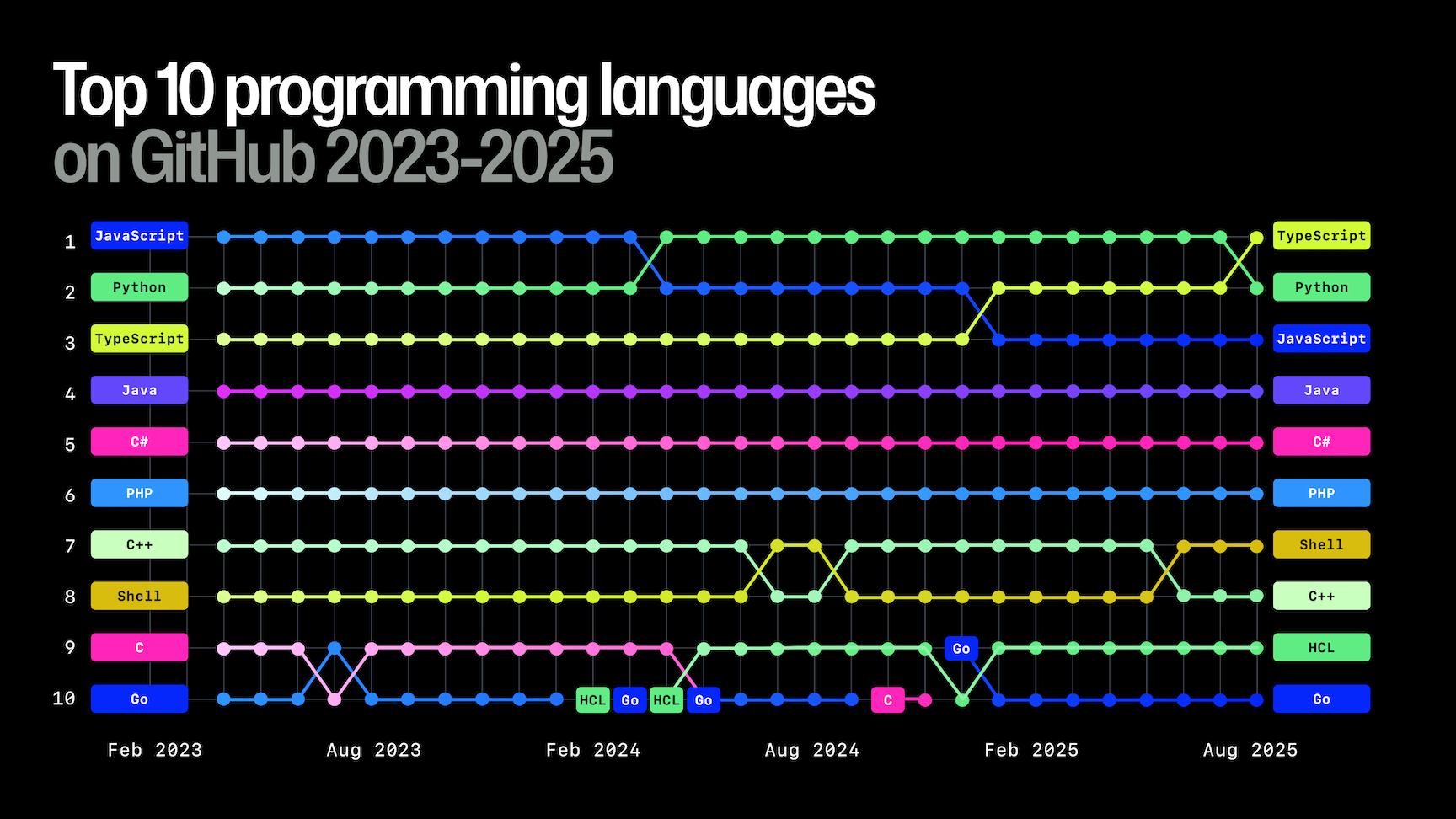
To apply chapter one in one sentence: treat X as the place you notice people and understand their thinking, then move fast to verify and reach them elsewhere, because the window between spotting a signal (a launch, a job move, a frustrated thread about tooling) and everyone else spotting it is measured in hours, not weeks.
2. What Changed on X (and What Broke)
The single most useful thing this guide can do is stop you from following advice that was true in 2023 and is wrong in 2026. X changed more in the last eighteen months than in the previous five years, and almost every change made sourcing harder or more expensive. Getting these facts right is also the fastest way to sound credible to a technical candidate, who will notice immediately if you reference a feature that no longer exists. So before any tactic, here is the honest state of the platform.
The biggest structural shift is that the developer API is now metered pay-per-use. X killed the old flat tiers and, as of February 2026, new developers buy prepaid credits and pay per action: $0.005 to read a post, $0.010 to read a user profile, and $0.010 to pull a follower or following list, capped at three million post reads per monthly billing cycle before you must negotiate an enterprise contract - X developer docs. The legacy $200-per-month Basic and $5,000-per-month Pro subscriptions were force-migrated during 2026. The practical consequence is that "just buy Basic and pull data" is dead advice; building your own X data pipeline is now a real, per-record cost that only makes sense at scale.
The strategic read on the API change is build versus buy. Before 2026, a technically minded team could pay a flat $200 a month and pull enough data to run its own X monitoring. Now every record has a price, so a homegrown pipeline that reads a few hundred thousand posts a month carries a real, recurring bill, and the three-million-read monthly ceiling caps what you can do before an enterprise contract enters the picture. For most recruiting teams that math now favors buying: either a licensed public-data provider for bulk needs, or, more commonly, doing discovery by hand in the app and letting a dedicated sourcing tool handle breadth elsewhere. The era of cheaply scraping X into your own candidate database is over, and pretending otherwise is how teams end up with a surprise invoice or a suspended developer account.
The second change hits the tool most sourcers actually used. X Pro, the multi-column dashboard formerly known as TweetDeck and the home of persistent search columns, moved behind the Premium+ tier at $40 per month on March 26, 2026, a roughly fivefold jump from the $8 Premium plan it used to be bundled with, and X gave no advance notice - MacRumors. If you want a live, side-by-side monitor of standing searches (the closest thing X has to saved-search alerts), that capability now costs $40 a month. It is still worth it for a full-time sourcer, but you should budget for it deliberately rather than assume it is free.
Three smaller changes round out the picture, and each one invalidates a common piece of older guidance:
- Communities were shut down on May 6, 2026, announced by X's head of product because they were used by under 0.4% of users yet generated 80% of spam reports - TechCrunch. The "Machine Learning & AI" Community that every old playbook told you to join no longer exists.
- Grok's best features moved behind paywalls. Tagging @grok in a thread was restricted to paying subscribers around March 2026, and the deep research mode is limited on the $8 tier.
- Location search broke. The classic
near:andgeocode:operators stopped returning results in early 2026 after X dropped precise post geodata, so geographic targeting now runs through plain-text location names or the People tab.
What all of this means in practice is that X sourcing in 2026 is a hands-on, manual-first discipline, not an automated one. The platform has systematically closed off cheap bulk access and pushed the useful monitoring tools behind subscriptions, while its rules (chapter 9) forbid the mass automation that email sourcers rely on. That is not a reason to skip X. It is the reason X still works: because it is annoying to scale, the builders there are not drowning in recruiter spam, so a thoughtful human still gets through. The rest of this guide is built around that reality. Communities are gone, so the workhorses are Lists, Spaces, and search, and the replacement for Communities, XChat "joinable" group chats capped near 500 members, is a nurture channel, not a discovery engine.
3. Build Your X Sourcing Stack
Before you search for a single candidate, decide what you are willing to pay for, because the free version of X quietly sabotages outreach in a way most recruiters discover only after weeks of silence. The stack has two layers: a discovery layer you assemble on X itself, and a resolution layer of tools that turn handles into contactable, screened candidates (covered in chapter 8). This chapter is about the discovery layer and the one non-obvious purchase that makes everything else work: a paid subscription buys deliverability, not just volume.
Here is the mechanic that traps unprepared recruiters. Every X user picks who can send them a message request from three options: everyone, "verified accounts and people you follow," or no one. A large share of users sit on that middle default. A paid Premium account is treated as a verified sender, so its requests reach those inboxes, while a request from an unpaid, unfollowed account often simply never surfaces, with no bounce and no notification - Postory. If you skip this and DM an AI engineer from a free account they do not follow, your carefully written message can be invisible. That is the single strongest argument for holding Premium before you start.
Picture the failure concretely: you spend twenty minutes crafting a thoughtful message to a research engineer who does not follow you, send it from your free account, and wait. No reply ever comes, and you conclude X outreach is a waste of time. What actually happened is that the engineer's inbox accepts requests only from verified senders and people they follow, so your message was filed somewhere they will never look, with no indication to you that anything went wrong. The engineer never rejected you; they never saw you. Paying the eight dollars a month that makes you a verified sender is not about status, it is the difference between your outreach existing and not existing.
The consumer tiers, at web prices (buying through the iOS or Android app costs more), are straightforward and worth memorizing:
- Basic, $3 per month ($32 per year): minor perks, not enough for sourcing.
- Premium, $8 per month ($84 per year): the blue check that makes you a verified sender, plus reply priority. This is the working recruiter's floor.
- Premium+, $40 per month ($395 per year): the largest reply boost, no ads, full Grok, and access to X Pro columns - MacRumors.
For most individual sourcers, Premium at $8 is the essential purchase and Premium+ at $40 is the upgrade you make once you are running standing searches daily and want the X Pro dashboard. Do not confuse the two: you can send message requests as a verified sender on the $8 tier, so you do not need the $40 plan just to reach people. You need it if you want the live multi-column monitoring that turns X into a pipeline rather than a series of one-off searches. Employers who also want to post jobs are in a different bucket entirely, since posting on X's job board is restricted to Verified Organizations at $200 to $1,000 per month - TechCrunch, though job search itself is open to everyone at x.com/jobs.
The whole method fits one repeatable funnel, shown below. You surface candidates through search, Lists, Grok, and engagement mining; you qualify them by pivoting to their code; you warm them up with genuine engagement; you send one precise message; and you move the conversation off-platform the moment they reply. Each stage has its own chapter, but keep the shape in mind, because the discipline is in never skipping a step (especially the warm-up, which is what separates a 2% reply rate from a 30% one).
To apply this chapter: buy Premium first, add Premium+ and X Pro when you are sourcing daily, and never send outreach from a fresh account, both because it is not a verified sender and because, as chapter 7 explains, a brand-new account's messages get filed straight to spam.
4. Find Them: Advanced Search Operators and Recipes
The core sourcing primitive on X is the advanced search box, and it is more powerful than most recruiters realize, provided you understand one gotcha that trips up nearly everyone. X search matches the text of posts, not the text of bios. So a search for "machine learning engineer" returns people who wrote that phrase in a tweet, not people whose profile says it. That distinction shapes everything: to find people by what they say in a post (their interests, availability, projects) you use operators, and to find people by what their profile says (their title, employer, location) you use the People tab or a dedicated bio-search tool. Getting this backwards is the number-one reason recruiters conclude "X search doesn't work."
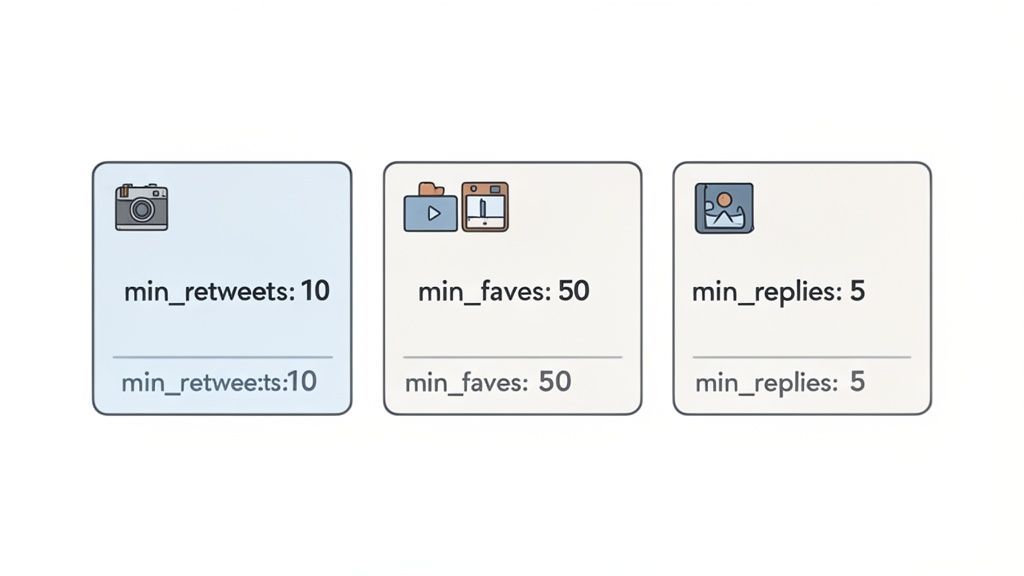
The operators themselves live at x.com/search-advanced, and the most useful ones for sourcing are from: and to: (posts by or replying to a handle), quoted "exact phrases", OR and the minus sign for logic, since: and until: for dates, min_faves: and min_retweets: for engagement floors, filter:links for posts containing a link, lang: for language, and url: to find people linking a specific domain - PostFast. One power move: any search can be saved as a bookmarkable URL of the form x.com/search?q=YOUR-QUERY&f=live, where f=live shows the latest results and f=user shows matching people. Since X has no native saved-search export, bookmarking your best queries is how you make them repeatable. The screenshot below shows the filter panel these operators drive.
The X advanced search filter panel
There is a critical trap the moment you move from the search box to any tool or the official API: the operator names change. The consumer search box uses min_faves:, min_retweets:, and filter:, but the API uses min_likes:, min_reposts:, and the is: and has: families instead - X developer docs. Copy a working web query into an API-based tool unchanged and it will silently fail or return nothing. For a non-technical recruiter this matters because many third-party X tools are API-backed, so if a query that works in the browser returns empty in a tool, the operator syntax is usually why.
Now the payoff: reproducible search recipes you can paste into x.com and adapt. Each one is built from the verified operators above, and each targets a different slice of AI talent - Fedica:
- Builders shipping with a portfolio link:
("training LLMs" OR "fine-tuning" OR "pretraining") filter:links min_faves:15 lang:en -filter:replies - Inference and serving engineers:
("inference" OR "vLLM" OR "quantization" OR "CUDA kernels") ("hiring" OR "open to" OR "portfolio") filter:links - Applied and RAG builders who shipped something:
("RAG" OR "retrieval augmented" OR "vector database") ("shipped" OR "built" OR "demo") min_faves:25 - Open-source authors linking their repo:
url:github.com ("open source" OR "weights") ("LLM" OR "transformer") min_faves:30 - Availability signals around a launch window:
("open to" OR "looking for") ("ML" OR "AI" OR "LLM") -is:retweet lang:en since:2026-06-01
Read those recipes as templates, not spells. The operators are reliable; the exact yield depends on your role, region, and timing, so expect to tune the keywords and engagement floors. The workflow is always the same: run the query on the Latest tab, click into promising posts, open the author's profile, and either add them to a private List (chapter 5) or pivot to their GitHub (chapter 6). Because search returns posts rather than profiles, building a candidate list from operators is inherently manual, one click per person, which is exactly why the passive, high-quality pool stays uncrowded. For the profile-keyword searches that operators cannot do, the People tab is your first stop, and bio-search tools are the upgrade, covered next. The short tutorial below walks through the filter panel visually if you prefer to see it in motion.
Work one recipe start to finish to feel the rhythm. Paste the inference-engineers query, switch to the Latest tab, and skim for posts where someone is describing their own work rather than resharing news. When you find "finally got vLLM speculative decoding stable, here is the throughput," open the author, glance at their bio and pinned post for a GitHub or Hugging Face link, and if it checks out add them to a private List named for the role. Do not message yet. Ten minutes of this yields five to fifteen real candidates, each already filtered by the fact that they were publicly doing the exact work you are hiring for. Then narrow the same query with a tighter keyword or a higher engagement floor and run it again next week to catch new names, which is how a one-off search becomes a standing pipeline.
How to Use X Advanced Search Filters
5. Find Them: Lists, Grok, the Follower Graph, and Spaces
Search finds people one at a time; the techniques in this chapter find them by the dozen and let you monitor them without tipping anyone off. The most important is the humble List, which is the free, silent backbone of an X pipeline. A private List lets you group profiles without following them and without notifying them, so you can quietly assemble a running roster of, say, "PyTorch contributors" or "NeurIPS 2025 authors" and read it as a clean feed separate from your noisy timeline - Unfollr. Public Lists do notify the people you add, so for sourcing you almost always want Private. Combined with the list: search operator, a List becomes a scoped search space: you can run keyword queries against only its members.
The second technique is engagement mining, and it is where X's real-time nature becomes a superpower. When a major model launches or a respected researcher posts a strong thread, the people who like, repost, and reply are a pre-qualified pool: they self-selected into caring about that exact topic on that exact day. You can open those engagement lists from the post's menu, and the likers and repliers of a launch thread are often a denser concentration of relevant, active engineers than any keyword search will produce - PostSyncer. The related move is follower-graph mining: start from a high-signal account, then look at who it follows and who follows it to discover second-degree peers, since strong engineers tend to follow other strong engineers. Native X only shows "followers you know," so relationship tools like Fedica's compare-users feature do the heavy lifting - Fedica.
A concrete engagement-mining pass looks like this: when a major open-weight model drops and the launch thread racks up thousands of reposts, open the repost and reply lists and skim for people posting their own results, "ran the 8B on a single 4090, here are the tokens per second," rather than one-word hype. Those are hands-on engineers who just self-selected into your exact topic on the day they were most active. Add the best ten to a private List, spend a few days engaging with their other posts, and you have a warm shortlist built entirely from one launch you did not create. This is the move that has no equivalent on LinkedIn, where there is no real-time public reaction to mine, and it is why timing your sourcing to launch days consistently outperforms steady-state searching.
Both techniques need seed accounts to mine, so start from a short list of high-signal AI voices and expand outward from their audiences and threads:
- @karpathy (Andrej Karpathy) for deep-learning thinking and minimal teaching codebases
- @_akhaliq (AK) for a near-real-time firehose of new arXiv papers and model releases
- @rasbt (Sebastian Raschka) for practical, from-scratch machine learning
- @simonw (Simon Willison) for hands-on LLM tooling and security
- @emollick (Ethan Mollick) for applied-AI adoption and experimentation
Those are starting points, not a definitive canon - KDnuggets. The value is not in following them for their takes; it is in mining the people who engage with them. When @_akhaliq posts a new model, the engineers quote-tweeting it with "just ran this on my setup, here are the numbers" are exactly the hands-on builders you want, and they are one click from their own profile and their own repo. Note one correction older guides get wrong: "AK" is @_akhaliq (Ahsen Khaliq), the paper and model aggregator, not Andrej Karpathy. They are different people, and confusing them in a message to a candidate is the kind of tell that ends a conversation.
The freshest addition to the toolkit is Grok, xAI's assistant built directly into X, which for a non-technical recruiter is the closest thing to a boolean-search replacement. Grok can search live X posts as a primary source and answer natural-language questions like "who has been posting about long-context inference on X in the last week," returning a single cited summary - BuildFastWithAI. Its deep research mode does multi-step discovery across X and the web at once. Access is tiered: a free account gets roughly ten prompts every two hours, full Grok is bundled into Premium at $8 and Premium+ at $40, and the unlimited deep-research tier runs $30 per month. Grok is a discovery and triage aid, not an outreach system, so use it to build and understand a shortlist, then reach people the manual way. The beginner walkthrough below covers its search abilities.
Ultimate Grok Tutorial for Beginners in 2026
Finally, do not overlook Spaces, X's live audio rooms, which survived the 2026 cuts and improved: any account can host, there is a dedicated Spaces tab, and you can now listen on the web without an account - Unfollr. An AI-topic Space is a warm sourcing surface. The speakers are self-selected experts, and the active listeners and repliers are engaged practitioners you can add to a List and warm up. Treat Spaces the way a good recruiter treats a conference hallway: you are not pitching, you are noticing who is thoughtful and building relationships you will use later. The practical rule for this whole chapter is that discovery on X is a graph problem, not a search problem: find one great node, and the people around it are your next twenty candidates.
6. Qualify Them: Builder vs Commentator
The hardest skill in AI sourcing is telling a builder from a commentator, because X is full of confident people who post takes but ship nothing. This chapter is the filter, and it is the highest-leverage skill you will learn here, because a great message sent to the wrong person still fails. The core principle: commentators post opinions, builders post artifacts and numbers. A commentator explains why an architecture is exciting. A builder posts the repo, the benchmark, the cost they cut from eleven cents per call to four, and a link to a live demo. Your job is to look past the follower count and find the evidence.
The good news is that genuine AI builders leave a checkable trail, and the strongest signals are concrete and specific rather than rhetorical - Qureos. When you open a promising profile, look for a small number of these tells:
- Merged pull requests into a real framework (a contribution to LangGraph or a popular library, not a forked tutorial)
- A published tool or model with a model card, a Hugging Face Space, or a package other people install
- Production numbers in-thread: latency, cost per invocation, throughput, eval scores, the details you cannot fake
- Named evaluation and observability tools (LangSmith, Langfuse, Braintrust, Arize) that signal real production experience
- Links in the bio or pinned post to GitHub, a personal site, arXiv, or Hugging Face
If a profile shows two or three of those, you are almost certainly looking at a real practitioner. If it shows none, you may be looking at someone who is very good at talking about AI, which is a different hire. This is also where the identifier pivot pays off: an X profile is a starting point, and the fastest way to verify it is to jump to the person's code. Builders reuse handles, so a username on X frequently maps to the same or a near-identical username on GitHub (watch for a swap from john_smith to john-smith, since GitHub disallows underscores), and username-checker tools can resolve one handle across hundreds of platforms at once - WhatsMyName. The pivot runs both directions: Hugging Face and GitHub profiles usually expose the person's X link too, so you can start from a trending model's author and land on their X handle to reach them.
Here is how that looks in practice. Say a recipe surfaces an account with 1,200 followers whose bio reads "building agents, ex-startup" and a pinned post claiming a new open-source RAG framework. The commentator test is one click: open the linked repo. If it has real commit history over months, issues filed by actual users, tests, and a model card with benchmark numbers, you have a builder, and the pinned claim checks out. If the "framework" is a three-file wrapper forked last week with no stars and no tests, the confident bio is doing the work the code cannot. That qualification took ninety seconds and saved you from warming up and messaging someone whose only real skill is posting. Multiply it across a week and the discipline of pivoting before messaging is the difference between a pipeline of real engineers and a list of loud accounts.
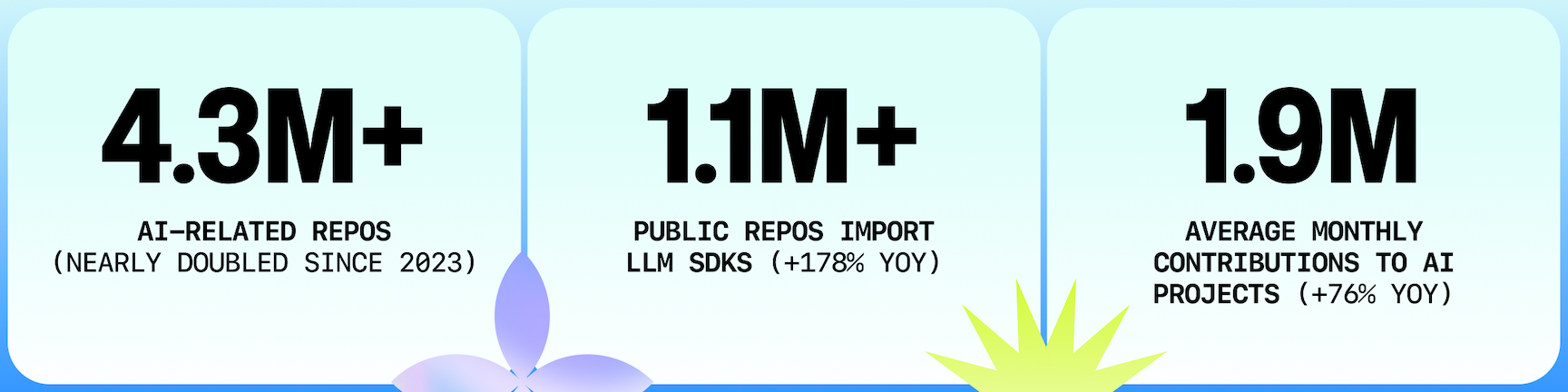
The image below, from GitHub's 2025 report, quantifies why GitHub is the evidence locker that makes X signals trustworthy. The surge in AI repositories and contributors is the pool that turns a vague "posts smart things about LLMs" into a verifiable "maintains a library 40,000 people depend on." The practical move is to never skip the pivot: a candidate who looks brilliant on X but has no shippable proof anywhere should be treated as a lead to investigate, not a qualified prospect, because the whole reason X works for AI is that the real builders are one click from their code.
The AI builder pool, quantified
Two honest caveats keep this from becoming naive pattern-matching. First, the strongest builders are often the quietest: a frontier-lab researcher under a nondisclosure agreement may post almost nothing verifiable, and their absence of public artifacts is not a lack of skill. Second, an enormous share of the best open-source AI work now originates outside the English-speaking X audience, with China accounting for 41% of Hugging Face downloads and a majority of trending open-weight models in 2026 - Hugging Face. For those two groups, X is a weak channel and GitHub, Hugging Face, arXiv, and warm referrals matter more. Qualification on X is therefore a tool for the loud, prolific 20% of the field, and you need other channels for the silent frontier.
7. Reach Them: DMs That Actually Get Replies
The reason to bother with X outreach at all is that the people you most want to hire have muted every other channel. Senior engineers are numbed to LinkedIn InMail, a LinkedIn Recruiter seat costs upward of $10,000 a year, and the best candidates are not job hunting. Meanwhile the evidence that channels are not interchangeable is stark: across more than 165,000 candidates contacted on both email and LinkedIn, 15.5% replied only on LinkedIn while 3.3% replied only on email - Pin. A meaningful share of responsive people are reachable on exactly one channel, so adding X captures candidates you would otherwise never touch. The goal is not to replace email or LinkedIn; it is to reach the person who ignores both but is voluntarily present, and talking about their work, on X.
The numbers explain why the method matters more here than anywhere else. Cold email response has collapsed from 8.5% in 2019 to 3.43% in 2026 - Martal, recruiting-specific LinkedIn messages land near 17% per message versus about 4.9% for email, and X direct messages span an enormous range depending entirely on how you send them - BlockAI. A pure cold DM gets 1 to 3%. A warm DM to someone who already follows you gets 8 to 15%. A genuinely personalized cold DM reaches 25 to 40%. The chart makes the spread concrete. The lesson is unambiguous: on X, the difference between a wasted afternoon and a full pipeline is entirely in the personalization and the warm-up, not the volume.
Reply Rate by Channel and Approach (%)
The warm-up is the part email sourcers skip and the part that makes X work. Over several days before you message anyone, follow them, like four or five of their recent posts, and leave two or three substantive replies that engage with their actual work, not "great post." This does two things at once: it converts a cold recipient toward a warm one (targeted follows earn a 19 to 24% follow-back in technical niches, and a follow means your DM lands in their inbox rather than the ignored Requests folder), and it makes you a familiar name instead of a stranger - BlockAI. There is a second warm-up you must not forget: your own account. A brand-new or dormant recruiter account has its DMs routed to spam, and roughly ten days of normal human activity restores deliverability before you contact real prospects - Xreacher.
When you do message, the structure that works for engineers and researchers is short and specific: one concrete observation about their work, one sentence on why them and what the opportunity is, and one low-friction question, in three to five sentences with no links in the first message - ReachForge. The personalization must come from their posts or repos, never generic praise: "your thread last week on cutting KV-cache memory" beats "love your work," and it demonstrably moves the number, since developer outreach that names a specific commit or pull request can lift replies toward 60% - Pin. Avoid "I saw your profile" and anything that reads as a template, because engineers detect them instantly. Lead with the interesting problem, not your company's funding. And a consent-first shortcut worth knowing: searching for "DMs open" in bios surfaces builders who have explicitly invited cold contact, sidestepping the deliverability problem entirely - TweetHunter.
A concrete example makes the difference obvious. A weak message reads: "Hi, I saw your profile and think you'd be a great fit for a Senior ML Engineer role at a well-funded startup. Do you have 15 minutes to chat this week?" It is generic, it flatters nothing specific, it leads with the company, and it asks for a call before earning a reply. A strong version of the same outreach reads: "Your thread on cutting KV-cache memory with paged attention was the clearest explanation I have read. We are fighting the same bottleneck serving a 70B model on a tight latency budget. Out of curiosity, did the paged approach hold up under bursty traffic, or did you fall back to something else?" It names real work, engages a technical choice, asks a question answerable in one line, and never mentions a job. The likely reply to the second is not "no thanks," it is an answer about paged attention, and now you are in a conversation. That single reframe, from pitching a role to being curious about a decision, is what moves an engineer from ignoring you to talking to you.
Cadence on X is much tighter than email, and getting it wrong is worse than sending nothing. Send exactly one follow-up after three to seven days with a new angle or a lighter ask; a second follow-up with no reply is the absolute maximum and "crosses into harassment," after which you stop DMing and keep engaging publicly - BlockAI. Time the message to a real signal (they just shipped something, changed jobs, or complained about their stack) rather than the clock, because signal-timed messages sit at the top of the response ladder. Once someone replies, move the conversation to email or a calendar link, since X is the warm top of a multi-channel funnel and sequencing across channels lifts results substantially over any single one - SendIQ. The whole discipline inverts the email sourcer's instinct: on X, less automation and more patience produce more replies.
8. Tools and AI Agents for Sourcing on X
The honest truth about the tooling market is the most useful thing in this chapter: X ships no recruiter product, and almost no AI sourcing agent is natively X-aware. So sourcing AI talent on X is a two-layer job. Layer one is X-native discovery, the search, Lists, Grok, and audience tools that tell you who is worth contacting. Layer two is a cross-web sourcing agent that resolves those handles into contactable, screened candidates and runs compliant outreach. Understanding that the big platforms operate at layer two, and that they reach X talent through GitHub and the open web rather than by crawling X directly, saves you from expecting any single tool to do the whole job.
At layer one, your cheapest native option is the X subscription itself: Premium+ at $40 per month unlocks X Pro's monitoring columns, and Grok (bundled, or $30 standalone for unlimited deep research) is the standout 2026 discovery aid because it queries live X in plain language. Because X search cannot read bios, the useful add-ons are bio-search and audience tools: Followerwonk, now part of Fedica, does boolean bio search with a free tier - Followerwonk, and Audiense profiles the followers of an AI lab or thought-leader to surface dense clusters of engineers, priced from a free tier and a $62.99-per-month Pro plan up to enterprise audience-intelligence contracts - TrustRadius. For teams that need bio and follower data at volume without the official API, licensed public-data providers such as SocialData sell it at around $0.20 per 1,000 results - SocialData, though chapter 10 explains why you should treat any bulk data pull cautiously.
At layer two, the AI sourcing agents are where a handle becomes a hire, and here is the pricing landscape at a glance, all cross-web tools rather than X-first ones:
- HeroHunt.ai: an autonomous AI Recruiter across 1.2B+ profiles with language-model screening and multichannel outreach, free to start with no credit card - HeroHunt.ai
- Juicebox (PeopleGPT): natural-language search over 800M+ profiles, Free, then $119 and $199 per seat monthly, plus a $199-per-agent autonomous add-on - TrustRadius
- SeekOut: 800M+ profiles with skills inferred from GitHub and publications, self-serve from $149 per month - Fabric
- hireEZ: 45+ open-web sources including GitHub and Stack Overflow, roughly $169 to $250 per seat monthly - Vendr
- Gem: sourcing plus recruiting CRM, published around $99 to $149 per user monthly - Pin
That list interprets one way: the strongest coverage these tools offer for AI talent is GitHub, which is the closest thing to "an X for engineers" that they index well, which is exactly why open-source builders are the most sourceable AI segment. None of them advertises native X search, so the realistic pattern is to spot the person and the signal on X, then hand the handle to an agent that resolves their identity across the open web and runs the outreach. HeroHunt.ai fits that resolution role, positioning itself as an AI Recruiter that searches over a billion public profiles, screens each against your written brief with a language model instead of keyword filters, and reaches candidates on autopilot, with a free tier and no credit card at herohunt.ai. Its honest limits are the same as the category's: it is a top-of-funnel sourcing and outreach layer rather than an ATS, and it is strongest on people who publish publicly, which is also X's blind spot.
Which layer-two tool fits depends on the shape of your hiring, and the honest differences are about coverage and workflow, not marketing. If your roles are open-source and engineering-heavy, prioritize a tool with strong GitHub inference, since that is where your X finds will verify. If you run high volume and want the agent to draft and send, weigh the ones with autonomous-outreach add-ons against their per-seat and per-agent costs. If you already own an applicant tracking system and just need better top-of-funnel, a sourcing-plus-CRM tool that plugs into it avoids duplicating your system of record. The trap to avoid is buying an expensive enterprise platform to solve a discovery problem that X and Grok already handle for the price of a subscription: match the tool to the bottleneck, which for most teams is resolving and reaching the people they have already spotted, not finding more names.
The demo below shows what an AI recruiting agent actually does end to end, which is useful context if you have only ever sourced by hand. The strategic point to hold onto is that these agents solve the scale problem that manual X outreach cannot: personalized human DMs are wonderful at ten candidates and collapse at a hundred, so the mature workflow is to reserve your human touch for the highest-signal X finds and let an agent handle the breadth across the open web.
AI Recruiting Agent for Recruiters: Candidate Sourcing Automation
9. Automation, Bans, and the Rules of the Game
The instinct that ruins accounts is importing an email sourcer's playbook to X: build a list, load a tool, and blast. X prohibits automated and bulk direct messages outright. Its developer policy requires "explicit consent before sending people automated replies or Direct Messages" and forbids "bulk, aggressive, or spammy actions, including bulk following" - X developer policy. Any programmatic mass-DM tool is against the rules regardless of which subscription tier you hold, and in April 2026 X went further, removing likes, follows, and quote-post writes from all self-serve API tiers, which closed off most compliant automation entirely - OpenTweet. Compliant mass automation on X essentially does not exist in 2026.
Even if you never touch a tool, manual outreach gets restricted well below the published caps because the spam filters watch patterns, not just totals. The daily send ceilings are roughly 500 for free accounts, 1,000 for Premium, and 1,500 for Premium+, but those numbers are a distraction, because identical or link-heavy messages "get you restricted at 30 sends as easily as at 500," and Premium buys no immunity - OpenTweet. The signals that trip enforcement are message velocity, high volume to non-followers, copy-paste text, brand-new accounts messaging strangers, and low reply combined with high block-and-report rates. That last one is self-punishing: because negative recipient signals feed X's throttle, a spammy campaign degrades deliverability for everything you send afterward.
The most-enforced rule of all is follow-then-unfollow churn, the old growth-hacking move of mass-following people to farm follow-backs and then unfollowing. "Fifty follows in five minutes is suspicious," and unfollowing at scale within a day or two is a fast route to a ban - Unfollr. Enforcement escalates predictably, and knowing the ladder helps you stop before the point of no return:
- A temporary feature limit (your follow or DM ability is paused for minutes to hours)
- An account lock requiring identity verification to regain access
- A suspension lasting 7 to 30 days
- A permanent ban, which automated-engagement violations can jump straight to
The practical throughline is the opposite of email sourcing: on X, personalized and paced manual outreach beats automated volume, and it is not a close call. The platform has deliberately engineered scale out of the cold-outreach playbook, so the recruiters who win are the ones who treat each DM as a scarce, reputation-linked resource. If you want automation for the parts that genuinely scale, keep it off X and put it in the resolution and outreach layer (chapter 8), where a compliant tool works across the open web and email rather than fighting X's spam machinery. Warm your account, personalize every message, pace your sends, and accept that a few thoughtful DMs a day is the sustainable ceiling, because it is.
10. The Legal and Compliance Map
Sourcing on X touches three escalating layers of legal risk, and a non-technical recruiter needs a working map of all three, because the way you get in trouble is rarely the way you expect. The layers are getting the data (scraping and terms of service), processing the data (privacy law), and deciding with the data (discrimination and AI regulation). None of this is legal advice, and you should involve counsel for anything at scale, but the shape of the risk is knowable and mostly manageable if you avoid a few specific mistakes.
On getting the data, the headline "scraping public data is legal" is half true and dangerous. US courts have repeatedly leaned that way: in the hiQ v LinkedIn line the Ninth Circuit held that scraping public, no-login pages does not violate the Computer Fraud and Abuse Act - Fenwick, and a judge dismissed X's scraping suit against Bright Data in 2024, warning that letting platforms lock up public data risks "information monopolies" - National Law Review. But three caveats gut the headline for recruiters. First, it can still be breach of contract: X's terms, effective January 15, 2026, ban scraping "in any form" and set liquidated damages of $15,000 per million posts, extended in 2026 to those who merely facilitate a violation, such as buyers of scraped datasets - crypto.news. Second, the Bright Data case ended in a confidential 2025 settlement, so it is persuasive, not binding. Third, the moment you use fake accounts or scrape behind a login you lose the "public data" shield entirely. The safe posture is to use the official API or licensed data, and to read and shortlist manually rather than run an unofficial bulk scraper.
On processing the data, the sharpest exposure is European, and the crucial fact is that "public" is not a GDPR free pass. Processing a public X profile of an EU-based candidate still needs a lawful basis (usually legitimate interest, which must survive a balancing test), and the EDPB adopted a dedicated web-scraping framework in 2026 - EDPB. The vivid warning is Clearview AI, fined €30.5 million by the Dutch regulator for building a database from public photos with no lawful basis - Hunton. You are also expected, under Article 14, to notify people whose data you collected indirectly, and to steer clear of inferring special-category traits (politics, health, ethnicity) that are trivially visible in someone's posts. In plain terms: document why you are allowed to process a candidate's data, keep it minimal, and do not build a shadow database of scraped EU profiles.
On deciding with the data, two threads matter. In the US, Title VII and the ADEA still bar selection processes that create unjustified adverse impact, measured by the four-fifths rule, and the risk is now carried by private litigation and state and city law even though federal enforcement pulled back in 2025 and 2026. The cautionary cases are concrete: Mobley v Workday saw a nationwide age-discrimination collective certified against an AI screening vendor - Holland & Knight, and iTutorGroup paid $365,000 after its software auto-rejected older applicants - EEOC. New York City's Local Law 144 requires an independent annual bias audit for automated hiring tools - NYC Rules. In the EU, AI used to source or screen candidates is expressly high-risk under the AI Act, but the surprising, must-get-right fact is that those obligations were deferred by the 2026 Digital Omnibus to December 2, 2027, with penalties reaching €35 million or 7% of global turnover - European Commission. So the hiring-AI rules are a 2027 deadline to prepare for, not a live obligation today, and the practical mitigation across all of this is the same: keep a human in the loop for any ranking or screening decision, and never let an automated tool make the final call.
11. Where X Fails: Bots, Bias, and Blind Spots
An honest guide has to say plainly where X is the wrong tool, because treating it as your only channel produces both bad hiring and real legal exposure. The most important limitation is selection bias: only about 21% of US adults use X, and the base skews male, under-35, and politically non-representative, with roughly 10% using it daily - Pew Research. Sourcing exclusively on X therefore fishes in a pool that excludes roughly four-fifths of US adults and over-represents specific demographics. That is both an efficiency problem (you miss most of the market) and, as chapter 10 explained, an adverse-impact risk (a non-representative source can skew your pipeline by sex, age, or race even without intent). X must be one channel among several, never the whole strategy.
The second failure mode is signal pollution from bots and fake accounts. Independent estimates put inauthentic accounts at roughly 9 to 15% of X baseline, rising to as high as 15 to 44% in high-attention conversations, with some estimates higher still - USC Viterbi. For a sourcer this means follower counts and engagement numbers can be inflated, "influence" is an unreliable proxy for competence, and any list you build from X will contain dead or synthetic accounts. It reinforces the chapter 6 discipline: qualify on verifiable artifacts (real code, real papers, real production numbers), never on reach.
The remaining blind spots are about who X cannot see, and the arXiv figure below illustrates a related trap worth internalizing. There are structural gaps and a screening caution to weigh together:
- The silent frontier: the most capable lab researchers often post little verifiable work under nondisclosure, so their X footprint understates them.
- The invisible majority: enterprise machine-learning and ops engineers frequently leave almost no public trail at all.
- The off-X ecosystem: a large share of top open-source AI work originates in non-English communities that cluster elsewhere.
- Stale accounts: many strong builders keep low-activity profiles and read DMs rarely, so reply rates on unsolicited outreach are structurally fragile.
- Automated-screening bias: research shows evaluator language models can favor resumes they themselves generated, a reminder that AI ranking of AI-adjacent candidates can encode its own distortions.
When the screener has a bias of its own

Taken together, these limits do not argue against X; they argue against X-only. The way to apply this chapter is to use X for what it is uniquely good at (spotting active, thoughtful, prolific builders and reaching them where they are engaged) while running GitHub, Hugging Face, referrals, and a broad-coverage sourcing agent in parallel for everyone X cannot reach. A recruiter who understands the platform's blind spots builds a more representative, more resilient pipeline than one who mistakes a loud slice of the field for the whole.
12. The Future: Agentic Sourcing and Grok-as-Recruiter
The forward view is that the three pieces of X sourcing (the candidate pool, the discovery engine, and the outreach channel) are collapsing into one native stack, and the accelerant is Grok. Its adoption has been vertical: from roughly 35 million monthly users in April 2025 to 117 million by March 2026, per a SpaceX regulatory filing, making it the third most-used chatbot in the US - DemandSage. The chart shows the trajectory. What matters for recruiting is that Grok lives inside the same app where AI builders post, so for the first time the tool that finds people, the assistant that researches them, and the platform where they hang out are the same surface. That is a structural advantage no other network has.
Grok Monthly Active Users (millions)
The next step past a research assistant is an autonomous agent, and it has already begun. Grok Bot, launched in beta in August 2026, is described as an agent that gets its own cloud computer, signs into apps you use, and completes multi-step tasks end to end - InfoQ. Combined with X's pay-per-use API, the ingredients now exist for an agent that searches profiles, drafts personalized messages, and manages follow-ups inside the platform. Whether X ever ships a first-party recruiter product is unknown, but the direction is clear, and it matches what is happening across recruiting: sourcing is the single most common place teams are deploying AI, and the tooling is moving from search assistant to autonomous coworker.
The adoption data confirms this is mainstream, not speculative. Roughly 27% of organizations already use AI specifically in recruiting, 52% of talent leaders plan to add autonomous agents in 2026, and Gartner projects that up to 40% of enterprise applications will embed task-specific agents this year, up from under 5% - Recruiterflow. Crucially, 85% of recruiters still want the final decision to be human, which is the honest frame for where this goes: agents will source, research, and draft at a scale no person can match, and humans will judge, build relationships, and decide. The recruiter who thrives in that world is not the one who resists the agents but the one who supervises them well.
For X specifically, the practical near-term future is a hybrid you can adopt today. Use Grok and its deep-research mode as your discovery and triage engine on X, let a cross-web sourcing agent resolve and reach candidates at breadth, and reserve your own attention for the handful of highest-signal builders where a genuinely human, well-informed message is what wins. The platform got harder to automate in 2026, but the intelligence layer on top of it got dramatically better, and that trade favors the recruiter who pairs machine breadth with human judgment.
13. Putting It Together: A Repeatable Weekly Workflow
The difference between recruiters who complain that "X doesn't work for hiring" and those who fill hard AI roles from it is not talent or luck; it is a repeatable routine. Everything in this guide reduces to a weekly rhythm that respects the platform's constraints while exploiting its unique strength as a real-time signal of who is building what. The decision framework underneath it is simple: use X to discover and understand, verify on GitHub and Hugging Face, warm up genuinely, send one precise message, and move fast off-platform. Skip any step and the numbers fall apart, especially the warm-up, which is the entire reason a personalized X DM outperforms a cold one by more than tenfold.
A realistic week looks like this, and it fits around other sourcing rather than replacing it:
- Monitor two or three standing searches and a private List of target accounts, plus any major model-launch threads, and add fresh names to the List as you find them.
- Qualify each promising profile by pivoting to their GitHub or Hugging Face and confirming real, shippable artifacts before you invest any outreach effort.
- Warm up the strongest five to ten people with genuine follows, likes, and substantive replies over several days.
- Reach the warmed-up shortlist with individually written three-to-five-sentence messages timed to a real signal, then send at most one follow-up.
- Hand off every reply to email or a call, and record what worked so your searches and messages improve each week.
That cadence is deliberately small because X rewards depth over volume, and because a few well-chosen, genuinely personalized touches per day is both the sustainable ceiling and the high-yield strategy. If you need breadth beyond what your own hands can do, that is precisely where an AI sourcing agent earns its place: let it resolve identities and run compliant outreach across the open web while you spend your human attention on the highest-signal X finds. Tools such as HeroHunt.ai exist to do exactly that resolution-and-outreach work at a scale manual DMing cannot reach, which is why the most effective 2026 setup is X for discovery plus an agent for breadth.
Spot them on X, then let an AI Recruiter resolve their profiles across the open web and run the outreach, free to start, no credit card.
The honest bottom line is that X in 2026 is a harder platform than it was, with a metered API, paywalled tooling, and a shrinking set of features, but it remains the one place where the most sought-after, least reachable people in technology voluntarily show their work in real time. That combination (hard to automate, rich in signal) is exactly what keeps it uncrowded and valuable for the recruiters willing to do it by hand. Learn the operators, respect the rules, qualify on evidence, personalize relentlessly, and pair your judgment with the machine breadth of a good sourcing agent, and X becomes the highest-signal channel in your entire sourcing stack.
This guide reflects the state of X, its pricing, and the AI hiring landscape as of September 2026. Platform features, subscription prices, API rates, and regulations change frequently, so verify current details before making decisions or spending money.