




Disclosure: some links in this article are affiliate links. If you sign up through one, HeroHunt may earn a commission at no extra cost to you.
Recruiting talent on AngelList (now Wellfound)
First, the name. AngelList Talent, the recruiting side of AngelList, was spun out and rebranded as Wellfound in 2022. The old links still work: angel.co/recruit now 301-redirects to wellfound.com/recruit. AngelList itself kept the name for its venture business (fund administration, syndicates, cap tables), so if you go looking for candidates on angellist.com today you are in the wrong product. Sourcing "on AngelList" in 2026 means sourcing on Wellfound.
What has not changed is the reason to bother. People create a profile there because they are already in the startup scene or want to break into it. That is a self-selecting pool: you are not persuading a comfortable enterprise engineer that a Series A is a good idea, because everyone in front of you already decided that.
Key facts
- Startup talent profiles, with a heavy remote skew
- 10M+ candidates, 25k+ companies and 100k+ hires, per Wellfound's own numbers (when this guide first ran, AngelList claimed 2.5 million profiles)
- Focussed on people who work or want to work in the startup world
- Free to post jobs and free applicant tracking, with sourcing and messaging behind a paywall
The detail that decides whether you find anyone
Wellfound splits a person into two profiles, and the difference is the whole ballgame for a sourcer. The public profile is always visible and says nothing about whether someone wants a job. The Jobs Profile is the one that surfaces in recruiter candidate search, and it only surfaces if the candidate has set their status to Open to Offers or Ready to Interview. Set to Closed to Offers, per Wellfound's own documentation, "no one can see your Jobs Profile".
So the searchable pool is not 10 million people. It is the slice of those 10 million who have actively raised a hand, and that number is not published. Read that both ways: it caps your reach hard, but everyone you can see has already put their hand up, so you are sending an opt-in message rather than a cold one. Wellfound also hides a candidate's job-seeking status from their current employer, which is why people are willing to flip the flag in the first place.
Information
The information you can find is similar to a LinkedIn profile. The biggest difference is that you will find people with experience predominantly at tech and startup related companies, plus two fields LinkedIn will not give you: desired salary and desired role.
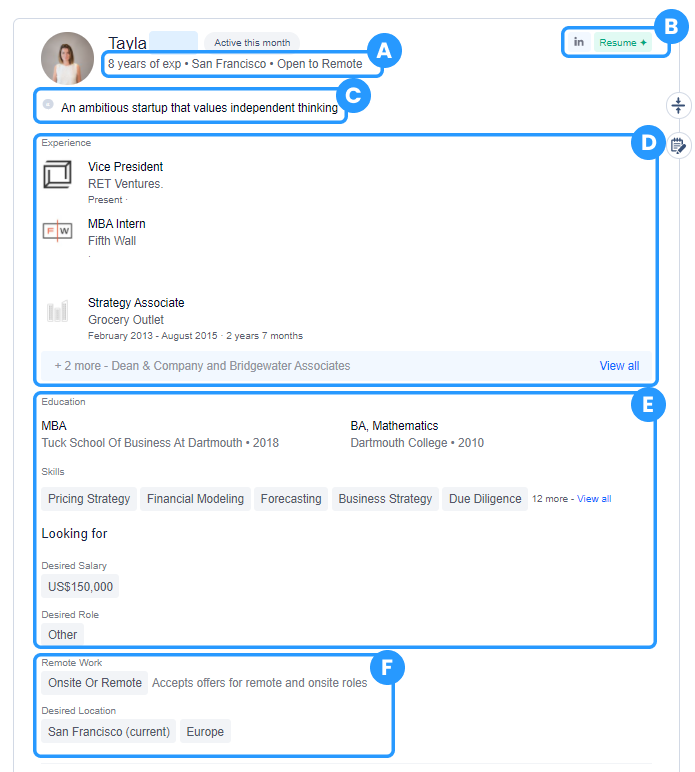
B: Links to socials
C: Summary description
D: Experience
E: Education, skills, salary and desired role
F: Location preferences
How to search Wellfound
Wellfound Recruit
Create an account and log in to Wellfound Recruit. The free tier is called Access: you get job posts, applicant review, a branded company profile and Track (their built-in ATS) for nothing, plus sourcing that Wellfound itself describes as "limited reach". That free ATS is genuinely free and integrates with Greenhouse, Lever and Workable, so there is no reason not to open an account.
The sourcing tier is Recruit Pro at $499/month, which unlocks the part you actually came for: advanced sourcing filters, resumes and social links, personalised pitch templates, instant scheduling and unlimited messaging. Two add-ons sit alongside it: Promoted Jobs from $200, and Autopilot (custom priced), where a 1:1 sourcing expert plus their AI runs outreach and drops 5 to 10 candidates on your calendar per week.
Be honest with yourself about that $499. It is one channel, for startup-minded candidates only. If you are hiring five startup roles at once it is cheap. If you are filling two roles a quarter, it is not obviously better value than the free tier plus your own outbound.
Google X-ray (this used to work, and mostly does not any more)
The old version of this guide told you to X-ray Google with site:angel.co/p saas sales. That advice has expired, and it is worth explaining why rather than quietly deleting it. Public profiles moved to wellfound.com/u/<slug>, and Wellfound's robots.txt now carries a Disallow: /u/ rule. Googlebot is not allowed to crawl the profile pages, so it cannot index the text inside them. Run site:wellfound.com/u with any keyword and you get almost nothing usable: at best a bare URL carrying the generic "Wellfound - Startup Job Search" title, because Google knows the page exists but has never been permitted to read it.
Unlike LinkedIn, then, X-ray is not a back door into Wellfound's candidate pool. It still works fine on the company side: job posts and company pages are crawlable, so site:wellfound.com "series a" "backend engineer" is a decent free way to map which startups are hiring what, and who your competition for a candidate is.
Reaching people without paying the messaging gate
This is where most small teams land: the free tier gets you the job post, the ATS and inbound applicants, but outbound is capped until you pay $499/month, and the X-ray shortcut is closed. The practical route is to split the job. Use Wellfound to find out who exists and who is signalling. Then reach them by email, off-platform, using a contact database that returns the address directly.
That is the step where Apollo.io earns its place in a startup sourcing stack, with a real limitation attached.
Apollo.io
You are deciding whether one startup channel justifies $499/month before you have messaged a single candidate. Apollo.io is the cheaper half of the workaround: filter by company, headcount and title to find people at the startups you just mapped through Wellfound's crawlable job posts, then pull work emails and run outreach yourself. The checkable numbers: the free plan is 900 credits per seat per year, released monthly, so about 75 lookups a month (enough to test the data on your own market, not to run a search on it), and Basic is $49/seat/month billed annually or $65 month to month.
The honest caveat, and it matters here: Apollo tells you where someone works, never whether they want to leave. Wellfound's Ready to Interview flag is exactly the signal Apollo cannot sell you, and it is the reason the platform is worth searching at all. Coverage is also strongest on work emails at companies with a real web presence, so seed-stage engineers and stealth founders come back patchier than GTM people at a Series B. Treat it as reach bolted onto Wellfound's intent, not as a replacement for it.
So is Wellfound worth sourcing on?
Yes, with a narrow brief. It is the highest-intent startup talent pool available, the free tier costs nothing and the candidates have pre-agreed to the premise of startup work. But it is a niche channel, the visible pool is only the opted-in slice, and the free Google X-ray route that used to make it cheap is gone. Open the free account and post the role on day one. Only upgrade to Recruit Pro once you have enough startup reqs open at the same time that $499/month divides into something sensible per hire.
Treat it as one channel, not the plan. The opted-in slice will not fill a whole roadmap of roles, so whatever you run alongside Wellfound, your own outbound or an AI recruiter like HeroHunt.ai, has to search the wider market rather than a single opt-in pool.
HeroHunt.ai
Wellfound's constraint is arithmetic: 10M profiles, but only the share who flipped their status to Open to Offers or Ready to Interview is searchable at all, and Wellfound does not publish that number. HeroHunt.ai works the other side of the trade, searching across roughly a billion public profiles, screening them with language models against your actual brief, and running the outreach, so the pool is the open market instead of one opt-in pond.
The honest caveat is the mirror image of Apollo's. Nobody outside Wellfound can hand you a declared job-seeking status: HeroHunt infers fit from what a profile says and what a person has done, it does not read an intent flag, and it will not give you the desired-salary and desired-role fields that make a Wellfound Jobs Profile unusually quick to qualify. The sane split is Wellfound for stated intent among startup people, broad AI search for the much larger group Wellfound cannot see.