



Disclosure: some links in this article are affiliate links. If you sign up through one, HeroHunt may earn a commission at no extra cost to you.
Recruiting talent on Meetup
Meetup is a platform where groups around a certain topic get together and organize events. These interests can be both nonprofessional and professional. There are profiles of individual members but they are usually not very rich in information. The value sits in the groups that an individual user is a member of. Based on those groups (and events) you can learn about their interests and skills. With over 60 million members worldwide - Meetup - and a strong tilt toward tech, data and startup communities, it is one of the largest interest graphs a sourcer can mine.
Key facts
- All profiles are public
- Over 60 million members
- Groups and events on business topics
Information
Basically two things are important in Meetup as source for talent: the groups (including the events) and the profiles.
Group

A: Group title
B: Group location, amount of members and organizers
C: Group description
D: Upcoming and past events within the group
E: Group members
Profile
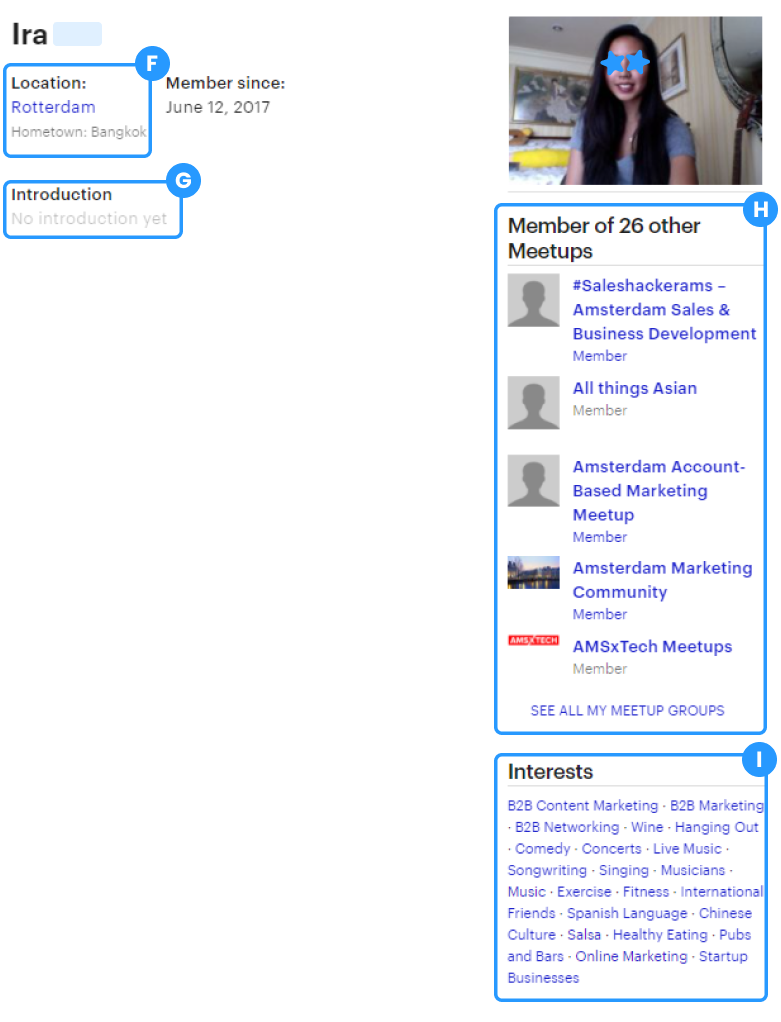
F: Location of individual member
G: Introduction section of member, usually not filled in
H: Other groups the user is a member of
I: Interests based on pre-configured tags
How to search Meetup
One of the most effective ways of finding talent is to attend, or at least scan, the relevant Meetups that you find. The group and member pages are only the starting point: because profile information is scarce, expect to enrich anyone interesting before you can actually reach them (covered below).
Search Google
You can search Google for Meetup groups that are relevant to your sourcing goals.
site:meetup.com intitle: software development
Search Meetup directly
Search relevant Meetup groups in Meetup directly.
Turn sparse profiles into reachable candidates
The hard part of sourcing on Meetup is not finding people, it is reaching them. A member page gives you a name, a city and a set of interest tags, but almost never an email or a phone number, and the introduction field is usually left blank. So the real workflow is two steps: use the groups and events to build a shortlist of genuine enthusiasts, then cross reference each name against LinkedIn and a B2B contact database to recover a work email you can actually message.
For that second step a contact-data tool like Apollo.io does the heavy lifting: you feed it the person and their employer and it returns a verified work email and a direct-dial number. If you would rather skip the manual loop entirely, AI sourcing platforms such as HeroHunt.ai search across 1 billion+ profiles and handle the outreach for you, which is essentially the automated version of the Meetup-then-enrich routine.
Apollo.io
Meetup hands you a name and a list of interests, almost never a way to reach the person. Apollo.io is built to close exactly that gap: paste in the member and their employer and it returns a verified work email and a direct-dial number, so the enthusiast you spotted in a group becomes someone you can message. Its free plan is genuinely $0 (900 credits per seat per year, released monthly), enough to test the routine before you pay. The honest limit: Apollo indexes people through their work identity, so a hobbyist who is between jobs, or whose employer is not in its B2B database, will not resolve, and that is exactly the case Meetup throws at you most.
Conclusion
Meetup rewards patience over volume. Pick a handful of groups that map tightly to the skills you are hiring for, show up to (or scan) their events, and treat the member lists as a warm interest graph rather than a database. The profiles are thin by design, so budget time for the enrichment step: that is where a contact tool earns its keep and where a name becomes a hire.
HeroHunt.ai
If the Meetup-then-enrich loop is the part you want to stop doing by hand, that whole routine is what an AI recruiter automates. HeroHunt.ai searches across 1 billion+ profiles, screens them against your role and runs the outreach, so instead of scanning group member lists one at a time you describe the engineer you want and review a shortlist. The honest caveat: it works from professional profiles, so it does not see the thing that makes Meetup useful in the first place, namely that someone shows up to a Rust or Kubernetes group every month. For that community signal you still have to read the groups yourself, and the two approaches are complements rather than substitutes.
Written by Yuma Heymans (@yumahey), who built HeroHunt.ai, the world's first AI Recruiter, now used by 15,000+ recruiters to source and reach candidates across 1B+ profiles on autopilot.