



The 2026 field guide to sourcing, paying, evaluating, and keeping the scarcest talent on earth
When Meta set out to staff its new superintelligence lab in the summer of 2025, OpenAI's Sam Altman said the offers his people were getting reached $100 million signing bonuses, plus even larger annual compensation - CNBC. One reported package, dangled at a co-founder of Mira Murati's startup, was worth roughly $1.5 billion over six years - TechCrunch. These are not salaries. They are the price of a strategic weapon, and they reset what the phrase "talent war" means.
Here is the problem almost no one says out loud: you will never write that check, and you do not need to. The nine-figure offers apply to a few hundred people on the planet who can build a frontier model from scratch - Odgers Berndtson. The war that affects everyone else is quieter and far more winnable. It is the fight to find, attract, assess, and retain the machine learning engineers, applied scientists, and AI product builders that every serious company now needs, against a backdrop where demand outstrips supply by more than three to one.
This guide is built for that fight. It starts at the top with the landscape and the players, then works down into the specifics: which roles actually matter and what they cost, where the talent hides, the outreach that converts, how to structure compensation and the levers that beat cash, how to evaluate candidates when interviews are flooded with AI cheating and outright fraud, how to keep people once you have them, and how AI agents are rewriting recruiting itself. Every number here is sourced and current to 2026, because in this market a statistic from eighteen months ago is already fiction.
This guide is written by Yuma Heymans (@yumahey), who has spent the past several years building AI recruiting technology and writing about how autonomous sourcing is reshaping talent acquisition. He approaches the talent war from the operator's side: what actually moves a candidate, and what just looks good in a press release.
Contents
- The State of the AI Talent War in 2026
- Who You Are Actually Competing Against
- What "AI Talent" Really Means (and What Each Tier Costs)
- Where AI Talent Actually Hides
- The Outreach That Actually Converts
- Compensation: What It Really Costs to Win
- Beyond Cash: The Levers That Win Researchers
- The Tool Stack: Sourcing and Autonomous AI Recruiters
- Evaluating AI Talent Without Getting Fooled
- Retention: Winning the War After the Offer
- How AI Agents Are Rewiring Recruiting Itself
- The 2026-2027 Outlook and Your Playbook
1. The State of the AI Talent War in 2026
The single most important thing to understand about the AI talent war is that it has split into two markets that barely touch each other. At the very top, a handful of frontier labs and big-tech giants are paying individual researchers like franchise athletes. Everywhere else, tens of thousands of companies are competing for a much broader pool of AI-capable engineers, and they are losing not on money but on speed, focus, and story. If you run talent for a company that is not OpenAI or Meta, your war is the second one, and almost none of the headline tactics apply to you.
The headlines are still worth understanding, because they set the psychological weather of the market. In mid-2025, Mark Zuckerberg personally recruited researchers for Meta Superintelligence Labs, courting prospects at his estate with "exploding offers" that expired in days, and named eleven new hires in an internal memo - Wikipedia. Meta poached around eight OpenAI researchers in a matter of weeks, and reportedly paid former Apple AI leader Ruoming Pang a package exceeding $200 million - Bloomberg. The "$100 million signing bonus" figure was later disputed by the very researchers it described, with poached scientist Lucas Beyer calling the sign-on number "fake news" and Meta clarifying that the large totals were multi-year packages for a few senior leaders - TechCrunch. The truth is less cartoonish than the headline but no less extreme: a tiny number of people now command compensation that detaches entirely from normal pay logic.
That extremity is rational, given the scarcity. Epoch AI estimates that superstar frontier-lab researchers can earn over $30 million a year, roughly six hundred times an average AI postdoc, because the prize they are competing for is "potentially worth tens of trillions of dollars a year" - Epoch AI. When the upside is that large and the qualified pool is that small, a $200 million package is a rounding error against the value of shipping the next model six months sooner. This is the logic that produced the bidding war, and it is the logic the rest of the market has to route around rather than imitate.
The clip below, from the height of the 2025 poaching war, captures the dynamic in the words of the person at the center of it. Sam Altman describes the market as the most intense he has seen, days after Meta pulled engineers out of OpenAI.
OpenAI's Sam Altman on the AI Talent War
For the broader market, the pressure shows up not as nine-figure offers but as a demand curve that has bent almost vertical. US job postings requiring AI skills grew roughly 144% year over year as of April 2026, while overall postings grew just 7%, meaning demand for AI fluency is rising about twenty times faster than the job market as a whole - PwC. The wage premium for AI skills reached 62% in PwC's 2026 barometer, up from 57% a year earlier and from just 25% the year before that - PwC. AI skills now appear in 2.5% of all US job postings, a 297% rise over the decade - Stanford HAI. The money and attention flowing into the field have repriced an entire category of work in real time.
The escalation in individual packages is easiest to grasp visually. The chart below traces the reported jump from a strong lab salary to the poaching offers that made news, and it explains why every recruiter now operates in the shadow of numbers they cannot match.
Reported AI Researcher Pay, From Lab Salary to Poaching Offer
The two-tier split shows up in the aggregate hiring data, not just the headlines. New-hire volume for AI and machine learning roles grew 88% year over year into 2026, and AI/ML engineer is now the single largest AI job category - Ravio. The shape of demand is shifting too: mentions of agentic AI in job postings jumped more than 280% in a single year, a sign that employers are no longer hiring for generic AI knowledge but for the specific ability to build autonomous systems - Stanford HAI. The category you are hiring into is fragmenting and repricing faster than annual salary surveys can track, which is why this guide leans on data current to 2026 rather than last year's benchmarks.
This pressure is not confined to tech companies, and that is the part most hiring plans underestimate. AI skills now carry a premium across nearly every industry, and the hardest-hit functions are often outside the labs entirely, in healthcare and financial services where AI time-to-hire stretches past six months. A regional bank, a hospital network, and a frontier lab can end up bidding for overlapping pools of applied AI talent, even though their budgets and brands could not be more different. For most readers of this guide, that is the real war: not the nine-figure headline, but the quiet, grinding competition for the engineer who can put a model into production and keep it reliable.
Why this matters for your hiring is simple: the war has made AI talent both more expensive and more skittish, even at levels nowhere near the frontier. People who would never get a Meta call still read about Meta's offers, and it shifts their expectations on pay, autonomy, and how fast you move. The hardest skills in the world to hire for, according to ManpowerGroup's 2025 global survey of more than 39,000 employers, are now AI model development and AI literacy, ahead of engineering and sales - ManpowerGroup. How to apply this: stop benchmarking yourself against the frontier labs, which you cannot beat on cash, and start competing on the dimensions where a focused company actually wins, which the rest of this guide lays out in detail.
2. Who You Are Actually Competing Against
Map the battlefield before you pick a fight, because most companies misidentify their real competitor. You are almost never competing with OpenAI for the same individual. You are competing with the three or four companies in your city, your salary band, and your problem space that a given engineer is actually considering. Understanding the full landscape matters anyway, because the frontier labs set the reference prices, the narratives, and the talent flows that ripple down to everyone else.
At the center sit two gravity wells. OpenAI closed a funding round at an $852 billion valuation in March 2026, employs roughly 7,850 people, and filed confidentially for an IPO targeting over a trillion dollars - Sacra. Anthropic raised a $30 billion Series G at a $380 billion valuation in February 2026 on a $14 billion revenue run-rate, then reportedly raised again toward a near-trillion-dollar figure ahead of its own IPO - Anthropic. Crucially, Anthropic is the quiet winner of the talent war: it retains 80% of its two-year hires versus OpenAI's 67%, and engineers leave OpenAI for Anthropic at an eight-to-one ratio - Fortune. That detail is the single most useful fact in this section, and section 7 explains why it should change how you recruit.
Then there is the aggressive tier of big tech and new labs, each with a different recruiting posture. Meta spent the most to catch up, paying roughly $14.3 billion for a 49% stake in Scale AI to install founder Alexandr Wang as Chief AI Officer, then reversing course in October 2025 by cutting around 600 lab roles and pivoting to what Wang called a "smaller and more talent-dense team" - Let's Data Science. The new-lab cohort recruits on research freedom and equity upside rather than raw cash: Ilya Sutskever's Safe Superintelligence reached a $32 billion valuation with no product - TechCrunch, xAI was absorbed by SpaceX in a deal valuing it at $250 billion - CNBC, and Europe's Mistral raised toward a $20 billion valuation with ASML as an anchor investor - CNBC. Microsoft, meanwhile, stood up its own MAI superintelligence team under Mustafa Suleyman and hired away the CEO and key researchers of the Allen Institute for AI - GeekWire.
The video below, also from the 2025 escalation, walks through Meta's strategy in detail and is a useful primer on how the most aggressive player thinks about buying a team rather than building one.
Inside Meta's Hiring Spree
The new-lab tier deserves a closer look, because its volatility is itself a recruiting signal. Thinking Machines Lab raised a record $2 billion seed at a $12 billion valuation behind an all-star ex-OpenAI founding team, yet within a year several of those founders had left, with its CTO and another founder returning to OpenAI and co-founder Andrew Tulloch leaving for Meta - Neowin. Reflection AI, founded by ex-DeepMind researchers, jumped to a reported $25 billion valuation while positioning itself as America's open-weights frontier lab - TechCrunch. The lesson for recruiters is that a marquee logo on a resume is not a guarantee of stability, and that researchers leaving a turbulent new lab are among the most winnable candidates in the market, because they have already shown they will move for the right problem and the right team.
It is also worth knowing the dirty tactics, because they shape candidate psychology. Google DeepMind has reportedly used 6-to-12-month noncompetes with paid "garden leave" to keep researchers, including Gemini contributors, off the market, with some staff said to have contacted Microsoft "in despair" about escaping the clauses - TechCrunch. When you recruit someone leaving a major lab, assume there may be a notice period, a vesting cliff, or a contractual handcuff in the way, and plan your timeline around it.
One more dimension is quietly reshaping the battlefield: geography. With the cost of importing talent to the US rising sharply after the $100,000 H-1B fee, and the share of top researchers based in China and India climbing, the smart non-frontier move is increasingly to hire where the talent already is rather than fight to relocate it. Europe's Mistral built a credible frontier lab on exactly this premise, anchoring world-class researchers in Paris rather than competing head-on for Bay Area salaries. For an ordinary employer the same logic supports remote and globally distributed hiring: a strong applied AI engineer in Bangalore, Warsaw, or Sao Paulo is both more reachable and more affordable than the equivalent in San Francisco, and the marketplace and agentic-sourcing tools covered later make that reach practical. Treating the search as global from the start is one of the few levers that genuinely widens a supply-constrained pipeline rather than just shuffling candidates within it.
Why this matters: if you treat the frontier labs as your competitors, you will design an offer that loses on every axis. How to apply this: identify the two or three companies a specific candidate is genuinely weighing, which are usually in your tier, and win on the comparison that candidate is actually making. For most employers that means competing on ground-floor ownership, autonomy, and speed rather than valuation, an approach that even talent advisors recommend startups lean into deliberately - Burkland.
3. What "AI Talent" Really Means (and What Each Tier Costs)
"AI talent" is not one job, and conflating the tiers is the most expensive mistake a hiring team makes. It is a stack of distinct roles with wildly different scarcity and price tags, and you cannot run a sane search until you know exactly which one you need. The ladder runs roughly from research scientists and research engineers at the top, through machine learning engineers and forward-deployed (applied) engineers, down through AI infrastructure and GPU-systems specialists, data and evaluation engineers, and AI product roles. Each is priced by how few people can do it and how directly it moves a model or a product.
The compensation ladder makes the differences concrete. Cross-company medians on levels.fyi show an AI Engineer around $151K, a Research Scientist around $246K, and a Machine Learning Engineer around $270K in total compensation - levels.fyi. Forward-deployed engineers, the client-facing builders who embed AI into a customer's stack, have become a premium category of their own at roughly $385K mid-level and over $1 million at principal inside frontier labs, versus a $215K median at Palantir where the role originated - Perspective AI. The rarest skill is low-level systems work: engineers who hand-write CUDA kernels or orchestrate training across thousands of GPUs command $300K to $500K-plus, because fewer than a few thousand people worldwide do it well - Second Talent.
It helps to separate the roles by what they actually produce, because the screening signals are completely different. A research scientist generates new methods and publishes; you assess them on papers, citations, and the originality of their ideas. A research engineer turns those ideas into working training runs; you assess them on systems skill and the ability to make large experiments converge. A machine learning engineer ships models into production; you assess them on pipelines, evaluation rigor, and reliability under real load. These three are routinely conflated in a single job post, and that conflation is why so many AI searches stall: the hiring manager pictures a research scientist, the recruiter screens for an ML engineer, and the pipeline fills with people who satisfy neither.
The applied and infrastructure tiers complete the map. A forward-deployed engineer embeds with customers and turns a general model into something that survives contact with messy real-world data, which is why labs now pay them like senior researchers. Infrastructure and GPU-systems specialists keep training and inference fast and cheap, the rarest and least visible skill of all. Data and evaluation engineers build the benchmarks and pipelines that decide whether a model is actually improving, a role that barely existed two years ago and is now central to every serious team. Naming which of these you need, in plain language, before you write the job description is the single highest-leverage step in an AI search.
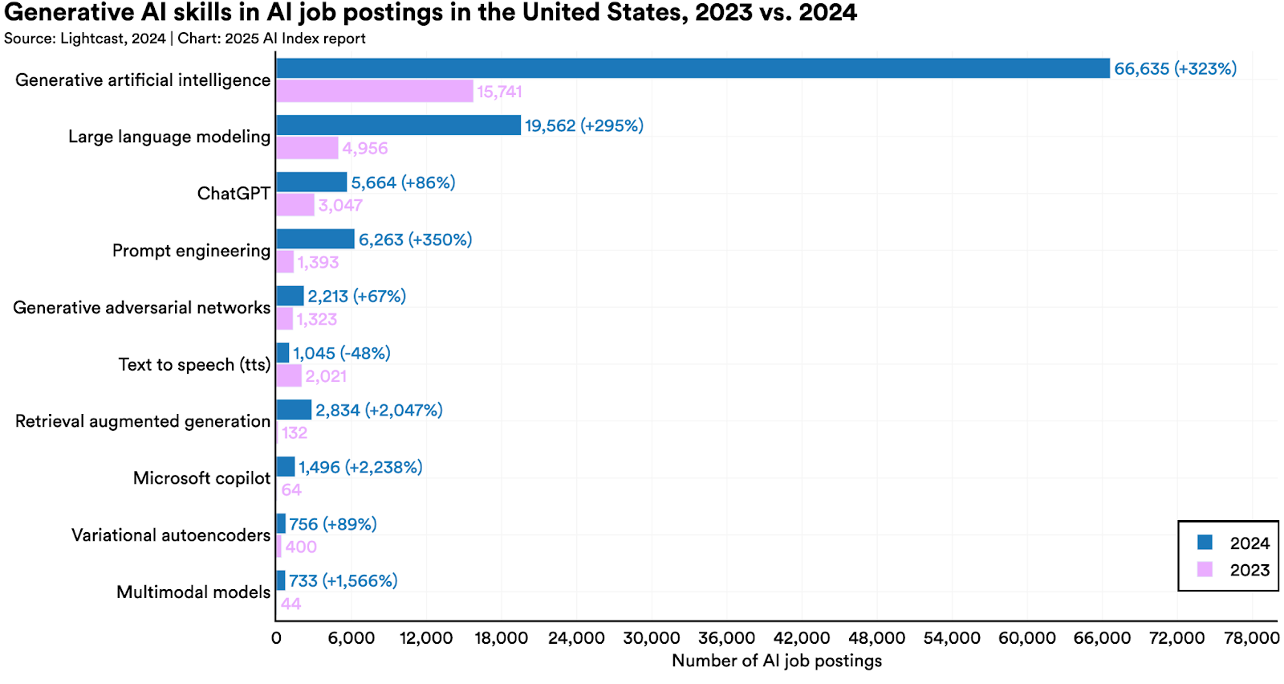
The demand that surrounds these roles has gone vertical, and a single chart from the Stanford AI Index captures why every recruiter feels the squeeze. Generative-AI-specific job postings roughly quadrupled in a single year, a step-change that explains the bidding pressure better than any anecdote.
Set against that demand is a supply pipeline that simply cannot keep up. Globally, open AI roles outnumber qualified candidates by roughly 3.2 to one, about 1.6 million positions against 518,000 people who can fill them, and average time-to-hire for AI roles now runs about 4.7 months - Second Talent. The funnel into the United States specifically is narrowing: the number of AI researchers and developers relocating to the US has dropped 89% since 2017 - Stanford HAI. A September 2025 proclamation imposing a one-time $100,000 fee on new H-1B petitions made importing talent dramatically more expensive overnight, pushing some hiring toward Europe and the Gulf - CNBC. Meanwhile the global center of gravity is shifting, with China now accounting for roughly 47% of top-tier AI researchers, up from 29% in 2019 - Carnegie Endowment.
The practical version of all this is a pricing map you can plan against. The chart below shows typical 2026 total compensation by tier, deliberately stopping at the frontier research scientist rather than the nine-figure outliers, because the outliers are not a market you can hire from.
Typical 2026 Total Compensation by AI Role Tier
Why this matters: a job titled "AI Engineer" can describe a $135K generalist or a $1 million systems specialist, and posting the wrong band wastes months you do not have in a 4.7-month market. How to apply this: write the role around the specific capability you need (does this person fine-tune models, build production pipelines, optimize inference, or ship AI features?), benchmark the band for that exact capability rather than the generic title, and accept that for the scarcest infrastructure and research roles you are competing in a genuinely global, supply-constrained pool where speed and specificity win.
4. Where AI Talent Actually Hides
The best AI talent is rarely browsing job boards, and it is almost never reachable through a generic LinkedIn keyword search. The people you most want have a public body of work, and that work is where you should be sourcing. The shift that separates effective AI recruiters from frustrated ones in 2026 is moving from "search by title" to "search by proof of work," then engaging on the substance of what someone has actually built. This is slower per candidate and far more effective per reply.
Proof-of-work venues are concrete and surprisingly finite. Accepted-author lists at NeurIPS, ICML, ICLR, and CVPR identify the people doing publishable research in a given subfield. GitHub surfaces the maintainers and contributors of the libraries your team already depends on, where an original neural-net project tells you more than any resume bullet. Kaggle is a ruthlessly verifiable signal: of more than 23 million accounts, only 612 have reached Grandmaster status, and NVIDIA alone has concentrated enough of them to dominate competition prizes - ML Contests. Hugging Face model authors, arXiv preprints, and Google Scholar round out a sourcing surface that is public, durable, and ignored by most recruiters.
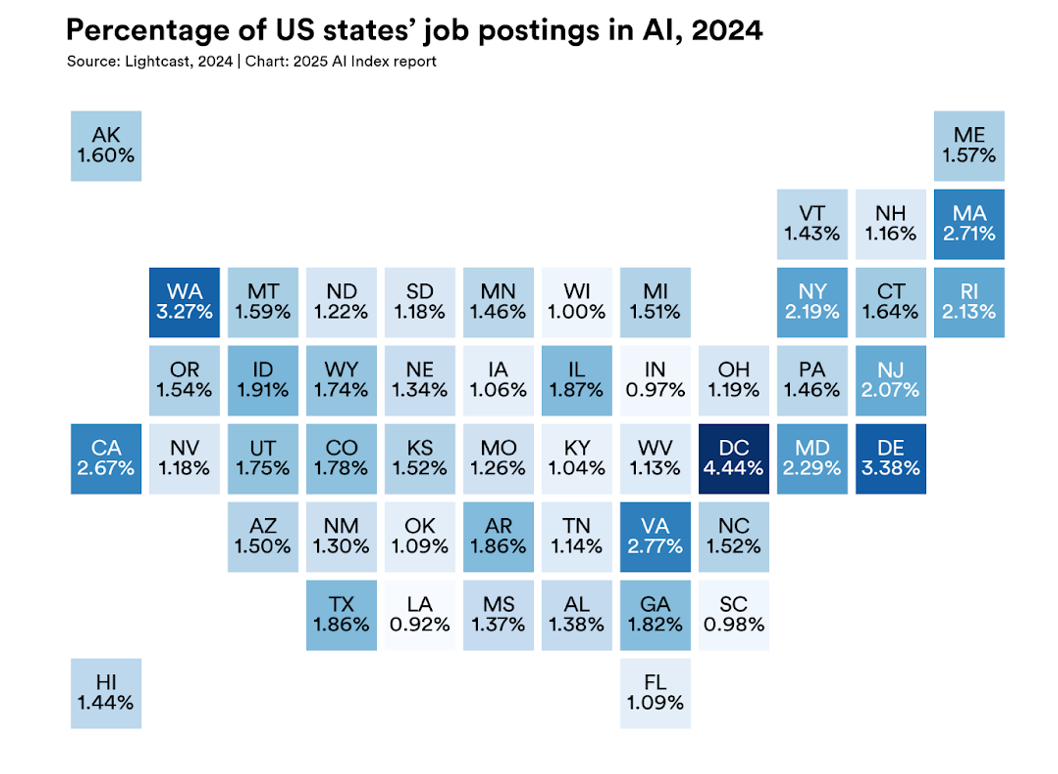
The map below, also from the Stanford AI Index, is a useful reminder that the talent is geographically lumpy. Washington D.C. leads the country in AI job-posting density, followed by Washington state and Delaware, which is not where most recruiters instinctively look.
The most aggressive companies do not source individuals at all when they can buy a team, and the rise of the "reverse acqui-hire" is the defining corporate tactic of this era. Microsoft licensed Inflection's models and hired its founders for $650 million - American Action Forum, Google paid roughly $2.4 billion to license Windsurf's technology and take its CEO and top researchers - CNBC, and Meta's Scale AI deal followed the same template. These structures, which acquire the people without a formal merger, now draw active DOJ and FTC scrutiny, but the lesson for ordinary recruiters stands: sometimes the fastest way to acquire a capability is to acquire the small team that already has it, through an acqui-hire or a lift-out of two or three people who work well together.
For teams without billions to spend, AI talent marketplaces have become a genuine sourcing channel, especially for specialized and contract work. Mercor, which matches vetted experts to AI labs, reached a $10 billion valuation and pays its contractor network roughly $1.5 million per day on about a 30% take rate - TechCrunch. Micro1 uses an AI recruiter named Zara to screen up to 250,000 candidates a month - TechCrunch, and generalist networks differ sharply on economics, from Toptal's roughly 30% markup to Braintrust's 15% client fee where talent keeps full rate - hireinsouth. These are not a fit for hiring a permanent head of research, but they are an underused way to access scarce skills quickly for projects, evaluations, and surge capacity.
The mechanics of working each venue are worth spelling out, because a channel only pays off if you engage it natively. On GitHub, the strongest signal is not stars but sustained, substantive contribution to a project your team already depends on, and the right opener references a specific pull request or design decision rather than the profile as a whole. For conference authors, the move is to read the abstract and reference the actual contribution, not the title of the paper. On Kaggle, a top finish in a competition close to your problem is a near-perfect proxy for applied skill. Even the marketplaces reward specificity: Turing, with a pool of more than three million developers and around $300 million in revenue, has pivoted toward supplying reinforcement-learning environments and agent-training work to frontier labs, which means the same network can yield both contract specialists and full-time candidates - Sacra.
Why this matters: the channel you source through determines the quality of the conversation you can have. A recruiter who finds someone through their published paper can open with that paper; a recruiter who found a title can only open with the title. How to apply this: build your sourcing around two or three proof-of-work venues that match your subfield, treat marketplaces as a fast lane for specialized contract needs, and keep acqui-hires in mind for capabilities you cannot assemble one hire at a time.
5. The Outreach That Actually Converts
The data on outreach is blunt: personalization beats volume by a wide margin, and at the top of the market the most effective recruiter in the building is often the founder. Large cold campaigns average about a 2.1% reply rate versus 5.8% for smaller, targeted sends, and personalized messages are roughly six times more likely to be opened - Metaview. One founder reported getting zero meetings from more than a thousand AI-generated emails and three meetings from fourteen manual, researched ones. The lesson is not "send more." It is "send better, to fewer, with evidence you actually understand their work."
This is exactly why founder-led and researcher-led recruiting works at the high end. When Zuckerberg recruited for Meta Superintelligence Labs, he did it through a personal WhatsApp leadership chat and face-to-face meetings with exploding offers, not through a recruiting funnel - Outlook Business. You can borrow the mechanism without the budget. A message from the engineer who will be the candidate's future teammate, referencing the candidate's specific repository or paper, outperforms a polished recruiter sequence because it signals that the work, not the headcount, is the point. The recruiter's job in this model is to orchestrate and brief the technical team, not to be the only voice in the candidate's inbox.
A concrete contrast makes the difference obvious. A weak message reads: "Hi, I came across your profile and think you'd be a great fit for a Senior ML Engineer role at our fast-growing startup, open to a quick chat?" It could have been sent to ten thousand people, and the recipient knows it. A strong message reads: "I read your paper on efficient attention, and the way you handled the memory tradeoff is exactly the problem we are stuck on in our inference stack. Our two ML engineers would love to compare notes, whether or not a role ever comes of it." The second earns a reply because it proves the sender did the work and respects the recipient's time.
The deeper principle is that AI engineers can smell automation, and in a market where they get dozens of identical messages a week, the only thing that breaks through is evidence of genuine attention. This is also why outreach and evaluation are connected: a candidate who gets a thoughtful, specific first message expects a thoughtful, specific interview process, and a company that delivers both signals that it is a serious place to do serious work. Sloppy outreach followed by a generic coding screen tells the best candidates everything they need to know, and they act on it.
The full pipeline is worth seeing as a system rather than a set of disconnected steps, because the parts reinforce each other. Sourcing at proof-of-work venues makes personalized outreach possible; a strong evaluation experience becomes part of the pitch; and a candidate you retain becomes a referral source that feeds the top of the funnel again.
The diagram makes a quiet but important point: the loop closes. Companies that win consistently treat each hire as the start of a relationship that produces the next hire, because the strongest signal a candidate can get is that respected peers already chose to be there and stayed. That is why the retention numbers in section 7 are also a sourcing advantage, and why a leaky pipeline is twice as expensive as it looks.
Why this matters: in a 3.2-to-one market, reply rate is the constraint, and generic outreach quietly caps your pipeline no matter how many messages you send. How to apply this: cut send volume, invest the saved time in genuine personalization tied to each candidate's public work, route the highest-value outreach through the technical team rather than a generic recruiter address, and design the candidate experience so that the people you do reach become advocates whether or not they join.
6. Compensation: What It Really Costs to Win
Compensation for AI talent has bifurcated and, just as importantly, shifted toward equity, which changes how you should structure an offer even at modest budgets. The headline gap is real: enterprise machine learning engineers earn roughly $170K to $245K in total comp, while a small frontier-lab cohort commands $600K to $1 million-plus for the same job titles - Pin. At OpenAI, software engineer total compensation runs from about $249K at L2 to $1.28 million at L6, and a typical L5 package is roughly $336K base plus $774K in stock, which tells you where the value actually sits - levels.fyi.
The most useful pattern for the rest of the market is that equity now drives the top of the package, representing 55% to 70% of total comp at the high end in 2026, up from 35% to 45% in 2024 - Perspective AI. This is both a threat and an opportunity. It is a threat because lab equity at a $380 billion valuation is hard to match. It is an opportunity because a credible equity story at a smaller company, with real ownership percentages rather than rounding-error grants, can close a gap that cash alone never could. The image below makes the raw comparison vivid, showing how far AI roles have pulled ahead of comparable non-AI engineering jobs at the same companies.

The cash floors have risen too, which is the part that catches under-resourced teams off guard. Senior AI research scientists now carry base salaries of roughly $300K to $489K, mid-level ML engineers $149K to $219K, and even startups are paying $170K to $400K base, a roughly 25% increase since 2022, as equity stops being the only lure - Inc.. The premium is also concentrating at senior levels, where the AI pay advantage over non-AI peers has climbed to 18.7% at staff level while compressing to 6.2% at entry - levels.fyi. In plain terms, junior AI pay is normalizing while proven senior talent gets more expensive every quarter.
To understand why investors and operators consider these numbers rational rather than insane, the clip below is worth a few minutes. Reid Hoffman, speaking during the 2025 escalation, explains why multimillion-dollar packages can pencil out when one person can move a model that is worth billions.
Reid Hoffman on the Multimillion-Dollar AI Talent War
The structure of equity matters as much as the headline number, and 2026 brought a shift worth understanding. OpenAI moved its equity from capped Profit Participation Units to standard restricted stock units and removed its vesting cliff, a change that made its packages both simpler and more liquid in employees' eyes - levels.fyi. For a smaller employer, the practical lesson is that candidates increasingly evaluate equity on its real terms, the vesting schedule, the refresh policy, the valuation basis, and the liquidity path, rather than the dollar figure on the offer letter. A grant a candidate cannot understand is a grant they will discount to nearly zero.
That creates an opening for employers willing to be transparent. A non-lab company that explains its valuation honestly, offers a meaningful ownership percentage rather than a token grant, and commits in writing to annual refreshers can construct an offer that competes on expected value even when the cash base is lower. The construction that works in practice is a credible market-rate base, now $170K to $400K even at startups, plus equity sized to the candidate's seniority and framed against a realistic outcome, plus the non-cash levers covered in the next section. The mistake is leading with a big-sounding equity number attached to a valuation the candidate has no way to trust.
Why this matters: if you anchor on last year's bands or assume equity will carry an offer it no longer can, you will lose candidates in the final negotiation after spending months to get there. How to apply this: benchmark cash to the current band for the specific role and seniority, treat equity as a primary lever rather than a sweetener by offering meaningful ownership with a transparent valuation story, and be honest with yourself that for senior and specialist roles the floor is higher than it was even six months ago.
7. Beyond Cash: The Levers That Win Researchers
The most important finding in this entire guide is that the company winning the talent war is not the one paying the most. Anthropic retains 80% of its two-year hires while paying less than OpenAI at the median, posts offer-acceptance rates of 88% for technical roles and 95% for go-to-market roles, and pulls engineers from OpenAI and DeepMind at ratios of eight and eleven to one - SignalFire. If money were the deciding factor, this could not happen. It happens because, at and even below pay parity, the best researchers choose mission, colleagues, compute, and the freedom to do their best work.
Each of those levers is concrete and copyable. Mission means a clearly articulated reason the work matters that a researcher actually believes, communicated by leaders who are visibly technical. Colleagues means the chance to work alongside specific named people, which is why Andrej Karpathy joining Anthropic's pre-training team in May 2026, framing it as wanting to "get back to R&D" at the frontier, was itself a recruiting event - TechCrunch. Compute means guaranteed access to GPUs, the single scarcest resource in a researcher's daily life, and the freedom to publish and attend conferences rather than disappear into a black box. The image below sits at the top of SignalFire's analysis of exactly this dynamic, and it is the case study every talent leader should study.
For employers outside the frontier, these levers are not consolation prizes; they are the whole game, and they are ones a small company can often offer more credibly than a giant. The engineers most worth hiring are frequently the ones fatigued by big-tech bureaucracy, and what wins them is the autonomy to build foundational systems from the ground up, real equity, and direct impact on core architecture - Acceler8 Talent. A 12-person company can promise a senior engineer that they will own the model strategy, ship to users in weeks, and never wait in a compute queue behind a thousand other teams. No frontier lab can credibly make that promise, which is precisely the gap a focused employer should attack.
Making these levers credible requires specifics, not slogans. "Research freedom" means a stated policy on publishing and conference attendance, ideally backed by examples of papers the team has already shipped. "Compute access" means a concrete answer to the question every serious researcher asks: how many GPUs will I actually be able to use, and how long is the queue? Vague reassurance loses to a competitor who can say "you will have dedicated access to a specific cluster." The companies that win on these dimensions treat them as commitments to be negotiated and documented, exactly the way cash and equity are.
There is a structural reason this favors smaller teams. A focused company can let a senior engineer own an entire model strategy and ship to real users in weeks, while the same person at a giant waits in a compute queue and pushes changes through layers of review. That contrast is precisely what pulls engineers fatigued by big-tech process, and it is why even well-funded startups are advised to recruit on ground-floor ownership and direct impact rather than trying to match lab comp dollar for dollar. The lever is real because the experience it promises is one the giants structurally cannot offer.
Why this matters: competing on cash against better-funded rivals is a losing game, but competing on autonomy, mission, compute, and the chance to work on a named hard problem is a game a small, focused team can win outright. How to apply this: audit your offer for the non-cash levers a researcher actually cares about, make the compute and autonomy commitments specific and verifiable rather than vague, foreground the named people a candidate will work with, and remember that the same culture that retains people is also what makes your next hire easier.
8. The Tool Stack: Sourcing and Autonomous AI Recruiters
The sourcing software market has split into three layers, and matching the layer to your team size and budget is the difference between a tool that pays for itself and one that drains a year of budget. The first layer is legacy search databases. The second is natural-language search engines that let you describe a candidate in plain English. The third, and the fastest-growing, is the autonomous AI recruiter that takes a brief and runs sourcing and outreach end to end. The direction of travel is clear: Korn Ferry found that 52% of talent leaders plan to add autonomous AI agents to their teams in 2026 - Korn Ferry, and Gartner expects 40% of enterprise apps to embed task-specific agents by year-end, up from under 5% in 2025 - Pin.
The legacy search layer is where most recruiting teams still live, and its economics are steep and rising. LinkedIn Recruiter Corporate runs roughly $10,000 to $12,960 per seat per year after a 15% increase, with a three-seat minimum that pushes real entry around $32,000 - Pin. SeekOut negotiates to about a $20,000 median annual contract but suffers from stale cached contact data and cut 30% of staff in 2024 - CheckThat.ai, while hireEZ lands near a $13,000 median and earns its keep mainly through "rediscovery" of past applicants across connected ATS systems - Vendr. These tools make a recruiter faster; they do not change the fundamental shape of the work.
The natural-language layer is more interesting for AI sourcing specifically, because it handles the messy, capability-based queries that AI roles demand. Juicebox, which searches more than 800 million profiles, prices self-serve seats from $79 to $199 per month and added an autonomous agent that sources around the clock for a $199 add-on, scanning public sources including GitHub, Stack Overflow, and Google Scholar - SiliconANGLE. Gem, an AI-first all-in-one platform, runs a roughly $24,900 median annual contract but trades filter depth for breadth - Pin. For teams that want sourcing done for them rather than with them, Fetcher offers managed autonomous sourcing at $379 to $849 per month that delivers vetted prospects to the inbox - Pin.
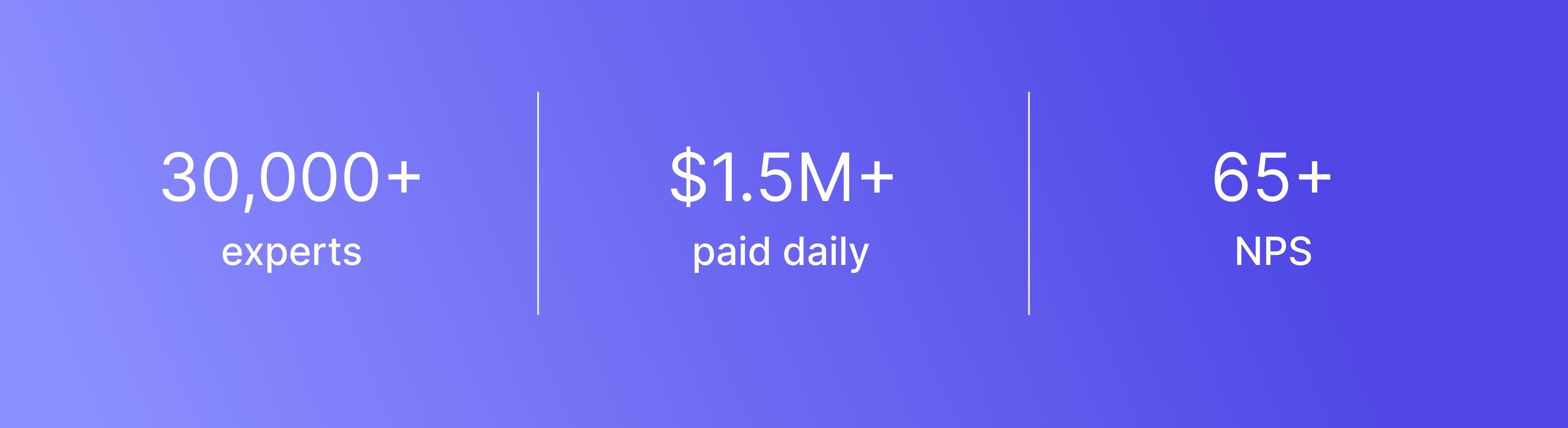
The autonomous AI recruiter category is the newest, and it is where the broader supply chain of talent is being productized. The Mercor banner below captures how far this has gone: a marketplace that pays its expert network more than a million dollars a day has become part of the hiring stack itself.
Within the autonomous-recruiter category specifically, a handful of products now run sourcing and personalized outreach with minimal human input rather than just improving search. Moonhub builds agents trained on billions of profiles and prices on a custom or success-fee basis - Moonhub, and HeroHunt.ai markets an autonomous AI Recruiter that sources from over a billion profiles via natural-language search and runs automated, personalized outreach with follow-ups, with self-serve plans reported around $97 to $199 per seat and an eight-day trial. At the enterprise end, talent-intelligence suites like Eightfold run $150,000 to $500,000-plus per year and target organizations with thousands of employees - Pin, while Findem sits in a custom band that is moving toward outcome-based pricing tied to actual hires - MindHunt AI.
The failure modes are predictable enough to plan around. Search databases decay because they cache contact data that goes stale, which is why even well-known tools produce dead emails by the time a recruiter reaches out. Enterprise suites lock teams into long implementations and five-figure floors that only make sense at scale. And the autonomous tools, the most promising category, vary widely in quality precisely because they are new, so the same brief can produce excellent candidates from one agent and noise from another. The way to protect a budget is to pilot before committing: run one real, hard-to-fill role through a tool for a month, measure qualified replies rather than raw output, and only then decide whether the economics work for your volume and your roles.
Why this matters: paying enterprise prices for a tool your team will use like a search box, or buying a search box when you need autonomous coverage, is the most common way recruiting budgets get wasted in 2026. How to apply this: a small team chasing AI engineers usually wants a natural-language search or autonomous tool in the low hundreds per seat rather than a five-figure enterprise contract; reserve the heavy talent-intelligence suites for large organizations with internal-mobility needs; and pilot any autonomous tool on one real role before committing, because the category is young and quality varies widely.
9. Evaluating AI Talent Without Getting Fooled
The signal you used to trust in hiring is collapsing, and pretending otherwise is now a security risk as much as a quality one. AI assistance in technical interviews has gone mainstream: across nearly 19,400 interviews analyzed from mid-2025 into 2026, 38.5% of all candidates were flagged for AI-cheating behavior, rising to 48% in purely technical roles, and 61% of those caught would still have advanced on their interview scores alone - Fabric. A January 2026 survey of 400 engineering leaders found that 71% say AI is making technical skills harder to evaluate - Karat. Tools built explicitly to defeat interviews, like the a16z-backed Cluely, render answers as an invisible overlay beneath the screen-share layer - TechCrunch.
Beyond cheating sits outright fraud, and it has reached a scale that should change how every team verifies identity. Gartner projects that by 2028, one in four candidate profiles could be fake - HR Dive. The most chilling case is the North Korean remote-IT-worker scheme, which the US Department of Justice says victimized more than 100 companies, prompting raids on 29 "laptop farms" and the seizure of around 137 laptops in a single 2025 action - Department of Justice. Security firm KnowBe4 publicly disclosed that it unknowingly hired one such operative who passed video interviews, background checks, and reference checks using a stolen identity and an AI-doctored photo, catching the malware only 25 minutes after the laptop went live - KnowBe4. Deepfake hiring fraud is rising in parallel, with one analysis finding 78% of cases involve video-interview manipulation - National Law Review.
The teams handling this well have abandoned abstract puzzles in favor of evidence that is hard to fake. OpenAI runs a paid take-home work trial of roughly 48 hours, reportedly compensated around $1,000, graded on real production code and shipping speed, while Anthropic pairs a take-home with an explicit candidate AI-use policy where violating it is an immediate disqualifier - Interview Coder. Bret Taylor's Sierra rebuilt its loop around a "build-with-us" demo where candidates present something they actually built and then defend the data models and abstractions live while interviewers probe how they used AI along the way - Sierra. The common thread is judgment under realistic conditions, plus identity verification, rather than a clean coding score that a candidate can quietly outsource.
Regulation is tightening around the automated screening tools many teams are simultaneously adopting, which adds a compliance dimension to evaluation design. The EU AI Act classifies AI used to recruit and evaluate candidates as high-risk, with obligations scheduled from August 2026 and fines up to 15 million euros or 3% of global turnover - artificialintelligenceact.eu. New York City's bias-audit law was found "ineffective" by a state comptroller audit in December 2025 - NY State Comptroller, and candidate trust remains low, with only 26% trusting AI to evaluate them fairly - Gartner.
The defensive playbook has a clear shape once you accept that the old signals are compromised. Verify identity with document authentication at application and a liveness check during interviews, then re-verify at the offer stage, because the fraud cases that get through are the ones where no single step confirms the person on camera is the person being hired. Pair that with evaluation that is expensive to fake: a paid trial on real code, a live session defending something the candidate actually built, and at least one in-person or synchronous round for senior or sensitive roles. None of these is exotic, and together they close most of the gap that cheating tools and synthetic identities exploit.
It is worth remembering that AI now sits on both sides of the table. Voice and video screening agents have scaled rapidly, with one vendor reporting more than one million candidates screened through adaptive AI interviews, even as surveys put AI use somewhere in the hiring process at the large majority of companies - PR Newswire. The arms race is real: candidates use AI to get through screens, employers use AI to run them, and the teams that stay ahead are the ones that keep a human in the loop for the judgments that carry the most risk.
Why this matters: a polished interview performance and a clean resume are now weak evidence, and a hire who is not who they claim to be is a breach, not just a bad fit. How to apply this: move the core of your evaluation to paid work trials or build-with-us sessions that reward judgment over recall, set and enforce an explicit AI-use policy, add identity and liveness verification at the interview and offer stages, and document the fairness controls on any automated screening you deploy so you stay on the right side of the law.
10. Retention: Winning the War After the Offer
An accepted offer is a down payment, not a victory, and the labs that understand this are pulling away from the ones that do not. The retention gap between frontier labs is stark and instructive: Anthropic keeps 80% of its two-year hires while Meta keeps just 64%, despite Meta's far larger checkbook - SignalFire. Retention is where the compounding happens, because every person you keep is one you do not have to re-source in a 4.7-month market, and one whose presence helps you land the next hire. The chart below shows the spread that should worry any leader relying on money alone.
Two-Year Talent Retention at Frontier AI Labs (2025)
The financial side of retention has become a discipline of its own, built around equity that keeps refreshing so an employee always has something unvested to lose. "Rolling handcuffs," annual refresh grants layered on the original package so a person always carries two to three years of unvested equity, are now standard practice across AI and chip firms - WebProNews. ByteDance went further, granting its Seed AI division special stock options of 90,000 to 130,000 units per employee per month to stop rivals from poaching - Metaintro. OpenAI responded to Meta's raids with retention bonuses of around $1.5 million for roughly 1,000 staff, reaching up to $5 million for top researchers - People Matters.
Money alone does not explain the retention gap, though, and the more durable lever is the same culture that wins people in the first place. When Anthropic ran its first tender offer at a $350 billion valuation in 2026, many employees declined to sell, betting on a higher future and signaling belief in the company rather than a rush for the exit - Bloomberg. That kind of conviction comes from transparent leadership, visible technical credibility, and genuine mission alignment, not from a refresh grant. The grant stops someone from leaving for money; the mission stops them from wanting to leave at all, and only the second one is cheap enough for a smaller company to match.
The non-financial mechanics of retention are where smaller companies can actually out-execute the giants. People leave when they stop growing, when their manager is weak, or when the mission they signed up for quietly changes, and all three are within a small team's control. A clear growth path that lets a senior engineer move toward staff or leadership scope, managers who are themselves technically credible, and honest communication when strategy shifts do more to keep people than any refresh grant. There is also a boomerang dynamic worth designing for: engineers who leave on good terms, stay in the orbit of a strong culture, and return later are a real and underused talent source, which is one more reason the way you treat departing employees is itself a recruiting strategy.
Why this matters: a high offer-acceptance rate paired with poor retention is a treadmill that burns budget and reputation, while strong retention turns your team into a self-reinforcing recruiting asset. How to apply this: structure equity to refresh so people always carry meaningful unvested upside, but do not rely on handcuffs alone; invest in the transparency, growth paths, and mission clarity that make people want to stay, and treat your existing team's tenure as the most credible recruiting pitch you have.
11. How AI Agents Are Rewiring Recruiting Itself
The same technology fueling the talent war is now automating the act of recruiting, and the teams that win the next phase will be the ones using AI to recruit for AI. The shift in 2026 is from tools that assist a recruiter to agents that act on their own. LinkedIn made its first recruiting agent, Hiring Assistant, globally available, and its charter customers reviewed 62% fewer profiles, saved more than four hours per role, and saw a 69% improvement in InMail acceptance - LinkedIn. Those are not marginal gains; they are the difference between a recruiter running three searches a week and thirty.
The money confirms the direction. Gartner forecasts worldwide AI agent software spending will reach $206.5 billion in 2026 and $376.3 billion in 2027, a build-out that includes the recruiting agents now entering the mainstream - Gartner. What separates an autonomous recruiting agent from a search tool is that it executes a multi-step job: it takes a brief, sources candidates, screens profiles, drafts and sends outreach, and follows up, rather than waiting for a human to drive each step. For a talent team chasing scarce AI engineers, that means coverage of more roles and more candidates than a human team could ever work by hand, which directly attacks the reply-rate and time-to-hire constraints that define this market.
The implication for the recruiter's own role is not replacement but redirection toward the parts that do not automate. When an agent handles the mechanical sourcing and first-touch outreach, the human's value concentrates in judgment, relationship-building, closing, and the candidate experience that decides a 50/50 offer. The recruiters who thrive in 2026 are the ones who let agents handle volume and spend their own time on the handful of conversations that actually determine whether a hard hire says yes. This is the same logic that has tiny AI-native teams outproducing large ones: leverage the automation for scale, and reserve human attention for the decisions that carry the most weight.
The concrete change to a recruiter's week is larger than it sounds. Sourcing that once meant manually building and running Boolean searches becomes a brief handed to an agent that works continuously, surfacing candidates across public sources while the recruiter sleeps. First-touch outreach that once consumed hours of copy-paste becomes a set of drafts the recruiter reviews and personalizes at the margin. Scheduling, follow-ups, and pipeline hygiene, the tasks that quietly eat a recruiter's day, move to the agent almost entirely. What remains is the work that genuinely requires a human: judging borderline candidates, building trust with a hesitant senior hire, and closing the offer when a competitor is also at the table. Teams that redesign the role around that division of labor, rather than bolting an agent onto an unchanged workflow, are the ones that capture the full productivity gain.
Why this matters: in a market where reply rate and speed are the binding constraints, a team that automates sourcing and outreach can cover several times more ground than one working by hand, and that coverage compounds. How to apply this: pilot an autonomous recruiting agent on a real, hard-to-fill AI role; measure it on qualified replies and time-to-first-conversation rather than raw volume; and deliberately reallocate the hours it frees up toward candidate relationships and closing, which remain stubbornly human.
12. The 2026-2027 Outlook and Your Playbook
The talent war is not cooling, but its center of gravity is moving, and the smart move now is to prepare for the next phase rather than fight the last one. The most important structural shift is that AI-native companies are resetting who counts as valuable. Anysphere's Cursor became the fastest software company in history to a billion dollars in revenue, hitting $2 billion ARR by February 2026 on a famously lean team, implying revenue per employee in the millions - Getlatka. Bootstrapped Midjourney sustained revenue per employee above $3 million, versus roughly $200,000 at a typical SaaS company - Getlatka. When a tiny team can generate that much value, the prize everyone fights for shifts from "many good engineers" to "a few exceptional ones," which intensifies exactly the scarcity this guide is about.
This reshapes who you should be fighting for. When output per person climbs this high, the marginal value of one exceptional engineer dwarfs the value of several average ones, and the companies that internalize this stop trying to hire in bulk and start concentrating their best offers on a small number of standout candidates. For a talent leader that means fewer, deeper searches, more senior-led closing, and a willingness to stretch on the rare person who can carry a disproportionate share of the work. The era of staffing a problem with ten interchangeable hires is giving way to one where finding and keeping the right two matters more than filling the requisition fast.
The macro forecasts point the same way. The World Economic Forum projects a net 78 million new jobs by 2030, with AI and machine learning specialists among the fastest-growing roles and two-thirds of employers planning to hire for specialized AI skills - World Economic Forum. Gartner warns that by 2027, half of enterprises without a people-centric AI strategy will lose their top AI talent to competitors who prioritize workforce enablement - Gartner. And the demand is not purely speculative: Anthropic's Dario Amodei expects powerful AI systems capable of handling most software-engineering tasks in late 2026 or early 2027, which would reshape which skills command a premium yet again - Memeburn.
There is a counter-current that talent leaders ignore at their peril. As agents absorb routine work, many companies are pausing entry-level hiring: Gartner found 55% of supply-chain leaders expect agentic AI to reduce early-career roles, yet warns that organizations which freeze junior hiring will pay 15% more for early-career professionals by 2030, because they will have starved their own pipeline of the people who become mid-level engineers - Gartner. For AI talent specifically, where senior specialists are already the scarcest and most expensive tier, cutting off the junior pipeline now is a way to guarantee a worse shortage later. The same logic applies to the people already on your payroll: Gartner projects that 80% of the engineering workforce will need to upskill in areas like agentic workflow design by 2027 - Gloat, which means the cheapest AI talent you can acquire may be the engineers you already employ.
This is the context in which the recruiting stack itself is being rebuilt around autonomous agents and merged talent supply chains. Founders building in this space, including Yuma Heymans (@yumahey), who has spent years building autonomous AI recruiting tools, argue that the only durable answer to a 3.2-to-one shortage is to give every talent team the reach of a much larger one through automation, rather than asking humans to send more messages by hand. Whether or not the most aggressive AGI timelines hold, the safe bet for any talent leader is that AI fluency keeps getting more valuable and harder to source, and that the teams who built an AI-native recruiting capability early will compound that advantage while everyone else scrambles.
The playbook that falls out of all twelve sections is compact enough to act on this quarter. It is not about outspending the frontier labs, which you cannot do, but about winning the war you are actually in.
- Define the exact role and tier before you source, because "AI Engineer" spans a $135K generalist and a $1 million specialist.
- Source at proof-of-work venues (papers, repos, competitions) so you can open every conversation on substance.
- Compete on autonomy, mission, and compute, the levers that let Anthropic out-retain better-funded rivals.
- Evaluate with paid work trials, plus identity checks, because interviews and resumes are now weak, gameable signals.
- Automate sourcing and outreach with agents, and spend the freed hours on relationships and closing.
Why this matters: the companies that treat AI recruiting as a capability to build now, rather than a problem to solve later, will own the talent advantage that decides the next several years. How to apply this: pick the two or three items above where you are weakest, fix them this quarter, and revisit your benchmarks every few months, because in this market the data ages fast and the advantage goes to whoever adapts first.
Conclusion
Winning the AI talent war does not mean writing the biggest check, and for almost every company it cannot. The nine-figure offers that made headlines apply to a few hundred people, and trying to imitate them is a fast way to lose money without landing anyone. The war that matters for the rest of the market is decided on a different field: clarity about which role you actually need, sourcing at the venues where talent proves its work, outreach that earns a reply by referencing real substance, compensation that uses equity honestly rather than as a gimmick, and the non-cash levers (autonomy, mission, compute, and named colleagues) that win researchers even at a pay disadvantage.
The decision framework is straightforward. If you are losing candidates on cash, you are probably fighting the wrong competitor and should re-anchor against the companies a candidate is genuinely weighing, then win on ownership and speed. If you are losing them on experience, fix your evaluation and outreach before you touch your budget. If you are losing them after they join, your problem is retention, and the answer is refreshing equity plus a mission people believe in, not a one-time bonus. And if you simply cannot reach enough people, that is the problem autonomous sourcing and AI recruiting agents exist to solve, whether you build that capability with a self-serve tool, a managed service, or one of the autonomous AI recruiters now entering the market. The talent is scarce, the demand is vertical, and the advantage belongs to the teams that adapt their playbook faster than the market changes around them.
This guide reflects the AI hiring landscape as of June 2026. Compensation figures, valuations, and tool pricing in this field move quickly, so verify current details against the linked sources before making decisions.