


The insider's buyer guide to the software that questions, scores, and ranks your candidates, split by category, priced, and stress-tested for 2026.
By May 2026, 63% of job seekers had already sat through an AI interview, up 13 percentage points in just six months - Greenhouse. The interview, the last stage most people assumed a machine would never touch, is now the stage AI is moving into fastest.
Here is the problem: the same survey found 70% of those candidates were never told an AI would evaluate them, and only 26% of applicants trust AI to judge them fairly - Gartner. So the category you are shopping in is powerful, fast-moving, and quietly capable of damaging your employer brand, your legal exposure, and the quality of your hires all at once if you buy the wrong thing.
This guide is built to stop that. It separates the market into the four kinds of tool that all get sold as "AI interview platforms," ranks the strongest products in each, gives real prices where they exist and names the ones that hide them, and maps the two risks that matter most in 2026: candidates cheating with their own AI, and the compliance regime closing in around automated hiring. Everything here is drawn from late-2025 and 2026 sources, because in this market a review from two years ago is describing a different product.
Written by Yuma Heymans (@yumahey), who built HeroHunt.ai, an AI recruiter that sources and screens candidates from over a billion profiles before they ever reach an interview. He has spent five years building autonomous hiring software and paying close attention to where it helps and where it quietly breaks.
Contents
- What an "AI Interview Platform" Actually Is
- The 2026 Landscape: One-Way Video Is Dying, Agentic Voice Is Winning
- The Rubric: Seven Questions That Decide the Purchase
- The Best Live and Agentic AI Interviewers, Ranked
- The Best Asynchronous Video Interview Tools
- The Best Interview Intelligence Platforms
- The Best Technical and Coding Interview Platforms
- What They Actually Cost
- The Integrity Crisis: Candidate AI Cheating and Deepfake Fraud
- Rules and Risk: The 2026 Compliance Picture
- Candidate Experience: The Trust Problem Nobody Priced In
- Where AI Interviews Win and Where They Break
- How to Choose and Run a 30-Day Pilot
- The Future: Agentic Interviewing and "AI Interviews AI"
- The Decision, in Six Sentences
1. What an "AI Interview Platform" Actually Is
The single most expensive mistake in this category is treating it as one market. It is four, and the tools inside each are barely comparable, because they automate different jobs at different points in the funnel. Buying a live conversational AI interviewer when what you needed was a notetaker that assists your human panel is not overpaying for a good product, it is buying the wrong product entirely. So before any ranking, the taxonomy.
The first category is asynchronous video, sometimes called one-way video. The candidate records answers to preset questions on their own time, and the software transcribes, sometimes scores, and lets your team review later. The second is the live or agentic AI interviewer, which is the fastest-growing corner of the market: an AI that holds a real, two-way voice or video conversation with the candidate and adapts its follow-up questions in real time. The third is interview intelligence, which does not interview anyone at all. It sits alongside a human interviewer, records and transcribes the conversation, and turns it into structured notes and scores. The fourth is technical and coding assessment, purpose-built to test whether an engineer can actually build things, now rebuilt around the reality that candidates code with AI every day.
The diagram below places the four categories where they belong in the hiring funnel, which is the fastest way to see why they are not substitutes for one another.
Notice what sits to the left of every interview tool: sourcing and screening. An interview platform can only question the people who reach it, which means its output is capped by the quality of whatever fills the top of the funnel. This is why autonomous AI recruiters that find and screen candidates, a separate category that includes tools like HeroHunt.ai, matter to this decision even though they do not run interviews: send an interview platform a weak shortlist and it will score weak candidates precisely. We covered the screening layer in depth in our guide to AI-driven candidate screening, and the rule that survives from it is simple. The interview tool is a filter, not a magnet, and no filter improves the water going in.
The practical takeaway for a buyer is to identify which job you are actually automating before you look at a single demo. If you are drowning in first-round phone screens for high-volume roles, you want a live AI interviewer or an async video tool. If your problem is that ten interviewers score candidates ten different ways, you want interview intelligence, not an AI that replaces them. If you are hiring engineers and half of them are quietly using an AI copilot in the test, you want a technical platform built for that. Each of the next four chapters ranks one of these categories on its own terms, because ranking them against each other would flatter some and punish others for doing a job they were never built to do.
2. The 2026 Landscape: One-Way Video Is Dying, Agentic Voice Is Winning
The defining shift of 2026 is the move away from the static, pre-recorded one-way video interview toward live, agentic voice interviewers that hold an adaptive conversation. For a decade the async video interview was the face of "AI in interviewing," even though most of those tools barely used AI beyond transcription. That era is closing. The clearest signal came on 18 June 2026, when HireVue, the enterprise incumbent, launched a voice-based AI Interviewer that replaces recorded answers with a dynamic two-way conversation - PR Newswire. When the company that built the category pivots away from its own founding format, the direction of travel is not subtle.
The image below is HireVue's own product visual for that launch, and it is worth looking at as an artifact of where the money is going: the enterprise standard is now an AI that talks back.
The incumbent pivots to conversational AI

Underneath that product shift is a wave of consolidation that tells you the category is being treated as strategic infrastructure, not a feature. Workday acquired Paradox, the conversational recruiting company behind the assistant "Olivia," for roughly $1 billion, closing the deal on 1 October 2025 - Workday. Weeks later Zoom acquired BrightHire, the company widely credited with creating interview intelligence, announcing it on 13 November 2025 and folding the product into Zoom Workplace - Zoom. On the async side, Radancy absorbed myInterview in September 2025, and Employ pulled Pillar into its ATS suite in March 2025. Four of the strongest standalone brands in this market are now features of larger platforms, which changes how you should think about buying any of them.
The reason the shift is happening now rather than in 2022 is that the underlying voice models finally became good enough to hold a natural conversation and cheap enough to run at hiring volume. A live AI interview is a far harder engineering problem than a recorded one: the system has to transcribe speech as it happens, decide what to ask next while the candidate is still talking, and recover gracefully when someone rambles or goes quiet. Until 2025 those capabilities were either too slow, too expensive, or too brittle to trust with a candidate who might post the result online. Once real-time speech models crossed the threshold of sounding human and answering within a beat, the economics flipped, and every serious vendor in this guide either shipped a live interviewer or announced one. That is why a category that looked static for years moved all at once.
Adoption is broad but shallower than the headlines imply, and the exact number depends heavily on what you count. SHRM's "State of AI in HR 2026" survey, fielded in December 2025 across 1,908 HR professionals, found that 62% of organizations use AI somewhere, 39% have adopted it inside HR, and recruiting is the single most common HR use case at 27% - SHRM. The chart below shows how the number narrows as the use gets more specific, which is the pattern to keep in mind whenever a vendor quotes you a big adoption figure.
AI adoption narrows as it gets specific (2026)
Read those bars together and the strategic picture is clear: general AI use is now normal, but purpose-built AI inside the interview is still a minority practice with a long runway ahead of it. That gap is exactly why buying carefully beats buying quickly. The teams pulling ahead are not the ones that bought the flashiest interviewer; they are the ones that matched a specific tool to a specific bottleneck and measured the result. The rest of this guide is organized to help you be in the first group, starting with the criteria that actually separate products once the demo ends.
3. The Rubric: Seven Questions That Decide the Purchase
Ranking AI interview tools on feature lists is useless, because every vendor ships every feature on the slide. What separates products in a real deployment is a smaller set of questions, and they are the same seven regardless of which of the four categories you are buying in. Score a shortlist against these before you take a demo and the demo becomes an interrogation rather than a presentation.
The first and heaviest question is validity: does the score predict job performance, and can you defend it? Decades of selection research keep returning the same finding, that a structured interview is one of the strongest single predictors of performance, meaningfully better than an unstructured chat - Sackett et al. re-analysis. A good AI interview tool inherits that advantage by enforcing structure and scoring against a rubric; a bad one automates an unstructured conversation and dresses a guess up as a number. The second question is format fit: a live voice interview, a recorded video, a text chat, and a coding environment are genuinely different candidate experiences, and the right one depends on the role, the volume, and who your applicants are.
The remaining five are quickly stated, but each has sunk a deployment somewhere:
- Integrity - can it detect a candidate using an AI copilot, and a deepfaked identity?
- Candidate experience - will people finish it, and will they still respect your brand afterward?
- Compliance - is there a bias audit, human oversight, and consent built in?
- Integrations - does the result write back to your ATS, or create a second system of record?
- Pricing shape - what does it meter, and does that match how you hire?
Those five are ordered roughly by how often they surprise buyers after signature rather than before. Integrity has become the question of 2026 because the ground shifted underneath the whole category, which the integrity chapter covers in detail. Candidate experience matters because completion and reputation are now measurable liabilities, not soft concerns. Compliance matters because the legal exposure moved from theoretical to litigated. Integrations matter because a tool that cannot update your ATS quietly splits your data across two places that disagree. And pricing shape matters because the meter, not the sticker, is what determines the bill: a tool priced per interview behaves very differently at 100 interviews a month than at 5,000.
Each of these is testable without technical knowledge, and the test is usually to just try the thing on a real role. For validity, ask the vendor to show you the rubric a score maps to and how it was built. For integrity, have a colleague attempt the interview with an AI assistant open and see whether the tool notices. For candidate experience, take the interview yourself, all the way through, and ask whether you would still feel good about the company at the end. A vendor who can answer all seven comfortably has built a serious product; one who deflects on two or more has built something narrower and named it a platform.
4. The Best Live and Agentic AI Interviewers, Ranked
This is the category everyone means when they say "AI interview platform" in 2026: software that actually conducts the interview, holding a live voice or video conversation, generating follow-up questions on the fly, and scoring the candidate at the end. It is also the fastest-moving and the least mature, so the ranking weighs transparency and defensibility heavily, because in a category this young those are the qualities that separate a real product from a demo that went viral. Every entry states what it does, what it costs, who it fits, and where it breaks.
One pattern worth noticing before the ranking is that price transparency tracks maturity in this category. The vendors confident enough to publish a number, Ribbon and Micro1, are the ones that had to make the product work without a sales team holding the customer's hand, while the quote-only players reserve the right to price by how big your logo is. That is not proof of quality, but it is a useful prior: a tool designed to be tried had to be genuinely good on its own, and a tool that can only be bought after a demo is a tool the vendor wants to explain before you are allowed to judge it. When two products look similar on a feature grid, the one that lets you start today without a call is usually the safer first bet.
The video below is a full AI-conducted screening interview from Apriora's "Alex," shown end to end, and it is worth watching before you read the ranking, because it makes concrete what the entire category is actually selling: a candidate talking to a machine that talks back.
A live AI-conducted interview, end to end
4.1 HireVue AI Interviewer
What it does: HireVue is the enterprise incumbent, and its June 2026 AI Interviewer is the category's most defensible entry precisely because it is the least exciting one. It runs a dynamic two-way voice interview, but scores responses against competency rubrics built by in-house industrial-organizational psychologists and validated with adverse-impact testing, then returns a ranked, evidence-backed shortlist. It sits on top of two decades of hiring science and, by the company's account, 80 million video interviews and 180 million completed assessments - PR Newswire. Crucially, HireVue removed facial and emotion analysis back in 2020 after an audit found visual data added only about 0.25% of predictive power - Fortune, which is why it now scores only the content of what is said.
Pricing: quote-only, and expensive. There is no public price and no monthly option; contracts are annual or multi-year. Third-party procurement data puts entry deployments around $25,000 to $40,000 a year and enterprise averages near $49,855, with large orgs exceeding $145,000, plus implementation fees - Leoforce/Leon analysis. Treat all of those as third-party estimates and negotiate a paid pilot before committing.
Best for: large enterprises and high-volume, early-career hiring that need a validated, auditable, defensible process and can absorb a five-figure contract.
Where it breaks: it is heavy, slow to implement, and overkill for anyone hiring in the dozens rather than the thousands. It also carries reputational baggage from its facial-analysis era that candidates and journalists have not forgotten, so the brand cost is real even though the technology moved on.
4.2 Ribbon AI
What it does: Ribbon is the standout for one reason that the rest of the category should be embarrassed by, which is that it publishes its prices. Its voice AI interviewer, "Bonnie," reaches applicants over SMS, WhatsApp or email, then conducts an adaptive two-way conversation, scores against a custom rubric, flags off-screen activity for fraud, and syncs to 60+ ATS platforms in 10+ languages - Ribbon. It is built for high-turnover, high-volume hiring, and reports 500,000+ interviews completed.
Pricing: published, which in this category is close to unheard of. Plans run Growth at $499 a month (100 interviews, $4 per interview over), Business at $999 (400 interviews, $3 over), and Scale at $1,999 (1,000 interviews, $2.50 over), all billed annually with a 7-day trial - Ribbon pricing. The number to model is the per-interview overage, because that is what your actual bill scales on, not the seat count.
Best for: agencies, RPOs, and scaling teams doing high-volume front-line screening who want transparent per-interview economics and white-label branding.
Where it breaks: the interview caps and overages mean cost climbs directly with volume, so a team that suddenly triples its screening triples the meter. It is also a young company with a shorter track record than the incumbents, which matters for support when something fails mid-interview.
4.3 Apriora (Alex)
What it does: Apriora, which rebranded its product to "Alex," is the Y Combinator-backed startup that pushed live conversational interviewing into the mainstream. Alex conducts real-time voice and video interviews, improvises follow-ups, runs cheat detection for tab-switching and generative-AI use, and writes hiring signals straight into 33+ ATS platforms. It raised $20 million in total funding, including a $17 million Series A led by Peak XV, announced in late 2025 - PR Newswire, and made the CB Insights AI 100 for 2026.
Pricing: quote-only. Every path leads to a demo booking, and third-party estimates put it in the region of $10,000 to $35,000 a year on annual contracts aimed at high-volume employers. Our dedicated breakdown of Apriora's pricing and alternatives goes deeper for anyone shortlisting it.
Best for: high-volume employers in healthcare, logistics, retail and staffing that want to automate the first-round live screen and can commit to an enterprise contract.
Where it breaks: Alex is also the category's cautionary tale. In May 2025 a recorded interview went viral when the AI looped the phrase "vertical bar pilates" more than a dozen times before ending the call, and reporting noted some candidates were not clearly told they would be talking to a machine - Slate. Live LLMs glitch, and when they glitch on a candidate, the clip travels.
4.4 Sapia.ai
What it does: Sapia takes the contrarian position that the safest interview format is not video at all. Its "Smart Interviewer" runs an untimed, chat-based structured interview: organizational psychologists design about five role-specific questions, and the AI analyzes the written answers for personality, competency and communication signals, then gives every candidate personalized feedback. It deliberately avoids face and voice to strip out accent and appearance bias, and it publishes an independent bias audit - Sapia. A Woolworths deployment reportedly gave it the capacity to interview around a million people a year.
Pricing: quote-only, with third-party estimates in the $15,000 to $60,000 a year band depending on hire volume. Our Sapia.ai pricing breakdown covers the tiers in more detail.
Best for: high-volume, bias-sensitive hiring in retail, contact centers and graduate programs, and any team that wants a lower-anxiety, accessibility-friendly format.
Where it breaks: text is a different experience that some hiring managers distrust because it feels less like an interview, and five questions cap the depth. Its funding is also dated, with the last major round back in 2022, which enterprise buyers weigh even when the product is shipping actively.
4.5 Humanly, Micro1, and the rest of the field
These three occupy the same decision slot as the leaders but each with a narrower angle, so they are grouped rather than individually ranked. Humanly runs omnichannel conversational screening across chat, phone and video and raised a $25 million Series B in May 2026, positioning itself explicitly around helping job seekers too - GeekWire. Micro1 built the technical interviewer "Zara" and publishes real prices, from $89 a month for an early-stage tier up to a standalone interviewer at $149, though the company is visibly pivoting toward supplying human experts to AI labs, so its recruiting roadmap is uncertain - our Micro1 pricing analysis. Talently offers live conversational interviews including live coding, and Fairgo is an early-stage Australian entrant focused on bias reduction.
One name that belongs here only as a boundary marker is Mercor, the AI-interview company that pivoted so hard it is barely a hiring tool anymore. It reached a $10 billion valuation in October 2025 and reportedly crossed $2 billion in annualized revenue by mid-2026 - Forbes, but that revenue comes from supplying vetted experts to AI labs, not from selling you an interviewer for your own roles. The lesson for buyers is that the fastest-growing "AI interview" companies are often optimizing for a different customer than you, and their attention follows their revenue. When you shortlist a startup here, ask directly whether recruiting software is still the core business or a legacy product, because in this category that answer changes fast and it determines whether anyone will be maintaining the tool you bought in eighteen months.
5. The Best Asynchronous Video Interview Tools
Asynchronous video, where the candidate records answers to fixed questions and your team reviews later, is the oldest and most commoditized corner of the market, which is exactly why it is the friendliest to buyers. Prices are mostly public, trials are easy, and the tools are simple enough to evaluate in an afternoon. The AI here is real but modest: transcription, summarization, benchmarking, and increasingly a layer of anti-cheating rather than the autonomous conversation of the live interviewers in the previous chapter. For a lot of teams, this is all they actually need, and paying live-interviewer prices for it would be a waste.
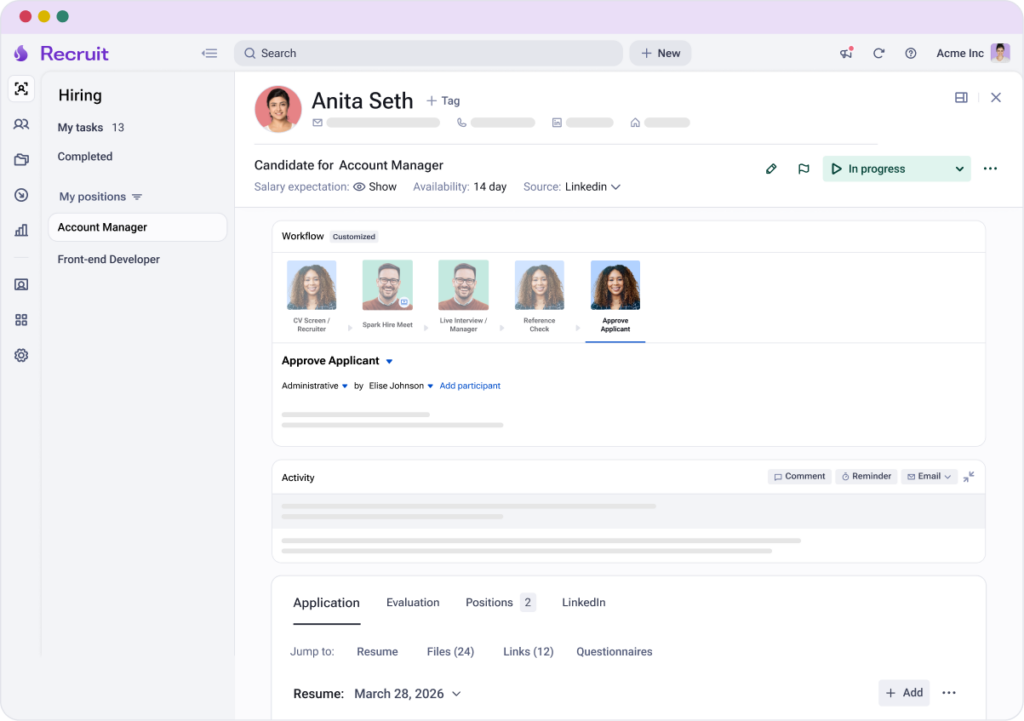
The Spark Hire interface below shows what a modern async workflow looks like in practice, with candidate video review sitting next to hiring-team collaboration, which is the everyday reality of this category more than any AI headline is.
The everyday async video workflow
The best value pick for most small teams is Hireflix, which is deliberately narrow and radically transparent. It does one-way video and little else, but it publishes flat pricing at $75 a month for companies under 50 people and $150 for those up to 250, with unlimited interviews, users and positions on every tier and a one-month free trial - Hireflix. No per-interview metering is a genuinely different economic model from everything else in this guide, and for a team doing steady volume it removes the anxiety of watching a counter. Willo is the next step up, adding an AI suite of transcription, summaries, benchmarking and AI-generated follow-up questions, plus a "Real Talk" feature that flags answers that look scripted or AI-generated, priced at $209 a month on Growth and $307 on Scale when billed annually - Willo.
For teams that want more than pure video, two options broaden the scope. Spark Hire now sells three modules after its 2024 acquisitions of Comeet and Chally, with the video product at $249 a month billed annually and a Recruit ATS from $335 - Spark Hire, which suits a team that wants video and a light ATS from one vendor but means the sticker for one module understates the true cost. Interviewer.AI adds AI scoring of responses plus built-in fraud checks that flag multiple voices, lip-sync anomalies and prompt-assistance, on credit-metered tiers of $199 and $399 a month - Interviewer.AI. At the enterprise end, VidCruiter remains a quote-only, heavily configurable suite favored in government and healthcare, and myInterview has effectively disappeared as a standalone product since Radancy folded it into its enterprise platform.
The Willo demo below walks through a full async setup and review cycle, and it is a useful contrast with the Alex interview clip earlier: same category on paper, completely different candidate experience in practice.
An asynchronous one-way video interview, set up and reviewed
The practical guidance is to treat async video as the default starting point rather than the destination. It is cheap, low-risk, and reversible, which makes it the ideal way to learn whether AI in your interview process helps at all before you commit to a five-figure conversational platform. If completion rates are strong and your reviewers genuinely save time, you have a working process and a baseline to measure the fancier tools against. If candidates drop out or your team ends up watching every video at full length anyway, you have learned something cheaply, which is the entire point of starting here. Many teams that think they need an AI interviewer discover in an async pilot that what they actually needed was better interview scheduling and a structured scorecard.
6. The Best Interview Intelligence Platforms
Interview intelligence is the category most buyers overlook and the one that most often turns out to be the right answer. These tools do not interview anyone. They sit inside the interviews your humans already run, recording, transcribing, and structuring the conversation into notes and scorecards, then feeding it back to your ATS and your interviewers as coaching. The pitch is not "replace the interviewer," it is "make every interviewer as good as your best one," and for teams whose real problem is inconsistency rather than volume, that is far more valuable than any autonomous bot. The category has also attracted serious capital and serious acquirers, which is a strong signal about its staying power.
The Metaview interface below shows the quiet sophistication of a modern notetaker: it detects that a call is a technical interview and routes it to the right note template automatically, which is the kind of unglamorous accuracy that actually saves a recruiter's afternoon.
Interview intelligence at work: notes that understand the interview
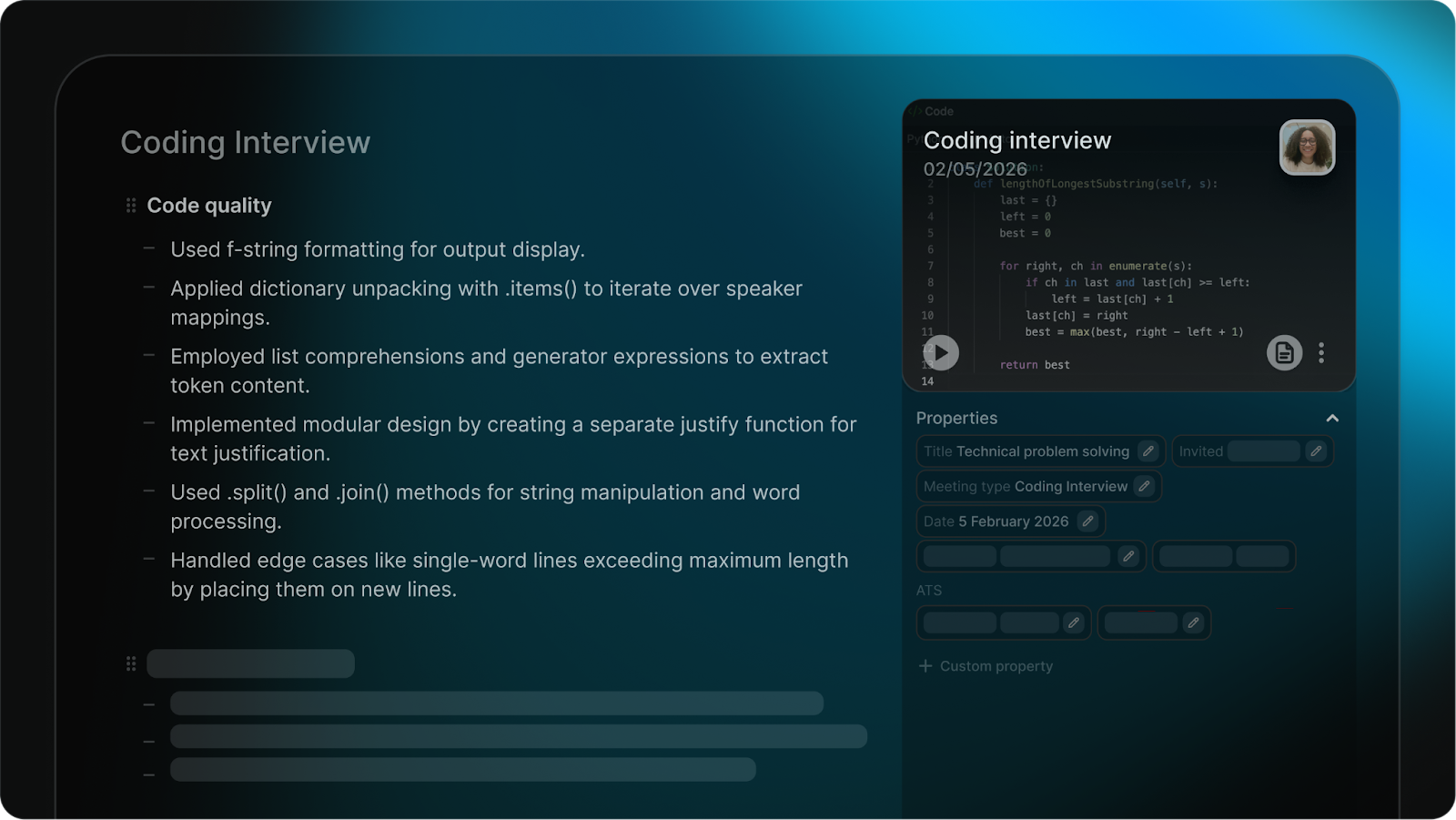
Metaview is the strongest standalone, and the market agrees: it raised a $35 million Series B led by Google Ventures in June 2025, bringing total funding to around $50 million - SiliconANGLE. It writes clean, template-driven notes and candidate summaries straight into Ashby, Greenhouse, Lever and others, and has expanded into hiring reports and even an AI sourcing agent, claiming roughly 30 minutes saved per interview on note review. BarRaiser takes the coaching angle furthest, with an AI copilot that feeds interviewers live questions and per-answer scoring prompts, and it is one of the few here with public pricing: a Team plan at $75 per interviewer per month, minimum five users, capped at 30 interviews each - BarRaiser, plus a free tier of five interviews. Screenloop bundles a notetaker that auto-fills scorecards with a lightweight ATS and reference checks, aimed at consolidating point tools for SMB talent teams.
The category's two defining companies, though, now belong to bigger platforms, which reframes how you buy them. BrightHire, the company that arguably created interview intelligence, was acquired by Zoom in late 2025 and folded into Zoom Workplace, and Zoom cited a study of 25,000+ candidates in which BrightHire users ran 27% fewer interviews per hire and saw 19% fewer candidate drop-offs - Zoom. Pillar was absorbed by Employ and rebranded the "AI Interview Companion" inside Lever, JazzHR and Jobvite, with Employ reporting recruiters save around 40 hours a month - Employ. If you already run Zoom or an Employ ATS, the intelligence layer may now be a checkbox rather than a purchase.
That last point is the real strategic shift in this category, and it cuts against the specialists. The horizontal generalists, Zoom AI Companion and Google Meet's Gemini notetaker, now sit inside nearly every interview call at no marginal cost, producing an automatic summary the moment the meeting ends. They do not map to competency scorecards, sync to an ATS, or flag interviewer bias, so they are not real interview intelligence, but they are good enough to be the reason a small team never buys a dedicated tool. The right way to shop this category is therefore to check what you already own first, then hold the specialist to the difference. If your interviews happen on Zoom and you just want recaps, you may already have what you need; if you need structured, ATS-synced, coachable evaluation across a whole hiring team, a specialist like Metaview or BarRaiser earns its price. Our roundup of interview recording tools for recruiters goes deeper on the recording layer specifically.
7. The Best Technical and Coding Interview Platforms
Technical interviewing was reshaped in 2026 by two forces hitting at once. Engineers now use AI copilots every day on the job, with CodeSignal citing 76% of developers coding with AI daily - PR Newswire, and candidates now use AI to cheat live coding tests at a scale that has broken the old autograder model. The category's response has split cleanly in two: some vendors embrace AI and evaluate how well a candidate works with it, while others double down on integrity and try to detect and defeat it. A serious buyer needs to decide which philosophy they believe in before choosing a tool, because the two camps are testing genuinely different things.
The HackerRank interface below shows the "embrace" philosophy in action: an AI assistant panel sitting right inside the live coding environment, so the interviewer can watch how a candidate prompts, validates and debugs with AI rather than pretending the tool does not exist.
Interviewing for AI fluency, not against it
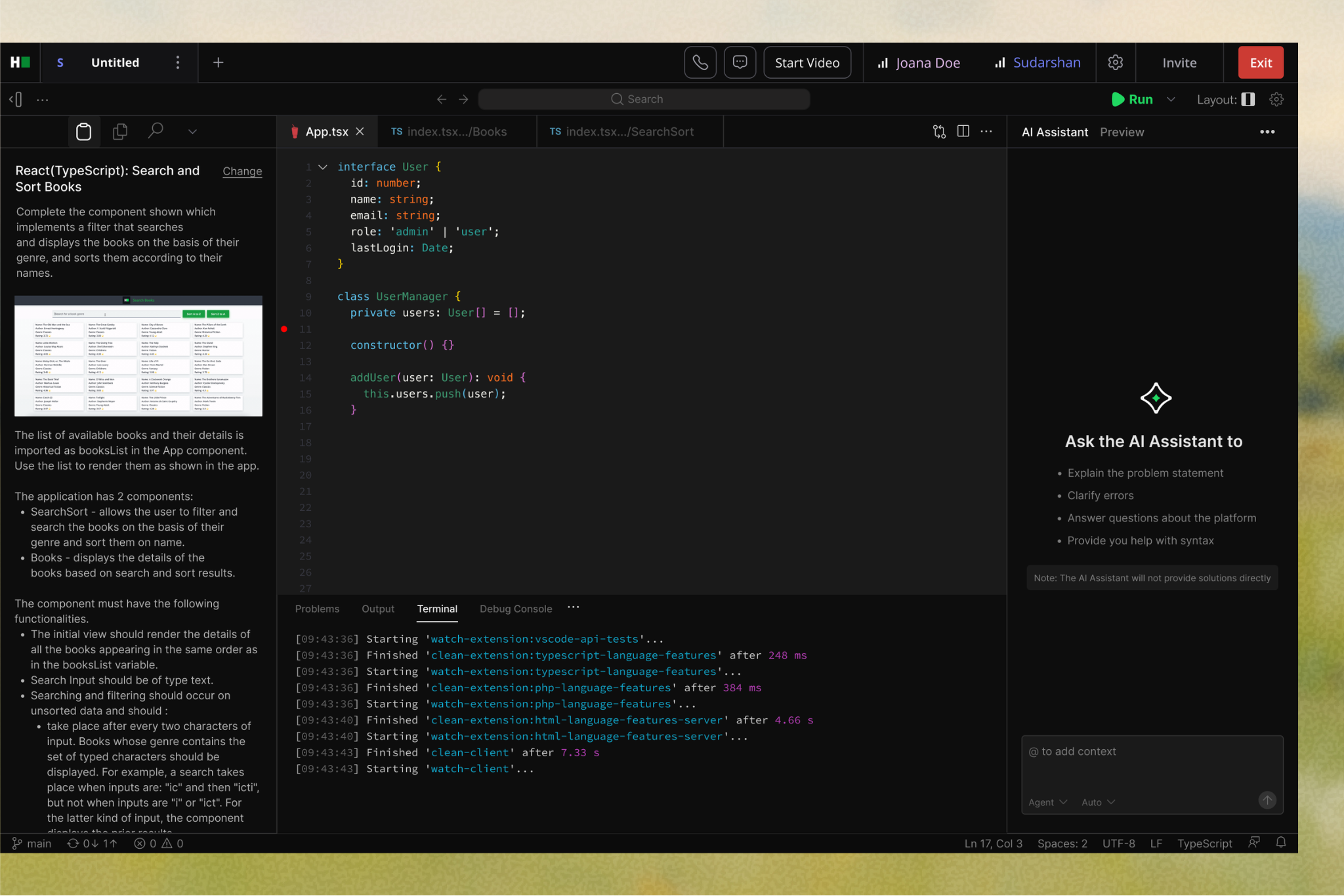
On the embrace side, CodeSignal and HackerRank lead. CodeSignal's AI, Cosmo, can sit in the candidate's IDE in either a full co-pilot mode or a limited guided mode, capturing a full transcript of every AI interaction so reviewers see the problem-solving process, and in April 2026 it expanded Cosmo into an agent that builds custom assessments from a library of 1,000+ questions - CodeSignal. HackerRank launched its own AI interviewer, Chakra, around February 2026, running adaptive voice or video interviews with integrated coding challenges and an auto-scored evidence report - HackerRank. CodeSignal's enterprise contracts run a median near $24,394 a year per Vendr data - Vendr, while HackerRank publishes SMB tiers at $199 and $449 a month and lands at a median around $12,230 annually.
The CodeSignal demo below shows its AI interviewer running a live phone screen and switching languages mid-conversation, which is the clearest short illustration of how far these tools have moved beyond the old take-home test.
An AI interviewer running a live multilingual phone screen
On the integrity side, the tools take the opposite bet. Codility is one of the most detection-focused vendors, layering copy-paste event-flow analysis, similarity checks against millions of past solutions and public repos, and a 2026 "Device Integrity" feature that scans the desktop for known cheat tools - ShadeCoder analysis, priced from $1,200 a year on Starter to $500 a month on Scale - Codility. CoderPad keeps the friendly live-coding pad most engineers prefer, with genuine published pricing including a free tier and paid plans from $120 a month, though its serious AI review and proctoring are gated to the enterprise tier - CoderPad. And Karat sidesteps the software arms race entirely by having trained human "Interview Engineers" conduct the interviews for you at roughly $200 to $450 per interview - InterviewCost data, which is expensive but genuinely hard to fool because a person is watching.
The honest conclusion for this category is that static, autograded, browser-locked tests are no longer a reliable signal on their own, and any vendor who tells you otherwise is selling you the last war. The durable signal comes from adaptive follow-up questioning, where a candidate has to explain line seven of code they submitted, and from formats that make AI overlays useless because the questions are not predictable. A 2026 entrant called Fabric built its whole product on that premise and published the study most cited across the industry, which the integrity chapter covers next. For most teams, the right buy here depends on volume and philosophy: HackerRank or CodeSignal if you want to test AI-augmented skill at scale, CoderPad for human-led live interviews, Codility if integrity is your obsession, and Karat if you would rather outsource the whole thing to people.
8. What They Actually Cost
Pricing in this market is deliberately hard to compare, and the difficulty is not an accident. Roughly half the vendors publish nothing, the ones that do meter on wildly different units (per seat, per interview, per credit, per attempt, per interviewer), and almost every AI-written comparison article invents numbers because vendor pricing pages render in JavaScript and cannot be scraped. What follows uses published prices where they exist and clearly labeled third-party estimates where they do not, split by the four categories, so you are comparing like with like rather than a monthly async price against an annual enterprise contract.
The first rule is that the meter matters more than the sticker. A tool at $499 a month that charges $4 per interview over its cap is cheap at 100 interviews and eye-watering at 2,000. A per-interviewer tool with a five-user minimum has a real floor well above its advertised per-seat price. And a "contact sales" tag is itself information: it tells you the vendor expects to negotiate, that pricing scales with your size, and that a self-serve pilot will not be possible. The chart below compares published monthly entry prices across the self-serve tools, which is the only slice of the market where the numbers mean the same thing, and even here the caption caveat matters because these plans meter differently underneath.
Published monthly entry price, self-serve AI interview tools (2026)
Those five bars span the self-serve market, but they hide the biggest divide in the category, which is between the tools you can buy with a card and the enterprise suites that never show a number. The table below lays the whole market out by category, states what each meters, and marks whether the figure is published by the vendor or a third-party estimate, so you can weigh how much to trust it.
| Platform | Category | Entry price | What it meters | Source |
|---|---|---|---|---|
| Hireflix | Async video | $75/mo | Company size, unlimited use | Published |
| Willo | Async video | $209/mo | Users + assessments | Published |
| Spark Hire | Async video | $249/mo | Per module (video/ATS) | Published |
| Interviewer.AI | Async video | $199/mo | Interview credits | Published |
| Ribbon AI | Live AI interviewer | $499/mo | Interviews + overage | Published |
| Micro1 | Live AI interviewer | $89/mo | Interviews | Published |
| HireVue | Live AI interviewer | ~$25k-$40k/yr | Enterprise contract | Third-party |
| Apriora (Alex) | Live AI interviewer | ~$10k-$35k/yr | Enterprise contract | Third-party |
| Sapia.ai | Live AI interviewer | ~$15k-$60k/yr | Hire volume | Third-party |
| Metaview | Interview intelligence | Free / from ~$20/user | Users / agents | Published, verify |
| BarRaiser | Interview intelligence | $75/interviewer/mo | Interviewers (5 min) | Published |
| CodeSignal | Technical | $79/mo, ent. ~$24k/yr | Credits | Published + Vendr |
| HackerRank | Technical | $199/mo | Candidate attempts | Published |
| CoderPad | Technical | Free / $120/mo | Interviews | Published |
| Codility | Technical | $1,200/yr | Invites | Published |
| Karat | Technical (service) | ~$200-$450/interview | Per interview | Third-party |
The row that should reshape your thinking is the gap between the self-serve tools and the enterprise suites. A team can run a genuine async or coding pilot for the price of a lunch, but a HireVue or Apriora contract requires a procurement cycle before you have learned anything at all. That asymmetry is a reason to start with a self-serve tool even if you suspect you will eventually need an enterprise one, because you can learn what you actually want from the cheap experiment and walk into the expensive negotiation knowing exactly what to demand. Finally, put the software cost next to what it displaces: a bad hire, or the recruiter hours spent on first-round screens, dwarfs any of these monthly figures, which is why the category grows even where individual tools underdeliver. The bar to clear is not perfection, it is being cheaper than the status quo.
9. The Integrity Crisis: Candidate AI Cheating and Deepfake Fraud
The single biggest change to interviewing in 2026 is that the person on the other side of the screen now has AI too, and sometimes is not even a real person. This is the reason "integrity" jumped to the top of the buying rubric, and it comes in two distinct flavors that get confused: candidates cheating with AI assistants during an otherwise legitimate interview, and outright impersonation fraud where the candidate is not who they claim to be. They need different defenses, and a tool that handles one may be blind to the other.
The cheating half is now measurable, and the numbers are startling. A 2026 study by Fabric analyzing 19,368 interviews found that 38.5% of candidates showed signs of AI-assisted cheating, rising to roughly 48% for technical roles, and, most alarmingly, that 61% of those cheaters scored above the pass threshold and would have advanced undetected - Fabric. The tools driving this are venture-funded and unapologetic: Cluely, whose founders were suspended from Columbia over an earlier "Interview Coder" tool, raised $15 million from a16z in 2025 explicitly to help people "cheat on everything" - TechCrunch. Detection is now an arms race of behavioral signals: gaze tracking, response-timing lags, keystroke dynamics, and language markers typical of large language models, none of which is deterministic, so both false negatives and false positives are unavoidable.
The fraud half is more serious because it is not a hiring problem, it is a security problem. Gartner projects that by 2028 one in four candidate profiles worldwide could be fake - HR Dive, and a GetReal Security survey found 41% of enterprises reported having already hired a fraudulent candidate - Security Magazine. The most severe strain is the North Korean remote-IT-worker scheme, where operatives use stolen identities and real-time deepfakes to pass interviews for jobs with system access, a pattern the DOJ has tied to more than 100 US victim companies - Crowell. Defenses here are different: liveness detection, government-ID verification, and behavioral prompts like asking a candidate to turn their head or hold up an object.
To see why this matters in practice, picture a common 2026 scenario. A remote software role attracts 400 applicants, and your team runs an automated first-round technical screen to make the volume manageable. Roughly half the technical candidates now arrive with an AI copilot running on a second screen, feeding them answers in real time, and the data says most of the ones who cheat will clear your pass bar. Somewhere in that same pool is at least one applicant whose identity is not real, using a stolen resume and a live face-swap. Your screen was built to rank ability, so it ranks the polished cheater highly and notices nothing about the impersonator, and both advance. The lesson is not that automation caused this, it is that an interview tool chosen only for efficiency, with integrity treated as an afterthought, actively selects for the wrong people in exactly this environment.
The practical consequence is that integrity is no longer a feature to skim past on a spec sheet, it is a primary selection criterion, and the right level of defense depends on the role. Here is the honest hierarchy of what actually works:
- Adaptive follow-up questioning - the strongest defense, because you cannot fake understanding of code you did not write
- Behavioral and biometric flags - useful signals, but probabilistic, so never a sole basis for rejection
- Liveness and ID verification - essential for remote roles with system access
- Static proctoring and browser lockout - now largely bypassable, treat as a speed bump
The order matters because it inverts what most tools market. Vendors love to sell proctoring and lockdown because they demo well, but a candidate with a second device defeats them in seconds. The durable defense is conversational depth, which is precisely why the whole market is shifting toward adaptive interviewers that force candidates off-script. For remote technical hiring specifically, layer identity verification on top, because there the failure mode is not a weak hire but a data breach or a sanctions violation. We go deep on the impersonation side in our guides to preventing deepfake candidate interviews and candidate identity verification, and the recurring lesson is that no single tool solves both halves, so buyers should map their specific risk before assuming a platform's "integrity" badge covers it.
10. Rules and Risk: The 2026 Compliance Picture
The legal ground under AI interviewing shifted repeatedly through 2025 and 2026, and the net effect is a landscape that is more permissive on paper and more litigious in practice. Both halves matter, because the absence of a federal rule is not a safe harbor, and the deferral of an EU deadline is not a reprieve from the parts that already apply. Any buyer who treats "the regulators backed off" as the headline has read the wrong half of the story.
In the United States the federal government stepped back: the EEOC removed its AI-in-hiring guidance in early 2025 and dropped AI from its stated enforcement priorities - National Law Review. But the underlying anti-discrimination statutes, Title VII, the ADEA and the ADA, still fully apply, and the real teeth moved to the states. New York City's Local Law 144 requires an independent annual bias audit, public posting of results, and candidate notice for automated employment decision tools - Warden AI. Illinois went further with HB 3773, effective 1 January 2026, which makes it a civil-rights violation to use AI in a way that has a discriminatory effect, bans ZIP codes as a proxy for protected classes, and requires notice - National Law Review. Colorado's more sweeping AI Act was repeatedly delayed and scaled back, now landing on 1 January 2027 in a narrower form - Hunton.
Europe moved in the same direction on paper while keeping its sharpest rules live. The EU AI Act classifies essentially all hiring and interview AI as high-risk, triggering documentation, human-oversight and transparency duties, and those core obligations were deferred from August 2026 to 2 December 2027 under the Digital Omnibus - DLA Piper. But the deferral does not touch the part that already bit: the Act's ban on emotion-recognition AI in the workplace and recruitment has been in force since February 2025, with fines up to 35 million euros or 7% of global turnover - Future of Privacy Forum. Any vendor still marketing "personality from facial expression" or vocal-emotion scoring is selling a feature that is already illegal to use on EU candidates.
The reason all of this should change how you buy, rather than just how you worry, is that the enforcement channel is now private litigation, and it is live. Mobley v. Workday became a nationwide collective action in 2025, alleging Workday's AI screening tools discriminated by age, with the court accepting that a software vendor can be liable as an employer's "agent" and formal notice authorized in February 2026 - Holland & Knight. Workday represented that its tools were involved in rejecting 1.1 billion applications during the relevant period, which is the scale that makes this a bellwether. The agent-liability theory means your legal exposure does not stop at your procurement boundary, so vendor bias-audit evidence is now genuine due diligence, not paperwork. Four habits cost almost nothing and matter a great deal: keep a human decision gate on rejections, insist on an explainable score rather than an opaque number, keep records of what the AI did, and get in writing what your vendor will hand you if you are ever asked for an audit.
11. Candidate Experience: The Trust Problem Nobody Priced In
The quietest liability in this category is the candidate, and it is the one most buyers discover only after they deploy. An AI interview that saves your recruiters twenty hours a week is a bad trade if it drives your best applicants to withdraw, and the 2026 data says that is exactly what is happening at the margins. This is not a soft concern to acknowledge in a values statement, it is a measurable conversion problem that shows up in your pipeline, and it deserves a place in the ROI model next to the time savings.
The numbers are sobering. In Greenhouse's May 2026 survey, 38% of job seekers said they had walked away from a hiring process because it used an AI interview, with another 12% saying they would - HR Dive. Gartner's work found only 26% of applicants trust AI to evaluate them fairly, and a quarter trust the employer less the moment AI is involved - Gartner. The chart below shows the split in candidate attitudes, and it is the single best argument for using these tools carefully and transparently rather than quietly.
How candidates feel about AI in hiring (Gartner, 2025)
What the split reveals is a paradox that defines the moment: candidates increasingly use AI on their own side of the table, with 39% deploying it in their applications, yet they distrust being evaluated by it. The distrust is not really about the technology, it is about consent and fairness, which is why transparency does most of the work in fixing it. The Greenhouse data found 70% of candidates were never told AI would evaluate them, and a majority believe disclosure should be legally required. Telling people upfront, offering a human alternative for those who ask, and keeping the format humane are not compliance chores, they are the difference between an AI interview that candidates tolerate and one they resent.
The practical guidance is to treat candidate experience as a design constraint, not an afterthought, and to test it the only way that counts, which is to take your own AI interview end to end before you inflict it on anyone. Ask whether the questions felt fair, whether a glitch would have rattled you, and whether you would still speak well of the company at the end. The tools that survive that test tend to share a few traits: they disclose the AI clearly, they keep the interview short and structured, they give the candidate feedback rather than a black-box rejection, and they leave a human in the loop for anyone who wants one. In a labor market where your interview is also your advertisement, the tool that respects the candidate is often the one that protects the hire, and the reputational cost of getting this wrong compounds far faster than any efficiency gain.
12. Where AI Interviews Win and Where They Break
There are situations where an AI interview genuinely outperforms the human process it replaces, and situations where it fails in ways that no configuration can fix, and the difference is not about the quality of the tool. It is about the nature of the task, and being precise about that line is what separates a deployment that pays for itself from one that quietly damages your hiring. The vendor claim that AI interviews help everywhere is exactly what makes buyers distrust the claim that they help anywhere.
The clearest wins are all variations on the same theme: high volume, low variance, and the need for consistency. When you are screening thousands of applicants for standardized roles, an AI interviewer runs the same structured conversation at 2am on a Sunday without fatigue or drift, which is a genuine improvement over a tired human running the fiftieth screen of the week. The flagship cases are real if occasionally overstated: General Motors reported cutting candidate screening by 70% with Workday's recruiter agent - TechTarget, and high-volume front-line deployments routinely compress time-to-hire from weeks to days. Consistency is the underrated win: a structured AI interview scores every candidate against the same rubric, which is both fairer and more defensible than a panel of humans each following their own instincts.
The failures cluster just as predictably, and they are worth naming plainly:
- Senior and judgment-heavy roles where the interview is a two-way negotiation, not an assessment
- Hallucinated scoring where the AI states a confidence it has not earned
- Gaming and false positives in the integrity arms race
- Brand damage when a glitch or a cold experience goes public
Each of these has a different root and a different mitigation. Senior roles fail because the value of a senior interview is the candidate assessing you as much as you assessing them, and an AI cannot sell your mission or answer a nuanced question about the team, so the higher you hire, the less the tool fits. Hallucinated scoring fails silently, which makes it the dangerous one: an AI that reports a candidate has eight years of experience when the transcript supports four produces a shortlist that reads beautifully and interviews badly, so spot-checking scores against transcripts is non-negotiable in any pilot. Gaming and brand damage are covered elsewhere in this guide, but both share a lesson: the tool is operating in an adversarial, public environment, and it will be tested by candidates and observed by the internet.
The dividing line that holds up best is this: delegate the interview when the job is to assess many people consistently against a clear rubric, and keep a human when the job requires judgment about a specific person or when the person is also judging you. A structured screen for a high-volume role is an excellent candidate for automation; a final-round conversation with a senior hire is not, and no amount of model quality changes that. Teams that keep the line at the nature of the task rather than drawing it by seniority or trying to automate everything get the returns and avoid the disasters, and they treat the AI interview as one instrument in the process rather than the whole orchestra.
13. How to Choose and Run a 30-Day Pilot
Most AI interview pilots fail for methodological reasons rather than product reasons, which is an expensive way to learn nothing. The two classic errors are running the pilot on an easy role, which proves only that easy roles are easy, and measuring the wrong thing, which is almost always raw speed or volume. A disciplined thirty-day pilot answers the only question that matters, which is whether this specific tool improves the quality of your hiring for a specific kind of role, and it costs far less than the wrong annual contract.
Start by choosing the category before the product, because the four categories are not interchangeable and picking the wrong one guarantees an ambiguous result. If your bottleneck is first-round screening volume, pilot a live AI interviewer or an async video tool. If it is interviewer inconsistency, pilot interview intelligence and leave your humans in the chair. If it is engineering assessment in an AI-copilot world, pilot a technical platform, and decide first whether you are testing skill with AI or without it. Then pick a role you have genuinely struggled with rather than an easy one, because an easy role will be filled regardless and teach you nothing about whether the tool can do real work.
Before the tool runs a single interview, write down your current baseline for the same role type, because a pilot without a baseline produces an opinion rather than a result. Then measure the four things that actually predict success at scale:
- Qualified rate - the share of AI-advanced candidates that survive human review
- Completion rate - the share of invited candidates who finish, versus your current process
- Adverse impact - selection rates across demographic groups, checked from day one
- Reviewer time saved - real hours, measured, not the vendor's estimate
Those four beat the metrics vendors prefer because they are hard to game and they map to outcomes rather than activity. Qualified rate is the most diagnostic: if seven of ten AI-advanced candidates survive your review, the tool is doing your job, and if two of ten survive, you have bought a faster way to generate reading. Completion rate is the candidate-experience canary from the previous chapter made concrete. Adverse impact is the one most teams skip and the one a regulator or a plaintiff will ask about first, so build the check into the pilot rather than discovering the problem after deployment. Run the loop across the full thirty days with a named owner reviewing results weekly, keep a human control working a comparable role by hand, and take the four numbers, not the demo, to the buying decision. A tool that improves qualified rate and completion without worsening adverse impact has earned its contract; one that only moves speed has not.
The most common way these pilots go wrong is subtle enough to be worth naming so you can avoid it. A team runs the tool on an easy, high-volume role, watches reviewer hours drop, declares victory, and rolls it out to every role including the hard ones where it fails. The speed number was real, but it measured the wrong thing: the tool was good at processing candidates who were easy to process, and told you nothing about whether it could find signal in a genuinely difficult hire. That is why the pilot role should be one you have actually struggled to fill, and why qualified rate rather than hours saved is the number that travels between roles. A tool that saves time on easy roles and collapses on hard ones is still worth buying, but only if you are honest about confining it to the easy roles.
14. The Future: Agentic Interviewing and "AI Interviews AI"
Three shifts are already visible in 2026 and will define the next eighteen months of this category, and none of them is speculative, because each has shipped somewhere already. Understanding them matters for a buyer because a multi-year contract signed today is a bet on where this is going, and the direction is now clear enough to bet on deliberately rather than by accident. The market that produced these tools is growing fast on any measure, with one analyst estimate putting AI recruitment software at $596 million in 2025, rising past $920 million by 2031 - Mordor Intelligence, and the broader AI-in-HR market several times larger.
The first shift is from async to fully agentic. The recorded one-way interview is being replaced by live conversational agents that adapt in real time, a transition HireVue's June 2026 launch, Ribbon's growth, and the whole live-interviewer chapter of this guide make concrete. The second is the "AI interviews AI" dynamic, where the candidate has an AI too, and the smartest employers are responding not by banning it but by testing for fluency with it. Google began piloting software-engineering interviews in May 2026 where candidates are allowed to use Gemini and are scored on how well they prompt, validate and debug - Entrepreneur, a policy that follows CEO Sundar Pichai's disclosure that roughly 75% of new code at Google is now AI-generated. When the reality of the job is human-plus-AI, testing humans in isolation stops making sense.
For the candidate, this dynamic is already surreal and getting more so. Applicants use AI to research the company, rehearse answers, and in the technical case literally generate code, while the employer uses AI to ask the questions and score the responses, so a growing share of the interview is one model talking to another with two humans supervising. The winning employer response is not to declare war on candidate AI, which is unenforceable anyway, but to design interviews where using AI well is the skill being measured, or where the questions are personal and adaptive enough that a copilot cannot answer them. Google's Gemini pilot is the clearest early example of the first approach, and the entire live-interviewer category is a bet on the second.
The third shift is consolidation into suites, which the acquisition wave of 2025 and 2026 already set in motion. As Workday, Zoom, Employ and Radancy absorb the strongest standalone interview tools, more buyers will get an adequate AI interviewer as a feature of a platform they already own, which collapses the price floor and forces standalone vendors to justify their entire contract on quality rather than existence. For buyers, the strategic implication is to avoid long contracts on undifferentiated products and to weight two things heavily: whether the vendor owns something defensible, such as validated scoring science or a genuinely hard-to-fool format, and whether the tool will still be maintained and independent in two years. A product whose only differentiator is "it has an AI interviewer" will not clear that bar by 2027, because by then everything will.
The deeper trajectory beneath all three is that the interview is becoming a conversation between systems, with humans supervising outcomes rather than conducting every step. That is not a reason to hand the whole process to a machine, and the trust and compliance chapters of this guide are the reasons not to. It is a reason to build an operating model now where AI handles the high-volume, structured, repetitive interviews and humans keep the judgment-heavy ones, with clear disclosure, a human gate on rejection, and a metric you actually track. The teams that get the returns from this technology are not the ones with the most autonomous tool, they are the ones with the most deliberate process around it.
15. The Decision, in Six Sentences
If your problem is first-round screening volume and you want to try before you commit, start with a self-serve async tool like Hireflix or Willo, because they are cheap, reversible, and honest about price. If you need a live AI interviewer at scale and can absorb an enterprise contract, HireVue buys validated, defensible scoring, while Ribbon AI buys transparent per-interview pricing and fast rollout for high-volume front-line hiring. If your real problem is that your human interviewers score inconsistently, buy interview intelligence such as Metaview or BarRaiser and leave your people in the chair, and check whether Zoom or your ATS already includes a version. If you are hiring engineers in an AI-copilot world, decide whether you are testing skill with AI or without it, then pick HackerRank or CodeSignal to embrace it or Codility or Karat to defend against cheating. Whatever you choose, weight integrity and compliance as heavily as capability, disclose the AI to candidates, keep a human gate on rejections, and measure qualified rate rather than raw speed, because the fastest process that hires worse people is not a win. And remember that no interview tool can fix a weak top of funnel, so before any of this, make sure the people reaching your interview are worth interviewing, which is the job of a sourcing and screening layer such as an AI recruiter like HeroHunt.ai, a different tool for a different, earlier problem.
This guide reflects the AI interview platform market as of August 2026. Pricing, product ownership, and legal deadlines in this category change on a monthly cadence, so verify current details against the vendor's own pages before you buy.