



The real numbers behind AI engineer pay in 2026, broken down by level, employer type, role, and geography, with base, equity, and bonus separated out.
A senior machine learning engineer at Meta cleared a median of $502,000 in total compensation in 2026, while the same title at a mid-market enterprise paid closer to $245,000, and a single 24-year-old researcher reportedly signed with Meta for $250 million over four years. That spread, roughly 1,000x from the middle of the market to the top of the auction, is the defining feature of AI engineer compensation right now. There is no single "AI engineer salary." There are bands, and where you land inside them depends on a small number of variables that this guide takes apart one at a time.
The problem with almost every salary article on this topic is that it quotes one number, usually a national median around $150,000 to $185,000, and stops there. That number is technically accurate and practically useless. It blends a junior prompt-engineering contractor in a low-cost metro with a staff research scientist at a frontier lab, and the average tells you nothing about either. The people who actually negotiate these packages, whether they are engineers weighing offers or recruiters trying to close them, think in bands: level, employer tier, role type, location, and the cash-versus-equity mix. Get those five right and you can predict a package within a fairly tight range. Get them wrong and you will either lowball a candidate out of the process or overpay by six figures.
This guide breaks down what AI engineers actually earn in 2026, level by level. It covers the market-composite bands from junior to principal, the extreme top of the market at OpenAI and Anthropic, the leveling ladders at Google, Meta, Amazon, Apple, Nvidia, and Microsoft, how startup cash and equity trade off by funding stage, what different titles are worth, how geography and remote policy move the numbers, and whether any of this is a bubble. Every figure is linked to its source so you can verify it and check how fresh it is.
This guide is written by Yuma Heymans (@yumahey), who built HeroHunt.ai, the AI recruiter now used by 15,000+ recruiters to source and engage technical talent, and who has spent the last few years watching AI engineering comp reprice in real time from the hiring side of the table.
Contents
- The State of AI Engineer Pay in 2026
- How AI Engineer Levels Actually Work
- Real Comp Bands by Level: The Market Composite
- Frontier Labs: The Top of the Market
- Big Tech Ladders and the AI Premium
- Startups by Stage: Trading Cash for Equity
- What Your Title Is Worth: Role by Role
- Geography, Remote Work, and the Global Picture
- Is It a Bubble? Demand, Agents, and the 2026 Outlook
- How to Win AI Engineers (and What It Costs)
1. The State of AI Engineer Pay in 2026
AI engineer compensation in 2026 is best understood as a two-tier market that shares a job title but almost nothing else. At the top, a few thousand researchers and engineers at frontier labs command packages that read like professional athlete contracts, with total compensation from $600,000 to well over $1 million a year and headline offers reaching nine figures. Below that, a much larger population of AI and machine learning engineers at big tech companies, funded startups, and traditional enterprises earns strong but recognizable software salaries, roughly $150,000 to $500,000 depending on level and employer. The gap between the two tiers has widened every quarter since 2023, and it is the single most important thing to understand before reading any average.
The reason the market split is scarcity meeting unlimited budgets. ManpowerGroup's 2026 Global Talent Shortage survey, covering more than 39,000 employers across 41 countries, found that AI and machine learning skills are now the hardest roles in the world to fill, ahead of engineering, IT, and the skilled trades for the first time - ManpowerGroup. When a handful of companies with effectively bottomless capital compete for a talent pool that cannot expand quickly, the result is less a labor market than an auction, a framing that compensation analysts have started using explicitly - Pin. The broad AI-skills wage premium captures the effect at scale: PwC's 2025 analysis found that roles requiring AI skills paid a 56% premium over comparable non-AI roles, up from 25% just one year earlier, more than doubling in twelve months.
Demand data confirms this is structural, not a spike. LinkedIn's 2026 Jobs on the Rise report ranked AI Engineer as the single fastest-growing job title in the United States, with postings up 143% year over year - LinkedIn. That growth sits on top of a supply base that universities and bootcamps cannot expand at anywhere near the same rate, because the skills that command the premium, distributed training, model architecture, inference optimization, and applied research, take years to build. The mismatch is why the premium keeps rising even as parts of the broader tech labor market soften.
It is worth remembering how fast this repriced, because the speed is itself a warning about how quickly it could move again. As recently as 2023, an "AI engineer" and a strong backend engineer were paid roughly the same, and the specialization carried a premium in the low double digits at most. Within two years, the top of the market detached entirely, the broad premium more than doubled, and a job title that barely existed as a distinct category became the fastest-growing role in the country. That trajectory means two things at once: the demand is real and the repricing is genuine, but a market that moved this far this fast is not one to extrapolate in a straight line. The engineers who benefit most are the ones who understand the structure well enough to position inside it, rather than chasing whatever number went viral last quarter.
Before diving into the bands, it helps to fix the five variables that determine where any individual lands. Level (junior through principal) is the largest single factor within a given employer. Employer tier (enterprise, big tech, or frontier lab) can move the same level by 2x to 4x. Role type (research scientist versus applied engineer versus MLOps) adds or subtracts a premium. Location still matters, though less than it did, and the cash-to-equity mix determines how much of a headline number is real cash versus illiquid paper. The rest of this guide is essentially those five variables, examined in turn.
The diagram above is not just a mental model; it is the order of magnitude of each lever. Level and employer tier together explain most of the variance, which is why two people with identical resumes and the same "AI Engineer" title can be $700,000 apart in total comp. Location and role type are meaningful adjustments on top, usually in the 10% to 40% range, and the equity mix determines how much you should trust the top-line figure at all. Keep this hierarchy in mind: when a number surprises you, it is almost always because one of these five variables is different from what you assumed.
2. How AI Engineer Levels Actually Work
Levels are the backbone of technical compensation, and AI engineers are leveled on the same ladders as other software engineers at nearly every major employer. The industry has converged on a five-rung structure: entry or junior, mid (often just called "engineer"), senior, staff, and principal or distinguished. Each company wraps its own numbering around these rungs, but the underlying scope is remarkably consistent. An entry-level engineer executes well-defined tasks under supervision. A mid-level engineer owns features independently. A senior engineer owns systems and mentors others. A staff engineer sets technical direction across teams, and a principal shapes strategy across an entire organization. Compensation roughly doubles from entry to senior, and can double again from senior to staff.
Understanding the level-to-title mapping matters because it lets you translate any offer into a common frame. When a recruiter says "E5" at Meta, "L5" at Google, "SDE III" at Amazon, or "ICT4" at Apple, they are all describing the senior rung, and the total-comp expectations should be broadly comparable within employer tier. The mapping below is the practical Rosetta Stone that experienced negotiators keep in their heads, drawn from the public level definitions these companies publish and the crowd-sourced data on Levels.fyi.
Two features of the ladder deserve emphasis because they trip up people used to thinking about pay as "salary." First, the mix flips as you climb. At entry level, base salary is the large majority of the package. By the senior and staff rungs, equity typically overtakes base as the single largest component, which is why a staff engineer's "salary" can look modest next to their total comp. Second, levels are sticky across employers but comp is not. A senior engineer moving from an enterprise to a frontier lab usually keeps the senior scope but can see total comp triple, because the equity component is denominated in a far more valuable currency. The level tells you the job; the employer tells you the price.
A concrete pair of packages shows the mix-flip in numbers. An entry-level ML engineer at Google (L3) earns a median of about $199,000, split roughly $154,000 base, $35,000 annual stock, and $10,000 bonus, so nearly 80% of the package is cash. A staff engineer at the same company (L6) earns about $607,000, split $272,000 base, $304,000 annual stock, and $32,000 bonus, so stock alone now exceeds base and cash is barely 45% of the total - Levels.fyi. The same person, five levels apart, has gone from a salaried employee to what is effectively a shareholder who also draws a salary. This is not a Google quirk; it is the universal shape of the ladder, and it explains why comparing two offers by base alone gets progressively more misleading the more senior the role. It also explains why senior engineers obsess over vesting schedules and stock performance in a way juniors rarely need to.
A final nuance: the research track often runs on a parallel ladder with its own titles (Research Scientist, Research Engineer, Member of Technical Staff) that map to the same numeric levels but frequently pay a premium at the same rung. At Meta, for example, the Research Scientist ladder starts higher than the engineering ladder, and at frontier labs the "Member of Technical Staff" umbrella deliberately flattens titles so that a brilliant individual contributor is not boxed in by a management-oriented level system. We return to these role distinctions in section 7, but it is worth knowing upfront that "what level" and "what title" are two separate questions, and both move the number.
3. Real Comp Bands by Level: The Market Composite
Here is the answer most readers came for: the total-compensation bands for a generalist AI or machine learning engineer across the broad US market, level by level, blending big tech, funded startups, and enterprises but excluding the frontier-lab extreme (which gets its own section). These are composite ranges synthesized from Levels.fyi self-reported data and multiple 2026 salary guides, and they represent where the bulk of offers actually land, not the outliers at either tail. Treat them as the middle 60% of the market for each rung.
| Level | Typical base | Total comp band | Equity share |
|---|---|---|---|
| Entry / Junior (L3) | $110K-$150K | $110K-$160K | 10-20% |
| Mid / Engineer (L4) | $140K-$190K | $170K-$260K | 20-30% |
| Senior (L5) | $180K-$230K | $220K-$350K+ | 30-45% |
| Staff (L6) | $230K-$290K | $350K-$600K+ | 45-55% |
| Principal (L7+) | $280K-$400K | $600K-$1M+ | 50-65% |
The national median sits well below the top of these bands because the distribution is heavily skewed. Levels.fyi puts the median US AI Engineer total comp at roughly $156,000, with a 25th percentile near $110,000 and a 90th percentile around $295,000 - Levels.fyi. When you narrow to engineers whose work is genuinely ML-focused, the average climbs to about $245,000, and the specific "Machine Learning Engineer" title carries a median near $272,500. The lesson is that the title on your business card matters less than whether your day-to-day work is core ML, which pushes you toward the higher composite bands.
AI Engineer Salaries: How Much Can AI Engineers Earn?
The single most important structural fact in the table is the equity share column. At entry level, roughly 80% to 90% of your package is cash you can spend, so the total-comp number and the salary number are close together. By the staff and principal rungs, half or more of the package is equity that vests over several years and, at private companies, may be illiquid for a long time. This is why a naive comparison of two offers by base salary alone is almost always wrong at senior levels. A $230,000 base with $250,000 of annual equity vesting is a $480,000 package, and comparing its base against a $260,000 base with token equity would lead you to the worse deal.
Percentiles matter as much as medians when you read these bands, because the spread inside a single level is enormous. At the senior rung, the difference between the 25th and 90th percentile of total comp can exceed $150,000, and it is driven almost entirely by employer tier and equity performance rather than by the individual's skill. This is why a candidate who "knows their worth" from one data point is often wrong in both directions: the junior who read a frontier-lab number expects too much, and the senior who read a national median accepts too little. The correct move is to locate yourself in the right band first, using level and tier, and only then argue about where inside the band you sit. A useful sanity check is that if you cannot explain an offer's position using the five variables from section 1, one of your assumptions about the offer is wrong, usually the equity value or the true level.
To see the level bands in action against a real employer, the chart below compares senior-level total compensation across the market tiers, using the market composite alongside verified Levels.fyi medians for two big-tech ladders and one frontier lab. The point is not the exact figures but the shape: the same "senior AI engineer" job pays radically differently depending on who signs the checks.
Senior AI Engineer Total Comp by Employer Type (2026)
The bifurcation shown above is the whole story of 2026 comp in one image. A senior AI engineer at a solid enterprise earns a genuinely good living around $245,000, a senior at Google or Meta earns $393,000 to $502,000, and a senior at OpenAI can clear $1.15 million - Pin. All three are "senior AI engineers." The scope of the work is similar. What differs is the value of the equity and the intensity of the competition for that specific person. For anyone negotiating, the practical takeaway is that moving up an employer tier at the same level is usually worth more than moving up a level within the same tier. For recruiters, it means your comp band has to be benchmarked against the tier you actually compete with, not against a national average that includes employers no serious AI candidate would consider.
4. Frontier Labs: The Top of the Market
The frontier labs are where AI compensation stops resembling a normal labor market. OpenAI's median software engineer total comp reached roughly $795,000 in 2026, and Anthropic's about $600,000, according to compensation benchmarks built on Levels.fyi submissions - Pin. A senior individual contributor at OpenAI at the L5 rung clears around $1.15 million, structured as roughly $336,000 base plus $774,000 a year in equity, and the most senior ICs run higher still. These are not signing-bonus headlines; they are the steady-state annual packages for ordinary (if exceptional) engineers at these companies. The frontier tier has effectively created a new compensation stratosphere that the rest of the market is measured against.
Public immigration filings, which disclose base salary only and exclude all equity and bonus, corroborate the scale from a completely independent source. OpenAI's H-1B filings show a median base salary of $300,000, with Research Scientist bases ranging from $245,000 all the way to $685,000 - h1bdata.info. Anthropic's dominant "Member of Technical Staff" title, which the company uses to cover research, engineering, and management alike, shows a median base of $300,000 and a range from about $156,000 to $485,000 - h1bdata.info. Remember that these are base-only figures with no equity attached, so the true total packages are far larger. When the government-disclosed base salary alone is triple the national median total comp, you are looking at a different market.
Why AI Engineers Are Becoming Billion-Dollar Assets
The most dramatic reset came from Meta in mid-2025, and the saga is worth telling precisely because it defined the ceiling. In June 2025, OpenAI CEO Sam Altman claimed on a podcast that Meta had been dangling $100 million signing bonuses to poach his researchers - TechCrunch. The claim ricocheted across the industry and became the shorthand for how far the talent war had gone, precisely because a hundred million dollars as a mere signing bonus would have been unprecedented for an individual contributor.
Meta pushed back hard on the framing. CTO Andrew Bosworth told staff the figure was misleading, saying the packages were not sign-on bonuses but multi-year compensation structured through equity, that only a few very senior leadership roles saw numbers near that scale, and, memorably, that "the market's hot, it's not that hot" - TechCrunch. One of the researchers who did move, Lucas Beyer, publicly confirmed the nuance, posting that he and his colleagues joined Meta but "did not get 100M sign-on, that's fake news." The distinction matters for anyone reading these headlines: the eye-popping numbers are almost always total packages vesting over four years, not cash on day one.
The denials, however, understated what was actually happening at the very top. Meta assembled its Superintelligence Labs under Alexandr Wang after a $14.3 billion deal for a stake in Scale AI, and to staff it, the reported packages were genuinely enormous. The clearest documented case is Matt Deitke, a 24-year-old researcher who had co-founded the startup Vercept and previously built the Molmo multimodal model at the Allen Institute. Meta reportedly offered him $125 million, then doubled it to $250 million over four years after Zuckerberg intervened personally, with as much as $100 million payable in the first year - Fortune via Yahoo. Former Apple AI leader Ruoming Pang reportedly joined the same effort on a package exceeding $200 million, part of a talent acquisition drive said to top $1 billion in aggregate. These figures are the true ceiling of the market, and while almost no one earns them, they anchor the negotiating expectations of everyone below.
Google DeepMind rounds out the frontier tier with a more conventional but still elite structure. Research roles there map to the standard numeric ladder, with total comp reported around $475,000 to $625,000 at L5, $725,000 to $950,000 at L6, and $950,000 to $1.4 million at L7 - CTAIO. Base salaries at DeepMind run roughly $200,000 to $380,000 depending on level, with the balance in Alphabet stock, which at least has the advantage of being publicly traded and liquid, unlike the private paper at OpenAI and Anthropic. That liquidity is a genuine differentiator that candidates weighing DeepMind against a pure-play lab should weigh explicitly: a slightly lower nominal total in a stock you can actually sell is often worth more than a higher number you cannot. Newer entrants pay to compete: Mira Murati's Thinking Machines Lab offered early technical hires base salaries alone of $450,000 to $500,000, averaging about $462,500 across its early filings - Pin. A structural note that matters for anyone weighing a frontier offer: this equity is itself illiquid. OpenAI's units and Anthropic's shares are typically realized through periodic secondary tenders every 6 to 18 months, not on a public market, and OpenAI only removed its capped-profit structure in its October 2025 restructuring. The paper is worth enormous sums, but it is not cash in your account, and that distinction becomes central the moment you compare a lab offer against a startup one.
The equity structures at these labs are also mid-transition, which changes the risk calculus in 2026 specifically. OpenAI historically paid in profit participation units under its capped-profit model, an unusual instrument that behaved unlike ordinary startup equity, and only in its October 2025 restructuring to a public-benefit corporation did OpenAI move employees toward conventional equity upside by removing the profit cap - Perspective AI. Anthropic pays in more conventional restricted stock, but at a private valuation that has climbed so fast that grant-date and realized values can diverge sharply. The practical consequence is that two frontier offers with identical headline totals can carry very different real risk depending on the instrument, the valuation vintage, and how often the company runs secondary tenders. Retention counter-offers add another layer: when a rival tries to poach a lab researcher, the incumbent frequently responds with an accelerated or refreshed grant, which is part of why the reported packages keep ratcheting upward. For an engineer, the lesson is to treat a frontier offer as a portfolio bet on a specific private company, not as a salary, and to ask pointed questions about liquidity that the recruiter may not volunteer.
5. Big Tech Ladders and the AI Premium
Big tech is where most AI engineers who are not at a frontier lab actually work, and the leveling ladders there are the most transparent part of the market thanks to years of crowd-sourced data. The pattern across Google, Meta, Amazon, Apple, Nvidia, and Microsoft is consistent: total comp roughly doubles from entry to senior, doubles again toward staff, and the equity component overtakes base somewhere around the senior rung. What varies is the absolute level, with Meta and Apple sitting at the top of the Magnificent Seven for machine learning roles and Microsoft anchoring the more conservative end. The table below maps the leveling ladders to real 2026 median total comp for machine learning engineers specifically, drawn from Levels.fyi.
| Company | Entry | Mid | Senior | Staff | Company median |
|---|---|---|---|---|---|
| $199K (L3) | $294K (L4) | $393K (L5) | $607K (L6) | $302K | |
| Meta | $187K (E3) | $294K (E4) | $502K (E5) | $660K (E6) | $492K |
| Amazon | $177K (L4) | $277K (L5) | $437K (L6) | higher (L7) | $277K |
| Apple | $171K (ICT2) | $272K (ICT3) | $401K (ICT4) | $615K (ICT5) | $386K |
| Nvidia | $205K (IC1) | $224K (IC2) | $292K (IC3) | $331K (IC4) | $261K |
| Microsoft | $161K (L59) | $216K (L61) | $229K (L62) | up to $414K (L65) | $219K |
The numbers reward a close read. At Meta, a senior E5 machine learning engineer earns a median of $502,000, of which $244,000 is annual equity and only $227,000 is base, and by the E6 staff rung, stock ($360,000) exceeds base ($266,000) outright - Levels.fyi. Apple shows the same crossover, with ICT5 stock of $330,000 topping a $245,000 base - Levels.fyi. This is the equity-flip from section 2 made concrete: at the levels where big money is made, you are being paid primarily in company stock, and your real outcome depends heavily on that stock's performance over your vesting period.
The company-to-company gap at the same rung is wider than most candidates assume, which makes cross-company benchmarking essential before accepting. Levels.fyi's 2025 End of Year report captured this in its senior-engineer new-offer data, where the medians ranged from about $263,000 at Tesla to $445,000 at Meta, with Microsoft near $337,000, Apple and Nvidia around $345,000, Google at $387,000, and Amazon at $425,000. The image below shows those ranges as distributions rather than points, which is the honest way to read them.
Senior engineer new-offer comp across the Magnificent Seven

The takeaway from that spread is that "big tech senior" is not one number but a $180,000-wide range, and the ML premium sits on top of it. A candidate weighing a Meta E5 against a Tesla senior offer is comparing $502,000 against something closer to $300,000 for nominally the same seniority, before the AI premium is even applied. Comparing company-wide medians makes the ordering even starker: Meta's overall SWE median runs around $444,000 against Google's $321,000 - Levels.fyi. None of this is captured by asking "what does a senior engineer make," which is precisely why level plus employer is the benchmark that matters.
Nvidia is the instructive special case. Its grant-date numbers look mid-pack, with an IC3 median around $292,000, but that dramatically understates what recent cohorts actually realized, because Nvidia stock returned 239% in 2023, 171% in 2024, and 39% in 2025 - Slickcharts. An engineer who joined in 2022 or 2023 saw their equity grants multiply several times over, effectively closing or reversing Nvidia's historic comp gap with Google and Meta. Accounting for that appreciation, one analysis puts realized Nvidia total comp by IC level far above the grant-date medians, climbing from roughly $175,000 at IC1 through $309,000 at IC3, $528,000 at IC5, and past $1 million at IC7, on a front-loaded vesting schedule that pays out 40% in year one - Leon Consulting. This is the double-edged nature of equity-heavy packages: the same mechanism that made Nvidia grants extraordinary can work in reverse when a stock stalls, which is exactly the risk that makes frontier-lab and big-tech offers hard to compare against cash-heavy alternatives.
The AI premium, visualized by company and level

The premium that AI and ML work commands over generic software engineering has become measurable at each level, and it widens as you climb. Levels.fyi's Q3 2025 analysis found the AI premium over comparable SWE roles was 6.2% at entry, 11.9% at the engineer level, 14.2% at senior, and 18.7% at staff - Levels.fyi. The pattern makes intuitive sense: at junior levels, an AI engineer and a backend engineer are nearly interchangeable and paid nearly the same, but by the staff level, the scarcity of people who can actually improve models or ship production ML at scale drives a meaningful gap. The chart below shows the premium climbing rung by rung.
AI/ML Engineer Pay Premium Over Generic SWE, by Level (2025)
The widening premium has a direct implication for both sides of the table. For engineers, it means the return on specializing deeply in ML compounds with seniority: the gap between you and a generalist is small early and large late, so the investment in hard ML skills pays off most in the second half of a career. For employers, it means that the "AI tax" on senior and staff hires is not optional or negotiable away; it is a structural feature of the market, and budgeting a senior ML req at generic-SWE rates simply guarantees the role stays open.
A subtler shift inside the premium data is worth flagging because it foreshadows the junior-market story in section 9. The entry-level AI premium actually shrank year over year, from 10.7% in 2024 to 6.2% in 2025, even as the staff premium grew from 15.8% to 18.7% - Levels.fyi. In other words, the market is paying less of a premium for junior AI engineers and more for senior ones, which is exactly what you would expect if AI tooling is making junior work more commoditized while senior judgment becomes scarcer. The premium is not just widening across levels; its shape is tilting toward experience. For a junior engineer, that is a signal to build toward the senior band quickly rather than to expect the entry premium to carry a whole career. The outlier data reinforces the point: Levels.fyi recorded entry AI offers as high as $288,050 at LinkedIn and staff-level AI comp around $917,000 at Intuit, which are the tails of the same distribution the premium describes.
The conservative end of big tech deserves its own note, because Microsoft and Amazon anchor a different value proposition than Meta and Apple. Microsoft's ML total comp is the most restrained of the group, with a company median around $219,000 and even senior levels landing well below the Google or Meta equivalents, but the trade is stability, breadth of internal mobility, and, for many, a less punishing pace. Amazon sits in the middle on total comp but famously front-loads cash with a sign-on bonus in the first two years to smooth its back-loaded stock vesting, which changes the year-by-year cash flow of an offer even when the four-year total looks similar. The practical implication is that "big tech" is not a monolith on comp any more than it is on culture: two offers at the same level from different Magnificent Seven companies can differ by 50% or more in total value and differ again in how that value arrives over time. Reading the vesting and bonus structure, not just the headline, is what separates a good decision from a regretted one.
6. Startups by Stage: Trading Cash for Equity
Startups play an entirely different compensation game, and the currency is equity rather than cash. A startup almost never matches big-tech cash and cannot dream of frontier-lab totals, so it competes by offering ownership: a percentage of the company that could be worth a great deal if things go well and nothing if they do not. Understanding startup offers therefore requires understanding two things at once, the cash-plus-equity bands by funding stage, and the mechanics of how startup equity actually converts into money. Get either wrong and you cannot evaluate the offer, which is why startup packages are the ones candidates most often misjudge.
The cash bands are more compressed than most people expect, because even cash-strapped startups have had to raise base salaries to stay in the game for scarce AI talent. Carta data shows the median base salary for AI/ML engineers rose 5.4% to 9.1% between January 2024 and June 2025, and the average base for a new engineering hire across startups reached about $189,000 by mid-2025, tied with product for the highest of any function - Carta. What has genuinely exploded is equity: Carta reports the median initial equity grant for AI/ML engineers grew 31% over two years, and up to 64% at the smallest ($1M-$10M) startups - Carta. Startups are paying for AI talent in the one currency they can print, and they are printing more of it than ever.
| Stage | Typical base | Equity grant (senior AI hire) | Option pool |
|---|---|---|---|
| Seed | $160K-$220K | 0.3%-1.0% | ~10% |
| Series A | $190K-$230K | 0.4%-1.0% | ~12% |
| Series B | $200K-$275K | 0.14%-0.8% | ~14% |
| Series C | ~$275K | ~0.2% | ~16% |
The equity percentages collapse by stage for a reason worth internalizing: earlier equity is riskier and therefore larger, later equity is safer and therefore smaller, and the two effects are supposed to roughly offset if the company grows. Index Ventures benchmarks a seed-stage senior engineer at up to 1.0% of fully diluted equity, a mid-level at 0.45%, and a junior at 0.15%, with the employee option pool growing from about 10% at seed to 16% by Series C - Index Ventures. Pave's benchmarks put a senior founding engineer's equity at 0.33% at the median and 1.24% at the 90th percentile, against a base around $187,000 to $235,000 - Standout. The generous 3% to 5% founding grants of 2021 have largely disappeared, and a realistic seed grant for engineer number one now sits closer to 0.5% to 1.25%.
Two structural shifts are quietly reshaping what a startup offer is worth. The first is that teams have gotten much smaller, which concentrates equity among fewer people: Carta reports the median seed-stage team is now just four employees, and average Series B headcount has fallen from 53 to 45 - Carta. Being one of four rather than one of forty is a materially larger claim on the outcome. The second shift is that cash floors have risen even at the earliest stages; Kruze Consulting's payroll data across 450 startups shows very senior engineers at seed companies earning $180,000 to $235,000 in the Bay Area, and founding-engineer market data puts the median founding-engineer base near $195,000, with many seed founders accepting around $175,000 in cash in exchange for more equity - Recruiting from Scratch. The upshot is that the modern startup offer is less of a cash sacrifice than the stereotype suggests, but the equity is more concentrated and therefore more consequential to evaluate correctly.
How modern equity grants actually vest

The mechanics behind the percentage are where offers are won and lost, and they are almost never explained in the offer letter. Startup engineers typically receive stock options (ISOs or NSOs), not the RSUs common at public companies, and those options carry a strike price equal to the company's 409A fair-market value at grant - Waveup. Standard vesting is four years with a one-year cliff: nothing vests until your first anniversary, then 25% vests, then the remainder monthly - Index Ventures. Options usually must be exercised within 90 days of leaving, ISOs can trigger alternative minimum tax, and none of it is worth anything until a liquidity event. The image above illustrates a further wrinkle: modern grants are often front-loaded and topped up with annual refreshers, so the headline "0.5% over four years" understates early-year value and the steady-state depends on refresh policy.
For the specific case of forward-deployed and applied-AI engineers, who sit between pure startups and enterprise, the bands are higher because the role directly drives revenue. Palantir originated the forward-deployed role and pays its FDSEs a median around $215,000, while senior forward-deployed engineers at applied-AI startups reach $340,000 to $470,000, and at frontier labs the same role runs $560,000 to $785,000 at senior level - Perspective AI. The through-line for anyone evaluating a startup offer is simple: never compare a startup's cash against big tech's total comp, and never treat an equity percentage as a dollar figure without knowing the stage, the strike price, the vesting schedule, and the odds. A 1% grant at a seed company that fails is worth exactly zero, and a 0.15% grant at the next breakout is worth a house.
7. What Your Title Is Worth: Role by Role
The job title in front of "engineer" or "scientist" is a compensation lever in its own right, and the hierarchy is consistent enough to plan around. Broadly, Research Scientist sits at the top, followed by Applied Scientist and Research Engineer, then AI Engineer and Machine Learning Engineer, then MLOps and ML Platform, with Data Scientist and general Prompt Engineer roles trailing. The gap exists because the market pays most for the ability to improve the model itself, which requires scarce research training, and pays less for applying existing models, which a larger pool of engineers can do. At frontier labs this hierarchy compresses under the "Member of Technical Staff" umbrella, but everywhere else it is very much alive.
The clearest evidence is at the companies that publish enough data to compare titles head to head. At Amazon, an Applied Scientist earns a median total comp around $335,000, with senior applied scientists near $526,000, well above the equivalent SDE - Levels.fyi. At Google, the Research Scientist band runs from about $187,000 at L3 to $893,000 at L8, with a median near $390,000, the widest range of any title - Levels.fyi. At Meta, the Research Scientist ladder runs from about $305,000 at IC4 to $581,000 at IC6, and it starts higher than the engineering ladder at the same numeric level - Levels.fyi. The research premium is real and it is largest at senior levels, where a research scientist can out-earn an applied engineer of the same rung by 10% to 30%. The reason is straightforward once you think about the scarcity: the pool of people who can meaningfully improve a model's architecture or training regime is far smaller than the pool who can integrate an existing model into a product, and the market prices that difference directly. It is also why the research track is where the frontier labs concentrate their most aggressive offers, and why an ambitious engineer with genuine research ability should think hard about which ladder to climb, since the choice compounds over a career rather than resetting with each job change.
A critical caveat applies when reading title-level averages from public data: they are badly diluted by non-frontier employers, so they understate what the elite pay. The national H-1B median base for "Research Scientist" is only about $127,000, because the title spans everything from a biotech lab to OpenAI - h1bgrader. Employer-specific figures tell the real story, which is why the OpenAI and Anthropic numbers in section 4 are so much higher than any title average. The same dilution runs the other way for hot sub-specialties: a general "prompt engineer" in the broad market earns a modest $110,000 to $130,000 mid-career, but prompt and evaluation engineers at Anthropic and OpenAI pull total packages of $500,000 to $1.2 million once equity and signing bonuses are added on top of a $300,000-plus base - KORE1. The title is a weak signal; the employer plus the title is a strong one.
Below the research tier, the applied roles have their own internal order that candidates should understand before accepting a title. The distinctions matter because a title can quietly cap or uncap your earning trajectory.
- AI Engineer / ML Engineer command a "production premium" over analysts, with AI Engineer medians around $185,000 and ML Engineer near $165,000 in the broad market - Index.dev
- Research Engineer sits closer to the research track and its pay, since the role supports novel research rather than shipping features
- MLOps / ML Platform engineers land mid-range, though senior ML Platform specialists clear $260,000 in base before equity
- LLM Engineer as a distinct title averages about $160,000 in the general market, well below frontier-lab equivalents - Glassdoor
- Data Scientist demand has flattened relative to engineering roles, and pay has followed
The practical implication of this hierarchy is that title negotiation is genuinely worth money, and not just at the margin. If you can do the work of an Applied Scientist but are being hired as a Machine Learning Engineer, the title alone can cost you a double-digit percentage of total comp at senior levels, plus a lower ceiling as you progress. The same caution applies in reverse for employers: posting a req as "Data Scientist" when you actually need production ML engineering will draw a different, lower-paid applicant pool and then fail to convert the strong candidates who correctly read the title as a lower band. The frontier-lab move of collapsing everything into "Member of Technical Staff" is partly a deliberate escape from exactly these title games, letting the company pay the person rather than the box. For a deeper look at sourcing these specific roles, our guide on recruiting AI and ML engineers breaks down the pipelines by role type.
8. Geography, Remote Work, and the Global Picture
Location still shapes AI engineer pay, but far less than it did five years ago, and the classic San Francisco premium has compressed to the point of nearly disappearing for remote roles. The San Francisco Bay Area remains the top-paying metro, with recruiter data putting base pay around $210,000 to $250,000 and total comp from $270,000 to $390,000 and up - KORE1. But the gap to a national remote band has narrowed dramatically. An analysis of 1.9 million job postings found that the median remote AI-engineer base ($217,000) actually slightly exceeded the San Francisco median ($213,000) in 2026, because remote-first employers compete nationally rather than discounting for location - Recruiting from Scratch. The premium that remains is concentrated in onsite roles at the specific companies clustered in the Bay Area, not in the geography itself.
Within the US, the metro hierarchy is legible and the differences are meaningful but not enormous. Levels.fyi's 2026 data puts the median AI engineer salary at $310,000 in both Seattle and the SF Bay Area, versus $225,500 in New York, $220,000 in Los Angeles and San Diego, and $201,600 in Austin - Levels.fyi. Seattle and Austin punch above their base numbers on a take-home basis because neither Washington nor Texas levies a state income tax, a factor that a headline salary comparison misses entirely. The image below shows the full metro and country breakdown.
Median AI engineer salary by metro and country

Internationally, the gap is where the real money differences live, and it is large. European AI-engineer pay trails the US by roughly 35% to 55% at senior levels even before equity is counted - Qubit Labs. Levels.fyi's country medians make the point bluntly: Switzerland leads Europe at $185,270, the UK sits at $136,404, the Netherlands at $99,501, well below any major US metro. Zurich is the European high-water mark, where Google total comp runs from CHF 182,000 at L3 to over CHF 1.1 million at L8 - Levels.fyi. London is converging fastest thanks to US frontier labs setting up shop: Anthropic has advertised research-engineering roles in London at up to £630,000 before stock - City A.M.. India and other low-cost hubs sit far below, with local senior ML bands running roughly $48,000 to $115,000, though the global capability centers of US firms pay 30% to 60% above domestic IT-services rates.
The within-Europe and cross-region detail rewards attention, because the effective gaps are often larger or smaller than the headline salary suggests once tax and equity are factored in. Continental senior bands run roughly €85,000 to €140,000 in Germany, €75,000 to €120,000 in France, and €90,000 to €135,000 in the Netherlands, where the 30% expat tax ruling can meaningfully lift net pay for eligible hires - AY Automate. Dublin's local base is modest at €55,000 to €75,000, but the US big-tech European headquarters there clear €200,000-plus in total comp at senior levels because they import US-style equity. Nearshore Latin America has emerged as a middle band with US time-zone overlap, paying senior engineers $50,000 to $110,000, above much of the world but well below onshore US. And within India, the split is stark: a global capability center pays a senior ML engineer roughly twice what the domestic IT-services firms pay for the same role, so "Indian salary" is not one number either. For US startups hiring remotely into India, packages of $90,000 to $150,000 buy top local talent at a fraction of the fully loaded US cost.
The policy layer on top of geography is shifting in ways that matter for both sides. Location-based pay is now mainstream: about 68% of fully remote companies apply some location adjustment, up from 41% in 2022 - Next Mantra. Google and Meta both cut pay by up to 25% for employees who relocate from high-cost hubs to cheaper markets. At the same time, some employers are moving the other way: GitLab retired its long-standing San Francisco-anchored location-factor calculator in May 2025 in favor of local-market ranges - GitLab. For engineers, the practical upshot is that a remote role at a national-band employer is now often the highest-paying option available outside the top onsite jobs. For employers hiring internationally, the arbitrage is real but shrinking as the best global talent learns its US-equivalent value. Our global AI talent map goes deeper on where these skills concentrate worldwide.
9. Is It a Bubble? Demand, Agents, and the 2026 Outlook
The bubble question is unavoidable, and the honest answer is that both the "bubble" and "structural" camps are partly right. The bubble case is easy to make: a handful of labs with near-unlimited capital are bidding up a tiny pool of elite researchers to nine-figure packages, compensation analysts openly describe the top of the market as "an auction" rather than a market, and history says auctions with a few deep-pocketed bidders eventually correct - Pin. If frontier funding tightened or a leading lab stumbled, the very top of the market could reprice quickly, and the engineers who took illiquid equity at peak valuations would feel it first. Anyone accepting a frontier or late-stage offer should price in that the paper may be worth less than the grant-date number suggests.
The structural case is equally strong for everyone below the auction. AI/ML skills are now the single hardest category to hire for globally, per ManpowerGroup's 41-country survey, and demand indicators like LinkedIn ranking AI Engineer the fastest-growing US role are not the signature of a fad - LinkedIn. The AI-skills wage premium doubling from 25% to 56% in a single year reflects real, broad-based repricing across the economy, not just a few marquee offers. For the large middle of the market, the fundamentals (scarce skills, surging demand, a supply base that expands slowly) point to durable premiums even if the frontier tier cools. The likeliest 2026 outcome is not a crash but a widening gap: continued escalation at the very top, steadiness in the middle, and real pressure at the bottom.
Early-career developer headcount is falling
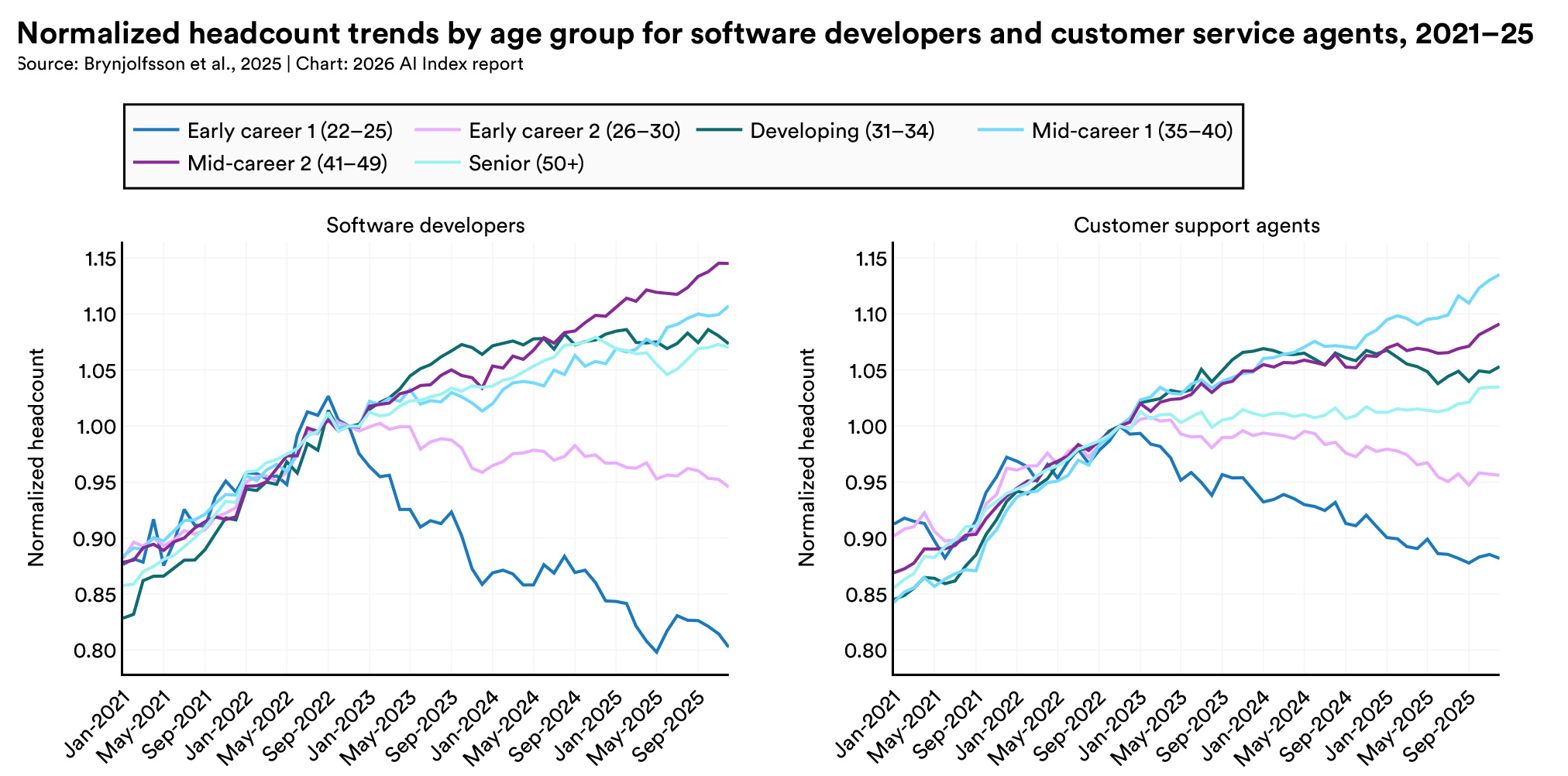
That pressure at the bottom is the most important trend for anyone entering the field, and it is driven by AI coding agents. Tools like Cursor, Claude Code, GitHub Copilot, and Devin have automated exactly the kind of well-defined implementation work that junior engineers used to cut their teeth on. The Stanford HAI 2026 AI Index found that headcount for early-career (age 22 to 25) software developers fell by roughly 20% from late 2022 to late 2025, even as every older cohort grew - Stanford HAI. Entry-level developer postings have dropped sharply from their 2022 peak, and the share of juniors in tech employment has thinned considerably - TechTimes. A single senior engineer with agentic tooling can now do what a small team used to, which compresses demand for the most junior roles precisely as it inflates the value of senior judgment.
The nuance that gets lost in the "AI is replacing engineers" panic is that total engineering demand has not actually fallen; it has shifted upward in seniority and outward in skill. Hiring data shows teams did not shrink the way the automation narrative predicted, because the work that agents unlock (more ambitious systems, more products, more AI features) creates new demand even as it erases routine implementation - TechTimes. What has changed is the entry point: the ladder now starts higher, requiring system design, judgment, and the ability to direct and review AI output rather than to hand-write boilerplate. For compensation, this bifurcates the entry-level market itself, with well-prepared juniors who can operate agents commanding a premium while the traditional order-taker role disappears. The strategic implication for a new engineer is to skip past the work agents already do and toward the judgment work they cannot, which is exactly the work the premium rewards.
The compensation over time reflects this churn rather than a smooth climb. Median AI engineer total comp actually swung hard, peaking near $295,000 in March 2024, falling to about $228,500 by January 2025, then rebounding toward $277,000 by spring 2025 as the frontier bidding war reignited - Levels.fyi. The chart below traces that volatility, which is a useful corrective to any narrative of endless linear growth.
Median AI Engineer Total Comp Over Time
Reading the trend line correctly is the whole game for 2026. The dip and rebound show that even elite AI comp is cyclical, not guaranteed, and that the frontier bidding war can pull the median around on its own. The prudent posture for engineers is to value liquid cash and diversified equity more highly than headline totals denominated in illiquid private paper, and to invest in the senior and research skills the market is repricing upward rather than the junior implementation work agents are absorbing. For employers, the message is that the middle of the market is where durable, hireable value sits, and that the entry-level pipeline they neglect today is the senior shortage they will pay dearly for in three years.
It is worth spelling out what a correction would and would not touch, because the word "bubble" implies everything pops at once, and that is not how this would play out. The vulnerable layer is the frontier auction: nine-figure packages priced off private valuations that assume continued exponential progress and continued access to capital. If either assumption weakened, the very top would reprice fast, and the engineers holding illiquid grants at peak valuations would absorb most of the loss on paper. The resilient layer is everything downstream of the auction, where compensation is tied to genuine, revenue-generating demand for people who can ship production AI. Enterprises deploying AI into real products are not paying the premium out of hype; they are paying it because the work creates value they can measure, and that demand does not evaporate if a lab stumbles. The realistic risk, in other words, is a repricing of the ceiling, not a collapse of the floor, and positioning yourself in the durable middle is the hedge against both.
The demand-supply arithmetic underneath all of this is what keeps the floor firm. AI and machine learning skills topping ManpowerGroup's global shortage ranking is not a survey artifact; it reflects the fact that the number of people who can genuinely do this work grows slowly while the number of companies that need it grows quickly. Universities graduate a fixed trickle of qualified specialists each year, the skills take years to build, and the agentic tooling that erodes junior demand does nothing to expand the senior supply. Until that imbalance resolves, which is a multi-year proposition at best, the premium for real AI engineering capability has a floor that headlines about a "bubble" tend to ignore. The engineers who treat the current moment as a chance to build durable, senior-level capability rather than to chase a peak number are the ones best positioned regardless of what the frontier tier does next.
10. How to Win AI Engineers (and What It Costs)
For recruiters and hiring managers, the preceding sections add up to a hard truth: you cannot win AI talent on base salary, and you cannot win it against the wrong benchmark. The candidates worth hiring are comparing total compensation across employer tiers, weighing liquid cash against illiquid equity, and reading your job title as a signal of the band you actually pay. Winning means competing on the whole package and on the dimensions where you can credibly beat a bigger-name competitor, which for most companies means cash certainty, meaningful ownership, scope, and speed rather than raw total-comp numbers you cannot match.
The tactical levers that actually move AI candidates are well understood, and they cluster around de-risking the offer rather than simply enlarging it. Each of these is a place where a smaller or non-frontier employer can win a candidate a lab would otherwise take.
- Lead with liquid cash when your equity is illiquid, since a higher base beats paper the candidate cannot sell
- Offer equity refreshers upfront, not just a new-hire grant, so year-three comp does not fall off a cliff
- Compete on scope and title, giving a senior engineer staff-level ownership you can credibly back
- Move fast, because in an auction the second-fastest offer loses regardless of size
- Be honest about equity mechanics, since candidates who have been burned reward transparency about strike price and vesting
The interpretation matters more than the list. The reason these levers work is that the frontier labs, for all their money, are slow, bureaucratic, and pay in paper that cannot be spent for years. A well-run company that makes a clean, fast, cash-forward offer with real ownership and genuine scope can and does beat a nominally larger frontier package, especially for candidates who value autonomy or are skeptical of peak-valuation equity. The mistake is trying to out-spend the auction; the winning move is to change the terms of comparison to the ground where you are actually stronger. For a fuller playbook, our guide on winning the AI talent war covers positioning and process in depth.
A concrete example shows how the math works in a company's favor. Suppose a Series B startup is competing for a senior ML engineer who has a big-tech offer around $450,000 in total comp, of which roughly $240,000 is annual equity in a public stock. The startup cannot match the headline, but it can offer $260,000 in liquid base (above the big-tech base of $210,000), a 0.4% equity grant, and, crucially, a written refresher policy that adds a fresh grant each year so the package does not collapse after the initial vest. If the candidate values cash certainty and believes in the company, the higher spendable base plus meaningful ownership can win even at a lower nominal total, because the big-tech "extra" is stock that may or may not hold its value. The decisive move is almost always the refresher commitment: candidates have been burned by four-year cliffs where year-five comp falls off a cliff, so an employer who de-risks that in writing signals seriousness that a larger but vaguer offer does not. None of this works if the process drags, which is why speed is on the list of levers at all.
The other half of the equation is finding these engineers before your competitors do, which is where sourcing intensity, not just compensation, decides outcomes. The best AI engineers are rarely on the job market, so the teams that win are the ones reaching passive candidates first and consistently. This is the specific problem that platforms like HeroHunt.ai were built to solve, using an AI recruiter to source technical candidates from over a billion profiles and reach out on autopilot, so a small team can run the kind of always-on outbound that a frontier lab's recruiting org does with dozens of people. Its RecruitGPT feature turns a plain-language description of the role into a ranked shortlist, which matters for AI hiring specifically because the signal that separates a strong ML engineer from a keyword match lives in project detail rather than job titles. In a market where the constraint is talent rather than budget for most employers, the leverage is in the top of the funnel, and the teams that automate the reaching-out step get more shots on goal than the ones still copying profiles by hand. Compensation gets you the yes, but only if you get to the conversation first. If you want the compensation-strategy side specifically, our AI talent benefits and compensation guide pairs naturally with the bands in this article.
Conclusion: How to Use These Numbers
The single most useful habit this guide can leave you with is to stop asking "what does an AI engineer make" and start asking "which band." Fix the level first, because it is the largest lever and it translates cleanly across employers. Then set the employer tier, which can move the same level by two to four times. Then adjust for role type, location, and, most importantly, the cash-to-equity mix, discounting illiquid private equity heavily against liquid cash. Run any offer through those five variables and you will land within a defensible range, whether you are the one being hired or the one doing the hiring.
For engineers, the strategic reads are clear. Specializing deeply in ML pays off most at senior and staff levels, where the premium is widest. Moving up an employer tier at the same level usually beats grinding for the next level in place. And in a market this volatile, liquid cash and diversified equity deserve a premium over headline totals built on illiquid paper. For employers, the mirror image holds: benchmark against the tier you actually compete with, budget the AI premium as a structural cost rather than a negotiable extra, and compete on the terms where you are strong (cash, scope, speed) rather than trying to out-bid an auction you cannot win. If you are building out the pipeline itself, our guide to recruiting AI engineers in 2026 picks up where this one leaves off.
The bands will keep moving, because this is the fastest-repricing corner of the labor market. But the framework, level, tier, role, location, and mix, is durable, and it is what lets you read next quarter's numbers without getting lost in a single misleading average.
This guide reflects AI engineer compensation data as of August 2026. Pay in this market moves quickly, especially at the frontier-lab tier, so verify current figures against the linked sources before making a decision.