



Almost every company employs software engineers or is planning to in the near future.
And the number of software developers employed keeps growing. The U.S. Bureau of Labor Statistics projects software developer employment to grow about 18% between 2023 and 2033, far faster than the 4% average across all occupations - BLS.
The demand is high for developers. But the supply of developers is not catching up fast enough. That means we can speak of a talent market scarcity; an insufficient supply (talent) to fill the demand (open jobs).
The result of this is that it has become harder and harder to find the right engineering talent and win them for you.
This guide serves as your practical playbook to learn new sourcing strategies and methods to find, reach and attract engineers.
Software engineer, who you’re talking to
Recruiting talent starts with understanding who you want to recruit in the first place.
A software engineer, sometimes called developer, coder or programmer, is typically a real problem solver who can work systematically through complex problems.
Some developers are focussed on building new things, and some are focussed on maintaining systems and making incremental improvements.
In this guide we primarily focus on the developers who build new software.
Characteristics of software developers:
- They are largely self-taught: 82% of developers say they learned to code using online resources, more than the share who learned in a classroom, and they are drawn to hard problems
- Many code outside of work as a hobby, not just for a paycheck, so what they get to build and the problems they solve matter to them as much as the offer
- Developers prioritize good work-life balance over salary and benefits
- They value the people they work with: developers mostly leave jobs because of poor management
Possible sourcing strategy for engineers
Software engineers are hard to find and hard to get. Experienced developers get a lot of messages from recruiters, in some cases five or ten messages per day.
What does NOT work anymore is doing what everyone is already doing; going on LinkedIn and relentlessly searching and sending InMails.
To find engineers and win them for you, you have to be searching for engineers in different sources, reach out based on their preferred contact details, personalize outreach and make an attractive offer.
This guide will help you based on these 5 steps:
Step 1. Explore your talent pool
Step 2. Search and select
Step 3. Find out more about the candidate
Step 4. Reach out and engage
Step 5. Make an attractive offer
Step 1. Explore your talent pool
To get a decent view on who you’re trying to find and how hard it is to attract them, it helps to map out the current talent market.
A talent mapping is an overview of the total addressable talent market for a given job compared to the demand for that talent.
Below is a summary of the steps to follow to do a talent mapping for engineers.
The outcome of a talent map for an engineering role is that you know how achievable the hiring goal is and what kind of limitations you can expect in the sourcing process.
Below is a summary of steps for a talent mapping (for a detailed guide refer to this complete guide to talent mapping).
1. The hiring goal.
Determine the hiring goal together with the hiring manager. Get the key questions answered before you deep dive into the actual search and analytics.
Questions to discuss with the hiring manager:
- What position does the hiring manager need to fill?
- Why does she need someone in the position?
- What is the number of hires that she needs?
- And in what time frame?
2. The profile.
Determine what the profile of the desired candidate should look like.
Translate the mental picture of the hiring manager of the ideal candidate to a set of job criteria.
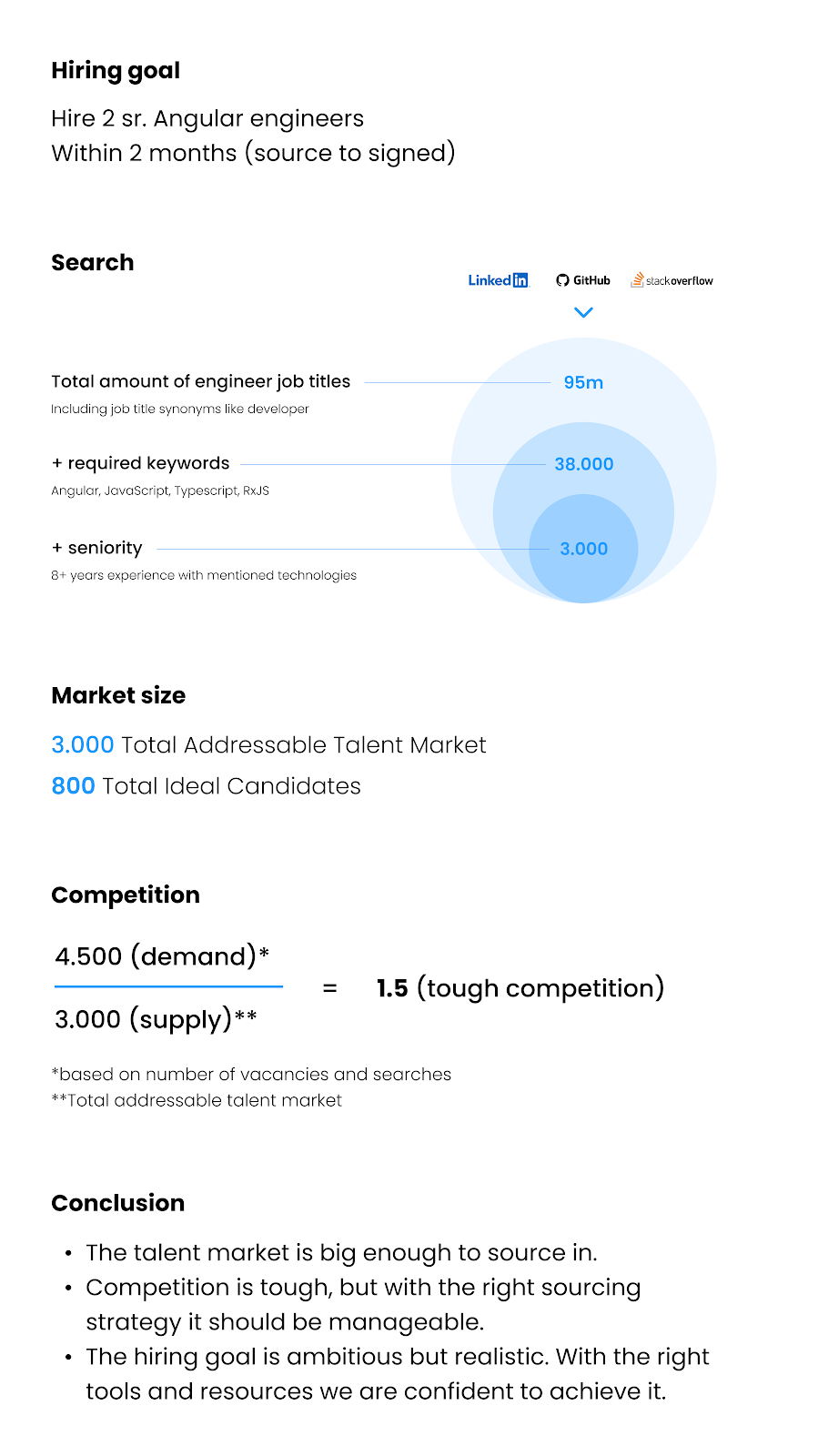
The required high level profile can look like this:
- Job title - engineer (including synonyms like developer)
- Key words - required: Angular, JavaScript, Typescript, RxJS. Optional: Jest, Sass, Karma
- Seniority level: 8+ years experience with the mentioned required technologies
3. Exploratory search.
Do a search based on the defined job criteria.
Is the available talent pool big enough to achieve your hiring goal? If not, discuss the limitations with the hiring manager and remove or adjust job criteria.
You can use a tool to determine the size of the talent pool.
4. Validate.
Validate if the profiles resulting from your initial search are indeed within the envisioned position.
Make a randomized selection of profiles by selecting eg 10 - 20 profiles out of the entire set of found profiles.
Do this across all search results pages to adjust for bias by the algorithmic ranking (of eg LinkedIn).
5. Compare with demand
Enrich the talent mapping by including talent demand. How many organizations are looking for these talents?
Look on job boards for similar jobs to get an idea of how competitive the market is for these talents and how much demand has changed over time.
Don’t forget that a lot of recruiters are pro-actively sourcing and not necessarily posting on job boards.
If you can find data on searches, include that data in your analysis. If not, note that in your talent mapping.
Talent mapping result:
Step 2. Search and select
Now you have your talent map ready and you know in which talent pool you are recruiting in, you can start your actual search.
There are a couple of things to keep in mind when you're searching for engineers.
Choose your platforms and tools wisely
First you need to make a selection of platforms where your candidate can be found on.
There are many online places where engineers hang out and can be found.
This is an overview of some of the sources where engineers are active.
Overview of engineering platforms 📜
- GitHub, all engineers
- Stack Overflow, all engineers
- Reddit, all engineers
- HackerRank, all engineers
- AngelList, startup minded engineers
- Xing, German area engineers
- Kaggle, data (science) engineers
- Medium, engineers with a voice
- Tumblr, all engineers
- ResearchGate, (data) research focussed engineers
- GitLab, all engineers
- Coderwall, all engineers
- Dev.to, all engineers
- StackShare, all engineers
Your best bets are GitHub, Stack Overflow and LinkedIn.
Read more on how to source these platforms here:
HeroHunt.ai
The reason this step is painful is arithmetic: the platform list above is fourteen sources, and running the same boolean across GitHub, Stack Overflow and LinkedIn by hand means three different query syntaxes and three sets of results to de-duplicate. HeroHunt.ai searches over a billion profiles across those sources from one query, then finds contact details and sends the outreach from the same place, which is steps two to four of this guide in one workflow. The honest caveat: it will not do step three's judgement for you. No tool reads a candidate's last three commits and tells you the code is good, so for senior engineering hires you still open the repositories yourself. It is also a sourcing and outreach tool, not an applicant tracking system, so your pipeline still lives in your ATS.
Search across sources, then select on signal
Choosing the platform is only half of step two. The other half is actually searching it and selecting the right people out of it.
On most of these sources you are not searching a tidy resume database, you are reading behaviour. On GitHub you can filter by language, location and followers, then open the repositories to see what someone actually ships and how they write code. On Stack Overflow, tags and reputation show you where a person has real depth. Boolean and x-ray searches on Google (for example site:github.com plus your keywords) get you into these profiles even when the on-platform search is weak.
When you select, resist plain keyword matching. A candidate with "React" in their bio is not the same as one whose last three repositories are React projects with real, recent commits. Pick the profiles that show signal you can point to, because that same signal is what you will use to personalize your outreach two steps from now.
Step 3. Find out more about the candidate
Before you reach out, learn enough about the candidate to know two things: whether they are genuinely a fit, and how to contact them on a channel they actually read.
Start with what is already public. An engineer's GitHub, personal site, blog, conference talks and Stack Overflow answers tell you more than a resume ever will: which languages they reach for, whether they maintain projects or abandon them, how they explain their thinking. This is also where you find the hook for your message. A specific line about a project they clearly cared about beats "I saw your impressive profile" every single time.
Finding their contact details
Engineers are the one group where you can often skip the paywalled databases entirely. Many developers expose an email in their public Git history: the author email is attached to their commits (git log will show it, and it is frequently a personal address they still read). Personal sites and GitHub profile pages often list an email too.
When the public trail runs cold, a B2B contact-data tool fills the gap. Apollo.io finds a work email and, on paid tiers, a direct-dial number, then lets you send from the same place. The honest caveat for engineers specifically: these databases are built for sales and business contacts, so their coverage of individual developers (especially juniors and people outside the US) is patchier than it is for a VP of Sales. Treat it as a fallback, verify what it returns, and lean on the public trail first.
Apollo.io
For step three, the reason to reach for Apollo is that finding the address and sending the message happen in one tool, so you skip the export-and-reimport loop that breaks most sourcing workflows. Know the limits before you rely on it: the free plan's general credit pool is 900 credits per seat per year, released monthly rather than granted upfront, and its export credits are separate and far scarcer, and paid starts at $49 per seat per month billed annually ($65 month to month) for 30,000 credits. The catch for engineer sourcing: Apollo is a B2B work-email database, so its coverage of individual developers is thinner than for sales titles, and you will still want the GitHub-commit-email route for the ones it misses.
Step 4. Reach out and engage
The channel matters as much as the message. Experienced engineers get five to ten recruiter messages a day on LinkedIn, so a LinkedIn InMail lands in the single most crowded inbox you can pick. Reaching them by email, or wherever they are most active, already puts you ahead of most of your competition.
Then make the message worth reading. Reference the specific thing you found in step three (a repository, a talk, an answer they wrote), be honest about the role and why you thought of them, and get to the point. Engineers reward directness and punish fluff and mass-blast templates. Automated LinkedIn connection blasting is exactly the pattern they have learned to ignore, so personalization is not a nice-to-have here, it is the whole game.
Expect a conversation, not a yes. Most strong engineers are passive: they are not looking, so your first message is planting a seed. Keep it low pressure, offer a short call, and follow up once or twice with something genuinely useful rather than "just bumping this."
Step 5. Make an attractive offer
By the time you are talking compensation, you should already know what actually moves this person, because you learned it in steps one through four. For most engineers the offer is not just the number.
Go back to the characteristics at the top of this guide. Developers consistently weigh the problems they will solve, the people and manager they will work with, autonomy and work-life balance alongside salary, and many leave jobs over poor management rather than pay. So an attractive offer names the interesting technical problem, the team and the stack, the flexibility and the growth path, not only the money. If you can let a candidate talk to the engineers they would actually work with, do it: that conversation closes more senior developers than any perk.
Be straight about compensation too. Engineers talk to each other and research ranges, so a lowball or a vague "competitive salary" reads as a red flag. Come in with a real number and the reasoning behind it.
Putting it together
Recruiting software engineers is not about sending more messages, it is about doing each of these five steps well: map the market so your goal is realistic, search the sources where engineers actually are, learn enough about each candidate to personalize, reach out on a channel they read, and make an offer built around what they care about.
The manual version of this is a lot of tabs and copy-paste. AI sourcing tools now do much of it for you: platforms like HeroHunt.ai search across these sources from over a billion profiles, find contact details, and send personalized outreach on autopilot, which is the automated counterpart to the five-step workflow above. Whichever route you take, the principles do not change: go where engineers are, treat them as individuals, and make an offer worth leaving a good job for.
Written by Yuma Heymans (@yumahey), who built HeroHunt.ai, the world's first AI Recruiter, now used by 15,000+ recruiters to source and engage engineers and other hard-to-reach talent on autopilot.