



The insider hiring guide to the fastest-growing engineering role of 2026: who forward deployed engineers really are, what they cost, where they hide, and how to land them before your competitor does.
Monthly job listings for forward deployed engineers rose more than 800% between January and September 2025 - PYMNTS. That single line explains why a role most recruiters had never heard of two years ago is now the hardest hire on the board at OpenAI, Anthropic, Palantir, Ramp, and roughly every applied-AI startup that has raised a Series A. The forward deployed engineer, or FDE, has become the person who decides whether a company's AI actually works inside a customer, and there are nowhere near enough of them.
The trouble is that the FDE is the most miscast job title in technology right now. The people who are genuinely good at it almost never carry the label, the strongest candidates are already embedded in a customer deployment and not looking, and most hiring teams screen them with a standard software loop that rejects the exact traits that make an FDE valuable. A brilliant back-end engineer who freezes in a customer meeting fails at this job, and so does a polished consultant who cannot debug a production system, yet a normal interview process catches neither failure. Get the role wrong and you spend three months and a retained-search fee hiring someone who quits after their fourth week of travel.
This guide is the practical map for anyone who has to actually fill the role, written for recruiters and hiring managers rather than for people who want to become an FDE. It covers what a forward deployed engineer really is and where the title came from, why demand went vertical in 2025 and 2026, exactly who is hiring and how their models differ, what these people cost, the traits and backgrounds that predict success, where to find candidates who never use the title, how to write a job description and an interview loop that screen for both halves of the job, how to keep FDEs from burning out, when the role is the wrong hire entirely, and how AI agents are now reshaping both the FDE's work and the hunt for them.
This guide is written by Yuma Heymans (@yumahey), who built HeroHunt.ai, the AI recruiter that sources engineers from more than a billion profiles. He spends his days on the exact problem at the center of this market, finding scarce technical people who never carry the obvious title, which is precisely why forward deployed engineers, a group that almost never calls itself that, are a case he knows well.
Contents
- What a Forward Deployed Engineer Actually Is
- Why FDE Hiring Exploded in 2025 and 2026
- Who Is Hiring FDEs: The 2026 Landscape
- What Forward Deployed Engineers Really Cost
- The Profile: Traits and Backgrounds That Predict Success
- Where to Find FDEs: Sourcing the Passive Pool
- Writing a Job Description That Attracts the Right Half
- The Interview Loop: Screening Both Halves
- Closing, Retention, and the Burnout Problem
- When an FDE Is the Wrong Hire: Limits and Failure Modes
- How AI Agents Are Changing the Hunt
- The Future Outlook: Durable Role or Hype Cycle
- The Recruiter's Playbook
1. What a Forward Deployed Engineer Actually Is
A forward deployed engineer is an engineer who embeds inside a customer, writes and owns production code in that customer's systems, and stays until the deployment actually works, then carries what they learned back into the core product. That is the whole role in one sentence, and every hiring decision downstream flows from it. The FDE is not a consultant who delivers a slide deck, not a sales engineer who runs pre-sales demos, and not a back-end engineer who ships features from headquarters. They are a hybrid built to close the gap between what a product can do in theory and what it does inside one specific, messy, real organization.
The title was invented at Palantir, where the internal name for the role is Delta. In Palantir's own framing, a Delta (a Forward Deployed Software Engineer) sits inside Business Development and deploys the company's platforms to a single customer, while a Dev (a product software engineer) sits inside Product Development and builds Foundry and Gotham for everyone. Palantir describes the split memorably: a Dev's focus is one capability, many customers, and a Delta's focus is one customer, many capabilities - Palantir. The name itself is a holdover from Palantir's early days, when each Business Development team was labeled with a NATO-alphabet letter, and it deliberately signals that a Delta is not a consultant: they build durable solutions the customer keeps improving, and they can push code back into the core products.
The concept goes back further than the current hype, and its origin story is worth knowing because it defines the temperament you are hiring for. Palantir CTO Shyam Sankar is credited with coining the term, inspired by a 2006 comment from CEO Alex Karp that at a French restaurant the wait staff are really part of the kitchen. Sankar named the model forward deployed engineering in 2007 - Pirate Wires. His description of the ideal FDE is still the sharpest one written: someone "crazy enough to get on a last-minute plane to Iraq," "smart enough to ship quality, same-day code," with an EQ "still high enough to talk to users (and maybe even enjoy it)." Hold that image, because it is three different people fused into one, and the fusion is exactly what makes the role scarce.
Palantir leaned so hard into the model that, up until roughly 2016, the company had more forward deployed engineers than it had traditional software engineers - The Pragmatic Engineer. The day-to-day rhythm of the job explains why it demands such an unusual person. One Palantir FDE described a typical week as a couple of days physically at the customer's premises understanding their problems, then time back in the office writing code changes and reviewing pull requests. That alternation, between the customer's world and the product's codebase, is the defining texture of the role and the thing a standard engineering job never asks for.
To make the last mile concrete, picture what an FDE actually inherits on day one at a large customer. The model works beautifully in a demo, but the customer's data is scattered across a mainframe, three SaaS tools, and a warehouse nobody fully understands, half the useful fields are unstructured free text, the security team will not allow anything to leave a private cloud, and the workflow the AI is meant to improve was never documented because it lives in the heads of four analysts. The FDE's job is to turn that into a working, trusted deployment: wiring up retrieval against the real data, designing evaluations that catch a hallucination before a regulator does, building the agent workflows, and standing up the observability that tells everyone whether it is actually working. None of that is model research and none of it is generic back-end work, which is exactly why it takes a distinct kind of engineer and why the market cannot simply retrain existing developers into the role overnight.
The cleanest way to understand the FDE is by what it is not, because the distinctions are exactly where hiring goes wrong. Against a solutions architect, the FDE is far more hands-on and actually writes production code on the customer's infrastructure rather than advising from a whiteboard. Against a sales engineer, the FDE contributes to the core product roadmap rather than running pre-sales. Against a normal software engineer, the FDE deliberately splits attention between the customer and the platform. The diagram below shows the three worlds an FDE straddles, and internalizing it is the first defense against writing a job description for the wrong person.
For a fast primer on what the role involves and why it is spreading, the talk below from Kevin Bai, who helped scale Palantir's FDE function, later founded the FDE org at Rippling, and now works on Anthropic's Applied AI team, is the single most useful 20 minutes a hiring manager can spend. It frames when an FDE is actually needed and how the function should be structured, which is precisely the calibration a recruiter needs before opening a requisition.
Forward Deployed Engineering 101: Kevin Bai
2. Why FDE Hiring Exploded in 2025 and 2026
The FDE boom is not fashion, it is a direct response to the single most important number in enterprise AI: roughly 95% of enterprise AI pilots deliver no measurable business impact, a finding from MIT's NANDA project that circulated through every boardroom in late 2025 - MarkTechPost. The failures are overwhelmingly on the deployment side, not the model side. The model is good enough. What breaks is the last mile: fragmented data, legacy systems, compliance constraints, and workflows nobody documented. The forward deployed engineer exists to survive that last mile, which is why every company selling AI to enterprises suddenly needs a battalion of them.
The hiring data reflects a genuine vertical takeoff. Beyond the 800% surge in the first three quarters of 2025, Indeed's postings data showed forward deployed engineer listings up roughly 729% year over year by April 2026, reaching a level about 5,230% above the January 2025 baseline, with Anthropic, OpenAI, Palantir, Stripe, and Google Cloud among the named hirers and advertised pay from about $170,000 to over $200,000 - Business Insider via AOL. Even the softer signal points the same way: mentions of forward deployed engineering in company documents rose about 17% in six months according to AlphaSense data cited by LeadDev - LeadDev. When a job title shows up in earnings calls and internal memos, the requisitions are not far behind.
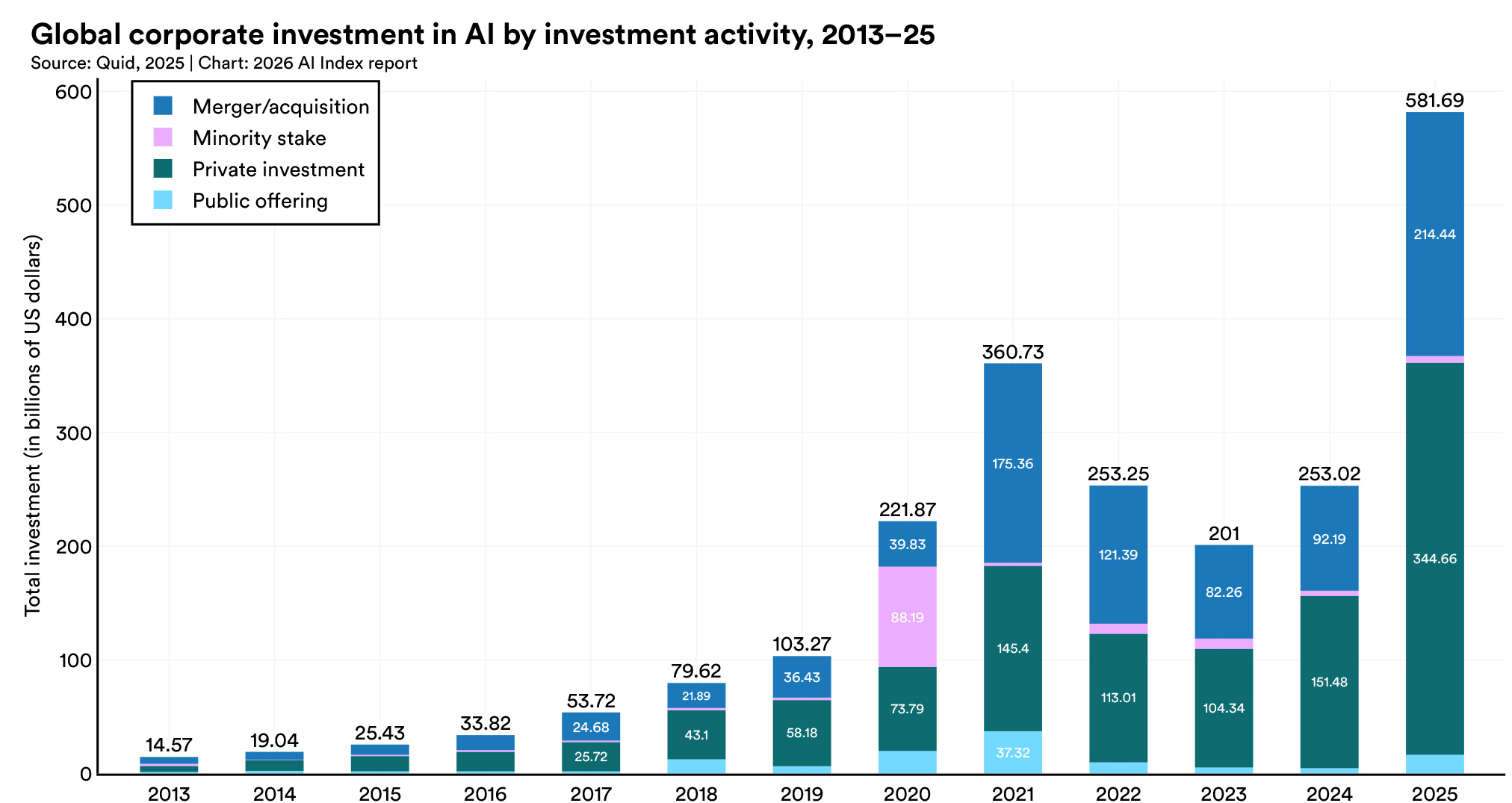
Underneath the demand sits a wave of capital that has to convert into deployed software to justify itself, and that conversion is human. The scale of enterprise AI investment is the pressure behind the hiring, because every dollar of model spend eventually needs someone to make it work at a customer. The chart below, from Stanford's AI Index, shows how steeply corporate AI investment has climbed, and the deployment gap is what turns that spend into FDE headcount.
The strategic idea that gave the trend a name is services-led growth, argued most influentially by Andreessen Horowitz, which in June 2025 called the FDE the hottest job in startups - a16z. The thesis inverts a decade of software orthodoxy. Pure product-led growth optimizes gross margin by keeping humans out of the loop, but for complex enterprise AI, the fastest path to revenue and to an unassailable moat is to put expensive engineers directly inside customers, absorb the messy integration work, and own the data layer nobody else can touch. You trade near-term margin for durable position. The a16z chart below contrasts the two curves and explains why sophisticated investors now reward the implementation-heavy model that looks worse on a spreadsheet.

For a recruiter, the practical consequence of this shift is that the FDE requisition is not a normal engineering req that happens to be trendy, it is a structurally different and structurally scarcer hire whose price is set by a bidding war between frontier labs and well-funded startups. The demand is real, it is durable for at least the next few years, and it is concentrated on a profile that the market has not produced in anything like the required numbers. Everything that follows in this guide is downstream of that imbalance, because scarcity is what sets the salary, dictates the sourcing strategy, and explains why these candidates behave nothing like the engineers you hired five years ago.
3. Who Is Hiring FDEs: The 2026 Landscape
The FDE hiring landscape splits into three tiers, and knowing which tier you sit in tells you who you are really competing with for talent. Tier one is Palantir, the originator, which still runs the largest and most mature forward deployed function and remains the template everyone else copies. Tier two is the frontier labs, principally OpenAI and Anthropic, which stood up dedicated FDE teams in 2025 to move their models from impressive demo to production reality inside strategic enterprise and government accounts. Tier three is the fast-growing field of applied-AI startups and enterprise platforms, from Glean and Sierra to Distyl, Decagon, Ramp, Databricks, Scale, Cognition, Mistral, and Harvey, each adapting the model to its own product.
The most useful distinction for a recruiter cuts across those tiers: product-led versus services-led. Product-led companies (Glean, Sierra, Decagon, Ramp) deploy their own platform, and their FDEs drive zero-to-one product surfaces and land-and-expand inside big accounts. Services-led companies (Palantir, Databricks, Distyl) own end-to-end delivery inside the customer's stack. The frontier labs sit in between, delivering a model and API through a heavy layer of embedded engineering. This distinction matters because it changes the candidate you want: a services-led FDE lives closer to bespoke customer work, while a product-led FDE needs a stronger instinct for what generalizes back into the roadmap.
That distinction should change who you shortlist, not just how you describe the role. For a services-led team like Palantir or Distyl, the ideal hire is energized by going deep on one customer's gnarly problem and does not resent building something genuinely bespoke, so you weight the screen for domain curiosity and stamina. For a product-led team like Glean or Sierra, the ideal hire instinctively asks which customer request is really a product feature in disguise and has the discipline to say no to one-off work that will never generalize, so you weight for product judgment. Hiring a deep-bespoke builder into a product-led role produces an engineer who drowns the roadmap in custom features nobody else can use, and hiring a product generalist into a services-led role produces someone who is quietly bored and gone within six months. The tier and the model together, not the title, define the person.
Palantir remains the reference point, and it still hires the role at volume across seniority levels, including new-grad requisitions with an estimated base of $135,000 to $145,000 on its careers board - Palantir Jobs. What makes Palantir strategically important to a recruiter is not that you will win candidates from it easily, because you usually will not, but that its alumni are the single most sought-after talent pool in the category, a point the sourcing section returns to. The company deliberately built a generalist, high-agency engineering culture, and the market now treats a former Palantir Delta as the closest thing to a proven FDE.
The frontier labs professionalized the role in 2025 and then institutionalized it in 2026. OpenAI runs a dedicated forward deployed team hiring across a long list of cities including San Francisco, New York, London, Paris, Munich, Seoul, and Tokyo, typically asking for five or more years of experience - OpenAI. Anthropic brands its version Forward Deployed Engineer, Applied AI, and describes it plainly: engineers who "work within customer systems to build production applications with Claude models," deliver MCP servers and agent skills, and travel 25 to 50 percent of the time to customer sites, with a Munich posting listing €205,000 to €220,000 and asking for four or more years in a technical, customer-facing role - Anthropic. Both labs went further in May 2026, standing up dedicated delivery vehicles: OpenAI reportedly created a majority-owned deployment company led by COO Brad Lightcap, and Anthropic launched a roughly $1.5 billion enterprise venture, with CFO Krishna Rao noting that "enterprise demand for Claude is significantly outpacing any single delivery model" - MarkTechPost.
The third tier is where the role is proliferating fastest and where the titles get creative, which is a trap for keyword-based sourcing. Glean hires a "Founding Forward Deployed Engineer" at $160,000 to $270,000 base, framed as zero-to-one product creation with founder-level autonomy - Glean. Distyl AI hires FDEs in San Francisco and New York at $150,000 to $250,000 plus equity to "own the behavior and performance of AI systems deployed for customers" - Distyl AI. Ramp posts a "Software Engineer, Forward Deployed" at $161,500 to $190,000 plus equity to build custom integrations for its largest accounts - Ramp. Sierra renames the role entirely, calling it an "agent engineer" who works with customers to design, build, and ship agents on its platform - Sierra. Add Databricks (an established services-led FDE function under Professional Services), Scale AI, Cognition (which calls it a "deployed engineer"), Mistral in Europe, and Harvey in legal, and the picture is clear: the role has jumped from a single company to the entire applied-AI economy in under two years.
The renaming is not a cosmetic detail, it is an active sourcing hazard, and it is worth translating for your whole hiring team before you start. Sierra calls it an agent engineer, Anthropic calls it Applied AI, Cognition calls it a deployed engineer, and Ramp files it under ordinary software engineering, which means a recruiter who searches only for the exact phrase forward deployed engineer will miss most of the market and, just as importantly, misjudge who they are losing candidates to. When you benchmark compensation, scope a requisition, or map the competition, collapse all of these labels back to the same underlying job. The companies use different words for one profile, and the candidates use different words again, so treating the title as the unit of analysis is the fastest way to build the wrong picture of your own market.
4. What Forward Deployed Engineers Really Cost
Forward deployed engineers are paid like scarce senior engineers plus a premium for the customer-facing half, and the first budgeting mistake is benchmarking them against a normal software salary. The honest headline is a wide band: advertised base pay for FDE roles in 2026 runs from roughly $135,000 for a new grad to $270,000 for a founding or senior hire, and that is before equity, which at startups and labs frequently rivals or exceeds base. LeadDev cites an average FDE base around $171,911, which is a reasonable midpoint to anchor on, but the spread around it is enormous and driven mostly by seniority and company stage - LeadDev.
The clearest way to see the base-pay landscape is to line up the advertised ranges from real 2026 postings, remembering that these span different seniorities from new-grad to senior. The chart below plots the midpoint of each posted base range. The point is not any single bar but the shape: entry sits near $140,000, and senior or founding roles cluster around $200,000 to $220,000 in base alone, with equity layered on top.
Advertised Base Pay for Forward Deployed Roles (2026)
Total compensation, once equity is included, tells a more dramatic story at the top. Palantir's FDSE-specific total comp on Levels.fyi runs roughly $171,000 to $295,000 with a median near $211,000, while Palantir software engineers overall show a median total compensation around $250,000 on a range of $145,000 to $426,000 - Levels.fyi. At the frontier labs the equity component pushes the ceiling far higher: OpenAI software engineer total compensation ranges from about $253,000 at entry to a median near $860,000 and past $1.1 million at staff level, and while those figures are for software engineers broadly rather than FDEs specifically, they set the gravitational field that a lab's forward deployed comp is pulled toward - Levels.fyi. An FDE at a frontier lab is not paid like a consultant, they are paid like a scarce senior engineer who also happens to fly to customers.
Two structural features of FDE pay matter for how you build an offer. The first is that base and equity are separate negotiations with separate logic: base compensates the grind and the travel, while equity is the real wealth lever at a startup or lab, and a candidate leaving a big-tech salary for a Series A FDE role is trading current cash for a bet on the company. The second is geography, which is shifting in a way that helps some employers. New York has overtaken San Francisco as the center of FDE demand, holding about 35 percent of postings against San Francisco's 11 percent per Uplers, which reflects how much of this hiring is enterprise-facing rather than pure research - Uplers. For a recruiter, that means the talent map for FDEs looks more like the map of enterprise software than the map of AI research, and it opens metros that a frontier research role would not.
The practical budgeting conclusion is liberating rather than intimidating for most employers. Unless you are a frontier lab, you are almost never competing head-to-head with OpenAI's million-dollar packages, because those are reserved for a tiny population and are mostly equity bets on a specific company. Your real competition is the rest of the enterprise-software and applied-AI market, where a base in the $160,000 to $220,000 range plus meaningful equity, real ownership, and interesting customer problems is genuinely competitive. The mistake is to either panic at the lab numbers and give up, or to lowball against last year's back-end salaries and wonder why strong candidates ghost you.
When you actually build the offer, the decision a strong candidate is weighing is rarely base against base, it is cash certainty against equity upside, and naming that trade-off out loud closes more of them than quietly nudging the salary. A senior engineer sitting on a $250,000 base at a big tech company will not move to a Series A forward deployed role for a lower base and a vague grant, but they will move for a slightly lower base plus a meaningful early-stage equity position, a real customer relationship to own end to end, and problems they find genuinely interesting, provided you make the equity concrete and the ownership believable. The employers who lose these candidates are usually the ones who presented the offer as a single salary number, apologized for not matching a lab, and never articulated the upside they actually had. Sell the whole package, be honest about which compensation universe you are competing in, and spend your energy on the levers you can genuinely pull rather than the one you cannot.
5. The Profile: Traits and Backgrounds That Predict Success
The single most important thing to accept before you screen a single resume is that the trait that makes a great FDE resists a standard rubric, which is why the role is, in one recruiter's phrase, "scarce, expensive, and brutal to interview for" - The VC Corner. You are not looking for the best engineer or the best communicator, you are looking for the rare person who is strong enough at both that neither one collapses under pressure. Everything about the profile follows from that dual requirement, and the most common hiring failures come from optimizing one axis and ignoring the other.
The most useful trait list comes from First Round Review, drawn from ex-Palantir practitioners, and it is worth memorizing because it is more predictive than any keyword search. Strong FDEs show grit, described bluntly as a willingness to eat pain, alongside staff-level technical rigor, a habit of prolific building, genuine business curiosity, and a bias toward problem-solving over pattern-matching - First Round Review. That last one matters more than it sounds. A pattern-matcher applies a known playbook, and FDE work punishes playbooks because every customer is differently broken. The people who thrive are the ones who treat an ambiguous, undocumented mess as an interesting puzzle rather than a threat.
Background is a strong but counterintuitive predictor, and this is where a lot of hiring teams over-index on the wrong signal. The clearest positive signal is having been one of the first ten engineers at a startup, where ambiguity, customer contact, and full-stack ownership are unavoidable - The Pragmatic Engineer. Ex-founders who actually shipped and scaled something are a bonus for the same reason. The surprising anti-signal is deep, comfortable tenure at a big tech company: First Round reports that candidates who spent more than ten years at a FAANG company were effectively in a "no fly zone," because the traits that get rewarded inside a large, specialized org (deep focus on a narrow surface, reliance on internal tooling) are close to the opposite of what an FDE needs. Recent grads made up the bulk of Palantir's early FDE roster, some with barely a year of experience, precisely because they had not yet learned a fixed playbook.
The dual requirement also defines the red flags, and both failure modes are symmetric. On one side is the brilliant engineer who cannot debug an unfamiliar production system under time pressure or who freezes in a room full of skeptical customer stakeholders. On the other is the polished, articulate consultant who interviews beautifully but cannot actually write and ship the code - Uplers. A recruiter's job is to screen for both halves deliberately, because a process tuned to catch only one will pass candidates who fail on the other. The consultant-shaped candidate is especially dangerous because they perform well in exactly the parts of the interview that feel most like the job.
There is a subtler quality that separates good FDEs from merely charismatic ones, and it is worth training your hiring managers to look for: the willingness to tell a customer they are wrong. The best Palantir-style FDEs interrogate whether the customer's proposed solution is actually right, and vocally propose alternatives backed with data, rather than simply executing whatever was requested - LeadDev. That is a specific kind of client-facing judgment, not general likeability, and it is the difference between an FDE who quietly builds the wrong thing well and one who changes the outcome of a deployment. Screen for the candidate who has a story about pushing back on a customer and being right, not just the one who is pleasant on a call.
A concrete way to picture the deciding trait is to imagine the same problem handed to two strong engineers. Told that a customer's data pipeline keeps silently dropping records, the pattern-matcher reaches for the last framework that worked and starts implementing it, while the problem-solver first asks what the records represent, who would notice if they vanished, and what the customer actually needs the pipeline to guarantee, and only then writes any code. In a normal product role that difference is minor. In a customer deployment, where the approach that worked at the last client is often exactly wrong for this one, it decides whether the project succeeds or quietly rots. Grit is the other half of the same picture: the willingness to sit in a windowless room at a client site for a week untangling a mess that is not your fault, because that is simply what a working deployment requires. Screen for the candidate who has obviously done that and would do it again, not the one who describes the pristine engineering environment they need in order to be productive.
6. Where to Find FDEs: Sourcing the Passive Pool
Forward deployed engineers are a passive-sourcing problem almost by definition, and accepting that up front will save you months. As one specialist recruiter puts it, "the best FDEs aren't browsing listings because they're knee-deep in a customer deployment" - Paraform. Posting a job and waiting produces a pipeline of consultants who like the title and back-end engineers who want to travel less than the role requires. The candidates you actually want are employed, busy, and not looking, which means outbound sourcing is not one channel among several, it is the channel.
The deeper problem is that the strongest FDE-shaped people rarely carry the title on LinkedIn. An ex-Palantir Delta often shows up as "Software Engineer," a founding engineer as "Co-founder," and a consultant-turned-builder as "Solutions Architect." Searching for the literal phrase "forward deployed engineer" returns a thin, self-selected pool and misses the best candidates entirely - Uplers. Effective sourcing therefore keys on evidence of the work rather than the label: someone who shipped production code inside a customer environment they did not build, who has startup ambiguity in their history, or whose GitHub shows integration and data-pipeline work rather than pure library development. This is a semantic sourcing problem, not a boolean one, which is exactly why title-based search underperforms here.
A concrete example makes the gap obvious. A boolean search for the title "forward deployed engineer" on a major network might return a few thousand self-identified profiles, most of them clustered at the handful of companies that use the exact label. A signal-based search for the underlying profile, engineers who list a customer deployment they personally owned, a founding role at a company that no longer exists, or a move from a consulting firm into an engineering seat, returns a far larger and far stronger pool, most of whom would never surface for the title. The recruiters who win this search are the ones who stop hunting for the word and start hunting for the evidence, because the word is the one thing the best candidates reliably do not put on their profile.
That gap between the profile and the label is where modern AI sourcing earns its place, because a tool that searches on signals rather than exact titles can surface people a keyword filter never will.
HeroHunt.ai
The hardest part of FDE sourcing is that the strongest candidates never carry the title: an ex-Palantir Delta reads as "Software Engineer," a founding engineer as "Co-founder." HeroHunt.ai searches across more than a billion profiles on signals (production code shipped inside a customer's environment, startup-founding history, a consulting-to-engineering move) instead of the literal words "forward deployed," then drafts the outreach automatically. The honest caveat worth stating plainly: an AI sourcer surfaces the engineering half of the profile, not the client-facing half. Whether a candidate can hold a room of skeptical bank stakeholders is still something only your interview loop can judge, so treat the shortlist as the start of screening, not the end.
Beyond the tooling, the highest-yield channels are specific talent pools you can target deliberately. The gold-standard pool is the Palantir alumni network, which one recruiter describes as one of the densest and most loyal in tech, where a single referral often opens many more doors - Recruiting from Scratch. Beyond Palantir, the productive pools are backend engineers coming out of AI labs, enterprise solutions architects who miss writing code, and technical consultants from firms like McKinsey, BCG, or Accenture Federal who are tired of billable hours and want to build. Each of these groups contains people who already have half the profile and are a plausible bet on the other half.
Two operational realities make sourcing more efficient. First, referrals compound in this category more than most, so mining your own team's former colleagues and asking every strong candidate for names is disproportionately effective given how networked the Palantir-and-startup world is. Second, a growing set of specialist recruiting networks now exists specifically for this profile, such as Betts Connect's pool of go-to-market and deployment candidates and Paraform's recruiter network, which has placed FDEs at Palantir, Rippling, Decagon, and Cognition - Betts Recruiting. These exist precisely because the strongest FDEs are not on job boards, and they can be worth the fee for a first critical hire. Whatever mix of channels you choose, budget realistically: a specialist search runs eight to twelve weeks, and contingency fees typically land around 25 percent of first-year salary, roughly $50,000 on a $200,000 package - Paraform.
7. Writing a Job Description That Attracts the Right Half
The FDE job description is the most common early mistake, because the instinct is to write an engineering req with a longer requirements list, and that instinct filters out exactly the people you want. The core rule from practitioners is to hire for traits, not credentials, and specifically to stop listing tools. A weak FDE posting reads like a back-end job and enumerates LangChain, Kubernetes, Pinecone, Docker, React, Go, and Rust as requirements, which signals to a strong generalist that you want a specialist and signals to the wrong candidates that a tool checklist is the bar - Uplers. The FDE will learn whatever stack the customer runs. What they cannot fake is the disposition to own an ambiguous, high-stakes deployment end to end.
A strong description centers on capabilities and situations instead. It describes the reality of the job (embedding with customers, debugging production systems you did not build, translating between a customer's business problem and a technical solution) and it screens hard on ownership. The single best litmus line practitioners recommend baking into both the JD and the screen is deceptively simple: the customer is blocked, figure it out. That framing attracts the person who is energized by ambiguity and repels the person who needs a well-specified ticket, which is precisely the filter you want operating before anyone reaches a phone screen.
The JD also has to be honest about the two things that cause the most expensive mismatches later: travel and the services-versus-product split. If the role involves being onsite at customers 25 to 50 percent of the time, as most lab and enterprise FDE roles do, say so in the first third of the posting, not the last line. Recruiters who have run this search repeatedly warn that "60 percent travel that sounds fine in the abstract" is a leading cause of early attrition, and the fix is to make it concrete and interview against it upfront - Recruiting from Scratch. A candidate who self-selects out because of travel at the JD stage is a gift, not a lost lead.
There is a scoping decision the JD has to make on your behalf, and getting it wrong wastes an entire pipeline. "FDE" now spans at least three distinct flavors: the integration specialist who wires the product into customer systems, the post-sales implementation engineer who owns go-lives, and the product-embedded engineer who feeds the roadmap. Misalignment between the hiring manager and the recruiter on which flavor you are filling is a documented way to burn months of sourcing - Paraform. Decide before you write a word whether this person's success is measured in customer deployments shipped, revenue expanded, or product improvements landed, and write the JD to that definition. The description is where you either recruit the right half of the market or quietly recruit the wrong one.
It helps to see the difference in actual language. A weak requirement line reads: five or more years building distributed systems, expert in Kubernetes, Go, and Terraform, deep experience with vector databases. A strong one reads: you have shipped software that ran inside someone else's company and been the person the customer called when it broke, you are comfortable when the brief is a paragraph of ambiguity rather than a ticket, and you would rather learn a customer's strange legacy stack than insist they adopt yours. The first version recruits a specialist who will be miserable the first time a customer changes their mind. The second recruits the person who is energized by the exact part of the job that cannot be automated. Go through your posting line by line and rewrite each requirement to describe a situation the candidate will face rather than a tool they must already know, and the applicant mix shifts before you have sourced a single name.
8. The Interview Loop: Screening Both Halves
The FDE interview loop has to do something a standard software loop does not: measure the customer-facing half without lowering the engineering bar. Companies that hire FDEs well replace the generic algorithm gauntlet with a loop built around ambiguity and communication, and the centerpiece is almost always an open-ended case rather than a LeetCode problem. Palantir's own onsite is the clearest example, structured around rounds it calls decomposition and learning that have no real FAANG equivalent, alongside coding and system design, and it deliberately prohibits AI tools during the technical rounds - Exponent. The signal being measured is not whether the candidate memorized an algorithm, it is how they think when the problem is deliberately underspecified.
The decomposition round deserves special attention because it is the truest proxy for the job. The candidate is handed a vague, real-world problem and asked to break it into requirements, stakeholders, data models, APIs, workflows, and tradeoffs, and there is no single correct answer, only better and worse structure - Exponent. This is exactly what an FDE does in their first week at a new customer, and it exposes the two most important things at once: whether they can impose order on chaos, and whether they instinctively ask the customer questions before proposing a solution. The most common instant-failure red flag in these rounds is a candidate who leaps to a solution without clarifying what the customer actually needs, which is the same behavior that sinks a real deployment - Perspective AI.
A good decomposition prompt looks deceptively small and then opens into everything. Give the candidate a single sentence, such as a regional hospital network wants to use your product to automatically triage inbound patient referrals, and watch where they go. The strong candidate immediately starts asking rather than designing: who sends the referrals and in what format, what does triage even mean to a clinician versus an administrator, what happens today when it goes wrong, which decisions are safe to automate and which are legally fraught, and how would anyone know the system is working once it is live. The weak candidate starts drawing boxes for a solution to a problem they have not yet understood. You are not grading the elegance of the architecture, you are grading whether they instinctively treat an ambiguous customer request as a set of questions to answer before it is a system to build, because that instinct is the single behavior most predictive of whether they will thrive in front of a real customer.
The customer-facing half needs a dedicated round, not a vibe check tacked onto the debrief. The most effective format practitioners use is a teach-us exercise: the legal-AI company Ironclad, for instance, asks candidates to present a problem from their own career and teach the panel how they used technology to solve it, which surfaces communication, judgment, and depth simultaneously - First Round Review. A sharp companion question, recommended for probing real client judgment, is to ask the candidate about a time a customer was wrong about what they needed and how they handled it. The answer separates the FDE who has genuine stakeholder spine from the one who is merely agreeable, which the profile section flagged as a core distinction.
Two design principles keep the loop honest and fast. The first is that the loop must adapt to how engineers now actually work: Sierra runs an explicitly AI-native onsite of Plan, Build, and Review, where the build stage is a two-hour independent session using whatever AI tools the candidate prefers, judged on production-grade output and end-to-end ownership rather than trivia, and framed around "hiring for strengths, not just an absence of weakness" - Sierra. The second is speed, because top FDEs hold multiple offers and a slow loop loses them. Google reportedly compressed its FDE hiring from four to six interviews over weeks down to as few as two interviews in two days, and Box CEO Aaron Levie has stressed that the role needs deep technical skill paired with real business acumen, which is exactly the combination a compressed but well-designed loop is trying to confirm - The Pragmatic Engineer. A four-part sequence of a collaborative kickoff, a take-home prototype, a solution presentation, and reference checks with former customer-facing colleagues can hit both goals without dragging.
9. Closing, Retention, and the Burnout Problem
Hiring an FDE is only half the battle, because the same intensity that makes the role valuable makes it a burnout risk, and attrition here is expensive to absorb. The travel is real, the customer pressure is constant, and the work oscillates between exhilarating zero-to-one building and grinding, capped customization that goes nowhere. Practitioners are candid that "forward deployed engineering is painful" and that much of the work is "necessary but not strategic," which is a recipe for churn if left unmanaged - First Round Review. Retention is not a perk problem here, it is a scope-design problem, and it belongs to the manager.
The most important retention lever is active scope management by the manager, not the FDE. The manager's job is to continuously rebalance work and to break off tasks that have no path toward a real software upside, so that the engineer is not trapped in an endless cycle of one-off customizations that never generalize. When the ratio of strategic building to pure services work tips too far toward services, strong FDEs leave, often to found their own startups or move into leadership. Guarding that ratio deliberately is what keeps them, and it is a management discipline that has to be designed into the role rather than hoped for.
Counterintuitively, requiring onsite time can be a retention lever rather than a cost, because of what it does for the work itself. Practitioners note that what an FDE discovers onsite is often radically different from what was sold in the contract, and being present at the customer is what lets them find the high-leverage problems worth solving rather than grinding through a stale requirements document - First Round Review. The travel that causes burnout when it is aimless becomes energizing when it consistently surfaces interesting problems, so the framing and the selection of which trips matter is itself a retention tool. An FDE who feels their onsite time is discovering real problems stays far longer than one who feels shipped around to babysit go-lives.
Structurally, teams that retain FDEs plan for turnover instead of being surprised by it. That means running defined tours of duty so the intense phases have an end in sight, keeping a bench so no single engineer is the irreplaceable owner of a critical account, and writing the succession plan before it is needed. The framing that works is to treat FDE churn as a known cost to be modeled and buffered rather than a failure to be prevented at all costs, because some of your best FDEs will leave to start companies no matter what you do, and a team designed around that reality stays healthy while one that ignores it lurches from crisis to crisis.
In practice, a tour of duty can be as simple as a stated expectation that an engineer owns a hard account for nine to twelve months, after which they rotate onto core product work or a fresh deployment of their choosing, with the rotation promised up front rather than negotiated later under duress. That one structural promise does two useful things at once. It gives the intense phase a visible finish line, which is what makes people willing to sprint through it, and it forces the team to document and cross-train so the account does not collapse when the engineer moves on. Teams that skip this end up with heroic individuals who quietly become single points of failure and then leave anyway, taking the only working knowledge of a critical customer out the door with them, which is a far more expensive outcome than the rotation would ever have cost.
10. When an FDE Is the Wrong Hire: Limits and Failure Modes
The most valuable thing a recruiter can do sometimes is tell a hiring manager they do not actually need an FDE, because the role has hard limits and hiring into them wastes money and burns candidates. The sharpest guardrail comes from practitioners directly: "forward deployed engineering is definitionally an upmarket motion," and "you should not be doing this if you believe the end shape of your product is product-led growth freemium" - First Round Review. FDEs make sense for large, complex customers with bespoke needs and a product that is not fully self-serve. Deploy them against a self-serve SaaS motion and you have added the most expensive headcount on the team to a problem it does not fit.
Title inflation is the failure mode that most distorts the market and the hiring process. As one consultant puts it, many organizations now call an FDE "anybody who's customer-facing and a little bit technical," which hollows out the meaning and makes sourcing on the title nearly useless - LeadDev. Palantir's own leadership has been dismissive of the copies, with global commercial head Ted Mabrey calling many competitor imitations a half measure that were largely failing. For a recruiter, the lesson is to distrust the title on both sides of the table: on the candidate side because strong FDEs do not use it, and on the requisition side because a hiring manager may be describing a support engineer or a sales engineer while asking for an FDE.
There is a genuine intellectual tension in the role that shows up as a limitation, and honest teams acknowledge it. Critics point out that adding "expensive, hard-to-find humans to replace humans doesn't seem very sustainable," a real critique of a model that sells automation while staffing up on services - LeadDev. There is also a customer-trust dimension, since embedding external engineers deep inside a client's systems raises questions about exposing proprietary data and processes. These are not reasons to avoid the model, but they are reasons to scope it carefully, to be clear with candidates about the services-heavy reality, and to avoid overselling the role as pure cutting-edge product work when a chunk of it is integration grind.
Finally, beware the two hiring extremes that the profile section warned about, because they are the concrete ways this goes wrong in practice. Over-index on Palantir pedigree and you will pay a premium for a brand while ignoring equally strong founders and startup generalists, and you will lose candidates in slow loops to faster competitors. Over-index on raw coding ability and you will hire someone who cannot survive a hostile customer meeting. The a16z guidance for building these teams is a useful corrective: recruit curious, high-agency hustlers with industry exposure rather than credential-stacked specialists, align FDE and account-executive incentives without imposing sales quotas that create perverse behavior, and prioritize genuine in-person presence with customers - a16z. The a16z best-practices summary below distills the build-team playbook into one frame worth keeping in front of the hiring committee.

11. How AI Agents Are Changing the Hunt
AI agents are reshaping FDE recruiting from both ends at once: they make it possible to find candidates who never use the title, and they compress the sourcing and screening work that used to eat a recruiter's week. This is not a speculative shift. Talent leaders are moving fast, with 84% planning to use AI in 2026 and 52% planning to add autonomous AI agents to their teams, according to Korn Ferry's annual talent-acquisition trends report - Korn Ferry. For a role as hard to source as the FDE, that tooling is not a luxury, it is the difference between a full pipeline and an empty one.
The adoption curve is steep and the productivity payoff is concrete. LinkedIn's Future of Recruiting research found 37% of organizations now actively integrating or experimenting with generative AI in hiring, up from 27% a year earlier, with heavy users saving roughly 20% of their work week, about a full day, and 73% of talent-acquisition professionals agreeing AI will change how organizations hire - LinkedIn. That reclaimed day matters most on the hardest searches, and few searches are harder than an FDE requisition where the best candidates are invisible to a keyword filter.
The specific reason AI sourcing fits the FDE problem so well is the title mismatch that this guide keeps returning to. Because a great FDE hides under labels like "Software Engineer," "Solutions Architect," "Applied AI," or an old Palantir "FDSE," a boolean search on the exact title returns a thin and misleading pool. Semantic and signal-based search that reads the career context, rather than matching a string, is what surfaces the person who did the work without ever claiming the label. A new wave of AI recruiting platforms is built precisely on that capability, and they are worth knowing by name.
- HeroHunt.ai runs an autonomous AI Recruiter that sources, screens in natural language, and messages candidates across more than a billion profiles.
- SeekOut offers agentic sourcing over a billion-plus profiles, with strength in deep technical and security-cleared talent.
- Gem pairs an AI Sourcing Agent over 800M-plus profiles with application review and CRM, and counts Anthropic among its users.
- Juicebox lets recruiters describe a role in plain English through PeopleGPT and returns ranked candidates with no boolean at all.
- hireEZ layers agentic sourcing, screening, and outreach on top of your existing ATS.
In practice the workflow that works for an FDE search is a relay, not a handoff to a robot. You point the AI sourcer at the signals that actually predict the profile, ask it to surface a few hundred candidates who shipped inside customer environments or founded something, and let it draft a first outreach note that references the specific work rather than a generic template. Then a human takes over at the exact moment judgment starts to matter: reading between the lines of a career history, deciding whether a founder-turned-engineer will tolerate someone else's roadmap, and writing the second message that actually earns a reply. The teams that get real value from AI sourcing use it to spend their scarce human attention on the twenty candidates worth a genuine conversation instead of the two hundred worth a database query.
The practical takeaway is not that a tool will hire your FDE for you, it is that AI changes where the human effort goes. The agent does the thing it is good at, casting a wide net across hidden profiles and drafting first-pass outreach, which frees your recruiters to spend their judgment on the thing AI cannot assess: whether a candidate can actually hold a room of skeptical customer stakeholders. That division of labor is why 73% of Korn Ferry's talent leaders still rank critical thinking as their number-one hiring priority, ahead of AI technical skills - Korn Ferry. For FDE hiring specifically, use AI to solve the discovery problem and keep humans firmly on the client-facing evaluation, because that is the half of the role a resume and an algorithm will never reveal.
12. The Future Outlook: Durable Role or Hype Cycle
The weight of institutional money in 2026 says the forward deployed engineer is a durable category, not a passing fad, even if the title itself keeps drifting. The clearest evidence is where the biggest players are putting billions. OpenAI launched a standalone deployment company in May 2026, raising $4 billion from nineteen investors at a reported $10 billion valuation and explicitly borrowing Palantir's model of parachuting engineers into clients, with the effort overseen by senior leader Brad Lightcap - TechCrunch. Anthropic launched a competing $1.5 billion enterprise venture the same month with Blackstone, Goldman Sachs, and Hellman & Friedman - CNBC. When the frontier labs stand up multibillion-dollar vehicles whose entire purpose is embedded deployment, the role underneath them is not a fad.
The clearest single signal came from AWS, which in June 2026 committed $1 billion to a dedicated forward deployed engineering organization seeded with thousands of FDEs, embedding pods of roughly five to six engineers per customer, with the Allen Institute, Cox Automotive, the NBA, the NFL, and Southwest already onboard - About Amazon. A billion-dollar commitment and thousands of hires is a structural bet on the model, and it tells a recruiter that FDE demand is not going to soften on the timeline of a normal workforce plan. The practitioner view aligns: specialist analysts argue the surge is a structural shift rather than cyclical hype, and a gap unlikely to disappear through 2027 as long as every enterprise carries unique data, workflows, and compliance constraints that require human integration - Paraform.
The historical precedent that services-heavy companies grow into healthy margins supports the durable read rather than the bubble one. Andreessen Horowitz points out that Workday climbed from a 54.1% gross margin at its IPO to roughly 75% as its early implementation-heavy motion matured, and frames the enterprise AI buyer as grandma getting an iPhone, someone who genuinely wants the technology but needs a person to set it up, which is the permanent niche the forward deployed engineer fills - a16z. The same analysis found that even a frontier model lab is riddled with the role rather than treating it as a temporary crutch. For a recruiter, the signal is that this is not a staffing bulge to be quietly unwound once the product matures, it is how an entire category of company now goes to market, which means the requisitions keep coming and the plan you build for this talent should assume years, not quarters.
The role itself is changing faster than almost any other, and this is the part recruiters most need to internalize, because it changes what you screen for. The VP of forward deployed engineering at Cursor put it starkly, saying that "if we are doing the same job we were doing six months ago, we have done something wrong," as AI agents push FDEs away from hands-on implementation and toward finding new high-value use cases - Latent Space. In the a16z framing, the FDE increasingly acts as a human manager for AI systems rather than a pure coder, which raises the premium on judgment, business sense, and customer instinct relative to raw implementation speed. Hire for the ability to learn continuously and to spot leverage, not for mastery of a stack that will be obsolete in two quarters.
The video below, a 2026 panel with practitioners from OpenAI, Ramp, and other applied-AI companies, is a useful current read on where the role is heading and how leading teams scope and staff it. It is worth watching before you finalize an FDE scorecard, because it surfaces how quickly the definition is moving at the companies setting the pace.
The Future of Forward Deployed Engineering
None of this means the skeptics are wrong, and a good recruiter holds both ideas at once. Some of the 2025 and 2026 demand is genuine "AI FOMO," some organizations are slapping the FDE label on ordinary support or sales-engineering roles, and there is a real risk that a poorly scoped FDE role decays into permanent technical firefighting with no durable career upside. One analysis of roughly a thousand postings puts total compensation for mid-level FDEs at $300,000 to $450,000 and senior at $450,000 to $550,000, heavily equity-weighted, which is exactly the kind of frothy number that invites a correction - Perspective AI. The balanced conclusion is that the underlying need, engineers who make AI work inside real enterprises, is durable and structural, while the title, the comp peaks, and the hype around them are cyclical. Hire for the durable need and stay skeptical of the froth.
13. The Recruiter's Playbook
If you distill everything above into a sequence you can actually run, FDE hiring becomes five decisions rather than one overwhelming search. The order matters, because each decision constrains the next, and almost every failed FDE search traces back to skipping the first one.
Decide whether you even need an FDE. The role is an upmarket motion for complex enterprise customers and a non-self-serve product, and hiring one against a product-led, freemium future is the most expensive way to solve the wrong problem. Sometimes the honest answer to a hiring manager is that they want a sales engineer, a support engineer, or a solutions architect, and naming that early saves everyone a quarter. Only open the requisition once the deployment gap is real and proof-of-concept deals keep stalling on integration.
Scope the flavor before you write a word. Decide whether this person's success is measured in customer deployments shipped, revenue expanded, or product improvements landed, because the integration specialist, the implementation engineer, and the product-embedded engineer are three different hires. Write the job description to capabilities and situations rather than a tool checklist, put the travel reality in the first third, and use the litmus that attracts the right half: the customer is blocked, figure it out.
Source the passive pool on signals, not titles. Assume the best candidates are employed, invisible under generic titles, and not looking, then go get them through outbound. Mine the Palantir alumni network and startup founding engineers, treat consultants-turned-builders as a live pool, and lean on AI sourcing tools such as HeroHunt.ai to surface people who never wrote "forward deployed" on their profile. Keep a human on every message that decides whether a scarce engineer engages, because this audience is the least forgiving of automation that reads like spam.
Screen both halves, and move fast. Replace the algorithm gauntlet with an ambiguous decomposition case and a teach-us or push-back round that tests real stakeholder judgment, and watch for the candidate who clarifies before solving. Then compress the loop, because top FDEs hold multiple offers and a two-week scheduling gap loses them to a competitor who ran two interviews in two days.
Retain by managing scope and planning for churn. Make it a manager's explicit job to guard the ratio of strategic building to pure services work, use onsite time to surface interesting problems rather than to babysit go-lives, and model turnover with tours of duty and a bench instead of pretending your best FDEs will never leave to found companies. The teams that win the forward deployed engineer are not the ones with the biggest budgets, they are the ones who understand exactly who this rare person is and what actually keeps them, and that understanding is an edge available to anyone willing to learn the market rather than just outbid it.
This guide reflects the forward deployed engineering hiring market as of August 2026. Compensation, company programs, and demand in this field change month to month, so verify current details before making decisions based on them.