




The 2026 field guide to candidate reply rates: what "good" looks like by channel, role, and touch, why the published benchmarks disagree by up to eight times, and how to beat the average.
Recruiting is the best-performing outreach discipline in the entire economy. In the largest recruiting-specific study published this year, candidate messages on LinkedIn replied at 17.08% and recruiter-written emails at 6.31% - Pin. For comparison, the average cold email sent by everyone else now replies at just 3.43% - Instantly. Being contacted about a job is genuinely welcome in a way that being pitched software is not, and the numbers prove it.
But here is the problem: almost no recruiter can tell you what a good reply rate actually is. Ask five vendors and you will get five answers that span an order of magnitude, from Belkins reporting a 0.45% average to Instantly reporting 3.43% on data from the same year - Belkins. Both are honest. They just count "a reply" differently. Meanwhile the ground is moving under everyone: LinkedIn connection-note reply rates fell 37% in twelve months, and cold email has slid from an 8.5% benchmark in 2020 to a third of that today - Expandi.
This guide fixes that. It sets out the real 2026 reply-rate numbers for recruiting outreach, drawn from primary datasets covering tens of millions of messages, and it does the harder work of telling you which numbers to trust. It breaks reply rate down by channel, by candidate role and industry, and by how many follow-ups you send. It explains the deliverability ceiling that silently caps your results before a candidate reads a word, the double-edged effect of AI on response, and the tools that move the number. Every figure is from late 2025 or 2026, because in outreach a two-year-old benchmark describes a market that no longer exists.
Written by Yuma Heymans (@yumahey), who built HeroHunt.ai and its autonomous AI Recruiter, and has spent years watching recruiting reply rates rise and fall from the inside of an outreach engine rather than the outside of a benchmark report.
Contents
- The 2026 Benchmark at a Glance: What Good Looks Like
- What Actually Counts as a Reply (And Why Numbers Disagree 8x)
- Reply Rates by Channel: Email, LinkedIn, Phone, SMS
- Reply Rates by Segment: Role, Function, and Industry
- The Levers That Move Reply Rate
- The Follow-Up Math: How Many Touches to a Reply
- The Deliverability Ceiling: The Cap Before Copy
- AI's Double Edge: Real Lift Versus Slop
- The Tools That Move the Number
- The 2026 to 2027 Outlook for Reply Rates
- How to Beat the Benchmark: Targets and a Playbook
1. The 2026 Benchmark at a Glance: What Good Looks Like
Start with the single most useful sentence in this guide: for candidate outreach in 2026, a good cold email reply rate is 5% or higher, a good recruiter email lands near 6 to 7%, and a good LinkedIn reply rate is 15% or more. Those are not aspirational stretch goals, they are the median of what competent recruiting teams actually achieve, and they come from the most recruiting-specific dataset available this year: Pin's analysis of over 4 million messages sent by more than 1,500 recruiting organizations to 1.5 million candidates between June 2025 and May 2026 - Pin. If your reply rates sit meaningfully below those marks, the rest of this guide is a diagnosis. If they sit above, it is a way to defend the lead.
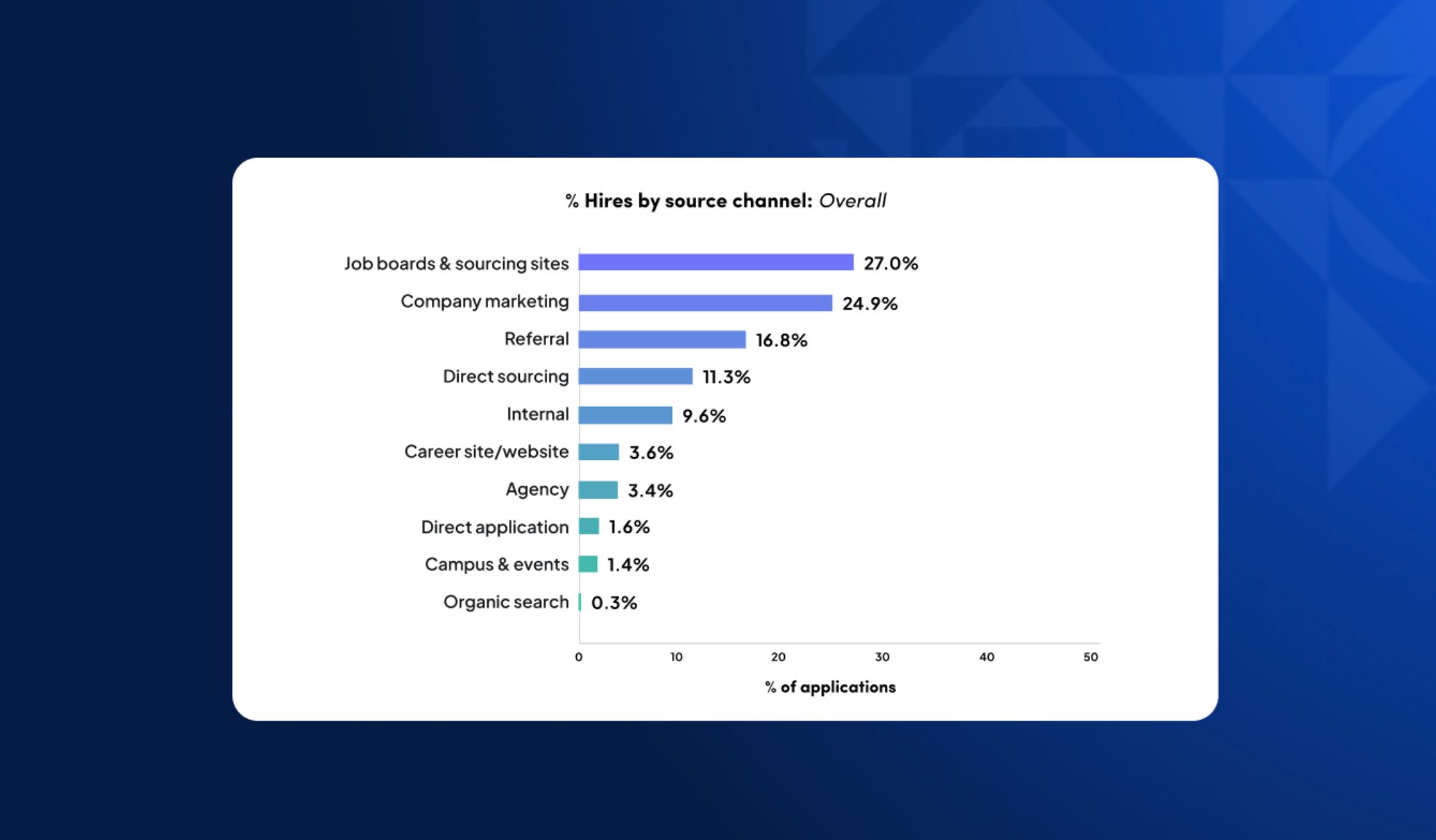
The reason those benchmarks are worth internalizing is that outreach is the highest-leverage motion in recruiting, and reply rate is its first measurable step. Sourced candidates convert to hires at a far higher rate than inbound applicants, roughly five times more likely to be hired once they enter the process, which is why proactive outreach exists at all despite being harder than posting a job - Gem. A reply is the moment a stranger becomes a conversation, and every downstream metric (screens, interviews, offers) is gated by it. Improving reply rate by two points is not a vanity gain, it is proportionally more pipeline from the same list.
The chart below, from Gem's 2026 benchmarks, makes the case for why the number matters. Proactive sourcing produces dramatically more hires per candidate touched than inbound applications, so the replies you win from outreach are worth far more than their raw count suggests.
Why outreach reply rate matters: sourced candidates convert far better
It helps to think in tiers rather than a single number, because a flat average hides the spread between a broken campaign and an elite one. On cold email specifically, the sales world (which shares the same inboxes and filters recruiters do) has converged on a clean set of bands that translate directly to recruiting.
- Below 3%: something is broken, usually deliverability or targeting - Lemlist
- 3 to 5%: a functioning campaign, the baseline of competence
- 5 to 8%: strong execution, good list and copy working together
- 8% and above: elite, the top decile of senders
- Positive replies: track separately, where 3 to 8% is the equivalent scale
Those bands, echoed almost identically by Apollo and Mailshake, are the yardstick to hold your own numbers against - Apollo. The important nuance is the last line: a reply is not the same as a positive reply. A campaign can post a healthy 6% reply rate while most of those replies say "not interested" or "remove me." The teams that win measure the interested share deliberately, because it is the number that actually predicts hires, and it is the one this guide keeps returning to. Recruiting starts from a better position than sales on every one of these bands, but the discipline of measuring against them is identical.
It is worth naming why recruiting sits above sales on every one of these bands, because it tells you where your advantage actually comes from. Hunter's analysis of 31 million emails found that headhunting and recruiting outreach averages a 7.5% reply rate, more than double the 3% of generic sales outreach and second only to digital PR - Hunter. The reason is structural rather than tactical: a job offer is one of the few unsolicited messages a professional is genuinely glad to receive, because it might make their life better, whereas a sales pitch almost never does. That built-in goodwill is the recruiter's edge, and it means the benchmarks in this guide are a floor you inherit for free, not a ceiling you have to fight toward. The failure that squanders it is generic, high-volume outreach that makes a welcome message feel like spam.
HeroHunt.ai
The two levers that move reply rate most in this guide, channel and genuine per-candidate relevance, are exactly the two that collapse when you scale outreach by hand: you personalize the first ten profiles and template the rest. HeroHunt.ai is built around that finding. Its AI Recruiter searches over 1 billion profiles, screens them against the brief, and runs personalized email outreach on autopilot, so the research that lifts reply rate happens on every candidate rather than only the ones you had time for. The honest caveat: no tool rescues a saturating channel with generic volume, and the data in section 8 shows fully AI-written blasts reply worse than humans. Automate the sourcing and the personalization, and keep a human on the replies.
2. What Actually Counts as a Reply (And Why Numbers Disagree 8x)
Before you trust any benchmark, including the ones in this guide, you have to understand why two credible reports can describe the same year and disagree by a factor of eight. Instantly, drawing on billions of interactions across hundreds of thousands of workspaces, reports an average cold email reply rate of 3.43% for 2025 - Instantly. Belkins, analyzing 7,530,489 genuinely cold, net-new B2B emails from the same period, reports 0.45% - Belkins. Neither is wrong. The gap is entirely a matter of the denominator and the definition, and if you do not know which one a benchmark used, the number is noise.
The definitional traps are specific and worth naming, because each one moves the headline by a large multiple. Belkins counts only unique first replies to truly cold, net-new contacts, divided by total sends, with open tracking off and auto-replies stripped out. Many other reports count any reply (including out-of-office bounces and "unsubscribe" messages), sometimes over "engaged" segments rather than the full send, sometimes over opens rather than sends. Each choice inflates the number. The practical rule is to distrust any reply-rate figure that does not tell you four things.
- The denominator: replies divided by sent, or by delivered, or by opened
- The reply definition: any reply, unique replies, or only positive replies
- The audience: net-new cold contacts, warm/engaged lists, or existing candidates
- The deductions: are auto-responders and bounces excluded
When a report is silent on those, treat its headline as a marketing artifact rather than a benchmark. When it is explicit, as Belkins and Pin both are, you can actually use it: you compare your numbers to theirs only after matching how you both count. This is why the seasonal Belkins series below is so useful despite its "low" absolute numbers. It is a clean, deduplicated, net-new baseline measured the same way every month, so the shape (a steady decline across 2025) is trustworthy even where the level looks conservative next to flashier reports.
A conservative, net-new reply-rate baseline measured consistently

There is a second, quieter measurement shift that every recruiter should absorb: open rate is effectively dead as a metric. Apple's Mail Privacy Protection pre-loads images and fires tracking pixels whether or not a human ever sees the message, which inflates reported opens to anywhere from 21% to 44% and makes the number nearly meaningless for a large share of your list - Woodpecker. The vendors closest to the data have responded by demoting opens entirely and elevating reply rate, and better still positive reply rate, as the north-star metric - Lemlist. For recruiters this is liberating rather than limiting. A reply is an unambiguous human action, and an interested reply is a candidate raising their hand. Those cannot be faked by a mail client, which is exactly why they belong at the center of your reporting and why this guide treats them as the currency of outreach.
The metric that survives all of this measurement noise is the positive reply rate, and it deserves to be your headline number. A total reply rate counts every "no thanks," "wrong person," and "remove me" alongside genuine interest, so two campaigns with identical 6% reply rates can have wildly different value if one is mostly rejections and the other mostly curiosity. Lemlist's guidance treats positive replies as the north star and suggests 40 to 60% of them should convert to a booked conversation, a downstream check that keeps the metric honest - Lemlist. For recruiters the equivalent is the "interested" reply, and recruiting sourcing data suggests only about half of all replies are genuinely positive, so a raw reply rate roughly doubles the interested rate sitting underneath it. Report both, and optimize the one that actually predicts hires.
A worked example makes the stakes concrete. Imagine two recruiting teams running the identical campaign to the identical 10,000 candidates, both earning 500 human responses. Team A reports "reply rate" as every response over emails delivered and proudly cites 5.3%. Team B counts only unique, genuinely interested first replies over total emails sent, strips out the 180 auto-responders and "not looking" notes, and reports 3.2%. Same campaign, same outcome, two numbers a third apart, and the only difference is the definition. Now they benchmark: Team A against Instantly's 3.43% concludes it is above average, Team B against Belkins' 0.45% concludes it is elite. Both are fooling themselves, because each compared its number to a benchmark measured a different way. The fix is not a better benchmark, it is measuring your own number the same way every month and only comparing it to a benchmark that discloses its method.
The takeaway from this chapter is not cynicism about benchmarks, it is literacy in reading them. Once you know that a 0.45% and a 3.43% can both be honest, you stop chasing someone else's headline and start measuring your own outreach consistently, month over month, on a definition you control. That single habit, holding your denominator fixed, does more for your ability to improve reply rate than any subject-line trick, because you finally have a number you can trust to tell you whether a change worked.
3. Reply Rates by Channel: Email, LinkedIn, Phone, SMS
If you only optimize one thing about your outreach, optimize the channel, because it is the single biggest lever in the data and it is not close. The cleanest proof comes from a matched-cohort test inside Pin's dataset: across the same 165,000 candidates contacted on both channels, 16.6% replied on LinkedIn versus 4.4% on email - Pin. Because the audience is held identical, this controls for the usual objection that LinkedIn just reaches better candidates. Same people, same recruiters, and LinkedIn still wins by nearly four to one. Channel choice, in other words, roughly quadruples your reply rate before you have written a single word.
That matched result lines up with the per-message benchmarks and with LinkedIn's own long-standing position. Pin's headline per-message reply rates are 17.08% for LinkedIn, 6.31% for recruiter-written email, and 4.96% for automated recruiter email, against the 3.43% all-industry cold-email baseline. LinkedIn has argued for years that InMail runs roughly three times the response of email with identical content, because it surfaces across the LinkedIn inbox, the email inbox, and a mobile push notification at once - LinkedIn. Treat that 3x as the platform's stated position rather than a dated study, but note that the independent Pin data lands in the same place. The chart below puts the recruiting channel gap in one view.
Candidate Reply Rate by Channel (2026)
The gap between automated and recruiter-written email in that chart deserves a moment, because it is a warning as much as a benchmark. The 1.35-point spread between hand-written (6.31%) and automated (4.96%) email is the cost of letting a template do the talking, and it compounds across thousands of sends. It does not argue against automation, it argues against undifferentiated automation, a distinction section 8 develops in detail. The practical read for now is simple: LinkedIn should carry your highest-value, hardest-to-reach candidates, and your email, whether sent by hand or by tool, should read as if a person wrote it to this specific person, because the data says the difference is worth roughly a quarter of your reply rate.
LinkedIn's advantage is not free, and the way you use it matters enormously. LinkedIn's own analysis of tens of millions of recruiter InMails found that messages under 400 characters get about 22% more responses than average, while those over 1,200 characters run 11% below, yet only 10% of InMails are actually that short - LinkedIn. The same analysis found individually sent InMails beat bulk sends by roughly 15%, and candidates flagged "Open to Work" respond 37% more often. Recruiting is also structurally the strongest vertical on the platform: Expandi's dataset of 13.2 million connection requests crowned Staffing and Recruiting the number one industry, at 36.5% connection acceptance and 18.9% message reply, well above the 28.5% and 10.4% platform averages - Expandi. The short, personal, well-targeted InMail is not a nicety on LinkedIn, it is the format the channel rewards.
For a concrete walkthrough of how a reply-generating LinkedIn sequence is actually structured, from connection to message to follow-up, the video below is a useful primer from a team that publishes its own outreach data.
A practical walkthrough of LinkedIn outreach that gets replies
Phone and text round out the channel picture, and both are high-variance specialists rather than volume workhorses. Cold calling in 2026 averages a 2.7% success rate industry-wide, though phone-first teams reach far higher, and it now takes on average about 1.55 calls to reach a prospect, down sharply from prior years - Cognism. Gong's analysis of over 300 million calls shows a similar story: a 5.4% average connect rate against 13.3% for top reps, a gap driven almost entirely by execution rather than lists - Gong. Text messaging looks spectacular on paper, with recruiting sources citing a 45% response rate and 98% open rate against email, but that figure is cross-industry and comes with a hard constraint - Pin. SMS works as a re-engagement or confirmation channel after a candidate has opted in, and in the United States it requires prior written consent under the TCPA, so it belongs late in a sequence with candidates who already know you, not at the cold top of the funnel.
On cost, the channels diverge as sharply as on reply rate, which is why email remains the volume workhorse despite LinkedIn's higher response. Cold email costs a fraction of a cold call per conversation started, with one 2026 estimate putting cost per meeting at roughly $153 by email against nearly $2,800 by phone - Instantly. Phone earns its place not on volume economics but on cutting through when it connects, and one useful multichannel effect is that leaving a voicemail measurably lifts the reply rate of the email that follows it - Gong. The practical hierarchy for recruiting is therefore email and LinkedIn for reach and cost, phone reserved for high-value candidates worth the manual effort, and SMS as a warm re-engagement channel once consent exists.
To see how channel choice compounds, walk a single 200-candidate list through a realistic sequence. Send email alone and, at recruiting's roughly 6% hand-written email reply rate, about 12 candidates answer. Add a LinkedIn touch to the same list and a different slice of people, the ones who never open cold email but live in their LinkedIn inbox, begins to respond, because the matched-cohort data shows large groups of LinkedIn-only and email-only responders who each ignore the other channel entirely - Pin. The two channels are not redundant, they are additive, which is why a two-step email-plus-LinkedIn sequence reliably out-replies either channel run alone. The operational cost is real (two accounts, two message styles, connection limits on LinkedIn), but the reply-rate math is decisive enough that single-channel outreach in 2026 leaves a structural chunk of every list permanently unreachable.
The overarching lesson of the channel data is that you should stop thinking in single channels at all. A two-step sequence that adds LinkedIn to email roughly doubles the reply rate over email alone in Pin's data, and the matched-cohort result shows why: a meaningful share of candidates are LinkedIn-only responders who will never answer an email and vice versa, so a single channel structurally leaves those people unreachable - Pin. The right mental model is not "which channel is best" but "which channels, in which order," a design question section 6 and section 11 answer directly. We go deeper on the mechanics of LinkedIn specifically in our companion guide to recruiting automation on the platform - LinkedIn recruiting automation in 2026.
4. Reply Rates by Segment: Role, Function, and Industry
The most expensive benchmarking mistake recruiters make is comparing themselves to a blended average when the person they are contacting sits in a completely different response regime. Reply rate varies more by who the candidate is than by almost anything you can change about your message. In Pin's 2026 data, product managers reply at 9.94% while engineers reply at 4.64% and healthcare candidates at 2.81% - Pin. An engineering recruiter hitting 4.6% and a marketing recruiter hitting 8.5% may be performing identically well against their segments, even though one number is nearly double the other. Benchmark against your function, not against the headline.
The function spread is large and consistent enough to plan around, and it maps to how saturated each talent pool is with recruiter outreach. The chart below shows the 2026 recruiting reply rate by candidate function, and the pattern is intuitive once you see it: the more sought-after and heavily-messaged the role, the lower the reply rate, because those candidates receive many more messages and answer a smaller fraction of them.
Recruiting Reply Rate by Candidate Function (2026)
Engineering deserves special attention because it is where the most recruiters compete and where the benchmark confusion does the most damage. Beyond replying at roughly half the rate of product managers, engineers are also the slowest to reply, at a median of about 4.1 days against 3.0 for product and 2.9 for customer success - Pin. That combination, lower reply rate and slower replies, means an engineering campaign needs both more patience and a longer measurement window before you judge it. Killing an engineering sequence at day two because it "underperforms" the company average is a classic error; it is performing exactly as engineering sequences do, and the replies are still arriving.
A larger, older sourcing dataset from Ashby corroborates the shape while reminding us how much the numbers move with methodology and time period. Ashby's analysis of over 500,000 sequences (data spanning 2022 to 2024, so directional rather than current) found sourcing reply rates of 49% for legal and 42% for recruiting roles at the top, with engineering at 21% sitting mid-pack, well below those categories - Ashby. The absolute numbers are far higher than Pin's because Ashby measures sequence-level reply across a different, often warmer, population, which is precisely the lesson of section 2 in action. The ordering of roles, however, is stable across both datasets, and the ordering is what you should use for target-setting.
Two segments the headline datasets under-report are worth calibrating yourself, because they move reply rate as much as function does. Seniority is the first: executive and senior candidates are contacted constantly and reply at lower rates than mid-level individual contributors, so an executive-search desk should expect single-digit replies and lean harder on LinkedIn and warm referrals, where the scarcity of relevant approaches works in its favor. Geography is the second, and it interacts with deliverability rather than interest: inbox placement swings from above 90% in parts of Europe to under 60% for some Asian providers, so a genuinely engaged candidate on a poorly-placing domain can look like a non-responder purely because your email never arrived - Validity, via The Agile Brand. Agency and in-house desks differ too, since an agency contacting on behalf of a named brand often out-replies an unknown internal team, and a solo external recruiter with no brand behind them the least. None of these appear in a blended average, and all of them belong in your own targets.
The practical application is to build a small internal table of expected reply rates for the functions you actually recruit, using the ordering above and calibrated to your own historical numbers, and then hold each campaign to its own line rather than a global average. This is also where recruiting benefits from the industry-level view: reply rate varies by the recipient's sector as well as their role, which is why an outreach program spanning multiple industries should segment its reporting rather than average across them. If you want a broader historical baseline for how these recruiting benchmarks have shifted over time, our earlier collection remains a useful reference point - The ultimate collection of recruiting benchmarks. Segment first, then optimize, because optimizing against a blended number just chases an average that describes none of your candidates.
5. The Levers That Move Reply Rate
Once channel and segment are set, three controllable levers explain most of the remaining variance in reply rate: relevance, format, and timing. Of the three, relevance is by far the largest, and the data on it is remarkably consistent across sources that measure it independently. In Pin's recruiting data, simply including the candidate's first name lifts reply rate from 2.61% to 5.13%, close to double - Pin. Hunter's analysis of 31 million emails found that adding two personalized attributes to the body raised reply rate from 3.6% to 5.6%, a 56% lift - Hunter. Ashby found AI-generated personalization tokens lifted sourcing reply rate by about 46%, from 24.1% to 35.3%, the single biggest lever in its dataset - Ashby. Relevance is not a tie-breaker, it is the game.
There is a crucial catch that the honest benchmarks reveal and the marketing ones hide: the bar for personalization has risen because everyone now clears the old one. First-name personalization doubles reply rate on paper, but since nearly every message now includes a first name, that particular move has stopped being a differentiator, and depth is the only thing left that works - Pin. "Depth" means referencing something specific and true about this candidate: a recent talk, a repository, a shared former employer, a comment they posted. LinkedIn's own recruiter guidance quantifies the payoff of warm signals directly, with candidates who follow your company 81% more likely to respond and referencing a shared former employer boosting response by 27% - LinkedIn. The recruiters winning in 2026 are not the ones who personalize the salutation, they are the ones who personalize the reason for reaching out.
Format is the second lever, and here shorter beats longer almost everywhere. The evidence clusters tightly enough to turn into rules.
- InMails under 400 characters: about 22% above-average response - LinkedIn
- Recruiting emails of 150 to 199 words: the best-replying body length at 5.46%
- Subject lines of 5 to 6 words: the top-replying length in recruiting data
- Cold emails under 80 to 125 words: the sales sweet spot most senders overshoot
The unifying principle behind those numbers is cognitive load. A candidate scanning their phone will reply to a message they can absorb in one glance and defer (then forget) a message that looks like work. Short does not mean generic, it means one clear, specific, personalized ask that respects the reader's time. This is also why the "wall of text" InMail underperforms so badly: length reads as a bulk send even when it is not, and the candidate's pattern-recognition for spam fires before they reach your point.
Subject lines deserve their own note, because they gate whether the message is opened at all and they obey the same short-and-specific rule. Recruiting data points to five-to-six-word subject lines as the top performers, and the winning ones read as if a human wrote them to a person rather than as a campaign - Pin. A subject that names the specific role and hints at why this candidate, something like "Owning the monolith migration at your next role," outperforms both the vague ("A career opportunity") and the clickbait ("You will not believe this role"), because the first sets an honest, relevant expectation while the other two either say nothing or trip the spam reflex. The same discipline that governs the body governs the subject: specific, short, honest, and about the reader rather than about you.
Timing is the third and smallest lever, but it is nearly free, so it is worth getting right. Recruiting replies cluster on midweek mornings: Wednesday and Thursday outperform, Saturday is consistently the worst day in both LinkedIn's InMail data and Pin's email data, and early sends win because the message sits at the top of the inbox when the candidate first checks their phone - Pin. The reply window is also narrower than most recruiters believe: the median time to a first reply is measured in hours, and roughly three quarters of all replies that will ever come arrive within 24 hours - LinkedIn. That single fact reshapes cadence design, because it means a candidate who has not answered within a day or two is unlikely to answer this message at all, and the value of your follow-up lives in section 6, not in resending the same note.
A concrete before-and-after shows what "depth" means in practice. A shallow message reads: "Hi Priya, I came across your profile and think you would be a great fit for a Senior Backend Engineer role at a fast-growing startup." It has a first name and nothing else, so it competes with every other templated message in the inbox and earns the low end of the reply range. A deep version reads: "Hi Priya, your talk on migrating a monolith to event-driven services is exactly the problem our platform team is wrestling with now, and this role owns that migration end to end." Same length, same ask, but the second references something only this candidate did, which is the difference the data attaches a near-doubling of reply rate to - Hunter.
The failure mode to avoid is fake personalization, which candidates now detect instantly and which backfires harder than no personalization at all. Dropping in a scraped "I loved your work at [Company]" with no evidence you know what that work was reads as a mail-merge field, signals bulk outreach, and primes the reader to ignore the rest of the message. The safe test is whether the personalized sentence could plausibly be sent to anyone else on your list; if it could, it is a token, not personalization. Depth costs research time, which is precisely why it is scarce and therefore valuable, and why the automation worth buying is the kind that does that research rather than the kind that just fills in a first-name variable.
For a current, practical view of how these levers get assembled into cold outreach that still earns replies in 2026, the walkthrough below is a useful companion to the numbers above.
How cold outreach that still gets replies is structured in 2026
6. The Follow-Up Math: How Many Touches to a Reply
The most common way recruiters leave replies on the table is quitting too early, and the second most common is quitting too late. Both are solved by one number: in recruiting sequences, the first three touches capture 93.2% of every reply a sequence will ever generate, and a fourth touch brings the cumulative total to 97.7% - Pin. Everything past the fourth message is, statistically, annoying people for almost nothing. The practical instruction is precise and rare in its clarity: plan three touches, allow a fourth, and stop. A five-message-plus cadence is not more thorough, it is a way to convert non-responders into people who actively resent you.
Follow-ups matter enormously up to that ceiling, though, and skipping them is the more expensive mistake. Across multiple datasets, follow-ups drive somewhere between 42% and 58% of all replies, meaning a single-send campaign forfeits roughly half its potential response before it starts - Instantly. Ashby's sourcing data shows the compounding directly: a one-email sequence replies at about 7%, two emails at roughly 15%, and three emails at 23%, after which it plateaus - Ashby. Gem's large sequence dataset found the same plateau slightly later, describing a "magic number" around five stages before engagement flattens - Gem. The exact plateau shifts with channel and audience, but the shape is universal: steep gains through the first few touches, then a hard flattening.
Each follow-up adds replies, with sharply diminishing returns
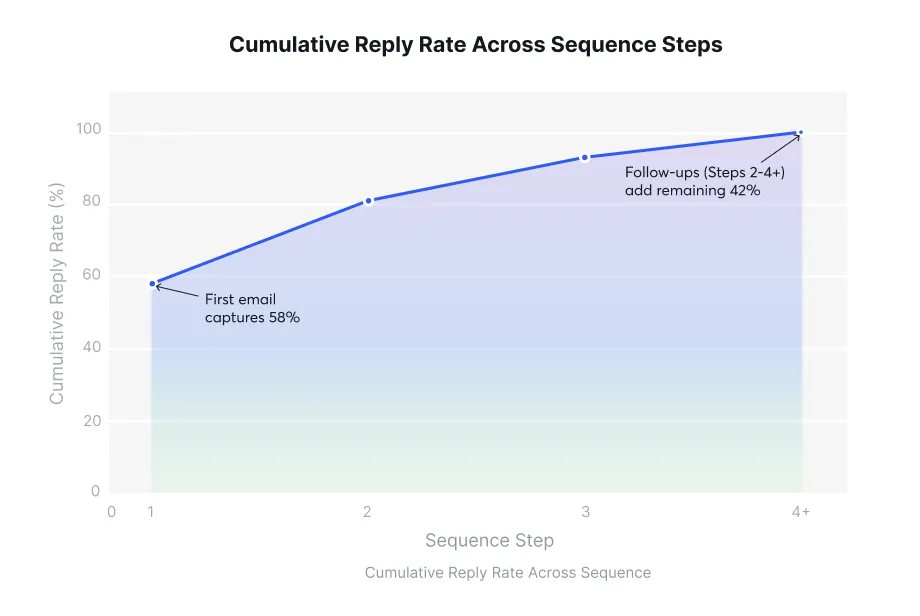
There is a genuine disagreement in the data worth confronting rather than papering over, because it changes how you weight your effort. Instantly reports that the first email captures 58% of all replies, with follow-ups splitting the remaining 42% - Instantly. Belkins, on its net-new B2B dataset, reports almost the opposite, that the initial email drives only 41.4% of replies while steps two through six together drive 58.6%, with step three alone booking the most meetings - Belkins. Both cannot be literally true, and the reconciliation is the denominator lesson from section 2: the two studies count different populations and different reply types. The safe synthesis for recruiters is that the first message is your single most productive touch, but the follow-ups collectively rival or exceed it, so neither "one and done" nor "endless nurture" is defensible. Send a strong first message, then two genuinely additive follow-ups.
"Additive" is the operative word, because a follow-up that just says "bumping this to the top of your inbox" is worse than no follow-up at all in a saturated channel. Each touch should add a new reason to reply: a different angle on the role, a new piece of information about the team or the mission, a switch of channel from email to LinkedIn. The strongest recruiting sequences are multichannel precisely because a channel switch is the most natural way to make touch two feel like a new message rather than a nag. We cover the construction of these sequences in depth, including copy that earns the second and third reply, in our dedicated guide - AI outreach sequences for recruiting in 2026.
A concrete three-touch sequence shows the math working end to end. Say you contact 300 well-targeted candidates. A strong first email at a 6% reply rate earns roughly 18 replies. A genuinely additive second touch two days later, ideally a LinkedIn message rather than a resent email, reaches the next slice of responders and might add another 12 to 15. A third touch a few days after that, offering a new angle on the role, adds a final handful, and by then you are near the 93% of total replies that the first three touches capture - Pin. A fourth touch would scrape a few more; a fifth and sixth would mostly generate unsubscribes and spam complaints that quietly damage the next campaign. The discipline is to see the plateau coming and stop at it, then reallocate the effort you would have spent on touches five and six into better targeting for the next 300.
Finally, respect the clock inside each touch. Because roughly three quarters of replies land within 24 hours and the median is measured in hours, the spacing of follow-ups should be days, not weeks: a common effective pattern is a first message, a follow-up two to three days later, and a third touch (ideally on a different channel) a few days after that, wrapping the whole sequence inside two weeks - Pin. Stretching a three-touch sequence across a month does not give candidates more time to reply, it gives them time to forget you existed. Tight, additive, multichannel, and capped at three or four touches is the entire follow-up playbook, and it is worth more than any individual message you could write.
7. The Deliverability Ceiling: The Cap Before Copy
Here is the uncomfortable truth that sits underneath every email reply rate in this guide: a large share of your outreach never reaches a human at all, and no amount of personalization can earn a reply from a message that landed in spam. Deliverability, not copy, is the real ceiling. Validity's 2026 report puts the global average inbox placement rate at 87.2% for 2025, meaning roughly one in eight legitimate emails still misses the inbox, and the number is wildly uneven by provider - Validity, via The Agile Brand. Gmail places at 89.8% while Microsoft and Outlook lag at just 77.4%, which is a brutal fact for B2B recruiters whose candidates disproportionately use corporate Outlook addresses. Before your subject line does any work, the mail system has already decided whether you get a shot.
The rules that govern that decision hardened sharply and are now non-negotiable table stakes. Since February 2024, and enforced and tightened through 2025, Google and Yahoo require bulk senders to authenticate with SPF, DKIM, and DMARC, to offer one-click unsubscribe, and above all to keep their spam-complaint rate reported in Postmaster Tools below 0.3% at all times, with a strong recommendation to stay under 0.1% - Google. Cross the complaint threshold and your mail is not throttled, it is rejected outright, which quietly zeroes the reply rate of an entire domain. The diagram below shows every stage between "sent" and a "yes" where reply rate leaks away, and why the top of that funnel matters more than the copy at the bottom.
Reading that funnel top to bottom explains why most reply-rate problems are actually delivery problems in disguise. A recruiter obsessing over the wording at stage E is optimizing a step that only a fraction of their list ever reaches, because bounces at stage B and spam-foldering at stage C already removed the audience. Two mechanical controls dominate the top of the funnel: keeping bounce rate under 2% by verifying addresses (verified lists bounce around 1.5% versus 2.55% for unverified), and warming new sending domains for two to four weeks before production volume, ramping from a handful of emails a day toward 40 to 50 - Warmy. Skipping warmup is the fastest way to get a fresh domain blocklisted, a hole that takes months to climb out of.
What makes deliverability such an underexploited edge is that almost nobody measures it. Sinch Mailgun found that only 13.3% of senders actually seed-test their inbox placement, and a startling 88% cannot correctly define the delivery-rate metric, even though avoiding spam is the single biggest deliverability challenge they name - Sinch Mailgun. That is an opportunity. A recruiting team that authenticates properly, verifies its lists, warms its domains, and seed-tests placement is competing for replies against a field where most rivals are silently losing a chunk of their sends to the spam folder. Deliverability is not glamorous, but it is the highest-return work in outreach precisely because it is the work everyone else skips.
The failure mode here is abrupt and expensive, and it usually looks like a mystery reply-rate collapse. A team buys a fresh domain, skips warmup because it is in a hurry, and sends 500 cold emails on day one. Gmail and Yahoo read a brand-new domain suddenly blasting volume as textbook spammer behavior, and the domain gets foldered or blocklisted within hours, which drops its reply rate to near zero regardless of how good the messages were - Warmy. Recovery is slow, often weeks of careful low-volume rebuilding, and many teams instead abandon the domain and start over, wasting the reputation they had begun to build. The mitigation is boring and reliable: warm every new domain for two to four weeks, ramp volume gradually, keep bounces low, and never let an unwarmed domain touch a real campaign. Reputation is earned slowly and lost instantly, which is the entire reason warmup exists.
The strategic point is to treat deliverability, list hygiene, warmup, and cadence as one connected system rather than four separate tactics. A clean list keeps bounces down, which protects domain reputation, which lifts inbox placement, which raises the ceiling on reply rate, which means your carefully written follow-ups actually reach people. Break any link and the whole chain sags. This is also the strongest argument for using tooling that manages sending infrastructure for you, because the alternative is becoming a part-time deliverability engineer, and the data says most recruiters do not have the time to do that well.
8. AI's Double Edge: Real Lift Versus Slop
Artificial intelligence is simultaneously the biggest opportunity and the biggest threat to reply rates in 2026, and the difference between the two comes down to a single design choice: whether a human stays in the loop. Used to deepen relevance at scale, AI clearly lifts reply rate. Ashby measured AI-generated personalization tokens driving a 46% improvement in sourcing replies, and Outreach's platform data shows customized emails replying at roughly double the rate of templates while cutting the research time per prospect from about 20 minutes to 2 - Outreach. That is AI's real value: it does the per-candidate homework that lifts replies, on every candidate, at a speed no human team can match. This is the promise that makes autonomous sourcing viable at all.
Used to mass-produce generic messages, however, AI actively lowers reply rates and poisons the channel. A controlled test by Saleshandy across three campaigns found AI-only emails replied at just 4.1% against 10.4% for human-written, while a hybrid AI-plus-human approach hit 14.7%, roughly 3.6 times the AI-only rate - Saleshandy. Worse, the AI-only messages were flagged as spam at 7.8% versus 2.9% for human-written, which means autonomous AI blasting does not just fail to earn replies, it damages the deliverability that section 7 showed is the ceiling on all future replies. Directionally consistent findings from a larger paired analysis point the same way, that fully autonomous AI underperforms humans on replies and draws more spam complaints, though that study's methodology is less transparent and should be read as corroboration rather than proof - Digital Applied. The pattern is unambiguous: AI as a research and drafting assistant wins, AI as an unattended send button loses.
The reason the loss is structural, not temporary, is that AI slop is actively saturating the channels it floods. LinkedIn connection-note reply rates fell 37% year over year, from 3.5% to 2.2%, even as acceptance stayed flat, a precise signature of inbox fatigue: people still connect, they just increasingly ignore the pitch attached - Expandi. On the demand side, Sopro found that 57% of buyers now say most outreach feels impersonal and irrelevant, which is the collective response of humans drowning in generated volume - Sopro. The chart below shows the multi-year consequence for cold email specifically, a steady decline from the 8.5% benchmark of 2020 toward today's 3.4%.
The Cold Email Reply-Rate Decline
That decline chart is the single most important trend in outreach, and it dictates strategy. When the baseline is falling because the channel is saturating with generic volume, adding more generic volume is the one move guaranteed to make your own numbers worse. The counterintuitive winning response is to send less to better-chosen people with something genuinely specific to say. The data supports this directly: small, tightly-targeted campaigns of under 50 contacts reply at roughly double the rate of blasts to 500 or more, and advanced, signal-based personalization runs multiples above basic personalization - Woodpecker. Precision, not volume, is the escape from the decline.
The hybrid workflow that wins is specific enough to copy. Let the AI do three jobs it does well: find candidates who fit the brief, research each one to surface a real personalization hook, and draft a short first message that uses it. Then have a human do the two jobs AI does badly: sanity-check the targeting (is this genuinely the right person for this role) and handle every reply, where tone, judgment, and negotiation decide whether interest becomes a conversation. This is roughly the configuration that produced Saleshandy's 14.7% hybrid reply rate against 4.1% for AI-only, and it keeps spam complaints near human levels because a person catches the off-key message before it sends - Saleshandy. The mistake is the opposite allocation, letting AI send unattended while a human writes the occasional message by hand, which gives you the worst of both: generic volume in the channel and no scale on the part that matters.
For recruiters, the honest conclusion is that AI belongs in your outreach, but pointed at the right job. Let it do the sourcing, the research, and the first-draft personalization that human recruiters never have time to do at scale, and keep human judgment on the targeting decisions and the replies, where relevance is decided and where a wrong AI move is most visible. Belkins' own study found AI-assisted first messages gave only a modest edge over non-AI (7.3% versus 7.0%) while a simple, genuinely personalized human touch on the connection note lifted replies 55%, a reminder that relevance beats automation every time the two are pitted against each other - Belkins. The teams that win with AI are not the ones who removed the human, they are the ones who moved the human to where they matter most.
9. The Tools That Move the Number
No tool will save a bad list or a spammy domain, but the right stack removes the mechanical drag that keeps reply rates below their ceiling, and the categories map cleanly onto the levers in this guide. There are four jobs to staff: getting accurate contact data, protecting deliverability, running the sequence, and (increasingly) doing the per-candidate research that lifts relevance. Understanding which tool does which job matters more than any single brand, because the most common stack mistake is buying three tools that all do sequencing and none that fixes data quality.
Contact data and verification is the foundation, because everything downstream depends on reaching a real, current address. Tools like Apollo and Lusha provide B2B emails and direct-dial numbers with built-in verification, and their value in a reply-rate context is entirely about the top of the funnel: a verified address bounces less, which protects the domain reputation that section 7 showed is the real ceiling. The honest caveat is that no database is perfectly current, so list verification before a send is a discipline, not a one-time purchase. For recruiting specifically, contact data is only half the problem, because finding the right candidate to contact is where the reply-rate leverage actually sits.
The trap in the data layer is treating coverage as quality. A database that returns an email for every candidate is worthless if a third of those addresses are stale, because every bounce erodes the domain reputation that section 7 showed is the real ceiling on reply rate. The recruiters who get the most from contact data verify aggressively, prefer a smaller list of confirmed-valid addresses over a larger list of guesses, and treat "catch-all" or unverifiable addresses as a separate, lower-priority segment rather than mixing them into the main send. This is unglamorous list hygiene, but it protects the deliverability every downstream reply depends on, and it is the single most common place a promising campaign quietly poisons its own sender reputation.
Sequencing and deliverability tooling is the second layer, and it is crowded with capable options that differ mostly at the edges. Multichannel platforms such as Reply.io and lemlist run email-plus-LinkedIn cadences with warmup and inbox rotation built in, which directly addresses the deliverability and multichannel levers, while recruiting-native platforms like Gem layer sequencing on top of a sourcing CRM and an ATS. The reason these tools lift reply rate is not magic copy, it is that they automate the unglamorous mechanics (warmup, throttling, follow-up timing, channel switching) that recruiters otherwise skip under time pressure. The trade-off is that a sequencing tool will happily help you send generic volume faster, so the tool amplifies whatever discipline you bring to it, for better or worse.
The fourth job, per-candidate research at scale, is the newest and the one most directly tied to the relevance lever that section 5 identified as the biggest driver of replies. This is where autonomous AI recruiters sit, and where HeroHunt.ai takes a different approach from the sequencing tools: rather than making a recruiter send faster, its AI Recruiter searches across more than 1 billion profiles, screens candidates against the brief, and generates and sends personalized outreach on autopilot, with RecruitGPT producing shortlists from a single prompt. Plans start at $149 per month - HeroHunt.ai plans. The category's promise is precisely the finding from section 8: it automates the research and targeting that lift reply rate, rather than the generic sending that lowers it. The same honest caveat from that section applies to every tool in this class, HeroHunt included: autonomous outreach is only as good as the human judgment behind the brief and on the replies.
The trade-off running through every tool category is the same: automation amplifies whatever discipline you bring, so a tool that helps a rigorous team scale relevance will help a sloppy team scale spam. A sequencing platform in the hands of a recruiter who segments tightly and writes deep first messages is a force multiplier; the identical platform in the hands of someone blasting a 5,000-name list is an accelerant for the reply-rate decline in section 8. This is why buying a tool rarely fixes a reply-rate problem on its own, and why the diagnosis matters more than the brand name. The best-run teams pick one tool per job and pair it with a rule for how that tool is allowed to be used, rather than buying capability and hoping discipline arrives with the invoice.
The practical way to assemble a stack is to work backward from the leak in your own funnel rather than buying the tool with the best demo. If your bounce rate is high, fix data and verification first. If your inbox placement is poor, invest in deliverability and warmup before anything else. If your reply rate is fine but you cannot scale relevance, that is where an AI recruiter earns its keep. And if you are sending strong messages that simply do not reach enough of the right people, the bottleneck is sourcing, not copy. Diagnose the specific stage where you lose people in the section 7 funnel, then buy the one tool that fixes that stage, because a stack assembled by diagnosis beats a stack assembled by category every time.
10. The 2026 to 2027 Outlook for Reply Rates
The defining trend for the next eighteen months is that reply rates will keep splitting into two divergent populations: a falling floor and a rising ceiling. The floor falls because generic, AI-generated volume keeps saturating every channel, dragging the average reply rate down the way it already pulled cold email from 8.5% to 3.4% and LinkedIn note replies down 37% in a year - Expandi. The ceiling rises because the tools to do genuine per-candidate research at scale keep improving, so the teams that use AI for relevance rather than volume can now personalize deeply across an entire list. The gap between the median recruiter and the top-decile recruiter, already large, will widen, and which side of it you land on is a choice about how you deploy automation, not about whether you deploy it.
A second structural shift is that automation is now running on both sides of the table, and it changes what a reply is worth. Candidates increasingly use AI to apply and to respond, employers use AI to source and screen, and the middle fills with noise that neither side wants. As generic outreach becomes trivially cheap to produce, the scarce and valuable thing becomes verified, genuine human interest: a reply that means a real person is really considering the move. This is why the smartest teams are re-weighting their metrics away from raw reply rate and toward positive reply rate and downstream conversion, because in a noisy channel the raw count of replies inflates faster than the count of replies that actually lead somewhere.
For recruiters specifically, the practical implication of the widening gap is that standing still means falling behind, because the average you are measured against keeps dropping. A reply rate that was top-tier in 2024 is merely average on several channels in 2026, and will be below average by 2027 if the decline holds. The teams that treat outreach as a system to be continuously tuned, rather than a set of templates to be reused, are the ones whose numbers rise while the field's fall. That is an optimistic conclusion hiding inside a pessimistic trend: the decline punishes complacency and rewards discipline, so the recruiters willing to do the unglamorous work of measurement, segmentation, and deliverability inherit a growing share of the replies as everyone else drifts down with the average.
The channel mix will keep shifting under these pressures, and recruiters should plan for it rather than react to it. LinkedIn will remain the strongest single channel for candidate reply rate, but its connection-note pathway will keep decaying as automation floods it, pushing value toward the post-connection message and toward InMail on high-value candidates. Email will stay the workhorse of volume because it is the cheapest channel per meeting by a wide margin, but its reply rate will keep depending more on deliverability discipline than on copy - Instantly. Multichannel sequencing stops being an optimization and becomes the default, because reaching the LinkedIn-only and email-only responders in the same campaign is the only way to hold reply rate steady against a falling per-channel baseline.
Expect measurement itself to become a competitive edge rather than just a hygiene practice. As reply counts inflate with automated noise, the teams that can distinguish a genuine, interested reply from a polite brush-off, and can tie reply rate to downstream interviews and hires, will allocate their outreach effort far more efficiently than teams still optimizing raw response. The same logic pushes verification up the priority list: when a rising share of inbound interest is automated or low-intent, confirming that a promising reply comes from a real, genuinely available candidate becomes worth real time. The scarce resource in 2027 is not the ability to contact a thousand people, which anyone can buy cheaply, it is confidence that the person who replied is real, qualified, and actually considering the move.
The most reliable prediction is also the most actionable: the fundamentals that drive reply rate will not change, even as everything around them does. Relevance will still roughly double replies, short and specific will still beat long and generic, three to four well-timed touches will still capture nearly all the response a sequence can earn, and deliverability will still cap the whole thing. What changes is the bar, which rises every quarter as more senders clear the old one. The recruiters who prosper through 2027 will be the ones who treat those fundamentals as a system, measure their own numbers honestly against the right benchmark, and spend the hours automation gives them back on the judgment that no model makes well: which candidate to contact, and what true thing to say to them.
11. How to Beat the Benchmark: Targets and a Playbook
Turning all of this into practice starts with setting the right target, because a target calibrated to a blended average will either flatter you into complacency or beat you up for performing normally. Set your targets by channel and by function, using the numbers in this guide as the median and aiming a tier above it: if your engineering email replies at 4.6%, a realistic stretch goal is 6 to 7%, not the 10% a product-management recruiter might reasonably chase - Pin. Write the target down per segment, measure against it monthly on a fixed definition, and treat the gap between your number and the benchmark as a to-do list rather than a grade. The recruiters who improve fastest are the ones who know precisely which segment and which channel is underperforming, because that is the only way to aim your effort.
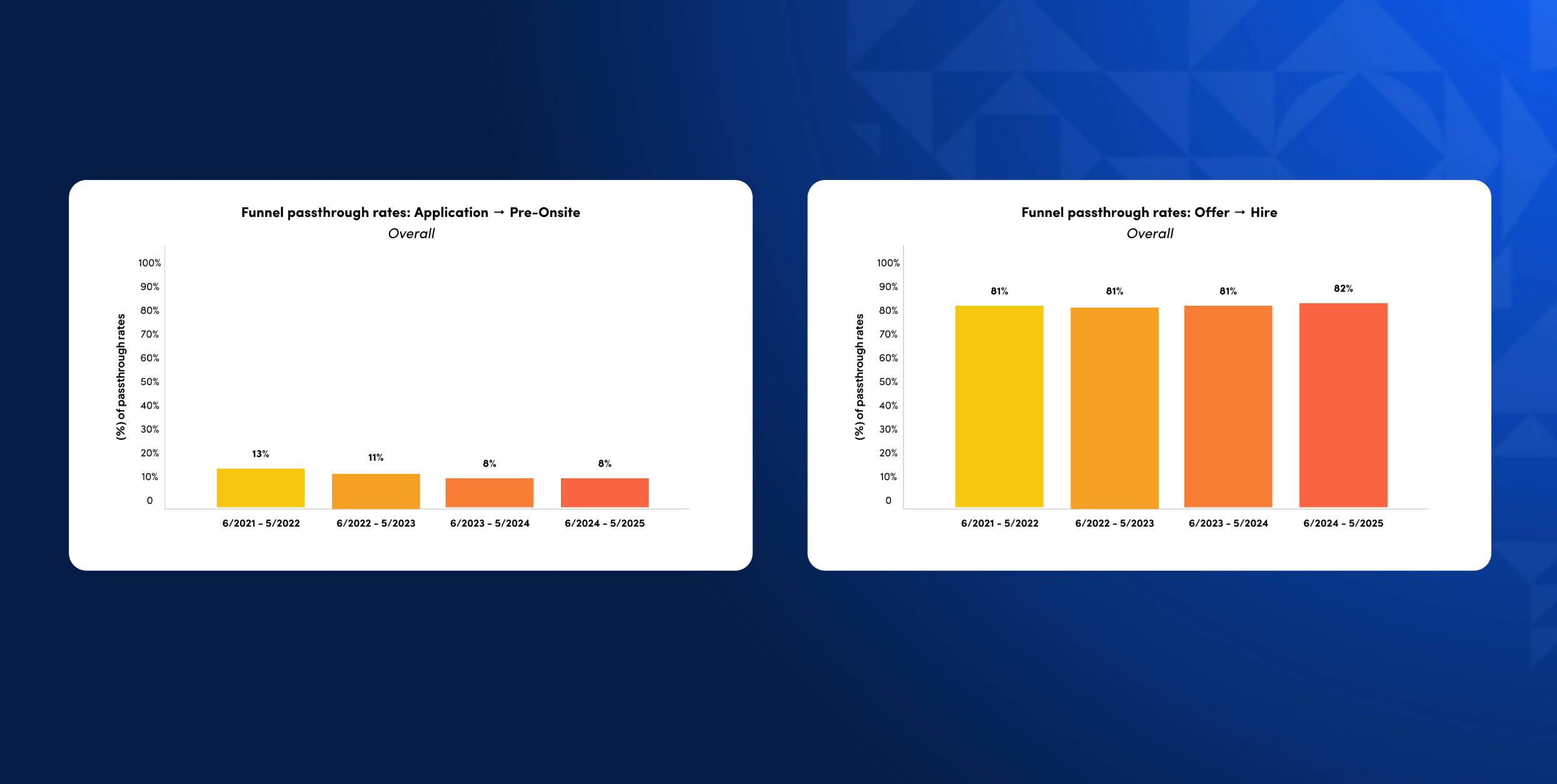
It also helps to remember that reply rate is a means, not an end, and to keep it anchored to the funnel it feeds. A high reply rate that produces no interested candidates is worse than a lower reply rate full of genuine interest, which is why positive reply rate belongs next to reply rate in every report you build. The Gem funnel below is a useful reminder of the downstream context: reply rate is the first controllable gate, but offer acceptance, passthrough, and the sourced-versus-inbound hire economics are what ultimately justify the outreach in the first place.
Reply rate is the first gate in a longer funnel
With targets set, the playbook that beats the benchmark is short enough to memorize and is drawn entirely from the data above. Follow it in order, because each step protects the next.
- Fix deliverability first: authenticate (SPF, DKIM, DMARC), verify lists to keep bounce under 2%, warm new domains, and seed-test inbox placement
- Lead with the strongest channel: put your hardest candidates on LinkedIn, where recruiting replies at roughly 3 to 4 times email
- Segment your targets: build small, tightly-defined lists, because under-50-contact campaigns reply at about double the rate of large blasts
- Personalize on a real signal: reference something specific and true, since depth (not first-name tokens) is now the differentiator
- Cap the sequence at three or four touches, tightly spaced within two weeks and switching channels between them
That sequence works because it attacks the reply-rate leaks in the order they occur in the funnel: deliverability at the top, channel and targeting in the middle, relevance and cadence at the point of contact. Skipping step one to spend more time on step four is the most common and most self-defeating pattern in outreach, because a brilliant, deeply personalized message still earns zero replies from the spam folder. The steps are cheap individually and compounding together, which is why a team that does all five routinely lands in the top tier while a team that does only the visible ones (copy and cadence) plateaus at the average.
A simple ninety-day plan turns this into motion. In the first month, fix the foundation: authenticate your domains, verify your lists, warm any new sending infrastructure, and seed-test inbox placement so you know your real ceiling before judging any copy. In the second month, restructure around channel and segment: move your highest-value candidates to LinkedIn, split monolithic lists into tight per-function segments, and rewrite your first message around a real personalization hook instead of a first-name token. In the third month, tighten the sequence and measure: cap cadences at three or four multichannel touches, start reporting positive reply rate alongside reply rate, and run one deliberate change at a time so you can attribute what moved. By day ninety a team that started at the average is usually a full tier above it, not because of any single trick, but because it fixed the leaks in the order the funnel loses people.
The final and most important habit is honesty about your own numbers. Measure reply rate and positive reply rate on a fixed definition, benchmark each segment against its own line rather than a headline average, and run one deliberate change at a time so you can tell what actually moved the number. Outreach rewards this discipline more than almost any other recruiting activity, because the feedback loop is fast and the data is unusually clean: a candidate either replied or they did not. Do the unglamorous work, point your automation at relevance instead of volume, and the benchmark stops being a ceiling and becomes a floor you comfortably clear. For the message-level craft that turns a good reply rate into a great one, our template library is a practical next step - Recruiting outreach message templates.
Set your reply-rate targets by channel and function, then let an AI Recruiter do the per-candidate research that hits them: search, screen, and personalized outreach across 1B+ profiles, on autopilot.
This guide reflects the recruiting outreach landscape as of August 2026. Reply-rate benchmarks, deliverability rules, and platform behavior change quickly, and different reports measure "a reply" differently, so verify the methodology behind any number (including these) before you hold your team to it.