




Talent becoming available as a result of layoffs
When companies have to let people go, it means that talent becomes available on the market.
Recruiting talent from companies that let talent go is a proven recruitment strategy.
But how can you be the first to know when companies are letting people go?
By using a Google Alert on company layoffs you can take immediate action and start conversations with talent that has been let go by their previous employer.
How to set up a Google Alert for candidates that are getting available
Step 1. Set up a simple search string.
Go to google.com/alerts.
Create a simple search string that signals plans of companies to letting people go, something like:
Company layoff
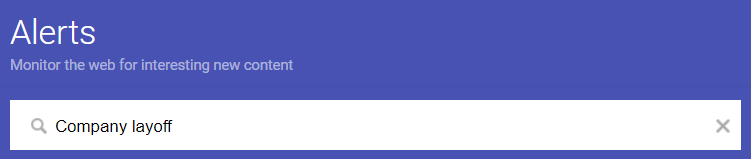
Step 2. Add keywords to your search string that describe the industry you’re recruiting in, for example:
(tech OR internet)
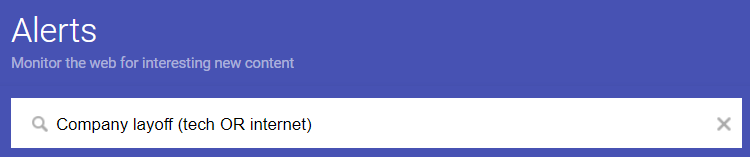
Step 3. Optionally add names of companies that you want to target to your search string, for example:
(Microsoft OR Google OR Salesforce OR Cisco)
*Adding company names is only recommended when you have a specific niche you’re recruiting in.
Step 4. Your final search string can look something like this:
Company layoff (tech OR internet)
In this case excluding the companies
Step 5. Review the results for the alert.
Include the search string in the search field and hit enter.
Review the results that pop-up and see if they are indeed results that you would like to receive updates on.
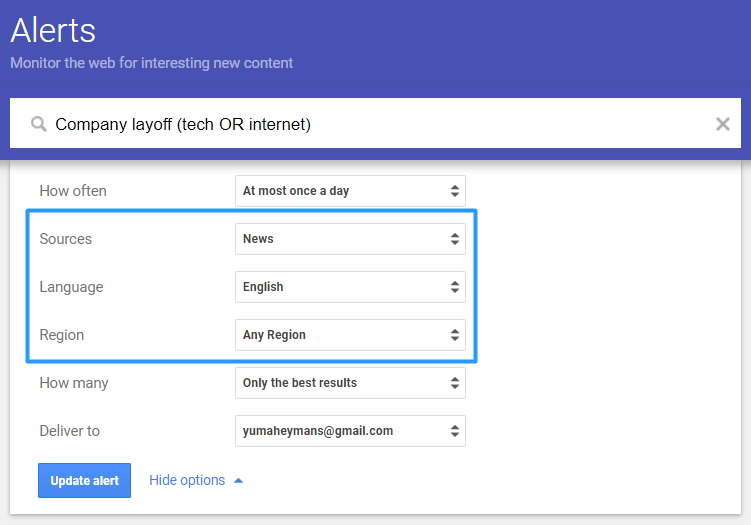
Step 6. Go to ‘Show options’ and add options
Add the following options:
- Sources: in this case ‘News’ is the most relevant one
- Language: the language your layoff news is most likely communicated in
- Region: the geography you want to source talent in
Step 7. Save the alert.
Now you will start receiving updates on news about companies letting people go so you can provide those people the new job they are looking for.
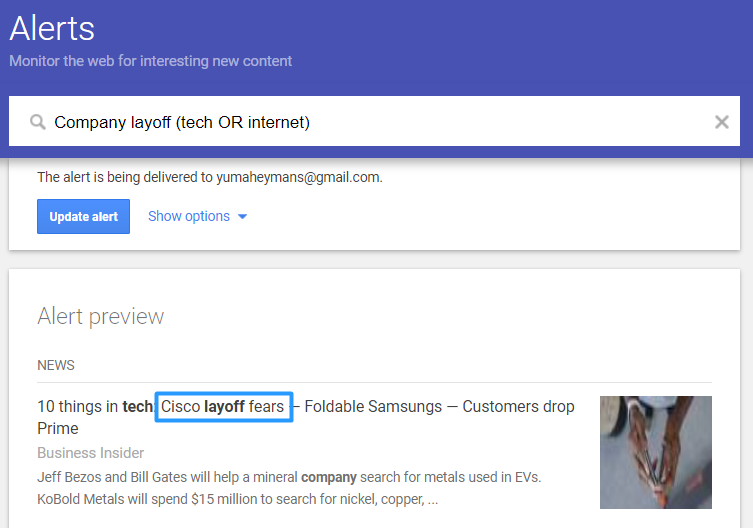
Google Alerts will show a preview of the updates you can expect, so check if these updates are in line with your recruitment goals and optimize the search accordingly.
Make your layoff radar more reliable
Google Alerts is free, but it is a blunt net. It only catches layoffs that reach the news, and it can arrive noisy or late. Pair it with two sources that are faster and more complete.
Dedicated layoff trackers. Layoffs.fyi, maintained by Roger Lee, has logged tech and startup layoffs since 2020 and passed 100,000 tech roles cut in 2026 by mid-year. It lists the company, the headcount, the date and usually a source link, so you can scan a whole quarter on one screen instead of waiting for an alert to fire.
WARN notices. In the US, the WARN Act requires employers with 100 or more staff to file 60 days advance written notice of a plant closing or a mass layoff of 50 or more people. Those filings are public: every state's dislocated-worker unit publishes a running WARN list with company names and affected headcounts, often weeks before the cuts actually land. That advance window is exactly when you want to be starting conversations.
From an alert to a conversation: find and contact the people
An alert tells you a company cut jobs. It does not tell you who, or how to reach them, and that is the real work. It breaks into two steps. First, find the affected people: search the company on LinkedIn and filter for recent departures and profiles flagged #OpenToWork, since laid-off staff often signal availability there within days. Second, get a contact detail you can actually message on, because an InMail sits behind a paywall and a direct email does not.
This is where a contact-data tool earns its place. Apollo.io lets you pull everyone at a target company by job title, reveal work and personal emails, and drop them straight into an outreach sequence, so you move from "Company X had layoffs" to a sent message in one sitting. Speed matters, because the strongest people are off the market within a week or two.
Apollo.io
Apollo fits this tactic because it turns a layoff headline into a contactable list: search the company, filter by title, and export verified emails in one pass, then sequence outreach in the same tool. Its free tier gives 900 credits per user per year (released monthly, so roughly 75 a month), and paid Basic is $49 per user per month billed annually ($65 month to month). The honest caveat: 900 credits a year is thin for volume sourcing, and contact databases lag reality, so right after a layoff Apollo may still list someone under the employer that just let them go, and personal emails are hit or miss. Use LinkedIn to confirm who actually left, then Apollo to reach them.
If running this by hand across dozens of companies gets heavy, tools like HeroHunt.ai automate the find-and-contact loop by sourcing matching profiles and drafting outreach for you, which helps when a single large layoff floods the market with candidates at once.
HeroHunt.ai
A layoff is a volume problem: one announcement can put several hundred relevant people on the market in the same week, and the Google Alert tells you nothing about which of them fit your roles. HeroHunt.ai searches over a billion public profiles, screens each one against your requirement with a language model rather than keyword matching, and drafts the outreach, so you can work a whole affected department instead of the ten profiles you had time to open by hand. The honest caveat: it has no layoff feed of its own. The timing signal still has to come from your alerts, Layoffs.fyi or the WARN filings, and like every profile database it will show some people under the employer that just let them go until they update it themselves.
Written by Yuma Heymans (@yumahey), who built HeroHunt.ai, the world's first AI Recruiter, used by 15,000+ recruiters to source and reach talent on autopilot.