



What Gem really costs in 2026: the FTE-based quote, the Standard vs AI-Powered seat split, the full startup price grid, the staffing price list, the contract fine print and the alternatives worth pricing against it
Gem publishes more prices than its reputation suggests, and almost none of them answer the question most buyers are asking. Gem sells its whole platform to a 10-person startup for $130 a month on yearly billing, sells recruiter seats to staffing firms from $99 per user per month, and publishes nothing at all for in-house teams above 100 employees, where every quote is "custom pricing, based on your company's FTE count" - Gem pricing. In that last group, the median buyer pays about $25,700 a year, based on 234 purchases tracked by Vendr - Vendr Gem pricing data.
The problem is that a Gem price is built from three moving parts that buyers rarely see side by side. The first is company headcount: in-house pricing scales with your total employee count rather than your recruiting team, and Gem's self-serve terms let it move you to a higher tier mid-contract if headcount grows. The second is the seat type: since its 2025 repricing Gem sells a Standard seat and an AI-Powered seat, and the AI sourcing agent, AI application review and talent rediscovery only unlock on the second. The third is the fine print, where a marketing promise of "unlimited AI sourcing" meets a Monthly Prospect Limit in Gem's own Terms of Service.
This guide prices Gem by the unit you actually pay for. It covers every published Gem price, read from Gem's pages and its pricing-page code on 29 October 2026, what the AI-Powered seat includes and what Gem's help center still calls a paid add-on, the full Startup Program grid across five company sizes, the staffing plans and their user caps, what buyers report paying, three worked budget scenarios, and the Gem alternatives that compete for the same budget.
Written by Yuma Heymans (@yumahey), who built HeroHunt.ai, an AI Recruiter that competes with Gem's AI sourcing agent by searching around a billion profiles and running outreach on autopilot. Pricing sourcing tools against each other is part of that job, which is why this guide splits Gem's price into headcount, seats and prospects instead of quoting one number.
HeroHunt.ai
Gem's AI sourcing agent only unlocks on an AI-Powered seat, Gem's help center still lists AI Sourcing as a paid add-on bought through an account manager, and in-house teams above 100 employees get no published price for any of it. If the job you are really pricing is AI sourcing plus automated outreach, HeroHunt.ai publishes its whole price: plans from $99 a month with unlimited positions and searches, metered on matched profiles and candidate emails found, after an 8-day free trial (card required). The honest caveat: HeroHunt.ai is not an ATS, a CRM or a scheduling tool. It replaces the sourcing half of a Gem AI seat, not Gem All-in-One, so if you are consolidating your whole stack onto one vendor it is not a substitute.
Contents
- Gem Pricing at a Glance
- How Gem Prices In-House Teams: FTE Count, Two Packages, Two Seats
- Standard vs AI-Powered Seats: What the AI Seat Buys
- The Gem Startup Program: The Full Price Grid
- Gem for Recruiting Firms: The Per-User Price List
- What Buyers Actually Pay, and the Contract Fine Print
- What Gem Costs in Practice: Three Budget Scenarios
- Where Gem Is Worth the Money, and Where It Falls Short
- The Best Gem Alternatives in 2026
- Full Comparison: Price, Unit and Best Fit
- How to Buy Gem Well
- The Bottom Line
1. Gem Pricing at a Glance
Gem runs three separate price lists, and which one you see depends on two facts about your company: whether you recruit for clients or for yourself, and how many people you employ. Recruiting and staffing firms get a published per-user price list with hard user caps. In-house companies with up to 100 employees get a published Startup Program grid priced per company, not per seat. Every other in-house team gets a custom quote driven by total headcount and by how many of its recruiters need AI.
That split explains most of the confusion online. Review sites quote "$130 a month" (the startup figure), others quote "$99 to $149 per user" (the staffing figure), and contract-data platforms quote a five-figure median (the enterprise reality). All three are correct, they just describe different customers. The table below puts every number Gem publishes in one place, read from Gem's own pricing pages on 29 October 2026.
| Who you are | What Gem publishes | Billing unit | Self-serve? |
|---|---|---|---|
| Recruiting firm, up to 3 users | Essentials: $99/user/mo yearly, $139 monthly | Per user | Yes, 7-day trial |
| Recruiting firm, up to 10 users | Professional: $149/user/mo yearly, $199 monthly | Per user | Yes, 7-day trial |
| Recruiting firm, 11+ users | Enterprise: custom | Custom | No |
| In-house, 1-30 employees | $130-$180/mo yearly, $300-$400 monthly | Per company | Yes, checkout behind a Gem login |
| In-house, 31-100 employees | $225-$405/mo yearly, $500-$900 monthly | Per company | No, button reads "Contact sales" |
| In-house, 100+ employees | Custom, "based on your company's FTE count" | Headcount plus seat mix | No |
Read the table from the bottom up, because that is where the money is. The staffing and startup prices are real and you can buy them by card today, but they are capped by design: the staffing tiers stop at 10 users and the startup grid stops at 100 employees. Most of Gem's revenue sits in the last row, which is also the only row without a number. The rest of this guide is mostly about estimating that row and negotiating it.
The decision tree below shows how Gem routes a buyer to one of its price lists. It is worth tracing your own path before a first sales call, because the path decides whether you are negotiating a per-user price, a per-company price or a headcount-based quote.
Two paths in that tree carry a trap. A staffing firm that needs the AI suite lands in Enterprise even with three users, because Gem lists AI Sourcing, AI Application Review and AI Sequences only on the Enterprise staffing tier. And a startup that grows past a band boundary changes price automatically, because Gem's terms tie the plan to the headcount range selected at checkout. Why this matters: the cheapest-looking Gem price is rarely the one you end up paying. How to apply this: identify your row, then read the section of this guide that covers it before you talk to sales.
2. How Gem Prices In-House Teams: FTE Count, Two Packages, Two Seats
For any in-house team above the startup grid, a Gem price is a quote, and the quote starts from your total employee count. Gem's pricing page offers two packages, Gem + Your ATS and Gem All-in-One, and labels both "custom pricing, based on your company's FTE count". Within either package, the quote is then shaped by how many recruiters you license and how many of those licenses are AI-Powered seats. Headcount sets the band, seats set the size, and bundles and contract length set the discount.
The two packages differ in what they replace. Gem + Your ATS keeps Greenhouse, Workday or whichever applicant tracking system you already run, and layers AI sourcing, CRM, outreach and analytics on top, with "no migration, no rip-and-replace". Its starting bundle is AI agents plus CRM, with scheduling, analytics and the AI Fraud Detection Agent listed as optional extras. Gem All-in-One replaces the whole stack: sourcing and CRM, applicant tracking, interview scheduling and analytics on "one bill", with Gem's own ATS built in.
The image below is Gem's own illustration of the All-in-One workflow: a natural-language search, AI match scores on the results, a personalized outreach message and an interview booked on the calendar. It is a useful mental model for what a Gem quote covers, because each of those four steps maps to a module that can be bundled or left out.
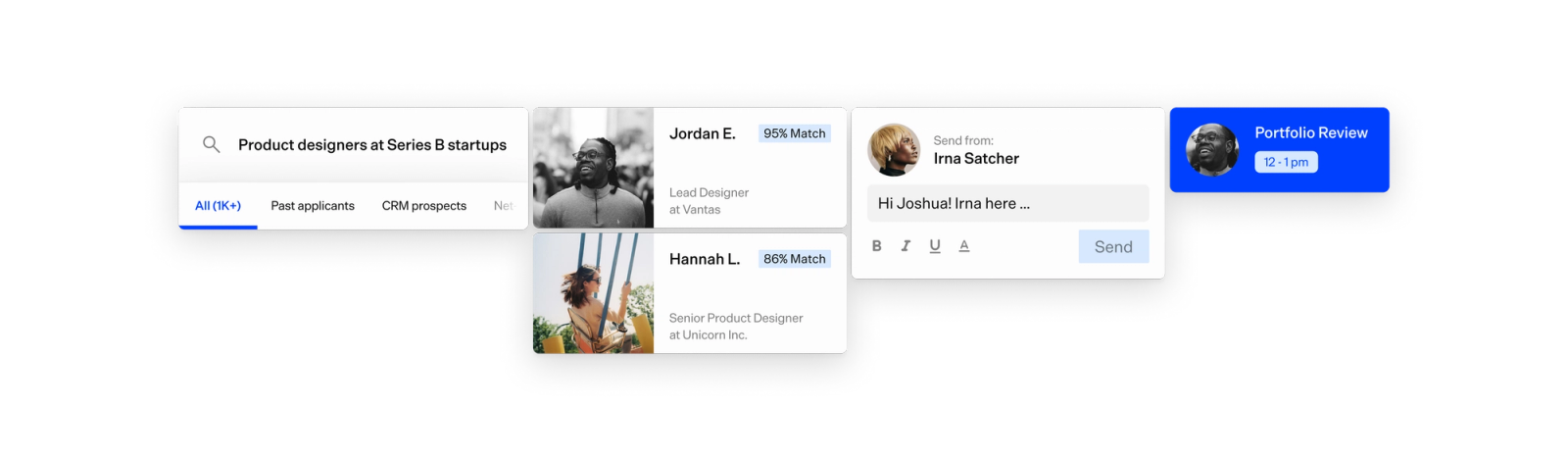
Notice that the illustration runs from search to scheduling without a hand-off to another tool. That is the commercial argument behind All-in-One pricing: Gem prices modules so that buying them together is cheaper than buying them apart, which pushes buyers toward consolidation. The search box and match scores belong to the AI-Powered seat, the message composer to the standard CRM, and the calendar block to scheduling, so a team that only wants the first two can still buy Gem + Your ATS.
2.1 What changed in the 2025 repricing
Gem rebuilt its price list in August 2025, and the current structure still follows that rebuild. In a post signed by CEO Steve Bartel, Gem admitted it had "made Gem too cost-prohibitive for too many teams" and announced fewer license types, lower list prices and AI agents bundled into seats instead of sold as separate bots - Gem's repricing post. Before the change, buyers paid separately for AI sourcing bots and an AI ranking platform fee.
The post is also the clearest public statement of how a Gem quote is assembled, so it is worth reading closely before a negotiation. Bartel describes discounts that stack on top of each other, which means the list price is the least informative number in a Gem deal. The five structural changes he lists are these:
- Bundle discounts of 15-50% when combining ATS, CRM, scheduling and more
- Two seat types, Standard and AI-Powered, replacing "many license types"
- Unlimited AI agents for sourcing, application review and rediscovery on AI seats
- All-inclusive quotes covering support, onboarding, integrations and updates
- Multi-year discounts for longer commitments
Read together, those changes tell you where the negotiating leverage sits. A Gem quote rewards breadth (more modules) and length (more years), not seat volume alone, so a buyer who only wants one module and a one-year term should expect to pay closer to list. The post also claims consolidating customers "typically save 60-70%", which is a vendor claim against the price of separate tools, not against Gem's own list. Treat the bundle range as the useful number: it shows a single module can cost up to twice its bundled equivalent.
2.2 Why FTE pricing matters more than seat count
Pricing on total employees means two companies with identical five-person talent teams can pay very different amounts. A 300-person company and a 3,000-person company might run the same sourcing workload, but the second sits in a higher band before a single seat is counted. It also means your Gem bill can grow when the company grows, even if the recruiting team does not change at all.
Gem's Terms of Service make that mechanism explicit for plans bought by headcount range at checkout, which today means the self-serve startup plans. If headcount rises into a different pricing tier, Gem "reserves the right to adjust the Fees to the appropriate pricing tier", at the next billing cycle for monthly plans and pro-rata for the rest of the term on annual plans, with at least 30 days' notice - Gem Terms of Service. The same clause says Gem "may also periodically review" your headcount, so this is not a term that waits for you to report growth. An enterprise order form can handle growth differently, which is exactly why it belongs in the negotiation.
The practical upside of the FTE model is that hiring managers do not consume seats. Gem's pricing page lists its Talent Pipeline view as "visible to all users including hiring managers" with "no seat required", and its startup page promises hiring manager access "without adding to your license count" - Gem for startups. In practice, you license recruiters, sourcers and coordinators, while interviewers and hiring managers ride along for free. Why this matters: a company that is hiring fast is also growing its headcount, so the moment Gem is most useful is the moment its price can move. How to apply this: ask for the band boundaries and the re-tiering rule in writing, and negotiate a cap on mid-term adjustments.
3. Standard vs AI-Powered Seats: What the AI Seat Buys
The AI-Powered seat is the single biggest swing factor in a Gem quote, and Gem publishes exactly what it unlocks while publishing nothing about what it costs. Gem's pricing page states the rule plainly: "Each workflow has a base set of features available on any Standard seat, plus AI capabilities that unlock with an AI-Powered seat." Everything an AI seat adds is AI work done for one recruiter: finding candidates, ranking them and writing to them.
That design is a deliberate choice. Gem could have priced AI per action, the way Ashby meters AI credits, or per company. Instead it prices AI per person, so the cost scales with how many recruiters you want the agents working for. The table below is a condensed reading of the seat comparison on Gem's pricing page, workflow by workflow.
| Workflow | Every Standard seat gets | An AI-Powered seat adds |
|---|---|---|
| Sourcing & CRM | 1-click add from 20+ sites, unlimited email-finding, talent pools, boolean search, multi-stage sequences, ATS sync | AI sourcing agents across 800M+ profiles, AI-personalized outreach, AI talent rediscovery, AI ranking |
| Applicant tracking | Core ATS workflows (included in All-in-One plans) | AI application review agents, AI resume highlights, AI-ranked applicant lists |
| Scheduling | Self-scheduling, panel scheduling, follow-ups on all plans | No AI seat split; load balancing is a paid add-on |
| Analytics | Talent Compass dashboards; pipeline view for every user | No AI seat split |
The pattern is consistent: Standard seats get the manual tools, AI seats get the agents that operate those tools for you. Scheduling and analytics do not split by seat at all, which tells you where Gem believes the AI value sits: sourcing and inbound review. If your recruiters spend most of their week on inbound applications rather than outbound search, the AI seat's value comes from the application review agent, not the 800M-profile search.
3.1 What Gem's help center still calls a paid add-on
Gem's marketing describes AI as built into the AI seat, but its help center describes two of the most valuable AI products differently. Under the heading "AI Paid Add-ons", it lists AI Sourcing and AI-powered App Review as "advanced AI products ... available for purchase through your Gem Account Manager" - Gem help center. The same article says AI-powered App Review works with Gem ATS and with Greenhouse, Workday, SuccessFactors and iCIMS.
These two descriptions are not necessarily in conflict, because an AI-Powered seat is itself something you buy through an account manager. They do confirm that AI sourcing is not part of a Standard seat, and that the help center treats it as a line item. The same article also lists the AI features every Gem customer gets at no extra cost, which is the floor of what a Standard-only deployment includes:
- Sequence templates drafted by AI from a short questionnaire
- AI custom tokens that personalize sequences, up to 500 recipients
- AI scorecard summaries across an interview panel
- AI prospect search that turns a job description into a query
- GeMCP, Gem's connector for Claude, ChatGPT and other AI tools
That complimentary list is more useful than it looks, because it defines what a team can do with Standard seats alone. AI-drafted outreach, summarized interview feedback and AI search inside your own CRM all come free, while the search across 800M+ external profiles and the ranking of inbound applicants are what you pay for. A team that mostly re-engages its own database and runs structured interviews can get a long way on Standard seats. A team whose bottleneck is finding net-new candidates cannot.
The screenshot below is Gem's own illustration of AI ranking, one of the AI-seat capabilities. It shows a candidate list sorted by AI score, with tabs for referrals, all candidates and CRM prospects, which is the view a recruiter on an AI seat works from all day.
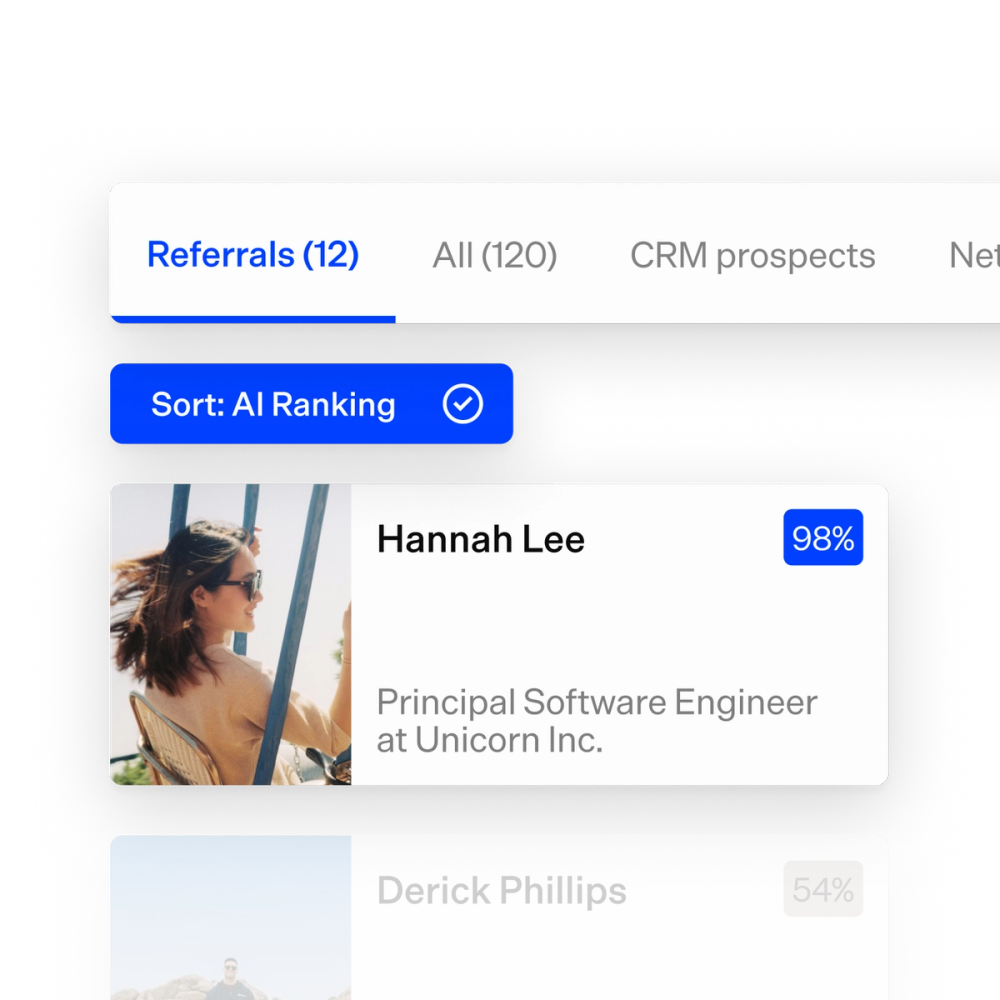
The gap between the 98% and 54% scores in that screenshot is the product Gem is selling with an AI seat: the recruiter starts at the top of the list instead of reading every profile. Gem's March 2026 update says recruiters act on "around 50%" of the candidates its AI surfaces and that AI speeds up application reviews by 60% - Gem AI update. Those are vendor figures, but they are the right yardstick for a pilot: measure your own action rate on AI-surfaced candidates before you pay for more AI seats.
3.2 "Unlimited AI sourcing" vs the Monthly Prospect Limit
Gem's strongest pricing claim in 2026 is that AI sourcing is unlimited. The March 2026 update, which reported 10x AI revenue growth and 7x AI customer growth over the prior year, says: "Gem offers unlimited AI sourcing for each recruiter with a license, instead of a credit-based model. Teams won't run into roadblocks or upcharges when they open a new role or need more candidates." That is a direct shot at competitors that meter AI by credits.
Gem's Terms of Service say something narrower. Under "AI Sourcing Tool Limitations", use of the AI Sourcing tool "is subject to a maximum number of prospects per month as specified in the applicable Order Form or as selected during the checkout process", defined as each unique individual the tool identifies or recommends. The limit resets on the first of each month, unused prospects do not roll over, and extra prospects can be bought "at the then-current overage rate specified on Gem's pricing page". On 29 October 2026, Gem's pricing page showed no overage rate.
Both statements can be true at once. "Unlimited" most likely describes searches, roles and runs, while the order form can still cap unique prospects per month. For a buyer, the difference matters only if your volume is high, but then it matters a lot: a team opening many roles at once is exactly the team that hits a monthly cap. The fix is simple. Ask for the Monthly Prospect Limit as a number on your order form, or ask for the order form to state that no limit applies.
Gem's own channel published a six-minute demo of the AI sourcing and rediscovery agent in May 2026, with recruiter and creator Joel Lalgee running a search live. It is the quickest way to see what an AI seat does in practice, and worth watching before deciding how many of your recruiters need one.
A day in the life of a super recruiter: AI Sourcing
The demo opens with the point Gem uses to justify the AI seat: according to its 2026 benchmarks, 46% of sourced hires came from candidates already sitting in the company's ATS. That figure is the strongest argument for paying for AI rediscovery, because a team with years of ATS and CRM history has a database most sourcing tools cannot see. A young company with an empty database gets far less from that half of the AI seat and should weigh it accordingly.
3.3 Deciding the seat mix, and what GeMCP adds
The seat mix is where an in-house team controls its Gem bill most directly. Full-time sourcers who search for net-new candidates every day are the obvious AI-seat users. Recruiters who mostly manage inbound pipelines benefit from the application review agent if your volume is high. Coordinators, recruiting operations staff and occasional users can usually work from Standard seats, and hiring managers need no seat at all.
The cheapest structure is rarely "AI seats for everyone". Gem's own staffing FAQ recommends "one license type for all your users", which is understandable from a vendor, but an in-house buyer should model both options. Price a quote with AI seats only for sourcers, then a second quote with AI seats for every recruiter, and compare the difference against the hours your team would actually save.
One AI capability that does not depend on seat type is GeMCP, Gem's implementation of the Model Context Protocol. It launched on 4 August 2026 after a beta announced in June, and it connects Gem to Claude, ChatGPT and other AI tools so recruiters can query pipelines, scorecards and outreach data in plain language - GeMCP launch post. Gem's help center lists it among the complimentary features available to all customers, and it inherits Gem's existing permissions, so recruiters see recruiter-level data only.
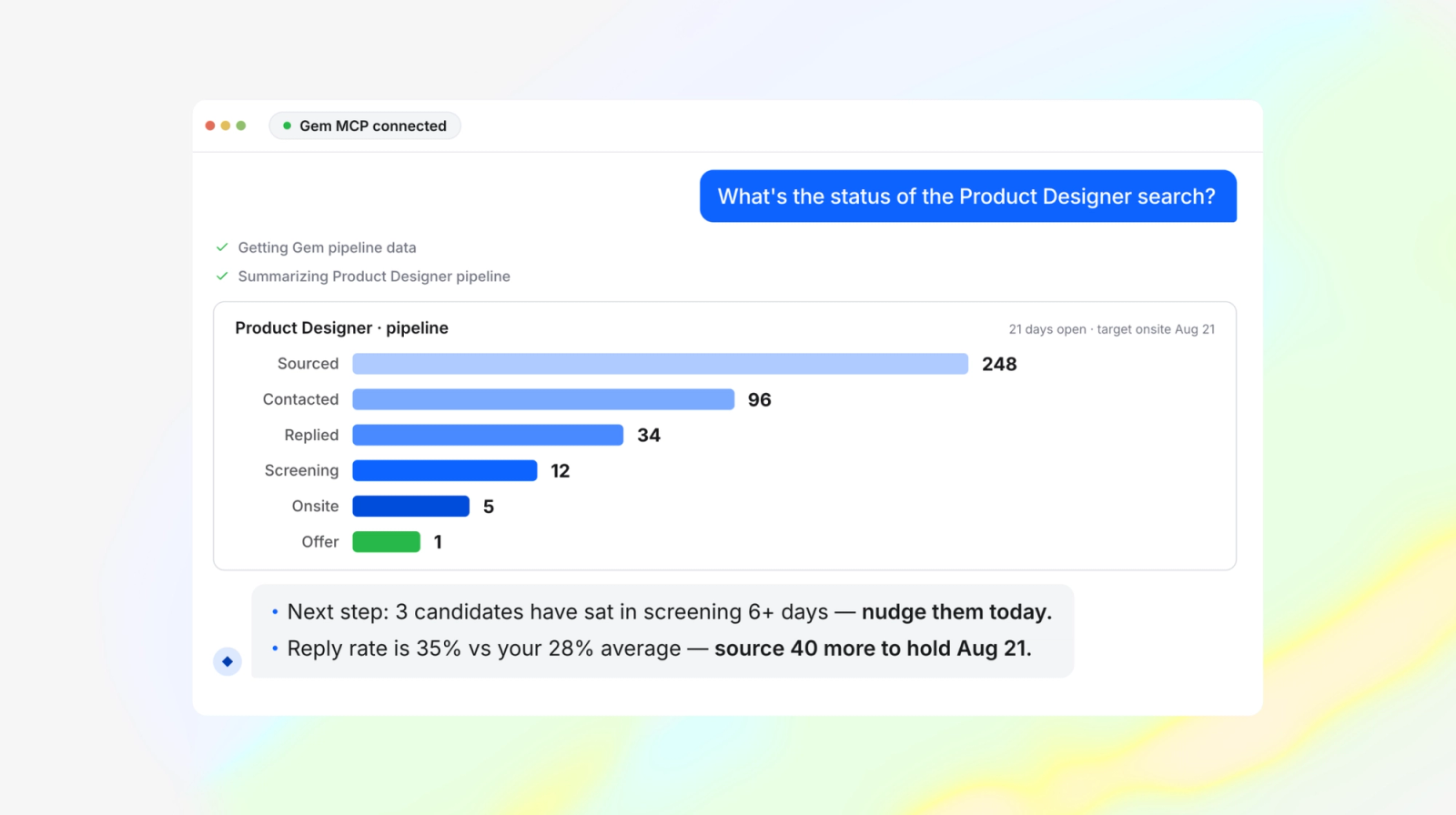
The screenshot shows the kind of question GeMCP answers: a pipeline from 248 sourced to one offer, with a suggested next step. For pricing purposes, the point is that GeMCP adds reporting value to every seat at no stated extra cost, which slightly shifts the value of Gem's paid analytics module. Why this matters: the AI-seat ratio, not the seat count, decides most of an in-house Gem quote. How to apply this: list which recruiters do net-new sourcing, quote AI seats for those only, and use the complimentary AI features as the baseline for everyone else.
4. The Gem Startup Program: The Full Price Grid
Gem's most precise prices sit on its pricing page, but only one of them is visible by default: $130 a month for a company of 1-10 employees on yearly billing. The other four company sizes appear only when you change a dropdown, and the full grid of prices is stored in the page's JavaScript. We read it from the code and then confirmed each value by switching the dropdowns in a real browser on 29 October 2026.
The plan behind the grid is Gem's full platform. The Startup Program card lists AI Sourcing and CRM, Analytics, Scheduling and ATS as included, which is the All-in-One package at a published price. Gem's 2025 repricing post described the startup offer as including "unlimited seats & email finding" and "generous AI credits", so the startup price is per company, not per user, while the AI side is described in credits rather than as unlimited. Here is every band:
| Company size | Monthly billing | Yearly, struck-through list | Yearly, price shown | Yearly total | Checkout |
|---|---|---|---|---|---|
| 1-10 FTE | $300/mo | $270/mo | $130/mo | $1,560 | Self-serve |
| 11-30 FTE | $400/mo | $360/mo | $180/mo | $2,160 | Self-serve |
| 31-50 FTE | $500/mo | $450/mo | $225/mo | $2,700 | Contact sales |
| 51-75 FTE | $700/mo | $630/mo | $315/mo | $3,780 | Contact sales |
| 76-100 FTE | $900/mo | $810/mo | $405/mo | $4,860 | Contact sales |
The chart below plots the same grid, monthly billing against yearly billing, per month. It makes the shape of Gem's startup pricing obvious: the price roughly triples from the smallest to the largest band, and yearly billing cuts every band by more than half.
Gem Startup Program Price per Month by Company Size
The yearly toggle is labelled "Yearly (10% off)", but yearly billing actually costs 55-57% less than monthly in every band. The 10% is the struck-through figure, which is exactly 90% of the monthly price. The price Gem then shows is half of that struck-through figure (and slightly less than half in the smallest band), which matches the "50% off when you move to a paid plan" offer in the copy. In other words, the displayed yearly price is a first-year promotional price stacked on an annual discount, and the monthly plan gets neither.
4.1 The Ashby mirror
The monthly column in that table is not arbitrary. Ashby prices its Foundations plan, an all-in-one ATS and CRM for companies up to 100 employees, at $300 to $900 a month across five headcount bands ($300, $400, $500, $700 and $900), with 10% off for yearly billing. Those are exactly Gem's five monthly startup prices, and Ashby's yearly price for its smallest band ($270) is exactly the figure Gem strikes through.
The band edges differ slightly: Gem's second band runs to 30 employees, while Ashby's runs to 25, so a 28-person company pays the second-band price at Gem and the third-band price at Ashby. Otherwise the two list prices are identical, and Gem then halves its yearly price for the first paid year. It is hard to read that as anything other than Gem pricing its startup offer directly against Ashby's published ladder, list for list, then undercutting it by half for year one.
For a startup choosing between the two, this simplifies the comparison. You are not comparing two unrelated price lists. You are comparing the same list price, with Gem discounting the first year more heavily and Ashby publishing a stable yearly price with metered AI credits on top. The detail of Ashby's credits is covered in our Ashby pricing guide, and it matters, because the AI line is where the two products diverge most.
4.2 Free months, partner codes and the renewal question
Gem layers free months on top of the grid. The pricing page says companies under 30 employees get Gem All-in-One free for six months, then 50% off when they move to a paid plan, and that companies with 30-100 employees get reduced rates "from day one", with "no sales call required". That last promise does not match the calculator, though: for every band from 31 to 100 employees, the button changes from "Get started now" to "Contact sales".
The pricing page's code also contains a partner path. It recognises partner codes for a list of investors and programs, including a16z, Accel, First Round, Greylock, NEA, Sequoia, Y Combinator, Pear, Rebel Fund, Dragonfly, General Catalyst and HubSpot. With a valid code, the offer for companies of 1-30 employees becomes "First 12 months free, then 50% off first paid year", and for 31-100 employees "First 6 months free, then 50% off first paid year". HubSpot's startup program confirms the 12-month version for its members, limited to new Gem customers with 30 or fewer full-time employees and excluding VC firms, accelerators and recruiting agencies - HubSpot for Startups Gem offer.
The open question is year two. Every discount in the grid is framed as a first-year discount, and Gem does not publish what the second paid year costs. The struck-through figure is the obvious candidate, and if it applies, a 1-10 person company's yearly bill would roughly double from $1,560 to $3,240. That is an inference, not a published fact, but it is exactly the kind of number to get written into the order form before you sign.
Why this matters: the startup grid is the only fully transparent Gem price, and it is genuinely cheap in year one. How to apply this: if your investor is on the partner list, ask for the code before checkout, choose yearly billing, and confirm the renewal price and the headcount rule in writing, because a startup that grows from 28 to 35 employees crosses into a band that is priced higher and sold through sales.
5. Gem for Recruiting Firms: The Per-User Price List
Recruiting and staffing firms get the most conventional Gem pricing: a published price per user per month, a card checkout and a 7-day trial. Gem sells two self-serve tiers and an Enterprise tier, and each self-serve tier has a hard cap on the number of users per account - Gem staffing pricing. The plans are only open to firms "whose primary function is to conduct job placement and recruiting activities on behalf of their clients", and Gem explicitly excludes in-house teams and VC or PE firms.
The staffing plans also differ from the in-house offer in what they include. Essentials is described as "All-in-one: ATS, CRM, Sourcing, Scheduling, and Analytics", with Gem's own ATS rather than an integration, and with outreach that can be sent on behalf of clients. The price ladder is short:
| Plan | Billed yearly | Billed monthly | Email-finding credits | User cap |
|---|---|---|---|---|
| Essentials | $99/user/mo | $139/user/mo | 150 per user monthly | Up to 3 users |
| Professional | $149/user/mo | $199/user/mo | 750 per user monthly | Up to 10 users |
| Enterprise | Custom | Custom | Flexible | No published cap |
The caps are the first catch to model. A three-person firm on Essentials yearly pays $3,564 a year in total. A ten-person firm on Professional pays $17,880 a year on yearly billing, or $23,880 month to month. The eleventh recruiter is not a price increase, it is a plan change: there is no published price for an 11-user firm, so growth past ten users moves you from a card checkout to an Enterprise negotiation.
5.1 The catches in the staffing plans
The second catch is the AI. On Gem's staffing pricing page, the line "AI suite: Sourcing, Application Review, and Sequences" appears only under Enterprise. Essentials and Professional include 1-click sourcing across 30+ social platforms, email-finding with a stated 90%+ success rate, and automated multi-step sequences, but not the AI sourcing agent that Gem markets most heavily in 2026. A three-person agency that wants Gem's AI search is quoted at Enterprise, not at $99.
The third catch is integration. The 16+ ATS connectors, including Bullhorn and Recruitee, are also Enterprise-only, alongside API access, SAML SSO and SOC 2 Type II reporting. Gem's FAQ confirms that Essentials and Professional customers use the Gem ATS, while Enterprise customers can choose Gem ATS or an integration. For an agency that already runs Bullhorn, that means the self-serve tiers are effectively a second system of record, not an add-on to the one you have.
Three smaller details are worth knowing before checkout. The yearly toggle says "Save 25%", which is accurate for Professional ($149 vs $199) but understates Essentials, where yearly billing saves about 29% ($99 vs $139). Gem accepts "all major credit cards" and no bank transfers or checks on these plans. And Gem's Terms of Service say a staffing license "may not be used for internal corporate recruiting" without written permission, so a firm that also hires for itself needs to keep the two uses apart.
The headline price invites one more comparison. Gem's Professional tier is $149 per user per month on yearly billing, the same headline as SeekOut's self-serve Sourcing Core plan, which works out to $1,788 a year. The two are not equivalent: SeekOut's own feature table lists 3 seats included on that plan while its card describes it for individual recruiters, and SeekOut has no ATS in it. Why this matters: the staffing tiers are good value for small firms that want one system and no AI agent. How to apply this: if you need AI search or a Bullhorn integration, skip the trial and ask for an Enterprise quote from the start, with the per-user price written as a rate.
6. What Buyers Actually Pay, and the Contract Fine Print
With no in-house list price above 100 employees, contract data is the closest thing to a real Gem price. Vendr, which brokers software purchases and publishes anonymized results, reports a median of $25,699 a year across 234 Gem purchases, with deals ranging from $7,000 to $73,076 and buyers saving 20% on average against initial quotes. Vendr's Gem page was last updated in February 2026, so treat it as a recent benchmark rather than a live feed.
Context helps here, because a median means little on its own. The chart below compares Gem's median annual contract with the medians Vendr reports for the platforms buyers most often price against it, read on 29 October 2026. Each figure is a whole-contract median, not a per-seat price, so it reflects the mix of company sizes that happen to buy each tool.
Median Annual Contract Paid, Per Vendr
Gem sits in the same range as Greenhouse ($26,553 across 886 purchases) and above Ashby ($20,878 across 167), SeekOut ($20,000) and Lever ($15,492). That ordering matches positioning: Gem prices like a core system rather than a sourcing add-on, even when it is bought as Gem + Your ATS. One caution applies to Vendr's Gem page itself: its written commentary describes Gem as priced "per-recruiter, per-month" with "Standard, Professional, and Enterprise" tiers, which does not match Gem's own FTE-based model. Use Vendr's transaction numbers and ignore its generic narrative.
A rough per-recruiter translation is possible, as long as it is labelled as arithmetic rather than data. Spread the $25,699 median across six recruiter seats and it works out to about $4,280 per seat per year, or roughly $357 a month. That is a sanity check, not a rate card: the real number depends on your headcount band, the AI seat mix and the modules bundled, which is why the range runs from $7,000 to over $73,000.
6.1 What Gem's Terms of Service say
Gem's online Terms of Service govern self-serve purchases and form the baseline that enterprise order forms amend. Most of the clauses are standard for SaaS, but four of them directly affect what you pay over the life of a contract. They are worth reading before signing anything annual, because the order form usually overrides only what you specifically negotiate, and whatever you leave out stays on Gem's defaults.
The renewal and price clauses are the important ones. Subscriptions are automatically renewing until cancelled, and Gem "reserves the right to change its price list and to institute new fees at any time" with at least 30 days' notice, after which continued use counts as acceptance. The money clauses that matter most are these:
- Auto-renewal: recurring subscriptions renew at the stated frequency until cancelled
- Price changes: new fees can apply after 30 days' notice, with no stated cap
- No refunds: fees already paid for the current term are non-refundable
- Late fees: unpaid fees carry a 1.0% per month finance charge
None of those clauses is unusual on its own, but together they shift renewal risk to the buyer. A 30-day notice period with no cap means a renewal can arrive at a materially higher price with a month to react, and paid fees cannot be clawed back if you decide to leave mid-term.
Two clauses covered earlier add to that risk. The headcount re-tiering rule from section 2 means company growth can raise a self-serve bill mid-term, and the AI Sourcing Monthly Prospect Limit from section 3 means "unlimited" sourcing has a ceiling the order form sets. The fix for all of them is the same: negotiate them into the order form, where they become your terms rather than Gem's defaults.
There is one place where Gem's public promise helps the buyer. The 2025 repricing post says "What we quote is what you pay" and that pricing includes "support, onboarding, integrations, and platform updates", with no implementation fees. Vendr's commentary, by contrast, says onboarding is sometimes quoted separately for larger teams. Quote the Gem post back in the negotiation and ask for the order form to state that no implementation, onboarding or integration fees apply. Why this matters: the contract decides your second-year cost more than the first quote does. How to apply this: treat renewal cap, prospect limit and re-tiering as three line items to negotiate, just like price.
7. What Gem Costs in Practice: Three Budget Scenarios
Three worked examples show how differently Gem's price lists behave once real companies are put through them. The first two use only published Gem prices. The third uses Vendr's contract data, because there is no published price to use, and every derived figure is labelled as arithmetic.
These scenarios are deliberately ordinary, because the edge cases are where buyers get surprised. Each one ends with the question that decides the budget, which is rarely the headline price.
7.1 A 22-person seed-stage startup
A 22-person company with one founder-recruiter falls in Gem's 11-30 FTE band. Without a partner code, it gets six months free, then pays $180 a month on yearly billing, which is $2,160 for the first paid year. On monthly billing, it would pay $400 a month with no startup discount. If its lead investor is on Gem's partner list, the free period stretches to 12 months before the same 50%-off first year.
The budget question is year two and growth. If the company hires to 35 people, it crosses into the 31-50 band, where the yearly price shown is $225 a month and the checkout routes to sales. If the renewal resets to the struck-through list, the yearly price for the 11-30 band would be $360 a month ($4,320 a year). For a startup that is still small at renewal, the all-in cost of Gem is low by any standard. The risk is purely the jump, and it is negotiable before signing.
7.2 A 10-recruiter agency
A ten-person agency fits Professional exactly: $149 per user per month yearly, so $17,880 a year, or $23,880 if paid monthly. Each user gets 750 email-finding credits a month, so the firm has 7,500 lookups a month across the team, and it gets Gem ATS, CRM, sourcing, scheduling and analytics in one system. For an agency replacing a spreadsheet-and-mailbox setup, that is a complete stack at a published price.
The budget question is the eleventh hire and the AI. Adding one recruiter means leaving Professional, because it caps at 10 users. Wanting Gem's AI sourcing agent, or keeping Bullhorn as the system of record, means Enterprise regardless of size. An agency planning to grow past ten recruiters within the year should price Enterprise up front, so the first renewal is not also the first negotiation.
7.3 An 800-person company with six recruiters
An 800-person company with a six-person talent team gets no list price. Vendr's median deal is $25,699 a year, which works out to about $4,280 per recruiter if spread across six seats, and the observed range runs from $7,000 to $73,076. Where this company lands depends on three choices: Gem + Your ATS or All-in-One, how many of the six seats are AI-Powered, and whether it signs for one year or several.
The budget question is headcount. Because Gem prices on FTE count, this company pays for 800 employees regardless of whether its six recruiters fill 30 roles a year or 300. If it is growing toward 1,000 or more, an order form that copies the self-serve re-tiering logic could raise the fee mid-contract, so that clause is worth reading line by line. A useful discipline here is to price the same six recruiters against published alternatives, for example six SeekOut or Findem seats plus the existing ATS, so the Gem quote is compared against something concrete rather than against a median.
8. Where Gem Is Worth the Money, and Where It Falls Short
Gem is worth its price when a team does serious outbound on top of a deep candidate database, and is overpriced when either of those is missing. That follows directly from how the product is built. Gem's core strength has always been the CRM: sequences, nurture, send-on-behalf-of, email coverage and analytics across years of candidate history. The 2026 AI agents make that database searchable and rankable, which is valuable in direct proportion to how much history you have.
The strongest buying cases are specific, and they all follow from how Gem prices. A quote built on bundles, AI seats and free hiring-manager access rewards teams that use many modules, many recruiters and many collaborators, and penalises teams that use one. Gem is a good fit when these three describe your team:
- Outbound-heavy sourcing by several full-time sourcers or recruiters
- Years of ATS history, often in Greenhouse or Workday, worth rediscovering with AI
- Consolidation plans that retire separate CRM, scheduling and sourcing tools
Each of those cases plays to a structural feature of Gem's pricing. Bundle discounts reward consolidation, AI rediscovery rewards database depth, and per-seat AI rewards teams whose recruiters search every day. Free pipeline access for hiring managers adds to the value when hiring is collaborative. When all three cases apply, Gem's quote is usually defensible against the alternatives in the next section. When only one applies, a narrower tool is usually cheaper for the same outcome.
Gem has also added a defensive reason to buy in 2026: candidate fraud. Its AI Fraud Detection Agent scores applications across six signals (including resume metadata, LinkedIn, email, phone and IP), claims 90%+ accuracy, and is sold as an add-on to Gem + Your ATS - Gem AI Fraud Detection. Gem's 52-second introduction below shows how a flagged candidate looks to a recruiter.
Meet Gem's AI Fraud Detection Agent
The fraud agent illustrates both the strength and the cost model of Gem in 2026: capabilities keep arriving as modules, and each module is a reason the quote grows. It is a useful feature for teams flooded with remote applications, but it is not free, and it belongs in the quote only if fraud is a measured problem in your funnel.
Gem falls short in four recognisable situations. High headcount with a small TA team makes FTE pricing work against you. Inbound-only hiring wastes most of the CRM and sourcing value. Staffing firms past ten users lose the published price and need Enterprise for AI. And teams that want transparent AI pricing will find Gem's per-seat AI model clearer than credits on paper, but harder to compare, because the seat price is never published.
Why this matters: the same Gem quote is a bargain for one team and a waste for another, and the difference is how your team works rather than how good Gem is. How to apply this: count how many of the three buying cases apply to you before you take a demo, and if one of the four shortfalls describes you, price the alternatives first.
9. The Best Gem Alternatives in 2026
Gem does several separable jobs, and the right alternative depends on which job you were actually buying. It is an ATS and CRM, an outbound engagement engine, and, increasingly, an AI sourcing agent across 800M+ profiles. Almost no team values all three equally, which is the key to replacing Gem cheaply: identify the job, then buy the tool that does that job best at a price you can see.
The ten alternatives below are grouped by that logic. Ashby, Greenhouse, Lever and Manatal replace the system-of-record half. SeekOut, hireEZ, Findem, Juicebox, Pin, LinkedIn Recruiter and HeroHunt.ai replace the sourcing half. Every price is taken from the vendor's own page or from contract data, read in October 2026.
9.1 Ashby: the published all-in-one
Ashby is Gem's most direct competitor for startups and growth companies, because it sells the same all-in-one bundle (ATS, CRM, scheduling and analytics) with published prices up to 100 employees. Foundations costs $300 to $900 a month by headcount band, 10% less on yearly billing, and the larger Plus and Enterprise plans are quote-only. Ashby built its reputation on recruiting analytics, and it now meters AI usage with credits: Foundations includes an account-wide monthly allowance, with extra credits at $0.10 each.
The contrast with Gem is instructive. Both list the same monthly prices up to 100 employees, but Gem halves the first year and prices AI per seat, while Ashby publishes a steady yearly price and prices AI per action. A startup that values a predictable year-two bill may prefer Ashby. A startup that wants the cheapest year one should take Gem's offer and negotiate the renewal. Vendr's median Ashby contract is $20,878, below Gem's.
Best for: companies under 100 employees that want an all-in-one with published pricing and deep analytics.
9.2 Greenhouse or Lever: keep the ATS, skip the layer
Many teams pricing Gem + Your ATS already pay for Greenhouse or Lever, and the cheapest alternative to adding Gem is sometimes using more of what they have. Lever says it "brings ATS and CRM together in one unified platform", with candidate nurturing built in, and its median contract on Vendr is $15,492 a year. Greenhouse, with a median of $26,553, has CRM and sourcing features of its own, and Gem sells a dedicated "Gem for Greenhouse" package, which tells you how often the two are bought together. Our Greenhouse pricing guide covers that contract in detail.
The honest trade-off is depth. A built-in ATS CRM is usually good enough for nurturing past applicants and running simple campaigns, and weaker for multi-step outbound sequences, email-finding and AI search across external profiles. If your outbound volume is modest, the incremental value of Gem on top of a capable ATS is small and the incremental cost is not.
Best for: teams with modest outbound volume that already pay for a capable ATS.
9.3 SeekOut: published sourcing seats
SeekOut is the closest like-for-like alternative to Gem's AI sourcing agent as a standalone purchase. Its self-serve Sourcing Core plan costs $149 a month billed annually ($1,788 a year) or $179 month to month, with 500 contact credits and 1,000 exports a month and a 14-day trial. Larger Sourcing plans with ATS integration are quoted per seat on annual terms, and Vendr's median SeekOut contract is $20,000.
What SeekOut does not do is the CRM and ATS half: it is a search-and-contact tool that feeds your system of record rather than replacing it. That makes it a clean fit for a team happy with its ATS but missing an external search engine. Read the seat terms carefully, because SeekOut's own page describes Sourcing Core for individual recruiters while its feature table lists 3 seats included. Our SeekOut pricing guide unpicks that contradiction.
Best for: teams that want AI sourcing at a published per-month price and are keeping their ATS.
9.4 hireEZ: priced against your stack
hireEZ sells an outbound sourcing and engagement layer on top of the ATS, which is the same position as Gem + Your ATS. Solo recruiters start at $494 a month with a 7-day free trial. Enterprise pricing is, in hireEZ's own words, "configured to the stack hireEZ replaces rather than a flat per-seat rate times headcount", and it comes with a four-week verification period before signing. Vendr's median hireEZ contract is $13,000, the lowest in our comparison.
The two vendors make the same consolidation argument from different starting points: Gem from the CRM and ATS outward, hireEZ from sourcing outward. hireEZ's model avoids the FTE problem entirely, because it prices against your current tool spend rather than your company size, which can favour large companies with small TA teams. Our hireEZ pricing guide explains how the solo price is calculated.
Best for: large companies with small TA teams that want a sourcing and engagement layer without FTE-based pricing.
9.5 Findem: sourcing seats by card
Findem began publishing prices in 2026 through Findem Studio. A Studio seat costs $249 a month with 6,250 AI credits, and Studio + Platform, which adds Findem's full sourcing platform, costs $599 per seat per month or $5,999 a year. Enterprise deals run higher, including a $25,000 annual licence on AWS Marketplace, as our Findem pricing guide details.
Findem's strength is talent intelligence: attribute-based search across its own enriched data, which is closer to Gem's AI sourcing agent than to Gem's CRM. A team that mainly wants smarter external search, and is willing to pay per seat for it, can compare Findem's published $599 seat directly with whatever Gem quotes for an AI-Powered seat. It is not a CRM replacement.
Best for: teams that want premium AI search and talent intelligence at a published seat price.
9.6 Juicebox: self-serve AI search
Juicebox is the low-cost, self-serve route to AI candidate search. Starter costs $99 per seat per month on annual billing with unlimited searches, 500 contact credits and 500 export credits, Growth costs $179, and autonomous sourcing agents cost $199 per agent per month. In October 2026 it also bought the IP and other assets of Fetcher, which shut down its platform, as covered in our Fetcher alternatives guide.
Juicebox competes with the AI-seat half of Gem only. It has no ATS, and its ATS and CRM integrations sit on its custom Business plan, so a small team would run Juicebox for search and keep candidates elsewhere. That separation is fine for a solo recruiter or a two-person startup team, and less fine for a team that wants every candidate interaction logged in one CRM.
Best for: solo recruiters and small teams that want AI search without a sales cycle.
9.7 Pin: the cheapest AI sourcing seat
Pin offers a free plan, a Solo plan at $100 per user per month billed annually (annual only), and Pro at $135 per user per month billed annually, with AI search and automated multi-channel outreach. It is the cheapest published AI-sourcing seat in this comparison, and it is designed to be bought without talking to anyone. Our Pin pricing guide covers the credit rules.
Like Juicebox, Pin replaces the sourcing and outreach half of Gem rather than the CRM and ATS. Its pricing card lists ATS integration as included on the custom Enterprise plan, so check how candidates will reach your ATS on Solo or Pro before assuming they will flow back automatically.
Best for: individual recruiters who want AI sourcing and outreach at the lowest published price.
9.8 LinkedIn Recruiter: the incumbent you may keep anyway
LinkedIn Recruiter is less an alternative to Gem than the incumbent many Gem teams keep, since Gem's Chrome extension is built to add candidates from LinkedIn and 20+ other sites. LinkedIn publishes no price on its own site, but its UK G-Cloud 14 price sheet lists a full per-seat ladder, from £8,925 per seat per year for one or two licences down to £6,350 at 251 or more - LinkedIn on G-Cloud. That makes a single Recruiter seat more than double the rough per-recruiter arithmetic for Gem in section 6.
Gem's 2025 repricing post pitches consolidation partly as a way to cut "expensive seats on standalone sourcing platforms", and LinkedIn is the obvious target. Whether you can actually drop LinkedIn seats depends on how much of your sourcing depends on InMail and LinkedIn-only profiles. Our LinkedIn Recruiter pricing guide covers the seat bands.
Best for: teams whose candidates are reachable mainly through LinkedIn, who will budget for it alongside any CRM.
9.9 Manatal: the low-cost ATS and CRM
If the half of Gem you were really pricing was the system of record, Manatal is the low-cost option with a fully published ladder. It is an ATS with a built-in recruitment CRM, sold per user per month, and it can be set up without a sales call. That makes it a realistic replacement for the Gem All-in-One ATS and CRM modules at a small fraction of an enterprise quote.
What it does not replace is the AI-seat half. Manatal has enrichment and sourcing features of its own, but nothing comparable to an 800M-profile AI sourcing agent or AI rediscovery across years of CRM history. Teams that pair it with a separate sourcing tool often end up spending less in total than on a single Gem quote, at the cost of running two systems.
Manatal
The comparison that matters here is a published ATS price against a headcount-based quote. Gem All-in-One has no list price above 100 employees, and Vendr's median Gem contract is around $25,700 a year. Manatal publishes every tier: $15 per user per month billed annually ($19 month to month), on a 14-day trial with no card. Read the cap before budgeting, because the $15 tier holds 15 active jobs and 10,000 candidates, unlimited jobs start at $35 ($39 monthly), and API access plus SSO only arrive at $55 ($59). And it replaces the ATS and CRM half of Gem only: there is no AI sourcing agent across 800M profiles and no AI rediscovery, so if the AI-Powered seat is why you were quoted, this is not the substitute.
Best for: small and mid-size teams that want a cheap, published ATS and CRM and will source elsewhere.
9.10 HeroHunt.ai: the AI recruiter at a published price
HeroHunt.ai replaces the part of Gem that the AI-Powered seat is sold for: finding net-new candidates and contacting them. It searches up to around a billion profiles across platforms, depending on plan, screens them against the role with language models, and runs personalized outreach automatically, so a recruiter gets a ranked, contacted shortlist rather than a search screen. Its pricing is published: plans start at $99 a month with unlimited positions and searches, metered on AI-screened matching profiles and candidate emails found per month, after an 8-day free trial with a card - HeroHunt.ai plans.
The comparison with Gem is a scope comparison, not a feature race. HeroHunt.ai is not an ATS, a CRM, a scheduler or an analytics suite, so it does not replace Gem All-in-One or Gem's database rediscovery. What it removes is the need to buy AI-Powered seats for net-new sourcing, priced per person against your company headcount. A team that keeps its ATS and wants AI sourcing and outreach at a number it can see in advance can start from the sign-up page without a sales cycle.
Best for: teams that want AI sourcing and automated outreach at a published price, while keeping their ATS or CRM.
10. Full Comparison: Price, Unit and Best Fit
The most useful way to compare Gem with its alternatives is by billing unit, because the headline numbers measure different things. Gem bills in-house teams on company headcount plus seats, its staffing plans per user, SeekOut and Findem per seat, Juicebox per seat and per agent, and HeroHunt.ai on monthly allowances. Comparing a per-company startup price with a per-seat sourcing price, without converting, is how buyers draw the wrong conclusion. Our recruiting software pricing hub applies the same unit-first method to 40 tools.
The table below lines up every option on four columns: the lowest published price, the unit it is billed on, the median paid where contract data exists, and the buyer it suits best. Prices are monthly unless stated, and medians are whole-contract figures from Vendr. A cell reading "n/a" means we are not using a Vendr median for that row, because there is none for that plan, the sample is small, or the contracts bundle other products.
| Tool | Lowest published price | Billing unit | Median paid (Vendr) | Best fit |
|---|---|---|---|---|
| Gem (in-house, 100+) | None | Company FTE + seat mix | $25,699/yr | Outbound-heavy teams with deep databases |
| Gem (startups) | $130/mo yearly | Per company, 5 bands | n/a | Startups under 100 employees |
| Gem (staffing) | $99/user yearly | Per user, capped at 10 | n/a | Agencies of 1-10 recruiters |
| Ashby | $300/mo (Foundations) | Per company, 5 bands | $20,878/yr | All-in-one with published pricing |
| Greenhouse | None | Quote | $26,553/yr | Structured hiring at scale |
| Lever | None | Quote | $15,492/yr | ATS and CRM in one |
| SeekOut | $149/mo yearly | Seat + contact credits | $20,000/yr | Standalone AI sourcing |
| hireEZ | $494/mo (solo) | Stack it replaces | $13,000/yr | Sourcing layer without FTE pricing |
| Findem | $249/seat | Seat + AI credits | n/a | Premium talent intelligence |
| Juicebox | $99/seat yearly | Seat + agents | n/a | Self-serve AI search |
| Pin | $100/user yearly | Per user | n/a | Cheapest AI sourcing seat |
| LinkedIn Recruiter | £8,925/seat/yr (G-Cloud) | Per seat, volume bands | n/a | LinkedIn-dependent sourcing |
| Manatal | $15/user yearly | Per user | n/a | Low-cost ATS and CRM |
| HeroHunt.ai | $99/mo | Matched profiles + emails | n/a | AI sourcing and outreach, published price |
Two patterns stand out. First, the system-of-record tools (Gem, Ashby, Greenhouse, Lever) cluster around $15,000 to $27,000 a year in median contracts, because buyers commit their whole hiring process to them. Second, the sourcing tools publish far more of their pricing, often by card, because they compete on trial and speed. If you need both halves, the realistic comparison is Gem against "one ATS plus one sourcing tool", not Gem against any single row.
Why this matters: a fair comparison needs the same unit on both sides. How to apply this: convert every option to an annual cost for your actual team (recruiters, headcount, open roles) before ranking them, and treat the medians as a check on quotes rather than as prices.
11. How to Buy Gem Well
The best Gem deals come from treating the quote as a set of separate terms, not a single price. Gem's own 2025 post tells you which levers exist: bundles worth 15-50%, multi-year discounts, and an all-inclusive promise on onboarding and integrations. Vendr adds that buyers save 20% on average against initial quotes. Neither source tells you which terms buyers most often regret, and that is where most of the long-term cost hides.
The most expensive Gem mistakes happen at renewal and during growth, not at signature. A first-year price can look excellent and still lead to a large second-year increase if the renewal cap, the headcount rule and the AI prospect limit were left at Gem's defaults. The table below sets each default from Gem's terms and pages against what to ask for in the order form:
| Term | Gem's default | What to get in writing |
|---|---|---|
| Headcount band | Self-serve fees re-tier when FTE grows, pro-rata on annual plans | The band, its edges, and a cap on mid-term re-tiering |
| AI seats | Seat price never published | The AI seat count and the price of adding seats later |
| Prospect limit | Monthly cap set in the order form | The number, or a statement that no limit applies |
| Renewal price | Changes allowed on 30 days' notice | A renewal cap, and the year-two price for startups |
| Fees | "What we quote is what you pay" (2025 post) | No implementation, onboarding or integration fees |
Those five terms cover the gaps between Gem's marketing and its contract. The headcount band and re-tiering rule protect you from paying more because the company grew. The AI seat price protects you from an expensive expansion once recruiters see the agents working. The prospect limit converts "unlimited" into something enforceable. The renewal cap and the fee language protect year two and three. A buyer who negotiates all five has, in effect, a published price for the life of the contract, which is the one thing Gem does not offer by default.
Two tactics improve the price itself. First, bring a concrete competing number rather than a vague one: Ashby's published Foundations ladder for smaller companies, or a SeekOut, Findem or HeroHunt.ai quote for the sourcing half. Gem has visibly priced against Ashby already, so a published Ashby number is a credible anchor. Second, run a three-role pilot before committing to AI seats: give two or three recruiters AI seats for a month on real open roles and measure how many surfaced candidates they act on, against Gem's own "around 50%" claim. If your action rate is far lower, buy fewer AI seats.
Term length is the last lever. Gem's offer of multi-year discounts gives you room to trade a longer commitment for a lower price, which is a good trade only if the renewal cap and an exit for headcount changes are already in place. Why this matters: Gem's list price is the least informative number in the deal. How to apply this: negotiate the five terms above first, then the price.
12. The Bottom Line
Gem's price depends on who you are, and for most in-house buyers the honest answer is a quote near $25,700 a year, shaped by headcount, AI seats and contract terms. For staffing firms of up to ten recruiters, Gem costs $99 to $199 per user per month and can be bought by card. For startups up to 100 employees, Gem costs $130 to $405 a month on yearly billing in year one, with free months on top, and the second-year price is the number to pin down.
The decision framework is straightforward once the halves are separated. If you want one system for everything and have the outbound volume and database depth to use it, Gem is a strong choice, and the job is to negotiate the headcount rule, AI seat count, prospect limit and renewal cap. If you are a startup under 100 employees, compare Gem's first-year discount with Ashby's stable published ladder and decide whether year one or year two matters more. If you mainly need a better ATS and CRM, Ashby, Lever or Manatal typically cost less. If you mainly need AI sourcing and outreach, buy a sourcing tool with a published price (SeekOut, Juicebox, Pin, Findem or HeroHunt.ai) and keep your ATS.
What not to do is buy AI-Powered seats for every recruiter without testing them, sign an annual Gem contract without a renewal cap, or compare a per-company startup price with a per-seat sourcing price as if they were the same unit. Gem is a capable platform with a deliberately layered price, and the buyers who pay least are the ones who price each layer separately.
This guide reflects Gem's pricing pages, pricing-page code, Terms of Service and help center as read on 29 October 2026, and contract data from Vendr as published at that date. Gem's in-house pricing is quoted per company and changes frequently, so your quote will differ. Verify current details with each vendor before purchasing.