



The ranked, fully-priced guide to the 10 best platforms for finding anyone's social media profiles across LinkedIn, X, Instagram, GitHub and the open web in 2026.
One handle now maps to accounts on more than 3,000 websites in seconds, and a single plain-English sentence can return 100 ranked candidate profiles with verified contact details attached. Finding someone's social presence used to be a manual hunt through a dozen search boxes. In 2026 it is a software problem, and the software has become startlingly good, in some cases good enough to run the entire search, screening, and outreach loop without you touching a keyboard.
The catch is that these platforms are not interchangeable. They start from different inputs, pull from different data, and expose you to very different costs and legal risks. A free username scanner, a face-recognition engine, a billion-record identity API, a consumer people-search subscription, and an autonomous AI sourcing agent all promise to "find anyone," yet each one is the right answer for a specific starting point and the wrong answer for the others. Picking the wrong platform wastes money, or worse, hands you a confident match that points at the wrong human being.
This guide ranks the 10 platforms that matter most in 2026, from the state-of-the-art autonomous agents that top the list down to the specialist tools that own a single niche. For each one you get what it actually does, the identifier it needs to start, its real coverage, current verified pricing, where it wins, where it fails, and who it is for. Along the way it covers the platform-by-platform tactics that still work (with a heavy focus on LinkedIn, the single most valuable professional network), the verification discipline that separates a lead from a fact, and the privacy and legal lines you cannot cross.
Written by Yuma Heymans (@yumahey), who built HeroHunt.ai and has spent years building AI that resolves a person's profiles across LinkedIn, GitHub and the open web. He writes here from hands-on experience with the exact identity-matching problem these platforms try to solve.
Contents
- The 2026 Landscape: How Finding Profiles Works Now
- How We Ranked, and the 10-Platform Comparison
- HeroHunt.ai (#1): Autonomous AI Profile Discovery
- IDCrawl (#2): The Best Free People and Username Search
- Maigret and Sherlock (#3): Open-Source Username Scanning
- PimEyes (#4): Reverse Face Search Across the Open Web
- FaceCheck.ID (#5): Face Search Straight to Social Profiles
- Pipl (#6): The Enterprise Identity Graph
- Spokeo and BeenVerified (#7): Consumer People-Search
- Maltego and Social Links (#8): Professional Link Analysis
- Epieos (#9): From an Email or Phone to Every Account
- Exa (#10): The AI Search API for Agents and Builders
- The Recruiter Contact Layer: ContactOut, SignalHire and Peers
- Platform by Platform: LinkedIn, X, GitHub and Bluesky
- Verification: Turning a Match Into a Confirmed Identity
- Accuracy, Hallucination and Failure Modes
- Privacy, Legal and Ethical Guardrails
- The Agentic Future and How to Choose
1. The 2026 Landscape: How Finding Profiles Works Now
The fastest way to understand this field is to stop thinking about it as one market and start seeing it as five that happen to converge on the same job. Username scanners start from a handle, face engines start from a photo, people-search sites start from a name, contact and identity platforms start from an email or phone, and a new generation of AI agents start from a plain-English description of the person you want. Each camp behaves differently, prices differently, and carries a different legal weight. The most valuable skill in 2026 is not running any single platform but knowing which one your starting information actually unlocks.
The change that reshaped everything in the past year is that the best platforms no longer just return a list of blue links. They reason across sources, score their own confidence, and increasingly act on what they find. "Find this person's profiles" has quietly become a natural-language request rather than a sequence of manual searches, and the leading tools now chain search, browsing, and screening into a single autonomous run. That is why the top of this ranking looks nothing like it did two years ago: the frontier is no longer the biggest database, it is the smartest agent sitting on top of one.
This is happening on top of a genuinely large and fast-growing industry. The open-source intelligence market, the engine behind most automated profile discovery, is sized at about $22.95 billion in 2026, up from $18.07 billion a year earlier and growing roughly 27% annually toward $60 billion by 2030 - The Business Research Company. Facial recognition adds another $10.69 billion market in 2026, while sales intelligence, identity resolution, and AI recruitment each contribute multibillion-dollar slices of their own - Precedence Research. The money is flowing because the demand is mainstream, not niche.
The chart below puts the 2026 market sizes side by side so you can see where the heaviest investment is concentrated. The precise figures matter less than the shape: OSINT and facial recognition dwarf the more specialized recruiting and identity tools, which tells you where the fastest innovation is happening and why the general-purpose platforms increasingly absorb the specialist ones.
2026 Market Size by Segment (USD Billions)
What the chart understates is how fast adoption is moving inside the smaller segments. SHRM's 2025 research found 69% of HR professionals now use AI to support recruiting, up from 51% the year before, with candidate sourcing the top use case - Skywalk Group. Korn Ferry's 2026 survey went further, with 84% of talent leaders planning to use AI and 52% planning to add autonomous AI agents to their teams - Korn Ferry. When a majority of an entire profession adopts a workflow in a single year, the tools stop being experimental and start defining how the job is done, which is exactly why the autonomous agents lead this ranking.
The other defining feature of 2026 is the legal overhang, and it is not optional background. Facial-recognition scraping is now explicitly restricted in Europe, biometric privacy laws carry per-violation damages in several US states, and using a people-search report to make a hiring decision can trigger federal consumer-protection rules. Capability has outrun regulation in some places and collided with it in others. Every platform below is assessed on where it is genuinely useful and where using it could land you in trouble, because in this field the second question is as important as the first.
2. How We Ranked, and the 10-Platform Comparison
The ranking rewards platforms that do the most useful work for the most people with the least manual effort, weighted by four things: how many social platforms they actually reach, how accurate and current their data is, how much automation sits on top, and how transparent and reasonable their pricing is. A tool that finds profiles across a thousand sites but requires a command line ranks below one that quietly does the whole job from a sentence, because most people finding profiles are recruiters, sales reps, investigators, and journalists, not security engineers. Reach and automation win; niche brilliance places lower.
That framework explains why an autonomous AI sourcing platform tops a list that also contains free command-line scanners. The number one slot goes to the approach that represents the actual state of the art in 2026: describing a person in plain English and getting back verified, ranked profiles with contact details, no searching required. The specialists that follow are ranked by how broadly useful they are, so a free tool that anyone can run in a browser (IDCrawl) sits above a $58,000-a-year enterprise identity graph (Pipl) despite the latter being far more powerful, because usefulness-per-reader is the yardstick, not raw capability.
The table below is the whole ranking at a glance, built so you can jump straight to the platform that fits the identifier you already hold. Read it as a map, not a scoreboard: the "starting input" column is often the fastest way to choose, because the right platform is usually dictated by what scrap of information you begin with rather than by which tool is objectively "best."
| # | Platform | Category | Starting input | Entry price | Best for |
|---|---|---|---|---|---|
| 1 | HeroHunt.ai | Autonomous AI sourcing agent | Plain-English description | Free 8-day trial, then ~$107/mo | Recruiters and teams automating the whole search |
| 2 | IDCrawl | Free people and username search | Name or username | $0 | A fast, free first pass in the US |
| 3 | Maigret / Sherlock | Open-source username scan | Username | $0 (open-source) | Mapping a handle across 3,000+ sites |
| 4 | PimEyes | Reverse face search (open web) | Photo | Free tier, $29.99/mo | Finding where a face appears in news and blogs |
| 5 | FaceCheck.ID | Face search to social profiles | Photo | Free tier, from $6 | Getting from a face to a social profile |
| 6 | Pipl | Enterprise identity graph API | Email, phone, name, handle | ~$0.10/match, ~$1,000/mo min | Fraud, trust and investigative teams |
| 7 | Spokeo / BeenVerified | Consumer people-search | Name, phone, email | $0.95 trial, then ~$22.95/mo | Occasional personal lookups |
| 8 | Maltego / Social Links | Professional link analysis | Any identifier | Free tier, EUR 3,000/yr | Mapping a full network visually |
| 9 | Epieos | Email and phone to accounts | Email or phone | Free tier, EUR 29.99/mo | Reverse email and Gmail lookups |
| 10 | Exa | AI search API for agents | Natural-language query | 20k free/mo, then $7/1,000 | Developers building sourcing agents |
The pattern in that table is worth internalizing before you spend a cent. The most powerful platforms cluster at the two extremes, either fully automated and paid (HeroHunt.ai, Pipl, the enterprise OSINT suites) or free and manual (IDCrawl, Maigret, the open-source stack), while the middle is occupied by focused specialists you reach for when you hold a specific identifier like a face or an email. No single platform covers every case, which is why professionals keep three or four of these on hand and pick by starting input, a habit the decision framework at the end of this guide turns into a simple rule.
3. HeroHunt.ai (#1): Autonomous AI Profile Discovery
The number one platform in 2026 is the one that removes the search entirely. HeroHunt.ai bills itself as the world's first AI Recruiter, an autonomous agent that takes a plain-English description of the person you want and runs the whole discovery loop on its own: it sources matching candidates from more than a billion public profiles, reads and scores each one against your requirements, finds verified contact details, and sends personalized outreach with follow-ups. It earns the top slot not because it has the largest raw database (it does not) but because it is the clearest example of where this entire field is heading, from searching to delegating.
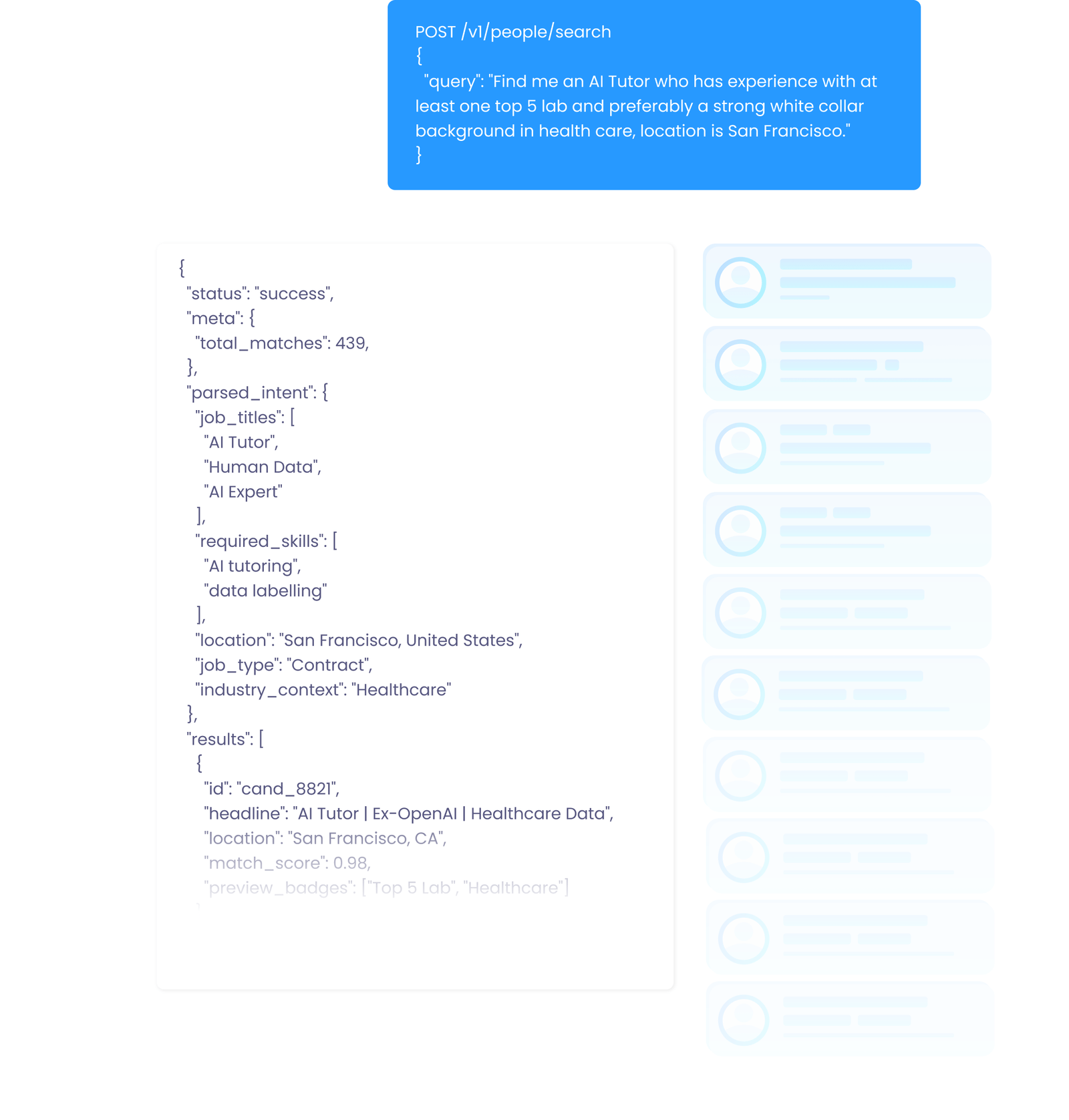
The mechanism is what makes it feel different from everything below it. You describe a role or a person in natural language, and the agent interprets that description, runs real-time searches across the open web rather than querying a cached snapshot, and returns up to about 100 ranked candidates scored on a 1-to-10 scale - Focused Futures. It reaches across LinkedIn, GitHub, Stack Overflow, Xing and other public professional sources, so it is a cross-platform finder by default, not a single-network tool. Two products sit on the same engine: RecruitGPT, which generates a candidate shortlist from a single prompt in seconds, and the autonomous AI Recruiter (renamed from "Uwi" in mid-2026), which handles screening and outreach without supervision. The screenshot below shows the RecruitGPT interface turning a plain description into a shortlist.
The coverage and adoption numbers explain why it resonates with working recruiters. HeroHunt.ai searches a reach of 1.2 billion+ public profiles in real time, on GDPR-compliant public professional data, and reports 15,000+ recruiters using it globally - HeroHunt.ai. The real-time angle is a genuine differentiator rather than marketing gloss: several enterprise rivals refresh their databases only every three to six months, so their "current" data is often a quarter stale, whereas an agent that retrieves profiles live returns what is on the web today - MindHunt AI. Pricing is deliberately simple for the category, a self-reported flat rate of about $107 per month bundling autonomous sourcing, screening, and outreach, which undercuts the annual-contract enterprise tools by an order of magnitude - HeroHunt.ai.
| Plan | Price | What you get |
|---|---|---|
| Free trial | $0 for 8 days | Up to 3 positions, limited profiles screened, approved outreach; auto-converts to paid |
| Pro | ~$107/mo (billed in EUR) | 10 new positions/month, unlimited profiles screened, unlimited outreach |
| Team | Custom (per seat) | Multiple sign-ins, shared workflow, annual options |
| Enterprise | Custom | Higher position volume, dedicated support |
It would be dishonest to place any platform at number one without its trade-offs, and HeroHunt.ai has real ones. The "free" offering is an 8-day trial that auto-converts to a paid plan rather than an unlimited free tier, positions reset monthly and are capped per plan (Pro allows 10), and the public pricing is opaque because the plans page renders prices through commerce tooling and quotes in euros - HeroHunt.ai. Outreach is email-centric, so teams that live on LinkedIn or WhatsApp messaging will find it less multi-channel than some rivals, and its verified-email accuracy is not published the way competitors advertise theirs. None of that changes the core case: for a small-to-mid team that wants profiles found, screened, and contacted from one sentence, it is the most complete answer on this list, which is what the top ranking reflects.
Where it fits against the field is as the automation layer, not a replacement for every specialist below. If you have a face, you still need a face engine; if you have an anonymous username, a free scanner is faster. But if your starting point is "the kind of person I need" expressed in words, HeroHunt.ai is the state-of-the-art way to go from that description to real, contactable profiles, and it is genuinely representative of the agentic shift that defines the 2026 landscape. That is why it opens the ranking, with the honest caveat that its power is concentrated on outbound recruiting and sales sourcing rather than general investigative OSINT.
4. IDCrawl (#2): The Best Free People and Username Search
If HeroHunt.ai is the most advanced platform, IDCrawl is the most useful free one, and that combination of zero cost and genuine breadth earns it the number two slot. It is a no-signup people-search engine that takes a name, username, email, or phone number and returns matching social profiles, web mentions, and public records on a single page in seconds. For the overwhelming majority of readers who just want to find someone's accounts without spending money or installing anything, it is the correct first move, and everything more expensive on this list should be reached for only after a free IDCrawl pass comes up short.
Its standout feature is the username tool, which is where it beats the paid consumer services. Enter a single handle and IDCrawl checks it across 100+ platforms including Instagram, TikTok, X, Facebook, YouTube, Snapchat, LinkedIn, Roblox, and Pinterest, surfacing every matching account in one view - IDCrawl. Name searches aggregate from 50+ data sources spanning social networks, public directories, and public records like property, court, and marriage filings, alongside contact data. The company reports indexing 500M+ people and handling 10M+ searches per month, and independent traffic estimates put it at roughly 1.8 million monthly visits as of April 2026, which tells you it is a mainstream tool rather than an obscure one - Similarweb.
The value model is refreshingly honest: the core searches are genuinely free, and IDCrawl makes money by routing deeper background-check and contact-lookup clicks to paid partners rather than paywalling the basics. That said, its limits are as real as its strengths and matter for how you use it. It is strongly US-centric, marketing coverage across all 50 states while offering thinner international data, so a search for a European or Asian subject will return far less. It is prone to false positives on common names and shared usernames, its data can be stale, and it is explicitly not a Consumer Reporting Agency, which means its results legally cannot inform hiring, tenancy, or credit decisions no matter how convenient they look.
The right way to treat IDCrawl is as a lead generator, not a source of truth, and that framing keeps you out of trouble. Run the name or username, collect the candidate profiles it surfaces, then confirm each one belongs to your subject through an independent signal before you act, exactly the verification discipline covered later in this guide. Used that way it is the highest-yield free platform available in 2026, and its position at number two reflects the simple reality that a tool costing nothing and covering a hundred networks does more good for more people than most of the expensive machinery further down the list. The one honest caveat is that its "AI" branding is marketing for algorithmic aggregation, not a distinct natural-language assistant, so set expectations accordingly.
5. Maigret and Sherlock (#3): Open-Source Username Scanning
When you have a username and nothing else, the most powerful platforms in the world are free, open-source, and run from a terminal. Maigret and Sherlock take a single handle and fan out requests to hundreds or thousands of sites, reporting back every place that handle is registered. They rank third because their raw coverage is unmatched by anything else on this list, with the honest trade-off that they demand a command line and a tolerance for noise that non-technical readers will find harder than IDCrawl's browser box.
The two tools split along a depth-versus-simplicity line, and knowing which to grab saves time. Maigret is the deeper engine, checking a username across more than 3,000 sites (its default run hits the roughly 500 highest-traffic ones first), parsing found pages for new usernames and IDs, recursively searching those, and exporting HTML, PDF, and graph reports - Maigret. It carries about 34,900 GitHub stars and, notably for 2026, added an --ai summary mode plus a community MCP server so an assistant like Claude can run a username search as a tool. Sherlock is the lightweight classic, hunting a handle across 400+ networks and printing found URLs, and with roughly 86,100 stars it is the most popular OSINT tool of its kind and ships pre-installed on Kali Linux. Both install in one command:
pipx install sherlock-project     # fast first pass across 400+ sites
sherlock johndoe                  # prints every found profile URL

pip install maigret               # the deeper 3,000+ site alternative
maigret johndoe --html            # full dossier with a report file
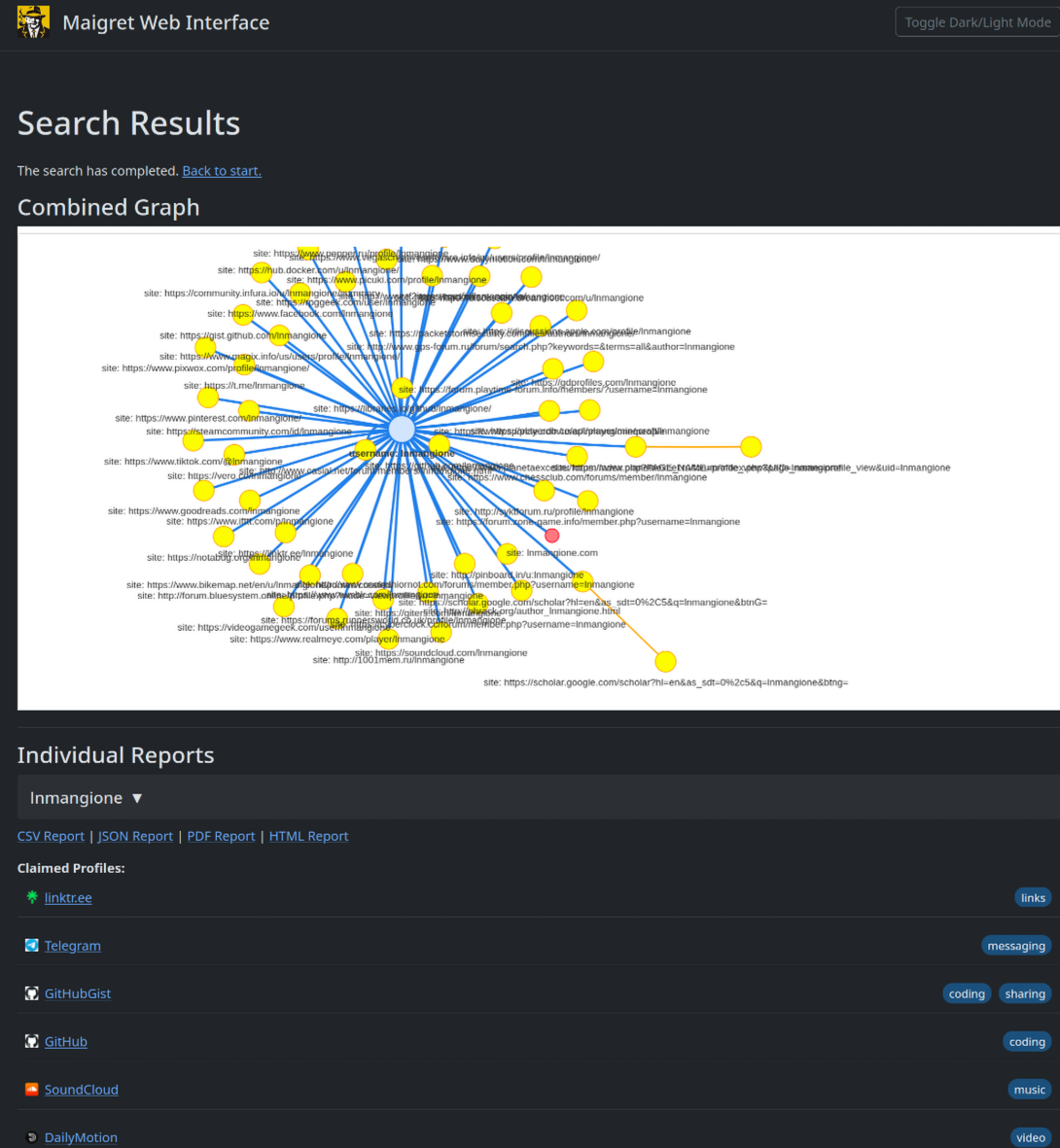
Maigret also ships a local web interface, which makes the output far more approachable than a wall of terminal text. The screenshot below shows its results dashboard, where discovered accounts are laid out as an interactive relationship graph rather than a raw list, and that visual view is what turns a scan into an investigation.
The coverage gap between these tools is worth seeing directly, because it explains why Maigret is the depth pick while the others win on speed or convenience. The chart below counts how many sites each one checks a single handle against, from the deepest open-source scanner down to the free browser engine ranked second on this list.
Sites Checked per Username Tool
The takeaway is not simply that more is better. Maigret's 3,000 sites include a long tail of niche forums and regional networks that most searches never need, whereas Sherlock's tighter 400 covers the platforms that actually matter for the majority of people, faster and with far less noise. IDCrawl's roughly 100 is the smallest net but the only one that needs no install and no command line, which is exactly why breadth and convenience trade off against each other and most professionals keep two of these within reach rather than betting on one.
Reading the output is a skill, because breadth comes with noise that will mislead the careless. A wide scan returns false positives where a site reports success for any input, and false negatives where bot protection silently blocks the check, so every hit is a candidate to open and confirm, never a fact. The main 2026 failure mode is not shutdowns but hardening: Cloudflare, CAPTCHAs, and TLS fingerprinting increasingly break plain-request scanners, which is precisely why a newer tool, Naminter, emerged to run the community WhatsMyName dataset of 730+ sites with browser-impersonation techniques that survive those blocks. Underpinning much of this ecosystem is WhatsMyName itself, a community-maintained list of 700+ site definitions that also runs as a free, no-install web app for anyone who will not touch a terminal.
The practical takeaway is that this tier gives you the widest net for zero dollars, and its position at number three is a deliberate statement that free, well-maintained open-source platforms outperform most paid consumer tools on pure coverage. Treat an absence of results as inconclusive rather than as proof, export every run so you have a timestamped record, and remember that these tools prove a username is claimed, not that it belongs to your target. The identity correlation, deciding whether devkadvya on GitHub is the same devkadvya on X, is human work, and the tools that try to automate it (the AI agents in section 18) are only as trustworthy as the verification you apply on top.
6. PimEyes (#4): Reverse Face Search Across the Open Web
When your only starting point is a photograph, you leave the world of names and handles entirely and enter face search, where PimEyes is the deepest open-web index available. It takes a face photo and returns the public web pages where that same face appears, matching across different angles, lighting, and backgrounds rather than requiring an identical image. It ranks fourth because a face is one of the hardest identifiers to work with and PimEyes handles it better than almost anything, with the crucial and widely misunderstood caveat that it is not actually a social-profile finder.
That caveat is the single most important thing to understand before you pay for it. PimEyes indexes roughly 3.5 billion images crawled from the open web, but it deliberately does not crawl the major social platforms or video sites - Tools For Humans. It surfaces news articles, blogs, forums, conference and press photos, stock photography, and, notably, adult content, then leaves you to pivot from those pages to the actual person. So it excels at the question "where does this face appear online" and fails at "what is this person's Instagram," which is a distinction that trips up most first-time users and sends them to FaceCheck.ID (next in the ranking) when profiles are the goal.
Pricing is subscription-based and the free tier is essentially a paywall teaser, showing you that matches exist but blurring the results until you pay. The 2026 tiers are stable and worth knowing before you sign up, because the useful features (source URLs, monitoring, unblurred results) all sit behind the paid plans.
| Plan | Price | What it unlocks |
|---|---|---|
| Free | $0 | Confirms matches exist; results blurred, ~5 searches/day, no source links |
| Open Plus | $29.99/mo | Unblurred results, source website URLs, limited monitoring alerts |
| PROtect | $79.99/mo | Adds ongoing monitoring plus the automated takedown agent |
| Advanced | $299.99/mo | Effectively unlimited searches, maximum alerts, deep search |
Those figures are the reliable current numbers, verified against a July 2026 review, though some third-party sites cite outlier promotional prices you should distrust - All About AI. Beyond price, PimEyes carries the heaviest legal baggage on this list. It blocks Illinois residents outright because of the state's biometric privacy act, its features are restricted in the EU after a 2022 Italian data-protection fine, and it announced a forthcoming face-in-video search tool in July 2025 that will only intensify the scrutiny - Biometric Update. Accuracy also degrades on low-resolution, side-angle, or obstructed photos, and like every face engine it returns people who merely look similar.
The disciplined way to use PimEyes is as one leg of a face workflow, never as a standalone verdict. It is the tool you reach for when you need the broadest open-web coverage of where a face has been published, the raw material for identifying someone whose profiles are private but whose photo appeared at a conference or in a news story. Its fourth-place ranking reflects both its genuine strength at that narrow job and the reality that it is the most legally constrained platform here, off the table entirely if you or your subject sit in the EU or Illinois. When your goal is the social profile itself rather than a web mention, the next platform is the better bet.
7. FaceCheck.ID (#5): Face Search Straight to Social Profiles
FaceCheck.ID solves the exact problem PimEyes leaves open: it takes a face and links you directly to social profiles, not just web pages. Where PimEyes indexes the open web and deliberately skips social platforms, FaceCheck.ID is purpose-built to surface Instagram, Facebook, X, LinkedIn, YouTube, and dating-site profiles, alongside news mentions, forum avatars, scam-report databases, mugshots, and sex-offender registries. For anyone whose goal is a social account rather than a news appearance, it is the more direct tool, which is why it sits at number five just ahead of the broader-but-shallower niche players.
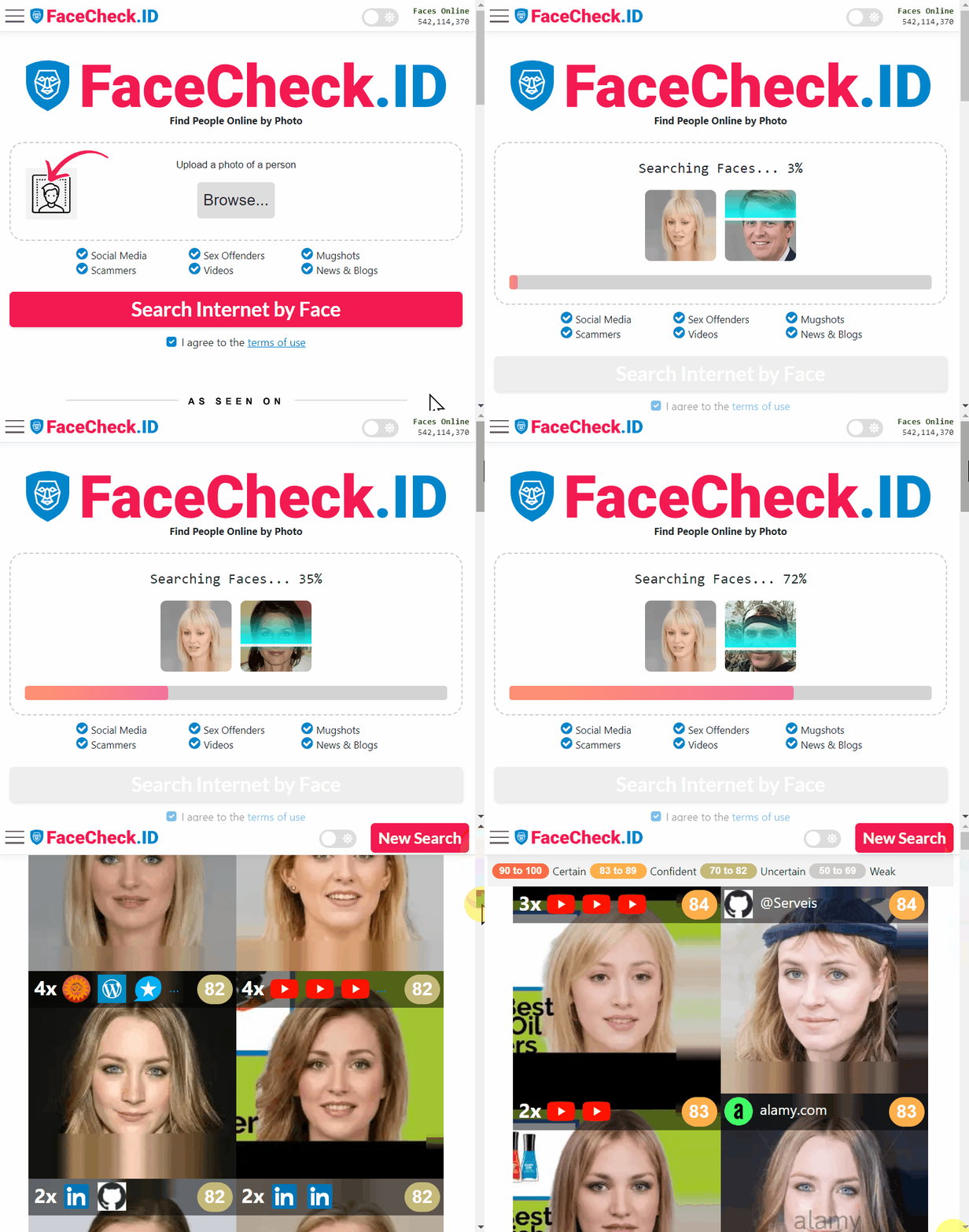
The engine works on facial embeddings rather than pixel matching, so it handles blurry, cropped, and side-profile photos better than a classic reverse image search, and it explicitly indexes sources Google will not touch. Every result carries a 0-to-100 confidence score banded into Certain (90-100), Confident (83-89), Uncertain (70-82), and Weak (50-69), which is genuinely useful because it tells you how much to trust each hit - FaceCheck.ID. Independent testers found that on clear front-facing photos both FaceCheck and PimEyes score above 90% accuracy, but FaceCheck returned dating-app matches in six of ten cases where PimEyes found nothing, confirming its social-and-dating edge - AutoGPT. The animated demo below shows the search-to-results flow.
Pricing moved to a credit-pack model rather than a subscription, which suits occasional investigators but comes with friction. Packs run from Just a Peek at $6 (36 credits, roughly 12 searches, expiring in two days) up to The Professional at $597 (10,000 credits, valid a year, with the lowest per-search cost), and every search costs three credits with free runs returning blurred previews - Tool Junction. The catch that surprises people is payment: since late 2024 FaceCheck.ID accepts cryptocurrency only (Bitcoin or Litecoin), which adds exchange and wallet fees and is a real barrier for casual users. Cheaper packs also expire fast, pressuring you toward bulk purchases you may not need.
The honest limitations are the ones the vendor itself flags, and they apply to every face tool. FaceCheck.ID only indexes public images, so anyone with private profiles or a thin online presence simply will not appear, producing false negatives. Lookalikes and relatives produce false positives, and when a scammer uses a stolen photo the search returns the victim's identity, not the perpetrator's, which can actively mislead an investigator. The company's own guidance is blunt: "many unrelated people look alike," and results are investigative leads, never proof - FaceCheck.ID. Its widely-quoted 79-out-of-80 win over PimEyes is a self-published test, so treat that specific figure as marketing.
The practical positioning is that FaceCheck.ID and PimEyes are complements, not competitors, and serious face work uses both. Start with FaceCheck.ID when you want a direct line to a social profile, fall back to PimEyes for the open-web appearances it misses, and require a second independent signal before you believe either. It ranks fifth because it does the single most sought-after face job (photo to social account) better than anything else, tempered by crypto-only payment, public-only coverage, and the same demographic accuracy problems that make all face search a lead rather than a conclusion. It is explicitly off-limits for regulated decisions like hiring, credit, or tenancy.
8. Pipl (#6): The Enterprise Identity Graph
Pipl is the platform professionals reach for when accuracy and scale both matter more than budget. It is an enterprise identity-graph API that takes a fragment (a name plus a city, an email, a phone number, or a social URL) and resolves it into a single consolidated identity, complete with linked social handles, addresses, contact data, employment history, aliases, and the source pages where each element was found. It ranks sixth not because it is weak, it is arguably the most rigorous identity resolver here, but because its price and access gating put it out of reach for the casual reader this ranking is weighted toward.
The depth of the graph is what sets it apart. Pipl's 2026 figures cite 5 billion+ trusted identities, 28 billion+ unique identifiers, and 9 billion+ social-media usernames across 150+ countries, built on more than two decades of cross-referenced data - Pipl. The core investigator-facing product resolves a fragment into either a single confirmed person or a set of scored candidates you disambiguate, and it returns source URLs for every data point, which is what makes it defensible in a formal investigation rather than just convenient. It is exposed both as a REST API and as a set of Maltego transforms, so it slots into the visual link-analysis workflows covered in the next section. Inside those graphs a Pipl query visibly distinguishes a confirmed person match from a merely possible candidate, which is what lets an investigator resolve an ambiguous fragment with confidence rather than guesswork.
Pricing is where Pipl separates itself from everything above it in this ranking, and it is built for organizations, not individuals. The Search API bills roughly $0.10 per matched query on a match-only basis (no-match responses are free) with a default $1,000 per month spending floor, while the browser-based Search Insights tool runs about $358 per user per month - Pipl. Aggregated deal data puts real enterprise contracts at an average near $58,000 per year, and access requires KYC vetting plus an approved use case - Vendr. That gating is a feature, not a bug: the same capability that helps a fraud team confirm an identity would be dangerous in the wrong hands, so Pipl vets who gets in.
The strategic shift worth knowing is that Pipl has repositioned in 2026 from a pure people-search API to an "identity trust" company, with the same graph now powering payment-fraud decisioning and a large risk model, underscored by an April 2026 partnership with FICO - BIIA. For the reader trying to find someone's profiles, the Search product remains the relevant piece, and it sets the ceiling for what fragment-to-identity resolution can achieve when precision and auditability are non-negotiable. Its sixth-place ranking is a statement about accessibility, not power: if you run a fraud, trust-and-safety, compliance, or investigative team, Pipl belongs near the top of your shortlist, but for a recruiter or a curious individual it is far more platform than the task requires, and the cheaper tools above will answer most questions.
9. Spokeo and BeenVerified (#7): Consumer People-Search
For the everyday, non-professional lookup, the consumer people-search subscriptions occupy a well-worn middle ground, and Spokeo and BeenVerified are the two most recognizable. They take a name, phone number, email, or username and return a consolidated report: contact details, address history, relatives and associates, and linked social profiles. They rank seventh because they genuinely serve a real need (identifying an unknown caller, reconnecting with a lost contact, vetting an online date) while carrying enough billing and accuracy baggage that they cannot rank higher than the free and professional tools around them.
The coverage is broad on paper, which is what draws people in. Spokeo aggregates 12 billion+ records including consumer, property, court, and business filings, cross-references 120+ social networks, and processes around 500,000 searches a day - Spokeo. BeenVerified serves 10 million+ users and handles roughly 38 million searches a month, bundling extras like a VIN lookup and a dark-web scan - Clay. Both support reverse email, phone, address, and username lookups, so they can map a contact point back to a person and their accounts, which is their most useful trick for social-profile finding specifically.
The pricing structure is where you must read carefully, because the cheap entry hooks are designed to convert into recurring charges. Independent testing found the accuracy is decent but not authoritative, with Spokeo correctly identifying about 85% of phone numbers on stable lines while surfacing outdated addresses and incorrect relatives - Digital Safety Squad.
| Tool | Entry | Ongoing | Key limit |
|---|---|---|---|
| Spokeo | $0.95 / 7 days | ~$22.95/mo (renewals reported higher) | Auto-renews; prepaid and non-refundable |
| BeenVerified | $1 / 7 days | $36.89/mo (1-mo) or $23.98/mo (3-mo) | Capped at 100 reports/month |
The recurring theme across both, and the reason they rank where they do, is billing friction and legal limits. Cheap trials silently convert to monthly subscriptions, sales are final, and cancellation requires beating a hard deadline, which is why Spokeo has drawn hundreds of Better Business Bureau complaints with billing issues making up a quarter of them - CheckThat.ai. More importantly, neither is a Consumer Reporting Agency, so neither can legally be used for hiring, tenancy, or credit decisions, a hard blocker that rules them out for recruiting entirely.
The right mental model is that these are consumer tools for one-off personal curiosity, not sourcing platforms, and using them outside that lane is where people get burned. They are worth the small trial fee for a single "who is this" lookup, provided you set a calendar reminder to cancel and treat every result as a lead to verify rather than a fact. Their seventh-place ranking reflects that narrow but real usefulness, squeezed between the free tools that do the social-profile job for nothing and the compliant, structured platforms that professionals actually build workflows on. For anyone finding profiles at volume or for any decision with consequences, look elsewhere on this list.
10. Maltego and Social Links (#8): Professional Link Analysis
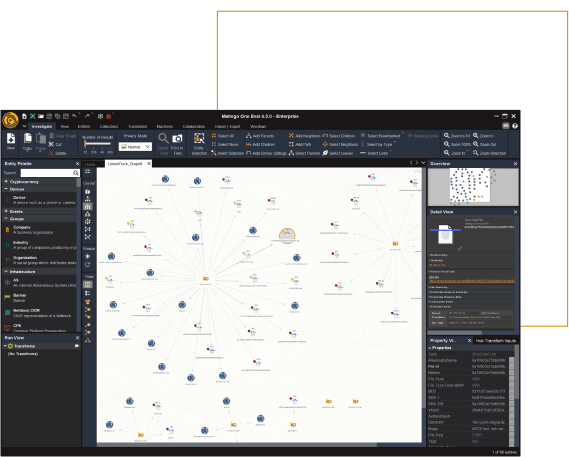
When the job is not finding one account but mapping an entire network, Maltego is the category standard, and it anchors the professional link-analysis tier at number eight. You seed a graph with a single identifier (a name, email, phone, handle, or wallet) and run "Transforms" that pull related entities from 120+ data partners, then watch the platform auto-plot everyone and everything as an interactive node-and-edge graph that exposes hidden relationships. It ranks eighth because it is extraordinarily powerful for investigators yet demands real tradecraft to use, which places it below the point-and-click tools most readers will prefer.
Maltego's credentials are the strongest in this segment. Frost and Sullivan named it the 2025 Global Product Leader in OSINT, it counts 200,000+ users and 2,000+ government organizations across 120+ countries, and its Transform Hub reaches every major social network plus dark-web and threat-intelligence feeds - Maltego. In 2026 it added an AI Assistant, a conversational copilot inside the graph that cleans, tags, translates, and reports on data, plus a new social-media Profile View that aggregates a target's whole profile into one card. Pricing is unusually transparent for the enterprise tier, which is part of why it leads: a free Community Edition, then EUR 3,000 per year (Entry) and EUR 7,500 per year (Professional) before custom enterprise deals - Maltego. The graph interface below is the core of the experience.
The peer platforms in this tier push into territory Maltego touches more lightly, and they matter for social-profile work specifically. Social Links runs SL Professional as a Maltego add-on and a standalone SL Crimewall platform, both extracting and visualizing data across 500+ open sources including social media, messengers, the dark web, and blockchains, and it too earned 2025 Frost and Sullivan recognition while serving law enforcement in 80+ countries. ShadowDragon SocialNet queries 200+ platforms and, critically, retains historical snapshots so that deleted or renamed accounts remain recoverable, a genuine differentiator for cold-case and attribution work. Both are quote-only, which is part of why the tier ranks below the transparent tools above it.
The 2026 trend defining this whole segment is agentic AI, and it shows why link analysis is converging with the autonomous agents at the top of this list. The official demo below shows Maltego's browser-based AI-powered link analysis, which is the clearest illustration of where investigative tooling is heading.
Maltego One: AI-powered link analysis in the browser
For most readers these platforms are more than the task requires, and that is exactly why they rank eighth rather than higher. They define the upper bound of network-scale profile discovery and they gate that power behind vetting precisely because it is dangerous, but the steep learning curve and enterprise pricing mean a recruiter or journalist will rarely need them. Where they earn their place is the investigation that spans dozens of connected identities across social media, messengers, and the dark web, presented as a court-ready visual graph, a job none of the simpler tools above can touch.
11. Epieos (#9): From an Email or Phone to Every Account
When your starting identifier is an email address or a phone number, Epieos is the specialist that does the most with it, and that focused excellence earns it ninth place. It is a hosted OSINT tool that takes a single email or phone and maps the linked accounts, public profiles, and data breaches behind it across 140+ online services, all without ever notifying the person you are looking up. Its signature trick is a reverse-Gmail lookup that surfaces the real name, profile photo, and public Google Maps reviews tied to a Gmail address, which often reveals more about someone than a dozen social profiles would.
The mechanism is two techniques bundled into one clean web interface. For an email, Epieos resolves it to a Google account (pulling the display name, photo, and Maps activity) and separately probes the registration and password-reset endpoints of many sites to detect where that email is registered, returning hits on platforms like LinkedIn, GitHub, Facebook, Pinterest, Strava, Spotify, and more. Being hosted is its practical advantage over the free command-line equivalents: there is no Python to install, no rate limits to eat, and no need to supply your own Google cookies. Pricing keeps a usable free tier and a single paid step, the Osinter plan at EUR 29.99 per month, which unlocks all modules including LinkedIn and GitHub but caps you at 30 full-access requests a month - Skrapp.
That request cap is the honest limitation, along with weaker phone-number results (much less reliable than email, especially outside the US) and no username search at all. It is worth knowing the free alternatives that do the same work if you are willing to run a terminal, because they trade convenience for zero cost and unlimited use.
- Holehe checks an email against 120+ sites by silently probing reset endpoints, though it is now largely unmaintained and many modules are broken.
- GHunt digs deep into a single Google account, extracting name, photo, Maps reviews, and shared Drive files, but requires your own authentication cookies.
The state of those two tools is itself a useful signal about this category in 2026. Holehe's decline is exactly why Epieos replaced the Holehe engine with its own in-house module claiming 200+ sites and no false positives, and it is a reminder that the whole email-to-account technique rests on platforms not hardening their endpoints - Epieos. When a major service tightens its password-reset flow, a slice of every scanner's coverage silently goes stale until someone patches it. That fragility is why an absence of results here means "inconclusive," never "this person has no accounts."
Epieos ranks ninth because it owns a specific, high-value corner of profile-finding (turning a contact point into a name, a photo, and a map of accounts) without pretending to be a general-purpose finder. It is the tool an investigator, a due-diligence analyst, or a recruiter reaches for the moment they hold an email and want to know who is behind it and where else they exist online. Its narrowness is the whole point: it does one thing that the broader platforms do less precisely, and it does it fast, passively, and cheaply.
12. Exa (#10): The AI Search API for Agents and Builders
The tenth platform is the one you never see, because it lives inside other software. Exa is an AI-native search API with a dedicated people index of 1 billion+ public profiles that developers and autonomous agents query in plain language and get back real, indexed profile URLs plus structured metadata. It rounds out the ranking because it represents the infrastructure layer of 2026 profile-finding: when an AI SDR, a sourcing agent, or a custom research bot goes looking for people, Exa is frequently the engine actually doing the retrieval, which makes it quietly one of the most consequential tools here.
What distinguishes Exa from a general web search is that it is built for machines and tuned to avoid the failure mode that plagues AI people-finding. You call it with a natural-language description and set the people category, and it runs semantic search over its profile index, returning real indexed URLs with name, role, company, location, work history, and education attached - Exa. Because every result is an actual page rather than model-generated text, hallucination on whether a profile exists stays inherently low, which is the entire reason agent builders reach for it instead of asking a chatbot to "find someone's LinkedIn." The people index refreshes weekly on a pipeline built for 50 million updates a week, and the whole thing is consumed through an official MCP server and first-class framework integrations - Exa.
Pricing is transparent pay-as-you-go, built for developers rather than end users. A generous free tier covers up to 20,000 requests per month, standard search runs $7 per 1,000 requests (raised from $5 in early 2026), page-content extraction adds $1 per 1,000, and optional contact enrichment costs $0.02 per email or $0.07 per phone - Exa. For non-developers there is Websets, a structured-dataset builder that turns one query into a verified list of people or companies, starting at $49 a month. The launch of the dedicated People Search vertical in December 2025, which replaced the older LinkedIn-only category, signaled how seriously Exa treats people-finding as a first-class use case rather than a side effect.
The honest limitations are the flip side of its design. The people category searches the whole web rather than a single platform, so there is no strict LinkedIn-only filter, only category-level quality tuning; the weekly refresh means it is not real-time for very recent job changes; and it is a general index, not a consent-based, compliance-oriented people database. It is also emphatically a builder's tool, not something a recruiter opens in a browser. The competitive context underlines how valuable this layer has become: Exa's rival Tavily was acquired by Nebius for roughly $275 million in February 2026, a signal of how much agent-grade search is now worth - Nebius.
Exa ranks tenth because it is the least directly usable platform for the average reader, yet it earns its spot by powering many of the others conceptually and literally. If HeroHunt.ai at number one is the finished autonomous product, Exa is the kind of engine that products like it are built on, and understanding it explains why the frontier of profile-finding shifted from databases to agents. For anyone building their own sourcing or research automation, it is the cleanest, most hallucination-resistant way to turn a description into real, citable profiles, which is exactly why it closes the ranking rather than being left off it.
13. The Recruiter Contact Layer: ContactOut, SignalHire and Peers
Beyond the ranked ten sits a category that deserves its own section because it solves the last mile that most finders leave open: turning a discovered profile into a verified email and phone number. This is the recruiter contact layer, and its defining tools are ContactOut, SignalHire, Lusha, and Apollo.io. They differ from the platforms above in that they assume you have already found the person (usually on LinkedIn) and now need to reach them, which is why they sit alongside the ranking rather than inside it.
ContactOut is the LinkedIn-native leader here, and recruiters favor it for a specific reason: it surfaces personal Gmail and Outlook addresses, not just corporate ones. Its Chrome extension overlays a sidebar on a LinkedIn or GitHub profile and reveals a person's work email, personal email, and phone in one click, drawing on an index of about 350 million professionals with 200 million work emails, 100 million personal emails, and 100 million phone numbers - ContactOut. The sidebar below shows the in-LinkedIn reveal that anchors the recruiter workflow.

The critical thing to understand about this entire category is the gap between advertised and real-world accuracy, because it determines what you actually pay per usable contact. Vendors market 95-to-99% accuracy, but independent testing tells a harsher story: one 100-contact test of ContactOut returned just 42 valid emails with a 7% bounce rate, and real-world figures land closer to 75-85% for US business email and 50-60% for phone - SyncGTM. The pricing models also punish the unwary, because phone reveals cost far more than emails and credits rarely roll over. The official walkthrough below shows how the tool is meant to be used inside the recruiter workflow.
How to Use ContactOut: Getting Started
The credit-model differences across the peers are worth internalizing before you subscribe, because the sticker price is not the real cost. SignalHire deducts a credit only when it actually returns data, so failed lookups are free; Lusha charges 1 credit per email but 5 per phone; and Apollo.io bundles generous email credits but hard-caps mobile-phone reveals even on paid tiers - Cleanlist. For heavy phone sourcing, that structure matters more than the headline price, and a pay-only-on-hit model like SignalHire's often wins on total cost. For recruiters who want the whole loop (find, screen, and contact) handled autonomously rather than assembled from a contact tool plus a sourcing tool, the number one platform on this list folds this last-mile step into the same agent, which is the structural advantage the agentic tier holds over the point tools.
For context on where these fit against the enterprise sourcing suites, the diversity-and-analytics platforms sit a tier up in price. SeekOut searches 1 billion+ profiles at roughly $20,000 a year and hireEZ indexes 750 million+ across 45+ platforms at a lower median near $13,000 - Juicebox. The natural-language layer is now standard across all of them, which is the clearest sign that the Boolean-search era is ending and the description-first, agent-driven approach that tops this ranking is becoming the default expectation rather than the frontier.
14. Platform by Platform: LinkedIn, X, GitHub and Bluesky
No matter which tool you use, the underlying social networks each behave differently, and the biggest force reshaping profile-finding in 2026 is API lockdowns. Understanding what still works on each platform is what lets you choose the right tactic when a tool comes up short, and it is especially important for LinkedIn, the single richest source of professional profiles and the one with the most aggressive anti-automation. The practical reality is that bulk API access is effectively closed to non-enterprise users, so professionals now lean on native search, Google dorking, and AI aggregators instead.
LinkedIn deserves the most attention because it holds the most value and guards it hardest. Its native Hiring Assistant now lets recruiters describe candidates in plain English instead of writing Boolean strings, and LinkedIn's January 2026 data claims an 81% reduction in profile reviews along with meaningful time savings per role - LinkedIn. The practical entry points for serious in-platform work remain Recruiter Lite at $170/month and Sales Navigator Core at $119.99/month. The universal free fallback across every platform, and still the most reliable one, is Google site: dorking: a query like site:linkedin.com/in "product manager" "Berlin" surfaces indexed public profiles without logging in, and running the same dork through DuckDuckGo or Yandex catches results Google misses.
A concrete example shows the precision these operators buy, and it is worth practicing because it costs nothing. To pull a LinkedIn profile that the platform's own search hides behind commercial limits, a query like "name@company.com" site:linkedin.com can surface it when the email appears anywhere on the public profile, and adding an employer or location term narrows a noisy result set fast. A handful of operators carry most of the weight in 2026: site: to pin a platform, quoted phrases for exact matches, intitle: and inurl: to target page structure, the minus sign to strip noise, and before: and after: to bound results by date. Chaining several site: queries with OR lets you sweep multiple networks in a single search.
The platform-specific realities below are the ones that save you from wasting effort on approaches that no longer work. Each network has quietly changed the rules, and knowing the current state is half the battle.
- X (Twitter): free native advanced search (
from:,since:,until:) is the practical route now that the API is pay-per-use with no free tier. - GitHub: operators like
language:,location:, andfollowers:find engineers, but most hide their email, so pair it with username correlation. - Bluesky: the outlier, with a free and open firehose and powerful native operators, making it the most accessible major platform.
- Facebook and Instagram: Graph Search has been gone since 2019, so finding profiles relies on email or phone reverse lookup and reverse image search.
The standout in that list is Bluesky, and it is worth dwelling on because it runs against the trend. Its AT Protocol firehose is free with no per-call fee and its native search supports rich operators, so in a year defined by platforms slamming their doors shut, Bluesky is the rare one opening them - Blotato. The cross-cutting tactic that ties every platform together is username correlation, which is why the open-source scanners ranked third matter so much here: because people reuse handles, running one username through Maigret or IDCrawl checks hundreds of platforms at once, including the niche ones you would never think to search by hand. No single-platform method is ever sufficient on its own, which is the entire argument for keeping several tools from this ranking within reach.
15. Verification: Turning a Match Into a Confirmed Identity
Finding a candidate profile is the easy part, and it is where most people wrongly stop. Confirming that the profile actually belongs to the right person is the discipline that separates competent work from costly mistakes, and it is where nearly every automated workflow quietly fails. The core principle is blunt: handle reuse is not proof of identity. The same username can belong to different people, an AI agent can assert a wrong match with total confidence, and a face engine can surface a stranger who merely looks similar. Verification is the practice of refusing to believe any of them until independent signals agree.
The practical method is confidence scoring against independent signals, and it is simple enough to apply every time. Treat a match as HIGH confidence only when three or more independent signals agree, MEDIUM at two, and LOW at one or anything circumstantial, then act only on HIGH-confidence matches. The strongest individual signals are a reverse-image-matched avatar (the same face on two profiles), mutual-connection or follower overlap, a consistent bio with cross-links between accounts, and matching account-creation timing. The trap to avoid is mistaking one weak fact repeated across platforms for several signals: a shared common first name and city is not corroboration, whereas a reused rare handle plus a matching avatar plus a bio cross-link genuinely is.
Seasoned investigators lean on structured frameworks precisely because the natural human tendency is to hunt for reasons a match is right rather than reasons it is wrong. Two are worth adopting, and both take seconds to run through mentally once they are habit.
- SIFT: Stop, Investigate the source, Find better coverage, and Trace claims back to the original.
- R2C2: weigh Relevance, Reliability, Credibility, and Corroboration before accepting a finding.
Both frameworks share one insight that is easy to state and hard to practice: require two or more independent sources and actively search for the disconfirming evidence. Lock an identity onto a unique pivot (a middle name, a prior address, a distinctive cross-platform handle) rather than a common one, and when you cannot find a second independent confirmation, record the finding as unconfirmed rather than promoting it to fact. This is also where the legal stakes concentrate, because acting on a misidentification in hiring, lending, or safety contexts is exactly the harm the laws in the next section exist to prevent.
Breach-data lookups are a legitimate corroboration tool when used carefully, and they close out the verification toolkit. Have I Been Pwned offers free email search and can confirm that an email and an alias appeared in the same breach, which strengthens a link between two identifiers - Have I Been Pwned. The hard ethical line is that breach data is for correlating identifiers, never for accessing accounts, and using a leaked password to log in is a crime. Verification done properly makes you slower and far more accurate, which is the correct trade in any context where being wrong about a person carries a consequence, and it is the single habit that turns any tool on this list from a risk into an asset.
16. Accuracy, Hallucination and Failure Modes
Every platform in this ranking fails in predictable ways, and knowing those failure modes is what keeps you from acting on a confident error. The first and most important rule is that AI face search is a lead, never proof. Even the best NIST-tested algorithms hold false positives to a fraction of a percent under lab conditions, but at population scale that still produces many similar-looking false matches, and the errors are not evenly distributed. NIST's demographic testing found false-positive rates varying by up to a factor of 7,203 across groups, with women, children, the elderly, and Black individuals far more likely to be misidentified - NIST.
The consequences of ignoring that are not theoretical, and they are the reason this section exists. Randal Reid spent six days in a Louisiana jail on a facial-recognition match with zero corroboration, later settling for $200,000 after phone records proved he was in another state - Biometric Update. At least 14 documented US wrongful arrests trace to facial recognition, and in every case the failure was identical: a match treated as evidence instead of a lead - ACLU. The technology was not the villain so much as the decision to act on it without verification, which is precisely the discipline the previous section describes.
Language models and AI agents fail differently but just as confidently, and this matters enormously for the agentic platforms that top the ranking. They fabricate names, profiles, and URLs at high rates, and making them "reason harder" can make it worse. Studies across 2025 and 2026 found citation-fabrication rates spanning 14% to 95% across models, with wholesale fabrications (invented profiles complete with working links to unrelated pages) the dominant pattern - SQ Magazine. Deep-research agents also ignore the constraints you set them, with restriction-neglect failure rates measured at 18 to 30% - arXiv. The operational rule that follows is absolute: open and verify every URL an agent gives you, because a meaningful fraction point at the wrong person or nothing at all.
The contact and data tools fail in a quieter but equally consequential way, through decay and exaggeration. The gap between advertised and tested accuracy is real, as the ContactOut example showed with 42 valid emails out of 100 against a marketed 99%, and B2B contact data goes stale at roughly 22 to 30% per year, so a "found" email can be wrong simply because it is out of date. Two structural realities compound this: platforms are increasingly polluted by AI-generated fake personas and deepfakes, and absence of a profile means nothing, because people can deliberately stay off-grid or use privacy tools. A thin, single-source match is a hypothesis, not a finding, and the cost of forgetting that scales directly with the stakes of the decision it feeds.
The thread running through every failure mode is the same, and it is the core lesson of this entire guide: tooling finds candidates, but only verification confirms them. The platforms will keep getting more capable and more convincing, which paradoxically raises the risk, because a fluent, well-formatted, confidently-wrong answer is harder to distrust than an obviously rough one. Reserve your confidence for findings that survive a deliberate search for reasons they might be wrong, and treat every number a vendor advertises, especially accuracy figures, as a ceiling you will rarely hit in the field.
17. Privacy, Legal and Ethical Guardrails
Operating inside the law is not optional in this field, and the legal frame shifted meaningfully in the last two years, so the platform you are allowed to use often matters more than the one you would prefer. Start with the foundational question of scraping public data, where the news is genuinely mixed. US courts have held that accessing public web pages does not violate the Computer Fraud and Abuse Act, and that a logged-out scraper is not bound by a platform's Terms of Service - Bright Data. But the same litigation showed that using fake accounts and touching password-protected pages remains high-risk, so the practical rule is that public, logged-out data is defensible while scraping behind logins is not.
Facial-recognition search of strangers is the single most legally dangerous technique across every platform here, which is why PimEyes and FaceCheck.ID carry warnings the other tools do not. The EU AI Act has banned, since February 2025, the untargeted scraping of facial images from the internet to build recognition databases, with fines reaching 35 million euros or 7% of global turnover - EU AI Act. Clearview AI is the cautionary tale that gives the rule teeth, absorbing a 30.5 million euro Dutch fine and a US settlement valued around $51.75 million. If you operate in, or your subject sits in, the EU, face search of strangers is effectively off the table, and PimEyes blocking Illinois residents is the domestic echo of the same principle.
In the United States, biometric law is a patchwork with sharp edges, and it catches more people than expected. Illinois BIPA makes it illegal to collect faceprints without prior written consent, with statutory damages of $1,000 to $5,000 per violation, which is exactly why PimEyes and Clearview pulled out of the state - Privacy World. Only Illinois, Texas, and Washington have standalone biometric statutes, but enforcement is real, with Texas securing a $1.4 billion settlement from Meta. The clearest line for professional work touching US residents is to avoid face search of strangers in Illinois entirely and to treat biometric data as legally radioactive everywhere else.
For hiring specifically, the Fair Credit Reporting Act is the hard limit, and it is the reason nearly every consumer people-search tool on this list disclaims FCRA compliance. If you use a third party (a people-search site, an AI dossier, or a screening vendor) to evaluate a candidate, that report becomes a "consumer report" and triggers disclosure, consent, and adverse-action duties. A 2024 CFPB circular argued that AI background dossiers and algorithmic scores fall under the FCRA, and although that specific guidance was withdrawn in May 2025, the underlying statute still governs any report used to judge a candidate - CFPB. This is why a recruiter who finds a candidate's public LinkedIn, notes their skills, and sends a personalized message is on solid ground, but the same recruiter crosses a line the moment they run that person through a consumer people-search tool to inform the hiring decision.
The responsible-use baseline that keeps you defensible is consistent across jurisdictions, and it is worth committing to memory because it applies no matter which platform you pick. Stick to public, professionally-relevant information; have a lawful basis and give notice under GDPR, which in the EU and UK means documenting legitimate interest and notifying the person you hold their data; never make an eligibility decision without FCRA compliance; and avoid face search of strangers in the EU and Illinois entirely. Regulators are tightening data-broker rules on both sides of the Atlantic, and a May 2026 EU "digital omnibus" deal pushed high-risk system rules (including biometrics and employment uses) to December 2027, signaling that more constraint, not less, is coming. These are not bureaucratic afterthoughts; they are what separates defensible professional work from the kind that ends in a fine.
18. The Agentic Future and How to Choose
The clearest trend line for the rest of 2026 and beyond is the move from passive search to agentic discovery, and it is why the top of this ranking looks the way it does. The platforms are shifting from search-and-list dashboards toward autonomous agents that plan multi-step investigations, reason across sources, and increasingly act on what they find. General-purpose agents now do a version of this out of the box: ChatGPT's agent mode, Gemini Deep Research, Perplexity's Comet browser (free since March 2026), and Claude's web search tool all chain search, browsing, and reasoning into a cited report, and all can now be pointed at a natural-language people-finding task. The connective tissue underneath is the Model Context Protocol, which lets a model call real tools like Maigret or a search API instead of guessing, which is the single biggest reason agentic profile-finding is becoming reliable rather than merely fluent.
The capital and adoption numbers confirm the direction is not hype. The AI agents market is projected to grow from $7.84 billion in 2025 to $52.62 billion by 2030, and Korn Ferry's finding that 52% of talent leaders plan to add autonomous agents in 2026 shows the demand is mainstream - MarketsandMarkets. The video below shows an autonomous sourcing agent finding and engaging people at enterprise scale, which is the clearest illustration of where the number one tier of this ranking is heading.
AI Sourcing Agents in the Enterprise: Live demo
The underlying market growth supports the thesis that finding people is becoming core infrastructure rather than niche tooling. The OSINT market's trajectory captures the steepness, a near-tripling over five years as AI, rising cyber threats, and expanding digital footprints compound. The numbers below will be revised, but the slope is the story, and it is the same slope pushing the agentic platforms up this ranking.
OSINT Market Growth, 2025-2030 (USD Billions)
With all of that established, choosing the right platform comes down to a simple rule: pick by the identifier you already hold, then match the tier to the stakes. The decision tree below maps each starting point to the platforms in this ranking that fit it, and it is the fastest way to turn eighteen sections into a single next action.
Match the tier to the stakes, not to your budget, and the rest follows. For a casual reconnect or a quick check, the free tools (IDCrawl, Maigret) and a cheap consumer subscription are plenty. For recruiting and sales at volume, an autonomous platform like HeroHunt.ai that folds finding, screening, and contacting into one agent earns its price by removing the manual loop entirely. For fraud, trust-and-safety, and investigative work, the identity graphs and link-analysis suites (Pipl, Maltego, Social Links) justify their cost through scale and auditability. The mistake is paying enterprise prices for a casual lookup, or trusting a free consumer tool with a decision that carries real consequences.
The deeper takeaway is that AI has made finding people easy and made being right about them harder, which is why the scarce skill in 2026 is no longer discovery but judgment. The platforms will keep getting more capable, more autonomous, and more convincing, so the workflow that produces trustworthy results is the same one this guide has argued throughout: choose the platform that fits your starting identifier, triangulate across at least two independent sources, verify before you act, and stay firmly inside the legal lines. Master that, and the specific platform you pick, whether it is the state-of-the-art agent at number one or a free scanner further down, becomes a detail rather than a risk.
This guide reflects the profile-finding landscape as of July 2026. Pricing, coverage, accuracy, and especially the legal and regulatory rules change frequently. Verify current details with each platform and confirm your own legal obligations before searching, sourcing, or making any decision about a person.