


The practical 2026 guide to spending less on LinkedIn sourcing without losing reach.
A single LinkedIn Recruiter Corporate seat now runs $10,800 to $12,960 per year, and LinkedIn quietly raised Corporate prices roughly 15% year over year into 2026 - Leonar. Because Corporate is sold as a team product with a common three-seat minimum, the real entry point for most in-house teams is closer to $32,400 a year, and a ten-person desk lands near $108,000 before a single InMail overage or AI add-on - Pin.
That is a lot of money for something you can largely do another way. LinkedIn profiles are mostly public, so a Recruiter licence does not buy exclusive access to the people on it. What the seat sells you is the search interface, the advanced filters, the monthly InMail quota, and the shared-project layer that sits on top of that data. Every one of those four things now has a credible 2026 substitute, and several of them are free or close to it.
This guide is written for a non-technical reader who has to justify or cut a sourcing budget. It breaks down exactly what LinkedIn Recruiter costs in 2026 and where that money actually goes, the honest places LinkedIn still wins so you do not cut the wrong thing, the two ways to reduce the bill (trim the contract, or replace it), and the seven best alternatives with real, sourced pricing. It closes with how autonomous AI sourcing agents are quietly turning the whole "per seat" model on its head, and a simple framework for picking what fits your team.
HeroHunt.ai
If the line item you are trying to kill is a per-seat InMail licence, the most direct swap is an autonomous AI recruiter that is not priced per seat at all. HeroHunt.ai meters on open positions instead of headcount, starting at $149 per month with an 8-day free trial, and its AI recruiter searches over 1 billion profiles across LinkedIn, GitHub and Xing, then runs personalised outreach on autopilot. The honest caveat worth knowing before you switch: it is a sourcing engine, not an applicant tracking system, its outreach leans on email and WhatsApp rather than InMail, and there is no permanent free tier, so it is the wrong fit if your candidates genuinely only reply inside LinkedIn.
Contents
- What LinkedIn Recruiter really costs in 2026
- Why the cost is worth cutting now (and where LinkedIn still wins)
- Cut the bill without leaving: downgrades, negotiation, and free search
- The 7 best LinkedIn Recruiter alternatives in 2026
- Build your own Recruiter replacement stack for under $200 a month
- The 2026 shift: from paying per seat to hiring an AI agent
- How to choose the right alternative for your team
1. What LinkedIn Recruiter really costs in 2026
The headline number is $10,800 to $12,960 per seat per year for Recruiter Corporate, but the number you actually pay is almost always higher. LinkedIn does not publish Recruiter pricing anywhere on its site, which is deliberate: the product uses account-based and market-based pricing, so two companies buying the same seat can pay very different amounts - Pin. New customers are frequently quoted around $8,999 for a first-year Corporate seat, with the standard rate settling into that five-figure band by renewal.
That phrase, "no published price," is doing a lot of work, and it shapes every number in this guide. LinkedIn negotiates each contract against what it believes the account will pay, so the same Corporate seat can cost a well-known tech company and a regional staffing firm materially different amounts, and quotes skew higher in North America than in many other regions. This is why every figure here is a range drawn from buyer and agency reports rather than a rate card: there is no rate card to quote. The practical consequence is that "what does LinkedIn Recruiter cost" has no single answer, only a band you negotiate within, which is at once the frustration of the product and, as the negotiation section will show, the opening it leaves you.
The reason the effective cost climbs above the sticker is structure, not usage. Corporate is quoted per seat but sold as a team product, and reps commonly enforce a three-seat minimum, so the practical starting point is roughly $32,400 a year rather than one seat's price - Pin. On top of that sit the extras that never appear in the first quote: extra InMail credits, Job Slots for posting, Talent Insights for market data, and now the Hiring Assistant AI agent as a separate line item. The seat is the floor, not the ceiling.
There are three genuine Recruiter tiers plus one AI add-on, and the differences that matter are network reach and monthly InMail volume. Recruiter Lite is the only tier LinkedIn sells month to month and the only one with a semi-public price. Recruiter Professional Services targets staffing agencies, and Recruiter Corporate is the full in-house product with pooled InMails and team collaboration.
| Plan | Annual cost per seat | InMails / month | Notes |
|---|---|---|---|
| Recruiter Lite | $1,680 (~$170/mo) | 30 | Single user, searches only your 1st to 3rd degree network |
| Recruiter Professional Services | $6,000 to $10,000 | 100 | Staffing and agency version, annual contract |
| Recruiter Corporate | $10,800 to $12,960 | 150 (pooled) | Full network, ~3-seat minimum, annual contract |
| Hiring Assistant (AI add-on) | Quote-only (five-figure) | n/a | Sits on top of a Corporate or RPS+ seat |
The single most misunderstood line is Recruiter Lite, because it looks like a cheap Recruiter and behaves like something much weaker. Lite only searches your own 1st, 2nd and 3rd degree network, so if you are sourcing in a market where you have no connections, it will simply not show you the people who are there - HeroHunt. It also caps you at 30 InMails a month and strips out more than twenty advanced filters. For a solo recruiter working warm markets it can be enough; for real outbound at volume it rarely is. If you want the full picture of the ladder, our dedicated LinkedIn Recruiter pricing breakdown keeps the current indications updated.
The Professional Services tier deserves a note of its own, because agencies often default to it without checking whether Corporate is actually cheaper for their mix. RPS carries 100 InMails a month against Corporate's 150, has no multi-seat minimum, and is aimed squarely at staffing and consulting firms, but its $6,000 to $10,000 per-seat range overlaps heavily with Corporate's lower end - Pin. For a single agency recruiter it can be the better value; for a growing desk that will add seats, Corporate's pooled InMails and shared collaboration sometimes win. Neither tier includes the parts many teams assume are bundled: Job Slots for posting roles and Talent Insights for market data are separate line items, so the total LinkedIn hiring bill is routinely higher than the seat price implies. The opacity is deliberate, and it works in LinkedIn's favour, because a buyer who cannot see a list price cannot easily tell they are paying more than the company down the street.
The official LinkedIn Recruiter product page leans hard on outcome statistics rather than prices, which is a fair reminder of what the seat is selling: a polished, fast search-and-message workflow on the freshest professional dataset in the market.

The hidden cost: InMail economics
Every Recruiter tier meters your outreach in InMail credits, and the moment you exceed the monthly allotment you are buying more at roughly $10 each. A hundred extra InMails is another $1,000, and some 2026 buyers report LinkedIn pushing overage rates as high as $21 per credit after an October 2025 change - LinkedHelper. Credits do carry a safety valve: LinkedIn refunds a credit when the recipient replies within 90 days, so effective cost depends heavily on your response rate.
That response rate is where the economics get uncomfortable for technical hiring. LinkedIn itself enforces a floor: recruiters must maintain at least a 13% InMail response rate across 100 or more InMails in every 14-day assessment window, or face sending restrictions - LinkedIn Help. Average recruiting response rates sit around 18% to 25%, but the software and SaaS vertical has collapsed to just 4.77% as engineers drown in identical messages - Pin. At that rate, a single developer reply can cost around $210 in credits once you account for how many messages it took to get one. The InMail quota, in other words, is not just a cap on volume; it is a tax on every hire that scales inversely with how saturated your market is.
It helps to put a real number on the all-in cost, because the seat price is only the visible part. Take a modest six-recruiter in-house team on Corporate at $10,800 a seat: that is $64,800 before anything else. Add even light InMail overage of 100 extra credits a month across the team at $10 each, and you have layered on $12,000 a year. Put the Hiring Assistant agent on the two senior sourcers, quoted in five-figure territory per seat, and the number pushes past $90,000 before you have posted a single job through a paid slot. The seat price you negotiated is often only 60% to 70% of what LinkedIn actually collects, which is exactly why a line-by-line audit before renewal tends to surface more savings than recruiters expect, and why "cut the LinkedIn bill" usually means cutting several bills at once.
The other force acting on the number is time. Corporate seats rose roughly 15% year over year into 2026, and if that pace holds, a $10,800 seat becomes about $12,420 next year and $14,283 the year after - Pin. Compounding matters here: the decision to keep paying is not a decision about this year's price, it is a decision about a curve.
LinkedIn Recruiter Corporate seat price at ~15% annual increase
Read that curve as the real cost of doing nothing. A team that renews on autopilot for three years is not holding steady at $10,800; it is quietly signing up for a third more. That is the backdrop against which every alternative below should be judged, because the question is never "is this tool as good as LinkedIn?" but "is the gap worth an amount that grows every year?"
2. Why the cost is worth cutting now (and where LinkedIn still wins)
Cutting LinkedIn Recruiter spend is worth doing in 2026 for two reasons at once: the price is climbing while the core product, InMail, is getting less effective. The most cited reason recruiters give for leaving Recruiter is not the invoice at all; it is that "the outreach just stopped working" as inboxes saturate - Pin. When your response rate drifts toward LinkedIn's own 13% floor, you are paying a premium for a channel that is quietly regressing to the mean.
At the same time, candidates are spreading out. Per iHire's 2025 State of Online Recruiting, 53.8% of candidates now use niche platforms over LinkedIn alone, up from 49.2% the year before - Pin. A LinkedIn-only strategy therefore misses a growing slice of the market by construction, and that slice is largest exactly where LinkedIn is weakest: deep-technical and specialist talent who live on GitHub, Stack Overflow, or in research communities rather than on a polished professional profile.
Before you cut, though, it pays to be honest about what you would be giving up, because LinkedIn's advantages are real and specific. Being clear-eyed about them is how you avoid replacing a $10,800 problem with a cheaper one that costs you hires.
- Data freshness - LinkedIn's 1.3B profiles are self-maintained by the professionals themselves, so job changes and titles update in near real time - DemandSage
- Deliverability - an InMail lands in the member's feed with no spam filter or bounce, versus roughly 83% inbox placement for cold email
- Brand trust - candidates recognise and open an in-platform LinkedIn message far more readily than a cold email from an unfamiliar domain
- Evaluation confidence - 87% of recruiters still rate LinkedIn as the most effective platform for evaluating candidates - Recruit AI Suite
Those four advantages explain why 97% of recruiters use LinkedIn and more than 85% of Fortune 1000 companies keep a Recruiter contract - EarthWeb. They also tell you exactly where a cheaper stack will bleed if you are careless: third-party contact data decays about 2% per month, so a scraped email that is six months old is materially less likely to reach anyone than a fresh LinkedIn profile. The right conclusion is not "abandon LinkedIn," it is "stop overpaying for the parts you can get elsewhere, and keep LinkedIn only where its freshness and deliverability genuinely earn the premium."
A concrete example makes the boundary clear. Recruiting a senior marketing leader in a major metro is close to LinkedIn's ideal case: the person keeps their profile current, they expect to be approached on the platform, and an InMail carries the trust of an in-network message, so the premium is defensible. Recruiting a systems engineer who last touched their LinkedIn profile in 2021 but commits to open source every week is the opposite: their freshest signal lives on GitHub, their real interest is in the work rather than the message, and a targeted email that references their actual project will beat a generic InMail that never gets opened. Most teams hire across both kinds of role, which is precisely why the answer is a blend rather than an all-or-nothing switch, and why the tools below are worth combining rather than ranking one above the rest.
The clearest way to see the opportunity is to compare reply rates by channel, because it reframes the whole decision. InMail still beats cold email on average, but in the verticals where sourcing is hardest, the gap has nearly closed, which means a cheaper channel with better targeting can win outright.
Typical outbound reply rates by channel and vertical
The takeaway from that spread is nuanced, and worth sitting with. On average InMail is genuinely 2.6 to 5 times more effective than cold email, and about 65% of replies arrive within 24 hours - Salesso. But for saturated technical roles, a well-targeted email to a verified address, or a message on a channel the candidate actually checks, can match or beat a generic InMail at a fraction of the cost. The strategy that follows from the data is targeting-first: spend less on raw InMail volume, and more on knowing precisely who to contact and where they will actually respond.
Zoom out and the case for trimming LinkedIn spend gets stronger, because that spend sits inside a hiring budget already under pressure. The average cost per hire is around $4,700, and the average time from posting to accepted offer reached 63.5 days in 2025, climbing past 80 days at smaller companies - Pin. Every dollar locked into a per-seat InMail licence is a dollar not spent on the tools that actually shorten those cycles, and every week a saturated channel fails to produce a reply is a week added to a time-to-hire that hiring managers already find too long. Cutting Recruiter cost is not only a procurement win; it frees budget for the sourcing methods that move the metrics executives care about, which is a far easier internal argument than "we want a cheaper tool."
The reason these alternatives are viable now, and were not three years ago, is that the underlying AI has crossed a usefulness threshold and recruiters have noticed. Per SHRM, 39% of HR teams now use AI for talent functions, up from 26% in 2024, and broader surveys put the share of companies using AI somewhere in talent acquisition near 69% - Pin. Sourcing is the single most common use case, and a majority of teams that use AI to source report higher-quality candidates rather than merely faster ones. That combination, mainstream adoption plus measurable quality gains, is what turned "cheaper LinkedIn alternative" from a compromise you tolerated into a genuine upgrade path many teams now prefer.
3. Cut the bill without leaving: downgrades, negotiation, and free search
Before you replace LinkedIn Recruiter, you can often cut its cost by 40% to 70% while keeping the seat, simply by right-sizing what you buy. Most teams over-buy Corporate: they put five recruiters on full seats when only one or two do heavy searching and the rest just review candidates and send the occasional message. The fix is to keep one heavy Corporate seat for the lead sourcer and move everyone else down. For a five-person team, one Corporate plus four lighter seats can take annual LinkedIn spend from roughly $64,800 to $22,512, a cut of about 65% - Leonar.
The important caveat is that this is a right-sizing exercise, not a seat-sharing one. LinkedIn explicitly prohibits sharing a single seat or passing logins around and can suspend accounts that do it, so "consolidate to one seat" means genuinely reducing how many people need full search, not quietly rotating a password. Before you downgrade anyone, migrate their projects, notes, and candidate history out of the Corporate seat first, because a downgrade can otherwise strip access to the pipeline they built. Time the change 30 to 45 days before renewal to hit the notice window, since these contracts lock to annual cycles.
To make the downgrade math concrete, picture a five-recruiter agency paying roughly $1,080 a seat a month after the 2026 increase, about $64,800 a year. If only the lead sourcer genuinely needs full Corporate reach and the other four spend their day reviewing candidates and sending the occasional message, moving those four to a lighter tier drops the run rate to around $1,876 a month, or $22,512 a year - Leonar. That is a 65% cut with no change in who you can find, because the one heavy seat still holds full network access. The saving scales with team size: it is nearer 40% for a two-person team and can exceed 70% at ten recruiters, where the ratio of light reviewers to heavy sourcers is highest. Before you touch anything, run a quick audit of per-seat usage, and flag anyone under roughly 200 profile views a week as a downgrade candidate, because low-usage full seats are where the waste concentrates.
The second lever is negotiation, and it is underused because LinkedIn presents the annual increase as a policy when it is really an opening position. The ~15% uplift is a default, not a rule, and buyers who come prepared routinely claw back 5% to 25% - Glozo. Your leverage is highest 60 to 90 days before renewal and collapses the moment you auto-renew, so the calendar matters as much as the argument.
- Pull your utilization data (logins, InMail usage, candidates advanced) to prove over-buying before the call
- Ask for a written price cap of 0% to 5% maximum annual increase, plus a year-two price lock on multi-year deals
- Sign at quarter-end (the last two weeks of March, June, September, or December) when rep quota pressure peaks
- Bring a real competitor quote from one of the alternatives below to anchor the conversation
Those four moves compound, and the last one is why the rest of this guide doubles as a negotiation tool: a genuine quote from SeekOut, hireEZ, or an autonomous agent priced per role changes what your LinkedIn rep is willing to do. Even if you decide to stay, walking in with a credible alternative in hand is worth more than any discount code. A team that never intends to leave still benefits from being able to leave.
One negotiation tactic is worth singling out because it is where reps hide the most margin: decouple the add-ons. LinkedIn prefers to present a single bundled number, but InMail overage rates, Job Slot allocations, and Talent Insights are each negotiable on their own, and a flat "10% off the total" can quietly leave an expensive overage rate untouched. Ask for each component to be priced and discounted separately, and treat a bundled add-on thrown in for free as a concession you can bank while still pushing on the seat price. The recruiters who save the most are rarely the ones who ask for the biggest headline discount; they are the ones who refuse to negotiate against a single opaque figure, because that figure is engineered to make trade-offs invisible.
The third no-switch lever is free discovery through X-ray and Boolean search, though it comes with a large and often-omitted caveat. Google's site:linkedin.com/in operator lets you surface public profiles with no paid seat, and query builders like Recruit'em generate the search string for you. But in January 2024 LinkedIn removed headline, About, experience, education, skills, and location from Google's public index specifically to push recruiters back toward paid Recruiter, which gutted the most valuable use case - Pin. X-ray on LinkedIn is now a supplement, not a replacement, and it works best off LinkedIn entirely, on GitHub's 180M+ developers, Stack Overflow, and other communities where full bios remain indexed. Our X-ray search guide and complete Boolean guide walk through the exact operators; the honest framing is that free search finds people but does not contact them, so it is one component of a stack rather than a whole strategy.
In practice, X-ray still earns its place when you point it at the right platforms. A query like site:github.com "machine learning" "Berlin" surfaces engineers by what they have actually built, and site:stackoverflow.com/users paired with a technology tag finds people who answer questions in your stack rather than merely list it as a skill. Feed either result into a contact-finder to turn the profile into an email, and you have reproduced the discovery-plus-contact half of a Recruiter seat for the price of the contact-finder alone. The technique fails quietly when you lean on it for LinkedIn title or location filtering after the January 2024 index change, so the working rule is simple: X-ray off-platform where bios are rich and public, and reserve LinkedIn's own search for the fields it still indexes.
One more honest constraint applies to leaning on free LinkedIn: the platform imposes a monthly commercial-use limit on how many searches a free account can run before it throttles you until the next cycle. For a recruiter doing real volume that ceiling arrives quickly, which is why free search works best as the discovery layer for a targeted list rather than as a bulk-sourcing engine. The practical workaround is to search narrowly and deliberately, using X-ray to pre-filter off-platform where there is no such limit, and to save the free LinkedIn searches for confirming and enriching a shortlist you have already built elsewhere. Treated that way, the free account stops being a crippled Recruiter and becomes a precise, no-cost verification tool.
4. The 7 best LinkedIn Recruiter alternatives in 2026
The strongest 2026 alternatives fall into three groups: autonomous AI recruiters that run the whole funnel, AI search platforms that find talent LinkedIn cannot see, and cheap contact-finders that let you skip InMail entirely. No single tool is a like-for-like LinkedIn Recruiter clone, and that is the point. You are not looking for a cheaper LinkedIn; you are assembling the specific capabilities you actually use for a fraction of the price. The seven below were chosen for genuinely current pricing, real 2026 feature sets, and a clear answer to "which part of the Recruiter bill does this replace."
It is worth naming the three groups before the detail, because they cut the cost in fundamentally different ways. The first is autonomous AI recruiters that run the entire funnel and charge per role, which attack the per-seat model head-on. The second is AI search platforms that index far beyond LinkedIn, so they cut cost by finding people LinkedIn cannot see rather than simply by being cheaper per seat. The third is contact-finders, the cheapest group, which do not source at all but turn a profile you already found into an email or phone number, replacing the single most expensive habit LinkedIn sells you: the metered InMail. Knowing which group a tool belongs to tells you immediately what it can replace and, just as usefully, what it cannot.
A short video overview is a good orientation before the detail, because it frames how sourcing changed over the last year and why the category has fragmented into specialists.
Best LinkedIn Recruiter Alternatives For 2026
Here is the full field at a glance. Prices are entry-tier and sourced in each write-up below; note that the tools are not all priced the same way, so the comparison is directional rather than apples-to-apples. LinkedIn Recruiter Corporate sits at the top as the baseline you are measuring against.
| Tool | Entry price (2026) | Profiles / data | Best for |
|---|---|---|---|
| LinkedIn Recruiter Corporate | $10,800+/seat/yr | 1.3B members | The incumbent baseline |
| HeroHunt.ai | $149/mo (per position) | 1B+ across platforms | Autonomous end-to-end sourcing |
| SeekOut | $2,150/yr (Recruit Lite) | 1B+ profiles | Technical and diversity hiring |
| hireEZ | ~$169/user/mo | 1B+ from 45+ sources | Layering AI onto your ATS |
| Juicebox (PeopleGPT) | $99/seat/mo | 800M+ profiles | Natural-language AI search |
| Apollo.io | Free / $49/user/mo | 275M+ contacts | Cheap emails and outreach |
| Loxo | $149/user/mo | 850M+ talent graph | All-in-one ATS plus sourcing |
| ContactOut | Free / ~$99/mo | ~800M profiles | Skipping InMail for direct email |
The pattern to notice before the individual reviews is that almost every alternative is one-fifth to one-fiftieth the price of a Corporate seat, and each is strongest at exactly one job. That is why the smartest 2026 setups combine two or three of them rather than searching for a single hero product.
Seeing the same numbers as a chart drives the point home, because the visual gap is wider than a table makes it feel.
Approximate entry price per year vs a LinkedIn Recruiter seat
Two caveats keep that chart honest. The bars are entry-tier annual prices, and the tools meter differently: HeroHunt is priced per open position rather than per user, Apollo and Juicebox add usage credits on top, and SeekOut's low Recruit Lite figure jumps into five figures at the team tier most enterprises actually buy. Even with those asterisks, the shape is the real finding. Every serious alternative starts at a fraction of a Corporate seat, so the question is never whether you can spend less, only which capability you are willing to assemble yourself to get there. With that framing, here is each in depth.
1. HeroHunt.ai
HeroHunt.ai is the world's first AI Recruiter, and it replaces the Recruiter seat by not charging for one. Instead of a per-seat InMail licence, you describe the role and its autonomous agent, Uwi, searches over 1 billion profiles across LinkedIn, GitHub, Xing, and Stack Overflow, screens each candidate against your actual requirements rather than keywords, and runs personalised outreach with automatic follow-ups across LinkedIn, email, and WhatsApp - HeroHunt.ai. Its companion, RecruitGPT, builds a ready shortlist from a single plain-language prompt, which is the closest thing on this list to typing a job description and getting back contactable people.
The pricing is where it diverges most sharply from LinkedIn. HeroHunt meters on open positions, not seats, starting at $149 per month (Starter), with Pro at $249 and Team at $499, and an 8-day free trial to test it before paying - HeroHunt pricing guide. Because cost tracks the number of roles rather than headcount, a small team can run several recruiters against the same plan, which is the exact opposite of the three-seat Corporate minimum. The honest trade-offs: it is a newer, smaller brand than the incumbents, there is no permanent free tier (the trial converts to paid), and it is a sourcing engine rather than a full applicant tracking system, so you still need somewhere to run your pipeline. It is the best fit for lean in-house teams, agencies, and embedded recruiters who want the whole top of the funnel handled autonomously at a predictable price.
2. SeekOut
SeekOut is the enterprise choice for technical and diversity hiring, and its edge is depth of data on hard-to-find people. It indexes 1B+ profiles and enriches them with signals LinkedIn does not surface well, including GitHub activity, patents, and publications, which makes it genuinely strong for engineering and scientific search - SeekOut. It also ships industry-leading DEI filters with the compliance tooling enterprises need, plus talent rediscovery that mines your own ATS, where SeekOut notes roughly 44% of hires already sit. In 2026 it has leaned into agentic AI that takes a job description to a shortlist in minutes and can even operate inside Claude, ChatGPT, and Gemini.
The catch is that SeekOut is priced for budget-holders, not solo recruiters. Its self-serve Recruit Lite tier is $2,150 a year for a single license with a 14-day trial, but the team and enterprise plans that unlock the full platform carry a three-seat minimum and land in the $10,000 to $30,000+ per year range, with third-party data showing a median contract near $20,000 - Pin. Reviewers consistently flag contact-data accuracy as the weak spot, with coverage strongest in North America and thinner across the EU and APAC. SeekOut is the right cut-the-cost move only if you are already spending Corporate money and your bottleneck is genuinely deep-technical or diversity sourcing, where its data earns the price.
A useful test for whether SeekOut justifies its enterprise price is its talent-rediscovery feature, because that is where it can pay for itself. If roughly 44% of your hires already sit in your ATS, a tool that surfaces those people with semantic search and fresh enrichment is not really an added cost; it is a way to stop paying to re-find candidates you already own. That logic only holds at scale, though. A team making a handful of hires a year will never work through enough of its database for the math to land, which is exactly why SeekOut is a strong buy for a fifty-person talent org and an expensive mistake for a two-person startup that would be better served by a per-role agent.
3. hireEZ
hireEZ keeps your existing ATS and bolts an agentic AI layer on top, which makes it the least disruptive way to modernise sourcing. It aggregates 1B+ open-web profiles from 45+ platforms, and in July 2026 it combined that pool with Nexxt's 150M+ profiles and Talroo to unify passive, nurtured, and active talent into one workflow - PR Newswire. Its EZ Agent orchestrates research, sourcing, screening, and scheduling, and it now includes conversational AI phone screening and an autonomous scheduler that coordinates calendars without a human triggering each step.
Pricing is quote-only, which is a real downside, but third-party data puts the startup tier around $169 per user per month and professional near $199, with enterprise deployments running $7,000 to $25,000+ per year and a median contract near $13,000 - Pin. There is no self-serve free plan, only a 14-day sales-gated trial. The most important honest flag is data quality: reviewers report email bounce rates approaching 30%, so hireEZ pairs best with a verification step before large sends, and its tag-based sourcing gives less Boolean control than some sourcers want. It fits mid-market and enterprise teams that like their current ATS and want an agentic sourcing layer rather than a rip-and-replace.
The strategic bet hireEZ is making is different from the others here, and worth understanding before you buy. Rather than ask you to leave your ATS, it inserts itself as an intelligence layer on top of it, which lowers the switching cost dramatically for a large team with an entrenched Workday or Bullhorn deployment. That is also its ceiling: because it rides on your existing systems, its value is capped by how well those systems already work, and the reports of email-bounce rates near 30% mean the data layer is the part to scrutinise hardest in a trial. Treat hireEZ as a modernisation of a working stack, not a rescue for a broken one.
4. Juicebox (PeopleGPT)
Juicebox is the tool to reach for if the part of LinkedIn you love is the search box, because PeopleGPT lets you describe your ideal hire in plain English instead of wrestling with Boolean. It searches 800M+ profiles aggregated from dozens of sources including LinkedIn, GitHub, Dribbble, and academic repositories, and every paid plan includes unlimited searches, so the real metering is on contact and export credits rather than queries - Juicebox. It also added Juicebox Agents, an always-on autonomous sourcer that continuously finds matches and can auto-email or shortlist candidates for you.
The PeopleGPT interface is the clearest example of how AI-native search differs from LinkedIn's filter grid.

Pricing is refreshingly transparent for this category: a genuine free plan exists, Starter is $99 per seat per month billed annually (or $119 monthly) with 500 contact credits, and Growth is $179 annually with 1,500 credits and collaboration - Juicebox. As of a July 2026 change, Starter's bundled credits doubled and its monthly price dropped, which is a rare move in the right direction. The honest limitation is that per-seat plus credit pricing climbs quickly for heavy sourcing, and Juicebox is a discovery engine rather than an ATS, so pipeline and hiring workflow live elsewhere. It is ideal for recruiters who want fast, Boolean-free candidate discovery sitting upstream of whatever system they already use.
The credit model is the thing to plan around before you commit, because it is where a cheap-looking plan can quietly get expensive. Searches are unlimited, but every email or phone number you reveal spends a contact credit, so a sourcer running high volume will work through Starter's 500 monthly credits fast and face an upgrade to Growth or a top-up. The way to keep Juicebox cheap is to search broadly but reveal selectively, spending credits only on candidates you have already decided to contact. Used that way, it is one of the best-value discovery engines available; used as a bulk-export tool, it stops being a bargain, which is a distinction worth settling before you pick a tier.
5. Apollo.io
Apollo.io is the budget answer to "I just need the email so I can skip InMail," and its free-forever plan makes it the cheapest entry on this list to start. Built as a B2B sales-intelligence platform, it carries a 275M+ contact database with verified business emails, enrichment, and built-in outreach sequences, and recruiters use it heavily as a low-cost way to reach candidates directly instead of buying InMail-bundled Recruiter seats - Amplemarket. Its paid tiers start at just $49 per user per month billed annually (Basic), with Professional at $79 and Organization at $119 for teams of three or more - Saleshandy. You can try it through Apollo.io on the free plan before spending anything.
Apollo's outbound engine shows how far a sub-$50 tool has come in bundling search, enrichment, and sequencing.
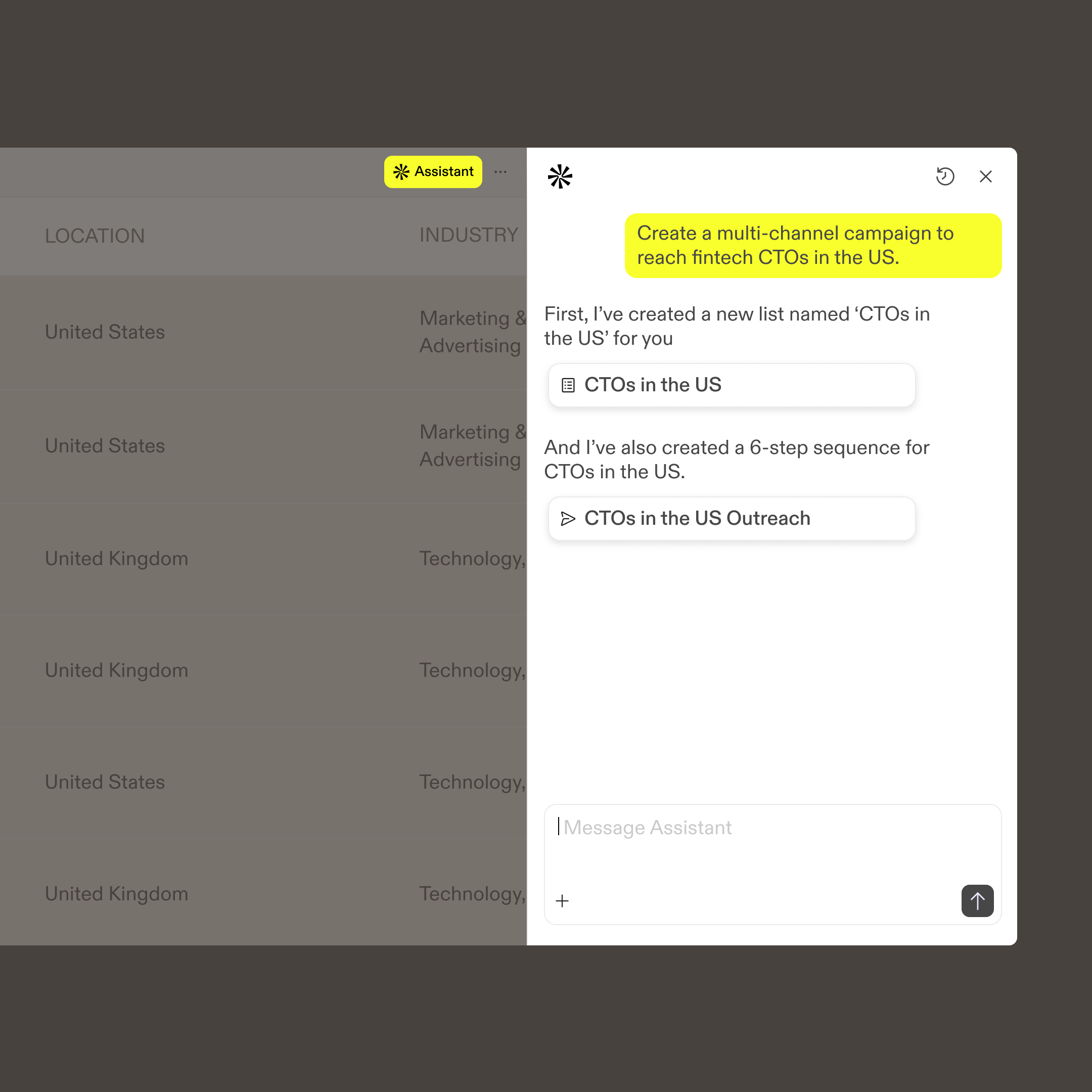
The honest limitation is that Apollo is built for sales, not recruiting, so it has no talent graph, no hiring pipeline, and no skills-based passive-candidate search. It replaces the contact-and-outreach half of a Recruiter seat, not the sourcing half, and its mobile-phone data is thin and drawn from a small separate credit pool. Credits also expire monthly with no rollover, and accuracy weakens outside the US. Treat Apollo as the outreach layer in a stack rather than a standalone LinkedIn replacement, and it is outstanding value.
The trap to avoid with Apollo is mistaking its sticker price for its real cost. The $49 Basic tier is genuine, but heavy users routinely spend more once phone reveals, which draw from a small separate pool, and monthly credit expiry push them toward overages or a higher tier. Budget for the credits you will actually consume rather than the seat alone, and Apollo still lands dramatically cheaper than InMail-bundled Recruiter for the same volume of outreach. The clean mental model is that Apollo replaces the contact-and-send half of a Recruiter seat, and you pair it with a discovery tool, free LinkedIn, X-ray, or one of the AI search platforms above, to cover the sourcing half it deliberately does not do.
6. Loxo
Loxo is the consolidation play: it folds an ATS, a recruiting CRM, sourcing, and AI agents into one system, so it can replace both LinkedIn Recruiter and a separate applicant tracker at once. Its platform runs on an 850M+ talent graph with natural-language AI search, and in 2026 it added a full agentic workforce with autonomous data-enrichment agents on every record - Loxo. For an agency currently paying for LinkedIn Recruiter plus a standalone ATS plus a separate sourcing tool, the appeal is collapsing three bills into one.
Pricing is $149 per user per month for Core (the full ATS and CRM with AI search) and $199 for Professional, which adds the 850M talent graph, the agentic workforce, contact data, and API access, all billed annually with a 7-day free trial of the Professional tier - Loxo. The trade-offs are real: Loxo is annual-contract only with no true monthly option, the features that actually replace LinkedIn Recruiter sit behind the $199 tier, and its included credits are pooled and capped, with extra "Boost" packs costing more. Prices also rose noticeably in 2026. Loxo is the right choice for staffing agencies and in-house teams that want one platform for the entire hiring workflow rather than a best-of-breed stack they assemble themselves.
The number that decides whether Loxo makes sense is not its per-seat price but the sum of what it replaces. An agency paying for a LinkedIn Recruiter seat, a separate applicant tracker, and a standalone sourcing tool can easily be spending $1,500 or more per recruiter a month across three vendors, so folding all three into a single $199 Professional seat is where the consolidation math becomes compelling. The risk is the mirror image of that saving: if you genuinely need only one of those three functions, you are buying a whole suite to use a single feature, and a focused point tool will almost always be cheaper and better at that one job. Loxo rewards breadth of need and punishes narrow need.
7. ContactOut
ContactOut is the most LinkedIn-native way to skip InMail: its Chrome extension reveals a candidate's personal email, work email, and direct dial straight from their profile. It draws on roughly 800M profiles with 150M personal emails and 100M direct dials, and recruiters rate it especially highly for personal (non-work) email accuracy, which is exactly what you want when a candidate ignores LinkedIn but reads their Gmail - ContactOut. It also bundles an AI email writer and a search portal so you can query the database without opening LinkedIn at all.
The free tier is genuinely usable for testing at 5 emails, 5 phone numbers, and 5 exports per day, and paid plans run about $99 per month for the email tier and $199 for email plus phone - BookYourData. The honest catch is that the "unlimited" paid plans are actually fair-use capped near 2,000 emails a month, and pricing shifts with billing cycle and a US/UK-data toggle, so quotes vary. If ContactOut's price does not fit, two close siblings are worth a quote: SignalHire offers emails at $57 a month or unlimited emails and phones at $167 - FullEnrich, and RocketReach starts at $69 a month for email-only lookups across 700M profiles - SalesIntel. All three do one job, cheaply: turn a public profile into a real contact so you never pay for an InMail credit again. Our roundup of LinkedIn Recruiter InMail alternatives goes deeper on that specific swap.
5. Build your own Recruiter replacement stack for under $200 a month
The cheapest complete replacement for a Recruiter seat is not one tool at all; it is a three-part stack that separates discovery, contact, and outreach, and it typically runs $100 to $300 per recruiter per month against a Corporate seat's $835 to $1,080. The insight is that a Recruiter licence bundles three jobs into one expensive product, and unbundling them is where the savings live. You find people with free LinkedIn or X-ray search, you turn those profiles into verified contact details with a contact-finder, and you run outreach through an email or multichannel sequencer instead of InMail - Clearout.
Laying it out as a flow makes the substitution obvious, and shows precisely which cheap tool takes over each job the seat used to do.
The economics are compelling but the honest downside is deliverability and glue. Cold email reaches the inbox only about 83% of the time versus near-100% for InMail, and third-party emails decay roughly 2% a month, so the stack needs a verification step and a warm-up tool to perform - Amra & Elma. You are also assembling and maintaining the connections yourself, which is real work that a single vendor would otherwise do. The offset is that omnichannel outreach (email plus LinkedIn plus phone) can lift response roughly 287% over email alone, so a well-built stack does not just cost less, it can outperform a lazy InMail blast.
Here is what a concrete stack looks like for a solo recruiter or boutique agency. Discovery runs on free LinkedIn search plus Google X-ray for the off-platform gaps, at no cost. Contact runs on a finder like ContactOut or SignalHire, roughly $57 to $99 a month depending on volume. Outreach runs through an email sequencer with built-in warm-up and A/B testing, another $50 to $100 a month, and tracking lives in an affordable ATS or CRM. The all-in figure lands around $150 to $250 a month per recruiter, against $835 to $1,080 for a Corporate seat, and it can be scaled down to almost nothing for very low volume by leaning on free tiers. The deliverability risk is manageable rather than fatal: a verification step to strip dead addresses and a two-week domain warm-up before your first real send are what separate a stack that lands in the inbox from one that lands in spam. What you are accepting in exchange for the saving is assembly and maintenance, real work that a single vendor would otherwise absorb.
There is a second, often larger saving hiding inside your own systems. Your cheapest candidates are the ones you already have, and switching on AI talent-rediscovery inside an ATS or CRM plus semantic sourcing let 91% of teams in one 2026 survey reduce or eliminate their LinkedIn Recruiter spend within 90 days - Pin. Roughly 44% of sourced hires in 2024 came from candidates already sitting in a company's database, up from 29% in 2021, so the "new" people you are paying LinkedIn to find are often already yours. Consolidating overlapping point tools into one platform on top of that can remove $300 to $700 per recruiter per month of adjacent software. The practical sequence is to mine your own database first, build the cheap external stack second, and keep a single LinkedIn seat only for the gaps the first two cannot cover.
The mechanics of rediscovery are worth understanding, because they are where the quiet savings hide. A traditional Boolean search only finds candidates whose profiles contain your exact keywords, which is why the same handful of people surface again and again while good matches with slightly different wording stay invisible. AI semantic search reads intent instead of strings, so it surfaces roughly 30% to 50% more qualified candidates from the same database, including silver-medalists from past roles and applicants whose titles do not match but whose experience does - Kula. Switching that on inside a CRM you already pay for is close to free money, because you are not buying new data, you are finally using the data you have. The one prerequisite is clean, enriched records, so the rediscovery play pays off fastest for teams that have been diligent about capturing candidates and stalls for those whose database is a graveyard of half-filled profiles.
The one piece of the stack worth choosing carefully is the system of record, because it is the hardest to swap later. A lightweight ATS or recruiting CRM is what turns a pile of one-off searches into a compounding asset: every candidate you source, screen, or reject becomes a rediscovery opportunity next quarter, which is precisely the mechanism that let so many teams cut their LinkedIn spend in the first place. Choose one that enriches and de-duplicates records automatically, integrates cleanly with your contact-finder and your sequencer, and lets you export your data if you ever decide to move. Get that anchor right and everything else becomes interchangeable: you can upgrade the contact-finder when a cheaper one appears, swap the sequencer when deliverability tooling improves, or fold the whole stack into an autonomous agent later, all without losing the candidate history that makes your pipeline valuable. That flexibility, the ability to change any one part without rebuilding the rest, is the real dividend of unbundling, and it is something a single all-in-one contract can never quite give you.
6. The 2026 shift: from paying per seat to hiring an AI agent
The biggest change in this market is not a cheaper tool; it is a different unit of purchase. Sourcing is moving from software you operate, priced per seat, to autonomous agents that operate for you, priced per role. An AI sourcing agent scans internal and external sources, scores fit, initiates multichannel outreach, adapts its follow-ups based on engagement, and books screens, all without a human triggering each step. When cost tracks open roles instead of headcount, the entire "three-seat minimum" logic of LinkedIn Recruiter stops making sense, because you are no longer paying for people to run searches.
Mechanically, an agent runs a loop that a human sourcer would otherwise perform by hand. It reads the role, translates it into a search across internal and external sources, scores each candidate against the requirements, drafts and sends personalised outreach, waits, and then adapts its follow-up based on whether and how the person engaged, escalating a warm reply toward a booked screen and quietly retiring a cold one. The difference from a search tool is that no human presses the button between steps. That is why the pricing model changes with the technology: you are no longer buying a faster interface for a recruiter to operate, you are buying the operation itself, which is naturally metered by how many roles it runs rather than how many people log in. Once you see that, the per-seat licence starts to look like a charge for a job the software now does on its own.
Adoption is moving fast enough that this is a near-term planning question, not a futurist one. 52% of talent leaders plan to deploy an AI recruiting agent by 2026, and 82% of HR leaders plan to use agentic AI by mid-2026 - GoPerfect. Underneath that intent is measurable payoff: AI can free up three to five hours of sourcing work a day, a roughly 41% efficiency gain, with some teams reporting up to 85% faster screening - Incruiter. Broadly, 62% of employers expect to use AI for most or all hiring steps by 2026 - DemandSage.
LinkedIn itself has read the same tea leaves, which is the clearest possible signal that the shift is real. Its Hiring Assistant, LinkedIn's first AI agent for recruiters, became generally available in English at the end of September 2025 and autonomously handles intake, continuous sourcing, shortlisting, and InMail outreach - LinkedIn News. LinkedIn's agentic hiring products reportedly reached a ~$450M annualized run rate by early 2026, so this is already a large business - Yahoo Finance.
LinkedIn's own charter-customer figures for Hiring Assistant are strong on paper. Per the same announcement, it claims 62% fewer profiles reviewed per role, four or more hours saved per role, and a 69% higher InMail acceptance rate, with later 2026 updates citing even larger gains. Those numbers are LinkedIn-supplied and measured against its own baselines, so treat them as directional rather than independently audited. The signal that matters is not the exact percentage but the framing: even the incumbent that built its entire business on selling seats is now marketing time saved by automation instead of seats occupied by recruiters, which tells you where the whole category believes the value is moving.

The catch with Hiring Assistant is the one that makes this whole guide relevant: it is a quote-only add-on that sits on top of an already five-figure Corporate or RPS+ seat, and it is not available on Lite at all - HeroHunt. A UK public-sector procurement listing put it at roughly £1,575 to £2,079 per license per year as a rare data point, but in the US it is priced through sales, layered onto the base subscription. It also inherits LinkedIn's two structural limits: it only searches LinkedIn profiles, missing the off-platform technical talent, and its outreach is InMail-only. So LinkedIn's own agent is designed to keep both your candidates and your spend inside its paid ecosystem. Our full breakdown of LinkedIn's Hiring Assistant cost and alternatives covers the trade-offs in detail.
The independent agents take the opposite approach on price and reach. HeroHunt.ai's Uwi runs the same search-to-outreach loop from about $149 a month metered per position, across 1B+ profiles and multiple channels rather than InMail alone, and hireEZ, Juicebox, and SeekOut have all shipped agentic modes in 2026.
The contrast between the two camps is worth drawing out, because it is the core strategic choice of 2026. LinkedIn's agent optimises for keeping you inside its ecosystem: it searches only LinkedIn, messages only by InMail, and prices as a premium add-on to a seat you already bought. The independent agents optimise for the opposite, aggregating many sources so they can reach the off-platform technical talent LinkedIn cannot see, messaging across email and other channels where saturation is lower, and pricing per role so cost does not scale with your headcount. Neither is universally right, but they answer different questions. If your hiring lives entirely inside LinkedIn and budget is not the constraint, the built-in agent is the convenient choice; if cost or reach is the problem you are actually trying to solve, an independent agent is the one built for it.
A hands-on comparison of how these actually perform is a useful reality check, because the category is genuinely new and results vary by tool.
I Tested 5 AI Sourcing Tools for Recruiters
The honest outlook is that agents are only as good as their data and guardrails, and unmonitored autonomous outreach can damage your employer brand, so 2026's best practice is agent-plus-human-review rather than fully hands-off. There is also a collective-action risk worth naming plainly: as more teams point agents at the same candidates, the very saturation that hollowed out InMail response will come for automated email too. The teams that win will be the ones whose agents personalise on real signals, a candidate's actual project, a specific mutual connection, a genuine role fit, rather than the ones that simply blast more volume faster. Differentiation is the only durable defence against saturation, which is an argument for agents with access to richer, multi-source data and for keeping a human reviewing messaging quality, not an argument against automation itself.
But the direction is unmistakable: within a year or two, "how many Recruiter seats do we need" will be a stranger question than it already is, replaced by "how many roles do we want an agent to work." That is the deeper reason to cut LinkedIn Recruiter cost now. You are not just saving money this year; you are moving to the pricing model the whole market is heading toward, ahead of the renewal curve rather than behind it.
7. How to choose the right alternative for your team
Pick your alternative by matching the one job you most need to the tool that does it cheapest, not by hunting for a single product that does everything. The mistake that keeps teams overpaying is treating "replace LinkedIn Recruiter" as one decision when it is really three: how you discover people, how you contact them, and how you track them. Once you separate those, the right choice usually becomes obvious, and it is often two tools rather than one. The decision flow below maps the most common situations to a sensible starting point.
Reading that tree in practice, a few clear recommendations fall out. If you are a lean team or agency and want the top of the funnel handled autonomously at a predictable, non-seat price, an autonomous AI recruiter is the most complete answer, and it is the only category that structurally breaks the per-seat model. If your bottleneck is genuinely deep-technical or diversity hiring and you have enterprise budget, SeekOut's data depth earns its price where a cheaper tool would not. If you love LinkedIn's search but hate its price, Juicebox gives you AI-native discovery for a tenth of a Corporate seat. And if the only thing you actually use InMail for is getting a message to a candidate, a contact-finder plus an email sequencer is the single highest-return swap on this list.
It helps to ground the framework in three common team profiles, because the right answer changes sharply with size. A startup founder doing their own recruiting should start with an autonomous agent or a free-tier stack, because their scarcest resource is time rather than money, and paying per role beats learning LinkedIn's search grid from scratch. A five-person agency almost always wins by right-sizing to one Corporate seat, adding a cheap contact-finder for the rest of the team, and pocketing the difference, which is frequently $30,000 or more a year. An enterprise talent team with real budget and a deep-technical or diversity mandate is the one case where a premium platform like SeekOut genuinely earns its keep, ideally paired with talent-rediscovery on the existing ATS so the expensive external search is reserved for real gaps rather than re-finding people you already have. Match the profile to your situation and the seven-way choice collapses into an obvious two or three.
The budget math is the part worth being disciplined about, because it is where the decision is really made. A Corporate seat's compounding 15% increases mean the gap between LinkedIn and any alternative widens every year you wait, so the cost of delay is not zero. Run the comparison on total spend, not sticker price: add InMail overages, the Hiring Assistant add-on, and the three-seat minimum to LinkedIn's side, and add verification and warm-up tools to a cheap stack's side, so you compare like with like. When you do, most teams find they can cut LinkedIn sourcing spend by half or more while keeping, and sometimes improving, their reach, precisely because they stop paying a premium for the parts they were getting elsewhere anyway.
The pragmatic path for most teams is neither "keep everything" nor "cut everything." It is to right-size LinkedIn to a single well-used seat, mine your own database first, and route the rest of your sourcing through one autonomous agent or a cheap purpose-built stack. That combination keeps LinkedIn's genuine advantages, freshness, deliverability, and trust, exactly where they matter, while moving the bulk of your outreach onto channels and pricing models that are getting cheaper and better instead of more expensive and more saturated.
Conclusion: cut the cost, keep the reach
LinkedIn Recruiter is worth its price for a narrow set of teams, and worth far less than its price for everyone else. If you hire continuously and at volume, run a shared in-house pipeline, and genuinely convert InMail into hires, a Corporate seat can earn back its five figures against a single agency fee. Outside that narrow case, the 2026 evidence points the other way: prices are climbing about 15% a year, InMail response is falling in the hardest markets, candidates are dispersing to niche platforms, and a wave of AI tools now does each individual job the seat bundles for a fraction of the cost.
Your decision framework is simple. First, right-size what you have through downgrades and a real negotiation, which alone can cut the bill 40% to 70% with no change in tools. Second, decide which of the three jobs, discovery, contact, or tracking, is your actual bottleneck, and buy the cheapest tool that solves it: an autonomous AI recruiter like HeroHunt.ai if you want the whole funnel run for you, SeekOut or hireEZ for deep-technical reach, Juicebox for AI-native search, Apollo or ContactOut to skip InMail, or Loxo to consolidate the stack. Third, mine your own database before you pay anyone to find people who may already be in it. Do those three things and the compounding cost of a per-seat contract stops being something that happens to you, and starts being a choice you make deliberately, every renewal.
Written by Yuma Heymans (@yumahey), who built HeroHunt.ai and its AI Recruiter, Uwi. He has spent years building and competing in the sourcing-tools market this guide covers, and writes from hands-on experience with what actually replaces a LinkedIn Recruiter seat, and what does not.
Pricing indications reflect the market as of August 2026. LinkedIn does not publish Recruiter pricing and negotiates per account, and every vendor changes prices frequently, so treat these figures as ranges to verify before you buy, not fixed list prices.