



The operator's manual for standing up an AI that sources, screens, and reaches out to candidates on its own, without setting your pipeline or your legal team on fire.
Deploying an autonomous AI recruiter is now a project most talent teams can finish in a quarter, yet only 10% of staffing firms have agentic AI running across their full workflow - Bullhorn GRID 2026. The tools crossed the line from demo to dependable in late 2025, but the gap between buying one and actually operating one is where almost every deployment stalls. A license is not a deployment. An agent that runs unsupervised the day it is switched on is a liability, not a productivity gain.
The reason the gap is so wide is that an autonomous recruiter is not a faster search box, it is a piece of software that takes actions in the world: it contacts real people, makes screening judgments that carry legal weight, and consumes your sender reputation and your candidate data as it works. Deploying one well means designing the guardrails, the human checkpoints, the data plumbing, and the audit trail before you let it loose, then ramping its autonomy as it earns trust. That is a change-management and systems-integration exercise, not a shopping decision.
This guide is the deployment playbook, not another tool roundup. It covers what "autonomous" actually commits you to, how to test whether your team and data are ready, how to choose an autonomy level, the architecture and ATS integration underneath, the guardrails and human-in-the-loop design that keep it safe, a phased shadow-to-scale rollout, the compliance work the EU and several US states now require, deliverability, the metrics that tell you it is working, the real economics, the failure modes, and a concrete first-90-days plan. It assumes no technical background and gets specific about the parts vendors gloss over.
Written by Yuma Heymans (@yumahey), who built HeroHunt.ai and its autonomous AI Recruiter, and has spent the last few years watching teams try to deploy sourcing agents, some of whom succeeded. This guide is what the successful ones did differently.
HeroHunt.ai
If you are deciding what to deploy, the shortest path to running the full loop end to end is a platform where sourcing, screening, and outreach already ship as one autonomous product rather than three tools you have to wire together. That is what HeroHunt.ai is built for: its AI Recruiter takes a role brief, searches more than 1 billion profiles across LinkedIn, GitHub, Xing and Stack Overflow, screens each one with language models against the role as you describe it (not by keyword matching), and runs personalized outreach, all metered by open position rather than by seat. It also exposes a People Search API and an MCP server, so if you are assembling your own agent stack (section 5) you can plug its billion-profile index in rather than rebuilding it. The honest caveat: it is a sourcing and outreach system, not an applicant tracking system, so you still need an ATS to run the evaluation and offer stages, and it is a younger company than the Workday-scale incumbents, so heavyweight procurement teams will find less compliance paperwork on the shelf.
Contents
- What "Deploying" an Autonomous AI Recruiter Actually Means
- The Readiness Test: Can You Delegate Hiring Yet?
- Choosing Your Autonomy Level
- The Platforms You Can Actually Deploy in 2026
- The Architecture: Data, ATS Integration, and the MCP Layer
- Guardrails and Human-in-the-Loop by Design
- The Phased Rollout: Shadow, Pilot, Scale
- Governance and the Law: Deploying Something Legal
- Deliverability: Keeping Autonomous Outreach Out of Spam
- Measuring the Deployment: Metrics and Observability
- The Economics: What It Costs and When It Pays
- Failure Modes and the Deployment Runbook
- What Comes Next: Multi-Agent Recruiting Teams
- Your First 90 Days: A Deployment Decision Framework
1. What "Deploying" an Autonomous AI Recruiter Actually Means
Deploying an autonomous AI recruiter means handing a piece of software a job that a person used to own, then managing it like a report rather than using it like a tool. The distinction is the whole game. An assistive tool makes a recruiter faster at a step the recruiter still performs: it drafts the message the recruiter sends, or suggests the Boolean string the recruiter runs. An autonomous recruiter performs the step itself: it takes a role brief, runs its own searches, evaluates the results, contacts the people it selects, handles the replies, and returns with booked calls instead of a list of options. Deployment is the work of making that handoff safe, legal, and reversible.
That framing matters because the word "autonomous" is the most oversold term in the category. Gartner estimates that of the thousands of vendors claiming agentic AI, only around 130 are building genuinely agentic systems, a pattern it calls agent washing - Gartner. The working test cuts through the marketing: does the system complete a multi-step loop (search, evaluate, act) without a human triggering each step? If a recruiter still clicks "next page" and "send," you are deploying autocomplete, and the rest of this playbook is overkill. If the system genuinely acts on its own, then everything here about guardrails and oversight is the actual product you are buying.
Deployment is also newly realistic because the ground shifted underneath it. Organizational AI use has climbed from just over half of firms to roughly four in five in two years, so delegating sourcing no longer asks a skeptical team to take a leap of faith, it asks them to point at hiring the same kind of automation they already trust elsewhere.
AI went mainstream before agents arrived
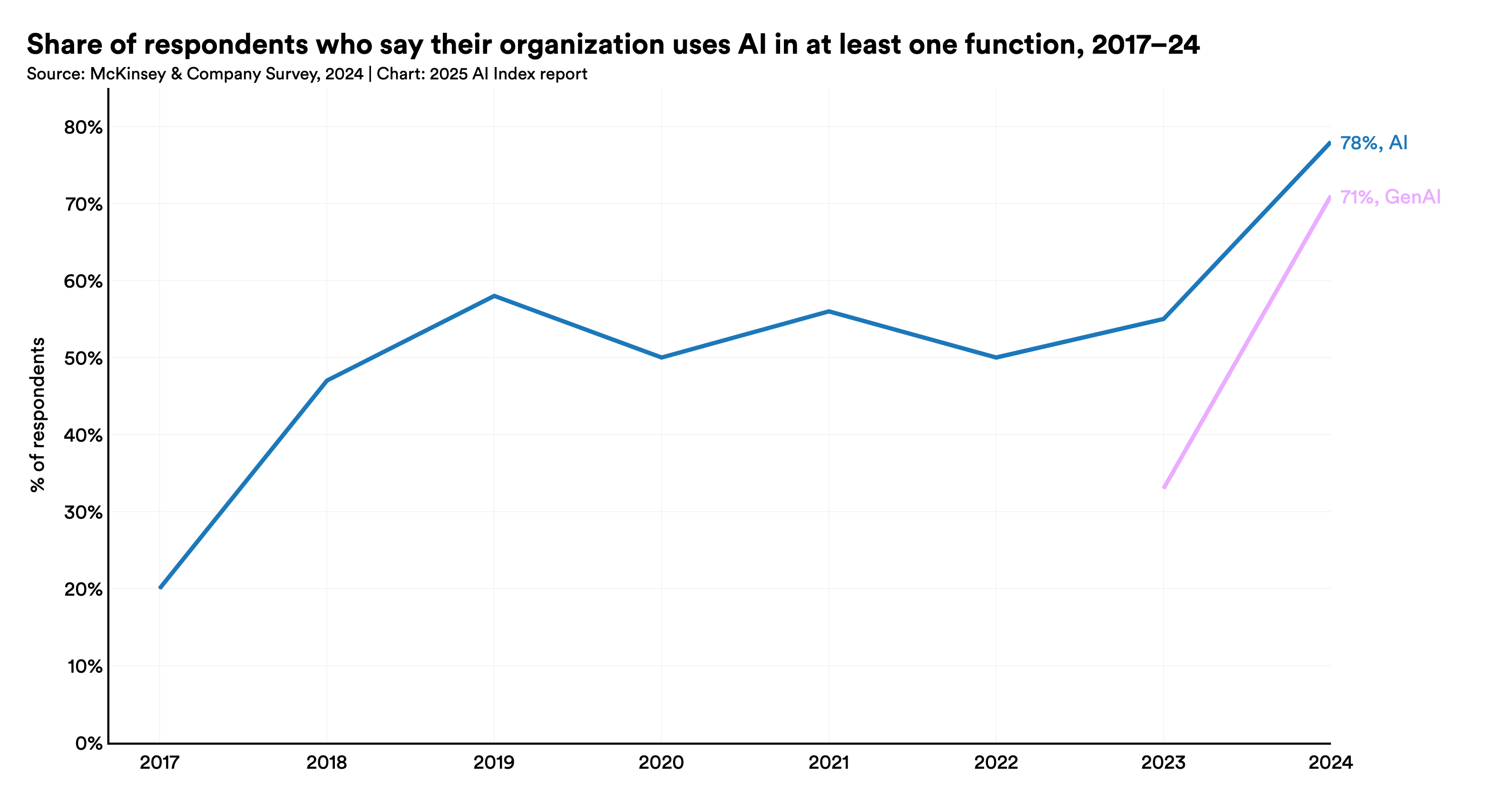
That shift in the baseline is a large part of why 2026, not 2023, is when autonomous recruiting stopped being a science project: the surrounding organization is already comfortable with AI doing real work, which lowers the political cost of letting it recruit.
The second thing deployment commits you to is that the agent takes irreversible actions on your behalf. A search returns nothing you cannot undo. An outreach message lands in a real person's inbox under your company's name and cannot be recalled. This is why deployment is not a settings toggle: the moment an agent can send, it can send badly, at volume, in your name. Every serious deployment therefore starts by mapping which actions are reversible (drafting, ranking, tagging) and which are not (sending, rejecting, scheduling), then deciding which of the irreversible ones a human must approve, at least at first.
- Reversible actions (searching, scoring, drafting, shortlisting): safe to automate early because a mistake costs only review time.
- Irreversible, low-stakes actions (tagging, enriching, moving a candidate stage): automate once accuracy is proven.
- Irreversible, high-stakes actions (sending outreach, rejecting a candidate, booking an interview): gate behind human approval until the agent has a track record.
That reversibility map is the single most useful artifact you can produce before you deploy, because it converts a vague fear ("what if the AI does something dumb?") into a concrete list of approval gates you can configure. The teams that skip it either over-restrict the agent into uselessness or, more commonly, let it run wide open and discover the failure modes in section 12 the hard way. A deployment is a negotiation between speed and control, and the reversibility map is where you write the terms down. Everything that follows, from readiness to rollout to metrics, is really about moving actions rightward on that list as evidence accumulates.
2. The Readiness Test: Can You Delegate Hiring Yet?
Most failed deployments were doomed before the software was ever configured, because the organization was not ready to delegate. Readiness is not about technical sophistication, it is about whether you can hand the agent the three things it needs: a crisp definition of a good candidate, clean access to your systems, and a human who will actually manage it. If any of the three is missing, the agent will amplify the gap rather than fill it. An autonomous recruiter fed a vague job description produces vague results faster, which is worse than slow, careful sourcing, not better.
The clearest readiness signal is whether your team can articulate what separates a strong candidate from a plausible one, in writing, for a specific role. Autonomous systems calibrate on examples and explicit must-haves, not on the tacit judgment a senior recruiter carries in their head. The vendors themselves stress that intake quality sets the ceiling on everything downstream, which is why 2026 releases increasingly let you calibrate an agent on the profiles of ideal candidates rather than on adjectives - HR Dive. If your intake process is a recycled requisition template nobody reads, fix that before you deploy anything, because the agent will take the template literally.
The second readiness signal is data and systems hygiene. An agent that cannot see your ATS cannot avoid re-sourcing candidates you already rejected, and an agent writing into a messy pipeline creates duplicates faster than a human can clean them. Before deployment, confirm the agent can read your existing candidate records, that your ATS exposes an API or a supported integration, and that your sender domains are healthy enough to survive a jump in outbound volume (section 9). These are unglamorous checks, and they are the ones that decide whether week two is a triumph or a cleanup.
The third and most overlooked signal is management capacity. An autonomous recruiter is a report that needs feedback, and the feedback loop only improves results if someone uses it. Bullhorn's GRID 2026 data shows top-performing staffing firms are 4x more likely to use AI than their peers, but the same research finds most deployments stay shallow because no one is assigned to steward them - Bullhorn. The practical test is simple: name the person who will review the agent's output daily during the pilot and recalibrate it. If that person does not exist or has no time, you are not ready to deploy, no matter how good the tool is. Readiness is ultimately a staffing decision disguised as a technology decision.
To make this concrete, picture two teams deploying the identical agent. The first hands it a five-year-old requisition template, points it at an ATS whose API nobody has tested, and assigns oversight to a recruiter already at capacity. Two weeks in, the agent has messaged previously rejected candidates, created duplicate records, and produced a shortlist nobody trusts, and the pilot is quietly shelved as proof that "the AI does not work." The second team spends a week rewriting the intake around two example hires, confirms a clean two-way ATS sync, and names a recruiter who reviews the output every morning. The same software, over the same fortnight, produces a shortlist the hiring manager mostly accepts. The tool did not differ between these two stories. The readiness did, and that is the variable you actually control.
3. Choosing Your Autonomy Level
The most consequential deployment decision is not which vendor you pick, it is how much autonomy you grant, and that choice should be made per role, not once for the whole company. The market has effectively sorted into three operating models, and matching the model to the job saves months of procurement regret. The truly autonomous model runs the full source-screen-outreach loop per role and only surfaces outcomes. The semi-autonomous or "guided autonomy" model executes the same chain but pauses at human approval gates, an approach hireEZ brands explicitly as guided autonomy - hireEZ. The assistive model keeps a human driving every step and uses AI only to accelerate tasks.
None of these is correct in the abstract, because they encode different beliefs about where human judgment belongs. What decides the right level for a given search is the cost of a mistake and the clarity of the target. High-volume, well-defined roles (a dozen warehouse associates, twenty customer support reps) tolerate and reward full autonomy, because the definition of a fit is unambiguous and one imperfect message among hundreds is cheap. Senior, ambiguous, or politically sensitive searches (a VP hire, a role with a delicate internal backstory) punish autonomy, because the cost of a tone-deaf outreach or a wrong rejection is high and the target is fuzzy. The deployment mistake is applying one autonomy setting to both.
A useful way to make this concrete is to score each role you intend to hand off on two axes: how reversible the agent's actions are for that role, and how clearly you can define success. That gives four practical postures.
- High clarity, low stakes (volume roles): full autonomy, spot-check the output.
- High clarity, high stakes (senior but well-defined): autonomous sourcing and screening, human-approved outreach.
- Low clarity, low stakes (exploratory pipelines): autonomous with frequent recalibration.
- Low clarity, high stakes (executive, sensitive): assistive only, agent drafts, human decides everything.
A worked example makes the dial concrete. Suppose you are filling twenty customer-support seats and one Head of Compliance in the same quarter. The support roles are high-clarity and low-stakes: define the must-haves once, let the agent source, screen, and message autonomously, and spot-check a sample of its outreach each day. The compliance role is low-clarity and high-stakes: let the agent build a longlist and draft messages, but a human reads every profile, approves every send, and owns every judgment call. Running both on full autonomy would either bury the support pipeline in needless review or fire a tone-deaf message at a sensitive senior candidate. Same platform, same week, two deliberately different autonomy settings, because the two roles carry entirely different costs of error.
The reason to formalize this rather than wing it is that autonomy is not a permanent setting but a dial you turn up as trust accrues. A role you start in "human-approved outreach" can graduate to full autonomy once the agent's messages have earned acceptance rates you are comfortable with, and section 7's phased rollout is precisely the mechanism for turning that dial with evidence rather than optimism. Deciding the starting posture per role, writing it down, and revisiting it monthly is what separates a deployment that compounds from one that stalls at "we tried the AI once." The autonomy level is not a feature you enable, it is a policy you operate.
4. The Platforms You Can Actually Deploy in 2026
There are three distinct ways to deploy an autonomous recruiter, and choosing the wrong one is the most expensive early mistake. You can buy a turnkey agent that runs the whole loop out of the box, you can assemble your own from an API or an MCP server and an orchestration layer, or you can switch on the agent already embedded in the HR suite you own. Each path implies a different budget, a different amount of internal engineering, and a different ceiling on how much you can customize the agent's behavior. Most teams should start by buying turnkey and only graduate to assembling once they know exactly what they want.
The buy-turnkey path is where the fastest deployments live, because the vendor has already solved the plumbing. The reference product is LinkedIn Hiring Assistant, generally available since the end of September 2025, which runs intake, dozens of searches, applicant evaluation, drafted InMail outreach, and pre-screening natively inside LinkedIn's member graph. LinkedIn reports charter customers reviewing 62% fewer profiles to find a qualified match and seeing 69% higher InMail acceptance than manual sourcing - LinkedIn. The catch for deployment planning is cost and captivity: it stacks on a Recruiter Corporate seat that third-party trackers put near $10,979 per seat per year and cannot be bought standalone - daily.dev, and it only ever sees LinkedIn members evaluated on self-reported data.
To see how the reference product actually runs that loop rather than just reading about it, the interview below is the clearest primary source: LinkedIn's VP of Product walks an analyst through how Hiring Assistant handles intake, sourcing, screening, and outreach, which is the same loop every platform in this section implements in its own way.
LinkedIn's VP of Product explains the Hiring Assistant AI agent
Among independent turnkey agents, the field divides by autonomy camp. HeroHunt.ai runs the full source-screen-outreach loop per role at self-serve prices from $149 per month, searching across more than 1 billion profiles on LinkedIn, GitHub, Xing and Stack Overflow and metering by open position rather than by seat - HeroHunt.ai pricing. Juicebox (PeopleGPT) ships always-on Agents that source and reach out from a natural-language brief, and has become one of the fastest-growing self-serve sourcing tools in the category. hireEZ deliberately sits in the semi-autonomous camp, branding its EZ Agent as guided autonomy so a recruiter approves the key steps, at roughly $494 per month for a solo recruiter - Vendr. And Paradox, whose Olivia assistant automates high-volume hourly hiring end to end, was acquired by Workday in a roughly $1 billion deal that closed on October 1, 2025 - Workday, a signal of how seriously the incumbents now take autonomous recruiting.
The embed-in-your-suite path is the one enterprises underestimate. If you already run Workday, SAP SuccessFactors, or a modern ATS, an agent may already be bundled or one purchase away, which removes an entire integration project. Workday's Paradox acquisition and SAP's purchase of SmartRecruiters, also completed in 2025, mean two of the three biggest HCM suites now ship agentic recruiting natively - SAP. The trade-off is that a bundled agent inherits its host's data boundaries and moves at the host's release cadence, so you gain integration simplicity and lose sourcing reach and configurability.
One more camp is worth knowing before you choose, because it deploys very differently: the autonomous interview agents that run first-round screening calls rather than sourcing. Alex (formerly Apriora) has conducted more than 1 million AI-led interviews, up to 5,000 a day for its largest customers - TechCrunch, and voice-native agents from Maki and Humanly do comparable work for high-volume roles. The category is also consolidating fast, which matters for a multi-year commitment: Salesforce acquired Moonhub in 2025 - CB Insights, and Ashby shipped custom agents and a governed MCP server directly into its ATS in 2026 - Ashby. Buying a standalone tool is partly a bet that it stays standalone, so weigh acquisition risk alongside features.
The right choice among these paths falls straight out of your readiness assessment: if intake and management capacity are your constraints, buy turnkey; if you have engineering and a clear specification, assembling gives you the most control, which section 5 explains how to build.
5. The Architecture: Data, ATS Integration, and the MCP Layer
Under every autonomous recruiter is the same architecture, and understanding it is what lets you deploy one without treating it as a black box. An agent is not a single model, it is a language model wrapped in a workflow: instructions that tell it what a good outcome looks like, tools it can call (a people database, an email sender, a calendar, your ATS), memory of what it has already tried, and rules about when to stop and ask a human. When a vendor says "the agent learned from your feedback," it means the workflow stored your thumbs-down and adjusted the next search, not that a new model was trained overnight. Deploying well means knowing which of those four parts you control and which the vendor owns.
The part that decides whether a deployment feels magical or maddening is tool access, and specifically integration with your existing systems. An agent that cannot read your ATS will re-source candidates you already rejected and write duplicates into your pipeline; an agent that can read it avoids both and enriches records instead. The connections that matter most are to your applicant tracking system (Greenhouse, Ashby, Workday, Lever), your email and calendar, and your source-of-truth candidate data. Before deployment, confirm each of these exposes a supported integration or an API, because a missing connector is the difference between a two-week rollout and a two-quarter one. The image below shows what a well-integrated agent looks like: an autonomous recruiter evaluating candidates while wired into the recruiter's existing pipeline, rather than sitting off to the side as a separate island of data.
An autonomous recruiter wired into the ATS
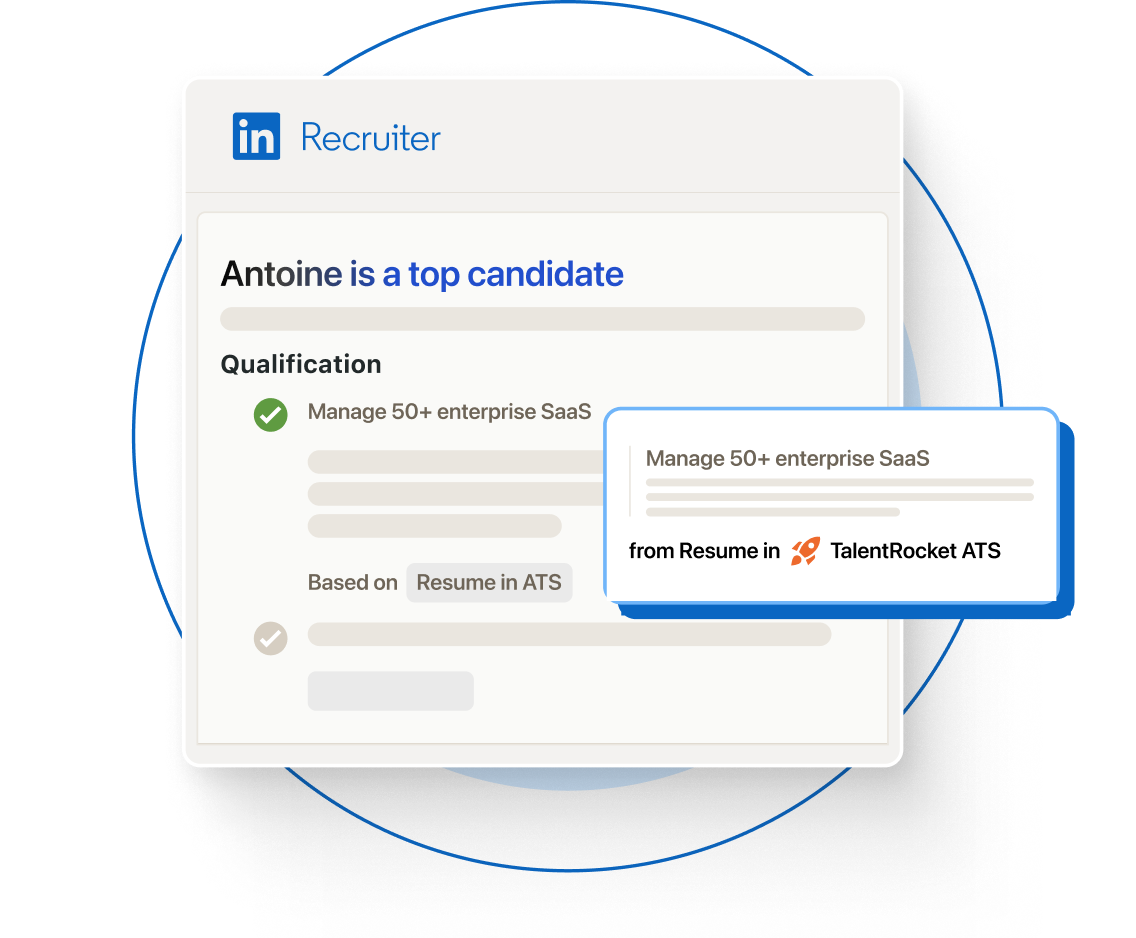
That shared context, the candidate detail and the pipeline living in one view, is exactly what a clean ATS connection buys you, and it is why the connection layer rather than the model is usually the hard part of a deployment.
The 2026 shift worth building toward is the Model Context Protocol (MCP), an open standard introduced by Anthropic that lets any agent talk to any tool through one common interface rather than a bespoke integration per system - Anthropic. MCP matters for recruiting deployments because it turns "can this agent see my ATS and my sourcing database?" from a custom engineering project into a configuration step: a growing number of recruiting platforms now publish MCP servers, and HeroHunt.ai, for instance, exposes its billion-profile index through one so teams can plug it into their own agents. If you are on the assemble-your-own path, standardizing on MCP is the single highest-leverage architectural decision, because it prevents the integration sprawl that makes home-built agent stacks unmaintainable.
Where a native MCP connector does not yet exist, the practical 2026 workaround is a unified API. Providers like Merge normalize dozens of applicant tracking systems behind a single integration, collapsing what used to be a quarter of connector engineering into days. The subtlety every deployer eventually learns is that reading data is easy and writing it back is hard: pulling candidates out of an ATS rarely breaks, but reliably pushing a sourced candidate in, advancing a stage, or posting an interview score is where integrations actually fail. Treat the write-back path, not the read path, as the real integration milestone, and prove it on live data before you count the connection as done, because a deployment that can only read is a deployment that quietly creates duplicate work everywhere it should be saving it.
The diagram below shows the reference architecture of a deployed autonomous recruiter and, more importantly, where your control points sit. Read it as a map of responsibilities: the model and orchestration are usually the vendor's, the tools and data connections are the integration you own, and the approval gates are the policy you set.
What a non-technical deployer should take from the architecture is three practical rules. First, the audit trail and the evidence log are not nice-to-haves, they are the artifacts you will hand to hiring managers and regulators, so prefer platforms that record why the agent scored someone the way it did. Second, the approval gate is yours to place, and section 6 is about placing it well. Third, the data connections are where projects slip, so budget real time for ATS integration and treat a clean two-way sync as a deployment milestone, not an afterthought. Architecture is destiny here: the teams that map this diagram onto their own stack before buying rarely get surprised, and the teams that skip it discover their ATS has no usable API three weeks into the pilot.
6. Guardrails and Human-in-the-Loop by Design
Guardrails are the actual product of a good deployment, and they should be designed before the agent sends its first message, not bolted on after the first incident. A guardrail is any constraint that limits what the agent can do without a human, and the art of deployment is placing them where they prevent harm without strangling throughput. The reversibility map from section 1 tells you where they belong: reversible actions need few, irreversible high-stakes actions need many. The goal is not maximum control, it is the minimum set of gates that keeps the agent safe while letting it do the work you hired it for.
The most important guardrail is the human approval gate on outreach, at least early in a deployment. When the agent has drafted messages and selected recipients, a human reviews a sample or the full batch before anything sends. This does two things at once: it catches tone-deaf or mistargeted messages before they reach real candidates, and it generates the feedback that makes the agent better. That calibration loop, where recruiters thumbs-up or thumbs-down the agent's early matches, is a primary driver of results, because each correction sharpens the next batch of candidates the agent surfaces. The approval gate is not friction to be removed as fast as possible, it is the training signal, so keep it until the agent has earned the metrics that justify removing it.
A cleaner way to reason about where gates belong is the permission ladder that both Anthropic and OpenAI describe for agents in general: read-only, then suggest, then supervised execution, then monitored autonomy, then full autonomy. Each rung grants one more class of action, and the rule for placing a human checkpoint is to put one only before actions that are irreversible, costly, or regulated, because over-gating strangles the efficiency you deployed the agent for while under-gating defeats the oversight - OpenAI. OpenAI's guidance adds that a single guardrail rarely suffices, so serious deployments layer several (a rules-based filter, an LLM-based check, and a moderation pass) rather than trusting one. In recruiting terms, sourcing and drafting sit low on that ladder and can run unsupervised early, while sending outreach and rejecting candidates sit high and stay gated until the evidence says otherwise.
Beyond the outreach gate, four guardrails belong in almost every recruiting deployment, and they are cheap to configure relative to the damage they prevent.
- Volume caps: a hard ceiling on messages per day per domain, so a misconfigured campaign cannot torch your sender reputation overnight.
- Do-not-contact lists: current employees, recent applicants, and anyone who opted out, enforced automatically.
- Suppression of protected-attribute inference: the agent must not screen on or infer age, gender, ethnicity, or other protected characteristics.
- Escalation triggers: defined conditions (a candidate replies with a complaint, a match falls below a confidence threshold) that route to a human.
Each of these maps to a specific failure mode in section 12, and configuring them is a one-time cost that pays for itself the first time it stops a problem. The subtle point is that guardrails should loosen on a schedule tied to evidence, not to impatience. A deployment that keeps every gate closed forever never realizes the productivity gain, and one that opens them all on day one invites the incident that gets autonomous recruiting banned inside your company. The right posture is a written policy: this gate stays closed until this metric clears this bar for this many weeks. Human-in-the-loop is not a phase you exit, it is a design you tune, and the tuning is the job.
7. The Phased Rollout: Shadow, Pilot, Scale
The single most reliable way to deploy an autonomous recruiter is in three phases that trade certainty for autonomy, and the discipline of not skipping a phase is what separates smooth rollouts from the ones that get shut down after a bad week. Each phase has an entry bar, a fixed scope, and a metric that must clear before you advance. Rushing from purchase to full autonomy is the deployment equivalent of pushing untested code straight to production, and it fails the same way: loudly, publicly, and in a way that poisons trust for the next attempt.
Phase one is shadow mode, and it is the phase teams most want to skip and most regret skipping. The agent does everything except send: it sources, screens, drafts outreach, and ranks candidates, but a human reviews all of it and nothing reaches a candidate automatically. Shadow mode answers the only question that matters before you grant autonomy: does the agent's judgment match yours? You are comparing its shortlist against the one your recruiters would have built, reading its drafted messages, and calibrating relentlessly. Run it on two or three real, live roles for two to three weeks, not on a toy problem, because agents behave differently on the messy requisitions you actually hire for.
A principle from broader agent deployments should govern how narrowly you scope each phase: single-function agents scale far more reliably than sprawling ones. Practitioner analysis in 2026 finds the successful pattern is to scope an agent to one well-defined task and expand only after the narrow version has proved stable, and warns that 86% of enterprise agent deployments are stuck in what it calls pilot purgatory, unable to move past the trial stage - AgentMarketCap. For a recruiting deployment that means resisting the urge to hand the agent every open role at once. Prove it on one archetype (one high-volume role, one location), get it genuinely stable, and let each expansion inherit a working configuration rather than kick off a fresh experiment. The teams that escape pilot purgatory are almost never the ones with the best model, they are the ones with the most disciplined scope.
Phase two is the guardrailed pilot, where the agent begins to act but inside tight limits. Pick one or two well-defined roles, turn on autonomous outreach with a low daily volume cap and full logging, and keep the approval gate on anything sensitive. The pilot's job is to prove the agent performs in the wild: that its messages get replies, that its screening holds up when hiring managers review the candidates, and that nothing embarrasses you. The entry bar to this phase is a clean shadow-mode result, and the exit bar is a set of outcome metrics (reply rate, hiring-manager acceptance of shortlisted candidates, zero compliance incidents) that you defined before you started, so success is measured, not felt.
Phase three is guardrailed scale, where you widen the aperture role by role and turn the autonomy dial up where the evidence supports it. This is not "switch everything to full autonomy," it is a controlled expansion: more roles, higher volume caps, fewer manual approval gates on the categories the agent has proven itself on, while senior and sensitive searches stay in a more supervised posture per section 3. The chart below shows the autonomy ramp a well-run deployment follows, with the human review share falling as the agent's proven reliability rises.
The Autonomy Ramp Across a Phased Rollout
The ramp is the point of the whole exercise: autonomy is granted as a reward for demonstrated reliability, never assumed. What the curve does not show, and what matters just as much, is that the human review share rarely goes to zero even at steady state, because senior roles, edge cases, and compliance-sensitive decisions keep a person in the loop permanently. A deployment that reaches 85% autonomous actions with 15% human oversight on the consequential ones is not a failure to fully automate, it is the mature, defensible operating point that section 8's regulations increasingly require anyway.
8. Governance and the Law: Deploying Something Legal
The moment you deploy an autonomous recruiter, you become responsible for decisions a machine makes about people's livelihoods, and several jurisdictions now regulate exactly that. This is not a footnote to bolt on after launch, it is a design constraint that shapes your guardrails, your logging, and your human gates from day one. The reassuring news is that the artifacts regulators demand (an audit trail, evidence-based screening, meaningful human oversight, a bias audit) are the same artifacts that make a deployment work well, so compliance and quality point in the same direction. The teams that treat the law as an afterthought are the ones that get their deployment frozen after an incident.
The regulatory picture starts with a simple map: most modern AI rules sort systems into risk tiers, and hiring AI lands near the top. The EU's own risk pyramid, below, is the clearest illustration of where an autonomous recruiter sits.
Where hiring AI sits in the EU risk pyramid
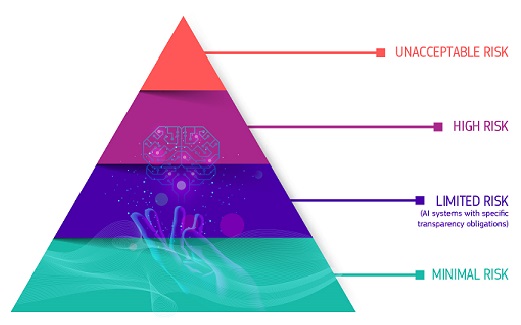
Recruitment sits in that high-risk tier, a single step below the uses the Act prohibits entirely, which is why the obligations that follow are neither optional nor light. In the European Union, recruitment and selection AI is explicitly classified as high-risk under Annex III of the AI Act, which triggers the full stack of obligations for the systems that source, filter, and evaluate candidates - EU AI Act. The single most important 2026 development is a reprieve on timing, not on substance: the Digital Omnibus (Regulation (EU) 2026/1744), in force from late July 2026, deferred the application date for standalone high-risk systems like employment AI from August 2026 to 2 December 2027 - Gibson Dunn. Read that as breathing room to build the controls properly, not permission to skip them, because the obligations themselves are unchanged and the deployers of these systems (the employers) carry duties regardless.
Those obligations are concrete, and they map cleanly onto the deployment work in earlier sections. The high-risk requirements a compliant deployment must satisfy include the following.
- Risk management and data governance, including bias testing across protected groups before the system goes live.
- Automatic event logging, retained for at least six months, which is the audit trail from section 5.
- Human oversight, the approval gates from section 6, designed to be effective rather than a rubber stamp.
- Transparency to candidates, informing people that AI is being used to evaluate them.
- Conformity assessment and registration before the system is placed on the market.
What this list should tell a deployer is that the controls are not exotic, they are the same guardrails, logs, and gates a well-run deployment already builds, formalized and documented. The United States adds a patchwork on top. New York City's Local Law 144 requires an independent bias audit within the prior year, a published summary, and at least ten business days' notice to candidates, with penalties up to $1,500 per day for continued non-compliance - NYC DCWP. Colorado's AI Act now takes effect on 1 January 2027, and California's ADMT rules require covered employers to comply by the same date - Hunton Andrews Kurth. At the federal level, the EEOC applies the long-standing four-fifths rule, treating a selection rate below 80% of the top group as a disparate-impact signal, and holds employers liable even when the biased tool came from a third-party vendor - Mayer Brown.
The practical core of these obligations is the bias audit, and it is worth knowing what one actually involves before a regulator or a plaintiff's lawyer asks. A recruiting bias audit computes selection or scoring rates for each protected group and checks the adverse-impact ratio: if any group's rate falls below four-fifths of the highest group's, that is a documented disparate-impact signal. The operational version of this for a deployed agent is to stress-test it on held-out demographic slices (female candidates, specific age bands, career returners) and look for performance gaps before they ever reach a real applicant - Sapia. Do not assume a light-touch jurisdiction stays light, either: a 2026 review by the New York City Comptroller found Local Law 144 enforcement had been largely ineffective, and the enforcing agency committed to strengthening it, which points toward more scrutiny of deployed tools, not less - DLA Piper.
The through-line across every regime is a right to meaningful human involvement in consequential decisions. Under GDPR Article 22, candidates have the right not to be subject to a decision based solely on automated processing that significantly affects them, and fully automated e-recruiting is the canonical example the regulation itself cites - GDPR-info. A superficial or rubber-stamp review does not satisfy this, which is precisely why the human approval gates in your rollout must be genuine checkpoints where a person can and does change outcomes. The practical deployment rule is to build for the strictest regime you touch (EU high-risk plus an NYC-style audit plus GDPR Article 22) and treat December 2027 as a hard deadline to be ready, not a reason to defer readiness. A deployment engineered for the toughest standard is legal everywhere and, not coincidentally, is also the one that produces defensible hiring decisions.
9. Deliverability: Keeping Autonomous Outreach Out of Spam
Deliverability is the deployment detail that quietly decides whether your autonomous recruiter works at all, and it is the one almost no buyer asks about before signing. An agent that sends personalized outreach at volume is, from an email provider's perspective, a bulk sender, and bulk senders that misbehave get filtered into spam or blocked outright. When that happens the agent keeps reporting messages as sent while candidates never see them, so the failure is invisible until your reply rates crater. Protecting sender reputation is therefore not an email-marketing nicety, it is core deployment infrastructure for any agent that reaches out on its own.
The rules got materially stricter in 2025, and a deployment has to be built to their thresholds. As of May 2025, Google, Yahoo, and Microsoft enforce bulk-sender requirements: spam-complaint rates must stay under 0.3%, bounce rates under 2%, and every sending domain needs SPF, DKIM, and DMARC authentication plus one-click unsubscribe, or messages get rejected - Instantly. These are not aspirational targets, they are hard gates, and an autonomous agent with no volume discipline will breach them fast. This is exactly why the volume caps and do-not-contact guardrails from section 6 exist: they are as much about deliverability survival as about candidate experience.
The architecture that keeps autonomous outreach deliverable follows a few well-established practices, and configuring them is part of the deployment, not an afterthought.
- Use separate sending subdomains, each with its own SPF, DKIM, and DMARC, so a problem never touches your primary corporate domain.
- Warm every new inbox for at least three weeks, starting near five messages a day and ramping gradually before live campaigns.
- Cap volume around 50 messages per inbox per day, spread across a small pool of inboxes rather than blasting from one.
- Honor unsubscribes and bounces automatically, pruning bad addresses before they inflate your bounce rate.
The reason to treat this as a first-class deployment task is that reputation is slow to build and fast to destroy: one uncapped campaign from a cold domain can blacklist you for weeks, and no volume of clever personalization recovers a domain the providers have decided to distrust. The channel you send on matters as much as the discipline. A large study of more than five million recruiting messages found AI-drafted LinkedIn messages reply at 16.9% versus just 4.97% for AI cold email, which tells deployers that spreading outreach across LinkedIn and email, rather than hammering a single channel, both lifts response and spreads deliverability risk - Pin. Deliverability is where a deployment's discipline becomes visible in the numbers, and it is the first place an over-eager rollout shows its damage.
10. Measuring the Deployment: Metrics and Observability
You cannot manage an autonomous agent you cannot see, so observability is not a reporting feature, it is the control panel of the entire deployment. The autonomy ramp in section 7 only works if you have the numbers to justify each turn of the dial, and the guardrails in section 6 only stay tuned if you watch what they catch. A deployment without instrumentation is a deployment run on faith, which is how the median rollout ends up shallow and disappointing while a few well-run ones pull far ahead. The first rule of measurement is to separate the metrics that prove value from the metrics that prove safety, because you need both and they answer different questions.
Outcome metrics tell you whether the agent is doing the job. The ones that matter are reply rate on outreach, hiring-manager acceptance of the agent's shortlist, time-to-hire, cost-per-hire, and eventually quality-of-hire measured by how those candidates perform. These connect the deployment to the business, and they have real benchmarks: LinkedIn's data shows generative-AI-enabled recruiters save about 20% of their week, time a well-run deployment redirects toward judgment-heavy work - Arctic Shores, while a Gem benchmark found AI-personalized outreach earns roughly 3x the reply rate of template sequences - Ninjahire. If your deployment is not moving these numbers within the pilot, something upstream (intake, calibration, targeting) is broken.
One discipline underpins all of these numbers and is the easiest to skip: capture a baseline before the agent touches anything. If you cannot state your current time-to-hire, reply rate, and cost-per-hire for the roles you are about to automate, you will have no way to prove the deployment helped, and "it feels faster" does not survive a budget review. Spend the first days of any deployment writing down the pre-agent numbers for the exact roles in scope. The shadow-mode phase from section 7 is the natural place to do this, because the agent is already processing the same live roles a human is, which gives you a genuine side-by-side comparison rather than a before-and-after muddied by every other thing that changed in the same quarter.
The channel you measure on changes the answer, which is why observability has to be cut by segment rather than reported as a single blended figure. The chart below shows how sharply reply rates diverge by channel in a large recruiting-outreach study, and it is the kind of view a deployment dashboard should surface automatically.
Candidate Reply Rate by Outreach Channel (5M+ Messages)
The second family, operational and safety metrics, tells you whether the agent is doing the job safely, and it is the family most deployments forget to build. The single most important number here is the human-override rate: how often a reviewer changes or rejects what the agent proposed. A falling override rate is the evidence that earns the agent more autonomy, and a spiking one is your earliest warning that something drifted. Alongside it sit the bias and impact ratios your compliance obligations require, the deliverability rates from section 9, and an error or hallucination rate sampled from the agent's outputs. Instrumenting these before you scale is what converts the autonomy ramp from a hopeful curve into a governed process, and it is the difference between a deployment you can defend to a regulator and one you can only apologize for.
11. The Economics: What It Costs and When It Pays
Autonomous recruiting mainly displaces the cost of high-volume sourcing, screening, and coordination, and it barely touches the cost of executive search, so the first economic question is not "how much does it cost" but "which of my hiring costs does it actually replace." Get that wrong and the ROI math collapses. Deployed against a steady flow of well-defined roles, an autonomous recruiter is dramatically cheaper per outcome than the alternatives. Deployed against a handful of senior, bespoke searches a year, it is an expensive way to do what a retained recruiter does better. The economics are entirely a function of volume and role type.
The comparison that makes this vivid is cost per hire across the options a talent team actually chooses between. Contingency agencies typically charge 15-25% of first-year salary, so filling a $180,000 engineering role costs $36,000 to $45,000 - Prepzo. Retained executive search runs higher, 25% to 33%. Recruitment process outsourcing runs $3,000 to $10,000 per hire - EOR HQ, while the average in-house cost-per-hire sits near $4,700. Against those numbers, a self-serve autonomous recruiter priced from roughly $150 to $500 a month changes the unit economics of sourcing entirely, because its marginal cost per additional candidate contacted is close to zero once deployed.
Approximate Cost to Fill One Role, by Channel
The savings are not theoretical, and the largest wins come from high-volume deployments where the agent replaces coordination and screening labor wholesale rather than augmenting a recruiter task by task. Unilever's AI screening stack saved more than 50,000 hours of candidate interview time and over one million pounds a year while cutting time-to-hire by roughly 90% - Best Practice AI. Hilton compressed time-to-hire from 42 days to 5 after adopting AI-assisted screening - Forbes. And IBM's HR automation delivered a 40% reduction in HR operational costs over four years - SHRM. The pattern across all three is identical: the payoff is largest where hiring is high-volume and repetitive, and it comes from eliminating coordination overhead, not from replacing human judgment on the final decision.
The chart makes the displacement obvious, but the honest deployment lesson is in where autonomous recruiting fails to pay. Gartner found 88% of HR leaders report no significant business value from AI tools yet, and McKinsey's late-2025 data shows only about 6% of firms qualify as AI high performers - Pin. The pattern behind those numbers is that most deployments bolt an agent onto an unchanged process and capture almost none of the upside, while the teams that re-engineer their workflow around the agent see Josh Bersin's projected 2-3x faster time-to-hire. The economic verdict for a deployer is therefore conditional, not automatic: at real hiring volume, with the process redesigned around it and the human effort redirected to judgment-heavy stages, an autonomous recruiter pays for itself many times over. At low volume, or bolted onto a process nobody changed, it becomes another tool in the 88% that disappointed. The cost of the software was never the deciding variable; the willingness to change how the team works is.
There is a human line item the ROI math tends to skip, and a deployment plan should name it honestly rather than let it surface as a surprise. The consensus in the 2026 data is augment-then-thin: recruiters move from executor to orchestrator of agents, but the headcount does not grow. Korn Ferry's 2026 research found 52% of talent leaders plan to add autonomous AI agents to their teams while 43% of companies plan to replace some roles with AI, and only about a quarter of teams expect headcount to rise - Korn Ferry. For whoever runs the deployment, the constructive response is to redeploy the hours the agent frees toward the judgment-heavy work it cannot do (calibration, closing, candidate relationships), which is, not coincidentally, exactly the work that keeps a qualified human meaningfully in the loop for the regulators in section 8.
12. Failure Modes and the Deployment Runbook
Every autonomous recruiter fails in a small set of predictable ways, and a deployment runbook is simply the document that names each failure, its earliest warning sign, and its fix before it happens rather than after. A major reason teams get stuck in the pilot purgatory from section 7 is that they treat failures as surprises instead of as a known catalog to engineer against, so a runbook is largely just the discipline of writing the catalog down in advance. The failure modes below are not hypothetical; each has a real incident behind it, and each maps to a guardrail you have already met in this playbook. Writing them down as a runbook is what turns a fragile pilot into an operable system.
The most dangerous failure is not the loud one, it is the quiet data-exposure failure, because it compounds silently and lands as a headline. The clearest cautionary tale is the McDonald's McHire incident, where the Paradox-powered hiring chatbot was found protected by an admin password of "123456" alongside an access-control flaw that potentially exposed up to 64 million applicant records - OVI. An autonomous recruiter accumulates enormous quantities of candidate personal data, so least-privilege access, per-user credentials rather than shared service accounts, and disciplined data minimization are deployment requirements, not security niceties. The other failure modes are more familiar but no less real, and each has a specific detection signal and response.
- Hallucinated candidates or facts: detected by evidence-log spot checks; fixed by requiring the agent to cite evidence and gating outreach on human review.
- Over-messaging and deliverability collapse: detected by rising bounce or spam rates; fixed by the volume caps and warmup discipline of section 9.
- Bias amplification: detected by stress-testing on held-out demographic slices; fixed by a formal bias audit against the four-fifths rule.
- Candidate-trust erosion: detected by reply sentiment and complaint volume; fixed by transparency and an easy path to a human.
That last failure deserves emphasis because it is the one no guardrail fully closes. Gartner found only 26% of candidates trust AI to evaluate them fairly, and a Greenhouse survey found 42% of US job seekers blame AI for declining trust in hiring - Pin. A deployment that hides the agent, over-messages, or leaves candidates talking to a wall converts that latent distrust into reputational damage and, increasingly, legal exposure. The runbook's real purpose is cultural: it forces the team to decide, in advance and in writing, what the agent does when it is uncertain, who gets paged when a metric breaches, and how a candidate reaches a person. Deployments that keep that document current are the ones that survive their first incident; deployments that improvise are the ones that get switched off.
Operationally, the runbook needs an owner and a cadence, not just a place on a shared drive. Assign one person accountable for the agent's behavior, give them a weekly review of the safety metrics from section 10 (override rate, bounce and spam rates, impact ratios), and define who gets paged when a threshold breaks. The autonomous recruiters that run for years without a scandal are rarely the ones with the smartest models; they are the ones where a named human looks at the dashboards every week and the escalation path was written down before anyone needed it. Revisit the document whenever the agent gains autonomy or the law changes, and it becomes the thing that lets you expand confidently, rather than the post-mortem you write after you expanded recklessly.
13. What Comes Next: Multi-Agent Recruiting Teams
The next phase of deployment is not a smarter single agent, it is a coordinated team of specialized agents, and building toward it changes how you architect today. The emerging pattern, drawn straight from how frontier AI labs build their own systems, is orchestrator-workers: a lead agent decomposes a requisition into sub-tasks and spawns specialized workers for sourcing, screening, outreach, and scheduling, each with its own tools and context, then synthesizes their results - Anthropic. This is not speculative architecture. It is how the most capable agent systems already run, and recruiting is a near-perfect fit because the stages are naturally separable.
The economics of multi-agent systems explain both their promise and their constraint, and a deployer should understand the trade before chasing it. Anthropic's own research found a multi-agent system outperformed a single agent by 90.2% on complex tasks, but consumed roughly 15x the tokens of an ordinary interaction, which means multi-agent designs are only justified when the task is valuable enough to warrant the cost - Anthropic. A filled requisition clears that bar easily, which is why recruiting is one of the first domains where multi-agent orchestration makes economic sense. The practical implication for a 2026 deployment is to prefer platforms and architectures that can grow into this shape rather than locking you into a single monolithic agent.
The connective tissue that makes multi-agent recruiting governable is the same MCP layer from section 5, now shipping with real controls. In 2026 both Greenhouse and Ashby launched governed MCP servers that let agents call the ATS as a set of curated tools with audit trails, organization-level rate limits, and permission-aware access - Greenhouse. Ashby's server, for instance, uses user-level OAuth so an agent inherits the individual recruiter's permissions rather than a shared super-account, and can require human approval before any write - Ashby. That governance detail is the whole ballgame for multi-agent deployments, because a team of agents acting with a single unrestricted credential is exactly the McHire failure waiting to happen.
There is a second shift that will reshape every deployment, and it is already underway: candidates are deploying agents too. Greenhouse built its governed layer partly for this reason, citing a finding that 30% of job seekers already use AI agents to apply and schedule. A hiring process is quietly becoming a negotiation between the employer's agents and the candidate's, which raises the premium on the human judgment, verification, and relationship-building that neither side's automation can convincingly fake. Deploying for that world means building an agent that is transparent and verifiable rather than adversarial, because a candidate whose own agent senses a hostile or deceptive employer bot will simply route around you.
The money agrees this is where the field is going: agentic AI startups raised $2.66 billion across 44 rounds in the first four months of 2026 alone, up 143% year over year - Tracxn. Deploying with MCP, per-user permissions, and human gates on consequential actions is how you build something today that the multi-agent recruiting teams of next year can extend rather than replace.
14. Your First 90 Days: A Deployment Decision Framework
A good deployment fits in a quarter, and the reason to time-box it is that the phases from section 7 map almost exactly onto a 90-day arc with clear go/no-go gates. The plan below is deliberately conservative, because the failure pattern is always the same: teams that compress or skip a phase to look decisive are the ones cleaning up an incident by week six. Treat each block as earning the right to the next, and let the metrics, not the calendar, decide when you actually advance.
The first two weeks are readiness and setup, not deployment. Run the readiness test from section 2 honestly: can you define a good candidate in writing, does the agent have clean access to your systems, and is there a named person to manage it? Then pick your path (buy turnkey, assemble via API and MCP, or switch on your suite's embedded agent), draw the reversibility map from section 1, and choose a single well-defined role to start with. The rest of the quarter follows the ramp.
- Days 1-15: readiness assessment, platform choice, reversibility map, one target role, guardrails and do-not-contact lists configured.
- Days 16-35: shadow mode on two or three live roles, comparing the agent's shortlist and drafts against your own, calibrating relentlessly.
- Days 36-60: guardrailed pilot with autonomous outreach on, low volume caps, full logging, and daily review of reply rate and override rate.
- Days 61-90: guardrailed scale, widening role by role, turning the autonomy dial up only where the evidence supports it, and formalizing your bias audit and compliance artifacts.
Each block should carry an explicit go/no-go gate, so advancing is a decision rather than a drift. To leave shadow mode, the agent's shortlist should agree with your recruiters' on a clear majority of candidates and its drafts should need only light editing. To leave the pilot, its outreach should be clearing a reply rate you set in advance, hiring managers should be accepting most of its shortlisted candidates, and the override rate should be trending down with zero compliance incidents. To keep scaling, each newly added role should hold those same bars before the next one joins. Write the numbers down before you start each phase, because a gate you define after seeing the results is not a gate, it is a rationalization.
The decision framework underneath the timeline is simpler than vendors make it sound, and it comes down to matching the deployment path to your actual constraint. If your bottleneck is intake quality and management capacity, buy a turnkey agent and spend your energy on calibration, not integration. If you have engineering capacity and a precise specification, assembling your own stack on an MCP foundation buys you control and future-proofing. If you already live inside Workday, SAP, or a modern ATS, evaluate the embedded agent first, because you may be one purchase away from skipping an integration project entirely. And there is a fourth honest answer that this whole playbook has been building toward: do not deploy at all if you hire at low volume, run mostly senior or sensitive searches, or have no one with time to manage the agent, because in those cases a retained recruiter or a lighter assistive tool will serve you better than an autonomous system nobody is steering.
What separates the deployments that compound from the ones that stall is a single mindset shift, and it is worth stating plainly to close. An autonomous recruiter is not software you install and forget, it is a new team member you onboard, supervise, correct, and gradually trust with more responsibility as it earns it. The teams that treat it that way, ramping autonomy on evidence and keeping a human on the decisions that matter, are the ones pulling away from a field where most deployments stay shallow. That reframing is not soft advice, it is the practical difference between the roughly one in ten teams already running agents across their full workflow and the majority still stuck at a stalled pilot. The tools are ready. Whether your deployment succeeds is now a question of how well you manage it, which was always the real job.
The source-screen-outreach loop this playbook keeps returning to is exactly what HeroHunt.ai runs end to end, so you can pilot the whole workflow on a single open role, in shadow mode first, before rebuilding your process around it.
This playbook reflects the autonomous recruiting landscape as of August 2026. Platforms, pricing, and regulations in this market change quickly: verify current details with vendors and qualified counsel before you deploy or buy.