


A hands-on comparison of three AI sourcing tools that promise the same thing and deliver it very differently.
In March 2026, Juicebox raised $80 million at an $850 million valuation, roughly 180 times the total capital behind Pin and Nova combined - Hunt Scanlon. That single gap tells you almost everything about why comparing these three tools is harder than it looks. They all make the same pitch on the homepage: describe the person you want in plain English, and the AI finds, ranks, and contacts them for you. Underneath that identical promise sit three products at wildly different stages of maturity, funded at different orders of magnitude, priced in two different currencies, and built on three different bets about what actually limits a sourcing outcome.
Here is the problem: the homepage pitch is now commoditized, so it tells you nothing. Natural-language search, an 800-million-plus profile index, autonomous outreach agents, an ATS sync: Pin, Juicebox and Nova Recruiter all ship every one of those, and so do a dozen tools not in this comparison. The differences that decide whether a tool works for your team live in the places the marketing skips: how the credits meter, how fresh the data is, which stages actually run without you, and whether the vendor will still exist in eighteen months. This guide goes to those places.
This comparison breaks down exactly what each tool costs in 2026 (every price verified against the live pricing page), how their data and autonomy genuinely differ, where each one wins and where each one breaks, and how to run a two-week bake-off that settles it for your specific roles. It also names the fourth option most three-way comparisons ignore, and it treats HeroHunt.ai as exactly that: one alternative among several, with its bias declared.
Written by Yuma Heymans (@yumahey), who built HeroHunt.ai and has spent five years shipping AI sourcing software against the exact category compared here. That is a useful vantage point and an obvious bias, and naming it is the honest way to let you weight what follows.
Contents
- The Verdict Up Front: Pin vs Juicebox vs Nova at a Glance
- How AI Rewired Sourcing in 2026
- Pin: The Transparent All-in-One Recruiter
- Juicebox: The Well-Funded Natural-Language Leader
- Nova: The Merit-Ranked European Challenger
- Pricing Head-to-Head: What Each Really Costs
- Features, Data, and Autonomy Compared
- The Data-Freshness Problem That Limits All Three
- Where Each Tool Wins and Where Each Breaks
- The Autonomous Alternative: Real-Time Sourcing
- How to Run a 30-Day Bake-Off
- The 2027 Outlook: Agentic Sourcing and the Disappearing Interface
- The Decision: Which One to Choose
1. The Verdict Up Front: Pin vs Juicebox vs Nova at a Glance
If you want the short version: Juicebox is the safe, proven bet, Pin is the transparent all-in-one for lean teams, and Nova is the merit-ranked European challenger to watch. Everything after this section is the evidence for that sentence, but a reader who stops here should still leave able to shortlist correctly. The three tools are genuinely differentiated rather than interchangeable, and the axis that separates them is not features (they overlap heavily) but maturity, pricing model, and where their single biggest bet sits.
Juicebox, marketed as PeopleGPT, is the category's proven leader. It popularized natural-language candidate search, it is backed by roughly $116 million in total funding across a Sequoia-led Series A and a DST-led Series B, and it serves more than 5,000 recruiting teams including Cursor, Ramp and OpenAI - Juicebox. If your buying committee wants a vendor that will still exist and improve in two years, this is the low-risk pick. Pin, built by the team that sold Interseller to Greenhouse, is the transparency play: a genuinely free tier, published prices, and one workspace that sources, enriches, sequences outreach, and now schedules and tracks a pipeline through a Kanban CRM - Pin. Nova Recruiter, from the Madrid-and-Stockholm startup Nova Talent, is the newest and cheapest to start, and its distinctive bet is merit-based ranking trained on 150,000 human candidate evaluations rather than keyword matching - Nova Talent.
The table below is the shortlist filter. Read it, pick the two tools whose profile fits your constraint, then read their deep sections and skip the third.
| Tool | Entry paid price | Profiles | Funding / maturity | Best for |
|---|---|---|---|---|
| Pin | $99/mo (Solo, annual) | 850M+ | $3M seed, 2024 launch | Lean teams wanting one transparent all-in-one |
| Juicebox | $99/seat/mo (annual) | 800M+ | $116M raised, $850M valuation | Teams wanting a proven, well-funded vendor |
| Nova | €49/mo (ex-VAT) | 800M+ | ~$4.7M raised, 2026 launch | EU-first teams and merit-ranked technical search |
| HeroHunt.ai | Free to start | 1B+ (real-time) | Established, 15,000+ recruiters | Fully autonomous, global, real-time sourcing |
The pattern in that table is the real takeaway, and it is more flattering to the challengers than most comparisons are. On transparency, all three sit on the right side of the line: every one publishes real numbers, which is rare in a category where hireEZ, SeekOut and GoPerfect all hide behind a demo wall. On data coverage they are near-identical, clustered at 800 to 850 million profiles, so raw index size is not a deciding factor between them. What actually separates them is risk tolerance and workflow shape: Juicebox de-risks the decision, Pin consolidates the stack, and Nova undercuts on price while betting on a genuinely proprietary ranking signal. The one honest caveat to name immediately is that none of the three is a fully autonomous recruiter in the way the marketing implies, which is where the fourth option below earns its place.
HeroHunt.ai
Before you commit to any of the three, it is worth naming the option that attacks their shared weakness. All three query a static, periodically refreshed index of 800 to 850 million profiles; HeroHunt.ai instead sources from over 1 billion profiles in real time, screens each candidate with language models against your written brief, and runs personalized LinkedIn, email and WhatsApp outreach, and it is free to start with no credit card. The honest caveat: it is a fully autonomous recruiter rather than a supervised search workspace, so it deliberately does not replicate Pin's built-in interview scheduling or Juicebox's Talent Insights dashboards, and its open-web coverage is weakest in fields where people keep no public footprint. Test it on one role you have failed to fill, and let the shortlist decide.
2. How AI Rewired Sourcing in 2026
The reason all three tools exist is a single shift: sourcing stopped being a search problem and became a delegation problem. For twenty years, better sourcing meant a better query, which is why recruiters learned Boolean strings and paid for LinkedIn Recruiter's filters. In 2026 the frontier tools invert that. You describe the person in plain English, the system converts your description and the profiles into embeddings, and it matches on meaning rather than exact tokens, surfacing qualified people who never used your keywords - TalentGPT. PeopleGPT-style tools claim this cuts manual sourcing time by roughly 70%, and whether or not that exact number holds, the workflow change is real and it is what Pin, Juicebox and Nova are all selling.
Underneath the interface change sits a genuine capability shift, and the adoption data shows it is still early. SHRM's 2025 Talent Trends survey of 2,040 HR professionals found AI adoption in HR jumped to 43% in 2025 from 26% a year earlier, with 51% of organizations now using AI specifically for recruiting, the single most common use case - SHRM. Intent runs even further ahead of practice: Korn Ferry's 2026 survey of 1,674 talent leaders found 52% plan to add autonomous AI agents, not just AI features, to their teams this year - Korn Ferry via Recruiterflow. The market itself is being priced for that trajectory, with one analysis putting the agentic AI in HR and recruitment sector at $3.8 billion in 2025 and projecting $120.5 billion by 2035 - Globe Market Research.
But depth of adoption is far shallower than the enthusiasm implies, which is the most useful fact in this chapter. LinkedIn's Future of Recruiting research shows how few teams have actually operationalized these tools rather than dabbling with them.
How far talent teams have actually gotten with GenAI (2025)
Read those bars together and the picture is clear: only 11% of talent-acquisition professionals are actively integrating GenAI into their workflow, while nearly two-thirds are still exploring or not engaging at all - LinkedIn. That gap is exactly where a tool like Pin, Juicebox or Nova is supposed to help, by turning "we should use AI" into a running pipeline. It is also why buying carefully matters: most teams are early enough that a bad first purchase sets AI sourcing back a year internally, because a disappointing pilot becomes the story everyone repeats.
The market has crystallized into two archetypes, and knowing which one a tool belongs to predicts more than any feature list. Supervised copilots keep a human in the loop and approve each step: LinkedIn deliberately frames its Hiring Assistant as "augmentation, not automation," and Juicebox's core search returns a ranked shortlist that the recruiter reviews. Autonomous AI recruiters run the whole top of the funnel end to end (sourcing, screening, first-touch outreach, and scheduling) without per-step human input, which is the camp Pin and Nova aim for. The consensus 2026 boundary is that AI cleanly automates the high-volume, repeatable top of the funnel, estimated to absorb 60 to 80% of transactional recruiter work, while humans keep calibration and the final hiring decision, with roughly 85% of leaders insisting on final authority.
The official Juicebox product film below is a useful primary source for what the natural-language shift looks like in practice, because it shows the describe-then-rank loop rather than describing it. Watch how the query is a sentence, not a Boolean string, and how the results arrive already ranked.
Introducing a New Era of Juicebox Search
What the video does not show, and what the rest of this guide insists on, is the counterweight to all this momentum. Gartner projects that more than 40% of agentic AI projects will be canceled by the end of 2027, and its survey work found 88% of HR leaders report they have not yet realized significant business value from AI tools - Pin AI adoption report. The tools in this comparison are among the better-built in the category, but the base rate for AI sourcing deployments is still failure by disappointment, and the difference between the teams that succeed and the ones that churn is almost never the logo they picked. It is the operating model around it, which chapter 11 turns into a concrete plan.
3. Pin: The Transparent All-in-One Recruiter
Pin's strongest card is that it publishes everything and starts genuinely free, and its weakest is that it is a small, young, lightly funded company betting on consolidation. For a solo recruiter or a lean team, a tool that shows its prices, offers a real free tier with no credit card, and runs sourcing, enrichment, outreach and scheduling from one interface is a genuinely good deal, and Pin does that combination better than almost anyone in its price band. It indexes 850 million-plus profiles with claimed near-total coverage of North America and Europe, connects to 120-plus applicant tracking systems, and in May 2026 added an AI-native recruiting CRM built around a Kanban pipeline - Pin.
The company behind it is legally Love Thy Recruiting, Inc., founded by Steven Lu, whose core team previously built Interseller, the outreach tool that sold to Greenhouse - Pulse 2.0. That pedigree is why Pin launched already looking like a mature outbound engine rather than a prototype. It came out of stealth in December 2024 on a $3 million seed led by Expa, and as of mid-2026 it runs on roughly 25 employees with no disclosed new funding round, which is the single most important context for the product - Tracxn. Pin markets aggressive outcome numbers (a roughly 70% cut in time-to-hire, two-week average fills, response rates near five times the industry average), but almost all of them are self-reported from its own press releases, so read them as vendor claims rather than audited results - PR Newswire.
Where Pin separates itself from a bare search tool is the agent layer plus the new CRM, which is a deliberate move from "find candidates" to "run the whole desk." Rather than returning a results page, Pin auto-sources against a role, enriches verified contact details through a credit system, sequences outreach across email, LinkedIn and SMS, and (as of May 2026) tracks the pipeline visually with AI-generated candidate cards, stale-candidate alerts, and a shared team inbox - National Law Review. The screenshot below shows the core sourcing workspace, where a candidate is scored against your criteria with an AI evaluation and an "already in your ATS" flag rather than presented as a raw profile.
Pin's all-in-one sourcing workspace

Notice what the interface reflects: the recruiter supervises AI-run sourcing and outreach rather than driving each search by hand, and the pipeline stage is now inside the same product. That is Pin's whole thesis, which is consolidation for a team that cannot afford a five-tool stack. The trade-off is trust: when the agents are well tuned to your role they save hours, and when they are not you are correcting an automated pipeline instead of building your own. Reviewers consistently praise the sourcing speed and match relevance, giving Pin a 4.8 out of 5 on G2, but that rating rests on only about 27 reviews, so the independent evidence base is still thin - G2.
The honest weaknesses cluster around maturity and data, and they are worth weighing rather than dismissing. G2 reviewers report that insufficient or inaccurate data sometimes hampers search accuracy, that automated sequences can re-contact candidates who already declined, and that despite the 120-plus integration claim, some users find their specific ATS missing - RemotePeople. The credit model also has sharp edges: phone-number lookups cost extra credits, and the security add-ons most procurement teams require (SSO/SAML and SCIM at +$150 per month each) push the true Business cost well above the headline seat rate. None of this is disqualifying for the right buyer, but it is the specific friction to test in a trial rather than take on faith, and we cover Pin's full price ladder in our dedicated Pin pricing guide.
To hear the product thesis directly from the founder, the interview below (recorded in May 2026) has Steven Lu explaining why Pin rebuilt recruiting search so the best-fit candidate ranks first across its index. It is a strategy walkthrough rather than a UI demo, which is the most substantive Pin-specific video available.
Pin CEO Steven Lu on rebuilding recruiting search
4. Juicebox: The Well-Funded Natural-Language Leader
Juicebox is the tool that popularized natural-language sourcing and now has the capital and customer base to make it the low-risk choice of the three. Marketed as PeopleGPT, it lets a recruiter describe an ideal candidate in plain English and returns matches from 800 million-plus profiles aggregated across 30-plus data sources, ranking up to 5,000 profiles per search with AI-generated summaries - Juicebox. Where Pin is a 2024 startup and Nova is a 2026 launch, Juicebox has the traction that de-risks a buying decision, which for many committees is the deciding factor regardless of feature parity.
The funding trajectory is the clearest signal of momentum in the category. Juicebox raised a $30 million Series A led by Sequoia in autumn 2025, bringing total funding to $36 million, then just months later raised an $80 million Series B at an $850 million valuation led by DST Global, with Sequoia, Coatue and Y Combinator participating - TechCrunch. The company reports that annual recurring revenue tripled since the Series A to roughly $30 million, and that more than 5,000 recruiting teams now use the product, including marquee AI-native logos like Cursor, Cognition, Perplexity and OpenAI - BusinessWire. Founded by David Paffenholz and Ishan Gupta out of Y Combinator's Summer 2022 batch, it launched PeopleGPT in late 2023 and has compounded usage since.
What you actually buy is a search engine that has grown outward into a platform. On top of natural-language search, Juicebox layers verified contact data (metered through contact and export credits), multi-step personalized outreach sequencing, a Talent Insights market-mapping view, and autonomous AI Sourcing Agents that run searches and outreach around the clock - Juicebox. The screenshot below shows the ranked-results experience, where each candidate carries a match percentage and a thumbs-up/thumbs-down feedback loop that trains the search.
Juicebox ranks candidates and learns from your feedback
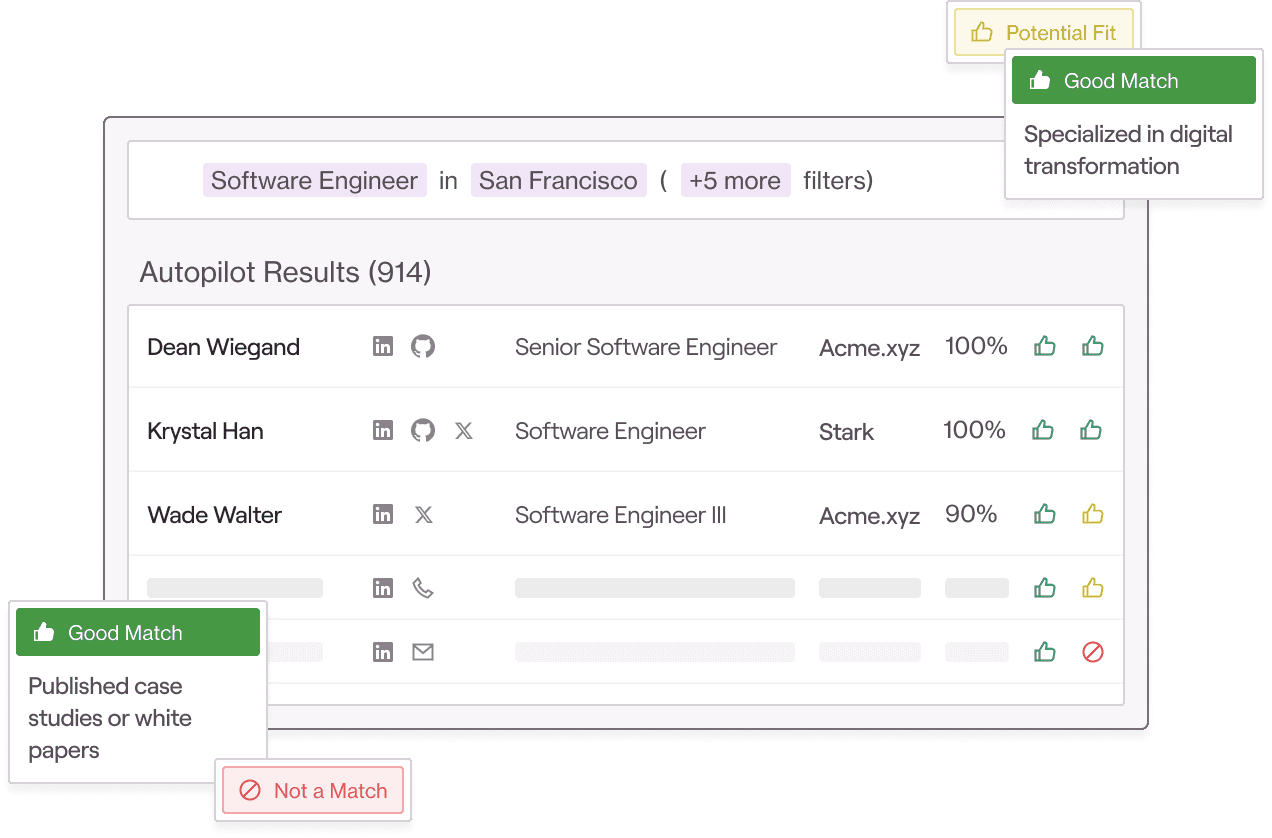
The design philosophy visible there is Juicebox's real strength: it treats sourcing as a ranking-and-feedback problem, and it is genuinely fast at surfacing relevant people from a plain-English prompt. Every paid tier includes unlimited searches, so the value metric is contact and export credits rather than queries, which rewards heavy exploration in a way credit-per-search tools punish. That is the right shape for a team that sources continuously rather than in occasional bursts.
The honest weaknesses are cost creep and a thin independent-review footprint. The credits gate real usage, and the autonomous Agents add-on stacks fast, so heavy users report real monthly spend of $300 to $400 once agents and extra contact data are layered on, well above the $99 headline - MakerStack. Some buyers also report being impressed in the demo only to find advertised features like deep ATS integration and hiring-manager seats gated to higher tiers than they bought - MindHunt AI. And despite the scale, the recruiting product has almost no verified G2 or Capterra reviews (the highly rated "Juicebox" on Capterra is an unrelated data-visualization tool), so social proof leans on vendor case studies and funding headlines rather than a large body of independent user experience. If you want the wider field, our roundup of Juicebox alternatives maps the competitors it is measured against.
5. Nova: The Merit-Ranked European Challenger
Nova Recruiter is the newest and cheapest to start of the three, and its distinctive bet is ranking candidates by merit rather than keywords, using a signal its rivals cannot easily copy. Built by Nova Talent, a startup headquartered in Stockholm with operational bases in Madrid and Milan, Nova Recruiter searches 800 million-plus public profiles across 30-plus sources including GitHub, Stack Overflow, academic papers and patents, then ranks them with an AI talent score trained on 150,000 real candidate evaluations drawn from Nova's 25,000-member vetted professional network - Nova Talent. That proprietary evaluation data is the part a pure data-scraper competitor cannot simply replicate, and it is the clearest reason Nova belongs in this comparison rather than the long tail.
Nova Recruiter is genuinely young as a standalone product, which cuts both ways. The parent company was founded in 2020 as a merit-based professional network, but the recruiter SaaS launched in closed beta only in December 2025 and reached general availability in April 2026, placing fifth on Product Hunt the day it launched - Product Hunt. It is funded modestly: a €3.2 million Series A in June 2025 led by CDP Venture Capital with BY Venture Partners and the Doha Tech Angels, plus a $1.5 million extension in April 2026 that the company frames as taking the round to roughly $4.7 million total - Silicon Canals. Nova reports reaching around $200,000 in ARR within the first eight weeks of beta and targets $2 to $3 million ARR by summer 2026 ahead of a future Series A - Nova Talent. Those numbers are self-reported and early, so treat them as a startup's own trajectory rather than an established track record.
The product itself is squarely in the autonomous-agent camp, and it is unusually forward-looking on one axis. Nova runs natural-language and reference-profile search, scores candidates on merit, and executes multichannel outreach (LinkedIn messages, connection requests, InMail, email, and its own app messaging) in a single automated sequence, claiming a 2.5x reply-rate lift over LinkedIn InMail. Its standout feature is native MCP support, which lets a recruiter drive searches, shortlists and campaigns from inside Claude, ChatGPT, Gemini or Cursor, a bet on the assistant-driven workflow that chapter 12 argues the whole market is heading toward. The screenshot below shows Nova's search entry point, where you can start from a plain-English prompt, a job description, or a reference profile.
Nova Recruiter starts from a sentence, a job description, or a reference profile
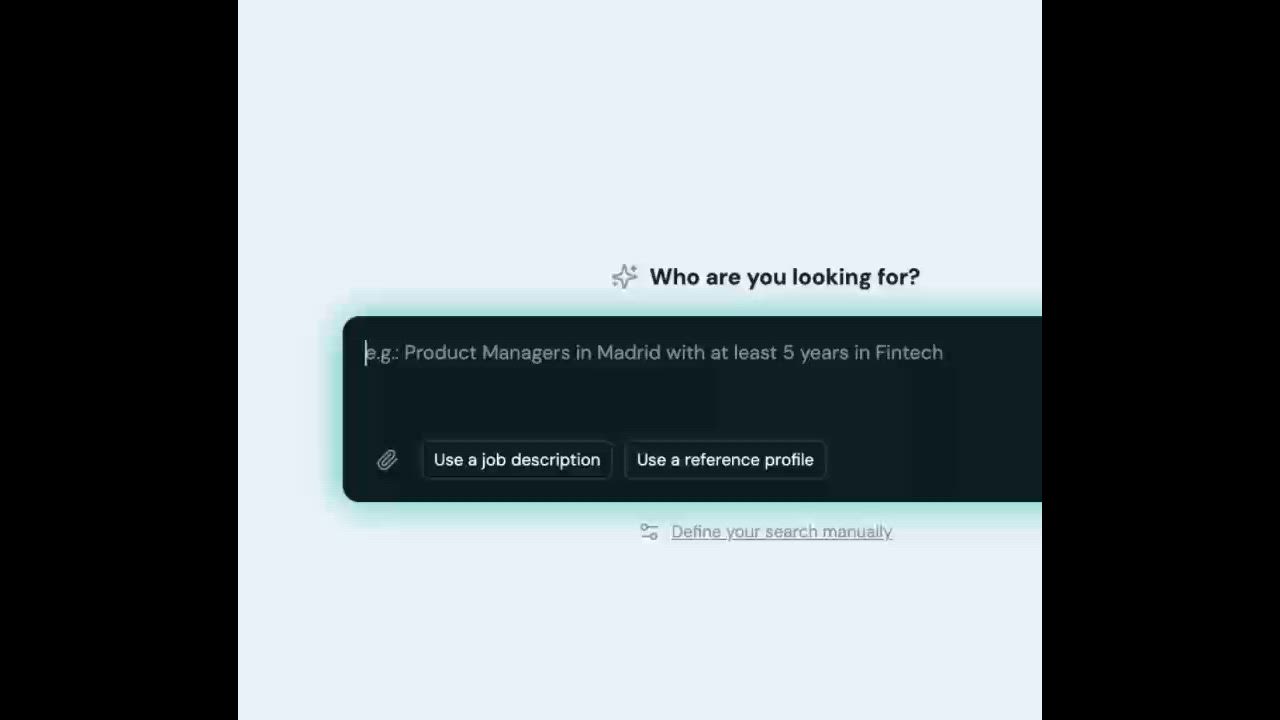
Nova's other genuine advantage is compliance posture, which matters more for European buyers than any feature. It runs on EU-based infrastructure, states GDPR compliance and EU AI Act alignment, and is pursuing ISO 27001 (still in progress), a stronger default stance than most US-built rivals for a team hiring in the EU. The honest weaknesses are the mirror image of its youth: there is essentially no independent review footprint (its social proof is a 5.0 rating from just two Product Hunt reviews), every performance claim is self-reported, and ISO certification is not yet complete. There is also a real naming trap to navigate, because Nova Talent separately sells a consumer network membership at prices that coincidentally resemble the recruiter tool, which we untangle in the next section - Nova Talent membership. For a team that values EU-first data handling and a distinctive ranking signal over a long track record, Nova is the challenger worth trialing.
6. Pricing Head-to-Head: What Each Really Costs
All three publish real prices, which is rare and worth rewarding, but they meter on different units and in different currencies, so the headline numbers are not directly comparable. This is the single most important thing to get right before you budget, because a seat price and a credit-usage price answer different questions. Pin and Juicebox charge per seat with a monthly credit allotment; Nova charges purely on usage credits with no per-seat structure at all. Comparing "$99 versus €49" as if they were the same kind of number will mislead you, so the table below states each tool in its own model and currency, verified against the live pricing pages.
| Plan level | Pin | Juicebox | Nova Recruiter |
|---|---|---|---|
| Free | $0, 5 credits/week, 1 seat | $0, 5 contact credits, 1 seat | €0, 2 searches/mo, 10 credits |
| Entry paid | $99/mo Solo (annual), 500 credits | $99/seat/mo annual ($119 monthly), 500 credits | €49/mo ex-VAT, 50 credits |
| Mid tier | $135/user/mo annual ($179 monthly), 1,000 credits | $179/seat/mo annual ($199 monthly), 1,500 credits, up to 5 seats | €199/mo ex-VAT, 300 credits, 3 members |
| Top tier | $225/user/mo annual ($299 monthly), 2,000 credits | Custom (Business) | Custom (Enterprise) |
| Autonomous agents | Included in tiers | +$199/agent/mo add-on | Included (credit-metered) |
A few details in that table decide real budgets. On Pin, the Solo tier is annual billing only, and the security add-ons (SSO/SAML and SCIM, +$150 per month each) sit on top of the seat price, so a compliance-conscious small team pays several hundred dollars a month above the sticker before revealing a single candidate - Pin. On Juicebox, note that annual is the cheaper option (Starter drops from $119 to $99, Growth from $199 to $179), and the autonomous Agents cost $199 per agent per month on top of your seat, which is where the $300-to-$400 real-spend reports come from - Juicebox. On Nova, the €49 and €199 prices are ex-VAT, so an EU buyer pays more than the sticker, and because Nova meters purely on credits (one credit equals one candidate contacted or exported), your real cost tracks reveal volume rather than seat count - Nova Talent.
The credit model is the part every buyer underestimates, and it behaves the same way across all three: the sticker is the floor, and reveal volume sets the ceiling. A recruiter working three or four senior roles a month may never exhaust Pin's 1,000-credit Professional allotment or Juicebox's 1,500, making the effective cost close to the headline. A high-volume agency desk revealing hundreds of contacts a week will blow through the cap and either upgrade or pay overage, pushing the real per-seat cost far above the sticker. Nova's usage-only model makes this explicit rather than hidden, which is arguably more honest, but it also means a busy desk on Nova pays €1 or €0.50 per extra candidate, and those cents compound. The practical rule is the same for all three: model your monthly reveal volume against the included credits, because that number, not the seat price, determines what the tool actually costs over twelve months.
One more distinction is worth naming because it is easy to get wrong. Nova's own membership page shows prices of €49 one-time, €199 annual, and €499 lifetime, which are for its consumer professional network, a completely different product from the Nova Recruiter SaaS covered here. The coincidental overlap between the €49 and €199 figures is a genuine trap, and several third-party write-ups conflate them. When you evaluate Nova as a sourcing tool, the prices that matter are the monthly, credit-metered SaaS tiers on the Nova Recruiter product page, not the membership page. Getting this wrong would have you comparing a one-time network fee against Pin's and Juicebox's recurring seats, which is not the same purchase at all.
7. Features, Data, and Autonomy Compared
On paper the three feature sets are nearly identical, so the differences that matter are in the data layer and the shape of the autonomy, not the checkbox list. Every one of these tools does natural-language search, an 800-to-850-million-profile index, verified contact enrichment, multichannel outreach, autonomous agents, and an ATS sync. If you compare them feature by feature you will conclude they are interchangeable, and you will be wrong, because the interesting variation is in how deep each capability goes and where the human still has to intervene. The table below cuts to the dimensions that actually separate them in a trial.
| Dimension | Pin | Juicebox | Nova |
|---|---|---|---|
| Ranking signal | Skills-based AI match | AI relevance + feedback | Merit score from 150k evals |
| Profile index | 850M+ | 800M+ (30+ sources) | 800M+ (30+ sources) |
| Outreach channels | Email, LinkedIn, SMS | Email sequences | LinkedIn, InMail, email, app |
| Downstream depth | CRM + scheduling | Talent Insights | Sourcing-first |
| AI-assistant access | No | No | Native MCP |
Three rows there are the real decision drivers. Nova's merit-based ranking is the most differentiated capability in the set, because it is trained on human evaluations rather than inferred from profile text, which is a genuinely different mechanism than Pin's or Juicebox's relevance matching. Pin's downstream depth is the widest, because the May 2026 CRM and scheduling mean it closes the loop from source to booked interview inside one product, where Juicebox and Nova hand off to your ATS. And Nova's native MCP access is the most forward-looking, letting the tool be driven from an AI assistant rather than its own interface. Which of those three matters most depends entirely on whether your pain is ranking quality, workflow consolidation, or assistant-driven sourcing.
Autonomy is the axis most likely to disappoint if you buy on the marketing, so it deserves a hard look. All three claim agents that run continuously, but "autonomous" means different things: Juicebox's Agents are the most mature, running 24/7 in the background, learning from your approvals and rejections, and auto-shortlisting or auto-emailing across multiple parallel agents per role. The screenshot below shows that agent queue, with role-specific agents surfacing profiles for review and a feedback loop that adapts each agent's criteria.
Juicebox's autonomous agents run in the background and learn from feedback

What that queue represents is the current state of the art for supervised autonomy: the agent does the continuous work, and the human approves in batches rather than driving each search. Pin and Nova offer comparable agent automation across sourcing, screening and first-touch outreach, but with thinner independent evidence of how well the loops actually learn over time. The practical test, which chapter 11 turns into a procedure, is to reject fifteen candidates in a trial and watch what the sixteenth batch looks like: if nothing changed, the "agent" is a search on a timer, whatever the label says. This is the single most gameable claim in the category, and it is worth stress-testing on all three rather than any one.
The data layer is where the near-identical index numbers hide the biggest real difference, and it is worth being precise about what an "800 million profiles" claim does and does not tell you. Profile count measures discovery data (who exists and what they have done), and on that axis the three are effectively tied. It says nothing about contact-data accuracy (the email and phone that decay fastest) or freshness (how recently the record was refreshed), which are the two things that actually determine whether your outreach lands. The chart below shows the discovery-data parity, and the point of it is that raw index size is not a tiebreaker between these tools.
Candidate profile index size by tool (2026)
The takeaway from that chart is deliberately anticlimactic: Pin, Juicebox and Nova are within a rounding error of each other on index size, so anyone selling you on "the biggest database" among these three is selling a distinction without a difference. The only line that clearly separates is a real-time index that refreshes at query time rather than a periodically aggregated snapshot, which is the data-freshness problem the next chapter is entirely about. For a comparison between these three specifically, treat the profile counts as equal and spend your evaluation energy on contact accuracy and freshness instead, because that is where the outreach actually succeeds or bounces.
8. The Data-Freshness Problem That Limits All Three
A semantically perfect match on a stale record still bounces, and this is the shared weakness that no amount of AI ranking fixes. All three tools query a periodically aggregated index, and aggregated indexes rot on a predictable schedule. B2B contact data decays at roughly 2.1% per month, compounding to 22 to 30% a year, which means response rates fall sharply on any contact older than about 90 days - Landbase. On the profile side the decay is even starker: only 15 to 20% of candidate records stay current two years after capture, and with US median employee tenure down to 3.9 years, the practical half-life of a record in high-mobility sectors like tech is roughly two years - Recruit with Atlas.
The cost of that decay is concrete and it lands directly on your reply rate. Verified contact data holds sub-1% bounce rates, while non-validated data bounces at 5 to 7%, and the best providers maintain only 90 to 95% email accuracy even at their freshest - Unify GTM. In a sourcing context this is the difference between an agent that reaches the people it found and one that fires outreach into dead inboxes while reporting healthy activity numbers. Because the agent does not know a record is stale, the failure is invisible: the dashboard shows messages sent, and only the missing replies reveal that a chunk of your pipeline never received anything. This is why chapter 11 insists on measuring reply rate against a baseline rather than trusting an activity count.
For a Pin-versus-Juicebox-versus-Nova decision specifically, the freshness question is the one worth pressing every vendor on, because their published numbers do not answer it. None of the three publishes a refresh cadence you can verify; Nova's product page says core fields are refreshed "weekly or monthly depending on the data source," which is more disclosure than most but still a range rather than a guarantee. The right procurement questions are blunt: how recently was this specific candidate's record refreshed, and is the contact data verified at the moment of delivery or served from a cache. A vendor that verifies at delivery will answer easily; one that serves a snapshot will deflect. This is also the strongest argument for the real-time alternative in chapter 10, because a live lookup at query time sidesteps the decay curve entirely rather than fighting it with more frequent batch refreshes.
The practical implication is that you should weight freshness by role velocity. If you hire in slow-moving markets where people stay put for years, a monthly-refreshed index is fine and the three tools are close to equivalent on data. If you hire in tech, startups, or any high-churn field, the decay curve punishes stale records within a year, and you should treat any tool's profile count as a ceiling on coverage rather than a promise of reachability. No AI ranking model, however good, can contact a person whose email changed three jobs ago, which is why the unglamorous data layer, not the impressive-looking match score, is what most often decides whether a sourcing pilot succeeds.
9. Where Each Tool Wins and Where Each Breaks
Each of the three wins decisively in one situation and breaks in another, and matching your situation to the right one matters more than any overall ranking. A blanket "best tool" verdict is close to useless here because the products are differentiated on purpose, so the useful framing is conditional: given your constraint, which one fits. This section states each tool's genuine sweet spot and its honest failure mode, because a recommendation without a downside is an advertisement, and the downsides are exactly what a trial should be designed to expose.
Pin wins for the lean team that wants one transparent tool for the whole desk, and breaks on data maturity. Its combination of a real free tier, published prices, and an all-in-one workspace that now includes scheduling and a CRM is genuinely hard to beat for a solo recruiter or a small agency that cannot justify a five-tool stack. It breaks where its youth shows: reviewers flag data gaps that hurt search accuracy, sequences that re-contact declined candidates, and a thin 27-review evidence base, so a team that needs proven reliability at scale is trusting a 25-person company on largely self-reported metrics. Juicebox wins for the team that wants a proven, well-funded vendor and continuous agent sourcing, and breaks on cost predictability. Its $116 million in funding, 5,000 customers, and mature background agents make it the low-risk institutional choice, but the credit-plus-agent model means real spend drifts to $300 to $400 a month for heavy users, well above the $99 headline, and some buyers find advertised features gated above the tier they bought.
Nova wins for EU-first teams and merit-ranked technical search, and breaks on track record. Its EU infrastructure, GDPR and AI Act posture, and merit score trained on 150,000 human evaluations give it two things the others lack, a compliance default and a genuinely proprietary ranking signal, and its €49 entry and native MCP make it the cheapest and most assistant-ready of the three. It breaks on maturity: with a December 2025 beta, an April 2026 launch, essentially no independent reviews, and modest funding, it carries the highest "will this vendor still be improving in two years" risk. Nova's outreach composer, shown below, illustrates the polish it does have, generating a personalized message from a job description, tone and highlight inputs that update live.
Nova Recruiter's AI outreach composer generates a personalized message live
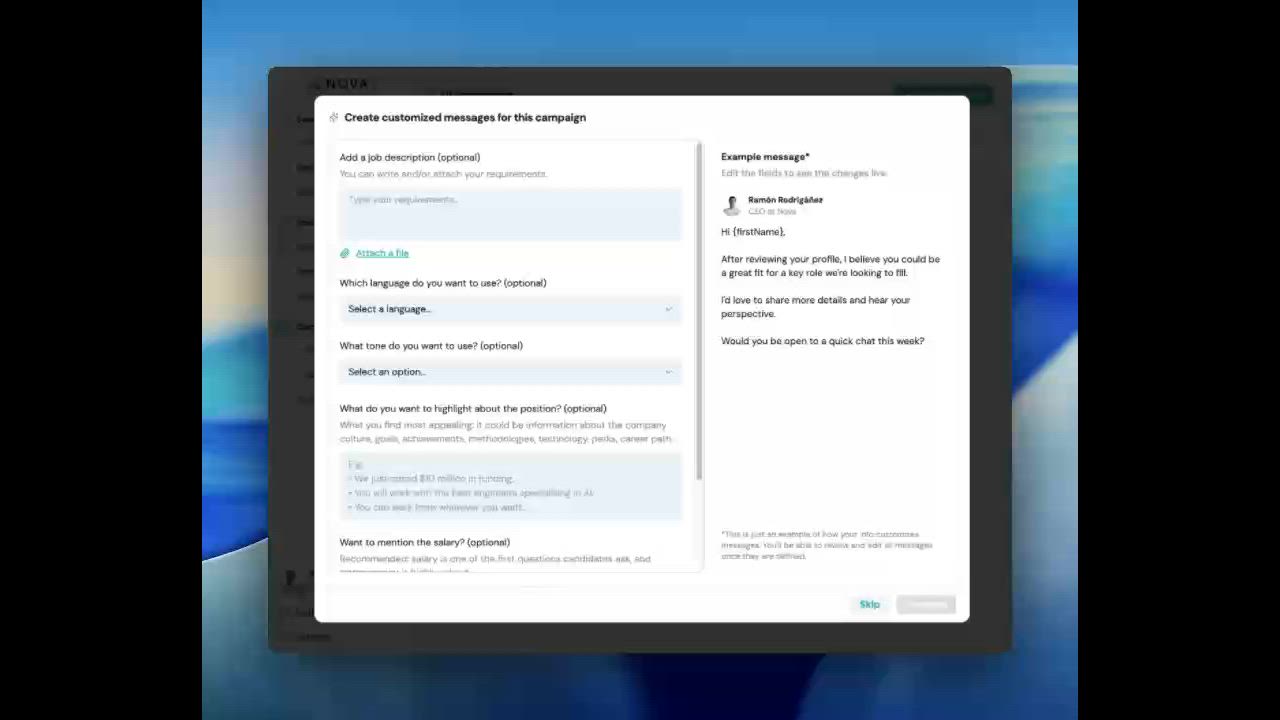
What that composer represents is the feature all three share and where the real differentiation has moved: personalized outreach is now table stakes, so the advantage no longer comes from mail-merge variables but from the evidence behind the message. A note that references the specific system a candidate built reads as human because a human, or a genuinely good screening step, actually read the profile; a note that says "I was impressed by your work" reads as machine output because it is the shape every machine produces. This matters more in 2026 than it did a year ago because candidates have become extremely good at detecting automated outreach, and only about 8% of job seekers believe AI makes hiring fairer, so a message that smells automated is discounted before it is read - Pin AI adoption report.
The uncomfortable conclusion that applies to all three is that the correct way to use any of them is often to have the agent do more work per candidate rather than contact more candidates. Volume is nearly free when an agent sends it, so it is rationed only by candidate patience, which is a shared and shrinking resource. A tool that contacts the best 40 people with real evidence will out-reply one that contacts 400 with a variable inserted, and this is true of Pin, Juicebox and Nova equally. When you evaluate them, resist the demo's instinct to celebrate how many candidates the agent surfaced, and judge instead how many of those turned into a real conversation, because that is the only number that turns into a hire.
10. The Autonomous Alternative: Real-Time Sourcing
The fourth option worth trialing against all three is a fully autonomous recruiter that sources from a real-time index rather than a static one, and it is the honest counterweight to their shared data-freshness weakness. Where Pin, Juicebox and Nova are supervised or semi-autonomous search workspaces querying a periodically aggregated database, a tool like HeroHunt.ai runs the whole loop and fetches candidates live. Its AI Recruiter takes a written brief, sources from over 1 billion profiles across professional platforms in real time, screens each candidate with language models against your actual criteria rather than keyword-matching a title, and writes and sends personalized outreach across LinkedIn, email and WhatsApp - HeroHunt.ai. Its companion RecruitGPT turns a single plain-language prompt into a candidate shortlist, which is the closest thing in the market to describing a role and getting engaged candidates back rather than a list to work through.
The two structural advantages over the three main tools are data freshness and price entry, and both map directly to weaknesses named earlier in this guide. Sourcing in real time sidesteps the 2.1%-per-month decay curve that limits any aggregated index, because the profile is fetched and enriched at query time rather than served from a snapshot that ages between refreshes. And it is free to start with no credit card, which removes the barrier before you commit to Pin's $99 seat, Juicebox's credit meter, or Nova's ex-VAT euros - HeroHunt.ai sign-up. With 15,000-plus recruiters using it globally, it has an adoption base that a 2026 launch like Nova is still building and a broader one than Pin's self-reported figures, though as the platform this guide is published on, that is disclosure rather than a neutral recommendation, and you should verify the current plan structure yourself.
The honest trade-offs keep it a genuine alternative rather than a universal answer, which is the point of naming it here with equal treatment. It is a fully autonomous recruiter, not a supervised workspace, so it deliberately does not replicate Pin's built-in interview scheduling or Juicebox's Talent Insights market maps, and it sits alongside your ATS rather than replacing it. Its open-web coverage is also uneven by geography and function, strong where people publish work publicly and weaker where they do not, which is the mirror image of a LinkedIn-centric tool's blind spot. It is the right test for a team that wants to fully automate sourcing and outreach, hire globally, and trial the autonomous approach for free before spending, and the wrong one for a team whose real pain is a visual pipeline or a scheduling handoff inside a single product. Compared against the three, it is best understood as the answer to "what if the index were live and the loop ran itself," which is a different question than "which supervised search tool is best," and worth answering in parallel rather than instead. For the wider autonomous field, our guide to the best autonomous recruiting solutions maps the category.
11. How to Run a 30-Day Bake-Off
The fastest way to settle Pin versus Juicebox versus Nova is not more research, it is a two-week trial on one real role, measured properly. Most sourcing-tool pilots fail for methodological reasons rather than product reasons, which is an expensive way to learn nothing. The two classic errors are running the pilot on an easy role, which proves only that easy roles are easy, and measuring the wrong output, which is almost always volume. Because all four options here (Pin's free tier, Juicebox's free plan, Nova's free tier, and a free-to-start autonomous tool) cost nothing to pilot, you can run two or three in parallel and let results break the tie rather than the sales pitch.
Pick the role first and pick it deliberately. The right pilot role is one you have genuinely struggled to fill, ideally one you would otherwise hand to an agency, because that is the real economic comparison. Then write the brief properly, because the brief is the program: spend an hour with the hiring manager producing the two or three non-negotiable qualifications with the evidence that satisfies each, the things that look like qualifications but are not, and a named list of three people who would be perfect if available. That last item is the highest-leverage input in the whole exercise, because it lets you test retrieval directly. If a tool cannot find people who resemble those three, its data layer is wrong for this role and no amount of prompt tuning will fix it. The decision path below maps the most common routes teams take once they have a real brief in hand.
The tree encodes the practical logic, but it cannot decide the one thing only a trial can: how each tool's model performs on your specific reqs, which varies enormously by industry and seniority. So before any tool runs a search, write down your current numbers for the same role type, because a pilot without a baseline produces an opinion rather than a result. You need four figures from your last two comparable searches: how many candidates your recruiter contacted, what share replied, how long it took to get three people in front of the hiring manager, and what the search cost in recruiter time and agency fees. Most teams do not have these to hand, and the hour spent reconstructing them from the ATS is the most valuable hour of the whole pilot.
Then measure the four things that actually predict whether this scales, and deliberately leave volume off the list.
- Qualified rate - what share of the shortlist survives recruiter review
- Response rate - replies per contacted candidate, versus your baseline
- Time to first slate - brief to three interview-worthy people
- Cost per qualified conversation - all-in spend divided by real conversations
Qualified rate is the single most diagnostic number: a shortlist where seven of ten survive review means the screening is doing your job, and one where two of ten survive means you have bought a faster way to generate reading. Response rate against your own baseline is what exposes the data-freshness problem from chapter 8, because a tool with a stale index will show healthy send counts and disappointing replies. Cost per qualified conversation is the number to take to a budget conversation, because it is directly comparable to what your agency spend buys. Run the loop at least three times inside the thirty days, using the second and third rounds to test whether the agents actually learn from your rejections, and assign one named owner a few hours a week, because an unowned pilot produces an inconclusive result that defaults to "no," which is often the wrong answer reached by accident.
12. The 2027 Outlook: Agentic Sourcing and the Disappearing Interface
The durable moat in AI sourcing is shifting from "can it search in natural language," now commoditized across all three, to "is the data fresh, are the matches verifiable, and is it defensible in an audit." Natural-language search was the differentiator in 2024 and is table stakes in 2026, which is precisely why Pin, Juicebox and Nova look so similar on the homepage. The next eighteen months will separate them on the axes the marketing currently glosses over, and three shifts already visible in 2026 roadmaps will drive that separation.
The first is the interface disappearing, and Nova's native MCP support is an early bet on it. Once candidate search becomes a tool that any AI assistant can call, the sourcing platform stops being a destination you log into and becomes infrastructure that Claude, ChatGPT or Cursor drives. That is excellent for buyers and awkward for vendors whose value was partly a well-designed search screen, and it will compress pricing for anyone whose product was mostly an interface. The second is consolidation, and the capital behind it is not subtle: Juicebox's jump from a $36 million Series A to an $80 million Series B at an $850 million valuation in roughly eight months is the kind of step-up that funds acquisitions, while seed-stage entrants like Pin and Nova race to prove ARR and reach their next round - Hunt Scanlon. Expect a small number of well-funded independents to survive on genuinely differentiated data or ranking, and the undifferentiated middle to get absorbed.
The third shift is regulation becoming a product feature rather than a footnote, and it is where Nova's EU-first posture may age well. AI used in recruitment is classified as high-risk under the EU AI Act, and in the US the patchwork is hardening: NYC's Local Law 144 already requires bias audits of automated employment decision tools, even though a December 2025 state audit found its enforcement "ineffective," which leaves liability sitting with employers rather than tools - DLA Piper. The practical consequence for a 2026 buyer is that explainability and bias auditing move from nice-to-have to procurement requirement, and a sourcing tool that cannot explain why it ranked or rejected a candidate is a liability waiting to surface. Merit scores trained on documented human evaluations, verifiable match reasoning, and EU data handling stop being marketing and start being the terms of an audit.
For a buyer choosing today, the strategic implication is to avoid long contracts on undifferentiated products and to weight data ownership and freshness heavily in any multi-year decision. A vendor that owns its ranking signal and refreshes its data at query time has something that survives both consolidation and the interface shift; a vendor that wraps a licensed profile API in a good screen has a business a better-funded rival can replicate in a quarter. Josh Bersin's 2026 analysis frames the direction as multi-agent systems requiring up to 30% fewer HR staff across two dozen distinct agent workflows, which is a useful reminder that sourcing is one workflow in a larger agentic stack, and the tools that integrate cleanly into that stack will outlast the ones that try to be an island - Josh Bersin.
13. The Decision: Which One to Choose
Choose Juicebox if you want the proven, well-funded option, Pin if you want transparent all-in-one consolidation, and Nova if you want the cheapest EU-first entry with a distinctive ranking signal. That is the decision in one sentence, and the evidence across this guide supports it. Juicebox has the capital, the customer base, and the most mature background agents, so it is the low-risk institutional pick where a buying committee wants a vendor that will still be improving in two years, and it earns that at a real cost of $300-plus monthly once agents and credits stack. Pin is the honest consolidation play, publishing its prices, starting genuinely free, and now closing the loop from source to scheduled interview inside one workspace, at the cost of being a young, lightly funded company whose metrics are largely self-reported.
Nova is the challenger worth a free trial specifically if you hire in Europe or value a merit score trained on real human evaluations over a long track record, accepting that it is new enough to carry vendor-continuity risk. And if what actually gives you pause about all three is that they query a static index and stop short of full autonomy, the real-time autonomous approach is the fourth test to run in parallel, for free, before you commit budget to any of them. None of these is a wrong answer; they are answers to different questions, and the fastest way to find which question is yours is the two-week bake-off in chapter 11, run on one role you have failed to fill.
Run the autonomous option alongside your Pin, Juicebox or Nova trial: brief one hard role in writing, and compare what a real-time, language-model-screened search returns against a static index.
Whichever way you go, insist on two numbers before you sign: the real per-seat or per-credit cost at your actual reveal volume, and the reply rate the tool produces against your own baseline. Those two figures, not the marketing, decide what an AI sourcing tool costs and whether it works, and they are exactly where a transparent-looking sticker can still surprise you. The pitch is now identical across every vendor in this category, so the only reliable way to tell them apart is to make them prove it on your roles, in your market, with your brand behind the outreach.
This guide reflects the AI sourcing landscape as of August 2026. Pricing, funding and product features in this category change on a monthly cadence, so verify current details on each vendor's own page before purchasing.