



The full 2026 guide to delegating candidate sourcing to AI agents: how it works, who builds it, what it costs, and where it breaks.
LinkedIn's agentic hiring products crossed a $450 million annualized revenue run-rate in April 2026 - Yahoo Finance. That number matters because it is not a survey about intentions or a vendor's funding announcement. It is real money that real talent teams are paying, right now, for software that does not help them search for candidates but searches instead of them. Recruiting has crossed a line: the agent finds the people, screens the people, and messages the people, and the recruiter reviews what comes back.
The intent numbers are even bigger than the revenue. 52% of talent leaders plan to add autonomous AI agents to their recruiting teams in 2026, according to a Korn Ferry survey of 1,674 global talent leaders - Korn Ferry. But here is the problem: most of what is written about "agentic recruiting" is either vendor marketing or generic AI hype, and the practical questions go unanswered. What does an agent actually do with your role brief at 2 a.m.? Which platforms run a genuinely autonomous loop, and which just renamed their search bar? What does it cost per month, per position, or per hire? When does delegation produce a great shortlist, and when does it spam 60,000 people to make 48 placements?
This guide answers those questions with numbers, names, and dates. It starts high level (what agentic recruiting means and why it exploded now), then goes progressively deeper: how sourcing agents work under the hood, the established platforms and the agent-first startups with real pricing for each, a delegation playbook with outreach benchmarks from 4 million real messages, an honest map of where it fails, the legal landscape including the lawsuit that involves 1.1 billion rejected applications, and the outlook through 2027 and beyond. Everything here is based on late 2025 and 2026 information, because in this market a statistic from two years ago is already history.
Written by Yuma Heymans (@yumahey), who built HeroHunt.ai and its autonomous AI Recruiter, and has been building AI sourcing agents since before "agentic" was a word recruiters used. This guide reflects what actually happens when you let software recruit.
Contents
- What Agentic Recruiting Actually Means
- Why Delegated Sourcing Exploded in 2025 and 2026
- How an AI Sourcing Agent Works, Step by Step
- The Established Players: Big Platforms Gone Agentic
- The New Wave: Agent-First Startups and Marketplaces
- What Letting AI Source Talent Actually Costs
- The Delegation Playbook: Briefing, Calibrating, and Managing an Agent
- Where Agentic Sourcing Wins and Where It Fails
- The Rules: Bias, Audits, and the Law Catching Up
- What Comes Next: Superagents, MCP, and the Arms Race
- Getting Started: A 30-Day Plan and Decision Framework
1. What Agentic Recruiting Actually Means
Agentic recruiting is the delegation of recruiting work, not the acceleration of it. The distinction sounds subtle and is not. An assistive AI tool makes a recruiter faster at a task the recruiter still performs: it drafts an outreach message the recruiter sends, or suggests Boolean strings the recruiter runs. An agentic system performs the task itself: it takes a role brief, runs its own searches, evaluates the results against the requirements, contacts the candidates it selects, and comes back to the human with outcomes rather than options. The human moves from operator to manager. That is the entire shift, and every claim in this guide hangs on it.
The word "agentic" is also one of the most abused terms in software right now, so a working test helps. Gartner estimates that of the thousands of vendors claiming agentic AI capabilities, only about 130 are building genuinely agentic systems, a phenomenon it calls "agent washing" - Gartner. The test is simple: does the system complete a multi-step loop (search, evaluate, act) without a human triggering each step? If a recruiter still clicks "next page" and "send," it is assistive software with better autocomplete, whatever the landing page says.
In recruiting specifically, the market has sorted into three camps, and knowing which camp a vendor belongs to saves you months of procurement pain. The truly autonomous camp runs the full source-screen-outreach loop per role: LinkedIn's Hiring Assistant, HeroHunt.ai's AI Recruiter, and Juicebox's always-on Agents work this way, as does Paradox for inbound high-volume hiring. The semi-autonomous camp executes the same chain but pauses for human approval at decision points: hireEZ literally brands its EZ Agent approach "guided autonomy" - hireEZ. And the deliberately assistive camp (Greenhouse, Ashby, Dover) embeds AI inside recruiter-driven workflows and openly rejects autonomy as the goal.
None of these camps is "correct." They express different beliefs about where human judgment belongs, and increasingly, different legal postures: as section 9 covers, several jurisdictions now effectively require a human in the loop for consequential hiring decisions. What matters for a buyer is matching the camp to the job. High-volume, well-defined roles tolerate (and reward) full autonomy. Ambiguous, senior, or politically sensitive searches punish it. The rest of this guide keeps returning to that dividing line, because it decides both the ROI math and the risk exposure.
One more definitional point that non-technical readers should hold onto: an agent is not a single magic model. It is a large language model wrapped in a workflow: instructions, tools (a people database, an email sender, a calendar), memory of what it has tried, and rules about when to ask a human. When this guide says "the agent learned from your feedback," it means the workflow stores your thumbs-down and adjusts its next search, not that a new model was trained overnight. Understanding that plumbing, which section 3 walks through, is what separates recruiters who manage agents well from those who treat them as an oracle and get burned.
2. Why Delegated Sourcing Exploded in 2025 and 2026
The single biggest force behind agentic recruiting is not employer enthusiasm for AI. It is the collapse of the inbound pipeline under AI-generated application volume. LinkedIn was receiving roughly 11,000 job applications per minute by mid-2025, up 45% year over year, driven substantially by candidate-side AI tools - eWeek. Ashby's analysis of more than 100 million applications found that applications per hire have tripled since 2021 and stayed above 300 throughout 2025, while a candidate's chance of landing an interview roughly halved - Ashby. When every inbox is flooded with machine-written applications, reading them by hand stops being a job a human can do.
The flood is not just voluminous, it is adversarial. Greenhouse's November 2025 survey of 4,136 respondents found 74% of US job seekers use AI in their search, 65% of hiring managers have caught applicants using AI deceptively (scripted answers, prompt injections hidden in resumes, even deepfakes), and 34% of recruiters spend up to half their week just filtering spam applications - Greenhouse. This is why outbound sourcing, the thing agents are best at, regained strategic value: Gem's benchmark data shows a sourced candidate is 5x more likely to be hired than an inbound applicant - Gem. The signal moved outbound, and outbound at scale needs automation.
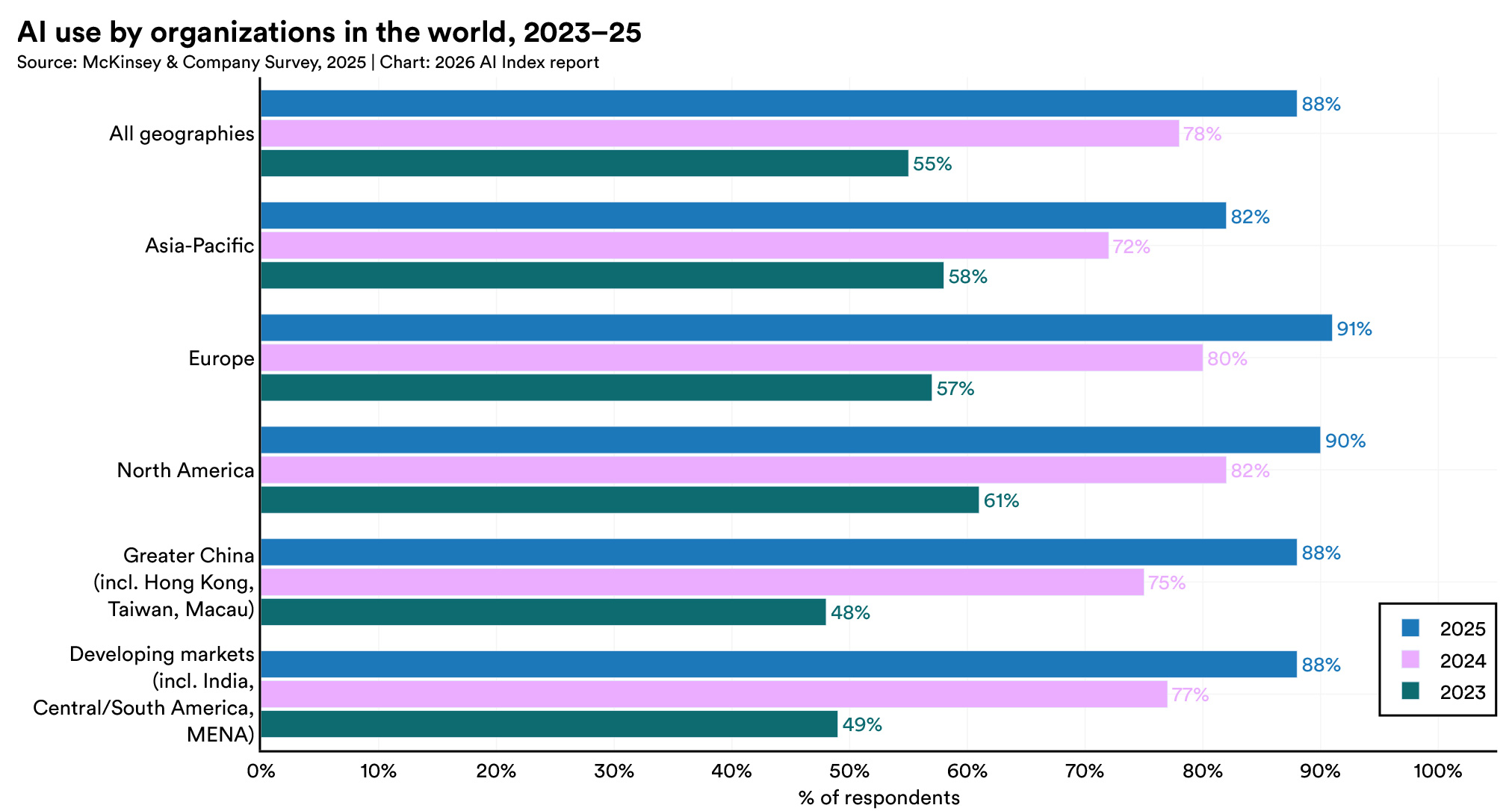
Meanwhile, general AI adoption crossed the threshold where agentic tools stopped feeling exotic. The Stanford AI Index's 2026 report, drawing on McKinsey survey data, shows organizational AI use worldwide jumping from 55% in 2023 to 88% in 2025. The chart below is worth a look because it explains the buyer psychology: when nine out of ten organizations already use AI somewhere, delegating sourcing no longer requires a leap of faith, just a business case.
AI adoption crossed the tipping point before agents arrived
What the Stanford figure does not show is how uneven recruiting-specific adoption still is, and that gap is the opportunity. Bullhorn's GRID 2026 survey of roughly 2,300 recruitment professionals found that while 30% of staffing firms use some agentic AI tools, only 10% have agentic AI embedded across their full workflow - Bullhorn. SHRM's December 2025 survey of 1,722 HR professionals puts overall AI adoption in HR at just 39% of organizations, with recruiting the most common use at 27% - SHRM. Intent, however, is nearly universal: 93% of TA professionals told LinkedIn they plan to grow AI use in 2026 - HR Dive.
The performance numbers early adopters report explain the urgency. Bullhorn found top-performing staffing firms are 4x more likely to use AI, and 55% of firms say AI screening alone improved KPIs by more than 25% - Bullhorn GRID 2026. On the corporate side, Employ's survey of 1,200+ US recruiters attributes faster time-to-hire (55%), better candidate quality (53%), and higher recruiter productivity (49%) to AI - Employ. A skeptic should note the counterweight: a separate Gartner survey found 88% of HR leaders have not yet seen significant business value from AI tools - Gartner. Both things are true at once: the median deployment is shallow and disappointing, and the well-run deployments are pulling away from the pack. The rest of this guide is about being in the second group.
3. How an AI Sourcing Agent Works, Step by Step
Every serious sourcing agent on the market in 2026, whatever its brand, runs a version of the same loop. Understanding the loop matters because each stage is a place where quality is won or lost, and because the vendors differ mainly in which stages they automate fully versus gate behind human approval. The reference implementation is LinkedIn's Hiring Assistant, which moved from a 500-company pilot in October 2024 to global availability by the end of September 2025 - LinkedIn. But the same anatomy applies to HeroHunt.ai, hireEZ, Juicebox, and the rest of the field.
The loop starts with intake, and intake is where most failed deployments actually fail. The agent ingests a job description, asks clarifying questions in chat, and converts the conversation into structured requirements: required qualifications versus nice-to-haves, titles, locations, seniority. Modern intakes accept example profiles too; LinkedIn's 2026 release added the ability to paste URLs of ideal candidates so the agent calibrates on real people instead of adjectives - LinkedIn Hiring Assistant. The screenshot below shows the moment of delegation: the agent has drafted the requirements and offers a button that says "Start sourcing for me."
The delegation moment

After intake, the agent moves through search, screening, and outreach on its own schedule. In the search stage it runs dozens of query variations across its data source (LinkedIn's member graph, or a cross-platform index like the 1 billion+ profiles that HeroHunt.ai searches across LinkedIn, GitHub, Xing, and Stack Overflow - HeroHunt.ai). In the screening stage it scores every profile against every requirement and, critically, writes down its evidence for each judgment. In the outreach stage it drafts personalized messages, sends them (immediately, or after approval, depending on the platform's autonomy camp), handles replies, and books calls. The diagram below shows the loop with its two human gates, which is how the semi-autonomous camp ships it.
Two elements of this diagram deserve emphasis because they are where agentic systems genuinely differ from the automation tools of 2020. The first is the feedback edge from review back to search: when a recruiter thumbs-down a sample match and says "too junior" or "wrong industry," the agent revises its search strategy and the next batch improves. LinkedIn reports this calibration loop is a major driver of its results, with charter customers reviewing 62% fewer profiles per hire, a figure that improved to 81% by early 2026 as intake got smarter - LinkedIn. The second is that the agent runs continuously in the background. It is not a search you execute; it is a process that pings you when strong candidates appear, day and night, which is why vendors describe capacity in "positions" or "roles" rather than searches.
What should a non-technical reader take from the plumbing? Three practical things. First, the quality ceiling is set at intake: an agent calibrated with example candidates and honest must-haves outperforms one fed a wish-list job description, no matter the vendor. Second, evidence-based screening is your audit trail; prefer agents that show why they scored someone 4/4, because you will need those receipts for both hiring managers and, increasingly, regulators. Third, the feedback loop only works if someone actually uses it, which is why section 7 treats agent management as a real recruiting skill rather than a set-and-forget purchase. Readers who want a deeper technical treatment of the agent stack can continue with our guide to AI agents for recruiting, but the loop above is all the mental model you need for the rest of this one.
4. The Established Players: Big Platforms Gone Agentic
The established end of the market spent 2025 and early 2026 racing to bolt agency onto distribution. The defining events were acquisitions, not features: Workday closed its roughly $1.1 billion purchase of Paradox on October 1, 2025 - Workday, and SAP completed its acquisition of SmartRecruiters that September - SAP. Two of the three biggest enterprise HCM suites bought their agentic recruiting capability within two months of each other. When incumbents buy rather than build, it tells you the capability is real and the window to build it internally has closed.
This section profiles the platforms most buyers will actually shortlist, with honest pricing (list prices where they exist, negotiated benchmarks where they do not) and a clear note on which autonomy camp each belongs to. A theme to watch: the biggest players are strongest where they own data or workflow (LinkedIn owns profiles, Workday owns the HCM record), while independents compete on coverage, price, and openness. For a broader tool-by-tool comparison beyond sourcing, see our companion piece on the new AI era for recruiters.
LinkedIn Hiring Assistant
Hiring Assistant is the reference point everyone else is measured against: LinkedIn's first true AI agent, generally available since the end of September 2025, sold as an add-on to LinkedIn Recruiter. It runs the full loop natively inside LinkedIn's member graph: intake chat, dozens of searches, applicant evaluation (now ingesting GitHub signals), drafted InMail outreach, and pre-screening of interested candidates. The vendor-reported results are striking: 81% fewer profiles reviewed to find a qualified match, 66% higher InMail acceptance than manual sourcing, and Expedia Group cutting time-to-hire by 30 days - LinkedIn. The screenshot below shows what its screening output looks like in practice: a candidate graded against each required qualification, with evidence and a thumbs-up/down control that feeds the calibration loop.
Evidence-based screening in LinkedIn Hiring Assistant

The catch is cost and captivity. Hiring Assistant has no public price and cannot be bought standalone: it stacks on a Recruiter Corporate seat that third-party trackers put at roughly $10,979 per seat per year as of January 2026 - daily.dev, with a fully loaded seat including Hiring Assistant estimated at $14,000 to $17,000 per year - Pin. It also only sees LinkedIn members, evaluates largely self-reported profile data, and inherits the platform's fake-profile problem. For a deeper look at how LinkedIn thinks about the product, the interview below is the best primary source on video: analyst Josh Bersin questioning LinkedIn's VP of Product Hari Srinivasan about exactly how Hiring Assistant sources, screens, and learns.
Josh Bersin interviews LinkedIn's Hari Srinivasan on Hiring Assistant
Best for: enterprise TA teams already paying for Recruiter Corporate who want autonomous sourcing without changing systems or data sources.
HeroHunt.ai
HeroHunt.ai is one of the few platforms where the entire source-screen-outreach loop runs genuinely autonomously per role, at self-serve prices rather than enterprise contracts. Its AI Recruiter takes a role brief and then recruits the position on autopilot: it searches more than 1 billion profiles across LinkedIn, GitHub, Xing, and Stack Overflow in 190+ countries, screens and scores every profile against every requirement, sends personalized outreach, and surfaces replies. RecruitGPT, its natural-language search layer, replaces Boolean strings with plain-English prompts. Plans are flat monthly subscriptions with unlimited positions and searches, metered on two monthly allowances (AI-screened and matched profiles delivered and candidate emails found), with paid plans from $99 per month and an 8-day free trial (card required) - HeroHunt.ai pricing.
The differentiation is threefold: full autonomy (the loop actually completes without a human triggering each step), cross-platform coverage beyond LinkedIn's walled garden (GitHub and Stack Overflow signals matter for technical roles), and accessibility (the price point undercuts a LinkedIn Recruiter seat by two orders of magnitude). It also ships a People Search API and MCP server so teams can plug its billion-profile index into their own agents, which section 10 explains is where the whole industry is heading. The honest trade-off: it is a smaller company than the enterprise incumbents, its traction metrics (4,800+ active hunts, sub-36-hour average time to candidate reply) are self-reported, and buyers with heavyweight procurement requirements will find less compliance paperwork than Workday-scale vendors provide.
Best for: startups, agencies, and lean in-house teams, especially in tech recruiting, that want true end-to-end autonomous sourcing without a five-figure contract.
hireEZ
hireEZ rebuilt itself from an outbound sourcing tool into an agentic platform with the March 2025 launch of its EZ Agent, and it is refreshingly explicit about its camp: semi-autonomous by design, with "guided autonomy" as the official framing - hireEZ. The agent reads a role, maps talent supply and salary benchmarks, sources across 45+ platforms plus your own ATS, ranks candidates, runs multi-step email and text sequences, conducts AI voice phone screens, and schedules interviews, pausing for human approval at decision points. Its strongest and most underrated capability is ATS rediscovery: mining the applicants you already paid to attract. That matters because rediscovered candidates rose to 44% of sourced hires by 2024 across Gem's dataset, a trend that holds industry-wide.
Pricing is sales-gated: no public price list, with Vendr's verified-purchase data showing a $13,000 median annual contract in a $7,000 to $25,000 range, plus onboarding fees that reach five figures with ATS connectors - Vendr. Buyers should negotiate renewal caps: hireEZ reviews repeatedly mention steep price escalation at renewal. It claims 70+ Fortune 500 customers including Visa, Zoom, and Accenture.
Best for: mid-market and enterprise teams doing high-volume outbound sourcing in tech or healthcare who want rediscovery plus outreach automation with human checkpoints.
SeekOut
SeekOut is the clearest example of an established sourcing platform betting its future on the agentic pivot: it named a new CEO, Sean Thompson, effective May 4, 2026, explicitly "to lead the agentic AI recruiting revolution" - Business Wire. Its stack now includes SeekOut Assist (job description to shortlist with drafted outreach), an AI interviewer called Sam, and, most notably, the first MCP server from a major sourcing vendor, letting recruiters run 14 guided workflows from inside Claude, ChatGPT, Gemini, or Copilot. Its traditional strengths remain the deepest vertical filters in the market: security clearances, healthcare licenses, and diversity analytics across a 1 billion+ profile index.
SeekOut is honest about staying semi-autonomous: agents execute sourcing, screening, and outreach drafts but surface recommendations for approval. Entry is self-serve at $149 per month billed annually for Recruit Core with 500 contact credits - SeekOut, while negotiated contracts run a $20,000 median per Vendr in a range reaching $54,920. The list-versus-negotiated gap is wide, so never pay the first quote.
Best for: teams with hard-to-fill vertical needs (cleared talent, healthcare) and teams that want sourcing embedded in their AI assistant via MCP.
Gem
Gem wraps its agents around the deepest sourcing CRM in the market, which changes what "sourcing" means: its AI works your existing relationship data, not just cold outbound. AI Sourcing finds and ranks candidates from a 650M+ profile index, AI Application Review screens inbound applicants, and AI Rediscovery mines your own CRM and ATS for past candidates and silver medalists. The rediscovery angle is backed by its own benchmark finding that sourced candidates are 5x likelier to be hired than inbound applicants - Gem. Agents are unlocked through special AI-Powered seats layered on standard ones.
Gem publishes startup pricing ($270 per month list for 1-10 employees, $130 per month on the annual deal, with 500 AI sourcing credits included) but is opaque above that tier - Gem pricing. Vendr's dataset of 233 verified purchases shows a $25,700 median annual contract in a range from $7,000 to over $73,000. It has not raised since its 2021 Series C, which in this capital-hungry market is worth factoring into vendor diligence.
Best for: in-house teams from funded startups to mid-market that want sourcing agents, CRM nurture, and ATS in one system.
Findem
Findem attacks sourcing from a different data angle: instead of searching profiles as they were written, it fuses roughly 1.6 trillion data points of people and company history into searchable attributes like "built a team from 0 to 50" or "worked at a startup that IPO'd." Its Copilot generates searches from intake notes, runs continuous automated sourcing into calibrated pipelines, and executes outreach campaigns. In October 2025 it raised $51 million (a $36M Series C led by Silver Lake Waterman plus $15M in growth financing) earmarked for agentic workflows spanning calibration through interviews - Findem. It is also the only major sourcing vendor committed to moving contracts to outcome-based pricing, charging for results rather than seats.
There is no public pricing; estimates run about $6,000+ per seat per year with annual contracts standard - Pin. The attribute-search approach has a learning curve, and the outcome-pricing transition creates renewal uncertainty. But for precision-heavy searches where "PM who shipped a 0-to-1 product at a Series B company" is a real requirement, nothing else queries the world that way.
Best for: enterprise TA and executive-search-style pipelines where attribute precision beats raw volume.
Eightfold AI
Eightfold is the talent-intelligence heavyweight of this list: deep-learning matching over billions of career trajectories, used for hiring, internal mobility, and workforce planning by a claimed third of the Fortune 500. Its agentic move is the AI Interviewer, which autonomously conducts structured screening, functional, and even coding interviews, and in May 2026 was embedded directly into Oracle Fusion Cloud Recruiting - Eightfold. That deal matters beyond Eightfold: it shows agentic screening becoming a component that slots inside other vendors' ATSs rather than a destination product.
Eightfold sells custom enterprise contracts only, with third-party estimates around $7 to $10 per employee per month and entry points near $650 per month at the small end, scaling steeply with headcount - MindHunt. Implementations run months, not weeks. Its sourcing and outreach are less autonomous than its screening loop, so pair it accordingly.
Best for: Fortune 500-scale organizations, especially Oracle Recruiting shops, that want one AI matching brain across hiring and mobility.
Phenom
Phenom has built the widest catalog of specialized recruiting agents of any suite vendor: its X+ Agents span executive research, shortlist curation, early-talent sourcing and event management, contingent direct sourcing, and interview-integrity checks, all built on industry-specific ontologies for healthcare, retail, and manufacturing - Phenom. An Agent Studio lets enterprises compose their own agents. Its agents complete real multi-step work (research, shortlist, schedule) and hand off to recruiters for decisions, placing it firmly in the semi-autonomous camp. In January 2026 it acquired Included AI for agentic people analytics, its seventh acquisition - Business Wire.
Pricing is custom, module-bundled, and enterprise-only, with buyers reporting six-figure annual contracts for full-suite deployments. The suite is the point and the problem: the agents shine when you run Phenom's career site, CRM, and chatbot together, which is a big commitment for the agent catalog alone.
Best for: large enterprises in healthcare, retail, and manufacturing that want one vendor for the whole talent experience plus vertical agents.
Workday and Paradox
Workday's agentic strategy is to make the system of record the system of agents. Its Illuminate platform embeds a Recruiting Agent (sourcing recommendations, screening, outreach drafting inside Workday Recruiting), a Contingent Sourcing Agent that went GA in early 2026, and an Agent System of Record that registers, governs, and meters fleets of agents, including third-party ones, like an HRIS for AI - Workday. Agents are paid via consumption-based Flex Credits rather than seats, a pricing model shift section 6 examines. The results its customers report are material: General Motors cut candidate screening time 70% with the Recruiter Agent - TechTarget.
Paradox, now a Workday company, is the proven autonomous agent for the other half of recruiting: inbound high-volume hiring. Its conversational agent lets hourly candidates find jobs, apply, screen, schedule, and onboard entirely by text, and its flagship result remains the Chipotle deployment that cut time-to-hire from 12 days to about 3.5 while raising application completion from 50% to 85% - Paradox. Paradox does zero outbound sourcing; it converts inbound flow. Together the pair covers both directions, but only inside Workday's orbit, and outbound sourcing beyond Workday's data still requires a LinkedIn, HeroHunt.ai, or hireEZ alongside.
Best for: existing Workday HCM enterprises (Illuminate) and high-volume frontline employers (Paradox).
The Assistive Pole: Greenhouse, Ashby, and Dover
Three widely used platforms belong in this guide precisely because they chose not to build autonomous sourcing agents, and their reasoning is instructive. Greenhouse embeds AI across the inbound funnel (application review, analytics, interview notes) and in July 2026 made its MCP server broadly available so external agents, including ones you build, can operate on Greenhouse data while it remains the system of record - Greenhouse. Buyer-reported pricing starts around $5,100 per year for small teams with a median around $12,250 per year, with sourcing automation as a paid add-on - Pin. Ashby, the AI-native ATS of the current startup generation (OpenAI, Ramp, Notion, and Cursor run on it), scores inbound applicants against recruiter-defined criteria but deliberately keeps humans deciding; it raised a $50M Series D in July 2025 and more than doubled its customer base to 2,700+ in a year - Crunchbase News. Its Foundations plan runs $400 per month for companies up to 100 employees - Costbench.
Dover is the anti-agent: a free ATS plus a marketplace of human fractional recruiters paid per placement (marketplace examples run about $1,500 to $5,700 per hire), with AI accelerating admin while humans do the judgment work - Dover. If your reaction to this whole guide is "I do not trust an agent yet," Dover is what that position costs and buys you: throughput scales with recruiter hours instead of compute. The strategic point of this trio: even the skeptics are building MCP connections and AI review layers, because the question in 2026 is no longer whether AI touches the funnel, only which steps it owns.
5. The New Wave: Agent-First Startups and Marketplaces
The startups in this section were built agent-first: no legacy search product to retrofit, no per-seat business model to protect. Venture money moved decisively behind them in late 2025 and 2026. Juicebox raised an $80M Series B at an $850 million valuation led by DST Global in March 2026 - Business Wire, and Mercor was reported in July 2026 to be raising at a $20 billion valuation - Forbes. The new wave is not one category but four: always-on sourcing agents, AI interviewers, agent-run marketplaces, and (working against you) candidate-side agents.
Buyers should read this section with both excitement and actuarial caution. The same 18 months that produced those funding rounds also produced the sector's first deaths, covered at the end of this section, and Gartner's prediction that over 40% of agentic AI projects will be canceled by the end of 2027 applies with extra force to startups selling into a mission-critical workflow - Gartner. The practical rule: diligence funding recency, demand data portability, and never let a seed-stage vendor be the only pipeline for your most important roles.
Always-On Sourcing Agents
Juicebox made natural-language people search mainstream with PeopleGPT (plain-English search over 800M+ profiles from 30+ data sources) and then layered autonomy on top: its Agents, formally launched as continuous sourcing in May 2026, run searches around the clock, auto-evaluate against your criteria, and can auto-email candidates, at a flat $199 per agent per month with unlimited contact and email credits on top of self-serve plans from $139 per month - Juicebox. It reported 5,000 customers and ARR tripling since its Series A - Juicebox blog. Its gaps are pipeline management (no ATS) and email-only outreach. The Y Combinator video below is the best available walkthrough of what its agents actually do end to end, from calibration to autonomous weekly shortlists.
Juicebox: AI agents for the hiring process
Pin is the cheapest credible entry into agentic sourcing: multi-channel outreach sequences (email, LinkedIn, SMS), 850M+ profiles, 120+ ATS integrations, and published pricing at every tier starting at $99 per month for a solo seat - Pin. It was founded by the ex-Interseller team (acquired by Greenhouse) and signed 600+ customers within two months of its late-2024 launch. Serra (YC S23) sources from a ~1B-profile semantic index and adds a clever wedge: it identifies which of your employees can make a warm introduction to a target candidate; pricing is public at $200 per seat per month for search, $400 with agents, or $10,000 per hire full-service - Serra. Perfect (GoPerfect) prices per open position, roughly $250 to $300 per position with unlimited seats, and claims to save recruiters up to 25 hours a week on full-cycle sourcing and outreach; it raised a $23M seed in February 2025, one of the category's largest - TechCrunch.
What unites this cluster is the pricing philosophy: transparent, self-serve, and detached from the per-seat logic of the incumbent generation. You pay for an agent, a position, or a small team seat, not for an enterprise contract. That makes them the natural first pilot for most teams, alongside HeroHunt.ai in the same self-serve autonomous camp, and section 11 builds the 30-day pilot around exactly this tier of tooling.
AI Interviewers and Voice Agents
A second cluster automates the conversation layer rather than the search layer, and it is growing even faster because it attacks the most painful bottleneck in high-volume hiring: screening thousands of inbound applicants by phone. Alex (formerly Apriora) conducts live two-way screening interviews over video and phone, evaluates responses, and flags fraud; it raised a $17M Series A led by Peak XV in September 2025 and counts Fortune 100 companies and Big 4 firms as customers - TechCrunch. ConverzAI sells voice-first virtual recruiters to staffing firms: its agents call, text, and email candidates, qualify them, and reactivate dormant databases, with customer results like Malone Workforce Solutions reporting 262 placements and $2.7M in revenue impact within three months - ConverzAI. Maki runs multilingual conversational agents for enterprise high-volume hiring across 50+ markets for customers like H&M, PwC, and FIFA, after a $28.6M Series A in January 2025 - TechCrunch. Classet brings the same idea to skilled trades, instantly phone-interviewing every applicant 24/7 and verifying licenses, with published pricing at $190 per week per job - Classet.
The interviewer cluster is where candidate experience and legal risk concentrate, so treat these numbers with their context. Greenhouse's April 2026 candidate survey found 38% of US job seekers have withdrawn from a hiring process because it included an AI interview, and 70% were not clearly informed AI would be used - Greenhouse. These tools deliver their eye-catching speed numbers in high-volume hourly contexts where candidates value speed over ceremony; deploy them on senior salaried searches and the withdrawal rate becomes your problem. Our separate guide to AI voice agents for recruiting covers this category in depth.
Agent-Run Marketplaces
The third cluster does not sell recruiting software at all: it replaced the recruiting agency with an AI interviewer attached to a marketplace. Mercor is the flagship: candidates take one AI-conducted interview and get matched to work, mostly supplying vetted experts (PhDs, lawyers, doctors, engineers) to AI labs for model training. It crossed roughly $2 billion in annualized revenue by June 2026, doubling in four months, and was in talks a month later to raise at a $20 billion valuation - TechCrunch. Experts earn $85+ per hour on average and Mercor takes roughly a 30% fee on placements - Sacra. micro1 runs the same play with its AI interviewer Zara gatekeeping a managed expert network; its ARR grew from $7M to $50M during 2025, with estimates around $300M annualized by April 2026 - TechCrunch. Dex flips the model to the candidate side of elite engineering: an AI talent agent that represents engineers and charges employers a search-firm-style 20 to 30% of first-year salary, having raised a $5.3M seed led by Notion Capital in April 2026 - Fortune.
For an in-house recruiting leader, the marketplaces matter for two reasons. First, as competition: Mercor and micro1 are quietly hiring the same scarce technical experts you are, with a pitch (one interview, many offers) that beats six rounds of process. Second, as a signal: both companies pivoted away from selling general-purpose AI recruiting because supplying talent directly monetized better. When the most successful AI recruiters in the world choose to become the agency rather than sell you the software, it says the software alone does not capture the value; the workflow around it does.
The Mirror Image and the Graveyard
Two final entries complete the honest map. The mirror image is Jobright.ai, a candidate-side agent that scans 400,000+ job posts daily, tailors resumes, and submits applications autonomously on the job seeker's behalf, claiming 2x more interviews; it launched its agent in June 2025 with backing from an Indeed-affiliated fund - PR Newswire. Every application your screening agent reads may have been written and submitted by a candidate's agent. That is not a hypothetical: it is the mechanism behind the application flood in section 2, and it is why inbound-only strategies decay.
The graveyard is short but instructive. Moonhub, the original VC-backed AI sourcing agent, wound down in June 2025 with part of its team absorbed into Salesforce, which pointedly stated it had not acquired the company - TechCrunch. Tezi, whose agent Max was the boldest "hire an AI recruiter, not a tool" pitch of 2024-2025, was acqui-hired by mental-health platform Headway around the end of March 2026 and shut the product down, giving customers 30 days to export their data - Fierce Healthcare. Neither failed because agentic sourcing does not work; both show that a point-solution agent without distribution or a durable data asset struggles against platforms that have one. The buyer lessons are concrete: check funding recency, contract for data export, and prefer vendors whose agent sits on an owned index or owned workflow.
6. What Letting AI Source Talent Actually Costs
Agentic recruiting has no single price because the market has not agreed on what you are buying: a seat, a position, an agent, an action, or a hire. Five pricing models coexist in 2026, and the same sourcing outcome can cost $990 or $17,000 a year depending on which model you buy it through. Understanding the models matters more than memorizing any vendor's current number, because the numbers change quarterly while the models reveal what the vendor believes its product replaces: software budgets, headcount budgets, or agency budgets.
At the accessible end sits per-seat and per-agent SaaS: Pin from $99 per month, HeroHunt.ai from $99 per month with unlimited positions, Juicebox from $139 plus $199 per always-on agent, SeekOut's Recruit Core at $149, Serra at $200 per seat. In the middle sits per-position pricing (Perfect at roughly $250 to $300 per open position) and consumption pricing, Workday's Flex Credits being the purest example: agent actions burn metered credits from an annual allocation, so you pay for what the agent does rather than who logs in - Workday. At the top sits enterprise contracting (hireEZ's $13,000 median, SeekOut's $20,000 median, Gem's $25,700 median per Vendr, LinkedIn's roughly $14,000 to $17,000 fully loaded seat) and, increasingly, outcome pricing: Findem is moving contracts to pay-for-results, OptimHire charges a flat 6% placement fee, and Dover's marketplace bills per hire. The chart below compares published monthly entry points at the self-serve end, which is where most teams should pilot.
Published Entry Price of Self-Serve Agentic Sourcing Tools (July 2026)
Read the chart as a floor, not a forecast of your bill. Entry plans carry credit caps, position limits, or seat minimums, and the vendors' own data shows real spend clustering far above list at the enterprise tier: the gap between SeekOut's $149 self-serve plan and its $20,000 median negotiated contract is the same product philosophy sold to two different budgets. The honest comparison set for any of these numbers is not other software but the recruiting costs they displace. SHRM's 2025 benchmarking puts average cost per hire at $5,475 for non-executive roles, agency fees run 15 to 20% of first-year salary, and an unfilled role costs roughly $500 per day in lost productivity - SHRM. A $99 or even $1,300 monthly agent that displaces one agency placement or shaves two weeks off one vacancy has paid for its year.
A worked example makes the math concrete. Take a mid-market team filling 25 knowledge-worker roles a year, currently sending 5 of them to agencies at 20% of a $100,000 salary. The agency line alone is $100,000. A self-serve autonomous agent at $99 to $400 per month costs no more than $4,800 a year; even the loaded LinkedIn option at $14,000 to $17,000 per seat is cheaper than one agency placement. If delegation lets the team reclaim even two of those five agency roles and trims a week off average vacancy across the rest (25 roles times 7 days times roughly $500 per day in vacancy cost), the gross benefit approaches $130,000 against a tooling cost of at most seventeen thousand. That asymmetry, not the productivity rhetoric, is why 67% of recruiting teams plan to increase spend with AI tools as the top target - Employ. The model breaks only when the agent cannot actually produce interview-ready candidates for your roles, which is what the 30-day pilot in section 11 is designed to establish before you commit real budget.
Two cost dynamics deserve special caution. First, renewal drift: buyer reports around hireEZ describe contracts escalating sharply at renewal, SeekOut deals carry 5 to 7% annual escalators unless capped, and Workday-style consumption pricing is inherently hard to forecast, so negotiate caps and consumption alerts up front. Second, hidden labor: semi-autonomous tools price like software but consume recruiter hours at every approval gate, while fully autonomous tools price the same but consume hours only at calibration and shortlist review. When you model total cost, count the human minutes per candidate advanced, not just the subscription. Section 7 shows how to keep those minutes low without losing control, and the decision framework in section 11 matches pricing models to team situations.
7. The Delegation Playbook: Briefing, Calibrating, and Managing an Agent
Teams that get great results from sourcing agents do not have better agents; they run them better. The operating pattern that produced the success stories in this guide is consistent across vendors and boils down to three disciplines: brief the agent like a new team member, calibrate it aggressively in the first week, and manage it by a small set of funnel numbers. This section walks through each, using the largest public outreach dataset in the industry, Pin's benchmark of more than 4 million recruiting messages sent between June 2025 and May 2026, as the quantitative backbone - Pin.
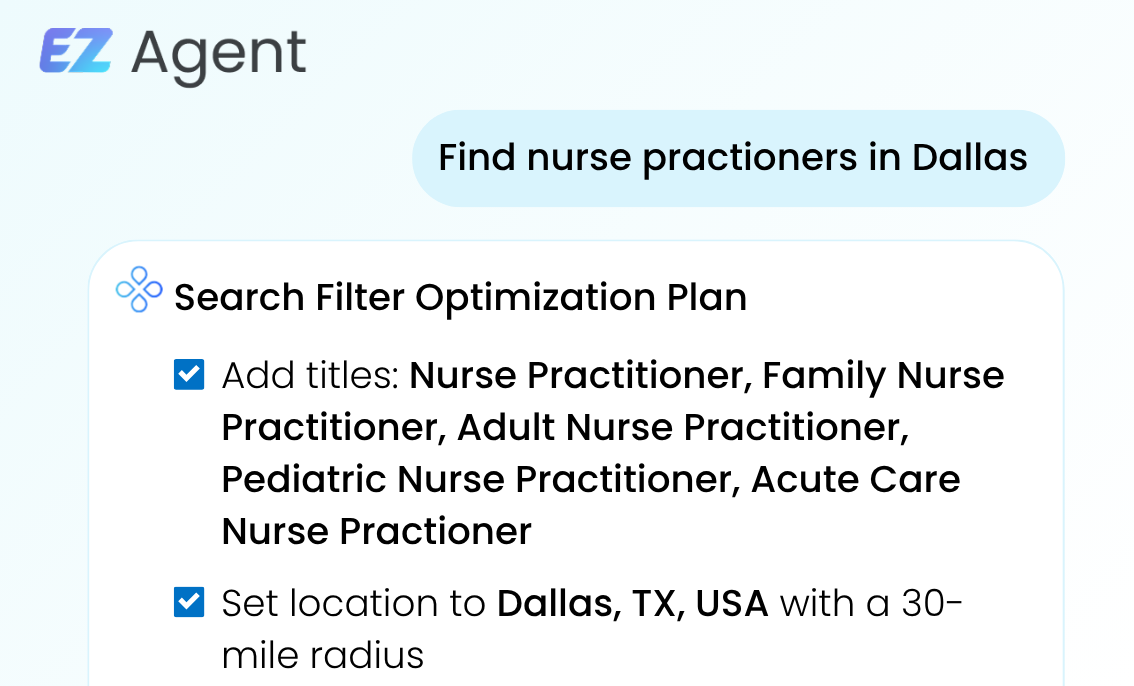
Briefing comes first because intake quality caps everything downstream. The failure mode is pasting a wish-list job description and accepting whatever comes back; the fix is treating intake as a structured negotiation. Give the agent three to five example profiles of people you would hire today, separate genuine must-haves from preferences (an agent treats every listed requirement as a filter, and each unnecessary must-have shrinks the pool geometrically), and state exclusions explicitly: competitors you cannot poach, locations that will not relocate, seniority bands that will not take the compensation. The screenshot below shows why this works mechanically: a modern agent converts your plain-English brief into an explicit search plan, expanding titles and setting radii, and a sloppy brief becomes a sloppy plan silently.
From one-line brief to search plan
Calibration is the discipline most teams skip, and it is where the compounding happens. In the first 48 hours, review the agent's sample matches and reject with reasons: "too junior," "agency background, need in-house," "this certification is expired." Every serious platform feeds this back into search strategy, and LinkedIn attributes a 16% improvement in InMail accept rates to better intake and calibration alone in its 2026 release - LinkedIn. Keep the review gate on outreach until the agent's shortlists hit your bar three batches in a row, then widen its autonomy. This mirrors how you would onboard a junior sourcer, with one difference: the agent never resents feedback and never gets bored of iterating.
Outreach configuration is where the benchmark data should overrule instinct. The most counterintuitive finding in Pin's dataset: automated email underperforms recruiter-written email per message (4.96% versus 6.31% reply rates), while LinkedIn messages outperform both at 17.08%. Automation wins on volume and consistency, not per-message quality, and the way to close the quality gap is channel mix and sequencing rather than more words. The chart below shows the single most actionable number in this guide: adding a LinkedIn touch to an email sequence multiplies cumulative replies by 2.3x to 3.9x.
Cumulative Candidate Reply Rate by Sequence Type (4M+ Messages)
The same dataset settles how long sequences should run. Reply rates decay from 5.52% on the first message to 3.34% by the fourth, and the first three touches capture 93.2% of all replies, so configure your agent to stop at three or four touches across at least two channels; everything beyond that adds spam risk for under 3% of incremental replies. Personalization basics still dominate: including the candidate's first name nearly doubles replies (5.13% versus 2.61%), and 150 to 199 words is the optimal message length. Expectations should also be set per role, not globally: the identical agent and sequence will pull 9.94% replies from product managers and 2.81% from healthcare professionals, a 3.5x spread that says nothing about your setup.
Reply Rate by Message Position in a Sequence
Delegation also runs inside hard physical ceilings that no agent can prompt its way past, and configuring an agent to ignore them gets accounts banned. On LinkedIn, a full Recruiter seat gets 150 InMail credits per month and most accounts can send only about 100 connection requests per week - Kondo. LinkedIn's User Agreement prohibits third-party bots and scrapers outright, and it enforces: compliant agents work through official APIs or licensed data rather than driving your LinkedIn account - LinkedIn Help. On email, Google and Yahoo require authentication (SPF, DKIM, DMARC) and enforce a 0.3% spam-complaint hard limit, with Gmail escalating rejections of non-compliant bulk senders since November 2025 - Red Sift. These ceilings are why credible vendors emphasize targeting precision over volume: the arms race rewards the most relevant thousand messages, not the largest hundred thousand.
Finally, manage the running agent by numbers, reviewed weekly, the way you would run a sourcing team standup. The metrics that matter form a short funnel:
- Reply rate per channel and sequence step, against the benchmarks above
- Qualified-candidate rate: share of agent-sourced profiles your team accepts at shortlist review
- Pass-through rate: shortlist to first interview, the truest quality signal
- Cost per qualified candidate: total agent cost divided by accepted candidates
- Time to first reply per role, the early-warning metric for a miscalibrated search
A funnel review like this catches the two classic agent pathologies early. A high reply rate with a low qualified rate means the agent is charming the wrong people: recalibrate targeting. A low reply rate with a high qualified rate means targeting is right and messaging or channel mix is wrong: fix sequencing before touching the search. Teams that run this loop weekly report the compounding gains the vendors advertise; teams that check in monthly usually discover a month of drift. And the deepest metric stays human: Gem's data shows rediscovered candidates from your own ATS rose to 44% of sourced hires by 2024, so point your agent at your own database before the open web - Gem.
8. Where Agentic Sourcing Wins and Where It Fails
The pattern in every credible success story is the same: agentic recruiting wins where roles are well-defined, volume is high, and speed decides outcomes. The flagship cases are worth restating with their context. Chipotle's Paradox deployment cut time-to-hire from 12 days to about 3.5 on in-restaurant roles and lifted application completion from 50% to 85%, because hourly candidates reward instant scheduling over ceremony - Paradox. In staffing, ConverzAI's voice agents produced 262 placements and $2.7M revenue impact in three months at Malone Workforce Solutions by contacting every applicant within minutes. In corporate sourcing, Expedia Group cut time-to-hire by 30 days with LinkedIn's Hiring Assistant, and General Motors cut screening time 70% with Workday's Recruiter Agent - TechTarget. Tech sourcing is the other sweet spot: definitions are crisp (stack, seniority, location), public signals are rich (GitHub, Stack Overflow), and cross-platform agents like HeroHunt.ai exploit those signals directly.
It is equally important to stare at the funnel math inside the wins, because it reveals what "success" means at volume. TalentBridge engaged 60,000 candidates in 90 days with ConverzAI's agents to produce 48 placements in a quarter - ConverzAI. That is a genuinely excellent staffing result, and it is also 1,250 conversations per placement: agentic recruiting at scale is a probabilistic machine, not a sniper. If your hiring plan is eight precise senior hires a year, that machine is the wrong shape for you, and the failure modes below explain why.
The clearest failure zone is executive and niche search. Retained firms still close 85 to 90% of executed engagements, and AI-led approaches lag badly at the top of the market; one documented case found an AI tool that over-weighted assertive communication styles screened out reserved but effective leaders, several of whom landed C-suite roles elsewhere within a year - RecruiterHustle. Executive searches fail agents for structural reasons: the candidate pool is tiny, the decisive information (board dynamics, motivation, reputation) lives in conversations rather than profiles, and a single bad outreach can burn a relationship the firm spent a decade building. The same logic applies to any role you cannot define in writing: an agent amplifies your spec, including its vagueness.
The second failure zone is data decay and hallucination. Roughly one in three professionals changes jobs within a 12-month window, and B2B contact records decay at 22.5 to 70% annually depending on source - Landbase. Agents sourcing from cached databases confidently present "current" roles that ended months ago, email dead addresses, and re-contact the same person through two different stale records. This is why data freshness is a primary vendor-selection criterion, why LinkedIn markets Hiring Assistant on its live graph, and why real-time lookup approaches beat static database dumps for contact-sensitive workflows. Ask every vendor one question: when was the profile you are showing me last verified, and can the agent check before it sends?
The third failure zone is the candidate trust gap, and the numbers are stark. Only 8% of job seekers believe AI makes hiring fairer, while 70% of hiring managers trust AI to make faster and better decisions; 46% of job seekers report declining trust in hiring overall, and 41% admit using prompt injections to game AI screens - Greenhouse. Candidates are also learning to detect machine-generated outreach; industry reporting describes AI-drafted sequences pulling a fraction of the responses of human-written notes when the personalization is generic, with candidates replying "Is this automated?" or going silent - Talroo. The mitigation is not hiding the agent (disclosure is increasingly required by law, per section 9) but raising personalization quality and keeping a human visibly reachable in the thread. The LinkedIn numbers prove the ceiling is high: agent-personalized InMails with good calibration outperform manual sourcing by 66% on acceptance, so the gap between the best and worst agent outreach is the whole game.
The final failure zone is organizational: buying an agent and running it like a database subscription. Gartner's finding that 88% of HR leaders have seen no significant business value from AI yet, and SHRM's finding that 56% of organizations do not formally measure their AI investments at all, describe the same underlying behavior: no calibration loop, no funnel metrics, no owner - SHRM. The delegation playbook in section 7 exists precisely because the technology's variance is now smaller than the operator's variance. In 2026, whether agentic sourcing works for you is mostly a management question, which is good news: management is fixable.
9. The Rules: Bias, Audits, and the Law Catching Up
The legal landscape for autonomous recruiting in mid-2026 is a split screen. The US federal government is actively deregulating: the EEOC removed its AI anti-discrimination guidance in January 2025, disparate-impact enforcement was ordered wound down, and a December 2025 executive order created a DOJ task force whose job is to sue states over their AI laws - The White House. Meanwhile states and the EU keep layering obligations on, and private litigation is escalating fast. The practical upshot for anyone delegating sourcing or screening to an agent: federal deprioritization does not remove liability, because Title VII, the ADA, the ADEA, and state civil-rights laws still fully apply and private plaintiffs can sue - Husch Blackwell.
The case defining the era is Mobley v. Workday, and its trajectory through 2026 has been relentless. After a federal judge conditionally certified a nationwide age-discrimination collective action in May 2025, the court authorized notice in February 2026 to everyone aged 40+ rejected through Workday's screening tools since September 2020, a scope that court filings connect to 1.1 billion rejected applications - Wiggins Childs. In March 2026 the court rejected Workday's argument that the ADEA does not cover applicants, and on June 22, 2026 it ruled Workday can be directly liable as an "agent" under California's FEHA even for applicants outside California - Duane Morris.
A second wave of litigation is forming behind Mobley, and it targets ordinary buyers, not just vendors. Harper v. Sirius XM alleges the AI scoring in an off-the-shelf applicant tracking system used zip codes, schools, and employment history as proxies for race in rejecting a Black IT professional roughly 150 times - Epstein Becker Green. And in March 2025 the ACLU and Public Justice filed complaints against Intuit and HireVue on behalf of a Deaf Indigenous woman rejected after an AI-scored video interview, alleging the underlying speech recognition performs worse for deaf and non-white speakers and that her request for human captioning was denied - Public Justice. The message across these cases is consistent: the vendor and the employer share the exposure, accommodation failures count, and "the algorithm did it" is not a defense anywhere.
On the statute side, the operator's map has a handful of landmarks, starting in Europe. The EU AI Act classifies recruitment AI as high-risk; its full high-risk obligations were deferred in June 2026 from August 2026 to December 2027, but its ban on emotion-recognition AI for job candidates has been enforceable since February 2025, with fines up to EUR 35 million or 7% of global turnover - DLA Piper. Any agentic interviewing tool that scores enthusiasm, voice stress, or facial expressions of EU candidates is already in prohibited-practice territory today, deferral or not. Deployers also owe candidates notice, human oversight with real authority to intervene, and monitoring for discriminatory impact once the high-risk obligations bite.
In the US, the strictest state rules are already in force. Illinois HB 3773, effective January 1, 2026, prohibits AI with discriminatory effect in employment decisions, explicitly bans zip codes as a proxy for protected classes, and requires notifying candidates when AI is used - Hinshaw. California's FEHA regulations, effective October 1, 2025, make employers with five or more California employees liable for disparate impact from any automated decision system, require keeping ADS data and testing results for four years, and extend agent liability to AI vendors - Paul Hastings. Notably, the California rules make your bias-testing history (or its absence) admissible evidence, which turns "we never audited" from an oversight into a litigation liability.
The rest of the US map is in motion, in both directions. NYC's Local Law 144 bias-audit regime is entering a stricter enforcement phase after a scathing December 2025 state comptroller audit found near-nonexistent enforcement to date - NY State Comptroller. Colorado's AI Act, the early landmark, was delayed to January 2027 and substantially narrowed - Hunton. Texas's TRAIGA, effective January 1, 2026, took the opposite pole: it prohibits only intentional AI discrimination, expressly states that disparate impact alone proves nothing, and is enforceable only by the state attorney general - K&L Gates. Multi-state employers therefore cannot design to one standard; the practical move is to build to the strictest rule you face (usually Illinois plus California) and inherit compliance everywhere else.
Data sourcing has its own regime, and agentic sourcing sits right on top of it. France's CNIL forced scraping vendor Kaspr to delete its entire 160-million-contact database after GDPR violations in harvesting LinkedIn data, closing the enforcement case in March 2026 - CNIL. The same scraped-profile pipelines that feed many sourcing agents are regulated personal data in Europe, which is a vendor-diligence question every EU-exposed buyer should ask: where does the index come from, what is the lawful basis, and what happens to your pipeline if a regulator orders the underlying database deleted?
The research on bias explains why regulators focus here, and it cuts both ways. The foundational University of Washington study found LLM-based resume screeners favored white-associated names 85% of the time and female-associated names 11% of the time, with Black male-associated names passed over in nearly 100% of tests - University of Washington. Worse for the standard safeguard, a 2025 follow-up found human reviewers mirror AI bias rather than correct it: 528 participants followed severely biased AI recommendations about 90% of the time, while choosing candidates equally across race when no AI advised them - University of Washington. That finding directly undercuts the human-in-the-loop safeguard most laws and vendors rely on: oversight only works if the human actually counteracts the machine.
There is credible counter-evidence, and it reframes the buying decision. Warden AI's analysis of 150+ independent bias audits found 85% of audited systems met the EEOC four-fifths rule, with an average impact ratio of 0.94 versus 0.67 for benchmarked human-led processes, but with fairness varying up to 40% between vendors - Warden AI. Read together, the studies say something precise: audited, purpose-built hiring AI can beat human baselines on measured fairness, unaudited AI can be catastrophically worse, and which agent you buy matters more than whether you use one. Independent audits are becoming a de facto procurement gate for exactly this reason.
Employers have noticed: 84% expect business impact from AI workplace regulation within a year (double the 2025 figure), and 68% now have a formal workplace AI policy versus 38% a year earlier - Littler. The operating checklist that emerges from counsel across these sources is short and implementable:
- Disclose AI use to candidates in outreach, screening, and interviews, in plain language
- Keep decision logs: which agent, which criteria, which evidence, for four years in California
- Run independent bias audits annually and before scaling any new agent
- Keep a human accountable who can explain every advancement and rejection
- Contract for indemnification and audit-cooperation rights with every AI vendor
None of these steps is expensive relative to the exposure, and one is existential: the standard SaaS liability cap of twelve months of fees is, in the words of employment counsel, not much comfort against a class action from thousands of auto-rejected applicants - K&L Gates. Post-Mobley, treat AI hiring risk as a shared employer-vendor exposure managed through contract: indemnification, audit cooperation duties, access to bias-testing results, and rights to validation data belong in every agreement.
Compliance here is also a quality forcing function rather than pure overhead. The logging, disclosure, and audit disciplines that keep you legal are the same disciplines that make the agent measurably better, because they force the funnel metrics and review gates of section 7 into existence. Teams that can explain every advancement and rejection decision also know exactly where their agent's judgment drifts, and they catch it in a weekly review instead of a plaintiff's filing.
10. What Comes Next: Superagents, MCP, and the Arms Race
The honest forecast is a hype correction and a structural transformation happening simultaneously, and the same analysts predict both. Gartner expects over 40% of agentic AI projects to be canceled by end-2027 for cost and unclear value, while also predicting that 40% of enterprise applications will feature task-specific AI agents by the end of 2026, up from under 5% in 2025 - Gartner. Both predictions describe the same mechanism: agents stop being products you buy and become features of the systems you already run, and the standalone projects that cannot justify themselves get culled. Recruiting is the proving ground for the whole enterprise agent thesis, because it has the clearest before-and-after metrics of any HR domain.
The analyst framing worth internalizing comes from Josh Bersin, whose 2026 research argues AI "superagents" will drive the largest HR transformation in decades, with core HR headcount potentially falling 30% or more as agents consolidate into domain families, recruiting first among them - Josh Bersin Company. His HR 2030 blueprint, introduced in the short video below, describes the end state this guide has been circling: talent acquisition run as a small human team directing a fleet of specialized agents, with displaced effort redirected to leading, curating, and training them.
Josh Bersin introduces HR 2030, the blueprint for agentic HR
The technical trajectory underneath that vision is interoperability, and its concrete form is MCP (Model Context Protocol), the open standard that lets AI assistants operate other software. The 2026 MCP roadmap prioritizes exactly what unattended enterprise agents need: asynchronous tasks, SSO-integrated auth, and audit trails - MCP blog. The recruiting stack is adopting it fast: Workable shipped a native MCP server with 38 recruiting tools in May 2026, Greenhouse took its MCP broadly available in July 2026, and SeekOut, HeroHunt.ai, and others already expose their indexes to agents this way. The endgame is that "which sourcing UI do you use" becomes the wrong question: recruiters will work from a general assistant that orchestrates ATS, sourcing index, and outreach through protocols. Our guide to recruiting with Claude shows what that already looks like in practice. Add OpenAI's announced AI-powered Jobs Platform, aimed squarely at LinkedIn - TechCrunch, and the distribution map of recruiting could look very different by 2028.
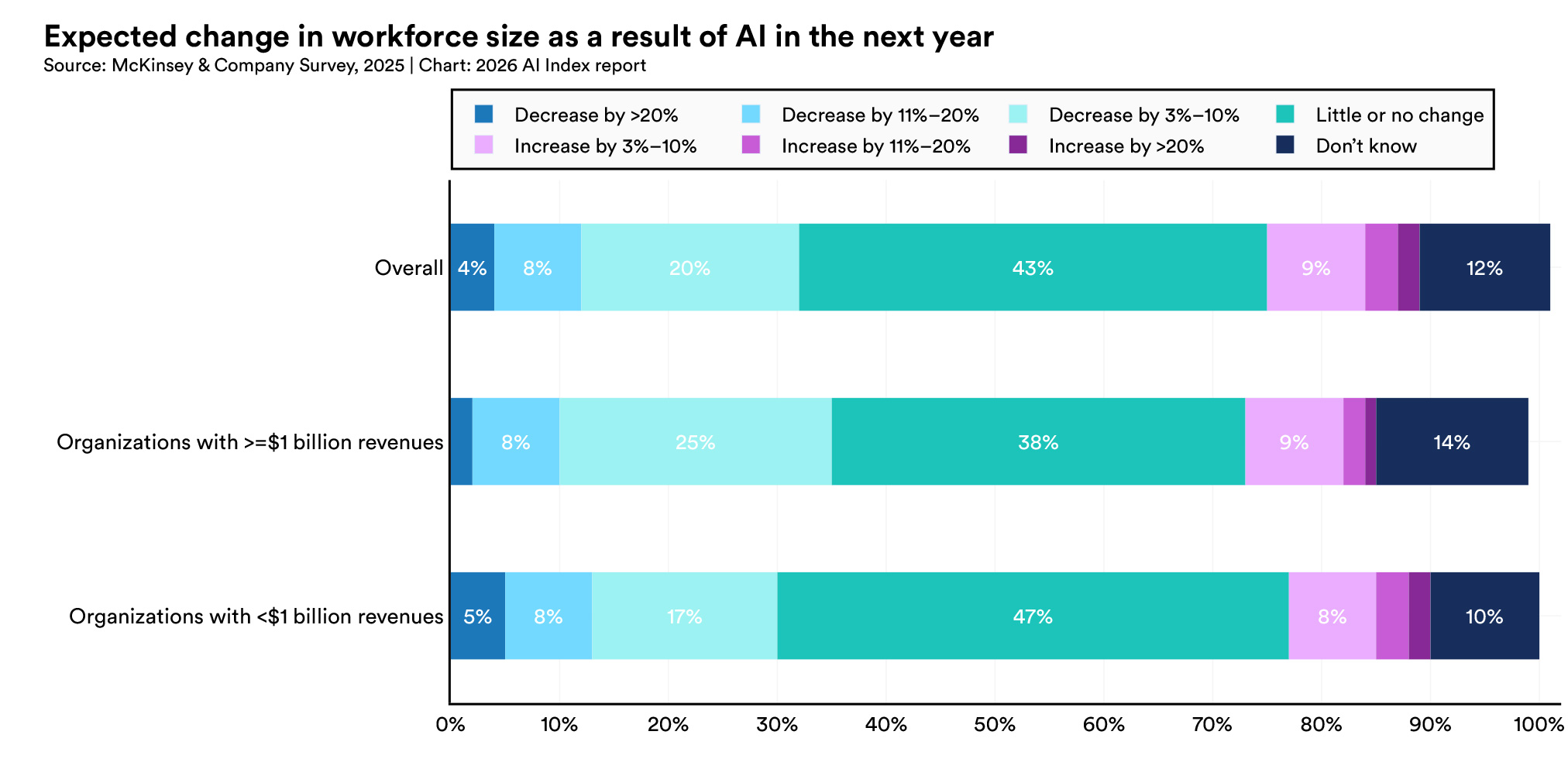
Economics will follow the agents. Deloitte cites projections that by 2030 at least 40% of enterprise SaaS spend shifts to usage-, agent-, or outcome-based pricing, and 35% of point-product SaaS tools get replaced by agents or absorbed into larger ecosystems - Deloitte. Recruiting is already living this: Workday's Flex Credits, Findem's outcome pricing, OptimHire's 6% placement fee, and Dover's per-hire marketplace are all bets that customers want to pay for hires, not seats. For recruiter jobs themselves, the data says transformation more than collapse, so far: Korn Ferry found 43% of companies plan to replace some roles with AI and only 24% plan to add recruiter headcount, while Robert Half's 2026 analysis found HR hiring steady and TA postings modestly up - Robert Half. The Stanford AI Index's economy chapter captures the same tension in one chart, below: about a third of organizations expect AI to shrink their workforce within a year, while 43% expect little or no change.
What organizations expect AI to do to headcount
The darkest storyline to watch is the authenticity arms race. Gartner predicts that by 2028, one in four candidate profiles worldwide will be fake, driven by deepfakes and synthetic identities - HR Dive. Pindrop measured deepfake fraud attempts rising more than 1,300% in 2024 and found over a third of applicants for its own openings were fraudulent - Pindrop. The counter-infrastructure is identity verification: LinkedIn crossed 100 million verified members and is pushing verification signals into third-party tools like Zoom - LinkedIn. By 2027, expect proof-of-human checks to be a standard stage in agent-run pipelines, on both sides: your agent verifying their humanity, and their agent verifying your job is real. The stable equilibrium this points to is candid and, honestly, fine: agents negotiating logistics with agents, and humans meeting only after both sides have established the conversation is worth having.
11. Getting Started: A 30-Day Plan and Decision Framework
Everything in this guide compresses into a decision framework you can apply this week. Match the tool camp to your hiring shape. If you hire high-volume hourly roles, conversational and voice agents on inbound flow (Paradox, Maki, Classet, or an interviewer like Alex) will produce the Chipotle-style wins, and outbound sourcing agents are the wrong tool. If you run staffing or agency desks, voice agents that reactivate your dormant database (ConverzAI) plus a self-serve sourcing agent give the best revenue per seat. If you hire knowledge workers and engineers, delegated outbound sourcing is your lever: pilot a self-serve autonomous platform like HeroHunt.ai, Juicebox, or Pin, or Hiring Assistant if you already pay for LinkedIn Recruiter seats. If you hire eight executives a year, keep your retained search relationships and use agents only for market mapping. And if you are enterprise-scale on Workday, Oracle, or SAP, your suite's agents (Illuminate, Eightfold-in-Oracle, SmartRecruiters) will arrive inside your existing contract; the question is sequencing them with a best-of-breed sourcing layer.
Then run a 30-day pilot designed to produce a decision, not a demo. Week one is setup and briefing: pick one real, well-defined role that you are also working manually (that parallel baseline is the whole experiment), write the intake with example profiles and true must-haves, and set the review gate to manual approval on all outreach. Week two is calibration: review every sample batch with reasons, per section 7, until shortlist acceptance stabilizes. Weeks three and four are measurement: let the agent run its sequences inside the deliverability ceilings, track reply rate, qualified-candidate rate, pass-through to interview, and cost per qualified candidate, and compare against your manual baseline on the same role. The trial economics make this nearly free: HeroHunt.ai has an 8-day free trial - start here, Juicebox and SeekOut offer free tiers or trials, and Pin starts at $99. Budget your own hours honestly: roughly five hours in week one, two hours per week after.
The decision at day 30 is a numbers comparison, but hold it to the standards this guide established. Vendor-grade results (81% fewer profiles reviewed, 66% better response rates) come from teams that calibrated aggressively; a mediocre pilot usually indicts the briefing, not the category. Check the compliance basics from section 9 before scaling: disclosure language in outreach, decision logs retained, a bias-audit commitment from the vendor, and indemnification in the contract. And keep perspective on what you are actually deciding. The application flood is not receding, LinkedIn's agentic products alone are a nine-figure business growing double digits, and the recruiters pulling ahead are not the ones with the strongest opinions about AI but the ones with three months more calibration data than their competitors. Delegating your first search costs an afternoon of setup and a month of attention. The teams that ran that experiment in 2025 are the case studies in this guide; the ones that run it now will be the case studies in the 2027 edition.
This guide reflects the agentic recruiting landscape as of July 2026. Pricing, features, regulations, and vendor status change fast in this market: verify current details with vendors and counsel before buying or deploying.