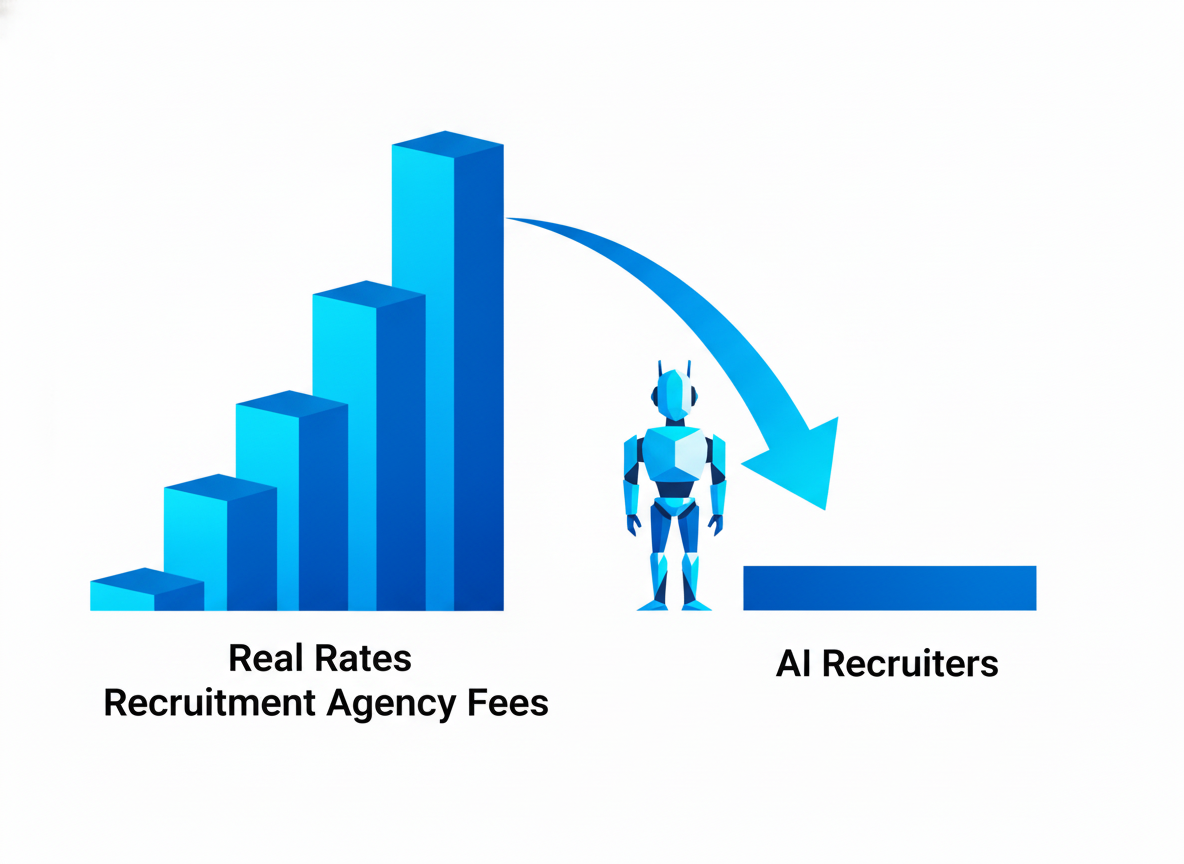




The Insider's Guide to Using Claude to Run a Faster, Sharper, More Profitable Recruitment Agency in 2026
Recruitment agencies that embed AI into their workflow were 3.5 to 4.5 times more likely to grow revenue in 2025 than those that did not - Bullhorn GRID 2026. That is not a rounding error. It is the difference between a firm expanding its desk count and one quietly writing redundancy letters, and the gap widened again this year.
For agency owners, the confusing part is not whether AI matters. It clearly does. The confusing part is what to actually buy, wire up, and trust when the incumbent tools contradict each other, the compliance rules keep moving, and every vendor claims their bot books meetings while you sleep. This guide cuts through that for one specific tool: Claude, Anthropic's AI assistant, and the ecosystem of connectors, skills, and agents around it.
This is written for the person who runs the desk, not the person who writes the code. It covers exactly what Claude costs, how it plugs into a Bullhorn-shaped stack, where it quietly saves money, and the places it will burn you if you let it near a hiring decision unsupervised. Every number here was checked against a primary source, and the honest failure modes get as much space as the wins, because a guide that only sells you the upside is not a guide, it is a brochure.
Contents
- The 2026 agency squeeze
- What Claude actually is, in plain agency English
- The pricing decoder: subscriptions, API, and agents
- The ROI arithmetic that reframes everything
- The Bullhorn problem and the strategic fork
- Connecting Claude to your stack
- The agency workflow, stage by stage
- Building your first recruiting skills and projects
- Where it breaks: the honest failure catalogue
- Compliance for agencies specifically
- Claude versus the field
- The agentic future and your fee model
- Your 90-day rollout plan
1. The 2026 agency squeeze
The market you are selling into is smaller than it was three years ago, and that fact should shape every technology decision you make this year. US staffing revenue peaked at $243.9 billion in 2022 and fell for three straight years to roughly $180 billion, with Staffing Industry Analysts forecasting only 1% growth in 2026 and 2% in 2027 - Staffing Industry Analysts. In the UK the picture is starker: the sector contributed £40.6 billion in gross value added in 2024, down from £44.4 billion the year before, an 8.6% drop in a single year - REC.
Underneath the headline contraction, the mix is shifting in ways that matter for where you point AI. Permanent placements have been hammered while contract holds up: UK permanent placements fell 33.5% between 2023 and 2024, from 806,400 to 536,400 - REC, while APSCo reported contract placements up 13% year on year even as permanent vacancies fell 16% - APSCo. Fewer candidates are coming to you first, too. Only 35% of candidates now approach a recruitment agency as their first move, down from 45%, and two to three of every five candidates turn down the offers you work so hard to secure - Bullhorn GRID 2026.
The bar chart below shows the shape of the US contraction and the slow bottoming-out that the current forecasts expect. It is the backdrop for everything that follows: in a flat market, growth has to come from doing more with the same headcount, not from a rising tide.
US Staffing Market Revenue by Year (USD billions)
What has changed most is who you are competing against. For a third consecutive year, tight talent pools and falling job volumes top the list of agency concerns, but the number two obstacle is now competition from other firms, and specifically the tech-enabled ones pulling ahead - Bullhorn GRID 2026. Bullhorn's data is blunt about the divide: 78% of firms that grew revenue more than 25% have AI embedded in their applicant tracking system, against 51% of firms whose revenue fell 10% or more. Whether AI causes that growth or merely correlates with well-run firms is a question we return to in section nine, but the direction of travel is not in dispute.
To understand why a few dollars of AI spend can matter so much, you have to look at how thin agency economics actually are. Contingency fees have been stable for years at 15 to 30% of first-year salary, with entry-level roles at the bottom of that band and senior or specialist searches at the top - The Resource Company. Temporary and contract work looks healthier on the surface, with markups over pay rate running 40 to 55% in light industrial and 30 to 50% in IT, but the agency's actual net profit inside that bill rate is only about 3 to 8% once payroll, insurance, and overhead come out. On a contract desk, in other words, a few points of cost or a few hours of wasted consultant time is the entire margin.
That thin margin is also why the industry is consolidating around the firms that operate efficiently. North America opened 2026 with 35 staffing M&A transactions in the first quarter, the strongest opening quarter in over three years, with IT staffing and executive search the most active segments - Staffing Hub. There are roughly 27,000 staffing and recruiting companies in the US alone - American Staffing Association, which means the competitive pressure is not coming from a handful of giants but from thousands of firms, some of whom have already rebuilt their process around AI and can now quote faster and cheaper than you.
This is the real reason to read on. In a growing market you can coast on relationships and volume. In a market that has shrunk by a quarter and is only now stabilising, on fees that leave 3 to 8% of a contract bill rate as actual profit, the firms that redesign their process around cheap, fast reasoning are the ones taking share from the firms that do not. Claude is one of the cheapest ways to buy that reasoning, and the rest of this guide is about using it well.
2. What Claude actually is, in plain agency English
Claude is not a single product, and treating it as "another ChatGPT" is the first mistake owners make. It is a ladder of surfaces that get progressively more powerful, and you climb it as your comfort grows. At the bottom is plain chat, a text box where you paste a job spec and ask for a Boolean string. Above that sit Projects, persistent workspaces that remember a client's context. Then come Skills, reusable instruction packs; Connectors, live links into your other software; Cowork, an agent that does multi-step jobs unattended; and Claude Code, a file-and-data workhorse that non-developers increasingly use for spreadsheet grunt work.
The most important thing to understand is that the flashiest surface is not built for engineers. When Anthropic analysed 1.2 million anonymised Cowork sessions from more than 600,000 organisations, software development was just 8.7% of usage, while business-process operations made up 33.4% and content and copywriting another 16.4% - TechCrunch. In other words, the typical Cowork task is reconciling a spreadsheet, drafting outreach, or building a checklist, which is exactly the back-office load that eats a recruiter's week. Cowork launched as a research preview on 12 January 2026 and reached general availability for all paid subscribers on 9 April 2026 - Claude release notes, expanding to web and mobile in early July.
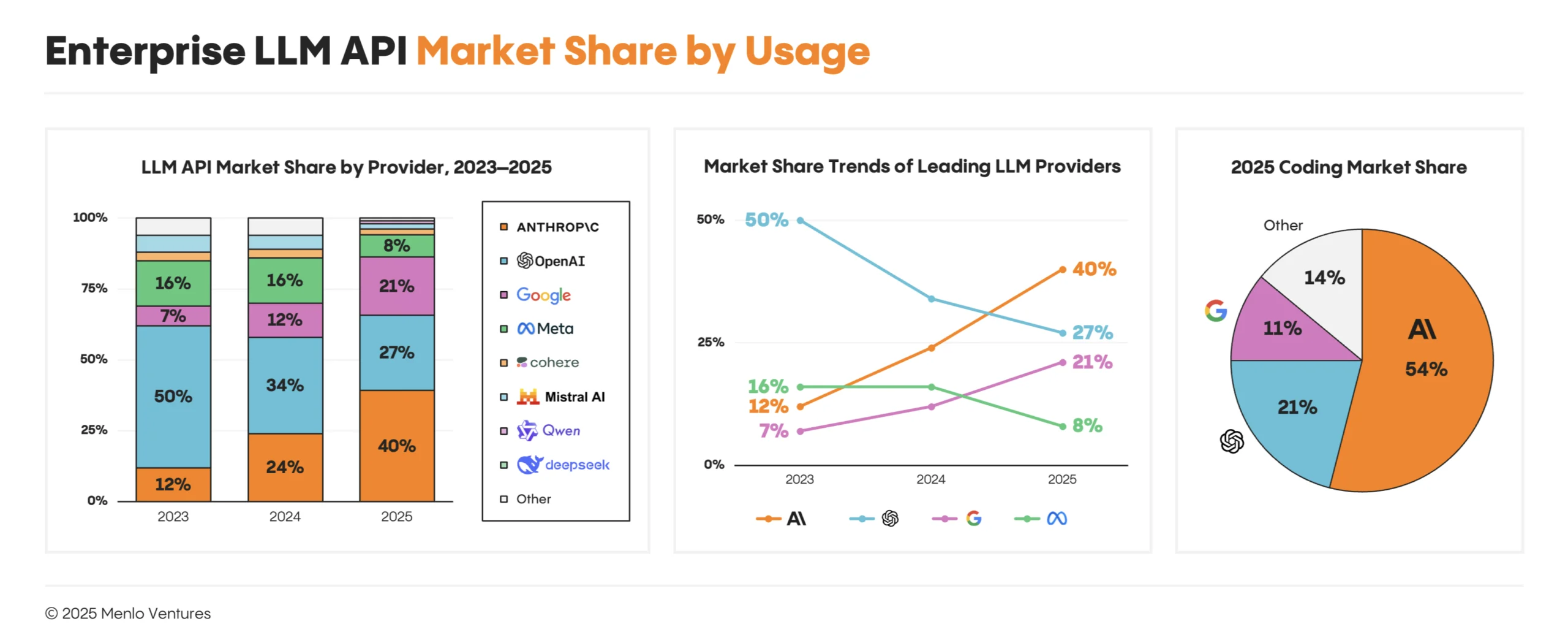
The Menlo Ventures enterprise survey below is worth pausing on, because it explains why so many businesses standardised on Claude specifically rather than a rival. Among companies buying large-language-model access through the API, Anthropic's share of usage climbed from 12% in 2023 to 40% by the end of 2025, overtaking OpenAI, which fell to 27%.
Enterprise LLM API market share, end of 2025
For a non-technical owner, the practical map of what to touch first is simpler than the product list suggests, because you do not need most of the ladder to get value. Chat and Projects together handle perhaps 80% of daily recruiting work: writing the job advert, generating the Boolean string, summarising a CV, and drafting interview questions. Skills are the next rung, and they turn a good prompt into a one-click button that your whole team can reuse rather than a trick that lives in one consultant's head. Connectors let Claude read your email, calendar, and drive directly, which is what finally stops the endless copy-and-paste. Cowork is where you hand over a whole multi-step brief, something like "go through these forty lapsed candidates and draft a re-engagement message for each," and let it work while you do something else. Claude Code, despite the name, is optional and mostly useful for messy data jobs such as deduplicating an exported candidate CSV.
The reason to learn the ladder rather than just the bottom rung is that each step removes a category of manual work. Chat removes blank-page writing time. Projects remove re-explaining a client every session. Connectors remove copy-paste. Cowork removes babysitting. You do not have to climb it all at once, and section thirteen lays out a sequence that starts at the bottom and only moves up once each rung is paying for itself. The short version: think of Claude as a very fast, very literal junior consultant who has read everything and remembers nothing unless you write it down for them.
Two smaller surfaces are worth knowing because they meet recruiters where they already work. Claude for Excel is an Office add-in that opened to all Pro subscribers in January 2026 and is genuinely useful for the spreadsheet side of agency life: reconciling a placement tracker, modelling a contract margin, or cleaning an exported candidate list - Anthropic. Claude for Chrome is a browser extension, now in beta on all paid plans, that lets Claude see and act on the page you are looking at, which matters when so much recruiting work happens inside a web-based ATS that has no formal integration - Anthropic. Neither is essential, but both remove a category of tab-switching.
The structural point behind all of this is that Claude is not a walled garden, and that reduces your lock-in risk. The connector standard underneath it, the Model Context Protocol, was created by Anthropic and then donated to a Linux Foundation body in December 2025, so the plumbing you build is an open standard rather than a proprietary hook - Anthropic. Skills followed the same path and are now read by more than two dozen other AI tools. For an owner, that means the work you put into writing a good screening rubric or a submittal template is portable: if you switch models in two years, the assets come with you. That is a materially different proposition from buying a closed AI feature inside a single vendor's platform, which is exactly the tension section five is about.
The following short demo shows Cowork handling a business-user task end to end, which is the mental model to carry into the rest of this guide: not a chatbot you interrogate, but a coworker you delegate to.
Claude Cowork Lightning Demo for Business Users
3. The pricing decoder: subscriptions, API, and agents
Claude runs two parallel pricing worlds that meter completely differently, and the single most expensive mistake an agency owner can make is choosing the wrong one. The first world is subscriptions: flat monthly fees that buy a pool of usage governed by rate limits. The second is the API, where you pay per unit of text processed. A third, newer option, Managed Agents, sits on top of the API for teams building their own autonomous tools. Getting this distinction right can be the difference between a $100 monthly bill and a five-figure one for identical work.
Start with the subscription plans, because that is what a desk will actually buy. Claude Pro is $17 per month billed annually and includes Claude Code, Cowork, unlimited Projects, and Microsoft 365 integration; the Max tiers add far higher usage ceilings at $100 and $200 per month - Claude Pricing. For teams, a Standard seat is $20 per user per month annually and a Premium seat is $100 per user per month, the latter carrying 6.25 times the usage of a Pro plan and including Cowork and Claude Code - Claude Help. The table below lays out the full ladder.
Claude plans, July 2026 - Claude Pricing:
| Plan | Price (annual) | Key inclusions | Best for |
|---|---|---|---|
| Free | $0 | Chat, web search, memory, one connector | Trials |
| Pro | $17/mo | Claude Code, Cowork, unlimited Projects | Solo recruiter |
| Max 5x | $100/mo | 5x Pro usage, priority access | Heavy solo user |
| Max 20x | $200/mo | 20x Pro usage | Power user, small desk |
| Team Standard | $20/seat/mo | SSO, admin, no model training | Agency desk |
| Team Premium | $100/seat/mo | 6.25x usage, Cowork, Claude Code | High-volume desk |
| Enterprise | $20/seat + usage | SCIM, audit logs, custom retention | Larger agency |
The trap hides in that last row. Enterprise looks cheap at $20 per seat, but it includes no usage at all: every chat, every Cowork run, every token is metered on top at API rates, so a heavy team can walk into a five-figure bill that a flat $200 Max seat would have absorbed - Anthropic API pricing. Owners who assume "Enterprise is the serious plan" often over-buy. For a small, high-usage desk, a couple of Max 20x seats can be dramatically cheaper than metered Enterprise; for a light-usage team of ten, the flat Team seats win. The instinct that the priciest plan is the safest is exactly backwards here.
If you decide to build custom automations rather than use the chat apps, you pay per token, roughly a token being three-quarters of a word. The current rates are $5 and $25 per million input and output tokens for the flagship Opus 4.8, $3 and $15 for Sonnet, and $1 and $5 for the fast, cheap Haiku, with Sonnet 5 on introductory pricing of $2 and $10 through 31 August 2026 - Anthropic API pricing. Two discounts matter for agency-scale jobs: the Batch API halves the price for work that is not time-sensitive, and prompt caching lets a cached instruction be re-read at a tenth of the input price. Those levers are why, as the next section shows, the raw cost of AI recruiting is far lower than owners expect.
The other thing subscriptions hide is the rate limit, and it catches teams off guard because Anthropic publishes it as a vague multiplier rather than a hard number. A Pro plan is the baseline, Max is five or twenty times that, and a Team Premium seat is roughly 6.25 times a Pro plan, all governed by rolling five-hour windows plus weekly caps - Anthropic. Nobody tells you how many CVs that is. In practice a consultant doing ordinary chat work will never notice the ceiling, while a consultant running Cowork sessions across a large candidate list can hit a weekly wall and lose the tool until it resets.
Work a concrete decision through and the shape of the right answer appears. Take a ten-person agency where two consultants are heavy AI users and eight are ordinary ones. Putting all ten on Team Premium at $100 a seat costs $12,000 a year and over-buys badly for the eight. Putting all ten on Team Standard at $20 a seat costs $2,400 and starves the two. The sane split is eight Standard seats plus two Premium, at roughly $4,320 a year, and moving any genuinely bulk work (screening a thousand-CV backlog, re-enriching the database) onto the metered API where there is no wall at all. That mixed posture, flat rates for interactive work and pay-as-you-go for bulk, is what most well-run AI-using agencies land on, and it is cheaper than either extreme.
Managed Agents, launched in public beta on 8 April 2026, are the third option: cloud-hosted agents that run long, multi-step sessions with sandboxing and permissions, billed at standard token rates plus $0.08 per session-hour of active runtime - Anthropic. Most agencies will never touch them directly; they are the plumbing that vendors like the ones in section eleven build on top of. The takeaway for an owner is simply that the platform beneath Claude is stable and maturing: Anthropic raised a $30 billion round in February 2026 at a $380 billion valuation on $14 billion of run-rate revenue - Anthropic, and filed confidentially for an IPO in June. You are not betting on a fragile startup.
4. The ROI arithmetic that reframes everything
Owners brace for AI to be the expensive new line item on the P&L. The arithmetic says the opposite, and once you see it, the whole build-versus-buy question changes shape. The cost of the actual thinking Claude does is close to a rounding error next to the tools you already pay for; what is expensive is the sourcing and applicant-tracking infrastructure, and Claude does not replace that. It replaces labour.
Work the numbers on a real task. Screening 100 two-page CVs against a structured rubric consumes roughly 200,000 input and 30,000 output tokens, because a two-page CV is about 1,800 to 2,600 tokens with the current tokenizer - Winder.ai. At published rates that costs about $0.35 on Haiku, $1.05 on Sonnet, and $1.75 on Opus, and the Batch API halves each figure - Anthropic API pricing. Writing 50 genuinely personalised outreach messages adds well under a dollar. A full day of screening plus outreach lands under $2.50 in raw tokens. For comparison, Anthropic's own worked example puts the cost of processing 10,000 support conversations on Haiku at roughly $37 in total.
Now set that against the vertical stack an agency already funds. A single LinkedIn Recruiter Corporate seat lists at $10,800 to $15,000 a year, with prices up around 15% in 2026 - HootRecruit. A SeekOut contract runs a $20,000 median - Pin, hireEZ around $13,000 - Juicebox, and Bullhorn lands most firms at $150 to $250 per user per month once add-ons are counted. A Claude Team Premium seat, by contrast, is $1,200 a year. The chart below puts these side by side, and the point it makes is not "Claude is cheaper than LinkedIn." It is that Claude occupies a completely different layer of the cost structure.
Annual Cost per Seat, Recruiting Tools (USD)
The reason this reframes the decision is that Claude and the expensive tools are not substitutes. LinkedIn, SeekOut, and Bullhorn sell you data and outreach infrastructure: profiles, contact details, and the system of record. Claude sells you cheap reasoning and writing: it reads the CVs that database surfaced, drafts the messages that platform sends, and summarises the notes that ATS stores. You still need the vertical stack; you just stop paying a human to do the reading and writing on top of it. That is why the honest framing throughout this guide is that Claude replaces labour, not software.
A worked example makes the payback concrete, with the caveat that it is a vendor-published case study and self-reported, so treat the numbers as directional rather than audited. A 50-recruiter US staffing firm running about $18 million in revenue automated five workflows using Claude behind an automation tool, and cut per-recruiter administrative time from roughly three hours a day to thirty minutes. The build cost about $3,000 up front and $180 a month to run, against roughly $72,000 a year of recovered consultant time, which works out to payback in a little over two weeks - Workforce Next. Even if you halve every one of those claims out of scepticism, the payback period is still measured in weeks, not quarters. That is the practical signature of this technology: the upfront cost is small enough that the risk of trying is low, which is why the sequenced pilot in section thirteen makes more sense than a business case built on projections.
The mechanism that keeps bulk work cheap is worth understanding because it is the difference between a sane bill and a silly one. Prompt caching lets Claude re-read a long, unchanging instruction, your screening rubric, your house style guide, your client brief, at one tenth of the normal input price, while the Batch API halves the cost of anything that does not need an answer in the next few seconds - Anthropic API pricing. Screening a backlog overnight is the textbook case: the rubric is cached, the CVs are batched, and the job that would have cost a consultant two days costs a few dollars and runs while the office is dark. Agencies that complain AI is expensive are almost always paying full interactive rates for work that should have been cached and batched.
There is one catch worth naming so the arithmetic stays honest. Subscription usage is capped by rate limits, published only as vague multipliers rather than hard token counts, and Anthropic explicitly warns that Cowork burns through those limits faster than chat - Anthropic. A heavy desk can hit a weekly wall mid-Thursday and lose the tool until the window resets. The escape hatch is to move the heaviest, most repetitive jobs (bulk screening, database re-enrichment) onto the metered API through a connector or a vendor, where you pay per token with no wall, and keep the flat subscription for interactive work. Getting that split right is the difference between AI feeling unlimited and feeling rationed.
5. The Bullhorn problem and the strategic fork
Here is the single most agency-specific fact in this entire guide, and almost no vendor will tell you: the applicant tracking system most staffing firms run has deliberately not opened a door for Claude. Bullhorn, the dominant staffing ATS and CRM, ships no official Model Context Protocol server and does not appear in Anthropic's Connectors Directory - UseCarly. This is not an oversight that a patch will fix next quarter. It is a strategy.
Bullhorn's whole 2025 to 2026 play is to move from "system of record" to "system of action" using its own agentic layer, Amplify Digital Workers, unveiled at Engage Boston. Amplify's matching engine draws on more than 60 million historical placements and the company reports early adopters seeing 51% more submissions and 22% higher fill rates - Bullhorn. Crucially, Bullhorn pitches its in-system chat assistant as a reason not to route candidate data to external tools like ChatGPT or Claude at all: keep the data in Bullhorn, use Bullhorn's AI. That is a coherent bet, and for some firms it is the right one, but it means the native, one-click Claude experience is simply not available for your core database.
Bullhorn Amplify Digital Workers

That leaves you with a genuine strategic fork, and it is worth deciding deliberately rather than by accident. Path one is to lean into Bullhorn's closed ecosystem: buy Amplify, keep everything in-system, and accept that Bullhorn's AI is quoted separately and priced at a premium on top of your $99 to $165 per user core seats - Bullhorn Pricing. Path two is to run Claude as a horizontal reasoning layer and bridge it into Bullhorn through third-party middleware. The commercial MCP bridge from StackOne, for example, exposes 47 pre-built actions across candidates, contacts, job orders, and placements, with per-user OAuth and prompt-injection scanning - StackOne, while unified-API providers like Merge and CData offer read-only paths.
Path one deserves a fair hearing, because Bullhorn's numbers are not marketing fluff. Its Digital Workers early adopters report real operational gains: the staffing firm Procom lifted its submission-to-placement rate by 65%, Employment Enterprises grew weekly gross profit 23%, IDR saved around 200 hours a week, and Tential handled 40% more submissions with the same team, with placements per recruiter across adopters up 39% - Bullhorn. If your firm is large, heavily Bullhorn-dependent, and nervous about data leaving the system, buying the incumbent's agents is a defensible choice that outsources the hard compliance questions to your vendor.
What makes it a real trade-off rather than an obvious one is the cost structure, which is where agencies get surprised. The sticker seat is only the floor: Bullhorn's automation, analytics, and sourcing modules are quoted separately, Amplify is priced separately again, and most firms end up at $150 to $250 per user per month all-in rather than the $99 headline. This opacity is the industry norm at the top end, and it contrasts sharply with the transparent SMB tools, where Manatal, Zoho Recruit, and TrackerRMS all publish their tiers openly. Some contracts also carry escalators; Crelate, for instance, raises renewals by the greater of 7% or inflation - Pin. Compare that against a $20 Claude seat and the point is not that Bullhorn is overpriced, it is that you should know which layer you are paying a premium for.
The trade-off is about who carries the burden. On path one, Bullhorn owns the security, the data residency, and the support, and you pay for that. On path two, the reasoning stays cheap and portable, but the agency, not Bullhorn, owns the integration, the security review, and the data-processing agreement. Neither is wrong. What is wrong is drifting into path two by pasting candidate CVs into a personal Claude account without realising you have just made yourself the data controller for a connection nobody signed off. Decide the fork on purpose, document it, and pick middleware that does per-user authentication rather than a shared master key. The genuinely native Claude experience, meanwhile, quietly belongs to the newer platforms covered next.
6. Connecting Claude to your stack
If Bullhorn is the wall, the rest of your stack is mostly open doors, and 2026 was the year the recruiting-specific ones opened. Connecting Claude to your software happens through the Model Context Protocol, an open standard Anthropic created in November 2024 and then donated to a Linux Foundation body in December 2025, so it is no longer a proprietary hook - Anthropic. In plain terms, MCP is a universal adapter: instead of copy-pasting between your email and Claude, you authorise a connector once and Claude can read and act inside that tool within your existing permissions.
The general-business connectors are mature and worth turning on first. Anthropic added an official Google Workspace connector in February 2026 covering Gmail, Calendar, and Drive, and explicitly does not train on that connector's data - Claude Help. The Microsoft 365 connector operates as a secure proxy so files stay in your tenant - Claude Help, and Slack runs an official hosted server where the agent acts only within your Slack permissions - Slack. Those three alone remove most of the copy-paste from a recruiter's day.
The recruiting-specific connectors are newer, and this is where your platform choice starts to bite. The pattern across 2026 is unmistakable: the AI-native and modern platforms shipped official servers, and the legacy staffing systems did not. Workable released an official MCP server on 13 May 2026 with 38 tools covering jobs, candidates, pipeline, and offers, free on every plan - GlobeNewswire. Ashby followed on 29 June with an open beta built on user-level authentication and optional admin approval before any write - Ashby. Apollo.io shipped a native Claude connector that works on any plan including the free tier, and Manatal exposes its LLM integration and open API on its top tier.
Set against that, the legacy staffing platforms are conspicuously absent. Bullhorn, iCIMS, Gem, and hireEZ have no official server, so any connection runs through a third party - HeroHunt. If you are choosing an applicant tracking system this year and expect to lean on AI, this is now a legitimate selection criterion rather than a technicality: an ATS with an official, well-scoped MCP server will let your team drive it from inside Claude on day one, and an ATS without one will not.
Two of those deserve a direct link because agencies will actually use them for outreach and sourcing. Apollo's connector lets Claude search its B2B contact database, enrich records, and drop prospects into sequences, which is genuinely useful for business-development lead building; you can start on any plan at Apollo.io. For firms that want an AI-first applicant tracking system rather than bolting Claude onto a legacy one, Manatal runs from $15 per user per month on annual billing with a 14-day free trial and unlocks its Claude and open-API integration on the Enterprise Plus tier at $55. A recruiting-native option worth knowing is that HeroHunt.ai also publishes its own MCP server, so its 1 billion-plus profile sourcing can be driven from inside Claude rather than a separate tab.
Manatal
If you take path two on the Bullhorn fork above, Manatal is the AI-native ATS this section has in mind: it exposes an open API and an LLM integration so Claude can read and act on your pipeline, and it starts at $15 per user per month on annual billing with a 14-day trial and no card. The honest catch is that the integration you actually want lives on the $55 Enterprise Plus tier, not the $15 one, and that entry tier caps at 15 active jobs and 10,000 candidates, so any desk running more than a handful of live requisitions is really comparing at $35 to $55. It earns the slot only if you are genuinely willing to leave a legacy ATS, not as a bolt-on next to Bullhorn.
One door stays firmly shut, and you should know it before wasting time. There is no official LinkedIn connector, and none is expected; the unofficial browser-automation workarounds violate LinkedIn's terms of service and risk account bans, with GDPR adding EU exposure on top - GitHub. The safe rule for every connection, LinkedIn or not, is to prefer official OAuth remote connectors over local servers that need a pasted API key, and to use read-only access wherever the job does not strictly require writing back.
That rule is not paranoia, and it is worth understanding why the official connectors are safer. Remote MCP connectors authenticate with OAuth 2.1, the same delegated-permission model behind "sign in with Google," which means Claude never receives your password and can only see what the signed-in user could already see - Anthropic. Ashby's implementation is the pattern to look for: it uses per-user authentication rather than one shared service account, and lets an administrator require explicit approval before the agent writes anything back - Ashby. A connector wired to a shared master key, by contrast, hands every consultant the permissions of your most privileged admin, which is exactly how a junior's careless prompt becomes a company-wide data problem.
The risk that owners consistently underrate is prompt injection, and the clearest way to hold it in your head is what security researchers call the lethal trifecta: private data, untrusted content, and an outbound channel. Any one is fine. All three in a single unattended agent is a breach waiting to happen, because untrusted content can carry instructions that hijack the agent into sending your private data out through the channel you helpfully attached. A recruiter builds this trifecta by accident the moment they connect an ATS full of candidate personal data, feed in inbound CVs and web research from strangers, and attach an email tool so the agent can "just send the outreach."
These are not theoretical failures. In 2025 and 2026 the platform vendors themselves got bitten: Asana's own MCP server leaked data across customer tenants for roughly two weeks, exposing information to around a thousand organisations, which is precisely the multi-client failure an agency holding several clients' candidate data should fear. Anthropic's own Git connector shipped prompt-injection vulnerabilities that had to be patched. The practical guardrails follow directly from the trifecta: never point one unattended session at both untrusted inbound content and an outbound channel, prefer read-only, require human approval before any write, and keep the agent that reads strangers' CVs separate from the agent that can send email. Do that and MCP is a genuine productivity unlock rather than an exfiltration route.
7. The agency workflow, stage by stage
The mistake most owners make is asking "what can AI do for recruiting" in the abstract. The useful question is narrower: at which specific stage of your own placement process does Claude remove the most manual work for the least risk? The answer is consistently the admin-heavy middle, not the judgment-heavy ends. UK recruiters lose roughly 17.7 hours per vacancy to administrative work - People Management, and that is the pool Claude drains.
Map it onto your actual funnel and the picture sharpens. Only about 3% of applicants reach interview and under 1% get hired - Pin, which means the bottleneck is triage: reading a mountain of CVs to find the few worth a call. A healthy agency keeps a CV-submission-to-interview rate of at least 50% and an interview-to-placement ratio of 3:1 or better - ecruit, and those ratios collapse when the front of the funnel is polluted by a bad brief. The diagram below shows where Claude earns its keep across the lifecycle.
The highest-value, lowest-risk use is the intake-to-brief transform, because a bad brief corrupts everything downstream. Feed Claude a transcript of a messy 45-minute hiring-manager call and ask it to produce a structured brief: must-haves capped at five, explicit deal-breakers, the comp band, ideal current titles, and a Boolean string. That single step fixes the root cause of low submission-to-interview ratios, which is recruiters working from vague requirements. The submittal pack is the next win: a standardised, client-ready candidate one-pager built with Claude's document skills, so every consultant sends the same professional format instead of a rushed email.
Two later stages are quietly the most profitable and the most neglected. Databases decay at roughly 30% per year, and re-enriching stale records lifts response rates around 50% - PitchMe, while redeployment is a hidden margin lever where top light-industrial firms place 40 to 60% of temps into a next assignment against under 25% for laggards - SIA. Claude is well suited to both: a Cowork session can work through a bench of lapsed candidates, draft a re-engagement message for each, and flag the ones whose stated preferences match a live role. Counter-offer coaching is a similar draft-and-review job, given that 50% of resigners are counter-offered and most who accept leave within six months anyway - Eclipse.
Business development is the stage where agencies most often misuse Claude, and it deserves a warning rather than a recipe. The instinct is to point AI at the top of the funnel and mass-produce outreach, which is exactly backwards. Generic, templated messaging has collapsed in effectiveness precisely because everyone now has a machine that writes it, and the well is poisoned: reply rates on untargeted sequences have fallen to low single digits while trigger-based outreach, messages sent because something actually happened, still performs many times better. The variance in reply rates is explained far more by who you contacted and why than by how the copy reads.
The right Claude play in business development is therefore not "write five hundred messages faster." It is "detect the signal, then write one genuinely relevant message." A construction recruiter in London who monitors council building-regulation submissions knows which firms just won work and will need people, and reaches out on that basis rather than on a scraped list. That is a research-and-synthesis job, which is exactly what Claude is good at: give it a Project loaded with your target market, have it scan for funding rounds, executive hires, office moves, or contract awards, and then draft the one message that references the specific trigger. Used that way AI improves your list quality, which is the thing that actually moves reply rates. Used the other way it accelerates you into the spam filter and burns the domain reputation you will need next year.
Notice what is missing from that list: the decision. Claude drafts the brief, triages the pile, formats the pack, and re-markets the bench, but a human still chooses who to submit and who to place. That is not timidity, it is the design that keeps you compliant and out of the failure modes in section nine. The winning pattern across every stage is the same: let Claude do the reading, writing, and structuring, and keep the judgment with the consultant whose name is on the placement.
8. Building your first recruiting skills and projects
Prompting Claude well is a skill you can systematise, and the two tools that turn a clever one-off prompt into a repeatable team asset are Projects and Skills. A Project is a persistent workspace with its own knowledge and custom instructions; the natural agency pattern is one Project per client, loaded with that client's job specs, tone of voice, interview process, and past feedback, so every session starts already knowing the account instead of being re-briefed. This alone removes the biggest hidden cost of chat, which is re-explaining context.
Setting up the Project properly is worth twenty minutes per client and pays back all year. Load its knowledge with the things you currently re-explain: the client's past job specs, the tone they respond to, their interview process and typical timeline, the feedback they have given on previous candidates, and the reasons past submissions were rejected. That last one is the most valuable and the most neglected, because a Project that knows why this client rejected your last three candidates will stop you submitting a fourth like them. The custom instructions then carry your house rules, chiefly that Claude should never state a conclusion the source documents do not support.
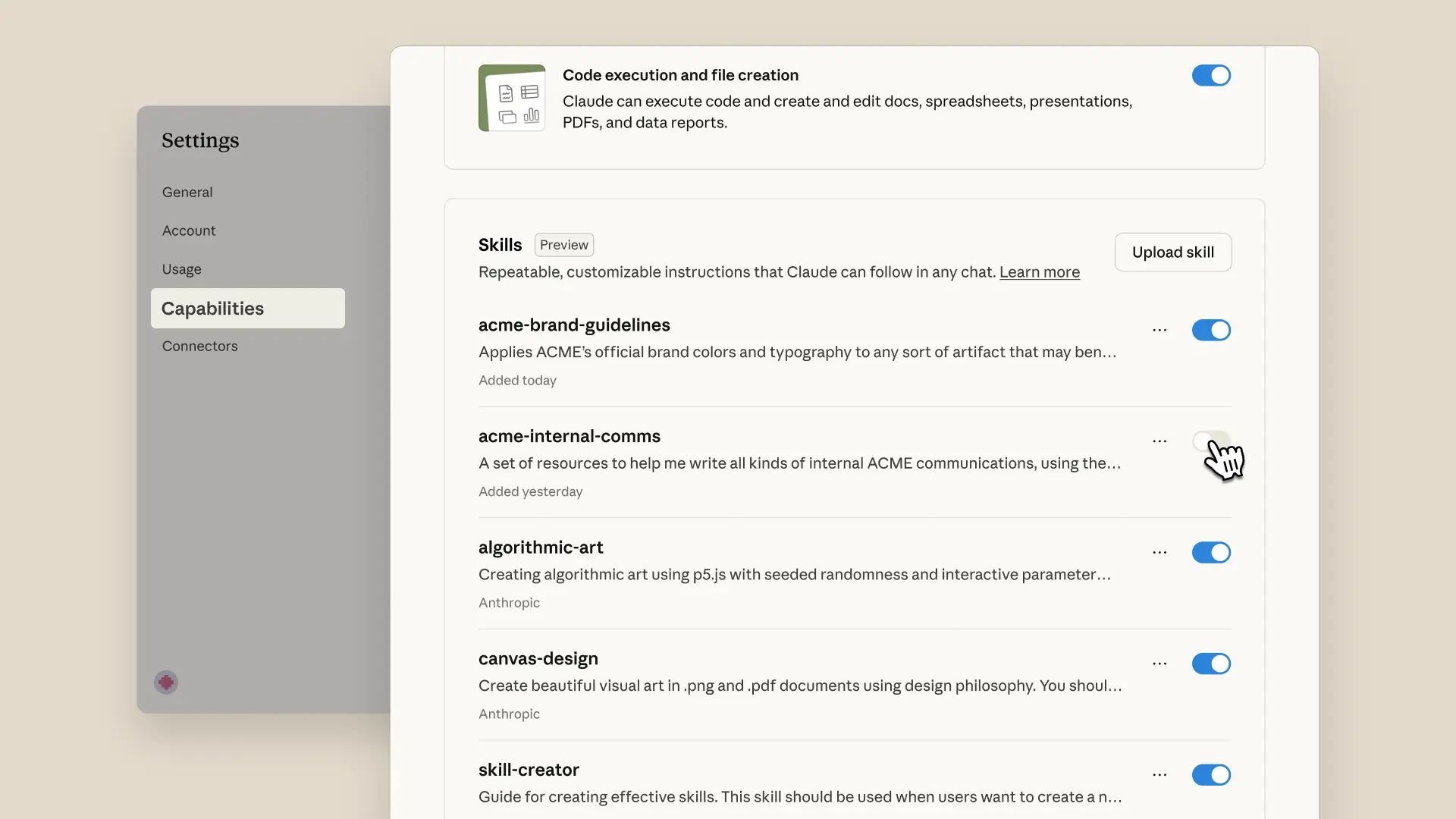
Skills are the bigger unlock for a team. A Skill is simply a folder containing a SKILL.md file with a short YAML header of a name and description, plus any templates or instructions the task needs, and Claude loads it only when relevant through what Anthropic calls progressive disclosure - Anthropic Engineering. Anthropic published Skills in October 2025 and made them an open standard in December, now read by more than two dozen AI tools - SiliconANGLE, and Anthropic maintains a public library of examples on GitHub you can adapt. The screenshot below shows the Skills interface where you enable and manage them.
Claude Skills
The four Skills a recruiting agency should build first map directly onto the workflow in section seven. Each one encodes your house standard so that quality does not depend on which consultant is prompting.
- Brief builder: turns an intake transcript into a structured, five-must-have brief with a Boolean string.
- Screening rubric: scores a CV against a role on named criteria and returns evidence, not a verdict.
- Submittal pack: produces your standard client-ready candidate one-pager, quote-grounded to the CV.
- Bench re-engagement: drafts a tailored re-marketing message for a lapsed candidate against a live role.
Those four are chosen deliberately rather than as a wish list. Each attacks a stage where the work is high-volume, repeatable, and judgment-light, and each produces an artefact a human then reviews. Notice that none of them is "decide who to hire," and none of them writes to a client without a consultant reading it first. That is the boundary that keeps this whole programme on the safe side of section ten.
A Skill is far less intimidating than it sounds. The whole thing is a plain text file with a short header telling Claude what the skill is for and when to use it, followed by the instructions you would otherwise have to remember to type every time. A screening rubric skill, stripped to its essentials, looks like this:
---
name: screening-rubric
description: Score a CV against a live role on named criteria and
  return evidence, never a hire/reject verdict. Use whenever a CV
  and a job brief are provided together.
---

# Screening rubric

1. First, extract verbatim quotes from the CV that relate to each
   must-have in the brief. Put them in a <quotes> block.
2. Score each must-have as Met / Partially met / Not evidenced,
   citing only the quotes above. Never infer from a job title.
3. List anything in the brief you found NO evidence for.
4. Output a 3-line summary and a recommended next step
   (call, hold, or decline) for the CONSULTANT to decide.

Never state a conclusion the quotes do not support.
Never guess at dates, titles, or qualifications.
That file is the entire skill, and it is doing a surprising amount of work. It forces evidence before judgment, it bans the model from inventing details, and critically it ends with a recommendation for a human rather than a decision. Save it once, share it across a Team plan, and every consultant's screening now runs to your best consultant's standard instead of whatever they happened to type that morning. This is the real reason Skills matter for an agency: they convert individual prompting talent, which is unevenly distributed and walks out of the door when someone resigns, into a company asset.
Building these well comes down to a handful of prompt-engineering levers that Anthropic's own guidance recommends, and none of them require code. Put the documents first and the instruction last, because models attend more reliably to material near the top of a long input. Use plain XML-style tags like <cv> and <job> to separate the pieces so Claude never confuses the candidate's history with the role. Give one or two worked examples of the output you want. Most importantly for recruiting, use quote-grounding: instruct Claude to first extract verbatim quotes from the CV into a <quotes> block, then write its summary using only those quotes. That one technique is the single best defence against the hallucinated-submittal risk in the next section, because every claim in the pack becomes traceable to source text. Share the finished Skills across a Team plan and every consultant is suddenly working to your best consultant's standard.
You do not have to start from a blank page, either. Anthropic maintains a public library of example Skills on GitHub that you can read and adapt, and because Skills became an open standard in December 2025 they are now portable across more than two dozen AI tools rather than locked to Claude. The mechanism that makes them cheap to run is progressive disclosure: Claude only loads the full contents of a Skill when the description tells it the Skill is relevant to what you just asked, so you can maintain a library of thirty recruiting Skills without slowing anything down or paying for context you are not using.
The organisational payoff is the part owners tend to miss. Prompting ability is currently distributed unevenly across your desk, and it is invisible: you cannot see which consultant is getting three times more out of the same tool, and when that person leaves, their technique leaves with them. Skills convert that private craft into shared infrastructure. Write the screening rubric once with your best biller and your most compliance-minded manager in the room, and every consultant, including the one who started on Monday, screens to that standard from their first day.
The short tutorial below walks through building, running, and sharing a Skill from scratch, which is the fastest way to see the mechanics before you build your own.
Claude Skills Tutorial: Build, Run, and Share
9. Where it breaks: the honest failure catalogue
A guide that only lists wins is a sales deck, so this section is the part to read twice. Claude is a superb drafting and triage assistant and a dangerous autonomous decision-maker, and the gap between those two roles is where agencies get hurt. The failures below are documented, current, and specific, and each one has a mitigation you can adopt today.
The first and least understood is that large-language-model CV screening is a self-bias machine. A May 2026 study found Claude was the most self-biased evaluator of the major models, recommending "hire" for resumes written in a competitor's style only 42% of the time against 84% for resumes written in its own style, a 42-point gap - i10X. Underlying research shows models favour their own outputs 67 to 82% of the time, and AI-polished resumes get a 23 to 60% boost in screening odds - arXiv. The perverse result is that the model screening a candidate systematically rewards whichever model wrote that candidate's CV, which has nothing to do with fit. This is why screening must use a structured rubric that scores against the actual role requirements, not an open-ended "is this a good candidate" prompt.
Worse, the "human in the loop" safety net that everyone leans on is weaker than it sounds. When University of Washington researchers gave people severely biased AI recommendations, the humans aligned with the biased AI about 90% of the time, mirroring rather than correcting it - University of Washington. The same lab's earlier work found resume-screening systems preferred white-associated names 85% of the time against 9% for Black-associated names, and never once preferred Black male names over white male names - University of Washington. The lesson is not "never use AI to screen." It is that a rubber-stamp human reviewer does not fix bias, so the review has to be genuine, evidence-based, and structured, which is exactly what the rubric-plus-quote-grounding pattern from section eight produces.
The under-covered agency killer is hallucination in submittals. Ask Claude for a "client-ready summary" of a pasted CV and it can fabricate a job title, a degree, or a tenure length, fluently and confidently, because that is how generative models fail. Sending a client a summary with an invented qualification is a reputational and contractual disaster, and while there is no landmark "agency sued over a hallucinated summary" case yet, the mechanism is well established and the adversarial-resume research shows models treat fabricated experience as real. The mitigation is quote-grounding, covered above: force every claim in the pack back to a verbatim quote from the source CV.
Four further failure modes round out the catalogue, and each has a direct agency cost. Channel collapse is the outreach problem from section seven: generic AI messaging has crushed reply rates industry-wide, so mass-producing it actively destroys the channel you depend on. Fake candidates are becoming a structural threat, with Gartner projecting that 1 in 4 candidate profiles worldwide will be fake by 2028 - HR Dive. Candidate backlash is real and measurable: 30% of candidates dropped out of a process after discovering the interview was AI-led, and 82% of them had not been told in advance - People Management. And data leakage is the quiet one, with nearly 40% of files employees upload to AI tools containing personal or payment data - eSecurity Planet.
The candidate-backlash number carries the clearest instruction: tell people. Losing three in ten candidates because they discovered rather than were told about AI is a self-inflicted wound, and disclosure costs nothing. It also happens to align you with where the law is heading, since the EU's transparency duties and the UK regulator's guidance both push in exactly that direction, as section ten sets out.
Two of those deserve unpacking, because they are actively reshaping how candidates behave toward you. The first is that candidates now use AI against your AI. Roughly 41% of US job seekers admit to trying resume prompt injection, hiding instructions in white text to manipulate an AI screener, and ManpowerGroup detects hidden text in around one in ten scanned resumes - Built In. The good news is that it mostly backfires, because applicant tracking systems strip formatting and surface the hidden text to a human, who is not amused. The bad news is that it tells you candidates assume a machine is reading, and they are optimising for the machine rather than for you.
The second is that the fraud problem has gone from irritating to criminal. The US Department of Justice has documented North Korean IT-worker schemes that fraudulently obtained employment at more than 100 US companies, with searches of 29 laptop farms across 16 states, and some operatives used real-time deepfakes in video interviews - Department of Justice. For an agency, this is not somebody else's problem: you are the party that vouched for the candidate. It is also why more than half of firms now report that AI-assisted candidate behaviour makes candidates genuinely harder to assess accurately, and why identity and reference verification are becoming a service agencies can charge for rather than a box they tick.
There is also a reputational trap on the other side of the desk. Hiring managers have turned sharply against visible AI output: 80% say they dislike AI-generated applications and 57% are less likely to hire someone they believe used AI to write them - People Management. The same instinct applies to what you send them. A submittal pack that reads like machine output signals that you did not do the work, which corrodes the exact thing a client pays an agency for. The lesson is not to hide AI use but to ensure the output carries genuine, specific, evidence-backed judgment, which is precisely what a quote-grounded rubric produces and what a lazy "summarise this CV" prompt does not.
Read together, these failures point to one design principle. Every one of them happens when AI is put in the decision seat or pointed at a channel unsupervised. None of them happen when Claude drafts and a human decides. That is not a limitation to apologise for; it is the operating manual. Use Claude to triage, structure, and draft under a rubric, keep a real human on every client-facing judgment, and disclose AI use to candidates, and the failure catalogue shrinks to a manageable set of habits.
10. Compliance for agencies specifically
Agencies occupy an awkward legal position: you are usually a data "deployer" and sometimes a "provider," you handle candidate personal data for multiple clients, and in some jurisdictions you are directly liable for the third-party AI tools you use. The good news for 2026 is that the most feared deadline slipped; the bad news is that plenty else did not. Getting this section right is cheaper than getting it wrong.
The headline change is that the EU AI Act's high-risk obligations for recruitment moved. Recruitment and selection AI is classified as high-risk under Annex III of the Act - EU AI Act, and the original application date was 2 August 2026. As of publication that is settled law: the European Parliament approved a delay on 16 June 2026 and the Council gave final green light on 29 June, pushing high-risk obligations to 2 December 2027 - Council of the EU. Three carve-outs still bite now, though: the Article 50 transparency duties were not delayed and apply from 2 August 2026, the general-purpose-model obligations already applied from August 2025, and the delay is relief, not repeal, so GDPR and national anti-discrimination law continue in full force. Penalties for high-risk breaches reach €15 million or 3% of worldwide turnover - EU AI Act.
The United States is the mirror image: federal enforcement retreated while states rushed in, producing a patchwork you must navigate client by client. The EEOC withdrew its AI guidance and the federal posture softened through 2026, but Title VII and state law remain in force - Husch Blackwell. The live state rules that touch agencies most are summarised below, and California's is the one to internalise because it holds the employer liable for a third-party AI tool.
- NYC Local Law 144: bias audit, public posting, and candidate notice; penalties $500 to $1,500 per violation per day - NYC DCWP.
- Illinois HB 3773: effective 1 January 2026; bars discriminatory AI use and zip-code proxies - Hinshaw.
- California FEHA ADS regs: effective 1 October 2025; four-year data retention and employer liable for third-party tools - Paul Hastings.
- Texas TRAIGA: effective 1 January 2026; intent-based, with penalties up to $200,000 per violation - Duane Morris.
Colorado is the outlier worth tracking but not yet fearing: its AI Act is on the books, but the effective date slipped to 30 June 2026 and the state's attorney general has said enforcement waits until rulemaking concludes - Akin. Treat it as a signal of where the country is heading rather than an immediate obligation, and note the pattern it shares with the EU: ambitious AI rules keep being written, then delayed under industry pressure, without ever being repealed. Planning your process around the strict version is the only stable strategy, because the delays buy time rather than granting permission.
What that patchwork means in practice is that your compliance obligation is set by where the role is, not where your office is. An agency in Manchester placing a candidate into a New York job is inside Local Law 144's orbit; the same agency filling a Chicago role is inside Illinois HB 3773. Since most agencies place across borders routinely, the only workable posture is to run to the strictest standard you touch and apply it everywhere, rather than maintaining a different process per jurisdiction. That sounds burdensome until you notice the strict standard is simply the one this guide has been describing throughout: a structured rubric, evidence rather than verdicts, disclosure to candidates, and a human with real authority making the call.
California's rule is the one that should change your vendor conversations, because it makes the employer liable for the third-party AI tools it uses and imposes four-year record retention on automated decision data. Read that alongside Mobley below and the message is consistent: outsourcing the screening does not outsource the liability. Ask any AI vendor you buy from for their bias-audit documentation, and keep records of how your own rubric-based screening reached its conclusions, because "the tool decided" will not survive contact with a regulator.
The United Kingdom sits between the two poles, and its regulator has been unusually specific about recruitment. The Information Commissioner's Office published a report and draft guidance on automated decision-making in recruitment in March 2026, covering transparency, meaningful human involvement, bias monitoring, and candidate data rights - DLA Piper. This followed audits of AI recruitment tools that produced almost 300 recommendations for providers and users. The ICO's practical message to agencies is that "a human glanced at it" is not meaningful human involvement; the human has to have the information, the authority, and the genuine opportunity to reach a different conclusion, which loops directly back to the finding in section nine that reviewers mirror biased AI about 90% of the time.
Engage Boston 2026
The case that should focus every owner's mind is Mobley v. Workday, where in March 2026 a federal judge held that age-discrimination law covers applicants and that an algorithmic-screening vendor can be the employer's "agent," exposing AI screeners to direct liability - AI Governance for HR. Translate that to your business: if you run a vendor's AI screener and it discriminates, "the tool did it" is not a defence. That is the legal foundation under the human-in-the-loop insistence of section nine.
Under GDPR, three obligations follow from putting candidate CVs through any AI system, and none of them is satisfied by your vendor's certifications. You need a data-processing agreement with the provider, which Anthropic offers. You need a data protection impact assessment under Article 35, because large-scale automated processing of personal data for recruitment is exactly the scenario the article was written for; in practice this is a written document recording what data you process, why, what could go wrong, and how you mitigate it. And you need a genuine human review route under Article 22, which gives candidates the right not to be subject to purely automated decisions with significant effects, plus the ability to contest one - GDPR.
None of that is onerous for a small agency, and it is dramatically cheaper than the alternative. A DPIA for a recruitment desk is a few pages, not a legal project, and the human-review route is something you were going to have anyway if you follow the rubric-and-consultant pattern this guide recommends. The firms that will struggle are the ones that let AI make the decision and then try to reverse-engineer a human into the story afterwards.
Finally, the data question, because "we do not train on your data" is the wrong reassurance. Anthropic's commercial terms confirm no training on API, Team, or Enterprise content, with default deletion within 30 days and optional zero data retention on request - Anthropic, and the company holds SOC 2, ISO 27001, ISO 42001, and is HIPAA-ready with a data-processing agreement - Anthropic. But not training is a training promise, not a data-residency one: candidate personal data still transits Anthropic during inference, so under GDPR you owe a data-processing agreement, an Article 35 impact assessment, and an Article 22 human-review route regardless of certifications. The single most important operational rule falls out of this: put candidate personal data only through the commercial API, Team, or Enterprise surfaces, never through a personal Free, Pro, or Max account, which runs under consumer terms and is the wrong place for other people's PII.
11. Claude versus the field
Claude is not the only option, and an honest guide names where a rival fits better. The realistic 2026 answer for most agencies is not "pick one model forever" but "standardise on one for reasoning and writing, and keep a couple of others open for specific jobs." That said, the horizontal AI-assistant market has consolidated around a few choices with clear trade-offs, and then there is a separate universe of recruiting-native tools that use these models under the hood.
Among the general assistants, the pricing has converged and the differentiation is now about integration and judgment. ChatGPT Business dropped to $20 per user per month on annual billing in April 2026 - CloudZero, Microsoft 365 Copilot runs $21 to $30 per user per month and buys deep Office integration - Microsoft, and Google folded Gemini into paid Workspace plans while raising base prices. Claude's edge for recruiting sits in long-document reasoning and a writing voice that many recruiters prefer for candidate-facing copy, plus the connector story in section six. Copilot wins if your whole firm lives in Outlook and Teams; Gemini wins if you are all-in on Google Workspace; Claude wins as the reasoning layer that plugs into either. This is why multi-model routing, not loyalty, is the pragmatic stance.
The recruiting-native tools are a different purchase entirely, and several are worth a place alongside Claude rather than instead of it. The table below sets out the ones an agency is most likely to evaluate in 2026.
Recruiting-native AI tools, 2026:
| Tool | Price | What it does |
|---|---|---|
| HeroHunt.ai | 8-day trial, then $99/mo | AI Recruiter, sources 1B+ profiles, autonomous outreach |
| Juicebox / PeopleGPT | Free, then $139/mo | Natural-language sourcing across 800M+ profiles - Juicebox |
| SeekOut | $149/mo, ~$20k median | Enterprise sourcing and diversity analytics - Pin |
| hireEZ | $169 to $199/recruiter/mo | Outbound sourcing across 750M+ profiles - Juicebox |
| Apollo.io | $49 to $119/mo | B2B contact data, native Claude connector - Apollo |
| Metaview | Free, then $20/mo | AI interview notetaker - Metaview |
The way to read that table is by layer, not by winner. HeroHunt.ai, Juicebox, SeekOut, and hireEZ are data and sourcing engines: they find people and surface contact details, which is precisely the vertical infrastructure Claude does not provide. Metaview captures interview signal. Apollo supplies business-development contact data and, usefully, ships a native Claude connector so it can be driven from inside your chat - Apollo.io. None of these is a Claude substitute; they are the databases and capture tools that feed the reasoning Claude does on top. An agency that already runs a sourcing tool should add Claude as the writing-and-triage layer rather than replacing anything.
Apollo.io
Apollo is the tool in that table Claude can actually drive through an official connector, and its free plan is a real starting point for the trigger-based business development in section seven: search the B2B database, enrich a record, drop one genuinely relevant prospect into a sequence. Know two limits before you lean on it. The free general and export credit pool is 900 per seat per year, not per month, and free email sending is governed by the Fair Use Policy, capped at 10,000 messages a month only on a verified corporate domain and dropping to 100 a month on a personal or Gmail address. Paid Basic is $49 per seat per month billed annually, or $65 month to month. Right for building a targeted BD list, wrong if you expected uncapped free volume.
The buy-versus-build line follows from that. If you want autonomous end-to-end recruiting, buy a purpose-built product; some, like the voice-agent startup Jack & Jill, are pricing aggressively at 10% of first-year salary on a success-only basis, half the industry norm - Jack & Jill. If you want a cheap, flexible reasoning layer that works across every stage and every client, standardise on Claude and connect it. Most agencies will do both: a sourcing tool for data, Claude for thinking and writing, and a deliberate decision about which of the two owns the automation. The mistake is expecting Claude to be the sourcing database or expecting the sourcing database to write like Claude.
HeroHunt.ai
If you take the layered view above, HeroHunt.ai is the sourcing half of it, and full disclosure, it is our own product. It searches over 1 billion profiles, runs the outreach sequence, and publishes its own MCP server, which is the point for this guide: unlike Bullhorn it can be driven from inside Claude, so the brief you wrote in section seven becomes a search without a tab switch. The honest caveat is that it is a sourcing and outreach layer, not an applicant tracking system and not a reasoning layer. It will not be your system of record, it will not replace Claude for drafting a submittal pack, and because it can message candidates on autopilot, every disclosure and human-review rule in sections nine and ten applies to it exactly as written.
12. The agentic future and your fee model
The genuinely strategic question is not which AI to buy this year but what AI does to the thing you sell. Agencies charge for outcomes, placements, but price them on an implicit assumption that a human's time produces those outcomes. Agentic AI, systems that source, message, and schedule with minimal supervision, decouples output from headcount, and that decoupling is where the fee model comes under pressure. Anthropic reports that its agents' longest reliable autonomous runs grew from under 25 minutes to over 45 minutes in four months and that its best model can complete tasks a human would take five hours on - Anthropic, so the capability is real and improving fast.
The honest counterweight is that reliability has a ceiling, and pretending otherwise is how agencies get burned. ManpowerGroup found that more than 90% of organisations deployed AI in talent acquisition, yet fewer than 5% report transformational outcomes and nearly 40% see efficiency with no quality gain - StaffingHub. BCG explains the gap: strategic clarity drives about 25 points of business impact while better tools alone drive around five. Agencies that bolt an agent onto a broken process get speed, not quality. Long-horizon agents are excellent at sourcing throughput and unreliable when left fully unsupervised on judgment, which is why an oracle check on anything client-facing is not optional.
The transition already underway inside agencies is from simple generative AI to agentic tools, and the Bullhorn data quantifies it: basic generative-AI experimentation fell from 52% to 29% of firms in a single year, 30% now use agentic tools, and 10% have agentic AI embedded across the full workflow - Bullhorn GRID 2026. The revenue picture the platform is built on continues climbing, which matters because it tells you the capability behind these agents is funded for the long haul. Anthropic's run-rate revenue chart below is a proxy for that trajectory.
Anthropic Run-Rate Revenue (USD billions)
There is a contradiction in the headcount predictions that is worth resolving, because owners keep hearing both halves and drawing the wrong conclusion. Prominent analysts forecast that internal corporate HR teams could shrink by 30% or more as AI absorbs their work. Yet the agency-side data points the other way: as AI adoption spread, the share of staffing firms contracting fell from 56% to 31%, and recruiter call time hit a record 286 minutes a week in early 2026, roughly double what it was two years earlier - StaffingHub. Those are two different populations. AI is compressing the corporate HR function that processes applications, while pushing agency recruiters toward more human contact, not less, because the admin that used to fill their day is being handled elsewhere.
That distinction is the strategic heart of the matter. If your agency's value proposition is processing, matching CVs to specs and forwarding them, then you are in the population that AI is compressing, and you should be worried. If your value proposition is judgment, market knowledge, and the relationships that get a reluctant candidate to take the call, then AI is removing precisely the work that never justified your fee anyway. The record call-time figure is the tell: the firms winning are the ones whose recruiters now spend their week talking to people instead of formatting documents.
Where does that leave your fee? Two forces pull in opposite directions, and the winning firms are choosing which one to ride. The downward pull is that clients can see the efficiency and are starting to ask for it back: roughly one in three agencies has already fielded an AI-discount request, and AI-native challengers are pricing the savings straight into the deal. The upward pull is that the efficiency lands, for now, on the agency's margin, and the firms using AI are placing faster and growing, not shrinking; among Bullhorn's early adopters, placements per recruiter rose 39% - Bullhorn. The resolution most successful firms are landing on is to frame AI as supercharged consultants, not replacements: keep the human relationship and judgment that clients actually pay for, use AI to remove the admin that never justified your fee anyway, and price on the quality and speed of the outcome rather than defending the old headcount-based math. The agencies that shrink are the ones that let AI cut their costs without deciding, on purpose, who keeps the saving.
13. Your 90-day rollout plan
The evidence in this guide points to a rollout that is cautious, sequenced, and compliance-first, not a big-bang "everyone use AI now" memo. The firms getting no return are the ones that deployed tools without redesigning the work around them; the firms pulling ahead moved deliberately. A 90-day plan lets you prove value on one desk before committing the whole business, and it keeps you on the right side of the risks in sections nine and ten from day one.
The first month is about a safe foundation and a single use case. Buy Team seats rather than letting consultants use personal accounts, so candidate data flows through the no-training commercial surface with an audit trail. Pick one desk and one workflow, and make it the intake-to-brief transform from section seven, because it is high-value, low-risk, and touches no protected hiring decision. Turn on only official connectors, start read-only, and write down which fork you took on the Bullhorn question so the security ownership is explicit. The measurable goal for month one is simple: cut the admin time on that one workflow and record the before-and-after against the funnel benchmarks.
Months two and three expand along a controlled path, and the sequence matters far more than the speed. Month two is for building your four core Skills so that quality stops depending on who is prompting, then adding screening triage under a structured rubric with mandatory human review, and rolling the whole thing to a second desk to prove it was not just one enthusiastic consultant. Month three is when you introduce Cowork for a genuinely delegated multi-step job, and bench re-marketing is the ideal first candidate because the downside of a mediocre result is low and the upside is revenue from candidates already sitting in your database. Quote-grounded submittal packs come at the same stage, once the screening rubric has been running long enough that you trust its evidence.
The ordering is deliberate: every step adds capability only after the previous one has demonstrated it can be trusted, and nothing that touches a hiring decision is ever automated outright. If a stage does not show a measurable improvement within its month, you stop and fix the process rather than adding another tool on top, because a tool applied to a broken process reliably produces faster brokenness.
Measurement is what separates a pilot from a hobby, and the metrics to watch are the ones you already track. If Claude is working, your submission-to-interview rate should rise, because better briefs and evidence-based triage mean you send fewer, better-matched candidates. Your interview-to-placement ratio should hold or improve. Time spent on administration per vacancy should fall against that 17.7-hour baseline. What should emphatically not happen is a rise in submissions with no rise in interviews, which is the signature of an agency using AI to spray more candidates at clients faster. That is the failure mode ManpowerGroup measured, where firms got efficiency with no quality gain, and it burns client relationships at speed.
The discipline that makes this work is refusing to put Claude in a decision seat until the assisted version has earned trust on that exact task. Four rules carry almost all of the safety, and they cost nothing to adopt: keep a human with real authority on every client-facing judgment, disclose AI use to candidates, never point one unattended agent at both untrusted inbound content and an outbound channel, and never let candidate personal data touch a consumer Free, Pro, or Max account. If you do nothing else from this guide, do those four.
It is also worth being honest about what a good outcome looks like, because the vendor pitches have set expectations badly. You are not going to fire half your desk and let an agent run the business. You are going to give each consultant back an hour or two a day, raise the floor on quality so your weakest brief looks like your strongest, and reclaim the redeployment and database-re-engagement revenue that has been sitting unworked in your ATS for years. That is an unglamorous, entirely achievable, and genuinely large prize on a 3-to-8% net margin. The firms chasing something more cinematic are the ones filling the "deployed AI, saw no transformation" column in every survey.
That is the honest shape of Claude for a recruitment agency in July 2026: a cheap, powerful reasoning and writing layer that removes the admin drowning your consultants, sitting alongside, not instead of, the sourcing and ATS infrastructure you already run. The owners who win this year are not the ones who bought the most AI. They are the ones who redesigned one workflow at a time, kept judgment human, and let the machine do the reading and writing it is genuinely good at.
This guide draws on hands-on experience in the AI recruiting market from Yuma Heymans (@yumahey), founder of HeroHunt.ai, whose AI Recruiter sources candidates from over 1 billion profiles and reaches out on autopilot. He has been building autonomous recruiting technology since 2021 and writes about where AI genuinely helps agencies and where it quietly does not.
This guide reflects the AI and recruitment landscape as of July 2026. Pricing, product availability, and especially AI regulation change quickly, so verify current details with each provider and your own legal counsel before acting on them.