



The insider guide to what AI product managers cost in 2026, where the good ones hide, and how to source, screen, and close them before a frontier lab does.
In 2026 the median AI product manager earns about $305,000 in total compensation, and at OpenAI the median product manager package clears $750,000 - Levels.fyi. Those two numbers frame the entire problem. The people who can turn a language model into a product customers will pay for have become one of the most expensive and most contested hires in technology, and almost none of the old product-hiring playbook helps you find or win them.
The trouble starts with the title. "AI Product Manager" now describes a former engineer shipping an agent on top of an API, a veteran platform PM who owns an internal model-serving stack, and a generalist who added "GenAI" to a resume last quarter, and the gap between those people is measured in years of scarce experience and hundreds of thousands of dollars. Most job descriptions ask for the wrong things, most sourcing tools surface the loudest profiles rather than the strongest, and the genuinely qualified pool, the PMs who have actually shipped an AI feature, watched it fail in production, and fixed it, is vanishingly small. This is a market where roughly 93 percent of open AI product roles target senior candidates and only about 2 percent are junior, which means you are almost never hiring a beginner and almost always competing for someone who already has a job and multiple offers - Axial Search.
This guide is the practical map of that market, written for a founder, hiring manager, or recruiter who has to act on it rather than read headlines about it. It covers what an AI product manager actually is in 2026 and the archetypes hiding under the label, how large and how senior the demand really is, what each level and each employer truly pays, where these people physically live and how remote work moves the price, where to find them and how to read a profile for real depth, what actually reaches them, the tools you would use and what they cost, how to screen without getting fooled by polished output, how AI agents are reshaping both the job and the way you hire for it, and where the whole market is heading. It assumes no machine learning background, only that you need to win at this.
Written by Yuma Heymans (@yumahey), founder of HeroHunt.ai and a former Bain and KPMG consultant who has been building AI sourcing technology since 2021. He spends his days on the exact problem at the center of this guide, finding scarce specialists who never answer a job post, which is why he writes about how the labs and the best startups actually hire them.
Contents
- What an "AI Product Manager" Really Is in 2026
- How Big the Market Is, and Why It Is So Senior
- What They Cost: The 2026 Pay Reality
- Where They Live and the Remote Arbitrage
- Where to Find Them and How to Read the Signal
- What Actually Reaches a Senior AI PM
- The Tooling: Sourcing Platforms and What They Cost
- How to Screen Them Without Getting Fooled
- How AI Agents Are Changing the Role and the Hunt
- The Future and the Bubble Question
- The Hiring Playbook
1. What an "AI Product Manager" Really Is in 2026
The single most useful thing to do before you source one candidate is to decide precisely which AI product manager you actually need, because the title covers several jobs that share a business card and almost nothing else. Get it wrong and everything downstream breaks: you write the wrong job description, screen for the wrong skills, benchmark against the wrong salary band, and lose the person you needed to a company that understood the distinction. The most expensive and most common mistake in this market is a requisition that says "AI Product Manager" while the hiring manager privately pictures one specific version of the role and the candidates picture another. A useful real example: a Series B vertical-SaaS company in Denver hired a strong AI PM from a Bay Area lab in early 2026, and by spring the new hire had shipped a slick internal support copilot while never touching the customer-facing assistant the company actually needed, because the job description said "AI Product Manager" instead of "the PM who owns our core-product assistant end to end" - KORE1.
What makes the AI PM genuinely different from a classic PM is not the tools they use but the nature of what they manage. A traditional PM ships deterministic features against a written spec; an AI PM manages a probabilistic system where the same input can produce different outputs, so the work is designing for uncertainty and failure states rather than fixed flows - CRV. Three shifts follow from that. First, data becomes a first-class part of the roadmap, because model code is often five percent or less of a production machine-learning codebase and the rest is data collection, labeling, and evaluation. Second, the PM defines guardrails and target behaviors ("answer support questions at a set accuracy within a latency budget") instead of step-by-step requirements. Third, the job does not end at launch: the AI PM owns drift, retraining cadence, and live monitoring, because a model that scores well offline can still fail in front of real users.
The clearest signal of this new job is that evals are replacing PRDs as the AI PM's core artifact. Evals are how you quantify soft qualities like accuracy, conciseness, or tone, and how you decide whether a model is good enough to ship at all - Arize AI. A PM who cannot describe the eval set behind a feature they claim to have shipped does not really understand it, which is why the ability to write good evals has become, in the words of one widely read 2025 breakdown, the defining skill for AI product managers - Lenny's Newsletter. That framing is worth internalizing even though it predates the last twelve months, because it explains what to screen for later in this guide.
Underneath the umbrella, it helps to name the archetypes you might be hiring, because the channel that finds one is useless for another. The role tends to split along two axes: how close the PM sits to building the model versus integrating it, and how much they orchestrate agents versus own a single surface.
- Builder-PM - ships AI prototypes directly, blurs the line with engineering, lives in Cursor or Replit
- Integrator-PM - high-EQ cross-functional owner who lands AI into an existing roadmap
- Agent PM - owns prompt logic, agent evals, and end-to-end agent deployments
- AI Platform PM - owns internal model tooling, gateways, and the latency and cost budget
- Assistant / Copilot PM - owns a chat or copilot surface and its trust metrics
These are not interchangeable people, and the market has already priced the distinction: a "Builder-PM" who can stand up a working prototype is being hired by AI-native firms at a premium, while the "Integrator-PM" wins where the AI has to fit a complex existing product and a demanding set of stakeholders - Userpilot. The practical move is to write the requisition around one archetype, name the surface and the model context explicitly, and separate "must have shipped AI in production" from "must be AI-fluent," because insisting on all of it in one person is how a req stays open for six months. The diagram below is worth holding in your head before you read a single profile, because each branch has its own hiding place, its own pay band, and its own screen.
The reason to be this precise is that each archetype carries a different center of gravity and a different failure mode when mishired. A Builder-PM dropped into a heavily cross-functional enterprise will chafe at the coordination and under-deliver on the politics, while an Integrator-PM placed at a two-week-cycle AI startup will feel slow and over-processed, and an AI Platform PM asked to run a customer-facing copilot will polish the plumbing while the experience drifts. None of these people is worse than the others; they are simply built for different problems, which is why a requisition that names the surface, the model context, and the archetype consistently outperforms one that says only "AI Product Manager." The single cheapest quality lever in this entire market is the fifteen minutes you spend deciding which of these jobs you are actually hiring for before you write a word of the description.
There is even a live debate about whether some companies need the role at all, which is a useful sanity check before you open a req. A dedicated AI PM earns its place when three things are true: customers are paying for model output, model behavior needs full-time attention, and data decisions are reshaping the roadmap. If none of those hold yet, you may be hiring a title before the work exists, and the most extreme version of that skepticism, covered later in this guide, is a multibillion-dollar AI company that deliberately employs no product managers at all. Naming the archetype and confirming the work is the discipline that makes everything after it cheaper and faster.
2. How Big the Market Is, and Why It Is So Senior
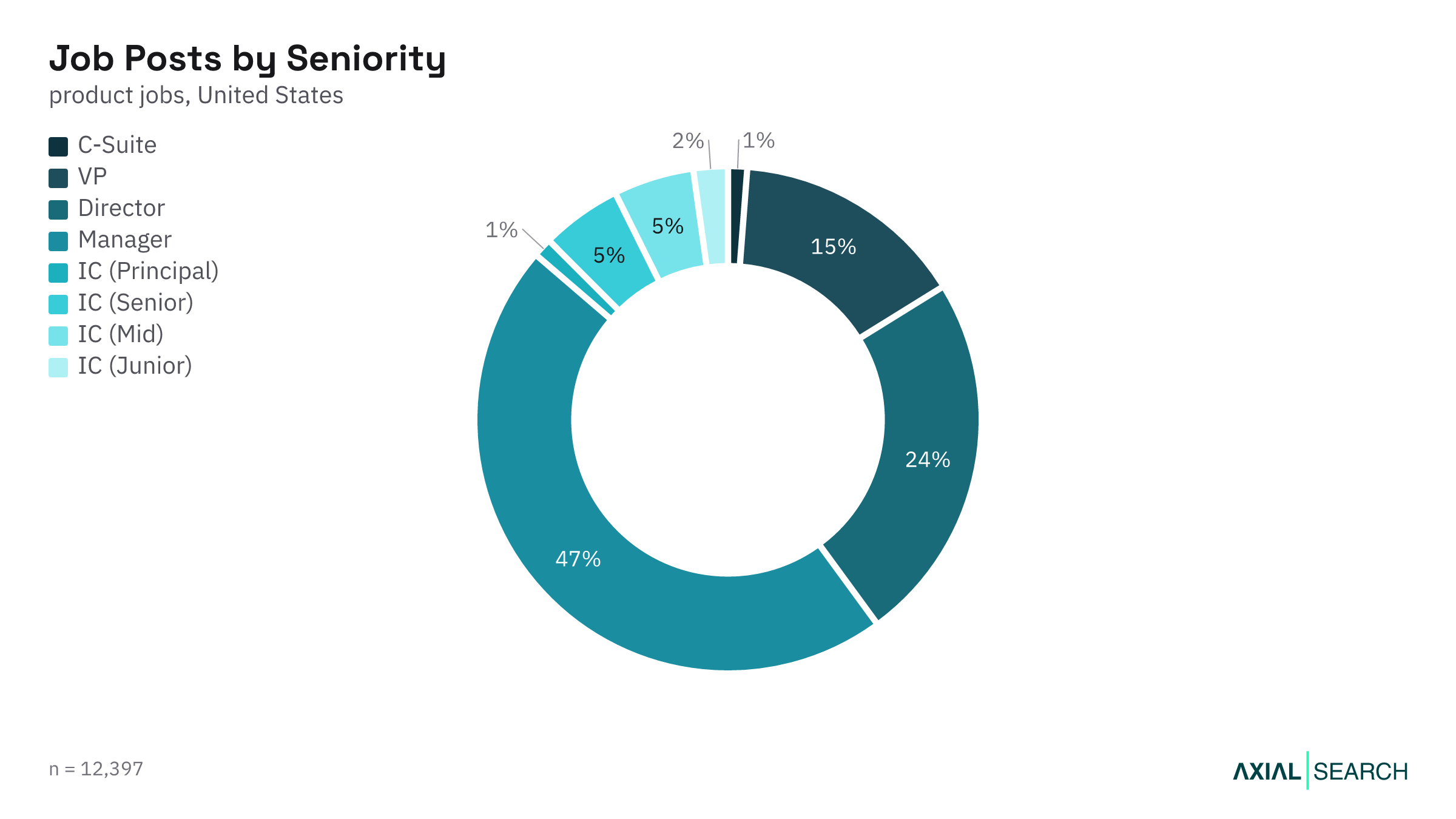
The defining feature of AI product hiring in 2026 is not just its size but its shape: demand is large, remarkably steady, and concentrated almost entirely at the senior end. The cleanest read comes from an analysis of 12,397 US AI product-management postings collected from public job boards since January 2026, which found roughly 714 new roles posted every week with no boom-bust cycle through the first half of the year - Axial Search. Inside that flow, about 47 percent of roles are manager-level, roughly a quarter are director-level, and only around 2 percent target junior candidates, which tells you this is a market built to buy ownership, not to train beginners. If you remember one structural fact before you start sourcing, make it this: you are competing for people who are already employed, already senior, and already being courted.
That seniority skew reframes how you should build a funnel, because the usual advice to "post the role and screen inbound" simply does not work here. The image below shows the distribution, and the near-absence of the junior bar is the point: there is no bottom of the funnel to lean on, so the work is proactive outreach to a small set of qualified people rather than filtering a large set of applicants.
Zoom out to the whole product-management function and the story is a re-mix, not simply growth. Overall PM postings were up about 14 percent year over year in May 2026, with roughly 42,000 open PM roles in early 2026, yet the share of that demand that is AI-flavored has exploded - Userpilot. One US-listing analysis found that AI PM roles jumped from about 2 percent of open PM jobs in February 2024 to roughly 46 percent by mid-2026, even as total PM postings fell from their 2025 peak - Aakash Gupta. Treat the exact share with care, because definitions vary wildly (a more conservative global cut puts AI-focused PMs at only 8 to 10 percent of open roles), but the direction is not in doubt: AI is eating the product requisition. The macro backdrop agrees, with the share of all US job postings mentioning AI reaching a record 4.2 percent in December 2025, up more than 130 percent since early 2020 while total postings barely moved - Indeed Hiring Lab.
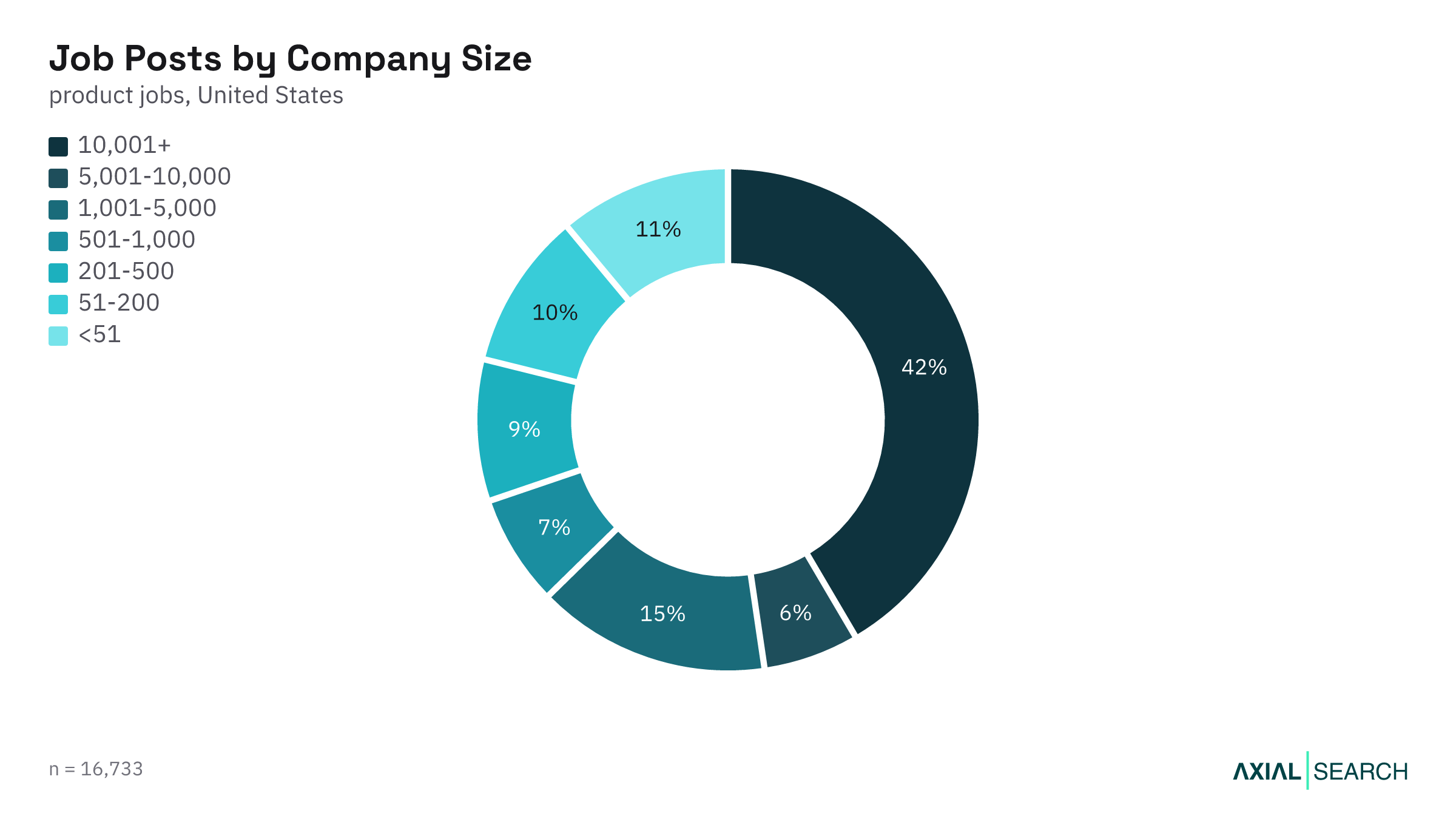
The composition of that demand tells you exactly who you are bidding against. Technology firms post about a third of AI product roles and financial services roughly another 14 percent, and around 41 percent of all postings come from enterprises with more than 10,000 employees, though nearly a third come from companies under 500, so startups and giants are fishing the same thin pond - Axial Search. That composition reframes the paradox of the moment: even as AI product demand runs hot, the broader PM market has cooled from its 2025 peak, so a flood of generalist applicants competes for shrinking roles at the very moment specialists are almost impossible to find. The practical response is to treat generalist inbound as noise and to run the specialist end as a proactive hunt from day one.
The bar that actually determines your search difficulty is the experience requirement, and it is high. Across those 113 closely read AI PM listings, 69 percent explicitly required prior AI or machine-learning experience and only 11 percent had no AI bar at all, though just 12 percent demanded that the experience be "in production or at scale," which is itself a quiet admission that the pool cannot supply it - Aakash Gupta. The scarcity shows up most concretely in time-to-fill. A specialized comp-and-hiring analysis pegs an internal AI PM search at 12 to 20 weeks or more, against roughly 6 to 9 weeks for a standard mid-level PM, with warm pipelines compressing that dramatically - KORE1.
The practical implications are worth stating plainly, because they shape every later decision in this guide. Budget months, not weeks, for a cold search, and assume a warm pipeline is three to five times faster. Split "shipped AI in production" from "AI-fluent" in the requisition rather than demanding both plus deep MLOps plus domain expertise in one impossible person. Prioritize judgment about which problems are worth solving, which employers now rank as the single most in-demand capability, over a checklist of tools. And accept that inbound applications are mostly noise for senior roles: the people you want are employed, not looking, and will only move for a specific, credible reason. The market is not short of applicants; it is short of proof, and the rest of this guide is about finding and verifying that proof efficiently.
3. What They Cost: The 2026 Pay Reality
There is no single "AI product manager salary" in 2026; there are two markets, and the first job of any hiring leader is to know which one they are actually competing in. The broad market has a clear center of gravity: the national median AI PM total compensation sits around $305,000, with a base roughly between $165,000 and $238,000 and a full range from about $214,000 to $427,000 - IdeaPlan. That figure carries a consistent premium over generalist PMs, most credibly measured at 15 to 25 percent at the same level, which works out to roughly $25,000 to $34,000 in extra annual comp on a mid-career package - Paraform. Some cuts of the data put the gap far wider (one analysis contrasts about $245,000 for AI-focused PMs against $123,000 for traditional PMs), so treat the exact premium as a range, but the existence and durability of it are not in question - Userpilot.
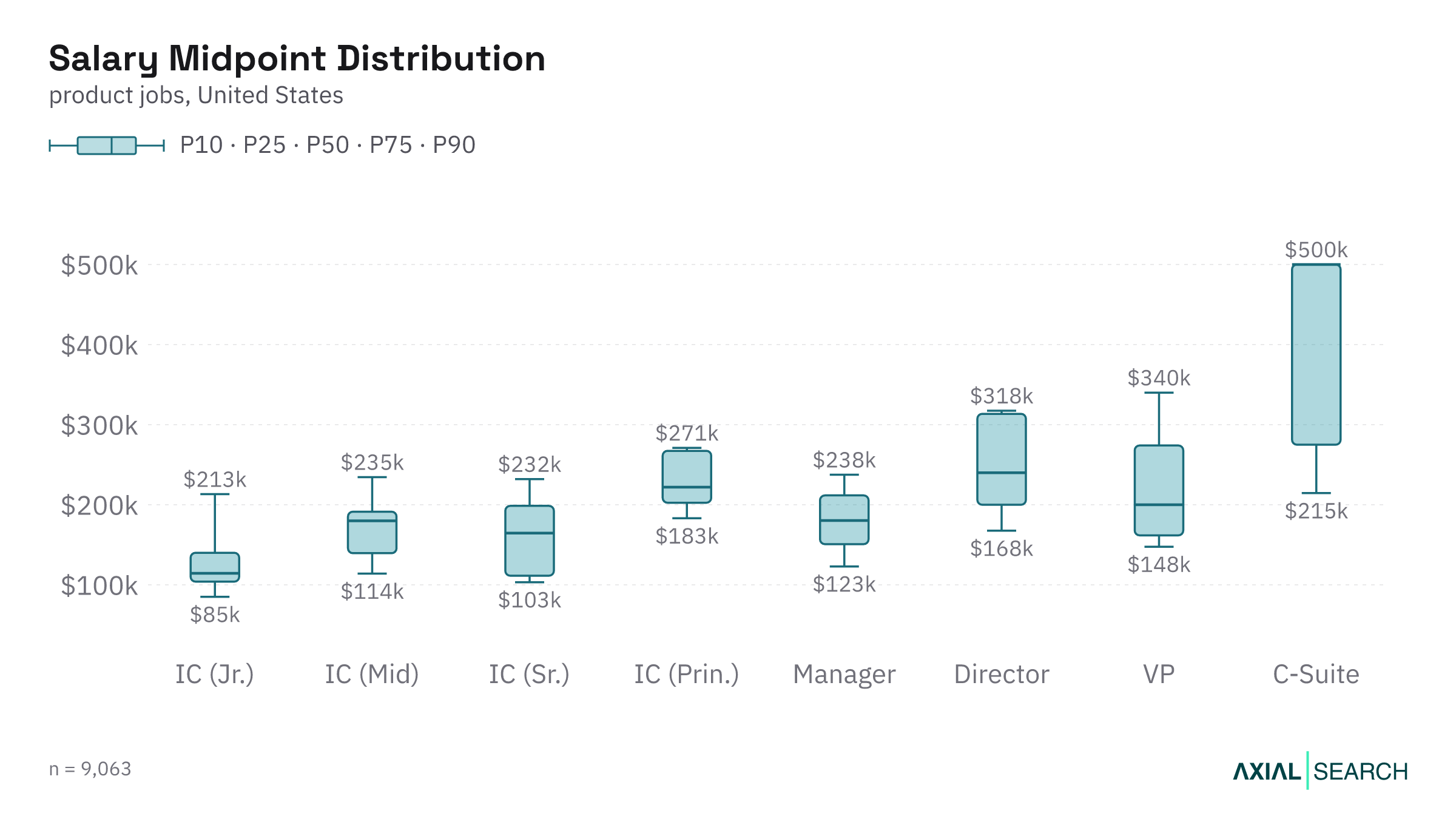
Underneath that median is a fairly clean level ladder, and pricing honestly within it is what keeps a search from stalling. A useful 2026 mental model for a US AI PM runs from $140,000 to $210,000 at the associate and entry level, $210,000 to $330,000 at mid, $320,000 to $520,000 for a senior PM, and $480,000 to $800,000-plus at staff or principal, with target bonuses climbing from 10 to 30 percent of base toward 50 percent at the top - KORE1. Leadership roles extend the ladder into rarer air, with directors of AI product commonly cited between $650,000 and $1.1 million and VPs above that, though those figures come from a single content source and should be treated as directional rather than precise - Techademy. The box-and-whisker view below is the most useful single visual in this section, because it lets you anchor an offer to a percentile band rather than a single average, which is how you avoid both underpaying the senior tier and overpaying the middle.
The second market is the frontier labs and the biggest tech companies, where the numbers stop looking like normal PM pay and where equity, not base, is the whole game. Self-reported packages make the gap concrete. OpenAI product-manager total compensation shows a live median near $750,000 (with the highest reported packages around $925,000), and a representative senior package earlier in 2026 read closer to $860,000, split roughly $310,000 base against $550,000 in annual equity - Levels.fyi. Meta's product-manager median sits at $521,000 across more than a thousand submissions, and Google's at $474,000, with the top of each ladder stretching past $2 million - Levels.fyi. Anthropic's PM data is thinner but lands in a common band of roughly $349,000 to $486,000, consistent with public job posts advertising base bands around $275,000 to $385,000 depending on the team - Levels.fyi. The chart below places the frontier next to the field so the size of the cliff is visible; the point is not any single bar but the distance between them.
Median Product Manager Total Comp by Employer (2026)
Two cautions make this chart useful rather than misleading. First, an "AI-first" name does not guarantee frontier pay: Scale AI's PM median sits around $240,000 and Microsoft's around $272,000, both closer to normal tech bands than to OpenAI, and some small-sample pages (Perplexity's, for instance) swing between a $194,000 read and a seven-figure one, which is a reminder to treat thin datasets as noise - Levels.fyi. Second, the equity mechanics at the labs are unusual and worth explaining to any founder comparing offers. A typical OpenAI package is roughly $300,000 base plus a $2 million profit-participation grant vesting over four years, netting around $800,000 a year, and those units are a contractual share of future profits rather than equity, monetized through periodic tender offers, so the negotiation lever is grant size, not base - JobsByCulture.
Company stage moves the number nearly as much as level does, and the trade is always cash for ownership. Early seed and Series A startups typically sit below the market on base (trading it for a larger equity slice), pre-IPO unicorns run a premium, and big tech and the frontier labs sit at the top, so the same senior AI PM can be worth around $260,000 at a bootstrapped enterprise and $500,000 or more at an AI-native firm once equity vests - Techademy. The specialist Agent PM roles are their own bracket entirely: Sierra has advertised San Francisco bands around $180,000 to $390,000 plus equity and Decagon senior agent-PM roles around $200,000 to $285,000 in on-target earnings, and specialized recruiters reportedly fill them in roughly twelve days rather than months - Paraform. Match your band to your stage honestly, because a seed-stage cash offer dressed up as a big-company role fools no one who has actually done the job.
The negotiation itself follows directly from that structure, and it is worth coaching whoever runs your offers on it. Base salary is the least flexible line because it is recurring payroll, while sign-on bonuses (commonly $20,000 to $100,000, and higher for senior hires) and equity quantity are one-time decisions a company moves on more freely, so when base is capped the productive pivot is to the signing bonus first and then to grant size or accelerated vesting - MentorCruise. The single strongest lever a candidate holds is the unvested equity they would leave behind at a current employer, which the labs routinely buy out with a large sign-on, and the strongest lever you hold below the frontier is everything that is not cash. Understanding that the equity line dominates a lab offer, and that it stays illiquid until a tender or an exit, is also how you help a candidate compare a real $300,000 base at a Series B against a paper $800,000 at a lab without either of you pretending the two are the same job.
It also helps to name the gravitational force distorting the very top of this market, because it shapes candidate psychology even where it does not apply to the role. The researcher talent war has produced genuinely surreal numbers, with Meta's Superintelligence Labs reportedly offering top AI researchers packages up to around $300 million over four years, and a reported $1.5 billion over six years to one Thinking Machines co-founder who turned it down - Pin. Those are researchers, not product managers, and no PM is receiving a nine-figure offer, but the headlines set an anchor in candidates' minds that can make a strong, fair $320,000 senior package feel small. Part of the job of a hiring leader in 2026 is to reset that frame gently: explain which universe your role lives in, price it honestly for that tier, and compete on the things cash cannot buy rather than apologize for not being a frontier lab.
For a hiring manager who is not a frontier lab, the honest framing is this: budget around $300,000 in total comp to land a strong AI PM in a normal company, understand that base is only 50 to 60 percent of the number at the top of the market, and know that a candidate coming from or being courted by OpenAI is comparing you against an equity-heavy package you cannot match on cash - MentorCruise. The good news is that you rarely need to. Below the frontier, the levers that actually move senior AI PMs are decision scope, autonomy, a credible mission, and the chance to ship real AI rather than sit in a governance committee, and those cost far less than a bidding war. The froth is real (one measure of the broader AI-skills wage premium jumped to 56 percent in 2026 from 25 percent a year earlier), which is exactly why anchoring your whole strategy to matching lab comp is a trap rather than a plan - Pin.
4. Where They Live and the Remote Arbitrage
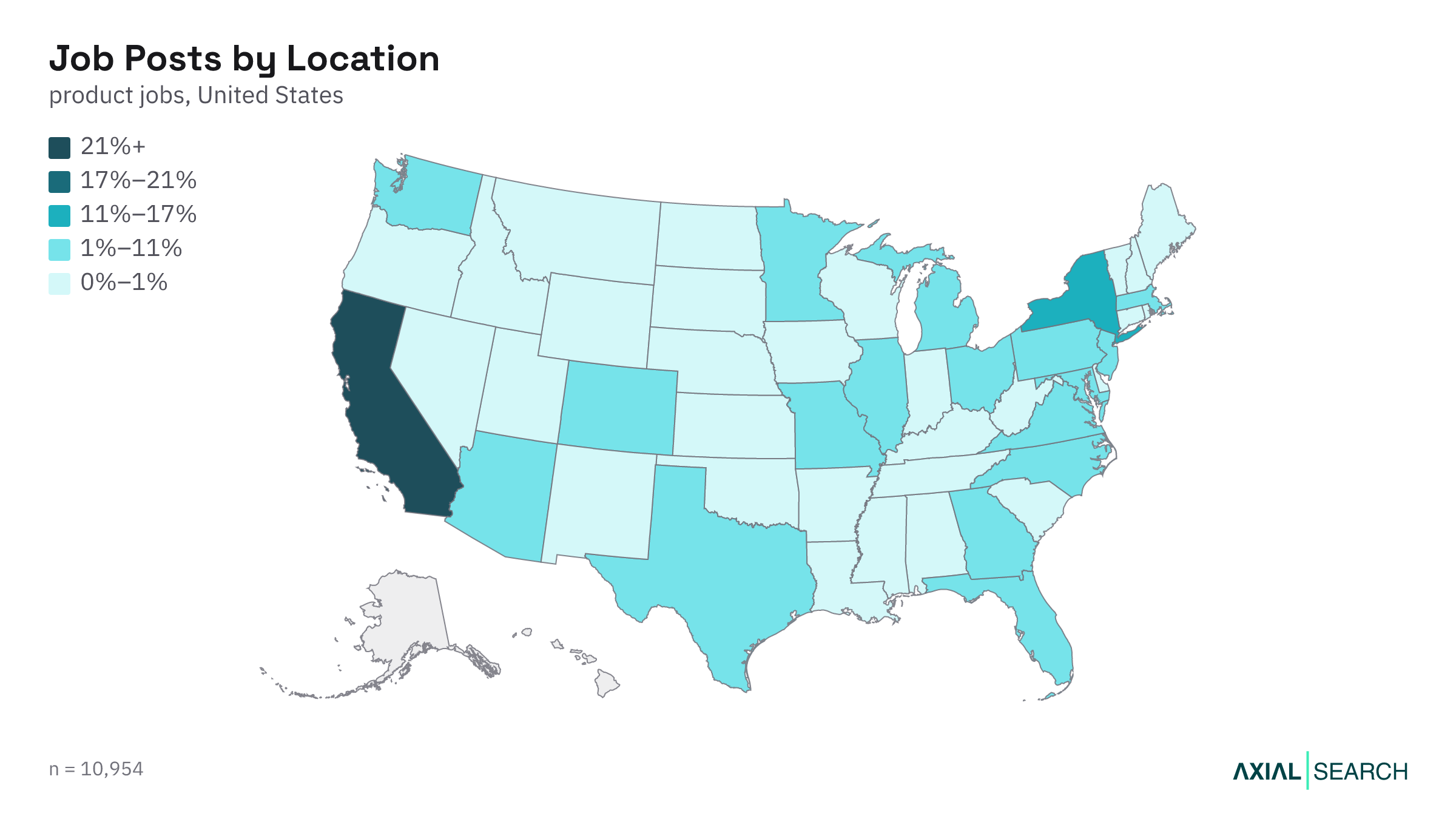
Geography still sets the price in AI product hiring, even in a remote-friendly market, and understanding the map is how you decide whether to pay a hub premium or arbitrage it away. Demand is heavily concentrated: about 25 percent of US AI product postings are in California and 16 percent in New York, with San Francisco alone accounting for roughly a tenth of the national total - Axial Search. Pay tracks that concentration. Senior AI PM total comp runs highest in the Bay Area at around $366,000 in San Francisco and $360,000 in San Jose, with New York near $351,000 and Seattle and Austin somewhat lower, while non-hub US remote roles land closer to $260,000 - IdeaPlan. The map below makes the concentration obvious, and it is a strategic document as much as a descriptive one: the shaded states are where your competitors are, where your poaching targets sit, and where a remote offer has to compete against local hub comp.
Outside the United States the same role costs materially less, which is the whole basis of the arbitrage. In London, AI product managers earn roughly £88,500 to £125,000 on a recent benchmark, well below US hub pay even before currency conversion - Robert Half. Germany sits lower still, with the median full-time Berlin tech salary around €80,000 in 2026 and senior product roles nearer €105,000, roughly a quarter below the US median in absolute terms - Ravio. India spans an even wider band, with AI PM pay commonly cited between ₹18 and ₹45 lakh and an average near ₹30 lakh, which is a large premium over local generalist PMs even though it is a fraction of US dollars - ProductLeadership. The takeaway for a budget owner is not that overseas talent is cheap labor; it is that the same person is priced very differently depending on where the offer originates.
That price gap is exactly why remote hiring has become a genuine strategy rather than a fallback, and it cuts both ways. Fully remote roles for US firms tend to pay 20 to 40 percent above local market, which means a senior AI PM in India, Latin America, or Eastern Europe can earn two to three times their local rate by taking a US "tier-two" band of roughly $80,000 to $180,000, and the US company still pays well under its domestic median - Techademy. Whether that trade works depends on the archetype: an Integrator-PM who must sit with executives and customers may need to be in-region, while a Builder-PM or Agent PM whose work is legible in artifacts (evals, prototypes, dashboards) is far easier to hire across time zones. The lesson is to decide the collaboration model first and let it, not habit, dictate the geography.
There is also a growing contractor layer that is worth knowing when you need capability faster than a full-time search allows. Fractional and contract AI PMs typically charge $100 to $250 per hour (with senior specialists at the top of that range), or monthly retainers around $5,000 to $9,000 for ten to fifteen hours a week and $9,000 to $12,000 for twenty, and a fractional CPO commonly $10,000 to $20,000 a month - Justin McKelvey. Day rates run from roughly $700 for junior-to-mid contractors up to $2,400 for senior and principal operators, with AI and machine-learning specialization adding a premium on top - Go Fractional. For a founder, the practical use of that layer is to bring in a senior fractional AI product leader to stand up the function and de-risk the roadmap while a permanent search runs in parallel, which often costs far less than leaving a critical product rudderless for four months.
5. Where to Find Them and How to Read the Signal
Because the pool is small, senior, and mostly not looking, the highest-yield sourcing move is lateral poaching, not funnel-building, and the cleanest signal that someone is a real AI PM is that they already do the job somewhere the AI is the product. A well-constructed target map for 2026 starts with the AI-native companies where product people ship models daily, then adds an under-fished second pool and a promising adjacent one. The named targets are worth having in front of you before you open a search, but the list is a starting point for judgment, not a substitute for it.
- AI-native product firms - Notion, Linear, Cursor, Replit, Vercel, plus OpenAI and Anthropic
- AI infrastructure - LangChain, LlamaIndex, Weaviate, Pinecone
- Under-fished SaaS pool - senior PMs quietly owning AI features at HubSpot, Asana, or Salesforce
- Adjacent talent - applied ML engineers with three to five years shipped who want product ownership
Each pool behaves differently, which is the practical reason to name them. The AI-native firms hold the most proven talent but are also where everyone else fishes, so you are competing on offer and mission, not access. The SaaS pool is the value play: strong PMs there are often quietly running an AI feature team while being paid on a generalist band, which makes them both qualified and poachable, and the labs themselves validate the hunting ground by pulling operators from enterprise software (OpenAI and Anthropic together hired close to 100 Salesforce employees in 2026) - Yahoo Finance. The adjacent pool of applied ML engineers is where you find raw AI depth that needs product coaching, useful when you can afford to develop the product muscle around genuine technical fluency.
Beyond direct poaching, the best AI PMs cluster in a small number of high-signal places, and knowing them turns a cold search into a warm one. The community stack has three layers: real-time chat for tactical signal, trusted peer groups for depth, and an in-person circuit where hiring managers openly recruit. The names below are the ones that consistently surface strong candidates, and membership in the gated ones is itself a mild quality signal.
- Peer depth - Lenny's Slack (a busy #ai channel among PMs at the top firms) and Product Coalition
- Real-time signal - Build Club, AI Tinkerers, and Latent Space for the frontier-lab crowd
- Technical crossover - the MLOps Community and invite-only Women in AI Product
Those communities are minable in ways a job post is not: attendee lists, speaker rosters, and member directories are directly useful, and the newsletters that anchor them (Lenny Rachitsky's, now past 1.2 million subscribers, and Marily Nika's AI Product Academy at more than 209,000) are the top of the funnel where the audience self-selects into AI product - Institute of Product Management. The in-person circuit matters too, and it has scaled fast: the AI Engineer World's Fair drew more than 6,000 attendees across 300 speakers in mid-2026, which is a dense concentration of exactly the builders and product people you want to meet - AI Engineer. The job boards worth monitoring, where labs and startups post before the roles reach LinkedIn, include ai-jobs.net, the Hugging Face board, Y Combinator's Work at a Startup, and the a16z Talent Network, and the mirror-image play is to watch them for the companies hiring AI PMs, because those firms are simultaneously your competitors and your poaching targets - Institute of Product Management.
When you do search directly, two technical realities shape the tactics. LinkedIn X-ray via Google largely broke in January 2024 when LinkedIn stripped headline, experience, and skills data from the public index, so pure site:linkedin.com/in strings are weak now and the reliable approach is Boolean inside LinkedIn Recruiter plus X-raying the platforms that still index, such as GitHub and Hugging Face - Boolean Strings. A workable in-platform string combines seniority and AI-depth language while excluding adjacent titles, for example:
("Product Manager" OR "Senior Product Manager" OR "Group Product Manager" OR "Head of Product")
AND ("LLM" OR "generative AI" OR "RAG" OR "agents" OR "evals" OR "prompt")
NOT ("project manager" OR "program manager" OR intern)
Tighten it for genuine depth by adding eval and agent language ("golden dataset" OR "LLM-as-judge" OR "fine-tun*"), and X-ray GitHub and Hugging Face for people who publish product-flavored AI work rather than just list it. The second reality is that keywords now lie: reporting shows roughly one in five long-tenured LinkedIn members has edited old entries to add AI buzzwords, and a large share of self-described AI PMs retrofitted a past job after leaving it - Briefs.co. So the headline is noise, and the signal is proof of work: a named shipped AI product with a described eval set, a production incident with a named model and a rollback, and a portfolio artifact such as a small eval-infrastructure project, which is called the single highest-signal piece precisely because almost no candidate has actually built one - Institute of Product Management. Read profiles for those artifacts, treat certificates without shipped product as motivation rather than qualification, and you will separate real AI PMs from buzzword profiles faster than any tool can.
When a profile looks plausible, a two-minute eval-flavored screen separates the real from the retrofitted faster than any keyword filter. Ask the person to name the AI product they are proudest of shipping and to describe its eval set; strong candidates lead with the eval and the failure modes, while weak ones lead with the model name and a demo - KORE1. Then ask them to walk through a production model failure, the rollback, and the regression test that now prevents it, and listen for whether they discuss latency, cost, and accuracy as budgets they traded against rather than as abstractions. Someone who can do that has almost certainly done the job; someone who pivots to frameworks and vision statements probably has not, no matter how the headline reads. The same quick screen works in a first message, a referral vetting call, or the top of a recruiter conversation, and it saves you from advancing polished profiles that dissolve under one specific question.
6. What Actually Reaches a Senior AI PM
Finding the right AI PM is only half the battle; reaching them is the other half, and the bar is high because the best ones have effectively opted out of generic recruiting. A candidate in a Bay Area AI hub can receive around 40 recruiter messages a week, most of them poorly targeted, and the strongest have simply stopped replying to unbranded outreach entirely - Underdog.io. That single fact should reset expectations: a templated "exciting opportunity" message is not just low-yield, it actively marks you as someone who did not do the work, which is disqualifying to exactly the senior operators you most want. The audience is the least forgiving in tech of automation that feels like spam, so the economics of outreach here reward precision and punish volume.
What works instead is credibility and specificity, and the difference is measurable in practice. Outreach that names a candidate's actual shipped project or published eval writeup converts far better than category-matching praise, because it proves you understand the work rather than the title - Paraform. Stack-specific messages that reference the exact model, surface, or eval problem the person would own reportedly lift response rates three to four times over generic recruiter language, which is a large enough gap to change how you staff a search: fewer, better-researched messages beat a large blast every time - KORE1. The implication is that the scarce resource in AI PM outreach is not send volume but research time, and the teams that win treat every message to a senior target as a small piece of custom work.
The single highest-conversion channel, though, is not a message at all; it is a warm referral from a product person the target already respects. Senior AI PMs move for reasons that rarely lead with money: the range of decisions they will own, the autonomy to make them, the caliber of the colleagues, and a mission they find credible. So the outreach that lands tends to come from the hiring manager rather than a nameless recruiter, and it leads with the problem and the scope rather than the comp band or generic flattery. The practical build is to treat a talent network as infrastructure: cultivate relationships in the communities named earlier, make it easy for respected PMs to refer people, and reserve cold outreach for the specific, well-researched cases where you have something genuinely relevant to say. Speed matters too, since AI PM candidates commonly hold multiple offers and a slow, vague process loses them, but speed without relevance just gets you ignored faster. The teams that consistently reach senior AI PMs are the ones that have made themselves worth replying to before they hit send.
7. The Tooling: Sourcing Platforms and What They Cost
Choosing sourcing tools for AI PMs comes down to one structural fact: the best candidates are split across two worlds, and your stack has to reach both. One cohort keeps a polished LinkedIn profile at a name-brand AI company; the other is builder-flavored, lives on GitHub and X, and barely maintains LinkedIn. Where your targets sit on that spectrum should drive the spend, because no single tool covers both worlds well and the pricing models differ enough to matter. The other structural fact is that most of this category hides its real price behind a sales call, so the sticker you see is rarely the invoice you pay, and comparing tools means comparing reported contract values, not list pages.
For the visible, brand-name cohort, LinkedIn Recruiter remains the highest-fidelity database, but its economics have worsened. Recruiter Lite runs about $170 per month, while the full Recruiter Corporate tier is quote-only and buyer-reported around $10,800 to $12,000 per seat per year after a mid-year increase, often with a three-seat minimum and InMail overages on top - Pin. Open-web aggregators widen reach to less-visible AI PMs and add contact enrichment: hireEZ lands around a $13,000 median annual contract and SeekOut advertises a $149 seat but most teams pay far more once pushed to enterprise, with a roughly $20,000 median annual deal - Vendr. Both are strong for surfacing PMs with technical backgrounds, and both bury their true cost behind minimums and credit overages, so budget for the real number rather than the headline seat.
The cheapest fast start is natural-language AI search, which suits small teams that want to describe the AI PM they want rather than build Boolean. Juicebox (PeopleGPT) runs $99 to $179 per seat per month and returns ranked matches from a plain-English brief, with credit caps as the main constraint - Juicebox. Gem publishes tiers around $99 to $149 per user per month and is the better pick when the search is a long nurture that needs a CRM and multi-touch outreach rather than just a query - G2. The company-size mix below is worth weighing when you pick a tool, because it tells you who you are competing with on offer: a large share of AI PM demand comes from enterprises with more than 10,000 employees, so a lean team often wins on speed and specificity rather than brand.
Where autonomous AI-recruiter tools fit is the open-web cohort, because they collapse finding, qualifying, and first outreach into one loop that reaches people who live outside LinkedIn. Tools like HeroHunt.ai search across LinkedIn, GitHub, and the open web, screen each profile against a written brief with a language model rather than matching a job title, and run the first outreach automatically, with pricing metered on open roles (roughly $149 to $499 a month) rather than seats. Lighter freemium alternatives exist on smaller profile indexes, and voice or video screening tools sit downstream for high-applicant roles, but the shared advantage of the agent tools is flat, published, per-role pricing that contrasts sharply with LinkedIn's rising seat costs.
HeroHunt.ai
If the AI PMs you want are the open-web kind (ex-engineers who live on GitHub and X and rarely touch LinkedIn), the tool shape that fits is an autonomous recruiter that screens on evidence, not titles. HeroHunt.ai searches over 1 billion profiles across LinkedIn, GitHub, and the open web, screens each person against your written brief with a language model, then runs the first outreach on autopilot. It is metered on open roles ($149 to $499 per month) with a free 8-day trial and no card, so a single hard AI PM req is a cheap experiment. The honest caveat: it is a sourcing and outreach layer, not an applicant tracking system, and it is strongest exactly where candidates publish work publicly and weaker where they do not.
Cost-per-hire math is what should ultimately frame the decision, because the two routes to a hire are priced very differently. The SaaS stack is near-fixed cost: a $149 to $499 monthly agent or a $99 to $199 seat, spread across every role you work, can land an AI PM for well under $2,000 of tooling if you fill even a couple of reqs a quarter. Contingency and marketplace routes invert that, and they earn their place on the hardest roles. Paraform bounties typically run $10,000 to $30,000 per hire (often 20 to 25 percent of first-year salary, with the recruiter keeping most of it) and you pay only on a successful hire - Paraform. Fractional marketplaces are priced per engagement rather than per search, with Go Fractional taking a 20 percent margin on a leader's rate and Toptal charging a blended hourly plus a small subscription - Go Fractional. The rule of thumb that falls out: use the cheap AI-search and agent stack to source full-time AI PMs in-house, reserve bounty marketplaces for the senior roles you genuinely cannot crack, and use fractional marketplaces when you need a product leader now rather than a permanent hire. Assessment tools like Karat (roughly $200 to $450 per interview) sit downstream as screening, not sourcing, and are only worth it at real volume - InterviewCost.
Beyond software, a specialized human layer has grown up around AI product hiring, and it is worth knowing when a role is senior enough to justify the fee. Boutique and executive-search firms now market dedicated AI-product practices, with one, Talentfoot, claiming a 98 percent client success rate across more than 2,500 companies and candidate slates in as little as five business days, while established technology-leadership firms such as Riviera Partners and Daversa Partners work the VP and C-suite end of the market - Talentfoot. The bounty marketplaces sit between pure software and retained search, letting a company post a role that a network of independent recruiters competes to fill on a pay-per-hire basis. The fee math is the deciding factor: contingency agencies typically charge 15 to 25 percent of first-year base and retained search 25 to 33 percent, so a human search on a $300,000 role can run $45,000 to $100,000, which only makes sense for the senior seats you genuinely cannot crack in-house. The rule most teams settle on is to run software-driven sourcing for the bulk of AI PM roles and reserve the human search layer for the one or two hires that are both critical and truly hard.
8. How to Screen Them Without Getting Fooled
The screening problem in 2026 is harder than it looks, and the reason has a name: AI slop, meaning highly polished, artificially generated applications that look excellent on paper while masking a lack of underlying substance - Product People. Because a language model can produce a flawless resume, a slick take-home, and a confident written case study, the old proxies (pedigree, brand names, formatted deliverables) have quietly stopped carrying signal. The counter-move is to lean on the most predictive method available and to make candidates think in front of you. Decades of selection research, refreshed by a major recent meta-analysis, put structured interviews at the top of the validity table at an operational validity around .42, ahead of job-knowledge tests, work samples, and cognitive ability, and pairing a structured interview with a cognitive component pushes composite validity toward .63 - SIOP. Practically, that means the same questions for every candidate, a written rubric each interviewer scores independently before the debrief, and at least one hands-on round that cannot be faked in advance.
It helps to know exactly what the most selective screens are testing, because it tells you what to score. One product-hiring firm with a sub-0.5 percent acceptance rate builds its live simulations around five signals: which problem is actually worth solving, pragmatic judgment about what really drives adoption and retention, ruthless prioritization including the willingness to kill features, first-principles reasoning rather than memorized frameworks, and raw speed - Product People. Those map cleanly onto concrete tells in an AI PM. The green flags are a shipped AI artifact with a live link, an owner's instinct ("here is what I would check first, and why"), fluent walkthroughs of two or three real failure modes, and cost intuition specific enough to say something like "at five cents a draft that is 10 percent of revenue, so it will not scale." The red flags are the mirror image: a recited framework with no product underneath it, an analyst's "here are five things we could look at" instead of a decision, no evidence of having built anything, and uncritical acceptance of confident but wrong model output.
The loop that has emerged for AI PMs reflects both the seniority of the role and the technical fluency it now demands, and the best advice is to build it around distinct dimensions rather than bolting an AI question onto a generic PM loop, which one specialist recruiter warns simply "won't surface the right people" - Paraform. A workable four-to-five round loop assesses a different thing at each stage, keeps the total short enough to hold a senior candidate against faster competing offers, and always includes at least one round that a language model cannot pre-chew.
- Recruiter screen - can the candidate be summarized as role, AI domain, and a shipped proof?
- Hiring-manager fit - behavioral prompts mapped to your team's real production war stories
- AI product sense - a live design problem with a model in it, graded on the "should we even use AI" instinct
- Technical-depth round - evals, precision and recall, RAG criteria, build-versus-buy, unit economics
- Live prototype round - build something real with AI tools while an interviewer watches how you direct it
Two of those rounds deserve emphasis because they are where the modern signal concentrates. The technical-depth round has genuinely shifted the balance of AI PM loops toward roughly 60 percent technical and 40 percent product, up from the reverse a couple of years ago, and it uses questions with real teeth: "your AI feature has a 12 percent hallucination rate, walk me through reducing it," or "write evaluation metrics for a travel-booking agentic workflow" - TechnoManagers. You are not testing coding ability here; you are testing whether the candidate can partner with data scientists, reason about data distribution and edge cases, and trade accuracy against latency and cost. The live prototype or "vibe-coding" round is the fastest-spreading addition, and some companies have redesigned interviews around it precisely because AI trivially solved conventional take-homes and gave no signal; the strongest candidates use AI strategically for well-defined subtasks while staying in control, and the weak ones lack the judgment to guide it - Canva.
Because take-homes now leak signal, the most reliable pre-loop filter is a small set of concrete artifacts, and a good four-dimension rubric turns any AI-assisted task into a scored signal. Ask each candidate for one shipped AI product (a side project counts), one written case study with real numbers, and one demonstrable eval suite, and score their AI fluency on prompting, verification, judgment, and recovery: how they specify a task, how they check the output, what they refuse to delegate, and what they do when the model is confidently wrong - PracHub. One decision to make explicitly and tell candidates in advance is your policy on AI use in interviews, because the industry is genuinely split, from companies that require it to ones that forbid it in live rounds; whichever you pick, score whether the candidate can check the model's work rather than just accept it. Finally, weight the ethics-and-safety round, where scenarios like "the model works for 90 percent of users but fails for one group, how do you proceed?" separate people who will delay a risky launch from those who dismiss the trade-off, and where at least one lab's behavioral screen reportedly has the highest failure rate of any stage - Northeastern University. Companies with mature loops, including Microsoft's three-to-six round AI PM onsite, converge on the same principle: reward real hands-on AI experience and shipped zero-to-one products over theory - Aced.
9. How AI Agents Are Changing the Role and the Hunt
The most important trend shaping AI PM hiring is a symmetry that is easy to miss: AI agents are pushing both the product manager and the recruiter who hires them from executor to orchestrator. On the product side, the mechanism is concrete. AI coding agents have multiplied engineering output, letting some teams ship at roughly three times their actual headcount, while product and design output did not move the same way, which pushed the constraint upstream onto product management - VentureBeat. The counterintuitive result is more demand for strong PMs, not less: when engineering triples, the bottleneck becomes the quality of product thinking feeding it, so the fix is to widen that constraint by hiring sharper product people. As one analysis put it, the productivity gap that matters in 2026 is not between PMs and AI, but between PMs who use AI to think faster and those who use it to type faster - ProductMap.
That reshapes what you should screen for. The tasks AI now does well (first-draft PRDs, research synthesis, meeting notes, metric reporting) are being automated, so hiring managers should stop optimizing for spec-writing and coordination and start screening for AI-evaluation literacy, judgment under ambiguity, the ability to catch what an AI-generated spec missed, and comfort orchestrating agent workflows rather than reviewing every artifact by hand. The evidence of a bifurcation is already in the data: senior PM hiring has grown while junior and mid hiring has softened, and the share of senior PM postings requiring AI fluency has risen sharply, so the role is consolidating into fewer, more senior, more technical seats - Institute of Product Management. The video below is worth watching on this exact question, because two veteran product leaders talk through how the AI era changes what you should hire a PM for, including the new emphasis on writing evals and constraining model behavior over classic spec work.
How AI is reshaping the product role (Oji and Ezinne Udezue)
The hunt for those PMs is being transformed by the same agents, and the direction is clear even if the endpoint is not. Talent-acquisition leaders are moving fast: roughly 84 percent plan to use AI in recruiting in 2026 and 52 percent plan to add autonomous agents that source, screen, and reach out without a human triggering each step, even as most still rank critical-thinking skills above raw AI competencies when hiring - Korn Ferry. Adoption is real but early, with about 27 percent of organizations using AI specifically in recruiting (rising to 60 percent at large enterprises), and around 85 percent of recruiters insisting on keeping final decision authority over AI recommendations - Recruiterflow. The pattern that emerges is exactly the one AI PMs themselves live: agents absorb the high-volume, repeatable top of the funnel, while human judgment stays on the decisions that actually determine a hire.
The direction of senior talent flow is visible in named moves, and it doubles as sourcing intelligence about where to fish. The labs have been pulling product and go-to-market leaders straight out of enterprise software: former Ironclad chief executive Jason Boehmig joined OpenAI to lead product for the legal industry, and former Slack chief executive Denise Dresser became OpenAI's chief revenue officer, both part of the wave that saw OpenAI and Anthropic hire close to 100 Salesforce employees in 2026 - Yahoo Finance. At the very top, Anthropic installed Instagram co-founder Mike Krieger as its first chief product officer, a reminder that the labs will reach outside the AI world entirely when the product leader is right - TechCrunch. The lesson for a recruiter is not to copy the labs but to read the pattern: many of the most sought-after AI product leaders are people with deep enterprise-software or marketplace backgrounds who learned the AI on the job, which widens your pool well beyond those who already carry the exact title.
For hiring AI PMs specifically, this means the winning play is agent-run sourcing plus human judgment on the close. Because AI-written resumes and generic outreach are now commodities, the leverage has moved to warm-channel sourcing (the communities, GitHub contributions, and conference speakers covered earlier) and to structured work samples that a language model cannot pre-solve. An autonomous sourcing layer can do the finding, first-pass qualifying, and initial outreach across the open web at a scale a human cannot match, but the evaluation of whether a candidate can genuinely reason about probabilistic products, and the human moments that persuade a senior person to move, remain stubbornly and correctly human. Treat the agents as a way to spend your scarce judgment where it counts, not as a way to remove judgment from the loop.
10. The Future and the Bubble Question
The honest outlook for AI PM hiring requires holding two ideas at once: the demand for people who can build and direct AI products is real and durable, while some of the prices being paid in 2026 are probably not sustainable. On the durable side, the buildout underneath the role is enormous. Analysts expect roughly 40 percent of enterprise applications to embed task-specific AI agents by the end of 2026, up from less than 5 percent a year earlier, which means a rising tide of products that need someone to own and orchestrate them - DevOpsDigest. Near-term signals agree: open PM roles hit a three-year high in early 2026, with more than 7,300 tracked openings, and AI roles within that were described as exploding - Lenny's Newsletter. The people who can turn agents into trustworthy products are not becoming less valuable; if anything, the automation of everything around them raises the premium on the judgment they provide.
On the fragile side, the same analysts who see the buildout also warn that more than 40 percent of agentic AI projects will be canceled by the end of 2027 due to escalating costs, unclear business value, and weak governance - Gartner. That prediction is not a reason to stop hiring AI PMs; it is a reason to hire a specific kind, because the projects that survive will be the ones led by people who can define success for a probabilistic system, measure ROI honestly, and kill what is not working. In other words, the coming shakeout makes evaluation literacy and cost judgment the differentiating skills to screen for, rather than agent enthusiasm. It also argues against paying frontier-lab comp on the assumption that every AI initiative will pay off, since a meaningful share plainly will not.
One structural shift worth building into a workforce plan now is the rise of very small, very senior teams. As AI multiplies individual output, a handful of strong people can do what a much larger group did a few years ago, which favors hiring fewer, more autonomous, more senior product people over building large junior benches, and it is part of why AI PM demand is consolidating upward rather than spreading out. The counterweight to plan around is the entry-level squeeze: if companies stop hiring and developing junior PMs because AI absorbs the routine work, the senior shortage that drives today's bidding wars only deepens in a few years, since the pipeline that eventually produces senior AI PMs is the junior roles nobody is filling now. The teams that will look smart in 2028 are the ones that hire senior for the scarce judgment today while still deliberately developing a small number of juniors into the specialists they will not be able to buy later.
The most provocative signal of all is a live counter-narrative that the role is not inevitable. The hottest AI coding company of the moment, Cursor's maker Anysphere, deliberately employs no product managers, with engineers talking directly to users, building, and shipping, all while running around $2 billion in revenue - JobsByCulture. That is a genuine data point, not a gimmick, and it should sharpen how you think about the role: the AI PM is most valuable where product complexity, stakeholder coordination, or trust-and-safety stakes are high, and least necessary where a small team of product-minded engineers can own the whole loop. It is also worth resisting the temptation to reason from a single global shortage number, because credible analysts note that no reliable single figure for the AI talent gap actually exists, and the widely repeated ratios are usually estimates repeated until they sound official - Second Talent. The defensible conclusion is that broad demand for people who can build and direct AI products is durable and worth investing in, while the frontier prices carry real bubble risk, so the winning posture is to hire durable judgment rather than chase perishable comp records.
11. The Hiring Playbook
If you internalize nothing else, internalize the small number of decisions that everything above collapses into, because they convert a confusing market into a plan you can actually run. The first and most important is to name the role precisely before you do anything else. Decide which archetype you need (a Builder-PM, an Agent PM, an AI Platform PM, an Integrator-PM, or an Assistant PM), name the surface and the model context in the requisition, and separate "must have shipped AI in production" from "must be AI-fluent." Almost every failed AI PM search traces back to a description that blurred two of those jobs together and therefore attracted and screened for the wrong person, the exact mistake behind the mis-scoped Denver hire in the first chapter.
The second move is to know which pay universe you are in and price honestly within it. If you are not a frontier lab, you are almost never competing head-to-head with an $800,000 equity-heavy package, so stop benchmarking against it and build a genuinely competitive offer for your tier, somewhere around a $305,000 total-comp median for strong senior talent, then win on the levers that actually move this population. Decision scope, autonomy, the freedom to ship real AI, strong colleagues, and a credible mission beat raw cash for most candidates below the frontier, and they cost far less than a bidding war you would lose anyway. Underprice by even 10 percent, though, and the senior tier stops replying within weeks, so set the band right before you open the search.
The third move is to source on evidence and screen on judgment. Find people through proof of work (shipped AI products, published evals, real prototypes, open-source contributions) rather than resume keywords that anyone can now retrofit, poach from the AI-native firms and the under-fished SaaS pool, and reach senior targets with researched, stack-specific messages or warm referrals rather than templated blasts. Then screen with a structured, multi-round loop that includes a technical-depth round and a live prototype round a language model cannot pre-solve, demand a small set of concrete artifacts before the loop, and score verification behavior over polished output. The AI-slop problem means the candidate who looks best on paper is often the one you understand least, so make people think in front of you.
The last move is the strategic one: build for the durable trend, not the bubble. Use autonomous agents to run the top of the funnel, and spend your scarce human judgment on the evaluation and the close where it actually decides the hire. Hire the people who can define success for probabilistic systems and reason honestly about cost and risk, because they are the ones whose projects survive the coming shakeout. Keep the process fast, because these candidates hold multiple offers, and keep it human where it counts, because this is the audience least forgiving of automation that feels like spam. The AI product managers who can turn a model into a product people trust are among the scarcest, most contested talent in the market right now, and the teams that win them are rarely the ones with the biggest budgets; they are the ones who understand exactly who these people are, where they hide, and what makes them say yes.
Test it on the one AI PM role you have failed to fill: write the brief, point it at the open web, and compare a language-model screen against your best manual shortlist. Start free at herohunt.ai/app.
This guide reflects the AI product manager hiring market as of September 2026. Compensation figures on self-report platforms drift week to week, pricing and tooling change on a monthly cadence, and the frontier-lab numbers rest on small samples, so verify current details against the primary sources linked above before you rely on them for a specific decision.