



The practical 2026 guide to what AI recruiting actually saves, backed by real cost data and a payback model you can run on your own team.
AI-enabled talent acquisition is now delivering time-to-hire that is 2 to 3 times faster than traditional methods, according to 2026 research from The Josh Bersin Company. That single number is why recruiting budgets are being rewritten this year. Speed is money in hiring, and a pipeline that closes twice as fast changes the economics of the entire function.
But here is the problem: most of the ROI numbers you will read are vendor math, not measured savings. A recent survey of over a thousand talent acquisition leaders found that only 8% of teams claiming measurable AI recruiting ROI had used a control group or an A/B test to prove it - Recruiting Tech Reviews. Most "ROI" is inferred from a dashboard or a gut feeling. So the useful question is not whether AI recruiting saves money in a press release. It is where the savings actually come from, how big they really are, what the tools cost, and how to model the return for your own reqs before you sign anything.
This guide answers that. It breaks down the real cost of hiring without AI, the five cost levers AI actually pulls, the named case studies with hard dollar figures, what the major tools cost in 2026, and a worked payback model you can copy. It also spends real time on where the returns disappear, because a guide that only sells you the upside is the vendor math this article is trying to replace.
Written by Yuma Heymans (@yumahey), who built HeroHunt.ai and its autonomous AI Recruiter. He spends most of his time on the unglamorous side of this exact question: what automated sourcing and screening genuinely cost a team, and what they genuinely return.
HeroHunt.ai
If you would rather test the economics than model them, an AI recruiter is the cheapest experiment you can run. HeroHunt.ai searches around 1 billion public profiles, screens each candidate against your written brief with a language model instead of keyword-matching a job title, and runs the outreach with follow-ups on autopilot. Its pricing is unusually legible for this category ($99 to $399 a month, with unlimited positions and monthly allowances of AI-screened and matched profiles and candidate emails rather than per-seat contracts), so a single hard-to-fill role is a low-stakes way to measure the return yourself. The honest caveat: it is a sourcing and outreach layer, not an applicant tracking system, so it sits alongside your ATS rather than replacing it, and it is strongest for roles where candidates publish their work publicly.
Contents
- The 2026 ROI Picture: What AI Recruiting Actually Saves
- The Real Cost of Hiring Without AI
- Where the Savings Come From: The Five Cost Levers
- Real Cost Savings Data: The Benchmarks
- Named Case Studies: Companies and Their Numbers
- What AI Recruiting Tools Actually Cost in 2026
- How to Calculate Your Own AI Recruiting ROI
- A Worked Example: The Payback Model for a 200-Hire Team
- Where the ROI Disappears: Hidden Costs, Bias, and Compliance
- AI Agents and the Shift to Outcome-Based Cost
- The 2027 Outlook: Where AI Recruiting ROI Goes Next
- Conclusion: A Decision Framework You Can Act On
1. The 2026 ROI Picture: What AI Recruiting Actually Saves
The honest headline for 2026 is that AI recruiting returns are real, large, and unevenly measured. The strongest, best-sourced savings show up as reallocated recruiter time and compressed time-to-hire, not as a single clean cost-per-hire percentage. Recruiters who actively integrate generative AI report saving roughly 20% of their work week, about one full working day, on recruiting tasks - LinkedIn Future of Recruiting 2025. That is the most defensible number in the entire category because it comes from the platform where most of the work happens, not from a tool trying to sell you a subscription.
The second thing to understand before any dollar figure is the gap between adoption and value. Roughly 69% of companies now use AI somewhere in hiring, but only about 18% use it broadly across the process, according to a 2026 survey of more than 400 US talent acquisition leaders - iCIMS and Aptitude Research. Almost everyone is dabbling; very few have industrialized it. That matters for ROI because the returns compound only when AI runs across the whole funnel, and it explains why the teams reporting the biggest savings look nothing like the teams that "tried an AI tool once."
The speed of that adoption is itself a cost signal, because falling behind now carries a measurable penalty rather than a theoretical one. The share of organizations using AI for HR tasks jumped to 43% in 2025, up from 26% in 2024 - SHRM, a seventeen-point leap in a single year, and the trajectory since has only steepened. The returns even reach the outcome that is hardest to quantify: 61% of talent acquisition professionals believe AI can improve how they measure quality of hire - LinkedIn Future of Recruiting 2025, the metric that ultimately decides whether a hire was worth its cost. When adoption climbs that fast on the same technology your competitors are buying, the cost of waiting stops being missed savings and becomes a widening capability gap in the one function that determines who you can hire at all.
The catch, and the reason this guide keeps returning to measurement, is that most organizations cannot yet grade the returns they are chasing. A striking 89% of talent professionals say measuring quality of hire is increasingly important, but only 25% feel confident actually doing it - LinkedIn Future of Recruiting 2025. That mismatch is the quiet reason so many AI recruiting investments never prove their worth: the savings may be real, but a team that never captured a baseline before the tool arrived is left arguing from belief rather than evidence. The companies extracting genuine value are frequently not the ones with the fanciest tools; they are the ones that decided what to measure before they switched anything on.
Screening is where the money is moving first, which tells you where the early ROI lives. Among employers using AI in hiring, the top applications are screening (58%), candidate communication (54%), assessments (50%), and sourcing (46%), and a striking 80% of employers say recruiters now spend the freed-up time on candidate engagement - iCIMS and Aptitude Research. The chart below shows that distribution, and it is worth reading as a map of where automation is actually paying off rather than where the marketing points.
Most common AI use cases in hiring (2026)
Read that chart alongside the adoption gap and the ROI logic falls into place. Screening and communication lead because they are high-volume, repetitive, and easy to measure, which is exactly the profile of work where automation converts directly into recovered hours. Sourcing trails slightly because it is harder to hand off well, but it is also where the biggest strategic savings sit once a tool is good enough to trust. The practical takeaway for a leader building a business case is to start the ROI story where the data already points: automate the queue (screening, scheduling, first-touch outreach) before you try to automate judgment.
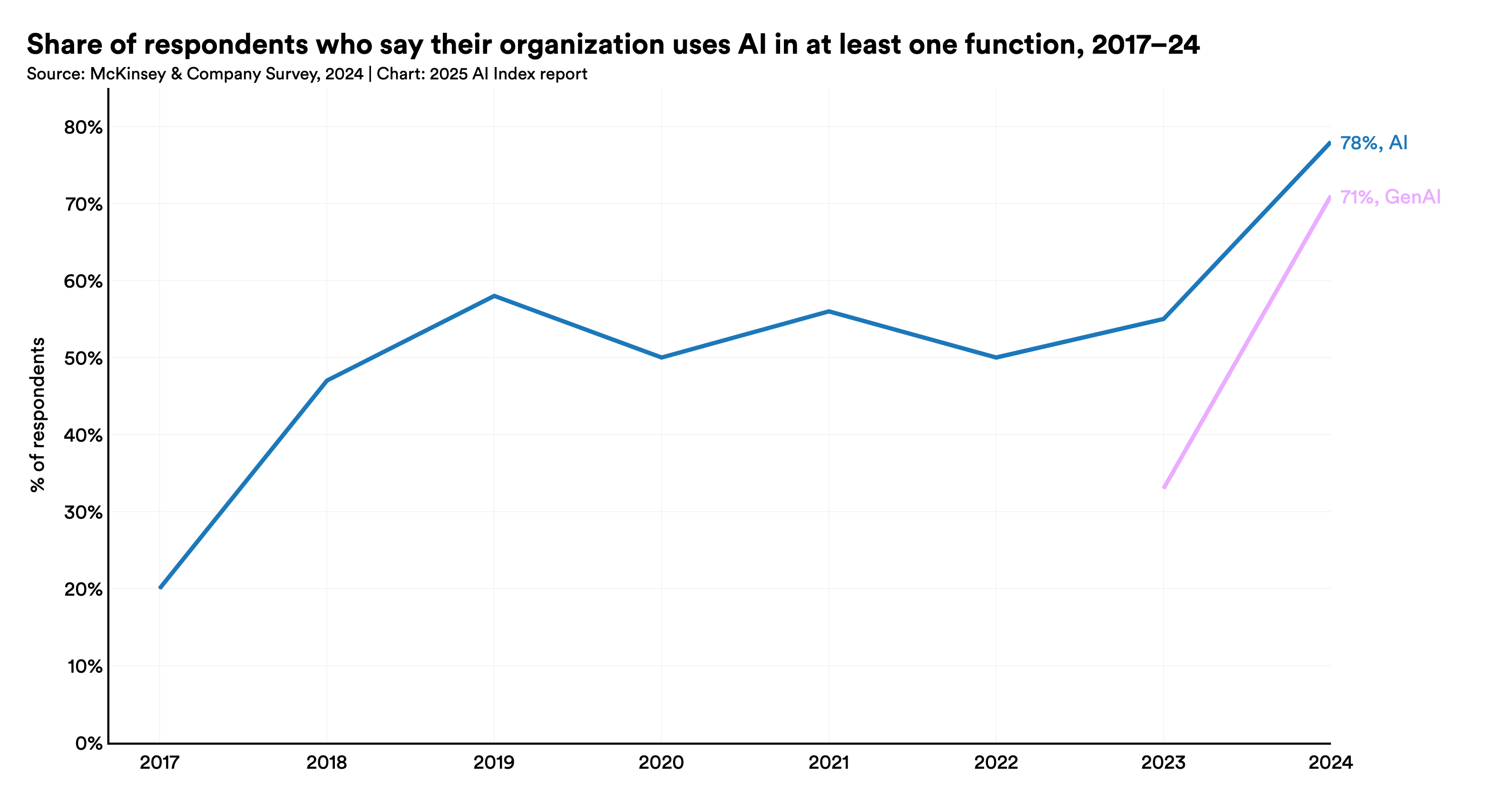
The macro backdrop is that AI adoption across business functions has climbed steeply, so recruiting is riding a wave rather than fighting the current. Stanford's AI Index shows the share of organizations using AI in at least one function reaching 78% for AI and 71% for generative AI by 2024, and the curve has only steepened since - Stanford HAI, 2025 AI Index. The image below plots that adoption climb, and it is the context every recruiting ROI conversation now happens inside: the question in most companies is no longer whether to use AI, but where it pays off first.
AI adoption across business functions has climbed steeply
2. The Real Cost of Hiring Without AI
To measure what AI saves, you first need an honest picture of the "before," and the before is more expensive than most teams admit. The current benchmark average cost-per-hire is $5,475 for a non-executive role and $35,879 for an executive role, roughly a seven-fold gap, per SHRM's 2025 Benchmarking Report released in October 2025 - SHRM. That $5,475 figure is the anchor for this entire guide. You may still see the older SHRM baselines of $4,700 and $4,129 quoted around the web; treat those as historical, and measure your AI savings against the current $5,475, not a number from several years ago.
Cost-per-hire, though, is only the visible tip. SHRM notes that many employers estimate the total cost to hire runs three to four times the position's salary once indirect costs are counted - SHRM. The two biggest hidden lines are external spend and internal time. On the external side, recruitment agencies typically charge 15% to 25% of first-year salary, so a single agency placement on an $80,000 role costs $12,000 to $20,000 - Eddy HR Encyclopedia. On the tooling side, the incumbent seat most teams buy, LinkedIn Recruiter Corporate, runs roughly $8,999 to $15,000 per seat per year after an approximate 15% price increase in 2026, with buyer-reported renewals landing near $10,800 to $12,960 - Pin.
The agency line deserves a closer look, because a single senior placement can cost more than a full year of recruiting software. A retained executive search typically totals about 25% of first-year salary, so a $75,000 role runs roughly $18,750 in fees, released in milestones as the search progresses - Top Echelon. Stack that across even a handful of hard roles and external spend dwarfs any tooling budget, which is why agency avoidance is usually the fastest and most legible AI saving a team can point to. It also explains the sheer scale of the prize: recruiting consumes on average about 26% of the total HR budget - SHRM, so squeezing inefficiency out of hiring moves a line the entire HR organization is watching.
Seeing the full base also guards against a common self-deception, which is celebrating a cut to the visible number while the expensive hidden lines go unmanaged. The blended cost is dominated by things AI touches unevenly: the hiring manager's interview hours, the output lost while a seat sits empty, and the ramp time before a new hire is fully productive. AI attacks the largest and most controllable of those, the sourcing and screening labor and the days a role stays open, but it does little for interview panel time or onboarding ramp. A credible before-and-after keeps those untouched costs constant on both sides of the comparison, so the savings you claim are the savings AI actually produced rather than an artifact of counting different things in each column.
Internal time is the line that never appears on an invoice, which is exactly why it hides so much cost. Recruiters spend an average of 17.7 hours of manual admin per vacancy, more than two working days, split across reviewing applications, scheduling interviews, and writing up notes, and that burden costs about £17,000 in lost productivity per recruiter per year - People Management. That time is not free: the US median annual wage for the HR specialists who recruit and screen was $72,910 in May 2024, before benefits and overhead - U.S. Bureau of Labor Statistics. Every hour of admin is paid hourly labor spent not talking to candidates.
Then there is the cost of getting it wrong, which is the multiplier that makes speed-versus-quality trade-offs so dangerous. The US Department of Labor estimates a bad hire costs at least 30% of first-year earnings, and CareerBuilder's national survey put the average loss at $14,900 per bad hire, with 74% of employers admitting they had hired the wrong person - CareerBuilder. Put the pieces together and the "before" picture is a function paying five figures per executive hire, thousands per non-executive hire, five-figure agency fees, five-figure per-seat tools, two days of paid admin per vacancy, and a one-in-four chance of an expensive mistake. That is the cost base AI is measured against, and it is why even partial automation produces numbers that look too good to be true.
3. Where the Savings Come From: The Five Cost Levers
AI recruiting savings are not one thing; they are five distinct levers, and confusing them is the fastest way to build a business case that collapses under scrutiny. The five are recruiter time, screening throughput, scheduling and outreach, time-to-fill (vacancy cost), and bad-hire reduction. Each maps to a different line in the "before" picture from the previous section, and each has a different level of proof behind it, so a credible model treats them separately rather than lumping them into a single headline percentage.
The first three levers are about recovered labor, and they are the best-evidenced. When AI drafts the screen, sorts the applicants, and books the interviews, it directly reclaims the 17.7 hours of admin per vacancy that were bleeding value. LinkedIn's own AI recruiting agent, its Hiring Assistant, reduces the number of profiles a recruiter must review by 81% and saves an average of 1.5 hours per role on applicant review alone - LinkedIn Talent Solutions. Those hours do not vanish from the budget; they get redeployed to the human work that actually moves offers, which is why 80% of employers report recruiters now spend more time engaging candidates. The diagram below maps the five levers onto the pipeline so you can see which stage produces which kind of saving.
The fourth lever, time-to-fill, is usually the largest in dollar terms and the most misunderstood. Every day a role sits open is a day the work is not getting done, and that lost output is real money even though it never appears on a recruiting invoice. Compressing time-to-fill is where AI produces its biggest raw numbers, because the savings are measured against the salary and output of the role being filled, not against the recruiting budget. This is also why frontline and high-volume hiring shows the most dramatic case-study figures: when you are filling thousands of roles, shaving a week off each one compounds into millions.
The fifth lever, bad-hire reduction, is the most valuable per unit and the hardest to prove, so it belongs in a business case only with heavy caveats. Better screening should mean fewer expensive mistakes, and the one rigorous randomized trial on the topic found AI-assisted shortlisting improved final interview pass rates by 17.5 to 20 percentage points - Aka, Palikot et al.. That is encouraging, but quality-of-hire is measured over months, not weeks, and only about 20% of organizations track it at all - SHRM. The practical rule is to build your model on the first four levers, which you can measure inside a quarter, and treat bad-hire reduction as upside you validate later rather than a number you promise your CFO up front.
The levers also compound, which is what most single-number models miss. A sharper sourcing brief improves screening precision, a better shortlist lifts offer-accept rates, and stronger hires stay longer and need less rework, with each stage feeding the next. LinkedIn's data captures the edge at the quality end: teams running the most skills-based searches are 12% more likely to make a quality hire, and those leaning hardest on AI-assisted messaging are 9% more likely - LinkedIn Future of Recruiting 2025. No single percentage there is dramatic, but they stack, and the practical result is that ROI grows non-linearly with how much of the funnel you automate. That is the mechanical reason the roughly one-in-five teams using AI broadly report far better returns than the majority who bolt a single tool onto a single stage.
There is a subtlety in the first three levers that changes how you should present them to finance. Automating sourcing, screening, and scheduling rarely deletes a payroll line; it converts low-value hours into high-value ones. The 80% of employers who say recruiters now spend the freed time on candidate engagement are describing a shift in what the same salary buys, not a headcount cut. That distinction is why disciplined models value recruiter time saved at a fully loaded hourly rate rather than booking it as cash: the money is real only if the reclaimed capacity is redeployed to close more roles, engage passive candidates, or absorb growth without adding a recruiter. Framed that way, the time lever is both defensible to a skeptical CFO and, across a full year, one of the largest.
4. Real Cost Savings Data: The Benchmarks
Strip away the vendor decks and a consistent set of benchmark ranges emerges, which is what you should plug into a first-pass model. On speed, the cleanest figure is Josh Bersin's finding that AI-enabled talent acquisition delivers 2 to 3 times faster time-to-hire, which the firm frames as companies "hiring 200 to 300% faster" than peers - The Josh Bersin Company. On recruiter productivity, the aggregate benchmark is that AI frees 15 to 20 hours per recruiter per week and can lift the number of open requisitions one recruiter handles from the mid-twenties toward forty - Outhire. Those two ranges alone are enough to build a defensible business case.
Underneath those aggregate ranges sits a distinction that decides whether a business case is honest: the difference between hours saved and dollars saved. A tool that reclaims fifteen hours a week per recruiter has unquestionably saved time, but it has only saved money if those hours are redirected to work that produces offers, or if they let the team handle more requisitions without hiring another recruiter. This is why the cleanest early proof point is throughput: not that a recruiter works harder, but that the queue stops waiting on a human at every step, so the same team clears more pipeline in the same week. The financial value follows only when leadership actually acts on the freed capacity, which is a management decision, not an automatic consequence of the software.
The reason the operational numbers deserve more trust than the financial multiples is triangulation. The hours-saved and days-shaved figures show up consistently across independent surveys, vendor case studies, and platform data, and they agree closely enough to be believable. The dollar multiples, by contrast, diverge wildly, from a few hundred percent to several thousand, precisely because each source makes different assumptions about what a saved hour or a shaved day is worth. When you build your own model, anchor it on the operational numbers everyone agrees on, then apply your own conservative dollar values, and you will end up with a figure you can defend rather than one you have to hope nobody interrogates.
On cost-per-hire specifically, the widely cited figure is a reduction of around 20% to 35%, and it is worth being precise about its provenance. The most common single number, roughly a 30% cut in cost-per-hire, comes from industry aggregators rather than primary research, so it should be presented as directional - Pin. The eye-catching 300% to 500% first-year ROI figures that circulate are vendor and aggregator estimates, not audited results, and a serious model should either exclude them or flag them clearly. The gap between the well-sourced operational numbers (hours saved, days shaved) and the shakier financial multiples is the single most important thing to understand about this data.
Vendor case data, used carefully, does add texture on specific tools. Eightfold reports its AI interview assistant produces a 33% reduction in time-to-fill and saves about 4 hours of recruiter time per position - Eightfold AI. LinkedIn's Hiring Assistant, beyond the 81% cut in profiles reviewed, lifts InMail acceptance from 39% to 65% on agent-sourced candidates versus manual sourcing - LinkedIn Talent Solutions. These are self-reported, but they come from the platforms themselves and are consistent with the independent productivity ranges, which is the kind of triangulation that should make you more confident.
The credibility caveat deserves its own paragraph, because it is what separates this guide from the marketing. As noted, only 8% of teams claiming AI ROI used a control group, and MIT's 2025 study of enterprise AI found that 95% of generative AI pilots delivered no measurable profit-and-loss impact - MIT Project NANDA. Recruiting is one of the better categories for AI returns, but it is not immune to the pattern where a pilot impresses and never scales. The correct posture is optimism with instrumentation: expect real savings on the first four levers, and measure them, so your ROI number is one of the credible ones rather than one of the 92% that are not.
5. Named Case Studies: Companies and Their Numbers
The most convincing evidence for AI recruiting ROI is not a survey average; it is named companies publishing specific numbers, and the pattern in those numbers is unmistakable. The biggest, most repeatable wins cluster in high-volume and frontline hiring, where conversational AI compresses a slow queue into a fast one. Chipotle cut its time-to-hire by 75%, from 12 days to 4 days, after deploying Paradox's conversational assistant, while application completion rose from 50% to over 85% - Paradox. McDonald's, using the same underlying Olivia assistant, cut hourly time-to-hire by 60% and returned 4 to 5 hours per week to each restaurant manager - HR Executive.
The hard-dollar figures at scale are what make CFOs pay attention, and several are large enough to be worth stating plainly. General Motors reports saving $2 million annually with hiring automation, having cut time-to-schedule from over five days to 29 minutes across more than 74,000 auto-scheduled interviews - Paradox. TruGreen saved $1.8 million in the first 12 weeks of a year and did the same hiring with 40 fewer people - Paradox. Great Wolf Lodge saved $700,000 in job advertising in a single year, and Eightfold's customer Eaton delivered $2.4 million in savings plus a nine-day reduction in time-to-offer against an annual need of 15,000 hires - Eightfold AI. The chart below puts the time-to-hire compression from several of these cases side by side.
Time-to-hire reduction in named AI hiring case studies
The landmark case that still anchors the category is Unilever, and it is worth revisiting because it shows all five levers firing at once. Using game-based assessments and AI video analysis across 1.8 million applications a year, Unilever saved roughly 50,000 recruiter hours and over £1 million annually, cut time-to-hire by 90% (from about four months to four weeks), and increased hire diversity by 16% - Reruption. More recent enterprise cases echo the shape: Emirates NBD saved 8,000 recruiter hours and $400,000 in under a year while cutting time-to-offer by 80% - HireVue, and Hilton reduced time-to-hire from 42 days to 5 days - LinkedIn Talent Solutions. The image below is from Chipotle's own rollout, one of the most cited frontline proof points.
Frontline hiring is where the biggest AI ROI numbers cluster

The recruiter-hour savings repeat across industry after industry, which is what makes them credible rather than anecdotal. 7-Eleven saved store leaders roughly 40,000 hours a week on recruiting tasks; Checkers and Rally's saved 35,000 hours a year and compressed interview scheduling from nine days to under four minutes; and ISS cut time-to-hire 85% while reclaiming 10,000 hours annually - Paradox. On the pure-efficiency end, Nestlé drove a 600% year-over-year increase in interviews scheduled after previously spending over 8,000 hours a month just on booking and rebooking. The dollar value of these hours is enormous at enterprise scale, but the transferable lesson for a smaller team is the ratio rather than the raw number: the same tools that save a giant 40,000 hours a week save a 200-hire team a proportional slice, because the admin burden per vacancy is roughly constant no matter how many vacancies you have.
Two caveats keep these numbers honest, and both matter for your own planning. First, nearly all of these figures are self-reported by the company or the vendor, not independently audited, so they are best read as directional evidence that the levers work, not as guarantees you will hit the same marks. Second, and more important for most readers, every case above is a mega-employer. A five-person recruiting team will not save $2 million, and the enterprise case studies quietly omit the segment most companies actually live in. Adoption itself splits sharply by size: roughly 33% of small firms use AI in HR versus 60% of large enterprises - SHRM. Vendor data for the mid-market suggests a first-year ROI around 280% with a 40% to 50% cut in time-to-hire, but that is an unaudited vendor figure and should be treated as a hypothesis to test, not a promise - TheHireHub. The video below, from Indeed's 2026 series, shows how leaders at PepsiCo, Lowe's, and other large employers describe using AI in practice, which is a useful reality check against the headline numbers.
The Future of Recruiting: How AI Is Changing Talent Acquisition
6. What AI Recruiting Tools Actually Cost in 2026
The cost side of the ROI equation is where the 2026 market gets interesting, because it splits cleanly into two camps: transparent self-serve pricing and contact-sales enterprise gating. That split is not a detail; it is a strategic signal. The self-serve tools are betting that legible, low-hundreds-per-month pricing wins the mid-market, while the enterprise platforms still run five-figure per-seat contracts with minimums, credit allotments, and setup fees that make true cost hard to pin down before a sales call. For anyone building a business case, the transparent tier is dramatically easier to model, and that ease is itself part of the return.
On the transparent side, a handful of tools publish real numbers you can put in a spreadsheet today. Juicebox (PeopleGPT) offers a free tier, a Starter seat at $99 per month billed annually, and an autonomous sourcing agent add-on at $199 per agent per month. Fetcher runs $115 to $649 per month with sourcing caps. hireEZ now publishes a solo-recruiter tier at $494 per month, though real team contracts run to a median near $13,000 a year. And HeroHunt.ai publishes a flat ladder of $99, $199, and $399 per month with unlimited positions, metered on monthly allowances of AI-screened and matched profiles delivered and candidate emails found rather than per-seat licences, which is worth noting when you compare per-hire economics. The table below summarizes the landscape.
| Tool | Public entry price | Pricing model | Typical annual cost |
|---|---|---|---|
| HeroHunt.ai | $99/mo | Flat plan, profile + email allowances | $990 to $3,990 |
| Juicebox | $99/seat/mo | Per seat + $199/agent | ~$1,188+/seat |
| Fetcher | $115/mo | Tiered + sourcing caps | ~$1,380 to $7,788 |
| hireEZ | $494/mo (solo) | Solo tier, else quote | ~$13,000 median |
| SeekOut | Contact sales | Per seat, 3-seat min | ~$20,000 median |
| Gem | Contact sales | Per recruiter | ~$25,700 median |
| Findem | Contact sales | Per seat | ~$6,000/seat (est.) |
| Paradox | Contact sales | Enterprise + setup | ~$30,000 to $95,000 |
| Eightfold AI | Contact sales | Per employee | $150,000 to $500,000+ |
| LinkedIn Recruiter | $1,680/yr (Lite) | Per seat | ~$9,000 to $15,000 (Corporate) |
The contact-sales tier is where costs balloon, and the aggregator data is the only way to see through the quotes. Vendr's marketplace data puts SeekOut at a median annual contract near $20,000 and Gem near $25,700 - Vendr. Enterprise talent-intelligence platforms are another order of magnitude: Eightfold licenses at roughly $7 to $10 per employee per month, which lands typical contracts in the $150,000 to $500,000+ range - Voyse. Paradox, the conversational assistant behind so many of the case studies above, runs from about $1,000 a month at entry to $30,000 to $95,000 a year for enterprise, plus setup - Truffle. None of these are wrong prices; they are simply a different purchase, aimed at employers hiring thousands.
Two things hide inside these numbers, and both bear directly on ROI. The first is credits: contact-sales platforms frequently meter contact reveals, exports, or messages on top of the seat price, so the quoted figure understates the real annual cost, and that opacity is exactly what makes the transparent tools easier to budget against. The second is momentum, which tells you where the category is heading: Juicebox alone reports 6,000-plus customers and 25,000 recruiters and has raised $80 million in venture funding - Juicebox, hardly a fringe experiment. Enterprise buyers should also budget for one-time setup fees of $15,000 to $35,000 on platforms such as Paradox - Truffle, a cost that never appears on a pricing page yet lands squarely in the ROI denominator.
The strategic reading of this table is that price transparency is itself an ROI factor, not just a convenience. A tool you can model in a spreadsheet in ten minutes lets you run the payback math before you commit, pilot on a single role, and walk away cleanly if the numbers disappoint. A contact-sales platform, by contrast, front-loads a procurement cycle, an annual commitment, and often a multi-seat minimum before you have any of your own data, which raises the stakes of being wrong. For most teams below enterprise scale, the lower-commitment tools are not merely cheaper on the sticker; they are cheaper to be wrong about, and in a category where the majority of AI pilots fail to show a measured return, the cost of being wrong is the number that deserves the most attention.
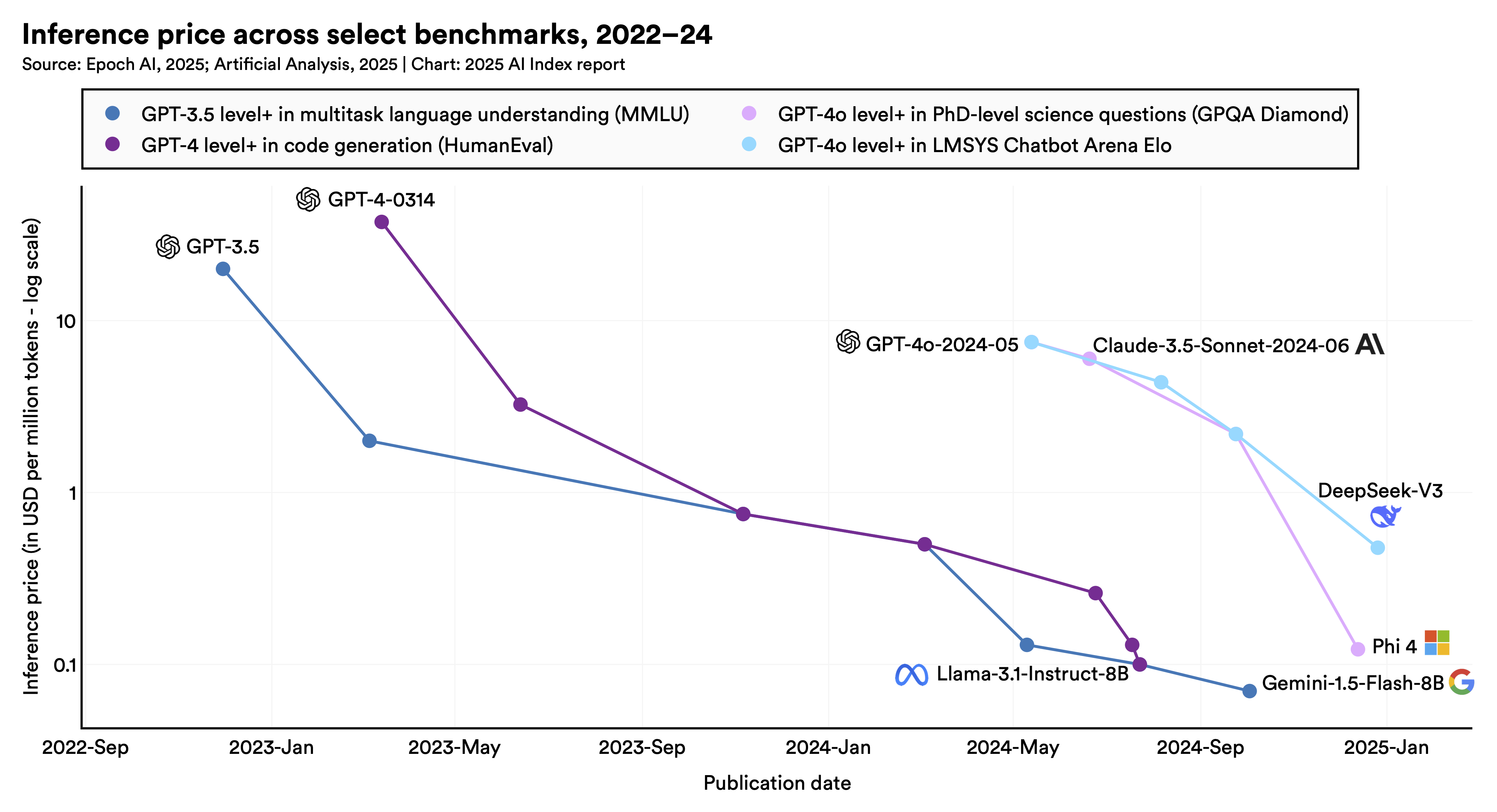
Two structural signals from 2025 should shape how you read this pricing. Consolidation is real: Workday completed its acquisition of Paradox on October 1, 2025 - Workday, folding the leading frontline-hiring assistant into an enterprise suite. Attrition is also real: the well-funded AI recruiter Moonhub shut down in June 2025 without ever publishing a price - HeroHunt.ai. The reason the newer self-serve tools can price so low is partly that the underlying AI got radically cheaper. The cost of running a model has collapsed by more than two orders of magnitude in a few years, as the chart below shows, which is what turned per-candidate automation from an enterprise luxury into a low-hundreds-per-month product.
Why AI recruiting tools got cheap: inference costs collapsed
7. How to Calculate Your Own AI Recruiting ROI
The formula is the easy part; the discipline is populating it honestly. ROI as a percentage is [(net benefits minus total costs) divided by total costs] times 100, and the companion metric is the payback period, which is simply total investment divided by monthly financial benefit - AIHR. If those two numbers are strong and the inputs are defensible, you have a business case. Everything else in this section is about making the inputs defensible, because a beautiful formula fed by vendor fantasy produces the 300% figures nobody should trust.
Start with the cost side, the denominator, because it is where most models cheat by leaving things out. Total cost is not just the subscription; it is the license plus implementation, integration, training, and change management, spread over the contract term. Enterprise platforms make this explicit with setup fees of $15,000 to $35,000, but even a self-serve tool costs real hours to configure and adopt. A model that compares a $6,000-a-year tool against $700,000 of savings while ignoring the 80 hours of recruiter time it takes to deploy is not a model; it is a sales slide. Put the full total cost of ownership in the denominator and your ROI will be lower, more credible, and far more likely to survive a finance review.
Now the benefit side, the numerator, built from the levers in Section 3. There are two conversion moves that turn operational gains into dollars, and both have standard methods. To value recruiter time saved, model the hours per placement (commonly 45 to 60) at a fully loaded cost around $75 per hour, then apply the reduction AI produces - The Hire Hub. To value faster fills, use the cost of vacancy per day, calculated as annual salary times an impact factor (1.0x for entry roles up to 3.0x for executives) divided by 260 working days, so a $120,000 engineering role costs roughly $923 per day it sits open - InterviewCost. Multiply that daily figure by the days you shave off time-to-fill and you have the single largest, and most legitimate, line in most recruiting ROI models.
The one benefit you should model last and trust least is quality of hire, even though it is the most valuable of all. The standard method scores it as a weighted composite of performance, retention, time-to-productivity, cultural fit, and manager satisfaction, then values improvements through the bad-hire cost they avoid - Pin. Because a bad hire runs from 30% of first-year salary up to 0.5 to 2 times annual salary once replacement and lost output are counted, even a modest drop in mis-hires is worth real money: on an $80,000 role, preventing a single bad hire is worth somewhere between $40,000 and $160,000. The reason to model it last is timing rather than size: you cannot know a hire was good for six to twelve months, so quality belongs in the second-year ROI case, validated with retention and performance data, not in the pitch that buys the tool.
All of which returns to the discipline that makes any of these numbers real: a baseline and, ideally, a control group. The most common way a genuine saving becomes an unprovable one is that the team improved for several reasons at once (a new tool, a new process, a better labor market) and attributed the whole gain to the AI. Holding out even a small group of requisitions run the old way, or comparing against the same quarter last year, is what lets you separate the tool's contribution from everything else. It is unglamorous, it is the step almost nobody takes, and it is the difference between an ROI figure your CFO believes and one they quietly discount to zero.
The discipline that separates a real number from a vendor number is measurement, and it follows a predictable timeline. Time-to-fill improvements show up in 2 to 4 weeks, cost-per-hire reductions become clear at the 90-day mark, and full ROI including quality-of-hire needs 6 to 12 months of data - Pin. Instrument a small set of metrics from day one (cost-per-hire, time-to-fill, recruiter hours, offer-accept rate, and, if you can, quality-of-hire) and, where possible, hold out a control group so you are measuring AI's contribution rather than the general improvement of a team that is paying attention. That last step is what only 8% of teams do, and doing it is how your ROI number ends up being one of the believable ones.
8. A Worked Example: The Payback Model for a 200-Hire Team
Numbers in the abstract convince no one, so here is a concrete model for a realistic mid-market employer hiring 200 non-executive roles a year with an in-house team, using only the benchmarks already established in this guide. Treat it as a template: swap in your own volumes and salaries, and keep the conservative-versus-full distinction, because that distinction is what makes it credible. The "before" baseline is the SHRM average of $5,475 per hire, or $1,095,000 a year in total recruiting cost, with a median time-to-fill of about 39 days for non-executive roles - SHRM.
Now apply the levers conservatively. Suppose AI cuts the cash cost-per-hire by a modest 25% (below the 30% aggregate benchmark, to stay honest), chiefly by reducing agency reliance and job-board spend. That is about $1,370 saved per hire, or $274,000 a year. Suppose it frees 15 hours of admin per vacancy, near the low end of the productivity range; at a fully loaded $75 an hour, that is $225,000 a year in reallocated recruiter labor. Those are the two "harder" savings, the ones you can defend in a quarter, and together they total roughly $499,000. The chart below shows how the levers stack up, including the softer vacancy figure discussed next.
Where the annual savings come from (modeled 200-hire team)
The third bar is the largest and the most caveated, and understanding why is the point of the exercise. If AI cuts time-to-fill from 39 days to about 20, that is roughly 19 days saved per hire; valuing a vacant $70,000 role at a mid-range impact factor gives about $404 per day, so 19 days is roughly $7,676 per hire, or $1,535,000 across 200 hires. That number is real economic value, but it is value created, not cash saved: it only becomes money if those faster-filled roles actually produce output sooner, or if the freed recruiter capacity lets you hire more without adding headcount. A CFO will rightly discount it, which is exactly why you present it separately from the hard savings rather than blending it into one triumphant figure.
Against those benefits, put an honest cost. Even at a generous $30,000 a year all-in for the AI stack (license plus implementation and training, well above the $3,990 a transparent tool like HeroHunt's top tier would cost on annual billing), the math is decisive. On the conservative hard savings alone, ROI is ($499,000 minus $30,000) divided by $30,000, about 1,560%, with a payback period under one month. Include the vacancy value and the number becomes large enough to be almost meaningless, which is the tell that you have left the realm of measurement. The lesson of the worked example is not "AI recruiting returns 1,560%." It is that the hard, measurable savings comfortably justify the spend on their own, so you never need the fantasy multiples to make the case, and a smaller team gets the same logic at smaller scale: a two-recruiter shop avoiding even three agency placements a year has already paid for a transparent tool several times over.
The value of a model like this is not its final percentage but its sensitivity, so it is worth stress-testing the weakest input. The vacancy figure swings hardest: halve the assumed impact factor and the vacancy value falls from about $1.5 million to roughly $770,000, and cut the time-to-fill improvement from nineteen days to ten and it drops further still. Yet even under those pessimistic settings, the two hard levers (the $274,000 in cash and the $225,000 in recovered time) still clear the $30,000 cost by more than fifteen to one. That is the real reason to build the model: not to defend a specific ROI number, which will always be arguable, but to discover whether the decision is robust across every reasonable assumption. When the conservative case and the optimistic case both say yes, the analysis has done its job, and you can stop negotiating with the spreadsheet and start the pilot.
It is worth being explicit about what that $30,000 cost actually covers, because the honesty of the denominator is what makes the numerator believable. A transparent tool's license might be only $6,000 a year, so the remaining $24,000 is the total cost of ownership most models quietly omit: the recruiter and IT hours to configure it, the integration into your existing ATS, the training so the team actually adopts it rather than reverting to old habits, and the management time to instrument and review the results. Deliberately over-provisioning that line, instead of quoting the sticker price, is not pessimism; it is what lets you claim the ROI holds even if the rollout is messier than the demo promised. A business case that assumes a frictionless deployment is a business case that will be wrong, and any experienced finance partner already knows it, so building in the friction is how you earn their trust rather than their discount.
9. Where the ROI Disappears: Hidden Costs, Bias, and Compliance
Everything above is the upside; this section is why the upside so often fails to materialize, and skipping it is how teams end up in the 95% of AI pilots with no measurable return. The first failure mode is the project that never scales. Gartner projected that at least 30% of generative AI projects would be abandoned after proof of concept, and separately warns that over 40% of agentic AI projects will be canceled by the end of 2027 on rising costs, unclear value, and inadequate risk controls - Gartner. AI recruiting is not exempt. A pilot that impresses in a demo and dies in integration produces negative ROI: you paid for the tool and the change effort and got nothing back.
The second failure mode is legal and bias liability, which can erase years of savings in a single settlement. The EEOC's first AI hiring-discrimination case ended with iTutorGroup paying $365,000 after its software auto-rejected older applicants - EEOC. In May 2025, a federal court granted preliminary certification of a nationwide age-discrimination collective action in Mobley v. Workday, holding that an AI vendor performing screening can be liable as the employer's agent - Holland & Knight. The cautionary tale underneath both is Amazon, which built and then scrapped an AI recruiter after discovering it penalized resumes containing the word "women's" - MIT Technology Review. Bias is not just an ethical problem; it is a direct financial liability that belongs in the risk column of any ROI model.
Compliance is now a real, recurring line item rather than a footnote, and it varies by geography. The EU AI Act classifies recruitment and candidate-screening AI as high-risk, triggering documentation, human-oversight, and conformity-assessment duties, with the compliance deadline for stand-alone systems now moved to 2 December 2027 and fines reaching €35 million or 7% of global turnover for the most serious violations - Gibson Dunn. In the US, New York City's Local Law 144 mandates an independent annual bias audit for automated hiring tools, with penalties of $500 to $1,500 per violation - Deloitte, and Illinois imposes strict liability for discriminatory AI outcomes as of January 1, 2026 - National Law Review. Each of these adds audit, documentation, and legal-review costs that a naive ROI model ignores entirely.
The regulatory map is also a moving target, which is a cost in its own right. Colorado's pioneering AI Act, which would have carried penalties of up to $20,000 per violation, was paused by a court in 2026 and replaced with a narrower law taking effect in 2027 - Norton Rose Fulbright. For a multi-state or multi-country employer, keeping pace with a patchwork of overlapping and shifting rules means recurring legal review, periodic re-auditing of tools, and candidate-notice workflows that have to be maintained year after year. None of this kills the ROI case, but it converts a slice of the gross savings into permanent compliance overhead, and the teams whose returns survive contact with a regulator are the ones that budgeted for that overhead from the start rather than discovering it after a complaint.
The subtlest failure mode is that the savings can come at the cost of quality and candidate experience, which shows up as ROI erosion later. Harvard and Accenture found 88% of employers admit their screening software filters out qualified candidates, contributing to an estimated 27 million "hidden workers" - The Register. A 2026 survey found 50.5% of job seekers were rejected with zero human feedback, and nearly a third abandoned applications specifically because of one-way AI screening - Enhancv. There is also a volume problem AI itself created: LinkedIn now receives roughly 11,000 job applications per minute, up 45% year over year, as candidates use AI to apply - eWeek. Part of the "time saved" by AI screening is simply running to stand still against an AI-inflated flood of applications. A guide that promised only savings would skip this; an honest model prices it in, and the teams that get the best returns are the ones that keep a human gate on consequential decisions precisely so these costs never land.
The deepest version of this trade-off appears in the one rigorous experiment on AI screening. That randomized controlled trial found candidates shortlisted with AI interview reports passed final blind human interviews 17.5 to 20 percentage points more often, a genuine quality gain, but also that roughly 75% of invited candidates never completed the AI interview at all - Aka, Palikot et al.. Read those two findings together and the lesson is precise: AI can raise the quality of the people who finish your process while shrinking the number willing to, so the net return depends entirely on whether the candidates you lose are ones you could afford to lose. For a high-volume role with abundant supply, heavy automation is close to free; for a scarce, senior, or passive-candidate search, the drop-off is a real cost that can swamp the efficiency gain, which is why the same tool can be a bargain in one funnel and a false economy in another.
10. AI Agents and the Shift to Outcome-Based Cost
The most important cost story of 2026 is not that AI tools got cheaper; it is that AI agents are breaking the per-seat pricing model that has governed recruiting budgets for a decade. Autonomous recruiting agents crossed from concept to shipping product this year, and they do not fit the "one human, one login" assumption that per-seat pricing rests on. As one industry leader put it, agents "work independently of any single user," which is pushing vendors toward usage-based and outcome-based pricing, including per-hire models - Automation Atlas. For a buyer, that shift changes the ROI calculation at its root: you start paying for results rather than for chairs.
What these agents actually do is run the full sourcing-to-outreach loop without a recruiter in the chair, and the early numbers are strong. LinkedIn's Hiring Assistant, generally available since September 2025, is the best-documented, with its 81% cut in profiles reviewed and a 30-day time-to-hire reduction at Expedia - LinkedIn Talent Solutions. Juicebox runs autonomous agents 24/7 across 800 million profiles for $199 an agent per month, and HeroHunt.ai's AI Recruiter searches around a billion public profiles, screens autonomously, and engages candidates on autopilot, with users reporting they spend far less time sourcing - HeroHunt.ai. The common thread is that the agent absorbs the volume levers (sourcing, screening, first-touch outreach) while the human keeps the judgment.
The market data explains why every major vendor is racing here. The AI-in-HR software market was valued at $4.03 billion in 2024 and is projected to reach $15.24 billion by 2030 at a 24.8% compound annual growth rate, while the broader AI agents market is forecast to hit $50.31 billion by 2030 - Grand View Research. Josh Bersin, who calls talent acquisition "the most mature, proven market for AI," notes that fewer than 5% of large frontline employers currently use agentic recruiting tools - Josh Bersin. That combination, a large proven ROI and tiny penetration, is exactly the runway that pulls capital and product into the space.
The forward-looking demand signals are just as strong as the market forecasts. Gartner expects 40% of enterprise applications to embed task-specific AI agents by 2026, up from under 5% in 2025 - Process Excellence Network, and recruiting is one of the most active fronts in that shift. Josh Bersin's team has catalogued more than 100 distinct HR agent applications already, spanning sourcing, screening, interviewing, offer generation, and onboarding - The Josh Bersin Company. The distance between that catalogue of shipping capabilities and the under-5% of frontline employers actually using agents is the clearest ROI arbitrage in the field: the tools exist, the case studies are documented, and most of the market has not moved, which means an early adopter is still buying an edge rather than paying to match a baseline everyone already shares.
The strategic implication for a buyer is that the cheapest unit of recruiting capacity is changing. For a decade, adding capacity meant adding a recruiter seat and a LinkedIn Recruiter license, a five-figure annual commitment per person. An agent that handles the volume work for a few hundred dollars a month, or on a per-hire basis, resets the marginal cost of another open req toward zero. The teams that understand this are not asking "how many more seats can we afford"; they are asking "which parts of our pipeline can an agent own, and what is the per-hire cost when it does." Gartner expects 30% of recruitment teams to rely on AI agents for high-volume and early-stage tasks by 2028 - Gartner, and the cost structure of the whole function is being redrawn around that shift.
Outcome-based pricing, if it becomes standard, will also make ROI far easier to prove, which is a return in itself. When you pay per hire rather than per seat, the cost side of the equation stops being a fixed annual bet and becomes a variable that scales with the value received, so a slow quarter costs less and a busy one is closer to self-funding. It also collapses the measurement problem: a per-hire fee is, by construction, a cost-per-hire line you can compare directly against your old blended figure, with none of the allocation guesswork that makes seat-based ROI so contestable. The vendors moving first toward this model are betting that transparency wins, and for buyers who have struggled for years to prove seat-based returns, a price already denominated in the exact unit they are measured on is a meaningful simplification rather than just a cheaper number.
11. The 2027 Outlook: Where AI Recruiting ROI Goes Next
The direction of travel is clear enough to plan around, even if the exact timing is not, and the headline is that the returns will increasingly come from restructuring the function, not optimizing tasks. Josh Bersin's HR 2030 vision holds that agents and "superagents" will automate the end-to-end recruiting workflow and shrink HR teams by 30% to 40% over the next several years - Josh Bersin. That is a different kind of ROI than a 25% cost-per-hire cut. It implies a smaller, higher-leverage team supervising a large amount of automated work, and the savings show up in the org chart rather than in the tooling line.
The second shift is that the recruiting funnel is becoming a place where software talks to software, which changes what you should invest in. Candidates already use AI to write resumes and complete applications, which means AI screening is increasingly evaluating artifacts produced by another AI. Gartner expects that by 2027, 75% of hiring processes will include some form of AI-proficiency testing - Gartner. As the volume of AI-generated applications rises, the ROI leader of 2027 will not be the tool that screens fastest but the one that best verifies a real, qualified person stands behind a polished profile. Budget that is spent on authenticity and signal, rather than pure throughput, will earn its return.
The interface itself is dissolving, and that reshapes vendor economics in the buyer's favor. For thirty years, recruiting technology meant logging into a specific tool for a specific job: a search platform to source, an ATS to track, a CRM to nurture. Agents and open connection standards are collapsing that into a single assistant that reaches across all of them, so the recruiter's day stops being a tour of a dozen tabs. As switching costs fall and outcome-based pricing spreads, the leverage in negotiations moves toward buyers who can measure results, which rewards exactly the instrumentation discipline this guide has argued for. The ROI advantage will accrue to teams that can prove what each tool contributes, because they will be the ones able to drop the ones that do not.
It is worth ending the outlook on realism, because the counterweight to all this momentum is a large and stubborn group of holdouts. SHRM's late-2025 data shows that 54% of organizations have not adopted AI in HR and have no plans to in 2026, with recruiting the single most common use case at just 27% of firms - SHRM. Set against the finding that most AI pilots show no measured return, that is the healthy skepticism a buyer should carry into every vendor meeting: the ROI is real for teams that deploy with discipline and illusory for teams that buy a tool and hope. The outlook is not that AI wins automatically. It is that the gap between disciplined adopters and everyone else keeps widening, and the returns flow to the teams that measure what they are doing.
What none of this changes is the part of recruiting that was never a search or a screen: the judgment about a specific human being, the offer conversation, the read on whether someone will thrive on a particular team. The correct dividing line for the next two years is between work that is boring, continuous, or high-volume, which agents should increasingly own, and work that requires judgment about a person, which stays human and, if anything, becomes more valuable as everything around it is automated. The teams that keep that line clear will capture the automation savings without paying the quality and compliance costs that sink the careless. That is the whole ROI story in one sentence: automate the volume, protect the judgment, and measure both.
12. Conclusion: A Decision Framework You Can Act On
The gap between reading this guide and profiting from it is a single habit: measure the levers separately and honestly. AI recruiting ROI is real and often large, but the credible savings live in recruiter time reclaimed and time-to-fill compressed, both of which you can measure inside a quarter, not in the 300% multiples that fill vendor decks. If you build your business case on the hard levers and treat quality-of-hire and vacancy value as upside you validate later, you will end up with a number your CFO believes and your results defend.
The decision framework, in five sentences, is this. First, anchor your "before" on the real cost base ($5,475 per non-executive hire, plus agency fees, per-seat tools, and 17.7 admin hours per vacancy), because that is what the savings are measured against. Second, put the full total cost of ownership, license plus implementation and training, in the denominator, so your ROI survives a finance review. Third, start where the data already points, automating screening, scheduling, and first-touch outreach before you try to automate judgment. Fourth, keep a human gate on every consequential decision, both because it protects quality and because in 2026 it is increasingly the law. Fifth, instrument a handful of metrics from day one and, if you possibly can, hold out a control group, because that is the difference between a believable ROI and a hopeful one.
For most teams the fastest way to learn all of this is to run one role through an AI pipeline end to end and compare it against your best manual effort. Start with a single hard-to-fill req, measure the hours and the days, and let the real numbers, not a vendor's, tell you whether to scale. Transparent, low-commitment tools make that experiment cheap, and the whole category is moving toward pricing that lets you pay for outcomes rather than seats, so the cost of finding out has never been lower.
Want to measure the return rather than model it? Run a HeroHunt.ai search on one open role during the 8-day free trial, track the recruiter hours and the days-to-fill, and compare the result against your current process. Start at uwi.herohunt.ai.
This guide reflects the state of AI recruiting costs, tool pricing, and hiring-AI regulation as of August 2026. Prices, vendor ownership, and compliance deadlines in this field change quickly (Colorado rewrote its AI law twice in a single year, and the EU deferred its high-risk deadline to December 2027), so verify current details against the primary sources linked above before you rely on them.