


These are the latest pricing indications for using Arc.dev to hire developers, updated for 2026.
Arc.dev is a platform that connects companies with pre-vetted remote developers, offering a flexible pricing model that adapts to whether you want a freelancer or a full-time hire.
Arc.dev deliberately does not publish a fixed price list, because the cost depends on the individual developer's rate and on whether you hire them by the hour or full-time. That is exactly why buyers keep searching for what it actually costs.
This guide breaks down what using Arc.dev would probably cost you in 2026, and whether it is the right way to build your dev team. We'll answer these questions:
- How does Arc.dev's pricing work?
- What does hiring through Arc.dev cost?
- When should I use Arc.dev for hiring?
- What are alternatives to Arc.dev?
How does Arc.dev's pricing work?
Arc.dev runs two separate pricing models, and conflating them is the single biggest mistake buyers make. The freelance model and the full-time model charge you in completely different ways, so start by deciding which one you actually need.
Freelance / hourly hires. You pay the developer's hourly rate and nothing else on top. Arc's own pricing page lists rates from $15 to $110+ per hour, and states you "only pay for the hours they actually work, no extra fees." In practice most vetted rates land in the $60 to $80 per hour range - Lemon.io. Arc handles the contracts, payment processing and compliance through its own platform, so there is no separate 20% line on freelance work: the platform's margin is already baked into the quoted rate. To start, Arc has historically required a $300 refundable deposit that is credited to your first invoice - Lemon.io. Freelance hires come with a risk-free trial of up to two weeks.
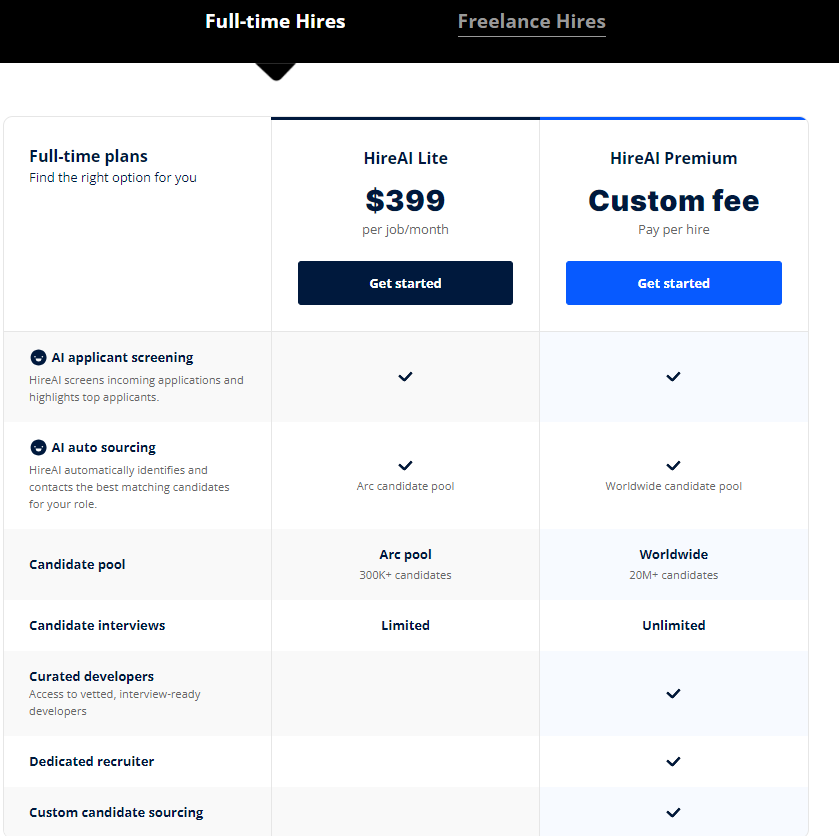
Full-time / permanent hires. Here the model flips to a placement fee: 20% of the developer's first-year annual salary, per Arc's pricing page. Interestingly, Arc lets you "pay what you want" on your very first full-time hire, so the 20% only kicks in from the second placement onward. AI auto-sourcing, AI applicant screening and a dedicated recruiter are included in both models, and Arc says it can surface pre-vetted candidates in as little as 14 days from a pool of roughly 239,000 developers - Arc.dev.
What does hiring through Arc.dev cost?
The honest answer is that your total cost has two buckets, and Arc's headline numbers only cover the first one. Work through a real example and the gap becomes obvious.
The freelance path is easy to model. A senior developer at, say, $90 per hour for 160 hours a month is $14,400 per month, plus the one-off $300 deposit that you get back against invoice one. There is no placement fee and no markup line: what you see quoted is what you pay, and you can end the engagement after the two-week trial with no further obligation.
The full-time path has a second cost Arc does not mention. On a $120,000 salary, Arc's 20% placement fee is $24,000, due shortly after the hire's start date. But that fee only finds and delivers the person. Once a full-time developer sits in another country, you become responsible for employing and paying them compliantly, and Arc does not do that for you. That recurring payroll-and-compliance cost is the bucket buyers forget when they compare Arc's 20% against a headline salary.
Deel
Arc's 20% is a one-time finder's fee. What it does not cover is the part that keeps recurring: once Arc places a full-time developer in another country, you are the employer and you have to run their payroll and compliance yourself. That is where Deel fits. Contractor management starts at $49 per contractor per month, and full employer-of-record cover (Deel becomes the legal employer in the developer's country) runs from $599 per employee per month. The honest caveat: Deel sources and vets no one, so it never replaces Arc's marketplace, and over a couple of years that $599 per month can quietly exceed the single 20% fee you paid to make the hire. For a freelance/hourly hire you do not need it at all, because Arc already handles those contracts and payments.
When should I use Arc.dev for hiring?
Arc.dev is most effective when you want vetted remote developers fast and are willing to pay a premium for the vetting and the trial safety net. It removes the two things that make remote developer hiring slow and risky: sourcing unknown candidates, and committing before you know whether they are any good.
Arc.dev is particularly valuable if you want to:
- Access a pool of pre-vetted remote developers
- Hire flexibly for either short-term or long-term work
- Reduce risk with a two-week trial on freelance engagements
- Streamline sourcing for technical roles you cannot fill yourself
- Build a global, remote development team
It is a weaker fit when you have your own sourcing capability, when you are cost-sensitive on full-time roles (the 20% placement fee is real money), or when you would rather run your own outreach than pay for a marketplace. In those cases the alternatives below deserve a serious look before you commit.
What are alternatives to Arc.dev?
If Arc's model or price does not fit, you have three broad categories of alternative, each trading off vetting, cost and effort differently.
Other vetted marketplaces. Toptal screens hard for the "top 3%" and is the closest like-for-like to Arc, though generally pricier. Hired (now part of the Adecco group) flips the model so candidates apply to you. Both replace Arc's marketplace but keep you paying a marketplace premium.
Open freelance marketplaces. Upwork and Freelancer.com give you far more supply at lower headline rates, but the vetting is on you, which is the exact work Arc charges you to skip.
AI-powered sourcing tools. If the expensive part for you is finding people rather than employing them, a tool like HeroHunt.ai takes a different approach: instead of a curated marketplace, its AI Recruiter sources candidates from over 1 billion profiles and reaches out on autopilot, and it is free to start with no credit card. That suits teams who want to own their pipeline rather than pay a per-hire placement fee.
HeroHunt.ai
Run the arithmetic against Arc's full-time model before you pick a lane. The 20% placement fee is charged per placement, not per year, so it lands again in full on every developer you hire. A sourcing tool inverts that: HeroHunt.ai's AI Recruiter searches over 1 billion profiles, screens against your brief and runs the outreach itself, so the cost attaches to the pipeline rather than to each signed offer. The honest caveat: you are buying sourcing, not vetting. Arc's two-week risk-free trial and its pre-vetted pool are genuinely doing work you would otherwise do yourself, so if you have no one to run technical screens, the marketplace premium may still be the cheaper option. HeroHunt also does not employ anyone, so the payroll bucket stays yours either way.
Whichever route you pick, remember the two-bucket rule from earlier: the sourcing cost and the employment cost are separate. Arc, Toptal and Upwork solve the first; running global payroll for whoever you hire full-time is a job for a platform like Deel.
Placed a full-time developer abroad through Arc? Deel puts them on a compliant payroll from $49 per contractor per month.
Written by Yuma Heymans (@yumahey), who built HeroHunt.ai, the world's first AI Recruiter, now used by 15,000+ recruiters to source and reach developers and other talent on autopilot. He writes from hands-on experience competing in the developer-hiring market.
This guide reflects Arc.dev's pricing as of July 2026. Rates and fees change, so verify current figures on Arc's own pricing page before you commit.