



The practical guide to what Loxo actually costs in 2026, the hidden extras, and the nine alternatives worth comparing before you sign.
Loxo now publishes a price, which most of its competitors still refuse to do: Core at $149 per user per month and Professional at $199 per user per month, both billed annually and paid up front - Loxo. That transparency is genuinely rare in agency recruiting software, where Bullhorn, JobAdder and most enterprise sourcing tools still hide every number behind a demo call. But the sticker price is not the whole story, and the gap between what Loxo lists and what a growing team actually pays is exactly where recruiters get surprised.
The real cost of Loxo is shaped by three things the pricing page does not put in bold: a per-seat contact-credit allowance that meters how much sourcing you can do, an automatic annual price increase that multiple verified reviewers report at around 5% a year, and an Enterprise tier that reverts to a custom quote the moment you need SSO or advanced governance - Capterra. The only independent transaction data available, from procurement platform Vendr, puts the average Loxo contract near $6,000 per year, though that figure rests on a very small sample - Vendr.
This guide breaks down exactly what Loxo costs in 2026, tier by tier, what the credits and add-ons really do to your bill, where the platform genuinely wins, and the nine strongest alternatives ranging from a free-to-start autonomous recruiter to transparent budget systems and enterprise sourcing suites. Every price is sourced, every claim is linked, and the alternatives are ranked on fit rather than on who pays the biggest referral fee.
Written by Yuma Heymans (@yumahey), who built HeroHunt.ai and has spent since 2021 building recruiting software that competes directly with platforms like Loxo. He writes from inside the category, not from a vendor brochure.
Contents
- What Loxo Actually Is
- Loxo Pricing in 2026: What It Really Costs
- Where Loxo Wins and Where It Falls Short
- How AI Agents Are Changing Recruiting Software
- The 9 Best Loxo Alternatives in 2026
- Full Comparison: Pricing and Best Fit
- How to Choose the Right Platform
- The Bottom Line
1. What Loxo Actually Is
Loxo is an all-in-one "Talent Intelligence Platform" that bundles an applicant tracking system, a recruiting CRM, a sourcing database, contact-data enrichment, and outbound outreach into a single product, with AI running across all of it - Loxo. The company's core argument is that stripping any one of those pillars out leaves you with a point solution rather than a platform, which is why it sells the whole stack rather than a la carte modules. For a staffing agency or an executive search firm, the pitch is that Loxo replaces the patchwork of an ATS, a separate LinkedIn Recruiter seat, a contact finder like ZoomInfo, and an email sequencer, and folds all of that into one login.
Understanding where Loxo sits in its own history matters, because it explains both the momentum and the higher price point. Founded in 2012 in Denver by CEO Matt Chambers and CTO Ilia Cheishvili, Loxo spent most of its life bootstrapped before taking a $115 million growth investment led by private equity firm Tritium Partners in February 2025 to accelerate its AI roadmap - Tritium Partners. That capital shows in the product cadence: through 2025 and 2026 Loxo shipped Natural Language Search, an AI Notetaker, Account-Based Prospecting for business development, and a "Next Generation Loxo" release built around conversational AI and a roster of autonomous agents.
The screenshot below shows the platform's unified workspace, where sourcing, pipeline management, and outreach live in one interface rather than across separate tools. This consolidation is Loxo's central design philosophy and the main thing recruiters pay for.
Loxo's unified Talent Intelligence Platform workspace

The data engine underneath is what separates Loxo from a plain ATS. Loxo Source searches a talent graph the company describes as 850 million+ professionals, combining that public dataset with your own private database in one searchable place, while Loxo Connect supplies personal emails and phone numbers built from more than 100 datasets - Loxo. One caveat worth flagging: Loxo's own figures are inconsistent, since its September 2025 Natural Language Search announcement cited 1.2 billion profiles while its current product pages say 850 million, and the company has not reconciled the two - StaffingHub.
The 2026 story is agentic AI. Loxo's newest release layers a set of autonomous agents on top of the platform, including a Longlist Agent that builds candidate pools of up to 10,000, a Shortlist Agent that scores candidates across seven hiring dimensions with supporting evidence, and a Contact Info Finding Agent, all coordinated through an "Agent Impact Center" that reports the hours and dollars the AI claims to have saved - Loxo. To see how this works inside the product, the official walkthrough below shows CEO Matt Chambers demonstrating natural-language sourcing, the feature that anchors Loxo's current AI positioning.
Loxo's Natural Language Search: sourcing candidates in plain English
Loxo markets itself as trusted by more than 125,000 recruiters, and it is built specifically for agencies, executive search firms, RPOs, and corporate in-house teams rather than for pure high-volume applicant processing - Loxo. Named customers include executive search firms like N2Growth. Knowing the target buyer is the key to reading the pricing below: Loxo is priced and packaged for a recruiter who bills for placements, not for a hobbyist or a team that just needs a cheap resume database.
2. Loxo Pricing in 2026: What It Really Costs
Loxo publishes four tiers: a free single-user plan, Core at $149 per user per month, Professional at $199 per user per month, and a custom-quoted Enterprise plan, with Core and Professional both billed annually and paid up front - Loxo. This alone puts Loxo ahead of most competitors on transparency, because you can see two real numbers before you ever talk to sales. The distinction that matters most is between Core and Professional: Core is the ATS and CRM with AI search and unlimited jobs, while Professional is the tier that unlocks the sourcing graph, contact reveals, the AI agents, and API access. In other words, the features that make Loxo a "Talent Intelligence Platform" rather than just an ATS live in the $199 tier, not the $149 one.
Here is the current published structure, with what each tier includes and where the numbers stop being public.
| Plan | Price (per user/month) | Billing | What you get |
|---|---|---|---|
| Free | $0 | 1 user | Core ATS and recruiting CRM basics, limited contact reveals |
| Core | $149 | Annual, prepaid | Full ATS + CRM, AI natural-language search, unlimited jobs and candidates, email and calendar sync, Chrome extension |
| Professional | $199 | Annual, prepaid | Everything in Core plus Loxo Source (850M+ graph), agentic AI, contact data, API, 2,500 credits/user/mo |
| Enterprise | Custom | Custom annual | Everything in Professional plus SSO/SAML, advanced governance, dedicated success team, priority support |
The number that quietly controls your real cost is the 2,500 contact credits per seat per month included with Professional, pooled across the team - Loxo. Credits are consumed when you reveal a candidate's verified email or phone number, so a recruiter working a handful of senior searches may never exhaust them, while a high-volume sourcing desk will burn through the allowance and need more. Loxo sells that extra capacity through Boost packs (Boost 2x raises the allowance to 5,000 credits, Boost 5x to 12,500), but it does not publish what those packs cost, which is the first point where the transparent pricing goes quiet.
The second hidden cost is renewal escalation. Multiple verified reviewers report an automatic annual price increase of around 5% written into their contracts, alongside what one Managing Partner at a staffing firm called "high integration costs" - Capterra. On an annual, prepaid, per-seat contract, a 5% yearly bump compounds: a five-seat Professional deal that starts near $12,000 a year drifts upward every renewal even if you add no one. That is not unusual for enterprise software, but it is the kind of term that never appears on a pricing page and only shows up when you read the contract or the reviews.
This is the exact point where price sensitivity peaks, so it is worth naming the honest budget alternative before going further into add-ons.
Manatal
Loxo's cheapest real tier for serious recruiting starts at $149 per user per month on an annual prepaid contract, and the sourcing you actually want sits in the $199 Professional tier. If a transparent, low-commitment ATS and recruiting CRM is what you need, Manatal publishes its full ladder: $15 per user per month billed annually ($19 monthly), with a 14-day free trial and no credit card. The honest caveat: Manatal is a lightweight ATS with AI candidate recommendations, not a system with Loxo's built-in 850M-profile talent graph and contact reveals, and that entry tier caps at 15 active jobs and 10,000 candidates, so a busy desk is really comparing its $35 per user Enterprise tier plus a separate sourcing tool against Loxo's all-in-one bundle.
Real-world pricing data confirms the picture the tiers imply. Procurement platform Vendr, which tracks what companies actually negotiate, lists Loxo's average annual contract at roughly $6,000, though it explicitly warns the sample is only a handful of deals - Vendr. One recruiting agency that reviewed Loxo hands-on reported paying about $300 per user per month for a basic package with sourcing, dropping to $200 per user once they held more than five licenses, which suggests genuine volume discounting for larger teams - Recruit with Atlas. Ignore the stale figures floating around third-party directories: Capterra and several SEO blogs still show a legacy "$109 Basic" tier or a "$169" starting price, and neither matches Loxo's current published page.
The practical takeaway for budgeting is to model three numbers, not one. Start with the seat price ($149 or $199), add your expected credit overage if you source at volume, and factor the compounding renewal increase across the length of your commitment. For a small team running a few searches a month, Loxo lands in a reasonable mid-market band. For a growing agency that sources heavily, the credits and Boost packs are where the bill can quietly climb well past the headline, which is why comparing against the transparent-priced alternatives below is worth doing before you sign an annual, prepaid contract.
3. Where Loxo Wins and Where It Falls Short
Loxo's strongest asset is consolidation, and its most consistent weakness is contact-data accuracy. Across G2, Capterra, GetApp and Software Advice, Loxo holds strong ratings: 4.6 out of 5 on G2 from around 170 reviews, and 4.5 out of 5 on Capterra from 133 reviews, with reviewers repeatedly praising the fact that emails, texts, call recordings, sourcing and pipeline all live in one integrated system - G2. The recurring theme in positive reviews is time saved by not switching between tools, plus genuine appreciation for how quickly Loxo ships new AI features. G2 has repeatedly badged it "Easiest to Use" in its category.
That said, the review data also exposes a clear soft spot: Value for Money is Loxo's lowest-rated category at 4.4, below its scores for ease of use, support and features - Capterra. The complaint underneath that score is specific and repeated. Reviewers report that the sourced contact data is "only accurate about half the time," that coverage weakens sharply for niche roles and non-US markets, and that Loxo Source does not replace a LinkedIn Recruiter seat for hard-to-find candidates. For a platform whose premium tier is largely justified by its data, that is the criticism that should weigh most heavily on a buyer.
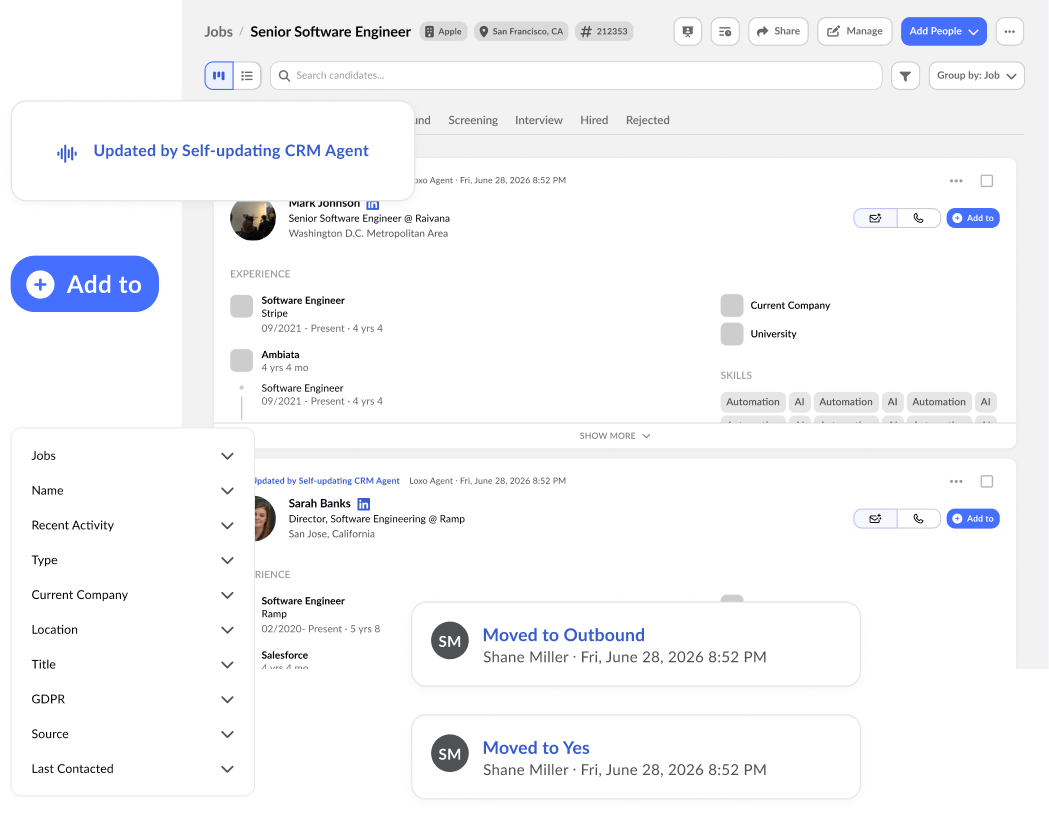
The Loxo Outreach interface below shows the multi-channel sequencing that reviewers generally like, where email and SMS campaigns run from the same place as the pipeline. The tooling is capable; the friction shows up in reliability and in the data feeding it.
Loxo's multi-channel outreach sequences
Beyond data quality, three limitations surface often enough to plan around. The first is support after the sale: reviewers describe response times slowing once the contract is signed, with European users reporting the longest waits, and one recruiter describing repeated attempts to cancel that fell "on deaf ears" - Leonar. The second is reliability: G2 and Software Advice reviews cite outreach emails silently failing to send, duplicate candidate records polluting the CRM, and formatting lost in notes. The third is the learning curve, with new teams reporting one to two weeks to get comfortable with the breadth of the platform.
The honest read is that Loxo is a strong all-in-one for its intended buyer, a professional agency or search firm that will actually use every module and can absorb the annual commitment, and a poor fit for a team that mainly needs accurate contact data or wants to start small and month to month. If your evaluation hinges on data accuracy, run a live trial against your own hardest roles before committing, because that is precisely where the aggregate ratings and the specific complaints diverge. The volatility of that judgment is why so many recruiters end up comparing Loxo against the alternatives further down, especially the ones that either price transparently or specialize in the sourcing data Loxo's reviewers question.
4. How AI Agents Are Changing Recruiting Software
The reason a platform like Loxo can charge $199 a seat and still grow is that AI has moved from a feature to the entire value proposition of recruiting software. The adoption curve is steep and well documented. According to iHire's 2025 State of Online Recruiting report, the share of employers actively using AI in their recruitment rose from 4.9% in 2023 to 25.9% in 2025, more than a fivefold increase in two years - iHire. This is not a fringe experiment anymore; it is fast becoming the default way roles get filled.
The trajectory below shows how quickly recruiting crossed from AI-curious to AI-active, which is the backdrop against which every vendor in this guide is repricing and repositioning.
Employers Actively Using AI in Recruiting
That surge explains why the industry's language shifted to "agents" in 2026. Where earlier tools helped a recruiter search faster, the newest generation aims to do the work: an agent reads the role, builds the longlist, scores the shortlist, finds the contact details, and drafts the outreach, leaving the human to review and decide. Gartner found that 82% of HR leaders plan to deploy some form of agentic AI within a year, and predicts that by 2028 roughly 30% of recruitment teams will rely on AI agents for early-stage hiring tasks - HR Executive. Loxo's Longlist and Shortlist agents are its answer to exactly this shift.
There is a sober counterpoint worth holding alongside the hype, and it should shape how you evaluate any AI recruiting purchase. An October 2025 Gartner survey found that 88% of HR leaders say their organizations have not yet realized significant business value from AI tools - Gartner. The gap between adoption and value is the whole ballgame for a buyer: the platform that wins is not the one with the longest agent roster, but the one whose agents actually produce accurate candidates and real placements for your specific roles. That is a bar you can only test with a trial, and it is the lens to carry into the alternatives below.
5. The 9 Best Loxo Alternatives in 2026
The alternatives below are chosen because each solves a specific problem Loxo leaves open, whether that is price, contact-data accuracy, full sourcing automation, or enterprise depth. They are ordered to move from the most accessible and automated options toward the most enterprise-heavy, so you can stop reading once you reach your budget and team size. To ground the comparison in real numbers first, the chart below plots published entry prices per seat, which makes clear that Loxo sits in the middle of a very wide field.
Published Entry Price per User per Month (2026)
The chart makes the strategic picture obvious. The market splits into three bands: transparent budget systems (Manatal, Zoho Recruit, Recruit CRM) that undercut Loxo by an order of magnitude, mid-market platforms (Loxo's own two tiers, which cluster around $149 to $199, plus HeroHunt.ai, an autonomous sourcing tool from $99 a month), and enterprise sourcing suites (hireEZ and quote-only tools) that run far higher. Loxo is not the expensive option in absolute terms, but it is priced for a team that will use the full platform, which is exactly why a lighter or more specialized tool often wins on value.
5.1 HeroHunt.ai: The Autonomous AI Recruiter
HeroHunt.ai takes the "AI does the work" promise further than Loxo's assistant-style agents by running a fully autonomous recruiter. You describe a role in plain language, and its AI Recruiter searches more than 1 billion profiles across LinkedIn, GitHub, Xing and Stack Overflow spanning 190+ countries, screens and scores candidates with language models, then runs hyper-personalized outreach with automatic follow-ups - HeroHunt.ai. Its companion feature, RecruitGPT, turns a single prompt into a candidate shortlist, which is the closest thing in the market to describing a job and getting engaged candidates back.
The two structural differences from Loxo are the pricing model and the automation depth. HeroHunt is a flat monthly plan with unlimited positions, metered on AI-screened and matched profiles delivered and candidate emails found rather than per seat, starting at $99 per month for the single-user Starter plan with an 8-day free trial, so a lean team pays for the candidates it actually receives rather than for each recruiter's login - HeroHunt.ai. Where Loxo hands a recruiter better tools to search and message faster, HeroHunt aims to remove the manual searching and messaging entirely. It is best for lean in-house teams, startups and agencies that want autonomous sourcing and outreach without an annual per-seat commitment, and that want to test the approach on a free trial before paying.
5.2 Manatal: The Transparent Budget System
Manatal is the clearest answer to Loxo's price for a team that wants a real ATS and recruiting CRM without an annual, prepaid, four-figure-per-seat commitment. It publishes its entire ladder: $15 per user per month billed annually (or $19 monthly) for Professional, $35 for Enterprise, and $55 for Enterprise Plus, each with a 14-day free trial and no credit card - Manatal. For agencies and in-house teams that mainly need a clean pipeline, AI candidate recommendations, and social-media enrichment, that is a fraction of Loxo's cost.
The trade-off is real and worth stating plainly. Manatal is a lightweight, easy-to-deploy ATS, not a talent-intelligence platform: it has no proprietary 850-million-profile talent graph, no built-in contact-reveal database, and no roster of autonomous sourcing agents. Its $15 entry tier also caps at 15 active jobs and 10,000 candidates, so a high-volume desk is really pricing the $35 Enterprise tier. A team that genuinely needs Loxo's native sourcing would compare Manatal plus a separate sourcing tool against Loxo's bundle. But for the many recruiters who bought Loxo mostly for the ATS and CRM and were underwhelmed by the data, Manatal delivers the core workflow for a tiny fraction of the price. It is best for budget-conscious agencies and in-house teams that value transparency and speed over a bundled data engine.
5.3 Zoho Recruit: The Configurable Low-Cost Option
Zoho Recruit is the budget generalist that scales down further than almost anything else in this guide, including a genuine free tier. Its Staffing Agency edition is published at $25 per recruiter per month for Standard, $50 for Professional (which adds Zia AI matching and assessments), and $75 for Enterprise, all on annual billing, with a free plan that covers a single active job - Recruit with Atlas. For a small agency already living inside the broader Zoho suite, the integration with Zoho CRM, Books and People is a meaningful advantage.
Zoho's strength is configurability at a low price, and its weakness relative to Loxo is the absence of a recruiting-specific data engine. There is no proprietary talent graph and no native contact-reveal database, so sourcing depends on your own inbound and on integrations rather than on a bundled dataset. Add-ons can also inflate the real bill notably, so read the tier limits carefully. It is best for cost-sensitive small teams, especially existing Zoho customers, that want a configurable ATS with a real free entry point and can source candidates through other channels.
5.4 Recruit CRM: The Agency and Search Specialist
Recruit CRM is the closest transparent peer to Loxo for agencies and executive search firms, purpose-built around both candidate and client pipelines. It publishes per-user pricing at $95 for Pro, $135 for Business, and $215 for Enterprise on annual billing, covering deal management, email sequencing, resume formatting, executive-search report generation, and invoicing - Recruit with Atlas. Its reputation for responsive support is a direct contrast to the post-sale complaints that recur in Loxo reviews.
The nuance is that several capabilities recruiters expect, such as advanced automation, analytics, LinkedIn messaging and data enrichment, sit in higher tiers or as metered add-ons, so the real total can climb above the entry price. Like Loxo, it is genuinely built for the agency workflow of managing both the candidate side and the client side of a placement, which most in-house ATS tools handle poorly. It is best for boutique-to-midsize search and staffing agencies that want tight candidate-plus-client management and prize support quality, at a lower and more predictable price than Loxo.
5.5 Recruiterflow: The Outbound-First Agency Platform
Recruiterflow treats recruiting like a sales engine, which makes it a natural comparison for agencies that live in outbound. It offers a simple flat rate, the Platform plan at $149 per user per month (with an annual option commonly cited nearer $119), and a custom-quoted AIRA plan that adds its full AI agents - Recruiterflow. The product centers on multichannel outreach sequences, recruiting and business-development automation, and a bulk-sourcing Chrome extension.
Compared with Loxo, Recruiterflow's sourcing runs over your own sources through its extension rather than over a proprietary database, so it competes on workflow automation and sequencing rather than on bundled data. For an agency whose bottleneck is consistent outbound follow-up rather than access to a candidate graph, that focus is an advantage, and the flat per-seat price with no metered credits is easier to forecast than Loxo's credit model. It is best for high-growth agencies running heavy candidate and client outreach that want automation and sequences in one predictable plan.
5.6 Bullhorn: The Enterprise Staffing Incumbent
Bullhorn is the market-leading ATS and CRM for staffing firms, and it is the platform Loxo most often displaces or is displaced by at the enterprise end. Unlike Loxo, Bullhorn publishes nothing: it is quote-based, with no free trial and no self-serve plan, and third-party reports put the base license anywhere from roughly $99 to $315 per user per month depending on tier, with annual contracts for small teams commonly starting around $20,000 once add-ons are included - Pin. For a deeper breakdown, our full Bullhorn pricing guide walks through the tiers and add-ons.
Bullhorn's advantage is depth for high-volume temp and contract staffing, including pay-and-bill, back-office and VMS capabilities through Bullhorn One, plus the largest integration marketplace in the category. Its disadvantage against Loxo is exactly that heaviness: it relies on separate data and sourcing tools rather than a bundled graph, and its total opacity on price means every prospect negotiates blind. It is best for mid-market and enterprise staffing agencies, especially high-volume contract shops that need mature back-office tooling and a broad ecosystem, and that have the budget for it.
5.7 hireEZ: Enterprise Outbound Sourcing
hireEZ is a specialist that does one part of Loxo's job, outbound sourcing, at greater depth and for a bigger organization. It searches 800 million+ public profiles, layers on talent-market intelligence and CRM-style nurture, and rediscovers candidates already sitting in your ATS. Its pricing is sales-led, with solo recruiters starting around $494 per month and enterprise seats configured to the stack you are replacing rather than a flat rate, and real deals reported anywhere from roughly $6,600 to $48,000 a year - hireEZ. Our hireEZ pricing breakdown covers the tiers in more detail.
The key distinction is architectural: hireEZ is a sourcing layer that sits on top of your ATS rather than being the system of record itself, whereas Loxo wants to be the whole platform. For an enterprise or large agency that already has an ATS it likes and mainly needs better outbound sourcing and rediscovery, hireEZ adds exactly that without forcing a full platform migration. It is best for enterprise and in-house talent teams doing high-volume outbound sourcing on top of an existing system of record.
5.8 SeekOut: Technical and Diversity Sourcing Depth
SeekOut is the sourcing engine to compare against Loxo when your hardest roles are technical, diverse, or in healthcare, because its data depth in those areas is its whole reason to exist. Its Recruit Core seat is published at $149 per user per month billed annually, or $179 month to month, with higher Sourcing and Full Recruiting Funnel tiers quoted by sales, and a 14-day free trial - SeekOut. Third-party contract data puts typical enterprise deals near a $20,000 median.
SeekOut's differentiator is the richness of its candidate signals, drawing on sources like GitHub and patents for engineers and specialized datasets for diversity and healthcare hiring, plus internal talent-mobility analytics that Loxo does not attempt. Like hireEZ, it is a sourcing and intelligence layer that pushes candidates into your ATS rather than replacing it. It is best for enterprises sourcing hard-to-find technical, diverse or healthcare talent, though a solo recruiter can self-serve the transparent $149 Core seat and get much of the value.
5.9 Gem: The In-House AI-First Platform
Gem is the alternative built for the opposite buyer to Loxo: corporate in-house talent teams rather than agencies. It unifies an ATS, recruiting CRM, sourcing across 800 million+ profiles, scheduling and pipeline analytics, with AI woven through each step, and it is used by teams at companies like DoorDash and Robinhood. Its pricing is headcount-based rather than per-seat: a published Startup Program runs about $130 per month billed yearly for small teams, while "Gem All-in-One" for larger companies is quoted on total employee count, with third-party data citing a roughly $24,900 median annual contract - Gem.
The reason Gem is on this list despite serving a different buyer is that in-house teams evaluating Loxo should know there is a platform designed around their workflow of nurturing and engaging pipeline rather than agency business development and placements. Gem prices on company FTE count, which suits a stable in-house team but penalizes an agency with fluctuating headcount. It is best for in-house and corporate talent-acquisition teams, from funded startups to enterprise, that want one AI-first system optimized for pipeline nurture rather than for billing placements.
6. Full Comparison: Pricing and Best Fit
The table below distills the nine alternatives plus Loxo into a single view, so you can scan entry price, pricing model, and intended buyer side by side. The pricing model column matters as much as the number, because a per-seat annual prepaid contract (Loxo), a flat plan metered on AI-screened and matched profiles and emails (HeroHunt.ai), and a company-headcount price (Gem) produce very different bills for the same team.
| Platform | Entry price | Pricing model | Best for |
|---|---|---|---|
| Loxo | $149/user/mo | Per seat, annual prepaid | Agencies wanting an all-in-one platform |
| HeroHunt.ai | Free trial, then $99/mo | Flat plan, unlimited positions, metered on profiles + emails | Teams wanting autonomous AI sourcing |
| Manatal | $15/user/mo | Per seat, transparent | Budget-conscious ATS and CRM buyers |
| Zoho Recruit | $25/user/mo | Per seat, free tier | Cost-sensitive teams in the Zoho suite |
| Recruit CRM | $95/user/mo | Per seat, transparent | Boutique search and staffing agencies |
| Recruiterflow | $149/user/mo | Per seat, flat rate | Outbound-heavy agencies |
| Bullhorn | ~$99+/user/mo | Quote-based | Enterprise and high-volume staffing |
| hireEZ | ~$494/mo | Quote-based | Enterprise outbound sourcing |
| SeekOut | $149/user/mo | Per seat + custom | Technical, diverse, healthcare sourcing |
| Gem | ~$130/mo | Company headcount | In-house talent-acquisition teams |
What the table reveals is that Loxo occupies a defensible but crowded middle. It is cheaper and more transparent than the enterprise incumbents (Bullhorn, hireEZ), but far more expensive than the transparent budget systems (Manatal, Zoho, Recruit CRM) that cover the ATS and CRM basics most teams actually use daily. Its unique claim is the bundle: sourcing graph, contact data, and agentic AI in one price. Whether that bundle is worth the premium depends entirely on whether you will use the sourcing and whether the data is accurate for your roles, which is the judgment the next section helps you make.
7. How to Choose the Right Platform
The right choice comes down to three questions: are you an agency or in-house, how much do you source, and how much price predictability do you need. Loxo wins when the answer is agency, high-sourcing, and comfortable with an annual commitment, because that is the exact profile its bundle and pricing were designed for. The moment one of those answers flips, a more specialized or transparent tool usually delivers better value. The decision tree below maps the most common paths.
For a budget-first team, the honest advice is to start with a transparent system and add specialization only when you feel the gap. Manatal or Zoho Recruit cover the ATS and CRM basics for a fraction of Loxo's cost, and you can layer in a dedicated sourcing tool later if inbound alone falls short. This staged approach avoids paying for a bundled data engine you may not use, which is precisely the mismatch Loxo's own reviewers flag when they rate value for money below every other category.
For a team whose real bottleneck is sourcing and outreach rather than pipeline administration, the calculus is different. If you want to keep a recruiter in the driver's seat with better tools, a sourcing layer like hireEZ or SeekOut on top of your existing ATS makes sense. If you would rather remove the manual sourcing and messaging entirely, an autonomous recruiter like HeroHunt.ai does the searching and first-touch outreach for you on a flat monthly plan with unlimited positions rather than per seat, which fits a lean team with fluctuating hiring volume better than an annual per-seat contract. The test that settles it is a live trial on your three hardest roles: whichever platform surfaces accurate, reachable candidates fastest is the one that earns the budget, regardless of how long its feature list runs.
8. The Bottom Line
Loxo is one of the more honest platforms in agency recruiting on price, and one of the more expensive once you account for credits, add-ons and annual escalation. It publishes a real number, which most competitors will not, and for an agency or search firm that will genuinely use the full bundle of ATS, CRM, sourcing graph and agentic AI, the $199 Professional tier can consolidate a stack of separate tools into one login. That is a legitimate value story, and the strong G2 and Capterra ratings reflect teams for whom the bundle works.
The reasons to look elsewhere are equally concrete. If your evaluation hinges on contact-data accuracy, the reviews are a genuine warning. If you want to start small, month to month, or without a four-figure-per-seat commitment, a transparent budget system serves you better. And if your bottleneck is sourcing itself rather than pipeline management, a specialist or an autonomous recruiter will likely outperform a generalist platform on the one job that matters. The market has never offered more credible options across every price band, which is exactly why paying for the demo-gated tools without comparing is the costliest mistake.
Whatever you choose, insist on the two things Loxo's own pricing page models well and its contract terms do not: a real, comparable number, and the freedom to test before you commit.
If Loxo's annual, prepaid, per-seat commitment is more than you want to take on to get a working ATS and recruiting CRM, Manatal starts at $15 per user per month with a 14-day free trial and no credit card.
For a wider view of what recruiting tools cost across the whole market, our recruiting software pricing guide compares dozens of platforms in one place.
This guide reflects Loxo's pricing and the recruiting-software landscape as of September 2026. Prices, tiers and features change frequently, and Loxo's Professional and Enterprise details in particular can shift, so verify current numbers on the vendor's own pricing page before purchasing.