


The insider's guide to the platforms that now conduct the first interview, what they really cost, and where they break
63% of US job seekers have now been interviewed by a machine, and 38% of all candidates have already walked out of a hiring process because it included one - Greenhouse. Exposure rose 13 points in six months. Another 12% say they would drop out if an AI interview were required, which puts half the candidate market at risk of abandoning your funnel at the exact stage you automated to save time.
The problem is that almost nobody buying these tools knows what they are buying. Only five of the twelve platforms in this guide publish a real price on their own website. Three publish no number anywhere on their own site. One deleted the rate card it used to publish. The most valuable company in the category does not sell its interviewer to anyone at any price. Meanwhile the compliance floor moved twice in the last twelve months, in opposite directions, and the single most-cited scientific audit in the entire industry was published in April 2021, before generative AI existed in a form any of these products use.
This guide breaks down exactly what the 12 leading AI candidate interviewers do, what each one genuinely costs (with the derivations shown and the unverifiable numbers left blank rather than invented), the randomised field experiment that is the only real evidence any of this works, the arms race between candidates buying stealth copilots at $149.99 a month and vendors selling detection, and the 2026 regulatory map that decides whether your deployment is defensible. Every price here was read on a page. Where a number could not be verified, the guide says so instead of guessing.
Written by Yuma Heymans (@yumahey), who built HeroHunt.ai and has been building AI systems that source and screen candidates at scale since 2021. This is written from inside the category, competing against several of the platforms compared below, which is also why the criticism here is specific rather than polite.
Contents
- What an AI Candidate Interviewer Actually Is
- Why the Screening Funnel Broke in 2026
- How These 12 Were Chosen
- The 12 Best AI Candidate Interviewers in 2026
- What an AI Interview Actually Costs
- Does It Work? The Evidence So Far
- Where AI Interviewers Fail
- The Arms Race: Cheating, Deepfakes and Two Philosophies
- Compliance in 2026: The Floor Fell Out, the Ceiling Rose
- Buying, Integrating and Deploying
- What Happens Next
- The Bottom Line
1. What an AI Candidate Interviewer Actually Is
An AI candidate interviewer is software that autonomously conducts a scored conversation with a job applicant, adapting its questions to the answers it receives. That definition is narrower than the marketing, and the narrowness is the single most useful thing you can carry into a vendor demo. A tool that plays a fixed list of questions at a webcam is a one-way video assessment. A tool that answers candidate questions over SMS and books a slot on a calendar is a conversational scheduler. A tool that transcribes a human interview and fills in a scorecard afterwards is a notetaker. All three get sold as AI interviewers in 2026, and none of them are.
The distinction matters commercially because the four categories have completely different failure modes, completely different regulatory exposure, and price differences of more than an order of magnitude. An async video tool with an AI summary layer costs a few hundred dollars a month and creates almost no automated-decision risk. A live agentic voice agent that scores a candidate against a rubric and advances or rejects on a numeric threshold is, in the language of both European and US regulators, a selection procedure, and it drags the entire apparatus of bias auditing, disclosure, accommodation and record retention along with it. Buying the second while believing you bought the first is the most expensive mistake in this market.
Five distinct modalities are genuinely in production in 2026, and every vendor in this guide sits in one of them. The diagram below maps the category as it actually exists, rather than as the homepage copy describes it.
Reading the diagram top to bottom is a useful diligence exercise, because the branch a vendor sits on predicts almost everything else about it. The chat branch spans the widest range of ambition: Paradox handles apply, knockout questions and scheduling for frontline employers, and reviewers describe Olivia as screening and scheduling rather than conducting a substantive assessment - Index.dev, while Sapia.ai at the other end runs a fully scored structured interview in text. The agentic voice branch is where every 2025 and 2026 startup landed, because voice is the modality that most resembles the recruiter phone screen it is replacing, and in June 2026 the incumbent HireVue crossed into it from async video. The technical branch is the only one where vendors treat candidate AI use as a skill to measure rather than a crime to detect.
The fifth branch, the interview-powered marketplace, is the strangest and the most instructive. Mercor starts a new AI interview roughly every nine seconds - Mercor Engineering, which makes it the largest deployment of autonomous interviewing on earth by a wide margin. It also sells none of it. The interview is a free funnel step into a labour marketplace, which tells you something uncomfortable about where the value in this technology actually accrues, and chapter 4 returns to what that implies for anyone buying software.
The practical takeaway for anyone evaluating vendors is to ask one question before any demo begins: does the system generate a question that was not written in advance, in response to something the candidate just said, and does its output feed a decision threshold. If the answer to the first part is no, you are buying assessment logistics, and you should pay assessment-logistics prices. If the answer to the second part is yes, you have acquired a regulated decision system and you need the bias audit, the accommodation path and the retention policy before you switch it on, not after.
2. Why the Screening Funnel Broke in 2026
AI interviewing exists because the arithmetic of human screening stopped working, not because anyone especially wanted to be interviewed by a machine. The scale of the break is measurable. Across thousands of organisations in North America, applications per recruiter rose 411.8% between 2022 and 2025, applications per hire rose 157.7%, and the number of recruiters per organisation fell 55.6% over the same period - Greenhouse Benchmark Report. A recruiting function absorbing five times the volume with less than half the headcount is not a function that can keep making phone calls.
The cruellest number in that dataset is what happened to speed. Despite every efficiency tool sold into the category over three years, average days to fill rose 36.8% to 56.7 days, and interview hours per hire went up, not down. This is the single most important context for the entire guide, because it directly contradicts the 50% to 90% time-to-hire reductions that vendors quote. Both things can be true: individual deployments genuinely accelerate, while the aggregate market gets slower because application volume is growing faster than automation is absorbing it. Any vendor promising to fix time-to-hire should be asked to explain that gap.
Application inflation is the mechanism. By mid-2025 LinkedIn was already processing around 11,000 applications per minute, up 45% year over year, with a Canva survey putting AI-assisted applications at 45% - eWeek. Independent benchmark data puts applications per open role above 300, triple the 2021 figure, with a given candidate now half as likely to get an interview as five years ago - HR Dive. The résumé stopped being a filter the moment writing one became free.
The Screening Squeeze, 2022 to 2025
What the chart does not show, because it would need a negative axis, is the line that makes the rest of it unbearable: recruiters per organisation fell 55.6% across the same three years. Read the bars alongside that number and the business case for an AI interviewer writes itself without any vendor assistance. A recruiter now schedules 650 interviews a year and completes roughly 4.9 hires a month, and the marginal candidate in a 300-applicant pool will never receive a phone call from a human being under any staffing model that a CFO will approve.
Adoption, however, is nowhere near where the noise suggests. Self-reported surveys put AI use in hiring at 57% of companies, with 34% of those applying it to interviews specifically - ResumeTemplates. An audit that actually walked through more than 200 live enterprise candidate experiences found something very different: fewer than 1% deployed a voice-based screening agent and 94% did not schedule interviews inline at all - Aptitude Research. Josh Bersin's own guess is that fewer than 5% of the million-plus employers with a frontline workforce use agentic recruiting tools today - Josh Bersin.
That gap between what employers say and what auditors observe is the most important strategic fact in this market, and it cuts two ways. For buyers, it means you are early rather than late, and the competitive advantage of doing this well is still available. For vendors, it means the category's revenue is concentrated in a small number of very large frontline deployments, which is exactly why almost every price in chapter 5 is quote-only: there are not yet enough mid-market buyers to justify a rate card. It also explains the valuation pattern. The dedicated AI recruitment market, software and services together, was worth about $641 million in 2026 and is forecast to grow at a modest 7.52% annually - Mordor Intelligence, which is a fraction of the numbers thrown around in funding announcements and a reminder that the money in AI interviewing has so far been made somewhere other than software licences.
Before going further into vendors, it is worth watching what one of these interviews actually feels like from the candidate's chair, because every strategic argument in this guide eventually resolves into that experience. A Verge reporter sat one herself and interviewed the companies building them.
A journalist takes an AI-led job interview
The reason that footage matters more than any feature list is that candidate tolerance, not technical capability, is the binding constraint on this category in 2026. The models are good enough. The conversations are coherent. What is not settled is whether the people on the other end will sit through them, and the evidence in chapter 7 says a large minority currently will not.
3. How These 12 Were Chosen
The twelve platforms below were selected on evidence, not on marketing surface, using five filters applied in order. This matters because the category is unusually polluted with listicles that recommend products which no longer exist. During research for this guide, one widely recommended vendor, Wayfaster, returned HTTP 404 on both of its domains. Another, Alpharun, had repositioned to AI sales coaching and its pricing page 404s. A third, Pillar, now redirects to a corporate parent and states plainly that its product does not score candidates or make recommendations. Every 2026 article still ranking those three is ranking ghosts.
The filters were as follows, and each one eliminated real candidates. First, the product must actually conduct an interview under the definition in chapter 1. That removed notetakers and schedulers, and it is why Karat appears as a counterpoint later rather than as a ranked entry. Second, the vendor must show current evidence of life in late 2025 or 2026: a funding round, a shipped product, a named customer, a dated announcement. Third, pricing had to be either published or honestly reported as unpublished, because a comparison guide that invents numbers is worse than no guide. Fourth, there had to be a documented criticism, since a vendor with no discoverable downside usually means nobody independent has looked. Fifth, the twelve together had to span every modality in the taxonomy, so that a reader in frontline retail and a reader hiring backend engineers both find something relevant.
Applying those filters produced a set with a striking property: only five of the twelve publish a real number on their own website. Ribbon, Classet, Willo, Interviewer.AI and CodeSignal do. Two more publish a pricing model without a figure, Sapia charging per hire and Maki charging per credit. HireVue's numbers exist only in third-party procurement data. HeyMilo published a full per-interview rate card in 2024 and has since removed it. Alex and Paradox disclose nothing usable at all, and Mercor has no interview SKU to price.
That distribution is not a footnote, it is the defining commercial fact of the category, and it should shape how you run a buying process. Where a price exists, you can model your funnel against it in an afternoon. Where it does not, you are entering a sales cycle in which the vendor knows your volume and you do not know their rate, and the gap between the two is their margin. The vendors who publish are not being generous, they are being self-serve, and self-serve is itself a signal about who they are built to serve. Everything that follows is organised so that the pricing evidence and its confidence level travel with each vendor rather than being summarised away.
4. The 12 Best AI Candidate Interviewers in 2026
The honest headline of this chapter is that there is no single best AI interviewer, because the twelve are not substitutes for one another. A tool built to phone-screen warehouse applicants at two dollars a conversation and a tool built to evaluate how a staff engineer collaborates with a coding agent share a marketing category and nothing else. The ranking below runs roughly from largest and most defensible to most specialised, but the ordering is far less useful than the modality and the pricing confidence attached to each entry.
Each entry follows the same shape: what the product actually does, the numbers that are verifiable, what it costs and how confident that figure is, the sharpest criticism against it, and who it genuinely suits. Vendor-stated metrics are labelled as such throughout, because in this category almost every impressive number originates with the company selling the thing. Where an independent source contradicts a vendor, both appear.
4.1 HireVue
HireVue is the only vendor here with genuine enterprise scale, and as of June 2026 it is no longer the legacy one-way video company its critics describe. The company reports 1,150+ customers and more than 60% of the Fortune 100, on cumulative volume of 180 million assessments, 80 million video interviews and 200 million chat engagements - HireVue. Its centre of gravity is industrial-organisational psychology: validated assessments, structured rubrics and the paper trail a legal department needs.
The strategic event of 2026 was that HireVue bought its agentic future. On 10 March 2026 it acquired the technology behind Hireguide, a Santa Monica agentic-interviewing startup, taking on its team - GlobeNewswire. On 18 June it launched HireVue AI Interviewer, a two-way voice agent that runs around the clock and scores against IO-validated rubrics, claiming an 86% completion rate and 10 recruiter hours returned per week - HireVue. In January it also joined the Workday AI Agent Partner Network, which is the most commercially significant distribution move any vendor made this year.
What separates HireVue in practice is auditability. Its interface exposes an Audit Mode that shows the model's own step reasoning next to the transcript, which is exactly the artefact a bias auditor or a regulator asks for and which almost no competitor produces.
What auditable AI interviewing looks like
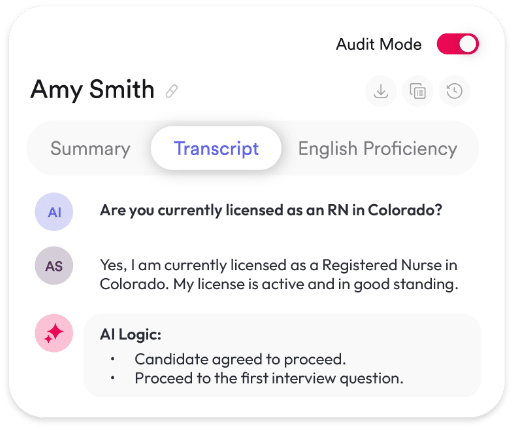
The AI Logic block visible in that screenshot is the difference between a summary and a defensible record, and it is the feature to demand from every other vendor on this list. Pricing is not published. The HireVue pricing page names an Essential and a Premium package with no dollar figures at all. Third-party procurement data reports an average contract value of $49,855 per year with a ceiling near $145,000, while the same firm's marketplace page reports a $20,900 median on a range of $9,794 to $41,056 - Vendr. Those two datasets contradict each other and both are drawn from tiny samples, so treat any HireVue number as directional only.
The criticisms are substantial. Headcount was 326 as of June 2026 on Tracxn's count, down over the period of a seven-year Carlyle hold that has produced no exit, which reads more like margin engineering than growth. Its flagship independent scientific audit dates from April 2021, before generative AI and before its own voice agent. And it carries live legal exposure, including a March 2025 discrimination charge brought by the ACLU covered in chapter 7. Best for Fortune 500 hiring where defensibility outranks price, and a poor fit below roughly 2,500 employees.
4.2 Alex (Apriora)
Alex is the best-funded pure-play agentic interviewer in the market and the one that has most aggressively expanded beyond the interview itself. The Y Combinator W24 company raised $20 million in September 2025, a $17M Series A led by Peak XV plus a $3M seed, and its homepage now claims 1,000,000 candidates interviewed, 30 languages and 33 supported ATS integrations - PR Newswire. It runs live conversations across video, phone, SMS and WhatsApp, which is the widest channel spread of any vendor here.
The 2026 product is five modules rather than one agent: AI Interviews, Coordinator for scheduling, Verify for identity and cheating checks, Talent Match for rediscovering dormant ATS profiles, and Resume Screens. That breadth is a genuine differentiator for teams that want one vendor across the whole top of funnel, and it was recognised with a place on the CB Insights AI 100 for 2026. Named customers include Tier4 Group, Allen Recruitment and the University of Alberta.
Pricing is completely opaque. The pricing page renders a 30-minute demo booking form and nothing else, and no contract value, ACV or per-interview rate for Alex exists in any procurement database. Independent reviewers confirm only that cost scales with interview volume, role families, integration scope and verification modules - Recruiting Tech Reviews. Any per-interview figure you see quoted for Alex online is fabricated.
The company also carries the category's most famous failure. In May 2025, a candidate recorded the agent looping the phrase "vertical bar pilates" roughly 14 times during an interview, and the clip went viral - 404 Media. Later reporting named the employer as a Stretch Lab studio in Ohio. The rebrand from Apriora to Alex followed, though the legal entity is still Apriora Inc. More substantively, reviewers report that ATS write-back is notes and status only rather than structured fields, that evidence export needs manual workarounds, and that conversational quality degrades at volume. Best for mid-market and enterprise teams wanting one agent across every channel, and wrong for anyone who needs a published price or field-level ATS integration. A deeper breakdown sits in our Alex pricing and alternatives guide.
4.3 Ribbon
Ribbon is the most useful vendor in this guide for one specific reason: it publishes its entire rate card, including overage, when nearly every rival hides behind a demo. Four tiers, billed annually, with a 7-day free trial on the three self-serve plans: Growth at $499 per month for 100 interviews, Business at $999 for 400, Scale at $1,999 for 1,000, and a custom Enterprise plan, with per-interview overage of $4.00, $3.00 and $2.50 respectively - Ribbon. Chapter 5 works through what those numbers actually mean.
The Toronto company runs voice-first asynchronous screening aimed squarely at high-turnover hourly hiring, and its own counters claim 1M+ interviews completed across 500+ recruiting companies. It reached that on a single $8.2 million seed led by Radical Ventures and a team of roughly 22 people, which is a genuinely impressive capital efficiency and also the main risk in buying it. Its most-cited customer outcome is LAZ Parking cutting time-to-interview from about 48 hours to under five minutes.
Watching a complete unedited interview is more informative than any feature list, and Ribbon is one of the few vendors that publishes them in full rather than as highlight cuts.
A complete AI voice interview, start to finish
The unedited format is worth eight minutes of your time because it exposes the thing demos hide: conversational latency, the pause before a follow-up, and how the agent handles a candidate who rambles. On the sceptical side, Ribbon's trust artefacts do not survive inspection. Its bias-audit page displays a "100% bias-free" claim behind a compliance badge with no auditor named, no date and no impact ratios published, while the report itself sits behind a lead form. Its testimonial portraits are AI-generated, with file names on the live page reading literally as Gemini and ChatGPT image exports. Its own ATS count contradicts itself across four pages on the same day. It holds SOC 2 Type I only, not Type II, which many enterprise security reviews reject outright. Best for high-volume hourly hiring and agencies that want a price they can sign today, covered further in our Ribbon pricing guide.
4.4 Maki
Maki is the strongest European platform and the only vendor in this guide publishing signed, named, intersectional third-party bias audits. The Paris company raised a $28.6 million Series A led by Blossom Capital in January 2025 and built a five-agent stack rather than a single interviewer: Shiro for screening across 300+ skills, Ken for deep assessment across 400+, Mochi for live adaptive voice interviews in 45+ languages, Kumi for scheduling, and Tomo, launched July 2026, which joins Zoom or Teams to co-pilot human interviews - Maki.
Its European credentials are the real moat. Maki says it has passed 80+ legal and AI committee reviews at Fortune 500 organisations - Maki, holds ISO 27001, and publishes full signed Holistic AI bias audits from March 2026 covering gender and race at both standalone and intersectional level. It also hard-codes a limit that most competitors leave to configuration: Maki states its scores can never automatically trigger disqualification. Customers include Deloitte, Capgemini, BNP Paribas and Nespresso, and one BPO, Foundever, processed 200,000 candidates in six months.
Pricing publishes a model but no number. Maki charges credits per candidate interaction and per activated agent, explicitly billing interactions rather than licences, and every call to action routes to a custom quote. No currency, rate, tier or minimum has ever been published, and no procurement database carries a Maki contract value.
The criticism is sharp and comes from an independent compliance scorer, which first graded Maki F, 45 out of 100, arguing that a voice agent scoring behavioural and linguistic performance is legally a selection procedure and that its published bias testing omits disability - Job Board Doctor. Maki responded in detail and the score was revised upward to 62, a D, on 17 July 2026, with the disability gap surviving the revision - HireAIScore. For a voice-scored interview, disability is precisely the population most at risk. The same analysis criticises Maki's June 2026 integration that runs the AI interview before the application reaches the ATS, which manufactures a far larger pool of scored-and-rejected candidates. Webcam snapshots every 30 seconds sit awkwardly beside a claimed 99% candidate approval. Best for European enterprise and RPO hiring where works councils and audit evidence matter as much as speed, with more detail in our Maki pricing analysis.
4.5 Sapia.ai
Sapia is the contrarian pick, and on the evidence it is the most defensible product in the category: a text-only interview with no video, no camera, no timer and no CV. Candidates type answers to five to seven behavioural questions over 20 to 30 minutes, on any device, and everyone receives a personality profile and a coaching tip whether they are hired or not - Sapia. The Melbourne company has run 10 million+ structured interviews across 77 countries, generating three billion words of candidate text - Sapia.
The number that justifies the whole design is disability equity. Sapia reports 98% hiring equity for candidates who disclose a disability, meaning they are hired at near-identical rates to those who do not disclose, and cites university research finding a 30% increase in female applicants when candidates know AI will assess them - HR Executive. It achieves that by refusing the modality everyone else shipped. Woolworths, Qantas, Kmart, Costa Coffee and Holland and Barrett are named customers, with Woolworths reporting 27,000 hires in under ten weeks.
Pricing is a model with no number, but the model itself is the most buyer-friendly in the market: Sapia charges per hire, not per interview or per seat, with interviews explicitly unlimited. The pricing page states it is designed for organisations hiring more than 500 people a year. No per-hire rate is published anywhere, and a directory listing showing a one-dollar starting price is a placeholder artefact rather than a real figure.
Three weaknesses are material. Sapia has not raised since November 2022 and runs on 58 employees while rivals raise nine-figure rounds, it supports only nine interview languages against 45+ for voice competitors, and text is the modality large language models ghostwrite most easily. Its claimed 1% false-positive rate on AI-content detection sounds small until you apply it to ten million interviews. Customers also report weak ATS integration and a cold-start problem where the system was not calibrated until 50 candidates had passed through. Best for very high-volume frontline hiring at 500+ hires a year where accessibility and neurodiversity are explicit goals.
4.6 Paradox (Olivia)
Paradox is the largest hiring conversation engine on earth and, by the strict definition in chapter 1, not an interviewer at all. Workday agreed to buy it in August 2025 for approximately $1 billion in cash, citing more than 189 million AI-assisted candidate conversations - PR Newswire, and completed the deal on 1 October 2025. Olivia now ships as the Workday Paradox Candidate Experience Agent. Its customer list is the most impressive in the category: McDonald's, Chipotle, Nestlé, Marriott, General Motors, 7-Eleven and Compass Group, which hires 120,000 people a year with a 20-person recruiting team.
The outcomes are real and large. Chipotle cut application-to-start from 12 days to 4 days and lifted application completion from 50% to 85% - Paradox. 7-Eleven reports 40,000 hours returned to store leaders every week. The mechanism is conversational apply plus knockout screening plus instant scheduling, which removes the friction that loses hourly candidates, rather than replacing evaluation.
No pricing is published and none is reliably reported, which matters because the deployment is enterprise-scale and reviewers put realistic ROI at 500+ annual hires. The honest framing for a buyer is that Paradox solves apply-completion and scheduling, and if you buy it expecting a probing scored assessment, independent reviews are clear that Olivia screens and schedules only.
Paradox also owns the worst security failure in the category's history. In June 2025, researchers logged into the admin panel of McHire, McDonald's Paradox-powered hiring portal, using the username and password "123456" with no MFA, then chained an insecure direct object reference to reach applicant records at scale - ian.sh. Reporting put the exposure at up to 64 million applicant records, including chat transcripts and authentication tokens; Paradox says only five records containing personal information were actually accessed. Credentials were killed within two hours and the flaws were remediated the next day, but the incident is the single best argument for treating an AI interviewer's transcript corpus as a materially larger breach surface than an ATS record. Best for frontline employers hiring tens of thousands per year inside a Workday stack.
4.7 HeyMilo AI
HeyMilo is the most current staffing-side vendor and the only pure screening tool shipping a live test of how a candidate works with an AI rather than whether they cheated with one. It announced $6 million in total funding on 16 June 2026, led by Category Ventures, alongside 1M+ candidates screened and 4x revenue growth in six months - HeyMilo. Named production customers include Randstad, WilsonHCG, ChristianaCare and Neo Financial across 47 Canadian locations.
The product runs voice, video, phone, SMS and résumé screening from one agent, with 15+ native ATS integrations weighted toward staffing systems like Bullhorn, Avionté, Ceipal and JobDiva. The June 2026 release added three agents at once, and the interesting one is AI Scenario Assessment: a live task the candidate completes with a built-in AI assistant, scored on how they work with the model rather than only on the deliverable. That is aimed at data annotation, AI data expert and AI-assisted engineering roles, and it is the clearest example anywhere of the instrumentation philosophy described in chapter 8. Customer numbers are strong where disclosed, with the industrial staffing firm TRG running 3,000 interviews a month.
Pricing was published and then withdrawn, which is worth stating precisely. In 2024 the vendor's own pricing page listed pay-as-you-go at $8.00 per interview for the first 100, $7.00 for the next 1,000 and $6.00 thereafter, with fixed contracts at $5.00 per interview at 100 a month and $4.00 at 1,000 a month - archived HeyMilo pricing. As of July 2026 the same URL is a demo form with no numbers. Those historical rates remain the best available anchor for what agentic voice screening costs at the staffing end of the market, but they are two years stale and third-party sites still recycling them as current are wrong.
The weaknesses are scale and evidence. $6 million raised in total is small against the logos claimed, headcount is undisclosed, and the G2 review base is 18 reviews, far too thin to mean anything. A competitor teardown argues, plausibly, that an invitation-based flow loses frontline candidates to whoever calls first. Best for staffing agencies, RPOs and BPOs on a mainstream ATS that want one vendor between "applied" and "recruiter decides".
4.8 Mercor
Mercor belongs in this guide as the proof of what AI interviewing can do at scale, and as the clearest warning about where the money in it actually is. Its interviewer runs roughly 10,000 interviews a day at about 700 milliseconds of voice latency, from a warm pool of pre-booted containers scaling from 80 overnight to 200 at peak - Mercor Engineering. Domain-expert sessions are the largest slice at 2,800 a day. No enterprise vendor in this guide operates anything close.
The commercial trajectory is extraordinary. Mercor raised $350 million at a $10 billion valuation in October 2025 led by Felicis, a fivefold step-up in eight months - TechCrunch. By July 2026 it was reported to be in talks at roughly $20 billion - TechCrunch. Its customers are the frontier AI labs, and it now pays out over $2 million a day to a network of 30,000+ weekly active contractors - Mercor.
You cannot buy any of it. There is no interview SKU. The interview is a free candidate-side funnel step into a labour marketplace, and Mercor bills labs for expert hours, taking an estimated 30% to 35% of gross payment volume. This is the second insight of the guide: the best businesses in AI interviewing have stopped selling AI interviewing. micro1 built arguably the most academically credible interviewer in the market, published a paper on it, sold it at $399 a month for 100 interviews - eesel, and then redirected the buy path to its homepage while pivoting to AI training data.
Mercor's 2026 also supplies the category's cautionary security tale. A supply-chain attack on an open-source AI gateway in March 2026 resulted in roughly 4TB exfiltrated, including video interviews, passport scans and contractor identity data, followed by five contractor lawsuits within a week - TNW. A separate class action filed in April 2026 attacks the AI interview itself, alleging opaque automated screening with no right to challenge and biometric profile images generated from interview footage. Best for understanding the ceiling of the category, not for procurement.
4.9 Classet
Classet is the frontline specialist with a published self-serve price and the sharpest argument in the category: video is friction for a worker screening on a break. Its voice agent phones applicants within minutes of application, 24/7, which matters because the company claims 64% of applications arrive after hours - Classet. It goes live in under a day, claims 500+ hiring teams, and targets skilled trades, home services and blue-collar staffing, with logos including Sears Home Services and Ace Handyman Services.
The pricing is genuinely published and genuinely misleading, which makes it the best teaching example in this guide. Flex costs $190 per week per job, or $700 per month per job, including 50 AI interviews per job per month, with $4.00 per interview overage and no contract, while ATS Sync starts at $1,995 per month for unlimited jobs and seats - Classet pricing. Read that carefully: the price is per job, not per account. Ten open requisitions on Flex costs $7,000 a month before a single overage.
Work the unit economics and the headline inverts. If you use the full bundle, $700 divided by 50 interviews is $14.00 per interview, roughly seven times Ribbon's $2.00 effective rate at its Scale tier, though the $4.00 marginal rate above the bundle is competitive. That gap between an attractive sticker and a high effective unit cost is the single most common trap in this market, and Classet is transparent enough that you can actually see it, which is more than can be said for the nine vendors that publish nothing.
The other caution is capacity. Tracxn records 13 employees as of April 2026 on $5.65 million raised, which is a thin surface for enterprise implementation, security review and support. There is no verified customer count or funding beyond seed rounds, all outcome metrics are self-reported, and much of the company's public content consists of competitor attack pages, which is advocacy rather than evidence. Best for trades, home services and blue-collar staffing that need something live this week at a price nobody has to negotiate.
4.10 Willo
Willo is the cheapest credible entry point into structured screening, and it is deliberately not an agentic interviewer. The Glasgow platform runs asynchronous one-way video and audio interviews with an AI layer over the recordings that transcribes, summarises, benchmarks and generates follow-up questions. It publishes complete pricing in four currencies with one, two and three-year commitment ladders: Growth at $209 per month billed annually for 2 assessments and 4 users, Scale at $307 per month for 10 assessments and 20 users - Willo pricing.
Three things make it worth a slot. It claims 5,000+ hiring teams with an NPS of 68 and localisation for the 18 most spoken languages, it ships ISO 27001 and MFA from the entry tier rather than gating security behind Enterprise, and it publishes an accessibility statement claiming WCAG 2.0 compliance while working toward 2.1 AA - Willo, which is more than most of this category discloses in a year when accessibility is what gets litigated. It is also the only vendor publishing a 50% non-profit discount and multi-year prepay rates.
The honest limitation is that the AI does not conduct anything. There is no live conversation, no adaptive follow-up in the moment, and no voice agent, which places Willo a generation behind the agentic tools on capability while placing it a generation ahead on price and predictability. Because billing is per concurrent assessment rather than per interview, the per-interview cost falls toward zero at volume within a role, which is the exact inverse of how voice vendors charge.
Two structural caps deserve attention before signing. Growth includes only 2 assessments, so any team running three open roles at once is really buying Scale, and both anti-cheat and SSO are Enterprise-only, which is a meaningful gap in a year when AI-assisted candidate answers on async video are the dominant integrity failure. Data retention is also a pricing lever rather than a policy: six months at Scale, twelve or more only at Enterprise. Third-party price listings for Willo contradict the vendor page badly, so use the vendor page. Best for cost-sensitive SMB and mid-market teams that specifically do not want an AI voice agent talking to their candidates.
4.11 Interviewer.AI
Interviewer.AI earns its place on one number that nobody else publishes: what the conversational AI layer costs relative to plain async video. On its published credit model, one credit buys an async video interview and two credits buy a conversational AI interview, on plans of $199 a month for 50 credits and $399 a month for 120, with credits rolling over and top-ups from $150 per 50 credits - Interviewer.AI pricing. Work that through and an async interview costs about $3.98 while a conversational one costs about $7.96 on the entry tier. That is the clearest published statement anywhere of what agentic conversation is actually worth.
The Singapore company claims 850+ companies, with an APAC and Middle East weighted customer base including AIA, Axis Bank and Emaar, and it is the only vendor here selling explicitly into education admissions alongside hiring. A 14-day free trial with five assessments removes the demo gate entirely, which for a small team evaluating the category is worth more than most feature comparisons.
Set against that, the caps are aggressive and they bite in a specific order. The entry tier limits interviews to 20 minutes each and job posts to three a month, which is a far tighter constraint than the 50 credits it advertises, and the vendor states plainly that no refunds are offered. On Essential, 50 credits buys just 25 conversational interviews, so the modality buyers actually want in 2026 is the one the pricing punishes.
The deeper concern is provenance. Total funding is roughly $780,000 across three rounds since 2018, with no Series A, which is a serious consideration for a multi-year hiring dependency. Its independent review base is about 20 reviews with no rating below four stars, which is not a plausible unfiltered sample. Much of the site's image inventory dates from 2021 and 2022, and no dated 2026 announcement exists anywhere on it. Best for SMBs, admissions teams and APAC recruiters who want a hard monthly ceiling and a self-serve trial.
4.12 CodeSignal
CodeSignal fills the technical slot, and it is the clearest example of the philosophy that candidate AI use should be measured rather than banned. Its agent Cosmo sits inside the candidate's IDE in one of two configurable modes, Full AI Co-Pilot where it actively collaborates on the problem, or Guided Support where it only helps with syntax and navigation, and every AI-assisted assessment ships with a full transcript of the candidate-AI interaction plus session replay - CodeSignal. The company justifies this by pointing at research showing 76% of engineers use AI copilots daily.
The technical interview surface

The shared editor with two live cursors in that screenshot is the point: a technical interview is a working session, and the artefact it produces is a recording of how someone builds, not a score for how they speak. CodeSignal publishes self-serve pricing, which competitors incorrectly claim it removed: Build at $79 a month billed annually for 60 credits a year and Grow at $479 a month for 420, both with $20 per credit overage and unlimited user licences, plus a custom Pro tier - CodeSignal pricing. One credit is one assessment or AI interview attempt, so the effective cost is roughly $15.80 per interview on Build and $13.69 on Grow, and enterprise reality is much higher, with tracked contracts averaging around $24,000 a year.
Its fraud research is the most useful public dataset in the category. CodeSignal reported that cheating and fraud attempt rates on proctored assessments rose from 16% in 2024 to 35% in 2025, nearly tripling to 40% for entry-level roles, with score inflation four times larger on unproctored assessments - CodeSignal.
The caveats are real. Cosmo is primarily an in-assessment assistant rather than an autonomous interviewer, the platform is English only, and reviewers report proctoring failures that lost recordings and forced full retakes, strict pass criteria with almost no candidate feedback, and no way to export tests. Best for engineering and technical hiring where the question is not whether a candidate used AI but how well.
4.13 Five that nearly made it, and why they did not
Three vendors were cut on currency or conflict of interest rather than quality, and two were cut because they are not AI interviewers at all, which makes them the most interesting of the five. ConverzAI is the purest staffing virtual recruiter, with nine named staffing-native ATS integrations including TempWorks, JobDiva and LaborEdge that few rivals carry, an American Staffing Association endorsement, and Apex Systems reporting conversations with 250,000 candidates. It was cut on momentum: the last raise was a $16 million Series A in February 2025, its headline metrics have not been refreshed since, and its live navigation still ships unedited placeholder text. Our ConverzAI pricing guide covers it properly.
Humanly raised a $25 million Series B led by SEEK in May 2026 on 5 million interviews conducted and 250,000 candidates engaged monthly, which makes it genuinely current. It was cut because the same round pivoted it toward selling pre-vetted candidates, putting it in competition with its own customers. Braintrust AIR runs voice interviews over a large marketplace but replaces a price with an ROI calculator and carries the same screening-into-your-own-marketplace conflict. Hireflix, at $75 a month for unlimited responses, seats and positions, is the cheapest credible async video product in existence and a useful price anchor, but it has no AI agent at all.
Karat is the cut that teaches the most. Its NextGen product, launched December 2025, puts a paid human Interview Engineer in the room to assess how a candidate uses an embedded AI assistant, with DocuSign and OpenAI named as customers - Karat. It is the philosophical opposite of everything else here and, because a human sits in every session, it can never approach two to eight dollars per interview. That is the trade in one sentence: the most rigorous evaluation of AI-era engineering skill currently available costs roughly what a human interview costs, because it is one.
5. What an AI Interview Actually Costs
The published price is never the unit cost, and the two most transparent voice vendors in this market differ by roughly seven times on the number that matters. Classet's monthly plan at $700 per job works out to about $14.00 per interview in-bundle, against $2.00 for Ribbon at its Scale tier, even though Ribbon's sticker price is nearly three times larger. Neither vendor is being dishonest. They meter different things: Classet prices per job, Ribbon prices per account with an interview allowance, and Willo prices per concurrent assessment. Comparing headline prices across those three models produces a conclusion that is not merely imprecise but backwards.
The correct method is to divide the annual commitment by your realistic annual interview volume, then check what happens when you exceed the bundle. That second step is where the real money is. Doubling Growth's volume on Ribbon to 200 interviews costs $499 plus 100 times $4.00, which is $899 a month, uncomfortably close to the $999 Business plan that includes 400. The overage is engineered as an escalator, not as flexibility, and every metered vendor in this category builds the same ramp.
Effective Cost per AI Interview, Published Rates Only
Every one of those figures is derived from a published plan rather than quoted as a unit price, and the derivation should travel with the number. Classet's $14.00 is $700 divided by the 50 interviews the plan includes; Interviewer.AI's are $199 divided by 50 credits, with a conversational interview consuming two credits; Ribbon's are the monthly fee divided by the included allowance; CodeSignal's $15.80 is $948 a year divided by 60 credits. The one vendor that ever quoted a straight per-interview price was HeyMilo, at $4.00 to $8.00 depending on volume, and it withdrew that page. A spread from $2.00 to $15.80 across published plans for what is broadly the same job tells you the market has not settled on a price, which means your negotiating leverage in 2026 is unusually high.
The other axis is the structural cap, and it is where most buyers actually get caught. On Ribbon the binding constraint at the entry tier is not interviews but 2 seats and 2 active roles, which makes it unusable for an agency running three requisitions regardless of volume. On Willo the same trap is set with concurrent assessments rather than seats. On Interviewer.AI, the entry plan caps job posts at three a month and interview duration at 20 minutes. Across the whole set the upgrade trigger is a structural limit rather than the thing being metered, which is a deliberate design and the first thing to model against your own requisition count.
| Platform | Modality | Published price | Effective per interview | Pricing confidence |
|---|---|---|---|---|
| HireVue | Enterprise suite + voice agent | None | Not published | Third-party only (~$49,855/yr avg) |
| Alex | Live agentic voice, multi-channel | None | Not published | Nothing published anywhere |
| Ribbon | Live agentic voice | $499 / $999 / $1,999/mo | $4.99 / $2.50 / $2.00 | Read on vendor page |
| Maki | 5-agent stack, voice + assessment | Credit model, no figure | Not published | Model only |
| Sapia.ai | Text/chat structured interview | Per hire, no figure | Interviews unmetered | Model only |
| Paradox | Conversational screening | None | Not published | Nothing published |
| HeyMilo | Multi-channel agentic screening | Withdrawn 2024 card | $4.00 to $8.00 (2024) | Historical, since removed |
| Mercor | Interview-powered marketplace | No interview SKU | Not sold | Not applicable |
| Classet | Live voice, frontline | $700/mo per job | $14.00, $4.00 marginal | Read on vendor page |
| Willo | Async video + AI layer | $209 / $307/mo | Not metered per interview | Read on vendor page |
| Interviewer.AI | Async video + avatar AI | $199 / $399/mo | $3.98 async, $7.96 live | Read on vendor page |
| CodeSignal | AI technical interview | $79 / $479/mo | ~$15.80 / ~$13.69 | Read on vendor page |
Reading that table by the right-hand column rather than the price column reorders the market usefully. Five vendors let you model a budget before you speak to anyone. Two publish a model that at least tells you what drives cost. The remaining five require a sales cycle to learn the most basic commercial fact about the product, and three of those five are the largest companies in the category. The correlation between size and opacity is not a coincidence: opacity is a pricing strategy that only works when the buyer has no alternative.
One number puts the whole discussion in perspective. A randomised field experiment run across nearly 71,000 applications with an RPO firm reported a cost breakeven at 8,500 interviews in a low-wage labour market where the human interviewer was cheap - PR Newswire. The roles in that study paid roughly $280 to $435 a month. In a US or European market where the interviewer's fully loaded cost is many times higher, breakeven arrives far sooner, which is the actual economic argument for this technology. It also implies the reverse: below a few thousand screening conversations a year, the honest answer is often that an AI interviewer will not pay for itself, and no vendor in this category will volunteer that.
6. Does It Work? The Evidence So Far
There is exactly one randomised controlled field experiment on AI interviewing, it is large, and its results are good for the vendors. Researchers at Chicago Booth and Erasmus University ran 70,884 applications across 48 entry-level customer service roles in the Philippines with an RPO firm, randomly assigning candidates to an AI interview, a human interview, or a free choice between the two, with human recruiters making the final hiring decision in every arm - ERE. Candidates interviewed by the AI were more likely to receive an offer, more likely to start, and more likely to still be there a month later.
The retention result is the one that should change minds, because it is the hardest to explain away as a throughput artefact. If AI interviews merely pushed more people through a funnel, offers would rise and quality would fall. Instead one-month retention rose alongside offers, and the AI covered 6.8 topics per interview against 5.5 for the human, or 45% of the interview guide against 38%, which is the most plausible mechanism: a machine works the full structured guide every time, while a tired recruiter on their eleventh screen of the day does not.
AI vs Human Interviewer, Randomised Field Experiment
The fourth pair on that chart is the one nobody expected: candidates interviewed by the AI reported gender discrimination at 3.3% against 5.98% for the human arm, a 45% reduction. Candidates who scored lower on language and analytical measures also chose the AI more often when the study let them pick. Two caveats belong on the record. The press release announcing the study was issued by the vendor whose AI was studied, and the labour market was Philippine entry-level customer service, a high-churn sector in which barely 5% of applicants were still employed a month after applying in either arm. Generalising from that to senior professional hiring in London or New York is not supported.
The bias evidence points the same direction and comes with the same conflict. An audit firm analysing more than a million test samples across 150+ audits found AI systems achieved a mean impact ratio of 0.94, against a synthesised human baseline of 0.67 assembled from older academic studies of résumé callbacks and blind auditions - Warden AI. On that comparison the AI systems were up to 45% fairer for racial minorities and 39% fairer for women, though the human baseline is a literature construct rather than a matched control. The same dataset found 15% of audited systems failed at least one demographic threshold, with variance between the best and worst systems exceeding 40%. Both halves matter. The average AI interview appears fairer than the average human one, and the variance between products is wide enough that the average tells you nothing about the specific tool you are buying.
Now the part vendors do not put on slides. The criterion validity of AI interview scores is essentially unestablished. The validity evidence that exists is largely for structured asynchronous video content rated by humans or by validated psychometric models, not for large language models conducting and scoring a conversation, and the field's own 2025 literature describes direct evidence on asynchronous video interviews as still very limited - Wiley. Peer-reviewed work on scoring interviews with large language models only began appearing in 2026. That is a genuine gap, not a technicality, and it is why the professional standard for selection assessments still requires that scores predict performance, be consistent on retest, be demonstrably unbiased and be documented well enough for external audit, which is the standard the SIOP guidelines set for any AI-based selection tool - Holistic AI.
Candidate reaction research fills in the missing half of the picture and is unusually actionable. In a controlled experiment with 921 respondents, an AI rejection with no explanation scored lowest on every fairness dimension measured, while adding an explanation lifted AI decisions to approach or exceed unexplained human ones on interpersonal treatment - Frontiers in AI. A separate 2026 study of 755 job seekers found that decision transparency was the only design feature that predicted both dimensions of perceived presence - Frontiers in Psychology. The finding replicates across studies with different samples and methods: it is not the machine that candidates reject, it is the machine that will not explain itself.
There is one more study worth reading before any deployment, because it argues that badly designed AI interviews cause the cheating described in the next chapter. An interface experiment with 180 participants, preceded by 17 interviews and an analysis of eleven subreddit discussions, found that mismatched expectations "often led to workarounds and deceptive practices", and that giving candidates response choice and informative feedback measurably improved their sense of autonomy - arXiv. Read alongside the walk-away data in chapter 7, the practical conclusion is that candidate hostility to AI interviews is largely a design problem that vendors and employers have been treating as a public relations problem.
7. Where AI Interviewers Fail
The dominant failure mode in this category is not bias, and it is not hallucination. It is that candidates leave. In a survey of 2,950 active job seekers across five countries, 38% of US candidates had already withdrawn from a hiring process because it included an AI interview, and another 12% said they would drop out if one were required - Fortune. No vendor reports this metric, because it does not show up in their telemetry: a candidate who never starts the interview is invisible to the platform running it.
The root cause is disclosure, and the numbers are damning in their consistency. 70% of candidates were never clearly told upfront that AI would evaluate them, 21% only discovered it once the interview had started, and 57% believe disclosure should be a legal requirement - Greenhouse. When asked what specifically made them quit, the top answers were a pre-recorded video scored by AI with no human present at 33%, non-disclosure at 27%, and AI monitoring during the interview at 26%. Read together with the transparency findings from chapter 6, the fix is nearly free and almost nobody is doing it.
Willingness also varies enormously by context, and averaging across contexts produces a number that describes nobody. In the Philippines field experiment, 78% chose the AI when offered a free choice between it and a human. When an ATS vendor ran the same experiment on its own APAC pipeline, 36% chose the AI - Ashby. Among the mostly professional respondents to the Greenhouse survey, a large minority walk rather than sit one at all. The gradient runs from high-volume, lower-wage, speed-sensitive hiring where AI is a genuine convenience, to professional hiring where it reads as a company that could not be bothered.
Then there is what happens after the interview. Of US candidates who completed one, 51% received no outcome at all, with 38% ghosted entirely and 13% still waiting, while 28% advanced and 13% were formally rejected - HR Dive. Automating the interview without automating the response is the worst of both worlds: it industrialises the part candidates dislike and leaves untouched the part they actually resent. It is also entirely self-inflicted, because a system that can conduct 1,000 conversations a month can obviously send 1,000 outcome emails.
The mechanism that produces most of those silent rejections is a number in a workflow builder, and it is worth seeing what that looks like in a real product.
The rule that does the rejecting
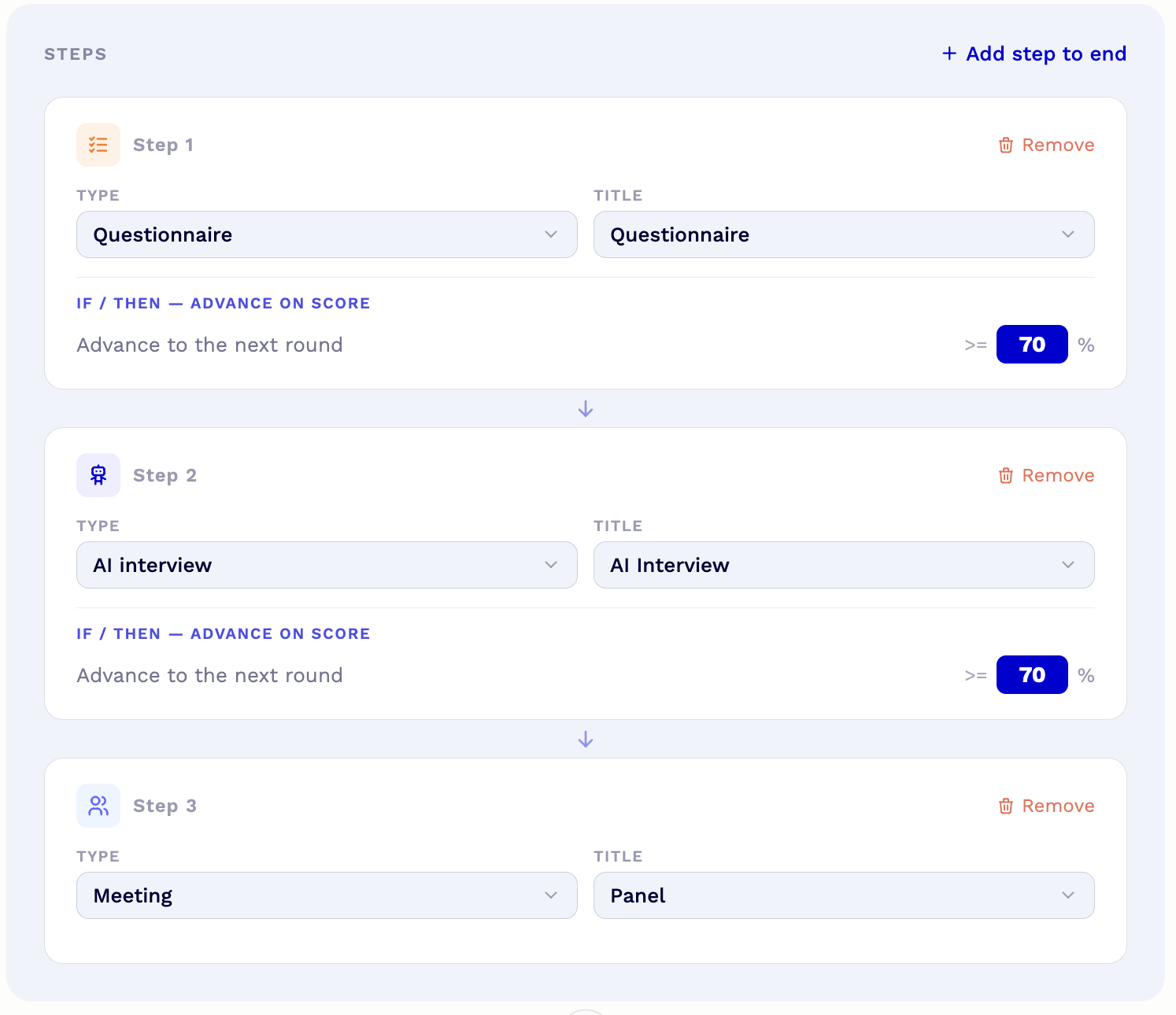
That "advance on score greater than or equal to 70%" rule is where an interview tool becomes an automated decision system in the legal sense, and where a large share of the compliance obligations in chapter 9 attach. Configuring it takes about four seconds and typically happens in an implementation call, without legal review, without a bias audit of the specific threshold, and without anyone recording why 70 was chosen rather than 65. It is the single highest-risk configuration in this entire category.
Accessibility is where the failures become legal. In March 2025 the ACLU of Colorado filed charges with the state civil rights division and the EEOC on behalf of a deaf and Indigenous Intuit employee who was required to use a HireVue video interview to apply for a promotion, requested human-generated captioning as an accommodation, was denied, and was then rejected for her "communication style" - HR Dive. HireVue's chief executive called the complaint entirely without merit and stated that Intuit did not use a HireVue AI-based assessment. That defence, whether or not it prevails, is the accountability gap every buyer must close in the contract: when the interview goes wrong, the employer and the vendor will each point at the other.
The pattern extends beyond sensory disability to anyone whose speech, pacing or affect sits outside the training distribution, and to anyone the model reads as unusual. Public backlash in New Zealand and Australia through 2025 and 2026 has centred on exactly that, including a 16-year-old told by an AI screen, after a brief text exchange, that he would struggle with distractions and did not like trying new things - RNZ. An employment programme lead quoted in the same piece put it plainly: anybody a little bit outside the box is disadvantaged. Note that voice, the modality the entire 2026 cohort shipped, is the one where that risk is sharpest, and that the bias audits published in this category almost never test for it.
A candidate-side account is worth more than any of this analysis, and a journalist recording their own interview with one of the leading agents is the closest thing to a controlled observation available.
A senior writer is interviewed by an AI recruiter
The detail that lands hardest in that recording is being greeted not by a person but by a static image, with no small talk before the questions begin. Small talk is not a nicety in an interview, it is how a candidate calibrates, and its absence is a design decision rather than a technical limit.
Finally, there is the surface area nobody prices in. An AI interviewer accumulates a conversational transcript on every applicant, which is a materially larger and more sensitive corpus than an ATS record, and the McHire incident described earlier showed what happens when it is not protected. Against that risk, only 37% of organisations using AI in hiring currently audit those tools for fairness at all - HR Dive. The failure modes in this chapter are not exotic. They are the predictable result of deploying a decision system with the governance posture of a scheduling tool.
8. The Arms Race: Cheating, Deepfakes and Two Philosophies
Candidates are now buying stealth as a premium SKU, and that single pricing fact tells you more about the state of AI interviewing than any vendor benchmark. Cluely, the company that grew out of a tool built to beat technical interviews, charges $19.99 a month for its assistant and $149.99 a month for the tier that is "completely hidden to meeting screen sharing software" - Cluely. Undetectability is priced at seven and a half times the product itself. It raised $15 million from Andreessen Horowitz at roughly a $120 million valuation in June 2025, and its founder later publicly retracted the revenue figure he had given press, admitting the number was fabricated.
Candidate adoption is no longer marginal. Asked directly, 20% of 2,510 verified professionals admitted secretly using AI during job interviews, and across the wider 3,617-person survey 55% agreed that doing so has become the new norm - Blind. A 2026 survey of a thousand active US job seekers put real-time AI use during live interviews at 22%, alongside 36% who admitted lying in interviews - Newsweek. The HR consultant quoted in that coverage frames it as a system employers built, arguing that if candidates are automating authenticity out of their side of the exchange, it has become necessary rather than shameful.
Platform telemetry pushes the numbers much higher, and this is where scepticism is essential. One AI interview vendor analysing 19,368 interviews on its own platform reported flagging 38.5% of candidates for AI-assisted behaviour, rising to 48% in technical roles, with 61.1% of detected cheaters still scoring above the advancement threshold - Fabric. That dataset is largely Indian-market and comes from a company selling cheating detection. Set it against HireVue's own whitepaper reporting that a fraction of one percent of responses triggered a similarity flag, and you have two vendor datasets two orders of magnitude apart. Every large fraud number in this category is published by someone selling the cure, and the contradiction between them is itself the story.
Identity fraud is the harder problem, because it is organised rather than opportunistic. Gartner's projection that one in four candidate profiles worldwide could be fake by 2028 is the canonical figure, drawn from a survey in which 6% of 3,000 candidates admitted to interview fraud - HR Dive. Note precisely what it claims: fake profiles, which includes AI-embellished résumés and stolen identities, not deepfaked video. One security vendor analysing its own hiring funnel found 1 in 6 applicants showed clear signs of fraud, 1 in 343 linked to North Korean infrastructure, and a quarter of those DPRK-linked applicants used deepfakes in the interview - Pindrop.
The prosecutions establish the scale. In July 2025 a woman running a laptop farm from her Arizona home was sentenced to 102 months in prison for a scheme that defrauded 309 US businesses, used 68 stolen identities and generated $17 million for North Korea - The Register. Further sentencings followed through 2026, including 108 and 92-month terms for facilitators who placed DPRK workers at more than 100 US companies. This is not a hypothetical risk to model, it is a live criminal enterprise that specifically targets remote hiring funnels. Our guide to deepfake candidate interviews covers the defensive playbook in detail.
The best detection technique currently in circulation costs nothing and came from a founder who caught two deepfaked candidates. Asked to place a hand partially in front of the face, a face-swap filter warps visibly around the moving hand. The candidate refused, and the interviewer ended the call - The Register. Other reliable tells are head and neck misalignment, response lag before answers arrive as neat bullet-shaped lists, and camera malfunctions that resolve suspiciously. This matters because humans identify AI-generated media at close to chance, so an unaided interviewer is not a control.
The industry's response has forked, and the two branches are genuinely incompatible. One branch treats candidate AI use as fraud to catch: integrity monitors flagging off-screen activity and response cadence, webcam snapshots and device fingerprinting, identity verification partnerships such as CLEAR's biometric checks inside an ATS. The other treats it as skill to score: full transcripts of the candidate-AI interaction, session replay, live scenario assessments measuring how someone works with a model, and human engineers assessing AI-assisted problem solving. Notably, only the technical vendors sit on the scoring side.
Which branch is right depends on a question most employers have not answered: will the job involve using AI. If it will, banning AI in the interview measures a skill nobody will use again, and the assessment needs rebuilding rather than policing. If it will not, detection is legitimate, but it is expensive, adversarial and, on the evidence above, unreliable. Most employers have chosen neither branch deliberately, which is how you end up paying for detection on a role whose daily work is prompting a model. Meanwhile the largest employers have quietly reached for the oldest control available: Google, Cisco and McKinsey all reintroduced in-person rounds in 2025, with Gartner reporting that 72.4% of recruiting leaders now conduct in-person interviews specifically to combat fraud - Computerworld. The most advanced screening technology in history has produced, as its first mass consequence, a return to meeting people in rooms.
9. Compliance in 2026: The Floor Fell Out, the Ceiling Rose
The single most important compliance fact for anyone deploying an AI interviewer in Europe is that the deadline everyone planned around has moved, and the date now in most vendor decks is wrong. The EU AI Act classifies recruitment and candidate evaluation as high-risk under Annex III, and those obligations were due to apply from 2 August 2026. Through the Digital Omnibus package, agreed politically in May 2026, endorsed by Parliament on 16 June and given final Council approval on 29 June, standalone Annex III high-risk obligations were deferred to 2 December 2027 - Dastra. If your programme is built around an August 2026 European deadline, you have roughly sixteen extra months.
Two European obligations were not deferred, and both bite now. Article 5 has prohibited AI systems that infer emotions in the workplace since 2 February 2025, outside narrow medical and safety uses - EU AI Act. Breaching a prohibition carries the Act's heaviest penalty, up to 35 million euros or 7% of worldwide turnover, enforceable since August 2025 - Article 99. Recruitment sits squarely inside "workplace". Any product scoring enthusiasm, confidence, sincerity or emotional engagement from face, voice or tone in an EU hiring context is prohibited outright, and rebranding affect inference as "communication style" does not change what is being inferred. This is a ban, not a risk tier, and it is the reason serious vendors abandoned facial expression analysis years ago.
The second live deadline is transparency. Article 50 requires that people be informed they are interacting with an AI system, and that synthetic audio or video be machine-readably marked, from 2 August 2026. For an AI voice or avatar interviewer that is a direct product requirement: the agent must disclose itself. Running underneath all of it, GDPR Article 22 gives candidates the right not to be subject to a decision based solely on automated processing with significant effects, which is precisely what a 70% auto-advance threshold creates without meaningful human review.
What that disclosure looks like in a shipped product is instructive, because the compliant version is not a paragraph in a privacy policy.
Consent, as a product surface
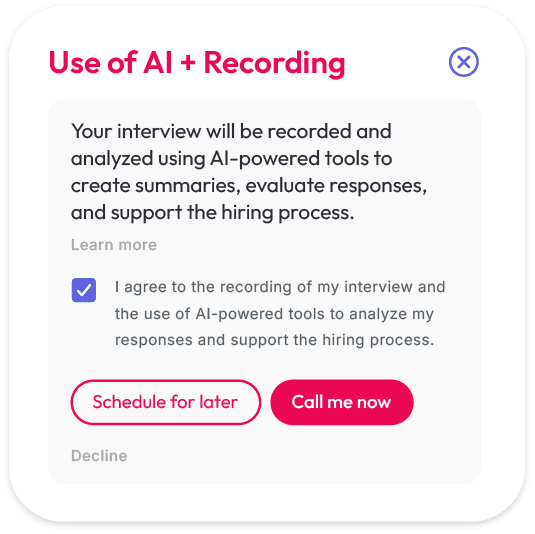
Note the third button. A consent screen that offers decline as a visible option, alongside scheduling and taking the call, is the difference between informed consent and a click-through. It is also close to what Illinois has required since 2020, and what a growing number of US states now require in some form.
The US picture is the opposite of Europe's: the federal floor fell out while state ceilings rose. In January 2025 the EEOC removed its AI employment guidance from its website, including the technical assistance on assessing adverse impact in algorithmic selection procedures, and in June 2026 the Department of Justice issued an opinion declaring the disparate-impact guidelines unconstitutional - HR Dive. None of that repeals Title VII, the ADEA or the ADA, and the four-fifths rule still sits in the regulations. What changed is who enforces: exposure shifted from federal agencies to private plaintiffs and state attorneys general.
The states have filled the gap in four incompatible ways, which turns compliance into a mapping exercise rather than a policy. Illinois amended its Human Rights Act effective 1 January 2026 to bar AI that has the effect of discriminating, ban ZIP code as a protected-class proxy, and require notice, with a private right of action behind it. Texas took the opposite approach the same day, requiring proof of intent and expressly providing that disparate impact alone is insufficient, enforceable only by the attorney general. California went furthest on liability: its automated-decision-system regulations took effect 1 October 2025, extend liability to AI vendors acting as the employer's agent, and require four years of record retention - Paul Hastings.
Colorado rewrote its law before it ever took effect, which is the change most likely to be stated incorrectly elsewhere. Governor Polis signed SB 26-189 on 14 May 2026, repealing and replacing the 2024 Colorado AI Act with a narrower framework built around automated decision-making technology, effective 1 January 2027 - Holland & Knight. It drops the algorithmic-discrimination language and the annual impact assessments, and replaces them with notice, disclosure within 30 days of an adverse decision, data correction rights, meaningful human review and reconsideration, and three-year recordkeeping. The state attorney general has said he does not intend to enforce it until rulemaking concludes.
New York City's Local Law 144 is the oldest rule here and the best evidence that a law on the books is not the same as a law in force. It requires an independent bias audit within the previous year, publication of selection rates and impact ratios, and ten business days' notice to candidates. A study in which 155 investigators checked 391 employers found that just 18 posted an audit report and 13 posted a transparency notice, with 96% of the audits that were published reporting impact ratios above the 0.8 threshold, which is a textbook signature of publication bias - arXiv. In December 2025 the New York State Comptroller judged the city's enforcement ineffective, finding that regulators reviewing 32 posted audits identified one compliance issue while the Comptroller's own reviewers found at least 17 in the same set.
The case that will settle more than any statute is Mobley v. Workday, because it puts the vendor rather than the employer in the defendant's chair on an agency theory. The court granted conditional certification of a nationwide collective of applicants aged 40 and over who were rejected through the platform since 24 September 2020 - Proskauer, on a record in which Workday itself represented that roughly 1.1 billion applications were rejected using its tools during the relevant period. In June 2026 the court refused to dismiss California discrimination claims brought by applicants who live nowhere near California, on the theory that the tools were designed and controlled there - HR Dive. In May 2026 the court also held that AI bias-testing data may be shielded from discovery by attorney-client privilege where counsel curated it for legal advice, which creates an uncomfortable incentive: the safest place to run your bias testing is under privilege, and privileged testing is testing nobody outside can see.
The synthesis for a buyer is short. Assume your AI interview is a regulated selection procedure in every jurisdiction where you hire. Disclose before it starts, keep meaningful human review in the loop for any adverse outcome, retain records for four years to satisfy the strictest state, and make the vendor contractually liable for accessibility and bias, because California already treats them as your agent and the ACLU case shows vendors will disclaim when it goes wrong. Our international recruiting compliance guide covers the cross-border version of the same problem.
10. Buying, Integrating and Deploying
The most consequential trend for buyers in 2026 is that applicant tracking systems stopped integrating with AI interviewers and started acquiring them. Ashby made its first ever acquisition, buying Talent Llama and rebuilding the product natively inside its own platform - Ashby. Greenhouse completed its acquisition of Ezra AI Labs in May 2026 to bring a conversational voice interviewer in-house. Workday bought Paradox outright. HireVue joined the Workday agent partner network rather than competing with it.
The implication is direct and slightly brutal. If you run Greenhouse or Ashby, the AI interviewer is becoming a native feature rather than a purchase, and the standalone vendor's addressable market is compressing toward Workday, iCIMS and SAP shops plus staffing and RPO. That should change how long a contract you sign. A three-year commitment to a standalone interviewer, at exactly the moment your ATS is building the same capability into the product you already pay for, is the most avoidable procurement mistake available in this category.
Integration depth is the other thing demos hide, and there is a reliable tell. HireVue publishes live customer counts per connector, showing 140+ live customers on Workday and 100+ on Oracle, while listing other systems as bare logos - HireVue. Connectors with named partner tiers and customer counts work. Connectors that appear only as a logo are the ones to probe in diligence. A second tell is pricing: Ribbon gates ATS integration with field mapping behind its $1,999 tier and custom mapping behind Enterprise, which is a vendor telling you plainly that basic integrations do not write back cleanly.
Before signing anything, there are five demands worth putting to a vendor in writing, and the useful ones are the ones that are awkward to answer.
- Show the impact ratio per protected class, dated within twelve months, from an auditor with no equity in you
- Name the decision owner and demonstrate that no score auto-rejects without human review
- Prove the accommodation path, including captioning, and a standing human-interview alternative
- Disclose retention and deletion for transcripts, audio and any biometric derivative
- Accept contractual liability for accessibility and discriminatory outcomes as our agent
Every one of those has a defensible answer that a serious vendor can give in a day, which is exactly why the question set is useful. The first is the sharpest, because what passes for a published audit in this category is frequently a badge rather than a report, as Ribbon's bias-audit page demonstrates. A vendor that will not hand over impact ratios by group is telling you either that it has not measured them or that it did not like what it found, and both answers should end the evaluation.
The pilot design matters as much as the vendor choice. Run one live, representative requisition on two tools in parallel for two to four weeks, and measure four things: completion rate against your existing screen, shortlist quality judged blind by the hiring manager, recruiter hours genuinely returned, and candidate drop-off at the invitation step, which is the number vendors do not report and the one that determines whether the technology works for your population. Because Ribbon and Interviewer.AI both offer trials without a sales gate, and CodeSignal sells a self-serve tier, at least one arm of that test can start today.
10.1 The adjacent category: sourcing tools like HeroHunt.ai
An AI interviewer only improves the funnel you already have, and for many teams the real constraint is that the right people never applied. This is the honest limit of everything in chapters 4 and 5. If 300 applicants arrive per role and 290 are unqualified, faster screening produces the same shortlist sooner. If the strongest candidates for a role are employed elsewhere and never see the posting, no interviewing technology in this guide will find them, because all twelve tools are triggered by an application.
That is a different category of product: outbound sourcing that searches the market, screens with language models against your criteria, and starts a conversation rather than waiting for one. It is worth naming because buyers routinely evaluate an AI interviewer when their actual problem sits one stage earlier, and the two are complementary rather than competing purchases.
HeroHunt.ai
If your bottleneck is an empty pipeline rather than a full inbox, an interviewer is the wrong tool. HeroHunt.ai works the other side of the funnel: it searches over a billion profiles, screens them with language models against your brief, and runs the outreach, which is the stage none of the twelve platforms above touch. The honest caveat is that it is not an AI interviewer and does not replace one. If your applicant volume is already high and your problem is screening speed, buy from the ranked list instead, and note that a free trial makes it cheap to find out which of the two problems you actually have.
Naming the constraint correctly before buying is the whole exercise, and it is why chapter 12 opens with the funnel question rather than a product recommendation. Teams that automate the wrong stage do not usually discover the error for a quarter, by which point they have a contract and a configured workflow defending the decision.
11. What Happens Next
The most likely outcome for the standalone AI interviewer is absorption, and the three ATS acquisitions described in chapter 10 are the first evidence rather than the last. That logic is hard to argue with, since the agent needs the requisition, the scorecard, the pipeline stage and the write-back path, all of which the system of record already owns. HireVue's own answer was to buy a startup's technology rather than build it, which tells you the same thing from the other direction: nobody in this market now believes the interview agent is where the durable advantage sits.
The pure-plays are therefore competing for a shrinking middle: employers on applicant tracking systems that will not build this, plus staffing and RPO firms whose economics differ enough to justify a specialist. That is a real market, but it is not the market their funding assumes. It also compounds the pattern from chapter 4, where the companies that ran the most interviews, Mercor and micro1, both concluded that the interview was worth more as a labour-supply funnel than as a licence, and Humanly's 2026 round funded the same move. Buyers should read that as a signal about vendor incentives over the life of a three-year contract: the exit for a successful AI interviewer may be to stop selling you software and start selling you people.
Identity is the layer most likely to become mandatory next, and it is already being built. Biometric verification is shipping inside applicant tracking systems, continuous verification products now run on the call itself across Teams, Webex and Zoom, and a wave of on-device deepfake detection launched through mid-2026. Given the prosecutions in chapter 8 and the scale of infiltration they revealed, the reasonable expectation is that verified identity becomes a standard gate on remote hiring within two years, in the way background checks did for regulated roles. The open question is who pays for it and who holds the biometric template afterwards, because the answer determines whether the fraud fix creates a second privacy liability on top of the transcript corpus.
The regulatory calendar is unusually legible for once, and three dates matter. 1 January 2027 is when Colorado's rewritten framework takes effect and when California's automated decision-making technology rules, in force since January 2026, reach their compliance deadline for businesses already using such tools in significant decisions - CPPA. Colorado is the one that adds a right to meaningful human review; California adds pre-use notice, an opt-out and an access right. 2 December 2027 brings the deferred EU high-risk obligations, at which point risk management systems, technical documentation, logging, human oversight and registration become live requirements for anyone interviewing candidates in Europe. Between now and then, the transparency duty in August 2026 is the near-term item.
The most under-priced legal risk remains disability, for the reason set out in chapter 7: the audits measure gender and race, the products score speech, and the one vendor with a hard disability equity number gets it by refusing voice and video entirely. Expect that to be tested in court rather than corrected voluntarily. A single well-argued class action on behalf of candidates with speech differences would reshape roadmaps across the category faster than any statute on the 2027 calendar, because it would attack the modality itself rather than the governance around it, and there is currently no published evidence any voice vendor could use as a defence.
Finally, the arms race probably resolves by changing what an interview is. If a conversation can be passed in real time by a copilot the candidate is paying $149.99 a month to hide, then the conversation was measuring recall rather than capability, and the durable response is to make the assessment a work sample instrumented for AI use rather than a quiz to be protected from it. That is what the technical vendors already do, and what live scenario assessments are early attempts at. The likely end state is neither an AI-free interview nor an AI-run one: it is a shorter machine-run qualification step, a work sample where using AI is expected and observed, and a human conversation that exists to judge the things a transcript cannot capture.
12. The Bottom Line
Match the tool to the funnel stage and the labour market, not to the demo, because the twelve platforms in this guide are not substitutes and the wrong choice fails quietly. The decision resolves through four questions in order: is the constraint sourcing or screening, is the hiring high-volume hourly or professional, do you need a published price or can you run a procurement cycle, and does the role involve using AI. Answering those four eliminates most of the list within an hour.
The tree encodes the logic most teams follow, and the branches are genuinely different products rather than tiers of the same one. If the problem is that nobody good applies, no interviewer helps and the spend belongs upstream. If you are hiring engineers, the only question worth asking is how they work with AI, which puts you on CodeSignal or a human-plus-AI format like Karat. If you are hiring frontline workers at volume in Europe, Maki and Sapia.ai are the two with real audit artefacts, and Sapia is the only one with a published disability equity number. If you want speed and a price you can sign this week, Ribbon at $2.00 to $4.99 an interview and Classet at $4.00 marginal are the transparent options. If you need Fortune 100 defensibility and can run procurement, HireVue has the validation library and Alex has the widest channel coverage.
Three numbers should govern the decision regardless of which branch you land on. The first is your realistic annual interview volume, because it converts every headline price into a unit cost and because below a few thousand conversations a year the honest answer is often that none of this pays for itself. The second is your structural cap, meaning seats and concurrent roles, which binds long before interview volume does on almost every published plan. The third is your completion rate, the number no vendor reports, which tells you whether your candidates will actually sit the thing. Acceptance is not a constant: when offered a free choice, 78% picked the AI in entry-level Philippine hiring and 36% did in one ATS vendor's APAC pipeline, while among mostly professional job seekers a large minority walk away rather than take one at all.
The strategic judgement underneath all of it is that this technology is real and early rather than hyped and mature. A randomised trial across 70,884 applications found more offers, more starts and better one-month retention from the AI arm, plus fewer reports of gender discrimination, which is stronger evidence than most HR technology ever produces. At the same time, no peer-reviewed study yet shows an AI interview score predicting job performance, the published audits skip disability, the largest employers are reintroducing in-person rounds to defeat fraud, and 38% of candidates have already walked away from a process because a machine was in it. Both of those descriptions are true simultaneously, and any vendor or article telling you only one of them is selling something.
So buy narrowly and instrument heavily. Pick one requisition, run two tools against it, insist on the impact ratios before you sign, keep a human in the loop on every adverse decision, tell candidates in plain language before the interview begins rather than during it, and give them a route to a human that does not require them to ask twice. Do those things and the technology in this guide is one of the few genuine productivity gains available to a recruiting team in 2026. Skip them and you will automate your way to a smaller, angrier applicant pool, and the metrics that would have told you will not be in your vendor dashboard.
This guide reflects the AI candidate interviewing market as of July 2026. Pricing, product capability and regulation in this category change unusually fast, several vendors here are demo-gated, and at least three widely recommended tools became defunct during the twelve months before publication, so verify current details on each vendor's own site before purchasing.