


The insider's guide to the tools that prove a remote candidate is a real, single, authorized human before you hire them in 2026.
Written by Yuma Heymans (@yumahey), who built HeroHunt.ai, an AI Recruiter that sources real professionals across more than a billion profiles. He wrote this guide because the same automation that lets recruiters find genuine candidates at scale is now being weaponized by fake ones, which is exactly why candidate identity verification became a hiring problem and not just a security one.
Nine security officials told Axios in 2025 that they have yet to meet a Fortune 500 company that has not accidentally hired a North Korean IT worker. That is not a fringe statistic, it is the new baseline of remote hiring - Axios. The voice-security firm Pindrop now reports that 16.8% of every job applicant it sees is fake, and that one in every 343 applicants traces back to North Korea, with fully remote postings pulling roughly 800 applicants against about 100 for an in-person role - Fortune.
The problem is no longer whether a candidate is qualified. It is whether the person on the video call is a real, single, legally authorized human who will actually do the job, rather than a deepfake avatar, a paid proxy sitting the interview for someone else, or a stolen identity operated from a laptop farm. Gartner projects that by 2028, one in four candidate profiles worldwide will be fake, a forecast that includes AI-generated audio and video built specifically to slip past virtual screening - HR Dive. Most hiring teams are not ready. HireRight's 2025 benchmark found that one in six employers had already been hit by identity fraud in hiring, yet only three in five run any identity check at all - HireRight.
This guide is the practical map through that gap. It explains why candidate identity verification became a hiring priority in 2026, how the technology actually works for a non-technical reader, what to look for when you buy, and a ranked breakdown of the top 10 solutions that HR and talent teams are actually deploying this year, with real pricing wherever it is published. It then covers the new front line of deepfake and proxy-interview defense, how identity fits alongside background checks and right-to-work rules across borders, and where AI agents take all of this next. The goal is insider knowledge you can act on, not a vendor brochure.
Contents
- Why Candidate Identity Verification Became a Hiring Priority
- Inside the Fraud: North Korean Workers, Deepfakes, and Proxies
- How Candidate Identity Verification Actually Works
- What to Look For: A Buyer's Benchmark for Hiring
- The Top 10 Candidate Identity Verification Solutions, Ranked
- Deepfake and Proxy-Interview Defense: The New Front Line
- Background Checks, Right-to-Work, and Global Hiring
- Pricing and How to Choose
- The Future: AI Agents, Reusable Identity, and the Arms Race
1. Why Candidate Identity Verification Became a Hiring Priority
The single most important shift in hiring over the past eighteen months is that identity became the first thing to verify, before skills or references. For most of the remote-work era, recruiters assumed the person who applied was broadly who they claimed to be, and the hard part was assessing competence. That assumption broke in 2025. Generative AI made it cheap to fabricate a convincing face, a synthetic voice, a polished resume, and a full backstory, while organized fraud operations industrialized the process of applying to remote jobs at scale. The result is that a hiring funnel is now an attack surface, and the candidate at the top of it is unproven until verified.
The numbers behind this shift are stark and recent. A Gartner survey of 3,000 job candidates in mid-2025 found that 6% admitted to interview fraud, meaning they had either posed as someone else or had someone pose as them, and a striking 62% said they would be more likely to apply if the employer required an in-person interview - Gartner. On the employer side, roughly 17% of 1,000 US hiring managers said they had encountered candidates using deepfakes in video interviews, up from just 3% a year earlier, and about 74% reported seeing AI-generated content in applications - CNBC. The trend line is not gentle, it is close to vertical.
Before diving into vendors, it helps to see how a real newsroom framed the scheme, because the visual of a synthetic candidate on a call lands harder than any statistic. This CNBC segment walks through how fake job seekers use AI to win remote roles, and it is a useful primer for any hiring manager who has not yet seen the threat in motion.
How Fake Job Seekers Are Stealing Remote Jobs
The clearest way to grasp the pace is to line up the year-over-year jumps in the fraud signals that hiring teams actually measure. Deepfakes in video interviews, cheating flags on technical assessments, and fraud at the entry level all moved sharply in a single year, which tells you this is a step change rather than a slow drift. The assessment platform CodeSignal, for example, saw fraud flags on proctored tests more than double, and entry-level fraud nearly triple, between 2024 and 2025 - CodeSignal.
The Surge in AI Hiring Fraud (2024 to 2025)
What that chart should tell a hiring leader is that no single control is enough, because the fraud is arriving through multiple doors at once. A deepfake defeats a video interview, an AI script defeats a take-home assignment, and a stolen identity defeats a paper background check, so teams that patched only one hole in 2024 are exposed on the others in 2026. It also explains why identity verification, the layer that confirms the human is real before any of those steps, has moved to the very front of the funnel. Verifying identity first shrinks every downstream risk at once, which is why it is the highest-leverage control a talent team can add this year.
There is also a quieter root cause worth naming, because it changes how you defend against this. Fraud concentrates in high-volume, anonymous inbound applicant floods, where a fake profile is just one of hundreds and no one has time to look closely. That is the environment Pindrop describes when it notes that a fully remote posting can draw 800 applicants. One structural way to reduce exposure is to start from real, sourced professionals rather than an inbox of unknown inbound applicants. Tools like HeroHunt.ai's AI Recruiter search across more than a billion public professional profiles to surface genuine, contactable people with a verifiable work history and online footprint, so the shortlist you then run through an identity check is built from real humans rather than a crowd of easily spoofed strangers - HeroHunt.ai. Sourcing does not replace verification, but it narrows the field that verification has to defend.
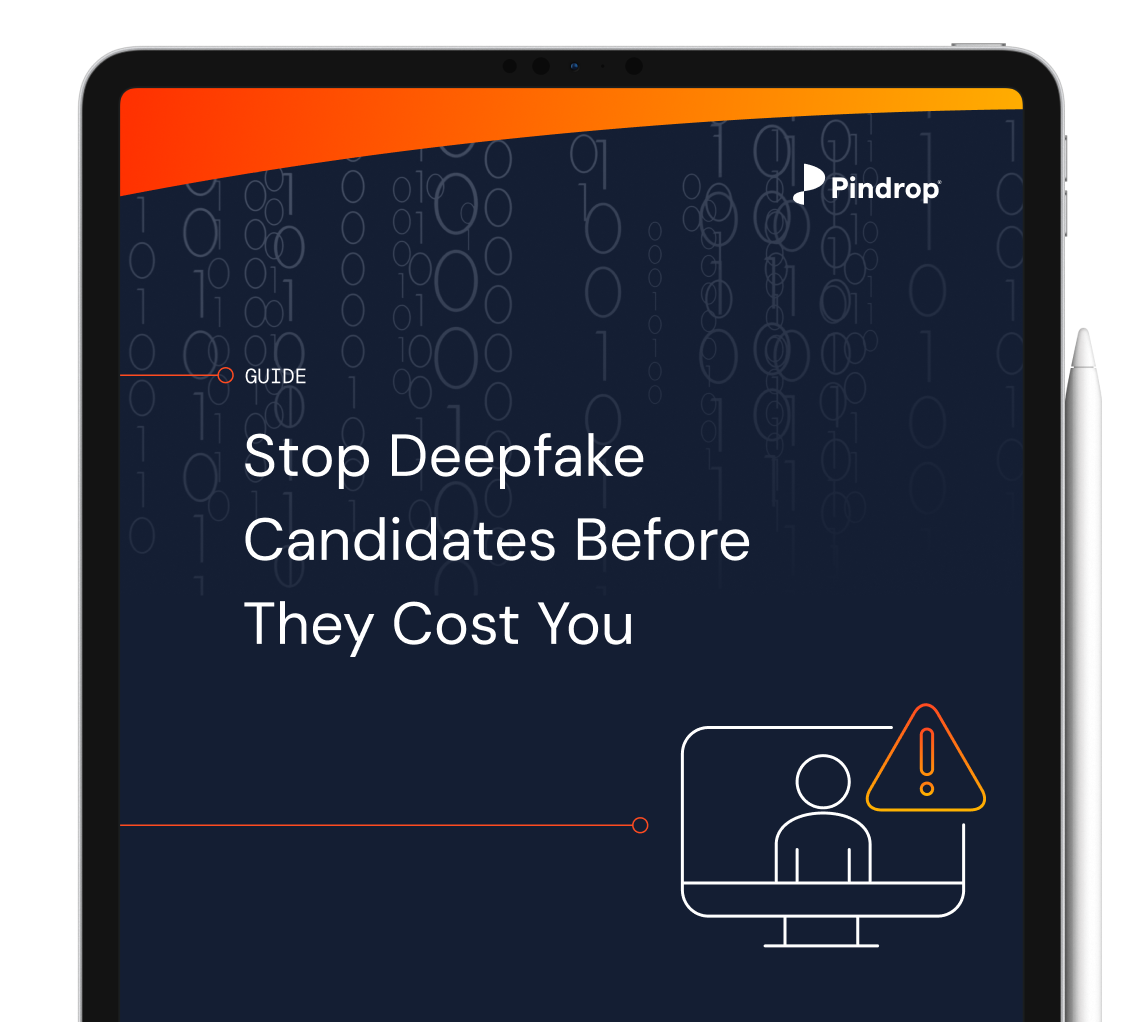
Deepfake candidates have crossed from novelty to a recurring line item in fraud reports, and vendors now publish research decks about them the way they once published KYC white papers. The image below is from one such report, and it captures how routine the phenomenon has become.
The deepfake job candidate, now a baseline hiring threat
The practical takeaway from this opening is that candidate identity verification is no longer a compliance nicety for regulated industries, it is a mainstream hiring control for anyone who interviews remotely. The rest of this guide treats it that way. Before comparing tools, though, it is worth understanding exactly what you are defending against, because the shape of the fraud determines which defenses actually matter.
2. Inside the Fraud: North Korean Workers, Deepfakes, and Proxies
The candidate fraud problem is not one threat, it is three overlapping ones, and the most dangerous is state-sponsored. Thousands of North Korean IT workers use stolen or borrowed Western identities to get hired into remote roles at US and European companies, then funnel their salaries back to the regime. The FBI estimates the scheme has moved somewhere from hundreds of millions of dollars up to roughly $1 billion to the DPRK over about five years, money that helps fund its nuclear and missile programs - Fortune. This is why the topic jumped from HR to national security, and why the DOJ now treats it as a coordinated law-enforcement priority rather than a series of isolated hiring mistakes.
The scale of infiltration surprised even security teams. CrowdStrike's 2025 threat report documented more than 320 North Korean IT-worker incidents in the twelve months to June 2025, a 220% jump year over year, with one executive saying his team now sees the group "almost every day" - CyberScoop. The enabler is often a domestic accomplice running a "laptop farm," a house full of company-issued laptops kept online so the overseas worker appears to be logging in from inside the country. In July 2025, an Arizona woman named Christina Chapman was sentenced to 102 months in prison for running exactly such an operation, one that helped place North Korean workers at more than 300 US companies using dozens of stolen American identities and even attempted to reach two US federal agencies - US DOJ.
This is not an abstract risk, and one investigative documentary captures how the scheme operates end to end better than any summary can. Bloomberg's team traced how North Korea embedded a remote workforce inside US companies, from the fake identities to the money flow, and it is worth watching for anyone who still thinks of this as a rare edge case.
How North Korea Hid an IT Workforce Inside US Companies
The enforcement response scaled up sharply through 2025. In a single coordinated action in June, the DOJ searched 29 laptop farms across 16 states, seized roughly 137 laptops, and took down 21 fraudulent websites tied to the scheme, which by then had reached more than 100 US companies including Fortune 500 names - US DOJ. The scale of that one operation is the tell: this is not a handful of isolated bad hires but an industrialized pipeline with domestic infrastructure, purpose-built to defeat exactly the checks most companies rely on. A defense that depends on an alert interviewer noticing something odd is not a defense against an adversary that runs this as a business.
The most instructive case for hiring teams is the one that happened to a security company. KnowBe4, a firm that trains other companies to spot social engineering, hired a North Korean operative as a principal software engineer in 2024. The candidate passed four video interviews, a background check, and identity verification, all defeated by a real but stolen US identity paired with an AI-enhanced stock photo, and began loading malware the moment the corporate laptop arrived - KnowBe4. The lesson is not that KnowBe4 was careless, it is the opposite. A sophisticated, security-aware employer running multiple checks still got through, because the checks were not designed to catch a coordinated identity attack. That is the gap modern verification tools are built to close.
The second threat is the deepfake applicant, and researchers have documented how coordinated these operations are. Palo Alto Networks' Unit 42 exposed a synthetic-identity hiring operation in which multiple "different" candidates turned out to be the same actors reusing an identical virtual background and fabricated faces. The image below, from that research, shows two supposedly distinct applicants sharing the same staged environment, a tell that only becomes obvious once you know to look for it.
One operation, many faces

Deepfakes are effective because humans are genuinely bad at catching them. A 2025 meta-analysis pooling 56 studies and more than 86,000 participants found people detect deepfakes with only 55.54% accuracy, barely better than a coin flip - ScienceDirect. That single number is the strongest argument for tooling: a human interviewer, no matter how experienced, cannot reliably eyeball the difference between a real face and a synthetic one, so the detection has to be machine-assisted. It is also why "just do more video interviews" is not a defense, since KnowBe4 ran four of them.
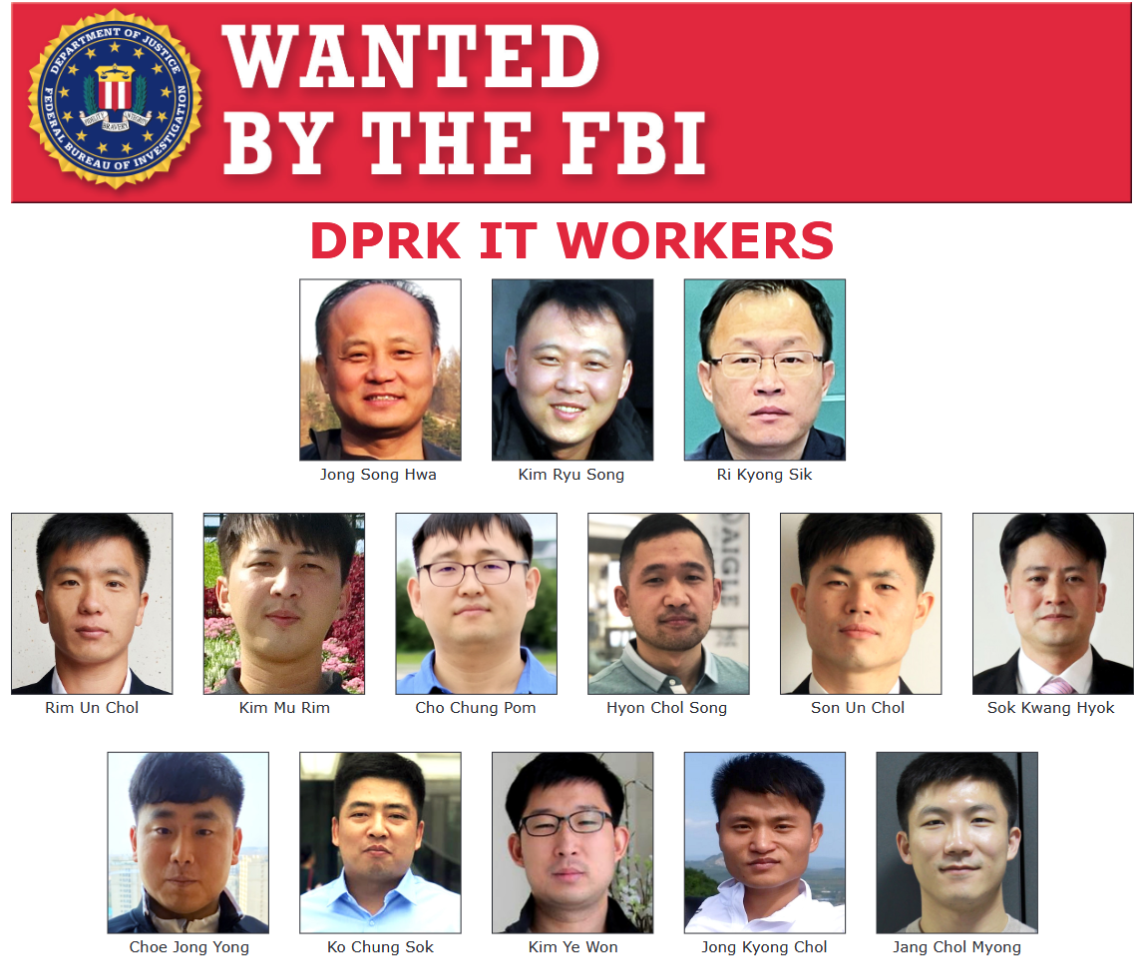
The threat is prosecuted, public, and state-directed, which is why treating it as a serious hiring control rather than a curiosity is the right posture. The wanted poster below, reproduced in the Unit 42 report, is a reminder that these are indicted individuals, not hypothetical bad actors, and that the companies who hired them became unwitting funders of a sanctioned regime.
A prosecuted, documented threat
The third threat is the everyday proxy and AI-assisted cheat, which is broader and less exotic than nation-state fraud but far more common. Greenhouse found that 65% of hiring managers had caught applicants using AI deceptively, including AI-scripted interview answers, prompt injections hidden in resumes, and deepfakes, while 36% of job seekers openly admitted using AI to alter their appearance, voice, or background in a video interview - Greenhouse. Karat, which runs proctored technical interviews, estimates that roughly one in three hiring managers has personally interviewed a candidate using a fake identity or a proxy - Karat. Taken together, these three threats explain why verification has to happen at multiple points, not once, and why the next section breaks down exactly how the technology does that.
3. How Candidate Identity Verification Actually Works
Modern candidate identity verification is best understood as a layered pipeline, not a single check, because each layer catches a different kind of fraud. At a high level, the system captures a government ID and a selfie, confirms the document is authentic, confirms the face on the selfie matches the face on the document, and confirms the selfie is a live human rather than a photo, a mask, or a deepfake. Increasingly it adds a fifth layer that confirms the video feed itself was not injected by software. Understanding these layers is what lets a non-technical buyer read past vendor marketing, because every product below is really a different combination of the same building blocks.
The flow is easier to follow as a diagram than as prose, because it is fundamentally a series of pass-or-fail gates that a real candidate clears and a fraudster gets stuck on. The pipeline below shows the path from application to a verified hire, with each decision point rejecting or routing the cases that fail.
The first layer, document verification, is more sophisticated than a photo of a passport. Good systems cross-validate the same data three ways: the machine-readable zone at the bottom of the document, the printed text read by optical character recognition, and, where present, the data on the embedded RFID chip. Check digits in the machine-readable zone catch tampering, while authenticity checks look for holograms, optically variable ink, and microprinting that forgers struggle to reproduce - Regula Forensics. When these signals disagree with one another, the document is likely altered, which is the single most common form of low-effort fraud.
The second and third layers, face match and liveness, are where the arms race lives. Face match confirms one-to-one that the selfie belongs to the same person as the document photo. Liveness confirms the selfie is a live human. Liveness comes in two flavors: passive, which analyzes a single frame or short clip without asking the user to do anything, and active, which issues a challenge such as blinking or turning the head. Active prompts feel more secure but are predictable, so advanced deepfake tools can script the expected response, which is why leading vendors layer passive analysis on top and also check that the video came from a genuine camera rather than injected software - Ping Identity. The synthetic faces that make this hard are built with face-swapping software like the kind Unit 42 documented, shown below.
How a synthetic candidate is built

The single most important buying signal in this whole category is a certification most buyers have never heard of: ISO/IEC 30107-3, the international standard for testing presentation-attack detection, usually verified by an independent lab called iBeta. It grades a system on how well it resists spoofs, from 2D photos and screen replays at Level 1, to 3D silicone masks at Level 2, to the most sophisticated attacks at newer Level 3 - iBeta. Because iBeta is a NIST-accredited lab, these are independently tested results rather than vendor self-claims, so the practical advice is simple: ask any liveness vendor for its iBeta confirmation letter and its level. A vendor that cannot produce one is asking you to take its word for the exact thing that matters most.
The fifth and newest layer, injection-attack detection, addresses the fraud that bypasses the camera entirely. Instead of holding a fake up to the lens, attackers feed a deepfake video straight into the application through a virtual camera, so the "liveness" check sees a perfectly live but entirely synthetic feed. These attacks are exploding: injection attacks surged roughly ninefold in 2024, driven by a 28-fold spike in virtual-camera exploits, and a single financial institution logged more than 8,000 injection bypass attempts in one eight-month stretch - Group-IB. Defending against them requires device and stream integrity checks that most legacy document-only tools simply do not have, which is a key reason the vendor rankings below reward platforms built for this specific threat.
To see why the layers have to work together, follow a single sophisticated attack through the whole pipeline. A fraudster buys a real person's identity data on a criminal market, generates a deepfake video of a plausible matching face, and feeds it through a virtual camera into the interview. The document check passes, because the stolen identity is genuine. The face match passes, because the deepfake was built to match the document photo. Even a basic liveness check can pass, because the injected video shows a live, blinking face. Only injection detection, which notices the feed never came from a physical camera, and continuous in-call monitoring, which catches the faint audio-visual lag of a real-time deepfake, actually stop it. Remove any one of those later layers and the attacker is through, which is the entire argument for defense in depth over a single premium check.
Beyond the technical pipeline sits the compliance layer, which is really a fourth question: not just "is this person real," but "is this person allowed to work here." That is governed by standards and law rather than biometrics. In the US, the NIST identity-assurance framework was refreshed in August 2025 and now defines three assurance levels, with the notable change that knowledge-based questions such as "what was your last address" are no longer acceptable for proofing because attackers can buy that data - NIST. Right-to-work verification adds another layer on top, which the guide returns to in section 7, but the core point here is that identity verification and work authorization are related yet distinct, and a complete hiring stack needs both.
4. What to Look For: A Buyer's Benchmark for Hiring
The criteria that separate a good hiring identity tool from a mediocre one are not the ones on the average vendor's feature grid, so it pays to define your own benchmark before taking a demo. A payments company buying identity verification cares about regulatory KYC and chargebacks. A hiring team cares about a different set of things: catching a deepfake on a live interview, verifying a candidate in a foreign country, fitting into an applicant tracking system, and doing all of it without turning a good candidate's first impression of your company into a frustrating ordeal. Score every vendor against the hiring-specific bar, because a tool that dominates in banking can still be a poor fit for talent acquisition.
The first and most decisive criterion in 2026 is certified deepfake and injection defense. Given that humans detect deepfakes barely better than chance and that injection attacks now outnumber physical spoofs in some datasets, a verification tool that only reads documents is solving last year's problem. AU10TIX's Q1 2026 benchmark, drawn from more than nine million transactions, found that AI-generated identity fraud surpassed physical document forgery for the first time on record - AU10TIX. The practical test is whether a vendor holds an iBeta ISO 30107-3 certification, at what level, and whether it detects injected video streams, not just presented ones. Everything else is secondary to getting this layer right.
The second criterion is hiring-native workflow, meaning how naturally the tool slots into how you already hire. A verification step that lives inside your applicant tracking system, auto-triggers a background check on a pass, and pre-fills verified fields is worth far more than a technically superior tool that forces recruiters to swivel between five tabs. The best hiring products treat verification as one step in an onboarding flow rather than a standalone security product, which is why several of the highest-ranked vendors below are the ones that embed directly into recruiting software.
The remaining criteria are best held as a short checklist you carry into every demo, because they are the questions vendors hope you forget to ask. Keep the list tight and score each vendor honestly against it.
- Global coverage for the countries you actually hire in
- Pricing model that matches your volume and pass rate
- Right-to-work support beyond identity, where relevant
- Candidate experience measured in minutes and drop-off
- Certifications you can independently verify, not just claims
Each of those deserves a moment of interpretation, because the right answer depends on your situation. Global coverage matters enormously if you hire contractors in fifty countries and barely at all if you hire only in one, so a vendor covering "190 countries" is irrelevant if it is weak in the three you use. Pricing model interacts with your fraud rate in a way that is easy to miss: a pay-per-approval vendor that only charges for passed verifications is dramatically cheaper if half your applicants are fraudulent, because you pay nothing for the fakes you reject. Candidate experience is the quiet killer, since every extra minute and every clumsy step costs you real candidates who abandon the process, which is why the same Gartner data that documented fraud also found most candidates would happily accept more verification friction if it were smooth. Hold vendors to all five, and the shortlist narrows quickly.
A concrete way to pressure-test a vendor against this benchmark is to replay the KnowBe4 scenario in the demo. Ask how the system would have handled a candidate presenting a real but stolen US identity paired with an AI-enhanced photo, then sitting four polished video interviews. A document-only tool passes that candidate, because the identity is genuine and the document is real, which is precisely what happened in the actual case. A tool that scores identity risk against a fraud graph, checks liveness against injection, and re-verifies at the interview would have had several chances to flag the mismatch instead. The vendors that can walk you through that specific failure, rather than reciting a feature list, are the ones that understand the hiring threat model rather than a generic banking one, and that distinction is worth more than any datasheet.
It is also worth weighting candidate experience more heavily than most buyers do, because verification friction is not free even when it works. Every extra step, every retry on a blurry document photo, and every minute of waiting costs you real applicants, and the ones you lose skew toward the strong passive candidates who have other offers. The counterintuitive lesson from the survey data is that candidates tolerate more verification when it visibly protects fairness, so framing matters: a check presented as shielding every applicant from impersonation lands far better than one that reads as an accusation. The best tools make the step feel like a thirty-second formality on a phone, and the gap between that and a five-minute desktop ordeal shows up directly in your completion rates and your offer-accept numbers.
The certification criterion is the one worth being pedantic about, because it is the single claim a vendor cannot quietly inflate. Marketing copy can call any product "AI-powered" or "deepfake-resistant," but an iBeta ISO 30107-3 confirmation letter is a dated, lab-issued document with a specific level attached, and a vendor either has one or it does not. The practical move is to ask for the letter, check the level (Level 2 is a reasonable floor in 2026 and Level 3 is leading edge), and note the test date, since a certificate issued three years ago predates the current generation of attacks. A vendor that hesitates, points to a partner's certification instead of its own, or offers a press release in place of the letter is telling you something important without meaning to.
Right-to-work support belongs on the benchmark for any team that hires across jurisdictions, and it is the criterion most often conflated with identity. A tool can verify a candidate's identity flawlessly and still leave you exposed if it does not connect to the legal work-authorization process, whether that is US E-Verify, the UK's certified digital right-to-work checks, or the emerging EU wallet. Some identity vendors integrate these steps, others deliberately stay out of the legal layer, and neither choice is wrong, but you need to know which you are buying so you do not discover the gap during an audit. Map your hiring geographies first, then ask each vendor exactly which work-authorization regimes it supports natively rather than through a vague partnership.
Put together, these criteria turn a vendor evaluation from a feature comparison into a structured test. The strongest way to run it is a short paid pilot on real traffic rather than a scripted demo, because a demo shows you the happy path while a pilot shows you the drop-off, the false rejections of legitimate candidates, and the fraud the tool actually catches in your funnel. Measure three numbers over a few weeks: the completion rate for genuine candidates, the share of applicants flagged, and the recruiter time saved or added. A tool that scores well on all three against this benchmark is the right buy, and one that dazzles in a demo but frustrates real candidates is not, no matter how impressive its underlying technology looks on a slide.
5. The Top 10 Candidate Identity Verification Solutions, Ranked
The ten solutions below are ranked by fit for hiring specifically in 2026, weighing hiring-native design, certified deepfake defense, pricing transparency, and proven recruiting or onboarding deployments, rather than by general market share. That ordering matters because the biggest identity brand is not automatically the best hiring tool, and several vendors that dominate banking are clumsy in a recruiting workflow. Each profile explains what the tool does, its standout strength for hiring, real pricing where it is published, and one recent development that signals where it is heading. Read the "best for" line as the fast filter, then read the profile for the nuance.
A note on pricing before the list. Some vendors publish transparent, self-serve prices, which is a genuine advantage for smaller teams, while others quote only on request, which usually signals an enterprise motion with volume discounts. Neither is inherently better, but the difference tells you who the vendor is built for. Where a figure is a third-party estimate rather than a published rate, the text says so, and section 8 compares the published starting prices side by side.
1. Persona
Persona is the most complete all-in-one choice for hiring teams that want more than a document scan. It is a unified identity platform that chains together government-ID checks, one-to-one selfie and liveness biometrics, deepfake and synthetic-face detection, and database or watchlist screening, all wired together with a no-code workflow builder it calls the verified identity layer. Crucially for this guide, Persona markets an explicit candidate verification solution aimed at hiring fraud, so you are not repurposing a KYC tool. It is also the identity engine behind the global EOR platform Remote and powers real-time re-verification for DoorDash at a scale of roughly 150,000 selfie checks per week, which is strong evidence it holds up under volume - Persona.
The standout for talent teams is orchestration: you can verify a candidate, branch the logic based on risk, and bolt on a background check without engineering work. Persona publishes real pricing, which is rare at this tier: an Essential plan at $250 per month billed annually includes 500 services per month, with additional services at $1.50 each, plus a 60-day free trial - Persona pricing. In 2026 it earned FedRAMP Moderate authorization, building on a $200 million Series D that valued it at $2 billion, signaling a push into government and regulated hiring - Biometric Update. Best for: high-volume candidate onboarding teams that want transparent pricing plus workflow orchestration in one platform.
2. Checkr
Checkr is the most hiring-native design on this list, because it was built for background checks first and added identity as the front door. Used by more than 120,000 businesses, Checkr launched Checkr IDV in early 2026, a biometric identity step that runs before the criminal check, powered by Socure's liveness and document analysis plus device intelligence to catch deepfakes, prerecorded video, and fake IDs - Biometric Update. On a pass it auto-triggers the background check and pre-fills verified fields, on a fail it blocks, and the whole thing finishes in about two minutes on a phone.
That single flow, identity and background check together, is exactly what most talent teams actually need, which is why Checkr ranks so high despite not being a pure identity specialist. Its pricing is unusually transparent for the screening world: published background packages run $29.99, $59.99, and $94.99 per report across Basic, Essential, and Complete tiers, with the standalone IDV step listed around $4.99 per check plus passthrough fees - Checkr pricing. Checkr reported 2025 gross revenue exceeding $800 million, so this is a well-capitalized incumbent rather than a startup bet. Best for: tech-forward, high-volume, and gig-economy hiring teams that want identity and background screening in one modern mobile flow.
3. Socure
Socure approaches the problem from a different angle: instead of only scanning a document, it scores identity risk against a proprietary graph of billions of known outcomes, which lets it catch synthetic identities that pass a visual check. Its purpose-built Workforce Verification product is aimed squarely at hiring, vetting applicants in roughly two seconds, claiming to block a large share of fraudulent applications before a recruiter ever sees them, and covering candidates across 160-plus countries - Socure. Because Socure's biometric engine also powers Checkr IDV, its technology reaches hiring two different ways.
The tradeoff is that Socure sells enterprise, consumption-based contracts on a quote-only basis, so it is less accessible for a small team than a self-serve tool. What you get for that is graph and consortium intelligence that document-only vendors cannot match, which matters most when the fraud is a well-constructed synthetic identity rather than a crude fake. In late 2025 Socure launched its RiskOS AI Suite with native AI agents, and it reported crossing $340 million in total ARR at 62% year-over-year profitable growth in early 2026, a sign of durable enterprise demand - Business Wire. Best for: enterprises that want graph-based fraud intelligence and automated risk decisioning, not just a selfie-to-ID match.
4. Jumio
Jumio is the pick when regulatory-grade assurance and independently certified anti-spoofing are the priority. It is an end-to-end identity platform that has processed more than a billion transactions across 200-plus countries, and it markets a dedicated candidate verification product built for employment-screening and background-check providers, with optional add-ons for SSN validation and device risk - Jumio. Its differentiator is certified liveness: Jumio Liveness Premium uses patented active-illumination techniques and holds iBeta Level 2 ISO 30107-3 certification, giving buyers the independent proof point that section 4 argues is decisive.
Jumio does not publish list pricing, and third-party estimates put full proofing somewhere in the range of a few dollars per verification, dropping below two dollars at enterprise volume, so treat those as directional rather than official - HyperVerge. Its 2026 momentum is real: Liveness Premium won a gold award for biometrics at the 2026 Cybersecurity Excellence Awards, and Jumio reported passing 100 million authentication transactions since the feature's mid-2025 launch - Jumio. Best for: regulated, high-assurance candidate screening that needs certified, independently tested anti-deepfake defense.
5. First Advantage
First Advantage is the largest US background-screening company after its $2.2 billion acquisition of Sterling closed in late 2024, and it now pairs global screening with a full biometric identity suite. That suite matches a live selfie to a government ID, flags synthetic identities and deepfakes, uses an AI rules engine to spot counterfeit documents, and offers live-scan fingerprinting in all fifty states plus continuous criminal monitoring - First Advantage. Its named products in this area include RightID for AI-driven identity verification and SmartHub for machine-learning credential routing, so a buyer is getting real, productized capability rather than a marketing wrapper.
The appeal for large employers is consolidation: one global vendor covering identity, fingerprinting, screening, and ongoing monitoring, which is especially valuable in regulated industries like healthcare, transportation, and finance where all four are mandatory. Pricing is enterprise and quote-based, consistent with that buyer profile. Financially the combined company is substantial, reporting first-quarter 2025 revenue of $354.6 million with Sterling integration synergies running ahead of schedule, which reduces the risk of buying into a shaky merger - First Advantage. Best for: large enterprises that want a single global vendor for identity, fingerprinting, screening, and monitoring.
6. Veriff
Veriff is the best transparent-priced option with broad global coverage, which makes it the natural pick for smaller recruiting and marketplace teams. The Estonia-born platform matches a person to their government ID through document and biometric liveness across more than 10,000 ID types in 190-plus countries and 40-plus languages, and it is the KYC engine behind Deel's contractor onboarding, so it has a proven hiring-adjacent deployment - Veriff. The self-serve pricing is genuinely accessible: an Essential tier at $0.80 per verification with a $49 monthly minimum, a Plus tier at $1.39, and a Premium tier at $1.89, with a sanctions-screening add-on and a 15-day free trial.
That published pricing removes the sales-call friction that slows adoption at smaller companies, and the broad document library means Veriff rarely leaves you stranded on an unusual passport. Its own research keeps it credible on the threat: Veriff's Identity Fraud Report for 2026 found that impersonation now makes up more than 85% of online fraud and that digitally presented media was 300% more likely to be AI-generated or altered than the year before - Veriff. Best for: teams that want transparent self-serve pricing and broad global document coverage without an enterprise contract.
7. Incode
Incode Technologies is the momentum leader on certified deepfake defense, and the right choice when resistance to synthetic media is your single highest priority. A biometric-first platform that already serves eight of America's top ten banks, Incode launched Deepsight in late 2025 and became the first liveness technology to pass iBeta Level 3 presentation-attack detection on both iOS and Android, reporting a 0% error rate across 900 of the hardest Level 3 attacks - Business Wire. For a hiring team whose threat model is dominated by deepfake interviews, that independent Level 3 result is the strongest single credential on this list.
Incode sells enterprise and custom contracts rather than self-serve plans, so it is aimed at high-volume buyers rather than a five-person team. Its trajectory is aggressive: it topped a Purdue University study of commercial deepfake-detection tools and was reported in talks to raise between $150 million and $300 million at a valuation approaching $3 billion on around $170 million of ARR - Biometric Update. That combination of certification and capital makes it a safe long-term bet for large employers. Best for: high-volume, biometric-first verification where best-in-class certified deepfake and liveness defense is the top requirement.
8. Sumsub
Sumsub is the strongest all-in-one when you need identity, anti-money-laundering screening, and deepfake defense in a single platform, which suits marketplaces and financial-adjacent hiring. Now a unicorn serving more than 4,000 clients, it combines document and face-match verification, an Adaptive Deepfake Detector shipped in 2026, AML screening, business verification, and reusable KYC - Sumsub. Its published pricing is refreshingly clear: a Basic tier at $1.35 per verification with a $149 monthly minimum and a Compliance tier at $1.85, billed only for successful verifications, with a trial that includes 50 free checks.
The billing-on-success model is a quiet advantage in high-fraud pipelines, since you are not paying to reject fraudsters. Sumsub's research also keeps it honest about the threat landscape, with its 2025 report documenting a 180% year-over-year rise in sophisticated fraud and multi-step attacks climbing from 10% to 28% of cases - Sumsub. The tradeoff versus a pure hiring tool is that Sumsub is a compliance platform at heart, so some of its depth is aimed at regulated onboarding rather than recruiting workflows. Best for: enterprise and marketplace hiring that needs deepfake defense plus AML in one platform.
9. iDenfy
iDenfy offers the most cost-friendly transparent pricing on this list thanks to a distinctive pay-per-approval model. It is an AI-driven identity, KYC, AML, and business-verification platform, and its defining feature for hiring is that only passed verifications are billed, so failed, fraudulent, and abandoned attempts cost nothing, which keeps per-hire cost low and predictable when a chunk of your applicants are fake - iDenfy pricing. List pricing starts at $1.35 per verification pay-as-you-go and drops to $0.55 at higher volumes, with modest add-ons for AML screening and 3D face liveness.
Coverage is broad, spanning 3,000-plus active document types across 190-plus countries, which is enough for most global remote hiring even if it is not the widest library here. The pay-only-for-passes economics are genuinely differentiated: in a pipeline where Pindrop-style fraud rates approach one in six, a vendor that charges nothing for rejections can be meaningfully cheaper than a lower-headline-price competitor that bills every attempt. In 2026 iDenfy expanded through banking partnerships and new electronic-ID integrations across Europe, deepening its coverage for regulated markets - FinTech Global. Best for: cost-conscious global remote and marketplace onboarding that wants transparent, pay-for-results pricing.
10. CLEAR
CLEAR rounds out the list with a genuinely different model: a reusable biometric identity that a candidate carries from application through employment. Best known for its airport lanes and its 31-million-member network, CLEAR extended into the enterprise with CLEAR Verified and CLEAR1, and its verification is embedded directly into the Greenhouse applicant tracking system for candidate identity, with a workforce deployment live at T-Mobile - CLEAR. The pitch is one identity for both onboarding verification and ongoing passwordless workforce authentication, so the same proof that got a candidate hired keeps securing their access afterward.
CLEAR sells enterprise, quote-based contracts, so like the other network players it is aimed at larger employers. Its enterprise push is accelerating: CLEAR1 reached FedRAMP In Process status and a government marketplace listing in early 2026, with first-quarter bookings up roughly fivefold year over year, signaling real traction beyond travel - CLEAR. The reusable-identity angle is also where the whole category is heading, which the future section returns to. Best for: enterprises that want one reusable identity spanning onboarding verification and ongoing workforce authentication.
Honorable mentions and adjacent players
No top-ten list captures a market this active, and several vendors just outside it are the right answer for specific needs. Onfido, now part of Entrust after a roughly $650 million acquisition, is the strongest choice when you want identity verification bundled into a broader identity and encryption stack, with its Atlas AI and Motion liveness holding iBeta Level 2 certification - TechCrunch. Trulioo specializes in cross-border person and business verification at scale, which matters when you verify vendors and contractors as well as employees. AU10TIX leads on enterprise anti-deepfake work and reusable verifiable credentials, and helped Microsoft cut fake partner accounts sharply - Biometric Update.
A second cluster covers specific gaps. ComplyCube offers transparent modular per-check pricing that suits the mid-market, with document checks around $0.75 to $1.05 and biometric checks a fraction of that - ComplyCube. Vouched is a developer-first, US-centric option now building a "Know Your Agent" capability to verify AI agents, priced as a base fee plus roughly $0.70 to $1.50 per transaction rather than a flat rate - Vouched. The background-screening incumbents HireRight, Certn, Veremark, and Zinc all layer identity onto their checks, with Certn covering 195 countries and delivering results quickly. And ID.me, a reusable government-grade identity network with more than 100 million members, is a strong fit for workforce onboarding and re-verification. The right pick depends on which of the section-4 criteria dominates your situation, which is exactly why the buyer's benchmark comes before the list rather than after it.
6. Deepfake and Proxy-Interview Defense: The New Front Line
The identity platforms above verify a candidate at a moment in time, but the newest and fastest-growing category defends the live interview itself, which is a different problem. A candidate can pass a document and selfie check at application, then have a deepfake avatar or a paid proxy show up to the actual video interview, or feed AI-generated answers in real time. Defending against that requires continuous, in-call detection rather than a one-time gate, and a distinct set of vendors has emerged to provide it. Hiring teams in 2026 increasingly run one tool from this section alongside one from the list above, because verification at intake and integrity during the interview catch different attacks.
There are two camps here, and they serve different buyers. The first is live deepfake and voice-authenticity detection built for security teams, which plugs into video-conferencing tools and flags synthetic faces and voices in real time. The second is assessment-integrity tooling built for recruiters, which hardens coding tests and skills assessments against AI cheating and proxies. Both matter, but they solve the problem at different points in the funnel, so it is worth understanding each before deciding which you need.
On the live-detection side, Pindrop is the most established name, having come from voice-security into deepfake defense. Its Pindrop Pulse for Meetings runs inside Zoom, Teams, and Webex to flag AI voices, face swaps, and synthetic avatars per participant, continuously throughout a call, and it was named one of TIME's best inventions of 2025 - Business Wire. Pindrop surpassed $100 million in ARR in 2025 on the back of this demand, and its own analysis of hiring pipelines is what produced the 16.8%-fake statistic that opens this guide. The best way to understand what live detection looks like in practice is to watch the product flag a deepfake candidate mid-interview.
How to Detect Deepfake Job Candidates in Remote Interviews
The other live-detection contenders are newer but well funded, and each takes a slightly different angle. Reality Defender, born out of Y Combinator, uses patented multi-model detection across audio, video, image, and text, and in late 2025 launched its Real Suite with plug-ins for Zoom and Teams aimed directly at interviews, backed by a Series A expanded to $33 million from investors including IBM Ventures and Booz Allen - PR Newswire. GetReal Security, co-founded by the digital-forensics authority Dr. Hany Farid, shipped GetReal Protect in 2026 for real-time continuous identity verification across major conferencing tools, on a $17.5 million Series A - TechCrunch. Validia is the early-stage entrant, founded in 2025 with a "Know Your Employee" product that validates identity on video calls, and it is best treated as an emerging option to watch rather than a proven enterprise standard.
Those funding rounds and product launches tell you the live-detection market is real and consolidating fast, but they also carry a caution: much of the accuracy data is vendor-reported, so figures like "99% detection" should be read as marketing claims until independently tested. The right way to buy in this category is to run a bake-off with your own deepfake samples rather than trust a datasheet, because the threat evolves monthly and last quarter's benchmark can be stale. For most hiring teams, the practical move is to start with the vendor that integrates cleanly into the conferencing tool you already use, then expand coverage as the threat proves out.
The recruiter-facing camp is about assessment integrity, and the numbers here are sobering. Karat runs human-plus-AI proctored technical interviews with a live proctor that defeats proxies, and estimates that roughly 80% of candidates use large language models on coding tests even when they are banned - Karat. HackerRank layered an integrity stack onto its coding tests in 2025, combining enhanced proctoring, AI-plagiarism detection, and behavioral signals like tab-switching and multi-monitor detection - HackerRank. CodeSignal added government-ID verification, video and screen proctoring, and a suspicion score, and its data showed proctored-assessment fraud flags more than doubling to 35% in 2025, reaching nearly half of attempts in Asia-Pacific - CodeSignal. For non-technical roles, Vervoe and iMocha offer comparable identity and proctoring layers on skills assessments. The takeaway is that a coding test or skills assessment is now an identity checkpoint as much as a competence one, and treating it that way closes a door that pure document verification leaves open.
For a team adopting these defenses for the first time, sequencing matters as much as selection. The highest-return first move is usually to harden the interview stage, because that is where a proxy or deepfake does the most damage and where most existing stacks have nothing at all. A live-detection plug-in for the conferencing tool you already use, or a proctored assessment for technical roles, closes the widest gap fastest and for the least integration effort. Only after that is it worth layering in continuous monitoring and re-verification at onboarding. Trying to deploy every control at once tends to stall on procurement and change management, whereas closing the interview gap first delivers a visible, defensible win that builds the internal support you need to fund the rest.
7. Background Checks, Right-to-Work, and Global Hiring
Identity verification, background screening, and right-to-work authorization are three different questions, and a common mistake is assuming one answers the others. Identity verification confirms the person is who they claim to be. Background screening asks what that verified person has done, such as criminal records or employment history. Right-to-work asks whether that person is legally allowed to work in this jurisdiction. A candidate can be a real, identity-verified human with a clean background who still has no legal right to work in your country, and a stolen-identity fraudster can pass a background check run against the real person's clean record, which is precisely how the North Korean scheme defeats naive screening. Getting all three right is what a complete hiring stack looks like.
The reason identity moved in front of the background check is that a background check is only as trustworthy as the identity it runs against. If a fraudster uses a real, stolen US identity, the criminal-record search comes back clean because it is searching the victim's spotless history, not the fraudster's. That is why 2026's most hiring-native products, led by Checkr IDV, run biometric identity first and only then trigger the background check, binding the record to a verified living person rather than a name and a number. HireRight's finding that only 60% of employers run any identity check, despite one in six suffering identity fraud, quantifies exactly how large this gap still is across the market - HireRight.
Right-to-work verification is governed by law rather than biometrics, and the rules are tightening and digitizing in parallel across major markets. In the US, employers enrolled in E-Verify and in good standing can now examine Form I-9 documents remotely over live video under a permanent alternative procedure that took effect in 2023, rather than requiring physical inspection - USCIS. In the UK, digital right-to-work checks must run through a government-certified Digital Verification Service using approved identity-document technology, a framework that became statutory in late 2025 with civil penalties reaching up to £60,000 per illegal worker for non-compliance - GOV.UK. Those are not identity-verification products, they are legal processes that identity tools increasingly plug into, and confusing the two leads to compliance gaps.
A concrete example shows why the three questions diverge across borders. Imagine hiring a software contractor in the Philippines through an employer-of-record platform. Identity verification confirms the person holds a genuine Philippine passport and that their live face matches it. The background element might check local records and prior employment. Right-to-work, in this case, is carried by the EOR, because it is the legal employer in that jurisdiction, so the compliance burden shifts from you to the platform. Now move the same hire to Germany, and the picture changes again once the EU Digital Identity Wallet is live, because the candidate may present a pre-verified government credential that satisfies identity in seconds. One role, two countries, three different mechanisms, which is exactly why a global identity strategy has to be a framework you apply per market rather than a single tool you buy once.
Global and remote hiring adds a further wrinkle, because verifying identity and work authorization across borders is genuinely hard, and this is where employer-of-record platforms have quietly become identity players. Deel, valued at roughly $17 billion in late 2025, and Remote both embed identity verification into their contractor and EOR onboarding rather than selling it standalone, using Veriff and Persona respectively as their verification engines. For a company hiring in dozens of countries without local entities, that bundled approach can be simpler than stitching together a separate identity vendor per market. The strategic point for a talent leader is to map which of the three questions each part of your stack actually answers, because the most expensive hiring failures come from assuming a tool covers a question it never touched.
8. Pricing and How to Choose
Pricing in candidate identity verification is more variable than most categories, and the headline per-check number is often the least important part of the decision. The vendors that publish transparent, self-serve prices, such as Veriff, Sumsub, iDenfy, ComplyCube, and Persona, are generally built for teams that want to start without a sales call, while the quote-only vendors, such as Jumio, Socure, Incode, First Advantage, and CLEAR, run enterprise motions with volume discounts and custom terms. The published starting prices span a surprisingly wide range, from well under a dollar per verification to several dollars for an identity step bundled with screening, so it helps to see the transparent tier side by side before modeling your own cost.
Published Starting Price per Verification (USD)
That chart flatters the cheapest sticker prices, but the sticker price is a trap if you read it in isolation, because two pricing mechanics matter more than the headline. The first is whether you pay for failed attempts. A vendor like iDenfy that bills only for passed verifications can be dramatically cheaper in a real hiring pipeline than a lower-priced competitor that charges for every attempt, because a large share of applicants in a fraud-heavy funnel will fail, and you do not want to pay to reject them. In a pipeline where roughly one in six applicants is fraudulent, the pay-per-approval model can invert the apparent price ranking entirely, which is the kind of thing a spreadsheet built on sticker prices will get wrong.
The second mechanic is what the price includes. Checkr's IDV step looks expensive next to a bare selfie check, but it bundles the trigger into a full background-screening workflow, so comparing it to a standalone document scan is comparing different products. Likewise, an add-on for sanctions screening, 3D liveness, or SSN validation can quietly change the effective price, so the honest comparison is the fully loaded cost of the exact checks you will actually run, not the entry tier. Model your real volume, your expected pass rate, and the specific add-ons you need, then compare, because that is the number your finance team will actually see.
A quick worked example makes the fully-loaded-cost point concrete. Suppose you run 1,000 verifications a month and, like Pindrop's pipelines, roughly one in six applicants is fraudulent, so about 167 fail. A vendor charging a flat $1.00 per attempt bills you $1,000, because it charges for the 167 fraudsters you rejected as well as the 833 real candidates who passed. A pay-per-approval vendor at $1.35 per pass bills only for the 833 that cleared, or about $1,125, which looks slightly higher until you add sanctions screening or 3D liveness to the flat-rate vendor and re-run the numbers. The point is not that one model always wins, it is that the ranking flips depending on your fraud rate and add-on mix, which is why the only trustworthy comparison is a spreadsheet built on your own funnel rather than a vendor's headline rate.
Beyond price, the decision framework that falls out of this guide is straightforward once you classify your own situation. If you hire at high volume and want identity plus background screening in one flow, Checkr or Persona fit best. If your threat model is dominated by deepfake interviews, prioritize certified liveness from Incode or Jumio and add a live-detection tool from section 6. If you hire globally on a budget, Veriff or iDenfy give you transparent pricing and broad coverage, and if you need graph-based fraud intelligence for synthetic identities, Socure leads. The wrong move is to buy on brand or on the lowest sticker price, because the best tool is the one that scores highest against the section-4 benchmark for your specific hiring, not the one with the most recognizable logo.
9. The Future: AI Agents, Reusable Identity, and the Arms Race
The clearest forward-looking thesis is that candidate identity verification becomes continuous and reusable rather than a one-time gate, and that AI agents fight on both sides of the line. The market is growing fast to meet the threat: MarketsandMarkets projects the identity-verification market rising from $14.34 billion in 2025 to $29.32 billion by 2030, a 15.4% compound rate, with the US segment nearly doubling over the same period - MarketsandMarkets. That is not a niche compliance spend anymore, it is a core piece of hiring infrastructure being built out at scale, and the trajectory below shows how steep the ramp is.
Identity Verification Market Size (USD billions)
The 2025 and 2030 endpoints on that line are the sourced figures, with the intermediate years reflecting the stated 15.4% compound rate, and other analysts see the same shape from different angles, with Juniper Research projecting global digital identity-verification checks reaching 175 billion by 2030. The interpretation for a hiring leader is that verification is becoming cheaper per check and more ubiquitous at once, which is the normal pattern for infrastructure that is scaling. As unit costs fall and coverage widens, the excuse of "it is too expensive to verify every candidate" disappears, and running identity checks on your whole funnel becomes the default rather than a premium option.
Regulation is converging on reusable, government-backed digital identity, which will reshape how verification works within a few years. The EU's Digital Identity Wallet must be available in every member state by the end of 2026, with the bloc targeting 80% of citizens using a digital ID by 2030, and the UK's certified digital-identity framework became statutory in late 2025 - European Commission. Gartner has predicted that at least 500 million smartphone users will use digital identity wallets to make verifiable claims, which points to a future where a candidate presents a pre-verified credential instead of redoing a full document scan for every employer. Mobile driver's licenses are already live in more than 20 US states, laying the groundwork for exactly that model. CLEAR's reusable-identity approach is an early commercial version of where this is all heading.
The harder dynamic is the AI-versus-AI arms race, because the same models that detect fraud also generate it. Deepfake and injection tools improve every month, and the EU AI Act's transparency rules for synthetic media become binding in August 2026, requiring deployers to disclose AI-generated deepfakes, which will help but will not stop determined fraudsters - EU AI Act. On the defense side, agentic AI is moving into verification itself, with the agentic fraud-detection market forecast to grow from $7.73 billion in 2025 to $55.66 billion by 2030, and a new "Know Your Agent" category emerging to verify the AI agents that will increasingly participate in hiring workflows - GlobeNewswire. Gartner has warned that deepfakes on face biometrics would push a meaningful share of enterprises to consider standalone verification unreliable in isolation, which is really an argument for layering the controls this guide describes rather than trusting any single one.
The practical forecast, then, is that the winning approach shifts from a single check to a layered, continuous, reusable posture. Expect verification to happen at application, at interview, and at onboarding rather than once, expect reusable credentials to reduce repeated friction, and expect the deepfake arms race to keep certified liveness and injection detection at the center of every serious buying decision. The teams that treat identity as an ongoing property of the hire, not a box ticked at intake, will be the ones that stay ahead of a threat that is itself getting smarter every quarter.
Conclusion: Build a Layered Defense, Starting Now
The decision framework that falls out of this guide is simpler than the threat landscape suggests, because it reduces to matching your biggest risk to the right layer. Start by verifying identity at the front of the funnel, before the background check, so every downstream step is bound to a real, single, authorized human rather than a name that a fraudster can borrow. For most teams the fastest high-leverage move is a hiring-native platform like Checkr or Persona that combines identity and screening in one flow, and for teams whose nightmare is a deepfake on the interview call, add certified liveness from Incode or Jumio plus a live-detection tool such as Pindrop or Reality Defender.
Match the rest of the stack to your situation rather than to brand recognition. If you hire globally on a budget, Veriff and iDenfy give you transparent pricing and broad coverage, with iDenfy's pay-for-passes model quietly cheaper in a fraud-heavy funnel. If synthetic identities are your concern, Socure's graph intelligence catches what a document scan misses, and if you want a reusable identity that spans onboarding and ongoing access, CLEAR points to where the category is going. Whatever you choose, insist on an independently verified iBeta certification, because in a year when humans catch deepfakes barely better than a coin flip, that letter is the one proof point you cannot fake.
Verification also works best when the pipeline it defends is built from real people in the first place, which is why sourcing and verification increasingly sit side by side in a modern hiring stack. Tools like HeroHunt.ai that surface genuine, verifiable professionals from their public work history reduce the flood of anonymous inbound applicants where fraud hides, so verification has a smaller, cleaner field to defend. The through-line of 2026 is that identity became the first question in hiring, not an afterthought. The employers who internalize that, and build the layered defense to match, are the ones who will keep hiring real humans while everyone else keeps hiring their stolen identities.
This guide reflects the candidate identity verification landscape as of July 2026, drawing on vendor pricing pages, funding disclosures, government filings, and fraud research. Pricing, certifications, and product features in this market change quickly, and several accuracy figures are vendor-reported rather than independently tested, so verify the current details before signing a contract.