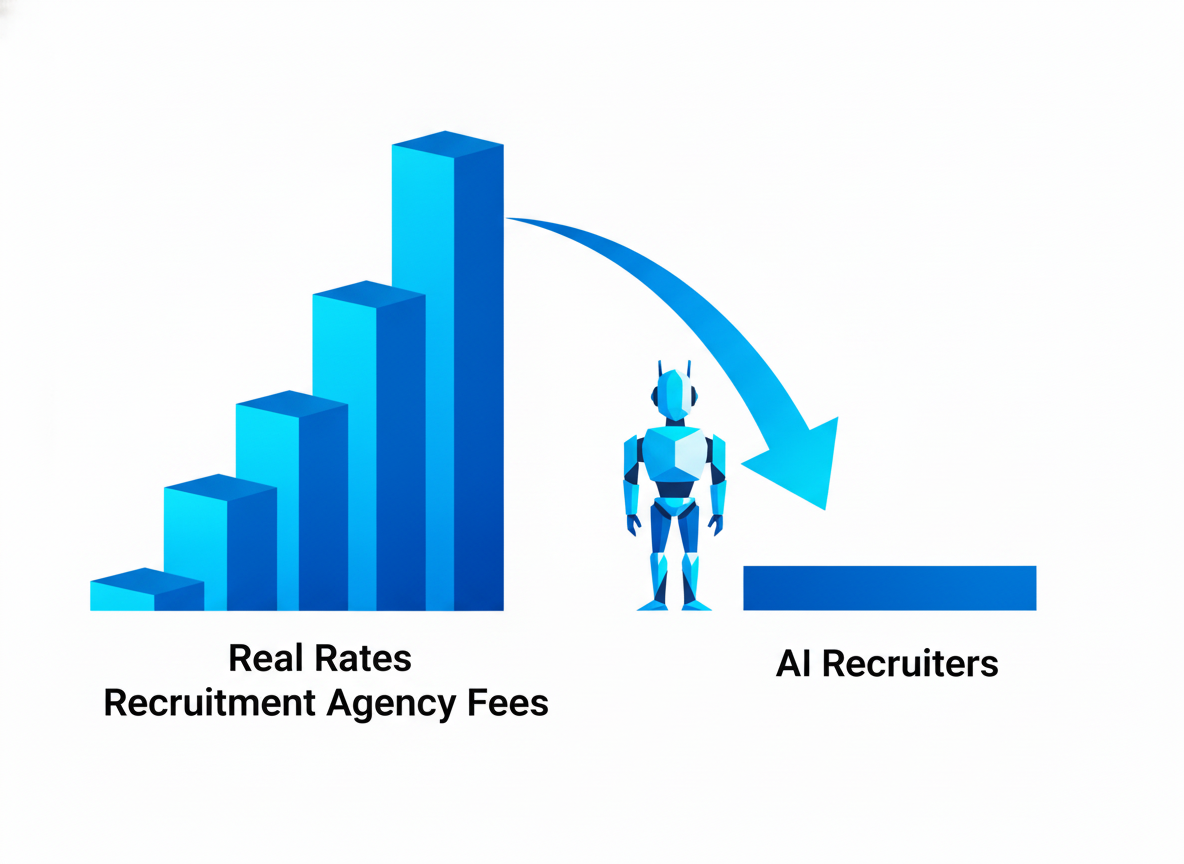




The practical, insider guide to the applicant tracking systems that actually run an agency desk with AI in 2026, ranked by fit, priced honestly, and stripped of vendor spin.
The highest-growth staffing firms are now the AI-heavy ones: 78% of agencies that grew revenue more than 25% last year have AI embedded directly in their ATS, against just 51% of the firms whose revenue fell - Bullhorn GRID 2026. That is no longer a soft correlation you can wave away. In Bullhorn's 2026 survey of nearly 2,300 recruitment professionals, agencies using AI at any stage of the process were 3.5x to 4.5x more likely to have grown in 2025, a gap that widened from a modest 25-40% advantage just a year earlier - Bullhorn.
Here is the problem that makes this guide necessary: the AI now lives inside the applicant tracking system, not beside it, and almost every ATS in the recruitment category has rebranded itself as "AI-native" in the past twelve months. Bullhorn shipped autonomous "digital workers," Loxo rewrote its search around plain English, Recruiterflow bolted on 36 agents, and even the budget tools added candidate-matching AI. Most of that marketing is true in outline and misleading in the specifics, because the genuinely useful AI is frequently paywalled into a higher tier, priced per agency instead of per seat, or still rolling out. For a recruiting agency, where every recruiter is a revenue producer and the ATS is where the whole business lives, choosing wrong is expensive in a way it never is for a corporate talent team.
This guide breaks down exactly which AI-native ATS platforms are worth it for agencies in 2026, what each one actually costs once the AI is switched on, where the AI is real versus a thin wrapper, and which tool fits which kind of desk. Every price is sourced, every AI feature is named rather than hand-waved, and the ranking is built around agency-specific work: business development, submittals, redeployment, and pay-and-bill, not the corporate-TA checklist most listicles recycle.
Written by Yuma Heymans (@yumahey), who built HeroHunt.ai and has spent since 2021 building in and competing across the AI recruiting stack. He writes about these platforms from hands-on experience with the category, not a vendor brochure.
Contents
- The State of the Agency ATS Market in 2026
- What Makes an ATS Genuinely "AI-Native"
- How to Choose an AI-Native ATS for Your Agency
- Bullhorn
- Loxo
- Recruit CRM
- Recruiterflow
- Manatal
- Crelate
- Vincere (Access Vincere Evo)
- JobAdder
- Zoho Recruit
- Full Comparison: Pricing, AI, and Best Fit
- Where AI Agents Are Taking Agency Recruiting Next
- The Bottom Line: Match the Platform to Your Desk
1. The State of the Agency ATS Market in 2026
The single most important shift in agency recruitment technology this year is that AI stopped being a separate product and became a layer inside the ATS. Two years ago an agency bought an applicant tracking system, then bought a sourcing tool, then bought a writing assistant, and stitched them together. In 2026 the leading platforms are trying to absorb all three, and the data says the agencies that let them are pulling ahead. Bullhorn's GRID research found that 55% of staffing firms report AI screening improved their KPIs by more than 25%, and 46% say AI cut their screening time in half or better - Bullhorn. Those are not marginal efficiency gains; they are the difference between a desk that hits target and one that misses.
What makes this a genuine market inflection rather than hype is that the adoption curve has clearly crossed from experiment to infrastructure. A year ago the majority of firms were still just playing with generative AI. In the 2026 GRID data only 29% remain in that early experimentation phase, down from 56%, while 30% have moved to some form of agentic AI that does work rather than just drafts text - The Staffing Pulse. The productivity math behind that move is stark: recruiters spend roughly 14.6 hours a week just searching for candidates, and Bullhorn estimates AI and automation could free up to 17 hours per recruiter per week - Bullhorn. For an agency owner, that is close to half a recruiter's week handed back per head.
The way that time reappears matters as much as the amount. AI screening compresses the screening stage from two or three weeks to one or two days, and a recruiter using AI can review 40 to 80 candidates a day against the 6 to 10 a human triages manually - Recruiterflow. For a contingent agency paid on placements, faster screening is not a comfort feature; it is throughput, because the firm that submits a qualified shortlist first usually wins the fee. That is the concrete link between the software and the revenue gap the survey data keeps surfacing: AI does not make recruiters better negotiators, it makes them faster to the submittal, and in a market where 56% of top firms place in under ten days, speed is close to the whole game.
The productivity effect is also global rather than a US artifact, which matters if your desk recruits across borders. In APAC, 54% of agencies reported KPIs rising more than 25% from AI screening alone, mirroring the North American numbers - Hunt Scanlon. Wider talent-acquisition data tells the same story from another angle: 67% of TA professionals now use AI somewhere in hiring, up from 35% two years earlier - DemandSage. For an agency the implication is that clients increasingly treat an AI-accelerated process as the baseline, so the ATS decision is partly about meeting a rising client expectation, not only internal efficiency.
The chart below traces how quickly this happened across successive editions of the industry's most-cited staffing survey. Note that the most recent point is a directional estimate, because the surveys do not word their questions identically from year to year, but the shape of the curve is not in doubt.
AI adoption in agency recruiting is compounding
The gap between those two lines is the real story for a buyer in 2026. Nearly everyone is now using AI in some form, but only 10% of staffing firms have AI embedded across their full workflow, and only about a third have adopted any agentic tools at all - Bullhorn. That whitespace is the opportunity: the platforms in this guide are competing to be the system that closes it for you, and the agencies that pick a genuinely AI-native ATS now are buying into the top line of that widening winners' gap rather than the bottom.
It helps to size the field before naming players. The global recruiting and staffing market is worth somewhere around $642 billion in 2025, heading toward roughly $690 billion in 2026 by the more conservative estimates - Mordor Intelligence. The applicant tracking software slice of that is far smaller, near $3 billion and growing at roughly 7-8% a year, but it punches above its weight because the ATS is the system of record every agency workflow flows through - MarketsandMarkets. When AI moves into that system of record, it touches everything, which is exactly why the buying decision matters more this year than it did last year.
It is worth being precise about causation here, because the correlation gets oversold in vendor decks. AI adoption does not magically manufacture revenue; the likelier mechanism is that well-run agencies adopt AI earlier and also do a dozen other things right, so part of the growth gap reflects operational maturity rather than the software itself. But the reverse reading matters just as much for a buyer: whatever the exact causal split, the firms pulling ahead are overwhelmingly the AI-equipped ones, and the price of the tools has fallen far enough that sitting out is now a deliberate choice rather than a budget constraint. When a $15-per-seat platform ships candidate scoring, the barrier to entry stops being money and becomes the willingness to change how the desk actually works.
2. What Makes an ATS Genuinely "AI-Native"
The phrase "AI-native" is doing a lot of unearned work in vendor marketing right now, so it is worth defining precisely before spending money. A genuinely AI-native ATS is one where AI does recruiting work autonomously inside the core workflow, not one that simply added a "generate with AI" button to its job-description editor. The distinction is the difference between a tool that drafts an email when you ask and a tool that sources a longlist, scores it against the role, drafts the outreach, and updates the CRM record while you are working a different req. The first is a feature; the second is an agent.
The clearest articulation of this shift came from Bullhorn CEO Art Papas, who framed 2025 as the arrival of the "third wave" of recruitment AI at the company's Engage Boston conference: not rules-based automation, not chat assistants, but autonomous digital workers that own a task end to end. His keynote is a useful primer on where the whole category is heading, and because it comes from the incumbent that most agencies already run on, it doubles as a statement of the direction of travel for the entire market.
The future of recruitment with AI: Art Papas keynote at Bullhorn Engage Boston 2025
In practice, five capabilities separate the AI-native tools from the ones just wearing the label. The first is semantic or natural-language search: the ability to describe a candidate in plain English and have the system understand intent rather than match keyword strings. The second is agentic sourcing, where the tool reaches beyond your own database into an external index of hundreds of millions of profiles and builds a shortlist on its own. The third is AI matching and scoring that ranks your existing pipeline against a live role. The fourth is generative content for submittals, outreach, and job descriptions, tuned to recruiting rather than generic. The fifth, and the newest, is agent extensibility, usually via a Model Context Protocol server that lets you query your ATS from an outside AI assistant like Claude or ChatGPT.
That last capability is the one most buyers underrate, and it is quietly the most future-proof. A Model Context Protocol server turns your ATS from a walled garden into something an external agent can read and act on, so a recruiter could ask a general assistant to pull every candidate who interviewed for a similar role last quarter and draft a re-engagement note without opening the ATS interface at all. Recruit CRM, Manatal, and Crelate have all shipped one, and the significance is directional: it signals a vendor building for a world where the ATS is one node in an agent workflow rather than the only place work happens. For an agency it is insurance against lock-in, because your data stays reachable by whatever AI tools you adopt next.
Those five are not equally distributed, and that is the trap. Most platforms have three or four of them, gate the best two behind their top tier, and market all five as if they ship in the base seat. A tool can legitimately call itself AI-native and still leave you paying double for the agent layer that made you interested in the first place.
A concrete example makes the line vivid. When Manatal's AI reads a job description and hands back a scored, ranked shortlist from your database, that is matching: a genuine AI capability, but one you still initiate. When Crelate's Insights Agent runs overnight, notices that three candidates in a dormant pipeline just changed jobs, refreshes their contact details, and surfaces them as a re-engagement opportunity before you have logged in, that is an agent doing work you never asked for in the moment. Both are marketed under the same "AI" banner. Only the second changes your headcount math, and the price gap between the tiers that include each is usually exactly where the real cost of an AI-native ATS hides. When you read the platform sections below, the useful question is not "does it have AI" but "does the AI that does the work come with the seat I can afford, or is it a second purchase."
There is one more category boundary worth drawing, because it explains a recurring gap in these products. An ATS is a system of record: it manages the pipeline, the client relationship, the submittal, and the placement. Dedicated AI sourcing tools are systems of discovery: they find and engage passive candidates who are not in your database yet. Several agencies pair a lean ATS with a specialist sourcing layer such as HeroHunt.ai, which runs autonomous search and outreach across more than a billion profiles, rather than expecting one platform to be world-class at both. Whether you want that combination or a single all-in-one system is one of the first questions the next section helps you answer.
3. How to Choose an AI-Native ATS for Your Agency
The best ATS for an agency is almost entirely a function of what kind of desk you run, and getting that framing right saves you from the most common buying mistake: paying for a temp-and-contract back office you will never use, or picking a lean perm tool and then discovering you cannot invoice a contractor. Start with the shape of your business, not the feature list. A boutique executive search firm placing a dozen senior roles a quarter has almost nothing in common, technologically, with a high-volume industrial staffing agency running thousands of weekly timesheets, even though both are "recruiting agencies."
The decision tree below is the compressed version of the reasoning the rest of this guide expands. It sorts on the three variables that actually change the answer: the kind of desk, the size and budget of the team, and whether you need native pay-and-bill.
Beyond desk type, four agency-specific criteria matter more than the generic feature grids you will see elsewhere. Business development and CRM depth comes first, because an agency lives and dies on client relationships, and a tool that treats BD as an afterthought will cost you placements. Submittal and redeployment workflow is second: how easily the system turns a shortlist into a branded, client-ready presentation, and how well it resurfaces the silver-medal candidates already sitting in your database. AI cost transparency is third, and it is where most buyers get burned, because the headline seat price rarely includes the agent layer. Pay-and-bill and mid-office is fourth, and it is binary: either you need timesheets, invoicing, and payroll, or you do not, and that single fact eliminates half the market for you.
Work a quick example to see how fast this narrows. Take a four-person retained search boutique placing senior finance roles: no temp desk, a tight budget, and a business that lives on client relationships and polished submittals, so pay-and-bill is irrelevant, pricing transparency matters, and the shortlist lands on Recruit CRM or Manatal depending on how much AI depth it wants to fund. Now take a forty-recruiter light-industrial staffing firm running thousands of weekly timesheets: pay-and-bill is mandatory, per-agency AI pricing rewards its headcount, and the answer is Bullhorn or Vincere almost regardless of the AI feature grid. Same category, opposite tools, and the deciding variables were desk type and back-office need, not which platform demoed the shiniest agent.
The AI-cost trap is worth pricing out concretely, because the multiples are large. On Recruiterflow the Platform seat is $119 a year but the AIRA agents roughly double it to an estimated $200; on Bullhorn the affordable Starter and Core tiers include no AI at all, so the real AI plan is a custom quote that lands well above the $165 Core sticker; on Vincere the £69 seat is only the start once you add a £235 or £349 per-agency Smart Pack. The pattern is consistent enough to be a planning rule: assume the plan you actually want costs 1.5 to 2 times the entry price, and build your budget from the AI-inclusive tier down, never from the marketing number up.
Two practical warnings apply across every option. First, almost none of the enterprise-grade platforms publish real pricing, so budgeting requires triangulating from third-party marketplaces and treating vendor "from" figures with suspicion. Second, the AI you are buying for is usually not in the entry tier, so always price the plan that actually includes the agents, not the one on the pricing page's left column. When you compare quotes, insist on two numbers before signing anything: the all-in per-seat cost with AI included, and the cost of the implementation and add-ons that never appear in the headline. Those two figures, not the marketing, decide what a platform actually costs your agency over a year.
4. Bullhorn
Bullhorn is the category incumbent and still the default for mid-market and enterprise staffing, and in 2026 it is making the most aggressive push toward genuinely autonomous AI of any platform here. It is the ATS and recruitment CRM that most large agencies already run on, built specifically for staffing rather than adapted from corporate hiring, and its differentiator has always been depth: business development, sourcing, submittals, placements, and in North America a full pay-and-bill middle office, all in one configurable system. What changed this year is that Bullhorn rebuilt its story around Bullhorn Amplify, the "digital workers" it positions as the third wave of recruitment AI.
The AI itself is substantive, not cosmetic. Amplify launched at Engage Boston on 28 May 2025 and packages a set of named agents that each own a task: Match surfaces and contacts top candidates by AI relevancy, Screen conducts and scores voice or chat interviews, Present generates branded submission packets, and Outreach runs personalized re-engagement campaigns, with newer skills like Verify and Extract handling credentialing and timesheet population - Bullhorn. Underneath sits the technology Bullhorn bought when it acquired Amsterdam-based Textkernel for around €300 million in June 2024, which powers its resume parsing, semantic search, and candidate-to-job matching against insights from 60 million-plus historical placements - Techzine. Early Amplify customers report a 51% increase in submissions and a 22% increase in fill rates, and reference customer IDR cited junior recruiters ramping 30% faster and 15,000-plus additional candidates screened monthly - Bullhorn.
The screenshot below shows how Bullhorn frames the digital-worker concept: a fleet of specialized agents rather than a single chatbot, which is the mental model to hold when comparing it against lighter tools.
Bullhorn Amplify: AI digital workers inside the ATS

The catch is cost and complexity, and it is a real one. Bullhorn does not publish enterprise pricing; its small-agency tiers start around $99/user/month for Starter and $165/user/month for Core, but neither of those includes any AI, which only appears on the custom-quoted Pro and Max tiers - Bullhorn pricing. Third-party marketplaces put mid-market and enterprise seats in the $150 to $315 per user range, and that is before Bullhorn Automation, Analytics, VMS integration, and implementation fees that run from $5,000 to $50,000 stack on top - Pin. Reviewers consistently flag a dated, slow interface, with searches that can take five to ten seconds, and support that can be inconsistent. Bullhorn is the right answer when you need the deepest ecosystem, native pay-and-bill, and the most mature agent roadmap, and you have the budget and the implementation appetite to match. It is the wrong answer for a small team that wants AI included and setup measured in days.
One maturity caveat is worth internalizing before you buy the vision. Bullhorn's own research shows only 10% of firms have AI embedded across the full workflow, and several Amplify skills are still rolling out rather than universally live, so a 2026 buyer is partly purchasing a roadmap - Bullhorn. The pragmatic move is to get the contract to name which specific agents are generally available on your tier today, and to treat autonomous screening and multi-step outreach as capabilities to validate in a trial rather than assume. Bullhorn's scale is precisely why it can fund a build this ambitious; it is also why the gap between the keynote and your live instance deserves hard scrutiny.
Best for: mid-market and enterprise staffing agencies, especially temp and contract firms that need front-to-back-office pay-and-bill and are willing to invest in implementation to run Amplify's agents.
5. Loxo
Loxo is the most convincing "replace your whole stack" pitch in the category, and for search-led agencies it is often the strongest AI-native choice. Where Bullhorn is a deep ATS that added AI, Loxo built itself as an all-in-one Talent Intelligence Platform that fuses the ATS, the recruiting CRM, sourcing, multichannel outreach, and built-in verified contact data on top of a proprietary talent graph of roughly 850 million professionals. The promise is that an agency can retire its separate ATS, its CRM, its LinkedIn-adjacent sourcing tool, and its ZoomInfo or Lusha contract, and run all of it inside one system. That consolidation is the reason Loxo shows up so heavily among retained and contingent executive search firms. Its customer roster skews to exactly that segment, with search firms such as Odgers Berndtson, Transearch, and N2Growth among named users, a useful signal that the workflow is tuned for retained search rather than high-volume staffing.
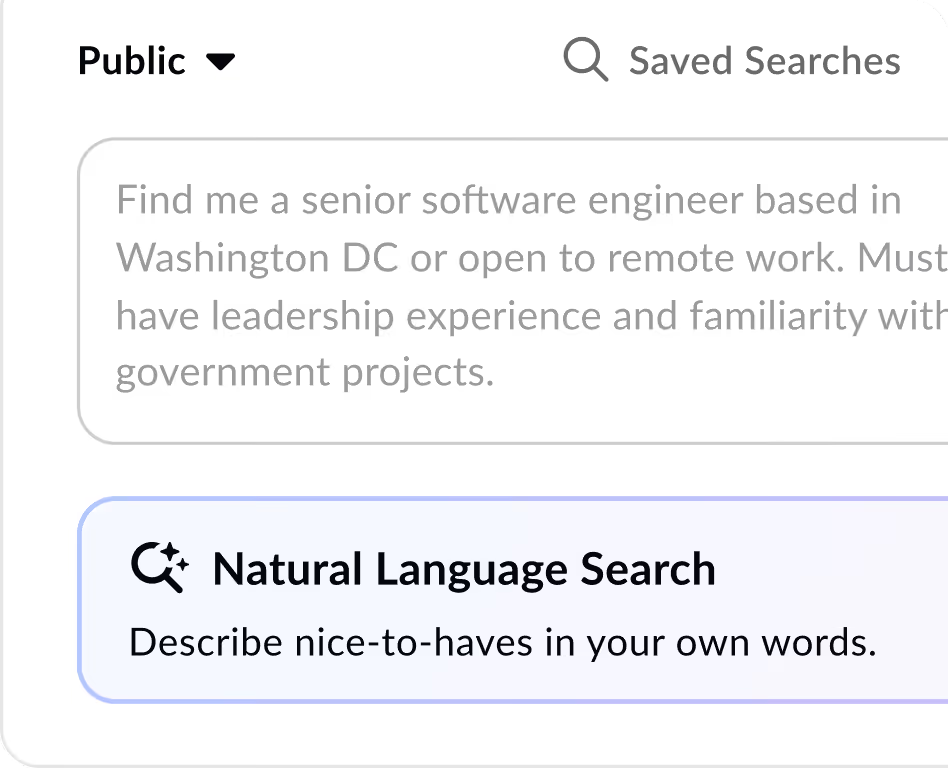
The AI is home-grown rather than a thin LLM wrapper, which shows in the product. Loxo says it runs 50-plus proprietary machine-learning models across six generations since 2012, and in 2025 it shipped its flagship Natural Language Search on 2 September, letting recruiters describe who they want in plain language across both their own CRM and the external graph - PRWeb. On top of that sit a fleet of agents: sourcing agents that build longlists and shortlists automatically, a contact-finding agent that pulls verified phone and email, a candidate submittal agent that writes the client-ready summary, and a self-updating CRM agent that keeps records clean for redeployment. An Agent Impact Center even quantifies what the automation produced in dollars and hours saved - TipRanks. The company raised a $115 million growth investment led by Tritium Partners in February 2025 to accelerate exactly this - PR Newswire.
The natural-language search interface below is the feature most search recruiters notice first, because it removes the Boolean-string tax from day-to-day sourcing.
Loxo's Natural Language Search
Two honest weaknesses temper the pitch. First, pricing is opaque above the genuinely free single-user tier: Basic runs roughly $119 to $169 per user per month, while Professional is quote-only with third-party estimates near $299, and reviewers report contact-reveal credits, migration fees, and automatic ~5% annual increases baked into contracts - GoPerfect. Second, the built-in contact data is inconsistent outside the US, with repeated complaints about outdated emails and wrong numbers for APAC, LATAM, and niche European roles, so globally-recruiting teams often keep a supplementary sourcing tool anyway. Loxo is also front-office only: it has no native pay-and-bill, so temp and contract staffing firms will outgrow it. For a boutique-to-mid search firm that wants one AI-native system for the whole search-and-submittal flow, though, it is hard to beat.
Where Loxo wins against the incumbents is the consolidation math. A search firm running Bullhorn plus a separate LinkedIn Recruiter seat plus a ZoomInfo contract can spend more on that stack than on a Loxo Professional seat that folds sourcing and contact data inside, and the single-system workflow removes the copy-paste tax between tools. Where it loses is depth in any one lane: its search is still more keyword-driven than the natural-language marketing implies, with recruiters reporting they group ten to fifteen title aliases by hand to get clean results, and its outreach automation draws reliability complaints. For a boutique that values one clean system over best-of-breed in every category, that trade is usually worth it; for a firm that already has a sourcing workflow it loves, it may not be.
Best for: executive search, retained and contingent, and direct-hire agencies that want a single AI-native front office to replace a separate ATS, CRM, sourcing tool, and contact-data vendor.
6. Recruit CRM
Recruit CRM is the strongest all-round pick for mid-market perm and executive-search agencies, and it earns that with a rare combination: genuinely agency-first design, a deep roster of AI agents, and pricing that is at least knowable. It was built from the ground up for staffing firms and search consultancies rather than retrofitted from corporate hiring, and it unifies candidate ATS pipelines, a client and BD CRM with deal pipelines, email and phone communication, job posting, and billing and invoicing so a placement can move from sourcing to submittal to invoice without leaving the tool. It is used by recruiters in more than 100 countries with support for 18-plus languages, and its verified review standing is among the best in the category at 4.8 out of 5 on G2 - G2.
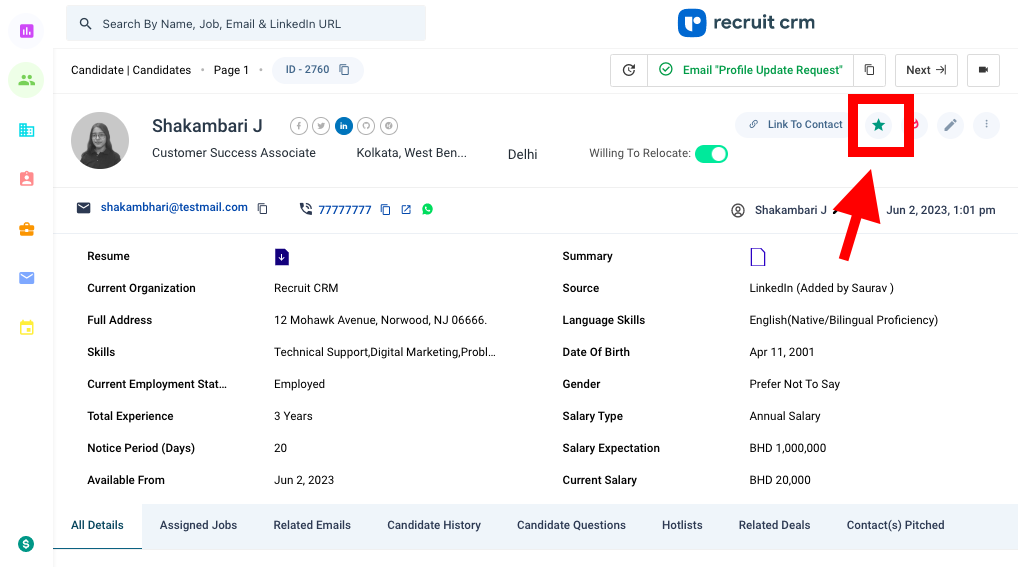
The AI is unusually broad and specific to agency work. Recruit CRM ships AI sourcing with X-ray search across the open internet, a two-way "bimetric" candidate matching model that scores skills, experience, education, location, and title on a transparent 0-100 scale, and context-aware resume parsing that reads seniority and career progression rather than just keywords - Recruit CRM. On the deliverable side it has a Candidate Submission Agent that builds the client-ready shortlist, a Resume Formatting Agent that produces branded and blinded CVs, and a Candidate Pitching Agent that writes the sell-the-candidate email, all of which map directly onto exec-search tasks. Notably, it also shipped a Model Context Protocol server so recruiters can query and act on their CRM data from external LLMs like Claude and ChatGPT, a genuinely 2026-era integration - Recruit CRM.
The candidate-matching flow below shows how the two-way scoring surfaces similar profiles to an ideal or previously placed candidate, which is the backbone of Recruit CRM's redeployment story.
Recruit CRM's AI candidate matching
Pricing is per user and, while the official page hides the numbers behind a demo toggle, third-party marketplaces put annual billing at roughly $85 for Pro, $125 for Business, and $165 for Enterprise - AVAHR. The important caveat is that the entry Pro tier is heavily gated: AI candidate matching is capped at two matches, you get only one email sequence and 15 custom fields, and there is no open API, so most serious agencies land on Business or Enterprise. There is also no native temp-and-contract pay-and-bill, so high-volume staffing firms will need a partner integration for timesheets and contractor invoicing. For perm and search desks that want agency-native BD plus a deep AI agent roster without enterprise weight, Recruit CRM is the safest default on this list.
The feature that most separates Recruit CRM from cheaper rivals like Manatal is the sales side. Agencies do not only manage candidates; they manage clients, deals, and business development, and Recruit CRM treats the BD pipeline as a first-class Kanban alongside the candidate pipeline, so a consultant works new-business opportunities and live placements in the same view. Its executive-search report generator and branded, blinded CV formatting are the kind of deliverable-specific tooling that retained firms otherwise rebuild by hand in Word every week. That BD-plus-deliverable depth, not the AI alone, is why it commands a higher price than the budget tier, and why mid-market perm agencies tend to stay put once they adopt it.
Best for: boutique-to-mid-market permanent-placement and executive-search agencies that want agency-first BD plus strong AI content, sourcing, and matching, and do not need heavy pay-and-bill.
7. Recruiterflow
Recruiterflow is the most aggressively agent-native of the modern challengers, and for outreach-driven search and staffing teams it is the one to shortlist. It is an agency-first ATS and recruiting CRM in a single database, built for search, recruiting, and staffing firms rather than corporate TA, and its identity in 2026 is its AI layer, AIRA, marketed as "36 agents built in." One clarification worth making, because the vendor's product name is easy to garble: the AI is called AIRA, an "AI RecOps Assistant," not "Rila." The agents share context across every job, contact, and candidate, so one agent's output feeds the next across sourcing, matching, outreach, note-taking, and CRM upkeep.
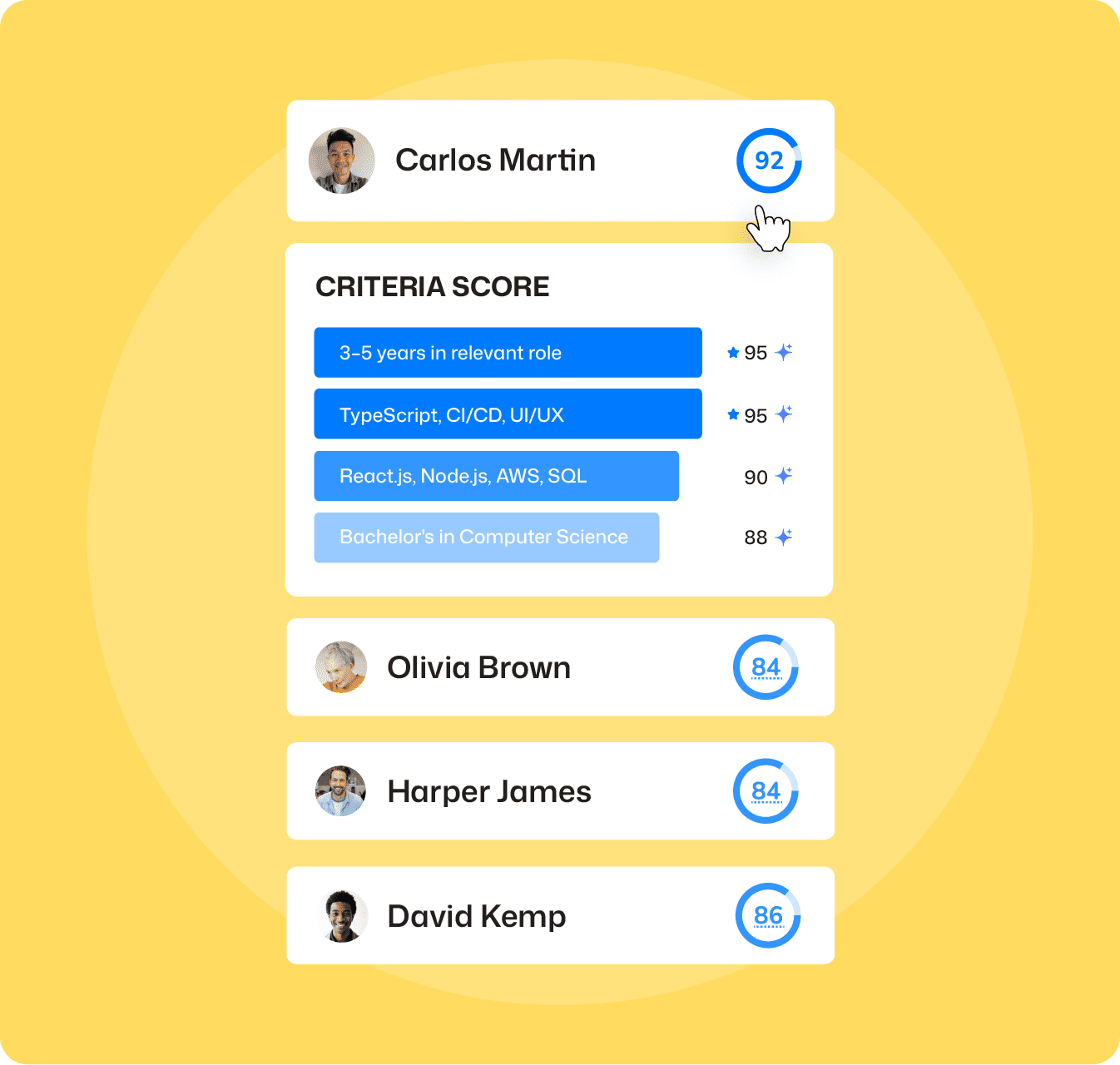
The agent roster is where Recruiterflow is genuinely differentiated. AIRA Search is marketed as a true natural-language search of your own database; AIRA Source reaches out across 850 million-plus external profiles from inside the ATS; Matchmaker semantically ranks your existing pipeline against a role; and a Submission Agent drafts client-ready write-ups that the company claims recruiters produce around 70% faster - Recruiterflow. The most agency-specific touch is Job Change Alerts, which watch your database and flag when a candidate or contact switches roles, giving you a live redeployment and business-development signal to act on before competitors do. It is a bootstrapped, fast-growing company that crossed roughly $6 million in ARR in March 2026 and markets itself as trusted by 2,100-plus search firms, with 4.8 ratings on both G2 and Capterra - The Print.
The Matchmaker view below is a good illustration of semantic shortlisting in practice, ranking candidates already in the database against the live role rather than making the recruiter open each profile.
Recruiterflow's AIRA Matchmaker
The trade-off is that the best AI is a separate, opaque purchase. Recruiterflow moved to a two-tier public model in 2026: the Platform plan is $149/user/month monthly or $119/user/month billed annually for the full ATS, CRM, sequences, and automation, but the AIRA plan that unlocks the agent suite is custom-quoted and annual-only, with third-party estimates around $200 per user per month - AVAHR. There is also a three-seat minimum that penalizes solo recruiters, and reviewers describe data migration as painful and reporting as rigid. For a small-to-mid agency, roughly 3 to 40 recruiters, that lives in outreach and BD and wants a modern agent-native system, the value is real; just budget for AIRA, not the Platform sticker.
The strategic question with Recruiterflow is whether the agent layer justifies roughly doubling the seat cost, and for the right desk the answer is clearly yes. An outbound search team that lives in sequences gets compounding value from AIRA because the agents share context: the same system that sources a candidate drafts the personalized outreach, logs the reply, and flags the job change six months later, so each agent makes the next one smarter. A team that mostly works inbound applicants and existing relationships will use a fraction of that and should question the uplift. The three-seat minimum and the migration friction reinforce the point, making Recruiterflow a tool that rewards commitment rather than a low-risk experiment for a solo recruiter testing the water.
Best for: small-to-mid recruiting, staffing, and executive-search agencies that run outreach-heavy desks and want an agent-native ATS and CRM in one database.
8. Manatal
Manatal is the best-value AI-native ATS on this list, and for small and boutique agencies it is often the smartest place to start. It is the tool that makes the strongest case that you do not need an enterprise budget to get real AI, and unlike almost everything above it, its pricing is fully public. It combines candidate sourcing, AI resume parsing, AI candidate scoring, social enrichment, branded career pages, and a client and BD CRM in one low-cost platform, and it serves recruiters in 135-plus countries with agency logos including Manpower, Kelly, and Randstad on its roster. If you are a lean agency choosing your first genuinely AI-native system, this is the one whose price will not make you flinch.
Manatal
Most platforms in this guide hide the AI behind a custom-quoted enterprise tier, so a small agency cannot see the real number without a sales call. Manatal is the exception: its AI candidate scoring, enrichment, and sourcing ship on the published $15 per user per month Professional plan (billed annually, or $19 monthly), with a 14-day free trial and no credit card. The honest caveat worth knowing before you commit: that entry tier caps at 15 active jobs and 10,000 candidates, and match accuracy is reliable for junior roles but weaker on senior and niche technical positions, so a busy or specialist desk is really comparing the $35 Enterprise tier with unlimited jobs. There is also no native pay-and-bill, so contract staffing firms will outgrow it.
The AI is more advanced than the price suggests. Manatal reads a job description, extracts the requirements, and scores every candidate in your database with a per-requirement breakdown showing exactly where they fit or miss, with customizable weightings. In January 2026 it added an AI Interviewer in beta, an async video-screening agent that has candidates record answers on their own schedule and then generates a transcript, an assessment summary, and a fit evaluation across four languages - Manatal. It also ships an AI Notetaker that joins client and candidate calls, an enrichment agent that scans 20-plus social and public platforms per candidate, and MCP server access that connects your account to Claude, ChatGPT, Gemini, and Microsoft Copilot Studio for natural-language pipeline queries - Manatal docs.
The AI recommendations view below shows the ranked, scored candidate profiles that are Manatal's core AI deliverable, and it is genuinely useful for triaging a high-applicant-volume pipeline without extra headcount.
Manatal's AI candidate scoring
.webp)
Where Manatal shows its price point is depth. Reporting is thin, with custom reports and per-recruiter performance tracking requiring an Excel export, which is a real gap for commission-driven agency management. Saved searches cannot be shared, archived candidates must be manually restored, and support is email-only below the top tier. None of that is disqualifying for the audience it targets. For a small-to-mid agency, an RPO, or a lean team that wants an affordable, genuinely AI-native ATS plus a client CRM and can live without heavy reporting or pay-and-bill, Manatal is the most accessible on-ramp in the category, and unlike its rivals you can switch it on today and see the number first.
Set against Zoho Recruit, the other transparent budget option, Manatal trades breadth for focus. Zoho is cheaper still and plugs into an entire business-software suite, but its AI matching starts a tier up and reviewers consistently flag a heavier, more cluttered interface. Manatal is the more purpose-built recruiting experience, with AI on the entry plan and a cleaner learning curve, which is why lean agencies that want to be productive in days rather than weeks tend to prefer it despite the slightly higher floor. Neither does pay-and-bill, so both are perm-and-search tools at heart; the real choice between them is suite-integration versus recruiting-first simplicity.
Best for: small-to-mid-sized agencies, boutique search firms, and lean RPO or TA teams that want an affordable, genuinely AI-native ATS plus client CRM for permanent placement.
9. Crelate
Crelate is the US-focused all-in-one that quietly shipped some of the most credible autonomous agents of 2025, and it deserves a serious look from American staffing and search firms. It is a purpose-built ATS and recruiting CRM designed for agencies rather than corporate TA, combining candidate tracking, a sales and BD CRM, sourcing, outreach sequencing, client and candidate portals, analytics, and onboarding and compliance across two product lines. In 2025 it repositioned around "The Living Platform," an agentic strategy that turns a static candidate database into one that continuously enriches itself and surfaces opportunities. It is independent and privately held, founded in 2012, and despite a persistent online rumor it is not owned by or affiliated with Deltek - Crunchbase.
The agent rollout is the reason it earns its slot. Crelate shipped Co-Pilot AI in 2024 with more than 20 recruiting-specific skills, then followed with two genuinely autonomous agents: the Discover Agent reached general availability on 31 July 2025, letting recruiters chat in natural language to search internal records plus an external network of a billion-plus profiles and get matched candidates back with phone and email - Crelate. The Insights Agent followed on 18 November 2025, running continuously to watch the database for stale records and hiring signals, auto-refresh contact data, and push next-best-action alerts - Crelate. That combination of a conversational sourcing agent and an always-on data-quality agent is exactly the "AI does the work" pattern that separates AI-native from AI-flavored.
Pricing is semi-transparent, which is a point in its favor. Essentials is $85/user/month, Business is $119/user/month billed annually or $149 month-to-month, and the AI-heavy Business Plus and Platform tiers are custom-quoted - Crelate pricing. The watch-outs are a five-seat annual minimum that penalizes very small teams, an automatic renewal increase of the greater of about 7% or CPI, and a separate unpublished add-on rate for the Contact Data Enrichment that feeds the agents. Reviewers still describe the interface as somewhat dated and reporting as cumbersome, and there is no native payroll, so full-desk firms wanting one-vendor pay-and-bill must integrate a third party. For a small-to-mid US agency that wants an all-in-one, agency-native system with genuinely shipped agents, though, Crelate is one of the most complete options and among the more honestly priced.
Crelate's most agency-relevant bet is the redeployment angle, and it is worth weighing against the sourcing-first tools. Most agencies sit on thousands of past candidates who are effectively invisible because the records went stale; the Insights Agent exists specifically to mine that dormant asset, refreshing data and surfacing re-engagement signals on its own. For a firm whose edge is its own database rather than net-new sourcing, that continuous-enrichment loop can be worth more than another external index, because those candidates are already relationship-warm. The counterweight is the five-seat minimum and the custom-quoted top tiers where the best agents actually live, so the true cost of the Living Platform runs higher than the $85 Essentials headline suggests.
Best for: small-to-mid US staffing agencies and executive search teams that want an all-in-one, agency-native ATS and BD CRM with genuinely shipped AI agents, and are comfortable integrating a third-party back office.
10. Vincere (Access Vincere Evo)
Vincere is the platform to beat when your desk mixes perm, temp, and contract and you need real front-to-back office, and it is now the AI flagship of The Access Group, which acquired it in early 2022. Marketed today as Access Vincere Evo, it is a purpose-built recruitment operating system used by more than 20,000 recruiters, combining ATS, CRM, client and candidate portals, and, crucially, a genuine mid-office and pay-and-bill layer. Its standout agency feature is LiveList, a branded, interactive client-collaboration portal that replaces spreadsheet and PDF submittals with a shared shortlist where clients comment, track, and make hiring decisions in real time, which is why exec-search firms in particular gravitate to it - Vincere.
The AI is real but structured very differently from its rivals, and understanding that structure is the whole decision. Vincere sells its AI as per-agency "Smart Packs" stacked on top of the core seat rather than bundling it per user. AI Candidate Scoring and Automatch rank talent already in the CRM, a Copilot answers recruitment questions against your data, an Enrichment Agent keeps records current, and generative tools draft job ads, candidate summaries, and spec CVs. One honest limitation the vendor itself acknowledges: none of the packs adds plain-language semantic search across your own candidate database, which requires a third-party integration - Access Group. That is a notable gap for a 2026 "AI-supercharged" platform, and worth pressing on in a demo.
The per-agency pricing model has a genuinely useful property: it gets cheaper per seat as you grow. The core ATS and CRM seat is £69/user/month, and the AI Smart Packs are billed per agency at £25 for Base, £139 for Present, £235 for Automate, and £349 for Elite - Happlicant. Because the AI cost is fixed rather than per-seat, a 20-person firm pays a fraction of the per-user AI cost that a 5-person firm does, which flips the usual economics and makes Vincere disproportionately attractive to larger multi-desk agencies. The trade-offs are a 12-month minimum term, heavily modular pricing where analytics, pay-and-bill, and portals are all separate, and support complaints that grew louder after the acquisition. For a mid-size to large agency running mixed perm and temp with real back-office needs, Vincere is purpose-built; for a lean perm boutique it is more machine than the desk requires.
The semantic-search gap deserves a hard look in a demo, because it is unusual for a platform selling itself as AI-supercharged. Vincere is candid that none of its Smart Packs adds plain-language search across your candidate database, which means the very capability that defines Loxo and Recruiterflow requires a third-party integration here. For a temp-and-contract firm whose value sits in the back office and the client portal, that may not matter; for a search firm whose daily work is finding the right person in a large database, it is a genuine limitation. The lesson generalizes across this guide: an "AI-native" badge does not guarantee every AI capability is present, and the per-agency pack model means you should map exactly which agents you get at which pack before signing the 12-month term.
Best for: mid-size to large multi-desk agencies running perm plus temp and contract that want front, middle, and back office including pay-and-bill in one platform, and will buy AI as add-on packs.
11. JobAdder
JobAdder is the easy-to-use, distribution-heavy choice for perm agencies, particularly in Australia, New Zealand, and the UK, and its 2026 AI story is deliberately different from everyone else's. It is a cloud ATS and recruitment CRM used by more than 26,000 users, owned by job-board giant SEEK, and its historical strengths are an uncluttered interface, very broad candidate distribution across 200-plus job boards, and a marketplace of 100-plus integrations that let agencies bolt on payroll, sourcing, and screening rather than getting them natively. It rates 4.4 out of 5 across 161 Capterra reviews with a claimed 99% customer satisfaction - Capterra.
Its AI approach is the contrarian one, and for some agencies it is the appeal. JobAdder launched Adder Intelligence in November and December 2025, and it is explicitly marketed as "prompt-free" and "recruiter-first," running in the background rather than as a chat assistant you have to talk to. As CEO Martin Herbst put it, recruiters should not have to talk to their tools. Smart Summary generates an instant candidate summary and match rating on every applicant, Smart Sync scans notes to detect gaps and prompt record updates, Smart Floats produces float-ready candidate overviews for client submittals, and Smart Skills, shipped in March 2026, auto-tags skills from resumes - Spott. The company claims early trials cut recruiter admin time up to 60% and time-to-hire by 67% - IT Brief.
The honest limitations are that the AI arrived late and is paywalled: Adder Intelligence starts at the Essential tier, so entry-level Lite customers get no AI at all, and the matching remains largely keyword and skill-based rather than deeply semantic despite the branding. Pricing is fully opaque, with no public list price and no free trial; third-party marketplaces estimate roughly $95 to $160-plus per user per month, with implementation and numerous paid add-ons on top - SelectHub. Reporting depth is the most-flagged weakness, and the native mid-office is thin, so temp-heavy firms lean on payroll integrations. For a mostly-perm agency that values ease of use and best-in-class job-board distribution and likes AI that stays out of the way, JobAdder is a comfortable fit, especially in its home ANZ market.
The "prompt-free" philosophy is a real strategic fork, not just a tagline, and it will suit some agencies and frustrate others. By running AI in the background rather than as a chat surface, JobAdder lowers the adoption barrier for less tech-literate recruiters who will never learn to prompt, and it keeps the interface uncluttered. The cost is control and ceiling: you cannot steer a background summarizer the way you can direct an agent you converse with, and the matching stays keyword-leaning rather than deeply semantic. Agencies that want recruiters productive without training will value the approach; those chasing the frontier of agentic sourcing will find it deliberately conservative. Its distribution moat through SEEK and 200-plus boards is often the real reason ANZ agencies pick it regardless of the AI.
Best for: small-to-mid, mostly-permanent agencies in ANZ, the UK, and the US that want an easy-to-use ATS with top-tier job-board distribution and automatic background AI.
12. Zoho Recruit
Zoho Recruit is the budget pick that still ships credible AI, and for cost-sensitive small agencies it is the value floor of this list. It is the recruiting product inside the broader Zoho suite, and unlike most rivals it comes in a dedicated Staffing Agency edition built for recruitment firms, so client and BD CRM, client portals, vendor management, and multi-org support are native rather than bolted on. Its differentiator is aggressive pricing paired with Zia, Zoho's AI assistant, and the ability to snap in the rest of Zoho's low-cost apps, from Books for invoicing to Analytics for reporting, to approximate a back office at a fraction of enterprise cost.
The AI is broader than the price implies, though the best of it is gated. Zoho Recruit uses Zia for candidate matching that scores and ranks applicants against a role in milliseconds, generative content for job descriptions and emails, AI resume parsing, a screening bot that triggers assessments on application, and recorded video-interview transcription with sentiment analysis - Zoho. Its public roadmap also lists pre-built and custom AI Agents, third-party data enrichment, and salary market intelligence as coming, though none of those are generally available yet, so buy on what ships today - Zoho roadmap. Zia candidate matching starts at the Professional tier, so the free and Standard plans are not where the AI lives.
Pricing is where Zoho wins outright. The Staffing Agency edition runs a genuine free tier, then Standard at $25, Professional at $50, and Enterprise at $75 per recruiter per month on annual billing, undercutting nearly every dedicated agency platform here - ITQlick. The important asterisk is add-on creep: client-portal seats, video-interview credits, extra job openings, and storage are all metered with unpublished unit prices, and third-party analyses warn the real bill commonly lands 30-50% above sticker. Reviewers also cite a cluttered interface, a learning curve, and sluggish page loads, and there is no native pay-and-bill, which rules it out for high-volume contract staffing. For a budget-conscious small agency, particularly one already living in the Zoho ecosystem, it delivers a full ATS plus CRM with real AI matching at the lowest credible price in the category.
The honest way to read Zoho's price is as a platform decision, not a product one. The $25 seat is real, but its value multiplies only if you adopt the wider Zoho ecosystem, using Books to invoice, Analytics to report, and Sign for offers, which together approximate the back office that dedicated staffing suites build natively. An agency that wants only an ATS will find the standalone experience less polished than Recruit CRM or Manatal at a similar effective cost once the metered add-ons stack. An agency willing to standardize on Zoho gets a genuinely cheap, integrated business stack with credible AI matching at its center, which is a defensible choice for a cost-led small firm even if it never wins a design award.
Best for: budget-conscious small-to-midsize agencies and lean in-house teams that want a full ATS plus recruitment CRM with credible AI matching at the lowest realistic price, especially existing Zoho users.
13. Full Comparison: Pricing, AI, and Best Fit
The table below condenses the nine platforms into the variables agencies actually decide on: the real entry price, whether pricing is public, the headline AI capability, whether native pay-and-bill exists, and the desk each one fits. Read the price column with the guide's recurring warning in mind, because in most cases the AI that made you interested is not in that entry number. Pay-and-bill is the single fastest disqualifier: if you run temp or contract volume and need native timesheets and invoicing, the "no" rows drop out immediately regardless of how good their AI is.
| Platform | Entry price (per user/mo) | Pricing public? | Headline AI | Native pay & bill | Best for |
|---|---|---|---|---|---|
| Bullhorn | ~$99 (AI only on custom Pro/Max) | No | Amplify agentic digital workers | Yes (North America) | Mid-market and enterprise staffing |
| Loxo | Free, then ~$119-169 | Partial | Natural-language search + sourcing agents | No | Executive and retained search |
| Recruit CRM | ~$85 annual | Partial | Bimetric AI matching + agents | No | Mid-market perm and search |
| Recruiterflow | $119 annual (AIRA extra ~$200) | Partial | AIRA, 36 built-in agents | No | Outreach-driven small-mid agencies |
| Manatal | $15 annual | Yes | AI scoring + AI Interviewer | No | Budget-conscious small agencies |
| Crelate | $85 annual | Partial | Discover + Insights agents | No | Small-mid US staffing |
| Vincere | ~£69 + per-agency AI packs | Partial | AI packs + LiveList portal | Yes | Multi-desk perm plus temp |
| JobAdder | ~$95-160 est. | No | "Prompt-free" background AI | Via integrations | Perm agencies in ANZ, UK, US |
| Zoho Recruit | Free, then $25 | Yes | Zia matching + screening bot | No | Budget small agencies |
A few patterns jump out once the platforms sit side by side. The transparent-pricing tools cluster at the affordable end, with Manatal and Zoho Recruit the only two that let you see the real number and start without a sales call, which is not a coincidence: opacity tends to travel with enterprise positioning. The native pay-and-bill line splits the market cleanly in two, with only Bullhorn and Vincere offering it natively, which is why those two dominate temp and contract despite being the heaviest to implement. And the AI-cost asterisk is nearly universal: on Bullhorn, Recruiterflow, JobAdder, Crelate, Vincere, and Zoho the genuinely agentic capability sits above the entry tier, so the honest comparison is tier-to-tier on the plan that includes the agents, not left-column to left-column.
The practical takeaway is that there is no single winner, only a best fit per desk, and the table is really a filter rather than a ranking. Filter first on pay-and-bill, because it is binary and removes half the field. Filter second on budget and transparency, because a small agency that cannot get a straight price from a vendor is telling itself something. Filter third on desk type, matching perm and search to the CRM-and-submittal-heavy tools and high-volume to the ecosystem-heavy ones. What remains after those three filters is usually a shortlist of two or three, which is a demo agenda, not a dilemma.
When you get to that demo, run the same three tests against every finalist rather than watching the vendor's scripted tour. First, load ten of your own real, awkward roles and see whether the AI matching and search surface candidates you would actually submit, because canned demo data hides the weakness on senior and niche positions that nearly every platform here shares. Second, ask the price of the exact tier that includes the agents plus every add-on you will need, in writing, and compare tier-to-tier rather than sticker-to-sticker. Third, test the exit: ask precisely how you would get all your data out, because the platforms with the worst portability are the ones that punish you most if the AI underdelivers. A finalist that resists any of those three tests is answering the question for you.
14. Where AI Agents Are Taking Agency Recruiting Next
The clearest signal in the 2026 data is that the frontier has moved from generative AI to agentic AI, and the platforms are racing to own the autonomous layer rather than the assistive one. The distinction matters for buyers because it changes what you are actually purchasing: an assistant makes each recruiter faster at the tasks they already do, while an agent removes tasks from the recruiter's plate entirely. Bullhorn's own research captures the transition numerically, with the share of firms still stuck in basic generative experimentation dropping from 56% to 29% in a single year while agentic adoption climbed to 30% - The Staffing Pulse. The next 24 months are about that 30% becoming the majority.
Three concrete shifts are worth planning around. The first is the Model Context Protocol becoming table stakes: Recruit CRM, Manatal, and Crelate have all shipped MCP servers, which means your ATS is increasingly something you can query and drive from an outside AI assistant rather than only from its own interface. The second is the collapse of the tool stack, with all-in-one platforms like Loxo and Recruiterflow absorbing sourcing and contact data that agencies used to buy separately, a consolidation that lowers the number of vendors but raises the stakes of the ATS decision. The third is autonomous screening moving upstream, with Manatal's AI Interviewer and Bullhorn's Screen agent conducting and scoring first-round conversations that a junior recruiter used to run.
The barrier that will actually gate this future is not the AI but the data underneath it. Bullhorn's research found that 36% of firms cite data limitations as the main obstacle to deeper AI, and the reason is intuitive: an agent that mines your database is only as good as the records it reads, and years of duplicate profiles, stale contact details, and half-filled fields quietly cap what any AI-native ATS can deliver - Bullhorn. The agencies getting the most from these tools are the ones that treat database hygiene as a prerequisite rather than an afterthought, which is precisely why the self-updating data agents in Loxo, Crelate, and Recruiterflow are more strategically important than they first look. Buy the AI, but budget the cleanup, because the two are inseparable.
None of this eliminates the discovery problem, which is where the limits of the ATS-centric approach show. An AI-native ATS is superb at working the candidates and clients already in your world, but sourcing genuinely new passive talent at scale remains a distinct discipline, and it is why dedicated AI recruiters that search across a billion-plus profiles and run autonomous outreach, such as HeroHunt.ai, continue to sit alongside the ATS in many agency stacks rather than being replaced by it. The likely 2027 configuration for a serious agency is not one tool but two well-integrated ones: an AI-native system of record for the pipeline and the client, and an AI sourcing layer for net-new discovery, with the agents on each side talking to the other over standard protocols.
The strategic risk for agency owners is not adopting too early but adopting the label without the substance. Because "AI-native" now sells, the incentive to overstate is enormous, and the gap between a platform that demos a slick agent and one that reliably runs it across your whole desk is exactly the gap the GRID data quantifies at only 10% full embedding. The agencies that win the widening revenue gap will be the ones that verify the agent actually does the work in a trial against their own data, rather than buying the keynote. That is the single most important habit to carry into every demo this year.
15. The Bottom Line: Match the Platform to Your Desk
There is no best AI-native ATS for recruiting agencies, only a best one for your desk, and the good news is that the decision compresses to three questions. Do you need native pay-and-bill? If yes, you are choosing between Bullhorn and Vincere, and the tiebreaker is scale and budget: Bullhorn for the deepest ecosystem and the most mature agents if you can absorb the cost, Vincere for mixed perm-and-temp multi-desk firms that benefit from its per-agency AI pricing as they grow. If no, the field opens up and the next two questions decide it.
The second question is what kind of value you optimize for. If you want the strongest all-round agency-native system with a deep AI roster and knowable pricing, Recruit CRM is the safest mid-market default. If you run an outreach-heavy desk and want the most agent-native experience, Recruiterflow and its AIRA suite is the challenger to beat. If you are a search firm that wants to collapse your whole stack into one AI system, Loxo makes the most convincing case. And if you are a small or boutique agency where price and transparency are the priority, Manatal is the most accessible on-ramp in the category, with Zoho Recruit the alternative for teams already inside the Zoho ecosystem or needing a dedicated staffing edition at the lowest floor.
Underneath all three questions sits a total-cost-of-ownership reality the sticker prices obscure. The cheapest platform per seat is rarely the cheapest in practice once implementation, add-ons, contact-data credits, and the AI tier are included, and the most expensive is not always the best value for a firm that will use its depth. A five-person perm boutique that pays $15 a seat and closes the same placements as a rival paying five figures a year has made the better decision; a fifty-person contract firm that saves money on a lean tool and then cannot invoice its contractors has made the worse one. Fit, not price, is the metric, and price is only one input to fit.
Public pricing from $15 per user per month, real AI scoring and an AI Interviewer on the entry plan, and a 14-day free trial with no card and no demo wall to get through first.
The third question is whether one platform should do everything. An AI-native ATS is a system of record, and it is increasingly good at sourcing your existing database, but net-new passive discovery is still a separate craft, which is why many agencies pair a lean, affordable ATS with a dedicated AI sourcing layer rather than paying enterprise prices for a single tool to be world-class at both. Whichever route you take, run the trial against your own roles and your own data, and insist on the two numbers that actually decide cost: the all-in per-seat price with the AI switched on, and everything that stacks on top. Those figures, not the "AI-native" badge, tell you what a platform will really do for your agency over the next year.
This guide reflects the AI-native ATS landscape as of August 2026. Pricing and AI features in this category change frequently, so verify current details on each vendor's own site before purchasing.