



What Recruitment Agencies Really Charge in 2026, and What AI Recruiting Costs Instead
One agency placement on a $120,000 salary still costs between $24,000 and $36,000 in 2026. That range is not a survey estimate. It is what published contracts say. Robert Walters' New York terms set a standard fee of 30% of the candidate's salary package whenever no other rate has been agreed - Robert Walters NY Terms of Business. Reed, one of Britain's largest agencies, publishes permanent fees of 22%, 25% and 27% of total first-year remuneration, depending on the service level a client picks - Reed Terms of Business. At the top of the market, Korn Ferry's 2026 annual report says its search fees are "generally one-third" of a placed executive's estimated first-year cash compensation, plus an extra charge for expenses - Korn Ferry 10-K.
AI recruiters now price the same outcome in two completely different ways. Some copy the agency model at a lower rate: Jack & Jill's AI recruiter Jill charges 10% of first-year base salary in the UK and Europe - Jack & Jill Pricing. The AI talent agent Dex goes further and charges employers 20% to 30% of a hire's salary, exactly like a search firm - Fortune. Others sell software by the month, where entry plans list at $549 a month or less on monthly billing and the fee does not change when you hire someone on a higher salary.
But here is the problem: a percentage and a subscription do not buy the same thing. An agency fee pays for sourcing, screening, persuading, interview logistics, offer negotiation and a guarantee, bundled into one number you pay only on success. A software subscription pays for the first half of that list, done faster and at much larger scale, and leaves the rest to you. Comparing 25% of a salary with a few hundred dollars a month tells you nothing until you know how many hires the tool will produce, who on your side will close them, and what the agency contract quietly adds on top of its headline rate.
This guide breaks down every agency fee model in use in 2026, the real rates printed in agencies' terms of business and in the annual reports of listed recruiters, the fine print that moves the final bill, why agency fees are as high as they are, and how the AI recruiter market prices the same work. It then runs worked cost-per-hire examples, sets out where each option wins and fails, and ends with a decision framework you can apply to your own roles. Every figure links to its source, and where a number is an estimate or our own arithmetic, the text says so.
Written by Yuma Heymans (@yumahey), founder of HeroHunt.ai, an AI Recruiter that sources and contacts candidates for more than 15,000 recruiters worldwide. A former management consultant at Bain and KPMG who has been building recruiting automation since 2021, he competes with agencies for the same hiring budgets every day, which is exactly why this guide quotes their contracts rather than their marketing.
Contents
- Recruitment Agency Fees in 2026: The Short Answer
- How Agencies Charge: The Five Fee Models
- The Real Rates: What Contracts and Filings Show
- The Fine Print That Changes What You Pay
- Why Agency Fees Are So High, and Where the Money Goes
- The Agency Market in 2026: Fewer Placements, Bigger Fees, More AI
- How AI Recruiters Are Priced in 2026
- The Players: Who Is Biggest and Who Is Coming Up
- Real Cost per Hire: Agency vs AI Recruiter, Worked Examples
- Where Agencies Still Win, Where AI Wins, and How Each Fails
- How to Cut Your Agency Bill Without Losing Quality
- The Future: AI Agents and the End of the 20% Default
- The Bottom Line
1. Recruitment Agency Fees in 2026: The Short Answer
Contingency agencies charge 20% to 30% of first-year pay, retained search firms charge about a third, and AI recruiters charge either 10% or a flat monthly price. Those three numbers are the whole market in one sentence, and most of the rest of this guide explains the exceptions. The contingency range comes from agencies' own published terms on both sides of the Atlantic: UK firms such as Aaron Wallis print 20% of basic salary plus guaranteed bonuses - Aaron Wallis Terms of Business 2026, Reed prints 22% to 27% on total remuneration, and Robert Walters' US default is 30%. Retained search sits at roughly 33% of first-year compensation, a rate that both Korn Ferry and Heidrick & Struggles describe in their regulatory filings.
The single most useful thing to understand is that the percentage is only half the price. The other half is the fee base, the amount the percentage is applied to. Reed calculates its fee on salary plus commission, bonuses, benefits and a car allowance valued at no less than £5,000. Aaron Wallis excludes non-guaranteed pay. Robert Walters counts a non-guaranteed bonus at two-thirds of its expected value. Two agencies quoting "20%" can therefore send invoices that differ by thousands on the same hire, and the cheaper-looking rate is not always the cheaper bill.
The table below summarises the models covered in this guide, with the typical 2026 rate, when the money changes hands, and who each model suits. Every row is sourced in the sections that follow.
| Model | Typical 2026 price | When you pay | Best for |
|---|---|---|---|
| Contingency agency | 20-30% of first-year pay | When the hire accepts or starts | Mid-level roles, several agencies competing |
| Retained search | ~33% of first-year cash, plus expenses | Usually in thirds: engagement, shortlist or monthly, then offer or start | Executive and confidential searches |
| Container (engaged) search | 20-30%, with part paid upfront | Engagement fee, then balance on hire | Priority roles where you want commitment |
| RPO | Management fee plus per-hire fees | Monthly, plus per hire | Large, continuous hiring programmes |
| Temp and contract staffing | Markup on pay; staffing gross margins of 16-39% | Per hour worked | Flexible capacity and try-before-you-hire |
| AI success-fee recruiter | 10% (Jill UK/EU, Reval) to 20-30% (Dex) | On hire | Startups that want pay-on-results |
| AI recruiter software | Up to $549 a month, entry list price | Monthly or annually | Teams with someone to interview and close |
Why this matters: the table shows that the gap between models is not a few percentage points but an order of magnitude. A 25% contingency fee on a $120,000 hire is $30,000; a year of the most expensive entry-level AI sourcing plan in the table, paid month to month, is about $6,600. The fair comparison, which section 9 runs in detail, is cost per hire once you count the work each option leaves for you.
How to apply this: before you sign anything, write down three numbers for every open role: the full first-year package (base, guaranteed bonus, sign-on, allowances), the realistic number of hires you need this year, and the internal hours you can give to interviewing and closing. Those three inputs decide which row of the table is cheapest for you, and they are the inputs the rest of this guide uses.
2. How Agencies Charge: The Five Fee Models
Almost every agency invoice in 2026 follows one of five structures, and the structure matters more than the headline percentage. The model decides who carries the risk of a failed search, whether you pay before anyone is hired, how many agencies can work a role at once, and what happens if the new hire leaves. A buyer who understands the structures can often get a lower effective price without negotiating the rate at all, simply by choosing the model that matches the role.
The five models differ along two lines: how much of the fee is paid before a hire (from nothing in contingency to everything in retained search), and whether you are buying a person or buying capacity (placement fees versus temp markups and RPO management fees). The diagram below shows when money moves under each of the three placement models, which is where most of the confusion sits.
Read the diagram from left to right and the trade-off is obvious. Under contingency, the agency takes all the risk and you pay nothing unless someone accepts an offer and joins, which is why contingency recruiters prioritise roles they think they can fill fast. Under retained search, you pay at least two-thirds of the fee before anyone is hired (firms that bill by the month, such as Heidrick, can collect all of it within three months), and in exchange you get exclusivity, a dedicated team and a firm that is paid to finish the search. Container search sits between the two.
Contingency search: paid only on a hire
Contingency is the default for most professional hiring below executive level, and it is the model most AI recruiters are trying to replace. The agency sources and submits candidates, you interview them, and the agency invoices only if one of its candidates accepts an offer (some agencies invoice on acceptance, others on the start date). Nothing is owed for a failed search. Robert Walters' New York contract shows the mechanics clearly: contingent fees are "payable in full" on the hire, and any search where retained or contained terms were not agreed "will be deemed a Contingent" search - Robert Walters NY Terms.
Because the agency is only paid on success, contingency is usually non-exclusive: you can brief three agencies at once and pay only the one that places. That sounds like a bargain for the buyer, and on easy roles it is. On hard roles it backfires, because every agency knows its odds of being paid are one in three, so each puts in a fraction of the effort. Robert Half, one of the largest listed US staffing firms, describes its pricing in one line: "Fees to clients are generally calculated as a percentage of the new employee's annual compensation" - Robert Half 10-Q.
The practical implication is that contingency prices the outcome, not the effort. A role that takes a recruiter two days to fill costs the same 20% as one that takes two months, which is exactly why fast, repeatable roles are where software and AI recruiters undercut agencies hardest, and slow, niche roles are where agencies still earn their money.
Retained search: paying for the search, not the hire
Retained executive search is the opposite bargain. The firm is engaged exclusively, paid in instalments whether or not you hire, and expected to run a full market map, approach every credible candidate and manage the process to completion. Heidrick & Struggles' last annual report as a listed company explains that the firm is typically "paid a retainer for our executive search services equal to approximately one-third of the estimated first-year compensation for the position to be filled", and that it bills "in one-third increments over a three-month period" - Heidrick & Struggles 10-K.
Two clauses make retained search more expensive than its one-third headline. First, an expense fee: Korn Ferry adds "a percentage of the fee to cover indirect engagement-related expenses", and Heidrick calculates indirect expenses "as a percentage of the retainer with certain dollar limits per search". Second, an uptick fee: if the final package beats the estimate, both firms bill extra, and Heidrick says it is "often authorized to bill the client for one-third of the excess". Reed's executive search terms publish the rates in full, with 27%, 30% or 35% of total first-year remuneration, paid as a non-refundable retainer, a shortlist fee and a final fee on start - Reed Executive Search Terms.
The reason companies accept paying before a hire is that retained search buys things contingency cannot: discretion when replacing a sitting executive, a firm that will approach candidates who are not looking, and a search partner that cannot walk away when the role gets hard. For a chief financial officer or a confidential replacement, that is often worth it. For a senior engineer, it rarely is.
Container search: part retainer, part contingency
Container search, also called engaged or exclusive search, splits the difference. You pay a portion of the fee upfront to secure the agency's commitment and exclusivity, and the balance when the hire starts. Robert Walters' US contract defines a "Contained Search" as an engagement fee "equal to half the Fee", payable on acceptance of the assignment, followed by a completion fee on the hire. Smaller UK agencies use the same idea; Certus Recruitment, for example, prices a retained search at 25% with half invoiced "upon instruction" - Certus Terms.
Container search is worth considering when a role is important, the market is thin, and you want one agency to treat it as a priority rather than three agencies treating it as a lottery ticket. The upfront payment is usually non-refundable, so the risk you accept is that the search fails and you lose the engagement fee. In exchange, the effective rate can be lower than open contingency, because the agency's win probability is far higher; Phillip Riley's Australian card, covered in section 3, knocks two to three points off for exclusivity.
RPO: renting a recruiting function
Recruitment process outsourcing replaces your recruiting team, or part of it, with a provider's team working under your brand. Pricing is almost always a mix of fixed and variable fees: a monthly management fee for the dedicated recruiters and technology, plus a fee per hire or per stage completed. Korn Ferry, which runs a large RPO business, describes its contracts as having an implementation phase and a post-implementation recruitment phase, delivering "end-to-end recruiting services to clients for which there are both fixed and variable fees" - Korn Ferry 10-K.
RPO generally only makes sense at volume, and its per-hire economics tend to sit well below agency fees because the provider is paid for steady capacity rather than for risk. It also creates lock-in: the recruiters, data and processes sit with the provider. For most companies reading this guide, RPO is less a rival to agencies than a rival to AI recruiters, because both promise the same thing, which is recruiting capacity that scales without permanent headcount.
Temp and contract staffing: the markup model
Temporary and contract staffing is priced as a markup on the worker's pay. The agency employs the worker, pays wages, payroll taxes and benefits, and bills you an hourly rate. The difference is the agency's gross margin, and listed staffing firms publish it every quarter. In the second quarter of 2026, Robert Half's contract talent gross margin was 39.1% of revenue. Kforce's flex gross margin, which it defines as the spread between consultants' bill and pay rates, was 26.4% for the first half - Kforce 10-Q. Company-wide gross profit rates, which also include some permanent placement fees, were 20.4% at Kelly and 16.1% at ManpowerGroup - ManpowerGroup 10-Q.
Converting those margins into the markups buyers see is simple arithmetic, and it is our calculation rather than a disclosed figure. A 39% gross margin means the bill rate is roughly 1.64 times the worker's loaded cost; a 26% margin means about 1.36 times; a 16% margin about 1.19 times. Specialist professional and IT staffing sits at the top of that range, high-volume light industrial at the bottom. Temp contracts also carry a conversion fee if you hire the worker permanently. Reed charges a transfer fee of 22% of first-year gross remuneration, or lets you avoid it by keeping the worker on hire for a further 26 weeks.
Why this matters: each model allocates risk differently, and you pay for the risk you hand over. Contingency is cheap when roles are easy and expensive when they are hard; retained is expensive upfront but buys commitment; temp markups look small per hour but add up to a large annual premium. How to apply this: match the model to the role before you negotiate the rate. Use contingency for roles a single good recruiter could fill in weeks, container search for priority roles in thin markets, retained search only for executive or confidential hires, and temp-to-perm when you genuinely need to try before you buy.
3. The Real Rates: What Contracts and Filings Show
Published agency terms in 2026 cluster between 20% and 30% for permanent roles, and the agencies themselves print higher rates for better guarantees. That is the most reliable way to read the market, because most "average recruiter fee" figures online are recycled estimates with no source. Terms of business are different: they are the contract a client accepts by using the agency, so the numbers in them are what agencies actually invoice when nobody negotiates. The listed recruiters add a second layer of evidence, because securities law obliges them to describe how they charge and how their fees are moving.
The pattern that emerges is consistent across sources. The default rate an agency prints is its opening position, typically 20% to 30% in the UK and US. Large buyers routinely push below it, and a few publish their own caps. Executive search sits in a separate band at roughly a third of first-year cash. The sections below take each layer in turn, starting with the UK, where agencies publish the most.
UK rate cards: 20% to 30% is the published norm
British agencies publish more of their pricing than their American peers, partly because UK regulations require agencies to agree terms with hirers before introducing candidates. Reed, one of the country's largest generalist agencies, sells three service levels: Standard at 22%, Advanced at 25% and Premium at 27%, with a Lite option at 17% for roles under £30,000 that carries a £500 non-refundable deposit per role and no guarantee. Those terms took effect on 1 April 2025 and apply to total first-year gross remuneration, including bonuses, commission and benefits.
Hays, one of the largest listed UK recruiters, bands its fee by salary rather than by service. Its December 2025 terms, filed on the UK government's G-Cloud marketplace, charge 20% up to £49,999, 25% from £50,000 and 28% from £70,000, with minimum fees of £6,000 outside London and £8,000 inside it - Hays Terms of Business. Specialist and boutique firms print similar numbers. Aaron Wallis, a UK sales recruitment specialist, charges 20% of first-year remuneration, counting basic salary and guaranteed bonuses or commission, in terms dated 19 May 2026. Certus Recruitment prices contingent search at 25% up to £120,000 and 30% above it. The direction is consistent: the more senior the role and the longer the guarantee, the higher the percentage.
- Reed: 22% / 25% / 27% on total remuneration, minimum fee £2,000
- Hays: 20% / 25% / 28% by salary band, minimum £6,000-£8,000
- Aaron Wallis: 20% on basic plus guaranteed bonus, 12-month sliding guarantee
- Certus: 25% to £120,000, 30% above, minimum £7,000
- Hays retained: 30% below £80,000 and 33% above, in three equal instalments
Two patterns stand out in that list. First, minimum fees quietly raise the effective rate on junior roles: Hays' £8,000 London minimum is 32% of a £25,000 salary, not 20%. Second, the banded structures mean a small salary change can trigger a big fee change. At Hays, a £69,999 hire costs £17,500 at 25%, while a £70,000 hire costs £19,600 at 28%, so a £1 rise in salary adds £2,100 to the invoice. Rates outside the UK follow the same logic at slightly different levels. Michael Page's Dutch terms from 2022 charged 27.5% up to €100,000 and 30% above, with a 7.5-point "start fee" payable upfront whether or not anyone was hired, and no guarantee at all - Michael Page Netherlands Terms. Australian agency Phillip Riley's 2023 card runs from 16% to 25% by salary, and knocks two to three points off every band if the client grants exclusivity - Phillip Riley Terms.
The buyer side tells the other half of the story. Kingsley Healthcare, a UK care provider, publishes the fees it will pay agencies and states that "there isn't any room for negotiation": 10% for management positions, 15% for nurses and a flat £500 for support staff, with no replacement candidates accepted - Kingsley Healthcare agency terms. A buyer with steady volume and a reputation agencies want on their client list can therefore pay half the published rate. Why this matters: the printed card is a ceiling for buyers with leverage, not a fixed price. How to apply this: if you hire repeatedly in the same category, set your own fee schedule and invite agencies to accept it, as Kingsley does, rather than signing each agency's standard terms.
US rates: 20% to 30%, with less published
American agencies rarely publish their fee schedules, so the clearest US data point is Robert Walters' New York contract and its 30% default. The same firm's Texas terms carry the identical clause - Robert Walters Texas Terms. The fee is calculated on a "Salary Package" that includes gross salary, bonuses, allowances and joining inducements, with guaranteed bonuses counted in full and non-guaranteed bonuses at two-thirds of the likely amount. A $150,000 base with a $30,000 non-guaranteed target bonus is therefore a $170,000 fee base, and a $51,000 fee at 30%.
Competitors' published comparisons put the typical US band in the same place. Dover, which sells fractional recruiting as an alternative, says agencies charge "20-30% of first-year salary" and works the example through: $24,000 to $36,000 on a $120,000 engineer - Dover. Paraform, a recruiter marketplace, quotes a narrower 15% to 25% for agency contingency in its own guide - Paraform. Both sell alternatives to agencies, so treat their ranges as directional; note that the one published US contract's 30% default sits at the top of Dover's range and above Paraform's.
The most authoritative US signal is not a rate at all but a trend. Robert Half reported that permanent placement revenue rose 2.9% in the second quarter of 2026, driven by "a 5.5% increase in average fees earned per placement, partially offset by a 2.6% decrease in the number of placements". Fewer placements at a higher average fee is consistent with agencies being pushed toward harder, better-paid roles, a shift section 6 examines in detail.
Executive search: about a third, and rising
Retained search fees are the best documented in the industry, because the two largest listed search firms had to describe them to investors. Heidrick & Struggles reported average revenue per executive search of $146,000 in 2024, up from $140,000 the year before. In the third quarter of 2025, its last full quarter as a listed company, the figure reached $162,000, against $149,000 a year earlier, and annualised search revenue per consultant was $2.3 million - Heidrick & Struggles 10-Q. The firm was then taken private by a consortium led by Advent International and Corvex in December 2025, so no later figures exist - Heidrick & Struggles.
Korn Ferry does not publish a dollar fee per search, but its fiscal 2026 report, for the year to 30 April 2026, shows the direction. Executive Search fee revenue was $924.1 million, the firm opened more than 6,500 new engagements with an average of 563 consultants, and North American fee revenue grew 9% on "a 6% increase in the weighted-average fee billed per engagement" and a 3% rise in engagements billed. Dividing revenue by engagements opened gives roughly $140,000 per search, a rough steady-state average of our own rather than a disclosed figure, and remarkably close to Heidrick's number.
Public procurement documents show what mid-sized search firms charge when the buyer can see every competitor's price. In a University of Wisconsin System tender (vendor fee listing dated August 2023), DHR International stated that its professional fee is "normally" 33% of targeted first-year compensation, plus an administrative fee of 12% of the professional fee, and discounted to 28% for that bid; Isaacson, Miller quoted one-third with a $60,000 minimum and 11% for indirect expenses; Parker Executive Search offered 30% with the same minimum - University of Wisconsin System RFP fee structures. Add a 12% administrative fee to a one-third professional fee and the true rate is about 37% of first-year compensation, which is the number to budget against.
At a fee of one-third, an average search worth $146,000 to $162,000 implies first-year packages in the mid-six figures, which is exactly the market retained firms serve. Why this matters: retained search is not overpriced relative to its own market, but it is the wrong tool for roles paying $150,000, where a one-third fee is $50,000 for work a specialist contingency recruiter or an AI recruiter could do. How to apply this: reserve retained search for roles where discretion, a full market map and a guaranteed process are worth a fee in that range.
What the average company actually pays per hire
Agency fees dominate the cost of the hires they touch, but most hires never touch an agency, and the averages show it. SHRM's 2025 benchmarking puts average cost per hire at $5,475 for non-executive roles and $35,879 for executives - SHRM. Its recruiting data brief, which uses medians to strip out outliers, reports $1,200 and $10,625 for the same two groups - SHRM 2025 Recruiting Benchmarking. SHRM's cost-per-hire definition lists third-party agency fees first among the costs it may include.
The chart below compares those averages and medians. The gap between them shows how skewed the data is: most organisations report a low cost per hire, and a minority with much higher costs, agency fees being one likely driver, pull the average to about 3.4 times the median for executives and 4.6 times for other roles.
Cost per Hire in the US, Average vs Median (SHRM 2025)
A single 20% contingency fee on a $100,000 role is $20,000, more than three times the non-executive average and more than sixteen times the median. That is why agency use is often the biggest single lever in a recruiting budget, and why finance teams scrutinise it first. Note also that only 55% of organisations told SHRM they have dedicated in-house recruiters, which means nearly half of the employers SHRM surveyed have no dedicated recruiter to take over an agency's work, even when a cheaper tool is available. Section 10 returns to that constraint, because it decides more agency-versus-AI choices than price does.
4. The Fine Print That Changes What You Pay
The clauses around the percentage often move the final bill more than the percentage itself. Two agencies quoting the same rate can differ by thousands on the fee base, by months on the guarantee, and by a full fee on what counts as an "introduction". Most hiring managers never read their agency's terms of business; the agencies know this, and the terms reflect it. The good news is that every one of these clauses is negotiable before you sign, and almost none of them is negotiable afterwards.
This section walks through the clauses that matter most, using real wording from published terms, most of them dated 2025 or 2026. They fall into four groups: what the fee is calculated on, what happens if the hire leaves, when a candidate "belongs" to the agency, and the penalties and minimums that apply when something goes wrong.
The fee base: base salary or total package
The first question is what the percentage applies to. Reed's definition of salary is about as wide as it gets: "total first year gross remuneration together with all commission, bonuses and benefits (including car allowance)", with a car or allowance valued at the greater of £5,000 or the actual amount, and the salary "as advised by the Client at the time of booking or the actual Salary to be paid to the Candidate, whichever is greater". Robert Walters includes allowances and joining inducements, so a sign-on bonus raises the fee. Aaron Wallis, by contrast, counts only basic salary and guaranteed bonuses or commission, and Jack & Jill's terms apply its 10% to first-year base salary only.
The difference is material on senior roles. Take a $160,000 base with a $40,000 target bonus and a $20,000 sign-on. At 25% of base, the fee is $40,000. At 25% of a package counting all three, it is $55,000. Why this matters: the fee-base definition can be worth more than a five-point rate cut. How to apply this: negotiate the fee on base salary only, or cap the bonus component, and get the definition in writing before the first CV arrives, because Reed's terms say clients are "deemed to have accepted" the terms simply by dealing with the agency.
Guarantees: refund, replacement or nothing
The second question is what happens if the hire leaves early, and here the published terms vary more than anywhere else. Some agencies refund cash, some only offer a replacement search, and the length of cover ranges from weeks to a year. A guarantee is effectively insurance bundled into the fee, so its terms are part of what the percentage buys, and two agencies at the same rate can offer very different protection.
The conditions attached matter as much as the length. Most guarantees exclude redundancy and changes to the role, require you to notify the agency within about seven days, and only apply once the invoice has been paid in full. The examples below are all current published terms, and the differences between them are worth real money on any hire that does not work out.
- Reed: 100% then 50% refunds, from 8 weeks (Standard) to 26 weeks (Premium)
- Hays UK: 50% refund under 8 weeks, 25% from week 8 to 13
- Aaron Wallis: replacement in weeks 1-4, 40% rebate months 2-6, 20% months 7-12
- Robert Walters US: "No rebate of Fees", replacement only within 12 weeks
- Robert Half: a 90-day guarantee period on permanent placements
Reed's structure shows what the higher percentage buys: Premium costs five points more than Standard, and in exchange the 50% refund window runs to six months instead of eight weeks. Robert Walters' replacement-only guarantee comes with conditions: the hire must have left "of his/her own will", your invoices must be paid, and the replacement search must be given exclusively to Robert Walters. A replacement-only clause has limited value if you have lost confidence in the agency, which is often exactly the situation in which the guarantee is triggered. For comparison, Jack & Jill offers a full refund if a hire leaves or is dismissed for performance in the first three months.
Ownership windows: when a candidate "belongs" to the agency
The third group of clauses decides when you owe a fee even if the agency did not, in your view, place the person. Reed charges its full fee if you engage an introduced candidate "in any capacity within one year", and if it does not know the salary, the fee is a flat £25,000. Aaron Wallis applies the same 12-month window, including where you pass the candidate's details to a third party who hires them. Robert Walters runs its window for 12 months "from our last communication", which can extend it well beyond a year from the first introduction.
The definition of "introduction" is the trap. Robert Walters' terms count "the sending of a Candidate's details, including a resume, Linkedin or other online profile" as an introduction. If an agency emails you the LinkedIn profile of someone your own team was already talking to, and you hire them, you may owe a fee unless you can show prior contact. Why this matters: in a market where AI tools surface the same candidates as agencies, overlap is common. How to apply this: add a clause that excludes candidates already in your applicant tracking system or already contacted by your team, with a short window (say five working days) to notify the agency of prior contact. Jack & Jill's platform terms include a similar pre-existing-candidate exemption, with ten business days to notify.
Penalties, minimums and payment terms
The last group is the smaller print that rarely matters until it suddenly does. Withdrawing an accepted offer costs 50% of the fee at Reed, Aaron Wallis and Certus. Robert Walters says the fee "shall still be due" when an offer is accepted but no employment results through no fault of the candidate. Minimum fees protect agencies on junior roles: £2,000 at Reed, £7,000 at Certus, and £5,000 plus VAT at Aaron Wallis for roles with no set remuneration. Payment terms range from 7 days at Certus and 14 days at Reed to 30 days at Robert Walters and Aaron Wallis.
There are also anti-poaching clauses aimed at the agency's own staff. Reed charges a £15,000 fee if you hire one of its employees you dealt with within 12 months; Aaron Wallis charges a full 20% fee if you hire one within three months of them leaving the agency. Fixed-term contracts get their own rules: Reed charges 50% of the permanent fee for contracts up to six months and a pro-rata fee up to twelve. Reed's guarantee rebates can even be clawed back if you re-engage the same candidate within 12 months of their leaving.
Taken together, these clauses mean the effective cost of an agency hire is the headline rate, applied to a base you may not expect, protected by a guarantee that may not refund cash, with tail risks attached. Why this matters: buyers who compare agencies on rate alone routinely choose the more expensive one. How to apply this: build a one-page fee schedule of your own covering fee base, guarantee, ownership window, prior-candidate exclusion and payment terms, and ask every agency to sign it instead of its standard terms. Agencies accept client terms every day; they simply do not offer.
5. Why Agency Fees Are So High, and Where the Money Goes
Agency fees are high because they pay for a great deal of labour and for every search that fails, not because agencies are unusually profitable. That distinction matters for anyone trying to cut the bill, because it tells you which part of the fee is negotiable and which part is the real cost of the work. The listed recruiters make the economics visible. In the second quarter of 2026, Robert Half's permanent placement business spent 98.3% of its revenue on selling, general and administrative costs, or 90.6% on the company's adjusted basis. Hays, across its whole business, converted only 5.4% of net fees into operating profit before exceptional items in the year to June 2026 - Hays FY26 Results.
In other words, a 20% to 30% fee is mostly consumed by the people who earn it and the overheads that support them. Contingency recruiters are paid commission on placements they make, and they work many searches that never pay at all: roles the client fills internally, roles that are cancelled, and roles where a rival agency's candidate wins. Every successful fee has to cover the unpaid work on the failed ones. Executive search runs at a higher revenue per head because the work is retained: Heidrick's annualised search revenue was $2.3 million per consultant in the third quarter of 2025, and Korn Ferry's $924.1 million of search fees over an average of 563 consultants works out at roughly $1.6 million each.
What the fee actually pays for
The fee bundles five distinct jobs, and it helps to separate them because AI changes their costs very unevenly. An agency invoice never itemises them, but every placement involves all five, and the share of effort each takes varies enormously between an easy role and a hard one.
On a routine mid-level role, most recruiter hours go into the first two jobs, finding and reaching people. On a hard executive or niche role, the hours shift toward screening, selling and managing a delicate process. That split is the key to the whole agency-versus-AI question: the first two are where most of the hours go on ordinary roles, while the last three are where most of the value is concentrated on hard ones.
- Finding candidates: building a long list from networks, databases and referrals
- Reaching them: contacting dozens or hundreds of people who are not job hunting
- Screening and selling: qualifying interest and persuading the right people to engage
- Managing the process: interviews, feedback, references and offer negotiation
- Carrying the risk: paid only on success, with a guarantee if the hire fails
The volume of outreach behind a single hire is larger than most hiring managers assume. Gem's 2026 benchmarks, drawn from 165 million applicants and 1.2 million hires, found that 2.5% of sourced candidates who enter a company's hiring process are eventually hired - Gem 2026 Recruiting Benchmarks. Gem's separate outreach study of 6.2 million email sequences found that reply rates averaged 16.9% in 2025 - Gem Email Outreach Benchmarks 2026. Both figures come from companies' own recruiting teams rather than agencies, but the funnel an agency recruiter works through is the same shape.
Chain those rates together, remembering that only some of the people who reply go on to enter the process, and a recruiter typically contacts several hundred people to produce one hire (our arithmetic, not a figure Gem publishes), most of whom never reply, and many of whom reply only to say no. Each of those contacts takes research, a personalised message and follow-ups, and each reply takes a conversation. That is the labour a contingency fee pays for, and it is precisely the labour that software has become very good at: searching large profile databases, ranking candidates against a brief and running personalised sequences at a scale no human team can match.
Why the fee is a percentage of salary
The percentage-of-salary convention survives for a simple reason: it is a crude but workable proxy for difficulty and value. Senior, well-paid roles are usually harder to fill and more costly to get wrong, so a fee that scales with salary roughly tracks both. It also aligns the agency with the candidate's pay expectations, which helps when negotiating an offer, and it is easy for both sides to calculate. Korn Ferry and Heidrick use the same logic at the top of the market, with uptick fees when the final package beats the estimate.
The convention breaks down at both ends. A $250,000 engineer is not five times harder to find than a $50,000 one, yet the fee is five times higher. And because the agency earns more when the salary is higher, its incentive in an offer negotiation is not perfectly aligned with yours. The percentage also hides the cost of repeat hiring: ten hires at $120,000 and 20% is $240,000 in fees, roughly the fully loaded cost of two in-house recruiters by our estimate. US Bureau of Labor Statistics data puts the median annual wage for human resources specialists, the occupation that includes recruiters, at $75,940 in May 2025 - BLS Occupational Outlook Handbook.
Why this matters: once you see the fee as payment for hours of searching and outreach plus a risk premium, the case for alternatives becomes concrete. If a tool removes most of the searching and outreach, and your own team can handle the selling and closing, you are paying the agency mainly for the risk premium and the process management.
How to apply this: for each role you would send to an agency, ask which of the five jobs above your team cannot do. If the honest answer is "finding and reaching people", an AI recruiter is the obvious substitute. If it is "persuading a sceptical passive candidate" or "running a confidential search", the agency is still earning its fee.
6. The Agency Market in 2026: Fewer Placements, Bigger Fees, More AI
Permanent recruitment is shrinking at the listed agencies, average fees per placement are rising, and the industry's own leaders now name AI and technology platforms as a structural threat. That combination is the clearest signal available about where agency fees are heading. Agencies are retreating toward harder, better-paid roles where their fee still looks reasonable, while the routine middle of the market, the roles a good sourcing tool can fill, is moving in-house. Fees are not falling across the board; volume is.
The evidence comes from the agencies themselves. Hays, which earns 36% of its net fees from permanent placements, reported that permanent net fees fell 13% (12% like for like) in the year to 30 June 2026, to £321.6 million from £368.4 million, while temporary and contracting fees fell 5%. Period-end consultant headcount dropped from 6,070 to 5,194, a 14% reduction. The year before was worse for volume: in fiscal 2025, Hays said "a 20% volume decline more than offset a 3% increase in average pricing" in permanent recruitment - Hays FY25 Results.
The listed recruiters' own warning
The most striking evidence is what Hays now says about its own industry. Introducing a new strategy in August 2026, the company wrote: "We've been through downturns before but this time is different. The future is significantly uncertain, shaped by the potential impact of AI on jobs, disintermediation by technology platforms, increased macroeconomic uncertainty, and threats from deglobalisation." Its response, a strategy called Momentum, pairs consultants with an "end-to-end tech-enabled process, supported by AI agents", and targets a 50%-plus increase in net fee productivity over the medium term, after a year in which consultant headcount fell by 14%.
The rest of the market is mixed. Robert Half's US permanent revenue grew in the second quarter of 2026 while international permanent revenue fell, and the growth came from higher fees per placement on fewer placements. Korn Ferry, serving the very top of the market, grew executive search fee revenue by 9% in North America in fiscal 2026 on a 6% rise in the weighted-average fee and a 3% rise in engagements billed, so the top of the market is growing in both price and volume. Meanwhile in the UK, the KPMG and REC Report on Jobs published in September 2026, covering August, found that permanent placements "rose slightly for the first time since late-2022", even as overall demand for staff fell for the 34th month running - KPMG and REC Report on Jobs.
Temporary staffing is holding up better than permanent recruitment. The American Staffing Association's index showed US temporary and contract staffing employment 4.4% higher year on year in mid-August 2026 - American Staffing Association. The split makes sense: temp staffing sells payroll, compliance and flexible capacity, which AI does not replace, while permanent recruitment sells search and persuasion, which AI increasingly does.
Agencies are adopting AI too, slowly
Agencies are not standing still. Bullhorn's GRID 2026 report, based on a survey of nearly 2,300 recruitment professionals, found that top-performing staffing firms are four times more likely to use AI, but only 10% of firms have implemented agentic AI across their full workflow - Bullhorn GRID 2026. When the same survey asked respondents how their firms plan to improve financial performance, the most common answer was using technology to raise recruiter productivity, ahead of diversifying into niches and cutting costs.
How recruitment firms plan to protect their margins in 2026
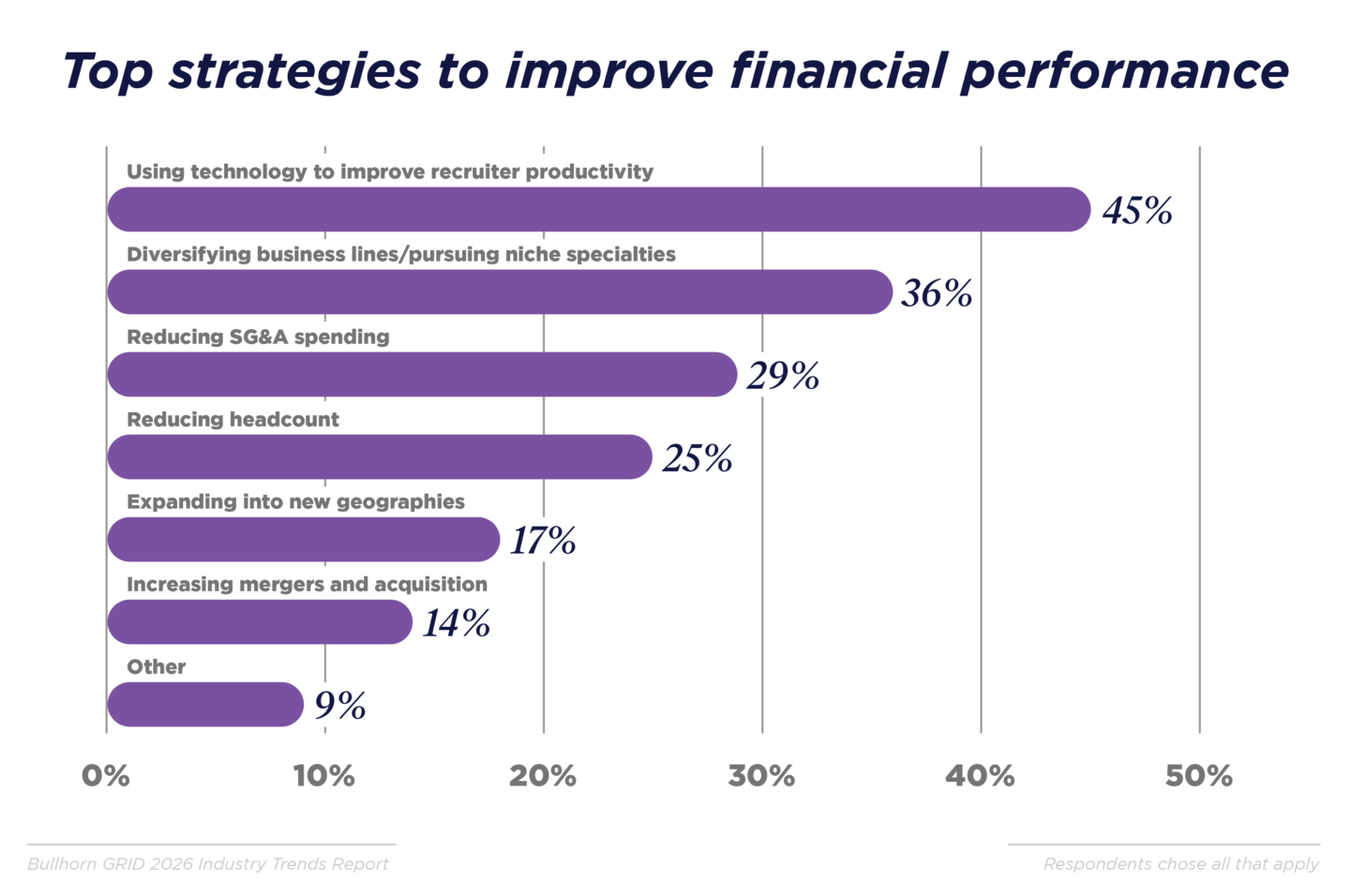
The chart shows 45% of respondents prioritising technology for recruiter productivity, 36% diversifying into niche specialties, 29% cutting overheads and 25% cutting headcount. Read together with the Hays numbers, the direction is clear: agencies are using AI to do more placements per consultant and specialising where their human network is hardest to copy. That is good news for buyers in one specific way. An agency that sources with AI has lower costs per placement, which gives you a stronger case for negotiating its rate down, especially on roles with large, reachable talent pools.
On the buyer side, recruiters are moving faster than agencies. LinkedIn's January 2026 research found that 93% of recruiters plan to increase their use of AI in 2026, and that US applicants per open role have doubled since spring 2022 - LinkedIn. Ashby's analysis of nearly 250,000 hires found inbound applicants accounted for between 43% and 52% of all hires over four years, with sourced and referral hires steady and agency hires declining slightly - Ashby Talent Trends. When a role draws twice as many applicants and your own sourcing tools can reach passive candidates directly, the share of roles that genuinely need an agency shrinks.
Why this matters: the agency market is not collapsing, but it is bifurcating. Fees on hard, senior and niche roles are holding or rising, while volume on routine professional roles is draining away. How to apply this: expect agencies to defend their rate on difficult searches and to be more flexible on roles they know a client could fill alone. Use that asymmetry. Send agencies only the roles your in-house capacity and tools cannot fill, and negotiate hard on any role where the talent pool is large, because the agency knows its odds of being undercut are rising.
7. How AI Recruiters Are Priced in 2026
"AI recruiter" now describes three different businesses with three different price models, and choosing between them matters more than choosing a vendor. The first group copies the agency model at a lower rate, charging a success fee on each hire. The second group combines human recruiters with AI and charges per hire or per hour. The third sells software, sometimes with autonomous agents, for a flat monthly or annual price that does not change with the salary of the person you hire. All three call themselves AI recruiting, and their invoices for the same hire can differ a hundredfold.
The distinction matters because each model shifts a different share of the work and the risk back to you. A success-fee AI recruiter carries the risk of failure like an agency, and usually limits itself to introductions. A hybrid service adds human judgement for a per-hire price well below agency rates. Software gives you the most capacity for the lowest price, but you run the process and you pay whether or not anyone is hired. The sections below take each group in turn, with verified 2026 prices.
Success-fee AI recruiters: the agency model, cheaper
The most direct challengers to agencies keep the agency's pricing logic and cut the rate. Jack & Jill's AI recruiter Jill charges 10% of first-year base salary in the UK and Europe, payable only on a hire, with a full refund if the hire leaves or is dismissed for performance in the first three months. In the US, since late summer 2026, the same company sells Jill by subscription instead: a free Meet Jill tier, then $199 per role per month on annual billing or $249 month to month, with no success fee on a plan - Jack & Jill US Pricing. Our Jack & Jill pricing guide covers both price lists and their fine print in detail.
Reval, an AI recruiting service acquired by Metaview in August 2026 to accelerate its fillmore agent, priced its service "from $50 to kick off a search and just 10% of base salary when you hire", with a 90-day money-back guarantee; its site now sends new clients to the fillmore waitlist - Reval. Metaview positions fillmore itself as an outbound recruiting agent you pay for only when you hire, without publishing the fee - Metaview fillmore. At the other end of the range, Dex charges agency rates for an AI-led service: 20% to 30% of a hired candidate's salary. It told Fortune in April 2026 that it had reached a roughly $1.8 million annualised revenue run rate since it began charging in late 2025 - Fortune.
Jack & Jill's own shortlist card, shown below, illustrates what a success fee buys from an AI recruiter: a ranked introduction with the agent's reasoning, which the hiring team accepts or passes on. On a US plan each "Request intro" uses one of the plan's intro requests; under UK and European success-fee pricing nothing is owed until a hire.
A success-fee AI recruiter's shortlist: Jill by Jack & Jill
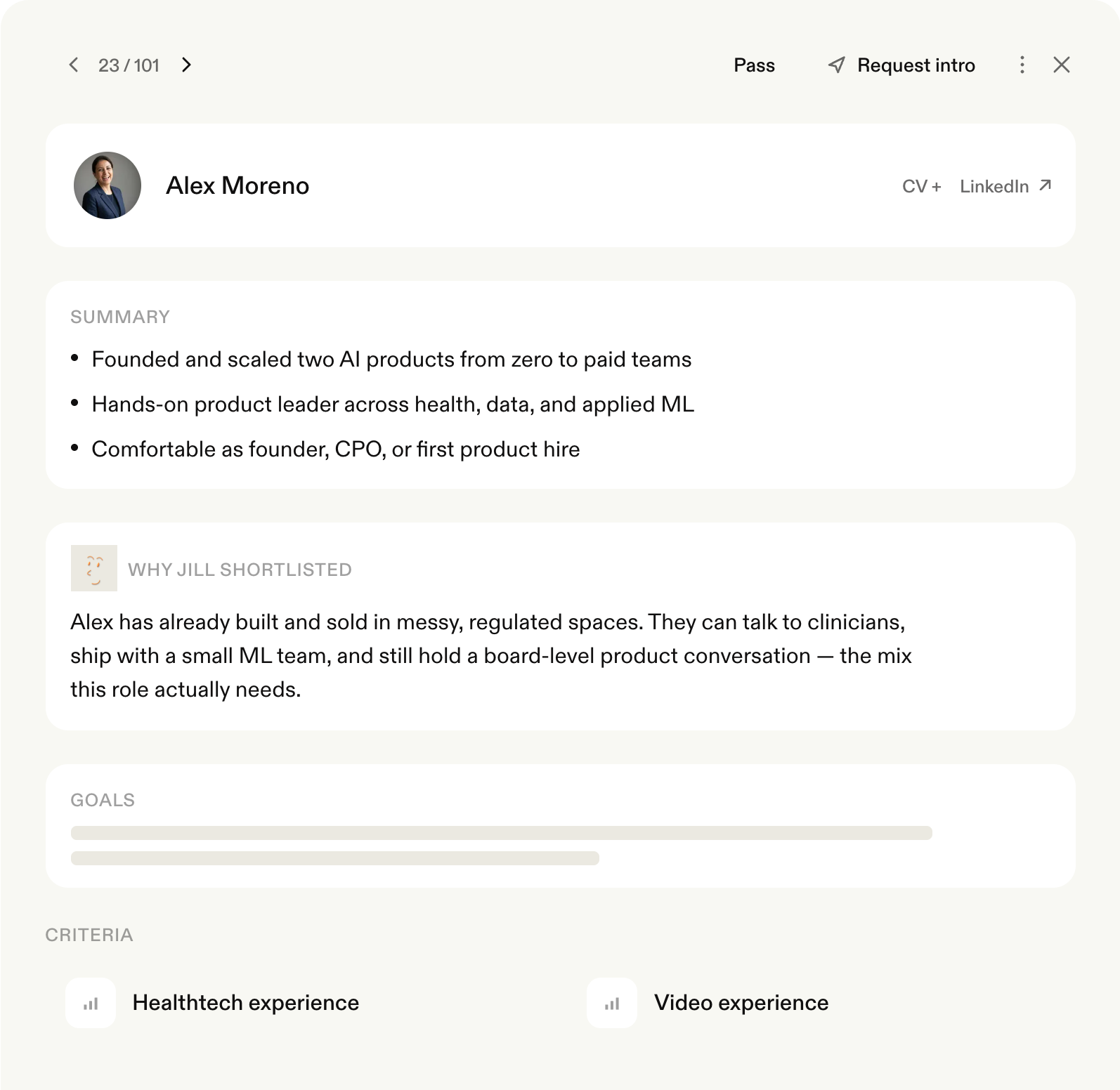
The card makes the business model tangible: you are paying for warm, pre-qualified introductions to people who have told the agent they want a role like yours, not for a database. Why this matters: success-fee AI recruiters are the closest like-for-like substitute for a contingency agency, at roughly a third to a half of the fee, but they depend on the candidate network the agent has built. How to apply this: test them on roles that match their network (Jack & Jill built its network in London, San Francisco and New York) and compare introductions accepted per role, not just the percentage.
Hybrid services: human recruiters, AI tooling, per-hire prices
The second group puts human recruiters on top of AI tooling and prices well below agencies. Paraform runs a marketplace where independent recruiters compete to fill a company's roles. It charges a flat percentage of first-year salary on success, with no retainer and a 90-day replacement guarantee, but does not publish the percentage - Paraform. Third-party comparisons put it at 20% to 25%, and Paraform's own March 2026 Series B announcement says the average placed candidate earns about $260,000 a year, with more than 1,000 companies served and total funding of $65 million - Paraform Series B. Our Paraform pricing guide compares the marketplace with its closest alternatives.
Dover runs a marketplace of fractional recruiters, mostly billed by the hour; since January 2026 it also supports retained and contingency arrangements - Dover. It says its customers "have most often spent $2,000 to $7,000 per hire", an observed range rather than a quote, with an $800 refundable deposit to start and embedded recruiters typically charging $100 to $250 an hour. Paraform's own guide to embedded recruiting puts full-time embedded recruiters at "around $10,000 to $20,000 per month", and is candid that the range "reflects market convention rather than a published benchmark". Both are useful middle options for teams that need human recruiting capacity for a few months without paying a percentage on every hire.
AI recruiter software: flat prices, unlimited upside, more work
The third group is software: AI sourcing tools and autonomous recruiting agents sold by seat, role slot, credit or monthly allowance. Prices are published and low relative to agency fees, but you supply the time to review candidates, interview and close. The chart below compares the cheapest paid plan of five AI recruiting tools at their monthly-billing list price, so the units line up as closely as public price lists allow.
Entry Plan Price of AI Recruiting Tools, Billed Monthly (USD per month)
The units differ in ways the chart cannot show, so read it alongside the plan rules. Juicebox's Starter is $99 per seat a month on annual billing or $119 monthly, with an optional Agents add-on at $199 per agent per month - Juicebox Pricing. SeekOut lists Recruit Core at $149 a month billed annually or $179 monthly - SeekOut Pricing. Hire Jill is priced per open role. hireEZ's Growth seat is $494 a month paid annually upfront, or $549 a month on the same annual plan paid monthly - hireEZ Pricing. Our hireEZ pricing guide explains the difference, including the month-to-month option on AWS Marketplace. HeroHunt.ai prices by monthly allowance rather than by seat or role: plans start at $99 a month with unlimited positions and searches, metered on AI-screened and matched profiles delivered and candidate emails found - HeroHunt.ai plans.
Two other pricing units are spreading. Credit pricing charges per candidate the agent handles: Workable's AI agent runs on credits that cost $0.12 each in a 5,000-credit pack or $0.10 in a 10,000 pack - Workable Pricing. And the largest platform sells its agent as a paid add-on to the seat. LinkedIn's UK government price list showed Hiring Assistant at £1,575 to £2,079 per licence per year under a promotion running to June 2026, on top of a Recruiter seat listed at £6,350 to £8,925 a year - LinkedIn G-Cloud price list.
The table below brings the three groups together. It is a snapshot of published prices in October 2026; vendors in this market change prices often, sometimes several times a year.
| Option | Pricing model | Published 2026 price | What you still do yourself |
|---|---|---|---|
| Jack & Jill (UK/EU) | Success fee | 10% of first-year base | Interview, close |
| Jack & Jill (US) | Per role slot | $199-$249 per role per month | Interview, close |
| Reval (now Metaview) | Kickoff + success fee | From $50 + 10% of base (fillmore: pay on hire, fee unpublished) | Interview, close |
| Dex | Success fee | 20-30% of salary | Interview, close |
| Paraform | Marketplace success fee | Unpublished; reported 20-25% | Interview, close |
| Dover | Mostly hourly recruiters | $2,000-$7,000 per hire observed | Some screening, close |
| Juicebox | Per seat (+ agents) | $99-$179 per seat a month, annual | Review, outreach rules, interview, close |
| hireEZ | Per seat | $494 a month, annual | Review, interview, close |
| HeroHunt.ai | Monthly allowance | From $99 a month | Review shortlist, interview, close |
| LinkedIn Recruiter + HA | Per seat + agent licence | £6,350-£8,925 per seat a year, plus HA (UK G-Cloud list, Oct 2025) | Review, interview, close |
Why this matters: the table shows that the real choice is not "agency or AI" but how much of the process you want to buy. Success-fee AI recruiters sell the agency's outcome at a lower rate; software sells capacity at a flat price. How to apply this: if you have nobody to run interviews and close candidates, start with the success-fee or hybrid rows; if you have even one person who can, the software rows will almost always produce the lowest cost per hire once you hire more than a handful of people a year.
8. The Players: Who Is Biggest and Who Is Coming Up
LinkedIn is the biggest player in AI recruiting by reach, the venture-funded AI natives are the fastest-growing, and the incumbent agencies are the largest by revenue but the slowest to change. Understanding who sits where helps you predict pricing: incumbents defend percentage fees, the platforms sell AI as add-ons to seats you already pay for, and the challengers compete on a lower or flatter price. It also helps you judge risk, because some AI recruiters that looked promising in 2025 have already been acquired or changed their model, as Reval and Jack & Jill's US pricing show.
The market divides into four camps: the large agencies and search firms, the platform incumbents adding agents to existing seats, the AI-native challengers selling software or success fees, and the hybrid marketplaces that combine both. The rest of this section profiles the players in each camp that a buyer is most likely to meet in 2026, with what each does differently.
The incumbents: agencies and search firms
The largest agencies by fee income remain the generalist staffing groups (Randstad, Adecco, ManpowerGroup, Robert Half, Hays) and, at the top end, the executive search firms (Korn Ferry, Heidrick & Struggles, Spencer Stuart, Russell Reynolds, Egon Zehnder). Their scale is real: Korn Ferry alone booked $2.9 billion of fee revenue in fiscal 2026 across all its businesses, from executive search and RPO to consulting and digital. Their strength is relationships and process; their weakness is a cost base built for a world in which finding candidates was the hard part, and Hays now says openly that "this time is different", citing "disintermediation by technology platforms" and the impact of AI.
Expect these firms to absorb AI rather than be displaced by it in the short term. Hays is rebuilding its process around AI agents after cutting consultant headcount by 14%, Adecco reported its professional recruitment business "back to growth at +1%" in the second quarter of 2026, even though group-wide permanent placement revenue was still 1% lower organically - Adecco Group Q2 2026, and executive search fees are still rising. For buyers, the practical consequence is that incumbent pricing will hold on senior and niche roles for some time, while mid-market rates become more negotiable.
The platform incumbents: LinkedIn first
LinkedIn is the one player that sits on both the candidate data and the recruiter's daily workflow, which makes its Hiring Assistant the most consequential AI recruiter in the market. In September 2026 it announced Hiring Assistant 2, which will update automatically for existing English-language customers "for free beginning in November", and said that more than 20,000 companies use its agentic hiring products. LinkedIn reports that recruiters using the assistant review 83% fewer profiles to find qualified matches, and that its prescreening completes in a median of six minutes against the 3.5 hours a recruiter typically takes to respond - LinkedIn Hiring Assistant 2.
LinkedIn's official explainer, published in October 2026, walks through what the second version adds, from sourcing and applicant evaluation to outreach, screening and scheduling. It is worth two minutes before you price anything else, because Hiring Assistant is the benchmark every other AI recruiter is now compared with.
What is Linkedin Hiring Assistant 2? Features and Benefits Explained
The catch is cost and scope. Hiring Assistant runs on top of LinkedIn Recruiter, so its price starts with a Recruiter seat, and its capacity is capped per licence each month - LinkedIn Help. It also only searches LinkedIn. For teams already paying for Recruiter, it is the obvious first agent to switch on; for teams not paying, it is one of the more expensive ways to start. Our Hiring Assistant 2 guide covers the limits and the published capacity tiers.
The AI-native challengers
The challengers sell either software or success fees, and the money flowing into them shows how seriously investors take the threat to agencies. Juicebox raised an $80 million Series B at an $850 million valuation in March 2026, saying it is used by more than 5,000 customers - Juicebox. Jack & Jill raised a $40 million Series A in September 2026 after a $20 million seed, and Metaview, best known for interview notes, raised a $60 million Series C in September 2026 as it brings fillmore, its outbound sourcing agent, to general availability - Metaview Series C. hireEZ has repositioned itself as an agent-native platform, and Alex, an AI interviewer, raised a $17 million Series A in 2025 to automate first-round interviews - TechCrunch.
HeroHunt.ai belongs in this group as one of the earliest autonomous options: an AI Recruiter that searches up to a billion profiles, screens them against a role with language models, and runs personalised outreach and follow-up on autopilot, priced by monthly allowance rather than by hire. What separates the challengers from each other is mostly the unit they charge on and where their candidates come from: a proprietary network of opted-in job seekers (Jack & Jill, Dex), a broad profile index searched on demand (Juicebox, hireEZ, HeroHunt.ai), or the recruiter's own LinkedIn seat (Hiring Assistant).
The hybrid marketplaces
The fourth camp keeps humans in the loop and uses AI to make them more productive. Paraform's marketplace of independent recruiters is the best funded, and it now pitches itself as an "agentic hiring platform" where recruiters and AI systems work together. Its dashboard, shown below, reflects the model: several recruiters work a role in parallel, and the client sees submissions, interviews and hires in one place.
A recruiter marketplace: several recruiters, one role, one dashboard
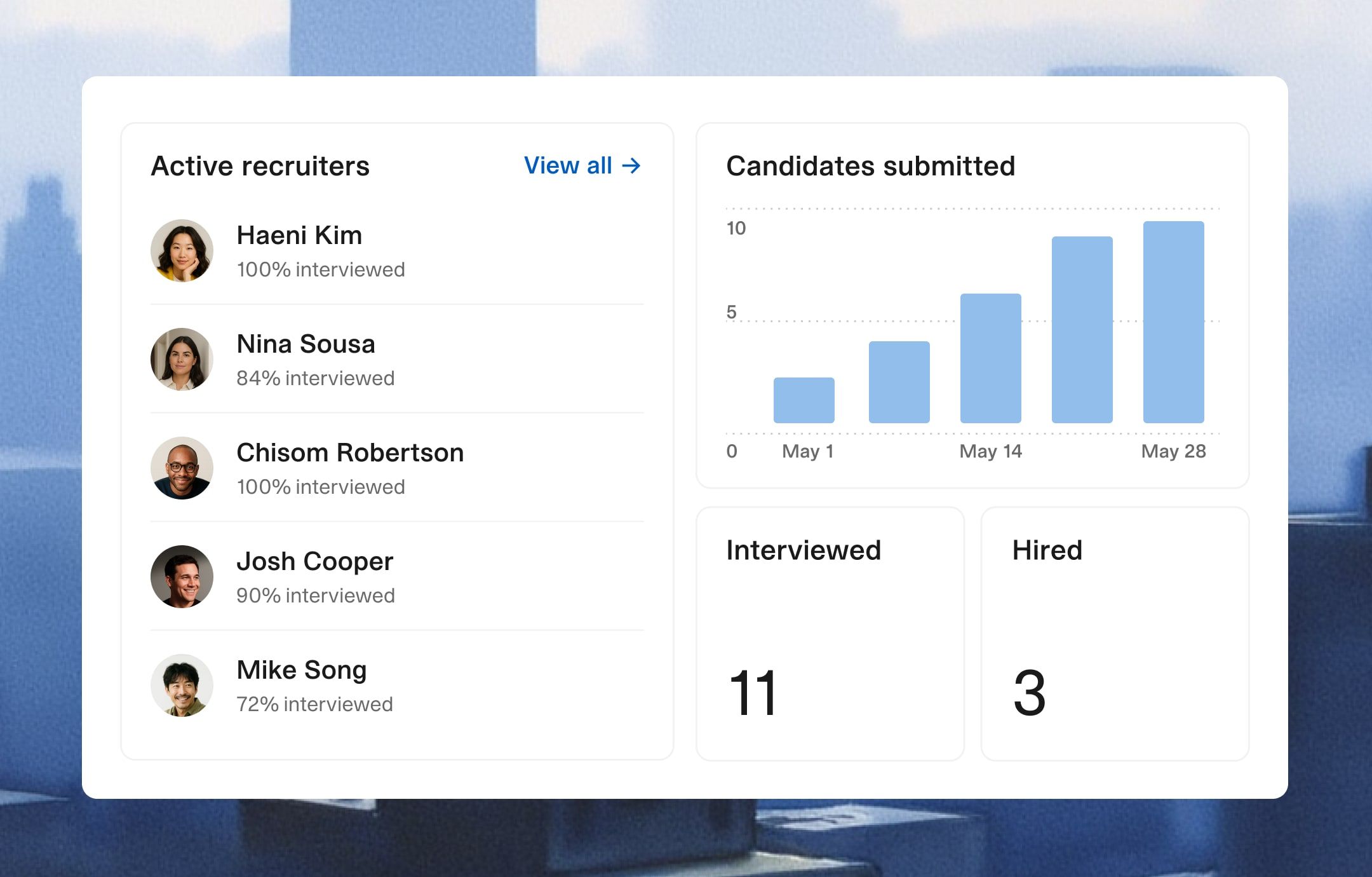
The illustration shows five active recruiters, eleven candidates interviewed and three hires: the competitive dynamic that makes marketplaces faster than a single agency. The trade-off is price, since marketplaces still charge a percentage of salary on every hire. Dover's fractional model is the cheaper hybrid, typically charging for recruiter hours rather than outcomes. Why this matters: the four camps compete on different units, so a direct price comparison only works within a camp. How to apply this: shortlist one option from each camp that fits your roles, then compare them on the one unit that cuts across all four, cost per hire, which is what the next section calculates.
9. Real Cost per Hire: Agency vs AI Recruiter, Worked Examples
For a single mid-level hire, an agency costs roughly ten to twenty-five times more than running an AI recruiter in-house, and for a team making ten hires a year the gap is roughly $200,000. Those are big claims, so this section shows the arithmetic, using the published rates from earlier sections and labelling every assumption. The aim is not to prove that software always wins. It is to give you a method you can rerun with your own salaries, volumes and internal costs, because the answer flips for some roles and you need to know which ones.
The examples use four inputs: the published fee or price, the fee base (base salary or total package), the time a search takes, and the internal time your team spends when it runs the search itself. That last input is the one most comparisons leave out. Our assumption is 25 hours of recruiter time per hire for reviewing candidates, supervising outreach, screening calls and scheduling, at about $50 an hour fully loaded, based on the BLS median wage for HR specialists of $75,940 plus on-costs of roughly a third. That puts the internal time at about $1,250 per hire, which sits close to SHRM's $1,200 median non-executive cost per hire.
Example 1: one $120,000 engineer in the US
Assume a software engineer on a $120,000 base with a $15,000 non-guaranteed target bonus, filled within three months. Under Robert Walters' default terms, the fee base counts two-thirds of the bonus, so the package is $130,000 and the fee at 30% is $39,000. A negotiated 20% contingency fee on base alone is $24,000. Paraform's reported 20% to 25% range lands at $24,000 to $30,000, and Dex's 20% to 30% at $24,000 to $36,000. Reval's model costs $50 plus 10% of base, or $12,050. A retained search at one-third of first-year compensation (base plus the $15,000 target bonus, $135,000) plus a 12% administrative fee would cost $50,400, though nobody should retain a search firm for this role.
The software routes cost far less in cash and more in your own time. Three months of a Hire Jill slot on monthly billing is $747, assuming Jill's network covers the role. Three months of Juicebox's Starter plan on monthly billing is $357, to which you add the roughly $1,250 of internal time, for about $1,600. Dover's observed per-hire spend of $2,000 to $7,000 sits between the two worlds. For everything an engineering hire costs beyond the fee, from payroll taxes to sign-on bonuses, see our guide to the true cost of hiring an AI engineer. The chart below plots the main options for this one hire.
Cost of One $120,000 Hire in the US, by Model (USD)
Read the chart as a rough staircase of how much work you buy: the higher bars hand less of the process back to your team. The exception is the bottom bar, Hire Jill, which is cash only (it excludes your own interview time) and only works if Jill's network covers the role. The biggest step is between the success-fee models and everything below them: a 10% fee is still $12,000, while running a tool yourself costs a few thousand dollars at most. Why this matters: for one hire, running a tool yourself saves about $10,000 against a 10% success fee and $22,000 to $37,000 against an agency, which is real money but may not justify changing how you work. The case becomes overwhelming at volume, as the fourth example shows.
Example 2: one £60,000 role in the UK
Take a £60,000 base with no bonus, the kind of mid-level role UK agencies fill every day. At Hays, the salary falls in the 25% band, so the fee is £15,000. Reed's Standard service at 22% is £13,200, Aaron Wallis at 20% is £12,000, and Jill's 10% of base is £6,000. A buyer with leverage that imposes its own cap, as Kingsley Healthcare does at 10% to 15%, would pay £6,000 to £9,000. UK agencies quote these fees plus VAT. The spread across published UK agency rates alone is £4,200 on a single hire (20% at Aaron Wallis to 27% for Reed's Premium service), before you count the guarantee differences from section 4.
The UK example also shows why the rate card is only part of the decision. Hays' 25% buys a 13-week partial-refund window (50%, then 25%); Reed's Standard 22% buys only eight weeks; Aaron Wallis' 20% comes with a 12-month sliding guarantee. On a role where early attrition is a real risk, the cheapest percentage is not the cheapest contract. And if your role sits just above a band boundary, it is worth asking whether the agency will apply the lower band, because at Hays a salary of £70,000 instead of £69,999 moves the fee from 25% to 28%.
Example 3: a $300,000 executive
For an executive on $300,000 of first-year cash compensation, a retained search at one-third costs $100,000, and a 12% administrative fee on top brings it to $112,000. Isaacson, Miller's published minimum of $60,000 shows where the floor sits even on smaller searches. Heidrick's average revenue per search of $162,000 in the third quarter of 2025 suggests this example is below the typical search the big firms run.
This is the one example where AI recruiters are not a like-for-like substitute. An AI tool can map the market, find candidates and draft outreach, which is useful preparation, and some firms will discount if you bring your own long list. But confidential approaches to sitting executives, reference work through back channels and board-level persuasion are exactly what a retained fee buys. Why this matters: the case for AI is weakest where agency fees are highest per hire. How to apply this: keep retained search for genuine executive and confidential roles, and use AI tools to benchmark the firm's long list rather than replace it.
Example 4: ten hires a year
Now take a growing company making ten hires a year at an average base of $110,000. Through contingency agencies at 20%, the annual fee bill is $220,000. If the company already has a recruiter, the AI route costs a tool subscription plus internal time: a year of hireEZ's Growth seat at $5,929, or a year of Juicebox Growth at $179 a month on annual billing ($2,148 per seat), plus ten times $1,250 of recruiter time, for roughly $15,000 to $18,500 in total. If the company has no recruiter and hires one at the BLS median wage plus on-costs, about $100,000, the AI route still costs roughly half the agency bill, and the recruiter stays on the payroll for next year's hiring.
The volume example is where the economics of percentage fees break. Each additional agency hire adds another $22,000; each additional in-house hire adds roughly $1,250 of time and nothing to the subscription until you outgrow your plan's allowance. Why this matters: the break-even is very low. A single avoided agency fee pays for several years of most AI recruiting tools. How to apply this: estimate how many of next year's hires sit in large, reachable talent pools; those are the roles to move in-house first, while the remaining hard roles stay with agencies.
HeroHunt.ai
If example 4 looks like your hiring plan, several roles a year that would otherwise go to a contingency agency at 20% or more, HeroHunt.ai replaces the part of the agency fee that pays for finding and reaching candidates. Plans start at $99 a month with unlimited positions and searches, metered on AI-screened and matched profiles delivered and candidate emails found (5,000 profiles and 1,000 emails a month on Pro), with no fee when you hire, whatever the salary. The honest caveat: it does not interview or close candidates for you, and its outreach is cold, not the warm, opted-in introductions a success-fee recruiter like Jill makes, so it pays off when someone on your team can run interviews. The 8-day trial requires a card.
10. Where Agencies Still Win, Where AI Wins, and How Each Fails
Agencies still win when the hard part of a hire is persuasion, discretion or a network you do not have; AI recruiters win when the hard part is volume, speed and reach into a large talent pool. Most roles fall clearly on one side of that line once you ask what is actually difficult about filling them. The mistake buyers make is to choose a single model for every role, either sending everything to agencies out of habit or moving everything to software to cut cost, and then blaming the model when it fails on the roles it was never suited to.
Both models also fail in predictable ways. Agencies fail through misaligned incentives and contract terms that favour them; AI recruiters fail through thin networks, low reply rates and compliance gaps. Knowing the failure modes in advance lets you design around them, which is cheaper than discovering them halfway through a search. The diagram below turns the section into a decision path for a single open role.
The path starts with the two questions that matter most: whether the role needs discretion, and whether anyone on your side can interview and close. Price only enters at the last branch, between large and niche talent pools. That ordering is deliberate. A cheaper tool that nobody has time to run produces no hires, and an agency briefed on a role your team could fill in three weeks produces an unnecessary fee.
Where agencies still earn their fee
Agencies justify their rate in a handful of situations, and in those situations the fee is often good value. The common thread is that the scarce resource is not candidate data, which AI has made abundant, but human trust, judgement and time. When a candidate needs to be persuaded by someone they know, or a search must stay invisible, software has little to offer.
A good specialist recruiter also brings market knowledge that is hard to buy any other way: which competitors are losing people, what packages are really closing, and which candidates will move for the right offer. That intelligence is a by-product of placing people in the same niche for years, and it is worth most when you are hiring into a market you do not know. The situations below are where it reliably pays for itself.
- Executive and confidential searches: replacing a sitting leader, or hiring before an announcement
- Very niche or regulated roles: where the candidate pool is tiny and known personally
- No dedicated recruiter: true of about 45% of employers in SHRM's survey
- New markets: entering a country where you have no brand and no network
- Urgent hires with risk transfer: where a guarantee and a dedicated team matter more than price
The third item deserves emphasis. SHRM found that only 55% of organisations have dedicated recruiters, so for nearly half of the organisations SHRM surveyed, the realistic alternative to an agency is not an in-house team with better tools but a hiring manager squeezing recruiting around a day job. For them, success-fee AI recruiters and hybrid services are often a better first step than self-serve software, because they take the work as well as the cost off the table. The same logic applies to urgent replacements: when a key person resigns and the role must be filled in weeks, paying for an agency's dedicated attention and guarantee can be cheaper than the cost of the vacancy.
Where AI recruiters win
AI recruiters win on the roles agencies like least: repeatable professional roles with large talent pools, many simultaneous openings, and companies that already know how to evaluate the people they hire. In these cases, the agency's main contribution is finding and contacting candidates, and that is now the cheapest part of recruiting to automate. LinkedIn's own figures show what the agents are doing to the workload: recruiters using Hiring Assistant review 83% fewer profiles to reach qualified matches.
The screenshot below, from LinkedIn's "Introducing Hiring Assistant 2" article of 29 September 2026, shows the kind of output that replaces hours of manual review: a candidate profile on the left and, on the right, the agent's check of each required and preferred qualification against the profile and resume, with the evidence it used.
An AI recruiter's screening, shown: LinkedIn Hiring Assistant 2

Notice that every qualification is tied to a source, the profile or the resume, which is what makes a screening decision reviewable. That is the work an agency's researcher does when building a shortlist, now done in minutes per candidate.
The volume effect compounds the advantage. A team hiring ten engineers can run every search through the same tool at no extra cost per role, reuse the same pipeline across openings, and rediscover past candidates. Gem's benchmarks found that rediscovered candidates already in a company's CRM or applicant tracking system accounted for 46% of sourced hires - Gem. An agency cannot sell you your own past applicants, but an AI recruiter running on your own data can surface them.
How agency engagements fail
Agency failures are mostly structural rather than personal. Non-exclusive contingency gives every agency the same incentive: submit quickly, submit many, and hope one sticks. That produces CV volume rather than fit. Percentage fees reward higher salaries, which can tilt an agency's advice in offer negotiations. And the contract terms covered in section 4 create disputes: candidates your team already knew, introductions by forwarded profile, guarantees that offer only a replacement from the agency that just failed.
The fix for most of these is in the contract and the brief rather than the choice of agency. Fewer agencies with clearer exclusivity, a prior-candidate exclusion, a fee on base salary only, and a refund-based guarantee remove most of the friction. When they do not, it is usually a sign the role was not a good agency role in the first place.
How AI recruiters fail
AI recruiters fail differently. Success-fee agents are only as good as their opted-in candidate network, and a role outside that network can sit unfilled while the vendor waits for the right person to sign up. Software that sends cold outreach runs into the same reply rates human recruiters face, around 16.9% on average in 2025 across 6.2 million Gem sequences - Gem, and poor personalisation drags that lower. Data quality is uneven: profiles go stale, and an agent screening on stale data makes confident mistakes. And some products sold as AI recruiters charge agency-level fees for an AI-led service, which removes the cost advantage entirely.
Compliance is the failure mode that grows fastest. New York City has required bias audits for automated employment decision tools since enforcement began in July 2023, with notices to candidates - NYC Department of Consumer and Worker Protection. In the EU, recruitment AI is classed as high-risk under the AI Act, and the 2026 AI Omnibus moved those obligations from 2 August 2026 to 2 December 2027 - National Law Review. Why this matters: an AI recruiter that cannot explain or audit its screening decisions is a liability, whatever it costs. How to apply this: ask every vendor how it documents screening criteria, how candidates are notified, and what its human-review step is, and prefer vendors whose answers you could show a regulator.
11. How to Cut Your Agency Bill Without Losing Quality
The fastest way to cut agency spend is to send agencies fewer, harder roles on better terms, and to run everything else through your own AI-assisted process first. Rate negotiation helps, but it is the smallest lever. The bigger levers are the fee base, the guarantee, the ownership window and, above all, which roles reach an agency in the first place. Companies that manage all four can cut their agency spend sharply without losing access to the agencies they value.
This section sets out the tactics in the order they usually pay off. None of them requires a confrontation with an agency. Agencies accept client terms, exclusivity trades and volume agreements every day; most simply do not volunteer them, because the default terms are better for them.
Negotiate the base before the rate
The fee base is the quiet multiplier, so fix it first. Ask for the fee to apply to base salary only, excluding target bonus, sign-on bonus, equity and allowances. On a senior role with a meaningful bonus and sign-on, that single change can be worth more than five percentage points off the rate. If an agency insists on including bonus, cap it at a fixed amount or count only the guaranteed portion, as Aaron Wallis does in its own terms.
Then negotiate the rate itself, using the published cards in section 3 as anchors. Reed's Standard tier at 22% and Aaron Wallis at 20% show that UK rates in the low twenties are normal, and buyers with steady volume can push lower, as Kingsley Healthcare's 10% to 15% caps show. In the US, a 30% default like Robert Walters' is an opening position, not a market price. Ask for 20% on base as a starting point for mid-level roles, and offer something in return.
Trade exclusivity and volume for points
Agencies price risk, so reduce their risk and ask for the saving. Exclusivity is the clearest trade: Phillip Riley's published card cuts every salary band by two to three points when the client grants exclusivity, and an agency that knows it will be paid if the role is filled can afford a lower rate. It also gets more of the agency's attention, because exclusive roles are the ones recruiters work first.
Volume is the second trade: a commitment to a number of roles a year, or a preferred-supplier list of two or three agencies, justifies a tiered rate that falls as placements rise. The trades below can be combined, and each one should be written into the agreement rather than left as a verbal understanding, because agency terms typically state that only written variations are binding.
- Exclusivity window: two to four weeks of exclusivity in exchange for a lower rate
- Volume tiers: for example, the rate drops after a set number of placements in a year
- Container search: an upfront fee for priority roles, deducted from the final fee
- Flat fees: a fixed price per hire for repeatable roles, regardless of salary
- Preferred-supplier list: fewer agencies, each with more of your business
Each of these trades gives the agency more certainty in exchange for a lower price, which is why they work. The most powerful for companies with repeat hiring is the flat fee: it removes the salary link entirely, which matters most on well-paid roles where a percentage fee balloons. The least powerful is a preferred-supplier list without any commitment behind it, because agencies discount for certainty, not for status. When you present the trades, lead with what the agency gains: a guaranteed fee, a predictable pipeline of roles, or faster feedback. Agencies respond far better to a clear offer than to a request for a discount with nothing attached.
Fix the guarantee and the ownership window
The guarantee and the ownership window are where agency contracts carry the most hidden cost, and both are easy to improve before signing. Ask for a refund rather than a replacement, because a replacement from the agency whose candidate just left is of limited value. Ask for at least 90 days, which is the guarantee period Robert Half, one of the largest US staffing firms, already works to, and for a pro-rata refund rather than a cliff. Reed's own tiers show what a longer guarantee is worth: five points of fee buys the difference between eight weeks and six months of cover.
On ownership, shorten the window and narrow the definition. Six months is a reasonable ownership period; twelve months from the last communication, as in Robert Walters' terms, is not. Define an introduction as a submission of a named candidate, with the candidate's consent, for a specific role, rather than any email containing a profile. And add a prior-candidate exclusion: anyone already in your applicant tracking system, or contacted by your team in the last year, belongs to you. That one clause prevents most fee disputes in a world where AI tools and agencies find the same people.
Run AI first, agencies second
The structural fix is to change the order of operations. Instead of briefing an agency the day a role opens, run every new role through your own process for a fixed period first: AI search and outreach, your own applicants, referrals and rediscovered past candidates. Only roles that are still open after that window go to an agency, and they go with a clear brief built on what you learned about the market. The window can be short; three weeks is enough to know whether a role is easy or hard.
This hybrid model changes the economics in two ways. It removes the easy roles, which were always the ones where agency fees bought least, and it makes your agency brief sharper, because you can tell the agency which profiles did not respond and why. Why this matters: the roles that survive the window are the ones where an agency fee is genuinely earned, so you stop paying 20% for work your tools could do. How to apply this: track cost per hire and time to hire by channel for two quarters. The data will show which role families belong in-house and which are worth an agency's fee, and it gives you the evidence to negotiate with the agencies you keep.
12. The Future: AI Agents and the End of the 20% Default
The 20% to 30% contingency default is unlikely to survive the next few years for routine roles, but percentage fees will persist, and may even rise, for executive and scarce talent. That is our reading of the evidence in this guide rather than a published forecast, and it rests on three forces that are already visible in 2026: AI recruiters pricing the same outcome at 10% or a flat fee, platforms adding agents to seats buyers already pay for, and agencies themselves using AI to cut the cost of each placement. Fees follow costs and alternatives, and both are falling for the middle of the market.
The pricing experiments are happening in public. Jack & Jill priced Jill as a 10% success fee in 2025 and, within a year, moved its US customers to per-role subscriptions with no fee on a hire. Metaview bought Reval, a 10%-on-hire service, to accelerate its own pay-on-hire agent. LinkedIn is upgrading Hiring Assistant for existing customers at no extra cost. Each move pushes the price of finding and contacting candidates toward the price of software, which is a small fraction of a placement fee.
Agents on both sides of the hire
The most interesting shift is that agents now sit on the candidate side too. Jack & Jill's model pairs a candidate agent, Jack, with a hiring agent, Jill, and matches are made when the two agree. Dex runs an AI talent agent for engineers. When candidates are represented by agents that already know their skills, preferences and salary expectations, the agency's role as the intermediary who knows both sides is directly challenged. Jack & Jill's own short demo shows how Jill takes a hiring brief and works it.
Meet Jill: An AI Agent for Hiring
The demo is short, but the workflow it shows (brief, matching against a network of opted-in candidates, introductions) is the agency model with the human intermediary removed. That model will not suit every role, and its quality depends entirely on the network behind it. But it is the clearest sign of where routine recruitment is heading: matching between agents that represent each side, with humans stepping in for interviews, judgement and the close.
Agencies become AI-augmented, and narrower
Agencies will not disappear; they will shrink in headcount and narrow in focus. Hays' plan to raise net fee productivity by more than half, with a process supported by AI agents and 14% fewer consultants than a year earlier, is a template the rest of the industry is likely to follow. Bullhorn's survey shows only one firm in ten has agentic AI across its full workflow today, which leaves plenty of room for productivity gains. If agencies capture those gains, their cost per placement falls, and competition from AI recruiters will push at least part of that saving into lower fees on mid-level roles.
At the same time, the roles that remain with agencies will be harder, more senior and better paid, which pushes average fees per placement up, as Robert Half's and Korn Ferry's 2026 numbers already show. The likely result is a two-tier market: flat or low-percentage pricing for roles AI can source, and traditional percentage fees for roles where the agency's network and judgement are the product.
Regulation and the applicant flood
Two external forces will shape how fast this happens. The first is regulation. EU obligations for high-risk recruitment AI now apply from December 2027, and New York City's bias-audit rule is already in force, so vendors that can document and explain their screening will have an advantage, and some agencies will sell human-in-the-loop compliance as a feature.
The second is volume: with US applicants per open role doubled since spring 2022, according to LinkedIn, the bottleneck in many hires has moved from finding candidates to screening them, which is exactly where AI agents are strongest. A recruiter facing several hundred applications for one role cannot read them all carefully, and neither can an agency, so screening agents will become standard infrastructure whoever runs the search. Taken together with the pricing shifts above, these forces suggest the following direction for the next few years.
- Routine roles: contingency rates drift toward 10-15% or flat fees
- Executive search: one-third fees hold, with AI used for research
- Pricing units: per role, per allowance and per credit spread further
- Candidate agents: more hiring happens through agent-to-agent matching
- Compliance: auditability becomes a buying criterion, not a footnote
These are our expectations, not certainties, and the timing will vary by country and sector. Why this matters: contracts signed today often run for a year or more, so buyers locking in 25% defaults for routine roles are likely to overpay against where the market is heading. How to apply this: keep agency agreements short and role-specific, avoid long exclusive commitments for routine hiring, and build your own AI-assisted sourcing capability now so that you can take advantage of lower prices as they arrive.
13. The Bottom Line
In 2026, agencies charge 20% to 30% of first-year pay for contingency hires and about a third for retained search, while AI recruiters charge either around 10% on success or a flat monthly price. The published contracts, from Reed's 22% to 27% and Hays' 20% to 28% in the UK to Robert Walters' 30% default in the US, show that agencies still print the same 20% to 30% headline rates. What has changed is the alternative. Finding and contacting candidates, the most labour-intensive part of what agencies sell, now costs a few hundred dollars a month in software, and the listed agencies' own results show permanent placement volumes falling while their fees per placement rise.
The right choice depends less on price than on what is genuinely hard about each role. A cheap option that nobody has time to run is not cheap, and an expensive agency on a role your team could fill alone is pure waste.
The framework below condenses this guide into five rules, one for each type of role you are likely to have open, plus one for every agency contract you sign. Use it for every opening:
- Executive or confidential: retained search, with AI to benchmark the long list
- No closer in-house: contingency, a marketplace, or a success-fee AI recruiter
- Large talent pool, in-house capacity: AI recruiter software, run by your team
- Niche pool, in-house capacity: three weeks of AI search, then one exclusive agency
- Every agency contract: fee on base, refund guarantee, prior-candidate exclusion
Why this matters: the framework replaces a habit (brief an agency when a role opens) with a decision made per role, and it puts the question of in-house capacity before the question of price, which is where most bad recruiting spend starts. How to apply this: run it on every open requisition for one quarter, record which branch each role took, and compare cost per hire and time to hire with the previous quarter. The comparison will show quickly whether the roles you moved in-house are filling as well as they did through agencies.
Applied consistently, that framework sends agencies only the roles where their fee is earned, and it moves the rest in-house at a fraction of the cost. For a team making ten hires a year, the difference is roughly $200,000 annually, enough to fund a recruiter, the tools and a good deal of employer branding. For a company making two hires a year with no recruiter, an agency or a success-fee AI recruiter may still be the sensible choice, and that is fine: the point is to choose the model deliberately for each role instead of by habit.
If you want to see how far an AI recruiter takes your own roles before you brief an agency, HeroHunt.ai is one of the options covered above: it searches up to a billion profiles, screens candidates against your criteria and runs personalised outreach on autopilot, priced per month rather than per hire - HeroHunt.ai.
For a wider comparison of sourcing and recruiting tools and the units they charge on, our recruiting software pricing index covers 40 tools.
Whichever mix you choose, measure it. Record the channel, the fee and the time to hire for every hire you make over the next two quarters, and review the numbers with your agencies and vendors. The buyers who pay least for recruiting in 2026 are not the ones with the toughest negotiators; they are the ones who know their own cost per hire by channel, and who can show an agency exactly which roles it is being asked to fill and why.
AI sourcing, screening and outreach for a flat monthly price with unlimited positions, and no placement fee when you hire.
This guide reflects agency terms of business, company filings and vendor pricing published as of October 2026. Agency rates are negotiable and AI recruiter prices change frequently, sometimes several times a year, so verify current terms and prices with each provider before you sign.