



The insider's buyer guide to the software that sources, screens, interviews and closes candidates for you, ranked on a stated rubric and priced with real numbers.
LinkedIn's agentic hiring products passed a $450 million annualized revenue run rate by April 2026 - HCAMag. That is not a survey about intentions or a funding round. It is money that talent teams are already spending on software that does not help them recruit faster, but recruits instead of them. When one product line inside one company clears half a billion dollars of run rate on autonomous hiring, the category has stopped being a demo.
Here is the problem: most of the tools sold as "AI recruiting tools" in 2026 are not what they claim to be. Gartner estimates that out of the thousands of vendors marketing agentic AI, only around 130 are building genuinely agentic systems, a pattern it named agent washing, and it predicts that over 40% of agentic AI projects will be scrapped by the end of 2027 on cost, weak value, or poor controls - Gartner. In recruiting, that gap between the pitch and the product is expensive, because a renamed search bar and a real autonomous recruiter carry very different price tags and deliver very different results.
This guide ranks the 15 best AI recruiting tools in 2026 on a rubric it states up front, gives real prices where prices exist, names the vendors that hide them, explains what each one actually automates, and maps where these systems break. Everything here is drawn from late 2025 and 2026 sources, because in a market moving this fast, a benchmark from two years ago describes a different product. Whether you are a solo agency recruiter or run talent acquisition for a global enterprise, the aim is the same: help you spend on the tool that fits your team rather than the one with the loudest launch video.
HeroHunt.ai
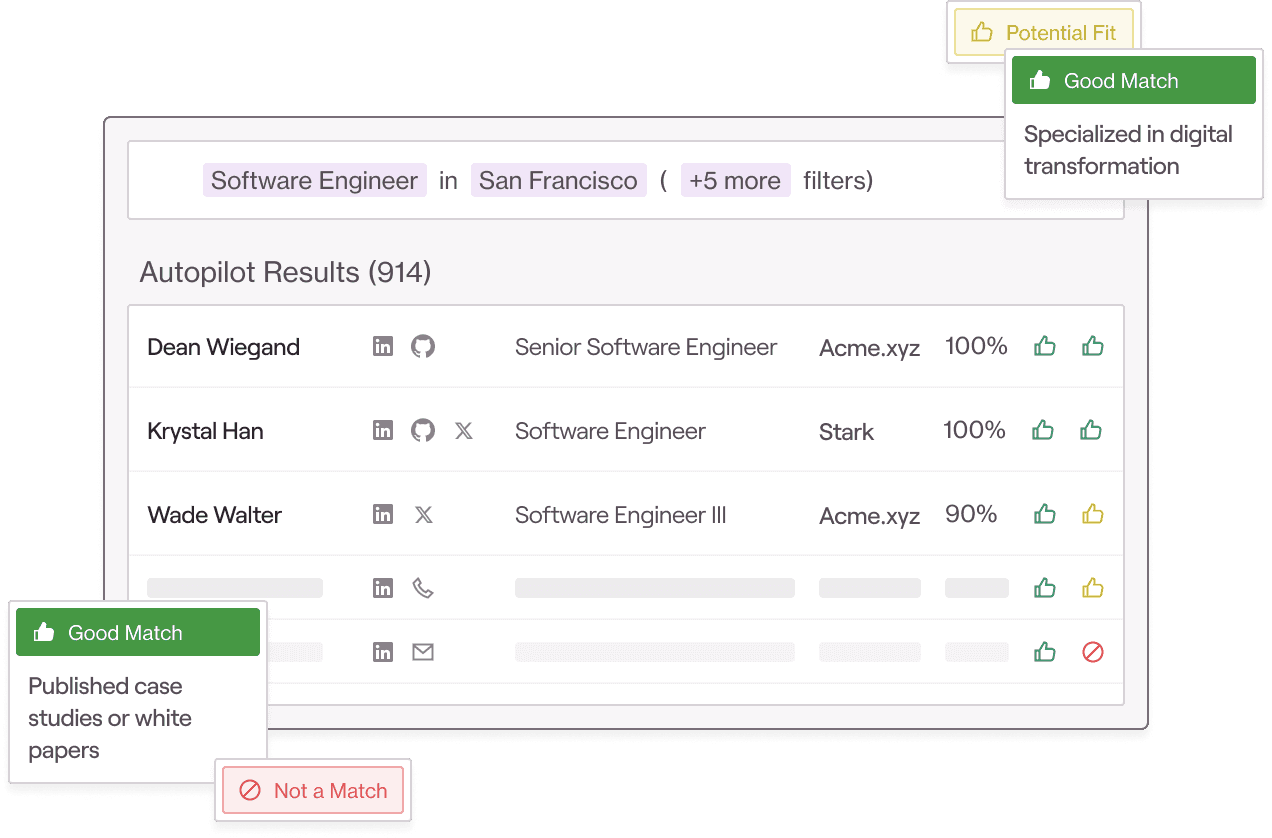
If your bottleneck is that the right people are not applying, the tool you want is an autonomous outbound engine, and that is exactly the slot HeroHunt.ai fills in this ranking. It searches over a billion public profiles, screens them with a language model against the brief you wrote, and runs personalized multichannel outreach across LinkedIn, email and WhatsApp without a human triggering each step. What makes it unusual in a category that hides its prices: it is flat SaaS, $149, $249 or $499 per month, metered on open positions per month (3, 10 and 20) rather than per-contact credits, with an 8-day free trial. The honest limit, so you buy it for the right reason: it is a sourcing, screening and outreach engine, not a full applicant tracking system, so your scorecards and offers still need somewhere to live.
Contents
- The 2026 Landscape: What Actually Changed
- How This Ranking Works: The Scoring Rubric
- The 15 Best AI Recruiting Tools in 2026, Ranked
- What They Actually Cost: The 2026 Pricing Picture
- Inside an AI Recruiter: How the Loop Actually Works
- Where AI Recruiting Tools Genuinely Win
- Where They Break: The Honest Failure Map
- Rules and Risk: The 2026 Compliance Picture
- How to Choose: Running a 30-Day Pilot
- The 2027 Outlook: Agent-to-Agent Hiring
- The Decision: Which Tool for Which Team
1. The 2026 Landscape: What Actually Changed
The single most useful fact about AI recruiting in 2026 is that adoption is wide but shallow, and the teams pulling ahead are the ones closing that gap. Almost every talent team now uses AI somewhere, yet very few have handed a real slice of the job to software. Bullhorn's GRID 2026 report, built on a survey of roughly 2,300 recruitment professionals, found that while 30% of firms have moved to some agentic AI tooling, only 10% have agentic AI embedded across their full workflow, and 29% are still on basic generative AI - Bullhorn. Read those numbers together and the picture is clear: most teams have automated a step, and a small minority have delegated a job.
That shallow-versus-deep split is where the returns live, and it is measurable. The same research found that firms using AI at any stage were 3.5 to 4.5 times more likely to grow revenue in 2025, and that 78% of the highest-growth firms embed AI in their applicant tracking system against just 51% of the slowest growers - Bullhorn. The lesson is not that AI is magic. It is that the operating model around the tool, a written brief, a review gate, a metric you actually track, is what separates the 10% from everyone else. The chart below shows how thin the deep end of the pool really is.
How deep agentic recruiting adoption really goes (2026)
The takeaway is that "we use AI in recruiting" and "we have delegated recruiting" are separated by a wide margin, and most of your competitors mean the former. Intent, though, is running far ahead of practice. In Korn Ferry's 2026 trends study of 1,674 global talent leaders, 84% plan to use AI this year and 52% plan to add autonomous AI agents to their teams, even as only 11% say their executives are prepared to lead the transition - Korn Ferry. That combination, high intent and low readiness, is precisely the condition under which teams overpay for the wrong tool.
Underneath the recruiting story sits a broader capability shift that explains why 2026 and not 2023. Autonomous agents only became commercially credible once models got good enough at multi-step computer work to be trusted with a loop. Stanford's 2026 AI Index tracks this directly: on OSWorld, a benchmark of real multi-step computer tasks, agent success jumped from roughly 12% in 2024 to 66.3% in 2026, and corporate AI investment more than doubled to $581.7 billion in 2025 - Stanford HAI. The same report notes that 88% of organizations now use AI in at least one function, even though agent deployment specifically remains in the single digits.
Adoption is near-universal; deep agent deployment is not
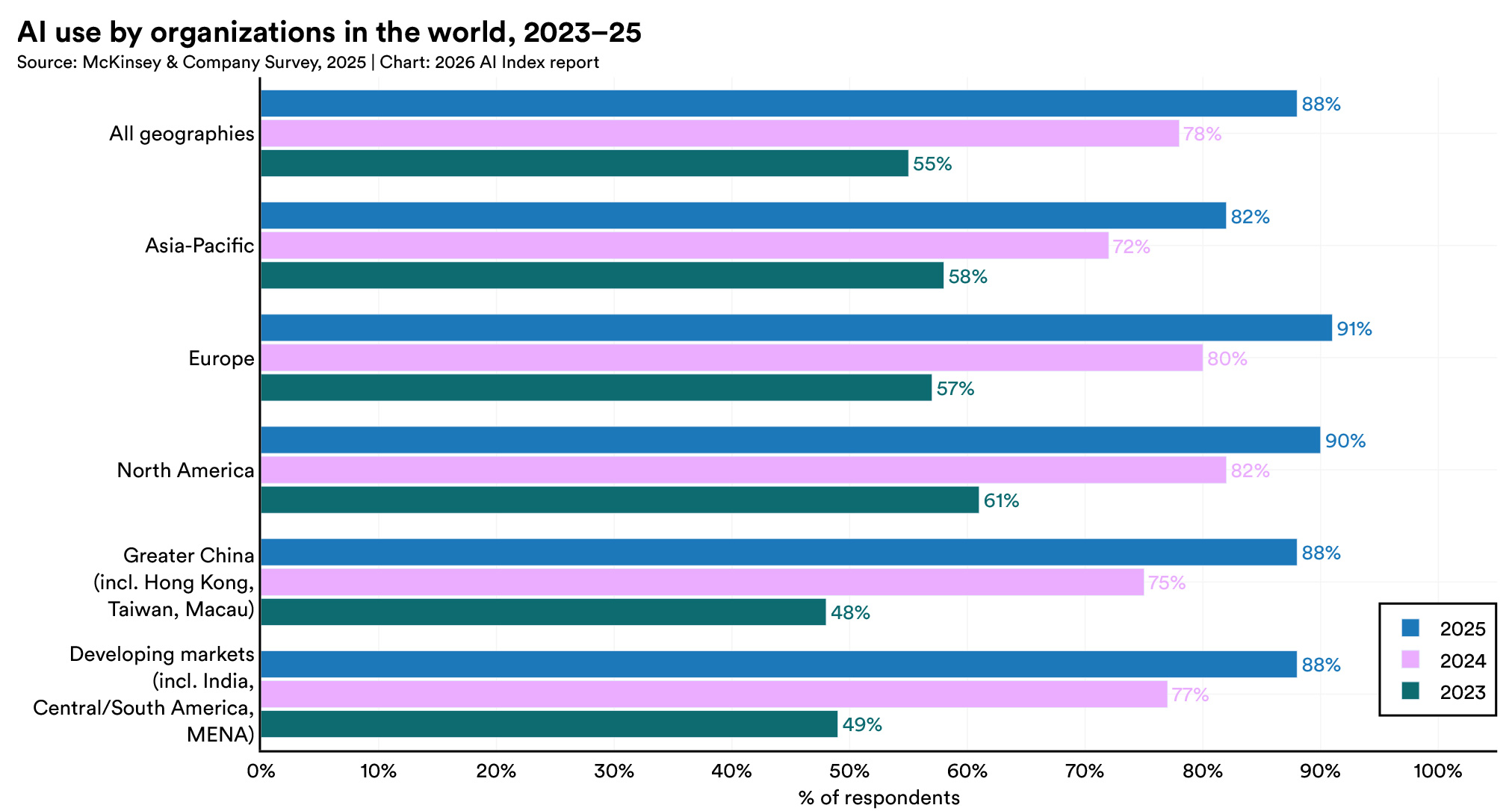
Notice the shape of that adoption curve against the single-digit agent-deployment reality underneath it. It is the same wide-but-shallow pattern the Bullhorn data shows inside recruiting, and it is why buying carefully beats buying quickly. The market has also consolidated into three recognizable camps, and knowing which camp a vendor sits in tells you more than any feature list: the incumbent search platforms that bolted an agent layer onto an existing database, the agent-first challengers designed around autonomy from day one, and the big suites where the agent arrives as a feature of the system you already own. The ranking in chapter 3 keeps those camps in view because they predict both the price and the failure modes.
Those three camps are worth naming precisely, because each carries a predictable economics and a predictable disappointment. The incumbent search platforms, hireEZ, SeekOut, Gem, Findem and Fetcher, sell reach plus a CRM, price per seat and increasingly per agent, and tend to fail when their open-web data goes stale. The agent-first challengers, HeroHunt.ai, Juicebox and a long tail of 2026 startups, sell autonomy and are the most likely to publish a price, but carry younger brands and thinner enterprise track records. The suites, LinkedIn, Workday, SmartRecruiters, Eightfold, Paradox and HireVue, sell the agent as a feature of a system you already run, which is convenient and expensive in equal measure, and they usually price on total headcount rather than usage. Identify the camp and you can predict the sales motion, the pricing model and the most likely regret before the first demo is even booked.
2. How This Ranking Works: The Scoring Rubric
A ranked list is only as honest as the rubric behind it, so here is ours before the names. These 15 tools do genuinely different jobs, an outbound sourcing agent and a high-volume interview bot are not competing for the same budget line, so the ranking rewards how completely and how transparently a tool does the job it is built for, not a single "best overall" fantasy. A tool that automates one stage brilliantly can outrank a broader suite that does five stages adequately, and a vendor that hides its price is marked down against one that publishes it, because opacity is itself a cost you pay in procurement time.
We scored every tool against five weighted criteria, and each tool's section names where it wins and where it loses on them. The point of stating the rubric is that you can re-weight it for your own situation: a Fortune 500 with a Workday contract will value ecosystem fit more than transparent pricing, while a two-person agency will invert that entirely. The rubric is a lens, not a verdict.
Two things we deliberately did not weight are brand and raw feature count, and it is worth saying why. Brand recognition tells you a vendor markets well, not that its agent works on your roles, and this market is full of well-funded names whose real autonomy is thinner than the launch video implies. Feature count is worse than useless as a signal: a tool that lists forty capabilities and does the core loop poorly loses to one that does sourcing, screening and outreach reliably, because in production you use three features constantly and thirty-seven never. So the rubric rewards depth on the job that actually matters and honesty about price, and it treats a sprawling feature list as a yellow flag rather than a green one. A vendor that cannot say plainly what its agent does without you, and what it costs, is usually hiding the answer to both.
- Autonomy - does it complete a loop (source, screen, engage, hand off) or merely assist a human at one task?
- Data reach - how many profiles it can see, how fresh they are, and across how many sources.
- Screening quality - whether matches are explainable and correctable, or an opaque score.
- Outreach and engagement - multichannel, personalized, and able to handle replies at volume.
- Pricing transparency and fit - is the price public, and does the model match how you actually hire?
The most contested of these in 2026 is screening quality, because it is where "AI recruiting" most often means a black box. A number without reasons cannot be audited, cannot be corrected, and cannot be defended if a rejected candidate asks why, which is why the tools that show their reasoning score higher here even when their raw matching is no better. Autonomy is the second dividing line: the difference between a tool that returns a ranked list you still have to read and one that contacts the people it selected is the difference between faster work and less work, and only the latter changes your headcount math. Every tool below is placed on those axes explicitly, so a low rank on our weighting can still be a top pick on yours.
3. The 15 Best AI Recruiting Tools in 2026, Ranked
What follows is the ranking itself, each tool with what its AI actually does, the real price where one exists, the single team it fits best, and the honest limitation that should stop the wrong team from buying it. The order reflects the rubric above, weighted toward autonomy, data reach and pricing transparency, which is why a genuinely autonomous outbound engine can outrank a larger but narrower enterprise suite. Prices are stated as each vendor or a credible third party published them in 2026; where a vendor sells only through sales calls, the section says so plainly rather than inventing a figure.
Read the ranks as a starting map, not a scoreboard, because the "best for" line matters more than the number beside the name. A tool ranked eleventh here may be the correct and obvious choice for an enterprise already standardized on its ecosystem, and a tool ranked second may be wrong for a team whose real problem is interview logistics rather than sourcing. The value of a stated rubric is that it lets you disagree precisely.
One more reading tip before the names: map each tool back to its camp from chapter 1, because the camp predicts the buying experience as much as the rank does. The agent-first challengers near the top will hand you a trial and a public price within minutes; the suites will route you through a sales cycle and a custom quote; the incumbent search platforms sit in between, publishing a teasing entry price and hiding the real one behind a contract. None of that changes which tool is best for your bottleneck, but it changes how long it takes to find out, and a team working against a deadline should weight the tools it can actually test this week accordingly.
1. LinkedIn Hiring Assistant
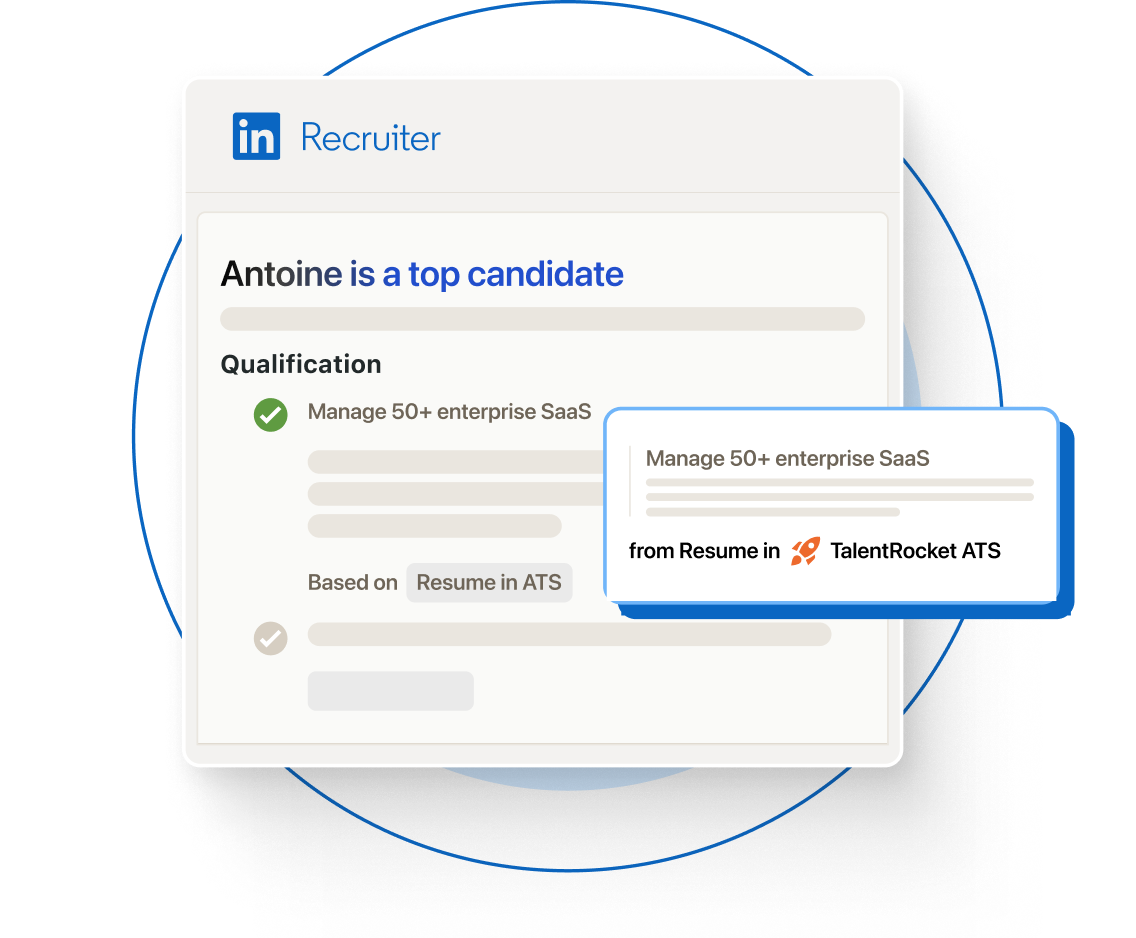
LinkedIn Hiring Assistant takes the top slot because it is the most widely deployed genuine recruiting agent in the world, sitting on the largest professional dataset in existence. It reached general availability in English at the end of September 2025 and lives inside LinkedIn Recruiter: a recruiter states a hiring goal or pastes a job description, and the agent builds a sourcing strategy, searches LinkedIn's 1 billion-plus member network, qualifies candidates, and returns a shortlist with its reasoning attached, then drafts outreach and learns from feedback - LinkedIn. Its February 2026 update pushed it beyond sourcing into applicant review with AI Follow-Ups, AI Applicant Targeting, a Verified Applicant Spotlight and Microsoft Teams collaboration. The detail that makes it genuinely agentic rather than a smarter filter is that its shortlists are explainable by design: for each candidate the agent lists the qualifications it checked, marks which are met, and cites the evidence it read, which is exactly what lets a recruiter supervise it without re-reading every profile from scratch.
LinkedIn's first AI agent, built into Recruiter
The honest catch is price and lock-in. Hiring Assistant is sold only as a paid add-on to Recruiter Corporate or RPS+, never standalone, and Recruiter Corporate alone runs roughly $10,800 to $12,960 per seat per year in 2026, with the assistant reported to add five figures on top - Pin. It also sources only LinkedIn's own network, so open-web and ATS-native candidates are invisible to it, and it currently supports only English, German and French. To see how the product owner frames the autonomy and explainability, this launch-era interview with LinkedIn's VP of Product is the clearest primary source available.
LinkedIn's Hari Srinivasan on AI, Hiring Assistant and the future of recruiting
Best for: enterprise and high-volume in-house teams already standardized on LinkedIn Recruiter Corporate that want sourcing and shortlisting automated without leaving LinkedIn. The watch-out is simple: you cannot buy the agent without the expensive base license, and everything it does is bounded by LinkedIn's walls.
2. HeroHunt.ai
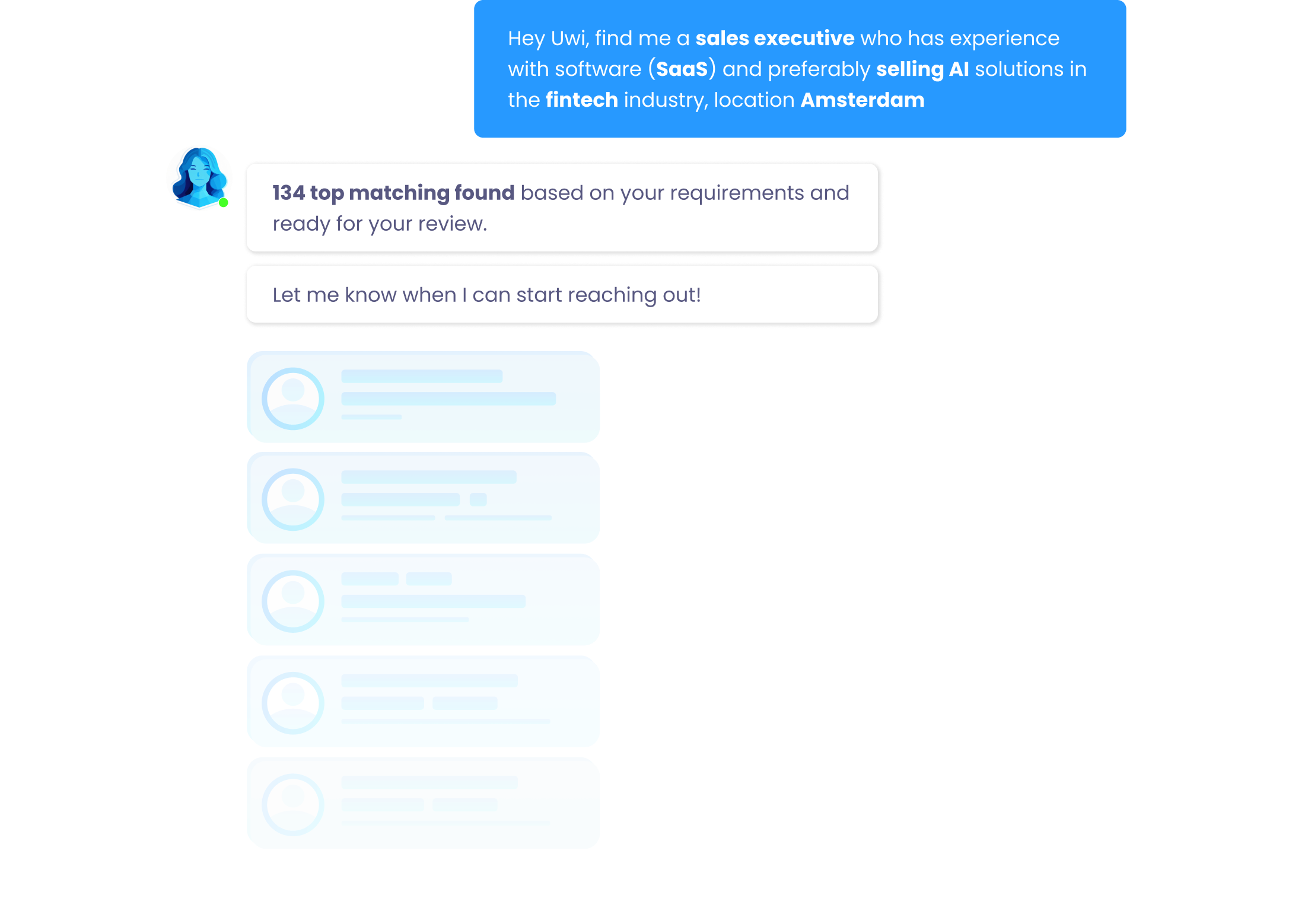
HeroHunt.ai earns second on the rubric because it completes the outbound loop end to end while doing the one thing almost every rival on this list refuses to do: publish a price. Its AI Recruiter searches across a reach of 1.2 billion-plus profiles spanning LinkedIn, GitHub and the open web, screens results with a language model against your written criteria, and runs fully autonomous multichannel outreach across LinkedIn, email and WhatsApp, with RecruitGPT turning a plain prompt into a shortlist - HeroHunt.ai. It is built by Yuma Heymans, who has spent the last five years shipping autonomous sourcing software, and the product reflects that focus: it is an engine for the top of the funnel, not a system of record. In practice that reach spans 190-plus countries, and the platform reports an average time to first reply under 36 hours, which is the metric that actually matters when a role is already burning and every day of silence loses a candidate to a faster competitor.
Autonomous outreach, drafted and sent per candidate
The pricing is the differentiator worth studying because it inverts the category's credit model. Instead of charging per contact or per email, HeroHunt meters on open positions per month: $149 (Starter, 3 positions), $249 (Pro, 10 positions) and $499 (Team, 3 users, 20 positions), each on an 8-day free trial. One seat can source as many candidates as a role needs within the position cap, which makes cost predictable in a way per-credit tools never are. The honest limits: screening is more profile and keyword driven than a structured interview, autonomous outreach copy still rewards a human read before it goes out, and the brand footprint is smaller than the incumbent suites.
Best for: lean in-house teams and agencies that want passive-candidate sourcing, screening and outreach as flat, forecastable SaaS rather than a per-profile meter. If your problem is inbound volume rather than a quiet pipeline, a screening or ATS tool lower on this list will serve you better.
3. hireEZ
hireEZ, formerly Hiretual, is the strongest open-web outbound platform in the ranking, and its 2026 pitch is an agent that chains the whole sourcing job together. Its EZ Agent works across five stages, research and intake, source and qualify, engage and nurture, match and screen, and schedule, drawing on 750 million-plus profiles across 45-plus platforms, one of the widest open-web pools in the category, and running multichannel outreach plus autonomous AI phone screens - hireEZ. In November 2025 it added ResumeSense, an integrity layer that flags hidden text, prompt injection and AI-manipulated resumes, a genuinely 2026 problem that most rivals ignore. The phone-screen piece is the part worth stress-testing in a demo: EZ Agent can run autonomous voice or chat screens with structured questions and then book interviews inside recruiter-set parameters, which is real delegation of a step most tools still leave entirely manual.
The company is substantial rather than a startup experiment: it reported $42.6 million revenue in 2024, more than 600 enterprise customers and over 175,000 users, on $76.3 million raised - GetLatka. Pricing is where it gets awkward. hireEZ publishes no full list price; its Solo Recruiter plan is advertised from a steep $494 per month with a 7-day trial, while Vendr's third-party data pegs the median contract near $13,000 per year with a normal range of $6,600 to $25,000 and implementation fees on top - Vendr. Critically, hireEZ itself describes EZ Agent as semi-autonomous, a human-in-the-loop layer rather than a hands-off recruiter.
Best for: mid-market to enterprise teams doing high-volume outbound beyond LinkedIn that want sourcing, CRM, outreach, screening and scheduling in one agent-driven stack. The watch-out is the contract minimums and the honest "semi" in semi-autonomous: you are still in the loop.
4. Gem
Gem ranks fourth because it is the most complete unified system on the sourcing-and-CRM side, and in 2026 it turned its analytics heritage into a genuine agent suite. Alongside outbound sourcing, candidate CRM, sequencing and its native ATS, Gem shipped AI Rediscovery, AI Talent Insights, AI Funding Insights and an AI Application Review Agent, and reported 7x growth in AI product revenue, 609,000-plus hours saved and 130x growth in AI-assisted hires - Gem. It indexes 800 million-plus candidate profiles, and its native ATS, launched in 2023, grew to roughly 500 customers, so it is no longer just a sourcing add-on. That ATS is the fastest-growing part of the business, reported to have grown roughly elevenfold in 18 months, and it matters because it lets Gem keep sourcing, outreach and hiring data in one system instead of forcing a recruiter to reconcile three tools that each hold a fragment of the truth.
Gem is also one of the few here that publishes a real entry price. Its startup tier lists at $270 per month, discounted to around $130 per month billed annually for teams of 1 to 10, bundling AI sourcing, CRM, analytics, scheduling and ATS, with a separate staffing plan reported from $99 per user per month and custom pricing above that - Pin. Companies under 30 employees can get the all-in-one product free for six months. The trade-off is that lower tiers gate AI sourcing behind monthly credits, and mid-market to enterprise pricing turns opaque and per-seat expensive once you scale past the startup band.
Best for: mid-market and enterprise talent teams that want one system for outbound, CRM, sequencing and analytics, especially startups that can exploit the discounts. It is built around outbound and CRM rather than deep skills inference, so a pure matching engine it is not.
5. SeekOut
SeekOut is the deepest talent-intelligence platform in the ranking, and its 2026 releases are the most forward-looking on this list. It searches 1 billion-plus profiles across seven verticals, public, GitHub, academic, healthcare, nursing, your ATS and internal talent, and its assistant turns a plain-English brief into structured criteria and drafts outreach. In 2026 it shipped SeekOut MCP, which lets recruiters search and hire from directly inside Claude, ChatGPT, Gemini and Copilot through 14 guided workflows, plus six specialized AI agents and Sam, an AI interviewer that runs rubric-based asynchronous interviews - SeekOut. The MCP move is a real bet on where recruiting interfaces are heading: into the assistant you already have open. Underneath the new agents, SeekOut's older strengths still carry the sale for most buyers: an assistant marketed as ChatGPT for recruiters, plus deep diversity and internal-mobility analytics that many enterprises adopt it for long before they ever touch the 2026 agentic features.
SeekOut is enterprise-grade in both capability and price. It publishes no public pricing, and Vendr data across 64 verified contracts shows annual deals from $5,790 to $54,940, typically $3,000 to $10,000 per seat, with a self-serve tier reportedly near $149 per month and auto-renewals that escalate 5 to 7% a year - Vendr. The company raised $189 million and hit a $1.2 billion valuation on its Series C, with customers including Microsoft, Sony and Cisco - Business Wire.
Best for: enterprise teams filling hard technical, engineering and healthcare roles, plus internal mobility and diversity hiring, who want to recruit from inside their AI assistant. The watch-out is cost: it typically lands at $10,000 to $30,000-plus a year and is heavier than a small team needs.
6. Eightfold AI
Eightfold AI ranks sixth as the most ambitious skills-graph platform, aimed at the entire employee lifecycle rather than sourcing alone. Its deep-learning talent-intelligence engine infers skills candidates never listed and matches them to roles, powers internal mobility and workforce planning, and in 2026 became genuinely agentic: it launched Talent Agents 2.0 on July 15, 2026, making its Candidate Agent and Avatar generally available, followed by a 360 Interview capability and an earlier AI Interview Companion - GlobeNewswire. The scale is real: Eightfold has raised around $410 million at a $2.1 billion valuation and serves customers across 155 countries - GetLatka. It reached roughly $96.6 million ARR in 2024, and its 2026 agent push built on an AI Interview Companion shipped in April before the Talent Agents 2.0 launch, a useful sign of how fast even the incumbents are re-platforming their whole stack around agents rather than adding one on the side.
The reason it is not higher is fit and cost. Eightfold is enterprise-only, with opaque custom pricing reported around $7 to $10 per employee per month and typical deals running into six figures a year, plus long implementations - MindHunt AI. The skills-graph value also depends heavily on clean, well-structured HR data, which many organizations do not have. For a company with 1,000-plus employees and a real workforce-planning mandate, that investment pays off; for an SMB that just needs to fill five roles, it is a category error.
Best for: large global enterprises that need skills-based talent intelligence, internal mobility and workforce planning unified across the lifecycle. If your problem is a specific open req rather than a strategic talent operating system, look elsewhere on this list.
7. Paradox (Olivia)
Paradox, with its assistant Olivia, is the category king of high-volume conversational hiring, and its ranking reflects dominance in a specific lane rather than breadth. For hourly and frontline roles in retail, restaurants, healthcare and logistics, Olivia screens applicants through chat, answers questions, and schedules interviews automatically, compressing a multi-day process into a text conversation. The proof is in the scale of its customers: Compass Group uses Olivia to hire roughly 120,000 workers a year with a recruiting team of about 20, and its roster includes McDonald's, CVS, Lowe's and Chipotle - Paradox. That is delegation at a volume no human team could match. The mechanism is mundane and powerful in equal measure: Olivia answers applicant questions in natural language, screens against knockout criteria, and then books, confirms and reschedules interviews over text, which removes the phone-tag and no-show churn that quietly clogs every high-volume pipeline.
The strategic fact that changed in 2026 is ownership: Workday completed its acquisition of Paradox on October 1, 2025, folding Olivia into a much larger HCM roadmap - Workday. Pricing is custom and volume-based, with third-party estimates putting implementations from around $15,000 a year and mid-market deployments near $3,000 a month - Index.dev. The honest limit is scope: Olivia is conversational-first, optimized for high applicant flow, and a weak fit for complex professional or technical sourcing where the problem is finding people, not processing them.
Best for: high-volume, hourly and frontline hiring where thousands of applicants need fast screening and automated scheduling. If you hire senior specialists one at a time, this is the wrong shape of tool.
8. Findem
Findem ranks eighth as the sharpest example of attribute-based talent data, an approach it calls three-dimensional, enriching candidate profiles with career attributes and market context rather than keyword matching. It supports attribute search, market mapping, internal mobility and DEI reporting, and in 2026 leaned into agentic sourcing at scale. Its momentum is real: it was named to The Agentic List 2026 and closed a $51 million Series C in October 2025 citing roughly 3x year-on-year growth, on $105 million raised in total, with customers including Adobe, Box and RingCentral - Findem. Its newer Intelligent Job Post even experiments with outcome-based pricing tied to hires rather than seats. The engine is built on what the company calls the largest expert-labeled talent dataset, and that labeling is what powers not just search but market mapping and internal-mobility analysis, the sort of workforce-planning questions a keyword-matching tool simply cannot answer at all.
Findem is enterprise-only and gives buyers little room to test before committing. There is no free trial and no self-serve, and third parties peg it at roughly $6,000-plus per seat per year, with total deals reported anywhere from $8,000 to $100,000-plus depending on seats and data volume - Pin. That opacity and the annual-contract minimum are exactly what a small or mid-sized team should avoid, and they are the reason a genuinely strong data product sits mid-table on a rubric that rewards transparency.
Best for: enterprise talent-acquisition and people-analytics teams that want deep talent intelligence plus 2026 agentic sourcing and can commit annually. Ad hoc hirers and SMBs will find no on-ramp here.
9. Juicebox (PeopleGPT)
Juicebox, known for its PeopleGPT engine, is the breakout natural-language sourcing challenger of 2026, and it ranks ninth on sheer momentum and usability. You describe the person you want in plain English and it searches 800 million-plus professional profiles across 30-plus data sources, no Boolean strings required, then drafts outreach. The market noticed: in March 2026 Juicebox raised an $80 million Series B at an $850 million valuation led by DST Global, said it had tripled ARR since its 2025 Series A, and reported around 5,000 customers - Juicebox. Its interface is one of the clearest illustrations of what explainable, natural-language sourcing looks like in practice. The trajectory is worth noting because it signals conviction from serious investors: Juicebox raised a Sequoia-led $30 million Series A in 2025 before this year's much larger round, unusually fast for a sourcing tool, on the back of a search experience that reads more like a conversation than a Boolean query builder - TechCrunch.
Natural-language search with explainable match scores
The price deserves a careful read because the headline understates it. Juicebox offers a free tier, then Starter around $99 to $119 per seat per month and Growth around $179 to $199, but its always-on Juicebox Agents automation is a separate add-on at $199 per agent per month, so the company's own recommended setup of one seat plus one agent runs roughly $338 to $400 a month before you do anything else - Juicebox. It is a sourcing and outreach tool rather than a full ATS, and contact-data accuracy can be inconsistent, the usual open-web caveat.
Best for: solo recruiters, agencies and startup-to-midmarket teams that want fast natural-language sourcing without Boolean. Budget for the agent add-on, because the sticker price is not the real one.
10. Fetcher
Fetcher takes tenth as the strongest done-for-you managed sourcing service, a genuinely different model from the self-serve tools around it. Rather than handing you a search bar, Fetcher combines software with human sourcers to deliver a steady stream of vetted, interested candidates, runs automated outreach sequences, and layers in diversity analytics, all from a 500 million-plus profile database - Fetcher. For a corporate TA team that does not want to build a sourcing muscle in-house, that managed approach removes the work rather than accelerating it. The model bundles a dedicated human sourcer with the software on its higher tiers and layers diversity analytics on top, which is exactly why teams that lack their own sourcing bench often prefer it to a self-serve search tool they would otherwise have to learn, staff and manage before it produced a single candidate.
Fetcher publishes clear tiers, which lifts it on the transparency axis: Self-serve $115 per month, Growth $379 per month and Amplify $649 per month, the last bundling a dedicated human sourcer across four to six roles plus AI-assisted interview support, with Vendr data showing a median annual contract near $11,000 - Pin. The honest limits are real: annual sourced-candidate caps (500 on Growth, 1,000 on Amplify) throttle high-volume hiring, there is no free trial, and the 500-million database is smaller than Juicebox's or hireEZ's pools.
Best for: corporate TA teams that want managed sourcing and automated outreach without doing manual Boolean themselves. If you want real-time, self-serve control over every search, the managed model will feel slow.
11. Workday HiredScore
Workday HiredScore ranks eleventh as the best explainable AI-screening and orchestration layer for teams that live inside an enterprise HCM. Rather than sourcing, HiredScore grades and prioritizes the candidates already in your system, surfaces internal talent through rediscovery, and orchestrates the workflow, all with an explicit focus on explainable, bias-audited scoring. Workday reports that HiredScore customers see a 54% increase in recruiter capacity within 10 months, 70% role coverage from existing talent pools, and 35% faster hiring-manager reviews - Workday. With the October 2025 Paradox acquisition, Workday now pairs HiredScore's Recruiting Agent with Olivia's candidate experience, its flagship 2026 recruiting story - PR Newswire. The rediscovery mechanic is the underrated part of the product: instead of sourcing externally, HiredScore continuously re-scores your existing applicants and past silver-medalists against every new requisition, which turns a dormant applicant database into the first, cheapest place to look before a role is ever posted to the open market.
The reason it is mid-table is dependency and opacity. HiredScore is an add-on licensed on top of Workday, with no standalone or self-serve option, and third parties estimate the full Workday Recruiting suite at roughly $80 to $150 per employee per month, with enterprise deployments running from $100,000 into the millions a year - Pin. It also sits inside the Mobley v. Workday collective action alleging its AI hiring tools enabled discriminatory screening, a live reminder that screening AI carries legal exposure the marketing rarely mentions.
Best for: large enterprises already on Workday that want explainable, bias-audited screening and rediscovery layered onto their existing ATS. It is a grading and orchestration layer, not a sourcing engine, and it realistically requires the Workday contract underneath.
12. SmartRecruiters (Winston)
SmartRecruiters ranks twelfth as the most convincingly AI-native ATS, with its Winston agents embedded across sourcing, screening, engagement and interviewing rather than bolted on as an afterthought. On April 7, 2026 it unveiled what it called "the future of hiring, from AI agents to autonomous talent acquisition," introducing agentic interviewing, an agentic CRM and applicant fraud detection - GlobeNewswire. It serves more than 4,000 customers across 120-plus countries, and reports that candidates recommended by Winston were 100% more likely to reach an interview - SmartRecruiters. The SAP tie is becoming concrete rather than nominal: a deepened SuccessFactors integration announced in March 2026 positions Winston as the AI-native front end to SAP's HR backbone, which is genuinely good news for SAP shops and a clear reason for everyone else to watch the roadmap before committing to a multi-year term.
Two things hold it here. First, pricing is charged per employee per year on total company headcount rather than recruiter seats, with third-party data showing entry deals near $14,995 a year scaling past $100,000, roughly $3.50 to $13.50 per employee per year plus implementation - Pin. For a large org with a small recruiting team, that headcount-based model can be punishing. Second, SAP completed its acquisition of SmartRecruiters in September 2025, so 2026 buyers face roadmap and licensing uncertainty as the product is absorbed into the SuccessFactors ecosystem.
Best for: mid-market and enterprise teams, especially in or moving toward SAP SuccessFactors, that want a single AI-native ATS with agents across the funnel. Watch the headcount-based pricing and the post-acquisition roadmap before signing a multi-year deal.
13. HireVue
HireVue is the enterprise standard for AI-driven interviewing and assessment, and it ranks thirteenth because it does one stage, evaluation, extremely well at a scale and legal rigor few can match. It runs structured, scientifically validated assessments and video interviews, and in 2026 shipped a new voice-based HireVue AI Interviewer on June 18, 2026 that conducts dynamic, skills-focused two-way interviews scored against IO-validated rubrics, following its February 2026 Assessment Builder - PR Newswire. The footprint is enormous: 1,150-plus customers including more than 60% of the Fortune 100, and 180 million-plus assessments completed. Beyond assessments, it reports 80 million video interviews conducted and 200 million chat-based candidate engagements, the kind of volume that only makes economic sense for organizations hiring at industrial scale, and the reason its per-candidate cost falls apart for anyone smaller.
Voice-based AI interviewing, grounded in assessment science

HireVue is expensive and enterprise-only, with no public tiers. Third-party sources report an entry point around $35,000 a year for the Essentials tier and an average deal near $49,855, with AI scoring, game-based assessments and scheduling often paid add-ons and implementation adding $15,000 to $40,000 - Leon Consulting. It also carries reputational history: HireVue dropped facial-analysis scoring in 2021 after criticism, and AI video interviewing still draws candidate and regulatory scrutiny that any buyer should factor in.
Best for: large, high-volume enterprises that need structured, legally defensible interviewing and assessment at scale. For SMBs and low-volume hiring, it is overkill and the add-on pricing compounds fast.
14. Sapia.ai
Sapia.ai ranks fourteenth as the most credible fair-hiring screening layer, built around chat-based, bias-audited interviews that a huge number of candidates have actually taken: more than 10 million people have completed a Sapia chat interview - Sapia.ai. It screens high-volume, frontline, retail, contact-centre and graduate applicants through a structured text conversation that removes names, photos and demographic cues, then returns comparable, explainable results. In 2026 it extended the line with Tia, an agent that helps make hiring decisions from existing talent data (August 7, 2026), plus Ask Sapia.ai and a mobile career coach - Sapia.ai. The through-line of those releases is transparency: Ask Sapia.ai lets a candidate interrogate how the AI evaluated them, and Phai coaches applicants directly, both aimed at building a screening layer candidates trust rather than resent, which for a consumer-facing employer is a brand decision as much as a hiring one.
Sapia's ranking is capped by scope, not quality: it is a screening and interview layer, not a sourcing engine or ATS, so it can only assess candidates already in your funnel. It publishes no pricing and is demo-gated, so buyers negotiate custom deals - Sapia.ai, and its structured chat format is genuine overkill for low-volume or specialist technical roles where a human conversation is cheaper and better. Where it shines is exactly where fairness and candidate experience are business-critical and volume is high.
Best for: high-volume frontline, retail, contact-centre and graduate hiring where fair, bias-audited screening and a strong candidate experience matter more than sourcing. If your problem is a quiet pipeline, this tool assesses a funnel it cannot fill.
15. Manatal
Manatal closes the ranking as the value pick, the tool that proves genuinely useful AI recruiting does not have to cost five figures. It is a complete ATS and recruitment CRM with built-in AI candidate scoring and profile enrichment, and in 2026 it added an AI Interviewer for automated 24/7 video interviews, an AI Notetaker, and an MCP Server that pipes your recruitment data straight into ChatGPT, Claude and Gemini - Manatal. It is trusted by more than 10,000 recruiting teams across 135-plus countries, and it is the only tool on this list whose full price is published without a sales call. The scale behind that low price is real, more than 900,000 recruitment processes managed to date, and the 2026 additions (the AI Interviewer plus an AI Notetaker that summarizes calls automatically) push it past a pure system of record toward light automation, even though it still will not go out and source passive candidates for you.
That price is genuinely low: $15 per user per month billed annually on Professional (15 jobs, up to 10,000 candidates), $35 on Enterprise for unlimited jobs plus workflow automation, and $55 on Enterprise Plus, which adds SSO, open API and the LLM integrations, all on a 14-day free trial with no card. The honest trade-offs keep it at fifteen rather than higher: its AI scoring leans more on keyword and rules matching than deep reasoning, it is a system of record rather than an autonomous outbound recruiter (it will not go find or engage passive candidates for you), and the most powerful AI is gated to the $55 tier. For an SMB, agency or headhunter, none of that outweighs the price.
Best for: SMBs, staffing agencies and headhunters that want a complete, genuinely affordable ATS and CRM with useful AI at the lowest per-seat price in the category. If you need software that sources for you, pair it with an engine higher on this list.
4. What They Actually Cost: The 2026 Pricing Picture
The clearest pattern in AI recruiting pricing is that the tools worth the most money are the ones least willing to tell you what they cost. Of the 15 tools ranked above, only a handful, HeroHunt.ai, Gem, Juicebox, Fetcher and Manatal, publish a real entry price you can act on without a sales call. The rest, LinkedIn, SeekOut, Eightfold, Paradox, Workday, SmartRecruiters, HireVue, Findem and Sapia, route every buyer through a demo and a custom quote, which is not an accident: opacity lets a vendor price-discriminate by company size and hides the comparison you are trying to make. The single most useful move a buyer can make in 2026 is to treat "contact sales" as a cost, not a courtesy.
The published prices, when they exist, span two orders of magnitude, and the chart below shows the entry monthly figures for the tools transparent enough to state them. The spread is the story: the same phrase, "AI recruiting tool," covers a $15-per-seat ATS and a $494-per-month sourcing agent, and buying on the label rather than the job is how teams end up overpaying. Read these as starting prices, since every one of them rises with seats, credits, add-ons or the position cap.
Published entry price per month, tools that state one (2026, USD)
Those numbers hide as much as they show, which is why the pricing model matters more than the sticker. Manatal at $15 per user per month is a system of record that will not source for you, so its low price buys a different job than HeroHunt's $149 flat position-metered plan or hireEZ's $494 solo agent. Juicebox's $99 seat looks cheaper than HeroHunt until you add the mandatory $199-per-agent automation, at which point the real figure is $338 to $400. The enterprise tier, meanwhile, lives in a different universe: HireVue averages near $49,855 a year, SmartRecruiters starts around $14,995, and a full Workday Recruiting deployment runs from $100,000 into seven figures. The practical rule is to price the outcome, cost per role worked or per hire, not the seat, because a per-seat tool that still leaves you doing the sourcing is rarely the bargain it appears to be.
The deeper trap is the credit meter, which is how most opaque vendors turn a friendly headline into an unpredictable bill. When a tool charges per contact revealed, per email sent, or per AI action, your cost scales with activity rather than results, so a busy month can quadruple the invoice and a poorly targeted search burns budget on candidates you never even contact. Flat, outcome-aligned models invert that risk: a position meter or a per-seat price is forecastable precisely because it is decoupled from how many profiles you happen to open. Before signing anything, ask the vendor to model your worst month, not your average one, because the credit model is engineered so that heavy use, which is exactly the use that justifies buying the tool, is where the price quietly runs away from you. A pilot that looks affordable at ten searches a week can become the line item finance flags at two hundred.
5. Inside an AI Recruiter: How the Loop Actually Works
To choose well, it helps to understand what "autonomous" actually means under the marketing, because the word covers everything from a smarter search box to a system that works a role while nobody is at the keyboard. A genuine AI recruiter runs a multi-step loop: it reads a role brief, plans and executes searches, screens the people it finds against your criteria, drafts and sends outreach, handles the replies, and hands qualified, interested candidates to a human at the decision point. Each of those steps is a place where a tool can be autonomous or merely assistive, and most tools are autonomous in some steps and assistive in others.
The distinction that matters most in practice is who decides and who acts at each stage. If a human types every query, it is a search tool with a language model on the front. If the system returns a ranked list that a recruiter must read in full to filter, the screening is not really delegated. If outreach needs a click per candidate, the loop has a manual gate exactly where volume matters. A real agent answers "the software" to all three, then gives you a way to overrule it, and the diagram below shows where the human supervises rather than operates.
The feedback arrow from the decision gate back to screening is the part that separates a tool you configure once from one that improves. When a recruiter rejects a shortlisted candidate, a well-built agent should treat that as a signal and adjust future screening, which is precisely the learning loop LinkedIn and Gem now advertise. The reason explainability keeps recurring in this guide is that it is the mechanism by which a human can supervise this loop without redoing it: a shortlist that states which criteria each candidate met can be corrected in seconds, while an opaque score out of 100 forces the recruiter to re-read every profile and quietly destroys the time the agent was supposed to save.
There is also a data layer beneath all of this that vendors rarely foreground, and it silently decides how well the loop performs. Every sourcing agent is only as good as the profiles and contact details it can actually see, and that data decays constantly: people change jobs, corporate emails bounce, and direct-dial numbers go dead, so a database advertised at a billion profiles is really a billion snapshots of wildly varying freshness. This is why two tools quoting similar reach can deliver very different results, and why deliverability and phone-match rates, not raw profile counts, are the numbers worth testing in a pilot. An agent that sends flawless, personalized outreach to a stale address has automated a failure at scale, and the only honest way to learn a vendor's real data quality is to measure replies on your own live roles rather than trust a headline number on the pricing page.
6. Where AI Recruiting Tools Genuinely Win
AI recruiting tools deliver their clearest, most defensible wins in three situations, and naming them precisely protects you from buying for a use case where the returns are thin. The first is high-volume, repeatable hiring, where the same role is filled hundreds or thousands of times and conversational screening plus automated scheduling remove genuine drudgery: this is the Paradox and Sapia territory, and the Compass Group example, 120,000 hires a year with a team of 20, is the ceiling of what delegation can do. The second is passive-candidate sourcing for hard-to-fill roles, where an engine that scans a billion profiles and drafts tailored outreach reaches people who will never see your job post. The third is talent rediscovery, surfacing qualified people already sitting in your ATS, which is often the cheapest hire you will ever make.
The measurable gains behind these wins are real and sourced, not vendor theater. Generative AI users in recruiting save roughly one full workday per week, about a 20% workload reduction, and AI-drafted outreach earns a 44% higher acceptance rate with 11% faster replies than human-only drafts - LinkedIn. On the speed axis, Bullhorn found that 56% of top-performing firms place candidates in under 10 days and 46% cut screening time by more than half. To hear practitioners argue about which of these automations to actually trust in 2026, and which are still hype, this industry panel is a useful, current reality check.
How AI is reshaping sourcing in 2026
A concrete example makes the pattern tangible rather than aspirational. Retail and food-service employers running Paradox describe compressing a screening-and-scheduling process that once took days into a text exchange completed in minutes, which is how a single Compass Group team of about 20 stays ahead of roughly 120,000 hires a year. On the outbound side the win rhymes but looks different: a lean agency using an autonomous sourcing engine can keep a dozen roles warm simultaneously because the software drafts and sends tailored outreach while the recruiters are sitting in interviews, turning idle pipeline time into contacted candidates overnight. In both cases the tool did not make a person faster at a task, it removed the task, and that distinction is the whole game, because only the second kind of automation changes a team's headcount math rather than merely lowering its stress level.
What unites all three winning cases is that the work is either high-volume or top-of-funnel, the two places where human hours are most wasted and least differentiated. The way to apply this is to audit your own funnel before you buy: if your problem is that great applicants are being screened too slowly, a screening or conversational tool wins; if your problem is that the right people never apply, only an outbound sourcing engine moves the number. Buying the wrong category is the most common and most expensive mistake in this market, and it happens because the tools all use the same three-letter acronym while solving opposite problems.
7. Where They Break: The Honest Failure Map
Every tool in this guide has failure modes, and the vendors will not volunteer them, so here is the honest map. The most common failure is category mismatch, covered above: buying a conversational high-volume tool to fill senior specialist roles, or an outbound sourcing engine when your real bottleneck is interview scheduling. The second is the black-box screen, where an opaque match score cannot be audited or corrected, which is both an operational tax (recruiters re-read everything) and a legal one. The Mobley v. Workday litigation is the live example: when AI screening cannot explain its decisions, a rejected-candidate claim becomes a discovery nightmare, and Gartner's warning that over 40% of agentic AI projects will be canceled by 2027 is partly about exactly this kind of unmanaged risk - Gartner.
Data quality is the third failure mode, and it is quietly the most common. Open-web sourcing tools draw on profiles that are stale, duplicated or wrong, so email deliverability and phone accuracy vary sharply by role and geography, and an agent confidently contacting the wrong person at scale is worse than no agent at all. A newer 2026 failure is adversarial input: candidates are now gaming AI screeners with hidden text and prompt injection in resumes, which is exactly why hireEZ built ResumeSense to flag AI-manipulated documents. An agent that reads a poisoned resume and advances a fabricated candidate has failed silently, and silent failures are the expensive kind.
A fourth failure is financial rather than technical, and it is the one that shows up in the post-mortem. Because so many tools meter on credits or per-agent add-ons, real usage routinely overshoots the quote: a Juicebox setup that looked like $99 becomes $338 once the mandatory agent is switched on, and an enterprise suite billed on total headcount can cost a large employer six figures to serve a small recruiting team. The pattern never changes, the price that sold the deal is not the price you pay at the volume that justified buying it, and finance discovers the gap a quarter later when the bill has already been paid. The only defense is to model the loaded cost, seats plus credits plus add-ons plus implementation, against the specific outcome it buys, and to do that arithmetic before the contract is signed rather than after the renewal notice arrives.
The mitigation for all of these is the same unglamorous discipline: keep a human at the decision gate, insist on explainable output you can correct, pilot on a real role before you commit, and measure outcomes rather than activity. The tools that break worst are the ones deployed as "set and forget" against roles that demand judgment, and the teams that succeed are the ones that treat the agent as a very fast junior sourcer who still needs a manager. That framing, capable but supervised, is the difference between the 10% who delegated the job and the projects that end up in Gartner's cancellation column.
8. Rules and Risk: The 2026 Compliance Picture
Compliance stopped being a footnote in AI recruiting in 2026, and any tool decision now has to account for it. Automated employment decisions are increasingly regulated: New York City's Local Law 144 requires bias audits of automated hiring tools, the EU AI Act classifies recruitment AI as high-risk with obligations that phase in through 2026 and 2027, and Illinois and Colorado have their own rules on AI in hiring. The practical consequence is that the explainability this guide keeps emphasizing is not just an operational nicety, it is fast becoming a legal requirement, and vendors that cannot produce an audit trail of why a candidate was scored the way they were are selling you their liability along with their software.
The specifics are worth knowing, because the timelines are already live rather than theoretical. New York City's Local Law 144 requires an annual independent bias audit of any automated employment decision tool and public posting of the summary results, with penalties assessed per violation. The EU AI Act designates recruitment and candidate-screening systems as high-risk, layering on documentation, human-oversight and transparency duties that phase in through 2026 and 2027. Illinois regulates AI-analyzed video interviews with candidate consent requirements, and Colorado's AI act adds obligations around consequential automated decisions. The common thread across all of them is that regulators now expect you to explain, document and audit automated hiring decisions, which means a vendor's ability to produce that paper trail on demand has quietly moved from a differentiator to a baseline purchase criterion, and buying a black box increasingly means buying a compliance gap you will own alone.
The industry's own posture reflects the tension between eagerness and unpreparedness. In Korn Ferry's 2026 study, 43% of talent leaders plan to replace some roles with AI, yet only 11% believe their executives are ready to lead the transition, a gap that is itself a risk factor - Korn Ferry. Deploying automated decision-making faster than you can govern it is how a productivity tool becomes a lawsuit, and the Mobley v. Workday case is the cautionary tale every buyer should read before signing. Fairness-first vendors like Sapia.ai, which strips demographic cues and publishes its bias approach, and Workday HiredScore, which markets bias-audited scoring, are responding to exactly this pressure.
The way to apply this is to make governance part of procurement rather than an afterthought. Ask every vendor three questions before you buy: can it produce an explainable, auditable record of each decision, has it been independently bias-tested, and who is liable if a screening decision is challenged. A tool that answers those cleanly is worth paying more for, because the alternative, a fast, opaque, unaccountable screen, transfers risk onto you at exactly the moment regulators and courts are paying attention. In 2026, the compliant tool and the good tool are increasingly the same tool.
9. How to Choose: Running a 30-Day Pilot
The single best way to avoid a six-figure mistake is to run a disciplined 30-day pilot on a real role before you sign anything, and most vendors will support one if you insist. The goal of a pilot is not to admire the demo but to measure whether the tool moves a metric you actually care about, against a baseline you recorded before you switched it on. That means picking one genuinely representative open role, not your easiest and not your hardest, writing down your current time-to-shortlist, response rate and cost, and then running the tool against the same role with a human supervising the decision gate.
Structure the pilot so the result is unambiguous, because a vague pilot always resolves in the vendor's favor. Keep it to a short, ordered set of steps and hold everything else constant.
- Define one metric that matters (time to first qualified reply, or qualified candidates per week).
- Record a baseline from your current process on a comparable role.
- Run the tool for 30 days with a human reviewing every autonomous action.
- Log the corrections you make, because the correction rate is the real autonomy score.
- Compare outcome and cost against the baseline, then decide.
The step most teams skip is logging corrections, and it is the most revealing one. A tool that produces beautiful shortlists you override half the time is not autonomous, it is a demo, and the correction rate tells you that faster than any reference call. Equally, a tool that saves ten hours a week but costs $2,000 a month is only worth it if those hours were the bottleneck, which is why the outcome metric must tie to a real constraint. Run this once per shortlisted vendor, on the same role where feasible, and the ranking in chapter 3 turns from a starting map into a decision you can defend to a budget holder.
Two pilot mistakes recur often enough to name and avoid. The first is piloting on an unrepresentative role, usually an easy one, because a tool that shines on a common software-engineer search may collapse on a niche bilingual compliance role, and you will have learned nothing useful about your actual hiring. The second is measuring activity instead of outcome: "the agent contacted 400 people" is not a result, whereas "the agent produced six qualified, interested candidates at half the cost" is. Vendors will steer you gently toward activity metrics because those always look impressive on a slide, so fix your outcome metric in writing before the pilot begins and refuse to let the definition of success drift once the numbers start coming in. A pilot with a pre-committed metric is a decision; a pilot without one is a demo you paid for.
10. The 2027 Outlook: Agent-to-Agent Hiring
The clearest signal about where this market is heading is that the interface itself is starting to dissolve, and 2027 will accelerate it. SeekOut's MCP release, letting recruiters hire from inside Claude or ChatGPT, is an early sign that the recruiting tool may soon be a capability your general assistant calls rather than a separate app you log into. Pushed further, this leads to agent-to-agent hiring: a candidate's agent negotiating with an employer's agent over fit, availability and compensation, with humans setting the parameters and approving the outcome. That sounds speculative until you notice that the pieces, autonomous sourcing, autonomous screening, autonomous scheduling and autonomous outreach, already exist separately in the tools ranked above.
The macro data says the appetite is there but the readiness is not, which is the defining tension of the next two years. The chart below contrasts how many talent leaders intend to lean on AI in 2026 with how few feel prepared to lead the change, and that gap is where both the opportunity and the risk live. Independent talent-market research, such as the vendor and statistics index maintained at AIRecruiter.co, is one way to keep the hype and the evidence separate as the category moves this fast.
Talent leaders' 2026 AI intentions vs readiness
The consolidation wave running through the vendor list is the other defining feature of the outlook. Workday bought Paradox, SAP bought SmartRecruiters, and the agent-first challengers, Juicebox at an $850 million valuation, Findem and HeroHunt.ai and others, are raising to stay independent. For a buyer, that means two of the tools you evaluate this year may be owned by someone else next year, with a different roadmap and a different price, so weight a vendor's independence and financial footing alongside its features. The safe bet is not to predict the winner but to choose tools with explainable output and honest pricing, because those are the ones that survive both the regulation and the roll-ups.
The other structural shift worth watching is the move from resumes to skills as the unit of hiring, which is what makes platforms like Eightfold's skills graph and Findem's attribute data strategically important rather than merely clever. As models get better at inferring what a person can actually do from their work rather than their job titles, screening moves from keyword matching toward capability matching, and the tools that own a rich, well-labeled skills dataset gain a moat that is genuinely hard to copy. For candidates, this points toward a career agent that represents demonstrated skills to employers on their behalf; for recruiters, it reframes the sourcing question from who holds this title to who can do this work, which is a better question and a much harder one to answer without exactly the kind of proprietary data these platforms are racing to accumulate. Whoever wins the skills-data layer will shape the next five years of the category more than any single agent feature.
11. The Decision: Which Tool for Which Team
Strip away the rankings and the choice comes down to matching a tool to your actual bottleneck, so here is the decision in plain terms. If you run a large in-house team already standardized on LinkedIn and money is not the constraint, LinkedIn Hiring Assistant is the obvious default, with SeekOut or Eightfold if you need deeper talent intelligence or internal mobility. If your problem is a quiet outbound pipeline and you want predictable, published pricing rather than a sales call, HeroHunt.ai, hireEZ or Gem are the engines to trial, with Juicebox and Fetcher strong for smaller teams and managed sourcing respectively.
If you hire at high volume for hourly or frontline roles, Paradox and Sapia.ai win on conversational screening and fair assessment, while HireVue owns structured, defensible interviewing at enterprise scale. If you need explainable screening layered onto an enterprise HCM, Workday HiredScore and SmartRecruiters are the suite plays, and if you simply want a complete, genuinely affordable ATS with useful AI, Manatal is the value answer at a fraction of everyone else's price. The through-line is that no tool here is best for everyone, and the teams that win are the ones that named their bottleneck before they shopped.
It also helps to read the ranking through the lens of budget, because price tier and team type track each other closely. Under $200 a month, the honest options are Manatal for a system of record, HeroHunt.ai for autonomous outbound, and Juicebox or Fetcher for self-serve or managed sourcing, and that band covers most agencies and startups completely. In the low-to-mid four figures a month, Gem, hireEZ and SeekOut open up with deeper data and CRM, which suits a scaling in-house team. Only above that, in five- and six-figure annual commitments, do LinkedIn Hiring Assistant, Eightfold, Workday, SmartRecruiters and HireVue start to make sense, and only when the hiring volume or the compliance stakes genuinely justify the spend and the multi-month implementation behind it.
If your bottleneck is outbound sourcing and you want to test an autonomous recruiter with published, position-metered pricing, HeroHunt.ai runs a full source-screen-outreach loop on an 8-day free trial.
Whatever you choose, run the 30-day pilot, insist on explainable output, and price the outcome rather than the seat. The AI recruiting market in 2026 is real, large and genuinely useful, but it is also crowded with agent-washed pretenders and opaque pricing, and the only reliable protection is a clear rubric and a baseline you measured yourself. Match the tool to the job, supervise the loop, and the software will do what the best of it now genuinely can: give you back the hours you were spending on work that never needed a human in the first place.
Written by Yuma Heymans (@yumahey), who built HeroHunt.ai, the world's first AI Recruiter, now used by 15,000-plus recruiters to source and reach out to candidates on autopilot. He has spent the last five years building autonomous sourcing software and writes about the AI recruiting market from inside it.
This guide reflects the AI recruiting landscape as of August 2026. Pricing and features in this category change frequently, so verify current details on each vendor's own page before purchasing.