




The insider's buyer guide to the software that finds candidates for you, ranked, priced, and stress-tested.
LinkedIn's agentic hiring products passed a $450 million annualized revenue run rate by April 2026 - Staffing Industry Analysts. That is not a survey about intentions or a funding announcement. It is money that talent teams are already spending on software that does not help them search faster, but searches instead of them.
Here is the problem: most of the tools marketed as "AI sourcing agents" in 2026 are not agents at all. Gartner estimates that out of the thousands of vendors claiming agentic AI capabilities, only about 130 are building genuinely agentic systems, a pattern it calls agent washing - Gartner. In recruiting, that gap is expensive. A real sourcing agent runs a multi-step loop without you: it reads the brief, plans searches, screens people against your actual requirements, writes the outreach, handles the replies, and learns from your rejections. A renamed search bar makes you do all of that, faster.
This guide separates the two. It ranks the best AI sourcing agents in 2026 on a stated rubric, gives real prices where prices exist, names the ones that hide them, explains the machinery underneath in plain language, and maps where these systems break. Everything here comes from late 2025 and 2026 sources, because in this market a benchmark from two years ago describes a different product category.
Written by Yuma Heymans (@yumahey), who built HeroHunt.ai and has spent the last five years shipping autonomous sourcing software, which mostly means watching it fail in interesting ways before it worked.
Contents
- What Counts as an AI Sourcing Agent (and What Does Not)
- The 2026 Landscape in One Picture
- The Rubric: Six Criteria That Decide a Sourcing Agent
- The Best AI Sourcing Agents in 2026, Ranked
- The Enterprise Suites: Agents You Get Whether You Wanted Them or Not
- What They Actually Cost
- Inside the Machine: How a Sourcing Agent Works, Step by Step
- The Data Layer Nobody Talks About
- Where Sourcing Agents Genuinely Win
- Where They Break: The Honest Failure Map
- The Outreach Problem: Why Volume Is Making Sourcing Worse
- Rules and Risk: The 2026 Compliance Picture
- How to Run a 30-Day Pilot and Measure It Properly
- What Comes Next: 2027 and the Agent-to-Agent Market
- The Decision, in Five Sentences
1. What Counts as an AI Sourcing Agent (and What Does Not)
An AI sourcing agent is software that completes the sourcing job end to end without a human triggering each step. That is the whole definition, and it is worth being pedantic about, because the pedantry is what protects your budget. Assistive AI makes a recruiter faster at a task the recruiter still performs: it suggests a Boolean string you then run, or drafts a message you then send. An agent performs the task: it takes a role brief, decides for itself what searches to run, evaluates who comes back, contacts the people it selects, and returns outcomes rather than options.
The practical test has three questions, and any vendor demo answers them in about four minutes. First, who decides the search? If a human types the query, it is a search tool with a language model on the front. Second, who decides who is good? If the system returns a ranked list and the recruiter reads every profile to filter it, the screening is not delegated. Third, who sends the message? If outreach requires a human click per candidate, the loop has a manual gate at the point where volume actually matters. A genuine agent answers "the software" to all three, and then gives you a way to overrule it.
None of this makes assistive tools bad. It makes them a different purchase, with different economics. A search tool is bought per seat because its value scales with recruiter hours. An agent is bought per role or per agent because its value scales with roles worked, and it can, at least in principle, work a role while nobody is at the keyboard. Confusing the two is how teams end up paying agent prices for autocomplete, and it is the single most common procurement mistake in this category right now.
Below is what genuine delegation looks like on screen. LinkedIn's Hiring Assistant does not just return a profile: it states the qualifications it checked, marks which ones the candidate meets, and shows the evidence it used (profile, resume, screening answers). That explainability is not decoration. It is the mechanism by which a recruiter can supervise an agent without redoing its work, and it is the feature most worth testing in a demo.
What delegated screening looks like when it is done properly

Notice what the panel does not say. It does not give a single opaque match score out of 100. It lists four requirements, marks each one met, and cites which source it read to decide. When you evaluate agents, that structure is the thing to insist on, because a number without reasons cannot be audited, cannot be corrected, and cannot be defended if a rejected candidate ever asks why. Several vendors now ship this pattern under different names: SmartRecruiters calls its version a four-star explainable match, Gem attaches "match scores with clear reasoning", and GoPerfect brands the same idea as a Match Card.
There is one more distinction that matters more in 2026 than it did in 2025: the difference between an agent that sources outbound and one that only processes inbound. Many products sold as recruiting agents are really applicant-flow agents. They screen, rank, schedule, and chat with people who already applied. That is genuinely useful, and for high-volume frontline hiring it is the whole ballgame. But it is not sourcing. If your problem is that the right people are not applying, an inbound agent will make your rejection process efficient without moving a single hire. Chapter 4 keeps these camps separate for exactly this reason.
2. The 2026 Landscape in One Picture
The market has consolidated into three camps, and knowing which camp a vendor sits in tells you more than any feature list. The first camp is the incumbent search platforms that added an agent layer on top of an existing profile database: hireEZ, SeekOut, Gem, Findem, Fetcher, Loxo. The second is the agent-first challengers that were designed around autonomy from day one: Juicebox, Tezi, HeroHunt.ai, GoPerfect, and a long tail of 2026 startups. The third is the suites, where the agent arrives as a feature of the system you already bought: LinkedIn, Workday, iCIMS, SmartRecruiters, Workable, Eightfold, Phenom.
Adoption is much shallower than the marketing suggests, which is the most useful fact in this chapter. Bullhorn's GRID 2026 survey of roughly 2,300 recruitment professionals found that while 30% of firms have moved to some level of agentic AI tooling, only 10% have agentic AI embedded across their full workflow - Bullhorn. Meanwhile 54% have automation specifically for candidate search. Read those numbers together and the picture is clear: most teams have automated a step, very few have delegated the job.
The gap between the two is where the returns live. The same Bullhorn research found that top-performing staffing firms are 4x more likely to use AI, and that leaders who felt equipped to guide AI adoption were nearly 40% more likely to have grown revenue in 2025. Intent is running well ahead of practice on the corporate side too: 52% of talent leaders told Korn Ferry they plan to add autonomous AI agents to their recruiting teams in 2026, from a survey of 1,674 global talent leaders - Korn Ferry.
The chart below shows how thin the actual depth of adoption is against how broad the surface-level usage looks. It is the single best argument for buying carefully rather than quickly.
How deep agentic recruiting adoption really goes (2026)
The takeaway is that "we use AI in sourcing" and "we have delegated sourcing" are separated by roughly 44 percentage points. If your competitor says they use AI agents, the base rate says they mean an automation somewhere in the search step. The teams pulling away are the 10%, and what distinguishes them is not the tool but the operating model around it: a written brief, a defined review gate, and a metric they actually track. Chapter 13 turns that into a 30-day plan.
Underneath the recruiting-specific story sits a broader capability shift that explains why 2026 and not 2024. Autonomous agents only became commercially plausible when models got good enough at multi-step computer work to be trusted with a loop. Stanford's 2026 AI Index tracks this directly: on OSWorld, a benchmark of real multi-step computer tasks, agent performance climbed from roughly 12% to about 66% in eighteen months, closing to within a few points of the human baseline - IEEE Spectrum.
Why sourcing agents became possible in 2026 and not 2024
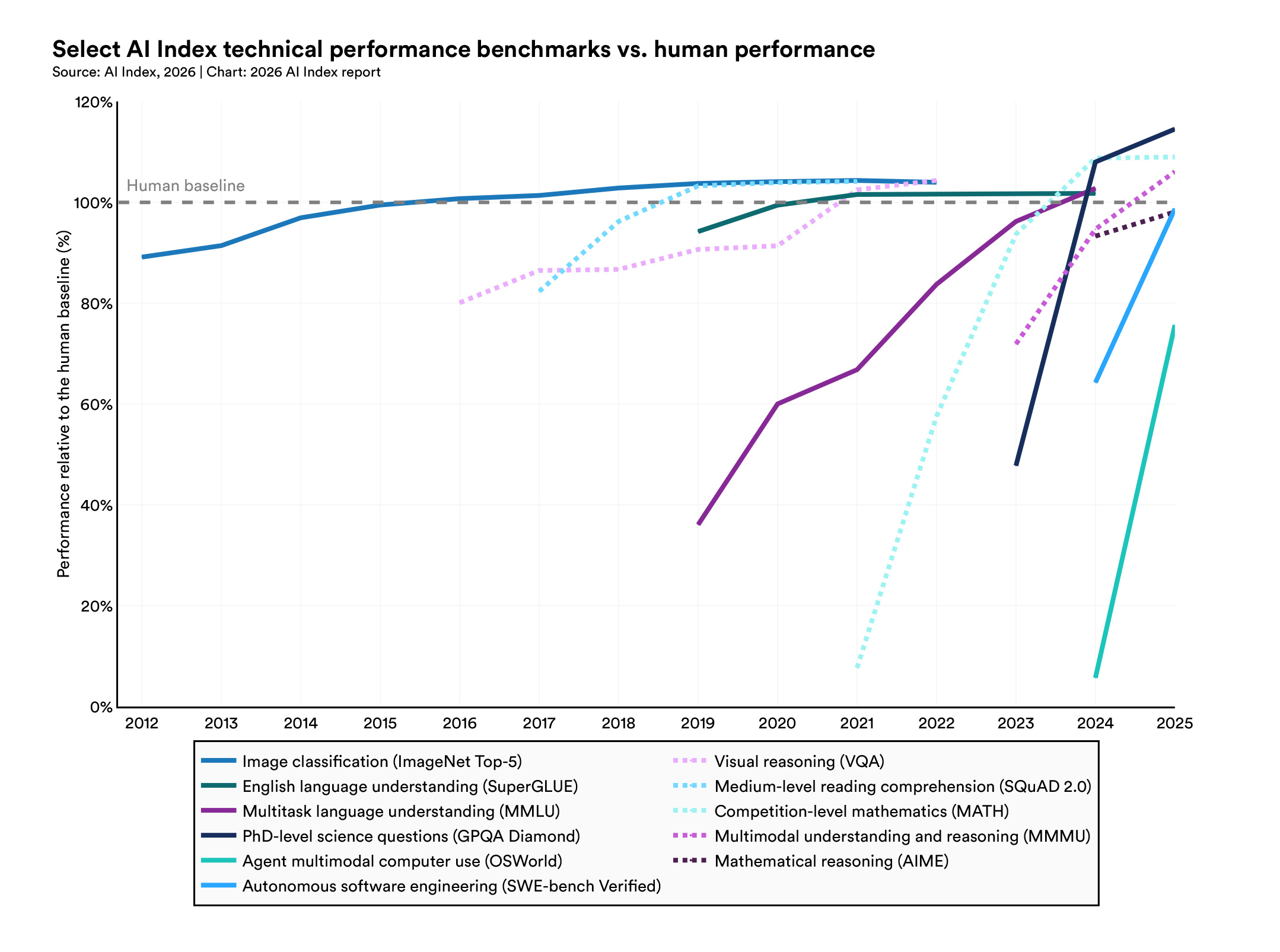
Trace the teal OSWorld line and the mint SWE-bench line on that chart and you have the technical precondition for this entire market. Both were near the floor in 2023 and both are approaching the human baseline by 2025. Sourcing is a multi-step computer task: open a source, read a profile, judge it against a brief, decide the next query. Until models could chain those steps reliably, "autonomous sourcing" was a demo. The commercial consequence arrived roughly a year later, which is exactly when the funding did.
3. The Rubric: Six Criteria That Decide a Sourcing Agent
Ranking sourcing agents on features produces a useless list, because every vendor ships every feature on the slide. The criteria below are the ones that actually separate products in a pilot, ordered by how often they decide the outcome. Each is written as a question you can answer in a trial rather than a category you can nod along to.
The first and heaviest criterion is where the profiles come from. An agent is bounded by its data: it cannot find a person it has never seen. LinkedIn's agent works inside the richest professional graph in existence but cannot look outside it. hireEZ claims 1 billion open-web profiles and pulls from public sources across the internet - PR Newswire. Gem unifies 800 million profiles with your own ATS and CRM history. Workable's agent searches a 400 million profile pool it owns. These are not interchangeable. For a niche engineering role, GitHub and conference data beat sheer volume; for a sales role in a mid-sized market, LinkedIn's graph is close to unbeatable.
The second is screening fidelity, which means how the agent decides who is good. There are two mechanisms in the market and they behave very differently. Keyword and skill-tag matching is fast, cheap, and fails on anything a title does not capture. Language-model screening reads the profile against your written requirements the way a human would, catches transferable experience, and costs more per candidate. If you are hiring for a role where the qualification lives in a project description rather than a job title, this criterion outweighs everything else on the list.
The remaining four criteria are quickly stated but each one has killed a deployment somewhere:
- Autonomy shape - does it run unattended, or pause for approval at each step?
- Outreach ownership - does it send from your domain, and can it handle replies?
- Write-back integration - does anything it does reach your ATS without a CSV?
- Explainability - can it show why it picked or rejected each person?
Those four are ordered roughly by how often they surprise buyers after signature. Autonomy shape matters because a "semi-autonomous" product, which hireEZ openly brands as guided autonomy, still consumes recruiter attention per step, so the labour saving is far smaller than the demo implies. Outreach ownership matters because sending from a shared vendor domain quietly destroys deliverability and attribution. Write-back matters because an agent that cannot update your ATS creates a second system of record, and within a quarter your data is split across two places that disagree. Explainability matters because it is the only thing standing between you and an undefendable rejection, which chapter 12 covers in detail.
Each of those four is testable in a trial, and none of them requires technical knowledge to test. For autonomy shape, count the clicks: work one role end to end and record every point where the software waited for you. For outreach ownership, send yourself a message from the agent and read the raw headers, or simply ask the vendor which domain the mail leaves from and whether replies land in your inbox or theirs. For write-back, advance a candidate and then look in your ATS ten minutes later. For explainability, take one rejected candidate you personally believe was strong and ask the system why it passed. If the answer is a number, the criterion has failed, whatever the documentation says.
The reason data breadth sits above screening fidelity on this list, rather than the other way round, is that screening failures are visible and recoverable while retrieval failures are invisible and permanent. If an agent screens badly, you see it immediately: the shortlist is full of people who do not fit, and you can tighten the brief or change the tool. If an agent never retrieves the right people at all, the shortlist looks plausible, nothing appears to be wrong, and you simply never meet the candidates you should have met. There is no error message for a talent pool you did not know existed, which is why the first question in any evaluation should be about the index rather than the intelligence.
The sixth criterion is cost shape, and it is last on the list only because it is the easiest to negotiate. What matters is not the headline number but what the number meters. Per-seat pricing rewards teams with few recruiters and many roles. Per-agent pricing, which Juicebox uses at $199 per agent per month, rewards teams that run a small number of continuous searches. Credit-based pricing punishes exploration, because every profile you look at costs money and recruiters start rationing curiosity. Consumption models like Workday's Flex Credits shift the risk onto you unless you can forecast volume. Match the meter to how your team actually works and you will save more than any discount you negotiate.
It is equally worth naming what this rubric deliberately ignores. Profile-count claims are close to meaningless as a comparison: a billion profiles that are three years stale is a worse asset than two hundred million refreshed weekly, and no vendor publishes refresh rates. Model choice is similarly irrelevant to buyers, because every vendor uses roughly the same frontier models and swaps them quarterly; what differs is the workflow around the model, which is what the six criteria actually measure. And integration counts, the "connects to 60+ ATS systems" line, tell you nothing about integration depth, which is the only thing that matters when you need a status to sync in both directions rather than a candidate to land in a pile.
Score a shortlist of three vendors against these six in a spreadsheet before you take a single demo and the demos become much shorter, because you will be asking questions the deck was not built to answer. That is precisely the point: a vendor who can answer all six comfortably has built a sourcing agent, and one who deflects on two or more has built something else and named it an agent.
4. The Best AI Sourcing Agents in 2026, Ranked
This ranking covers products whose primary job is finding people who have not applied. Inbound screening agents, interview agents, and full HR suites appear in chapter 5, because comparing them here would flatter them unfairly: they are excellent at a different job. Each entry states what the agent actually does, what it costs, who it fits, and where it falls down, because a recommendation without a downside is an advert.
One note on prices before the list. Roughly half of this category refuses to publish pricing, which is itself a signal about who they sell to. Where a vendor publishes a number, it is cited to their own page. Where they do not, the figure comes from third-party buyer data and is labelled as such. Treat unlabelled prices you read elsewhere in this category with suspicion, because vendor pricing pages are JavaScript-rendered and most AI-written comparison articles simply invent the numbers.
4.1 LinkedIn Hiring Assistant
What it does: LinkedIn's Hiring Assistant is the reference implementation of the category and the one every other product is measured against. It runs a structured intake conversation, turns your goals into a sourcing strategy, executes dozens of searches across LinkedIn's graph, evaluates applicants as well as passive candidates, drafts personalized outreach, and pre-screens people who reply. It reached general availability in English at the end of September 2025 - LinkedIn, and now also runs in German and French.
The published results are strong enough to be worth quoting precisely: LinkedIn reports 81% fewer profiles reviewed to reach qualified matches, a 66% higher InMail acceptance rate versus traditional sourcing, and about 1.5 hours saved per role identifying top applicants - LinkedIn. Expedia Group cut 30 days off its time-to-hire using it. The February 2026 quarterly release added Microsoft Teams collaboration, AI Follow-Ups, AI Applicant Targeting, and Verified Applicant Spotlight, which is the cadence you should expect from a product with Microsoft's engineering budget behind it.
Pricing: not published. Hiring Assistant is an add-on to LinkedIn Recruiter, so the real cost question is your Recruiter contract, which is negotiated per seat and per market. Ask specifically whether the add-on is priced per seat or per project, because the answer has changed during 2026 for some accounts.
Best for: teams whose hiring happens inside LinkedIn's graph anyway, and who value message deliverability more than data breadth. The InMail acceptance advantage is real and comes from LinkedIn owning the inbox.
Where it falls down: it cannot see outside LinkedIn. For engineering, research, and trades roles where the strongest signal lives on GitHub, in publications, or on niche communities, the agent is blind to exactly the evidence that matters. It also deepens a dependency that is already your largest recruiting line item.
The clip below is a useful outside view of what changed when this shipped, recorded shortly after general availability, and it is worth watching for the framing of what recruiters stop doing rather than what the software starts doing.
How LinkedIn's AI Hiring Assistant Is Changing Recruiting
4.2 Juicebox
What it does: Juicebox began as PeopleGPT, a natural-language search over more than 30 data sources, and has become the most credible agent-first challenger in the category. You describe the person you want in plain English, and the platform searches, enriches, and runs outreach. Its Agents product is the part that matters here: it runs continuously in the background rather than per query, auto-shortlisting and auto-emailing as new people match.
The company's trajectory tells you how the market is valuing this bet. Juicebox raised a $30 million Series A led by Sequoia in September 2025, then $80 million at an $850 million valuation in March 2026, led by DST Global with Sequoia, Coatue and Y Combinator participating - Juicebox. That is a nine-month step-up that only happens when usage is compounding.
Pricing: published, which is rare here and worth rewarding. Plans start at $99 per seat per month, with a free tier, mid-tiers around $179 per seat, and the autonomous Agents add-on at $199 per agent per month - Juicebox. Contact credits are metered per tier (500 on the entry paid plan, 1,500 higher up), which is the number to model, not the seat price.
Best for: startups and agencies that want genuine autonomy without an enterprise procurement cycle, and teams that value transparent pricing enough to self-serve.
Where it falls down: the credit meter is the real cost and it is easy to underestimate. If your agent runs continuously across several roles, contact credits become the binding constraint long before seats do. The agent add-on also prices per agent, so a team running eight parallel searches is looking at a very different bill than the headline $99 suggests.
4.3 hireEZ
What it does: hireEZ is the most established outbound sourcing platform to have committed publicly to agents, and it is unusually honest about the shape of that commitment. It launched its agentic layer in March 2025 under the explicit banner of semi-autonomous recruiting - PR Newswire, automating sourcing, screening, outreach, scheduling and analytics while keeping the recruiter at the decision points. EZ Agent extends this into autonomous phone and chat screens with structured questions, returning standardized comparisons.
In July 2026 the company unified its 1 billion open-web profiles with Nexxt's nurtured audience and Talroo's active job seekers into a single agentic workflow, which is a genuinely interesting structural move: it puts passive, nurtured and active candidates into one pipeline instead of three tools. The Nexxt integration is live for customers now, with Talroo rolling out through design partners.
Pricing: not published. There is no self-serve plan and no public price page, only a sales-gated 14-day trial. Third-party buyer data puts entry licences in the region of $169 to $199 per recruiter per month with a median annual contract near $13,000, and enterprise accounts materially higher - Pin's hireEZ pricing analysis. All plans bill annually.
Best for: mid-market and enterprise teams that need open-web reach beyond LinkedIn and can live with a human in the loop at each decision point.
Where it falls down: guided autonomy is a real design choice with a real cost. Every approval gate is recruiter attention, so the productivity gain is a fraction of what a fully autonomous loop delivers. The annual-only, sales-gated model also makes a genuine like-for-like pilot against a self-serve competitor harder than it should be.
4.4 Gem
What it does: Gem is the strongest example of the CRM-first path into agents. Rather than treating sourcing as a search problem, it treats it as a relationship-data problem: its AI Sourcing Agent translates a plain-language description into searches that pull from 800 million profiles, your existing ATS pipeline, and your CRM history at once, returning match scores with stated reasoning. Its 2026 releases added AI Rediscovery, AI Talent Insights and Ideal Profiles - Gem.
Rediscovery deserves attention because it is the most underrated agent workflow in the market. Most companies already hold hundreds of qualified people who were rejected for timing rather than ability. An agent that continuously re-reads that pool against new requisitions finds hires at zero sourcing cost, and it is the one use case where the ROI arithmetic is trivially obvious.
Pricing: not published on Gem's site. Buyer data from Vendr, drawn from 218 verified purchases, puts the median annual contract at $24,900, with a range from roughly $7,000 to $71,000 - Vendr. G2's aggregated data shows per-seat figures starting around $135 per month.
Best for: in-house talent teams with real pipeline history, where the CRM and rediscovery angle turns existing data into hires.
Where it falls down: the value proposition weakens sharply if you have no pipeline history to mine, which makes it a poor first purchase for a young company. Contract sizes also cluster well above the self-serve challengers, so it is rarely the right answer for a team of two.
4.5 SeekOut
What it does: SeekOut is the deep-vertical specialist, with 1 billion+ profiles and roughly 750 customers, and it has spent 2026 rebuilding around agents rather than bolting them on. Workspaces turns a job description into a ranked shortlist in one step. Sam runs structured, rubric-based interviews asynchronously and returns comparable results. Spot combines agentic AI with human recruiters to deliver interview-ready candidates as a service - SeekOut.
The most forward-looking piece is SeekOut MCP, which exposes candidate search directly to Claude, ChatGPT, Gemini and Copilot across seven talent verticals with fourteen guided workflows. This matters more than it sounds. It means the recruiter's interface stops being SeekOut and starts being whatever assistant they already have open, which is where chapter 14 argues the whole market is heading.
Pricing: not published. Third-party reviews consistently place annual contracts in the $10,000 to $30,000 range depending on seats and verticals, and the vertical modules (healthcare, engineering, security clearance) are priced separately.
Best for: teams hiring into specialised verticals, particularly healthcare and engineering, where the vertical-specific data is worth more than raw profile count.
Where it falls down: pricing opacity plus per-vertical modularity means the quoted number and the number you eventually pay tend to diverge. Teams doing generalist hiring often find they are paying for depth they never touch.
4.6 HeroHunt.ai
What it does: HeroHunt.ai runs a full autonomous loop over the open web rather than a single network. Its AI Recruiter takes a written brief, searches public sources including GitHub and Stack Overflow alongside mainstream professional profiles, screens each candidate with a language model against every requirement in the brief rather than keyword-matching a title, and then writes and sends personalized outreach. RecruitGPT produces a shortlist from a single prompt. The design bet is that screening quality, not index size, is what limits sourcing outcomes.
Pricing: a free 8-day trial (card required), then flat monthly plans from $99 with unlimited positions, metered on AI-screened and matched profiles and candidate emails rather than sold per seat. Because it is the platform this guide is published on, treat that as disclosure rather than a recommendation and verify the current plan structure yourself before buying.
Best for: teams hiring technical or hard-to-title roles, where the qualifying evidence sits in a repository or a project description rather than a job title, and teams that want to test autonomous sourcing without a procurement cycle.
Where it falls down: it is not an ATS and does not try to be, so it sits alongside your system of record rather than replacing it. Open-web coverage is also uneven by geography and function: it is strong where people publish work publicly and weaker in fields where they do not, which is the mirror image of LinkedIn's blind spot.
HeroHunt.ai
If the roles that break your sourcing are the ones where the title tells you nothing, this is the specific bet worth testing: HeroHunt.ai screens each profile with a language model against your written brief across public sources like GitHub, instead of matching keywords inside one network. There is a free 8-day trial and plans start at $99 a month, so a single hard role is a cheap experiment. The honest caveat: it is a sourcing layer, not an ATS, so you still need your system of record, and its coverage is weakest in fields where people do not publish work publicly.
4.7 Tezi
What it does: Tezi's agent, Max, was one of the first products to claim full autonomy across the funnel and reached general availability in March 2025 - Tezi. It builds the sourcing list, runs email sequences, reviews resumes, screens candidates and schedules interviews, integrating with existing ATS platforms. The company raised $9 million in seed funding led by 8VC and Audacious Ventures, with the founding CEOs of Instacart and Thumbtack participating as angels.
Tezi is unusually specific about outcomes, which is worth noting in a category that mostly speaks in percentages. Within its first months of general availability the company reported dozens of customers across nearly 100 roles, tens of thousands of candidates sourced, more than 1,000 candidates screened and scheduled, and roughly 10,000 recruiting hours saved. It also states SOC 2, CCPA and New York City Local Law 144 compliance up front, which is a meaningful signal in this market.
Pricing: not published. Sold through sales conversation.
Best for: small in-house teams hiring a handful of roles at once who want one system to carry a search from brief to scheduled interview without a recruiter operating it.
Where it falls down: it is a young company with a small customer base relative to the incumbents, which matters for integration depth and support when something breaks mid-search. Full autonomy across the funnel also concentrates risk: when the brief is wrong, the error propagates all the way to a scheduled interview rather than being caught at the shortlist.
4.8 Fetcher, Loxo and Findem
These three are grouped not because they are interchangeable but because they occupy the same decision slot: capable mid-market outbound tools with partial agentic behaviour, chosen mostly on cost shape and existing stack. Fetcher runs managed outbound sourcing campaigns with published tiers, Loxo bundles sourcing into a recruiting CRM aimed at agencies, and Findem builds attribute-based talent search on enriched profile history.
Fetcher is the only one of the three with genuinely public pricing, at roughly $379 to $499 per month on Growth and $649 to $849 on Amplify, with Vendr putting the median annual contract near $11,000 - Vendr. Loxo's Basic plan sits in the $169 to $209 per user per month range, with higher tiers undisclosed. Findem does not publish pricing at all.
For most buyers these are the sensible answer to a narrow question rather than a platform decision. If you already run an agency CRM, Loxo removes a tool. If you want outbound campaigns without building the muscle in-house, Fetcher is the lowest-friction option in the category. If your differentiator is finding people by career attributes rather than current title, Findem's model is genuinely distinct. What none of them currently offer is the unattended, continuous loop that defines the top of this ranking, so treat them as strong assistive tooling with agentic edges rather than as delegation.
4.9 The ranked list, side by side
The summary below scores the ranked agents against the criteria from chapter 3 that most often decide a pilot. It is deliberately blunt: the point is to make the trade-offs visible rather than to award everyone a participation medal.
| Platform | Data reach | Autonomy | Pricing transparency | Best fit |
|---|---|---|---|---|
| LinkedIn Hiring Assistant | LinkedIn graph only | Full loop, in-network | None | Commercial roles, deliverability |
| Juicebox | 30+ sources | Full, always-on agents | Published | Startups and agencies |
| hireEZ | 1B open-web + partners | Guided, human gates | None | Enterprise open-web reach |
| Gem | 800M + your CRM | Full on sourcing and rediscovery | None | Teams with pipeline history |
| SeekOut | 1B + verticals | Full, plus MCP access | None | Specialised verticals |
| HeroHunt.ai | Open web incl. GitHub | Full loop, LLM screening | Published, from $99/mo | Hard-to-title technical roles |
| Tezi | Sourcing + ATS | Full funnel to scheduling | None | Small teams, few roles |
| Fetcher / Loxo / Findem | Mid-market indexes | Partial | Partial | Narrow, stack-driven choices |
Read the transparency column next to the autonomy column and a pattern appears that is worth naming. The products that publish prices are, almost without exception, the ones that expect you to try before you talk to anyone, and they are also the ones that had to make autonomy work without a services layer propping it up. That correlation is not a guarantee of quality, but it is a decent prior: a product designed to be self-served has to be genuinely autonomous, because there is no implementation consultant standing behind it.
5. The Enterprise Suites: Agents You Get Whether You Wanted Them or Not
For a large share of companies the sourcing agent decision will not be a purchase at all. It will arrive inside the HR platform you already run, switched on by a release note. This is the quietest and most consequential dynamic in the 2026 market, because a bundled agent that is merely adequate beats a superior standalone agent that requires a new contract, a new integration, and a new security review.
Workday is the clearest case and has been the most aggressive buyer. It acquired Paradox, the conversational hiring platform behind Olivia, for approximately $1 billion, completing the deal on 1 October 2025 - Workday. That sits on top of its Illuminate agent line, which includes a Recruiter Agent that General Motors used to cut candidate screening by 70%, and a Contingent Sourcing Agent that moved from early adopters at the end of 2025 to broader availability during 2026 - Workday. Pricing runs through Workday Flex Credits, a consumption model rather than a per-seat one, which is a meaningful shift: you are no longer buying licences, you are buying agent work.
The rest of the suite field moved on a similar cadence through late 2025 and the first half of 2026. iCIMS announced its AI Sourcing Agent on 20 October 2025 as the first agent in its intelligent network, automating talent discovery, matching and engagement inside iCIMS CXM - iCIMS. SmartRecruiters launched Winston, a set of agents covering conversational apply, explainable matching, and automated screening, reporting a two-times increase in candidate conversion from Winston Chat and a 75% reduction in manual screening from Winston Screen - SmartRecruiters. Workable shipped Workable Agent on 13 March 2026, searching a 400 million profile database, running structured intake before the job description is written, and shipping as a free upgrade to every Workable Recruiting account - GlobeNewswire.
That last detail is the strategically important one. When a mid-market ATS gives every existing customer an agent at no extra cost, the price floor for basic agentic sourcing collapses to zero for a large slice of the market. Standalone vendors then have to justify their entire contract on quality of screening and breadth of data, not on the existence of an agent. Expect that pressure to intensify through 2027.
The high-volume frontline segment is a separate world with its own physics, and it is where multi-agent systems are furthest along. Josh Bersin's July 2026 analysis of the segment notes that fewer than 5% of employers with frontline workforces currently use agentic recruitment tools, out of more than a million such employers worldwide, while the deployments that do exist compress time-to-hire from two weeks to three days and eliminate entire call-centre scheduling functions - Josh Bersin. Maki People's assessment-plus-agent deployment at H&M produced a 30% retention improvement in many locations, which is a quality outcome rather than a speed one and therefore much harder to dismiss.
The demo below shows Eightfold's Candidate Agent, launched in mid 2026, handling candidate inquiries across web, mobile and Slack. It is worth watching because it makes the inbound-versus-outbound distinction from chapter 1 concrete: this is an agent doing excellent work on people who already raised their hand, which is a different job from finding people who have not.
Eightfold's Candidate Agent in action
The practical guidance for buyers is uncomfortable but simple. If you run Workday, iCIMS, SmartRecruiters or Workable, pilot the agent you already own before you buy another one, and hold the standalone vendors to the difference rather than to the absolute. In most cases the bundled agent will handle the inbound half competently and leave a genuine gap on outbound discovery, and that gap is the only thing a standalone purchase needs to justify. Where the bundled agent handles both, the honest answer is that you do not need a second product, and no amount of feature comparison will change that.
6. What They Actually Cost
Pricing in this category is deliberately hard to compare, and the difficulty is not accidental. Roughly half the vendors publish nothing, most meter on units that are not seats, and almost every third-party comparison article you will find contains invented numbers, because vendor pricing pages render in JavaScript and cannot be scraped. What follows uses published prices where they exist and clearly labelled buyer data where they do not.
The first thing to understand is that the seat price is rarely the real price. Contact credits, agent instances, enrichment, and per-vertical modules routinely exceed the licence cost. A team on a $99 seat that runs three continuous agents and burns 4,000 contact credits a month is not on a $99 plan in any meaningful sense. Model the whole thing, then compare against the alternative you are actually displacing, which for most teams is agency fees at 15% to 25% of first-year base salary rather than another piece of software.
Here is the comparable picture across the standalone agents, restricted to entry-level per-recruiter pricing so the numbers mean the same thing.
Entry price per recruiter seat, per month (2026)
Two of those five bars are published by the vendor and three come from buyer data, which is itself the finding. The spread from $99 to $379 does not reflect a fourfold difference in capability. It reflects different go-to-market choices: the self-serve challengers price to be tried, and the sales-led incumbents price to be negotiated. In practice the negotiated contracts land closer together than the entry prices suggest, with Vendr's data putting the median annual Gem contract at $24,900 and the median Fetcher contract at $11,000.
The table below adds the vendors that cannot be charted because they publish no per-seat number at all, and states where each figure comes from so you can weigh it.
| Platform | Entry price | What it meters | Source of the number |
|---|---|---|---|
| Juicebox | $99/seat/mo | Seats + contact credits + $199/agent/mo | Published |
| Gem | ~$135/seat/mo | Seats, agents unlimited on higher tiers | G2 / Vendr buyer data |
| Loxo | $169/user/mo | Seats within a recruiting CRM | Third-party review |
| hireEZ | ~$199/user/mo | Seats + contact credits + modules | Buyer data, annual billing only |
| Fetcher | $379/mo | Managed outbound campaigns | Published tiers |
| SeekOut | Not published | Seats + verticals | Third-party: $10k-$30k/yr |
| Not published | Recruiter seats + add-on | Negotiated per market | |
| Workday | Not published | Flex Credits consumption | Vendor model, quoted per account |
| Workable | Included | Bundled with Recruiting plans | Published as free upgrade |
| HeroHunt.ai | $99/mo | AI-screened and matched profiles + emails (unlimited positions) | Published, verify current plans |
The row that should change your thinking is Workable's. When agentic sourcing ships free inside an ATS that mid-market companies already pay for, the question stops being "which agent should we buy" and becomes "what does a paid agent do that the free one cannot". That is a much harder question for vendors to answer, and asking it in a sales conversation is the fastest way to find out whether you are talking to a genuine agent or an agent-washed search tool.
Finally, put the software cost next to the cost it is supposed to displace. SHRM's benchmark puts average cost per hire near $4,800, with a median time-to-fill around 44 days. At an agency fee of 20% on a $120,000 role, one avoided placement fee is $24,000, which covers a mid-market agent contract for a year. That arithmetic is why this category is growing even where the technology underdelivers: the bar it has to clear is not perfection, it is one placement fee.
7. Inside the Machine: How a Sourcing Agent Works, Step by Step
Every serious sourcing agent on the market runs a version of the same loop, whatever the branding. Understanding it is the difference between managing an agent and hoping at it, because each stage is a place where quality is won or lost, and vendors differ mainly in which stages they automate fully versus gate behind a human click.
It is worth being clear about what an agent is technically, because the word invites mysticism. An agent is a language model wrapped in a workflow: a set of instructions, a set of tools it is allowed to call (a profile database, an enrichment service, an email sender, a calendar), a memory of what it has already tried, and rules about when to stop and ask a person. When a vendor says the agent "learned from your feedback", they almost always mean the workflow stored your rejection and adjusted the next query, not that a model was retrained overnight. That distinction sets a realistic expectation for how fast an agent improves: within a search, quickly; across searches, only if the product was built to carry that memory.
The diagram below shows the loop as it actually runs, including the two places where a human review gate is normally inserted.
Trace the path from the brief to the first human gate and you have located every quality decision that matters. Query planning determines the candidate universe: an agent that writes narrow queries finds obvious people, and one that writes broad queries floods the screening stage with noise. Retrieval determines whether anyone outside the obvious pool can be found at all. Enrichment determines whether you can actually reach the people you found, which is where most disappointments originate. Screening determines what fraction of the shortlist is worth a recruiter's attention, and it is the only stage where a better language model directly buys a better outcome.
The intake stage deserves more respect than it usually gets, because it is the one stage you control completely. Workable's agent runs a structured intake conversation that pins down must-haves, nice-to-haves and disqualifiers before a job description exists, and LinkedIn's runs a similar conversation to convert hiring goals into a sourcing strategy. This is not a formality. An agent given "senior backend engineer, Berlin, fintech experience" will produce a technically correct and commercially useless shortlist. An agent given "we need someone who has personally owned a payment ledger through a migration, so payment-adjacent titles matter less than the migration story" produces something a hiring manager will actually read. The brief is the program, and most disappointing pilots are disappointing because the brief was three lines long.
The final stage, feedback, is where products separate over months rather than days. A weak implementation stores your thumbs-down and shows you fewer of that exact profile. A strong one infers the underlying criterion, applies it to the next query, and carries it into the next role you open. When you evaluate agents, reject fifteen candidates in a trial and watch what the sixteenth batch looks like. If nothing changed, the loop in the diagram is decorative, and you are looking at a search tool that runs on a timer.
8. The Data Layer Nobody Talks About
An agent cannot find a person it has never seen, cannot contact a person whose email it does not hold, and cannot judge a person whose profile is three years stale. Everything in the ranking above ultimately rests on a data layer that almost no vendor discusses in a sales conversation, and understanding it is the most reliable way to predict whether a pilot will work before you run it.
There are three distinct data problems and they are usually solved by three different suppliers. Discovery data is the index of who exists and what they have done, sourced from public professional profiles, code repositories, publications, company sites and job boards. Contact data is the email address and phone number, which decays faster than anything else in the stack because people change jobs. Signal data is everything that tells you whether someone might move: tenure, recent title changes, funding events at their employer, open-source activity. Vendors that claim a billion profiles are almost always describing discovery data, and the number tells you very little about the other two.
The economics are worth knowing because they explain vendor behaviour. Most teams pay somewhere between $0.01 and $1.50 per enriched record in 2026 depending on method and provider, with the commodity middle of that range around a few cents - Cleanlist. People Data Labs sells access to 1.5 billion+ profiles from roughly $98 per month at the entry tier, and Coresignal's API starts near $49 per month with premium tiers around $1,500. When a sourcing platform meters you on contact credits, this is the cost it is passing through, usually with a healthy margin. It is also why credit limits tighten when you least want them to.
Here is the supplier layer most sourcing agents are quietly built on, with what each is actually good at, so you can recognise the ingredients when a vendor describes their index.
| Provider | Scale claimed | Strongest at | Entry price |
|---|---|---|---|
| People Data Labs | 1.5B+ profiles | Person-level discovery data | From $98/mo |
| Coresignal | Company + job data | Firmographics and job postings | From $49/mo |
| Apollo.io | 275M+ contacts | Emails and direct dials, free tier | Free, paid from $49/seat/mo annual |
| Open-web crawl | Varies by vendor | GitHub, publications, niche communities | Built in-house |
| Your own ATS | Your history | Rediscovery, warm candidates | Already paid for |
The last row is the one most teams undervalue and the first one they should exploit, because it costs nothing and carries no coverage risk. The row above it is the one that separates platforms: a vendor that runs its own open-web crawl can find evidence no licensed dataset contains, which is precisely why open-web platforms outperform on technical roles and underperform where people keep no public footprint.
For teams that want to sanity-check what an agent is telling them, keeping an independent contact-data source is a cheap and unglamorous habit that pays for itself. Apollo.io is the usual choice here simply because it has a free tier and a browser extension, so a recruiter can spot-check a candidate in ten seconds without a procurement conversation. A verified email that the agent could not find is a candidate you can still reach; a bounce rate that only shows up in one tool is a data problem rather than a market problem.
Apollo.io
The cheapest way to test whether a sourcing agent's contact data is any good is to check a sample against an independent source. Apollo.io has a free plan that grants 900 credits per seat per year, released monthly, plus email credits capped by fair use at 10,000 a month on a verified corporate domain (only 100 on a personal domain like Gmail). Run forty candidates through both and compare. The honest caveat: Apollo is a B2B sales database first, so its coverage of engineering and non-commercial roles is noticeably thinner than a recruiting-specific provider, and its paid Basic tier jumps to $65 per seat month-to-month against $49 billed annually.
The legal ground under this layer has also shifted, and it is now a genuine procurement question rather than a technicality. Scraping-related litigation between the large platforms and data providers has made some previously popular profile APIs unavailable or unreliable, and a sourcing agent whose index depends on a single contested source carries a continuity risk your contract will not cover. Ask any vendor two direct questions: which suppliers sit behind your index, and what happens to my searches if one of them disappears. A vendor that owns its crawl and blends several suppliers will answer easily. One that resells a single API will not.
The practical consequence for buyers is that data breadth and screening quality trade off against each other in ways that should map to your roles. If you hire commercially in mature markets, a deep single-network index plus good screening will outperform a broad shallow one. If you hire technical, research or trades talent, breadth wins, because the qualifying evidence lives outside professional networks entirely. And if you hire in emerging markets, test coverage before anything else, because every vendor's profile count is heavily weighted toward North America and Western Europe regardless of what the marketing implies.
9. Where Sourcing Agents Genuinely Win
There are four situations where delegating sourcing to an agent produces results that a human recruiter cannot match on cost, and it is worth being precise about them, because the vendor claim that agents help everywhere is what makes buyers distrust the claim that they help anywhere.
The first and strongest is continuous search on a slow-burning role. Human sourcing is bursty: a recruiter works a role hard for a week, then attention moves to the next fire. An agent runs the same search every day for three months without getting bored, which matters because the person you want was not on the market in week one. This is the use case that justifies per-agent pricing, and it is why Juicebox prices its always-on agents separately from seats.
The second is rediscovery of your own pipeline. Most companies with two years of hiring history hold hundreds of people who were qualified but rejected for timing, budget or a marginally stronger competing candidate. An agent that re-reads that pool against every new requisition finds hires at effectively zero sourcing cost, and the data is already yours, so none of the coverage problems in chapter 8 apply. Gem built a specific product around this and it is the single highest-confidence ROI case in the category.
The third is high-volume screening at the top of the funnel, where the volume is genuinely unmanageable by hand. This is where the frontline segment lives, and the numbers there are the most convincing in the market: time-to-hire compressed from two weeks to three days, entire scheduling functions eliminated, and in Maki People's H&M deployment a 30% retention improvement that suggests the matching is getting better rather than merely faster.
The fourth is searching outside your own knowledge, which is the least discussed and possibly the most valuable. Every recruiter has a mental map of where good candidates come from, and that map is both an asset and a cage. LinkedIn's reported 81% reduction in profiles reviewed comes partly from the agent surfacing pools a recruiter would not have thought to query. An agent has no loyalty to the five companies you always poach from, which is worth something in a market where everyone is poaching from the same five companies.
What unites all four is that the agent is doing something that is boring, continuous, or outside habit, rather than something that requires judgement about a specific human being. That is the correct dividing line, and it holds up better than any of the industry's attempts to draw it by seniority or function. A senior search can be agent-sourced very effectively; a senior offer conversation cannot be agent-run at all. Keep the line at the nature of the task rather than the level of the role and your deployment decisions will be right more often than not.
10. Where They Break: The Honest Failure Map
Sourcing agents fail in patterned, predictable ways, and knowing the patterns is worth more than any feature comparison, because every one of these failures is survivable if you expect it and expensive if you do not. Gartner's projection that more than 40% of agentic AI projects will be cancelled by the end of 2027 is not a prediction about the technology. It is a prediction about deployments that hit these failures without a plan.
The most fundamental failure mode is error compounding across steps, and it is a property of chained autonomy rather than a bug in any product. A system with a 5% error rate at each step does not have a 5% error rate over a five-step trajectory: small per-step errors accumulate into a materially higher chance that the whole run went somewhere wrong. In sourcing terms, a slightly misread requirement at intake becomes a slightly wrong query, which becomes a systematically skewed candidate pool, which becomes outreach to the wrong people at scale. This is exactly why the human gates in chapter 7 exist, and why the shortlist gate is the one you should never remove.
The second is fragmented agents that cannot see each other's work. As teams buy an agent for sourcing, another for screening, and another for scheduling, each solves its slice without access to what the others learned. A sourcing agent that never reads the intake notes will keep sourcing against a stale brief; a screening agent that never hears what the recruiter heard on the intro call will keep scoring on the written requirements alone - Metaview. The fix is not more agents. It is insisting that whatever you buy writes back into one place that everything else reads.
The third cluster is data failure, and it shows up in three flavours that get confused with each other:
- Stale contact data producing bounces that look like disinterest
- Coverage gaps in geographies or functions the index barely holds
- Confident wrong inferences about seniority, tenure or current employer
Each of these has a different fix and misdiagnosing them wastes a quarter. Bounces are a supplier problem and are fixed by adding an enrichment source. Coverage gaps are a product-fit problem and cannot be fixed at all, only worked around by changing tool for those roles. Confident wrong inferences are a screening problem, and they are the dangerous one, because an agent that states a candidate has eight years of experience when the profile supports four will produce a shortlist that reads beautifully and interviews badly. Spot-check ten profiles against their source during any trial, specifically looking for claims the agent made that the underlying data does not support.
The fourth failure is the adversarial one, and it grew fastest during 2026. Candidates now use AI too, which means agents are increasingly screening artefacts produced by other agents. Gartner projects that by 2028 one in four candidate profiles worldwide could be fake - HR Dive. The FBI has documented more than 300 US companies that unknowingly hired North Korean operatives using stolen identities and AI-generated personas. InCruiter, after deploying deepfake detection in early 2026, found fraudulent activity in 25% to 30% of flagged interview sessions, roughly double what human interviewers had been catching. A sourcing agent that scores a profile without any identity signal is, in this environment, scoring a document rather than a person.
The last failure is the least technical and the most common: an agent deployed without an owner. The teams that succeed assign one person to read what the agent did each week, correct the brief, and kill searches that are producing noise. The teams that fail switch it on, let it run, and discover three months later that it has been sending mediocre outreach to a broad pool in their name. Agents do not reduce management overhead to zero. They convert recruiter time from doing into supervising, and if nobody is assigned to supervise, the work simply degrades quietly at scale.
11. The Outreach Problem: Why Volume Is Making Sourcing Worse
Sourcing agents create an externality that no vendor will put on a slide: they make outbound recruiting harder for everyone, including the people using them. This is the most important strategic consideration in the category and it is almost entirely absent from the buying conversation.
The mechanism is straightforward. When contacting a hundred candidates costs a recruiter two hours, volume is naturally rationed. When it costs an agent nothing, volume is rationed only by candidate patience, and candidate patience is a shared resource. The measurable result is already visible in the data: connection-request reply rates fell from 3.5% in May 2025 to 2.2% in April 2026 as low-effort automation flooded inboxes, and a senior engineer now receives five to ten recruiter messages a week - Pin's outreach benchmark data. Every agent deployment makes the next one slightly less effective.
Personalization is the standard answer and it is only half true in 2026. Personalized recruiter messages still substantially outperform templates, with well-targeted outreach reaching response rates several times higher than generic sends. But the advantage now comes from evidence rather than mail-merge. A message that references the specific system a candidate built reads as human because a human, or a very good screening step, actually read the profile. A message that says "I was impressed by your work at Acme" reads as machine output precisely because it is the shape every machine produces. The candidate-side detector for this has become extremely well calibrated.
The trust data confirms it is not just an inbox-volume problem. Only 26% of job applicants trust AI to evaluate them fairly, according to Gartner's survey work - Gartner. Separately, roughly 46% of job seekers report that their trust in hiring has fallen over the past year, with a large majority of those attributing the decline specifically to AI. When candidates suspect an automated pipeline, they discount the message before they read it, which means the agent is competing against a prior rather than starting from neutral.
There are three practical implications, and they run against the direction most deployments drift. Send less, not more: an agent that contacts the best 40 people with real evidence will outperform one that contacts 400 with a variable inserted. Sequence tightly rather than endlessly: three touches capture the overwhelming majority of replies a sequence will ever earn, so a seven-step cadence mostly buys annoyance. And send from a real person's real domain, because deliverability and reply rate both collapse when the message comes from a vendor's infrastructure with a shared reputation.
The uncomfortable conclusion is that the correct way to use a sourcing agent is often to have it do more work per candidate rather than more candidates. That is not how most products are marketed, and it is not how most teams configure them. It is, however, what the outreach data has been saying consistently since late 2025, and teams that reorganised around it are the ones still getting replies.
12. Rules and Risk: The 2026 Compliance Picture
The legal position of autonomous sourcing changed twice in the first half of 2026, in both directions, and the net effect is a landscape that is more permissive on paper and more litigious in practice. Both halves of that sentence matter for how you configure an agent.
The permissive half is Europe. The EU AI Act classifies AI used in recruitment and candidate selection as high-risk, which brings documentation, human-oversight, and transparency obligations. Those obligations were due to bite on 2 August 2026. Under the Digital Omnibus on AI, which the European Parliament endorsed on 16 June 2026 by 423 votes to 57 and the Council gave final approval on 29 June 2026, standalone high-risk obligations were deferred by sixteen months, moving the employment deadline to 2 December 2027 - Gibson Dunn. This is a real reprieve and it is also frequently overstated: prohibited-practice rules and transparency provisions were not deferred, so "the EU delayed the AI Act" is a dangerously imprecise summary of what happened.
The American picture is a patchwork moving the same way on legislation and the opposite way in court. Colorado's AI Act, the most far-reaching US state law in this area, was pushed back again: Governor Polis signed SB 189 on 14 May 2026, delaying the effective date from 30 June 2026 to 1 January 2027 while stripping out the duty of care, deployer risk-management programmes and impact assessments - Hunton. Meanwhile Illinois HB 3773 took effect on 1 January 2026, requiring notice when AI is used in employment decisions and prohibiting ZIP codes as a proxy for protected characteristics, and California's Civil Rights Council regulations on automated decision systems have been in force since 1 October 2025. New York City's Local Law 144 bias-audit requirement continues to apply to automated employment decision tools used on city candidates.
The litigation half is where the real exposure sits, and it moved decisively during 2026. In Mobley v. Workday, the court authorised collective notice on 17 February 2026 covering anyone in the US who applied through Workday since September 2020 and was 40 or older, with the opt-in window closing on 7 March. On 22 June 2026, Judge Rita Lin ruled that the core discrimination claims may proceed - Forbes. The doctrinal point that should concern every buyer is the agent theory: the court has allowed claims that the software vendor acted as an agent of the employer, which means liability does not necessarily stop at your procurement boundary.
What this means operationally is less dramatic than it sounds, and it comes down to four habits that cost almost nothing if you build them in from the start. Keep a human decision gate on rejection, not just on advancement, because a system that filters people out without review is the one that draws claims. Keep the explainability output from chapter 1, because a stated reason is the artefact a defence is built on. Keep records of what the agent did, including the queries it ran, for longer than you think you need them, since California's regulations already impose extended record-keeping on automated-decision data. And ask your vendor, in writing, what they will provide if you are asked to produce an audit.
Tezi is worth naming here as the counter-example to the industry norm, because it states SOC 2, CCPA and Local Law 144 compliance in its launch material rather than in an appendix. That posture is cheap for a vendor to adopt and it is a reasonable proxy for whether they have thought about the problem at all. If a sourcing agent vendor cannot tell you how their screening decisions would be explained to a regulator, they have not built for the market they are selling into.
13. How to Run a 30-Day Pilot and Measure It Properly
Most sourcing agent pilots fail for methodological reasons rather than product reasons, which is an expensive way to learn nothing. The two classic errors are running the pilot on an easy role, which proves only that easy roles are easy, and measuring the wrong output, which is almost always volume.
Pick the role first and pick it deliberately. The right pilot role is one you have genuinely struggled to fill, ideally one where you know what a good candidate looks like but have run out of places to look. It should be a role you would otherwise give to an agency, because that is the real economic comparison. Running a pilot on a role your team could fill in a week guarantees an ambiguous result: the agent will fill it, and you will have learned nothing about whether it can do the work you actually need done.
Write the brief properly, because the brief is the product. Spend an hour with the hiring manager producing three things: the two or three non-negotiable qualifications with the evidence that would satisfy each one, the things that look like qualifications but are not, and a named list of three people who would be perfect if they were available. That last item is the highest-leverage input in the whole exercise, because it lets you test retrieval directly: if the agent cannot find people who resemble those three, the data layer is wrong for this role and no amount of prompt tuning will fix it.
Before the agent runs a single search, write down your current numbers for the same role type, because a pilot without a baseline produces an opinion rather than a result. You need four figures from the last two comparable searches: how many candidates your recruiter contacted, what share replied, how long it took to get three people in front of the hiring manager, and what the search cost in recruiter time and agency fees. Most teams do not have these to hand, and the hour spent reconstructing them from the ATS is the most valuable hour of the whole pilot, because it is also the hour where you discover which of your own metrics you have never actually tracked.
Then measure the four things that actually predict whether this will work at scale.
- Qualified rate - what share of the shortlist survives recruiter review
- Response rate - replies per contacted candidate, versus your own baseline
- Time to first credible slate - brief to three interview-worthy people
- Cost per qualified conversation - all-in spend divided by real conversations
Volume is deliberately absent from that list, and so is time saved, because both are trivially gameable by any product and neither correlates with hires. Qualified rate is the single most diagnostic number: a shortlist where 7 of 10 survive review means the screening is doing your job, and one where 2 of 10 survive means you have bought a faster way to generate reading. Cost per qualified conversation is the number to take to a budget conversation, because it is directly comparable to what your agency spend buys.
Run the loop at least three times inside the thirty days, and use the second and third rounds specifically to test learning. Reject a batch with clear reasons, then look at what comes back. Most teams can complete a meaningful pilot in about 30 days and reach a scaled operating rhythm inside 90, but the compressed version only works if you commit a named owner for a few hours a week. An unowned pilot produces an inconclusive result at the end of the month, and inconclusive results default to "no", which is often the wrong answer arrived at by accident.
Three traps account for most pilots that end inconclusively, and all three are avoidable. The first is letting the vendor configure the agent for you, which produces a result you cannot reproduce and a skill your team never acquired: insist on doing the setup yourself with the vendor watching, because the friction you feel is data about what running this at scale will cost. The second is stopping outreach after the first weak batch, which conflates a bad first query with a bad product; almost every agent produces a mediocre first round and a materially better third. The third is judging the agent on candidates who declined, since interest is a market signal about your role and your brand, not a measure of whether the agent found the right people.
Involve the hiring manager from the start rather than presenting results at the end. The single fastest way to calibrate an agent is to put five of its shortlisted profiles in front of the person who will make the hire and ask them to rank the five and say why. Those reasons are exactly what the brief was missing, and feeding them back in is worth more than a week of prompt adjustment. It also converts the hiring manager from a sceptical bystander into a participant, which matters when you later ask for budget.
One final piece of pilot hygiene: keep a control. Have a recruiter work a comparable role by hand over the same period. Vendors will tell you this is unnecessary because their benchmark data covers it. It is not unnecessary, because their benchmark data was not collected on your roles, in your market, with your brand. Two roles, thirty days, one control, four metrics is a complete evaluation, and it is more rigour than most six-figure HR technology purchases receive.
14. What Comes Next: 2027 and the Agent-to-Agent Market
Three shifts are already visible in 2026 product roadmaps and will define the next eighteen months. None of them is speculative: each has shipped somewhere already, just not everywhere.
The first is the interface disappearing. SeekOut's MCP server lets recruiters search and run workflows from inside Claude, ChatGPT, Gemini or Copilot rather than inside SeekOut. Once candidate search becomes a tool that any assistant can call, the sourcing platform stops being a destination and becomes infrastructure. That is excellent for buyers and existentially awkward for vendors whose value was partly the interface, and it will compress pricing for anyone whose product was mostly a well-designed search screen.
The second is the agent-to-agent market, where the candidate has an agent too. This has already begun: Dex raised a $5.3 million seed round led by Notion Capital in April 2026 to build an AI talent agent that job seekers talk to by voice or text, targeting AI researchers and engineers - Fortune. Extrapolate the trend and the endpoint is negotiation between a sourcing agent and a representation agent, with humans reviewing outcomes. That sounds absurd until you notice that the application side already works this way, which is why application volume rose so sharply through 2025 and 2026.
The third is consolidation, and the capital behind it is not subtle. Global corporate investment in AI reached $581.69 billion in 2025, more than double the 2024 figure, with mergers and acquisitions accounting for $214 billion of it.
The capital behind the consolidation
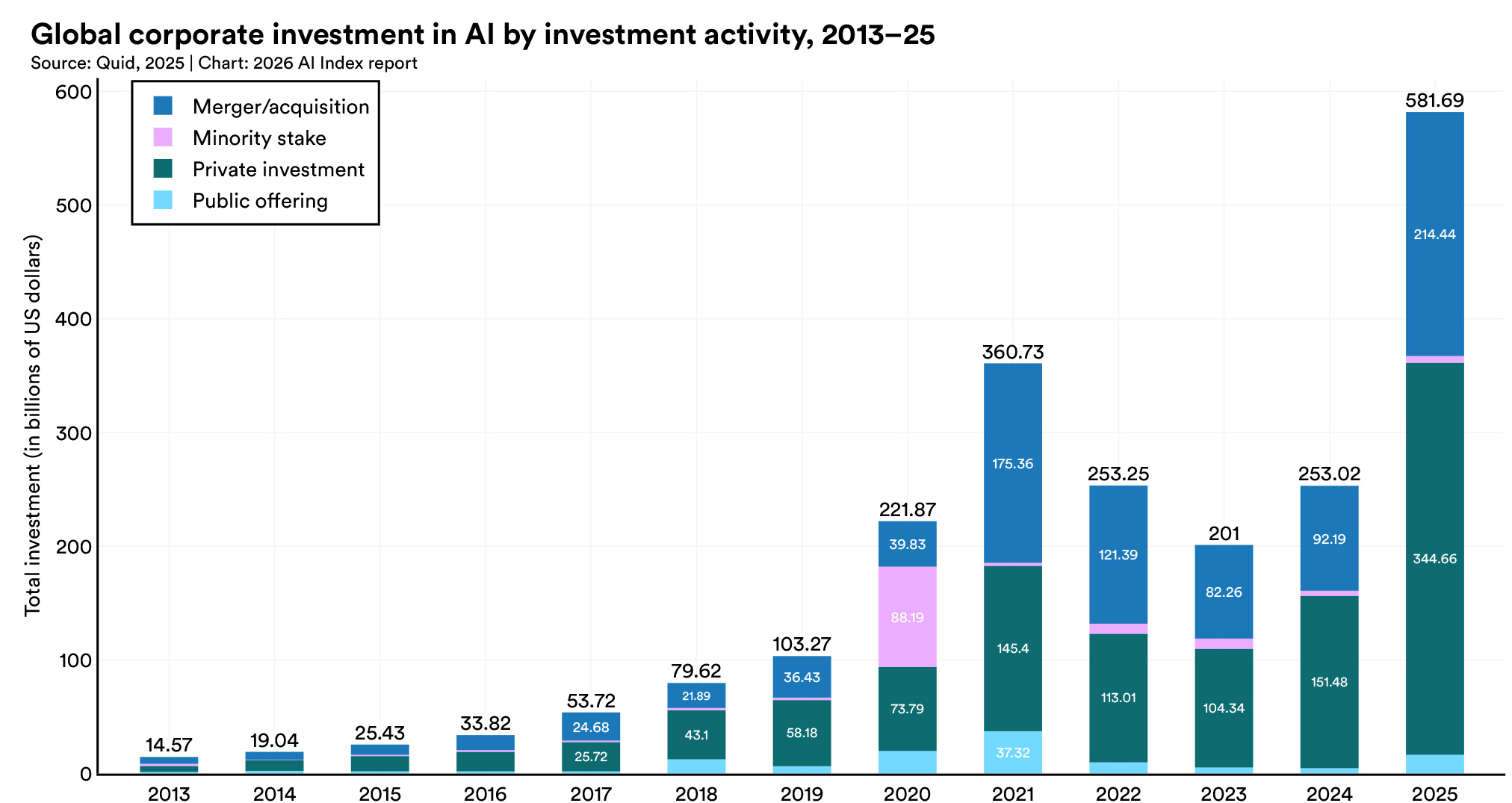
The recruiting-specific version of that chart is Workday buying Paradox for around a billion dollars and HiredScore before it, and it tells you where standalone sourcing agents are heading. The most likely 2027 structure is a small number of suites that bundle adequate agents into contracts companies already hold, and a smaller number of independents that survive on genuinely differentiated data or genuinely better screening. Products whose only differentiator is "we have an agent" will not clear that bar, because by 2027 everyone will.
For buyers, the strategic implication is to avoid long contracts on undifferentiated products, and to weight data ownership heavily in any multi-year decision. A vendor that owns its index and its screening model has something that survives consolidation. A vendor that wraps someone else's API in a good interface has a business that a suite can replicate in a quarter, and you do not want to be mid-contract when that happens.
15. The Decision, in Five Sentences
If your hiring happens inside LinkedIn's graph and message deliverability is your constraint, buy Hiring Assistant and stop shopping, because nothing else owns the inbox. If you want genuine autonomy with transparent pricing and no procurement cycle, Juicebox is the strongest self-serve option in the category right now. If you need open-web reach with enterprise governance and can live with approval gates, hireEZ is the safe incumbent choice, and SeekOut is the better one if you hire into a specialised vertical. If your problem is that titles do not describe the people you need, an open-web platform that screens with a language model against a written brief, such as HeroHunt.ai, is the specific shape of tool that addresses it. And if you already run Workday, iCIMS, SmartRecruiters or Workable, pilot the agent you own before buying anything at all.
Whatever you choose, the operating model matters more than the product. Write a real brief, keep a human gate on the shortlist and on rejection, measure qualified rate rather than volume, send fewer and better messages, and assign one person to supervise the thing. Teams that do those five things get results from mediocre software. Teams that do not will be disappointed by the best product in the market, and will conclude, wrongly, that the category does not work.
Test it on one role you have failed to fill: brief it in writing, and see what a language model screening the open web returns.
This guide reflects the AI sourcing agent market as of July 2026. Pricing, product names and legal deadlines in this category change on a monthly cadence, so verify current details against the vendor's own pages before you buy.