



The 2026 field guide to AI recruiters that source, screen, and reach out on their own, ranked by how autonomous they really are.
In 2026, 52% of talent leaders say they plan to add autonomous AI agents to their recruiting teams this year - Korn Ferry. That single number is why the phrase "autonomous AI recruiter" went from a pitch-deck slogan to a line item in real hiring budgets. A year ago, most of these tools were demos. Today a software agent can take a job brief, search a billion public profiles, decide who fits, write the outreach, send it, chase the non-responders, and book the call, all before a human logs in.
But here is the problem: almost none of them are as autonomous as the marketing claims, and two of the loudest pioneers were quietly absorbed by bigger companies inside twelve months. Moonhub's team went to Salesforce in June 2025 - TechCrunch, and the team behind Tezi, which billed Max as "the world's first fully autonomous AI recruiting agent," left for a mental-health company in March 2026 - PR Newswire. Choosing well in this category means separating genuine autonomy from a chatbot with a good landing page, and knowing which vendors will still exist when your annual contract renews.
This guide ranks the best autonomous AI recruiters of 2026 across four categories: the sourcing agents that find and message candidates, the AI interviewers that screen them, the talent marketplaces that vet at scale, and the enterprise agentic suites. For every tool you get what it actually automates, the real price (verified, not guessed, wherever a vendor publishes one), the 2026 funding and product news that tells you whether it is safe to bet on, and the honest limitations. We assume you are a recruiter or founder, not an engineer, so nothing here needs a technical background to use.
Contents
- What "autonomous" really means for an AI recruiter in 2026
- The 2026 landscape: adoption, money, and the value gap
- How we ranked the autonomous AI recruiters
- The autonomous sourcing agents (find and message candidates on autopilot)
- The autonomous AI interviewers and screeners
- The autonomous talent marketplaces and agent-assisted networks
- The enterprise agentic suites
- The full comparison: autonomy, reach, and price at a glance
- Where autonomous AI recruiters still fail
- How to choose the right one for your team
- The 2027 outlook: where autonomous recruiting goes next
- The verdict: our ranked shortlist
1. What "autonomous" really means for an AI recruiter in 2026
Autonomy in recruiting is a spectrum, not a switch, and almost every tool that calls itself "autonomous" actually sits somewhere in the middle of it. The useful distinction for a buyer is how many hiring stages run without a human triggering each step, and how many decisions the software is trusted to make on its own. At the low end, a tool "assists": it drafts a search or an email, and you approve everything. In the middle, it is "semi-agentic": it chains several steps together within limits you set, and checks in for approval at key moments. At the top, it runs on "autopilot": you hand it a role and it works the funnel until a qualified human is ready to interview.
The important, slightly deflating truth is that most 2026 tools deliberately stop short of full autopilot, and buyers generally prefer it that way - Pin. Hiring carries legal and reputational risk that pure automation cannot absorb, so vendors keep a human in the loop for the actual decision. LinkedIn frames its own agent as "augmentation, not automation." The practical question is therefore not "is it autonomous?" but "which specific stages does it run hands-off, and where does it hand control back to me?" A tool that autonomously sources and messages is solving a very different problem from one that autonomously interviews.
The recruiting funnel below shows where 2026 agents typically operate on their own and where humans still own the outcome. Sourcing, screening, and first-touch outreach are the stages that automate cleanly, because they are high-volume and repeatable. Interviewing and offers stay human on most platforms, though the AI-interviewer category (Chapter 5) is pushing autonomy one stage deeper into the funnel.
Reading the diagram, the pattern is clear: the deeper into the funnel a task sits, the more likely a human still owns it. The dotted lines back to "Recruiter approves" are where the semi-agentic tools insert their checkpoints. When you evaluate a vendor, map its claims onto this funnel and ask exactly which arrows it draws solid (fully automated) and which it draws dotted (human-approved). That single exercise cuts through more marketing than any feature list.
To see what genuine top-of-funnel autonomy looks like in motion, the clearest visual is a vendor walking through an open role end to end. The demo below from Tezi shows its Max agent sourcing, screening, and scheduling for a live role with no human driving each step, which is the purest illustration of the "autopilot" end of the spectrum even though, as we cover later, Tezi's own future is now uncertain.
Manage a Live Role with Max by Tezi
2. The 2026 landscape: adoption, money, and the value gap
Recruiting is now the single most common place companies deploy AI inside HR, ahead of HR tech and learning and development. Sourcing alone is used by 27% of companies, more than any other HR AI use case - Pin. Zoom out and 39% of HR teams have already adopted AI for talent functions, with another 46% expecting to by the end of 2026, and 84% of talent leaders say they plan to use AI this year - Korn Ferry. This is no longer early-adopter territory; it is the mainstream of the profession.
The reason sourcing leads is structural. It is high volume, repetitive, and measurable, which is exactly the shape of work automation handles well. The chart below shows how the three most common HR AI use cases stack up, and why vendors have concentrated on the top of the funnel first.
Most common AI use cases inside HR (share of companies)
That adoption has pulled in extraordinary amounts of capital, which matters to you because funding is the clearest proxy for whether a vendor survives your contract term. Juicebox raised $80M at an $850M valuation in March 2026 - BusinessWire, and Mercor was in talks in July 2026 to raise around $500M at a roughly $20B valuation, double its $10B mark from nine months earlier - Forbes. The broader AI-in-recruitment market hit $8.16B in 2025 and is forecast to reach $15.24B by 2030 at a 24.8% compound growth rate - Pin. Money is not a problem in this category; picking a winner is.
Here is the counterweight every buyer should hold in mind: adoption has raced ahead of proven results. 88% of HR leaders report no significant AI business value yet, and Gartner predicts over 40% of agentic AI projects will be canceled by 2027 on cost, unclear value, or weak controls - Pin. The tools that deliver, according to end-to-end platform users, report a 14-day average time-to-fill and around 12 hours saved per recruiter per week against a U.S. average time-to-hire near 42 days - PR Newswire. The gap between those two facts, real savings for some and no value for most, is the entire game. It is decided less by which model a tool uses and more by whether it is pointed at the right stage of the funnel and actually adopted by the team.
The mechanism behind that gap is worth understanding, because it tells you exactly how to land on the winning side of it. Autonomous recruiters pay back when they are adopted deeply and aimed at a genuine bottleneck, and they stall when they are bought for their capability and then half-configured, run in parallel with the old manual process "just to be safe." A team that keeps sourcing by hand alongside the agent gets the cost of both and the speed of neither. The organizations posting 14-day fills are the ones that committed: they let the agent own a stage end to end, measured it against their old baseline, and adjusted the brief rather than second-guessing every shortlist. The lesson for a buyer is that the tool is maybe half the outcome; the other half is a decision to actually hand it the work.
3. How we ranked the autonomous AI recruiters
We ranked these tools on how well they serve a real 2026 buyer, not on how loudly they use the word "autonomous." Five factors drove the order, weighted toward the things that separate a tool you can trust from a demo that photographs well. The first and heaviest is autonomy depth: how many funnel stages actually run hands-off, verified against the vendor's own descriptions rather than its taglines. A tool that genuinely sources, screens, and messages without you scores higher than one that drafts a search and waits.
The second factor is reach and data quality, because an autonomous sourcer is only as good as the pool it searches. The third is pricing transparency, which we treat as a feature in its own right: in a category where the default is a demo wall, a vendor that publishes a real rate card is doing you a favor and signaling confidence. The fourth is traction and stability, measured through funding, customer counts, and whether the founding team is still building the product. The fifth is compliance and candidate experience, which has moved from nice-to-have to legal requirement in 2026.
We evaluated the factors as follows, in priority order:
- Autonomy depth - which stages run without a human, and how many decisions it owns
- Reach and data - profile pool size and freshness, and channels beyond LinkedIn
- Pricing transparency - whether a real price is published, and how it meters
- Traction and stability - funding, adoption, and team continuity
- Compliance and experience - bias auditing, candidate trust, and regulatory fit
Two of those deserve emphasis because they are where buyers get burned. Stability is not academic: the Moonhub and Tezi acqui-hires prove that a well-funded pioneer can vanish as a product inside a year, stranding the teams that built workflows around it. And pricing transparency correlates strongly with fit for smaller teams, because the tools that hide price behind a sales call are almost always aiming at five-figure enterprise contracts. Where a vendor publishes no number, we say so plainly and use the most credible third-party estimate, clearly labeled as an estimate, rather than inventing a figure.
4. The autonomous sourcing agents (find and message candidates on autopilot)
This is the heart of the category and the closest thing to what most people mean by "an autonomous AI recruiter": software that finds candidates who are not applying and reaches out to them for you. These tools take a role, search hundreds of millions of public profiles, rank the matches, write personalized outreach, and run the follow-ups, so a recruiter wakes up to a pipeline of interested people instead of an empty search box. They differ mainly on three axes: how big and fresh their profile pool is, how genuinely hands-off the outreach is, and whether they charge by seat, by position, or by result.
The ranking below orders them by fit for a team that specifically wants hands-off top-of-funnel work at a defensible price. The best-funded tool is not automatically the best fit, and the cheapest is not automatically the weakest, so read the "best for" line as much as the rank. We will start with the tool whose pricing model is the most unusual and transparent in the group, then move through the incumbents and the budget challengers.
1. HeroHunt.ai
HeroHunt.ai is an autonomous AI recruiter that sources, screens, and cold-messages candidates across the open web, and its distinguishing move is pricing on open positions rather than seats or credits. You hand it a role and its AI Recruiter runs the search-to-outreach loop on autopilot: it searches roughly 750 million to a billion public profiles across LinkedIn, GitHub, Stack Overflow, and more, shortlists using a language model rather than keyword filters, drafts outreach that references a candidate's actual projects, sends it, and can run an initial chat screen with anyone who replies. The stages that run hands-off are sourcing, screening, first-touch outreach, and follow-up; you stay in the loop to approve the brief and the shortlist.
Full disclosure before the write-up goes further: HeroHunt.ai is our own product, so weigh this section the way you would weigh any vendor writing about its own market. What genuinely earns it the top slot for this specific use case is the combination of real open-web reach beyond LinkedIn and a published, unusually legible price. The screening step is worth understanding because it is where the "language model, not keywords" claim actually shows up in your day: a rejected candidate comes back with a reason you can read and argue with, rather than silently failing a Boolean filter.

Key capabilities:
- Role-based search across 750M profiles (Starter) up to 1B (Pro and Team)
- Language-model screening with explainable reasons, standard models on Starter and premium models on Pro and Team
- Automated outreach and follow-ups, personalized to each candidate
- Initial AI chat screening of candidates who respond
- Open-position metering (3, 10, or 20 roles per month), with unlimited profiles inside each position
The pricing model is the reason it opens this chapter, so it is worth stating precisely. HeroHunt publishes a live rate card that meters on open positions, not seats: Starter is $149 per month for three roles at a time, Pro is $249 per month for ten, and Team is $499 per month for twenty, each with an 8-day free trial and no permanent free tier - HeroHunt.ai. Slots reset monthly and do not roll over. That shape suits a small in-house or technical team running a handful of reqs; it is the wrong shape for an agency cycling dozens of roles a week, and the autonomy stops before interview scheduling and offers.
HeroHunt.ai
Full disclosure: HeroHunt.ai is our own product, so weigh this the way you would weigh any vendor writing about its own category. What makes it fit this specific guide is the pricing. Almost every autonomous recruiter here hides its number behind a demo; HeroHunt publishes a live rate card that meters on open positions, not seats: Starter is $149 per month for 3 roles at a time, Pro is $249 for 10, Team is $499 for 20, each with an 8-day trial and no permanent free tier. The honest caveat: that per-position cap is the wrong shape for an agency cycling dozens of reqs a week, and the autonomy stops at the top of the funnel. It will source, screen and message on autopilot, but it will not book your interviews or negotiate the offer the way an interview-stage tool like Ribbon, or a full-funnel claim like Tezi, sets out to. Run the 8-day trial on one genuinely hard live role and judge the shortlist it returns, not the demo.
Best for: in-house recruiters, founders, and small technical teams that want a genuinely hands-off top of funnel, reach beyond LinkedIn, and a price they can predict without a sales call.
2. Juicebox (PeopleGPT)
Juicebox is the best-funded and most widely adopted tool in this chapter, and its PeopleGPT engine lets you search more than 800 million profiles in plain English before layering optional autonomy on top. The core product is recruiter-driven: you write a natural-language query, it returns ranked and enriched candidates with contact details, and it drafts outreach you trigger. Full autonomy comes from a paid add-on, Juicebox Agents, which once configured will source, reach out, and follow up around the clock without a recruiter online. That two-mode design is deliberate, and it is why Juicebox scores high on stability but slightly lower on out-of-the-box autonomy than a tool where hands-off is the default.
The stability case is strong. Juicebox raised an $80M Series B at an $850M valuation in March 2026, led by DST Global with Sequoia and Coatue, on the back of tripling its recurring revenue and passing roughly 5,000 customers including Cognition, Ramp, and Perplexity - Juicebox. If your primary worry is that your vendor disappears, this is the safest bet in the chapter. The trade-off is that the autonomy you probably came for is an upcharge on top of seat licenses.
Key capabilities:
- PeopleGPT natural-language search over 800M+ profiles from 30+ sources
- Contact enrichment for emails and phone numbers built in
- Juicebox Agents add-on for autonomous 24/7 sourcing and outreach
- Deep integrations with roughly 41 ATS and 21 CRM systems
- Talent insights and analytics on higher tiers
On price, the base plans are published and reasonable, but the autonomy is not cheap. The Starter tier runs roughly $99 to $139 per seat per month and Growth around $199, while the autonomous Agents add-on is about $199 per agent per month on top of any paid plan - Paraform. For a small team that wants best-in-class search now and can switch on autonomy later, that is a rational ramp. For a team that wants full autopilot on day one, the real monthly cost is the seat plus the agent, which pushes it above the per-position tools.

Best for: growing tech teams that want the strongest natural-language sourcing and enrichment in one tool, with the option to add true autonomy when they are ready.
3. Pin
Pin is the budget-friendly answer to the same problem, pairing an Autonomous Recruiting Agent with the lowest transparent entry price in this chapter. You give it a job description and it returns ranked shortlists from more than 850 million profiles, writes and sends multi-channel outreach across email, LinkedIn, and SMS, runs follow-up sequences, and books interviews when candidates respond, adapting its sequences based on replies. For a founder or a one-person talent function, it is one of the few genuinely hands-off tools you can start for nothing and scale without a contract.
Pin is young, which is both the appeal and the risk. It emerged from stealth in December 2024 with a $3M seed from Expa and by 2026 reports more than 600 customers and a "hire in 14 days" founder pitch - Pulse 2.0. There is no new 2026 round yet, so it is lighter on enterprise features and less battle-tested than the incumbents, and its headline "5x response" and "70% faster" figures are vendor-published rather than audited.
Key capabilities:
- Autonomous Recruiting Agent running sourcing and outreach 24/7
- 850M+ profile search pool
- Multi-channel outreach across email, LinkedIn, and SMS
- Automatic follow-ups and interview scheduling on reply
- Free plan with an intro quota, no card required to test
Its pricing is refreshingly plain: a free plan, Solo at $99 per month, Professional at $135, and Business at $225 per user billed annually - Pin. That makes it the natural first experiment for a budget-conscious team, with the caveat that its autonomy covers the top of the funnel well but does not extend into deep screening or decisioning, and per-seat pricing on higher tiers adds up as the team grows.
Best for: founders, solo recruiters, and budget-conscious teams that want autonomous sourcing and outreach with a free tier to test and no sales cycle.
4. GoPerfect
GoPerfect (formerly Perfect) runs the full sourcing pipeline autonomously and, like HeroHunt, charges per open position rather than per seat, which makes it a close comparison for teams that liked the per-role model but want explainable scoring baked in. Its Autopilot module sources continuously without recruiter intervention, running semantic search across more than 800 million profiles, scoring each candidate on a 1-to-5 Match Card you can actually interrogate, and sending personalized outreach across LinkedIn, email, and SMS with automated follow-ups. Screening and interview tooling are included, but the recruiter still reviews shortlists and closes.
The growth story is notable and worth weighing as a stability signal. GoPerfect raised a $23M seed in early 2025 led by Hanaco Ventures and grew from 20 to 200 paying customers in its first selling year, with mid-2026 web traffic cited as the steepest climb of any new AI recruiting tool - PR Newswire. The explainable Match Card is its clearest differentiator: in a category where "the AI ranked them" is often a black box, a readable 1-to-5 rationale is genuinely useful for defending decisions to a hiring manager.
Key capabilities:
- Autopilot module for continuous, hands-off sourcing
- Semantic search across 800M+ profiles
- Explainable 1-to-5 Match Card scoring
- Multi-channel outreach with automated follow-ups
- Bi-directional sync with 60+ ATS systems
Pricing is per position at roughly $250 per role per month on an annual contract with a two-seat minimum, so the smallest real commitment is around $6,000 a year, and the on-site pricing page is gated behind a demo - AI Tooling. That annual, two-seat floor rules out one-off hiring, and its self-published 55% acceptance rate should be read as a vendor claim rather than an audited benchmark. But for an in-house team that wants per-role economics with transparent scoring, it is a strong pick.
Best for: in-house teams and scaling startups that want per-position autonomous sourcing with explainable candidate scoring and strong ATS sync.
5. hireEZ
hireEZ is the widest-reaching sourcing platform here, and in 2025 it pivoted from a search tool into an agentic layer called EZ Agent that sits on top of your ATS and chains work across five stages. Those stages, in its own framing, are research and intake, source and qualify, engage and nurture, match and screen, and schedule interview. It searches more than a billion profiles across 45+ platforms, one of the largest open-web pools in the category, and the agent will run multi-channel outreach and scheduling within parameters you set. hireEZ calls this "guided autonomy," which is an honest label: it goes further than LinkedIn on breadth but keeps the recruiter supervising.
The 2026 story that matters for buyers is trust and fraud, not just reach. hireEZ launched ResumeSense in November 2025, an integrity layer that detects hidden text, prompt injections, and AI-manipulated resumes, flagging 3 to 5% of resumes as deceptive in internal testing - Pin. As candidates increasingly use AI to game screening, that kind of defense becomes a real differentiator rather than a checkbox.
Key capabilities:
- EZ Agent spanning five workflow stages from intake to scheduling
- 1B+ profiles across 45+ platforms
- Multi-channel outreach and nurture sequences
- ResumeSense anti-fraud and resume-integrity layer
- Sits on top of your existing ATS
hireEZ does not publish official pricing, and buyer data shows why it lands mid-ranking for small teams: reports put it around $169 to $250+ per user per month billed annually, with a median annual contract near $13,000 and enterprise deployments running well into six figures - Vendr. Its value concentrates at team and enterprise scale, and "semi-autonomous" still means meaningful setup and oversight, so it is heavy for a solo recruiter but excellent for a mid-market team that wants the broadest reach plus an agent that handles outreach and scheduling.
Best for: mid-market and enterprise teams that want the widest open-web reach plus agentic outreach, nurture, and scheduling on top of their ATS.
6. LinkedIn Hiring Assistant
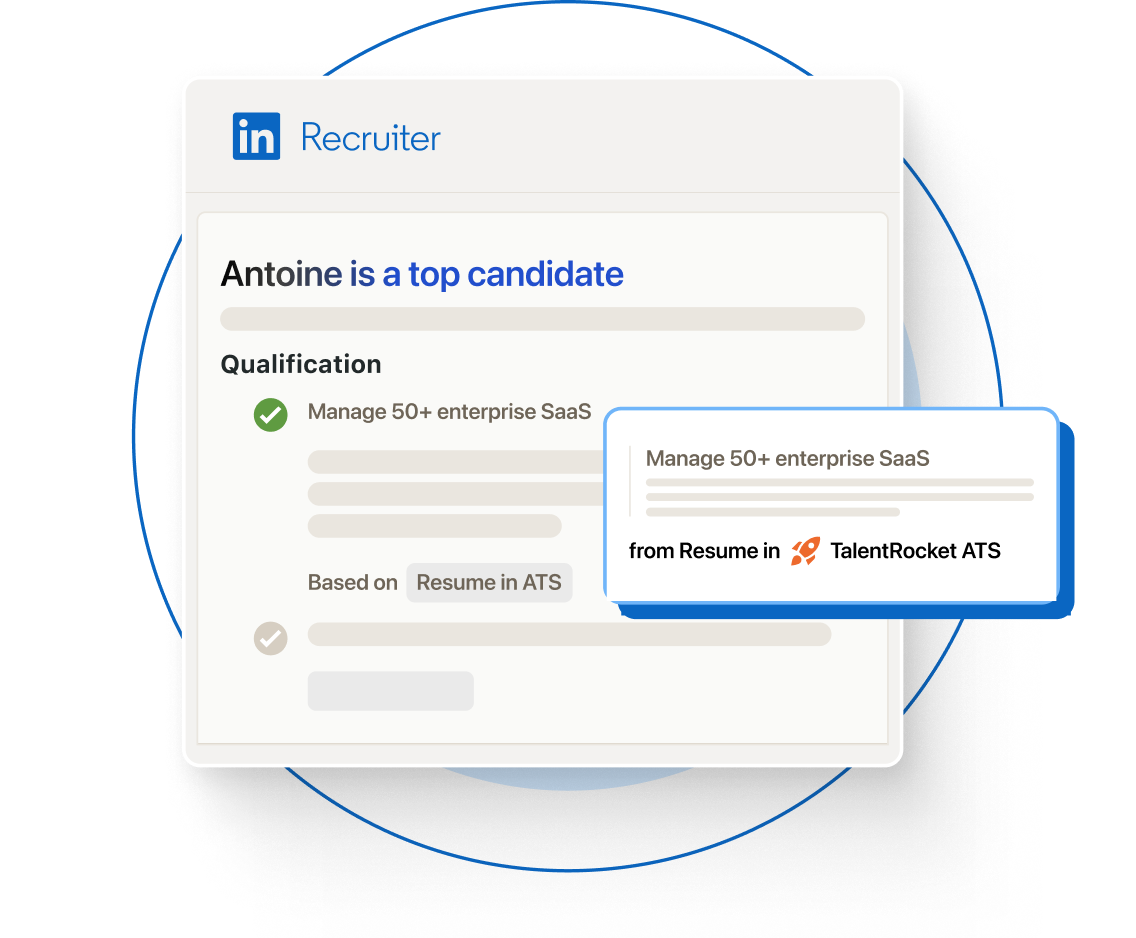
LinkedIn Hiring Assistant is the highest-profile agent in recruiting, and its advantage is obvious: it works inside the graph where roughly a billion professionals already keep their profiles current. It is LinkedIn's first true AI recruiting agent, sold as an add-on to LinkedIn Recruiter, and it runs the pipeline from guided intake through sourcing, candidate review, and outreach drafting using specialized sub-agents. Crucially, it is supervised by design: you confirm the role's qualifications, review a shortlist that comes with the AI's reasoning, and approve or edit every InMail before it sends. LinkedIn is explicit that this is augmentation, and it never sends outreach without you.
The February 2026 update pushed it meaningfully forward for the same buyer. It added AI-Assisted Applicant Targeting, a Verified Applicant Spotlight that flags identity-verified applicants to cut fakes, AI-Assisted Follow-Ups for non-responders, and a Microsoft Teams integration for hiring-manager review - HeroHunt research summary of LinkedIn's Wave 2 release. LinkedIn's own data claims 81% fewer profile reviews and materially higher InMail acceptance, though those are vendor figures.
Key capabilities:
- Guided intake that builds a sourcing strategy beyond keywords
- AI candidate surfacing with reasoning on every shortlist
- AI-drafted InMail that you approve or edit before send
- Verified Applicant Spotlight to reduce fake applicants
- Runs on the ~1B-member LinkedIn graph
The catch is cost and reach. Hiring Assistant is sold only as an add-on to a Recruiter Corporate seat, which itself runs roughly $10,800 to $12,960 a year in 2026, and practitioner reports put the AI add-on in five-figure territory on top, so a single fully-loaded seat can run $14,000 or more - Pin. It also cannot see the roughly 30 to 40% of professionals who are inactive or off-platform, and outreach is limited to InMail. It is the right tool if you already live in Recruiter and want an agent inside it, and the wrong one if you need reach beyond LinkedIn or a small budget.
Best for: corporate talent teams already committed to LinkedIn Recruiter who want a supervised agent inside the tool they already trust.
7. SeekOut
SeekOut is the enterprise technical-and-diversity sourcing platform that has leaned hardest into the agentic shift, and its most interesting 2026 move is meeting recruiters inside the AI assistants they already use. Through SeekOut MCP, you can search and recruit from within Claude, ChatGPT, Gemini, or Copilot across seven talent verticals including GitHub, academic, healthcare, and your own ATS, with guided skill-based workflows for search, outreach drafting, and market analysis. It layers six specialized agents plus "SeekOut Assist," which the company describes as going from job description to initial contact in moments, and it has pushed one stage deeper with Sam, an autonomous asynchronous AI interviewer. Throughout, it keeps a human approving, surfacing recommendations rather than acting behind your back.
The 2026 cadence has been steady rather than splashy: SeekOut rolled agentic updates from late 2025 through mid-2026, positioning itself as the agentic AI recruiting platform used by more than 750 enterprises - SeekOut. Its reputation for diversity, healthcare, and deep technical sourcing is genuine and hard to replicate, which is why it sits high for the right buyer even though it is enterprise-priced.
Key capabilities:
- SeekOut MCP to source from inside Claude, ChatGPT, Gemini, or Copilot
- Six specialized agents plus SeekOut Assist
- Workspace Express turning a job description into a ranked shortlist
- Sam, an autonomous rubric-based AI interviewer
- People Insights for skills, diversity, and market analytics
Pricing is enterprise and sales-gated. The published reference point is roughly $833 per seat per month billed annually (about $9,996 a year), with a three-seat minimum and a median annual contract near $20,000 in buyer data - Vendr. A self-serve free trial exists, which softens the entry, but the annual deals, onboarding fees, and escalators make it a poor fit for solo or very small recruiters and a strong one for enterprise technical and diversity hiring.
Best for: enterprise and technical or diversity-focused teams that want deep multi-vertical sourcing and want to work inside their AI assistant via MCP.
8. Fetcher
Fetcher rounds out the chapter as the "managed sourcing on autopilot" option, and it earns its place by doing one thing dependably rather than claiming the whole funnel. It combines AI with human curation: it automatically searches a pool of roughly 500 million profiles against your criteria, but curated candidate batches are reviewed by a human before they reach you, and you approve them into automated email sequences. That AI-plus-human model makes it more predictable than the pure agents on quality, at the cost of being the least autonomous tool in this chapter and email-only on outreach.
Its most recent substantive update predates 2026, which is telling in a fast-moving field. A June 2025 release added natural-language search, automated resume parsing, and expanded European coverage, but Fetcher has not shipped the "agent" relaunch its rivals have - Pin. It is best understood as sourcing you outsource to a tool, not a full recruiting agent, which for some teams is exactly the point.
Key capabilities:
- AI sourcing of passive candidates from ~500M profiles
- Human-reviewed batches for quality control
- Automated email sequences with analytics
- 20+ ATS integrations via a unified API
- Dedicated sourcer included on higher tiers
Fetcher publishes its price, which is a point in its favor: Growth at $379 per month billed annually for 500 sourced candidates a year, and Amplify at $649 per month with a dedicated sourcer, plus custom Enterprise - Pin. The hard candidate caps per tier can throttle high-volume hiring, and email-only outreach with a smaller database than rivals limits its ceiling. But for a small team that wants top-of-funnel sourcing handled for them at a known price, it is a clean, low-risk choice.
Best for: small and mid-size teams that want sourcing and first-touch email done for them, with human quality control, at a published price.
5. The autonomous AI interviewers and screeners
The fastest-moving frontier in 2026 is the stage most tools leave to humans: the interview. A new class of AI recruiter conducts real screening conversations over voice, phone, or video, asks adaptive follow-up questions, scores candidates against a rubric, and hands a human only the finalists. This is autonomy pushed a stage deeper than sourcing, and it is where the biggest efficiency gains and the biggest risks both live. Done well, it lets a team screen thousands of applicants no human could ever call back. Done badly, it is where bias, hallucinated inferences, and candidate resentment concentrate.
These tools cluster around high-volume hiring, where the math is overwhelming: if you get 5,000 applicants for a role, a human cannot speak to all of them, so the realistic alternative to an AI screen is no screen at all. The ranking below favors tools that are transparent about price and have taken compliance seriously, because in this sub-category the legal exposure is real and the candidate-experience downside is severe. We lead with the tool that pairs genuine autonomy with the rarest thing in the group, a published price.
1. Ribbon AI
Ribbon AI is the standout for most teams because it combines a genuinely autonomous voice interviewer with fully transparent, self-serve pricing, which almost nobody else in this sub-category offers. Its AI interviewer, Bonnie, holds adaptive two-way voice conversations over any phone, asks contextual follow-ups, handles outreach over SMS, email, and WhatsApp, runs unlimited interviews in parallel around the clock, flags suspicious activity, and syncs scored results to more than 60 ATS platforms. A human reviews the flagged and scored finalists. It supports 10+ languages and, importantly, completed an NYC Local Law 144 bias audit, which is a meaningful compliance signal in 2026.
The company is young but credible, having raised an $8.2M seed in March 2025 led by Radical Ventures and since passing a million interviews - FinSMEs. It is smaller than the enterprise incumbents, so it is less proven at Fortune 500 scale, and its vendor-reported 98% satisfaction figure is not independently verified. But for the money and the transparency, it is the easiest AI interviewer to adopt.
Key capabilities:
- Voice-plus-video adaptive interviewer over any phone
- 10+ languages and multi-channel outreach
- Custom scoring rubrics and automated shortlisting
- Fraud and cheating flags for integrity
- NYC Local Law 144 bias audit completed
Ribbon's pricing is published and per-interview-legible: Growth at $499 per month for 100 interviews, Business at $999 for 400, and Scale at $1,999 for 1,000, each billed annually with a 7-day trial, working out to roughly $3 per completed interview - Ribbon AI. Voice-only screening can feel impersonal to some candidates, and the standard AI-interviewer risks of scoring bias and over-inference from short conversations still apply, with the bias audit a mitigation rather than a guarantee. For SMB and mid-market high-volume hiring, it is the pick.
Best for: SMB and mid-market teams that want a transparent, fast-to-deploy autonomous voice screener without an enterprise sales cycle.
2. Apriora (Alex)
Apriora, now branded Alex, is the highest-scale live AI interviewer, built to run real-time video and phone interviews at volumes no human team could match. Alex conducts the interview on its own, remembers and understands answers, asks relevant follow-ups dynamically rather than reading a fixed script, and delivers scored hiring insights, while also automating scheduling, reminders, and rescheduling end to end. Its largest customers run up to roughly 5,000 interviews in a single day, and the platform has passed more than a million AI-led interviews. A human reviews the scores and makes the call, but nobody needs to sit in the interview.
The funding and momentum are real: Alex raised a $17M Series A led by Peak XV in September 2025, on top of an earlier seed, bringing total funding near $20M, and it made CB Insights' 2026 list of the most innovative AI startups - PitchBook. The candidate-experience risk is equally real, and worth naming: the product became briefly infamous in late 2024 when the AI visibly glitched mid-interview, part of the reason it rebranded.
To see the format in action, the clip below from the Alex channel shows the AI interviewer running a live two-way candidate conversation, which conveys the experience far better than a description can.
Data Scientist Interview with Alex (AI Recruiter)
On price, Alex publishes nothing; every path leads to a demo, and third-party estimates put it in the $10,000 to $35,000 a year range on annual or multi-year contracts aimed at companies hiring thousands per year - Recruiting Tech Reviews. Treat those as estimates. The category-wide risks of hallucination and scoring bias apply, and Alex publishes little independent bias-audit or quality-of-hire data, so it is best reserved for genuinely high-volume employers that can absorb a five-figure minimum.
Best for: high-volume employers hiring thousands per year that want live, conversational AI interviews at scale and scored shortlists.
3. Paradox (Olivia)
Paradox, whose assistant is named Olivia, is the most proven high-volume conversational screener in the world, now owned by Workday, and it is the safe institutional choice for frontline and hourly hiring. Olivia automates screening and scheduling within a mostly text, SMS, and chat flow rather than a live voice interview: it asks knockout questions to filter on qualifications, availability, and work authorization, offers and books interview slots by syncing recruiter calendars, runs one-way video interviews with transcription, and answers candidate questions 24/7 in more than 100 languages. It has handled over 189 million candidate conversations, a track record no startup can claim.
The 2026 headline is ownership: Workday closed its roughly $1 billion acquisition of Paradox in October 2025 and is folding Olivia into its talent-acquisition suite - Index.dev. For existing or future Workday customers that is reassuring; for everyone else, roadmap priority is now an open question. Olivia is more an automated screener and scheduler than an autonomous interviewer, and it deflects complex questions to humans.
Key capabilities:
- 24/7 conversational screening via text and chat in 100+ languages
- Automated knockout screening questions
- Autonomous interview scheduling and reminders
- One-way video interviews with transcription
- Deep ATS integration, especially Workday
Paradox does not publish pricing, and third-party estimates put mid-market deployments in the $30,000 to $95,000 a year range plus setup, with enterprise higher - HireTruffle. It needs 500-plus annual hires for strong ROI, setup is time-intensive, and it is not suited to small teams or complex executive roles. But for enterprise and franchise employers doing very high-volume hourly hiring, especially in the Workday ecosystem, it is the incumbent for good reason.
Best for: large enterprise and franchise employers doing high-volume hourly hiring, particularly current or future Workday customers.
4. Maki, ConverzAI, and Humanly
Three more autonomous screeners deserve a place on any shortlist, each aimed at a distinct buyer, and grouping them keeps the trade-offs clear. Maki (Maki People) is a French enterprise platform built around an "AI Tier" of six named agents that autonomously screen skills, run conversational interviews, evaluate, and schedule, with minimal human involvement at each stage; one customer processed roughly 200,000 candidates in six months. It raised a $28.6M Series A in January 2025 led by Blossom Capital and counts H&M, PwC, and IKEA among its customers - Bryq. The catch is opaque credit-based pricing and unusually heavy proctoring, including webcam snapshots every 30 seconds, which raises real candidate-experience and privacy concerns.
ConverzAI is the autonomous voice recruiter built specifically for staffing firms, conducting real 6-to-21-minute phone screens in parallel at scale (one case study screened 60,000 candidates in 90 days) and returning scored shortlists rather than task lists. It raised a $16M Series A led by Menlo Ventures in February 2025 and integrates with staffing ATSs like Bullhorn - Menlo Ventures coverage. Its weakness is sourcing: it works mostly from existing pools rather than discovering net-new passive candidates, and it prices on outcomes with figures hidden until negotiation.
Humanly is the mid-market conversational screener pivoting hardest toward outcomes. Its AI Recruiter and AI Interviewer engage, screen, and schedule every applicant 24/7 across chat, phone, and video, and in 2026 it added a "service-as-software" candidate-delivery model with pay-per-candidate and pay-per-hire options. It raised a $25M Series B in May 2026 led by SEEK Investments and engages more than 250,000 candidates a month - GeekWire. The outcome-based pivot is new and unproven at scale, and, as across this whole sub-category, nobody is yet publishing quality-of-hire or retention data to prove the screens actually pick better people. That absence of retention evidence is the single most important caveat for every AI interviewer here: they all prove speed, none yet proves hire quality.
6. The autonomous talent marketplaces and agent-assisted networks
A different model skips the "software you operate" premise entirely: you describe the role and a marketplace, powered by AI vetting, delivers vetted humans. These are not sourcing seats you drive; they are networks where an AI does the screening and matching and you review the output. The category matters in 2026 because it is where the most money and the fastest revenue growth in all of recruiting now sit, driven heavily by AI labs that need vast amounts of specialized human labor to train and evaluate their models. The trade-off is control and cost: you consume a marketplace rather than running your own funnel, and you pay agency-grade fees.
The ranking here reflects both scale and fit. The leader is not close on raw momentum, but the smaller, more focused networks may be the better answer for a specific hire. Read these as "delivered talent" options to weigh against the sourcing agents in Chapter 4, especially when speed matters more than owning the process.
1. Mercor
Mercor is the money story of 2026 recruiting and the clearest example of AI-driven vetting at scale. Its platform conducts automated candidate interviews and skills assessments, scores portfolios, and matches specialized experts, engineers, PhDs, and domain specialists, from a pool of more than 300,000 vetted professionals, with little human review on the sourcing side. It is best understood as autonomous sourcing and screening plus a human hire decision, and it has become the talent backbone for AI labs, with customers reportedly including OpenAI, Anthropic, and Meta and its contractor network paid over $2 million a day.
The numbers are staggering and the trajectory near-vertical. Mercor was in talks in July 2026 to raise about $500M at a roughly $20B valuation, double its $10B mark from the September 2025 Series C, with its CEO saying annualized revenue run-rate had crossed roughly $2 billion, up 100% in four months - Forbes. The important nuance for a recruiter is that much of this growth is gig labor for AI training, so the "recruiting" framing understates how much of Mercor is really a contract-labor marketplace.
Key capabilities:
- AI-conducted interviews and skills assessment at scale
- Matching engine over 300,000+ vetted professionals
- Expert-as-a-Service hourly access to specialists
- Direct placement for tech companies and AI labs
- Deep footprint in AI training and model evaluation
Mercor does not publish a self-serve rate card; revenue comes from a roughly 30% placement fee on direct hires plus a margin on hourly expert engagements - Sacra. That is agency-grade and not cheap, and it is narrow toward technical and AI-adjacent roles, so it is a poor fit for high-volume generalist hiring. But if you need pre-vetted specialized talent fast, nothing else moves at this speed.
Best for: companies, especially AI labs and tech firms, that need pre-vetted specialized or technical talent fast without running their own sourcing.
2. Paraform, Contrario, and Dex
Three sharper, smaller networks pair AI with human recruiters or a narrow talent focus, and each fits a specific hiring problem better than a general marketplace. Paraform is a bounty marketplace: you post a per-role bounty and a network of more than 10,000 vetted independent recruiters, now augmented with custom AI agents, competes to fill it, paid only on hire. It raised a $40M Series B in March 2026 led by Scale Venture Partners - Paraform. Bounties typically run $10,000 to $30,000 per hire, roughly 20 to 25% of first-year base, which is agency economics with a faster, more competitive front end, ideal for hard senior and technical roles.
Contrario takes a similar human-plus-AI approach with a graph-neural-network matching engine, automating sourcing, screening, and shortlisting while human recruiters own the relationship, on a pay-per-hire model near 25% of salary. It launched publicly after hitting $6M annualized revenue and paying more than $1M to recruiters in under six months, closing a $2.3M seed led by Nexus Venture Partners - Pulse 2.0. It is very early and concentrated in the San Francisco startup scene, so track record and support depth are limited, but for AI-native startups it has real traction.
Dex is the narrowest and most specialized: a London-based AI talent agent for elite technical talent, matching AI researchers, ML and quant engineers, and software developers to companies from a pool of more than 15,000 engineers used by 50-plus companies including ElevenLabs and Synthesia. It raised a $5.3M seed in April 2026 led by Notion Capital, with angels from OpenAI - Fortune. Its deliberate narrowness is the point: useless for generalist or high-volume hiring, but high-signal for the specific slice of AI and engineering talent that every company is fighting over. Across all three, remember these are contingency or marketplace models, not software you operate, so cost per hire is high and outcomes depend on the humans in the loop.
7. The enterprise agentic suites
The largest platforms are not sourcing point-tools at all; they are talent-intelligence suites that added an agentic layer on top of an existing enterprise system of record. For a big employer already running one of these, the autonomous features arrive as an upgrade rather than a new vendor, which is a powerful advantage: the agent inherits the data, compliance, and integrations already in place. The trade-off is that these are quote-only, long-cycle purchases sized for large organizations, so they are overkill and unaffordable for small and mid-size teams. We cover them because for enterprise buyers they are often the realistic shortlist.
The two most relevant in 2026 illustrate the pattern from different starting points, one built on skills-based deep learning, the other on an attribute data graph. Both are betting that owning the underlying talent data, not the sourcing UI, is where durable advantage lies.
Eightfold AI
Eightfold AI extended its established skills-based talent-intelligence platform with a multi-agent "Talent Agents" layer in 2026, and its clearest new capability is candidate-facing. Its Candidate Agent, launched in July 2026, gives every candidate 24/7 conversational guidance from first message through application, while agentic interview intelligence, embedded in Oracle Recruiting Cloud in May 2026, brings autonomy into the interview stage inside the enterprise system many large employers already run - Eightfold. Eightfold claims agentic AI can cut time-to-hire dramatically, with agents improving as humans validate their outputs, though the "10x faster" figures are marketing rather than audited.
Eightfold's credibility rests on analyst standing and scale: it was named a Strategic Leader in the 2026 Fosway 9-Grid for Talent Acquisition and a Gartner Magic Quadrant Visionary. Pricing is enterprise and quote-only, sized by modules, seats, and workforce, with no public rate card. The agentic features are new enough that real-world autonomy is still maturing, and the value only materializes if you commit to the broader suite. It is the right consideration for a large enterprise that wants proven talent intelligence, especially alongside Oracle, now extended with supervised agents.
Findem
Findem approaches the same enterprise buyer from a data angle, building a rich attribute graph on more than a billion people and layering autonomous sourcing and, via acquisition, AI interviews on top. Its 2026 Intelligent Job Posts turn a single job post into an autonomous sourcing agent that finds and surfaces matched candidates, and its acquisition of Glider AI, announced in March 2026, adds skills validation, autonomous interviews, and identity verification aimed at an end-to-end "discover to hire-ready" flow - PR Newswire. Analysts have noted the Glider deal is as much about owning talent data as about hiring, which is the strategic thesis of this whole chapter.
Findem is enterprise-only in practice, with no free trial, no monthly billing, and sales-led onboarding, and third-party estimates put most deployments in the $25,000 to $100,000+ per year range - Software Advice. It added outcome-aligned pricing tied to actual hires in 2026, which is a welcome direction. The Glider integration is new, so the promised end-to-end flow is still bedding in, and the platform's power comes with a learning curve. For mid-to-large TA teams that want deep talent-market intelligence plus autonomous sourcing under one roof, it is a serious contender.
8. The full comparison: autonomy, reach, and price at a glance
The single most useful way to hold twenty-plus tools in your head is to line them up on the three axes that actually decide fit: how autonomous they are, how far they reach, and what they cost. The table below does that. Read "autonomy" as which stages run hands-off, "reach" as the size and type of talent pool, and "entry price" as the cheapest real commitment, with "demo only" flagged wherever a vendor hides its number behind a sales call. Price transparency is itself a signal: the tools with published numbers are, almost without exception, the ones aimed at teams your size rather than at six-figure enterprise contracts.
| Platform | Category | Autonomy | Reach / data | Entry price |
|---|---|---|---|---|
| HeroHunt.ai | Sourcing agent | Source, screen, outreach | 750M-1B, open web | $149/mo (3 positions) |
| Juicebox | Sourcing agent | Search + Agents add-on | 800M+ | ~$99/seat/mo (+$199/agent) |
| Pin | Sourcing agent | Source, outreach, schedule | 850M+ | $99/mo (free tier) |
| GoPerfect | Sourcing agent | Source + outreach (Autopilot) | 800M+ | ~$250/position/mo |
| hireEZ | Sourcing agent | 5-stage guided agent | 1B+, 45+ sites | ~$169/seat/mo (demo) |
| LinkedIn Hiring Assistant | Sourcing agent | Supervised, approve to send | ~1B LinkedIn | Add-on, five-figure (demo) |
| SeekOut | Sourcing agent | Agents + MCP + Sam | 1B+, 7 verticals | ~$833/seat/mo |
| Fetcher | Sourcing agent | AI + human curation | ~500M | $379/mo |
| Ribbon AI | AI interviewer | Autonomous voice screen | Voice, 10+ languages | $499/mo (100 interviews) |
| Apriora (Alex) | AI interviewer | Autonomous live interview | Video + phone | ~$10K-$35K/yr (demo) |
| Paradox (Olivia) | AI interviewer | Screen + schedule | Chat/SMS, 100+ langs | ~$30K-$95K/yr (demo) |
| Mercor | Marketplace | AI vetting + match | 300K+ experts | ~30% placement fee |
| Paraform | Marketplace | Agent-assisted recruiters | 10K+ recruiters | $10K-$30K/hire |
| Eightfold | Enterprise suite | Supervised agents | 1B+, skills graph | Quote only |
| Findem | Enterprise suite | Autonomous job posts | 1B+, attribute graph | ~$25K-$100K/yr |
Two patterns jump out of the table and both should shape your shortlist. First, genuine end-to-end autonomy is still rare: most "agents" automate two or three funnel stages, and the ones claiming the whole funnel are either enterprise-priced or, in Tezi's case, no longer safe to bet on. Second, there is a clean split between tools that publish a price under a few hundred dollars a month and tools that route you to a demo, and that split maps almost perfectly onto "built for small and mid-size teams" versus "built for enterprise." Neither is better in the abstract; the question is which side of that line your team sits on.
To make the transparent-price cluster concrete, the chart below plots the cheapest published monthly plan for the tools that actually put a number on their website. Everything not shown here, from LinkedIn Hiring Assistant to Apriora to Mercor, requires a sales conversation to get a figure at all.
Cheapest published monthly price (transparent-priced tools)
The takeaway from the chart is not that cheaper is better; it is that a published price signals a vendor confident enough to compete on value rather than on a negotiated discount. For a small team, starting with a transparent tool you can trial for the cost of a single month is a far lower-risk way to learn what autonomy is worth to you than committing to an annual enterprise contract before you have seen a single shortlist.
9. Where autonomous AI recruiters still fail
The honest headline of 2026 is that autonomous recruiting works far better at speed than at trust, and the trust gap is now the binding constraint. The most striking data point in the whole category is the split between the two sides of the desk: 70% of hiring managers trust AI to make faster and better hiring decisions, while only 8% of job seekers believe AI makes hiring fairer - Greenhouse. Nearly half of job seekers say their trust in hiring fell over the past year, and many blame AI directly. When candidates distrust your process, your best applicants opt out, which quietly poisons the very pipeline the tool was bought to fill.
That erosion is not abstract; it shows up in how rejections happen. In one 2026 study, half of job seekers were rejected at least once without a single word from a human, and most of that group believed a machine made the call - Enhancv. Autonomous screening at scale means more candidates than ever are filtered by software they never see, and the resentment that produces is a reputational cost that rarely appears in a tool's ROI calculation. The vendors that will win the trust argument are the ones building transparency and human review into the flow, not bolting it on.
The second failure mode is the value gap covered earlier: adoption has outrun measurable results, with 88% of HR leaders reporting no significant AI business value yet and Gartner forecasting over 40% of agentic AI projects canceled by 2027 - Pin. The common thread in the failures is not bad models; it is tools pointed at the wrong problem, bought for capability rather than for a specific bottleneck, and never adopted deeply enough to pay back. An autonomous sourcer bought by a team whose real constraint is interview scheduling will always disappoint.
The third failure mode is now legal, and it changed the calculus in 2026. The EU AI Act classifies recruitment and selection AI as high-risk, with its high-risk obligations taking effect on 2 August 2026 and penalties up to 15 million euros or 3% of global turnover - The Hire Hub. In the United States, NYC Local Law 144 requires an annual independent bias audit of each automated employment decision tool, a public results summary, and advance candidate notice. These rules force human oversight, logging, and candidate transparency into any autonomous hiring workflow, which is exactly why the fully hands-off pitch is receding and the semi-agentic, human-approved design is winning. A tool that cannot show you its bias audit or its decision logs is not just a candidate-experience risk; in 2026 it is a compliance one.
None of this means autonomous recruiting is a bad bet; it means the failure modes are predictable and therefore avoidable. The teams that get burned are almost always the ones that treated an autonomous recruiter as a magic replacement for judgment rather than as leverage on it. The mitigation is unglamorous but reliable: tell candidates plainly when AI is involved, keep a human on every reject decision that a person will remember, ask each vendor for its most recent bias audit before you sign, and instrument the tool so you can see why it ranked someone the way it did. Every one of those steps also happens to be what the 2026 regulations now expect, so the compliance work and the good-hiring work are, conveniently, the same work.
10. How to choose the right one for your team
Start from your bottleneck, not from the tool, because the single biggest predictor of whether an autonomous recruiter pays back is whether it is pointed at the stage that actually slows you down. If your problem is an empty top of funnel, you want a sourcing agent from Chapter 4, and the right one depends on budget and reach: a transparent per-position tool for a small tech team, an enterprise reach platform for a mid-market team, or the LinkedIn agent if you already live in Recruiter. If your problem is that you cannot screen the volume of applicants you already get, you want an AI interviewer from Chapter 5, and Ribbon's transparent pricing makes it the low-risk place to start. If your problem is a hard, senior, or specialized role you simply cannot fill, a marketplace like Mercor or Paraform may beat any software.
The second decision is how much autonomy you actually want, and the honest answer for most teams is "less than the maximum." Full autopilot sounds efficient, but it concentrates compliance and candidate-experience risk, and the 2026 regulatory environment rewards keeping a human on the decision. A semi-agentic tool that automates the grind and checks in for approval is, for most teams, both the safer and the more defensible choice. Reserve full hands-off automation for genuinely high-volume, lower-stakes hiring where the alternative is no human contact at all.
Before you commit, run this short evaluation:
- Name the bottleneck - sourcing, screening, scheduling, or a specific hard role
- Match the category - sourcing agent, AI interviewer, or marketplace, not the loudest brand
- Trial on one real role - judge the shortlist, never the demo
- Check the compliance posture - ask for the bias audit and decision logs
- Verify vendor stability - funding, customer count, and whether the founders are still building it
That last point is not paranoia; it is the clearest lesson of the past year. Two of the most-hyped autonomous recruiters, Moonhub and Tezi, were absorbed by larger companies within twelve months, stranding the teams that had built workflows around them. When you trial a tool, you are also betting on the company, so weigh the funding, adoption, and team-continuity signals as seriously as the feature list. A slightly less capable tool from a stable vendor often beats a brilliant one whose future is a coin flip.
A brief note on the person behind the perspective in this guide: it is written from inside the category by the team at HeroHunt.ai, founded by Yuma Heymans (@yumahey), who has been building AI-powered candidate sourcing since 2021 and has watched this exact market form pitch by pitch and funding round by funding round. That vantage point is the reason this guide weighs vendor stability and honest caveats as heavily as raw capability.
A concrete example makes the framework less abstract. Picture a 30-person startup with one overloaded recruiter trying to hire five engineers. The bottleneck is almost never screening, because they are not yet getting hundreds of applicants; it is that the good engineers are not applying at all. That points squarely at a sourcing agent, not an AI interviewer, and the budget points at a transparent per-position or low-monthly tool rather than a five-figure enterprise contract. The right first move is to trial one sourcing agent on the single hardest of the five roles, let it run outreach for two weeks, and judge it on how many qualified engineers actually replied. Contrast that with a 2,000-person retailer hiring hourly staff across 50 locations: there the bottleneck is screening thousands of applicants nobody can call back, which points at an AI interviewer or a conversational screener, and the volume justifies the enterprise price. Same framework, opposite answer, because the bottleneck is different. The tool that would transform the retailer would be nearly useless to the startup, and vice versa.
11. The 2027 outlook: where autonomous recruiting goes next
The clear direction of travel is that recruiting roles are being re-shaped rather than replaced, with AI absorbing the transactional work while the human role elevates to judgment. The consensus in 2026 research is that AI is taking over 60 to 80% of transactional recruiter work, moving humans toward relationship management, calibration, and hiring-manager partnership - Pin. The recruiter of 2027 looks less like a searcher and more like a manager of agents and relationships, deciding what good looks like and owning the human moments the software cannot. The teams that thrive will be the ones that redesign the job around that split rather than bolting agents onto the old workflow.
Three shifts will define the next year. First, autonomy will keep pushing deeper into the funnel: the AI-interviewer category that barely existed in 2024 is now a crowded, well-funded field, and scheduling and screening will increasingly run hands-off even at cautious employers. Second, the market will consolidate, as the Moonhub, Tezi, Paradox, and Findem-Glider moves already show; expect the incumbents (LinkedIn, Workday, and the best-funded startups like Juicebox and Mercor) to absorb capability while weaker point tools disappear. Third, and most importantly, trust and compliance will become the primary battleground, not raw capability.
The trust point deserves the last word because it inverts the usual assumption that better technology wins. In a world where candidates increasingly know they are being screened by machines and half say their trust is falling, the differentiator shifts from "how autonomous is it" to "how transparent and fair is it, and can you prove it." The tools that publish bias audits, keep humans on the decision, and treat candidates as people rather than throughput will pull ahead, and the ones that chase pure automation into a legal and reputational wall will not. The winning autonomous recruiter of 2027 is not the one that removes the human; it is the one that makes the human's judgment go further while keeping the process worthy of a candidate's trust.
12. The verdict: our ranked shortlist
If you want the short version, autonomy is real in 2026 but concentrated at the top of the funnel, so buy for your bottleneck and favor vendors that publish a price and will still exist at renewal. For a small or mid-size team that wants hands-off sourcing at a transparent, predictable cost, the per-position and low-price sourcing agents are the standout value, with HeroHunt.ai, Pin, and GoPerfect leading on price legibility and Juicebox the safest bet on stability. For teams drowning in applicants rather than short of them, Ribbon AI is the easiest autonomous interviewer to adopt and Apriora the one built for the highest volumes. For hard specialized roles, Mercor and Paraform deliver vetted humans faster than any tool sources them.
For enterprises, the calculus is different: the agentic suites from Eightfold and Findem, and the LinkedIn and SeekOut agents, arrive as upgrades to systems you already run, which is often worth more than a marginally better point tool. Across every category, the two questions that matter most are the same: which specific funnel stage does this automate, and will this vendor be here in a year. Answer those honestly and the twenty-plus options collapse into a shortlist of two or three.
If your bottleneck is the top of the funnel (finding and messaging good candidates who are not applying), HeroHunt.ai is the transparent-priced option in this ranking: $149 to $499 per month metered on open positions, not seats, with an 8-day trial and no permanent free tier. It sources, screens, and messages on autopilot across the open web, but it stops before the interview stage, so pair it with your ATS and interview tooling rather than expecting it to replace them.
Whichever way you go, treat the trial as the real decision. Pick your single hardest live role, run it through two or three tools from the right category in the same week, and compare the actual shortlists and the actual candidate replies, not the sales decks. The autonomous recruiter that wins that bake-off for your specific hiring is the best one for you, regardless of where it sits on any ranking, including this one.
This guide reflects the autonomous AI recruiting landscape as of August 2026. Funding, pricing, and product features in this category change monthly, and two of the tools referenced were acquired within a year, so verify current details with each vendor before purchasing.